real world
science
We’re at the advent of a new age of clinical
study, one that will dramatically amplify the
size and scope of research.And, you’re
invited to join.
trend01
How much
effort does it
take to recruit
participants
for a medical
study?
60,000
“We have sent out over 60,000
letters. Those 60,000 letters have
netted 305 women.”
- Kathryn Schmitz, PhD,
University of Pennsylvania Health System
How much
effort does it
take to recruit
participants
for a medical
study?
“To get 10,000 people enrolled in a medical
study normally, it would take a year and 50
medical centers around the country.”
– Alan Yeung,
Medical Director, Stanford Cardiovascular Health
50 med centers
12 months
10,000 people
50 med centers
12 months
10,000 people
AppleResearchKit+
StanfordUniversity
0
1
30,000
Welcome to
the trial in
your pocket.
How it works
Each day the app asks
simple questions:
1. How user feels
2. If she’s used an inhaler
3. if she’s taken her meds
Mount Sinai Asthma App
Uses phone sensors to track a
multitude of data in the
foreground and background
Integrates wearable data
Data is then sent to researchers
on a dashboard
Review sites
are the new
targeted
trials.
Morethan30millionAmericans
takeantidepressants,
30,000,000+
4,041
butthelargeststudyconducted
to-dateincludedjust4,041people.
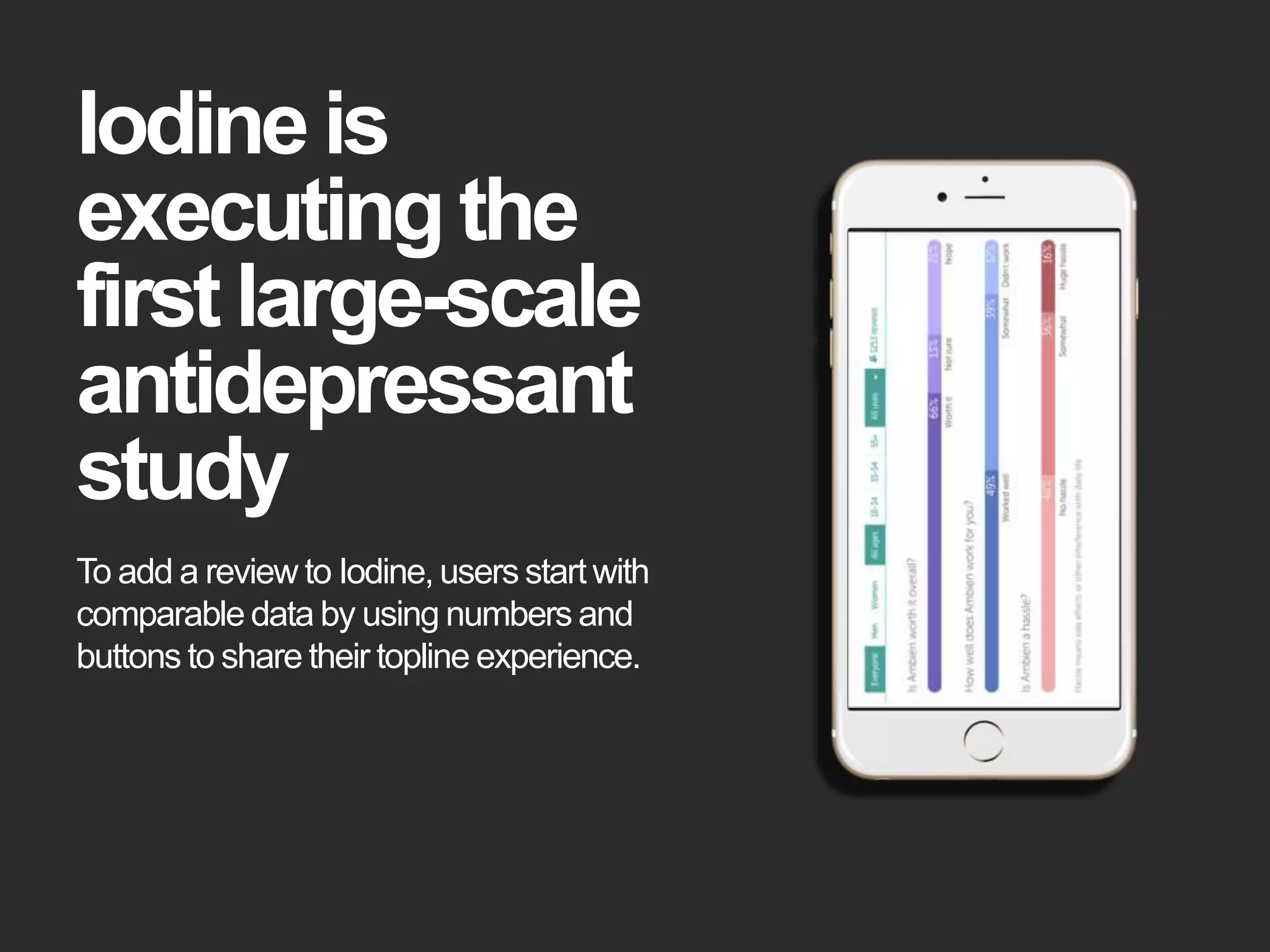
Iodineis
executingthe
first large-scale
antidepressant
study
To add a review to Iodine, users start with
comparable data by using numbers and
buttons to share their topline experience.
Each review is combined
with others to let searchers
see a snapshot of all user
experience and then quickly
toggle into specific subsets
of users or view comments.
And big
brands are
noticing the
value.
*Brands with patientslikeme partnerships
The Final Frontier
(ForNow)?
Electronic Health Records
GuardantHealth+Flatiron
usingbigdataandEHR’s
tohelpoptimizeclinicaltrials.
how much?
The debate may be an old one, but it’s re-
energized and raging in 2016. Patients, payers,
and providers want to know: are these drugs
really worth the cost?
trend02
There’sawargoingon.
VS
Doctors Rising
Drug Costs
VS
Doctors Rising
Drug Costs
100 prominent oncologists wrote in
the journal Mayo Clinic Proceedings
that skyrocketing cost of cancer
treatment puts sick Americans in an
untenable situation.
VS
Doctors Rising
Drug Costs
100 prominent oncologists wrote in
the journal Mayo Clinic Proceedings
that skyrocketing cost of cancer
treatment puts sick Americans in an
untenable situation.
The American Medical Association
recently voted to support banning
DTC advertising to combat
rising drug costs.
VS
Rising
Drug Costs
Patients
The #1 health care priority for voters:
Making sure that high-cost drugs for
chronic conditions, such as HIV,
Hepatitis, mental illness and cancer,
are affordable to those
who need them.
And here
are their
demands:
And here
are their
demands:
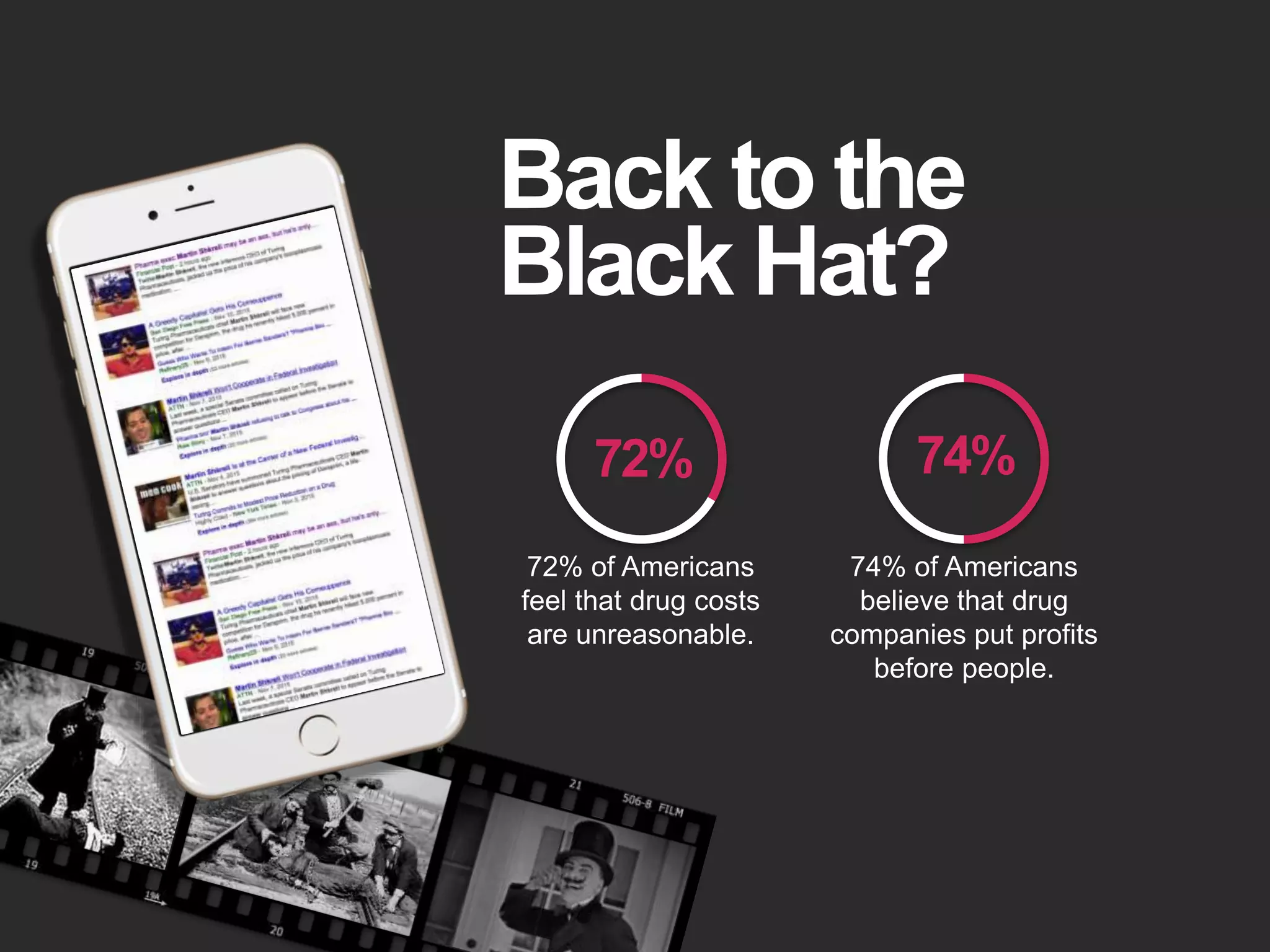
Back to the
Black Hat?
74%72%
72% of Americans
feel that drug costs
are unreasonable.
74% of Americans
believe that drug
companies put profits
before people.
New Equations for Value
National Comprehensive Cancer Network
efficacy+
safety+
qualityofevidence
supportingtherapy+
consistencyof
thatevidence+
affordability
value of
treatment
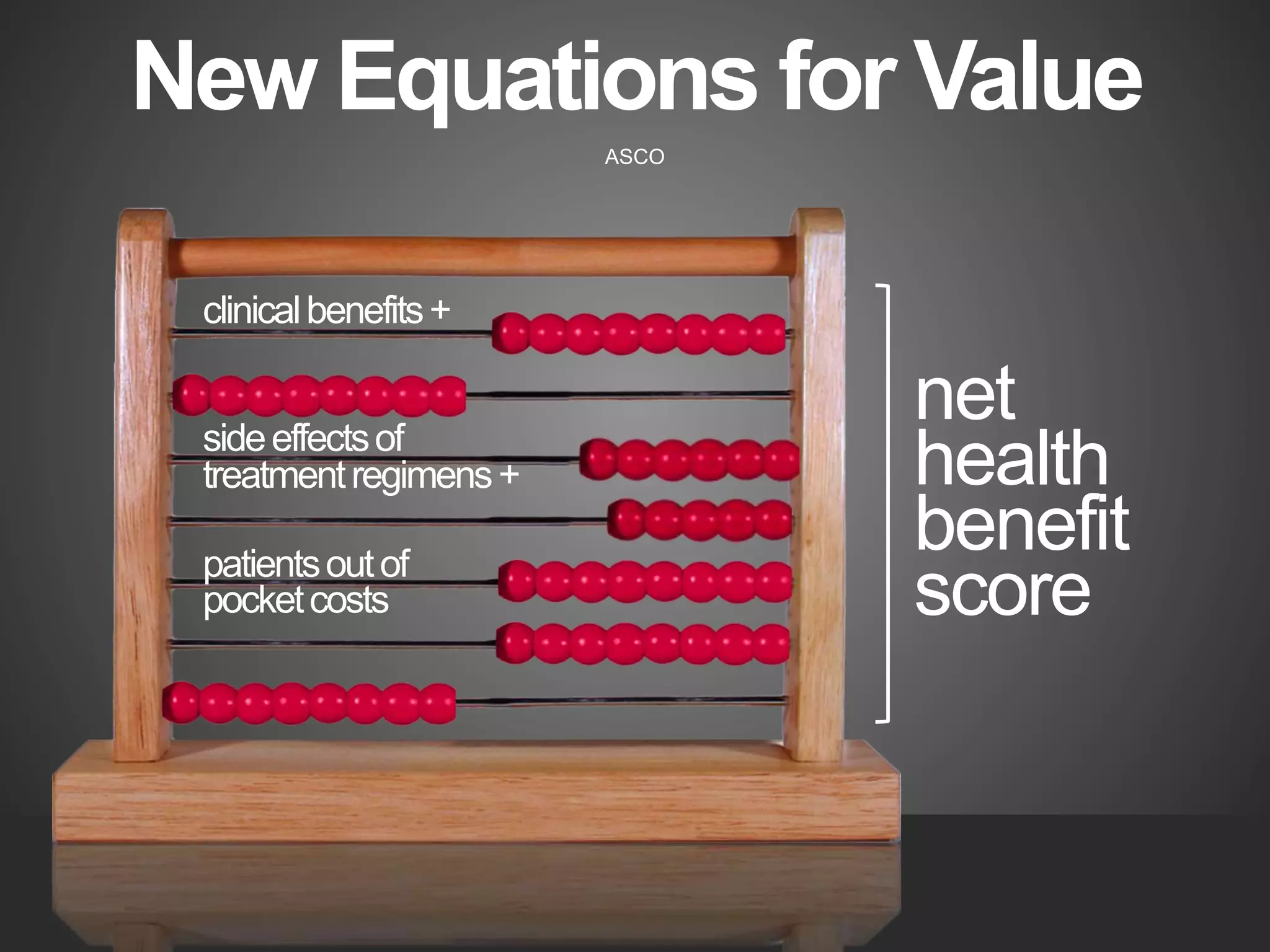
New Equations for Value
ASCO
clinicalbenefits+
sideeffectsof
treatmentregimens+
patientsoutof
pocketcosts
net
health
benefit
score
healthy
getting
healthier
Already motivated to live better?
Good, we’ve got more stuff for you.
But, what about the people who
aren’t motivated yet?
trend03
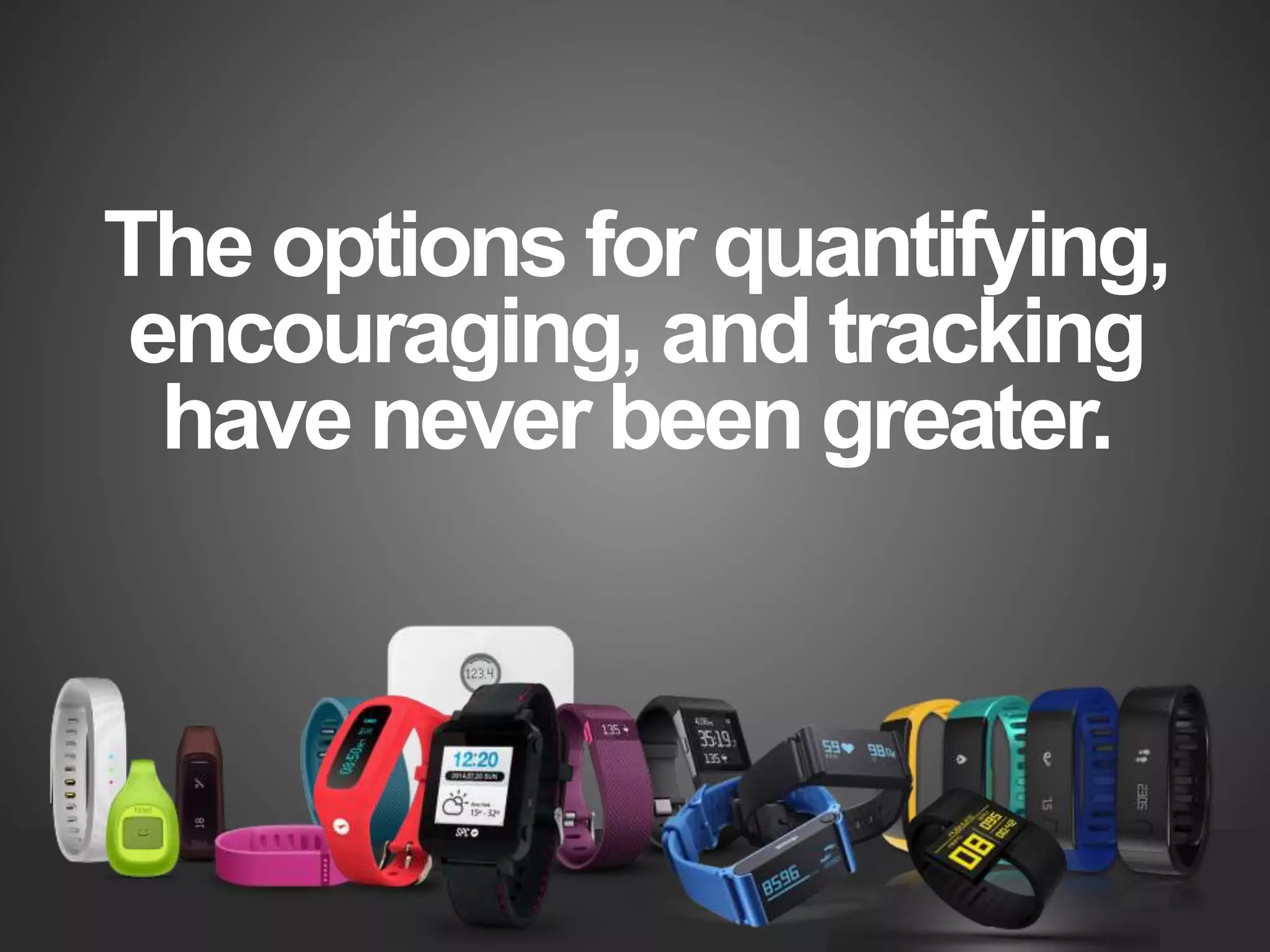
The options for quantifying,
encouraging, and tracking
have never been greater.
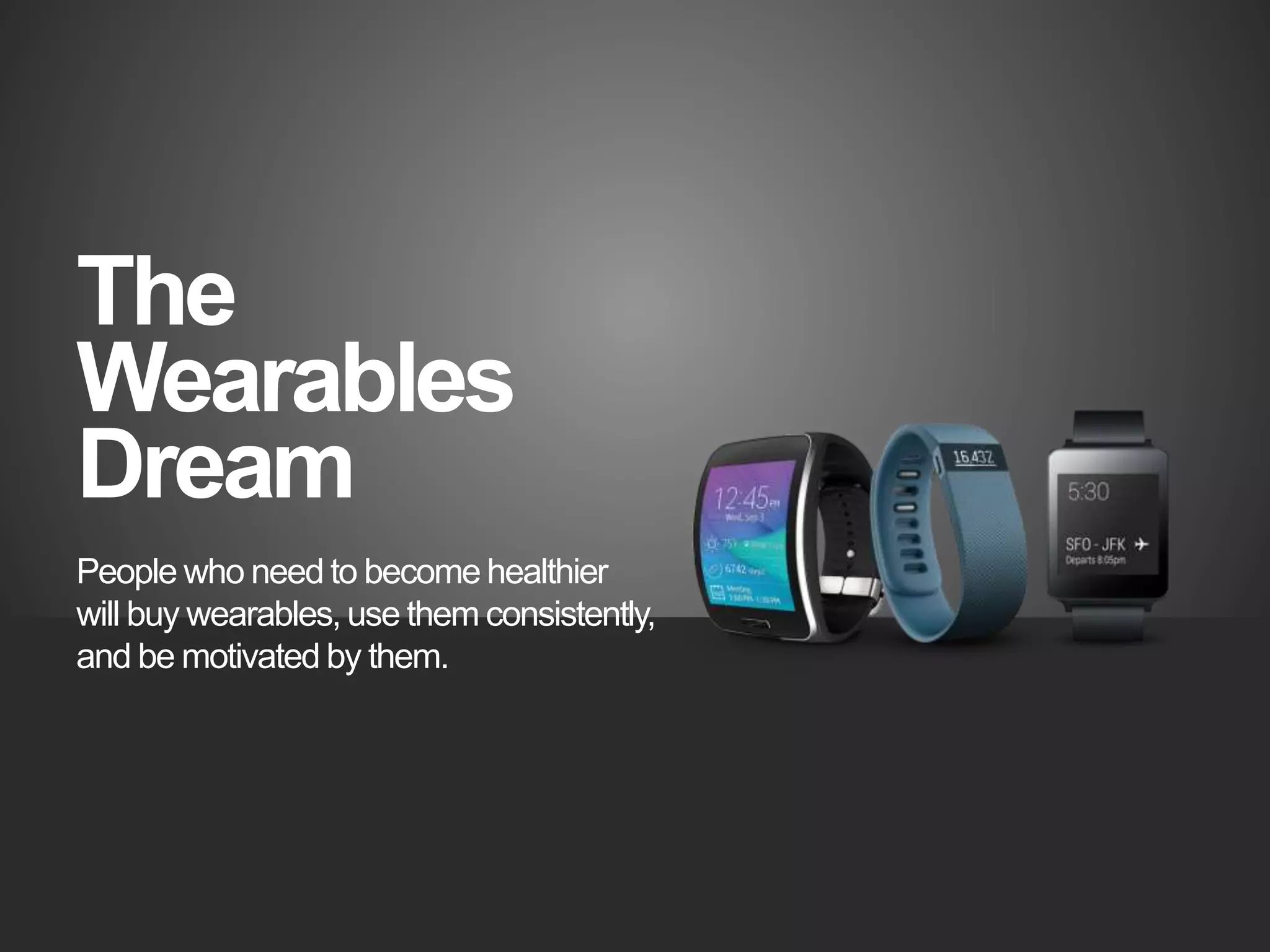
The
Wearables
Dream
People who need to become healthier
will buy wearables, use them consistently,
and be motivated by them.
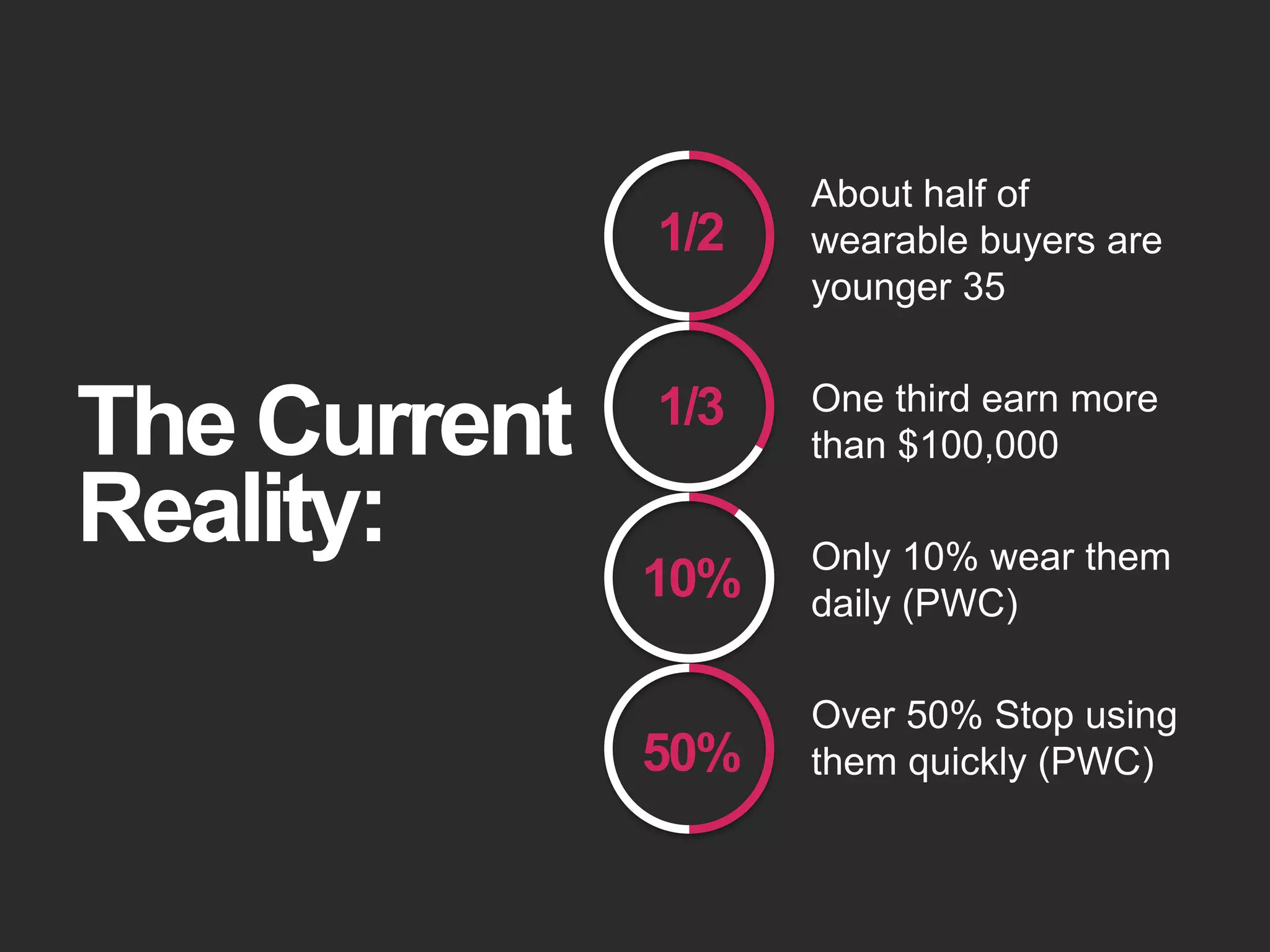
The Current
Reality:
About half of
wearable buyers are
younger 35
One third earn more
than $100,000
Only 10% wear them
daily (PWC)
Over 50% Stop using
them quickly (PWC)
1/2
1/3
10%
50%
So what’s driving real
behavior change with
those that aren’t as
inclined to be healthy?
In previous years we tried
TELLING people what to do.
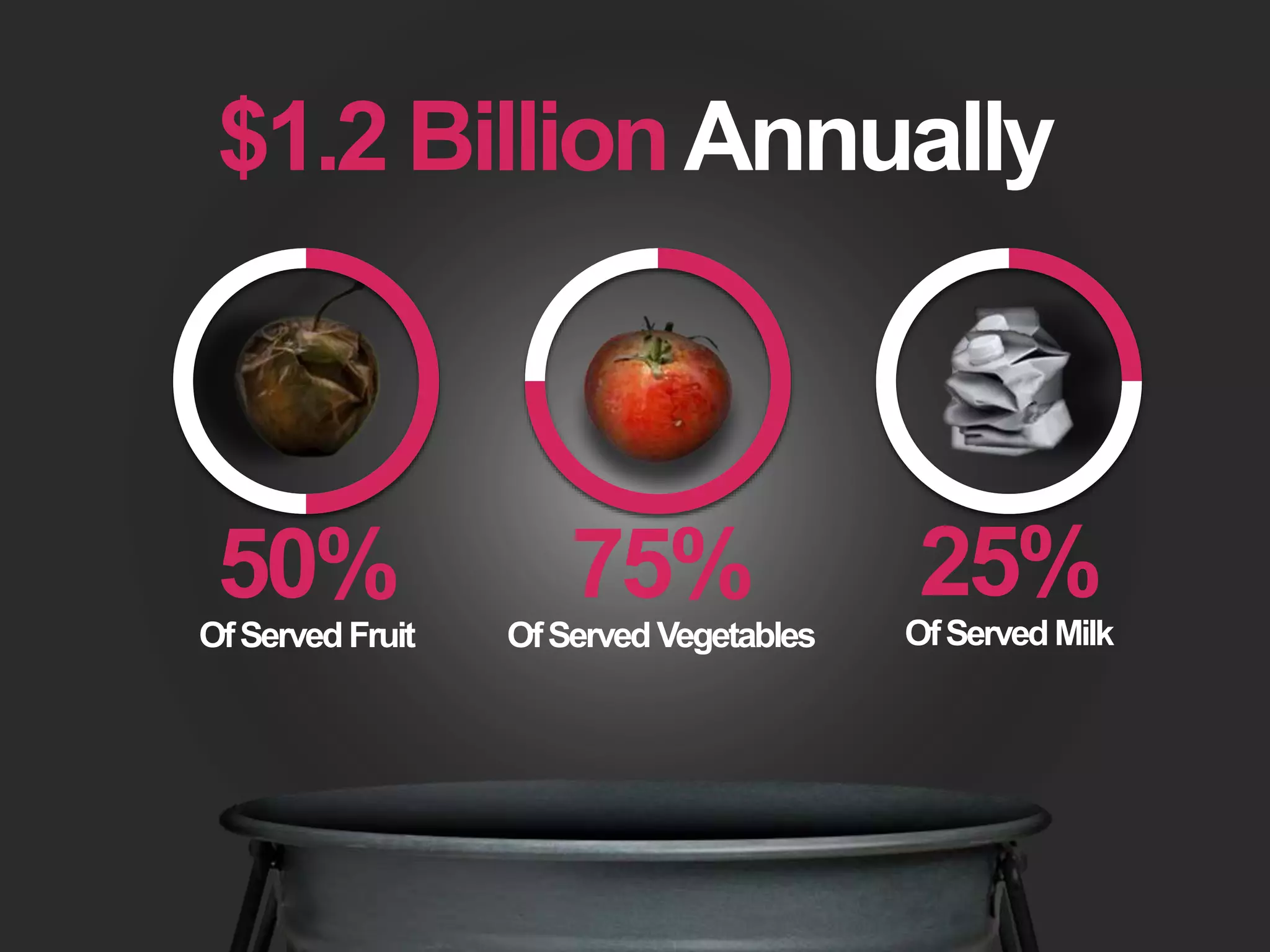
TheNationalSchoolLunchProgram
The Result?
$1.2 BillionAnnually
50%
OfServedFruit
75%
OfServedVegetables
25%
OfServedMilk
So in 2016
we’re helping people
DISCOVER what to do.
Contextual Clues
vs Restriction
Incentives
Elevating
wearables
as medical
devices
any doctor
will do
In 2016, healthcare is happening
everywhere. Consumers are finding
trusted health professionals in pods, on
iPads, in stores, on the couch, and more.
trend04
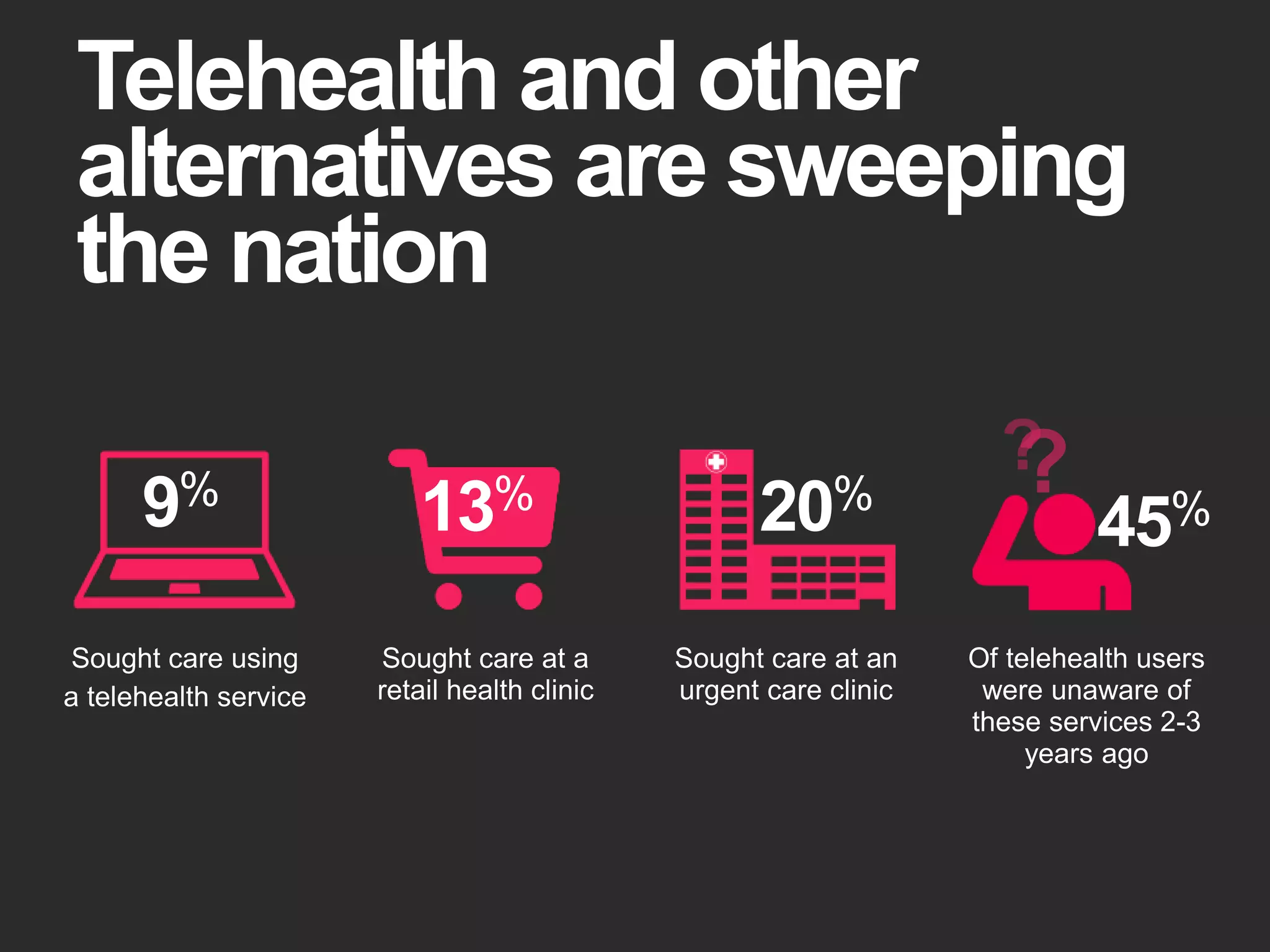
Telehealth and other
alternatives are sweeping
the nation
9%
20%13%
45%
Sought care using
a telehealth service
Sought care at a
retail health clinic
Sought care at an
urgent care clinic
Of telehealth users
were unaware of
these services 2-3
years ago
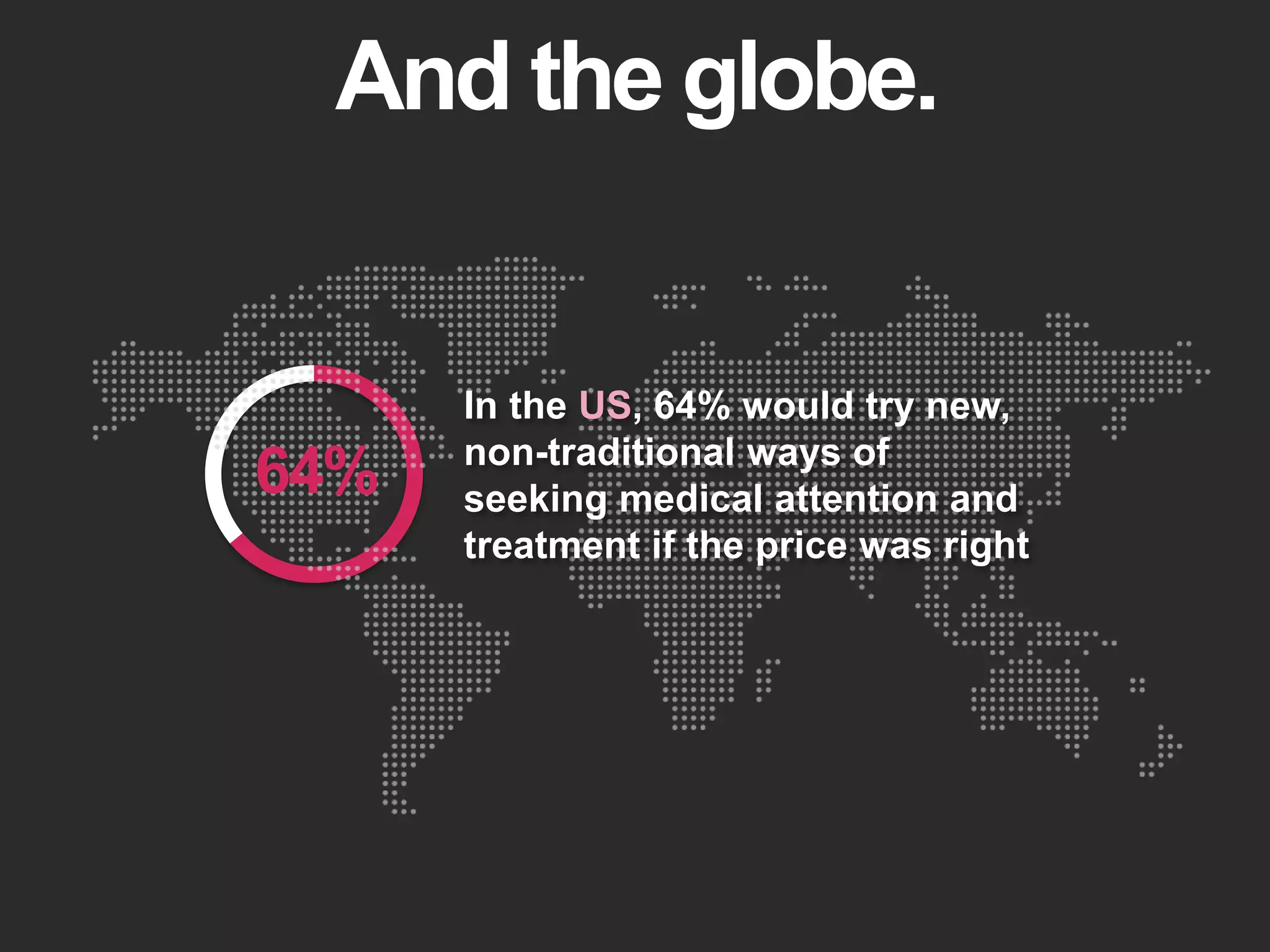
In the US, 64% would try new,
non-traditional ways of
seeking medical attention and
treatment if the price was right
64%
And the globe.
And the globe.
In Canada, 52%of patients predict
that mobile health (mHealth) will
improve the convenience and access
of healthcare
52%
And the globe.
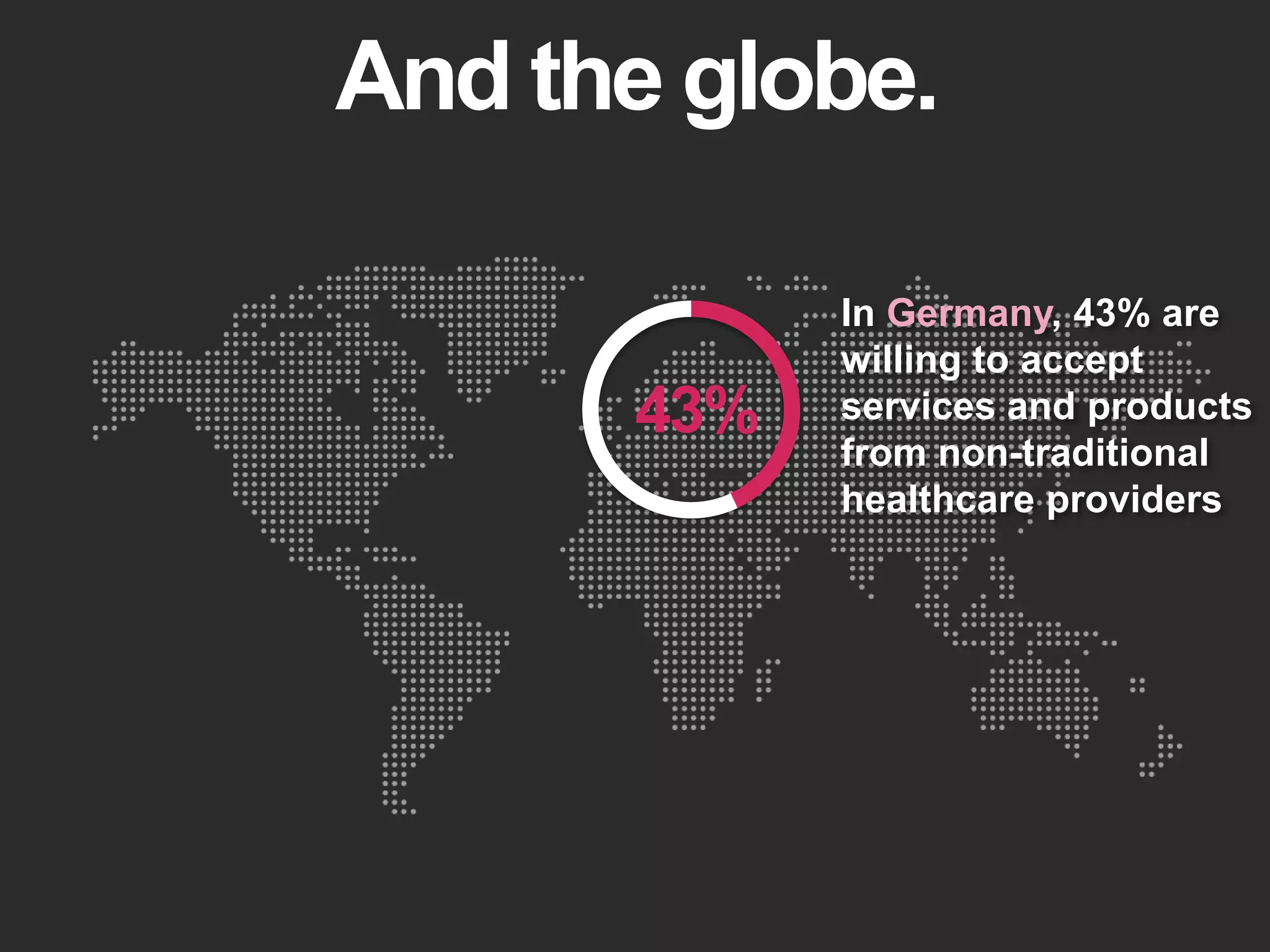
In Germany, 43% are
willing to accept
services and products
from non-traditional
healthcare providers
43%
And the globe.
In emerging markets,
54% expect that mHealth
will improve the quality
of healthcare they
receive in the next three
years
54%
Home health is becoming
personalized.
Designed for:
children with reoccurring ear infections
Designed for:
women’s healthcare
Designed for:
caregivers working with elderly or frail patients
And this means
BIG savings
Using digital health tools in primary care
could save the US healthcare system
$10 billion annually
—Accenture
And BIG impact for
the healthcare system
—Accenture,2015
PATIENT OFFICE VISIT
TIME
SAVINGS
37,000 PCPs
(18% OF PCP WORKFORCE)
ANNUAL
VALUE ~$7 BILLION
Don’t want to
stay at home?
Grab and go
healthcare at
the store.
prescribed
prescriptions
Payers, administrators, and patients are ripping
away decision making from the point of care.
trend05
“What we’ll pay for”
“What we can afford”“What we’ve seen work”
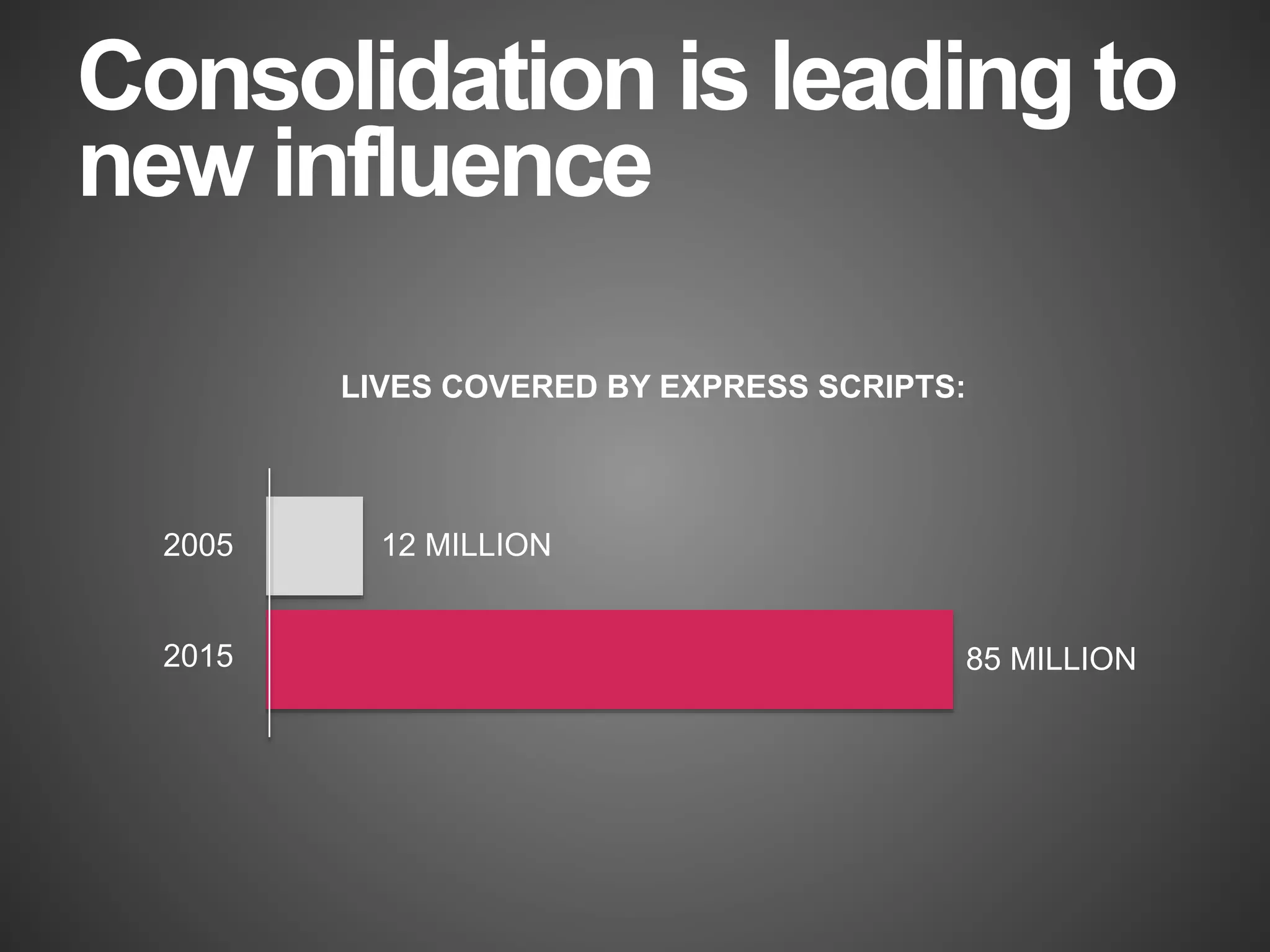
Consolidation is leading to
new influence
LIVES COVERED BY EXPRESS SCRIPTS:
2005
2015
12 MILLION
85 MILLION
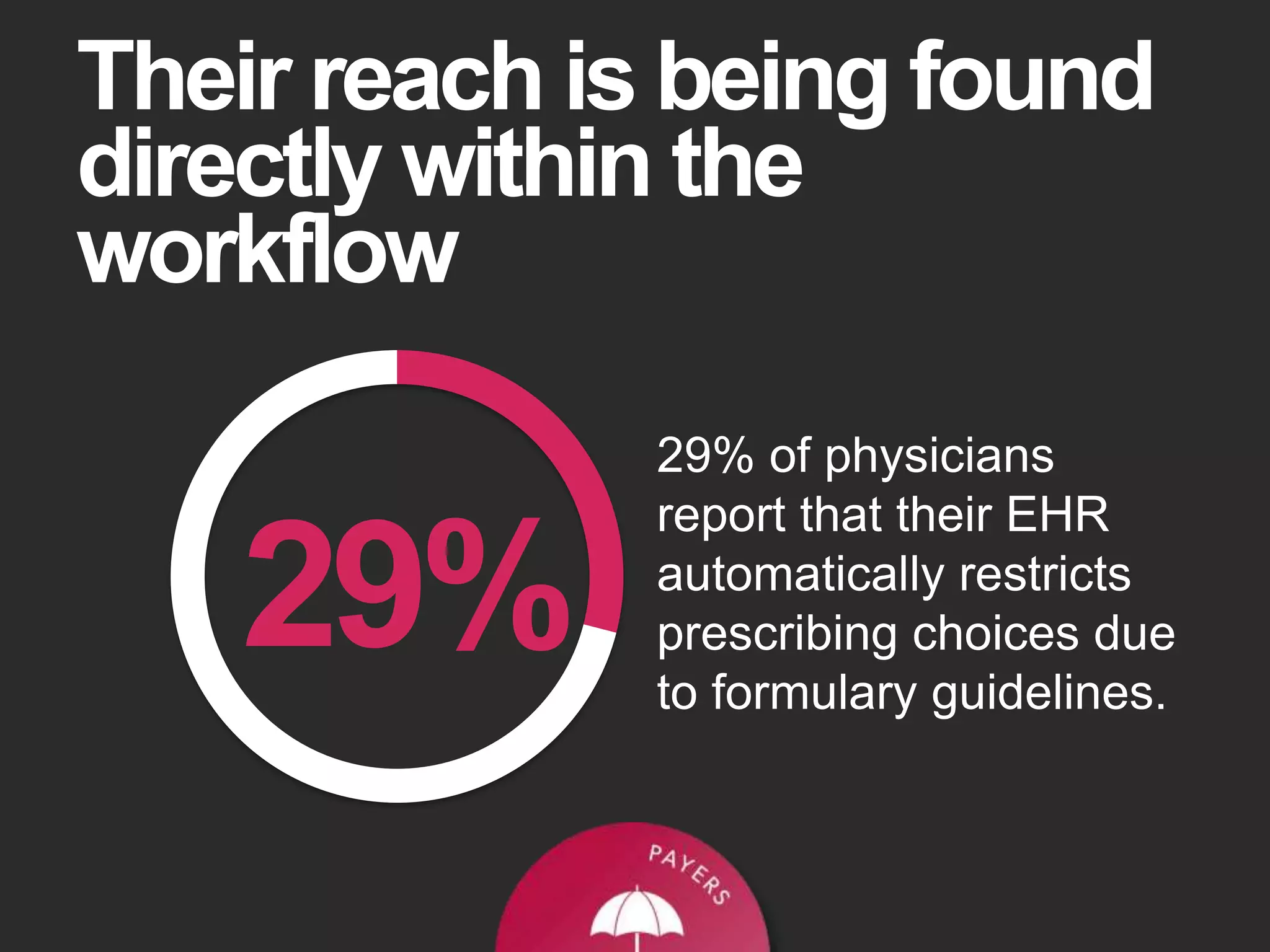
Their reach is being found
directly within the
workflow
29% of physicians
report that their EHR
automatically restricts
prescribing choices due
to formulary guidelines.
29%
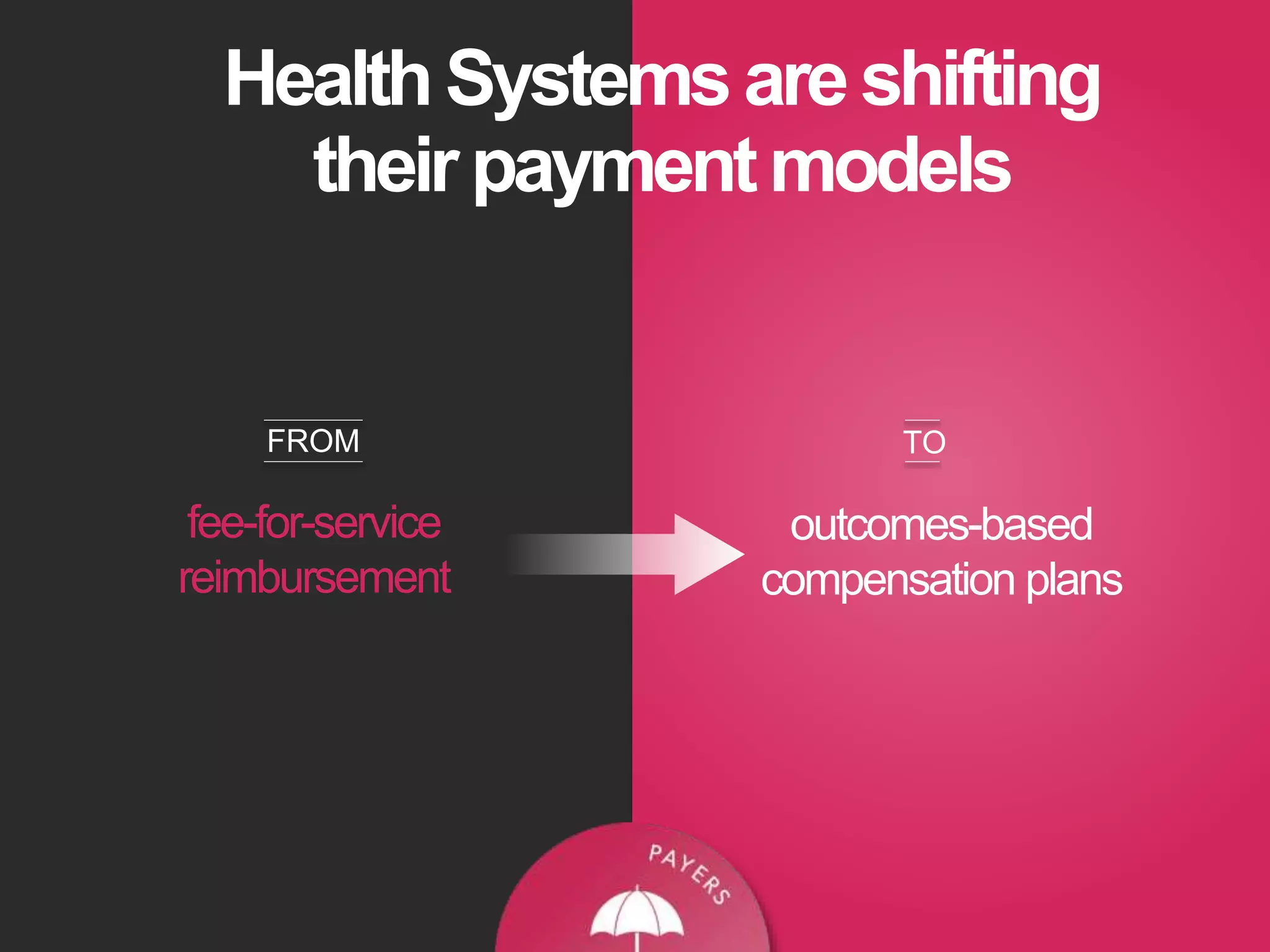
fee-for-service
reimbursement
outcomes-based
compensation plans
HealthSystemsareshifting
theirpaymentmodels
FROM TO
Increasing
reliance on the
Director of
Pharmacy role
Decreased choice, but
decreased hassle
55% of physicians agree that
participation in ACOs will
constrain the level of choice
they have when it comes to
what they can prescribe for
patients
–Manhattan Research, 2015
55%
Patients are
being sticker-
shocked into
action
38%
52%
38% of men said they opted out of
going to the doctor to save money.
52% of women shared the same
sentiment. –eHealth survey, 2015
Tools employers are providing to boost consumer-like behavior
Self-service decision
supporttools
Price transparency
tools for medical
services
Medical
decisionsupport &
secondopinion
services
Employee
advocacy tools &
services for claims
assistance
High-touch health
concierge services
Patients are encouraged to
behave like consumers
Consumerist Patients
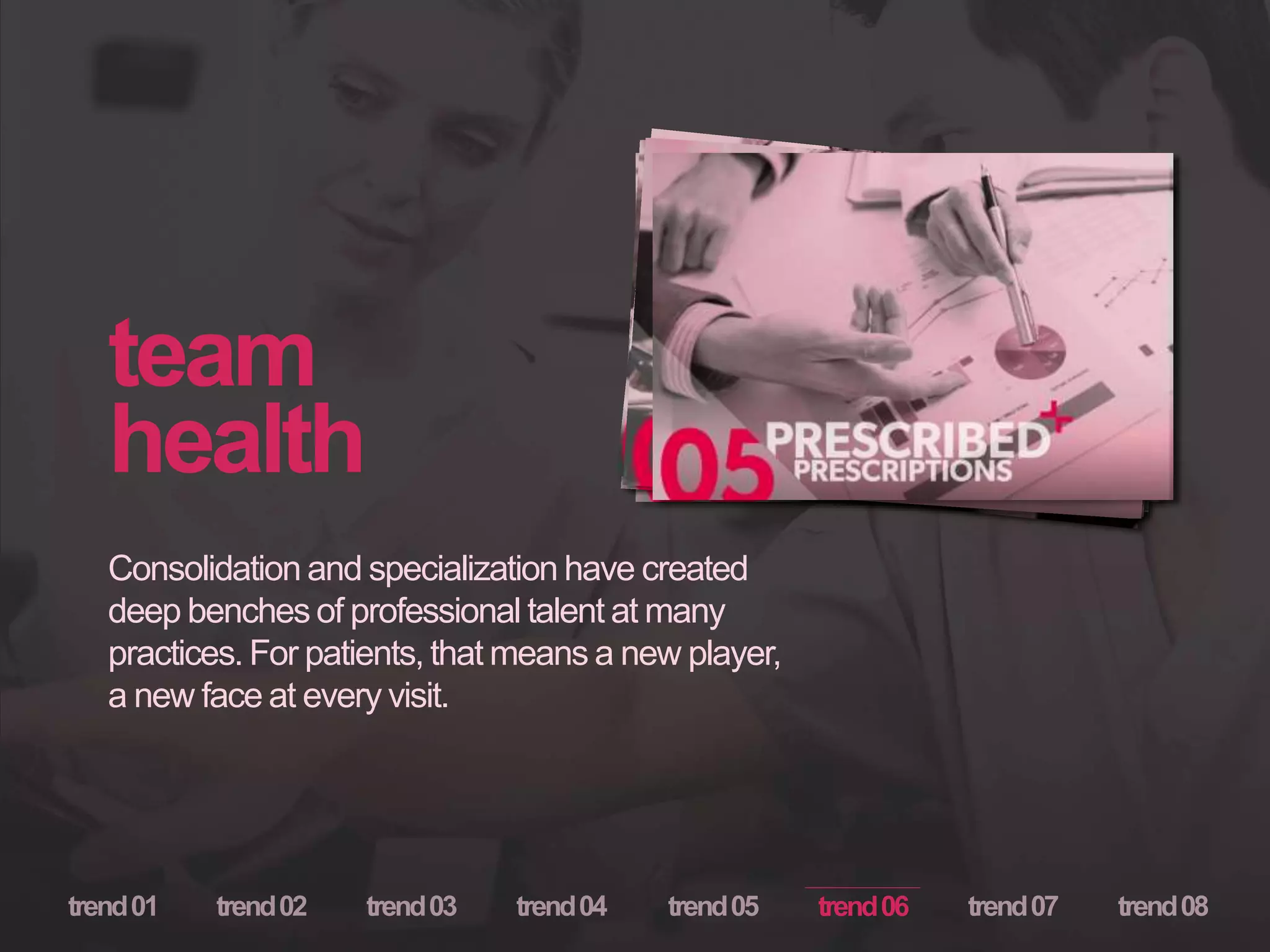
team
health
Consolidation and specialization have created
deep benches of professional talent at many
practices. For patients, that means a new player,
a new face at every visit.
trend06
In 2015 healthcare was
in a merger frenzy.
In 2015 healthcare was
in a merger frenzy.
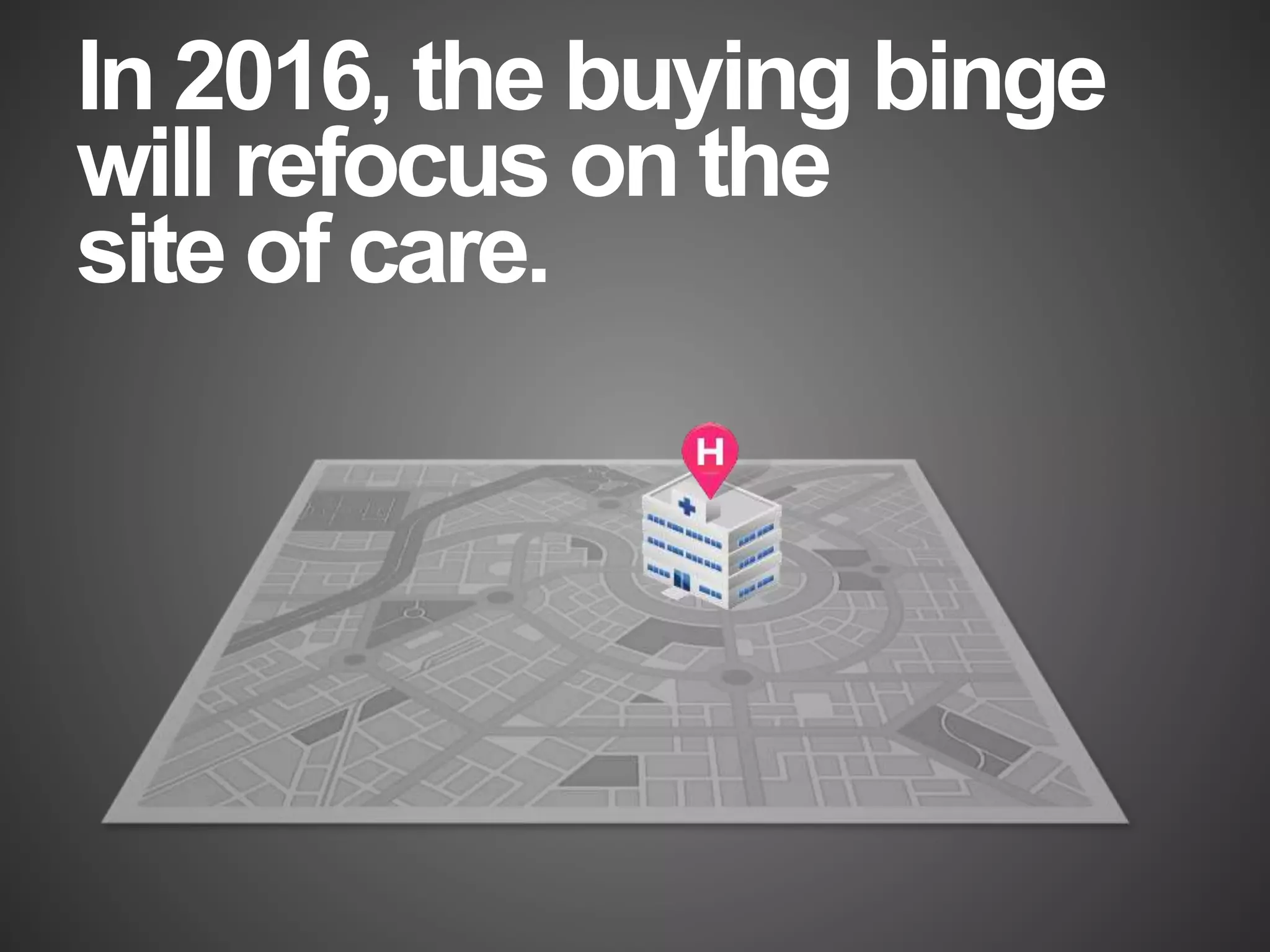
In 2016, the buying binge
will refocus on the
site of care.
In 2016, the buying binge
will refocus on the
site of care.
Encouraged by evolving
physician attitudes
46% 33% 23% 21%
Top physician reasons for consolidation
Gain/retain
income security
Leverage negotiating
power with payers
Achieve/retain
work-life
balance
taking advantage of
organizational
infrastructure
— Deloitte survey of US physicians
Group
Med
13
Hot jobs
“I’M CARING FORYOU”
HOURS WORKED
OWNING MYPRACTICE
“WE’RE CARING FORYOU”
IMPACTMADE
MULTIPLE EMPLOYERS
FROM TO
MillennialDoctorsarethrivinginthe
shiftinghealthcareenvironment.
first visit,
second
opinion
Patients are coming into the practice with strong
opinions about what’s wrong and what they
need to feel better.
trend07
The evolution of the
empowered patient
Patientsbecame
activelyinvolvedin
theircare.
88% feel confident in
their abilities to take
responsibility for their
health
89% agree that they
know where to look and
whom to ask if they have
health questions or
concerns
64% feel that they
could be making more
decisions about their
health and wellness
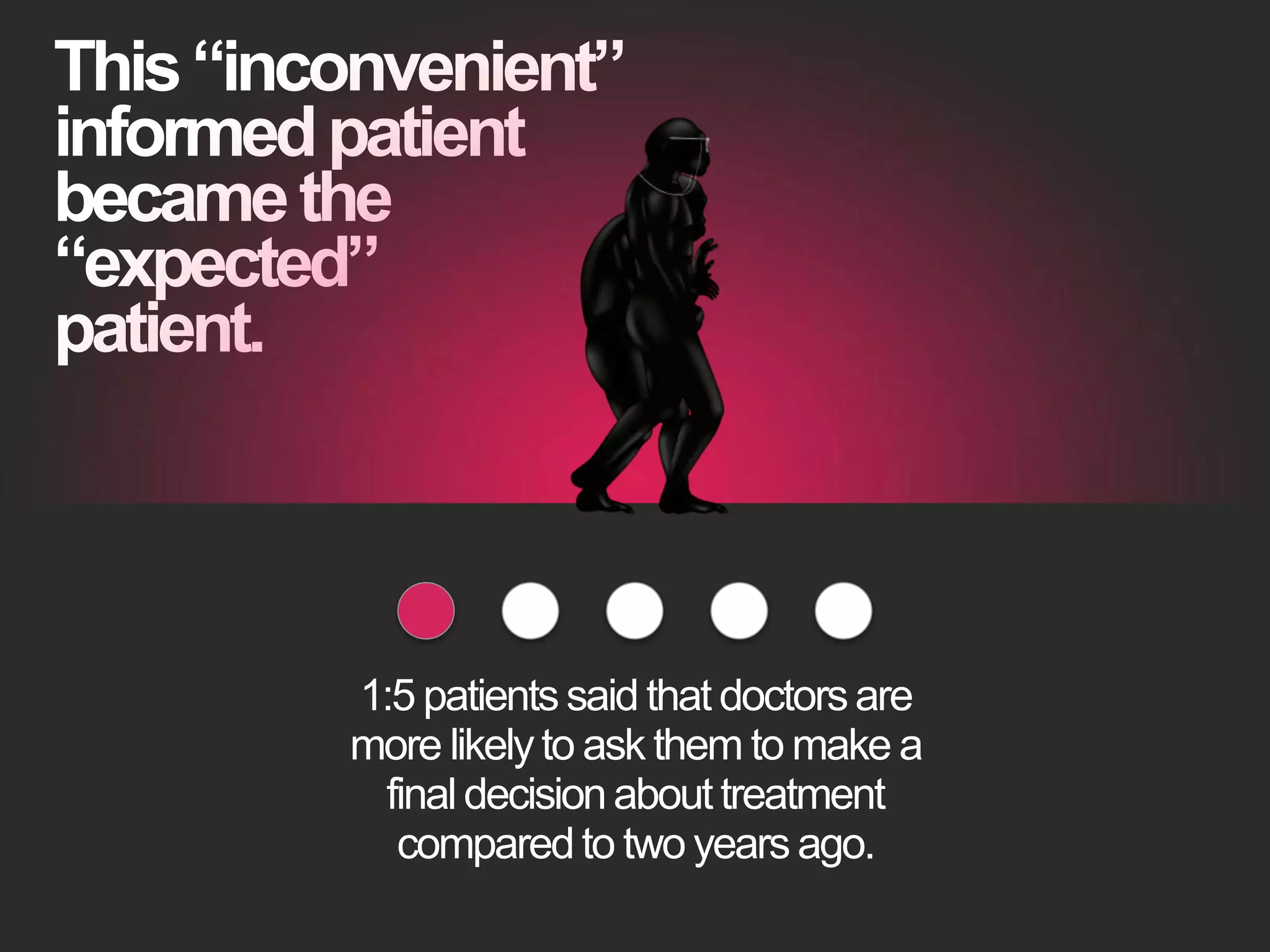
This“inconvenient”
informedpatient
becamethe
“expected”
patient.
1:5 patients said that doctorsare
more likelyto ask them to make a
finaldecisionabouttreatment
comparedto two years ago.
Patientsare
becoming
empoweredto
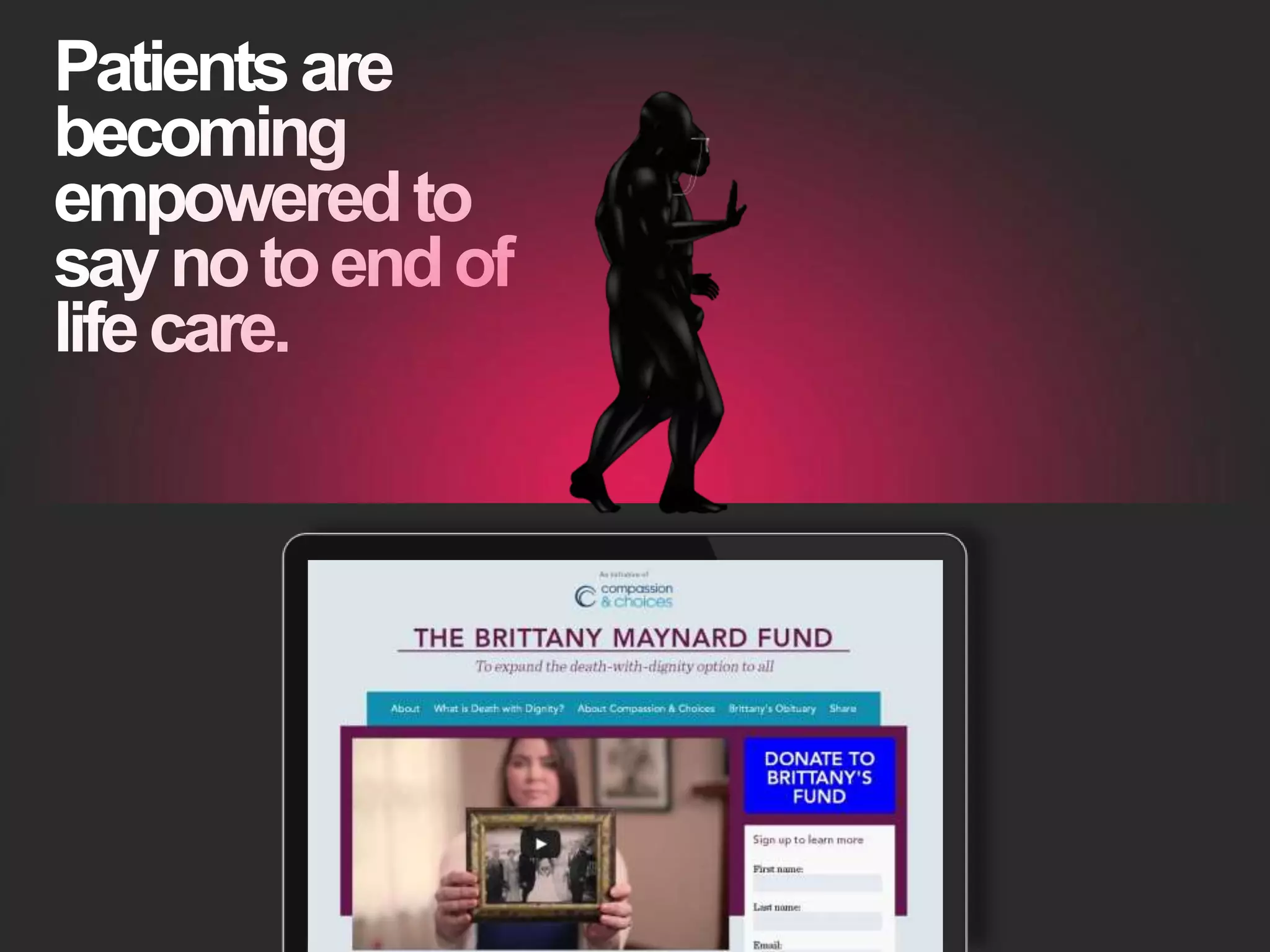
saynotoendof
lifecare.
Patients
interpretingdata
andproviding
themselveswith
direction.
Personal Analytics Dashboards
Patients
interpretingdata
andproviding
themselveswith
direction.
Wearables as a coach
caregiver
crunch
Millions of people are doing a job they were
never trained for: managing the health and
wellness of an aging loved one.
trend08
Who are our caregivers?
1:10
people in the UK
are caregivers
1:6
people in the US
are caregivers
1:4
people in Canada
are caregivers
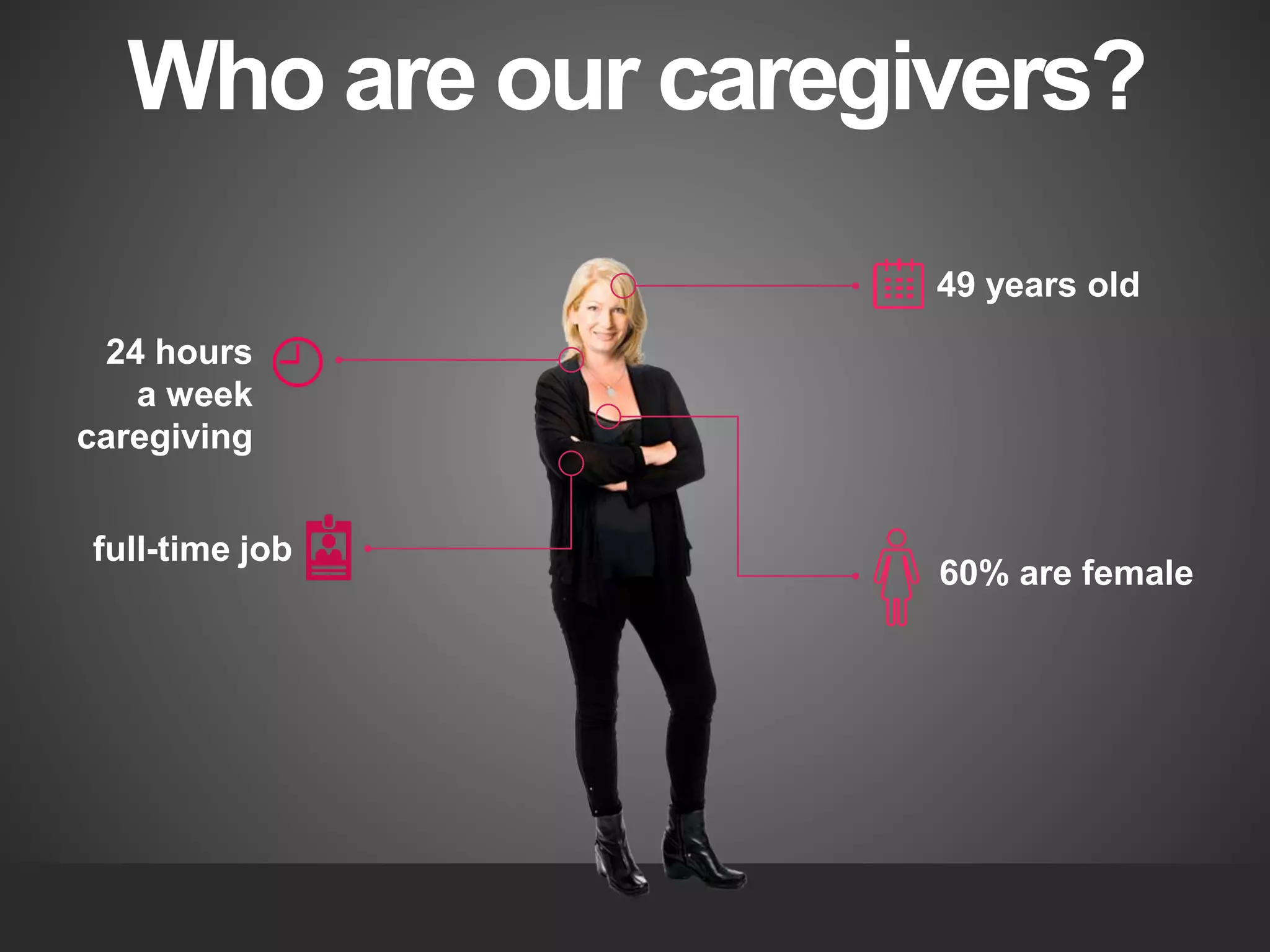
Who are our caregivers?
49 years old
60% are female
full-time job
24 hours
a week
caregiving
We’re approaching
a caregiver cliff.
Thenumberoffamily
caregiversavailablefor
eachpersonrequiringcare
isprojectedtodropfrom
7 to 3
They need
support
Around 9 in 10 want more
opportunities to meet and share
knowledge and experiences with.
More than 8 out of 10 caregivers
say that they could use more
information or help on
caregiving topics.
And they are
getting older
Older adults caring for spouses
provide an average of nearly 45
hours-a-week of care, nearly
twice the average.
Caregivers who are 75 or older
are less likely to have paid help,
are managing their family
finances, and act as medical
advocates.
Tohelpmeettheirneeds,
2016willbringnewideasin:
supportsystems employmentlawfinancialincentives
Healthful Caregiving?
special thanks
Abigail Schmelzer
Alex Brock
Allison Pignatelli
Amanda Joly
Amardeep Lally
Andreas Reinbolz
Andrew Glenn
Ann Manousos
Brooke Glanzberg
Chris Devine
Chris Iafolla
Christina Blosser
Christopher Callahan
Dan Smith
Dave Sonderman
Duncan Arbour
Ed Hammerton
Eduardo Menendez
Elizabeth Stelzer
Eric Davis
Eric Sabo
Francine Carrick
Heather Irvine
Ilya Tetelman
James Tomasino
Jason Sankey
Jeffrey Giermek
Jennifer Fleishman
Jennifer Oleski
Jessie Brown
Joanna Voorhis
Joe Desalvo
John Mucha
Joy Hart
Juli Cavnar
Kara Kinsey
Kevin Coleman
Kevin Nalty
Kristianne Shanker
Leigh Householder
Liana Federico
Logan Cooper
Maggie Janco
Marci Piasecki
Mark Jazvac
Mark Stechschulte
Matt Mizer
Matthew Bergen
Melissa Morrow
Michael Bonilla
Michelle Casciola
Naseem Allaf
Nate Lemke
Nicholas Capanear
Nick Bartlett
Nicole Sordell
Nina Bressau
Pat Etter
Patrick Richards
Rupert Dooley
Salvatore Cannizzaro
Sarah Brown
Scott Page
Stephanie Jones
Susan Perlbachs
Tom Callan
Tom Mullins
Tyler Sax
Vaneeta Verma
Vanessa Rivera
Zach Gerber
information

2016 Healthcare Trends

Editor's Notes

  • #4 Really highlight the actual numbers from the quotes. ----- Meeting Notes (12/30/15 10:00) ----- move the 10,000 people to the bottom.
  • #5 Really highlight the actual numbers from the quotes. ----- Meeting Notes (12/30/15 10:00) ----- move the 10,000 people to the bottom.
  • #6 Really highlight the actual numbers from the quotes. ----- Meeting Notes (12/30/15 10:00) ----- move the 10,000 people to the bottom.
  • #8 App is automatically tracking things like the GPS location so that it can match back other data, like pollen count, ozone, heat index, and other asthma-triggering conditions. (Could present Sinai Steps in Similar Format as Digital Study, but ideally we have a screencast of the actual app)
  • #11 *Can this be told in a screencast vs. text?
  • #12 *Can this be told in a screencast vs. text?
  • #14 The final frontier is EHRs.
  • #17 physicians are waging war. More than 100 prominent oncologists wrote in the journal Mayo Clinic Proceedings that they skyrocketing cost of cancer treatment puts sick Americans in an untenable situation as they’re fighting for their lives.
  • #18 Physicians are waging war.
  • #19 Physicians are waging war.
  • #20 Physicians are waging war.
  • #21 Physicians are waging war.
  • #22 Advocates and physicians are asking for the following:
  • #23 Advocates and physicians are asking for the following:
  • #24 Screencast of scrolling through a Google News feed for Turning
  • #25 There are also new equations to help patients make decisions and not just view drug costs in isolation..
  • #26 There are also new equations to help patients make decisions and not just view drug costs in isolation..
  • #34 Healthcare app data.
  • #35 So what’s driving real behavior change?
  • #36 So what’s driving real behavior change?
  • #37 physicians are waging war. More than 100 prominent oncologists wrote in the journal Mayo Clinic Proceedings that they skyrocketing cost of cancer treatment puts sick Americans in an untenable situation as they’re fighting for their lives.
  • #38 physicians are waging war. More than 100 prominent oncologists wrote in the journal Mayo Clinic Proceedings that they skyrocketing cost of cancer treatment puts sick Americans in an untenable situation as they’re fighting for their lives.
  • #39 So what’s driving real behavior change?
  • #40 Google cafeteria insights: Plate size Healthy Stickers Relegating sweet beverages to the bottom and nutritious foods at the front.
  • #41 wellcoin
  • #42 Focusing on wearables that can be classified as medical devices. Noom + CityMD Samsung S Health Diabetes Program
  • #49 Cell scope, Maven,
  • #50 $79 device that attaches to iPhone camera. Footage is sent to on call doctors who can prescribe care within two hours.
  • #51 Schedule time with a doctor, connect via video, and collect notes from exams.
  • #52 Contains bluetooth diagnostic tools.
  • #55 Today share of the 10 billion immunization market is 4%, with room to grow (*Can we create icons for each of these menu items?)
  • #58 And that influence is increasing thanks to consolidation. If you think about any other aspect of health care, no one has accumulated 85 million lives that they can represent” – Steve Miller
  • #60 ACO’s Preferred Practice Formularies.
  • #61 to set the treatment policies that guide physician practices throughout the system.
  • #62 ACO’s Preferred Practice Formularies.
  • #65 Users enter healthcare service they need. Smartshopper finds the prices at high quality local providers. Consumer shares in savings.
  • #67 Can we have these logos coming together and then turning into just the one on the left?
  • #68 Can we have these logos coming together and then turning into just the one on the left?
  • #69 Independent small and midsized practices joining up with management companies, hospitals and integrated delivery systems. Due to structural shifts in NA and euro health care systems AND generational shifts in physicians attitudes toward work-life balance as seen in this chart.
  • #70 Independent small and midsized practices joining up with management companies, hospitals and integrated delivery systems. Due to structural shifts in NA and euro health care systems AND generational shifts in physicians attitudes toward work-life balance as seen in this chart.
  • #71 Independent small and midsized practices joining up with management companies, hospitals and integrated delivery systems. Due to structural shifts in NA and euro health care systems AND generational shifts in physicians attitudes toward work-life balance as seen in this chart.
  • #72 The average cancer patient sees more than 13 different health care providers in a 12 month period. More than 46% of these patients see more than 21 unique health care providers. -Biologics benchmark study
  • #74 52% don’t want to own their own practice Want to be a part of teams, outcome based to reach finanical goals, leverage tech.
  • #84 the number of family caregivers available for each person requiring care is projected to drop from 7 to 3. That’s the number of available caregivers – not the number who will actually agree to help.
  • #85 the number of family caregivers available for each person requiring care is projected to drop from 7 to 3. That’s the number of available caregivers – not the number who will actually agree to help.
  • #86 the number of family caregivers available for each person requiring care is projected to drop from 7 to 3. That’s the number of available caregivers – not the number who will actually agree to help. **Can we do an animation with the 7 number dropping to 3?
  • #87 the number of family caregivers available for each person requiring care is projected to drop from 7 to 3. That’s the number of available caregivers – not the number who will actually agree to help. professional carers (93%) as well as with other family members and informalcarers (90%)
  • #89 the number of family caregivers available for each person requiring care is projected to drop from 7 to 3. That’s the number of available caregivers – not the number who will actually agree to help.
  • #90 which the principle investigator called “a considerable survival advantage.”