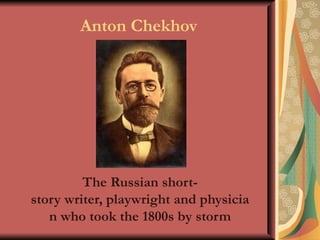
Anton Chekhov


         The Russian short-
story writer, playwright and physicia
   n who took the 1800s by storm
Held in high esteem
Anton Chekhov was considered to be one of
the greatest short-story writers in the history of
world literature. His career as a dramatist
produced four classics and his best short stories
are held in high esteem by writers and critics. 
Chekhov had at first written stories only for the
money, but as his artistic ambition grew, he
made formal innovations which have
influenced the evolution of the modern short
story.
Life of Chekhov
Anton Chekhov was born in the old Black Sea port of
Taganrog on January 17, 1860.

The young Chekhov was soon impressed into the services
of the large, poverty-stricken family, but he worked
cheerfully in his father's shop, closely observing the idlers
that assembled there, and gathering the drollest stories,
which he would afterward whisper in class to his laughing
schoolfellows.

When Chekhov was about fourteen, relieved of work in
the shop, his progress at school became remarkable. At
seventeen he wrote a long tragedy, which was afterward
destroyed, and he already showed flashes of the wit that
was soon to blaze into genius.
The Start of a Career
 His first story appeared in a Moscow paper in 1880.

 During his student years, he poured forth a succession of
 short stories and sketches of Russian life with incredible
 rapidity. He wrote, he tells us, during every spare minute,
 in crowded rooms where there was "no light and less air,"
 and never spent more than a day on any one story. 
 His audience demanded laughter above all things, and,
 with his deep sense of the ridiculous, Chekhov asked
 nothing better. His stories, though often based on themes
 profoundly tragic, are penetrated by the light and subtle
 satire that has won him his reputation as a great
 humourist. 
 In 1884 he took his degree as doctor of medicine, and
 decided to practice, although his writing had by now
 taken on a professional character. 
The Issues of Life
 Weary and with an obstinate cough, he went south in
 1888, took a little cottage on the banks of a little river and
 surrendered himself to his touching love for nature,
 happy in his passion for fishing, in the quiet of the
 country, and in the music and gaiety of the peasants. 
 His health, however, did not improve. In 1889 he began
 to have attacks of heart trouble.
 In 1890 Chekhov made a journey to the island of
 Saghalien, after which his health definitely failed, and the
 tuberculosis, with which he had long been threatened,
 finally declared itself. His illness exiled him to the Crimea,
 and he spent his last ten years there, making frequent trips
 to Moscow to superintend the production of his four
 important plays, written during this period of his life.
Chekhov’s Legacy
 Always modest, Chekhov could hardly have
 imagined the extent of his posthumous
 reputation.
 Despite Chekhov's eminence as a playwright,
 some writers believe his short stories represent
 the greater achievement.
 The Lady with the Dog  was considered as one
 of the greatest stories ever written.
  Chekhov writing was as if one person relates to
 another the most important things in his life,
 slowly and yet without a break, in a slightly
 subdued voice.
Chekhov's Quotes
 ‘A good upbringing means not that you
 won't spill sauce on the tablecloth, but that
 you won't notice it when someone else
 does.’
 ‘The world perishes not from bandits and
 fires, but from hatred, hostility, and all
 these petty squabbles.’

Anton chekhov

  • 1.
    Anton Chekhov The Russian short- story writer, playwright and physicia n who took the 1800s by storm
  • 2.
    Held in highesteem Anton Chekhov was considered to be one of the greatest short-story writers in the history of world literature. His career as a dramatist produced four classics and his best short stories are held in high esteem by writers and critics.  Chekhov had at first written stories only for the money, but as his artistic ambition grew, he made formal innovations which have influenced the evolution of the modern short story.
  • 3.
    Life of Chekhov AntonChekhov was born in the old Black Sea port of Taganrog on January 17, 1860. The young Chekhov was soon impressed into the services of the large, poverty-stricken family, but he worked cheerfully in his father's shop, closely observing the idlers that assembled there, and gathering the drollest stories, which he would afterward whisper in class to his laughing schoolfellows. When Chekhov was about fourteen, relieved of work in the shop, his progress at school became remarkable. At seventeen he wrote a long tragedy, which was afterward destroyed, and he already showed flashes of the wit that was soon to blaze into genius.
  • 4.
    The Start ofa Career His first story appeared in a Moscow paper in 1880. During his student years, he poured forth a succession of short stories and sketches of Russian life with incredible rapidity. He wrote, he tells us, during every spare minute, in crowded rooms where there was "no light and less air," and never spent more than a day on any one story.  His audience demanded laughter above all things, and, with his deep sense of the ridiculous, Chekhov asked nothing better. His stories, though often based on themes profoundly tragic, are penetrated by the light and subtle satire that has won him his reputation as a great humourist.  In 1884 he took his degree as doctor of medicine, and decided to practice, although his writing had by now taken on a professional character. 
  • 5.
    The Issues ofLife Weary and with an obstinate cough, he went south in 1888, took a little cottage on the banks of a little river and surrendered himself to his touching love for nature, happy in his passion for fishing, in the quiet of the country, and in the music and gaiety of the peasants.  His health, however, did not improve. In 1889 he began to have attacks of heart trouble. In 1890 Chekhov made a journey to the island of Saghalien, after which his health definitely failed, and the tuberculosis, with which he had long been threatened, finally declared itself. His illness exiled him to the Crimea, and he spent his last ten years there, making frequent trips to Moscow to superintend the production of his four important plays, written during this period of his life.
  • 6.
    Chekhov’s Legacy Alwaysmodest, Chekhov could hardly have imagined the extent of his posthumous reputation. Despite Chekhov's eminence as a playwright, some writers believe his short stories represent the greater achievement. The Lady with the Dog  was considered as one of the greatest stories ever written. Chekhov writing was as if one person relates to another the most important things in his life, slowly and yet without a break, in a slightly subdued voice.
  • 7.
    Chekhov's Quotes ‘Agood upbringing means not that you won't spill sauce on the tablecloth, but that you won't notice it when someone else does.’ ‘The world perishes not from bandits and fires, but from hatred, hostility, and all these petty squabbles.’