How To Define a Corporate Structure for Start-ups:
What, Why, Where, & How?
Gary M. Myles, Ph.D.
Mark P. Walters
John A. Morgan
Intellectual Property Attorneys
Lowe Graham Jones PLLC
November 5, 2015
How to Define a Corporate Structure
for Start-ups
• "A well-defined corporate and organizational structure
is key to attracting investors"
• Topics for Discussion
 WHAT: Overview of Business Entities
• Legal, Tax, and Liability Considerations
 WHY: Choosing the Best Business Entity
• Ensuring Successful Business Transactions
• Financing, Partnering, M&A, IPO
 HOW: Logistics of Incorporation
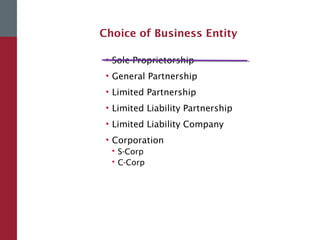
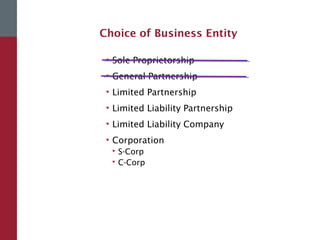
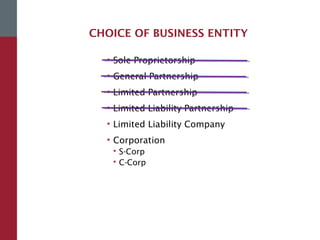
Choice of Business Entity
• Sole Proprietorship
• General Partnership
• Limited Partnership
• Limited Liability Partnership
• Limited Liability Company
• Corporation
 S-Corp
 C-Corp
WHAT?
Sole Proprietorship
• Definition:
 Business entity in which all assets are owned by one
person
• Management:
 Management and operation decisions are wholly in the
control of the owner
• Liability:
 Owner is personally liable for all business liabilities
• Tax Treatment:
 Income and loss are recognized by the owner directly on
his or her personal tax return
 No separate entity tax return required
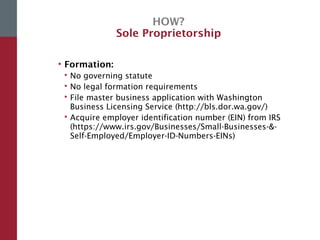
HOW?
Sole Proprietorship
• Formation:
 No governing statute
 No legal formation requirements
 File master business application with Washington
Business Licensing Service (http://bls.dor.wa.gov/)
 Acquire employer identification number (EIN) from IRS
(https://www.irs.gov/Businesses/Small-Businesses-&-
Self-Employed/Employer-ID-Numbers-EINs)
WHY?
Sole Proprietorship
Pros:
• Simple and cheap
• No legal formation
requirements
• No non-tax record
keeping
• Single level of taxation
Cons:
• Unlimited personal
liability
• Co-owners prohibited
• Business ceases with
owner’s death
Choice of Business Entity
• Sole Proprietorship
• General Partnership
• Limited Partnership
• Limited Liability Partnership
• Limited Liability Company
• Corporation
 S-Corp
 C-Corp
WHAT?
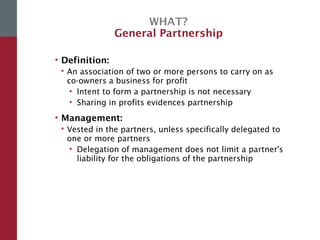
General Partnership
• Definition:
 An association of two or more persons to carry on as
co-owners a business for profit
• Intent to form a partnership is not necessary
• Sharing in profits evidences partnership
• Management:
 Vested in the partners, unless specifically delegated to
one or more partners
• Delegation of management does not limit a partner's
liability for the obligations of the partnership
WHAT?
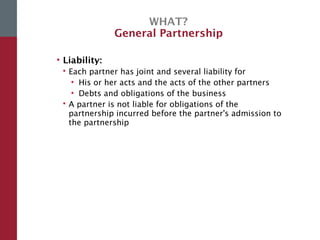
General Partnership
• Liability:
 Each partner has joint and several liability for
• His or her acts and the acts of the other partners
• Debts and obligations of the business
 A partner is not liable for obligations of the
partnership incurred before the partner's admission to
the partnership
WHAT?
General Partnership
• Tax Treatment:
 A general partnership is a flow through entity
• No entity level taxation
• Income and loss are reported and recognized by the
partners on their personal tax returns
• Cash distributions of the partnership are taxable if
they exceed a partner's tax basis in his or her
partnership interest
• A federal partnership tax return must be filed
WHAT?
General Partnership
• Costs:
 Limited formation and maintenance costs
• Transferability of Interest:
 A partner's economic interest is transferable
 A partner’s right to manage the partnership or vote are
not transferable unless …
• all partners consent, or
• provided by the Partnership Agreement
HOW?
General Partnership
• Formation:
 Governed by the Uniform Partnership Act (RCW 25.05
http://apps.leg.wa.gov/RCW/)
 A Partnership Agreement setting forth terms of
ownership, voting rights, distribution of profits, ability
to transfer interests, dissolution -- not required but
recommended
Pros:
• Simple and cheap.
• No non-tax record-
keeping requirements
• Can allocate profits and
losses specially among
the partners
• Single level of taxation
• Practical where liability is
minimal
Cons:
• Partners have unlimited
personal liability
• Problems inherent in
shared management
responsibility
WHY?
General Partnership
Choice of Business Entity
• Sole Proprietorship
• General Partnership
• Limited Partnership
• Limited Liability Partnership
• Limited Liability Company
• Corporation
 S-Corp
 C-Corp
WHAT?
Limited Partnership
• Definition:
 A partnership comprising
• one or more general partners who manage [the]
business and who are personally liable for
partnership debts, and
• one or more limited partners who contribute capital
and share in profits but who take no part in running
[the] business and incur no liability with respect to
partnership obligations beyond contribution
WHAT?
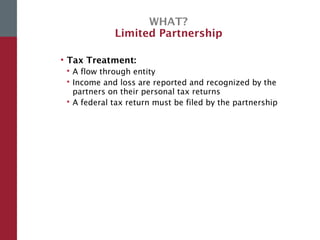
Limited Partnership
• Tax Treatment:
 A flow through entity
 Income and loss are reported and recognized by the
partners on their personal tax returns
 A federal tax return must be filed by the partnership
WHAT?
Limited Partnership
• Liability:
 General Partner
• Unlimited personal liability for the obligations of the
partnership
 Limited Partner ("silent partners”)
• Liability is limited to the extent of his or her capital
contribution to the partnership
• A limited partner who participates in the
management of the partnership may lose his or her
limited liability protection
HOW?
Limited Partnership
• Formation:
 Formed by filing a Certificate of Limited Partnership
with the Secretary of State
(http://www.secstate.wa.gov/_assets/corps/LPCERT.pdf)
 Partnership Agreement not required by statute, but is
highly recommended
 Partners can be individual persons or entities
WHY?
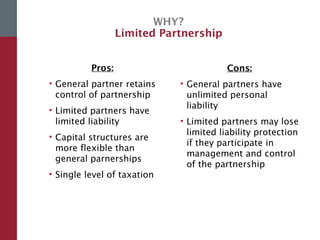
Limited Partnership
Pros:
• General partner retains
control of partnership
• Limited partners have
limited liability
• Capital structures are
more flexible than
general parnerships
• Single level of taxation
Cons:
• General partners have
unlimited personal
liability
• Limited partners may lose
limited liability protection
if they participate in
management and control
of the partnership
CHOICE OF BUSINESS ENTITY
• Sole Proprietorship
• General Partnership
• Limited Partnership
• Limited Liability Partnership
• Limited Liability Company
• Corporation
 S-Corp
 C-Corp
WHAT?
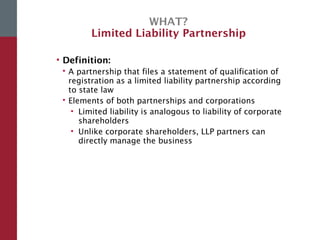
Limited Liability Partnership
• Definition:
 A partnership that files a statement of qualification of
registration as a limited liability partnership according
to state law
 Elements of both partnerships and corporations
• Limited liability is analogous to liability of corporate
shareholders
• Unlike corporate shareholders, LLP partners can
directly manage the business
WHAT?
Limited Liability Partnership
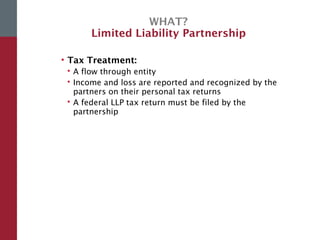
• Tax Treatment:
 A flow through entity
 Income and loss are reported and recognized by the
partners on their personal tax returns
 A federal LLP tax return must be filed by the
partnership
WHAT?
Limited Liability Partnership
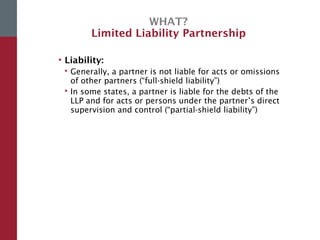
• Liability:
 Generally, a partner is not liable for acts or omissions
of other partners (“full-shield liability”)
 In some states, a partner is liable for the debts of the
LLP and for acts or persons under the partner’s direct
supervision and control (“partial-shield liability”)
WHAT?
Limited Liability Partnership
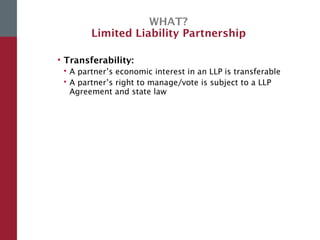
• Transferability:
 A partner’s economic interest in an LLP is transferable
 A partner’s right to manage/vote is subject to a LLP
Agreement and state law
HOW?
Limited Liability Partnership
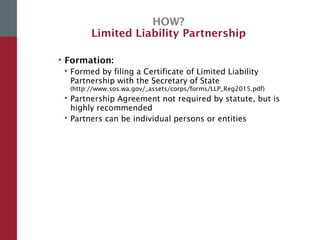
• Formation:
 Formed by filing a Certificate of Limited Liability
Partnership with the Secretary of State
(http://www.sos.wa.gov/_assets/corps/forms/LLP_Reg2015.pdf)
 Partnership Agreement not required by statute, but is
highly recommended
 Partners can be individual persons or entities
WHY?
Limited Liability Partnership
Pros:
• High level of flexibility
and control
• Limited liability protection
• Commonly used entity for
accountants and lawyers
• Single level of taxation
Cons:
• Limited liability protection
vulnerable to application
of “piercing the corporate
veil” theories
• Formality and expense
similar to LLCs
• Uncertainty owing to
under-developed case law
CHOICE OF BUSINESS ENTITY
• Sole Proprietorship
• General Partnership
• Limited Partnership
• Limited Liability Partnership
• Limited Liability Company
• Corporation
 S-Corp
 C-Corp
WHAT?
Limited Liability Company
• Definition:
 A company that is characterized by
• Limited liability
• Management by members or managers
• Limitation on ownership transfer
 Ownership interests (i.e., “membership interests”) are
held by members of the company
• Management:
 Management of an LLC may vest in its members or in a
member or non-member manager
WHAT?
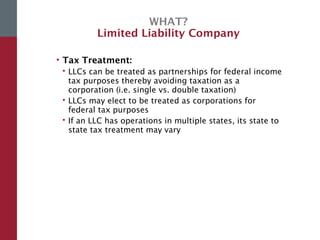
Limited Liability Company
• Tax Treatment:
 LLCs can be treated as partnerships for federal income
tax purposes thereby avoiding taxation as a
corporation (i.e. single vs. double taxation)
 LLCs may elect to be treated as corporations for
federal tax purposes
 If an LLC has operations in multiple states, its state to
state tax treatment may vary
WHAT?
Limited Liability Company
• Liability:
 Members of an LLC enjoy limited liability protection
 Liability of managers is limited by statute absent a
breach of fiduciary duty
 Limited liability protection may, however, be negated
by “piercing the corporate veil” theories
WHAT?
Limited Liability Company
• Transferability:
 A member’s economic interest in an LLC is transferable
 A member’s right to manage/vote is subject to a LLC
Operating Agreement and state law
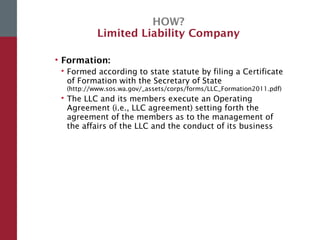
HOW?
Limited Liability Company
• Formation:
 Formed according to state statute by filing a Certificate
of Formation with the Secretary of State
(http://www.sos.wa.gov/_assets/corps/forms/LLC_Formation2011.pdf)
 The LLC and its members execute an Operating
Agreement (i.e., LLC agreement) setting forth the
agreement of the members as to the management of
the affairs of the LLC and the conduct of its business
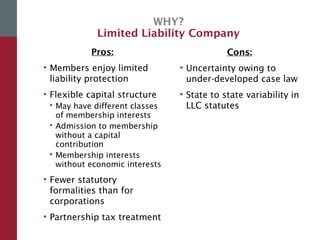
WHY?
Limited Liability Company
Pros:
• Members enjoy limited
liability protection
• Flexible capital structure
 May have different classes
of membership interests
 Admission to membership
without a capital
contribution
 Membership interests
without economic interests
• Fewer statutory
formalities than for
corporations
• Partnership tax treatment
Cons:
• Uncertainty owing to
under-developed case law
• State to state variability in
LLC statutes
CHOICE OF BUSINESS ENTITY
• Sole Proprietorship
• General Partnership
• Limited Partnership
• Limited Liability Partnership
• Limited Liability Company
• Corporation
 S-Corp
 C-Corp
WHAT?
Corporation
• Definition:
 A legal entity that is formed under state law and in
which ownership interest (i.e., stock) is owned by one
or more shareholders
• Management:
 Corporations have centralized management that is
vested in a board of directors and company officers
 The board of directors is elected by the shareholders
 Officers are appointed by the board of directors
WHAT?
S-Corporation
• Tax Treatment:
 A corporation electing to be taxed under Subchapter S
of the Internal Revenue Code
 S-Corporations are flow-through entities and are taxed
like partnerships thereby avoiding double taxation
 S-Corporations must file federal corporation tax
returns
 S-Corporations have the following restrictions
• No more than 100 shareholders
• Shareholders must be individuals or trusts (NOT
corporations or partnerships)
• Shareholders may not be non-resident aliens
• Limited to one class of stock, which can include both
voting and non-voting common stock
WHAT?
C-Corporation
• Tax Treatment:
 A corporation taxed under Subchapter C of the Internal
Revenue Code
 S-Corporations are subject to double taxation
• Income of the corporation is taxable at the entity
level and distributions to shareholders are taxable
to the shareholders
 Election for Subchapter C treatment is NOT required
WHAT?
Corporation
• Liability:
 Shareholder liability is limited to the extent of his/her
investment in the corporation unless a court “pierces
the corporate veil”
 Limited liability protection and indemnification of
corporate officers and directors unless they breach a
fiduciary duty
WHAT?
Corporation
• Transferability:
 Shares are freely transferable unless restricted by a
Shareholder’s Agreement or under securities law
HOW?
Corporation
• Formation:
 Formed according to state statute by filing Articles of
Incorporation with the Secretary of State
(http://www.sos.wa.gov/_assets/corps/forms/ProfitArticles2010v2.pdf)
 Must adopt by-laws addressing management and
control of the corporation
 Must observe significant corporate formalities
• Authorizing resolutions
• Issuing shares
• Subscription agreements
• Preparing minutes of board and stockholder
meetings
• Maintaining books and records
 Must provide buy-sell arrangements and transfer
restrictions in a Shareholder or Founder Agreement
WHY?
Corporation
Pros:
• Shareholders enjoy limited
liability protection
• Familiar corporate structure
and well-developed juris
prudence is appealing to
investors and lenders
• Tax advantages in many
liquidity transactions
• Availability of incentive
compensation (e.g., stock
options)
• C corporations may have
more than one class of stock
 Appealing to venture
capital transactions (i.e.,
preferred stock)
Cons:
• Double taxation with C
corporations
• Significant and on-going
formalities and filing
requirements
• Detailed and restrictive state
corporation laws
• Income and loss must be
allocated in proportion to
shares owned
Which Entity to Choose?
• Primary choices
 Limited Liability Company
 S corporation
 C corporation
• Key Considerations
 How will your business be financed?
• Self financed
• Grants
• Angel investment
• Venture capital
• Bank loans
 Substantial outside financing disfavors an
LLC
Which Entity to Choose?
C-Corp S-Corp LLC
Pass-through
Tax Treatment
No Yes Yes
Flexible
Ownership and
Capital Structure
High Low High
Attractive to
Investors
Yes No No
Complexity Moderate Moderate Moderate to High
Costs Small to
Moderate
Small to
Moderate
Small to High
Ideal Profile VC or angel
backed
Early state
intending to
convert to a C
corp
Insubstantial
outside
investment
Adapted from http://wtnnews.com/articles/7526/
Incorporation in State of Principal Office
or in Delaware?
• Variability in State filing fees, taxes,
and response times
• Variability in extent of limited liability
protection and indemnification of
officers/directors
• Variability in maturity of case law
• Variability in favorability of regulations
and business laws
Thank you!

2015-11-4_WSU_Corp Structure & Formation for Start-ups

  • 1.
    How To Definea Corporate Structure for Start-ups: What, Why, Where, & How? Gary M. Myles, Ph.D. Mark P. Walters John A. Morgan Intellectual Property Attorneys Lowe Graham Jones PLLC November 5, 2015
  • 2.
    How to Definea Corporate Structure for Start-ups • "A well-defined corporate and organizational structure is key to attracting investors" • Topics for Discussion  WHAT: Overview of Business Entities • Legal, Tax, and Liability Considerations  WHY: Choosing the Best Business Entity • Ensuring Successful Business Transactions • Financing, Partnering, M&A, IPO  HOW: Logistics of Incorporation
  • 3.
    Choice of BusinessEntity • Sole Proprietorship • General Partnership • Limited Partnership • Limited Liability Partnership • Limited Liability Company • Corporation  S-Corp  C-Corp
  • 4.
    WHAT? Sole Proprietorship • Definition: Business entity in which all assets are owned by one person • Management:  Management and operation decisions are wholly in the control of the owner • Liability:  Owner is personally liable for all business liabilities • Tax Treatment:  Income and loss are recognized by the owner directly on his or her personal tax return  No separate entity tax return required
  • 5.
    HOW? Sole Proprietorship • Formation: No governing statute  No legal formation requirements  File master business application with Washington Business Licensing Service (http://bls.dor.wa.gov/)  Acquire employer identification number (EIN) from IRS (https://www.irs.gov/Businesses/Small-Businesses-&- Self-Employed/Employer-ID-Numbers-EINs)
  • 6.
    WHY? Sole Proprietorship Pros: • Simpleand cheap • No legal formation requirements • No non-tax record keeping • Single level of taxation Cons: • Unlimited personal liability • Co-owners prohibited • Business ceases with owner’s death
  • 7.
    Choice of BusinessEntity • Sole Proprietorship • General Partnership • Limited Partnership • Limited Liability Partnership • Limited Liability Company • Corporation  S-Corp  C-Corp
  • 8.
    WHAT? General Partnership • Definition: An association of two or more persons to carry on as co-owners a business for profit • Intent to form a partnership is not necessary • Sharing in profits evidences partnership • Management:  Vested in the partners, unless specifically delegated to one or more partners • Delegation of management does not limit a partner's liability for the obligations of the partnership
  • 9.
    WHAT? General Partnership • Liability: Each partner has joint and several liability for • His or her acts and the acts of the other partners • Debts and obligations of the business  A partner is not liable for obligations of the partnership incurred before the partner's admission to the partnership
  • 10.
    WHAT? General Partnership • TaxTreatment:  A general partnership is a flow through entity • No entity level taxation • Income and loss are reported and recognized by the partners on their personal tax returns • Cash distributions of the partnership are taxable if they exceed a partner's tax basis in his or her partnership interest • A federal partnership tax return must be filed
  • 11.
    WHAT? General Partnership • Costs: Limited formation and maintenance costs • Transferability of Interest:  A partner's economic interest is transferable  A partner’s right to manage the partnership or vote are not transferable unless … • all partners consent, or • provided by the Partnership Agreement
  • 12.
    HOW? General Partnership • Formation: Governed by the Uniform Partnership Act (RCW 25.05 http://apps.leg.wa.gov/RCW/)  A Partnership Agreement setting forth terms of ownership, voting rights, distribution of profits, ability to transfer interests, dissolution -- not required but recommended
  • 13.
    Pros: • Simple andcheap. • No non-tax record- keeping requirements • Can allocate profits and losses specially among the partners • Single level of taxation • Practical where liability is minimal Cons: • Partners have unlimited personal liability • Problems inherent in shared management responsibility WHY? General Partnership
  • 14.
    Choice of BusinessEntity • Sole Proprietorship • General Partnership • Limited Partnership • Limited Liability Partnership • Limited Liability Company • Corporation  S-Corp  C-Corp
  • 15.
    WHAT? Limited Partnership • Definition: A partnership comprising • one or more general partners who manage [the] business and who are personally liable for partnership debts, and • one or more limited partners who contribute capital and share in profits but who take no part in running [the] business and incur no liability with respect to partnership obligations beyond contribution
  • 16.
    WHAT? Limited Partnership • TaxTreatment:  A flow through entity  Income and loss are reported and recognized by the partners on their personal tax returns  A federal tax return must be filed by the partnership
  • 17.
    WHAT? Limited Partnership • Liability: General Partner • Unlimited personal liability for the obligations of the partnership  Limited Partner ("silent partners”) • Liability is limited to the extent of his or her capital contribution to the partnership • A limited partner who participates in the management of the partnership may lose his or her limited liability protection
  • 18.
    HOW? Limited Partnership • Formation: Formed by filing a Certificate of Limited Partnership with the Secretary of State (http://www.secstate.wa.gov/_assets/corps/LPCERT.pdf)  Partnership Agreement not required by statute, but is highly recommended  Partners can be individual persons or entities
  • 19.
    WHY? Limited Partnership Pros: • Generalpartner retains control of partnership • Limited partners have limited liability • Capital structures are more flexible than general parnerships • Single level of taxation Cons: • General partners have unlimited personal liability • Limited partners may lose limited liability protection if they participate in management and control of the partnership
  • 20.
    CHOICE OF BUSINESSENTITY • Sole Proprietorship • General Partnership • Limited Partnership • Limited Liability Partnership • Limited Liability Company • Corporation  S-Corp  C-Corp
  • 21.
    WHAT? Limited Liability Partnership •Definition:  A partnership that files a statement of qualification of registration as a limited liability partnership according to state law  Elements of both partnerships and corporations • Limited liability is analogous to liability of corporate shareholders • Unlike corporate shareholders, LLP partners can directly manage the business
  • 22.
    WHAT? Limited Liability Partnership •Tax Treatment:  A flow through entity  Income and loss are reported and recognized by the partners on their personal tax returns  A federal LLP tax return must be filed by the partnership
  • 23.
    WHAT? Limited Liability Partnership •Liability:  Generally, a partner is not liable for acts or omissions of other partners (“full-shield liability”)  In some states, a partner is liable for the debts of the LLP and for acts or persons under the partner’s direct supervision and control (“partial-shield liability”)
  • 24.
    WHAT? Limited Liability Partnership •Transferability:  A partner’s economic interest in an LLP is transferable  A partner’s right to manage/vote is subject to a LLP Agreement and state law
  • 25.
    HOW? Limited Liability Partnership •Formation:  Formed by filing a Certificate of Limited Liability Partnership with the Secretary of State (http://www.sos.wa.gov/_assets/corps/forms/LLP_Reg2015.pdf)  Partnership Agreement not required by statute, but is highly recommended  Partners can be individual persons or entities
  • 26.
    WHY? Limited Liability Partnership Pros: •High level of flexibility and control • Limited liability protection • Commonly used entity for accountants and lawyers • Single level of taxation Cons: • Limited liability protection vulnerable to application of “piercing the corporate veil” theories • Formality and expense similar to LLCs • Uncertainty owing to under-developed case law
  • 27.
    CHOICE OF BUSINESSENTITY • Sole Proprietorship • General Partnership • Limited Partnership • Limited Liability Partnership • Limited Liability Company • Corporation  S-Corp  C-Corp
  • 28.
    WHAT? Limited Liability Company •Definition:  A company that is characterized by • Limited liability • Management by members or managers • Limitation on ownership transfer  Ownership interests (i.e., “membership interests”) are held by members of the company • Management:  Management of an LLC may vest in its members or in a member or non-member manager
  • 29.
    WHAT? Limited Liability Company •Tax Treatment:  LLCs can be treated as partnerships for federal income tax purposes thereby avoiding taxation as a corporation (i.e. single vs. double taxation)  LLCs may elect to be treated as corporations for federal tax purposes  If an LLC has operations in multiple states, its state to state tax treatment may vary
  • 30.
    WHAT? Limited Liability Company •Liability:  Members of an LLC enjoy limited liability protection  Liability of managers is limited by statute absent a breach of fiduciary duty  Limited liability protection may, however, be negated by “piercing the corporate veil” theories
  • 31.
    WHAT? Limited Liability Company •Transferability:  A member’s economic interest in an LLC is transferable  A member’s right to manage/vote is subject to a LLC Operating Agreement and state law
  • 32.
    HOW? Limited Liability Company •Formation:  Formed according to state statute by filing a Certificate of Formation with the Secretary of State (http://www.sos.wa.gov/_assets/corps/forms/LLC_Formation2011.pdf)  The LLC and its members execute an Operating Agreement (i.e., LLC agreement) setting forth the agreement of the members as to the management of the affairs of the LLC and the conduct of its business
  • 33.
    WHY? Limited Liability Company Pros: •Members enjoy limited liability protection • Flexible capital structure  May have different classes of membership interests  Admission to membership without a capital contribution  Membership interests without economic interests • Fewer statutory formalities than for corporations • Partnership tax treatment Cons: • Uncertainty owing to under-developed case law • State to state variability in LLC statutes
  • 34.
    CHOICE OF BUSINESSENTITY • Sole Proprietorship • General Partnership • Limited Partnership • Limited Liability Partnership • Limited Liability Company • Corporation  S-Corp  C-Corp
  • 35.
    WHAT? Corporation • Definition:  Alegal entity that is formed under state law and in which ownership interest (i.e., stock) is owned by one or more shareholders • Management:  Corporations have centralized management that is vested in a board of directors and company officers  The board of directors is elected by the shareholders  Officers are appointed by the board of directors
  • 36.
    WHAT? S-Corporation • Tax Treatment: A corporation electing to be taxed under Subchapter S of the Internal Revenue Code  S-Corporations are flow-through entities and are taxed like partnerships thereby avoiding double taxation  S-Corporations must file federal corporation tax returns  S-Corporations have the following restrictions • No more than 100 shareholders • Shareholders must be individuals or trusts (NOT corporations or partnerships) • Shareholders may not be non-resident aliens • Limited to one class of stock, which can include both voting and non-voting common stock
  • 37.
    WHAT? C-Corporation • Tax Treatment: A corporation taxed under Subchapter C of the Internal Revenue Code  S-Corporations are subject to double taxation • Income of the corporation is taxable at the entity level and distributions to shareholders are taxable to the shareholders  Election for Subchapter C treatment is NOT required
  • 38.
    WHAT? Corporation • Liability:  Shareholderliability is limited to the extent of his/her investment in the corporation unless a court “pierces the corporate veil”  Limited liability protection and indemnification of corporate officers and directors unless they breach a fiduciary duty
  • 39.
    WHAT? Corporation • Transferability:  Sharesare freely transferable unless restricted by a Shareholder’s Agreement or under securities law
  • 40.
    HOW? Corporation • Formation:  Formedaccording to state statute by filing Articles of Incorporation with the Secretary of State (http://www.sos.wa.gov/_assets/corps/forms/ProfitArticles2010v2.pdf)  Must adopt by-laws addressing management and control of the corporation  Must observe significant corporate formalities • Authorizing resolutions • Issuing shares • Subscription agreements • Preparing minutes of board and stockholder meetings • Maintaining books and records  Must provide buy-sell arrangements and transfer restrictions in a Shareholder or Founder Agreement
  • 41.
    WHY? Corporation Pros: • Shareholders enjoylimited liability protection • Familiar corporate structure and well-developed juris prudence is appealing to investors and lenders • Tax advantages in many liquidity transactions • Availability of incentive compensation (e.g., stock options) • C corporations may have more than one class of stock  Appealing to venture capital transactions (i.e., preferred stock) Cons: • Double taxation with C corporations • Significant and on-going formalities and filing requirements • Detailed and restrictive state corporation laws • Income and loss must be allocated in proportion to shares owned
  • 42.
    Which Entity toChoose? • Primary choices  Limited Liability Company  S corporation  C corporation • Key Considerations  How will your business be financed? • Self financed • Grants • Angel investment • Venture capital • Bank loans  Substantial outside financing disfavors an LLC
  • 43.
    Which Entity toChoose? C-Corp S-Corp LLC Pass-through Tax Treatment No Yes Yes Flexible Ownership and Capital Structure High Low High Attractive to Investors Yes No No Complexity Moderate Moderate Moderate to High Costs Small to Moderate Small to Moderate Small to High Ideal Profile VC or angel backed Early state intending to convert to a C corp Insubstantial outside investment Adapted from http://wtnnews.com/articles/7526/
  • 44.
    Incorporation in Stateof Principal Office or in Delaware? • Variability in State filing fees, taxes, and response times • Variability in extent of limited liability protection and indemnification of officers/directors • Variability in maturity of case law • Variability in favorability of regulations and business laws
  • 45.