1
Goals
• Understand Pre-Formation Issues
• Learn About Available Entity Forms
• Understand Advantages & Disadvantages
• Walk Through Real World Application
2
Pre-Formation Issues
3
Founders’ Agreements
4
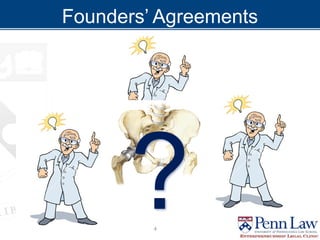
Founders’ Agreements
• Who Owns the Idea
• Roles and Responsibilities
• Decision Making and Operations
• Ownership and Vesting
• Departure and Transfers
• Competition with the Business
5
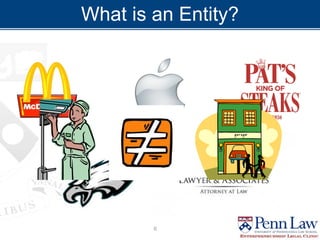
What is an Entity?
6
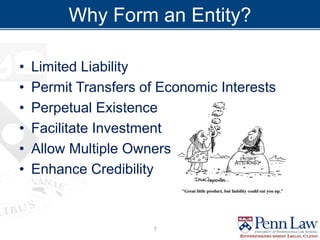
Why Form an Entity?
• Limited Liability
• Permit Transfers of Economic Interests
• Perpetual Existence
• Facilitate Investment
• Allow Multiple Owners
• Enhance Credibility
7
Entity Considerations
• Size of Business
• Partners and Investors
• Transferability and Continuity
• Liability
• Taxation
• Financial Considerations
8
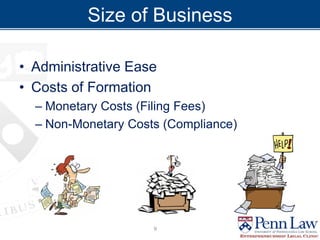
Size of Business
• Administrative Ease
• Costs of Formation
– Monetary Costs (Filing Fees)
– Non-Monetary Costs (Compliance)
9
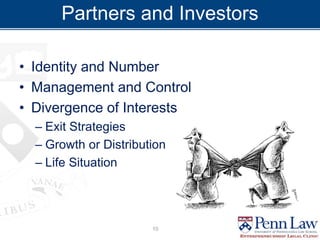
Partners and Investors
• Identity and Number
• Management and Control
• Divergence of Interests
– Exit Strategies
– Growth or Distribution
– Life Situation
10
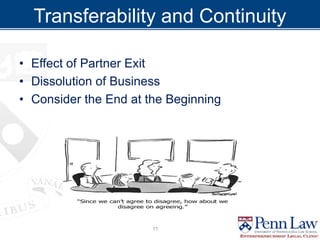
Transferability and Continuity
• Effect of Partner Exit
• Dissolution of Business
• Consider the End at the Beginning
11
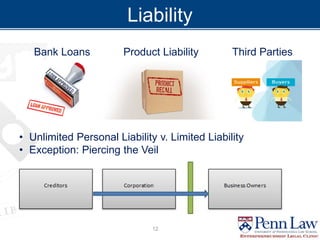
Liability
Bank Loans Third PartiesProduct Liability
• Unlimited Personal Liability v. Limited Liability
• Exception: Piercing the Veil
12
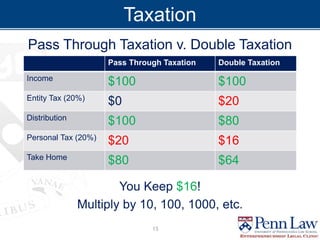
Taxation
Pass Through Taxation v. Double Taxation
You Keep $16!
Multiply by 10, 100, 1000, etc.
Pass Through Taxation Double Taxation
Income
$100 $100
Entity Tax (20%)
$0 $20
Distribution
$100 $80
Personal Tax (20%)
$20 $16
Take Home
$80 $64
13
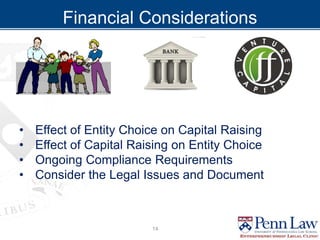
Financial Considerations
• Effect of Entity Choice on Capital Raising
• Effect of Capital Raising on Entity Choice
• Ongoing Compliance Requirements
• Consider the Legal Issues and Document
14
Available Entity Forms
15
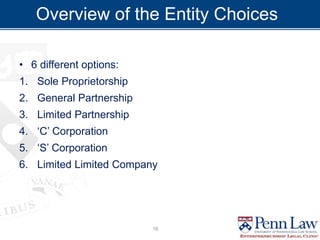
Overview of the Entity Choices
• 6 different options:
1. Sole Proprietorship
2. General Partnership
3. Limited Partnership
4. ‘C’ Corporation
5. ‘S’ Corporation
6. Limited Limited Company
16
Sole Proprietorships and General Partnerships
Most common form of conducting business
• Formation: Easy to incorporate. No
formalities unless a fictitious name is
intended to be used
• Personal Liability: No corporate shield
• Limited Existence
• Tax: All income earned treated as income of
the owner
17
Sole Proprietorships and General Partnerships
• Management: Owner free to manage the way he
desires
• Low Maintenance Cost: No record keeping
• Desirable for businesses with low investment
and limited assets
• Not desirable for multiple owners or high
potential liabilities
• Partnerships not desirable for spouses as
partners are jointly and severally liable to
creditors
18
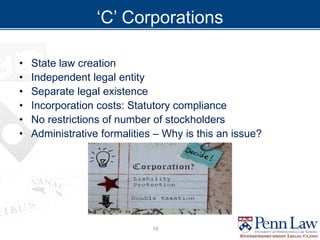
‘C’ Corporations
• State law creation
• Independent legal entity
• Separate legal existence
• Incorporation costs: Statutory compliance
• No restrictions of number of stockholders
• Administrative formalities – Why is this an issue?
19
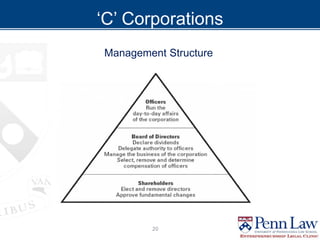
‘C’ Corporations
Management Structure
20
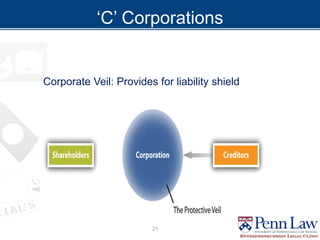
‘C’ Corporations
Corporate Veil: Provides for liability shield
21
‘C’ Corporations
 Lifting the Corporate Veil
 Tax: Double Taxation
22
‘S’ Corporations
• An IRS creation for tax purposes
• Hybrid between ‘C’ Corporations and Partnerships
• Same characteristics as a ‘C’ Corporation
• Suited for small businesses
• Form can be changed
23
‘S’ Corporations
Differs from ‘C’ Corporation:
(i) Ownership Structure: Only up to 100
shareholders. Limited to individual US residents
and certain trusts
(ii)Tax Treatment: No Double Taxation
24
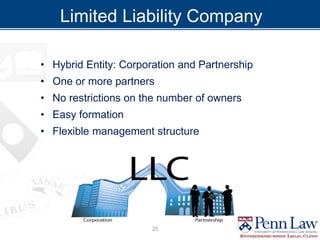
Limited Liability Company
• Hybrid Entity: Corporation and Partnership
• One or more partners
• No restrictions on the number of owners
• Easy formation
• Flexible management structure
25
Limited Liability Company
• Limited Liability
• Piercing the corporate veil
• Low Maintenance Cost: Not required to convene
periodic meetings or maintain records
• Tax: Flow Through Treatment
26
Advantages & Disadvantages
27
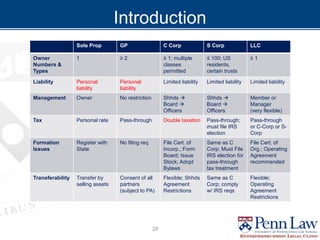
Introduction
Sole Prop GP C Corp S Corp LLC
Owner
Numbers &
Types
1 ≥ 2 ≥ 1; multiple
classes
permitted
≤ 100; US
residents,
certain trusts
≥ 1
Liability Personal
liability
Personal
liability
Limited liability Limited liability Limited liability
Management Owner No restriction Shhds 
Board 
Officers
Shhds 
Board 
Officers
Member or
Manager
(very flexible)
Tax Personal rate Pass-through Double taxation Pass-through;
must file IRS
election
Pass-through
or C-Corp or S-
Corp
Formation
Issues
Register with
State
No filing req File Cert. of
Incorp.; Form
Board; Issue
Stock; Adopt
Bylaws
Same as C
Corp; Must File
IRS election for
pass-through
tax treatment
File Cert. of
Org.; Operating
Agreement
recommended
Transferability Transfer by
selling assets
Consent of all
partners
(subject to PA)
Flexible; Shhds
Agreement
Restrictions
Same as C
Corp; comply
w/ IRS reqs
Flexible;
Operating
Agreement
Restrictions
28
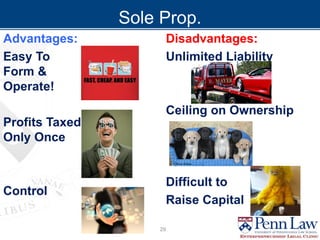
Advantages:
Easy To
Form &
Operate!
Profits Taxed
Only Once
Control
Disadvantages:
Unlimited Liability
Ceiling on Ownership
Difficult to
Raise Capital
Sole Prop.
29
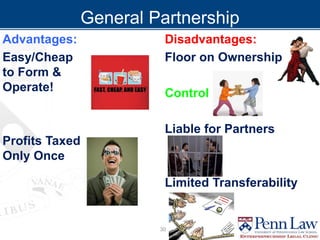
Advantages:
Easy/Cheap
to Form &
Operate!
Profits Taxed
Only Once
Disadvantages:
Floor on Ownership
Control
Liable for Partners
Limited Transferability
General Partnership
30
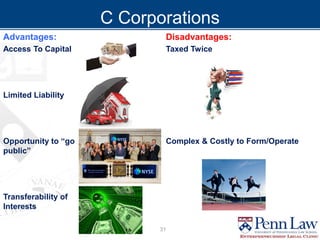
Advantages:
Access To Capital
Limited Liability
Opportunity to “go
public”
Transferability of
Interests
Disadvantages:
Taxed Twice
Complex & Costly to Form/Operate
C Corporations
31
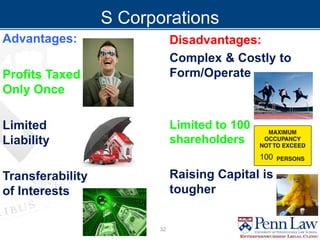
Advantages:
Profits Taxed
Only Once
Limited
Liability
Transferability
of Interests
Disadvantages:
Complex & Costly to
Form/Operate
Limited to 100
shareholders
Raising Capital is
tougher
S Corporations
100
32
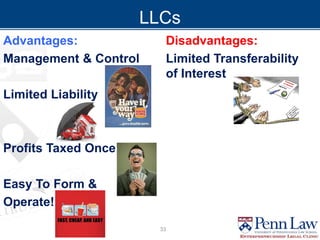
Disadvantages:
Limited Transferability
of Interest
LLCs
Advantages:
Management & Control
Limited Liability
Profits Taxed Once
Easy To Form &
Operate!
33
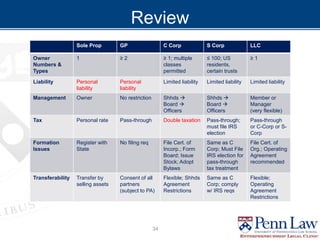
Review
Sole Prop GP C Corp S Corp LLC
Owner
Numbers &
Types
1 ≥ 2 ≥ 1; multiple
classes
permitted
≤ 100; US
residents,
certain trusts
≥ 1
Liability Personal
liability
Personal
liability
Limited liability Limited liability Limited liability
Management Owner No restriction Shhds 
Board 
Officers
Shhds 
Board 
Officers
Member or
Manager
(very flexible)
Tax Personal rate Pass-through Double taxation Pass-through;
must file IRS
election
Pass-through
or C-Corp or S-
Corp
Formation
Issues
Register with
State
No filing req File Cert. of
Incorp.; Form
Board; Issue
Stock; Adopt
Bylaws
Same as C
Corp; Must File
IRS election for
pass-through
tax treatment
File Cert. of
Org.; Operating
Agreement
recommended
Transferability Transfer by
selling assets
Consent of all
partners
(subject to PA)
Flexible; Shhds
Agreement
Restrictions
Same as C
Corp; comply
w/ IRS reqs
Flexible;
Operating
Agreement
Restrictions
34
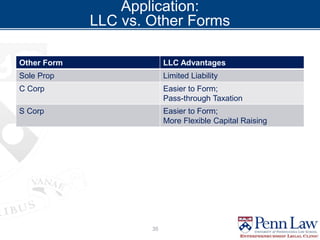
Application:
LLC vs. Other Forms
Other Form LLC Advantages
Sole Prop Limited Liability
C Corp Easier to Form;
Pass-through Taxation
S Corp Easier to Form;
More Flexible Capital Raising
35
Real World Application
36
Case Study #1
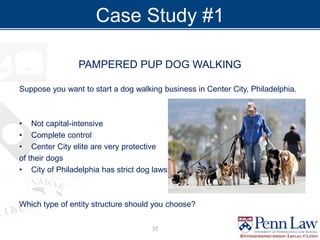
PAMPERED PUP DOG WALKING
Suppose you want to start a dog walking business in Center City, Philadelphia.
• Not capital-intensive
• Complete control
• Center City elite are very protective
of their dogs
• City of Philadelphia has strict dog laws
Which type of entity structure should you choose?
37
Case Study #1
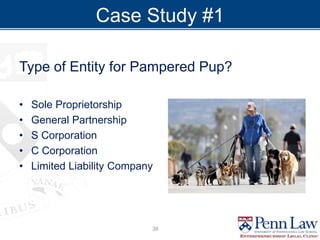
Type of Entity for Pampered Pup?
• Sole Proprietorship
• General Partnership
• S Corporation
• C Corporation
• Limited Liability Company
38
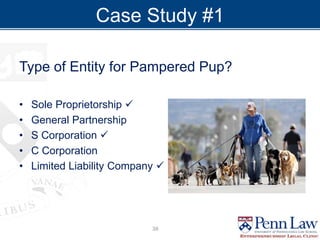
Case Study #1
Type of Entity for Pampered Pup?
• Sole Proprietorship 
• General Partnership
• S Corporation 
• C Corporation
• Limited Liability Company 
39
Case Study #2
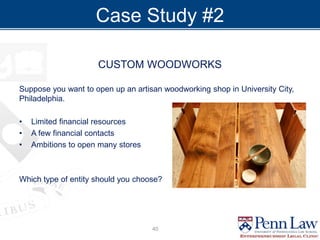
CUSTOM WOODWORKS
Suppose you want to open up an artisan woodworking shop in University City,
Philadelphia.
• Limited financial resources
• A few financial contacts
• Ambitions to open many stores
Which type of entity should you choose?
40
Case Study #2
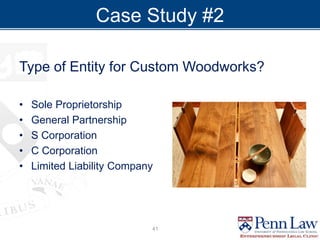
Type of Entity for Custom Woodworks?
• Sole Proprietorship
• General Partnership
• S Corporation
• C Corporation
• Limited Liability Company
41
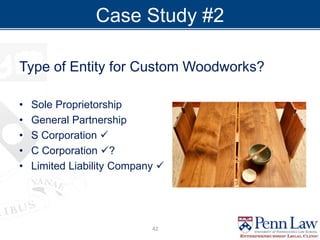
Case Study #2
Type of Entity for Custom Woodworks?
• Sole Proprietorship
• General Partnership
• S Corporation 
• C Corporation ?
• Limited Liability Company 
42
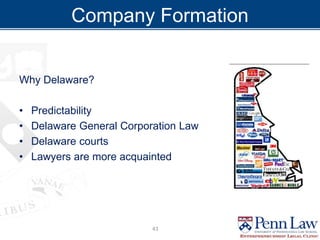
Company Formation
Why Delaware?
• Predictability
• Delaware General Corporation Law
• Delaware courts
• Lawyers are more acquainted
43
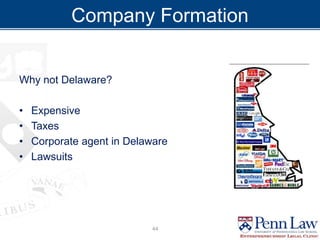
Company Formation
Why not Delaware?
• Expensive
• Taxes
• Corporate agent in Delaware
• Lawsuits
44
Questions?
45

Structuring Your Business from Startup Through Growth

  • 1.
  • 2.
    Goals • Understand Pre-FormationIssues • Learn About Available Entity Forms • Understand Advantages & Disadvantages • Walk Through Real World Application 2
  • 3.
  • 4.
  • 5.
    Founders’ Agreements • WhoOwns the Idea • Roles and Responsibilities • Decision Making and Operations • Ownership and Vesting • Departure and Transfers • Competition with the Business 5
  • 6.
    What is anEntity? 6
  • 7.
    Why Form anEntity? • Limited Liability • Permit Transfers of Economic Interests • Perpetual Existence • Facilitate Investment • Allow Multiple Owners • Enhance Credibility 7
  • 8.
    Entity Considerations • Sizeof Business • Partners and Investors • Transferability and Continuity • Liability • Taxation • Financial Considerations 8
  • 9.
    Size of Business •Administrative Ease • Costs of Formation – Monetary Costs (Filing Fees) – Non-Monetary Costs (Compliance) 9
  • 10.
    Partners and Investors •Identity and Number • Management and Control • Divergence of Interests – Exit Strategies – Growth or Distribution – Life Situation 10
  • 11.
    Transferability and Continuity •Effect of Partner Exit • Dissolution of Business • Consider the End at the Beginning 11
  • 12.
    Liability Bank Loans ThirdPartiesProduct Liability • Unlimited Personal Liability v. Limited Liability • Exception: Piercing the Veil 12
  • 13.
    Taxation Pass Through Taxationv. Double Taxation You Keep $16! Multiply by 10, 100, 1000, etc. Pass Through Taxation Double Taxation Income $100 $100 Entity Tax (20%) $0 $20 Distribution $100 $80 Personal Tax (20%) $20 $16 Take Home $80 $64 13
  • 14.
    Financial Considerations • Effectof Entity Choice on Capital Raising • Effect of Capital Raising on Entity Choice • Ongoing Compliance Requirements • Consider the Legal Issues and Document 14
  • 15.
  • 16.
    Overview of theEntity Choices • 6 different options: 1. Sole Proprietorship 2. General Partnership 3. Limited Partnership 4. ‘C’ Corporation 5. ‘S’ Corporation 6. Limited Limited Company 16
  • 17.
    Sole Proprietorships andGeneral Partnerships Most common form of conducting business • Formation: Easy to incorporate. No formalities unless a fictitious name is intended to be used • Personal Liability: No corporate shield • Limited Existence • Tax: All income earned treated as income of the owner 17
  • 18.
    Sole Proprietorships andGeneral Partnerships • Management: Owner free to manage the way he desires • Low Maintenance Cost: No record keeping • Desirable for businesses with low investment and limited assets • Not desirable for multiple owners or high potential liabilities • Partnerships not desirable for spouses as partners are jointly and severally liable to creditors 18
  • 19.
    ‘C’ Corporations • Statelaw creation • Independent legal entity • Separate legal existence • Incorporation costs: Statutory compliance • No restrictions of number of stockholders • Administrative formalities – Why is this an issue? 19
  • 20.
  • 21.
    ‘C’ Corporations Corporate Veil:Provides for liability shield 21
  • 22.
    ‘C’ Corporations  Liftingthe Corporate Veil  Tax: Double Taxation 22
  • 23.
    ‘S’ Corporations • AnIRS creation for tax purposes • Hybrid between ‘C’ Corporations and Partnerships • Same characteristics as a ‘C’ Corporation • Suited for small businesses • Form can be changed 23
  • 24.
    ‘S’ Corporations Differs from‘C’ Corporation: (i) Ownership Structure: Only up to 100 shareholders. Limited to individual US residents and certain trusts (ii)Tax Treatment: No Double Taxation 24
  • 25.
    Limited Liability Company •Hybrid Entity: Corporation and Partnership • One or more partners • No restrictions on the number of owners • Easy formation • Flexible management structure 25
  • 26.
    Limited Liability Company •Limited Liability • Piercing the corporate veil • Low Maintenance Cost: Not required to convene periodic meetings or maintain records • Tax: Flow Through Treatment 26
  • 27.
  • 28.
    Introduction Sole Prop GPC Corp S Corp LLC Owner Numbers & Types 1 ≥ 2 ≥ 1; multiple classes permitted ≤ 100; US residents, certain trusts ≥ 1 Liability Personal liability Personal liability Limited liability Limited liability Limited liability Management Owner No restriction Shhds  Board  Officers Shhds  Board  Officers Member or Manager (very flexible) Tax Personal rate Pass-through Double taxation Pass-through; must file IRS election Pass-through or C-Corp or S- Corp Formation Issues Register with State No filing req File Cert. of Incorp.; Form Board; Issue Stock; Adopt Bylaws Same as C Corp; Must File IRS election for pass-through tax treatment File Cert. of Org.; Operating Agreement recommended Transferability Transfer by selling assets Consent of all partners (subject to PA) Flexible; Shhds Agreement Restrictions Same as C Corp; comply w/ IRS reqs Flexible; Operating Agreement Restrictions 28
  • 29.
    Advantages: Easy To Form & Operate! ProfitsTaxed Only Once Control Disadvantages: Unlimited Liability Ceiling on Ownership Difficult to Raise Capital Sole Prop. 29
  • 30.
    Advantages: Easy/Cheap to Form & Operate! ProfitsTaxed Only Once Disadvantages: Floor on Ownership Control Liable for Partners Limited Transferability General Partnership 30
  • 31.
    Advantages: Access To Capital LimitedLiability Opportunity to “go public” Transferability of Interests Disadvantages: Taxed Twice Complex & Costly to Form/Operate C Corporations 31
  • 32.
    Advantages: Profits Taxed Only Once Limited Liability Transferability ofInterests Disadvantages: Complex & Costly to Form/Operate Limited to 100 shareholders Raising Capital is tougher S Corporations 100 32
  • 33.
    Disadvantages: Limited Transferability of Interest LLCs Advantages: Management& Control Limited Liability Profits Taxed Once Easy To Form & Operate! 33
  • 34.
    Review Sole Prop GPC Corp S Corp LLC Owner Numbers & Types 1 ≥ 2 ≥ 1; multiple classes permitted ≤ 100; US residents, certain trusts ≥ 1 Liability Personal liability Personal liability Limited liability Limited liability Limited liability Management Owner No restriction Shhds  Board  Officers Shhds  Board  Officers Member or Manager (very flexible) Tax Personal rate Pass-through Double taxation Pass-through; must file IRS election Pass-through or C-Corp or S- Corp Formation Issues Register with State No filing req File Cert. of Incorp.; Form Board; Issue Stock; Adopt Bylaws Same as C Corp; Must File IRS election for pass-through tax treatment File Cert. of Org.; Operating Agreement recommended Transferability Transfer by selling assets Consent of all partners (subject to PA) Flexible; Shhds Agreement Restrictions Same as C Corp; comply w/ IRS reqs Flexible; Operating Agreement Restrictions 34
  • 35.
    Application: LLC vs. OtherForms Other Form LLC Advantages Sole Prop Limited Liability C Corp Easier to Form; Pass-through Taxation S Corp Easier to Form; More Flexible Capital Raising 35
  • 36.
  • 37.
    Case Study #1 PAMPEREDPUP DOG WALKING Suppose you want to start a dog walking business in Center City, Philadelphia. • Not capital-intensive • Complete control • Center City elite are very protective of their dogs • City of Philadelphia has strict dog laws Which type of entity structure should you choose? 37
  • 38.
    Case Study #1 Typeof Entity for Pampered Pup? • Sole Proprietorship • General Partnership • S Corporation • C Corporation • Limited Liability Company 38
  • 39.
    Case Study #1 Typeof Entity for Pampered Pup? • Sole Proprietorship  • General Partnership • S Corporation  • C Corporation • Limited Liability Company  39
  • 40.
    Case Study #2 CUSTOMWOODWORKS Suppose you want to open up an artisan woodworking shop in University City, Philadelphia. • Limited financial resources • A few financial contacts • Ambitions to open many stores Which type of entity should you choose? 40
  • 41.
    Case Study #2 Typeof Entity for Custom Woodworks? • Sole Proprietorship • General Partnership • S Corporation • C Corporation • Limited Liability Company 41
  • 42.
    Case Study #2 Typeof Entity for Custom Woodworks? • Sole Proprietorship • General Partnership • S Corporation  • C Corporation ? • Limited Liability Company  42
  • 43.
    Company Formation Why Delaware? •Predictability • Delaware General Corporation Law • Delaware courts • Lawyers are more acquainted 43
  • 44.
    Company Formation Why notDelaware? • Expensive • Taxes • Corporate agent in Delaware • Lawsuits 44
  • 45.