Biotechnology Patents:
Disclosure Requirements under
35 USC § 112
University of Washington
School of Law
Gary M. Myles, Ph.D.
January 25, 2017
(425) 466-8262
gary@mylesip.com
Copyright ©2017, Myles Intellectual Property Law
Topics Covered
35 U.S.C. § 112
Enablement and Written Description
• In Re Wright (Fed. Cir. 1993)
• U. of California v. Eli Lilly (Fed. Cir. 1997)
• Enzo v. Gen-Probe (Fed. Cir. 2002), Rader Dissent
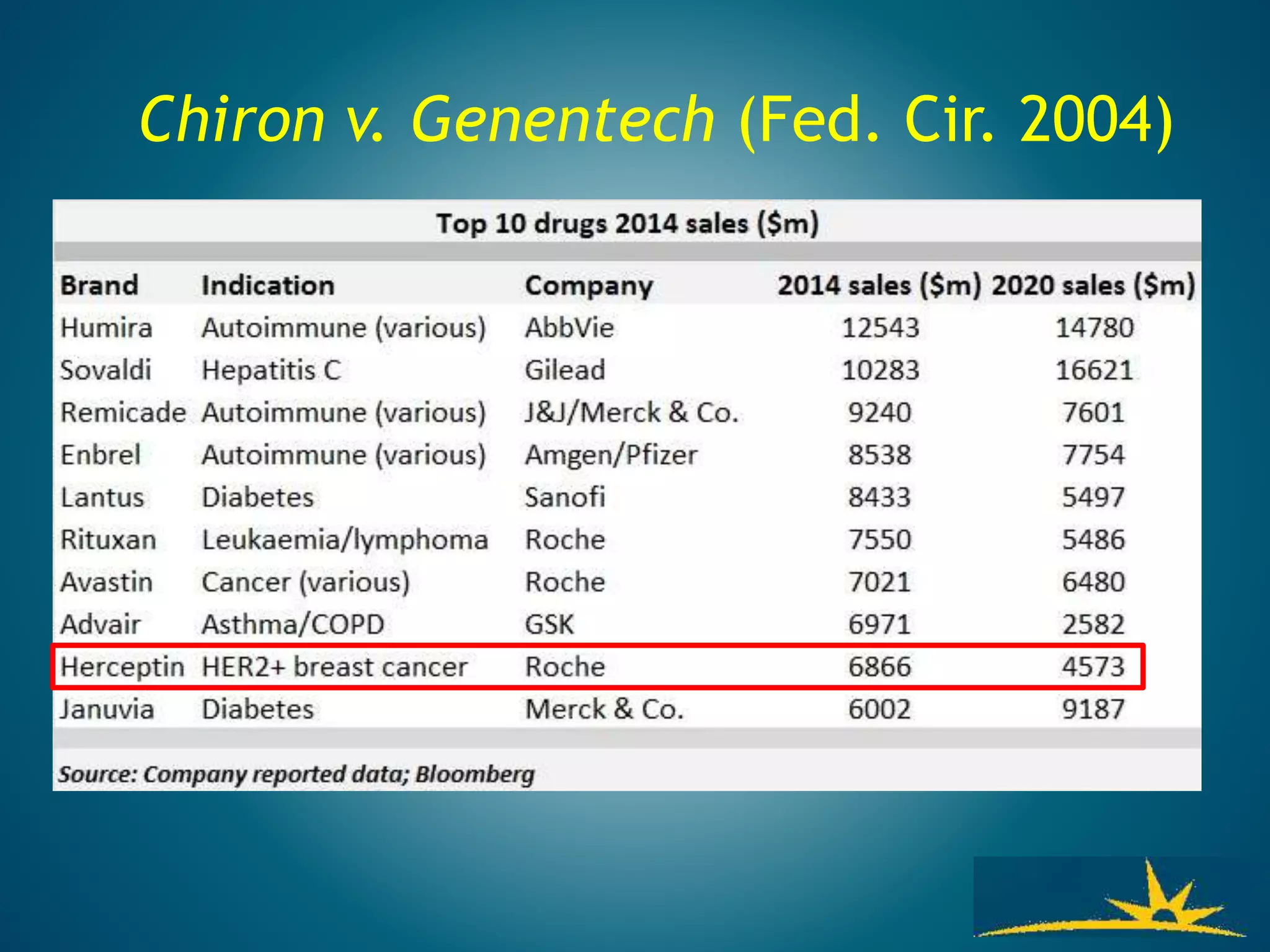
• Chiron v. Genentech (Fed. Cir. 2004)
• Rochester v. Searle (Fed. Cir. 2004)
• Ariad v. Lilly (Fed. Cir. 2009), (Fed. Cir., en banc,
2010)
• 35 U.S.C. § 101, Utility
– Specific, Substantial, and Credible
• 35 U.S.C. § 112, Specification
– Enablement
– Written Description
– Best Mode
The Statutory Patent Disclosure
Requirements
PRE-AIA
35 U.S.C. § 112, ¶ 1
The SPECIFICATION shall contain a written
description of the invention, and of the
manner and process of making and using it, in
such full, clear, concise, and exact terms as to
enable any person skilled in the art to which
it pertains … to make and use the same, and
shall set forth the best mode contemplated by
the inventor of carrying out his invention.
POST-AIA
35 U.S.C. § 112(a)
(a) In General.— The SPECIFICATION shall contain
a written description of the invention, and of
the manner and process of making and using it,
in such full, clear, concise, and exact terms as
to enable any person skilled in the art to
which it pertains … to make and use the same,
and shall set forth the best mode contemplated
by the inventor or joint inventor of carrying out
[[his]] the invention.
Enablement – Basic Concepts
 A patent application must provide sufficient
disclosure to enable a person skilled in the art
to make and use the claimed invention
 One skilled in the art would be enabled to
practice the claimed invention if:
• It would NOT require “undue experimentation” to
make and use the claimed invention
• The claims are NOT of “undue breadth” in view of
the scope of the disclosure provided by the
specification
Enablement – Basic Concepts
 In re Wands (Fed. Cir. 1988): “The key word is
‘undue,’ not ‘experimentation’ ” Quoting In re
Angstadt (CCPA 1976)
• Quantity of experimentation
• Amount of direction and guidance provided
• Presence or absence of working examples
• Nature of the invention
• State of the prior art
• Relative skill of those in the art
• Predictability of the art
• Breadth of the claims
The Problem of Enablement in
Biotechnology
 What is the scope of protection afforded by these
claims?
• A cDNA encoding Protein X, comprising the
nucleotide sequence of SEQ ID NO: 1.
(wherein SEQ ID NO: 1 encodes full-length Protein
X)
• A cDNA encoding Protein X, comprising a nucleotide
sequence that is at least 70% identical to the
nucleotide sequence of SEQ ID NO: 1.
 How easy would it be for a third-party competitor to
escape the literal scope of these claims by “designing
around” with insubstantial nucleotide substitutions?
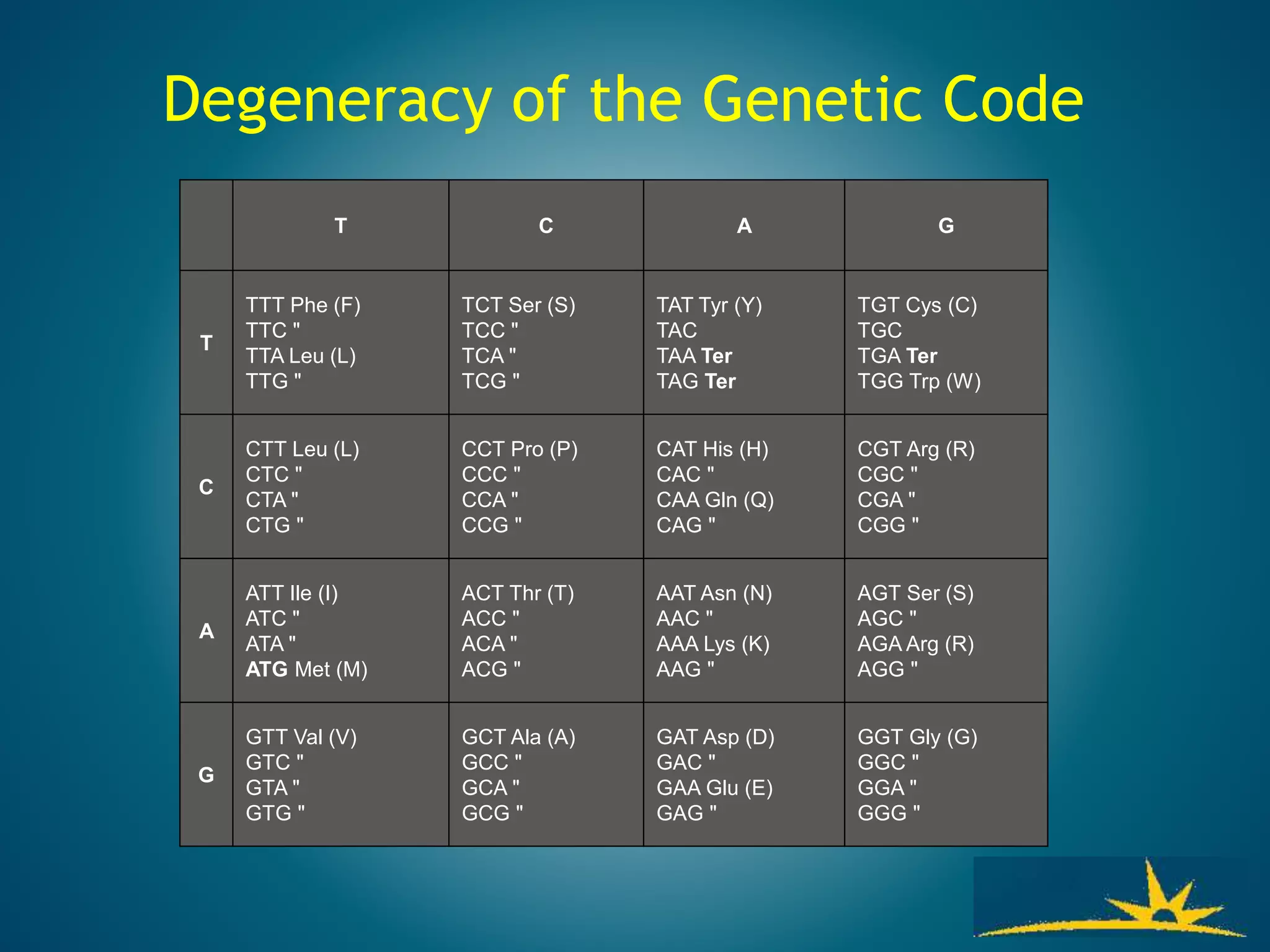
Degeneracy of the Genetic Code
T C A G
T
TTT Phe (F)
TTC "
TTA Leu (L)
TTG "
TCT Ser (S)
TCC "
TCA "
TCG "
TAT Tyr (Y)
TAC
TAA Ter
TAG Ter
TGT Cys (C)
TGC
TGA Ter
TGG Trp (W)
C
CTT Leu (L)
CTC "
CTA "
CTG "
CCT Pro (P)
CCC "
CCA "
CCG "
CAT His (H)
CAC "
CAA Gln (Q)
CAG "
CGT Arg (R)
CGC "
CGA "
CGG "
A
ATT Ile (I)
ATC "
ATA "
ATG Met (M)
ACT Thr (T)
ACC "
ACA "
ACG "
AAT Asn (N)
AAC "
AAA Lys (K)
AAG "
AGT Ser (S)
AGC "
AGA Arg (R)
AGG "
G
GTT Val (V)
GTC "
GTA "
GTG "
GCT Ala (A)
GCC "
GCA "
GCG "
GAT Asp (D)
GAC "
GAA Glu (E)
GAG "
GGT Gly (G)
GGC "
GGA "
GGG "
Amgen v. Chugai (Fed. Cir. 1991)
 Teach how to make and use the claimed
invention such that it can be practiced by a
person of skill in the art without undue
experimentation
• Disclosure that is commensurate in scope
with the breadth of the claims
• Multiple working examples within the claim
scope
• Teaching of how to test additional
undisclosed variants within the claim scope
Amgen v. Chugai (Fed. Cir. 1991)
 Make and Use Without Undue Experimentation
• Structural Limitations
−Provide algorithms for computing percent
identity
−Describe conservative amino acid
substitutions
• Functional Limitations
−Disclose assay systems and methodologies
for confirming claimed functionality
In Re Wright (Fed. Cir. 1993)
 Claim 11
A live, non-pathogenic vaccine for a pathogenic
RNA virus, comprising an immunologically effective
amount of a viral antigenic, genomic expression
having an antigenic determinant region of the RNA
virus, but no pathogenic properties.
In Re Wright (Fed. Cir. 1993)
 One Working Example
• A recombinant vaccine that confers
immunity in chickens against Prague Avian
Sarcoma Virus (PrASV), which is an RNA virus
that is a member of the Rous Associated
Virus (RAV) family
In Re Wright (Fed. Cir. 1993)
 Federal Circuit
• “… claims are directed to vaccines, and
methods of making and using these
vaccines, which must by definition trigger
an immunoprotective response in the host
vaccinated; mere antigenic response is not
enough”
In Re Wright (Fed. Cir. 1993)
 Federal Circuit
• “Wright has failed to establish by evidence
or arguments that, in February of 1983, a
skilled scientist would have believed
reasonably that Wright’s success with a
particular strain of an avian RNA virus
could be extrapolated with a reasonable
expectation of success** to other avian
RNA viruses.”
**QUERY: Is “reasonable expectation of
success” a test for enablement?
Enablement
 General Rules
• Broad scope requires broad disclosure
• Working examples not required
• Not required to teach “and preferably omits”
what is well known in the art”
(Hybritech v. Monoclonal Antibodies (Fed.
Cir. 1986))
Enablement
Historically …
• Enablement was the most onerous
disclosure requirement under 35 USC § 112,
first paragraph
UCalifornia v. Eli Lilly (Fed. Cir. 1997)
 UC disclosed:
• Cloned a cDNA encoding rat insulin
• Determined the rat cDNA nucleotide
sequence
• Amino acid sequence of human insulin protein
• General method for obtaining the human
cDNA
UC v. Eli Lilly (Fed. Cir. 1997)
 UC claimed:
1. A recombinant plasmid replicable in
procaryotic host containing within its
nucleotide sequence a subsequence having the
structure of the reverse transcript of an mRNA
of a vertebrate, which mRNA encodes insulin.
5. A recombinant procaryotic microorganism
modified so that it contains a nucleotide
sequence having the structure of the reverse
transcript of an mRNA of a human, which
mRNA encodes insulin.
UC v. Lilly (Fed. Cir. 1997)
 District Court
• Held claims invalid under § 112, ¶ 1,
because “the specification, although it
provided an adequate written description
of rat cDNA, did not provide an adequate
written description of the cDNA required
by the asserted claims.”
UC v. Lilly (Fed. Cir. 1997)
 Federal Circuit Upholds District Court
• Claim 1 invalid
−A description of rat insulin cDNA is not a
description of the broad classes [genra] of
vertebrate or mammalian insulin cDNA
−A description of a chemical genus ‘requires a
precise definition, such as by structure,
formula, [or] chemical name.’ Quoting, Fiers
v. Revel 984 F.2d at 1171
• Claim 5 invalid
−“whether or not [Example 6] provides an
enabling disclosure, it does not provide a
written description of the cDNA encoding
human insulin.”
UC v. Lilly (Fed. Cir. 1997)
Written description becomes a super-
enablement requirement, which is
separate and apart from the enablement
requirement
Enzo v. Gen-Probe (Fed. Cir. 2002)
 Rader dissent
• UC v. Lilly (1997) was a “deviation from 30
years of precedent”
• Fed. Cir., for the first time, “purported to
apply WD as a general disclosure doctrine in
place of enablement, rather than as a
priority doctrine.”
Enzo v. Gen-Probe (Fed. Cir. 2002)
 Rader Dissent
• History of the Written Description
Requirement
−“Written description” first appears in
Patent Act of 1793
−Evans v. Eaton (1822), S. Ct. construed
description requirement to be an
enablement requirement
−JEM AG Supply (2001), S. Ct.
acknowledged only enablement as the
disclosure quid pro quo of Patent Act
The Priority Claim
 35 U.S.C § 120. Benefit of Earlier Filing Date in
the United States
• “An application for patent for an invention
disclosed in the manner provided by the
first paragraph of section 112 of this title in
an application previously filed in the United
States … shall have the same effect, as to
such invention, as though filed on the date
of the prior application.”
What Does 35 U.S.C. § 120 Mean?
 A claim in a CON or CIP, which claims priority to
a parent application, is valid under 35 U.S.C. §
112, ¶1 if the priority application:
• Is enabling (make and use) of the claim
• Provides written description (possession)
support for the claim
 Supports a policy of providing broad protection
for pioneering inventions
Historical Perspective on
Continuation Practice
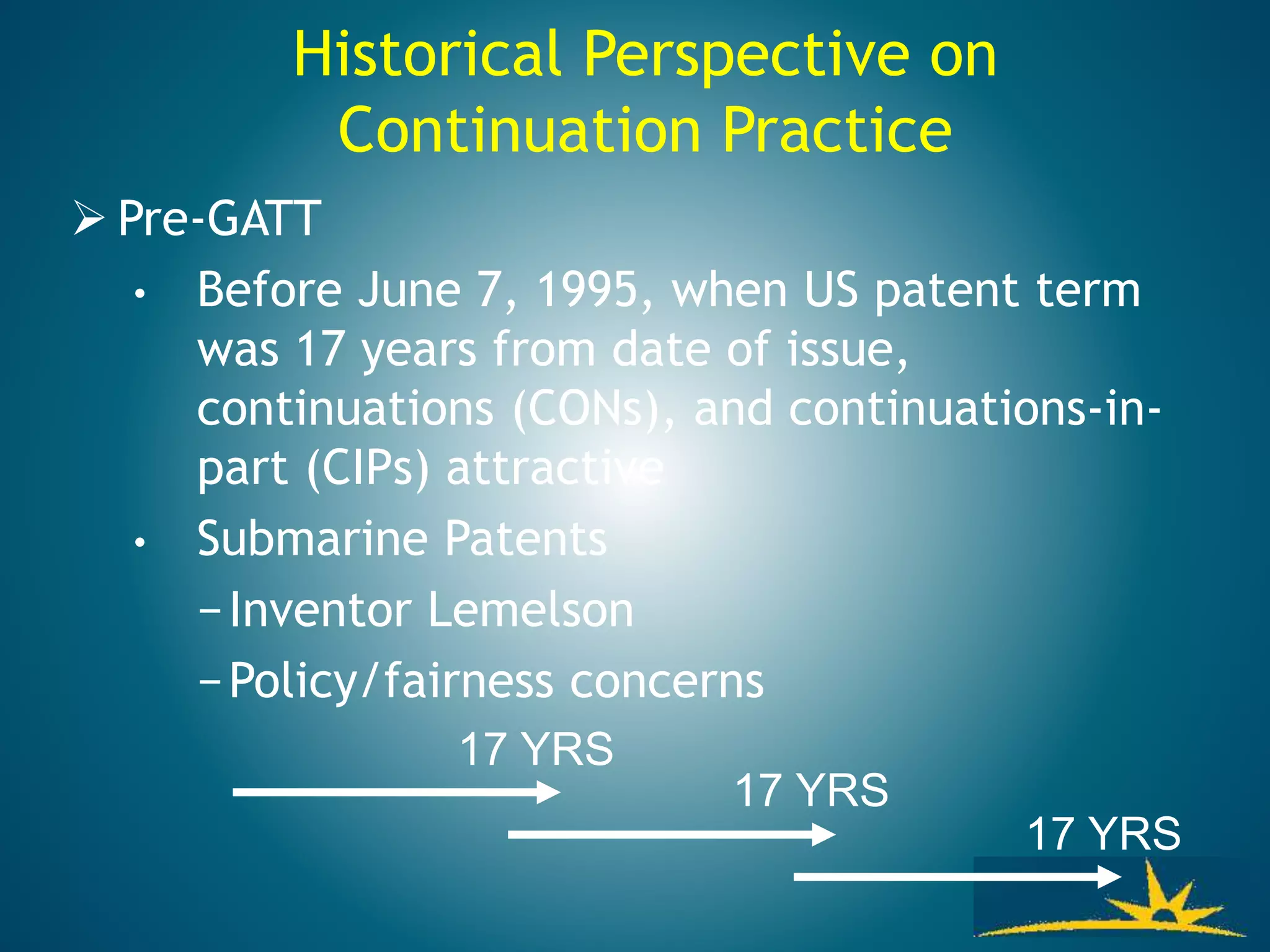
 Pre-GATT
• Before June 7, 1995, when US patent term
was 17 years from date of issue,
continuations (CONs), and continuations-in-
part (CIPs) attractive
• Submarine Patents
−Inventor Lemelson
−Policy/fairness concerns
17 YRS
17 YRS
17 YRS
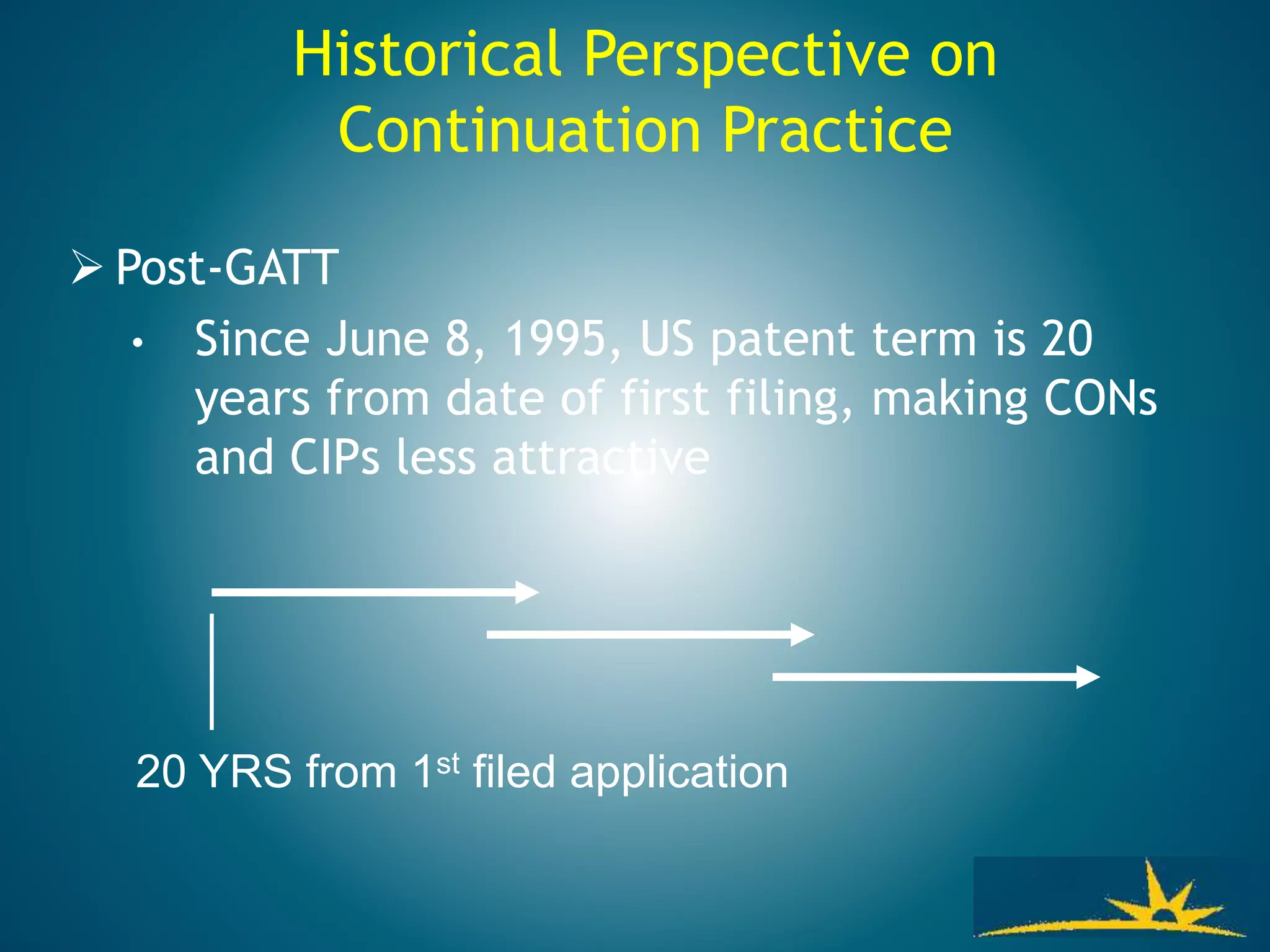
 Post-GATT
• Since June 8, 1995, US patent term is 20
years from date of first filing, making CONs
and CIPs less attractive
20 YRS from 1st filed application
Historical Perspective on
Continuation Practice
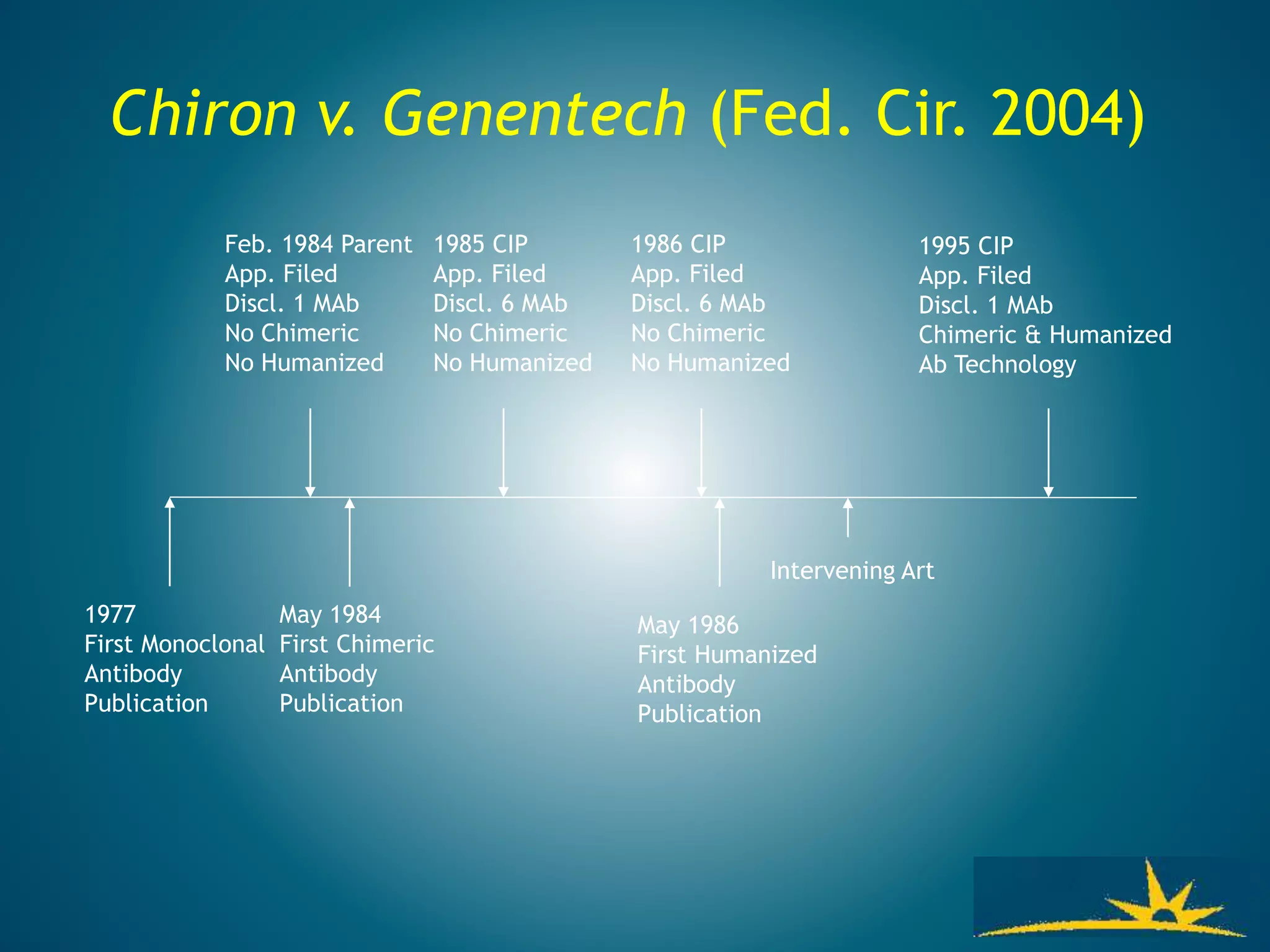
Chiron v. Genentech (Fed. Cir. 2004)
Feb. 1984 Parent
App. Filed
Discl. 1 MAb
No Chimeric
No Humanized
May 1984
First Chimeric
Antibody
Publication
1985 CIP
App. Filed
Discl. 6 MAb
No Chimeric
No Humanized
1986 CIP
App. Filed
Discl. 6 MAb
No Chimeric
No Humanized
1995 CIP
App. Filed
Discl. 1 MAb
Chimeric & Humanized
Ab Technology
May 1986
First Humanized
Antibody
Publication
Intervening Art
1977
First Monoclonal
Antibody
Publication
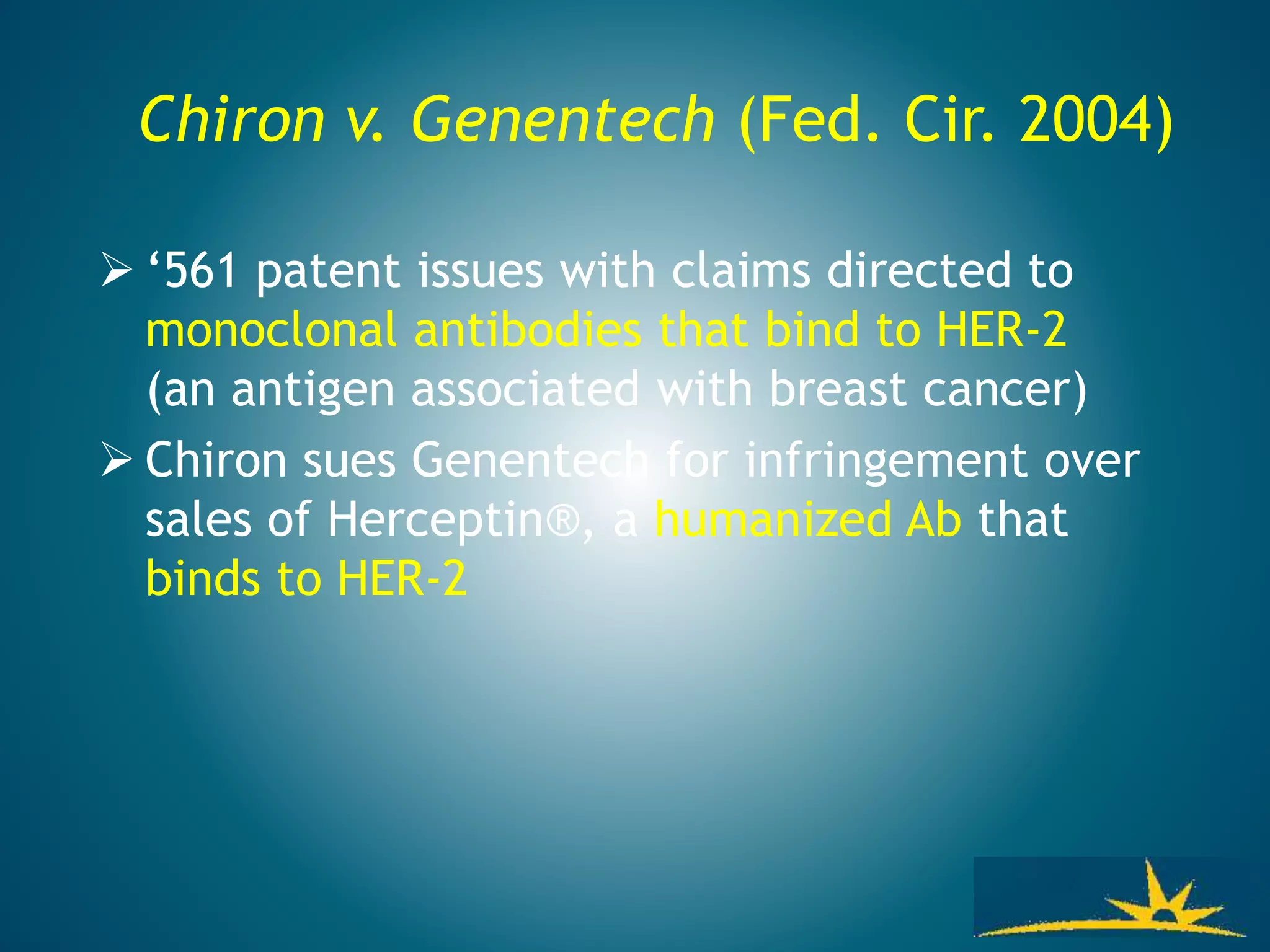
Chiron v. Genentech (Fed. Cir. 2004)
 ‘561 patent issues with claims directed to
monoclonal antibodies that bind to HER-2
(an antigen associated with breast cancer)
 Chiron sues Genentech for infringement over
sales of Herceptin®, a humanized Ab that
binds to HER-2
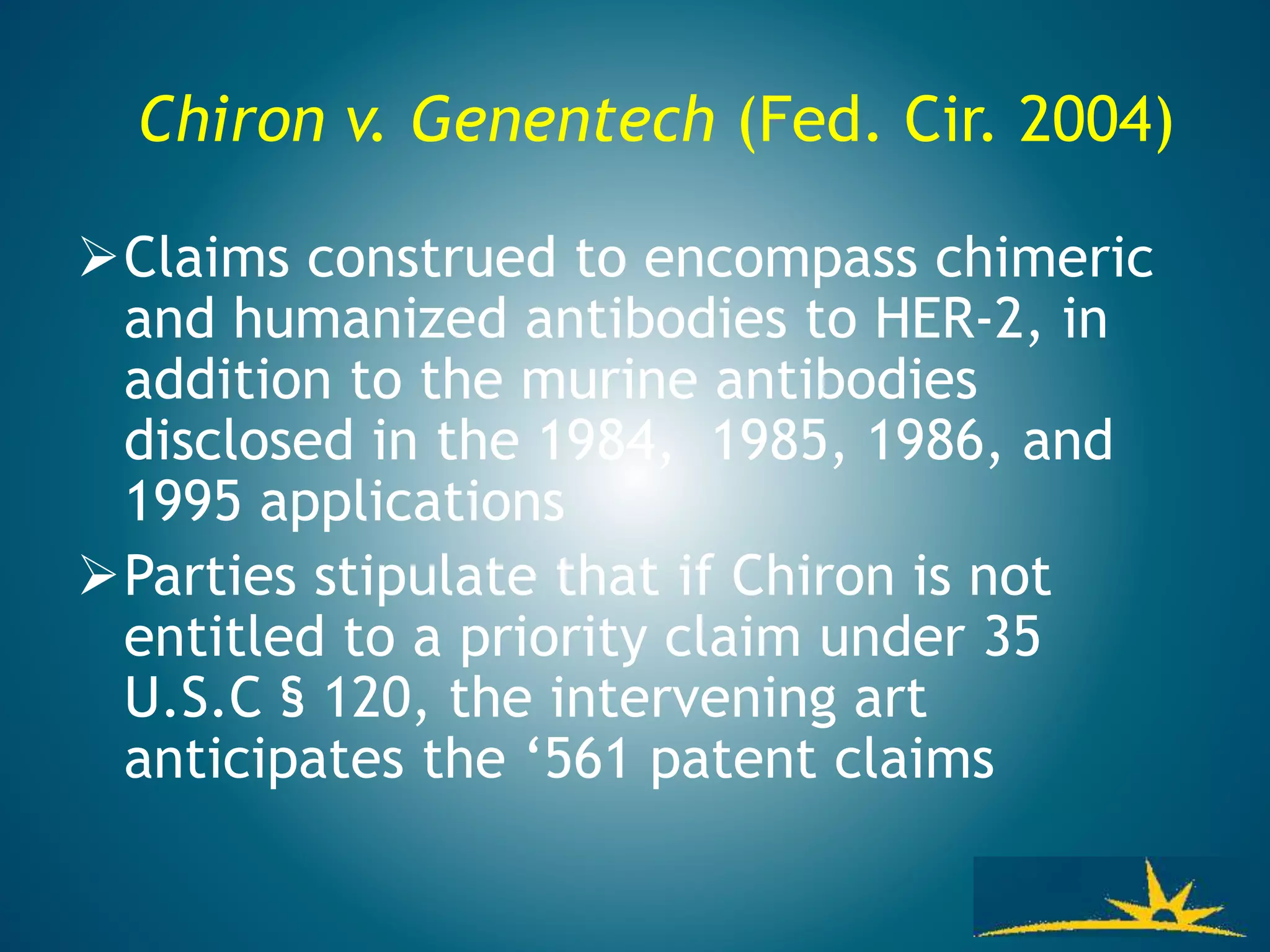
Chiron v. Genentech (Fed. Cir. 2004)
Claims construed to encompass chimeric
and humanized antibodies to HER-2, in
addition to the murine antibodies
disclosed in the 1984, 1985, 1986, and
1995 applications
Parties stipulate that if Chiron is not
entitled to a priority claim under 35
U.S.C § 120, the intervening art
anticipates the ‘561 patent claims
Chiron v. Genentech (Fed. Cir. 2004)
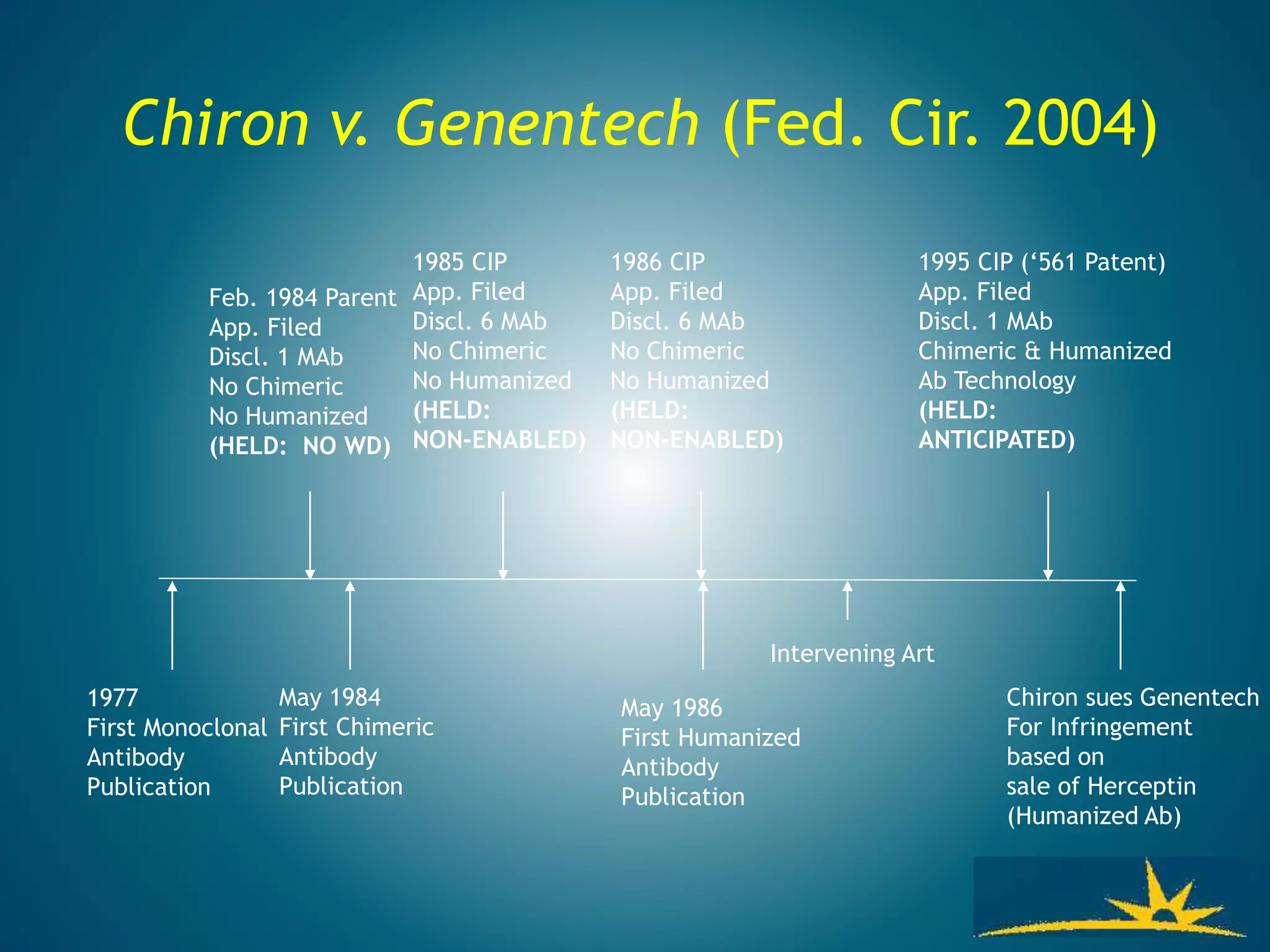
Feb. 1984 Parent
App. Filed
Discl. 1 MAb
No Chimeric
No Humanized
(HELD: NO WD)
May 1984
First Chimeric
Antibody
Publication
1985 CIP
App. Filed
Discl. 6 MAb
No Chimeric
No Humanized
(HELD:
NON-ENABLED)
1986 CIP
App. Filed
Discl. 6 MAb
No Chimeric
No Humanized
(HELD:
NON-ENABLED)
1995 CIP (‘561 Patent)
App. Filed
Discl. 1 MAb
Chimeric & Humanized
Ab Technology
(HELD:
ANTICIPATED)
May 1986
First Humanized
Antibody
Publication
Chiron sues Genentech
For Infringement
based on
sale of Herceptin
(Humanized Ab)
Intervening Art
1977
First Monoclonal
Antibody
Publication
Chiron v. Genentech (Fed. Cir. 2004)
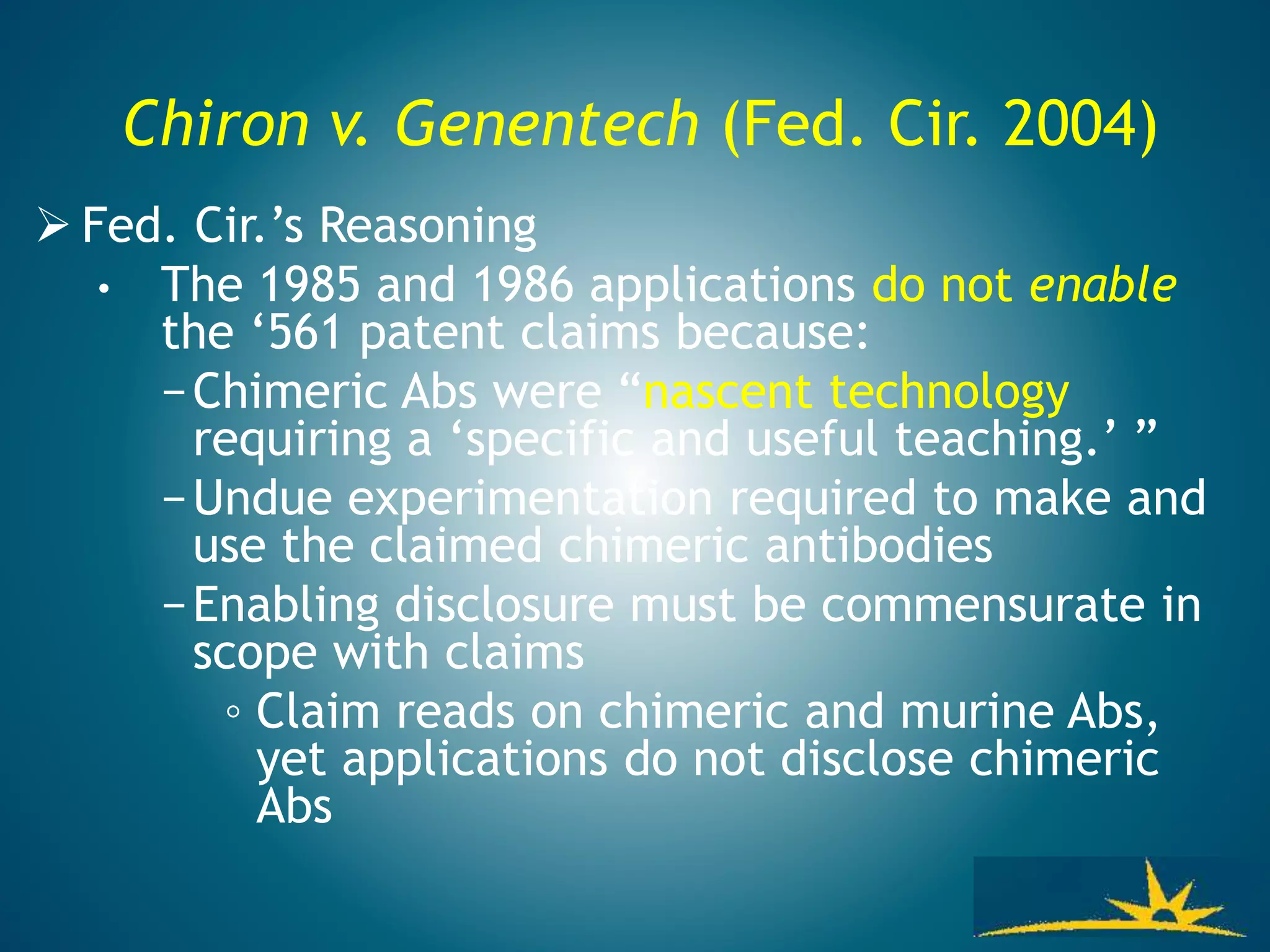
 Fed. Cir.’s Reasoning
• The 1985 and 1986 applications do not enable
the ‘561 patent claims because:
−Chimeric Abs were “nascent technology
requiring a ‘specific and useful teaching.’ ”
−Undue experimentation required to make and
use the claimed chimeric antibodies
−Enabling disclosure must be commensurate in
scope with claims
◦ Claim reads on chimeric and murine Abs,
yet applications do not disclose chimeric
Abs
Chiron v. Genentech (Fed. Cir. 2004)
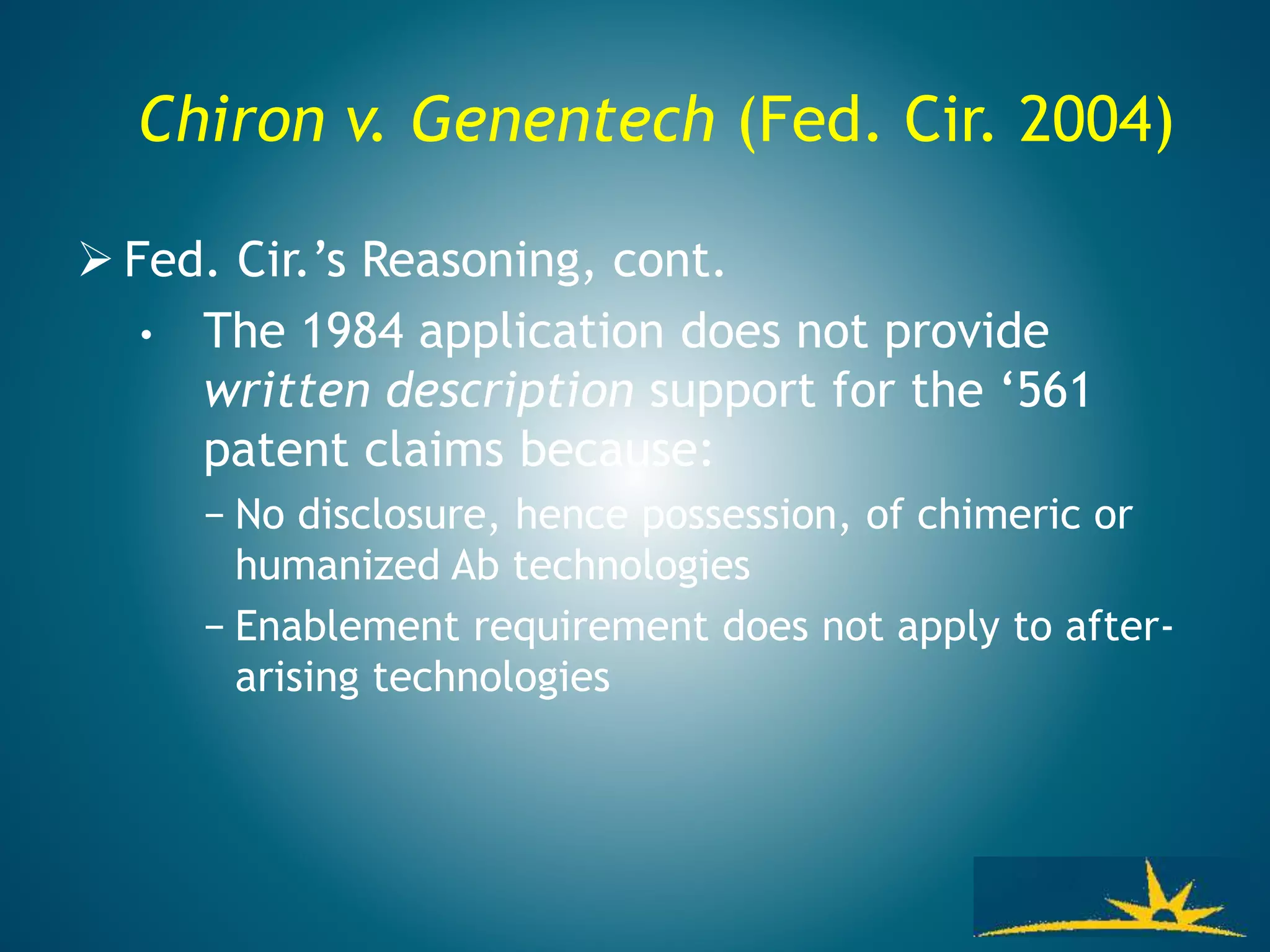
 Fed. Cir.’s Reasoning, cont.
• The 1984 application does not provide
written description support for the ‘561
patent claims because:
− No disclosure, hence possession, of chimeric or
humanized Ab technologies
− Enablement requirement does not apply to after-
arising technologies
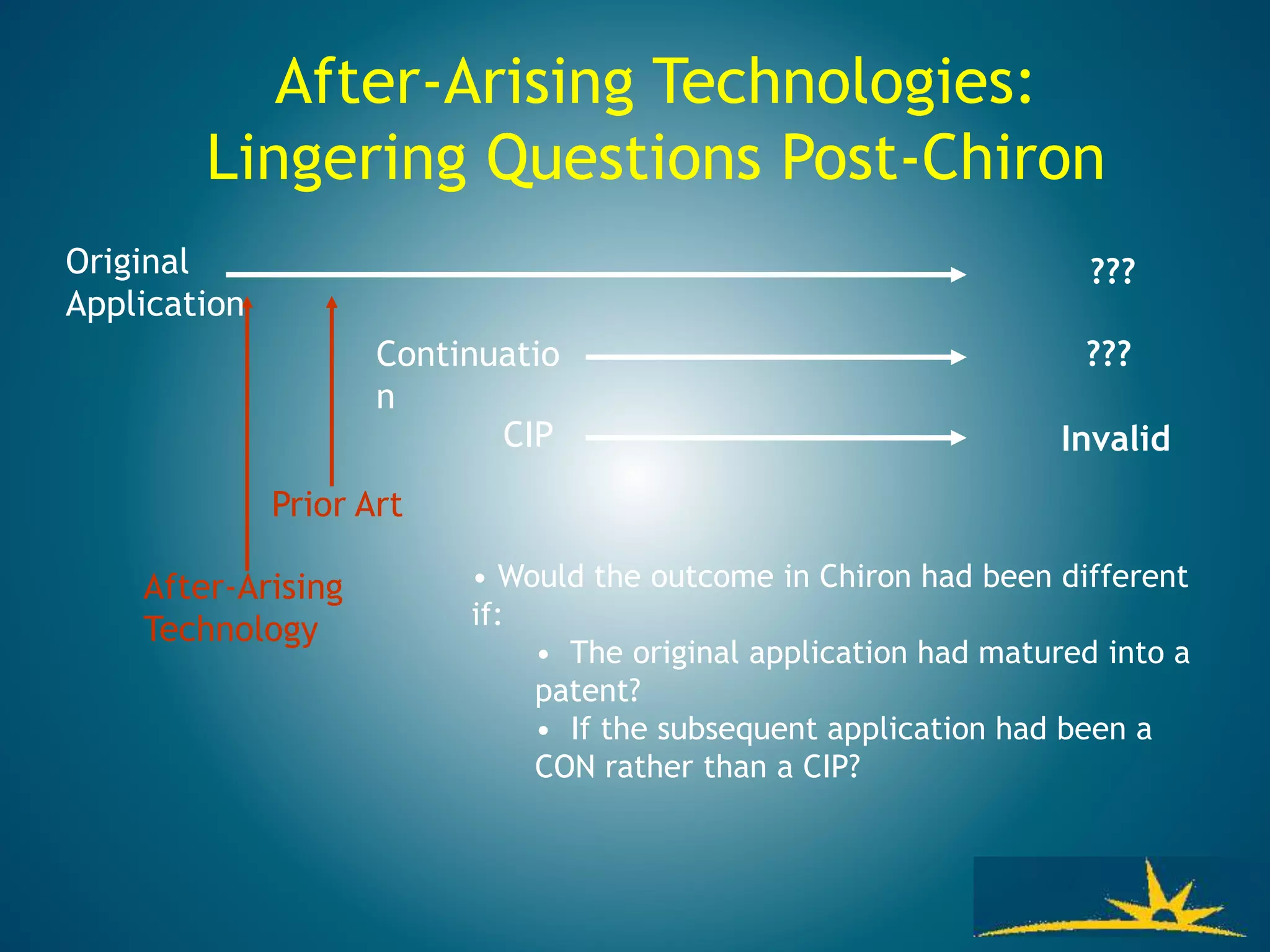
After-Arising Technologies:
Lingering Questions Post-Chiron
Original
Application
Invalid
After-Arising
Technology
CIP
Continuatio
n
???
???
• Would the outcome in Chiron had been different
if:
• The original application had matured into a
patent?
• If the subsequent application had been a
CON rather than a CIP?
Prior Art
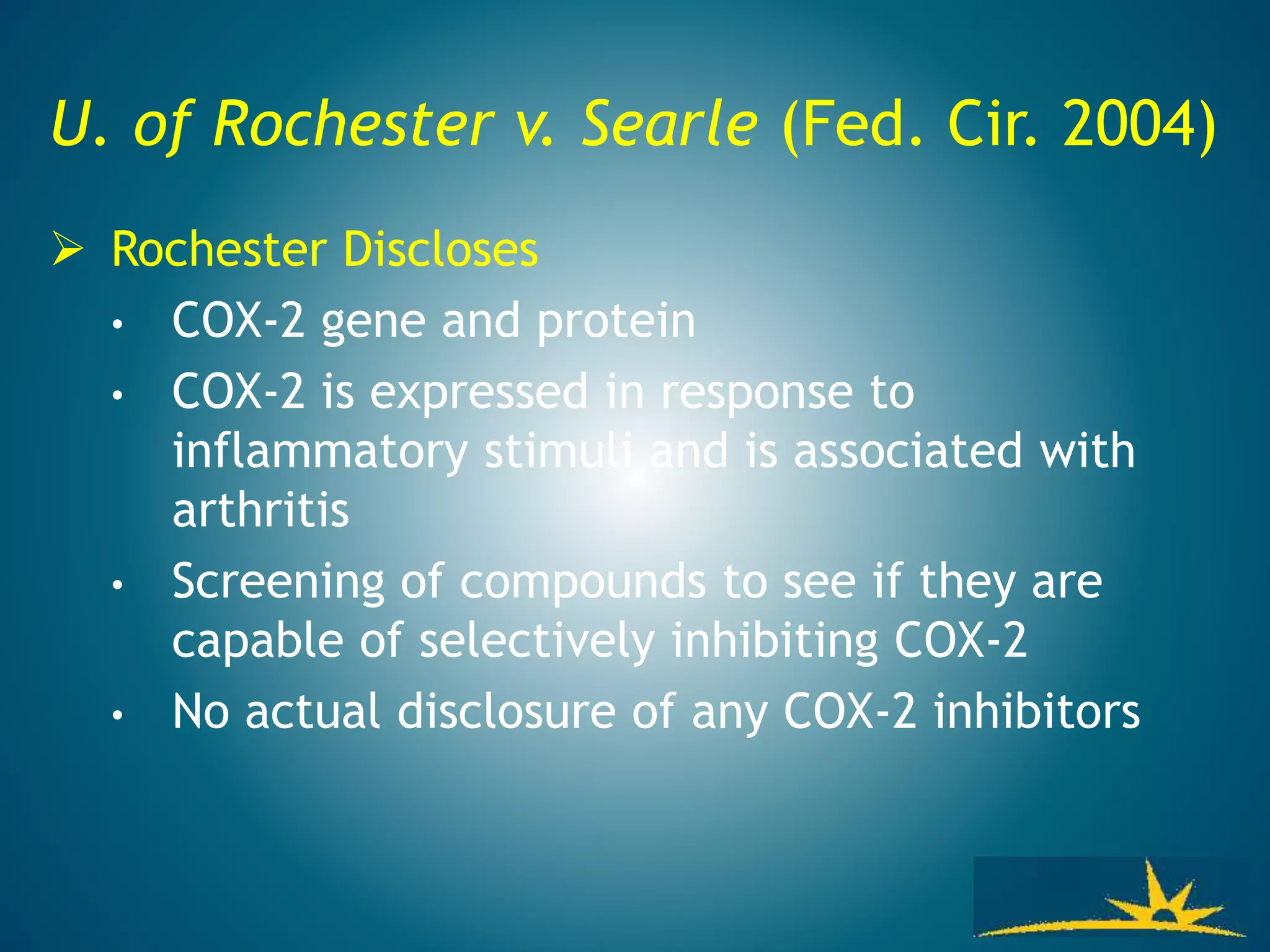
U. of Rochester v. Searle (Fed. Cir. 2004)
 Rochester Discloses
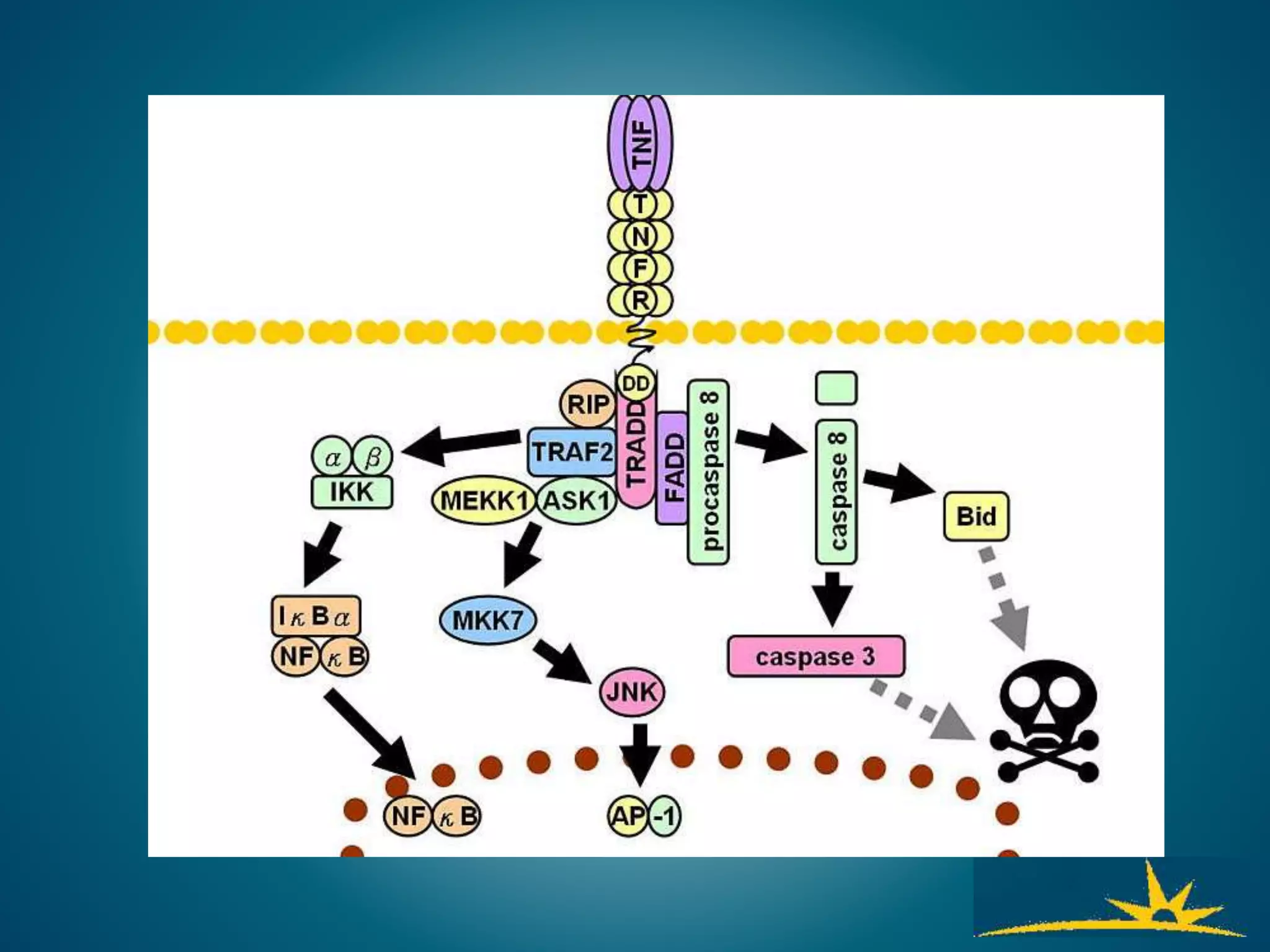
• COX-2 gene and protein
• COX-2 is expressed in response to
inflammatory stimuli and is associated with
arthritis
• Screening of compounds to see if they are
capable of selectively inhibiting COX-2
• No actual disclosure of any COX-2 inhibitors
U. of Rochester v. Searle (Fed. Cir. 2004)
 Rochester claims
• Methods for selectively inhibiting [COX-2]
activity in a human host, comprising
administering a non-steroidal compound that
selectively inhibits activity of the [COX-2]
gene product to a human host in need of
such treatment
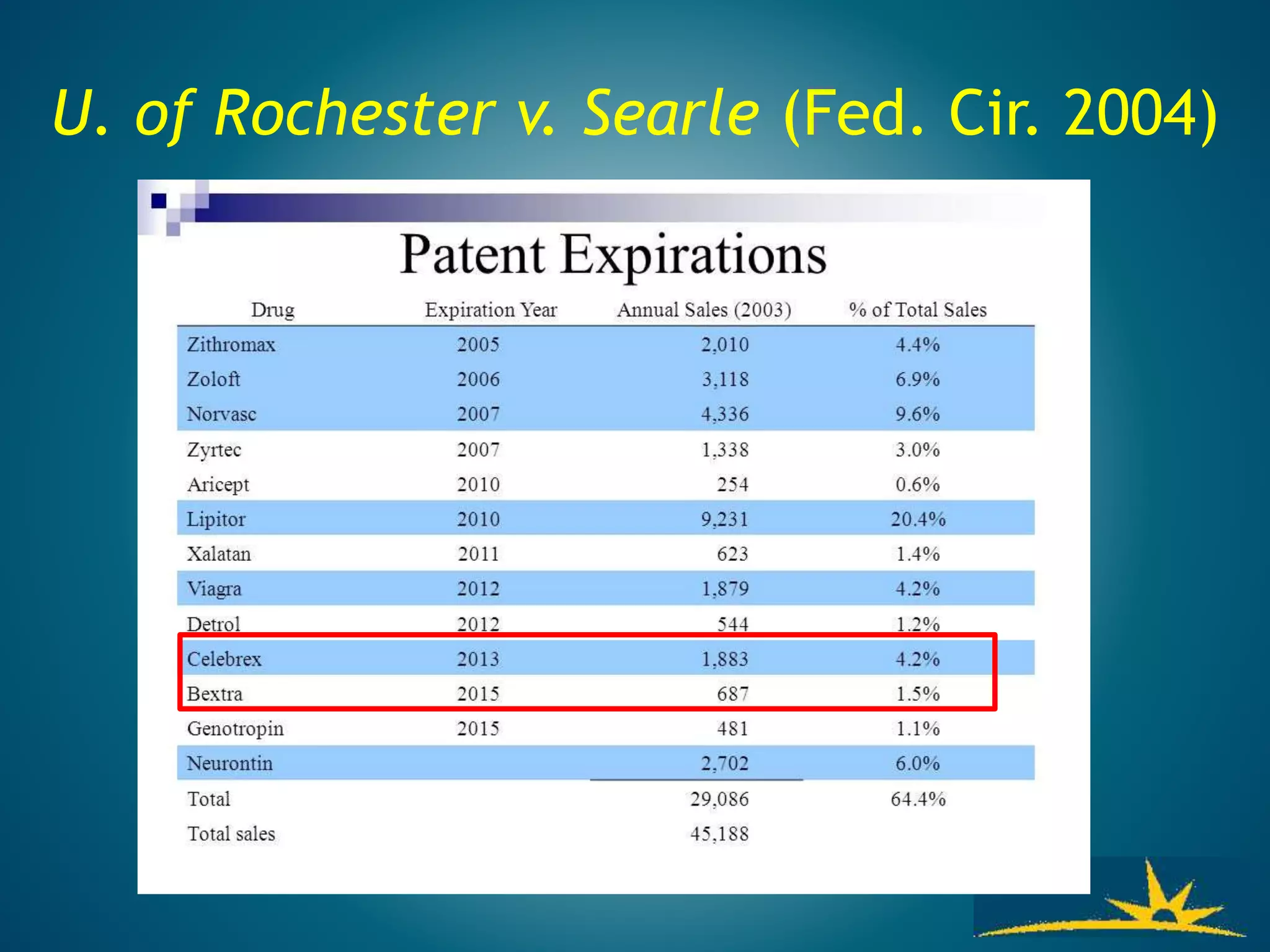
 Searle sued for sale of COX-2 inhibitors
Celebrex® and Bextra®, marketed for
treatment of inflammation
U. of Rochester v. Searle (Fed. Cir. 2004)
 Fed. Cir. upholds invalidity of claims for lack of
written description.
• “[T]he ‘850 patent does not disclose any
compounds that can be used in its claimed
methods. The claimed methods thus cannot
be practiced based on the patent’s
specification, even considering the
knowledge of one skilled in the art.”
Ariad v. Lilly (Fed. Cir. 2009)
Ariad Claims:
95. [A method for reducing, in eukaryotic
cells, the level of expression of genes which
are activated by extracellular influences
which induce NF-κB-mediated intracellular
signaling, the method comprising reducing
NF-κB activity in the cells such that
expression of said genes is reduced], carried
out on human cells.
Ariad v. Lilly (Fed. Cir. 2009)
 Ariad Disclosed:
• Three classes of molecules
(by function, not structure)
−Specific Inhibitors
−Dominantly interfering molecules
−Decoy molecules
Ariad v. Lilly (Fed. Cir. 2009)
District Court
• Held claims infringed and not invalid for
anticipation, lack of enablement, and lack
of written description
Ariad v. Lilly (Fed. Cir. 2009)
 Federal Circuit
• “Regardless of whether the asserted claims
recite a compound, Ariad still must describe
some way of performing the claimed
methods. … the specification suggests
only the use of the three classes of
molecules*** to achieve NF-κB reduction.”
*** The three classes of molecules include
−Specific Inhibitors
−Dominantly interfering molecules
−Decoy molecules
Ariad v. Lilly (Fed. Cir. 2009)
 Federal Circuit
“Thus, to satisfy the written description
requirement for the asserted claims, the
specification must demonstrate that Ariad
possessed the claimed methods by sufficiently
disclosing molecules capable of reducing NF-κB
activity.” Citing, Capon v. Eshhar (Fed. Cir. 2005)
Ariad v. Lilly (Fed. Cir. 2009)
 Federal Circuit
“A vague functional description and an
invitation for further research does not
constitute written disclosure of a specific
inhibitor.
* * *
written description requires more than a
‘mere wish or plan for obtaining the
claimed chemical invention.’ ” UC v. Eli Lilly
Ariad v. Lilly (Fed. Cir. 2009)
 Federal Circuit
• Judge Linn’s Concurrance
“I write separately to emphasize … my belief
that our engrafting of a separate written
description requirement onto 35 USC 112,
paragraph 1 is misguided.
* * *
[S]ection 112, paragraph 1 requires no more
of the specification than a disclosure that is
sufficient to enable a person having
ordinary skill in the art to make and use the
invention.”
Ariad v. Lilly (Fed. Cir. 2009)
 Ariad appeals to Federal Circuit for en banc
review
• Whether 35 U.S.C. § 112, ¶ 1, contains a
written description requirement separate
from an enablement requirement
• If a separate written description
requirement is set forth in the statute, what
is the scope and purpose of the
requirement?
 On August 21, 2009, Federal Circuit grants en
banc review, vacating the court’s April 3, 2009
opinion
Ariad v. Lilly (Fed. Cir. 2010) (en banc)
 Federal Circuit
• Opinion joined by every member of the
Court except Linn and Rader
• Reaffirms that there is a separate written
description and enablement requirement
under 35 USC § 112, first paragraph
Ariad v. Lilly (Fed. Cir. 2010) (en banc)
 A separate written description requirement
“plays a vital role in curtailing claims that do
not require undue experimentation to make and
use, and thus satisfy enablement, but that have
not been invented**, and thus cannot be
described.”
Ariad v. Lilly (Fed. Cir. 2010) (en banc)
 And “particularly for the biological arts,”
having a separate written description
requirement “ensures that when a patent
claims a genus by its function or result, the
specification recites sufficient materials to
accomplish that function.”
Ariad v. Lilly (Fed. Cir. 2010) (en banc)
 “Generic claim language appearing in ipsis
verbis in the original specification does not
satisfy the written description requirement if it
fails to support the scope of the genus
clamed.”
Ariad v. Lilly (Fed. Cir. 2010) (en banc)
 “A generic claim may define the boundaries of a vast
genus of chemical compounds, and yet the question may
still remain whether the specification, including original
claim language, demonstrates that the applicant has
invented species sufficient to support a claim to a
genus. The problem is especially acute with genus
claims that use functional language to define the
boundaries of a claimed genus. In such a case, the
functional claim may simply claim a desired result, and
may do so without describing species that achieve that
result. But the specification must demonstrate that the
applicant has made a generic invention that achieves
the claimed result and do so by showing that the
applicant has invented species sufficient to support a
claim to the functionally-defined genus.”
In Summary …
 35 U.S.C. § 112 (a) -- Specification
• Enablement
− Teach one skilled in the art
− Make and use the claimed invention
− Without undue experimentation
− Disclose nascent technology
• Written Description
− Demonstrate Applicant’s possession of the
claimed invention
− Provide disclosure of structure, formula,
chemical name, or physical properties
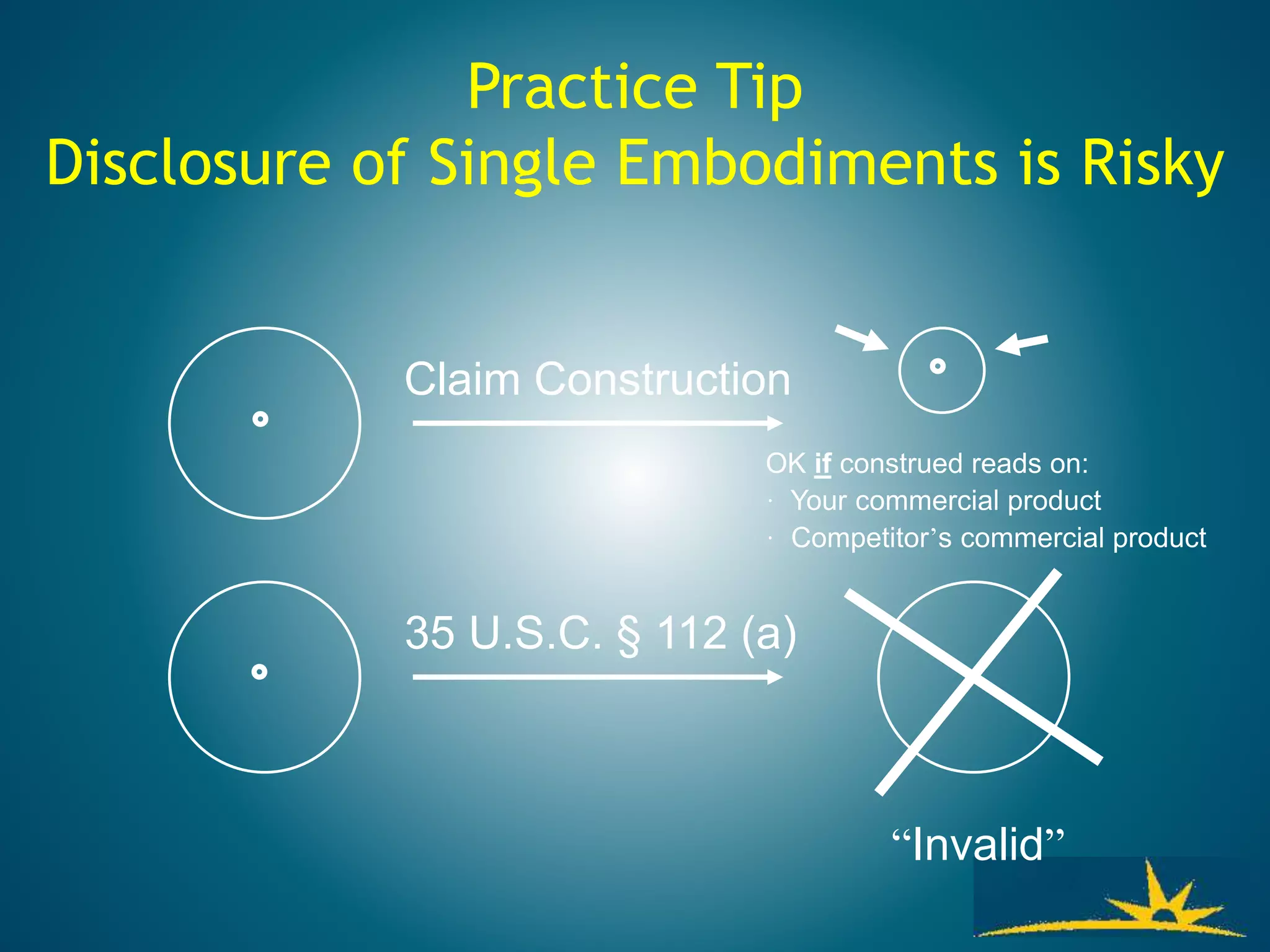
Practice Tip
Disclosure of Single Embodiments is Risky
Claim Construction
35 U.S.C. § 112 (a)
OK if construed reads on:
· Your commercial product
· Competitor’s commercial product
“Invalid”
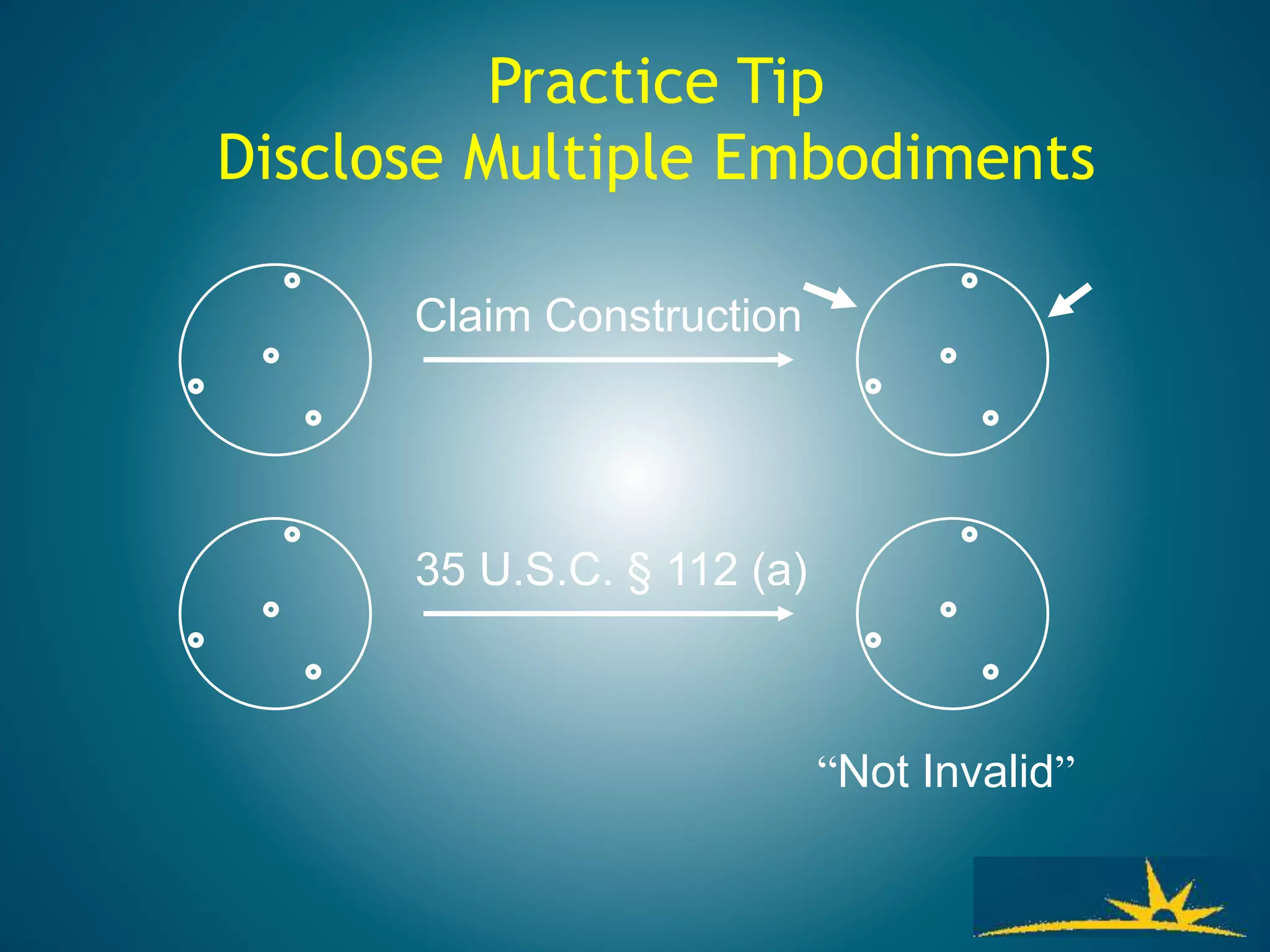
Practice Tip
Disclose Multiple Embodiments
Claim Construction
35 U.S.C. § 112 (a)
“Not Invalid”
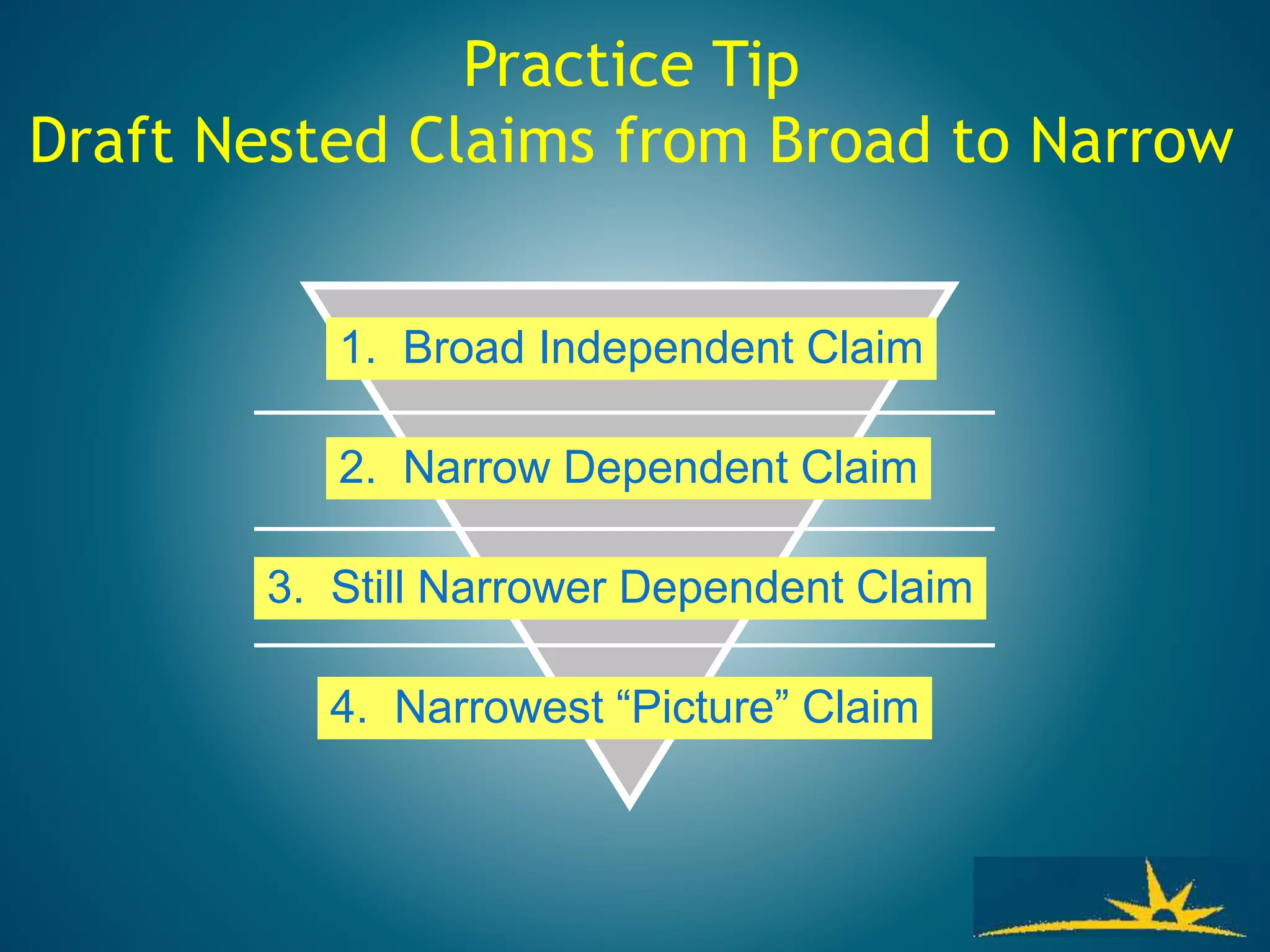
Practice Tip
Draft Nested Claims from Broad to Narrow
1. Broad Independent Claim
2. Narrow Dependent Claim
3. Still Narrower Dependent Claim
4. Narrowest “Picture” Claim
Stay Tuned …
Thank You!
Gary M. Myles, Ph.D.
gary@mylesip.com
(425) 466-8262

2017 01-25 uwls-apl_biotech 112

  • 1.
    Biotechnology Patents: Disclosure Requirementsunder 35 USC § 112 University of Washington School of Law Gary M. Myles, Ph.D. January 25, 2017 (425) 466-8262 gary@mylesip.com Copyright ©2017, Myles Intellectual Property Law
  • 2.
    Topics Covered 35 U.S.C.§ 112 Enablement and Written Description • In Re Wright (Fed. Cir. 1993) • U. of California v. Eli Lilly (Fed. Cir. 1997) • Enzo v. Gen-Probe (Fed. Cir. 2002), Rader Dissent • Chiron v. Genentech (Fed. Cir. 2004) • Rochester v. Searle (Fed. Cir. 2004) • Ariad v. Lilly (Fed. Cir. 2009), (Fed. Cir., en banc, 2010)
  • 3.
    • 35 U.S.C.§ 101, Utility – Specific, Substantial, and Credible • 35 U.S.C. § 112, Specification – Enablement – Written Description – Best Mode The Statutory Patent Disclosure Requirements
  • 4.
    PRE-AIA 35 U.S.C. §112, ¶ 1 The SPECIFICATION shall contain a written description of the invention, and of the manner and process of making and using it, in such full, clear, concise, and exact terms as to enable any person skilled in the art to which it pertains … to make and use the same, and shall set forth the best mode contemplated by the inventor of carrying out his invention.
  • 5.
    POST-AIA 35 U.S.C. §112(a) (a) In General.— The SPECIFICATION shall contain a written description of the invention, and of the manner and process of making and using it, in such full, clear, concise, and exact terms as to enable any person skilled in the art to which it pertains … to make and use the same, and shall set forth the best mode contemplated by the inventor or joint inventor of carrying out [[his]] the invention.
  • 6.
    Enablement – BasicConcepts  A patent application must provide sufficient disclosure to enable a person skilled in the art to make and use the claimed invention  One skilled in the art would be enabled to practice the claimed invention if: • It would NOT require “undue experimentation” to make and use the claimed invention • The claims are NOT of “undue breadth” in view of the scope of the disclosure provided by the specification
  • 7.
    Enablement – BasicConcepts  In re Wands (Fed. Cir. 1988): “The key word is ‘undue,’ not ‘experimentation’ ” Quoting In re Angstadt (CCPA 1976) • Quantity of experimentation • Amount of direction and guidance provided • Presence or absence of working examples • Nature of the invention • State of the prior art • Relative skill of those in the art • Predictability of the art • Breadth of the claims
  • 8.
    The Problem ofEnablement in Biotechnology  What is the scope of protection afforded by these claims? • A cDNA encoding Protein X, comprising the nucleotide sequence of SEQ ID NO: 1. (wherein SEQ ID NO: 1 encodes full-length Protein X) • A cDNA encoding Protein X, comprising a nucleotide sequence that is at least 70% identical to the nucleotide sequence of SEQ ID NO: 1.  How easy would it be for a third-party competitor to escape the literal scope of these claims by “designing around” with insubstantial nucleotide substitutions?
  • 9.
    Degeneracy of theGenetic Code T C A G T TTT Phe (F) TTC " TTA Leu (L) TTG " TCT Ser (S) TCC " TCA " TCG " TAT Tyr (Y) TAC TAA Ter TAG Ter TGT Cys (C) TGC TGA Ter TGG Trp (W) C CTT Leu (L) CTC " CTA " CTG " CCT Pro (P) CCC " CCA " CCG " CAT His (H) CAC " CAA Gln (Q) CAG " CGT Arg (R) CGC " CGA " CGG " A ATT Ile (I) ATC " ATA " ATG Met (M) ACT Thr (T) ACC " ACA " ACG " AAT Asn (N) AAC " AAA Lys (K) AAG " AGT Ser (S) AGC " AGA Arg (R) AGG " G GTT Val (V) GTC " GTA " GTG " GCT Ala (A) GCC " GCA " GCG " GAT Asp (D) GAC " GAA Glu (E) GAG " GGT Gly (G) GGC " GGA " GGG "
  • 10.
    Amgen v. Chugai(Fed. Cir. 1991)  Teach how to make and use the claimed invention such that it can be practiced by a person of skill in the art without undue experimentation • Disclosure that is commensurate in scope with the breadth of the claims • Multiple working examples within the claim scope • Teaching of how to test additional undisclosed variants within the claim scope
  • 11.
    Amgen v. Chugai(Fed. Cir. 1991)  Make and Use Without Undue Experimentation • Structural Limitations −Provide algorithms for computing percent identity −Describe conservative amino acid substitutions • Functional Limitations −Disclose assay systems and methodologies for confirming claimed functionality
  • 12.
    In Re Wright(Fed. Cir. 1993)  Claim 11 A live, non-pathogenic vaccine for a pathogenic RNA virus, comprising an immunologically effective amount of a viral antigenic, genomic expression having an antigenic determinant region of the RNA virus, but no pathogenic properties.
  • 13.
    In Re Wright(Fed. Cir. 1993)  One Working Example • A recombinant vaccine that confers immunity in chickens against Prague Avian Sarcoma Virus (PrASV), which is an RNA virus that is a member of the Rous Associated Virus (RAV) family
  • 14.
    In Re Wright(Fed. Cir. 1993)  Federal Circuit • “… claims are directed to vaccines, and methods of making and using these vaccines, which must by definition trigger an immunoprotective response in the host vaccinated; mere antigenic response is not enough”
  • 15.
    In Re Wright(Fed. Cir. 1993)  Federal Circuit • “Wright has failed to establish by evidence or arguments that, in February of 1983, a skilled scientist would have believed reasonably that Wright’s success with a particular strain of an avian RNA virus could be extrapolated with a reasonable expectation of success** to other avian RNA viruses.” **QUERY: Is “reasonable expectation of success” a test for enablement?
  • 16.
    Enablement  General Rules •Broad scope requires broad disclosure • Working examples not required • Not required to teach “and preferably omits” what is well known in the art” (Hybritech v. Monoclonal Antibodies (Fed. Cir. 1986))
  • 17.
    Enablement Historically … • Enablementwas the most onerous disclosure requirement under 35 USC § 112, first paragraph
  • 18.
    UCalifornia v. EliLilly (Fed. Cir. 1997)  UC disclosed: • Cloned a cDNA encoding rat insulin • Determined the rat cDNA nucleotide sequence • Amino acid sequence of human insulin protein • General method for obtaining the human cDNA
  • 19.
    UC v. EliLilly (Fed. Cir. 1997)  UC claimed: 1. A recombinant plasmid replicable in procaryotic host containing within its nucleotide sequence a subsequence having the structure of the reverse transcript of an mRNA of a vertebrate, which mRNA encodes insulin. 5. A recombinant procaryotic microorganism modified so that it contains a nucleotide sequence having the structure of the reverse transcript of an mRNA of a human, which mRNA encodes insulin.
  • 20.
    UC v. Lilly(Fed. Cir. 1997)  District Court • Held claims invalid under § 112, ¶ 1, because “the specification, although it provided an adequate written description of rat cDNA, did not provide an adequate written description of the cDNA required by the asserted claims.”
  • 21.
    UC v. Lilly(Fed. Cir. 1997)  Federal Circuit Upholds District Court • Claim 1 invalid −A description of rat insulin cDNA is not a description of the broad classes [genra] of vertebrate or mammalian insulin cDNA −A description of a chemical genus ‘requires a precise definition, such as by structure, formula, [or] chemical name.’ Quoting, Fiers v. Revel 984 F.2d at 1171 • Claim 5 invalid −“whether or not [Example 6] provides an enabling disclosure, it does not provide a written description of the cDNA encoding human insulin.”
  • 22.
    UC v. Lilly(Fed. Cir. 1997) Written description becomes a super- enablement requirement, which is separate and apart from the enablement requirement
  • 23.
    Enzo v. Gen-Probe(Fed. Cir. 2002)  Rader dissent • UC v. Lilly (1997) was a “deviation from 30 years of precedent” • Fed. Cir., for the first time, “purported to apply WD as a general disclosure doctrine in place of enablement, rather than as a priority doctrine.”
  • 24.
    Enzo v. Gen-Probe(Fed. Cir. 2002)  Rader Dissent • History of the Written Description Requirement −“Written description” first appears in Patent Act of 1793 −Evans v. Eaton (1822), S. Ct. construed description requirement to be an enablement requirement −JEM AG Supply (2001), S. Ct. acknowledged only enablement as the disclosure quid pro quo of Patent Act
  • 25.
    The Priority Claim 35 U.S.C § 120. Benefit of Earlier Filing Date in the United States • “An application for patent for an invention disclosed in the manner provided by the first paragraph of section 112 of this title in an application previously filed in the United States … shall have the same effect, as to such invention, as though filed on the date of the prior application.”
  • 26.
    What Does 35U.S.C. § 120 Mean?  A claim in a CON or CIP, which claims priority to a parent application, is valid under 35 U.S.C. § 112, ¶1 if the priority application: • Is enabling (make and use) of the claim • Provides written description (possession) support for the claim  Supports a policy of providing broad protection for pioneering inventions
  • 27.
    Historical Perspective on ContinuationPractice  Pre-GATT • Before June 7, 1995, when US patent term was 17 years from date of issue, continuations (CONs), and continuations-in- part (CIPs) attractive • Submarine Patents −Inventor Lemelson −Policy/fairness concerns 17 YRS 17 YRS 17 YRS
  • 28.
     Post-GATT • SinceJune 8, 1995, US patent term is 20 years from date of first filing, making CONs and CIPs less attractive 20 YRS from 1st filed application Historical Perspective on Continuation Practice
  • 29.
    Chiron v. Genentech(Fed. Cir. 2004) Feb. 1984 Parent App. Filed Discl. 1 MAb No Chimeric No Humanized May 1984 First Chimeric Antibody Publication 1985 CIP App. Filed Discl. 6 MAb No Chimeric No Humanized 1986 CIP App. Filed Discl. 6 MAb No Chimeric No Humanized 1995 CIP App. Filed Discl. 1 MAb Chimeric & Humanized Ab Technology May 1986 First Humanized Antibody Publication Intervening Art 1977 First Monoclonal Antibody Publication
  • 30.
    Chiron v. Genentech(Fed. Cir. 2004)  ‘561 patent issues with claims directed to monoclonal antibodies that bind to HER-2 (an antigen associated with breast cancer)  Chiron sues Genentech for infringement over sales of Herceptin®, a humanized Ab that binds to HER-2
  • 31.
    Chiron v. Genentech(Fed. Cir. 2004)
  • 32.
    Chiron v. Genentech(Fed. Cir. 2004) Claims construed to encompass chimeric and humanized antibodies to HER-2, in addition to the murine antibodies disclosed in the 1984, 1985, 1986, and 1995 applications Parties stipulate that if Chiron is not entitled to a priority claim under 35 U.S.C § 120, the intervening art anticipates the ‘561 patent claims
  • 33.
    Chiron v. Genentech(Fed. Cir. 2004) Feb. 1984 Parent App. Filed Discl. 1 MAb No Chimeric No Humanized (HELD: NO WD) May 1984 First Chimeric Antibody Publication 1985 CIP App. Filed Discl. 6 MAb No Chimeric No Humanized (HELD: NON-ENABLED) 1986 CIP App. Filed Discl. 6 MAb No Chimeric No Humanized (HELD: NON-ENABLED) 1995 CIP (‘561 Patent) App. Filed Discl. 1 MAb Chimeric & Humanized Ab Technology (HELD: ANTICIPATED) May 1986 First Humanized Antibody Publication Chiron sues Genentech For Infringement based on sale of Herceptin (Humanized Ab) Intervening Art 1977 First Monoclonal Antibody Publication
  • 34.
    Chiron v. Genentech(Fed. Cir. 2004)  Fed. Cir.’s Reasoning • The 1985 and 1986 applications do not enable the ‘561 patent claims because: −Chimeric Abs were “nascent technology requiring a ‘specific and useful teaching.’ ” −Undue experimentation required to make and use the claimed chimeric antibodies −Enabling disclosure must be commensurate in scope with claims ◦ Claim reads on chimeric and murine Abs, yet applications do not disclose chimeric Abs
  • 35.
    Chiron v. Genentech(Fed. Cir. 2004)  Fed. Cir.’s Reasoning, cont. • The 1984 application does not provide written description support for the ‘561 patent claims because: − No disclosure, hence possession, of chimeric or humanized Ab technologies − Enablement requirement does not apply to after- arising technologies
  • 36.
    After-Arising Technologies: Lingering QuestionsPost-Chiron Original Application Invalid After-Arising Technology CIP Continuatio n ??? ??? • Would the outcome in Chiron had been different if: • The original application had matured into a patent? • If the subsequent application had been a CON rather than a CIP? Prior Art
  • 37.
    U. of Rochesterv. Searle (Fed. Cir. 2004)  Rochester Discloses • COX-2 gene and protein • COX-2 is expressed in response to inflammatory stimuli and is associated with arthritis • Screening of compounds to see if they are capable of selectively inhibiting COX-2 • No actual disclosure of any COX-2 inhibitors
  • 38.
    U. of Rochesterv. Searle (Fed. Cir. 2004)  Rochester claims • Methods for selectively inhibiting [COX-2] activity in a human host, comprising administering a non-steroidal compound that selectively inhibits activity of the [COX-2] gene product to a human host in need of such treatment  Searle sued for sale of COX-2 inhibitors Celebrex® and Bextra®, marketed for treatment of inflammation
  • 39.
    U. of Rochesterv. Searle (Fed. Cir. 2004)
  • 40.
    U. of Rochesterv. Searle (Fed. Cir. 2004)  Fed. Cir. upholds invalidity of claims for lack of written description. • “[T]he ‘850 patent does not disclose any compounds that can be used in its claimed methods. The claimed methods thus cannot be practiced based on the patent’s specification, even considering the knowledge of one skilled in the art.”
  • 41.
    Ariad v. Lilly(Fed. Cir. 2009) Ariad Claims: 95. [A method for reducing, in eukaryotic cells, the level of expression of genes which are activated by extracellular influences which induce NF-κB-mediated intracellular signaling, the method comprising reducing NF-κB activity in the cells such that expression of said genes is reduced], carried out on human cells.
  • 43.
    Ariad v. Lilly(Fed. Cir. 2009)  Ariad Disclosed: • Three classes of molecules (by function, not structure) −Specific Inhibitors −Dominantly interfering molecules −Decoy molecules
  • 44.
    Ariad v. Lilly(Fed. Cir. 2009) District Court • Held claims infringed and not invalid for anticipation, lack of enablement, and lack of written description
  • 45.
    Ariad v. Lilly(Fed. Cir. 2009)  Federal Circuit • “Regardless of whether the asserted claims recite a compound, Ariad still must describe some way of performing the claimed methods. … the specification suggests only the use of the three classes of molecules*** to achieve NF-κB reduction.” *** The three classes of molecules include −Specific Inhibitors −Dominantly interfering molecules −Decoy molecules
  • 46.
    Ariad v. Lilly(Fed. Cir. 2009)  Federal Circuit “Thus, to satisfy the written description requirement for the asserted claims, the specification must demonstrate that Ariad possessed the claimed methods by sufficiently disclosing molecules capable of reducing NF-κB activity.” Citing, Capon v. Eshhar (Fed. Cir. 2005)
  • 47.
    Ariad v. Lilly(Fed. Cir. 2009)  Federal Circuit “A vague functional description and an invitation for further research does not constitute written disclosure of a specific inhibitor. * * * written description requires more than a ‘mere wish or plan for obtaining the claimed chemical invention.’ ” UC v. Eli Lilly
  • 48.
    Ariad v. Lilly(Fed. Cir. 2009)  Federal Circuit • Judge Linn’s Concurrance “I write separately to emphasize … my belief that our engrafting of a separate written description requirement onto 35 USC 112, paragraph 1 is misguided. * * * [S]ection 112, paragraph 1 requires no more of the specification than a disclosure that is sufficient to enable a person having ordinary skill in the art to make and use the invention.”
  • 49.
    Ariad v. Lilly(Fed. Cir. 2009)  Ariad appeals to Federal Circuit for en banc review • Whether 35 U.S.C. § 112, ¶ 1, contains a written description requirement separate from an enablement requirement • If a separate written description requirement is set forth in the statute, what is the scope and purpose of the requirement?  On August 21, 2009, Federal Circuit grants en banc review, vacating the court’s April 3, 2009 opinion
  • 50.
    Ariad v. Lilly(Fed. Cir. 2010) (en banc)  Federal Circuit • Opinion joined by every member of the Court except Linn and Rader • Reaffirms that there is a separate written description and enablement requirement under 35 USC § 112, first paragraph
  • 51.
    Ariad v. Lilly(Fed. Cir. 2010) (en banc)  A separate written description requirement “plays a vital role in curtailing claims that do not require undue experimentation to make and use, and thus satisfy enablement, but that have not been invented**, and thus cannot be described.”
  • 52.
    Ariad v. Lilly(Fed. Cir. 2010) (en banc)  And “particularly for the biological arts,” having a separate written description requirement “ensures that when a patent claims a genus by its function or result, the specification recites sufficient materials to accomplish that function.”
  • 53.
    Ariad v. Lilly(Fed. Cir. 2010) (en banc)  “Generic claim language appearing in ipsis verbis in the original specification does not satisfy the written description requirement if it fails to support the scope of the genus clamed.”
  • 54.
    Ariad v. Lilly(Fed. Cir. 2010) (en banc)  “A generic claim may define the boundaries of a vast genus of chemical compounds, and yet the question may still remain whether the specification, including original claim language, demonstrates that the applicant has invented species sufficient to support a claim to a genus. The problem is especially acute with genus claims that use functional language to define the boundaries of a claimed genus. In such a case, the functional claim may simply claim a desired result, and may do so without describing species that achieve that result. But the specification must demonstrate that the applicant has made a generic invention that achieves the claimed result and do so by showing that the applicant has invented species sufficient to support a claim to the functionally-defined genus.”
  • 55.
    In Summary … 35 U.S.C. § 112 (a) -- Specification • Enablement − Teach one skilled in the art − Make and use the claimed invention − Without undue experimentation − Disclose nascent technology • Written Description − Demonstrate Applicant’s possession of the claimed invention − Provide disclosure of structure, formula, chemical name, or physical properties
  • 56.
    Practice Tip Disclosure ofSingle Embodiments is Risky Claim Construction 35 U.S.C. § 112 (a) OK if construed reads on: · Your commercial product · Competitor’s commercial product “Invalid”
  • 57.
    Practice Tip Disclose MultipleEmbodiments Claim Construction 35 U.S.C. § 112 (a) “Not Invalid”
  • 58.
    Practice Tip Draft NestedClaims from Broad to Narrow 1. Broad Independent Claim 2. Narrow Dependent Claim 3. Still Narrower Dependent Claim 4. Narrowest “Picture” Claim
  • 59.
    Stay Tuned … ThankYou! Gary M. Myles, Ph.D. gary@mylesip.com (425) 466-8262