Setting up the Company
Presented to: Sir Jehanzaib Akram
Presented By: Rian Haider
Hafiz Zohaib
Sameera Khan
Junaid Jameel
Forms of Business
Sole proprietorship
C-corporations
S-corporation
Partnership
Limited Liability Companies
Rian Haider
Is a type of business entity that is owned and run
by one individual
or one legal person and in which there is no legal
distinction between the owner and the business.
 The owner is in direct control of all elements and
is legally accountable for the finances of such
business and this may include debts, loans, loss etc.
INTRODUCTION
Pros Of Sole Proprietorship
Ease of formation
Tax benefits
Employment
Decision making
Less capital
No profit share
No Government regulations
Cons Of Sole Proprietorship
Liability
Taxes
Lack of continuity
Difficulty in raising capital
Short life
Hafiz Zohaib
 The corporate form of ownership was established to overcome
problems inherent in proprietorships and partnerships.
 A corporation is an association of individuals united for a
common purpose and permitted by law to use a common name
and to change its members without dissolution of the
association.
 The corporation carries on a business in its own name and
exists as a separate legal entity.
 It can raise capital by either selling ownership (stock)
or borrowing (issuing bonds).
 Individual owners, as stockholders, have no liability for
corporate debt.
 Foreign in a different state from the one where they
operate, because of favorable laws, rules, regulations, and
tax benefits.
 Limited liability
 Perpetuity
 Funding sources
 Transfer of ownership
 Separation of ownership and management
 Expansion and contraction
 Cost, time and paper work
 Taxation
 Red tape, paperwork and regulations
 Perils of increasing capitalization
 Federal and state control
 Charter restrictions
 S corporation is a corporate identity treated as an individual for
income tax purposes.
 In order to qualify for S corporate status, a company must meet
certain requirements:
 All stockholders must be individuals, estates, and certain trusts.
 There can be no more than 75 stockholders.
 The business must be a domestic corporation.
 Nonresident aliens cannot be stockholders.
 There can be only one class of common stock.
 Corporate taxes are avoided.
 Shareholders are taxed on the corporate income as if it were their own
and pay the appropriate individual income taxes.
 Profits are not taxed at both the corporate and personal levels, double
taxation is avoided.
 it achieves equity of taxation with small business single proprietorships,
partnerships, and corporations.
 In cases where the business is losing money, stockholders are allowed
to deduct these losses from their income on an individual basis.
 Lower taxable income taxes for the C corporation may be lower than taxes
on an individual resulting from the S corporation pass-through.
 S corporation cannot deduct as business expenses, for tax purposes, many
fringe benefits such as insurance.
 While the typical corporation can offer a wide range of pension benefits, the
S corporation’s options are fewer.
 Every state recognizes the S corporation for state tax purposes except
Connecticut, the District of Columbia, Louisiana, New Hampshire, New
Jersey, New York, Tennessee, Texas, and Vermont. Alaska, Florida, Nevada,
South Dakota, Texas, Washington, and Wyoming have no state income taxes.
Sameera Khan
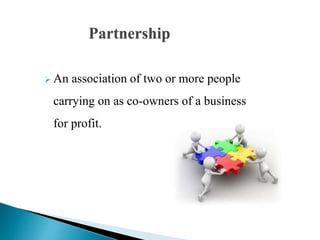
Partnership
 An association of two or more people
carrying on as co-owners of a business
for profit.
Types of Partners
 General partnership
 Limited partnership
Pros Of Partnership
 Easy to establish
 Complementary skills of partners
 Division of loss
 Larger Pool of capital
 Ability to Attract limited partners
 Little government regulation
 Taxation
Cons Of Partnership
 Unlimited liability of at least one partner
 Capital accumulation
 Restrictions of elimination for the general
partnership
 Lack of continuity for the general partnership
 Potential for personality and authority conflicts
 Share of profit
 Delayed decisions
Junaid Jameel
 An unincorporated business entity that combines the
most favorable attributes of general partnerships,
limited partnerships, and corporations.
Limited Liability Companies
Powers of an LLC
 An LLC has the same powers as an individual
 It can own, mortgage, and transfer real estate.
 It can own and transfer personal property.
 It can enter into contracts and make
guarantees.
 The LLC may borrow money, and issue notes
and bonds.
 An LLC can be sued and can sue.
Member’s Limited Liability
 Member – an owner of an LLC.
 Members have limited liability.
 Members are liable for the LLC’s debts, obligations, and
liabilities only to the extent of their capital contributions.
Liability of an LLC
 LLC is liable for loss or injury caused by wrongful
act or omission or member, manager, employee, or
agent in course of ordinary business.
 Managers are not personally liable for debts,
obligations, and liabilities of LLC.
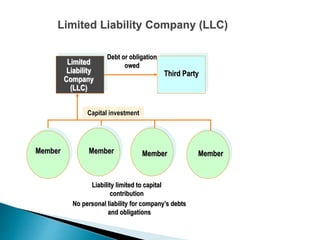
Limited Liability Company (LLC)
Liability limited to capital
contribution
No personal liability for company’s debts
and obligations
Capital investment
Debt or obligation
owedLimited
Liability
Company
(LLC)
Third Party
Member Member Member Member
Pros Of LLC
 Choice of tax regime.
 Limited liability,
 Much less administrative paperwork and record keeping than a corporation
 Pass-through taxation (i.e., no double taxation), unless the LLC elects to be
taxed as a C corporation.
 Using default tax classification, profits are taxed personally at the member
level, not at the LLC level.
Pros Of LLC
 LLCs in some states can be set up with just one natural
person involved.
 Less risk to be "stolen" by fire-sale acquisitions (more protection
against "hungry" investors).
 For real estate companies, each separate property can be owned by its
own, individual LLC, thereby shielding not only the owners, but their
other properties from cross-liability.
Cons Of LLC
 It may be more difficult to raise financial capital for an LLC
 Renewal fees may also be higher
 The management structure of an LLC may be unfamiliar to many.
Unlike corporations, they are not required to have a board of
directors or officers
Corporation

Corporation

  • 1.
    Setting up theCompany Presented to: Sir Jehanzaib Akram Presented By: Rian Haider Hafiz Zohaib Sameera Khan Junaid Jameel
  • 2.
    Forms of Business Soleproprietorship C-corporations S-corporation Partnership Limited Liability Companies
  • 3.
  • 5.
    Is a typeof business entity that is owned and run by one individual or one legal person and in which there is no legal distinction between the owner and the business.  The owner is in direct control of all elements and is legally accountable for the finances of such business and this may include debts, loans, loss etc. INTRODUCTION
  • 6.
    Pros Of SoleProprietorship Ease of formation Tax benefits Employment Decision making Less capital No profit share No Government regulations
  • 7.
    Cons Of SoleProprietorship Liability Taxes Lack of continuity Difficulty in raising capital Short life
  • 8.
  • 9.
     The corporateform of ownership was established to overcome problems inherent in proprietorships and partnerships.  A corporation is an association of individuals united for a common purpose and permitted by law to use a common name and to change its members without dissolution of the association.  The corporation carries on a business in its own name and exists as a separate legal entity.
  • 10.
     It canraise capital by either selling ownership (stock) or borrowing (issuing bonds).  Individual owners, as stockholders, have no liability for corporate debt.  Foreign in a different state from the one where they operate, because of favorable laws, rules, regulations, and tax benefits.
  • 11.
     Limited liability Perpetuity  Funding sources  Transfer of ownership  Separation of ownership and management  Expansion and contraction
  • 12.
     Cost, timeand paper work  Taxation  Red tape, paperwork and regulations  Perils of increasing capitalization  Federal and state control  Charter restrictions
  • 14.
     S corporationis a corporate identity treated as an individual for income tax purposes.  In order to qualify for S corporate status, a company must meet certain requirements:  All stockholders must be individuals, estates, and certain trusts.  There can be no more than 75 stockholders.  The business must be a domestic corporation.  Nonresident aliens cannot be stockholders.  There can be only one class of common stock.
  • 15.
     Corporate taxesare avoided.  Shareholders are taxed on the corporate income as if it were their own and pay the appropriate individual income taxes.  Profits are not taxed at both the corporate and personal levels, double taxation is avoided.  it achieves equity of taxation with small business single proprietorships, partnerships, and corporations.  In cases where the business is losing money, stockholders are allowed to deduct these losses from their income on an individual basis.
  • 16.
     Lower taxableincome taxes for the C corporation may be lower than taxes on an individual resulting from the S corporation pass-through.  S corporation cannot deduct as business expenses, for tax purposes, many fringe benefits such as insurance.  While the typical corporation can offer a wide range of pension benefits, the S corporation’s options are fewer.  Every state recognizes the S corporation for state tax purposes except Connecticut, the District of Columbia, Louisiana, New Hampshire, New Jersey, New York, Tennessee, Texas, and Vermont. Alaska, Florida, Nevada, South Dakota, Texas, Washington, and Wyoming have no state income taxes.
  • 17.
  • 18.
    Partnership  An associationof two or more people carrying on as co-owners of a business for profit.
  • 19.
    Types of Partners General partnership  Limited partnership
  • 20.
    Pros Of Partnership Easy to establish  Complementary skills of partners  Division of loss  Larger Pool of capital  Ability to Attract limited partners  Little government regulation  Taxation
  • 21.
    Cons Of Partnership Unlimited liability of at least one partner  Capital accumulation  Restrictions of elimination for the general partnership  Lack of continuity for the general partnership  Potential for personality and authority conflicts  Share of profit  Delayed decisions
  • 22.
  • 23.
     An unincorporatedbusiness entity that combines the most favorable attributes of general partnerships, limited partnerships, and corporations. Limited Liability Companies
  • 24.
    Powers of anLLC  An LLC has the same powers as an individual  It can own, mortgage, and transfer real estate.  It can own and transfer personal property.  It can enter into contracts and make guarantees.  The LLC may borrow money, and issue notes and bonds.  An LLC can be sued and can sue.
  • 25.
    Member’s Limited Liability Member – an owner of an LLC.  Members have limited liability.  Members are liable for the LLC’s debts, obligations, and liabilities only to the extent of their capital contributions.
  • 26.
    Liability of anLLC  LLC is liable for loss or injury caused by wrongful act or omission or member, manager, employee, or agent in course of ordinary business.  Managers are not personally liable for debts, obligations, and liabilities of LLC.
  • 27.
    Limited Liability Company(LLC) Liability limited to capital contribution No personal liability for company’s debts and obligations Capital investment Debt or obligation owedLimited Liability Company (LLC) Third Party Member Member Member Member
  • 28.
    Pros Of LLC Choice of tax regime.  Limited liability,  Much less administrative paperwork and record keeping than a corporation  Pass-through taxation (i.e., no double taxation), unless the LLC elects to be taxed as a C corporation.  Using default tax classification, profits are taxed personally at the member level, not at the LLC level.
  • 29.
    Pros Of LLC LLCs in some states can be set up with just one natural person involved.  Less risk to be "stolen" by fire-sale acquisitions (more protection against "hungry" investors).  For real estate companies, each separate property can be owned by its own, individual LLC, thereby shielding not only the owners, but their other properties from cross-liability.
  • 30.
    Cons Of LLC It may be more difficult to raise financial capital for an LLC  Renewal fees may also be higher  The management structure of an LLC may be unfamiliar to many. Unlike corporations, they are not required to have a board of directors or officers