Biotechnology Patents:
Utility and Eligibility Requirements
under 35 USC § 101
University of Washington
School of Law
Gary M. Myles, Ph.D.
February 15, 2017
(425) 466-8262
gary@mylesip.com
Copyright ©2017, Myles Intellectual Property Law
Topics Covered
 35 U.S.C. § 101 – Utility
• Lowell v. Lewis (MA 1817)
• Brenner v. Manson (SCOTUS 1966)
• Utility Guidelines (USPTO 2001)
• In re Fisher (CAFC 2005)
Topics Covered
 35 U.S.C. § 101 – Patent Eligibility
• Funk Brothers v. Kalo (SCOTUS 1948)
• Diamond v. Chakrabarty (SCOTUS 1980)
• Amgen v. Chugai (CAFC 1991)
• In re Kubin (CAFC 2009)
• LabCorp v. Metabolite (SCOTUS 2006)
• In re Bilski (CAFC 2008)
• Classen v. Biogen
− (DC MD 2006), (CAFC 2008), (SCOTUS 2010), & (CAFC 2011)
• Prometheus v. Mayo
− (SD CA 2008), (CAFC 2009), (CAFC 2010), & (SCOTUS 2012)
• Bilski v. Kappos (SCOTUS 2010)
• Myriad v. ACLU
− (NY FDC 2010), (CAFC 2011), (CAFC 2012), & (SCOTUS 2013)
Utility
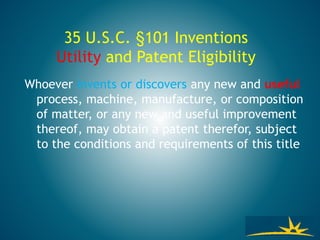
35 U.S.C. §101 Inventions
Utility and Patent Eligibility
Whoever invents or discovers any new and useful
process, machine, manufacture, or composition
of matter, or any new and useful improvement
thereof, may obtain a patent therefor, subject
to the conditions and requirements of this title
The Utility Requirement
 Historically was rarely an obstacle to a patent
The Utility Requirement
 Lowell v. Lewis (MA 1817), Justice Story
• “All that the law requires is, that the invention
should not be frivolous or injurious to the well-
being, good policy, or sound morals of society. …
But if the invention steers wide of these objections,
whether it be more or less useful is a circumstance
very material to the interest of the patentee, but of
no importance to the public. If it not be extensively
useful, it will silently sink into contempt and
disregard.”
 Brenner v. Manson (SCOTUS 1966), Justice Fortas
• Due to the unpredictability of the art, disclosure not
sufficient to show likelihood that the steroid produced
would function similar to its homologues (i.e. no
credible utility).
• “A process patent in the chemical field, which has not
been developed and pointed to the degree of specific
utility, creates a monopoly of knowledge which should
be granted only if clearly commanded by the statute.”
• “The basic quid pro quo contemplated by the
Constitution and Congress for granting a patent
monopoly is the benefit derived by the public from an
invention with substantial utility.”
The Utility Requirement
 In the late 1990s, became a substantial hurdle
in chemistry and biotechnology
The Utility Requirement
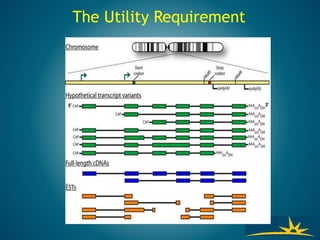
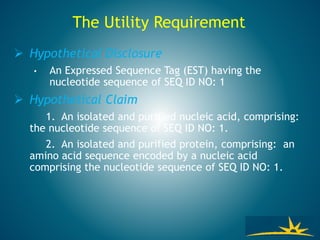
 Hypothetical Disclosure
• An Expressed Sequence Tag (EST) having the
nucleotide sequence of SEQ ID NO: 1
 Hypothetical Claim
1. An isolated and purified nucleic acid, comprising:
the nucleotide sequence of SEQ ID NO: 1.
2. An isolated and purified protein, comprising: an
amino acid sequence encoded by a nucleic acid
comprising the nucleotide sequence of SEQ ID NO: 1.
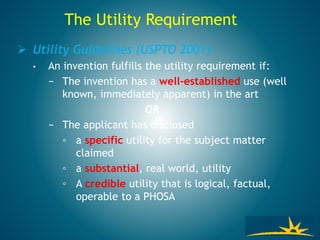
 Utility Guidelines (USPTO 2001)
• An invention fulfills the utility requirement if:
− The invention has a well-established use (well
known, immediately apparent) in the art
OR
− The applicant has disclosed
◦ a specific utility for the subject matter
claimed
◦ a substantial, real world, utility
◦ A credible utility that is logical, factual,
operable to a PHOSA
The Utility Requirement
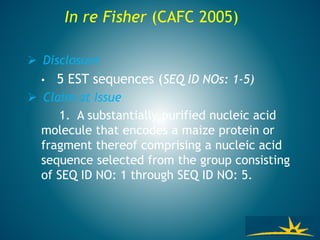
 Disclosure
• 5 EST sequences (SEQ ID NOs: 1-5)
 Claim at Issue
1. A substantially purified nucleic acid
molecule that encodes a maize protein or
fragment thereof comprising a nucleic acid
sequence selected from the group consisting
of SEQ ID NO: 1 through SEQ ID NO: 5.
In re Fisher (CAFC 2005)
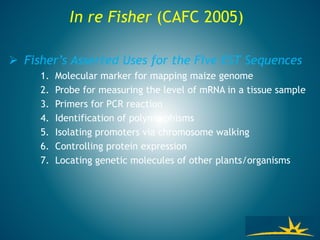
 Fisher’s Asserted Uses for the Five EST Sequences
1. Molecular marker for mapping maize genome
2. Probe for measuring the level of mRNA in a tissue sample
3. Primers for PCR reaction
4. Identification of polymorphisms
5. Isolating promoters via chromosome walking
6. Controlling protein expression
7. Locating genetic molecules of other plants/organisms
In re Fisher (CAFC 2005)
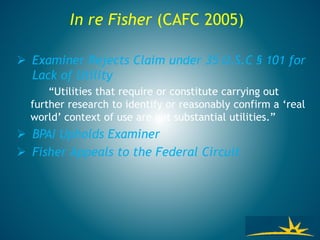
 Examiner Rejects Claim under 35 U.S.C § 101 for
Lack of Utility
“Utilities that require or constitute carrying out
further research to identify or reasonably confirm a ‘real
world’ context of use are not substantial utilities.”
 BPAI Upholds Examiner
 Fisher Appeals to the Federal Circuit
In re Fisher (CAFC 2005)
 Amicus Briefs
• Until the corresponding genes and proteins have a
known function, the claimed ESTs lack utility under
§ 101
 Federal Circuit
• The Supreme Court in Brenner v. Manson
“appeared to reject Justice Story’s de minimis
view of utility.”
• Substantial Utility: A practical, “real world” utility
having “immediate benefit to the public.”
• Specific Utility: “[A] use that is not so vague as to
be meaningless. … [A] well-defined and particular
benefit to the public.”
In re Fisher (CAFC 2005)
Patent Eligibility
35 U.S.C. §101
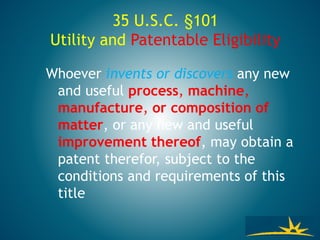
Utility and Patentable Eligibility
Whoever invents or discovers any new
and useful process, machine,
manufacture, or composition of
matter, or any new and useful
improvement thereof, may obtain a
patent therefor, subject to the
conditions and requirements of this
title
U.S. Constitution
Article 1, Section 8
Congress shall have power "to promote the
progress of science and useful arts, by securing
for limited times to authors and inventors the
exclusive right to their respective writings and
discoveries".
Funk Bros. v. Kalo (SCOTUS 1948)
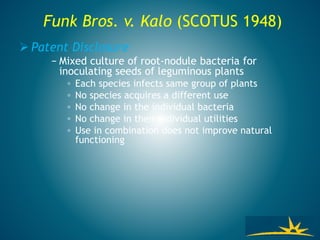
 Patent Disclosure
− Mixed culture of root-nodule bacteria for
inoculating seeds of leguminous plants
◦ Each species infects same group of plants
◦ No species acquires a different use
◦ No change in the individual bacteria
◦ No change in their individual utilities
◦ Use in combination does not improve natural
functioning
 Holding
• No patent eligible subject matter
• “Manifestations of nature are free to all men and
reserved exclusively to none”
Funk Bros. v. Kalo (SCOTUS 1948)
Diamond v. Chakrabarty (SCOTUS 1980)
Invention
• Oil-eating bacterium
 Claim
A bacterium from the genus
Pseudomonas containing therein
at least two stable energy-
generating plasmids, each of said
plasmids providing a separate
hydrocarbon degradative pathway.
 USPTO
• Relies on Funk Brothers to reject
Chakrabarty’s claim because a bacterium is a
“product of nature” … a living thing
Diamond v. Chakrabarty (SCOTUS 1980)
 Supreme Court
• Upholds validity of Chakrabarty’s claim
• “The Committee Reports accompanying the 1952
Act inform us that Congress intended statutory
subject matter to ‘include anything under the sun
that is made by man.’ ” [Citing, S. Rep. No. 1979, 82d Cong., 2d
Sess., 5 (1952); H. R. Rep. No. 1923, 82d Cong., 2d Sess., 6 (1952)]
Diamond v. Chakrabarty (SCOTUS 1980)
 Supreme Court
• “This is not to suggest that § 101 has no limits or
that it embraces every discovery. The laws
of nature, physical phenomena, and abstract ideas
have been held not patentable.”
• “[a] new mineral discovered in the earth or a new
plant found in the wild is not patentable subject
matter. Likewise, Einstein could not patent his
celebrated law that E=mc2; nor could Newton have
patented the law of gravity. Such discoveries are
"manifestations of . . . nature, free to all men and
reserved exclusively to none."
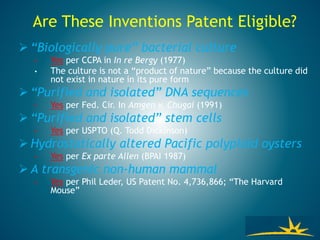
Are These Inventions Patent Eligible?
 “Biologically pure” bacterial culture
• Yes per CCPA in In re Bergy (1977)
• The culture is not a “product of nature” because the culture did
not exist in nature in its pure form
 “Purified and isolated” DNA sequences
• Yes per Fed. Cir. In Amgen v. Chugai (1991)
 “Purified and isolated” stem cells
• Yes per USPTO (Q. Todd Dickinson)
 Hydrostatically altered Pacific polyploid oysters
• Yes per Ex parte Allen (BPAI 1987)
 A transgenic non-human mammal
• Yes per Phil Leder, US Patent No. 4,736,866; “The Harvard
Mouse”
So, what makes a process
patent eligible?
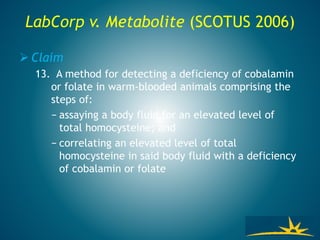
LabCorp v. Metabolite (SCOTUS 2006)
 Claim
13. A method for detecting a deficiency of cobalamin
or folate in warm-blooded animals comprising the
steps of:
− assaying a body fluid for an elevated level of
total homocysteine; and
− correlating an elevated level of total
homocysteine in said body fluid with a deficiency
of cobalamin or folate
LabCorp v. Metabolite (SCOTUS 2006)
 Lower Courts
• Upheld the patent claim’s validity and found that
LabCorp infringed the claim
 Supreme Court
• Granted cert to determine whether claim is invalid
because it seeks to “claim a monopoly over a basic
scientific relationship”
− Correlation between in vivo cobalamin/folate
levels and in vivo homocysteine levels
• Dismissed writ of certiorari as improvidently
granted
LabCorp v. Metabolite (SCOTUS 2006)
• Justice Breyer (Dissent)
• Laws of nature are unpatentable because
“sometimes too much patent protection can
impede rather than ‘promote the Progress of
Science and useful Arts.’ ” U.S. Const., Art 1, § 8
• “[T]he enormous potential for rent seeking that
would be created if property rights could be
obtained in [those basic principles]” and
• “[T]he enormous transaction costs that would be
imposed on would-be users”
LabCorp v. Metabolite (SCOTUS 2006)
 Justice Breyer (Dissent)
• “[T]here can be little doubt that the correlation
between homocysteine and vitamin deficiency set
forth in claim 13 is a ‘natural phenomenon’ ”
• The process described in claim 13 is not a process
for transforming blood or any other matter.
• Claim 13’s process instructs the user to
− obtain test results and
− think about them
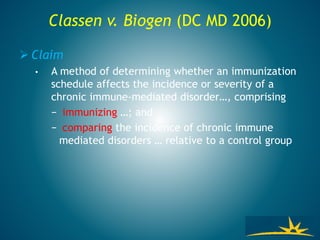
Classen v. Biogen (DC MD 2006)
 Claim
• A method of determining whether an immunization
schedule affects the incidence or severity of a
chronic immune-mediated disorder…, comprising
− immunizing …; and
− comparing the incidence of chronic immune
mediated disorders … relative to a control group
Classen v. Biogen (DC MD 2006)
 Holding
• Patent does not claim a specific technique or
technical process of testing safety
• Patent describes only a general inquiry of whether
the proposed correlation between an immunization
schedule and the incidence of chronic disorders
exists
• Process claim is indistinguishable from the idea
itself
• Patent seeks to patent an unpatentable natural
phenomenon
In re Bilski (CAFC 2008)
 Claim
1. A method for managing the consumption risk
costs of a commodity sold by a commodity provider at a
fixed price comprising the steps of:
(a) initiating a series of transactions … ;
(b) identifying market participants … ; and
(c) initiating a series of transactions … .
In re Bilski (CAFC 2008)
 The § 101 Inquiry
• If a claim preempts substantially all uses of a
fundamental principle, it is unpatentable subject
matter
• If a claim preempts only a particular application of
a fundamental principle, it is patentable subject
matter
In re Bilski (CAFC 2008)
 Machine or Transformation Test
• Adopted by CAFC to determine preemption of a
fundamental principle
• A claimed process is directed to patentable subject
matter under § 101 if it:
− Is tied to a particular machine or apparatus; or
− Transforms a particular article into a different
state or thing
Classen v. Biogen (CAFC 2008)
 Federal Circuit
• “In light of our decision in In re Bilski … we affirm
the district court’s grant of summary judgment that
these claims are invalid under 35 U.S.C. § 101”
• Claim “is neither ‘tied to a particular machine or
apparatus’ nor does it ‘transform a particular
article into a different state or thing’ ”
Classen v. Biogen (CAFC 2008)
 Classen
• Files a petition for writ certiorari to the U.S.
Supreme Court
Prometheus v. Mayo (SD CA 2008)
 Claim
1. A method of optimizing therapeutic efficacy…,
comprising:
− administering a drug providing 6-thioguanine to a
subject…; and
− determining the level of 6-thioguanine in said
subject … wherein
◦ 6-thioguanine less than about 230 pmol per
8x10⁸ red blood cells indicates a need to
increase the amount of said drug
◦ 6-thioguanine greater than about 400 pmol per
8x10⁸ red blood cells indicates a need to
decrease the amount of said drug
Prometheus v. Mayo (SD CA 2008)
 District Court
• Claimed correlations between certain
thiopurine drug metabolite levels and
therapeutic efficacy and toxicity are natural
phenomena … that result from innate
metabolic activity in human body
• Inventors did not “create” the correlation; the
correlation results from a natural body process
• Claims wholly preempt use of the correlations
− The only practical use of the correlation is in drug
treatment for autoimmune diseases
Prometheus v. Mayo (CAFC 2009)
 Federal Circuit Reverses
• Methods for calibrating a drug dosage are patent
eligible under 35 USC § 101
Prometheus v. Mayo (CAFC 2009)
 Federal Circuit
• Applies the Bilski Machine or Transformation test
• The required administration of a drug “transforms
an article into a different state or thing.”
• Distinguish diagnosis claims that merely require
data gathering and correlation rather than
injection of drugs
Prometheus v. Mayo
 Mayo
• Files a petition for writ of certiorari to the U.S.
Supreme Court
• Question Presented
“Whether 35 U.S.C. § 101 is satisfied by a patent claim
that covers observed correlations between patient test
results and patient health, so that the claim effectively
preempts all uses of these naturally occurring
correlations”
Bilski v. Kappos (SCOTUS 2010)
 Supreme Court
• Affirms CAFC Bilski decision
“The machine or transformation test is not the
exclusive test for patent eligibility, but in most
instances the existence of a machine or
transformation is highly relevant to the question of
patent eligibility”
• Grants certiorari, Vacates the Federal Circuit’s
Classen and Prometheus decisions and Remands to
the Federal Circuit in view of its Bilski decision
Prometheus v. Mayo (CAFC 2010)
 Federal Circuit Upholds Claim Validity
• Bilski provides broad – although not unlimited –
scope for patent protection
• “[A]n application of a law of nature or
mathematical formula to a known structure or
process may well be deserving of patent
protection.”
• Patent eligibility rests on the specific treatment
steps recited by the claims: the “administering”
step and the “determining” step
Prometheus v. Mayo (CAFC 2010)
 Federal Circuit upholds claim validity
• “The inventive nature of the claimed methods
stems not from preemption of all use of these
natural processes, but from the application of a
natural phenomenon in a series of steps comprising
particular methods of treatment.”
Prometheus v. Mayo (CAFC 2010)
 Federal Circuit upholds claim validity
• The asserted claims are “claims to methods of
treatment, which are always transformative, when
one of a defined group of drugs is administered to
the body to ameliorate the effects of an undesired
condition”
• The “determining” step is transformative because
it involves “some form of manipulation, such as the
high pressure liquid chromatography method
specified in several of the asserted dependent
claims … ”
• The presence of “mental steps” does not “negate
the transformative nature of prior steps”
Classen v. Biogen (CAFC 2011)
 Federal Circuit Affirms its Prior Decision
• “Methods that simply collect and compare data,
without applying the data in a step of the overall
method, fail to traverse the § 101 filter.”
• The “immunizing” step is analogized to the gathering
of published data
Classen v. Biogen (CAFC 2011)
 Moore Dissent
• The majority mischaracterizes the “immunizing
mammals” step as “reviewing the effects of known
immunization schedules”
• Distinguishes Prometheus’ claims, which are directed
to administration of a specific compound for a
specific disease
Myriad v. ACLU (NY FDC 2010)
 Claim
2. A method for diagnosing a predisposition for
breast cancer in a human subject which comprises
− comparing the germline sequence of the BRCA2
gene or the sequence of its mRNA in a tissue
sample from said subject with the germline
sequence of the wild-type BRCA2 gene or the
sequence of its mRNA
wherein an alteration in the germline sequence
of the BRCA2 gene or the sequence of its mRNA
of the subject indicates a predisposition to said
cancer.
Myriad v. ACLU (NYFDC 2010)
 NY Federal District Court
• Judge Sweet grants Summary Judgment in favor of
the ACLU
• The scientific inquiry of looking at a gene or
comparing two genes are not patentable
• Constitutes a natural phenomena, a law of nature,
and abstract ideas
 Myriad Amicus Brief
• Methods of diagnosis claims are patent
eligible, in part, because they all require
physical transformation of a DNA sample
(i.e., isolation, processing, and analysis)
that satisfies the Bilski machine or
transformation test
◦ NOTE: Compare Prometheus
 Methods that involve the processing of a
biological sample “necessarily involve a
transformation” and, thus, meet the Bilski
machine or transformation test
Myriad v. ACLU (CAFC 2011)
 Federal Circuit Affirms NY District Court
• Method claims directed to “comparing” or
“analyzing” DNA sequences are patent ineligible
because they do not include a transformative step
and cover only abstract, mental steps
Prometheus v. Mayo (SCOTUS 2012)
 Supreme Court Grants Certiorari
• Question Presented
“Whether 35 U.S.C. § 101 is satisfied by a patent claim that
covers observed correlations between blood test results and
patient health, so that the claim effectively preempts all uses
of the naturally occurring correlations, simply because well-
known methods used to administer prescription drugs and test
blood may involve ‘transformations’ of body chemistry.”
Prometheus v. Mayo (SCOTUS 2012)
 Supreme Court Reverses the Federal Circuit
• Personalized medicine dosing process invented by
Prometheus is not eligible for patent protection
because the process is effectively an unpatentable
law of nature
Myriad v. ACLU (SCOTUS)
 Supreme Court
• Grants writ of certiorari, vacates judgment,
remands to Federal Circuit for decision in
light of Mayo v. Prometheus
Myriad v. ACLU (CAFC 2012)
 Federal Circuit
• Myriad's method claims directed to comparing or
analyzing gene sequences are not subject matter
eligible
• Myriad's method claim to screening potential
cancer therapeutics via in vitro changes is subject
matter eligible
So, what makes a DNA patent
Eligible?
Patent Eligibility of DNA
 Federal Circuit
• Amgen v. Chugai (CAFC 1991)
− Court upholds validity of claims directed to “[a] purified
and isolated DNA sequence consisting essentially of a DNA
sequence encoding human erythropoietin.”
• In re Kubin (CAFC 2009)
− “The isolation and sequencing of a human gene that
encodes a particular domain of a protein” is “a classic
biotechnology invention”
Patent Eligibility of DNA
 USPTO
• Utility Examination Guidelines, 66 Fed. Reg. 1092
(2001)
− “A patent on a gene covers the isolated and purified gene
but does not cover the gene as it occurs in nature.”
• Issued >2,000 patents to isolated and purified DNA
Myriad v. ACLU
Myriad v. ACLU (NY FDC 2010)
 In May 2009, the ACLU filed a lawsuit against
the USPTO, Myriad Genetics, and the University
of Utah Research Foundation
 Challenged patents claiming the human
BRCA1/BRCA2 DNA and methods employing the
detection of the BRCA1/BRCA2 gene/mRNA for
the diagnosis of breast and ovarian cancer
Myriad v. ACLU (NY FDC 2010)
 Disclosure
• SEQ ID NO: 1 –- Nucleotide sequence of cDNA
encoding BRCA1
• SEQ ID NO: 2 -- Amino acid sequence of BRCA1
protein
 Claims
1. An isolated DNA coding for a BRCA1
polypeptide, said polypeptide having the amino acid
sequence set forth in SEQ ID NO: 2.
2. The isolated DNA of claim 1, wherein said DNA
has the nucleotide sequence set forth in SEQ ID NO:1.
5. An isolated DNA having at least 15 nucleotides
of the DNA of claim 1.
Myriad v. ACLU (NY FDC 2010)
 ACLU
“Because human genes are products of nature, laws of
nature and/or natural phenomena, and abstract ideas
or basic human knowledge or thought, the challenged
claims are invalid under Article 1, section 8, clause 8
of the United States Constitution and 35 U.S.C. § 101.”
Myriad v. ACLU (NYFDC 2010)
 NY Federal District Court
• Judge Sweet grants Summary Judgment in favor of
the ACLU
• Human genetic sequences are not patentable
• constitutes a natural phenomena, a law of nature,
and abstract ideas
Myriad v. ACLU (CAFC 2011)
 Myriad Amicus Brief
• Composition of matter claims directed towards
isolated DNA molecules are patent eligible, in part,
because they have “markedly different
characteristics” than their naturally occurring
counterparts
• “Products of nature” are patentable and have been
held to be for nearly 100 years
• Such a “sweeping exception” would bar the
patenting of pharmaceuticals derived from natural
sources (e.g., Taxol)
Myriad v. ACLU (CAFC 2011)
 Department of Justice Amicus Brief
• Genomic DNA that has merely been isolated from
the human body, without further alteration or
manipulation, is not patent-eligible.
• The unique chain of chemical base pairs that
induces a human cell to express a cancer protein is
not a 'human-made invention.'
• Nor is the fact that particular natural mutations in
that unique chain increase a woman's chance of
contracting breast or ovarian cancer."
Myriad v. ACLU (CAFC 2011)
 Federal Circuit Reverses NY District Court
• Composition claims to “isolated” DNA are patent
eligible since the molecules as claimed do not exist
in nature
Myriad v. ACLU (CAFC 2011)
 Federal Circuit
• Distinguishes “Isolated” and “Purified”
− Isolated = Patent Eligible?
◦ “Isolated” molecules have “a markedly different chemical structure”
or “a distinctive chemical identity and nature” from a molecule that
exists in nature
◦ “Isolated” molecules are “manipulated chemically” … “chemically
cleaved from their chemical combination with other [] materials” as
exists in nature … differences “are directly related to the change in
chemical bonds.”
− Purified = Ineligible?
◦ “Purification makes pure what was the same material, but was
previously impure”
◦ “Mere purification of a naturally occurring element is typically
insufficient to make it patentable subject matter”
Central Dogma of Molecular Biology
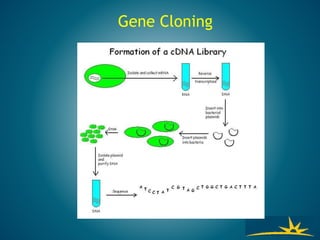
Gene Cloning
Myriad v. ACLU (CAFC 2012)
 Federal Circuit, on Remand
• Myriad's composition claims to isolated
DNAs, including cDNAs fall within the scope
of Section 101 patentable subject matter
Myriad v. ACLU (CAFC 2012)
 Bryson (Dissent)
• [E]xtracting a gene is akin to snapping a leaf from a
tree. Like a gene, a leaf has a natural starting and
stopping point. It buds during spring from the same
place that it breaks off and falls during autumn.
Yet prematurely plucking the leaf would not turn it
into a human-made invention. That would remain
true if there were minor differences between the
plucked leaf and the fallen autumn leaf, unless
those differences imparted "markedly different
characteristics" to the plucked leaf.
Myriad v. ACLU (CAFC 2012)
Lourie and Moore (Majority)
• It is also important to dispute the dissent's analogy
to snapping a leaf from a tree. With respect, no
one could contemplate that snapping a leaf from a
tree would be worthy of a patent, whereas
isolating genes to provide useful diagnostic tools
and medicines is surely what the patent laws are
intended to encourage and protect. Snapping a
leaf from a tree is a physical separation, easily
done by anyone. Creating a new chemical entity is
the work of human transformation, requiring skill,
knowledge, and effort.
Myriad v. ACLU (CAFC 2012)
 Lourie (Majority)
• The isolated DNA molecules before us are not found
in nature. They are obtained in the laboratory and
are man-made, the product of human ingenuity.
While they are prepared from products of nature,
so is every other composition of matter.
Myriad v. ACLU (CAFC 2012)
 Lourie (Majority)
• While purified natural products thus may or may
not qualify for patent under § 101, the isolated
DNAs of the present patents constitute an a fortiori
situation, where they are not only purified; they
are different from the natural products in "name,
character, and use." (quoting Chakrabarty).
Myriad v. ACLU (SCOTUS 2013)
 Supreme Court Holds (9 to 0)
• Naturally occurring DNAs fall within the “naturally
occurring phenomena” exception to 35 U.S.C. § 101
and are, therefore, not patent eligible
• Synthetically produced cDNAs are patent eligible
Myriad v. ACLU (SCOTUS 2013)
 Test for Patent Eligibility
• Whether the subject matter of the claim “was new
with markedly different characteristics than that
found in nature”
Myriad v. ACLU (SCOTUS 2013)
 Genomic DNA
• Myriad’s contribution was to “uncover[ ] the
precise location and genetic sequence of the BRCA1
and BRCA2 genes within chromosomes 17 and 13”
• “Groundbreaking, innovative, or even brilliant
discovery does not by itself satisfy the § 101
inquiry”
Myriad v. ACLU (SCOTUS 2013)
 cDNA
• The Court rejected Petitioner’s argument that
“[t]he nucleotide sequence of cDNA is dictated by
nature, not by the lab technician,” thereby making
cDNA patent ineligible
• cDNA is not a product of nature because it is new
and distinct from the parent DNA even though it
retains naturally occurring exons of the parent DNA
 “Isolated”
• Does not make otherwise patent ineligible subject
matter patent eligible
 Moore (Concurring in Part)
• “Congress has, for centuries, authorized an expansive scope of
patentable subject matter. Likewise, the United States Patent
Office has allowed patents on isolated DNA sequences for
decades, and, more generally, has allowed patents on purified
natural products for centuries. There are now thousands of
patents with claims to isolated DNA, and some unknown (but
certainly large) number of patents to purified natural products
or fragments thereof. … I believe we must be particularly
wary of expanding the judicial exception to patentable subject
matter where both settled expectations and extensive
property rights are involved.”
Myriad v. ACLU (SCOTUS 2013)
Myriad and Prometheus
Post-mortem
 USPTO has granted >5,000 patents that claims
“isolated DNA”
 What about other biomolecules such as proteins
and antibodies?
Practice Tips
 Clearly describe structural and functional
distinctions between the claimed subject
matter that might otherwise be regarded as a
natural phenomenon or a law or product of
nature
Practice Tips
 Describe how newly disclosed biomolecules
differ from naturally occurring biomolecules
and disclose splice variants of naturally
occurring DNAs
Practice Tips
 Set out definitions for terms such as
“synthetic,” “percent identity,”
“complementary,” “conservative
substitution,” and “recombinant,” which can
be used in claims to distinguish the subject
matter over natural products
Practice Tips
 Avoid terms such as “discovered,” “found,”
“identified,” “located,” “isolated,” and
“purified,” which were specifically called out
as potentially problematic by the Court
Practice Tips
 Product Claims
• Use terms, such as “created,” “synthetic,” and “derived,”
which were adopted by the Court when discussing why a
cDNA is patent eligible
• Vectors for expression of cDNAs
• Host cells comprising those expression vectors
• Compositions and formulations
• For proteins or antibodies having a native amino acid
sequence
− Structural modifications that do not naturally occur in
vivo
− Predicted changes in glycosylation patterns or other post-
translational modifications
Practice Tips
 Method Claims
• Claims methods of detection with steps of
amplification, hybridization, sequencing, and the
like that will be, or could be, used in methods for
detection
• Recite sequences of suitable primers and probes
used in detection steps
• Claim methods for identifying candidate
therapeutics based on cell systems that express
gene and cDNA sequences
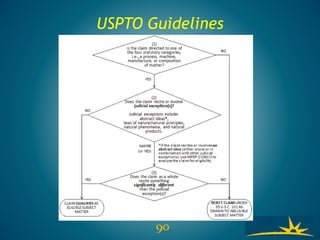
USPTO Guidelines
 USPTO “Guidance For Determining Subject
Matter Eligibility Of Claims Reciting Or
Involving Laws of Nature, Natural Phenomena,
& Natural Products” (March 24, 2014)
89
USPTO Guidelines
90
Stay Tuned …
Thank You!
Gary M. Myles, Ph.D.
gary@mylesip.com
(425) 466-8262

2017 02-15 uwls-apl_biotech 101

  • 1.
    Biotechnology Patents: Utility andEligibility Requirements under 35 USC § 101 University of Washington School of Law Gary M. Myles, Ph.D. February 15, 2017 (425) 466-8262 gary@mylesip.com Copyright ©2017, Myles Intellectual Property Law
  • 2.
    Topics Covered  35U.S.C. § 101 – Utility • Lowell v. Lewis (MA 1817) • Brenner v. Manson (SCOTUS 1966) • Utility Guidelines (USPTO 2001) • In re Fisher (CAFC 2005)
  • 3.
    Topics Covered  35U.S.C. § 101 – Patent Eligibility • Funk Brothers v. Kalo (SCOTUS 1948) • Diamond v. Chakrabarty (SCOTUS 1980) • Amgen v. Chugai (CAFC 1991) • In re Kubin (CAFC 2009) • LabCorp v. Metabolite (SCOTUS 2006) • In re Bilski (CAFC 2008) • Classen v. Biogen − (DC MD 2006), (CAFC 2008), (SCOTUS 2010), & (CAFC 2011) • Prometheus v. Mayo − (SD CA 2008), (CAFC 2009), (CAFC 2010), & (SCOTUS 2012) • Bilski v. Kappos (SCOTUS 2010) • Myriad v. ACLU − (NY FDC 2010), (CAFC 2011), (CAFC 2012), & (SCOTUS 2013)
  • 4.
  • 5.
    35 U.S.C. §101Inventions Utility and Patent Eligibility Whoever invents or discovers any new and useful process, machine, manufacture, or composition of matter, or any new and useful improvement thereof, may obtain a patent therefor, subject to the conditions and requirements of this title
  • 6.
    The Utility Requirement Historically was rarely an obstacle to a patent
  • 7.
    The Utility Requirement Lowell v. Lewis (MA 1817), Justice Story • “All that the law requires is, that the invention should not be frivolous or injurious to the well- being, good policy, or sound morals of society. … But if the invention steers wide of these objections, whether it be more or less useful is a circumstance very material to the interest of the patentee, but of no importance to the public. If it not be extensively useful, it will silently sink into contempt and disregard.”
  • 8.
     Brenner v.Manson (SCOTUS 1966), Justice Fortas • Due to the unpredictability of the art, disclosure not sufficient to show likelihood that the steroid produced would function similar to its homologues (i.e. no credible utility). • “A process patent in the chemical field, which has not been developed and pointed to the degree of specific utility, creates a monopoly of knowledge which should be granted only if clearly commanded by the statute.” • “The basic quid pro quo contemplated by the Constitution and Congress for granting a patent monopoly is the benefit derived by the public from an invention with substantial utility.” The Utility Requirement
  • 9.
    The Utility Requirement In the late 1990s, became a substantial hurdle in chemistry and biotechnology
  • 10.
  • 11.
    The Utility Requirement Hypothetical Disclosure • An Expressed Sequence Tag (EST) having the nucleotide sequence of SEQ ID NO: 1  Hypothetical Claim 1. An isolated and purified nucleic acid, comprising: the nucleotide sequence of SEQ ID NO: 1. 2. An isolated and purified protein, comprising: an amino acid sequence encoded by a nucleic acid comprising the nucleotide sequence of SEQ ID NO: 1.
  • 12.
     Utility Guidelines(USPTO 2001) • An invention fulfills the utility requirement if: − The invention has a well-established use (well known, immediately apparent) in the art OR − The applicant has disclosed ◦ a specific utility for the subject matter claimed ◦ a substantial, real world, utility ◦ A credible utility that is logical, factual, operable to a PHOSA The Utility Requirement
  • 13.
     Disclosure • 5EST sequences (SEQ ID NOs: 1-5)  Claim at Issue 1. A substantially purified nucleic acid molecule that encodes a maize protein or fragment thereof comprising a nucleic acid sequence selected from the group consisting of SEQ ID NO: 1 through SEQ ID NO: 5. In re Fisher (CAFC 2005)
  • 14.
     Fisher’s AssertedUses for the Five EST Sequences 1. Molecular marker for mapping maize genome 2. Probe for measuring the level of mRNA in a tissue sample 3. Primers for PCR reaction 4. Identification of polymorphisms 5. Isolating promoters via chromosome walking 6. Controlling protein expression 7. Locating genetic molecules of other plants/organisms In re Fisher (CAFC 2005)
  • 15.
     Examiner RejectsClaim under 35 U.S.C § 101 for Lack of Utility “Utilities that require or constitute carrying out further research to identify or reasonably confirm a ‘real world’ context of use are not substantial utilities.”  BPAI Upholds Examiner  Fisher Appeals to the Federal Circuit In re Fisher (CAFC 2005)
  • 16.
     Amicus Briefs •Until the corresponding genes and proteins have a known function, the claimed ESTs lack utility under § 101  Federal Circuit • The Supreme Court in Brenner v. Manson “appeared to reject Justice Story’s de minimis view of utility.” • Substantial Utility: A practical, “real world” utility having “immediate benefit to the public.” • Specific Utility: “[A] use that is not so vague as to be meaningless. … [A] well-defined and particular benefit to the public.” In re Fisher (CAFC 2005)
  • 17.
  • 18.
    35 U.S.C. §101 Utilityand Patentable Eligibility Whoever invents or discovers any new and useful process, machine, manufacture, or composition of matter, or any new and useful improvement thereof, may obtain a patent therefor, subject to the conditions and requirements of this title
  • 19.
    U.S. Constitution Article 1,Section 8 Congress shall have power "to promote the progress of science and useful arts, by securing for limited times to authors and inventors the exclusive right to their respective writings and discoveries".
  • 20.
    Funk Bros. v.Kalo (SCOTUS 1948)  Patent Disclosure − Mixed culture of root-nodule bacteria for inoculating seeds of leguminous plants ◦ Each species infects same group of plants ◦ No species acquires a different use ◦ No change in the individual bacteria ◦ No change in their individual utilities ◦ Use in combination does not improve natural functioning
  • 21.
     Holding • Nopatent eligible subject matter • “Manifestations of nature are free to all men and reserved exclusively to none” Funk Bros. v. Kalo (SCOTUS 1948)
  • 22.
    Diamond v. Chakrabarty(SCOTUS 1980) Invention • Oil-eating bacterium  Claim A bacterium from the genus Pseudomonas containing therein at least two stable energy- generating plasmids, each of said plasmids providing a separate hydrocarbon degradative pathway.
  • 23.
     USPTO • Relieson Funk Brothers to reject Chakrabarty’s claim because a bacterium is a “product of nature” … a living thing Diamond v. Chakrabarty (SCOTUS 1980)
  • 24.
    Diamond v. Chakrabarty(SCOTUS 1980)  Supreme Court • Upholds validity of Chakrabarty’s claim • “The Committee Reports accompanying the 1952 Act inform us that Congress intended statutory subject matter to ‘include anything under the sun that is made by man.’ ” [Citing, S. Rep. No. 1979, 82d Cong., 2d Sess., 5 (1952); H. R. Rep. No. 1923, 82d Cong., 2d Sess., 6 (1952)]
  • 25.
    Diamond v. Chakrabarty(SCOTUS 1980)  Supreme Court • “This is not to suggest that § 101 has no limits or that it embraces every discovery. The laws of nature, physical phenomena, and abstract ideas have been held not patentable.” • “[a] new mineral discovered in the earth or a new plant found in the wild is not patentable subject matter. Likewise, Einstein could not patent his celebrated law that E=mc2; nor could Newton have patented the law of gravity. Such discoveries are "manifestations of . . . nature, free to all men and reserved exclusively to none."
  • 26.
    Are These InventionsPatent Eligible?  “Biologically pure” bacterial culture • Yes per CCPA in In re Bergy (1977) • The culture is not a “product of nature” because the culture did not exist in nature in its pure form  “Purified and isolated” DNA sequences • Yes per Fed. Cir. In Amgen v. Chugai (1991)  “Purified and isolated” stem cells • Yes per USPTO (Q. Todd Dickinson)  Hydrostatically altered Pacific polyploid oysters • Yes per Ex parte Allen (BPAI 1987)  A transgenic non-human mammal • Yes per Phil Leder, US Patent No. 4,736,866; “The Harvard Mouse”
  • 27.
    So, what makesa process patent eligible?
  • 28.
    LabCorp v. Metabolite(SCOTUS 2006)  Claim 13. A method for detecting a deficiency of cobalamin or folate in warm-blooded animals comprising the steps of: − assaying a body fluid for an elevated level of total homocysteine; and − correlating an elevated level of total homocysteine in said body fluid with a deficiency of cobalamin or folate
  • 29.
    LabCorp v. Metabolite(SCOTUS 2006)  Lower Courts • Upheld the patent claim’s validity and found that LabCorp infringed the claim  Supreme Court • Granted cert to determine whether claim is invalid because it seeks to “claim a monopoly over a basic scientific relationship” − Correlation between in vivo cobalamin/folate levels and in vivo homocysteine levels • Dismissed writ of certiorari as improvidently granted
  • 30.
    LabCorp v. Metabolite(SCOTUS 2006) • Justice Breyer (Dissent) • Laws of nature are unpatentable because “sometimes too much patent protection can impede rather than ‘promote the Progress of Science and useful Arts.’ ” U.S. Const., Art 1, § 8 • “[T]he enormous potential for rent seeking that would be created if property rights could be obtained in [those basic principles]” and • “[T]he enormous transaction costs that would be imposed on would-be users”
  • 31.
    LabCorp v. Metabolite(SCOTUS 2006)  Justice Breyer (Dissent) • “[T]here can be little doubt that the correlation between homocysteine and vitamin deficiency set forth in claim 13 is a ‘natural phenomenon’ ” • The process described in claim 13 is not a process for transforming blood or any other matter. • Claim 13’s process instructs the user to − obtain test results and − think about them
  • 32.
    Classen v. Biogen(DC MD 2006)  Claim • A method of determining whether an immunization schedule affects the incidence or severity of a chronic immune-mediated disorder…, comprising − immunizing …; and − comparing the incidence of chronic immune mediated disorders … relative to a control group
  • 33.
    Classen v. Biogen(DC MD 2006)  Holding • Patent does not claim a specific technique or technical process of testing safety • Patent describes only a general inquiry of whether the proposed correlation between an immunization schedule and the incidence of chronic disorders exists • Process claim is indistinguishable from the idea itself • Patent seeks to patent an unpatentable natural phenomenon
  • 34.
    In re Bilski(CAFC 2008)  Claim 1. A method for managing the consumption risk costs of a commodity sold by a commodity provider at a fixed price comprising the steps of: (a) initiating a series of transactions … ; (b) identifying market participants … ; and (c) initiating a series of transactions … .
  • 35.
    In re Bilski(CAFC 2008)  The § 101 Inquiry • If a claim preempts substantially all uses of a fundamental principle, it is unpatentable subject matter • If a claim preempts only a particular application of a fundamental principle, it is patentable subject matter
  • 36.
    In re Bilski(CAFC 2008)  Machine or Transformation Test • Adopted by CAFC to determine preemption of a fundamental principle • A claimed process is directed to patentable subject matter under § 101 if it: − Is tied to a particular machine or apparatus; or − Transforms a particular article into a different state or thing
  • 37.
    Classen v. Biogen(CAFC 2008)  Federal Circuit • “In light of our decision in In re Bilski … we affirm the district court’s grant of summary judgment that these claims are invalid under 35 U.S.C. § 101” • Claim “is neither ‘tied to a particular machine or apparatus’ nor does it ‘transform a particular article into a different state or thing’ ”
  • 38.
    Classen v. Biogen(CAFC 2008)  Classen • Files a petition for writ certiorari to the U.S. Supreme Court
  • 39.
    Prometheus v. Mayo(SD CA 2008)  Claim 1. A method of optimizing therapeutic efficacy…, comprising: − administering a drug providing 6-thioguanine to a subject…; and − determining the level of 6-thioguanine in said subject … wherein ◦ 6-thioguanine less than about 230 pmol per 8x10⁸ red blood cells indicates a need to increase the amount of said drug ◦ 6-thioguanine greater than about 400 pmol per 8x10⁸ red blood cells indicates a need to decrease the amount of said drug
  • 40.
    Prometheus v. Mayo(SD CA 2008)  District Court • Claimed correlations between certain thiopurine drug metabolite levels and therapeutic efficacy and toxicity are natural phenomena … that result from innate metabolic activity in human body • Inventors did not “create” the correlation; the correlation results from a natural body process • Claims wholly preempt use of the correlations − The only practical use of the correlation is in drug treatment for autoimmune diseases
  • 41.
    Prometheus v. Mayo(CAFC 2009)  Federal Circuit Reverses • Methods for calibrating a drug dosage are patent eligible under 35 USC § 101
  • 42.
    Prometheus v. Mayo(CAFC 2009)  Federal Circuit • Applies the Bilski Machine or Transformation test • The required administration of a drug “transforms an article into a different state or thing.” • Distinguish diagnosis claims that merely require data gathering and correlation rather than injection of drugs
  • 43.
    Prometheus v. Mayo Mayo • Files a petition for writ of certiorari to the U.S. Supreme Court • Question Presented “Whether 35 U.S.C. § 101 is satisfied by a patent claim that covers observed correlations between patient test results and patient health, so that the claim effectively preempts all uses of these naturally occurring correlations”
  • 44.
    Bilski v. Kappos(SCOTUS 2010)  Supreme Court • Affirms CAFC Bilski decision “The machine or transformation test is not the exclusive test for patent eligibility, but in most instances the existence of a machine or transformation is highly relevant to the question of patent eligibility” • Grants certiorari, Vacates the Federal Circuit’s Classen and Prometheus decisions and Remands to the Federal Circuit in view of its Bilski decision
  • 45.
    Prometheus v. Mayo(CAFC 2010)  Federal Circuit Upholds Claim Validity • Bilski provides broad – although not unlimited – scope for patent protection • “[A]n application of a law of nature or mathematical formula to a known structure or process may well be deserving of patent protection.” • Patent eligibility rests on the specific treatment steps recited by the claims: the “administering” step and the “determining” step
  • 46.
    Prometheus v. Mayo(CAFC 2010)  Federal Circuit upholds claim validity • “The inventive nature of the claimed methods stems not from preemption of all use of these natural processes, but from the application of a natural phenomenon in a series of steps comprising particular methods of treatment.”
  • 47.
    Prometheus v. Mayo(CAFC 2010)  Federal Circuit upholds claim validity • The asserted claims are “claims to methods of treatment, which are always transformative, when one of a defined group of drugs is administered to the body to ameliorate the effects of an undesired condition” • The “determining” step is transformative because it involves “some form of manipulation, such as the high pressure liquid chromatography method specified in several of the asserted dependent claims … ” • The presence of “mental steps” does not “negate the transformative nature of prior steps”
  • 48.
    Classen v. Biogen(CAFC 2011)  Federal Circuit Affirms its Prior Decision • “Methods that simply collect and compare data, without applying the data in a step of the overall method, fail to traverse the § 101 filter.” • The “immunizing” step is analogized to the gathering of published data
  • 49.
    Classen v. Biogen(CAFC 2011)  Moore Dissent • The majority mischaracterizes the “immunizing mammals” step as “reviewing the effects of known immunization schedules” • Distinguishes Prometheus’ claims, which are directed to administration of a specific compound for a specific disease
  • 50.
    Myriad v. ACLU(NY FDC 2010)  Claim 2. A method for diagnosing a predisposition for breast cancer in a human subject which comprises − comparing the germline sequence of the BRCA2 gene or the sequence of its mRNA in a tissue sample from said subject with the germline sequence of the wild-type BRCA2 gene or the sequence of its mRNA wherein an alteration in the germline sequence of the BRCA2 gene or the sequence of its mRNA of the subject indicates a predisposition to said cancer.
  • 51.
    Myriad v. ACLU(NYFDC 2010)  NY Federal District Court • Judge Sweet grants Summary Judgment in favor of the ACLU • The scientific inquiry of looking at a gene or comparing two genes are not patentable • Constitutes a natural phenomena, a law of nature, and abstract ideas
  • 52.
     Myriad AmicusBrief • Methods of diagnosis claims are patent eligible, in part, because they all require physical transformation of a DNA sample (i.e., isolation, processing, and analysis) that satisfies the Bilski machine or transformation test ◦ NOTE: Compare Prometheus  Methods that involve the processing of a biological sample “necessarily involve a transformation” and, thus, meet the Bilski machine or transformation test Myriad v. ACLU (CAFC 2011)
  • 53.
    Myriad v. ACLU(CAFC 2011)  Federal Circuit Affirms NY District Court • Method claims directed to “comparing” or “analyzing” DNA sequences are patent ineligible because they do not include a transformative step and cover only abstract, mental steps
  • 54.
    Prometheus v. Mayo(SCOTUS 2012)  Supreme Court Grants Certiorari • Question Presented “Whether 35 U.S.C. § 101 is satisfied by a patent claim that covers observed correlations between blood test results and patient health, so that the claim effectively preempts all uses of the naturally occurring correlations, simply because well- known methods used to administer prescription drugs and test blood may involve ‘transformations’ of body chemistry.”
  • 55.
    Prometheus v. Mayo(SCOTUS 2012)  Supreme Court Reverses the Federal Circuit • Personalized medicine dosing process invented by Prometheus is not eligible for patent protection because the process is effectively an unpatentable law of nature
  • 56.
    Myriad v. ACLU(SCOTUS)  Supreme Court • Grants writ of certiorari, vacates judgment, remands to Federal Circuit for decision in light of Mayo v. Prometheus
  • 57.
    Myriad v. ACLU(CAFC 2012)  Federal Circuit • Myriad's method claims directed to comparing or analyzing gene sequences are not subject matter eligible • Myriad's method claim to screening potential cancer therapeutics via in vitro changes is subject matter eligible
  • 58.
    So, what makesa DNA patent Eligible?
  • 59.
    Patent Eligibility ofDNA  Federal Circuit • Amgen v. Chugai (CAFC 1991) − Court upholds validity of claims directed to “[a] purified and isolated DNA sequence consisting essentially of a DNA sequence encoding human erythropoietin.” • In re Kubin (CAFC 2009) − “The isolation and sequencing of a human gene that encodes a particular domain of a protein” is “a classic biotechnology invention”
  • 60.
    Patent Eligibility ofDNA  USPTO • Utility Examination Guidelines, 66 Fed. Reg. 1092 (2001) − “A patent on a gene covers the isolated and purified gene but does not cover the gene as it occurs in nature.” • Issued >2,000 patents to isolated and purified DNA
  • 61.
  • 62.
    Myriad v. ACLU(NY FDC 2010)  In May 2009, the ACLU filed a lawsuit against the USPTO, Myriad Genetics, and the University of Utah Research Foundation  Challenged patents claiming the human BRCA1/BRCA2 DNA and methods employing the detection of the BRCA1/BRCA2 gene/mRNA for the diagnosis of breast and ovarian cancer
  • 63.
    Myriad v. ACLU(NY FDC 2010)  Disclosure • SEQ ID NO: 1 –- Nucleotide sequence of cDNA encoding BRCA1 • SEQ ID NO: 2 -- Amino acid sequence of BRCA1 protein  Claims 1. An isolated DNA coding for a BRCA1 polypeptide, said polypeptide having the amino acid sequence set forth in SEQ ID NO: 2. 2. The isolated DNA of claim 1, wherein said DNA has the nucleotide sequence set forth in SEQ ID NO:1. 5. An isolated DNA having at least 15 nucleotides of the DNA of claim 1.
  • 64.
    Myriad v. ACLU(NY FDC 2010)  ACLU “Because human genes are products of nature, laws of nature and/or natural phenomena, and abstract ideas or basic human knowledge or thought, the challenged claims are invalid under Article 1, section 8, clause 8 of the United States Constitution and 35 U.S.C. § 101.”
  • 65.
    Myriad v. ACLU(NYFDC 2010)  NY Federal District Court • Judge Sweet grants Summary Judgment in favor of the ACLU • Human genetic sequences are not patentable • constitutes a natural phenomena, a law of nature, and abstract ideas
  • 66.
    Myriad v. ACLU(CAFC 2011)  Myriad Amicus Brief • Composition of matter claims directed towards isolated DNA molecules are patent eligible, in part, because they have “markedly different characteristics” than their naturally occurring counterparts • “Products of nature” are patentable and have been held to be for nearly 100 years • Such a “sweeping exception” would bar the patenting of pharmaceuticals derived from natural sources (e.g., Taxol)
  • 67.
    Myriad v. ACLU(CAFC 2011)  Department of Justice Amicus Brief • Genomic DNA that has merely been isolated from the human body, without further alteration or manipulation, is not patent-eligible. • The unique chain of chemical base pairs that induces a human cell to express a cancer protein is not a 'human-made invention.' • Nor is the fact that particular natural mutations in that unique chain increase a woman's chance of contracting breast or ovarian cancer."
  • 68.
    Myriad v. ACLU(CAFC 2011)  Federal Circuit Reverses NY District Court • Composition claims to “isolated” DNA are patent eligible since the molecules as claimed do not exist in nature
  • 69.
    Myriad v. ACLU(CAFC 2011)  Federal Circuit • Distinguishes “Isolated” and “Purified” − Isolated = Patent Eligible? ◦ “Isolated” molecules have “a markedly different chemical structure” or “a distinctive chemical identity and nature” from a molecule that exists in nature ◦ “Isolated” molecules are “manipulated chemically” … “chemically cleaved from their chemical combination with other [] materials” as exists in nature … differences “are directly related to the change in chemical bonds.” − Purified = Ineligible? ◦ “Purification makes pure what was the same material, but was previously impure” ◦ “Mere purification of a naturally occurring element is typically insufficient to make it patentable subject matter”
  • 70.
    Central Dogma ofMolecular Biology
  • 71.
  • 72.
    Myriad v. ACLU(CAFC 2012)  Federal Circuit, on Remand • Myriad's composition claims to isolated DNAs, including cDNAs fall within the scope of Section 101 patentable subject matter
  • 73.
    Myriad v. ACLU(CAFC 2012)  Bryson (Dissent) • [E]xtracting a gene is akin to snapping a leaf from a tree. Like a gene, a leaf has a natural starting and stopping point. It buds during spring from the same place that it breaks off and falls during autumn. Yet prematurely plucking the leaf would not turn it into a human-made invention. That would remain true if there were minor differences between the plucked leaf and the fallen autumn leaf, unless those differences imparted "markedly different characteristics" to the plucked leaf.
  • 74.
    Myriad v. ACLU(CAFC 2012) Lourie and Moore (Majority) • It is also important to dispute the dissent's analogy to snapping a leaf from a tree. With respect, no one could contemplate that snapping a leaf from a tree would be worthy of a patent, whereas isolating genes to provide useful diagnostic tools and medicines is surely what the patent laws are intended to encourage and protect. Snapping a leaf from a tree is a physical separation, easily done by anyone. Creating a new chemical entity is the work of human transformation, requiring skill, knowledge, and effort.
  • 75.
    Myriad v. ACLU(CAFC 2012)  Lourie (Majority) • The isolated DNA molecules before us are not found in nature. They are obtained in the laboratory and are man-made, the product of human ingenuity. While they are prepared from products of nature, so is every other composition of matter.
  • 76.
    Myriad v. ACLU(CAFC 2012)  Lourie (Majority) • While purified natural products thus may or may not qualify for patent under § 101, the isolated DNAs of the present patents constitute an a fortiori situation, where they are not only purified; they are different from the natural products in "name, character, and use." (quoting Chakrabarty).
  • 77.
    Myriad v. ACLU(SCOTUS 2013)  Supreme Court Holds (9 to 0) • Naturally occurring DNAs fall within the “naturally occurring phenomena” exception to 35 U.S.C. § 101 and are, therefore, not patent eligible • Synthetically produced cDNAs are patent eligible
  • 78.
    Myriad v. ACLU(SCOTUS 2013)  Test for Patent Eligibility • Whether the subject matter of the claim “was new with markedly different characteristics than that found in nature”
  • 79.
    Myriad v. ACLU(SCOTUS 2013)  Genomic DNA • Myriad’s contribution was to “uncover[ ] the precise location and genetic sequence of the BRCA1 and BRCA2 genes within chromosomes 17 and 13” • “Groundbreaking, innovative, or even brilliant discovery does not by itself satisfy the § 101 inquiry”
  • 80.
    Myriad v. ACLU(SCOTUS 2013)  cDNA • The Court rejected Petitioner’s argument that “[t]he nucleotide sequence of cDNA is dictated by nature, not by the lab technician,” thereby making cDNA patent ineligible • cDNA is not a product of nature because it is new and distinct from the parent DNA even though it retains naturally occurring exons of the parent DNA
  • 81.
     “Isolated” • Doesnot make otherwise patent ineligible subject matter patent eligible  Moore (Concurring in Part) • “Congress has, for centuries, authorized an expansive scope of patentable subject matter. Likewise, the United States Patent Office has allowed patents on isolated DNA sequences for decades, and, more generally, has allowed patents on purified natural products for centuries. There are now thousands of patents with claims to isolated DNA, and some unknown (but certainly large) number of patents to purified natural products or fragments thereof. … I believe we must be particularly wary of expanding the judicial exception to patentable subject matter where both settled expectations and extensive property rights are involved.” Myriad v. ACLU (SCOTUS 2013)
  • 82.
    Myriad and Prometheus Post-mortem USPTO has granted >5,000 patents that claims “isolated DNA”  What about other biomolecules such as proteins and antibodies?
  • 83.
    Practice Tips  Clearlydescribe structural and functional distinctions between the claimed subject matter that might otherwise be regarded as a natural phenomenon or a law or product of nature
  • 84.
    Practice Tips  Describehow newly disclosed biomolecules differ from naturally occurring biomolecules and disclose splice variants of naturally occurring DNAs
  • 85.
    Practice Tips  Setout definitions for terms such as “synthetic,” “percent identity,” “complementary,” “conservative substitution,” and “recombinant,” which can be used in claims to distinguish the subject matter over natural products
  • 86.
    Practice Tips  Avoidterms such as “discovered,” “found,” “identified,” “located,” “isolated,” and “purified,” which were specifically called out as potentially problematic by the Court
  • 87.
    Practice Tips  ProductClaims • Use terms, such as “created,” “synthetic,” and “derived,” which were adopted by the Court when discussing why a cDNA is patent eligible • Vectors for expression of cDNAs • Host cells comprising those expression vectors • Compositions and formulations • For proteins or antibodies having a native amino acid sequence − Structural modifications that do not naturally occur in vivo − Predicted changes in glycosylation patterns or other post- translational modifications
  • 88.
    Practice Tips  MethodClaims • Claims methods of detection with steps of amplification, hybridization, sequencing, and the like that will be, or could be, used in methods for detection • Recite sequences of suitable primers and probes used in detection steps • Claim methods for identifying candidate therapeutics based on cell systems that express gene and cDNA sequences
  • 89.
    USPTO Guidelines  USPTO“Guidance For Determining Subject Matter Eligibility Of Claims Reciting Or Involving Laws of Nature, Natural Phenomena, & Natural Products” (March 24, 2014) 89
  • 90.
  • 91.
    Stay Tuned … ThankYou! Gary M. Myles, Ph.D. gary@mylesip.com (425) 466-8262