Elliot Duff – Research Director - Autonomous Systems Program
DIGITAL PRODUCTIVITY FLAGSHIP
Theme 2: Automated and
Assistive Technologies
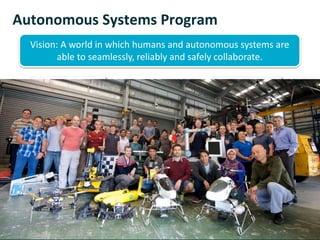
Vision: A world in which humans and autonomous systems are
able to seamlessly, reliably and safely collaborate.
Autonomous Systems Program
45
40
15
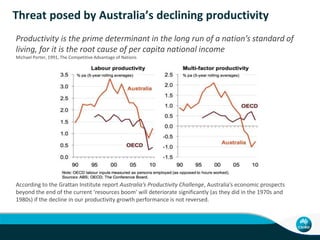
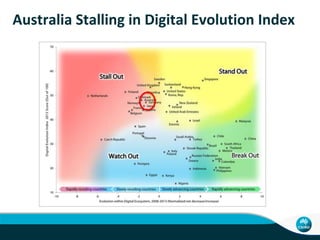
Threat posed by Australia’s declining productivity
Productivity is the prime determinant in the long run of a nation’s standard of
living, for it is the root cause of per capita national income
Michael Porter, 1991, The Competitive Advantage of Nations
According to the Grattan Institute report Australia’s Productivity Challenge, Australia’s economic prospects
beyond the end of the current ‘resources boom’ will deteriorate significantly (as they did in the 1970s and
1980s) if the decline in our productivity growth performance is not reversed.
Australia Stalling in Digital Evolution Index
Industry Engagement
Objective
To develop automated and assistive technologies that can enable
Australian industrial workers to increase productivity and extend
their participation in the workforce. Facing increasing operational
costs, skills shortages and comparatively low productivity growth,
combined with external factors such as increasing competition from
low-wage countries, manufacturers are in need of a broader range
of affordable solutions that give them the flexibility and agility to
respond to a volatile market demand whilst also boosting their
firm’s productivity.
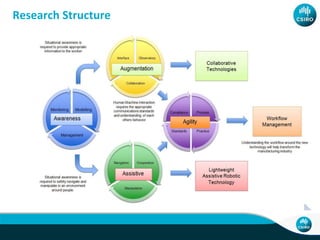
Research Structure
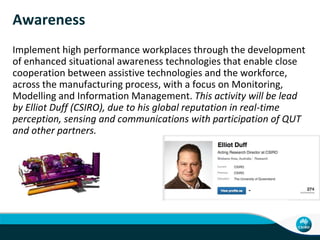
Awareness
Implement high performance workplaces through the development
of enhanced situational awareness technologies that enable close
cooperation between assistive technologies and the workforce,
across the manufacturing process, with a focus on Monitoring,
Modelling and Information Management. This activity will be lead
by Elliot Duff (CSIRO), due to his global reputation in real-time
perception, sensing and communications with participation of QUT
and other partners.
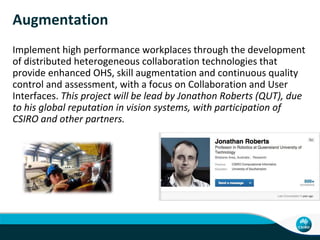
Augmentation
Implement high performance workplaces through the development
of distributed heterogeneous collaboration technologies that
provide enhanced OHS, skill augmentation and continuous quality
control and assessment, with a focus on Collaboration and User
Interfaces. This project will be lead by Jonathon Roberts (QUT), due
to his global reputation in vision systems, with participation of
CSIRO and other partners.
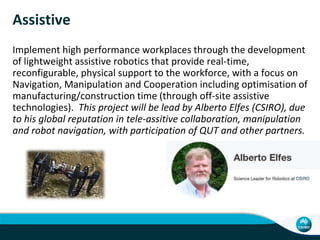
Assistive
Implement high performance workplaces through the development
of lightweight assistive robotics that provide real-time,
reconfigurable, physical support to the workforce, with a focus on
Navigation, Manipulation and Cooperation including optimisation of
manufacturing/construction time (through off-site assistive
technologies). This project will be lead by Alberto Elfes (CSIRO), due
to his global reputation in tele-assitive collaboration, manipulation
and robot navigation, with participation of QUT and other partners.
Governance (Agility)
Implement high performance workplaces through the development
of information assisted methods and proxies for the development
of processes, associated standards and codes of practices for new
manufacturing processes, including scaling and quality control, and
methods of testing and compliance of manufacturing components
and systems (using agile manufacturing/ personalised production).
This project will be lead by Tuan Ngo (UniMelb), due to his global
reputation in modelling systems, with participation of CSIRO and
other partners.
•New Workflows
•New Business
Models
•New Enterprises
•New Processes
•New Materials
•New Production
•Mass
Customization
•Maximize
Flexibility
•Mass Production
•Minimize Waste
Lean Agile
Information
Driven
Advanced
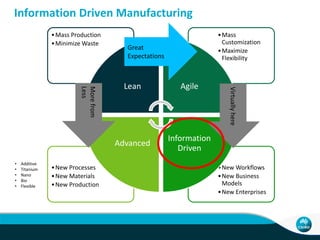
Information Driven Manufacturing
Great
Expectations
Virtuallyhere
Morefrom
Less
• Additive
• Titanium
• Nano
• Bio
• Flexible
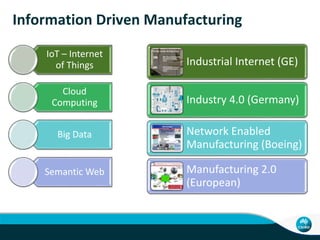
Information Driven Manufacturing
Industrial Internet (GE)
Industry 4.0 (Germany)
Network Enabled
Manufacturing (Boeing)
Manufacturing 2.0
(European)
IoT – Internet
of Things
Cloud
Computing
Big Data
Semantic Web
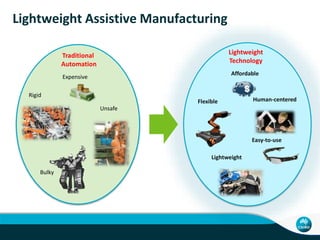
Lightweight Assistive Manufacturing
Traditional
Automation
Rigid
Bulky
Expensive
Unsafe
Lightweight
Technology
Flexible
Lightweight
Affordable
Human-centered
Easy-to-use
Lightweight
Technologies
HMI
ICT
Perception
Robotics
Mobile
Tele-presence
Lightweight
Robotics
Mirror
Worlding
Social
Networking
Sensing in
Unstructured
Dynamic
Environments
Field
Robotics
Dependability
Robustness
Military/Mining
Collective
Intelligence
Cloud
ServicesBig Data
Internetofthings
Cheap sensor,
processors
and actuation
Consumer
Devices
Immersive
Interfaces
Gaming
AdditiveManufacturing
Intuitive
interfaces
Mobile
Devices
Ubiquitous
Connectivity
Locationbasedservice
Technology/Trendsto
DevelopAssistiveRobotics
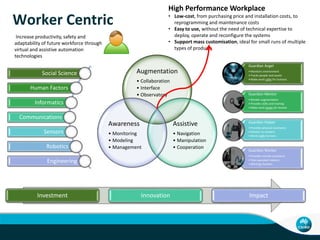
Guardian Angel
• Monitors environment
• Tracks people and assets
• Make work safer for humans
Guardian Mentor
• Worker augmentation
• Provides skills and training
• Make work easier for human
Guardian Helper
• Provides physical assistance
• Robotic co-workers
• Works with humans
Guardian Worker
• Provides remote assistance
• Tele-operated robotics
• Work for humans
Worker Centric
Augmentation
• Collaboration
• Interface
• Observatory
Assistive
• Navigation
• Manipulation
• Cooperation
Awareness
• Monitoring
• Modeling
• Management
Social Science
Human Factors
Informatics
Communications
Sensors
Robotics
Engineering
Investment Innovation Impact
Increase productivity, safety and
adaptability of future workforce through
virtual and assistive automation
technologies
High Performance Workplace
• Low-cost, from purchasing price and installation costs, to
reprogramming and maintenance costs
• Easy to use, without the need of technical expertise to
deploy, operate and reconfigure the systems
• Support mass customisation, ideal for small runs of multiple
types of products
Guardian Video
What is CSIRO doing
Disruptive
Technologies
LESANZ| Commercialization
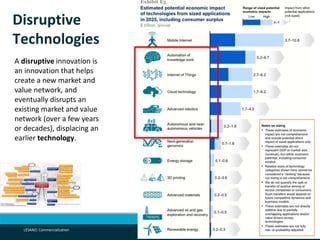
A disruptive innovation is
an innovation that helps
create a new market and
value network, and
eventually disrupts an
existing market and value
network (over a few years
or decades), displacing an
earlier technology.
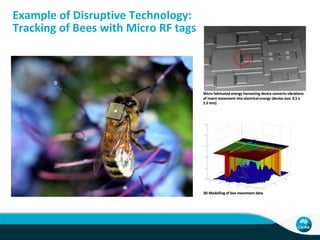
Example of Disruptive Technology:
Tracking of Bees with Micro RF tags
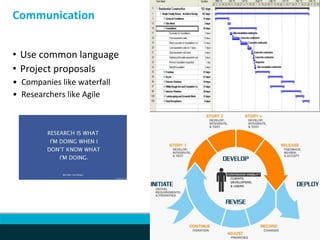
• Use common language
• Project proposals
• Companies like waterfall
• Researchers like Agile
Communication
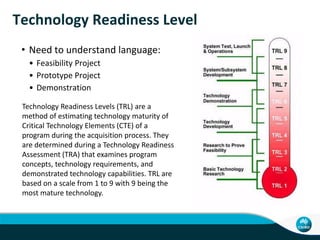
Technology Readiness Level
Technology Readiness Levels (TRL) are a
method of estimating technology maturity of
Critical Technology Elements (CTE) of a
program during the acquisition process. They
are determined during a Technology Readiness
Assessment (TRA) that examines program
concepts, technology requirements, and
demonstrated technology capabilities. TRL are
based on a scale from 1 to 9 with 9 being the
most mature technology.
• Need to understand language:
• Feasibility Project
• Prototype Project
• Demonstration
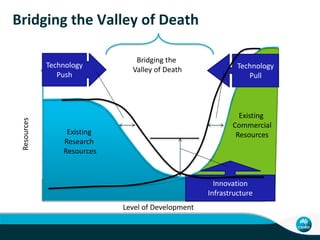
Level of Development
Resources
Existing
Research
Resources
Existing
Commercial
Resources
Bridging the
Valley of Death
Technology
Push
Innovation
Infrastructure
Technology
Pull
Bridging the Valley of Death
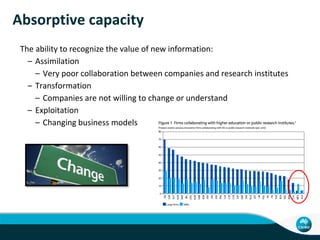
Absorptive capacity
The ability to recognize the value of new information:
– Assimilation
– Very poor collaboration between companies and research institutes
– Transformation
– Companies are not willing to change or understand
– Exploitation
– Changing business models
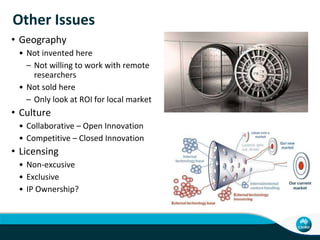
Other Issues
• Geography
• Not invented here
– Not willing to work with remote
researchers
• Not sold here
– Only look at ROI for local market
• Culture
• Collaborative – Open Innovation
• Competitive – Closed Innovation
• Licensing
• Non-excusive
• Exclusive
• IP Ownership?
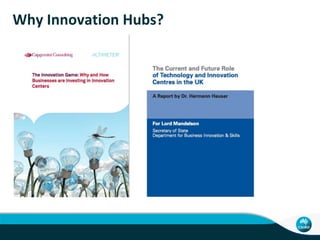
Why Innovation Hubs?
i3Hub
• To inspire and transform Australian businesses to improve their
global competitiveness, CSIRO will create a connected
innovation marketplace where our customers and partners will
collaborate and experience what is possible today and what are
the potential futures associated with the industrial internet.
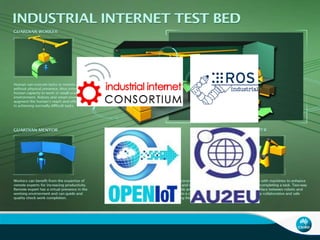
• Engagements
• Industrial Internet Consortium
• ROS Industrial (Robotic Operation Systems)
• OpenIoT and AU2EU (security and trust)
• IMCRC – Innovative Manufacturing CRC
LESANZ| Commercialization
Underlying Principle
• In an industrial context, IoT technologies typically address five
business scenarios, independent of sector or particular activity.
• These are:
• connecting supply chains
• enabling proactive maintenance
• enabling better factory/plant/refinery/rig automation and/or integration
• better factory/plant/refinery/rig visibility
• improved safety without an impact on productivity
• The Industrial IoT innovation hub will aim to develop
demonstrators for each of these scenarios.
Challenges … But the Opportunity …
• Accenture reported, that only 38% of C-Suite executives believed
that their company’s senior leaders fully understand the IoT and
73 % have yet to make any concrete investments in the IoT.
• 87 % of the executives believe that IoT technologies will lead to
long term job growth and 84 % believe that their organisations
have the ability to create new service-based revenue streams.
• Findings correlate with CSIRO industry consultations around the
role of ICT in manufacturing SMEs. See Appendix B for Mind Map
of relationships
• Markets for IoT technologies in Australia are largely undeveloped
and CSIRO has the opportunity to position itself as the centre of
the IoT innovation in Australia.
• A national IoT Innovation Hub is vital to achieving this.
CSIRO – Digital Productivity Flagship
Eating our own dog food
• I3Hub will be part of our business as
usual.
• It will not only demonstrate what ‘could
be’, but what ‘is’.
• It will provide confidence to our
customers that our research is applied
and lead by their interests
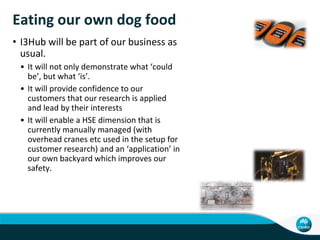
• It will enable a HSE dimension that is
currently manually managed (with
overhead cranes etc used in the setup for
customer research) and an ‘application’ in
our own backyard which improves our
safety.
Functionality*
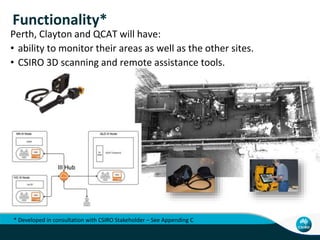
Perth, Clayton and QCAT will have:
• ability to monitor their areas as well as the other sites.
• CSIRO 3D scanning and remote assistance tools.
* Developed in consultation with CSIRO Stakeholder – See Appending C
Partners in Conversation
CSIRO – Digital Productivity Flagship
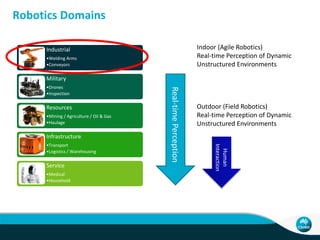
Robotics Domains
Real-timePerception
Human
Interaction
Industrial
•Welding Arms
•Conveyors
Military
•Drones
•Inspection
Resources
•Mining / Agriculture / Oil & Gas
•Haulage
Infrastructure
•Transport
•Logistics / Warehousing
Service
•Medical
•Household
Outdoor (Field Robotics)
Real-time Perception of Dynamic
Unstructured Environments
Indoor (Agile Robotics)
Real-time Perception of Dynamic
Unstructured Environments
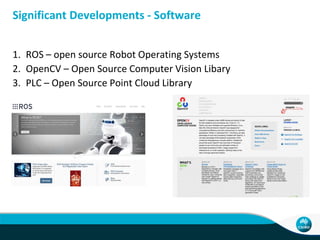
Significant Developments - Software
1. ROS – open source Robot Operating Systems
2. OpenCV – Open Source Computer Vision Libary
3. PLC – Open Source Point Cloud Library
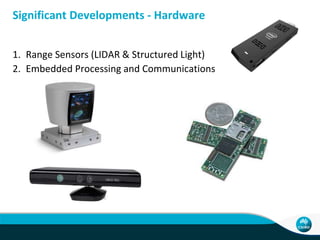
Significant Developments - Hardware
1. Range Sensors (LIDAR & Structured Light)
2. Embedded Processing and Communications
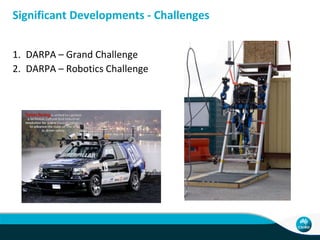
Significant Developments - Challenges
1. DARPA – Grand Challenge
2. DARPA – Robotics Challenge
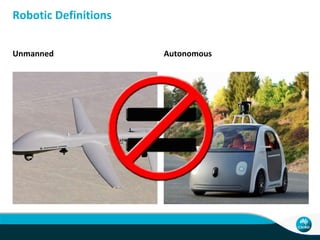
Unmanned Autonomous
Robotic Definitions
2015 imcrc

2015 imcrc

  • 1.
    Elliot Duff –Research Director - Autonomous Systems Program DIGITAL PRODUCTIVITY FLAGSHIP Theme 2: Automated and Assistive Technologies
  • 2.
    Vision: A worldin which humans and autonomous systems are able to seamlessly, reliably and safely collaborate. Autonomous Systems Program 45 40 15
  • 3.
    Threat posed byAustralia’s declining productivity Productivity is the prime determinant in the long run of a nation’s standard of living, for it is the root cause of per capita national income Michael Porter, 1991, The Competitive Advantage of Nations According to the Grattan Institute report Australia’s Productivity Challenge, Australia’s economic prospects beyond the end of the current ‘resources boom’ will deteriorate significantly (as they did in the 1970s and 1980s) if the decline in our productivity growth performance is not reversed.
  • 4.
    Australia Stalling inDigital Evolution Index
  • 5.
  • 6.
    Objective To develop automatedand assistive technologies that can enable Australian industrial workers to increase productivity and extend their participation in the workforce. Facing increasing operational costs, skills shortages and comparatively low productivity growth, combined with external factors such as increasing competition from low-wage countries, manufacturers are in need of a broader range of affordable solutions that give them the flexibility and agility to respond to a volatile market demand whilst also boosting their firm’s productivity.
  • 7.
  • 8.
    Awareness Implement high performanceworkplaces through the development of enhanced situational awareness technologies that enable close cooperation between assistive technologies and the workforce, across the manufacturing process, with a focus on Monitoring, Modelling and Information Management. This activity will be lead by Elliot Duff (CSIRO), due to his global reputation in real-time perception, sensing and communications with participation of QUT and other partners.
  • 9.
    Augmentation Implement high performanceworkplaces through the development of distributed heterogeneous collaboration technologies that provide enhanced OHS, skill augmentation and continuous quality control and assessment, with a focus on Collaboration and User Interfaces. This project will be lead by Jonathon Roberts (QUT), due to his global reputation in vision systems, with participation of CSIRO and other partners.
  • 10.
    Assistive Implement high performanceworkplaces through the development of lightweight assistive robotics that provide real-time, reconfigurable, physical support to the workforce, with a focus on Navigation, Manipulation and Cooperation including optimisation of manufacturing/construction time (through off-site assistive technologies). This project will be lead by Alberto Elfes (CSIRO), due to his global reputation in tele-assitive collaboration, manipulation and robot navigation, with participation of QUT and other partners.
  • 11.
    Governance (Agility) Implement highperformance workplaces through the development of information assisted methods and proxies for the development of processes, associated standards and codes of practices for new manufacturing processes, including scaling and quality control, and methods of testing and compliance of manufacturing components and systems (using agile manufacturing/ personalised production). This project will be lead by Tuan Ngo (UniMelb), due to his global reputation in modelling systems, with participation of CSIRO and other partners.
  • 12.
    •New Workflows •New Business Models •NewEnterprises •New Processes •New Materials •New Production •Mass Customization •Maximize Flexibility •Mass Production •Minimize Waste Lean Agile Information Driven Advanced Information Driven Manufacturing Great Expectations Virtuallyhere Morefrom Less • Additive • Titanium • Nano • Bio • Flexible
  • 13.
    Information Driven Manufacturing IndustrialInternet (GE) Industry 4.0 (Germany) Network Enabled Manufacturing (Boeing) Manufacturing 2.0 (European) IoT – Internet of Things Cloud Computing Big Data Semantic Web
  • 14.
  • 15.
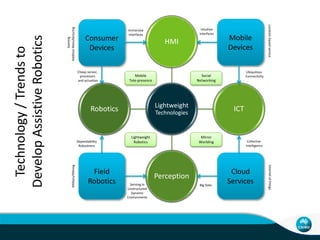
    Lightweight Technologies HMI ICT Perception Robotics Mobile Tele-presence Lightweight Robotics Mirror Worlding Social Networking Sensing in Unstructured Dynamic Environments Field Robotics Dependability Robustness Military/Mining Collective Intelligence Cloud ServicesBig Data Internetofthings Cheapsensor, processors and actuation Consumer Devices Immersive Interfaces Gaming AdditiveManufacturing Intuitive interfaces Mobile Devices Ubiquitous Connectivity Locationbasedservice Technology/Trendsto DevelopAssistiveRobotics
  • 16.
    Guardian Angel • Monitorsenvironment • Tracks people and assets • Make work safer for humans Guardian Mentor • Worker augmentation • Provides skills and training • Make work easier for human Guardian Helper • Provides physical assistance • Robotic co-workers • Works with humans Guardian Worker • Provides remote assistance • Tele-operated robotics • Work for humans Worker Centric Augmentation • Collaboration • Interface • Observatory Assistive • Navigation • Manipulation • Cooperation Awareness • Monitoring • Modeling • Management Social Science Human Factors Informatics Communications Sensors Robotics Engineering Investment Innovation Impact Increase productivity, safety and adaptability of future workforce through virtual and assistive automation technologies High Performance Workplace • Low-cost, from purchasing price and installation costs, to reprogramming and maintenance costs • Easy to use, without the need of technical expertise to deploy, operate and reconfigure the systems • Support mass customisation, ideal for small runs of multiple types of products
  • 17.
  • 18.
  • 19.
    Disruptive Technologies LESANZ| Commercialization A disruptiveinnovation is an innovation that helps create a new market and value network, and eventually disrupts an existing market and value network (over a few years or decades), displacing an earlier technology.
  • 20.
    Example of DisruptiveTechnology: Tracking of Bees with Micro RF tags
  • 21.
    • Use commonlanguage • Project proposals • Companies like waterfall • Researchers like Agile Communication
  • 22.
    Technology Readiness Level TechnologyReadiness Levels (TRL) are a method of estimating technology maturity of Critical Technology Elements (CTE) of a program during the acquisition process. They are determined during a Technology Readiness Assessment (TRA) that examines program concepts, technology requirements, and demonstrated technology capabilities. TRL are based on a scale from 1 to 9 with 9 being the most mature technology. • Need to understand language: • Feasibility Project • Prototype Project • Demonstration
  • 23.
    Level of Development Resources Existing Research Resources Existing Commercial Resources Bridgingthe Valley of Death Technology Push Innovation Infrastructure Technology Pull Bridging the Valley of Death
  • 24.
    Absorptive capacity The abilityto recognize the value of new information: – Assimilation – Very poor collaboration between companies and research institutes – Transformation – Companies are not willing to change or understand – Exploitation – Changing business models
  • 25.
    Other Issues • Geography •Not invented here – Not willing to work with remote researchers • Not sold here – Only look at ROI for local market • Culture • Collaborative – Open Innovation • Competitive – Closed Innovation • Licensing • Non-excusive • Exclusive • IP Ownership?
  • 26.
  • 27.
    i3Hub • To inspireand transform Australian businesses to improve their global competitiveness, CSIRO will create a connected innovation marketplace where our customers and partners will collaborate and experience what is possible today and what are the potential futures associated with the industrial internet. • Engagements • Industrial Internet Consortium • ROS Industrial (Robotic Operation Systems) • OpenIoT and AU2EU (security and trust) • IMCRC – Innovative Manufacturing CRC LESANZ| Commercialization
  • 28.
    Underlying Principle • Inan industrial context, IoT technologies typically address five business scenarios, independent of sector or particular activity. • These are: • connecting supply chains • enabling proactive maintenance • enabling better factory/plant/refinery/rig automation and/or integration • better factory/plant/refinery/rig visibility • improved safety without an impact on productivity • The Industrial IoT innovation hub will aim to develop demonstrators for each of these scenarios.
  • 29.
    Challenges … Butthe Opportunity … • Accenture reported, that only 38% of C-Suite executives believed that their company’s senior leaders fully understand the IoT and 73 % have yet to make any concrete investments in the IoT. • 87 % of the executives believe that IoT technologies will lead to long term job growth and 84 % believe that their organisations have the ability to create new service-based revenue streams. • Findings correlate with CSIRO industry consultations around the role of ICT in manufacturing SMEs. See Appendix B for Mind Map of relationships • Markets for IoT technologies in Australia are largely undeveloped and CSIRO has the opportunity to position itself as the centre of the IoT innovation in Australia. • A national IoT Innovation Hub is vital to achieving this. CSIRO – Digital Productivity Flagship
  • 30.
    Eating our owndog food • I3Hub will be part of our business as usual. • It will not only demonstrate what ‘could be’, but what ‘is’. • It will provide confidence to our customers that our research is applied and lead by their interests • It will enable a HSE dimension that is currently manually managed (with overhead cranes etc used in the setup for customer research) and an ‘application’ in our own backyard which improves our safety.
  • 31.
    Functionality* Perth, Clayton andQCAT will have: • ability to monitor their areas as well as the other sites. • CSIRO 3D scanning and remote assistance tools. * Developed in consultation with CSIRO Stakeholder – See Appending C
  • 32.
    Partners in Conversation CSIRO– Digital Productivity Flagship
  • 33.
    Robotics Domains Real-timePerception Human Interaction Industrial •Welding Arms •Conveyors Military •Drones •Inspection Resources •Mining/ Agriculture / Oil & Gas •Haulage Infrastructure •Transport •Logistics / Warehousing Service •Medical •Household Outdoor (Field Robotics) Real-time Perception of Dynamic Unstructured Environments Indoor (Agile Robotics) Real-time Perception of Dynamic Unstructured Environments
  • 34.
    Significant Developments -Software 1. ROS – open source Robot Operating Systems 2. OpenCV – Open Source Computer Vision Libary 3. PLC – Open Source Point Cloud Library
  • 35.
    Significant Developments -Hardware 1. Range Sensors (LIDAR & Structured Light) 2. Embedded Processing and Communications
  • 36.
    Significant Developments -Challenges 1. DARPA – Grand Challenge 2. DARPA – Robotics Challenge
  • 37.