Response Robotics
Bushfire Use Case
Elliot Duff – Cyber Physical Systems - CSIRO
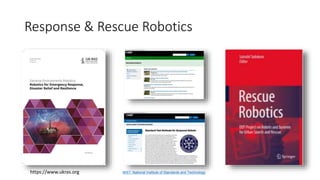
Response & Rescue Robotics
NIST: National Institute of Standards and Technologyhttps://www.ukras.org
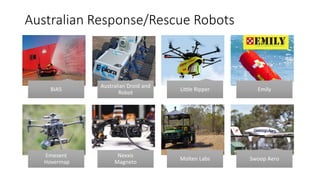
BIA5
Australian Droid and
Robot
Little Ripper Emily
Emesent
Hovermap
Nexxis
Magneto
Molten Labs Swoop Aero
Australian Response/Rescue Robots
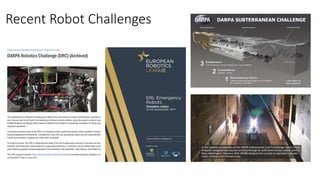
Recent Robot Challenges
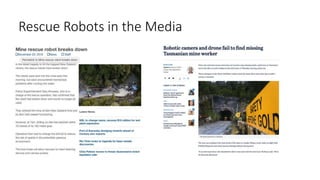
Rescue Robots in the Media
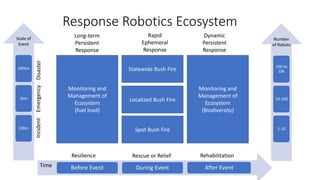
Response Robotics Ecosystem
Spot Bush Fire
Rescue or ReliefResilience Rehabilitation
Time Before Event During Event After Event
Scale of
Event
IncidentEmergencyDisaster
100m
1km
100km
Localized Bush Fire
Statewide Bush Fire
Monitoring and
Management of
Ecosystem
(fuel load)
Monitoring and
Management of
Ecosystem
(Biodiversity)
Number
of Robots
1-10
10-100
100 to
10k
Rapid
Ephemeral
Response
Long-term
Persistent
Response
Dynamic
Persistent
Response
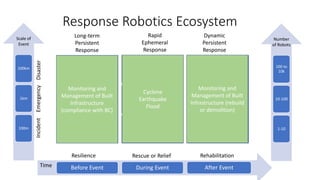
Response Robotics Ecosystem
Spot Bush Fire
Rescue or ReliefResilience Rehabilitation
Time Before Event During Event After Event
Scale of
Event
IncidentEmergencyDisaster
100m
1km
100km
Localized Bush Fire
Statewide Bush Fire
Monitoring and
Management of
Ecosystem (fuel load)
Monitoring and
Management of
Ecosystem
(Biodiversity)
Number
of Robots
1-10
10-100
100 to
10k
Rapid
Ephemeral
Response
Long-term
Persistent
Response
Dynamic
Persistent
Response
Monitoring and
Management of Built
Infrastructure
(compliance with BC)
Monitoring and
Management of Built
Infrastructure (rebuild
or demolition)
Cyclone
Earthquake
Flood
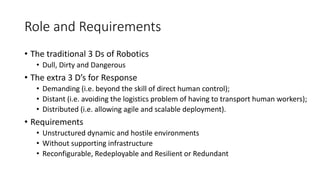
Role and Requirements
• The traditional 3 Ds of Robotics
• Dull, Dirty and Dangerous
• The extra 3 D’s for Response
• Demanding (i.e. beyond the skill of direct human control);
• Distant (i.e. avoiding the logistics problem of having to transport human workers);
• Distributed (i.e. allowing agile and scalable deployment).
• Requirements
• Unstructured dynamic and hostile environments
• Without supporting infrastructure
• Reconfigurable, Redeployable and Resilient or Redundant
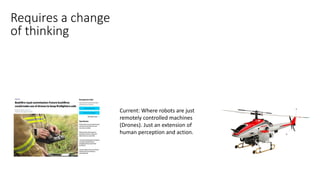
Current: Where robots are just
remotely controlled machines
(Drones). Just an extension of
human perception and action.
Requires a change
of thinking
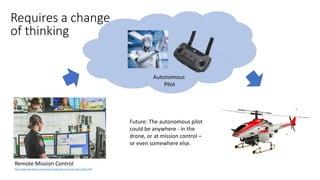
Autonomous
Pilot
Remote Mission Control
https://www.qfes.qld.gov.au/employment/jobs/fire-communications-officer.html
Future: The autonomous pilot
could be anywhere - in the
drone, or at mission control –
or even somewhere else.
Requires a change
of thinking
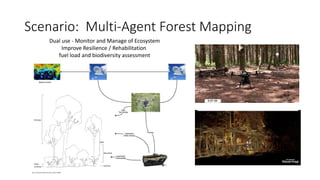
Scenario: Multi-Agent Forest Mapping
Dual use - Monitor and Manage of Ecosystem
Improve Resilience / Rehabilitation
fuel load and biodiversity assessment
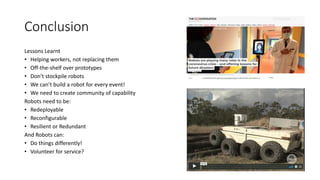
Conclusion
Lessons Learnt
• Helping workers, not replacing them
• Off-the-shelf over prototypes
• Don’t stockpile robots
• We can’t build a robot for every event!
• We need to create community of capability
Robots need to be:
• Redeployable
• Reconfigurable
• Resilient or Redundant
And Robots can:
• Do things differently!
• Volunteer for service?

Response robotics

  • 1.
    Response Robotics Bushfire UseCase Elliot Duff – Cyber Physical Systems - CSIRO
  • 2.
    Response & RescueRobotics NIST: National Institute of Standards and Technologyhttps://www.ukras.org
  • 3.
    BIA5 Australian Droid and Robot LittleRipper Emily Emesent Hovermap Nexxis Magneto Molten Labs Swoop Aero Australian Response/Rescue Robots
  • 4.
  • 5.
  • 6.
    Response Robotics Ecosystem SpotBush Fire Rescue or ReliefResilience Rehabilitation Time Before Event During Event After Event Scale of Event IncidentEmergencyDisaster 100m 1km 100km Localized Bush Fire Statewide Bush Fire Monitoring and Management of Ecosystem (fuel load) Monitoring and Management of Ecosystem (Biodiversity) Number of Robots 1-10 10-100 100 to 10k Rapid Ephemeral Response Long-term Persistent Response Dynamic Persistent Response
  • 7.
    Response Robotics Ecosystem SpotBush Fire Rescue or ReliefResilience Rehabilitation Time Before Event During Event After Event Scale of Event IncidentEmergencyDisaster 100m 1km 100km Localized Bush Fire Statewide Bush Fire Monitoring and Management of Ecosystem (fuel load) Monitoring and Management of Ecosystem (Biodiversity) Number of Robots 1-10 10-100 100 to 10k Rapid Ephemeral Response Long-term Persistent Response Dynamic Persistent Response Monitoring and Management of Built Infrastructure (compliance with BC) Monitoring and Management of Built Infrastructure (rebuild or demolition) Cyclone Earthquake Flood
  • 8.
    Role and Requirements •The traditional 3 Ds of Robotics • Dull, Dirty and Dangerous • The extra 3 D’s for Response • Demanding (i.e. beyond the skill of direct human control); • Distant (i.e. avoiding the logistics problem of having to transport human workers); • Distributed (i.e. allowing agile and scalable deployment). • Requirements • Unstructured dynamic and hostile environments • Without supporting infrastructure • Reconfigurable, Redeployable and Resilient or Redundant
  • 9.
    Current: Where robotsare just remotely controlled machines (Drones). Just an extension of human perception and action. Requires a change of thinking
  • 10.
    Autonomous Pilot Remote Mission Control https://www.qfes.qld.gov.au/employment/jobs/fire-communications-officer.html Future:The autonomous pilot could be anywhere - in the drone, or at mission control – or even somewhere else. Requires a change of thinking
  • 11.
    Scenario: Multi-Agent ForestMapping Dual use - Monitor and Manage of Ecosystem Improve Resilience / Rehabilitation fuel load and biodiversity assessment
  • 12.
    Conclusion Lessons Learnt • Helpingworkers, not replacing them • Off-the-shelf over prototypes • Don’t stockpile robots • We can’t build a robot for every event! • We need to create community of capability Robots need to be: • Redeployable • Reconfigurable • Resilient or Redundant And Robots can: • Do things differently! • Volunteer for service?

Editor's Notes

  • #3 https://www.ukras.org/wp-content/uploads/2018/10/UK_RAS_wp_extreme_print_final.pdf