Agile Approach & Scrum Framework
Presented By
Samira D. AlShahrani
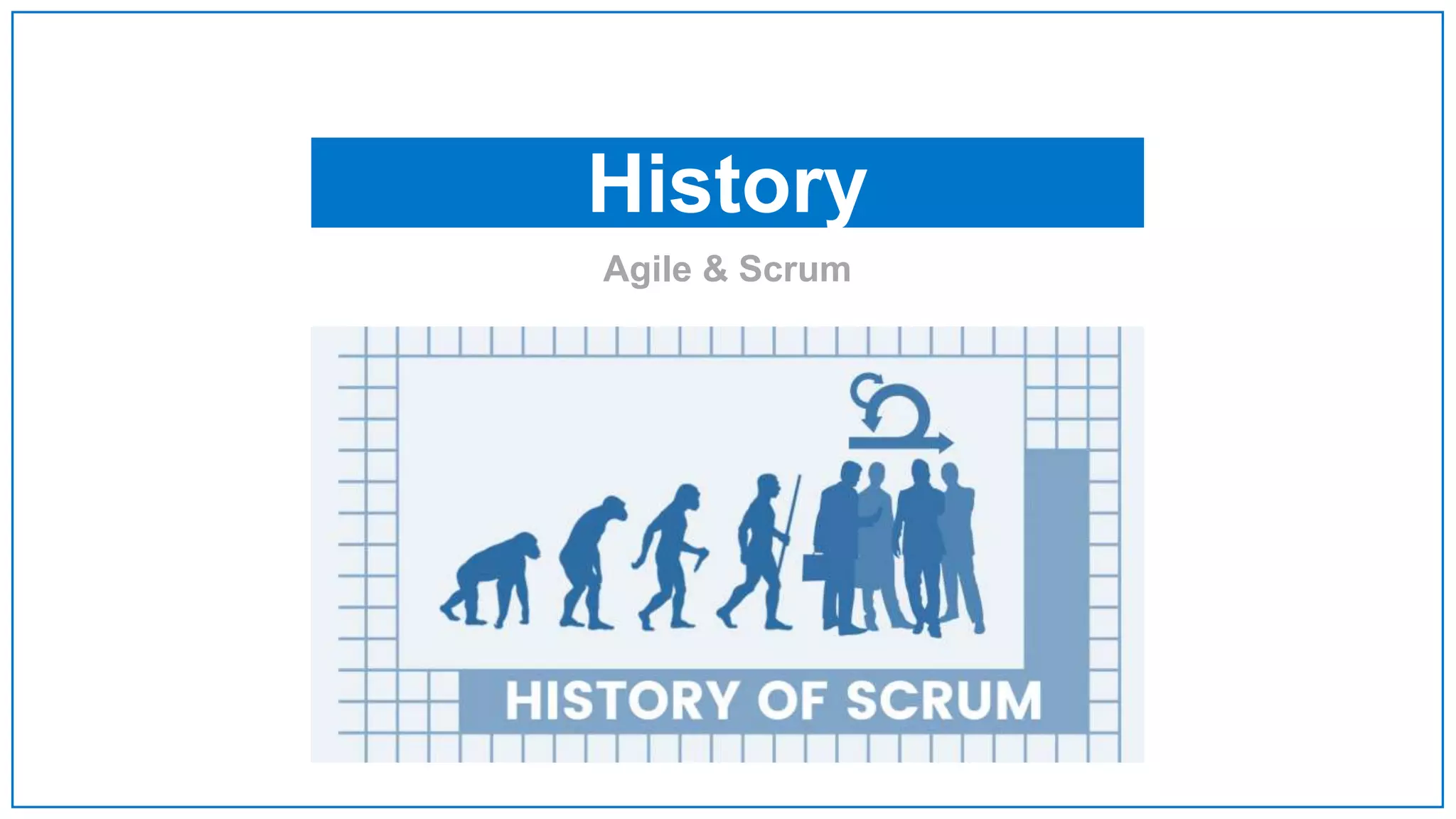
History
Agile & Scrum
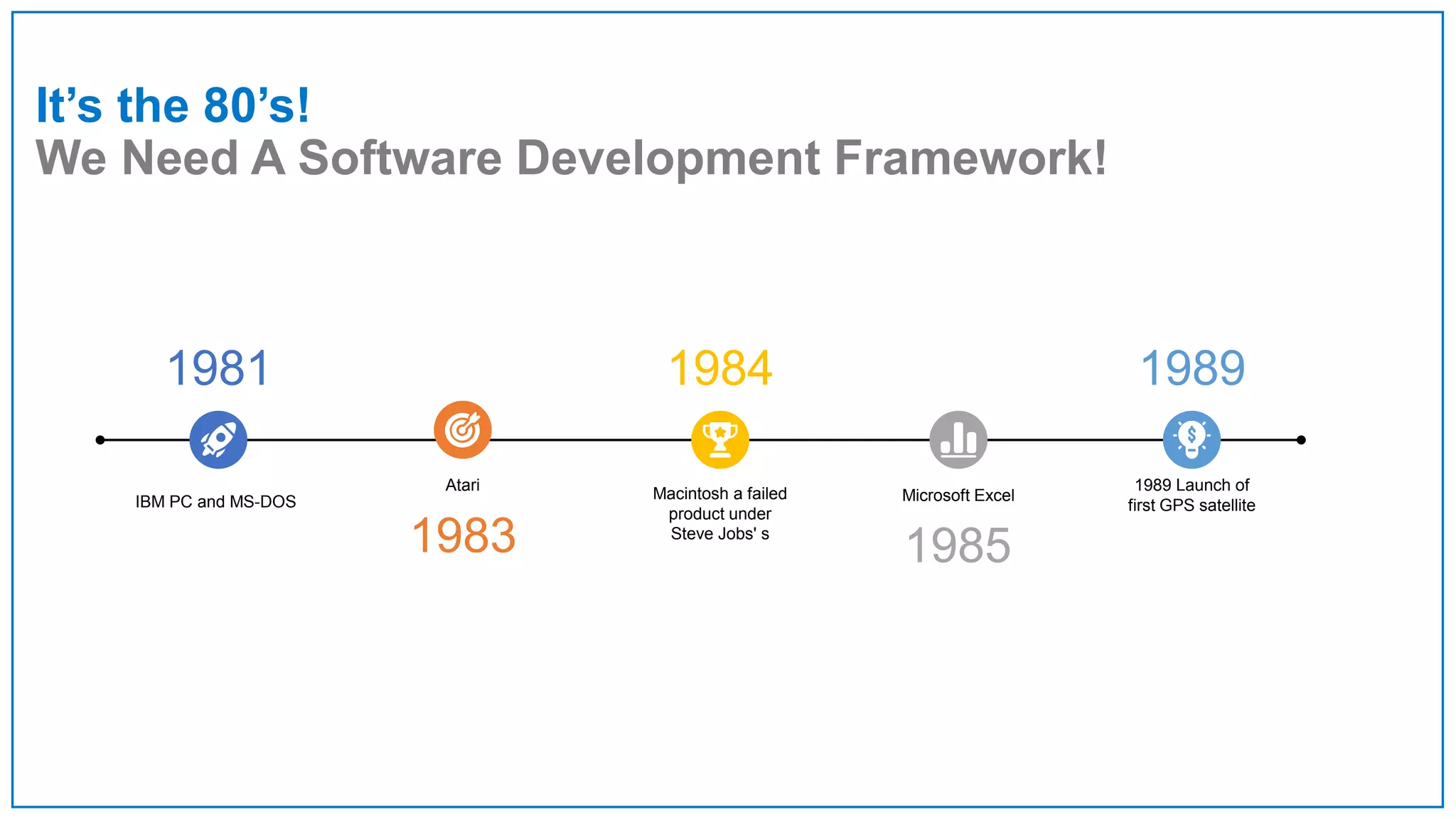
It’s the 80’s!
We Need A Software Development Framework!
Macintosh a failed
product under
Steve Jobs' s
IBM PC and MS-DOS
Atari 1989 Launch of
first GPS satellite
Microsoft Excel
1981 1984 1989
1983 1985
Why We Need A New SDLC Approach?
• The traditional ways are just not good now!
• It is imposable to identify all the requirements from the beginning
• The rapid customer changing requirements
• Waiting for the entire cycle to end before getting feedback from customers
• At best this leads to the elimination of the estimated profit but in most cases can
lead to serious losses
• The nature of the problem would often change (but the project requirements
would not)
Do You Think Agile or Scrum Was First Born?
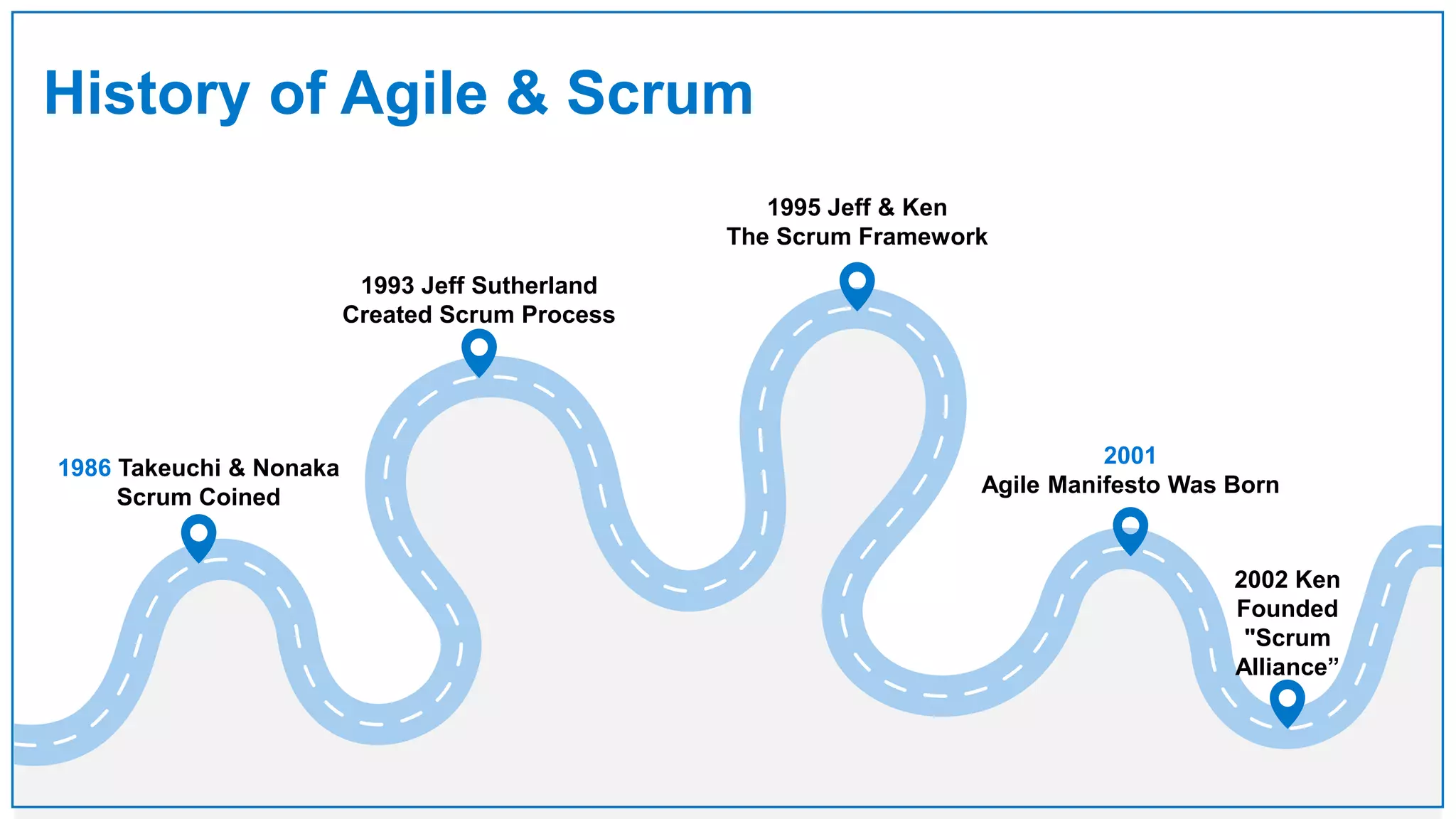
History of Agile & Scrum
1986 Takeuchi & Nonaka
Scrum Coined
1995 Jeff & Ken
The Scrum Framework
2001
Agile Manifesto Was Born
1993 Jeff Sutherland
Created Scrum Process
2002 Ken
Founded
"Scrum
Alliance”
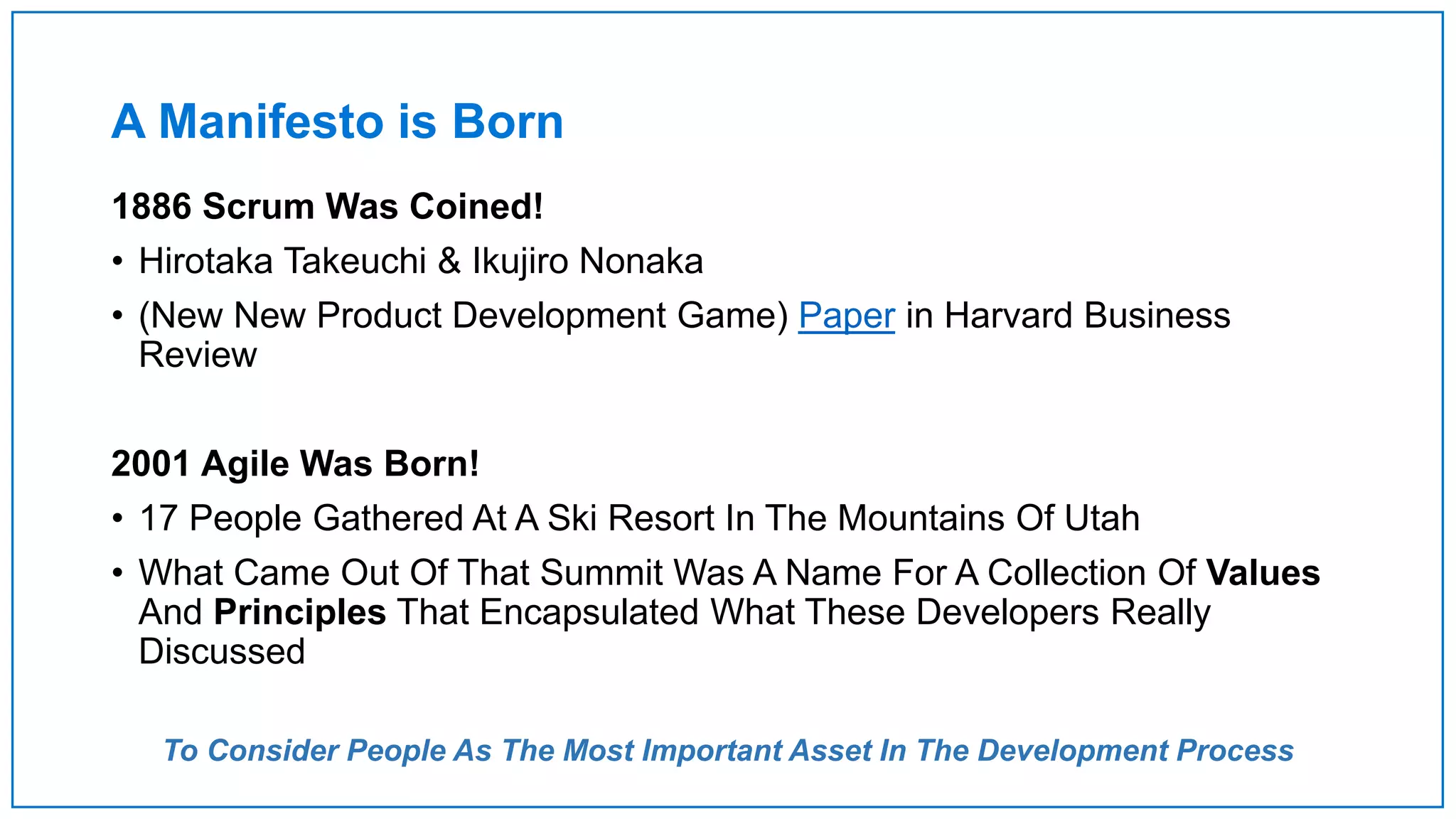
A Manifesto is Born
1886 Scrum Was Coined!
• Hirotaka Takeuchi & Ikujiro Nonaka
• (New New Product Development Game) Paper in Harvard Business
Review
2001 Agile Was Born!
• 17 People Gathered At A Ski Resort In The Mountains Of Utah
• What Came Out Of That Summit Was A Name For A Collection Of Values
And Principles That Encapsulated What These Developers Really
Discussed
To Consider People As The Most Important Asset In The Development Process
What Is Agile?
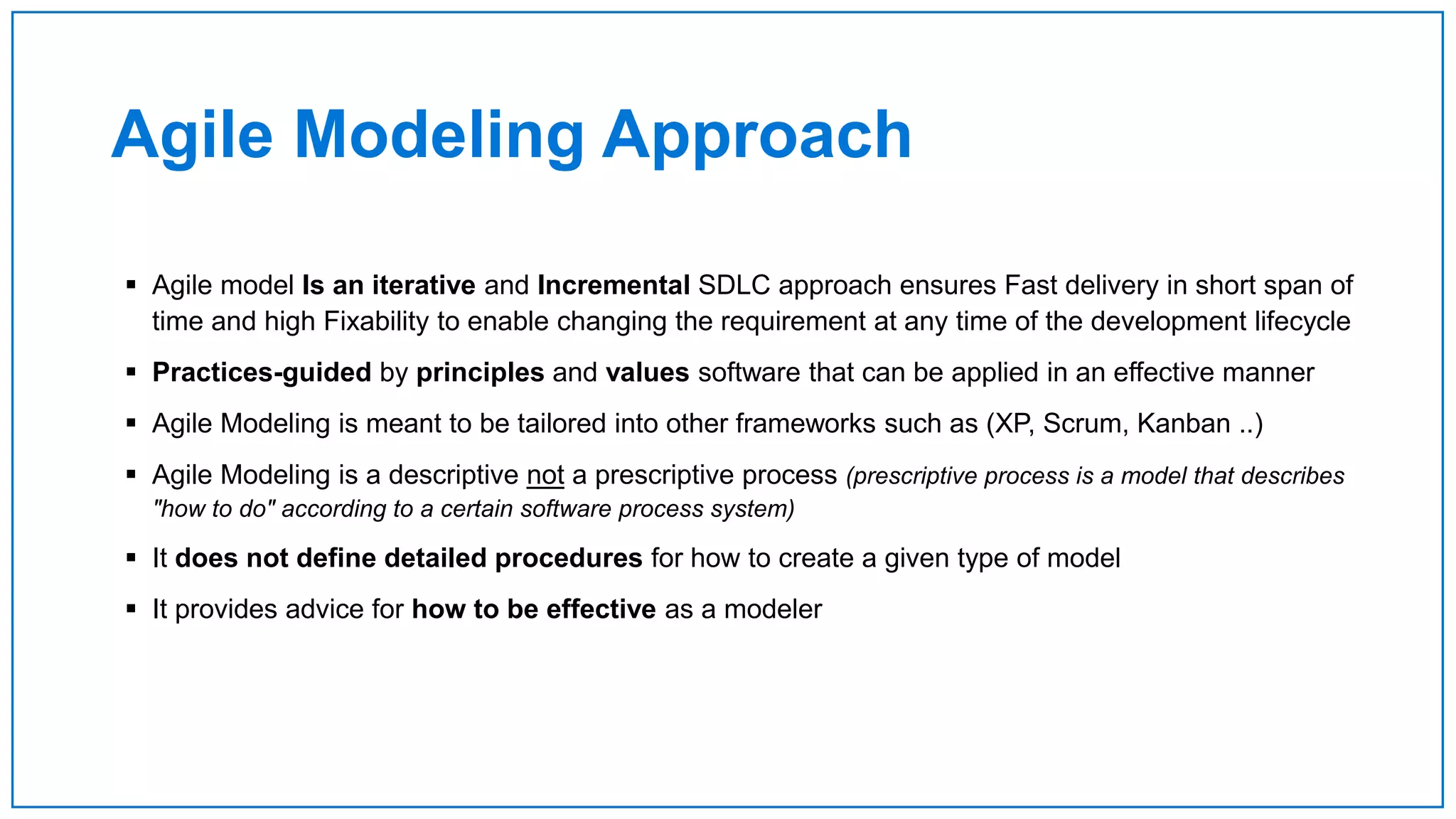
Agile Modeling Approach
 Agile model Is an iterative and Incremental SDLC approach ensures Fast delivery in short span of
time and high Fixability to enable changing the requirement at any time of the development lifecycle
 Practices-guided by principles and values software that can be applied in an effective manner
 Agile Modeling is meant to be tailored into other frameworks such as (XP, Scrum, Kanban ..)
 Agile Modeling is a descriptive not a prescriptive process (prescriptive process is a model that describes
"how to do" according to a certain software process system)
 It does not define detailed procedures for how to create a given type of model
 It provides advice for how to be effective as a modeler
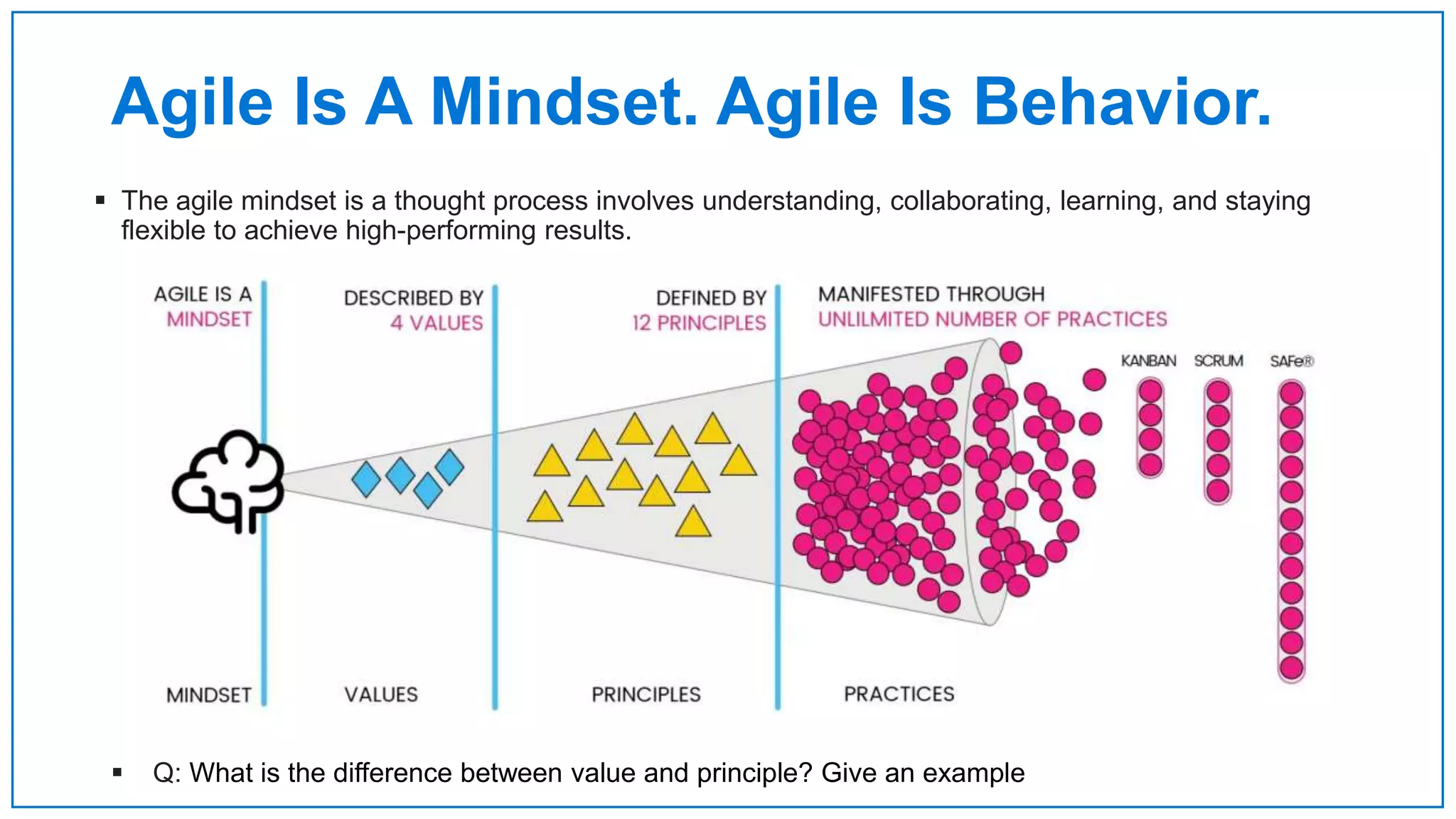
 The agile mindset is a thought process involves understanding, collaborating, learning, and staying
flexible to achieve high-performing results.
Agile Is A Mindset. Agile Is Behavior.
 Q: What is the difference between value and principle? Give an example
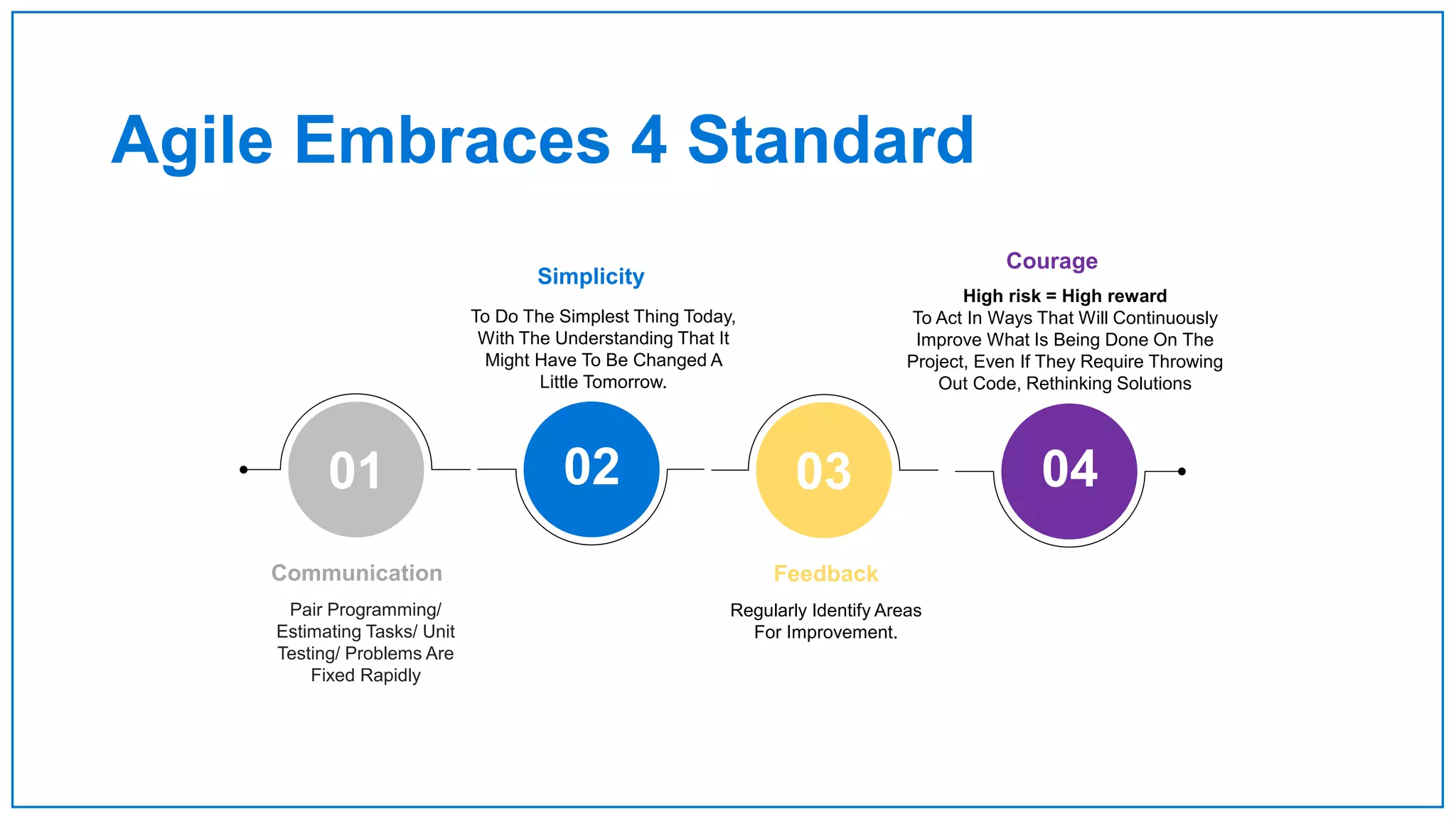
Agile Embraces 4 Standard
Communication
Pair Programming/
Estimating Tasks/ Unit
Testing/ Problems Are
Fixed Rapidly
Feedback
Regularly Identify Areas
For Improvement.
Simplicity
To Do The Simplest Thing Today,
With The Understanding That It
Might Have To Be Changed A
Little Tomorrow.
Courage
High risk = High reward
To Act In Ways That Will Continuously
Improve What Is Being Done On The
Project, Even If They Require Throwing
Out Code, Rethinking Solutions
01 03 04
02
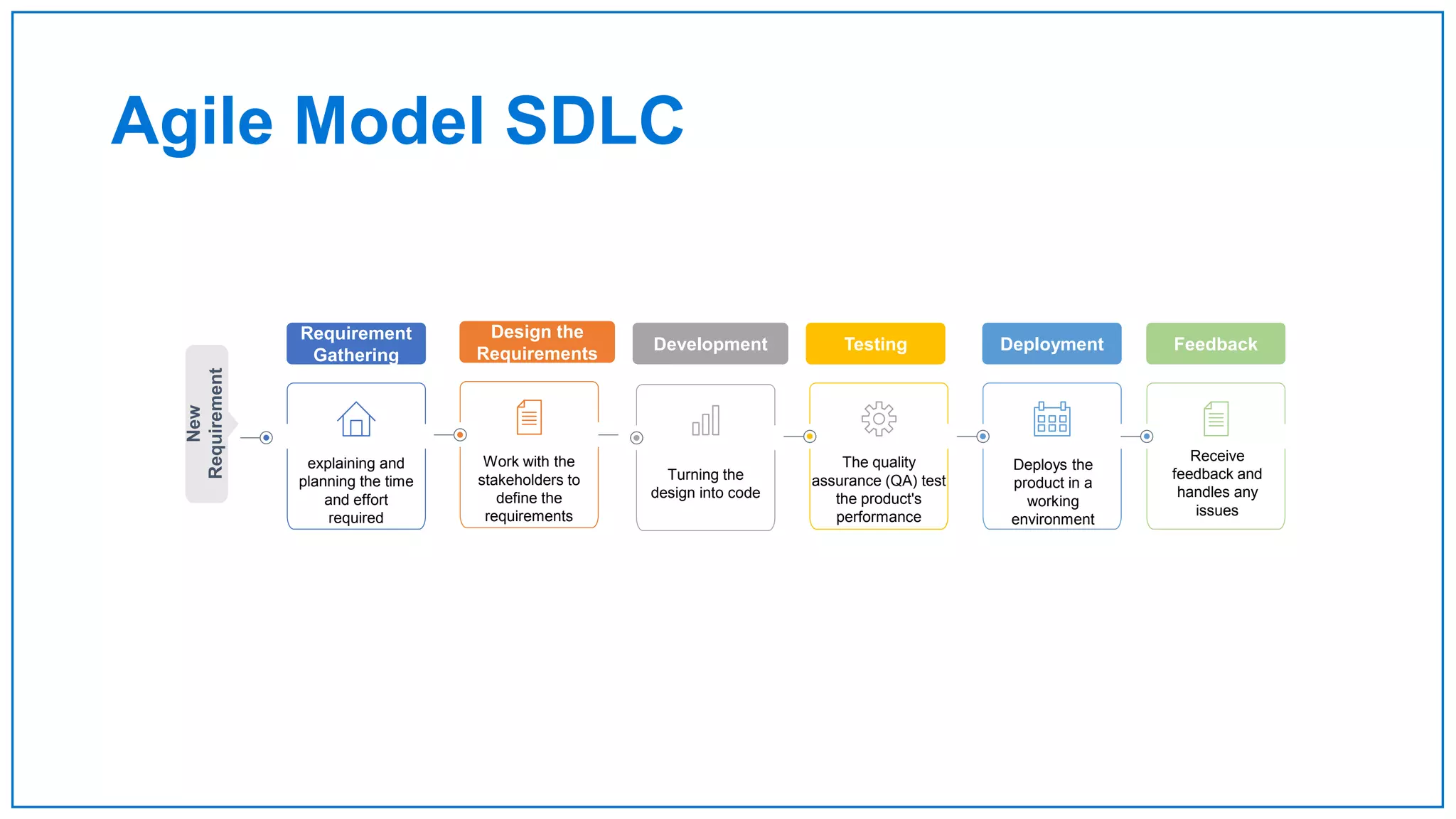
Agile Model SDLC
explaining and
planning the time
and effort
required
Work with the
stakeholders to
define the
requirements
Turning the
design into code
The quality
assurance (QA) test
the product's
performance
Deploys the
product in a
working
environment
Requirement
Gathering
Design the
Requirements
Development Testing Deployment
New
Requirement
Receive
feedback and
handles any
issues
Feedback
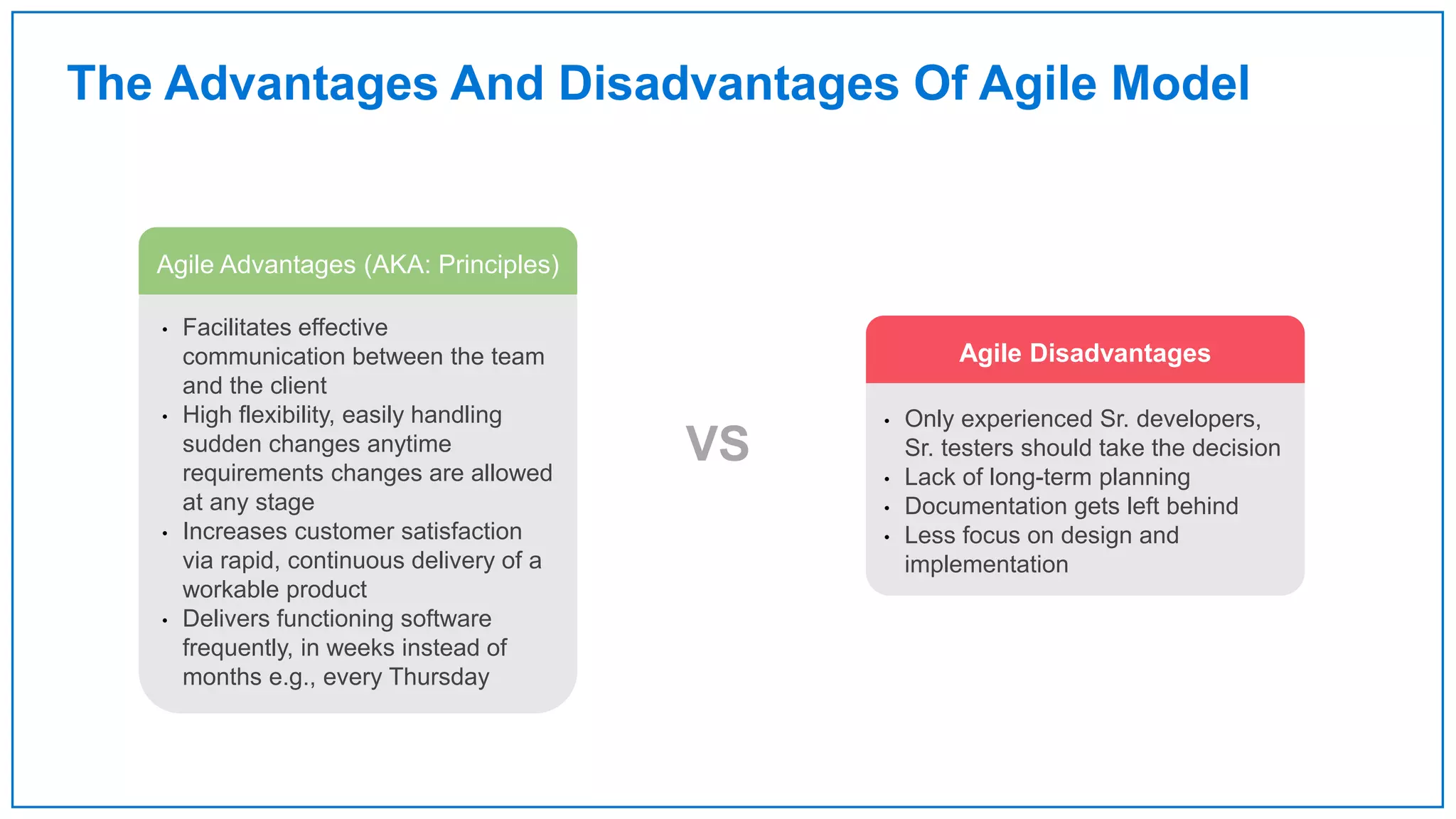
The Advantages & Disadvantages Of Agile Model
• Only experienced Sr. developers,
Sr. testers should take the decision
• Lack of long-term planning
• Documentation gets left behind
• Less focus on design and
implementation
Agile Disadvantages
• Facilitates effective
communication between the team
and the client
• High flexibility, easily handling
sudden changes anytime
requirements changes are allowed
at any stage
• Increases customer satisfaction
via rapid, continuous delivery of a
workable product
• Delivers functioning software
frequently, in weeks instead of
months e.g., every Thursday
Agile Advantages (AKA: Principles)
The Advantages And Disadvantages Of Agile Model
VS
The Difference Between Agile & Scrum
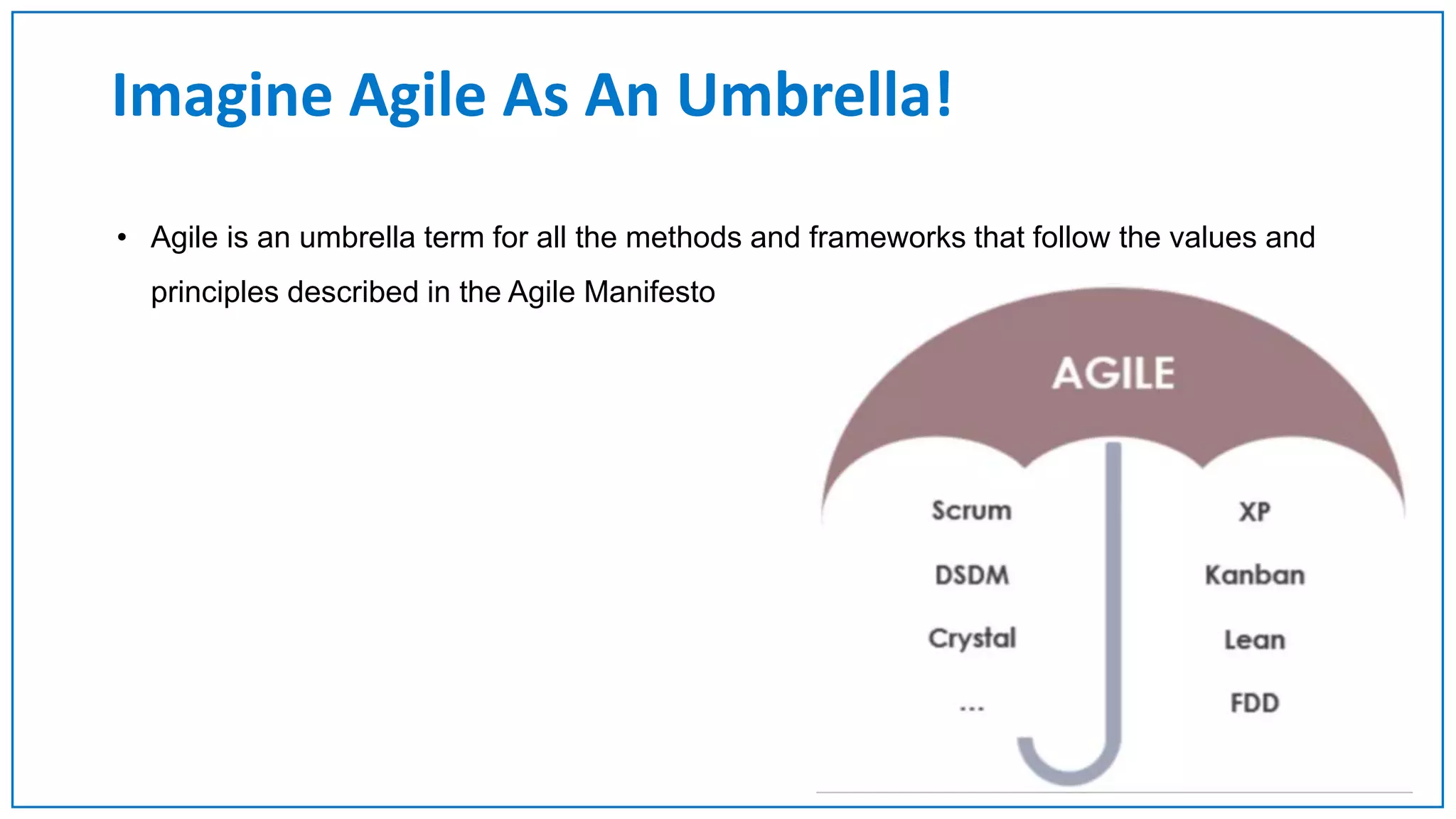
Imagine Agile As An Umbrella!
• Agile is an umbrella term for all the methods and frameworks that follow the values and
principles described in the Agile Manifesto
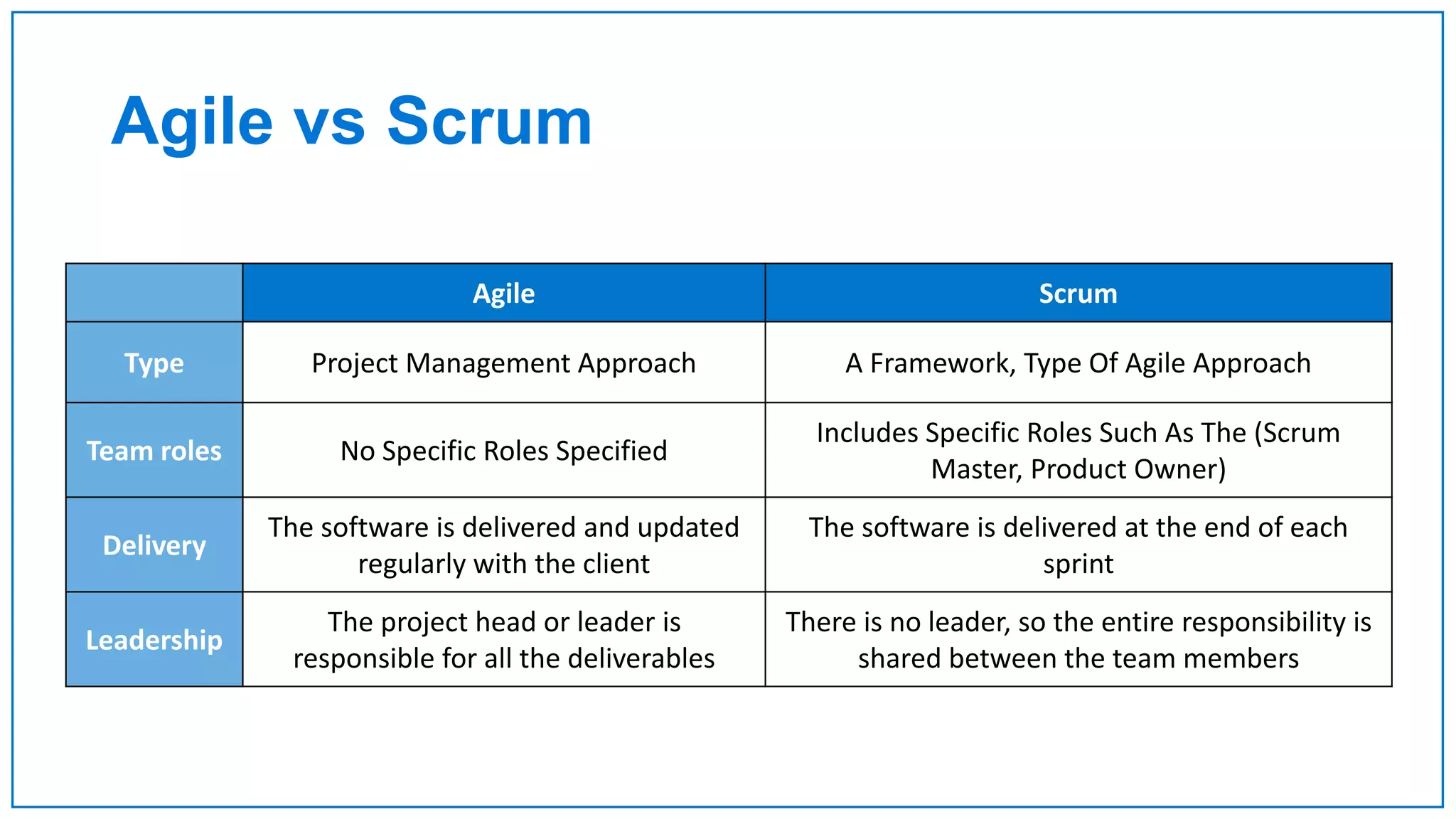
Agile vs Scrum
Agile Scrum
Type Project Management Approach A Framework, Type Of Agile Approach
Team roles No Specific Roles Specified
Includes Specific Roles Such As The (Scrum
Master, Product Owner)
Delivery
The software is delivered and updated
regularly with the client
The software is delivered at the end of each
sprint
Leadership
The project head or leader is
responsible for all the deliverables
There is no leader, so the entire responsibility is
shared between the team members
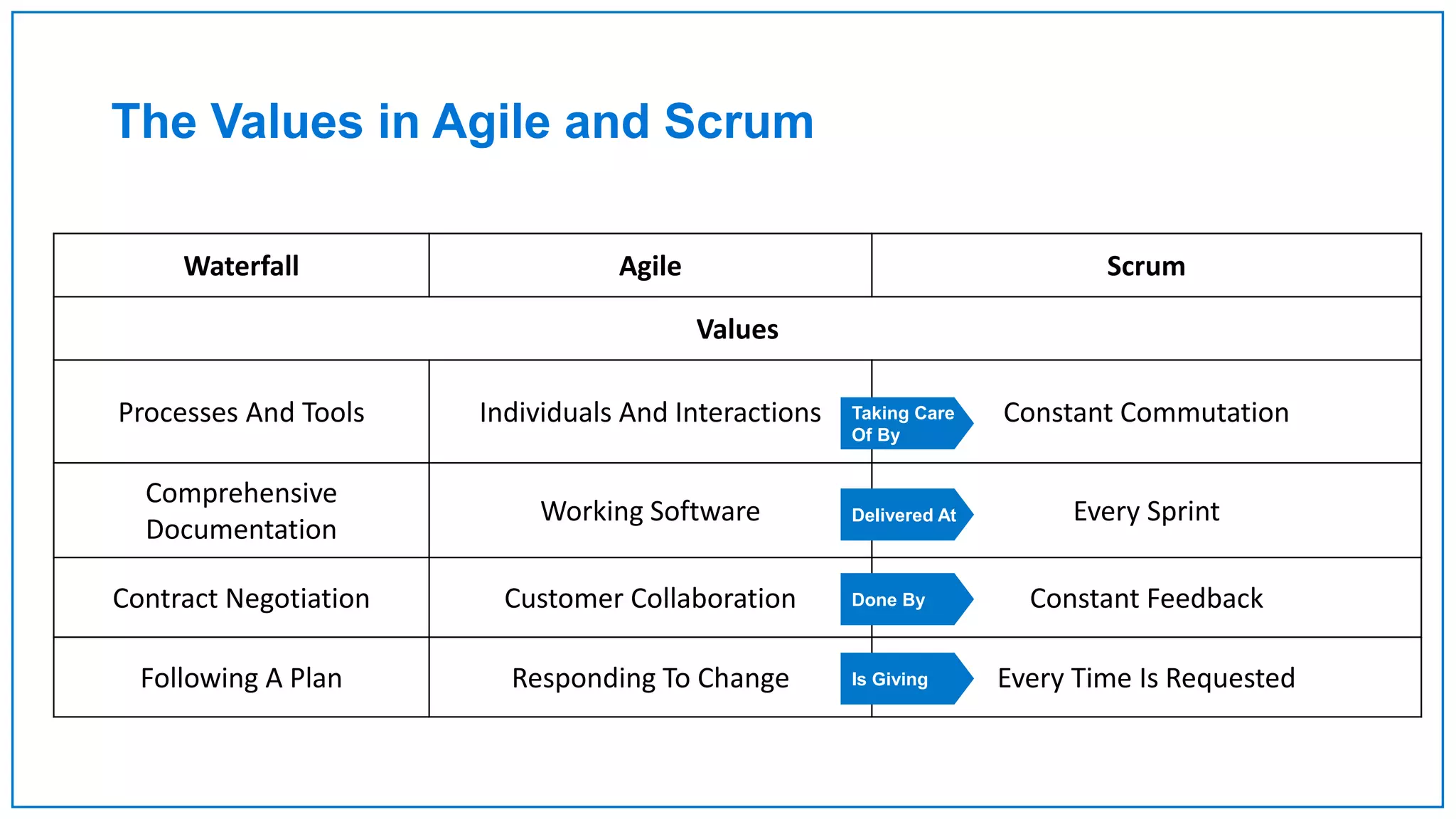
The Values in Agile and Scrum
Waterfall Agile Scrum
Values
Processes And Tools Individuals And Interactions Constant Commutation
Comprehensive
Documentation
Working Software Every Sprint
Contract Negotiation Customer Collaboration Constant Feedback
Following A Plan Responding To Change Every Time Is Requested
Taking Care
Of By
Delivered At
Done By
Is Giving
What Is Scrum?
Scrum Definition
• Scrum is a lightweight framework that helps teams and organizations
generate value through adaptive solutions for complex problems
• Scrum as a way to get work done (as a team) in small pieces at a time,
with continuous experimentation and feedback loops along the way to
learn and improve as you go
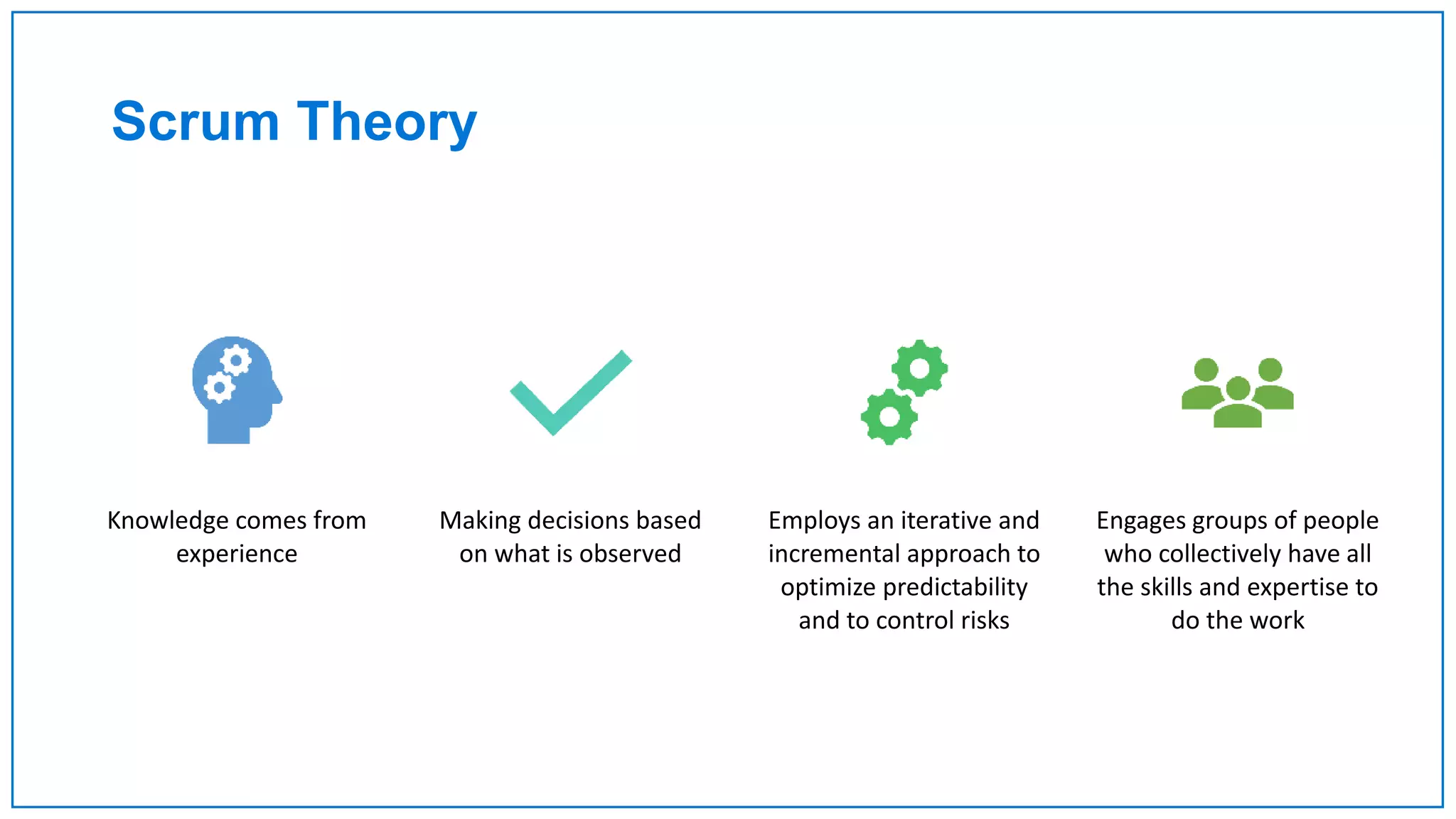
Scrum Theory
Knowledge comes from
experience
Making decisions based
on what is observed
Employs an iterative and
incremental approach to
optimize predictability
and to control risks
Engages groups of people
who collectively have all
the skills and expertise to
do the work
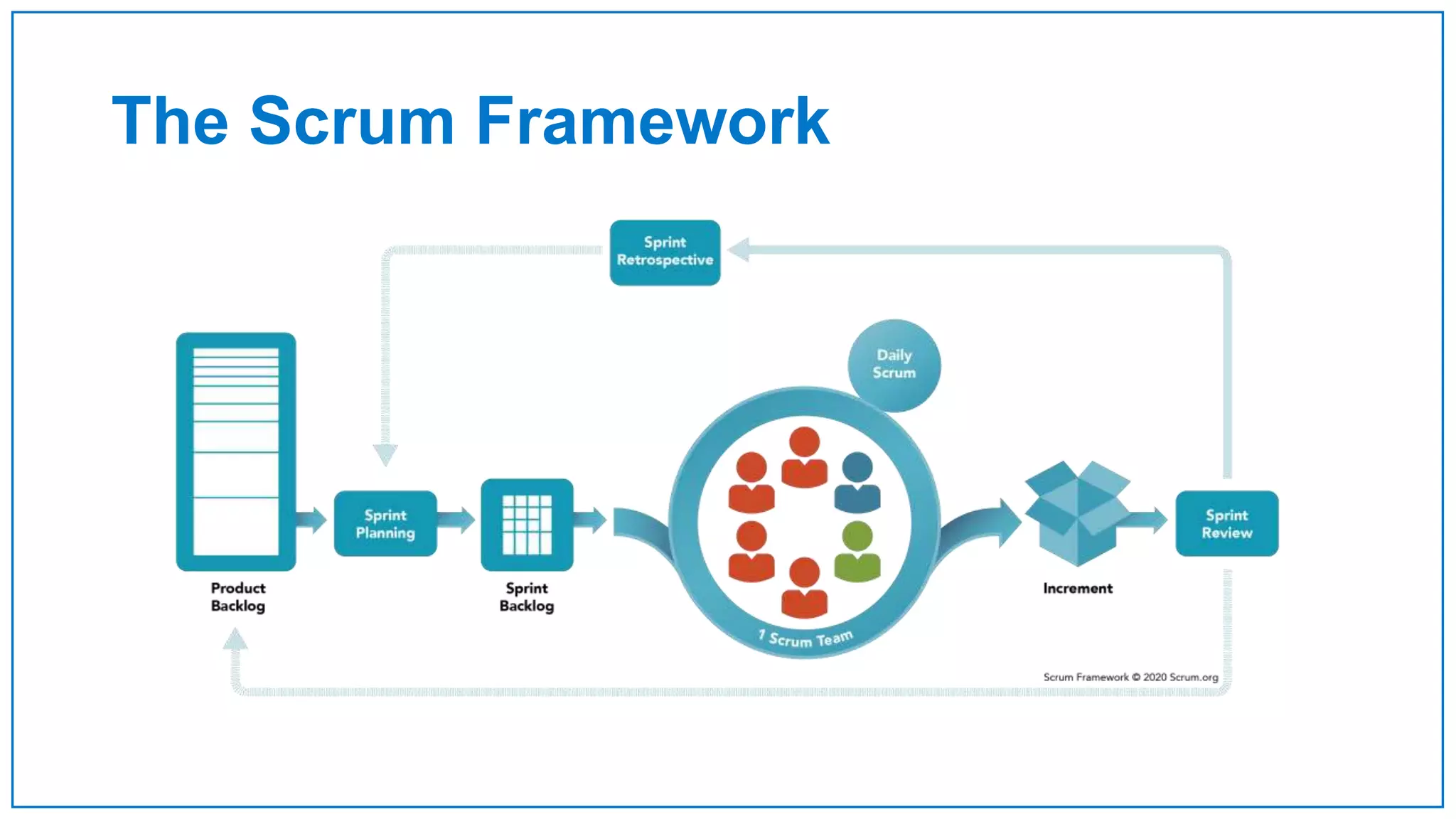
The Scrum Framework
The Scrum Team
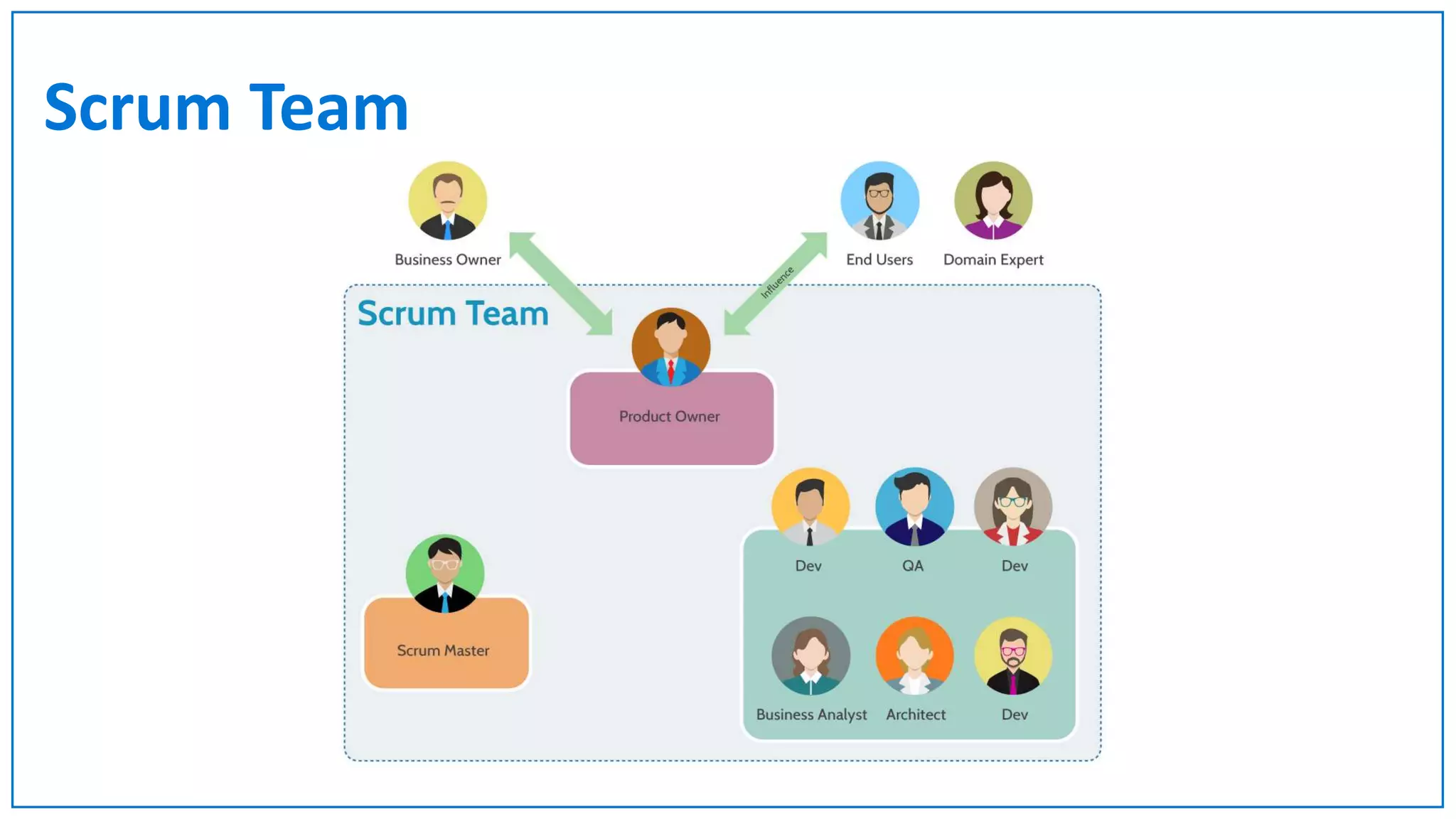
Scrum Team
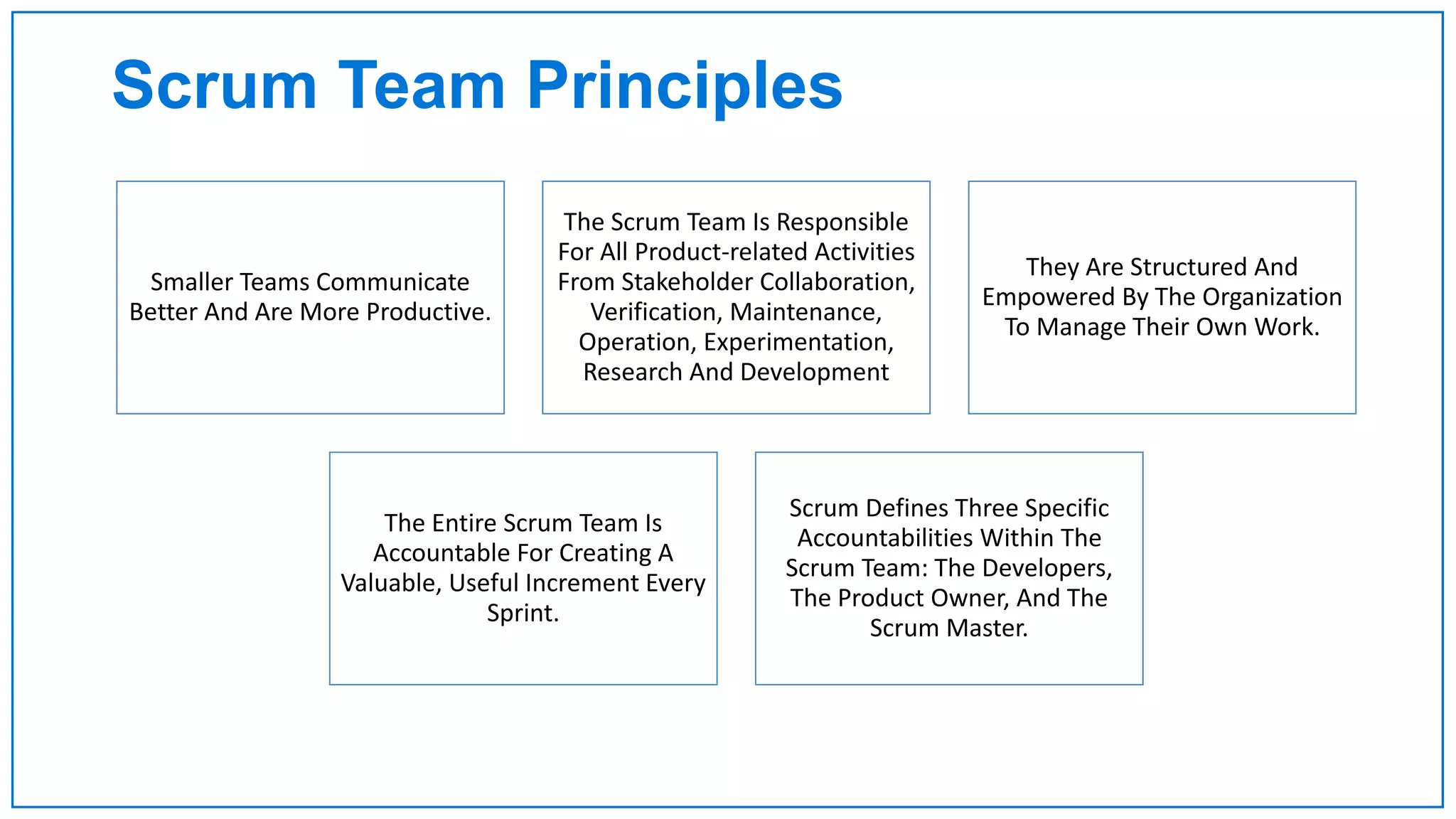
Scrum Team Principles
Smaller Teams Communicate
Better And Are More Productive.
The Scrum Team Is Responsible
For All Product-related Activities
From Stakeholder Collaboration,
Verification, Maintenance,
Operation, Experimentation,
Research And Development
They Are Structured And
Empowered By The Organization
To Manage Their Own Work.
The Entire Scrum Team Is
Accountable For Creating A
Valuable, Useful Increment Every
Sprint.
Scrum Defines Three Specific
Accountabilities Within The
Scrum Team: The Developers,
The Product Owner, And The
Scrum Master.
The Scrum Events
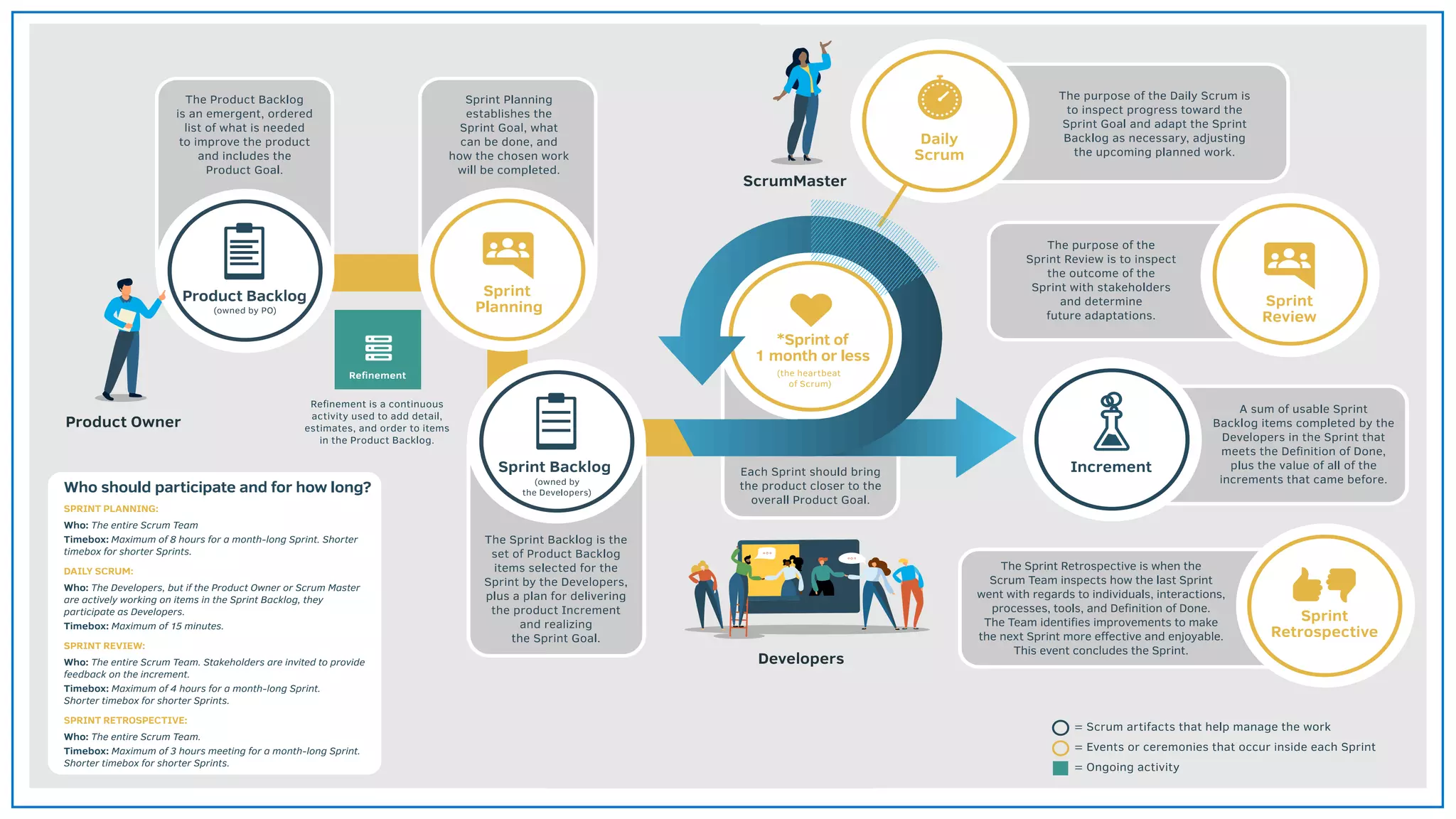
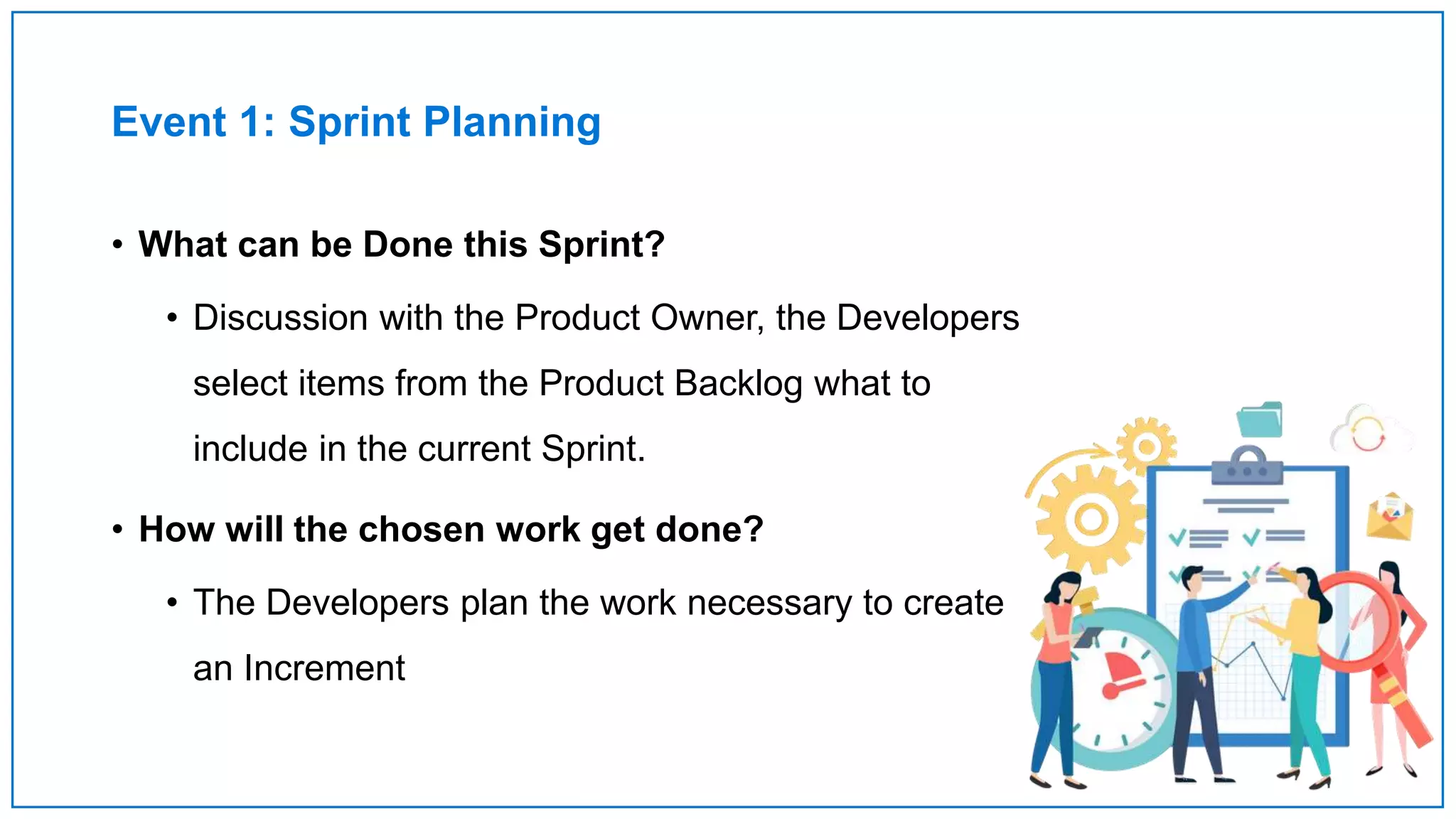
Event 1: Sprint Planning
• What can be Done this Sprint?
• Discussion with the Product Owner, the Developers
select items from the Product Backlog what to
include in the current Sprint.
• How will the chosen work get done?
• The Developers plan the work necessary to create
an Increment
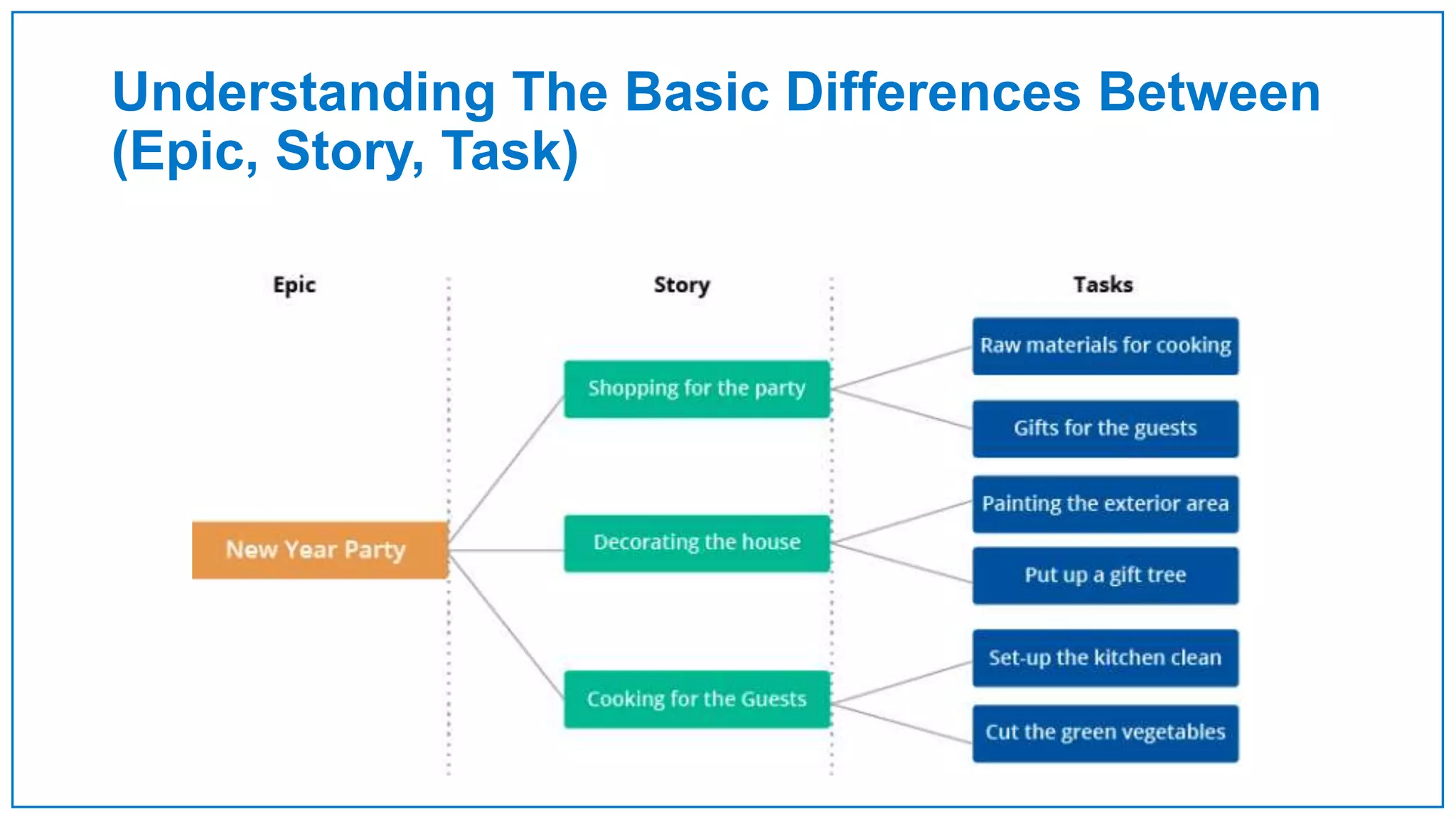
Understanding The Basic Differences Between
(Epic, Story, Task)
Event 2: Daily Scrum Meeting
• The purpose of the Daily Scrum is to inspect progress toward the Sprint Goal and adapt the Sprint
Backlog (if necessar).
• The Daily Scrum is a 15-minute event for the Developers of the Scrum Team (Developers are the
people in the Scrum Team that are committed to creating any aspect of a usable Increment each
Sprint).
• To reduce complexity, it is held at the same time and place every working day of the Sprint.
• The Developers can select whatever structure and techniques they want, as long as their Daily
Scrum focuses on progress toward the Sprint Goal and produces an actionable plan for the next
day of work. (This creates focus and improves self-management)
Sprint Rules
During the Sprint:
• No changes are made that would endanger the Sprint Goal
• Quality does not decrease
• The Product Backlog is refined as needed
• Scope may be clarified and renegotiated with the Product Owner as more is learned
• A Sprint could be cancelled if the Sprint Goal becomes obsolete
• Only the Product Owner has the authority to cancel the Sprint
Event 3: Sprint Review
• Sprint review is an informal meeting held at the end of a sprint, in which the Scrum team shows
what was accomplished during this period
• This typically takes the form of a demonstration of new features, with the goal of creating
transparency and generating feedback
• The purpose of a Scrum sprint review is not to provide a status update or make a presentation to
stakeholders, it is to collect feedback on the actual product increment
• Based on this information, attendees collaborate on what to do next
• The Product Backlog may also be adjusted to meet new opportunities
Event 4: Sprint Retrospective
• To plan ways to increase quality and effectiveness internally
• The Scrum Team inspects how the last Sprint went with regards to individuals, interactions, processes, tools.
The Scrum Team discusses three questions
1. What went well during the Sprint?
2. What problems it encountered?
3. How those problems were (or were not) solved?
• The Scrum Team identifies the most helpful changes to improve its effectiveness.
• The most impactful improvements are addressed as soon as possible.
• They may even be added to the Sprint Backlog for the next Sprint.
• The Sprint Retrospective concludes the Sprint
Now We Have Increment!
Increment
• Increment is the result of Development Team’s work in the Sprint
• The Increment is the sum of all the Product Backlog items completed during a Sprint and the value of the increments of
all previous Sprints
• The increment doesn’t need to be released at the end of the Sprint, but it needs to be in releasable state
• Decision about releasing the Increment is in the Product Owner’s hands
Summary
• Agile approach came into existence after the need for a light way to do software development in
order to accommodate changing requirements environment.
• Agile approach rules and practices require communication between the developer and the customer
• Under pressure to stick to the Agile principles, developers must be ready for any change at any time
• Scrum is a project management framework that is applicable to any project with aggressive
deadlines, complex requirements and a degree of uniqueness.

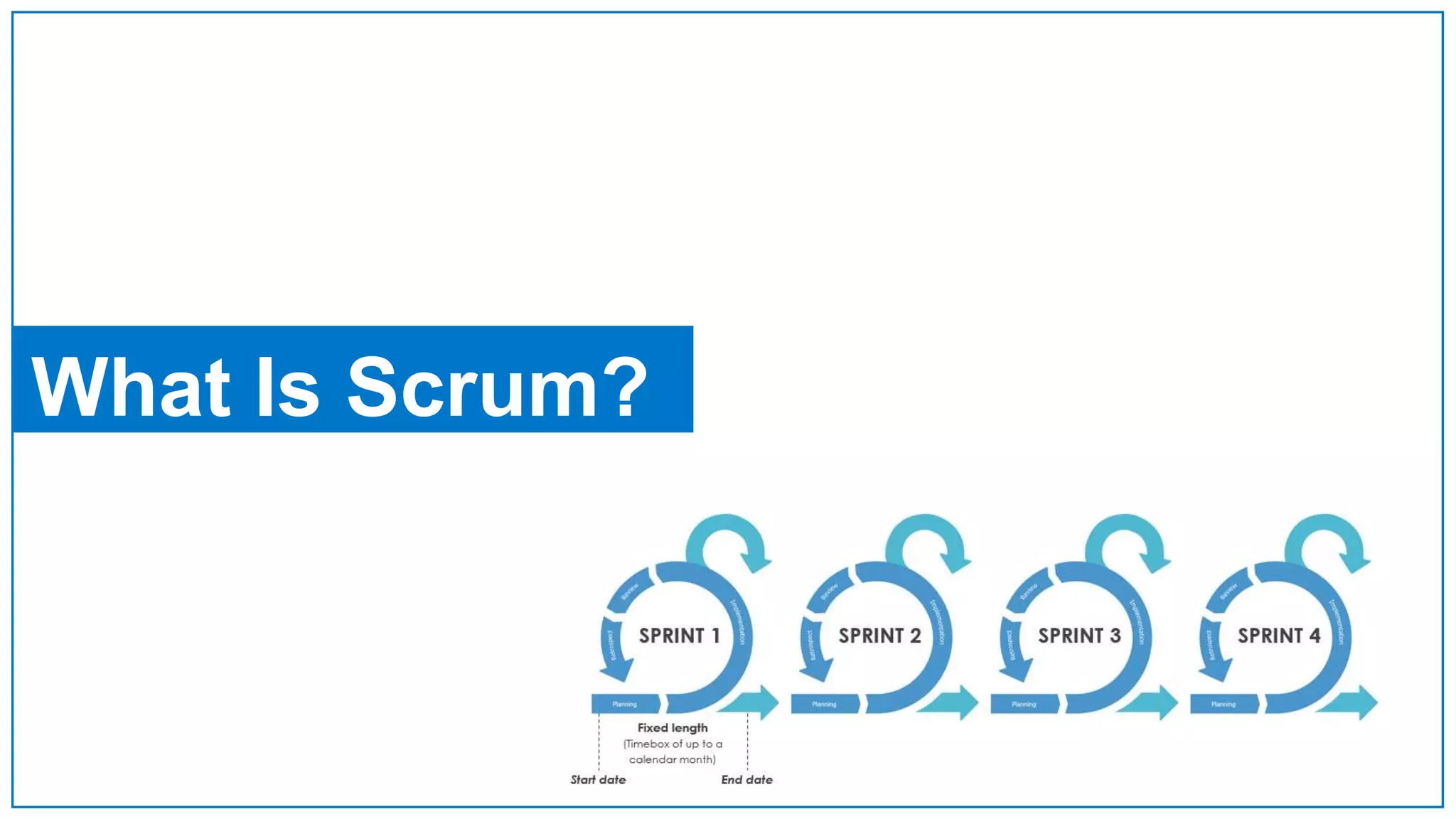
• In Scrum, projects move forward via a series of iterations called sprints.

• Each sprint is typically two to four weeks long.
Q&A
Thank you!

Agile Modeling & Scrum Development.pptx

  • 1.
    Agile Approach &Scrum Framework Presented By Samira D. AlShahrani
  • 2.
  • 3.
    It’s the 80’s! WeNeed A Software Development Framework! Macintosh a failed product under Steve Jobs' s IBM PC and MS-DOS Atari 1989 Launch of first GPS satellite Microsoft Excel 1981 1984 1989 1983 1985
  • 4.
    Why We NeedA New SDLC Approach? • The traditional ways are just not good now! • It is imposable to identify all the requirements from the beginning • The rapid customer changing requirements • Waiting for the entire cycle to end before getting feedback from customers • At best this leads to the elimination of the estimated profit but in most cases can lead to serious losses • The nature of the problem would often change (but the project requirements would not)
  • 5.
    Do You ThinkAgile or Scrum Was First Born?
  • 6.
    History of Agile& Scrum 1986 Takeuchi & Nonaka Scrum Coined 1995 Jeff & Ken The Scrum Framework 2001 Agile Manifesto Was Born 1993 Jeff Sutherland Created Scrum Process 2002 Ken Founded "Scrum Alliance”
  • 7.
    A Manifesto isBorn 1886 Scrum Was Coined! • Hirotaka Takeuchi & Ikujiro Nonaka • (New New Product Development Game) Paper in Harvard Business Review 2001 Agile Was Born! • 17 People Gathered At A Ski Resort In The Mountains Of Utah • What Came Out Of That Summit Was A Name For A Collection Of Values And Principles That Encapsulated What These Developers Really Discussed To Consider People As The Most Important Asset In The Development Process
  • 8.
  • 9.
    Agile Modeling Approach Agile model Is an iterative and Incremental SDLC approach ensures Fast delivery in short span of time and high Fixability to enable changing the requirement at any time of the development lifecycle  Practices-guided by principles and values software that can be applied in an effective manner  Agile Modeling is meant to be tailored into other frameworks such as (XP, Scrum, Kanban ..)  Agile Modeling is a descriptive not a prescriptive process (prescriptive process is a model that describes "how to do" according to a certain software process system)  It does not define detailed procedures for how to create a given type of model  It provides advice for how to be effective as a modeler
  • 10.
     The agilemindset is a thought process involves understanding, collaborating, learning, and staying flexible to achieve high-performing results. Agile Is A Mindset. Agile Is Behavior.  Q: What is the difference between value and principle? Give an example
  • 11.
    Agile Embraces 4Standard Communication Pair Programming/ Estimating Tasks/ Unit Testing/ Problems Are Fixed Rapidly Feedback Regularly Identify Areas For Improvement. Simplicity To Do The Simplest Thing Today, With The Understanding That It Might Have To Be Changed A Little Tomorrow. Courage High risk = High reward To Act In Ways That Will Continuously Improve What Is Being Done On The Project, Even If They Require Throwing Out Code, Rethinking Solutions 01 03 04 02
  • 12.
    Agile Model SDLC explainingand planning the time and effort required Work with the stakeholders to define the requirements Turning the design into code The quality assurance (QA) test the product's performance Deploys the product in a working environment Requirement Gathering Design the Requirements Development Testing Deployment New Requirement Receive feedback and handles any issues Feedback
  • 13.
    The Advantages &Disadvantages Of Agile Model
  • 14.
    • Only experiencedSr. developers, Sr. testers should take the decision • Lack of long-term planning • Documentation gets left behind • Less focus on design and implementation Agile Disadvantages • Facilitates effective communication between the team and the client • High flexibility, easily handling sudden changes anytime requirements changes are allowed at any stage • Increases customer satisfaction via rapid, continuous delivery of a workable product • Delivers functioning software frequently, in weeks instead of months e.g., every Thursday Agile Advantages (AKA: Principles) The Advantages And Disadvantages Of Agile Model VS
  • 15.
  • 16.
    Imagine Agile AsAn Umbrella! • Agile is an umbrella term for all the methods and frameworks that follow the values and principles described in the Agile Manifesto
  • 17.
    Agile vs Scrum AgileScrum Type Project Management Approach A Framework, Type Of Agile Approach Team roles No Specific Roles Specified Includes Specific Roles Such As The (Scrum Master, Product Owner) Delivery The software is delivered and updated regularly with the client The software is delivered at the end of each sprint Leadership The project head or leader is responsible for all the deliverables There is no leader, so the entire responsibility is shared between the team members
  • 18.
    The Values inAgile and Scrum Waterfall Agile Scrum Values Processes And Tools Individuals And Interactions Constant Commutation Comprehensive Documentation Working Software Every Sprint Contract Negotiation Customer Collaboration Constant Feedback Following A Plan Responding To Change Every Time Is Requested Taking Care Of By Delivered At Done By Is Giving
  • 19.
  • 20.
    Scrum Definition • Scrumis a lightweight framework that helps teams and organizations generate value through adaptive solutions for complex problems • Scrum as a way to get work done (as a team) in small pieces at a time, with continuous experimentation and feedback loops along the way to learn and improve as you go
  • 21.
    Scrum Theory Knowledge comesfrom experience Making decisions based on what is observed Employs an iterative and incremental approach to optimize predictability and to control risks Engages groups of people who collectively have all the skills and expertise to do the work
  • 22.
  • 23.
  • 24.
  • 25.
    Scrum Team Principles SmallerTeams Communicate Better And Are More Productive. The Scrum Team Is Responsible For All Product-related Activities From Stakeholder Collaboration, Verification, Maintenance, Operation, Experimentation, Research And Development They Are Structured And Empowered By The Organization To Manage Their Own Work. The Entire Scrum Team Is Accountable For Creating A Valuable, Useful Increment Every Sprint. Scrum Defines Three Specific Accountabilities Within The Scrum Team: The Developers, The Product Owner, And The Scrum Master.
  • 26.
  • 28.
    Event 1: SprintPlanning • What can be Done this Sprint? • Discussion with the Product Owner, the Developers select items from the Product Backlog what to include in the current Sprint. • How will the chosen work get done? • The Developers plan the work necessary to create an Increment
  • 29.
    Understanding The BasicDifferences Between (Epic, Story, Task)
  • 30.
    Event 2: DailyScrum Meeting • The purpose of the Daily Scrum is to inspect progress toward the Sprint Goal and adapt the Sprint Backlog (if necessar). • The Daily Scrum is a 15-minute event for the Developers of the Scrum Team (Developers are the people in the Scrum Team that are committed to creating any aspect of a usable Increment each Sprint). • To reduce complexity, it is held at the same time and place every working day of the Sprint. • The Developers can select whatever structure and techniques they want, as long as their Daily Scrum focuses on progress toward the Sprint Goal and produces an actionable plan for the next day of work. (This creates focus and improves self-management)
  • 31.
    Sprint Rules During theSprint: • No changes are made that would endanger the Sprint Goal • Quality does not decrease • The Product Backlog is refined as needed • Scope may be clarified and renegotiated with the Product Owner as more is learned • A Sprint could be cancelled if the Sprint Goal becomes obsolete • Only the Product Owner has the authority to cancel the Sprint
  • 32.
    Event 3: SprintReview • Sprint review is an informal meeting held at the end of a sprint, in which the Scrum team shows what was accomplished during this period • This typically takes the form of a demonstration of new features, with the goal of creating transparency and generating feedback • The purpose of a Scrum sprint review is not to provide a status update or make a presentation to stakeholders, it is to collect feedback on the actual product increment • Based on this information, attendees collaborate on what to do next • The Product Backlog may also be adjusted to meet new opportunities
  • 33.
    Event 4: SprintRetrospective • To plan ways to increase quality and effectiveness internally • The Scrum Team inspects how the last Sprint went with regards to individuals, interactions, processes, tools. The Scrum Team discusses three questions 1. What went well during the Sprint? 2. What problems it encountered? 3. How those problems were (or were not) solved? • The Scrum Team identifies the most helpful changes to improve its effectiveness. • The most impactful improvements are addressed as soon as possible. • They may even be added to the Sprint Backlog for the next Sprint. • The Sprint Retrospective concludes the Sprint
  • 34.
    Now We HaveIncrement!
  • 35.
    Increment • Increment isthe result of Development Team’s work in the Sprint • The Increment is the sum of all the Product Backlog items completed during a Sprint and the value of the increments of all previous Sprints • The increment doesn’t need to be released at the end of the Sprint, but it needs to be in releasable state • Decision about releasing the Increment is in the Product Owner’s hands
  • 36.
    Summary • Agile approachcame into existence after the need for a light way to do software development in order to accommodate changing requirements environment. • Agile approach rules and practices require communication between the developer and the customer • Under pressure to stick to the Agile principles, developers must be ready for any change at any time • Scrum is a project management framework that is applicable to any project with aggressive deadlines, complex requirements and a degree of uniqueness. • In Scrum, projects move forward via a series of iterations called sprints. • Each sprint is typically two to four weeks long.
  • 37.
  • 38.

Editor's Notes

  • #2 Agile is an approach to software development that seeks the continuous delivery of working software created in rapid iterations. However, the phrase "agile methodology" is misleading because it implies that agile is a singular approach to software development. It is a way of thinking about collaboration and workflows, and it is a set of values which guide our choices in regard to what we make and how we make it. Scrum is not a methodology ‘Methodologies’ are typically composed of stringent and mandatory sequences of processes and procedures that implement predefined algorithms. We call Scrum a… framework.
  • #10 Iterative = Same process will be repeated Incremental = Means that we ell keep have new features added to our product
  • #11 Values: are the roots of the beliefs that matter to us and the field’s practitioners, while ethics are the guidelines that govern how we practice our craft. So, these to me are things like: Courage to speak up, psychological safety, respect, love for one another, These are intangible roots of belief, or if you like, they are the foundations of things we value. ———————– Principles: If it is a call to action specific to the context, then it becomes a principle So I would say both “deliver value continuously” and “make people awesome” are principles. A value would be that people are awesome
  • #25 All starts with the product owner how represent the customer and all stakeholders >> drives the prouduct backlog Work is done by self-organized teams during the sprint “period of 1 to 4 weeks”
  • #30 Epic – A requirement that is just too big to deliver in a single sprint. Epics need to be broken into smaller deliverables (stories). Story – A requirement that the business wants. It is something that is deliverable within a single sprint. Tasks – The essentials of a story, these are the milestones to take the story to ‘Done’.