Software Engineering II
By: Muhammad Usman
email:mu702823@gmail.com
Scrum
 Scrum is an agile method that focuses on
managing iterative development rather than
specific agile practices.
 There are three phases in Scrum.
Scrum
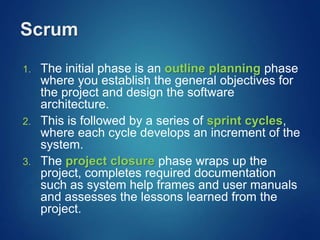
1. The initial phase is an outline planning phase
where you establish the general objectives for
the project and design the software
architecture.
2. This is followed by a series of sprint cycles,
where each cycle develops an increment of the
system.
3. The project closure phase wraps up the
project, completes required documentation
such as system help frames and user manuals
and assesses the lessons learned from the
project.
Scrum Terminology
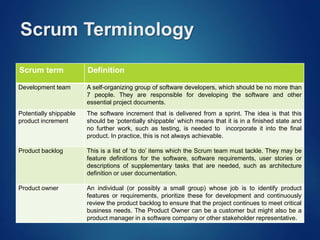
Scrum term Definition
Development team A self-organizing group of software developers, which should be no more than
7 people. They are responsible for developing the software and other
essential project documents.
Potentially shippable
product increment
The software increment that is delivered from a sprint. The idea is that this
should be ‘potentially shippable’ which means that it is in a finished state and
no further work, such as testing, is needed to incorporate it into the final
product. In practice, this is not always achievable.
Product backlog This is a list of ‘to do’ items which the Scrum team must tackle. They may be
feature definitions for the software, software requirements, user stories or
descriptions of supplementary tasks that are needed, such as architecture
definition or user documentation.
Product owner An individual (or possibly a small group) whose job is to identify product
features or requirements, prioritize these for development and continuously
review the product backlog to ensure that the project continues to meet critical
business needs. The Product Owner can be a customer but might also be a
product manager in a software company or other stakeholder representative.
Scrum terminology
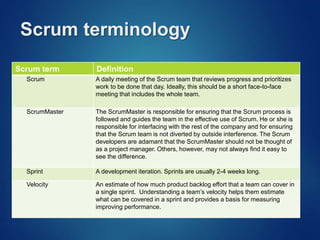
Scrum term Definition
Scrum A daily meeting of the Scrum team that reviews progress and prioritizes
work to be done that day. Ideally, this should be a short face-to-face
meeting that includes the whole team.
ScrumMaster The ScrumMaster is responsible for ensuring that the Scrum process is
followed and guides the team in the effective use of Scrum. He or she is
responsible for interfacing with the rest of the company and for ensuring
that the Scrum team is not diverted by outside interference. The Scrum
developers are adamant that the ScrumMaster should not be thought of
as a project manager. Others, however, may not always find it easy to
see the difference.
Sprint A development iteration. Sprints are usually 2-4 weeks long.
Velocity An estimate of how much product backlog effort that a team can cover in
a single sprint. Understanding a team’s velocity helps them estimate
what can be covered in a sprint and provides a basis for measuring
improving performance.
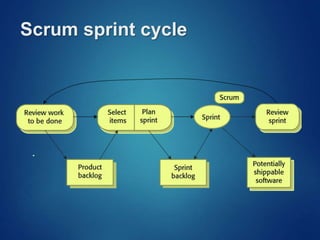
Scrum sprint cycle
The Scrum sprint cycle
 Sprints are fixed length, normally 2–4 weeks.
 The starting point for planning is the product
backlog, which is the list of work to be done on
the project.
 The selection phase involves all of the project
team who work with the customer to select the
features and functionality from the product
backlog to be developed during the sprint.
The Sprint cycle
 Once these are agreed, the team organize
themselves to develop the software.
 During this stage the team is isolated from the
customer and the organization, with all
communications channelled through the so-
called ‘Scrum master’.
 The role of the Scrum master is to protect the
development team from external distractions.
 At the end of the sprint, the work done is
reviewed and presented to stakeholders. The
next sprint cycle then begins.
Teamwork in Scrum
 The ‘Scrum master’ is a facilitator who arranges daily
meetings, tracks the backlog of work to be done, records
decisions, measures progress against the backlog and
communicates with customers and management outside
of the team.
 The whole team attends short daily meetings (Scrums)
where all team members share information, describe their
progress since the last meeting, problems that have arisen
and what is planned for the following day.
 This means that everyone on the team knows what is going on
and, if problems arise, can re-plan short-term work to cope with
them.
Scrum benefits
 The product is broken down into a set of
manageable and understandable chunks.
 Unstable requirements do not hold up progress.
 The whole team have visibility of everything and
consequently team communication is improved.
 Customers see on-time delivery of increments and
gain feedback on how the product works.
 Trust between customers and developers is
established and a positive culture is created in which
everyone expects the project to succeed.
Software Engineering
Practices
Principles that Guide Process
 Principle #1. Be agile. Whether the process model you
choose is prescriptive or agile, the basic tenets of agile
development should govern your approach.
 Principle #2. Focus on quality at every step. The exit
condition for every process activity, action, and task should
focus on the quality of the work product that has been
produced.
 Principle #3. Be ready to adapt. Process is not a religious
experience and dogma has no place in it. When necessary,
adapt your approach to constraints imposed by the
problem, the people, and the project itself.
 Principle #4. Build an effective team. Software
engineering process and practice are important, but the
bottom line is people. Build a self-organizing team that has
mutual trust and respect.
 Principle #5. Establish mechanisms for communication
and coordination. Projects fail because important
information falls into the cracks and/or stakeholders fail to
coordinate their efforts to create a successful end product.
 Principle #6. Manage change. The approach may be either
formal or informal, but mechanisms must be established to
manage the way changes are requested, assessed,
approved and implemented.
 Principle #7. Assess risk. Lots of things can go wrong as
software is being developed. It’s essential that you establish
contingency plans.
 Principle #8. Create work products that provide value
for others. Create only those work products that provide
value for other process activities, actions or tasks.
Principles that Guide Process

Scrum

  • 1.
    Software Engineering II By:Muhammad Usman email:mu702823@gmail.com
  • 2.
    Scrum  Scrum isan agile method that focuses on managing iterative development rather than specific agile practices.  There are three phases in Scrum.
  • 3.
    Scrum 1. The initialphase is an outline planning phase where you establish the general objectives for the project and design the software architecture. 2. This is followed by a series of sprint cycles, where each cycle develops an increment of the system. 3. The project closure phase wraps up the project, completes required documentation such as system help frames and user manuals and assesses the lessons learned from the project.
  • 4.
    Scrum Terminology Scrum termDefinition Development team A self-organizing group of software developers, which should be no more than 7 people. They are responsible for developing the software and other essential project documents. Potentially shippable product increment The software increment that is delivered from a sprint. The idea is that this should be ‘potentially shippable’ which means that it is in a finished state and no further work, such as testing, is needed to incorporate it into the final product. In practice, this is not always achievable. Product backlog This is a list of ‘to do’ items which the Scrum team must tackle. They may be feature definitions for the software, software requirements, user stories or descriptions of supplementary tasks that are needed, such as architecture definition or user documentation. Product owner An individual (or possibly a small group) whose job is to identify product features or requirements, prioritize these for development and continuously review the product backlog to ensure that the project continues to meet critical business needs. The Product Owner can be a customer but might also be a product manager in a software company or other stakeholder representative.
  • 5.
    Scrum terminology Scrum termDefinition Scrum A daily meeting of the Scrum team that reviews progress and prioritizes work to be done that day. Ideally, this should be a short face-to-face meeting that includes the whole team. ScrumMaster The ScrumMaster is responsible for ensuring that the Scrum process is followed and guides the team in the effective use of Scrum. He or she is responsible for interfacing with the rest of the company and for ensuring that the Scrum team is not diverted by outside interference. The Scrum developers are adamant that the ScrumMaster should not be thought of as a project manager. Others, however, may not always find it easy to see the difference. Sprint A development iteration. Sprints are usually 2-4 weeks long. Velocity An estimate of how much product backlog effort that a team can cover in a single sprint. Understanding a team’s velocity helps them estimate what can be covered in a sprint and provides a basis for measuring improving performance.
  • 6.
  • 7.
    The Scrum sprintcycle  Sprints are fixed length, normally 2–4 weeks.  The starting point for planning is the product backlog, which is the list of work to be done on the project.  The selection phase involves all of the project team who work with the customer to select the features and functionality from the product backlog to be developed during the sprint.
  • 8.
    The Sprint cycle Once these are agreed, the team organize themselves to develop the software.  During this stage the team is isolated from the customer and the organization, with all communications channelled through the so- called ‘Scrum master’.  The role of the Scrum master is to protect the development team from external distractions.  At the end of the sprint, the work done is reviewed and presented to stakeholders. The next sprint cycle then begins.
  • 9.
    Teamwork in Scrum The ‘Scrum master’ is a facilitator who arranges daily meetings, tracks the backlog of work to be done, records decisions, measures progress against the backlog and communicates with customers and management outside of the team.  The whole team attends short daily meetings (Scrums) where all team members share information, describe their progress since the last meeting, problems that have arisen and what is planned for the following day.  This means that everyone on the team knows what is going on and, if problems arise, can re-plan short-term work to cope with them.
  • 10.
    Scrum benefits  Theproduct is broken down into a set of manageable and understandable chunks.  Unstable requirements do not hold up progress.  The whole team have visibility of everything and consequently team communication is improved.  Customers see on-time delivery of increments and gain feedback on how the product works.  Trust between customers and developers is established and a positive culture is created in which everyone expects the project to succeed.
  • 11.
  • 12.
    Principles that GuideProcess  Principle #1. Be agile. Whether the process model you choose is prescriptive or agile, the basic tenets of agile development should govern your approach.  Principle #2. Focus on quality at every step. The exit condition for every process activity, action, and task should focus on the quality of the work product that has been produced.  Principle #3. Be ready to adapt. Process is not a religious experience and dogma has no place in it. When necessary, adapt your approach to constraints imposed by the problem, the people, and the project itself.  Principle #4. Build an effective team. Software engineering process and practice are important, but the bottom line is people. Build a self-organizing team that has mutual trust and respect.
  • 13.
     Principle #5.Establish mechanisms for communication and coordination. Projects fail because important information falls into the cracks and/or stakeholders fail to coordinate their efforts to create a successful end product.  Principle #6. Manage change. The approach may be either formal or informal, but mechanisms must be established to manage the way changes are requested, assessed, approved and implemented.  Principle #7. Assess risk. Lots of things can go wrong as software is being developed. It’s essential that you establish contingency plans.  Principle #8. Create work products that provide value for others. Create only those work products that provide value for other process activities, actions or tasks. Principles that Guide Process