An Agile Odyssey:
  A Case Study of Agile Adoption
within a Health Insurance Company


    Alston Hodge, Agile Coach

       2013 AgileIndy Conference
             March 8, 2013
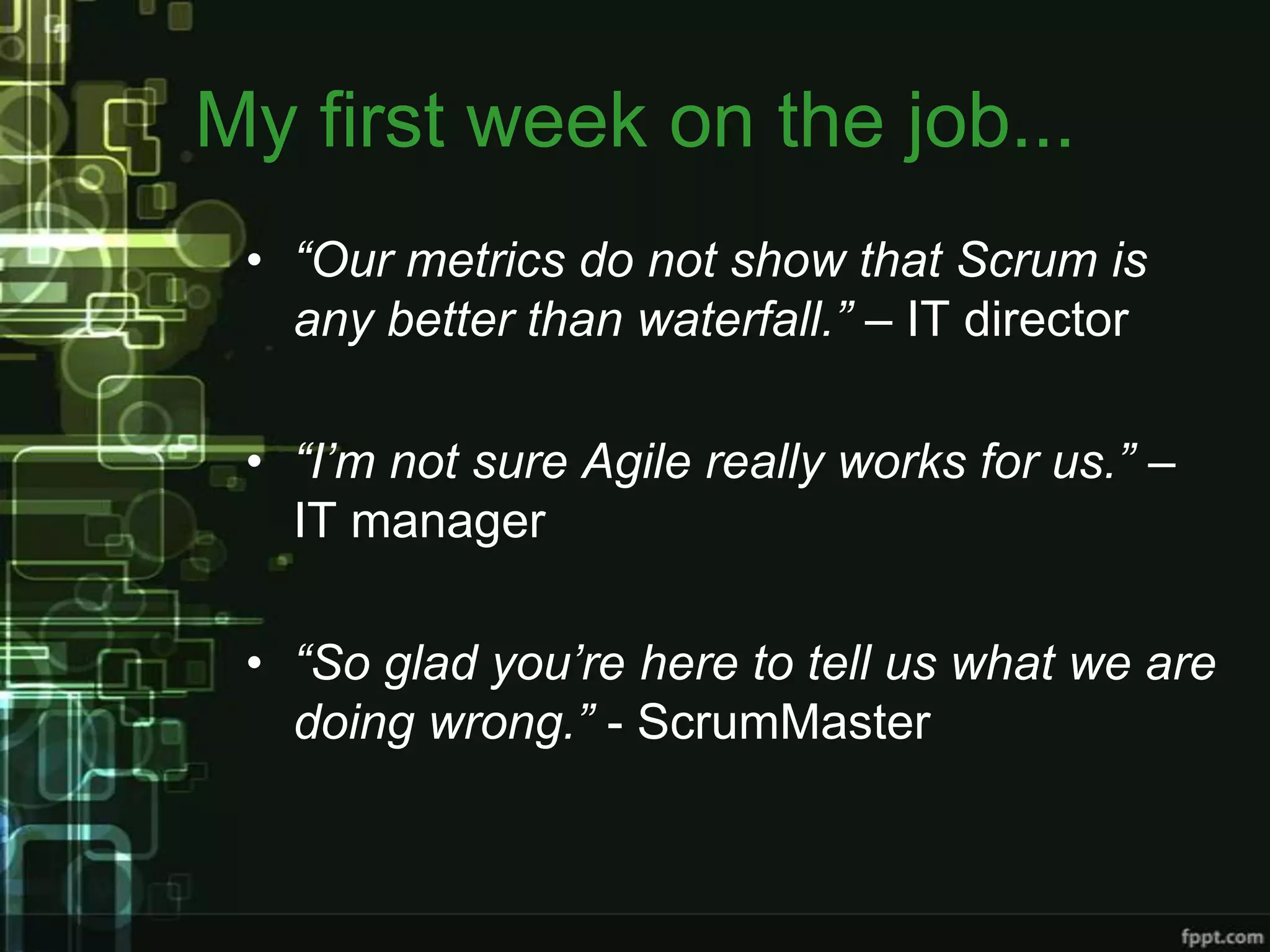
My first week on the job...
 • “Our metrics do not show that Scrum is
   any better than waterfall.” – IT director

 • “I’m not sure Agile really works for us.” –
   IT manager

 • “So glad you’re here to tell us what we are
   doing wrong.” - ScrumMaster
Agenda
• History
• Assessment
  –   Findings
  –   Anti-Scrum Patterns
  –   Root Causes
  –   Impacts to the insurance company
• Fixing the Problems
• Lessons Learned
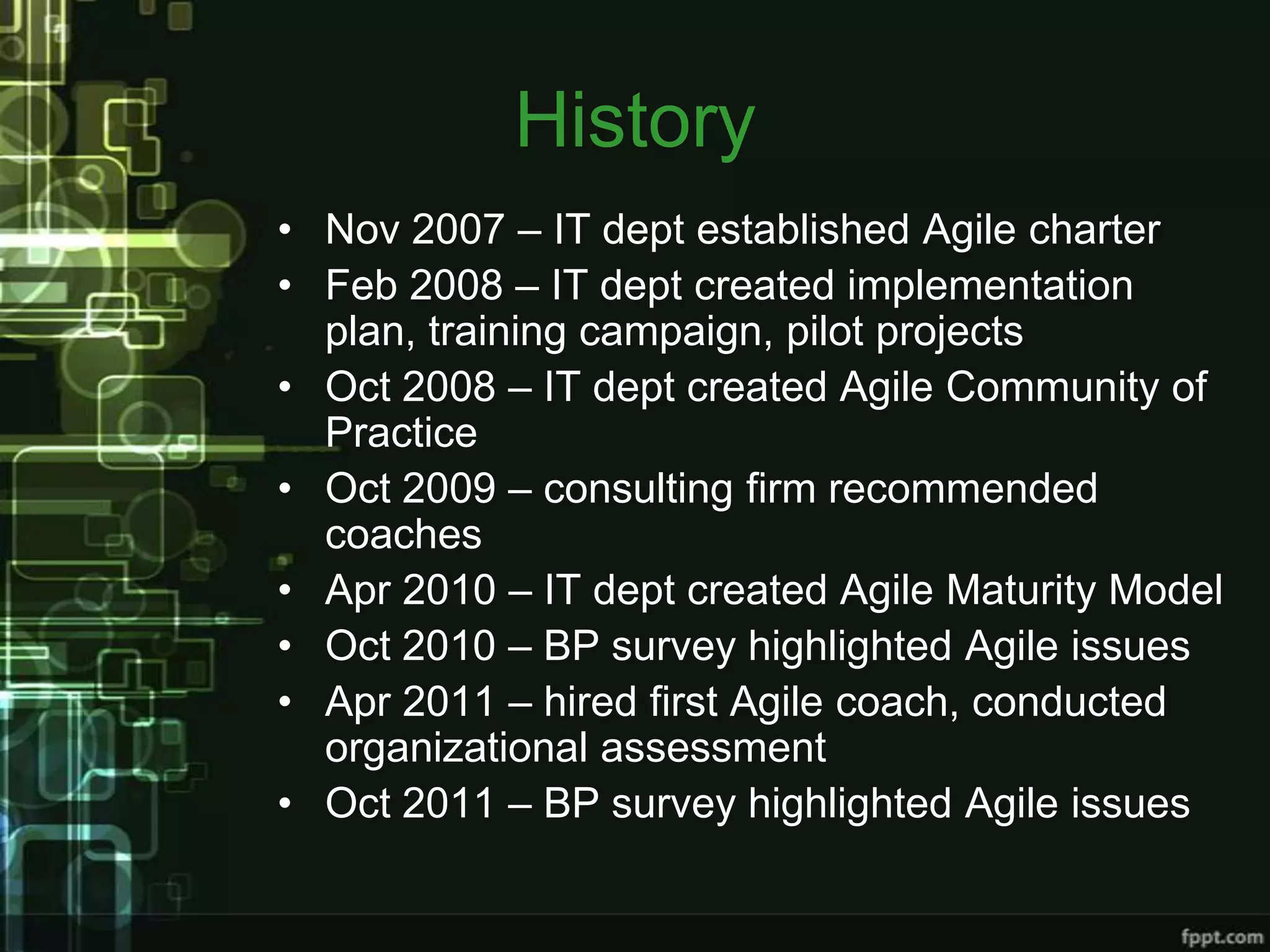
History
• Nov 2007 – IT dept established Agile charter
• Feb 2008 – IT dept created implementation
  plan, training campaign, pilot projects
• Oct 2008 – IT dept created Agile Community of
  Practice
• Oct 2009 – consulting firm recommended
  coaches
• Apr 2010 – IT dept created Agile Maturity Model
• Oct 2010 – BP survey highlighted Agile issues
• Apr 2011 – hired first Agile coach, conducted
  organizational assessment
• Oct 2011 – BP survey highlighted Agile issues
Organizational
 Assessment
Assessment Topics
• Scrum Training?
• Following the basic Scrum practices?
  – Timeboxed work?
  – Goal of potentially deployable product?
  – Have a SM and PO?
  – Team maturity?
  – Retrospectives?
  – Demos?
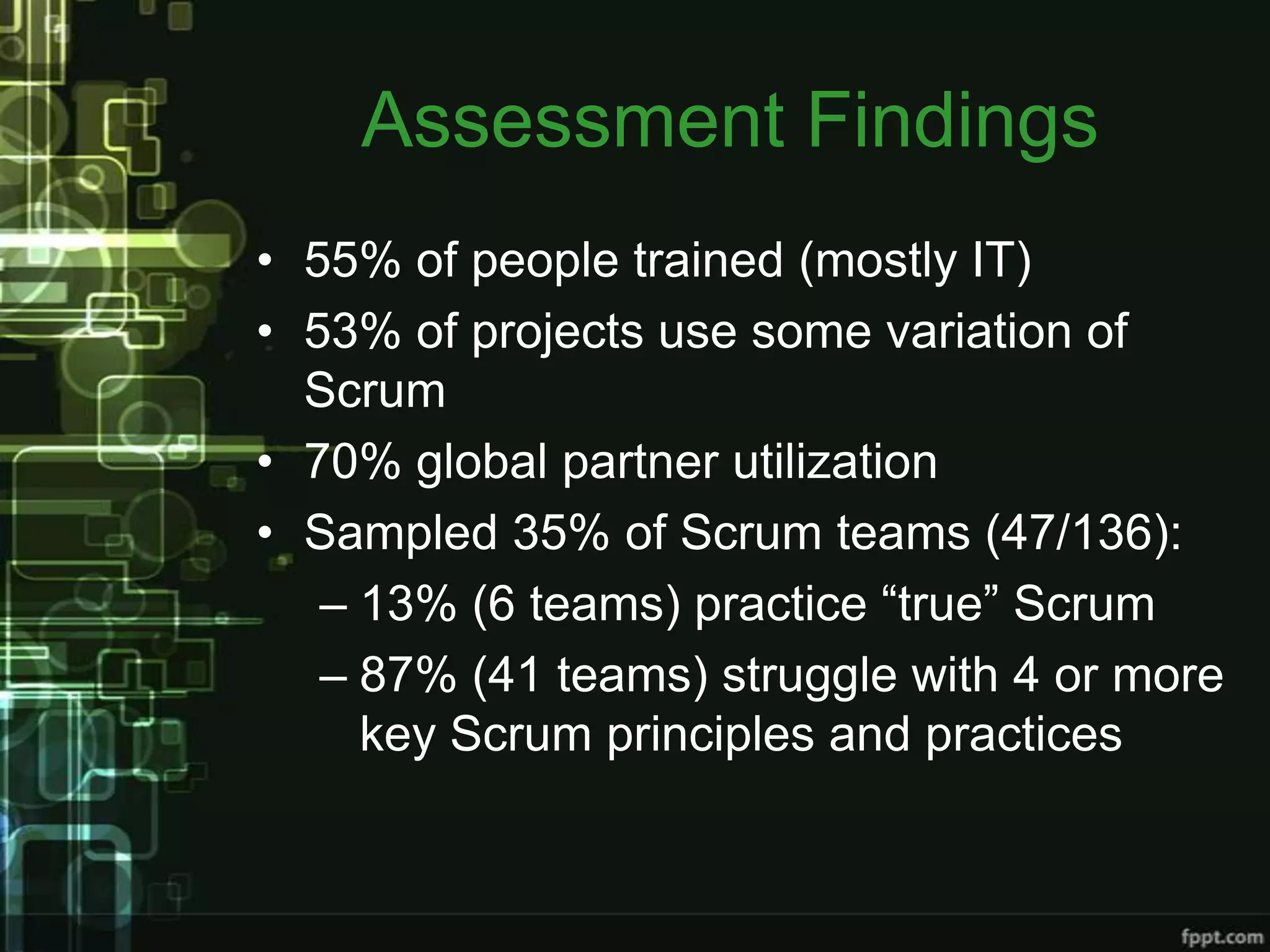
Assessment Findings
• 55% of people trained (mostly IT)
• 53% of projects use some variation of
  Scrum
• 70% global partner utilization
• Sampled 35% of Scrum teams (47/136):
   – 13% (6 teams) practice “true” Scrum
   – 87% (41 teams) struggle with 4 or more
     key Scrum principles and practices
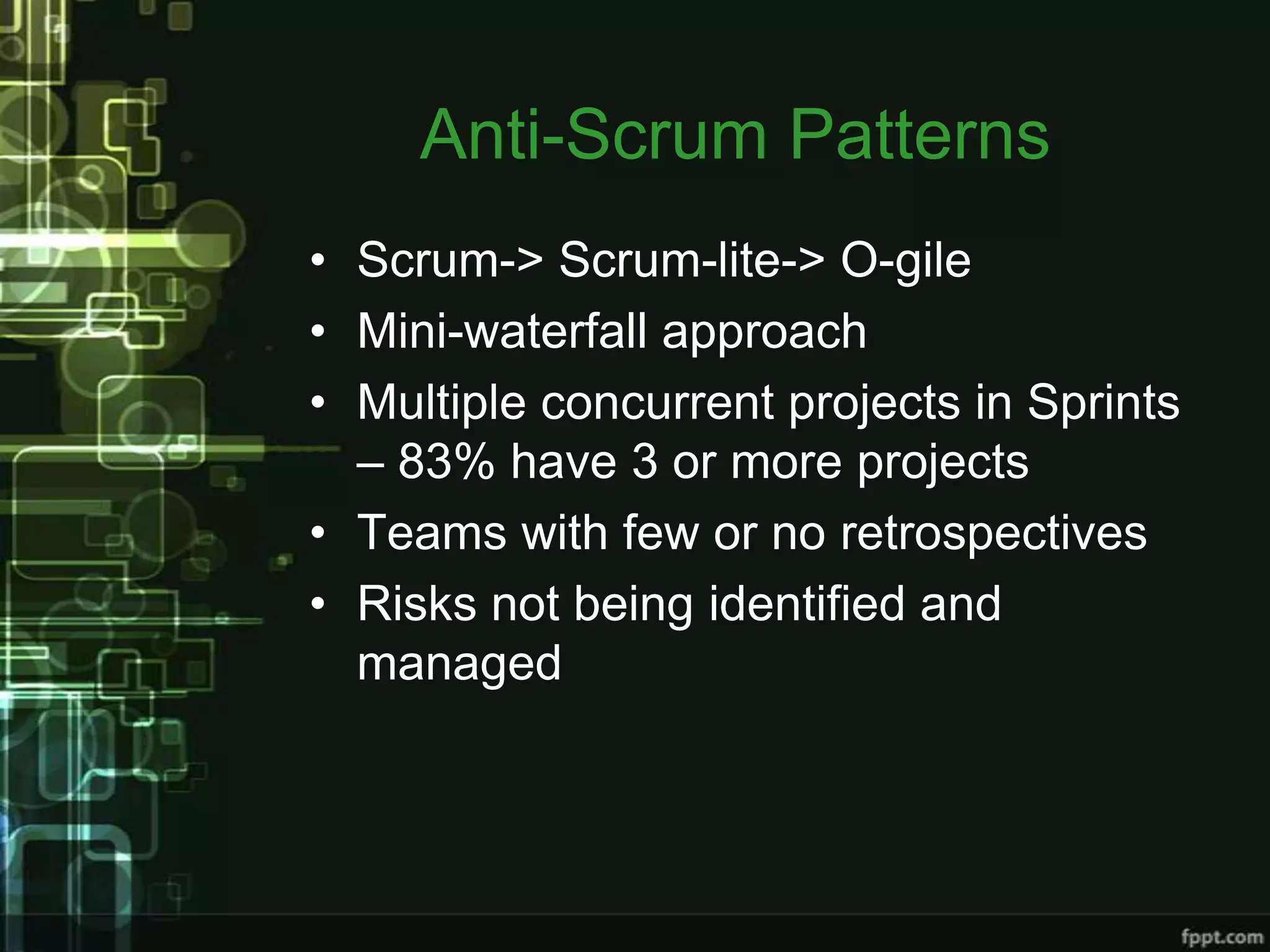
Anti-Scrum Patterns
• Scrum-> Scrum-lite-> O-gile
• Mini-waterfall approach
• Multiple concurrent projects in Sprints
  – 83% have 3 or more projects
• Teams with few or no retrospectives
• Risks not being identified and
  managed
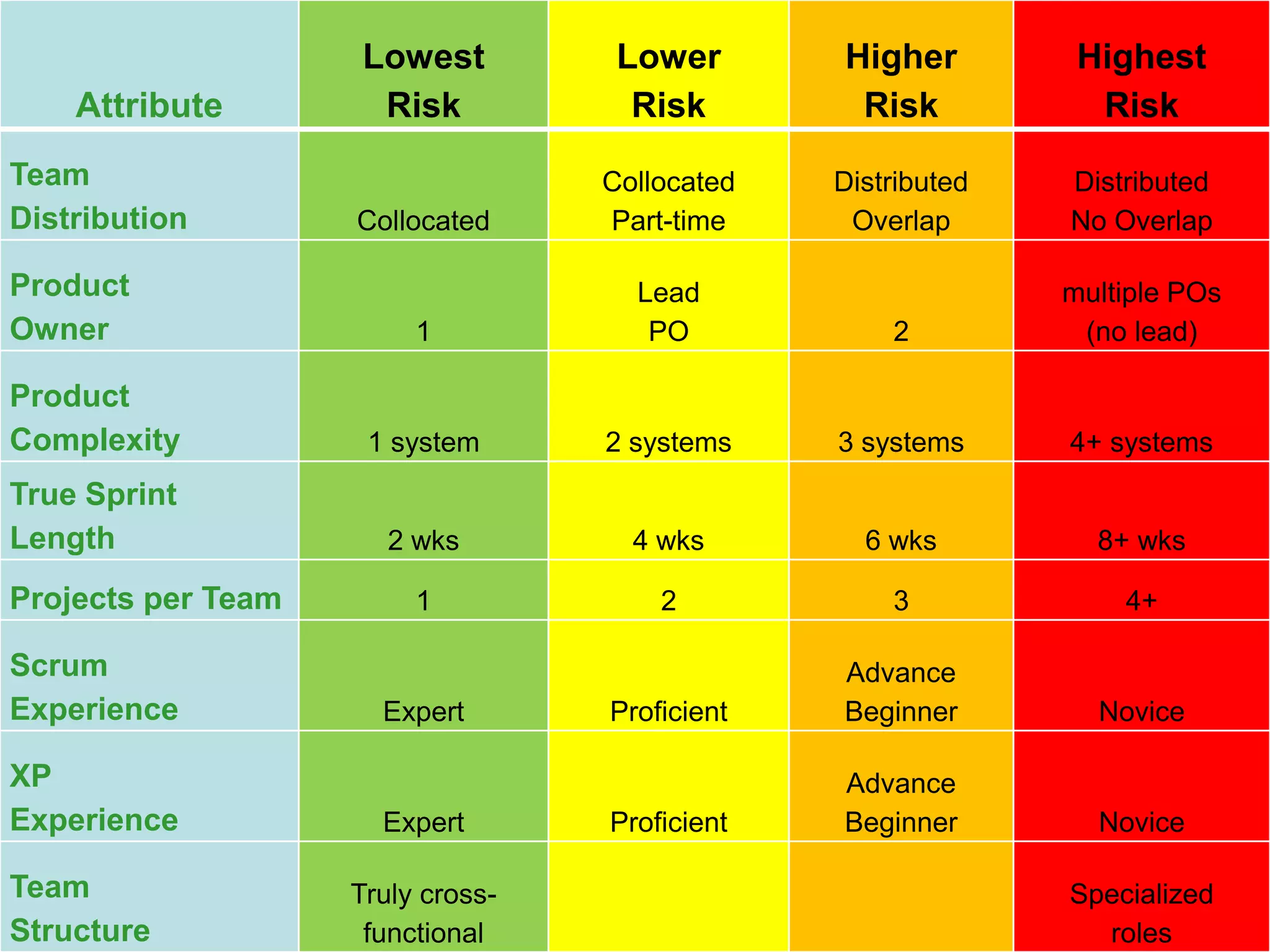
Lowest          Lower       Higher         Highest
    Attribute        Risk            Risk        Risk           Risk
Team                               Collocated   Distributed   Distributed
Distribution        Collocated     Part-time     Overlap      No Overlap

Product                              Lead                     multiple POs
Owner                    1            PO            2          (no lead)

Product
Complexity           1 system      2 systems    3 systems     4+ systems
True Sprint
Length                 2 wks         4 wks        6 wks         8+ wks

Projects per Team        1             2            3             4+

Scrum                                           Advance
Experience            Expert       Proficient   Beginner        Novice

XP                                              Advance
Experience            Expert       Proficient   Beginner        Novice

Team                Truly cross-                              Specialized
Structure            functional                                 roles
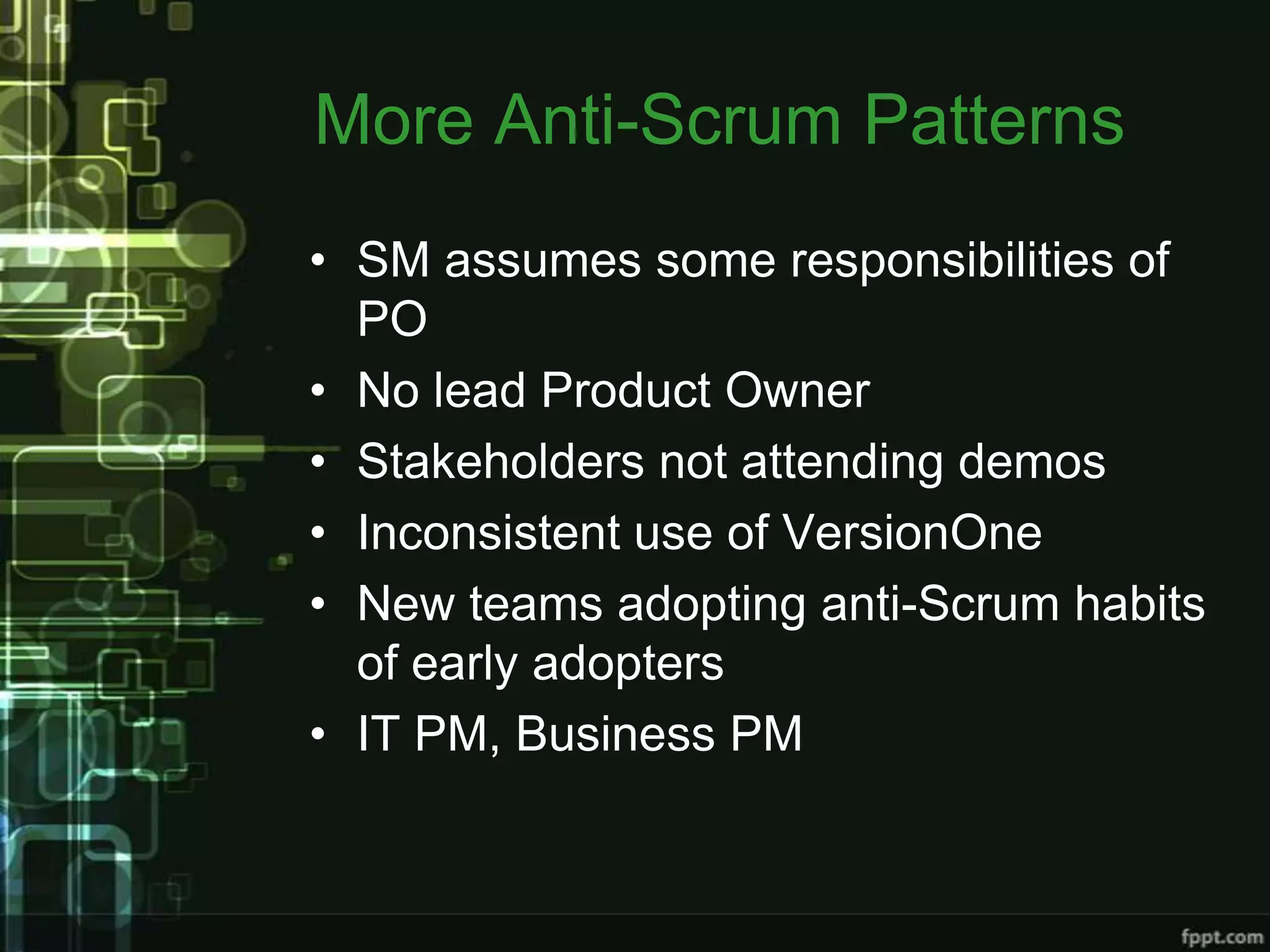
More Anti-Scrum Patterns
• SM assumes some responsibilities of
  PO
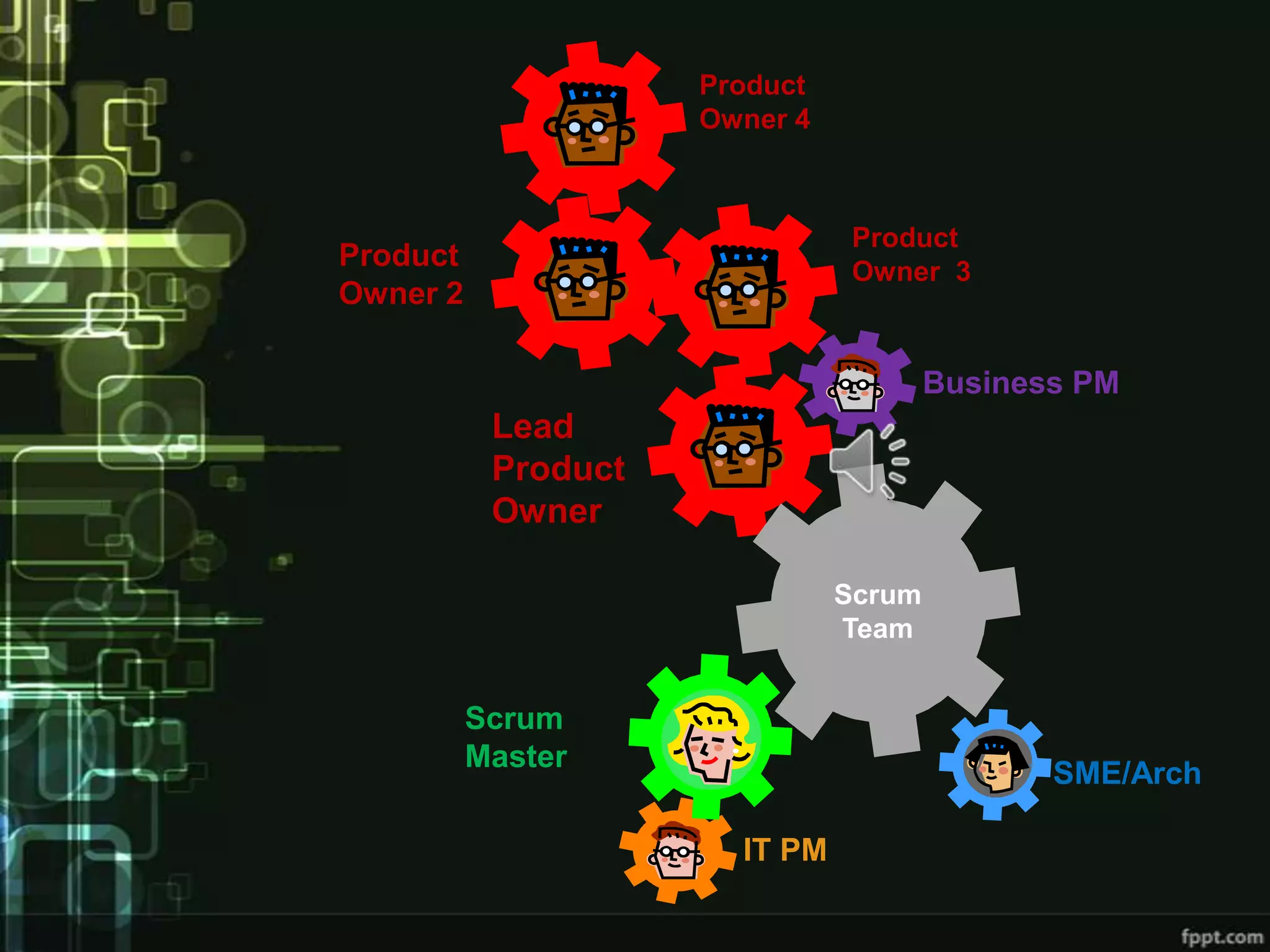
• No lead Product Owner
• Stakeholders not attending demos
• Inconsistent use of VersionOne
• New teams adopting anti-Scrum habits
  of early adopters
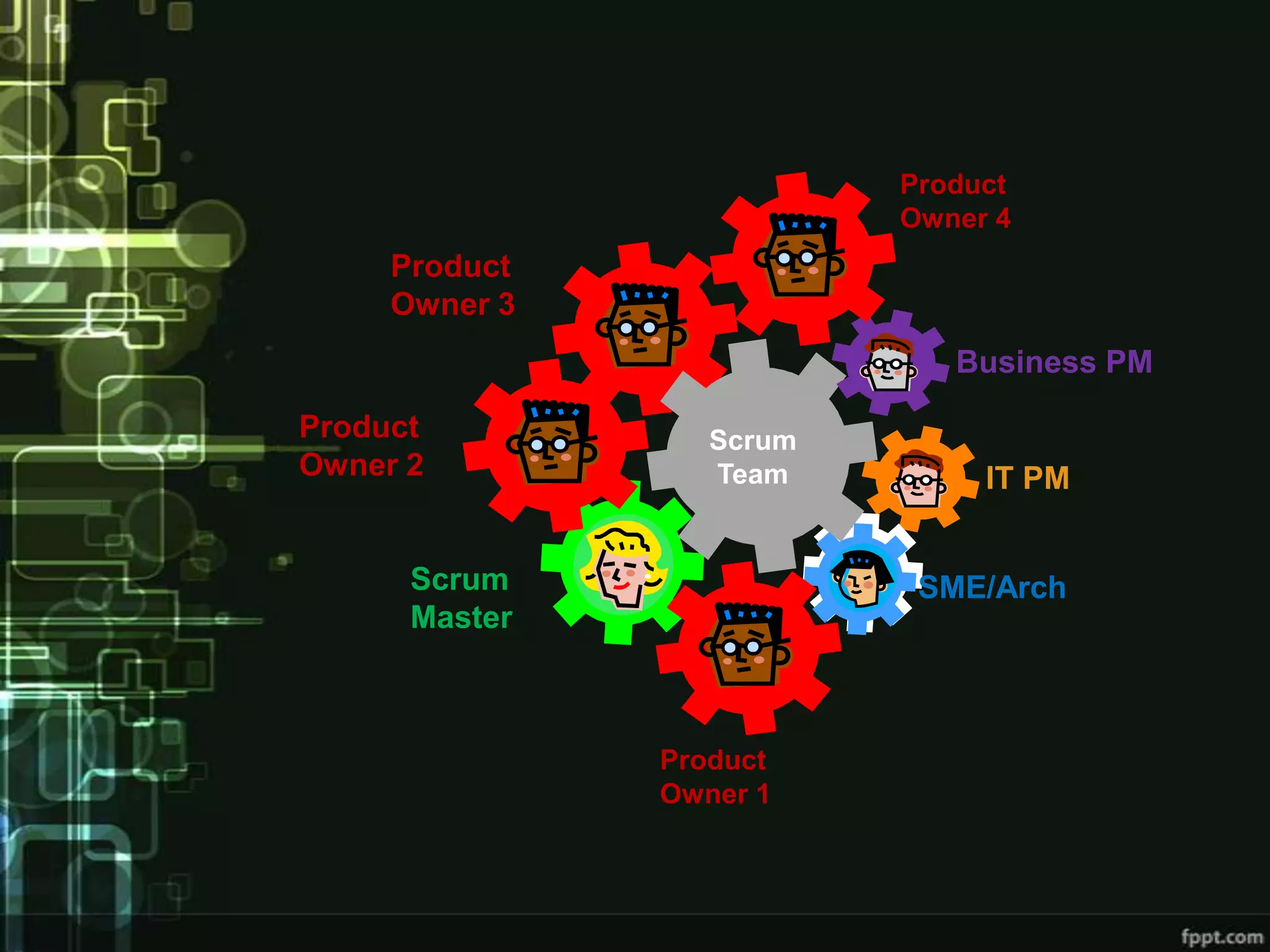
• IT PM, Business PM
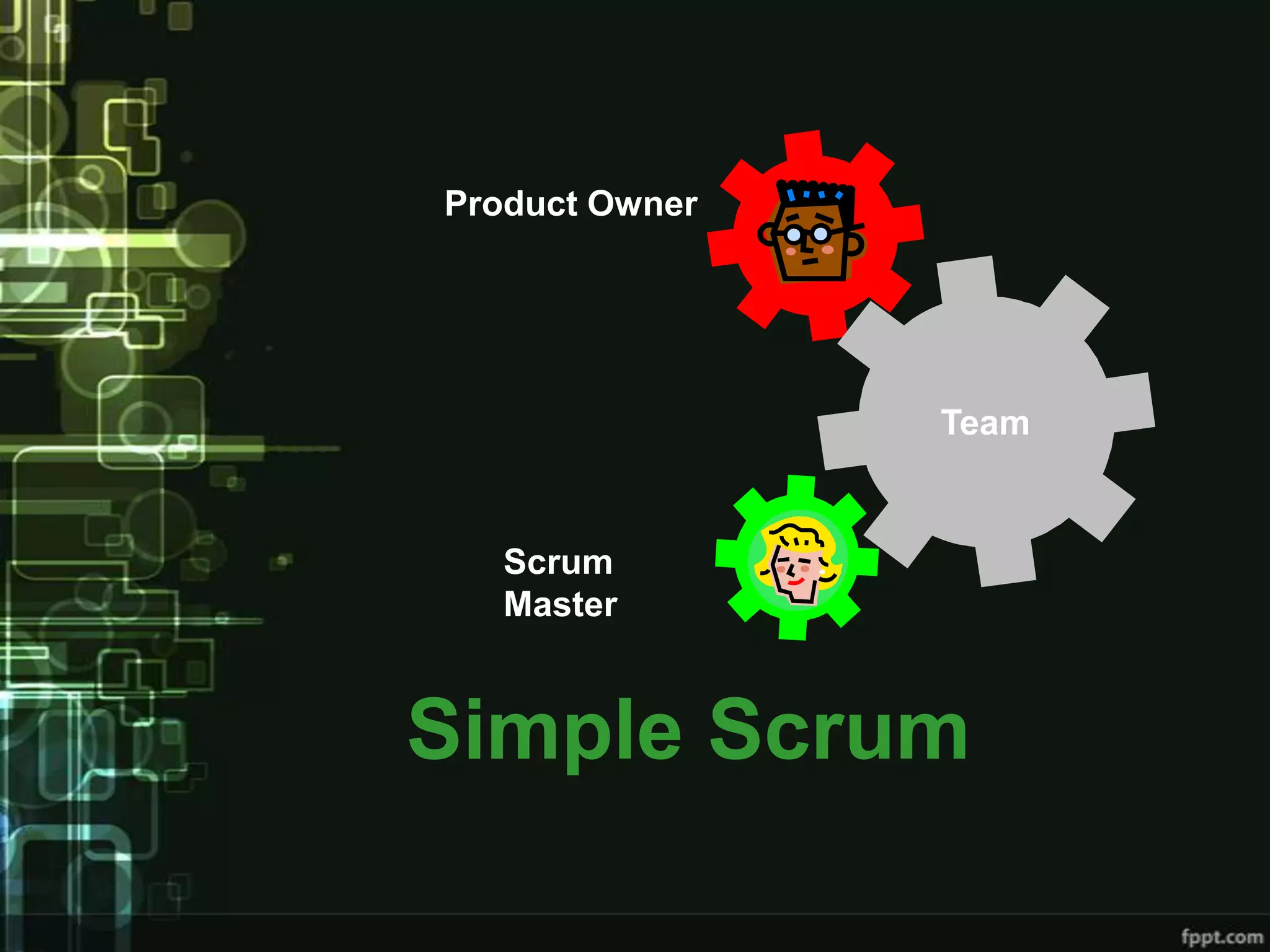
Product Owner


                Team


   Scrum
   Master


Simple Scrum
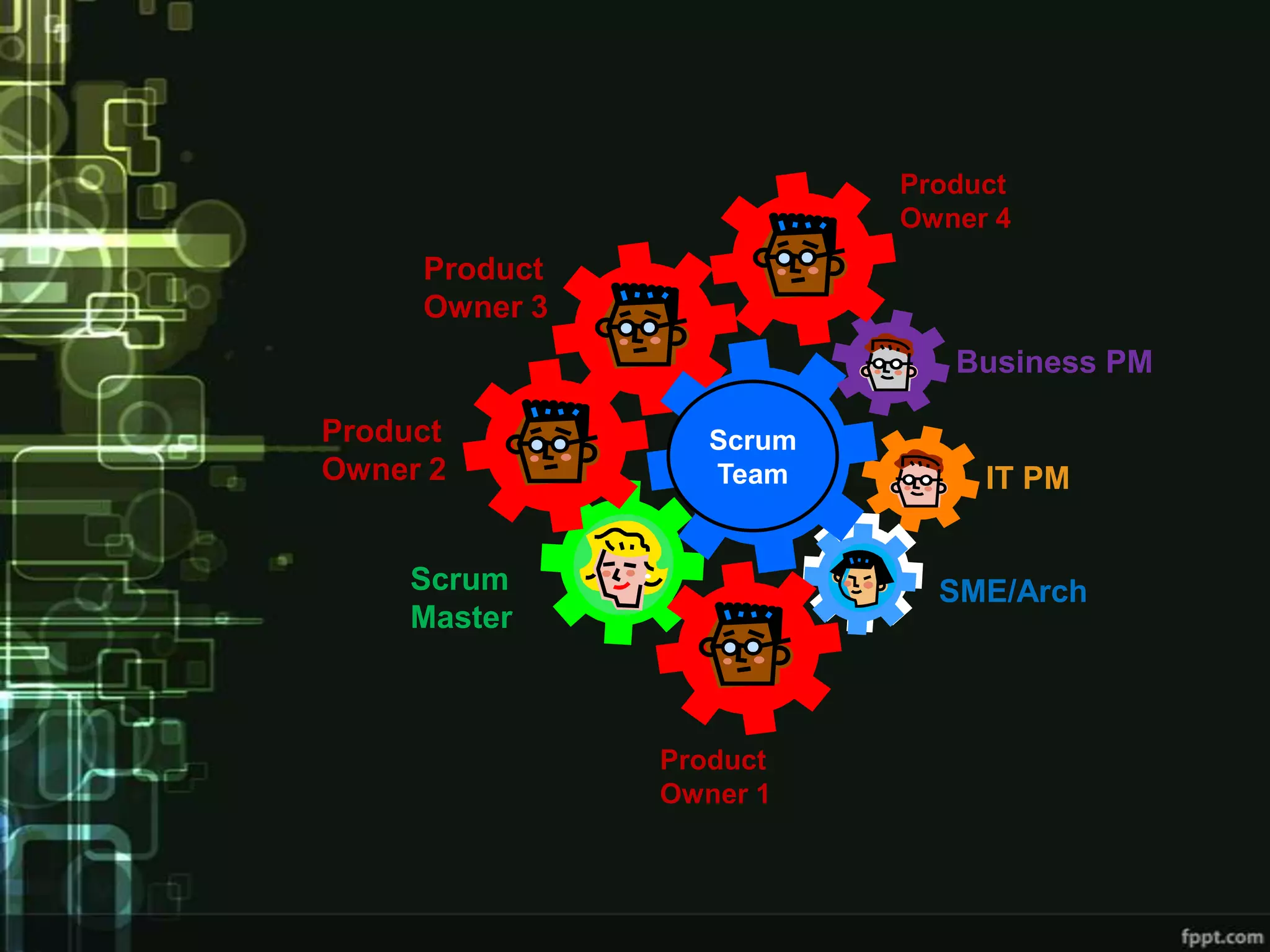
Product
                          Owner 4
     Product
     Owner 3
                             Business PM

Product           Scrum
Owner 2           Team         IT PM


    Scrum                   SME/Arch
    Master


               Product
               Owner 1
And some more….
•   Individual performance measures
•   Workload exceeds capacity
•   Start most/all stories at same time
•   No sprint goals
•   No tracking velocity
•   Teams larger than 12 members
•   Separate testing from development
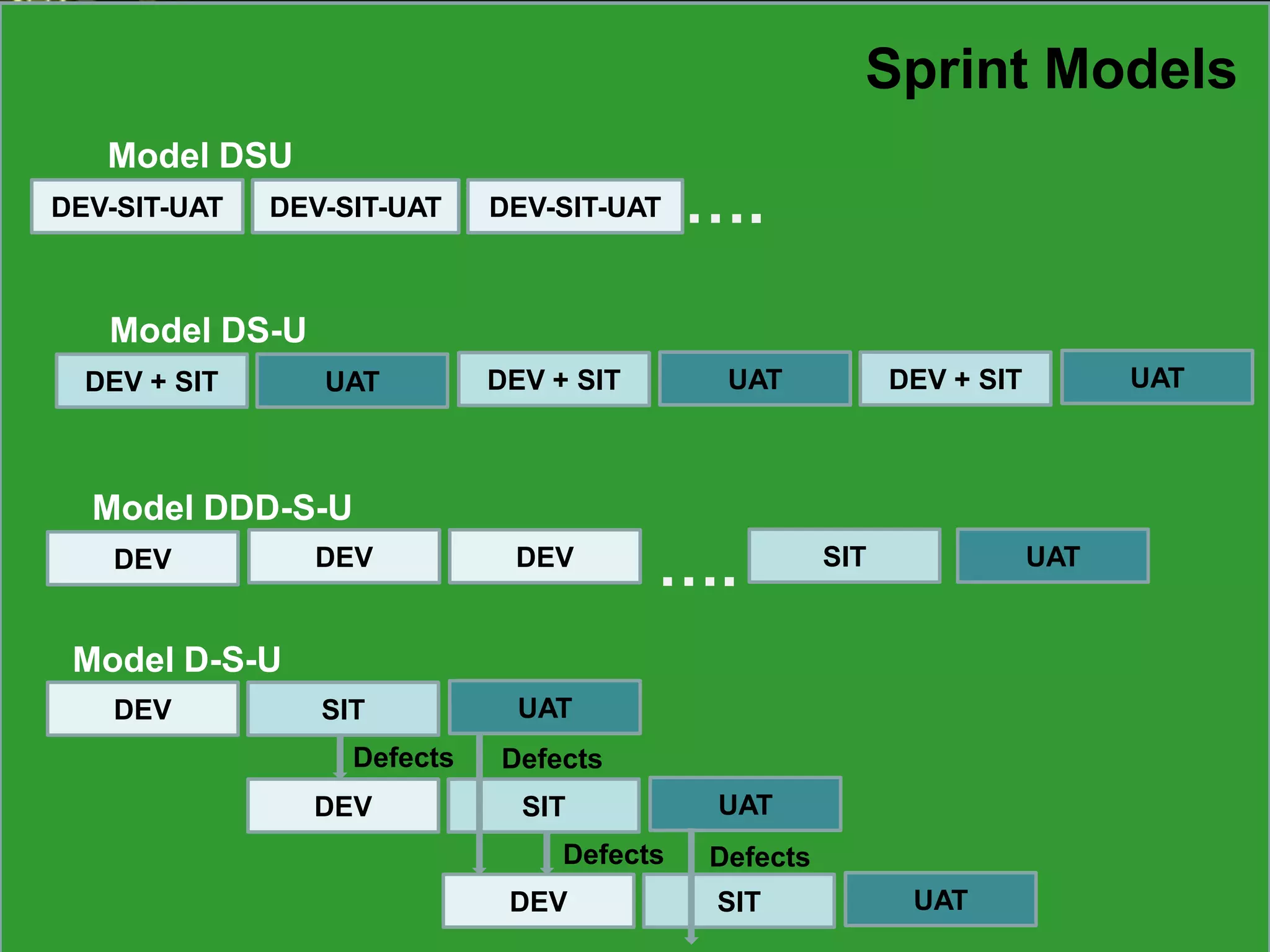
Sprint Models
   Model DSU
DEV-SIT-UAT   DEV-SIT-UAT    DEV-SIT-UAT    ….
   Model DS-U
  DEV + SIT      UAT         DEV + SIT       UAT            DEV + SIT         UAT


  Model DDD-S-U
   DEV          DEV           DEV
                                         ….           SIT               UAT


 Model D-S-U                             .
   DEV           SIT           UAT
                   Defects   Defects
                DEV            SIT          UAT
                                  Defects   Defects
                              DEV           SIT              UAT
Assessment Findings
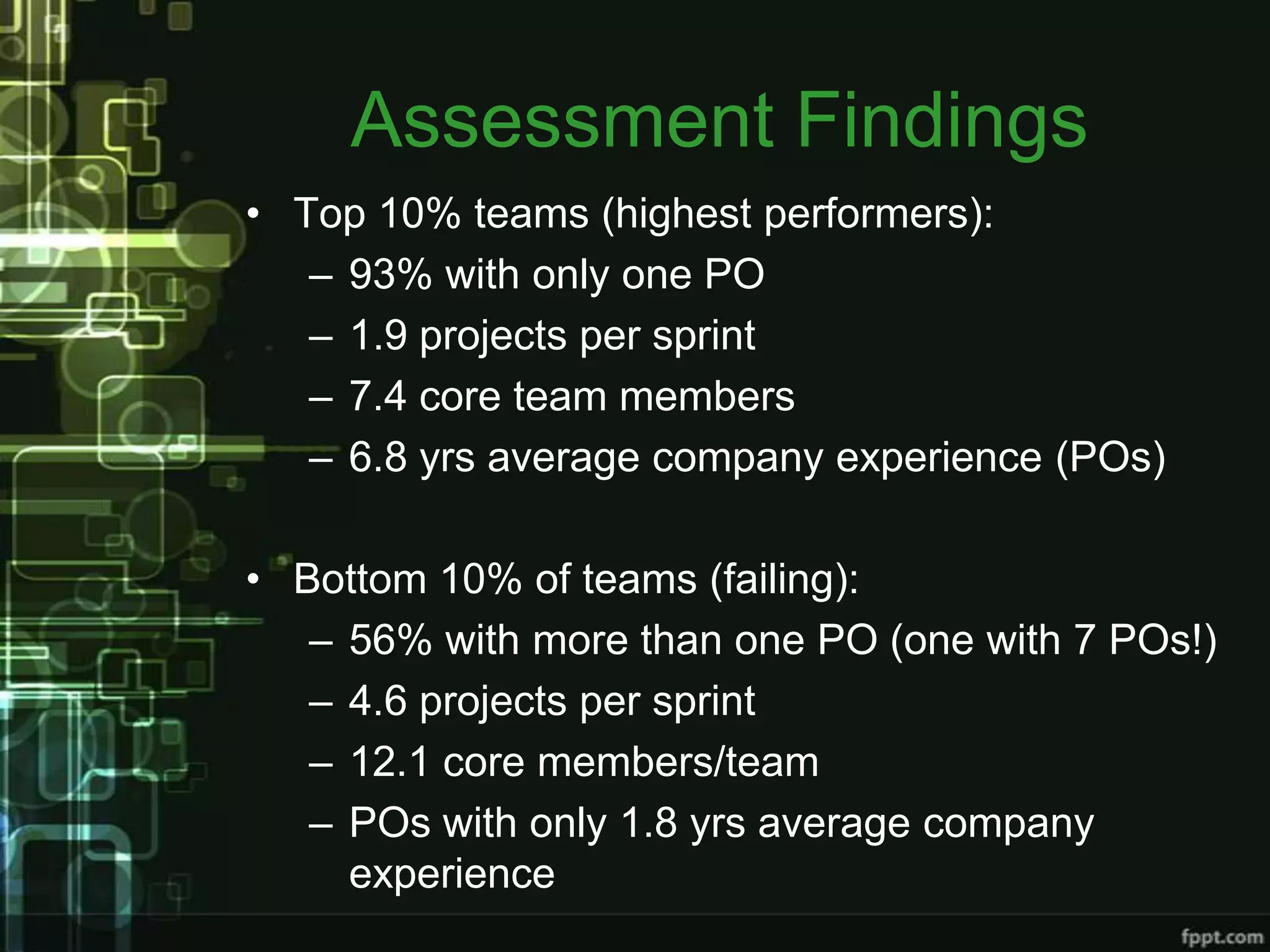
• Top 10% teams (highest performers):
   – 93% with only one PO
   – 1.9 projects per sprint
   – 7.4 core team members
   – 6.8 yrs average company experience (POs)

• Bottom 10% of teams (failing):
   – 56% with more than one PO (one with 7 POs!)
   – 4.6 projects per sprint
   – 12.1 core members/team
   – POs with only 1.8 yrs average company
     experience
Root Causes
Root Cause 1:
   Adapting vs. Adopting Scrum


• “We need your help to adapt Scrum to fit our
  culture” – PMO Program Manager

• “Perhaps we need to adopt the Values and
  Principles, and adapt the techniques and
  practices instead.” – Alston
Agile Values and Principles
  • Already complement our corporate values and
    principles.
  • Guide us in our daily decisions.
  • Are foundational, the core of what we believe
    to be true about us.
  • Generally accepted Scrum practices are
    based on Agile values and principles.
  • Changing the values and principles de-
    stabilizes our Scrum framework.
Examples
• Choosing to not have retrospectives
  hampers:
   – Continuous improvement
   – Transparency
   – Sustainable development
• Not tracking velocity hampers:
   – Continuous improvement
   – Transparency
   – Sustainable development
Root Cause 2:
       Adoption Viewed as an IT campaign,
                  not a company campaign
• Initiated and supported as IT campaign
• Business partners not fully understanding the
  implications:
   – PO develops the backlog
   – PO prioritizes based on business value
   – PO approves story completion
   – PO decides when to release

 With Agile, the Business is in the driver’s seat!
IT left with un-answered Questions


  •   Service Provider vs. Business Partner
  •   IT projects vs. Business projects
  •   What to do with PMs?
  •   Scrum-> Scrum-lite-> O-gile?
Root Cause 3:
 Accelerated Contract/Offshore Utilization

• 2008 – 60% company, 40% contractor
• 2011 – 30% company, 70 % contractor
• Source of business innovation cut in half
Look at the numbers
• US health insurance experience
   – 160+ years as an industry
   – Over 80% of Americans with healthcare
     insurance today
• India’s health insurance experience
   – 12 years experience in industry
   – Less than 6% with healthcare insurance (as of
     2010)
Root Cause 4:
   ADD – Agile Deficit Disorder
• Symptoms
   – Difficulty in focusing
   – Hard to develop self-discipline (team &
     organizational)
   – Commitment issues
   – Scrum Buts
   – Resistance to Transparency
   – Workload exceeds capacity

   “We need to take on this additional work
   because it is important. But it goes without
   saying that we can’t let anything fall off the
   plate.” – IT manager
Impacts to the
Insurance Company
Collaboration Challenges
• Agile Community of Practice stalled
• Increasing collaboration issues
• Increase turnover (company, vendors) in
  some areas
• Decline in Partnership survey scores
   – Innovation
   – Communications
   – Ownership
• Increased use of PMs (IT and Business)
Fixin’ the Problems
Update the training
• Use experienced SMs and Pos as trainers
• Focus more on the “Why” of key Scrum
  concepts
• Lots of new resources available now
• Address the common Anti-Scrums
• Introduce eXtreme Programming
   – Continuous integration
   – Paired programming
   – Automated testing
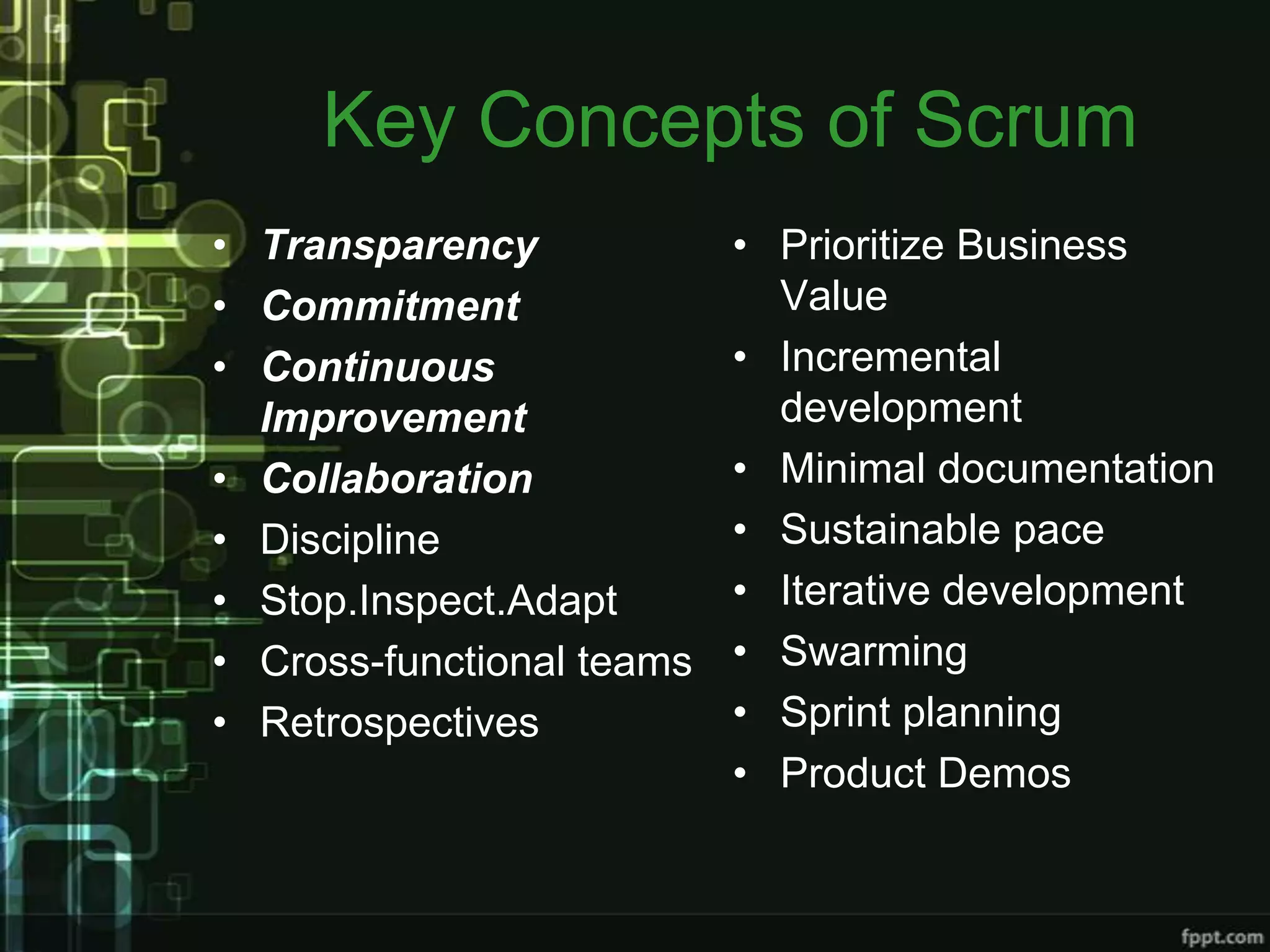
Key Concepts of Scrum
• Transparency             • Prioritize Business
• Commitment                 Value
• Continuous               • Incremental
  Improvement                development
• Collaboration            • Minimal documentation
• Discipline               • Sustainable pace
• Stop.Inspect.Adapt       • Iterative development
• Cross-functional teams   • Swarming
• Retrospectives           • Sprint planning
                           • Product Demos
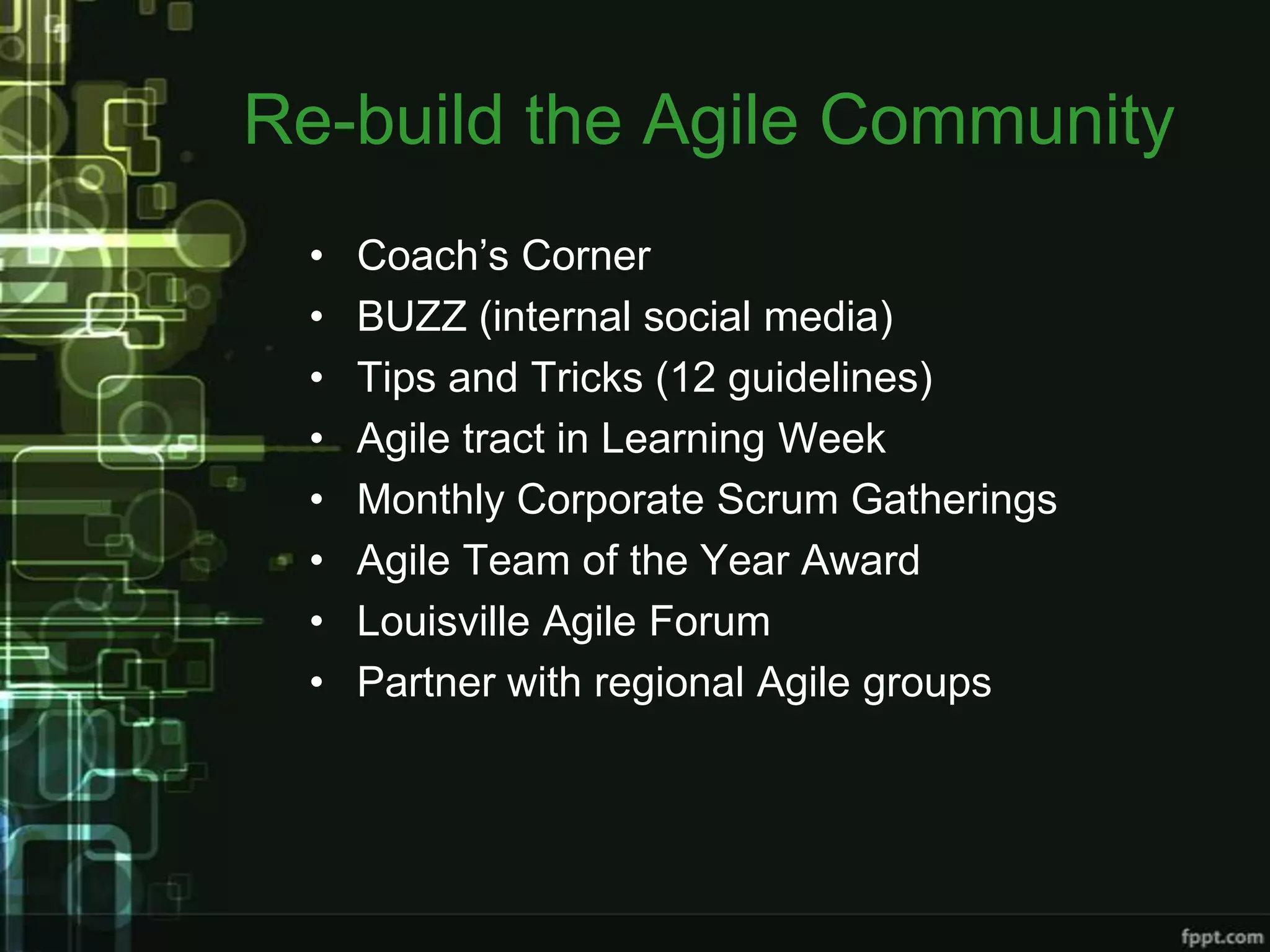
Re-build the Agile Community
 •   Coach’s Corner
 •   BUZZ (internal social media)
 •   Tips and Tricks (12 guidelines)
 •   Agile tract in Learning Week
 •   Monthly Corporate Scrum Gatherings
 •   Agile Team of the Year Award
 •   Louisville Agile Forum
 •   Partner with regional Agile groups
Coaches     Coaches

Coaches Coaches
           Coaches
Coaches
    Coaches
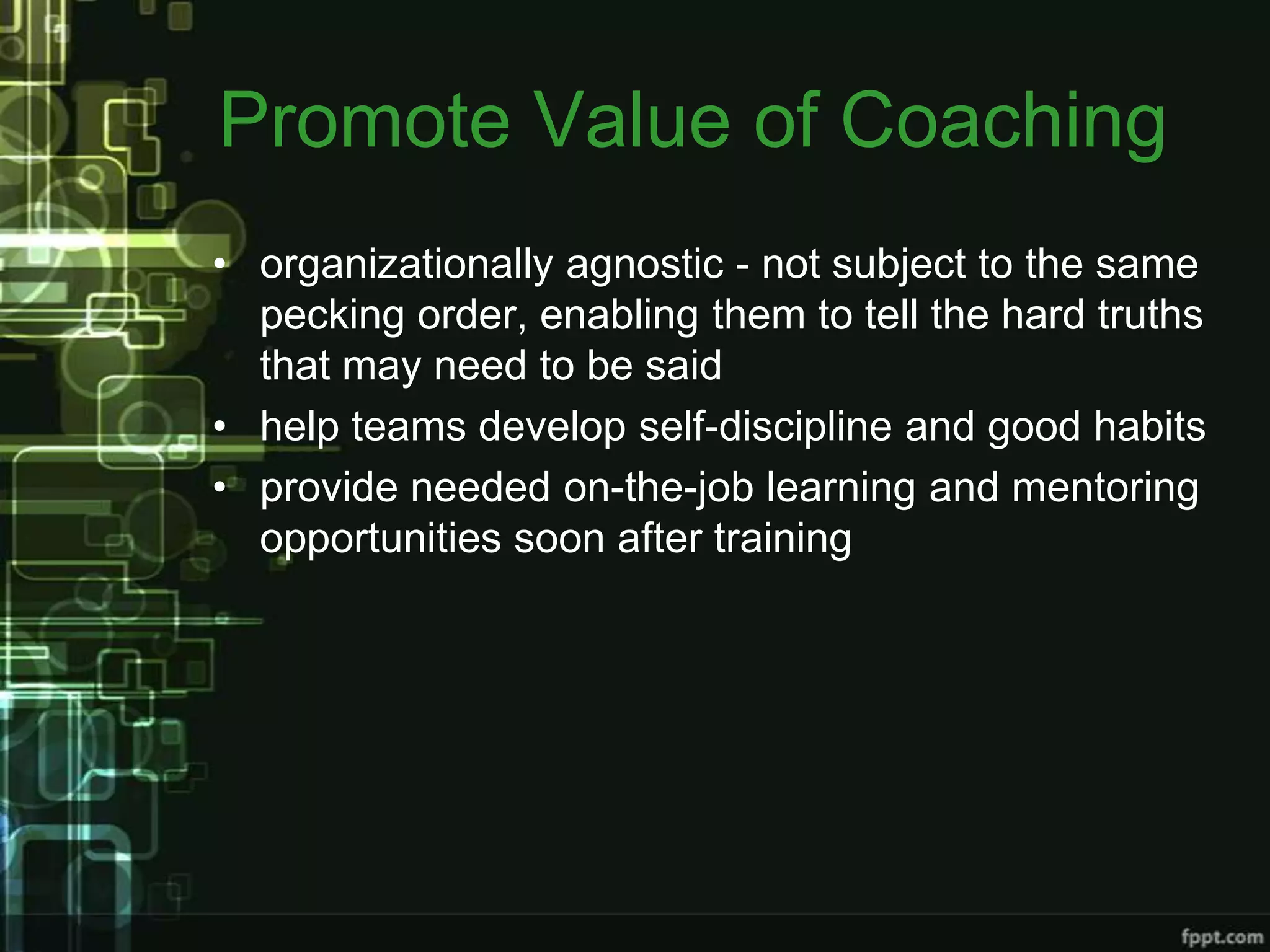
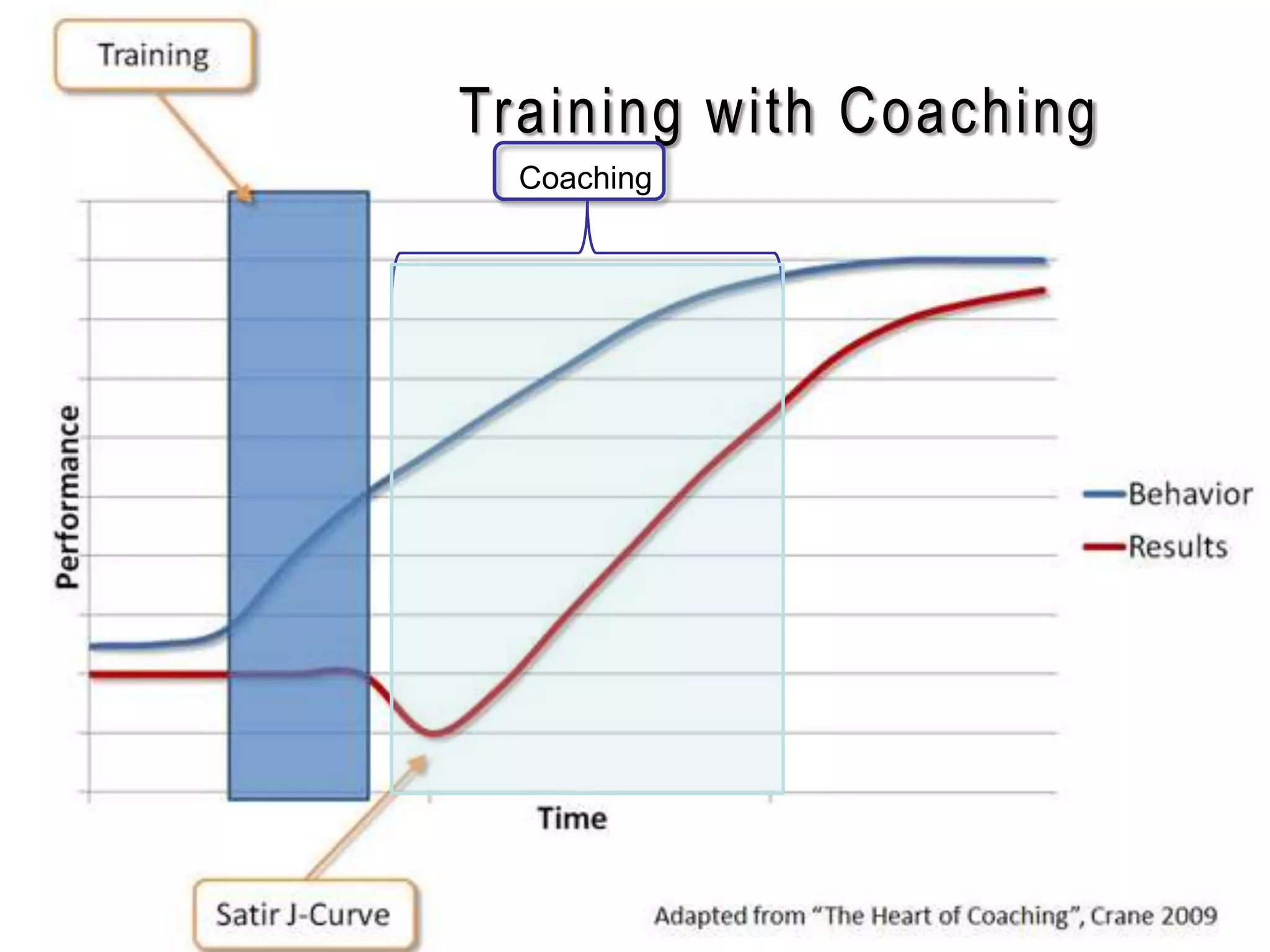
Promote Value of Coaching
• organizationally agnostic - not subject to the same
  pecking order, enabling them to tell the hard truths
  that may need to be said
• help teams develop self-discipline and good habits
• provide needed on-the-job learning and mentoring
  opportunities soon after training
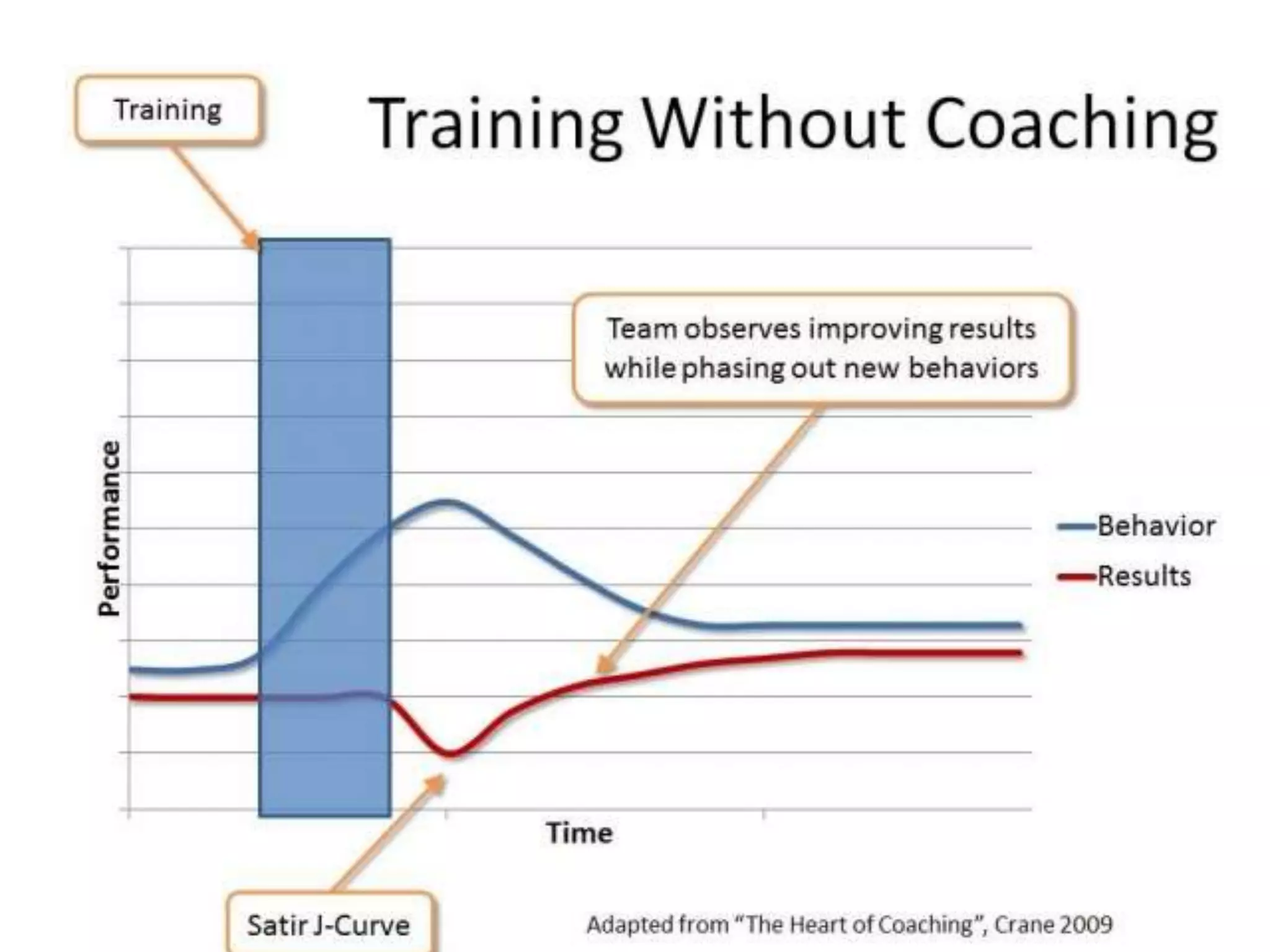
Training with Coaching
  Coaching
Promote Value of Coaching
 • Challenge teams to address the difficulties
   they face rather than sweep them under the
   rug.
 • bring both tried and new practices and
   processes to the team and organization
   reducing the degree of trial and error.
 • bring an outside view of the organization, team
   and individuals and remove intrinsic bias and
   interpersonal issues.
“Grow your Own” Coach
• Internal coach program
   – 6 months to “coach the coach”
   – Full time commitment
   – Workload of 12-15 teams
   – Already knows the business
• Limitations
   – Agile experience limited to one company
   – Not organizationally agnostic
   – No previous coaching experience
Educate Business leadership
•   Find the champions
•   Educate top down and bottom up
•   30 minute intro to Scrum
•   Provide Product Owner learning plan
•   Solicit their help to champion Scrum
•   Sell the idea of external coaches
•   Help Business “take back the reins”.
Educate IT leadership
• Find the champions
• Provide Agile PM learning plan
• Address the unanswered questions:
   – Are we a Service Provider or Partner?
   – How to develop Agile PMs?
   – Do we understand and accept the risk of
     offshoring?
   – Are we serious about Scrum adoption?
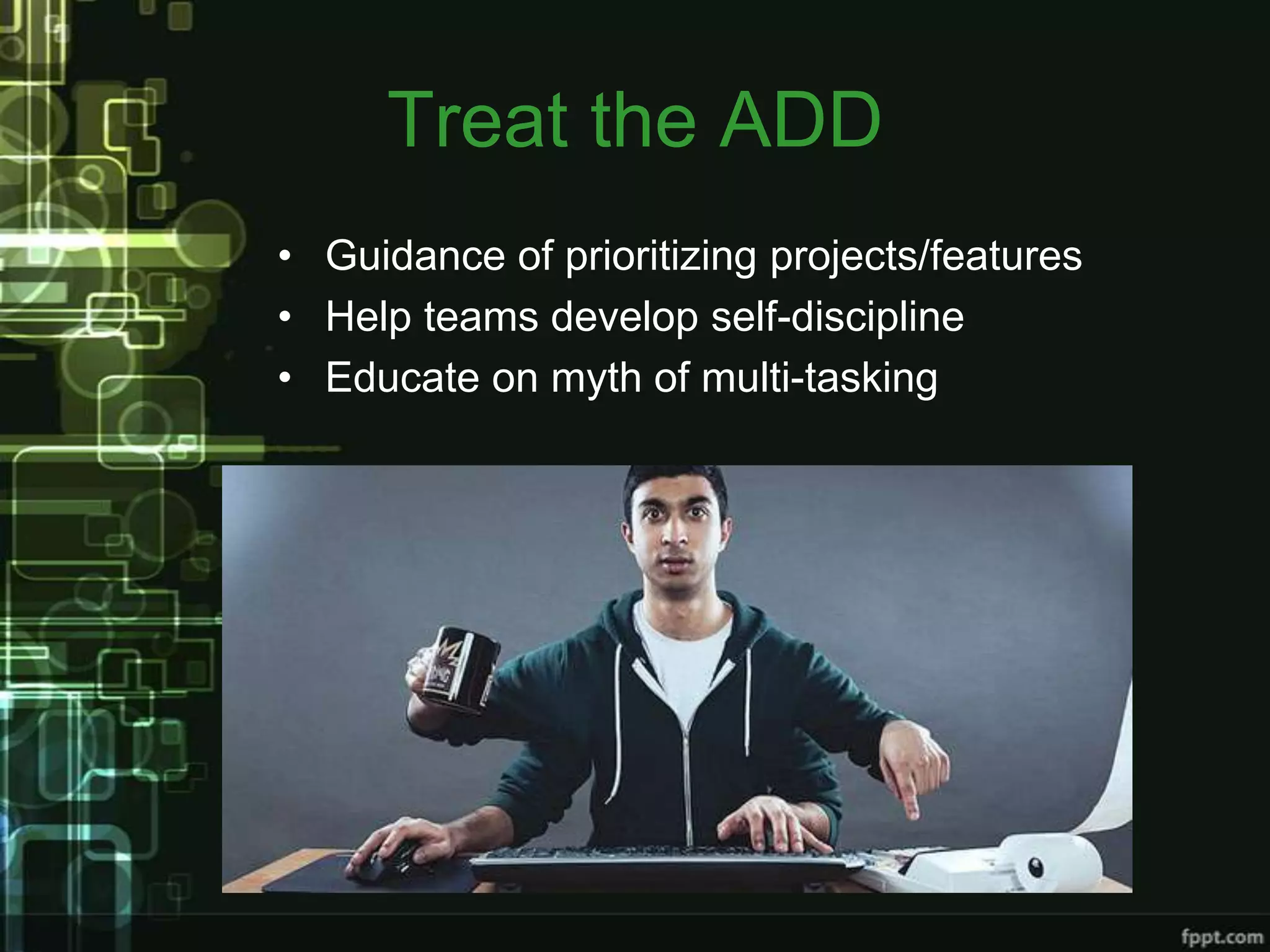
Treat the ADD
• Guidance of prioritizing projects/features
• Help teams develop self-discipline
• Educate on myth of multi-tasking
Address Collaboration Issues
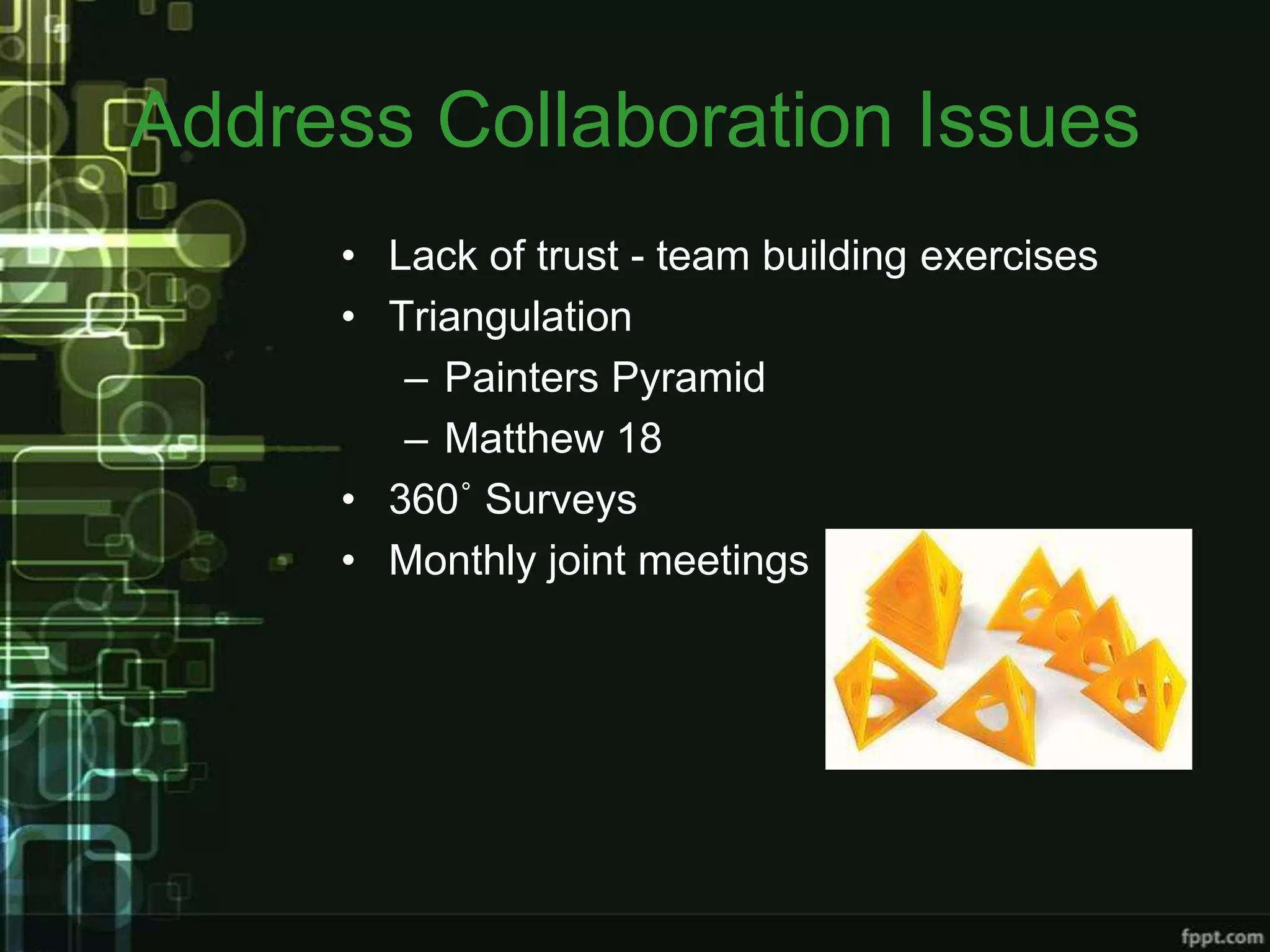
     • Lack of trust - team building exercises
     • Triangulation
        – Painters Pyramid
        – Matthew 18
     • 360˚ Surveys
     • Monthly joint meetings
Agile Adoption
Lessons Learned
LLs for the Company

• Involve the Business from beginning
• Utilize external coaches for first year
• Honor Scrum values & principles
   – Be transparent
   – Be honest
LLs for an Agile Coach
• You can lead a horse to water…
• Culture is hardest to change.
• Got to know when to quit.
A company has to decide
      for itself…
• Do you want to be a Guppy or an Olympic
  Swimmer?
Product
                          Owner 4
     Product
     Owner 3
                             Business PM

Product           Scrum
Owner 2           Team         IT PM


      Scrum                SME/Arch
      Master


               Product
               Owner 1
Product
                     Owner 4


                                Product
Product                         Owner 3
Owner 2

                                       Business PM
           Lead
           Product
           Owner

                               Scrum
                               Team


          Scrum
          Master
                                              SME/Arch

                       IT PM
Questions?
Contact me!
• alstonehodge@gmail.com
• Twitter: @alstonhodge
• Join me each month at the Louisville Agile Forum
   – Farm Credit Mid-America (1601 UPS Drive, Louisville)
   – 4th Wednesdays (6PM)
• Call me at 502-631-3175

Agile Odyssey: Case Study of Agile Adoption within A Health Insurance Company

  • 1.
    An Agile Odyssey: A Case Study of Agile Adoption within a Health Insurance Company Alston Hodge, Agile Coach 2013 AgileIndy Conference March 8, 2013
  • 2.
    My first weekon the job... • “Our metrics do not show that Scrum is any better than waterfall.” – IT director • “I’m not sure Agile really works for us.” – IT manager • “So glad you’re here to tell us what we are doing wrong.” - ScrumMaster
  • 3.
    Agenda • History • Assessment – Findings – Anti-Scrum Patterns – Root Causes – Impacts to the insurance company • Fixing the Problems • Lessons Learned
  • 4.
    History • Nov 2007– IT dept established Agile charter • Feb 2008 – IT dept created implementation plan, training campaign, pilot projects • Oct 2008 – IT dept created Agile Community of Practice • Oct 2009 – consulting firm recommended coaches • Apr 2010 – IT dept created Agile Maturity Model • Oct 2010 – BP survey highlighted Agile issues • Apr 2011 – hired first Agile coach, conducted organizational assessment • Oct 2011 – BP survey highlighted Agile issues
  • 5.
  • 6.
    Assessment Topics • ScrumTraining? • Following the basic Scrum practices? – Timeboxed work? – Goal of potentially deployable product? – Have a SM and PO? – Team maturity? – Retrospectives? – Demos?
  • 7.
    Assessment Findings • 55%of people trained (mostly IT) • 53% of projects use some variation of Scrum • 70% global partner utilization • Sampled 35% of Scrum teams (47/136): – 13% (6 teams) practice “true” Scrum – 87% (41 teams) struggle with 4 or more key Scrum principles and practices
  • 8.
    Anti-Scrum Patterns • Scrum->Scrum-lite-> O-gile • Mini-waterfall approach • Multiple concurrent projects in Sprints – 83% have 3 or more projects • Teams with few or no retrospectives • Risks not being identified and managed
  • 9.
    Lowest Lower Higher Highest Attribute Risk Risk Risk Risk Team Collocated Distributed Distributed Distribution Collocated Part-time Overlap No Overlap Product Lead multiple POs Owner 1 PO 2 (no lead) Product Complexity 1 system 2 systems 3 systems 4+ systems True Sprint Length 2 wks 4 wks 6 wks 8+ wks Projects per Team 1 2 3 4+ Scrum Advance Experience Expert Proficient Beginner Novice XP Advance Experience Expert Proficient Beginner Novice Team Truly cross- Specialized Structure functional roles
  • 10.
    More Anti-Scrum Patterns •SM assumes some responsibilities of PO • No lead Product Owner • Stakeholders not attending demos • Inconsistent use of VersionOne • New teams adopting anti-Scrum habits of early adopters • IT PM, Business PM
  • 11.
    Product Owner Team Scrum Master Simple Scrum
  • 12.
    Product Owner 4 Product Owner 3 Business PM Product Scrum Owner 2 Team IT PM Scrum SME/Arch Master Product Owner 1
  • 13.
    And some more…. • Individual performance measures • Workload exceeds capacity • Start most/all stories at same time • No sprint goals • No tracking velocity • Teams larger than 12 members • Separate testing from development
  • 14.
    Sprint Models Model DSU DEV-SIT-UAT DEV-SIT-UAT DEV-SIT-UAT …. Model DS-U DEV + SIT UAT DEV + SIT UAT DEV + SIT UAT Model DDD-S-U DEV DEV DEV …. SIT UAT Model D-S-U . DEV SIT UAT Defects Defects DEV SIT UAT Defects Defects DEV SIT UAT
  • 15.
    Assessment Findings • Top10% teams (highest performers): – 93% with only one PO – 1.9 projects per sprint – 7.4 core team members – 6.8 yrs average company experience (POs) • Bottom 10% of teams (failing): – 56% with more than one PO (one with 7 POs!) – 4.6 projects per sprint – 12.1 core members/team – POs with only 1.8 yrs average company experience
  • 16.
  • 17.
    Root Cause 1: Adapting vs. Adopting Scrum • “We need your help to adapt Scrum to fit our culture” – PMO Program Manager • “Perhaps we need to adopt the Values and Principles, and adapt the techniques and practices instead.” – Alston
  • 18.
    Agile Values andPrinciples • Already complement our corporate values and principles. • Guide us in our daily decisions. • Are foundational, the core of what we believe to be true about us. • Generally accepted Scrum practices are based on Agile values and principles. • Changing the values and principles de- stabilizes our Scrum framework.
  • 19.
    Examples • Choosing tonot have retrospectives hampers: – Continuous improvement – Transparency – Sustainable development • Not tracking velocity hampers: – Continuous improvement – Transparency – Sustainable development
  • 20.
    Root Cause 2: Adoption Viewed as an IT campaign, not a company campaign • Initiated and supported as IT campaign • Business partners not fully understanding the implications: – PO develops the backlog – PO prioritizes based on business value – PO approves story completion – PO decides when to release With Agile, the Business is in the driver’s seat!
  • 21.
    IT left withun-answered Questions • Service Provider vs. Business Partner • IT projects vs. Business projects • What to do with PMs? • Scrum-> Scrum-lite-> O-gile?
  • 22.
    Root Cause 3: Accelerated Contract/Offshore Utilization • 2008 – 60% company, 40% contractor • 2011 – 30% company, 70 % contractor • Source of business innovation cut in half
  • 23.
    Look at thenumbers • US health insurance experience – 160+ years as an industry – Over 80% of Americans with healthcare insurance today • India’s health insurance experience – 12 years experience in industry – Less than 6% with healthcare insurance (as of 2010)
  • 24.
    Root Cause 4: ADD – Agile Deficit Disorder • Symptoms – Difficulty in focusing – Hard to develop self-discipline (team & organizational) – Commitment issues – Scrum Buts – Resistance to Transparency – Workload exceeds capacity “We need to take on this additional work because it is important. But it goes without saying that we can’t let anything fall off the plate.” – IT manager
  • 25.
  • 26.
    Collaboration Challenges • AgileCommunity of Practice stalled • Increasing collaboration issues • Increase turnover (company, vendors) in some areas • Decline in Partnership survey scores – Innovation – Communications – Ownership • Increased use of PMs (IT and Business)
  • 27.
  • 28.
    Update the training •Use experienced SMs and Pos as trainers • Focus more on the “Why” of key Scrum concepts • Lots of new resources available now • Address the common Anti-Scrums • Introduce eXtreme Programming – Continuous integration – Paired programming – Automated testing
  • 29.
    Key Concepts ofScrum • Transparency • Prioritize Business • Commitment Value • Continuous • Incremental Improvement development • Collaboration • Minimal documentation • Discipline • Sustainable pace • Stop.Inspect.Adapt • Iterative development • Cross-functional teams • Swarming • Retrospectives • Sprint planning • Product Demos
  • 30.
    Re-build the AgileCommunity • Coach’s Corner • BUZZ (internal social media) • Tips and Tricks (12 guidelines) • Agile tract in Learning Week • Monthly Corporate Scrum Gatherings • Agile Team of the Year Award • Louisville Agile Forum • Partner with regional Agile groups
  • 31.
    Coaches Coaches Coaches Coaches Coaches Coaches Coaches
  • 32.
    Promote Value ofCoaching • organizationally agnostic - not subject to the same pecking order, enabling them to tell the hard truths that may need to be said • help teams develop self-discipline and good habits • provide needed on-the-job learning and mentoring opportunities soon after training
  • 34.
  • 35.
    Promote Value ofCoaching • Challenge teams to address the difficulties they face rather than sweep them under the rug. • bring both tried and new practices and processes to the team and organization reducing the degree of trial and error. • bring an outside view of the organization, team and individuals and remove intrinsic bias and interpersonal issues.
  • 36.
    “Grow your Own”Coach • Internal coach program – 6 months to “coach the coach” – Full time commitment – Workload of 12-15 teams – Already knows the business • Limitations – Agile experience limited to one company – Not organizationally agnostic – No previous coaching experience
  • 37.
    Educate Business leadership • Find the champions • Educate top down and bottom up • 30 minute intro to Scrum • Provide Product Owner learning plan • Solicit their help to champion Scrum • Sell the idea of external coaches • Help Business “take back the reins”.
  • 38.
    Educate IT leadership •Find the champions • Provide Agile PM learning plan • Address the unanswered questions: – Are we a Service Provider or Partner? – How to develop Agile PMs? – Do we understand and accept the risk of offshoring? – Are we serious about Scrum adoption?
  • 39.
    Treat the ADD •Guidance of prioritizing projects/features • Help teams develop self-discipline • Educate on myth of multi-tasking
  • 40.
    Address Collaboration Issues • Lack of trust - team building exercises • Triangulation – Painters Pyramid – Matthew 18 • 360˚ Surveys • Monthly joint meetings
  • 41.
  • 42.
    LLs for theCompany • Involve the Business from beginning • Utilize external coaches for first year • Honor Scrum values & principles – Be transparent – Be honest
  • 43.
    LLs for anAgile Coach • You can lead a horse to water… • Culture is hardest to change. • Got to know when to quit.
  • 44.
    A company hasto decide for itself… • Do you want to be a Guppy or an Olympic Swimmer?
  • 45.
    Product Owner 4 Product Owner 3 Business PM Product Scrum Owner 2 Team IT PM Scrum SME/Arch Master Product Owner 1
  • 46.
    Product Owner 4 Product Product Owner 3 Owner 2 Business PM Lead Product Owner Scrum Team Scrum Master SME/Arch IT PM
  • 47.
  • 48.
    Contact me! • alstonehodge@gmail.com •Twitter: @alstonhodge • Join me each month at the Louisville Agile Forum – Farm Credit Mid-America (1601 UPS Drive, Louisville) – 4th Wednesdays (6PM) • Call me at 502-631-3175