May 2014 Online EditionIAEM Bulletin
22
(continued on page 23)
Emergency Technology Caucus to Assist with LinkedIn
Profile Makeovers at the Annual Conference
Use These Tips to Build a Professional Network and Personal Brand
By Mary Jo Flynn, MS, CEM; Jennifer Lazo, MS; and Christopher Tarantino
S
ocial media has revolution
ized emergency manage-
ment – changing not only
how emergency managers engage
with the public, but also how they
develop networks, personal brand-
ing, and careers. Developing or
improving a LinkedIn profile can
open doors and improve networking
success. The IAEM-USA Emerging
Technology Caucus (ETC) will be
providing LinkedIn Profile
Makeovers at the Crisis Technol-
ogy Center (CTC) booth during the
2014 Conference.
Make in-person networking
more effective by using LinkedIn to
seek out speakers and attendees in
advance of the conference. Re-
search the profiles of speakers, to
effectively prioritize time and attend
sessions that are the most beneficial
and match career goals. Use the
conference as an opportunity to
meet new people, exchange ideas,
and share those ideas with existing
networks. Long after the conference
has ended, those networks become
more valuable as they are nurtured
by researching, developing and
sharing valuable content.
Make the Most of LinkedIn
Join groups and participate in
discussions. Make sure to judge the
tenor of a group before sharing an
opinion or other information.
Follow the companies and
organizations that help meet
professional objectives and engage
with them online.
Follow and connect with the
speakers who may be experts in an
area of interest. Communicate
whether their presentation or
session provided greater under-
standing of a topic and how it is
being implemented.
Build social capital by using
tools such as slideshare.net to
distribute presentations and white
papers improves the value of an
individual’s network.
Successful networking is often
about utilizing weak ties. Sociologi-
cal research has shown that strong
ties such as family, close friends and
coworkers do not necessarily lead to
career advancement or new
learning because they often know
the same information and operate
within the same circles. Instead, the
weak ties, such as acquaintances,
serve as bridges between networks,
connecting individuals with new
possibilities for career opportunities.
LinkedIn is a powerful tool for
finding those weak ties and using
them to engage with new networks
by visualizing how networks are
interconnected, determining what
skills and resources they contain,
and providing access to new content
from which knowledge, skills and
career information.
A great network should be
diverse. Through LinkedIn Visualiza-
tion Tools (http://inmaps.linkedin
labs.com/network), one may gauge
the similarities and differences
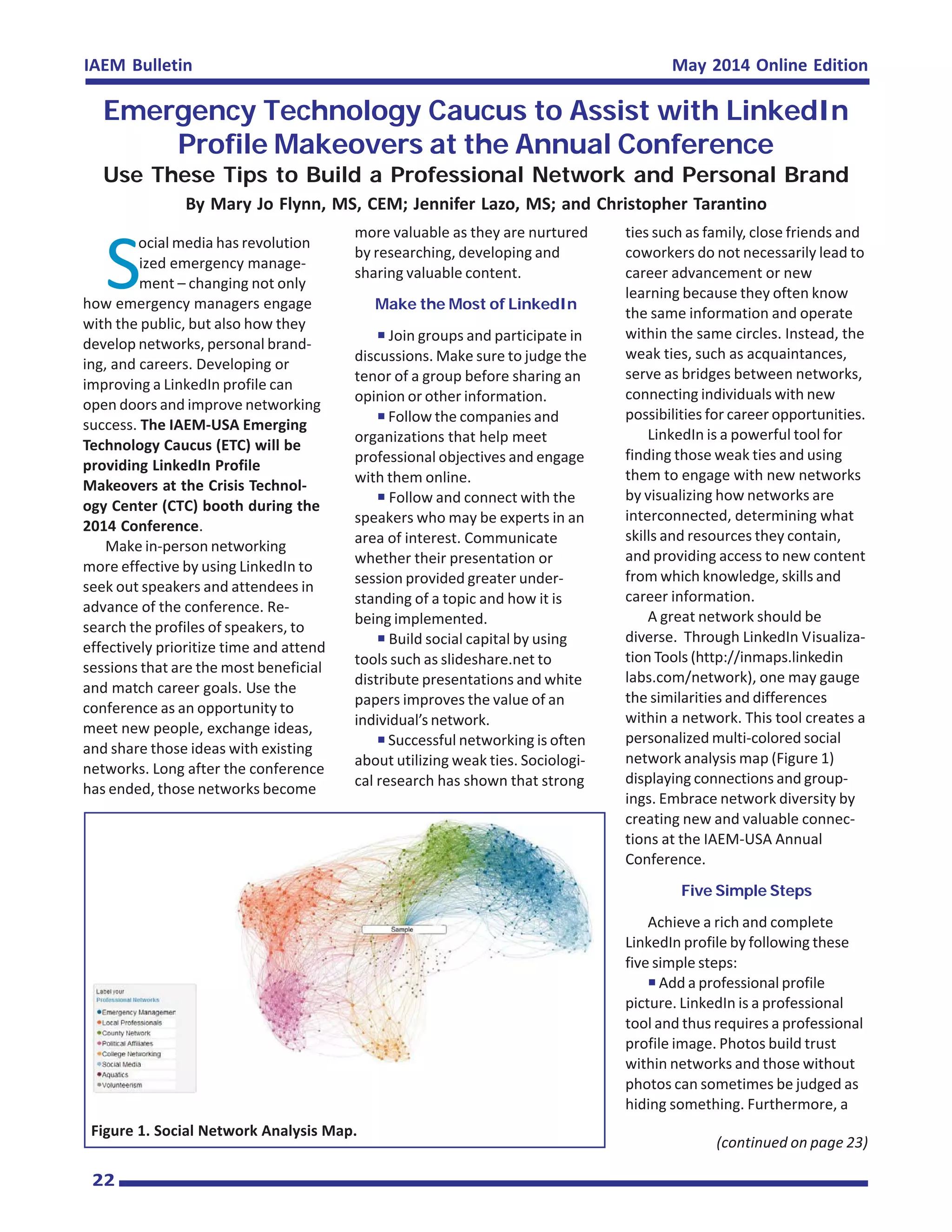
within a network. This tool creates a
personalized multi-colored social
network analysis map (Figure 1)
displaying connections and group-
ings. Embrace network diversity by
creating new and valuable connec-
tions at the IAEM-USA Annual
Conference.
Five Simple Steps
Achieve a rich and complete
LinkedIn profile by following these
five simple steps:
Add a professional profile
picture. LinkedIn is a professional
tool and thus requires a professional
profile image. Photos build trust
within networks and those without
photos can sometimes be judged as
hiding something. Furthermore, a
Figure 1. Social Network Analysis Map.
May 2014 Online EditionIAEM Bulletin
23
LinkedIn Makeover
(continued from page 22)
picture improves one’s chances of
building a network as often people
will remember a face, not necessar-
ily a name.
Customize the LinkedIn URL. A
short personalized link represents a
personal brand and is easily shared
with new acquaintances, or even
added to business cards. Do not skip
this step, as the alternative is a long,
cluttered URL.
Add skills and projects. LinkedIn
profiles are an opportunity to tell a
story without major space concerns.
Take advantage of that and share
the details that highlight unique and
interesting career elements.
Reorganize sections. Move
around profile sections so that the
most prominent and flattering
accomplishments are listed first. For
example, recent graduates may
want to put relevant education at
the beginning of their profile.
Recommend others when
appropriate. Remember the old
adage: those who give receive.
When writing a quality, informed
recommendation of a networked
colleague, the favor is often re-
turned. However, no one should
expect that recommendations serve
as a quid pro quo.
Remember to tap into existing
LinkedIn contacts and invite a friend,
to become a member of IAEM.
References
Adams, S. Everything You Need
To Know About LinkedIn Recommen-
dations. Forbes. Retrieved Mar. 8,
2014, from http://www.forbes.com/
sites/susanadams/2012/02/08/
everything-you-need-to-know-
about-linkedin-recommendations.
Azahar, Azeem. “Weak Ties &
High Bandwidth: The Value of the
Conference.” World’s Largest
Professional Network. N.p., 19 Jan.
2014. Retrieved Mar. 8, 2014, from
http://www.linkedin.com/today/
post/article/20140119120122-2954-
weak-ties-high-bandwidth-the-value-
of-the-conference.
Hockenson, L. (2011, Decem-
ber 3). LinkedIn Bootcamp.
Mashable. Retrieved Mar. 8, 2014,
from http://mashable.com/2011/12/
03/linkedin-boot-camp-infographic.
Must See LinkedIn Profiles of
2013. Retrieved Mar. 8, 2014, from
http://www.slideshare.net/linkedin/
must-see-linkedin-profiles-of-2013.
Canada’s Protective
Direction No. 32
(continued from page 21)
management structure. Further-
more, this protective directive
recognizes the importance of
safeguarding industry data, desig-
nating the Canadian Transport
Emergency Centre (CANUTEC) as the
central agency for sharing contact
information and data between
industry and municipalities.
Looking Forward
More work is to be done across
Canada and internationally to
ensure safe transport of dangerous
goods by rail. Examination of every
part of the process is underway.
Physical safety mechanisms, chemi-
cal composition during transport and
increasing insurance requirements
are under examination, and the
working groups have their noses to
the grindstone.
As Hazard Mitigation and
Disaster Risk Reduction programs
evolve across Canada, the slow
moving trains of yesterday have
been replaced with a quick and
responsive industry. Managing these
evolving risks may become a domi-
nant challenge for the emergency
management sector in years to
come.
Learn More
If you would like more detailed
information regarding Protective
Direction No. 32, please refer to
Transport Canada’s website, http://
www.tc.gc.ca/eng/mediaroom/
backgrounders-protective-direction-
no32-7428.html.
IAEM/inWEM Webinar
(continued from page 20)
Ms. Cherrie Black
Judge Reneìe Cardwell Hughes
(Ret.), Delta Sigma Theta Sorority,
Inc.
Ms. Andrea Berwind Davis
Visit our website at http://inwem.
org/wp/inwem-hall-of-fame for
additional information on each
inductee.
Assignment
They say a picture speaks a
thousand words. Think about an
emergency management meeting
you recently attended or saw on
television. The meeting was called
to order. How many women,
seniors, individuals with disabilities
and those with access and functional
needs, individuals with limited
English proficiency, geographically
isolated or educationally disenfran-
chised people, people of color, as
well as those of ethnic and national
origin minorities, and members of
underserved populations do you
visually remember, in partnership,
and included at “the table”?

2014 may iaem bulletin linked in

  • 1.
    May 2014 OnlineEditionIAEM Bulletin 22 (continued on page 23) Emergency Technology Caucus to Assist with LinkedIn Profile Makeovers at the Annual Conference Use These Tips to Build a Professional Network and Personal Brand By Mary Jo Flynn, MS, CEM; Jennifer Lazo, MS; and Christopher Tarantino S ocial media has revolution ized emergency manage- ment – changing not only how emergency managers engage with the public, but also how they develop networks, personal brand- ing, and careers. Developing or improving a LinkedIn profile can open doors and improve networking success. The IAEM-USA Emerging Technology Caucus (ETC) will be providing LinkedIn Profile Makeovers at the Crisis Technol- ogy Center (CTC) booth during the 2014 Conference. Make in-person networking more effective by using LinkedIn to seek out speakers and attendees in advance of the conference. Re- search the profiles of speakers, to effectively prioritize time and attend sessions that are the most beneficial and match career goals. Use the conference as an opportunity to meet new people, exchange ideas, and share those ideas with existing networks. Long after the conference has ended, those networks become more valuable as they are nurtured by researching, developing and sharing valuable content. Make the Most of LinkedIn Join groups and participate in discussions. Make sure to judge the tenor of a group before sharing an opinion or other information. Follow the companies and organizations that help meet professional objectives and engage with them online. Follow and connect with the speakers who may be experts in an area of interest. Communicate whether their presentation or session provided greater under- standing of a topic and how it is being implemented. Build social capital by using tools such as slideshare.net to distribute presentations and white papers improves the value of an individual’s network. Successful networking is often about utilizing weak ties. Sociologi- cal research has shown that strong ties such as family, close friends and coworkers do not necessarily lead to career advancement or new learning because they often know the same information and operate within the same circles. Instead, the weak ties, such as acquaintances, serve as bridges between networks, connecting individuals with new possibilities for career opportunities. LinkedIn is a powerful tool for finding those weak ties and using them to engage with new networks by visualizing how networks are interconnected, determining what skills and resources they contain, and providing access to new content from which knowledge, skills and career information. A great network should be diverse. Through LinkedIn Visualiza- tion Tools (http://inmaps.linkedin labs.com/network), one may gauge the similarities and differences within a network. This tool creates a personalized multi-colored social network analysis map (Figure 1) displaying connections and group- ings. Embrace network diversity by creating new and valuable connec- tions at the IAEM-USA Annual Conference. Five Simple Steps Achieve a rich and complete LinkedIn profile by following these five simple steps: Add a professional profile picture. LinkedIn is a professional tool and thus requires a professional profile image. Photos build trust within networks and those without photos can sometimes be judged as hiding something. Furthermore, a Figure 1. Social Network Analysis Map.
  • 2.
    May 2014 OnlineEditionIAEM Bulletin 23 LinkedIn Makeover (continued from page 22) picture improves one’s chances of building a network as often people will remember a face, not necessar- ily a name. Customize the LinkedIn URL. A short personalized link represents a personal brand and is easily shared with new acquaintances, or even added to business cards. Do not skip this step, as the alternative is a long, cluttered URL. Add skills and projects. LinkedIn profiles are an opportunity to tell a story without major space concerns. Take advantage of that and share the details that highlight unique and interesting career elements. Reorganize sections. Move around profile sections so that the most prominent and flattering accomplishments are listed first. For example, recent graduates may want to put relevant education at the beginning of their profile. Recommend others when appropriate. Remember the old adage: those who give receive. When writing a quality, informed recommendation of a networked colleague, the favor is often re- turned. However, no one should expect that recommendations serve as a quid pro quo. Remember to tap into existing LinkedIn contacts and invite a friend, to become a member of IAEM. References Adams, S. Everything You Need To Know About LinkedIn Recommen- dations. Forbes. Retrieved Mar. 8, 2014, from http://www.forbes.com/ sites/susanadams/2012/02/08/ everything-you-need-to-know- about-linkedin-recommendations. Azahar, Azeem. “Weak Ties & High Bandwidth: The Value of the Conference.” World’s Largest Professional Network. N.p., 19 Jan. 2014. Retrieved Mar. 8, 2014, from http://www.linkedin.com/today/ post/article/20140119120122-2954- weak-ties-high-bandwidth-the-value- of-the-conference. Hockenson, L. (2011, Decem- ber 3). LinkedIn Bootcamp. Mashable. Retrieved Mar. 8, 2014, from http://mashable.com/2011/12/ 03/linkedin-boot-camp-infographic. Must See LinkedIn Profiles of 2013. Retrieved Mar. 8, 2014, from http://www.slideshare.net/linkedin/ must-see-linkedin-profiles-of-2013. Canada’s Protective Direction No. 32 (continued from page 21) management structure. Further- more, this protective directive recognizes the importance of safeguarding industry data, desig- nating the Canadian Transport Emergency Centre (CANUTEC) as the central agency for sharing contact information and data between industry and municipalities. Looking Forward More work is to be done across Canada and internationally to ensure safe transport of dangerous goods by rail. Examination of every part of the process is underway. Physical safety mechanisms, chemi- cal composition during transport and increasing insurance requirements are under examination, and the working groups have their noses to the grindstone. As Hazard Mitigation and Disaster Risk Reduction programs evolve across Canada, the slow moving trains of yesterday have been replaced with a quick and responsive industry. Managing these evolving risks may become a domi- nant challenge for the emergency management sector in years to come. Learn More If you would like more detailed information regarding Protective Direction No. 32, please refer to Transport Canada’s website, http:// www.tc.gc.ca/eng/mediaroom/ backgrounders-protective-direction- no32-7428.html. IAEM/inWEM Webinar (continued from page 20) Ms. Cherrie Black Judge Reneìe Cardwell Hughes (Ret.), Delta Sigma Theta Sorority, Inc. Ms. Andrea Berwind Davis Visit our website at http://inwem. org/wp/inwem-hall-of-fame for additional information on each inductee. Assignment They say a picture speaks a thousand words. Think about an emergency management meeting you recently attended or saw on television. The meeting was called to order. How many women, seniors, individuals with disabilities and those with access and functional needs, individuals with limited English proficiency, geographically isolated or educationally disenfran- chised people, people of color, as well as those of ethnic and national origin minorities, and members of underserved populations do you visually remember, in partnership, and included at “the table”?