Drone Technology & Social Media
Mary Jo Flynn
Emergency Operations Coord.
Sacramento County OES
@MaryJoFly
Sarah K. Miller
Emergency Management Coord.
King County, WA (Contract)
@scba
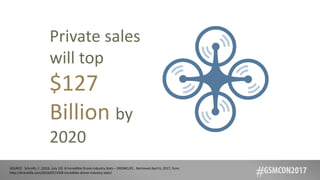
SOURCE: Schroth, F. (2016, July 19) 8 Incredible Drone Industry Stats – DRONELIFE. Retrieved April 6, 2017, from
http://dronelife.com/2016/07/19/8-incredible-drone-industry-stats/
Private sales
will top
$127
Billion by
2020
Terminology
• Drone
• What the public calls hobbyist quadcopters as well as
military assets
• Small Unmanned Aircraft System (sUAS)
• This is the typical hobbyist device
• It has a means of coordinating flight and geography
• Unmanned Aerial Vehicle (UAV)
• Typical quadcopter, however, some may come with
payloads other than photography or video
Government Requirements
• Government entities or organizations (e.g. law enforcement
agencies, public universities, state governments, local
municipalities) have 2 options for flying UAS:
• Fly under the small UAS rule – follow all rules under 14 CFR
part 107, including aircraft and pilot requirements
• Obtain a blanket public Certificate of Waiver or
Authorization (COA) – permits nationwide flights in Class G
airspace at or below 400 feet, self-certification of the UAS
pilot, and the option to obtain emergency COAs (e-COAs)
under special circumstances Contact 9-AJV-115-
UASCOA@faa.gov to learn more about public COAs.
COA and Government Access
• A COA allows an operator to fly drones in a specific place
for a particular purpose and for a specific period of time,
often up to two years.
• Once a public operator has a COA, they are able to self-
certify their own pilots and are not held to Part 107
restrictions.
• In addition, public operators may apply for an emergency
COA if the situation meets the FAA’s requirements. An
emergency COA is generally granted for a specific purpose
in a limited time frame, and the turnaround for an
emergency COA request is no longer than 24 hours.
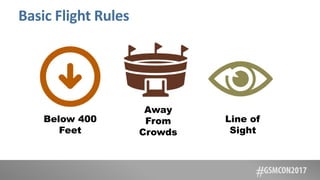
Basic Flight Rules
Below 400
Feet
Away
From
Crowds
Line of
Sight
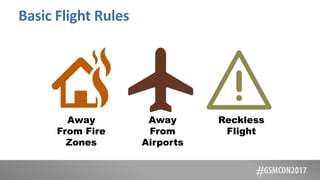
Basic Flight Rules
Away
From Fire
Zones
Away
From
Airports
Reckless
Flight
Waivable sections of part 107
• Operation from a moving vehicle or aircraft (§ 107.25)*
• Daylight operation (§ 107.29)
• Visual line of sight aircraft operation (§ 107.31)*
• Visual observer (§ 107.33)
• Operation of multiple small unmanned aircraft systems (§ 107.35)
• Yielding the right of way (§ 107.37(a))
• Operation over people (§ 107.39)
• Operation in certain airspace (§ 107.41)
• Operating limitations for small unmanned aircraft (§ 107.51)
Top 5 Policy Must Haves
1. How will you address privacy and safety
• Must comply with Privacy Impact Assessment/Civil Liberties Impact
Assessment PIA/CLIA
2. Flight program
• Training
• Airworthiness and Aircraft Maintenance
• Flight Logs and Documentation
3. Data Security - how long will you maintain records, how will records be
protected
4. Public notification of use e.g. posting signage photography taking place
5. Authorized and Prohibited uses - or the purpose for aerial flight
• Emergencies
• Search & Rescue
• Marketing
Program Elements
• Administrative Policy
• Standard Operating Procedures
• Operator Training
• Operator Certification
• Maintenance Logs
• Flight Logs
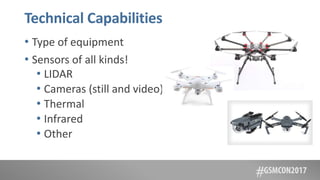
Technical Capabilities
• Type of equipment
• Sensors of all kinds!
• LIDAR
• Cameras (still and video)
• Thermal
• Infrared
• Other
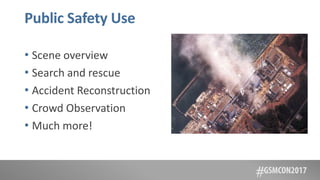
Public Safety Use
• Scene overview
• Search and rescue
• Accident Reconstruction
• Crowd Observation
• Much more!
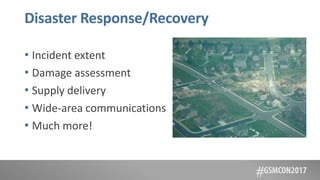
Disaster Response/Recovery
• Incident extent
• Damage assessment
• Supply delivery
• Wide-area communications
• Much more!
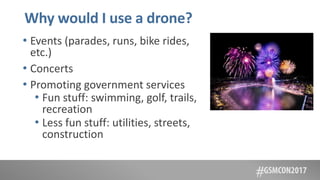
Why would I use a drone?
• Events (parades, runs, bike rides,
etc.)
• Concerts
• Promoting government services
• Fun stuff: swimming, golf, trails,
recreation
• Less fun stuff: utilities, streets,
construction
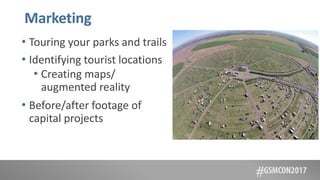
Marketing
• Touring your parks and trails
• Identifying tourist locations
• Creating maps/
augmented reality
• Before/after footage of
capital projects
Best Practices
• Flight
• Photos
• Two operator setups
• Social Media
• Media storage
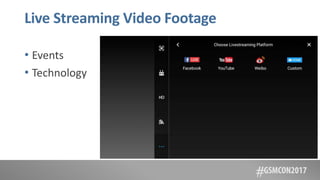
Live Streaming Video Footage
• Events
• Technology
Live Video Rules the World
• Same basic rules as other
live video
• Commentary
• Rapid Abort Strategy
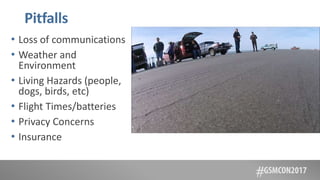
Pitfalls
• Loss of communications
• Weather and
Environment
• Living Hazards (people,
dogs, birds, etc)
• Flight Times/batteries
• Privacy Concerns
• Insurance
References & Links
• National League of Cities
• http://uavs.insct.org/wp-
content/uploads/2016/09/NLC-Drone-Report.pdf
• City of San Francisco Policy Requirements
• http://sfcoit.org/sites/default/files/Item%207.3%20-
%20Drone%20Policy%20(draft).pdf
• California League of Cities White Paper
• https://www.cacities.org/Resources-Documents/Policy-
Advocacy-Section/Hot-Issues/Drones/Drone-White-
Paper_Feb-14-2017.aspx
References and Links
• City of Auburn (WA) Policy and Operations Manual
• goo.gl/uHtv5I
• NDPTC AWR 345 – Unmanned Aircraft Systems in
Disaster Management
• https://NDPTC.Hawaii.edu
• FAA Unmanned Aircraft Systems
• https://www.faa.gov/uas/
QUESTIONS?
Please provide feedback on this session – Session Code 259

2017 GSMCON: Drones and Social Media

  • 1.
    Drone Technology &Social Media Mary Jo Flynn Emergency Operations Coord. Sacramento County OES @MaryJoFly Sarah K. Miller Emergency Management Coord. King County, WA (Contract) @scba
  • 2.
    SOURCE: Schroth, F.(2016, July 19) 8 Incredible Drone Industry Stats – DRONELIFE. Retrieved April 6, 2017, from http://dronelife.com/2016/07/19/8-incredible-drone-industry-stats/ Private sales will top $127 Billion by 2020
  • 3.
    Terminology • Drone • Whatthe public calls hobbyist quadcopters as well as military assets • Small Unmanned Aircraft System (sUAS) • This is the typical hobbyist device • It has a means of coordinating flight and geography • Unmanned Aerial Vehicle (UAV) • Typical quadcopter, however, some may come with payloads other than photography or video
  • 4.
    Government Requirements • Governmententities or organizations (e.g. law enforcement agencies, public universities, state governments, local municipalities) have 2 options for flying UAS: • Fly under the small UAS rule – follow all rules under 14 CFR part 107, including aircraft and pilot requirements • Obtain a blanket public Certificate of Waiver or Authorization (COA) – permits nationwide flights in Class G airspace at or below 400 feet, self-certification of the UAS pilot, and the option to obtain emergency COAs (e-COAs) under special circumstances Contact 9-AJV-115- UASCOA@faa.gov to learn more about public COAs.
  • 5.
    COA and GovernmentAccess • A COA allows an operator to fly drones in a specific place for a particular purpose and for a specific period of time, often up to two years. • Once a public operator has a COA, they are able to self- certify their own pilots and are not held to Part 107 restrictions. • In addition, public operators may apply for an emergency COA if the situation meets the FAA’s requirements. An emergency COA is generally granted for a specific purpose in a limited time frame, and the turnaround for an emergency COA request is no longer than 24 hours.
  • 6.
    Basic Flight Rules Below400 Feet Away From Crowds Line of Sight
  • 7.
    Basic Flight Rules Away FromFire Zones Away From Airports Reckless Flight
  • 8.
    Waivable sections ofpart 107 • Operation from a moving vehicle or aircraft (§ 107.25)* • Daylight operation (§ 107.29) • Visual line of sight aircraft operation (§ 107.31)* • Visual observer (§ 107.33) • Operation of multiple small unmanned aircraft systems (§ 107.35) • Yielding the right of way (§ 107.37(a)) • Operation over people (§ 107.39) • Operation in certain airspace (§ 107.41) • Operating limitations for small unmanned aircraft (§ 107.51)
  • 9.
    Top 5 PolicyMust Haves 1. How will you address privacy and safety • Must comply with Privacy Impact Assessment/Civil Liberties Impact Assessment PIA/CLIA 2. Flight program • Training • Airworthiness and Aircraft Maintenance • Flight Logs and Documentation 3. Data Security - how long will you maintain records, how will records be protected 4. Public notification of use e.g. posting signage photography taking place 5. Authorized and Prohibited uses - or the purpose for aerial flight • Emergencies • Search & Rescue • Marketing
  • 10.
    Program Elements • AdministrativePolicy • Standard Operating Procedures • Operator Training • Operator Certification • Maintenance Logs • Flight Logs
  • 11.
    Technical Capabilities • Typeof equipment • Sensors of all kinds! • LIDAR • Cameras (still and video) • Thermal • Infrared • Other
  • 12.
    Public Safety Use •Scene overview • Search and rescue • Accident Reconstruction • Crowd Observation • Much more!
  • 13.
    Disaster Response/Recovery • Incidentextent • Damage assessment • Supply delivery • Wide-area communications • Much more!
  • 14.
    Why would Iuse a drone? • Events (parades, runs, bike rides, etc.) • Concerts • Promoting government services • Fun stuff: swimming, golf, trails, recreation • Less fun stuff: utilities, streets, construction
  • 15.
    Marketing • Touring yourparks and trails • Identifying tourist locations • Creating maps/ augmented reality • Before/after footage of capital projects
  • 16.
    Best Practices • Flight •Photos • Two operator setups • Social Media • Media storage
  • 17.
    Live Streaming VideoFootage • Events • Technology
  • 18.
    Live Video Rulesthe World • Same basic rules as other live video • Commentary • Rapid Abort Strategy
  • 19.
    Pitfalls • Loss ofcommunications • Weather and Environment • Living Hazards (people, dogs, birds, etc) • Flight Times/batteries • Privacy Concerns • Insurance
  • 20.
    References & Links •National League of Cities • http://uavs.insct.org/wp- content/uploads/2016/09/NLC-Drone-Report.pdf • City of San Francisco Policy Requirements • http://sfcoit.org/sites/default/files/Item%207.3%20- %20Drone%20Policy%20(draft).pdf • California League of Cities White Paper • https://www.cacities.org/Resources-Documents/Policy- Advocacy-Section/Hot-Issues/Drones/Drone-White- Paper_Feb-14-2017.aspx
  • 21.
    References and Links •City of Auburn (WA) Policy and Operations Manual • goo.gl/uHtv5I • NDPTC AWR 345 – Unmanned Aircraft Systems in Disaster Management • https://NDPTC.Hawaii.edu • FAA Unmanned Aircraft Systems • https://www.faa.gov/uas/
  • 22.
    QUESTIONS? Please provide feedbackon this session – Session Code 259

Editor's Notes

  • #3 http://www.faa.gov/uas/regulations_policies/media/FAA_UAS-PO_LEA_Guidance.pdf