Networking for Employment
A guide for newcomers to British Columbia
Networking for Employment
A guide for newcomers to British Columbia
Last updated: July 23, 2018 2
Contents
1. Why Network?.........................................................................................2
2. Who is in Your Network? ..........................................................................4
3. Preparing your Networking “Toolkit” .......................................................... 7
4. Types of Networking ................................................................................9
5. Additional Resources.............................................................................. 13
1. Why Network?
Introduction
What can networking do for you?
 Lead to information on job openings not yet advertised
 Lead to an inside connection at a company
 Provide you with insights into an industry or profession
 Help you get advice on your job search methods
Networking is an important part of your job-search. Approximately 75 to 95 percent
of job openings are not advertised in sources such as the newspaper or Internet.
You can find out about these “hidden” jobs only by talking to other people or
networking.
Networking includes everything from a casual conversation with a friend to an
informational interview with a potential employer.
Networking doesn't mean asking everyone you run into for a job. It means building
relationships so that you can comfortably ask for ideas, advice, and referrals to
those with hiring power.
This guide takes you through the steps of building a network and how to make your
network help you with your job search.
Networking for Employment
A guide for newcomers to British Columbia
Last updated: July 23, 2018 3
More information on networking:
 What is Networking? University of Toronto Mississauga
www.utm.utoronto.ca/careers/sites/files/careers/public/shared/pdf/tipsheets/2017tipshee
ts/2017%20Tipsheet%20Effective%20Networking%20v20171010%201435.pdf
 The Value of Networking. Settlement.org
https://settlement.org/ontario/employment/working-in-canada/workplace-culture/the-
value-of-networking/
Networking for Employment
A guide for newcomers to British Columbia
Last updated: July 23, 2018 4
2. Who is in Your Network?
Start with people you know
Your network is probably already bigger than you think. It includes your family,
friends, and even casual acquaintances.
Make a list of people you know including:
 family members
 friends
 neighbours
 former employers and co-workers
 members of clubs or community organizations you belong to
 classmates
 teachers and coaches
Also think about people you’ve met through your close connections: your sister’s
co-worker; your best friend’s boss. Don’t forget to include people like your doctor,
accountant, or yoga instructor.
The following tools can help you identify your network:
 Who is in Your Network? Alberta Work Search Online
https://alis.alberta.ca/look-for-work/networking/who-is-in-your-network/
 Brainstorming Your Network. Alberta Work Search Online
https://alis.alberta.ca/look-for-work/networking/brainstorming-your-network/
Networking for Employment
A guide for newcomers to British Columbia
Last updated: July 23, 2018 5
Growing your network
You can expand your network in a number of ways. Some useful approaches
include:
Professional Associations
Joining a professional association is a great way to meet people in your field
of interest. You can attend professional development seminars, tradeshows
and information events.
Information on local professional associations can be found at:
 Associations Canada
Available at VPL Central Branch, 060 A84
Volunteering
Volunteering for a charity, community organization or professional group is a
good way to meet potential business and employment contacts. Volunteering
is also often recognized as valuable work-related experience by employers.
Volunteer opportunities can be found at:
 GoVolunteer.ca
http://govolunteer.ca/
 Charity Village
https://charityvillage.com/app/
Networking for Employment
A guide for newcomers to British Columbia
Last updated: July 23, 2018 6
Job Search Programs
Job clubs can bring together people who are going through the same
experiences you are when looking for work. Job clubs are a great way to
network and can be very effective in your job search.
Job search programs in Metro Vancouver can be found at:
 WorkBC Employment Services & Support
https://www.workbc.ca/Employment-Services/Labour-Market-Programs/Employment-
Services-and-Supports-Program.aspx
More information on growing your network:
 How to Build and Expand your Career Network: 10 Proven
Techniques
https://www.livecareer.com/career/advice/jobs/expanding-career-network
 Career Cruising
Look under “Employment”: Work Search – Networking Strategies
http://www.vpl.ca/digital-library/career-cruising
Available from the VPL Digital Library | Explore our Digital Library page
NOTE: You can access this database from a Library computer. If you are using a computer
from outside the Library, you will need a Vancouver Public Library card to login to this
database.
Networking for Employment
A guide for newcomers to British Columbia
Last updated: July 23, 2018 7
3. Preparing your Networking “Toolkit”
Networking Business Cards
Networking business cards have the look of a traditional business card. They
provide your career and contact information to people you meet in social and
professional situations.
Your networking business card can include:
 Name
 Credentials
 Career focus
 Contact information: telephone number, email, website
 Summary of skills, qualifications, experience and background (on either the
front or reverse of the card)
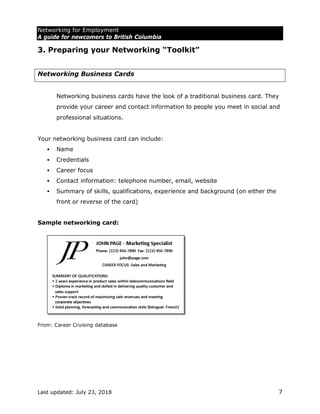
Sample networking card:
From: Career Cruising database
Networking for Employment
A guide for newcomers to British Columbia
Last updated: July 23, 2018 8
More information on creating business cards available at:
 Networking Business Cards: An Essential Job Search Tool
http://www.quintcareers.com/networking_business_cards.html
 What to Include on a Business Card for Job Seekers
https://www.thebalancecareers.com/what-to-include-on-a-business-card-for-job-
seekers-2062582
 Career Cruising
http://www.vpl.ca/digital-library/career-cruising
Look under “Employment” - Work Search: Creating a Calling Card.
Elevator Speech
An elevator speech is a brief introduction you can state in the time it takes to
share an elevator ride with someone new. It’s a very short summary of who
you are, what you do, and even what you’re looking for.
While there is no exact formula, the point is to be memorable in a positive
way.
Further details on how to create and deliver an elevator speech available at:
 Craft a 30-second Elevator Speech to Impress Potential and Current
Employers and Associations
http://canadianimmigrant.ca/work-and-education/craft-a-30-second-elevator-speech-to-
impress-potential-and-current-employers-and-associates/
 The Elevator Speech is the Swiss Army Knife of Job-Search Tools
http://www.quintcareers.com/job-search_elevator_speech.html
Networking for Employment
A guide for newcomers to British Columbia
Last updated: July 23, 2018 9
4. Types of Networking
Informal
Informal Networking uses your existing network of friends, family,
neighbours and other acquaintances to help develop employment
opportunities. It may involve a casual conversation at a social event or an
everyday encounter with a friend.
During your job search, you may want to direct your conversations by asking
questions and listening for useful information about potential employment
opportunities.
Keep your conversations casual and don’t feel pressured to turn everything
into a job pitch. If someone looks like they might be a good contact to
pursue further, ask how you can keep in touch.
Informational Interviews
An informational interview is a brief meeting with someone who is employed
in your field, position or organization of interest. Informational interviews
may help you:
 Get a personal perspective on occupations and organizations of interest
 Obtain advice and information that may help you target your job search
efforts
 Practise interviewing and networking skills
 Hear about opportunities before they are posted
 Broaden your network
Networking for Employment
A guide for newcomers to British Columbia
Last updated: July 23, 2018 10
An informational interview is about information and advice. It is not about
calling someone up and asking them for a job.
Although not all requests for information interviews are successful, many
people respond very positively to the initiative and courage it takes to ask for
an information interview.
More advice on getting and preparing for informational interviews:
 Tapping into the Hidden Job Market: Informational Interviewing.
York University Career Centre
http://www.yorku.ca/careers/handouts/InformationalInterviewing.pdf
 The Ultimate Guide to an Informational Interview
https://www.livecareer.com/career/advice/interview/informational-interviewing
Cold Calling
Cold calling involves contacting organizations of interest and attempting to
meet with the person who has the decision-making power to hire you. A cold
call is a telephone call to someone you do not know, even though the
employer has not advertised a job opening.
Cold-calling prospective employers can seem scary, but career experts say it
can be a powerful tool.
Some people prefer to make initial contact by sending a letter of introduction
first (also known as broadcast letter), followed by a telephone call.
Networking for Employment
A guide for newcomers to British Columbia
Last updated: July 23, 2018 11
How to Prepare for and Make a Cold Call
 Prepare a list of companies to contact through company research.
(Tip: Central Branch of the Vancouver Public Library has a great collection of
Company Directories which are a good source of company information)
 Find out the name of the hiring manager by making a preliminary phone call
to the company to obtain this information
 Have an outline of key points you want to discuss with an employer before
you make your call
 Have a copy of your resume and any information about the company that
you are contacting in front of you
 Always state your name and the purpose of your call
 Keep the calls brief - less than 3 minutes is best
 Tell the potential employer about your qualifications first, this way you are
giving them something that they can value
 If the manager seems interested, ask if you can meet to discuss possibilities
in more detail.
 If the manager can't meet with you, ask if you can send in your resume.
 Whatever happens, thank your contact. Send a thank-you note and re-state
your interest in working for his/her organization.
 Keep the information on your contact and his/her organization. You never
know when you might need it again.
 If you get turned down, do not take it as a personal rejection
Further advice on cold calling:
 Cold Calling: a time-tested method of job hunting
https://www.livecareer.com/career/advice/jobs/cold-calling
 Cold Calls Can Lead to Hot Jobs.
http://www.careerjoy.com/news-and-events/in-the-media/cold-calls-can-lead-to-hot-jobs
Networking for Employment
A guide for newcomers to British Columbia
Last updated: July 23, 2018 12
Online Social Networking
Social networking websites are valuable tools that can help you increase the
number of professionals you meet and connect with. Some of these tools include:
 LinkedIn
 Facebook
 Twitter
 MeetUp
For more information on social networking see the separate guide:
 Online Social Networks for Employment. A guide for newcomers to British
Columbia
http://skilledimmigrants.vpl.ca
[Search “Online Social Networks”]
Networking for Employment
A guide for newcomers to British Columbia
Last updated: July 23, 2018 13
5. Additional Resources
Still looking for more information? Try looking at the following resources:
 Networking for People who Hate Networking: a Field Guide for
Introverts, the Overwhelmed, and the Underconnected / Devora Zack.
2010. Central Library, 650.13 Z16n
 Friend of a Friend: Understanding the Hidden Networks That Can
Transform your Life and your Career / David Burkus. 2018. Central
Library, 650.13 S97n
 Knock ‘em Dead Social Networking / Martin John Yate. 2014. Central
Library, 650.13 Y31k
 Key Career Networking Resources for Job Seekers. Quintessential
Careers
https://www.livecareer.com/career/advice/jobs/networking-resources
Questions? Please ask the Information Staff in Central Library or telephone
604-331-3603.
Please note that the information in this guide is also available online through the
Skilled Immigrant InfoCentre website at http://skilledimmigrants.vpl.ca/
Online Social Networks for Employment
A guide for newcomers to British Columbia
Online Social Networks for Employment
A guide for newcomers to British Columbia
Last updated: July 26, 2017 2
Contents
1. Why Use Online Social Networks? ............................................................. 2 
2. Online Social Networking Tools................................................................. 3 
3. Additional Resources............................................................................... 7 
1. Why Use Online Social Networks?
Introduction
What can social media do for you?
 Lead to information on job openings not yet advertised
 Showcase your abilities to potential employers
 Help you expand your network
Online social networking sites such as LinkedIn, Twitter and Facebook are important
tools for your job search. Social media can help you connect with employers or find
out about job opportunities. They also let you highlight your education, experience
and talents.
According to a survey by Career Builder, 43% of employers use social networking
sites to research job candidates. As such, it is important to make sure your social
networking activities help, rather than work against, your job search. Make sure
any profiles you write are free of typos, the information is positive and clearly
written, and your photos present you in a favourable light.
More information:
 Career Builder
http://www.careerbuilder.ca/share/aboutus/pressreleasesdetail.aspx?sd=6%2F26%2F20
14&id=pr829&ed=12%2F31%2F2014
Online Social Networks for Employment
A guide for newcomers to British Columbia
Last updated: July 26, 2017 3
2. Online Social Networking Tools
LinkedIn
http://ca.linkedin.com/
LinkedIn is the professional equivalent of Facebook. You can use it to connect
to millions of professionals who use the site to recruit employees, find jobs,
participate in online communities, and share expertise. To access LinkedIn,
you must first create a profile.
To get the greatest value from LinkedIn, you should:
 Make your profile publicly accessible, so employers will see what you would
like them to see when they search for you on Google
 Use relevant key words in your profile, so that recruiters and other
professionals will be able to find you more easily
 Join professional, networking and alumni groups
 Search for people—not just to research people you plan to meet, but also to
search for skills, areas of expertise and training that help people in your field
get ahead
 Search for and follow organizations—find the names of people to contact for
information interviews, identify the titles of positions you’d like to apply for,
and more
 Let contacts know that you are in the job market, and specify the skills you
have to offer
 Direct people to your Twitter, blog, online portfolio or webpage
 Request introductions to people you’d like to meet
Employers are increasingly using LinkedIn as a recruiting tool,
so building your LinkedIn profile is worthwhile!
Online Social Networks for Employment
A guide for newcomers to British Columbia
Last updated: July 26, 2017 4
Further information available at:
 Jobs. LinkedIn
https://www.linkedin.com/jobs/
 Build your Online Presence on LinkedIn. UBC Student Services
https://students.ubc.ca/career/career-resources/build-online-presence-linkedin
Facebook
http://www.facebook.com
You can use Facebook to:
 join relevant professional groups, adding details of your professional interests
to your page
 stay in touch with contacts through alumni and other networking groups
 follow companies of interest by becoming a fan of their corporate pages; and
more
 search for, and respond to, job postings
More information:
 4 Ways to Use Facebook to Find a Job. Forbes
http://www.forbes.com/sites/susanadams/2014/02/06/4-ways-to-use-facebook-to-find-
a-job/
 How to Use Facebook’s New Job Search Feature
http://time.com/money/4674436/facebook-new-jobs/
 Should you Use Facebook for Professional Networking? The Balance
https://www.thebalance.com/should-you-use-facebook-for-professional-networking-
2062587
Facebook is a social—not professional—networking site. However, if
used correctly Facebook can be a useful part of your job search.
Online Social Networks for Employment
A guide for newcomers to British Columbia
Last updated: July 26, 2017 5
Twitter
http://twitter.com
Twitter is great for broadcasting short calls of help with your job search,
giving professional updates, and more.
Twitter also lets you connect with people you can’t access through Facebook
or LinkedIn. You can learn what issues concern them and what skills they
value.
You can also search Twitter for posts on job search to find links to articles
and advice.
More information:
 Here’s How to Build a Twitter Presence and Boost Your Job Search
http://talentegg.ca/incubator/2014/07/18/twitter-in-job-search/
 Professional Networking Tips. Getting Started on Twitter
http://career-advice.monster.ca/job-hunt-strategy/professional-networking/get-started-
on-twitter-canada/article.aspx
Many companies have a corporate presence on Twitter and use
it to post job openings.
Online Social Networks for Employment
A guide for newcomers to British Columbia
Last updated: July 26, 2017 6
MeetUp
http://www.meetup.com/cities/ca/bc/vancouver/
Meetup is the world's largest network of local groups. Many of these groups
are based on professional networks. You can search the Vancouver site for
groups with similar career interests (ie: “Information Technology”) or
experiences (ie: “newcomers”)
Online Discussion Groups
Online discussion groups can also be useful job search tools. Taking part in
discussion groups allows you to showcase your knowledge and connect with
others in your field, including potential employers.
For more information see:
 Online Discussion Group Networking Etiquette Do’s and Don’ts
http://www.quintcareers.com/online_networking-dos-donts.html
Online Social Networks for Employment
A guide for newcomers to British Columbia
Last updated: July 26, 2017 7
3. Additional Resources
Still looking for more information? Try the following resources:
 Networking for Employment. A guide for newcomers to British
Columbia
http://skilledimmigrants.vpl.ca
[Search Networking]
 How to find a Job on LinkedIn, Facebook, Twitter and Google+ / Brad
Schepp. 2012. Central Library, 650.142 S325h1
 Use Social Media to find your Dream Job / W. Daniel Quillen. 2016.
Vancouver Public Library, 650.142 Q67u
 Social Media. University of Waterloo Career Centre
http://www.careeraction.uwaterloo.ca/resources/Social%20Media.pdf
 Your Digital Footprint Matters. Internet Society
https://www.internetsociety.org/your-digital-footprint-matters
 Using Social Media for Job Success. Canadian Immigrant
http://canadianimmigrant.ca/work-and-education/using-social-media-for-job-success
Questions? Please ask the Information Staff in the Central Library or
telephone 604-331-3603.
Please note that the information in this guide is also available online through the
Skilled Immigrant InfoCentre website at http://skilledimmigrants.vpl.ca/
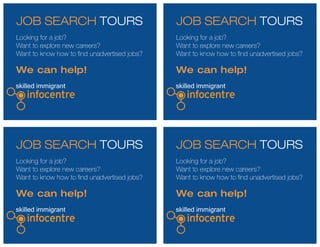
JOB SEARCH TOURS
Looking for a job?
Want to explore new careers?
Want to know how to find unadvertised jobs?
We can help!
JOB SEARCH TOURS
Looking for a job?
Want to explore new careers?
Want to know how to find unadvertised jobs?
We can help!
JOB SEARCH TOURS
Looking for a job?
Want to explore new careers?
Want to know how to find unadvertised jobs?
We can help!
JOB SEARCH TOURS
Looking for a job?
Want to explore new careers?
Want to know how to find unadvertised jobs?
We can help!
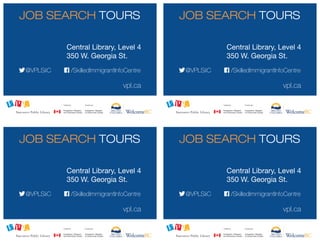
vpl.ca
vpl.ca
vpl.ca
vpl.ca
/SkilledImmigrantInfoCentre
@VPLSiiC
@VPLSiiC
@VPLSiiC
@VPLSiiC
Central Library, Level 4
350 W. Georgia St.
Central Library, Level 4
350 W. Georgia St.
Central Library, Level 4
350 W. Georgia St.
Central Library, Level 4
350 W. Georgia St.
JOB SEARCH TOURS
JOB SEARCH TOURS
JOB SEARCH TOURS
JOB SEARCH TOURS
Wednesdays Wednesdays
10: 30 a.m - 12 p.m. 10: 30 a.m - 12 p.m.
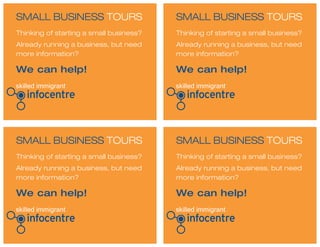
SMALL BUSINESS TOURS
Thinking of starting a small business?
Already running a business, but need
more information?
Thinking of starting a small business?
Already running a business, but need
more information?
Thinking of starting a small business?
Already running a business, but need
more information?
Thinking of starting a small business?
Already running a business, but need
more information?
We can help!
We can help!
We can help!
We can help!
vpl.ca
/SkilledImmigrantInfoCentre@VPLSiiC
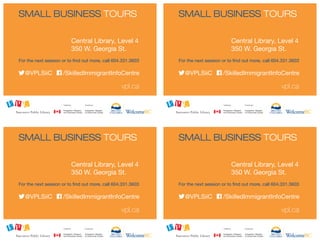
Central Library, Level 4
350 W. Georgia St.
For the next session or to find out more, call 604.331.3603
SMALL BUSINESS TOURS
vpl.ca
/SkilledImmigrantInfoCentre@VPLSiiC
Central Library, Level 4
350 W. Georgia St.
For the next session or to find out more, call 604.331.3603
SMALL BUSINESS TOURS
vpl.ca
/SkilledImmigrantInfoCentre@VPLSiiC
Central Library, Level 4
350 W. Georgia St.
For the next session or to find out more, call 604.331.3603
SMALL BUSINESS TOURS
vpl.ca
/SkilledImmigrantInfoCentre@VPLSiiC
Central Library, Level 4
350 W. Georgia St.
For the next session or to find out more, call 604.331.3603
SMALL BUSINESS TOURS
Choose a Saturday convenient for you! Choose a Saturday convenient for you!
Jan 5 & 26 Feb 16 Mar 9 & 30 Jan 5 & 26 Feb 16 Mar 9 & 30
10:30 a.m. 10:30 a.m.
CAREEREXPLORER
New to B.C. and looking for
employment opportunities?
We can help.
CAREEREXPLORER
New to B.C. and looking for
employment opportunities?
We can help.
CAREEREXPLORER
New to B.C. and looking for
employment opportunities?
We can help.
CAREEREXPLORER
New to B.C. and looking for
employment opportunities?
We can help.
At this free workshop, use library resources to learn
about job options based on your skills and interests.
FREE! 	 For more information or to register: 604.331.3787
Central Library
350 W. Georgia St.
At this free workshop, use library resources to learn
about job options based on your skills and interests.
FREE! 	 For more information or to register: 604.331.3787
Central Library
350 W. Georgia St.
At this free workshop, use library resources to learn
about job options based on your skills and interests.
FREE! 	 For more information or to register: 604.331.3787
Central Library
350 W. Georgia St.
At this free workshop, use library resources to learn
about job options based on your skills and interests.
FREE! 	 For more information or to register: 604.331.3787
Central Library
350 W. Georgia St.
Dec 14
Jan 18
Feb 08
Dec 14
Jan 18
Feb 08
Dec 14
Jan 18
Feb 08
Dec 14
Jan 18
Feb 08
10 a.m. – 4 p.m. 10 a.m. – 4 p.m.

CONNECTWorking 2019-01 - Hidden Market

  • 1.
    Networking for Employment Aguide for newcomers to British Columbia
  • 2.
    Networking for Employment Aguide for newcomers to British Columbia Last updated: July 23, 2018 2 Contents 1. Why Network?.........................................................................................2 2. Who is in Your Network? ..........................................................................4 3. Preparing your Networking “Toolkit” .......................................................... 7 4. Types of Networking ................................................................................9 5. Additional Resources.............................................................................. 13 1. Why Network? Introduction What can networking do for you?  Lead to information on job openings not yet advertised  Lead to an inside connection at a company  Provide you with insights into an industry or profession  Help you get advice on your job search methods Networking is an important part of your job-search. Approximately 75 to 95 percent of job openings are not advertised in sources such as the newspaper or Internet. You can find out about these “hidden” jobs only by talking to other people or networking. Networking includes everything from a casual conversation with a friend to an informational interview with a potential employer. Networking doesn't mean asking everyone you run into for a job. It means building relationships so that you can comfortably ask for ideas, advice, and referrals to those with hiring power. This guide takes you through the steps of building a network and how to make your network help you with your job search.
  • 3.
    Networking for Employment Aguide for newcomers to British Columbia Last updated: July 23, 2018 3 More information on networking:  What is Networking? University of Toronto Mississauga www.utm.utoronto.ca/careers/sites/files/careers/public/shared/pdf/tipsheets/2017tipshee ts/2017%20Tipsheet%20Effective%20Networking%20v20171010%201435.pdf  The Value of Networking. Settlement.org https://settlement.org/ontario/employment/working-in-canada/workplace-culture/the- value-of-networking/
  • 4.
    Networking for Employment Aguide for newcomers to British Columbia Last updated: July 23, 2018 4 2. Who is in Your Network? Start with people you know Your network is probably already bigger than you think. It includes your family, friends, and even casual acquaintances. Make a list of people you know including:  family members  friends  neighbours  former employers and co-workers  members of clubs or community organizations you belong to  classmates  teachers and coaches Also think about people you’ve met through your close connections: your sister’s co-worker; your best friend’s boss. Don’t forget to include people like your doctor, accountant, or yoga instructor. The following tools can help you identify your network:  Who is in Your Network? Alberta Work Search Online https://alis.alberta.ca/look-for-work/networking/who-is-in-your-network/  Brainstorming Your Network. Alberta Work Search Online https://alis.alberta.ca/look-for-work/networking/brainstorming-your-network/
  • 5.
    Networking for Employment Aguide for newcomers to British Columbia Last updated: July 23, 2018 5 Growing your network You can expand your network in a number of ways. Some useful approaches include: Professional Associations Joining a professional association is a great way to meet people in your field of interest. You can attend professional development seminars, tradeshows and information events. Information on local professional associations can be found at:  Associations Canada Available at VPL Central Branch, 060 A84 Volunteering Volunteering for a charity, community organization or professional group is a good way to meet potential business and employment contacts. Volunteering is also often recognized as valuable work-related experience by employers. Volunteer opportunities can be found at:  GoVolunteer.ca http://govolunteer.ca/  Charity Village https://charityvillage.com/app/
  • 6.
    Networking for Employment Aguide for newcomers to British Columbia Last updated: July 23, 2018 6 Job Search Programs Job clubs can bring together people who are going through the same experiences you are when looking for work. Job clubs are a great way to network and can be very effective in your job search. Job search programs in Metro Vancouver can be found at:  WorkBC Employment Services & Support https://www.workbc.ca/Employment-Services/Labour-Market-Programs/Employment- Services-and-Supports-Program.aspx More information on growing your network:  How to Build and Expand your Career Network: 10 Proven Techniques https://www.livecareer.com/career/advice/jobs/expanding-career-network  Career Cruising Look under “Employment”: Work Search – Networking Strategies http://www.vpl.ca/digital-library/career-cruising Available from the VPL Digital Library | Explore our Digital Library page NOTE: You can access this database from a Library computer. If you are using a computer from outside the Library, you will need a Vancouver Public Library card to login to this database.
  • 7.
    Networking for Employment Aguide for newcomers to British Columbia Last updated: July 23, 2018 7 3. Preparing your Networking “Toolkit” Networking Business Cards Networking business cards have the look of a traditional business card. They provide your career and contact information to people you meet in social and professional situations. Your networking business card can include:  Name  Credentials  Career focus  Contact information: telephone number, email, website  Summary of skills, qualifications, experience and background (on either the front or reverse of the card) Sample networking card: From: Career Cruising database
  • 8.
    Networking for Employment Aguide for newcomers to British Columbia Last updated: July 23, 2018 8 More information on creating business cards available at:  Networking Business Cards: An Essential Job Search Tool http://www.quintcareers.com/networking_business_cards.html  What to Include on a Business Card for Job Seekers https://www.thebalancecareers.com/what-to-include-on-a-business-card-for-job- seekers-2062582  Career Cruising http://www.vpl.ca/digital-library/career-cruising Look under “Employment” - Work Search: Creating a Calling Card. Elevator Speech An elevator speech is a brief introduction you can state in the time it takes to share an elevator ride with someone new. It’s a very short summary of who you are, what you do, and even what you’re looking for. While there is no exact formula, the point is to be memorable in a positive way. Further details on how to create and deliver an elevator speech available at:  Craft a 30-second Elevator Speech to Impress Potential and Current Employers and Associations http://canadianimmigrant.ca/work-and-education/craft-a-30-second-elevator-speech-to- impress-potential-and-current-employers-and-associates/  The Elevator Speech is the Swiss Army Knife of Job-Search Tools http://www.quintcareers.com/job-search_elevator_speech.html
  • 9.
    Networking for Employment Aguide for newcomers to British Columbia Last updated: July 23, 2018 9 4. Types of Networking Informal Informal Networking uses your existing network of friends, family, neighbours and other acquaintances to help develop employment opportunities. It may involve a casual conversation at a social event or an everyday encounter with a friend. During your job search, you may want to direct your conversations by asking questions and listening for useful information about potential employment opportunities. Keep your conversations casual and don’t feel pressured to turn everything into a job pitch. If someone looks like they might be a good contact to pursue further, ask how you can keep in touch. Informational Interviews An informational interview is a brief meeting with someone who is employed in your field, position or organization of interest. Informational interviews may help you:  Get a personal perspective on occupations and organizations of interest  Obtain advice and information that may help you target your job search efforts  Practise interviewing and networking skills  Hear about opportunities before they are posted  Broaden your network
  • 10.
    Networking for Employment Aguide for newcomers to British Columbia Last updated: July 23, 2018 10 An informational interview is about information and advice. It is not about calling someone up and asking them for a job. Although not all requests for information interviews are successful, many people respond very positively to the initiative and courage it takes to ask for an information interview. More advice on getting and preparing for informational interviews:  Tapping into the Hidden Job Market: Informational Interviewing. York University Career Centre http://www.yorku.ca/careers/handouts/InformationalInterviewing.pdf  The Ultimate Guide to an Informational Interview https://www.livecareer.com/career/advice/interview/informational-interviewing Cold Calling Cold calling involves contacting organizations of interest and attempting to meet with the person who has the decision-making power to hire you. A cold call is a telephone call to someone you do not know, even though the employer has not advertised a job opening. Cold-calling prospective employers can seem scary, but career experts say it can be a powerful tool. Some people prefer to make initial contact by sending a letter of introduction first (also known as broadcast letter), followed by a telephone call.
  • 11.
    Networking for Employment Aguide for newcomers to British Columbia Last updated: July 23, 2018 11 How to Prepare for and Make a Cold Call  Prepare a list of companies to contact through company research. (Tip: Central Branch of the Vancouver Public Library has a great collection of Company Directories which are a good source of company information)  Find out the name of the hiring manager by making a preliminary phone call to the company to obtain this information  Have an outline of key points you want to discuss with an employer before you make your call  Have a copy of your resume and any information about the company that you are contacting in front of you  Always state your name and the purpose of your call  Keep the calls brief - less than 3 minutes is best  Tell the potential employer about your qualifications first, this way you are giving them something that they can value  If the manager seems interested, ask if you can meet to discuss possibilities in more detail.  If the manager can't meet with you, ask if you can send in your resume.  Whatever happens, thank your contact. Send a thank-you note and re-state your interest in working for his/her organization.  Keep the information on your contact and his/her organization. You never know when you might need it again.  If you get turned down, do not take it as a personal rejection Further advice on cold calling:  Cold Calling: a time-tested method of job hunting https://www.livecareer.com/career/advice/jobs/cold-calling  Cold Calls Can Lead to Hot Jobs. http://www.careerjoy.com/news-and-events/in-the-media/cold-calls-can-lead-to-hot-jobs
  • 12.
    Networking for Employment Aguide for newcomers to British Columbia Last updated: July 23, 2018 12 Online Social Networking Social networking websites are valuable tools that can help you increase the number of professionals you meet and connect with. Some of these tools include:  LinkedIn  Facebook  Twitter  MeetUp For more information on social networking see the separate guide:  Online Social Networks for Employment. A guide for newcomers to British Columbia http://skilledimmigrants.vpl.ca [Search “Online Social Networks”]
  • 13.
    Networking for Employment Aguide for newcomers to British Columbia Last updated: July 23, 2018 13 5. Additional Resources Still looking for more information? Try looking at the following resources:  Networking for People who Hate Networking: a Field Guide for Introverts, the Overwhelmed, and the Underconnected / Devora Zack. 2010. Central Library, 650.13 Z16n  Friend of a Friend: Understanding the Hidden Networks That Can Transform your Life and your Career / David Burkus. 2018. Central Library, 650.13 S97n  Knock ‘em Dead Social Networking / Martin John Yate. 2014. Central Library, 650.13 Y31k  Key Career Networking Resources for Job Seekers. Quintessential Careers https://www.livecareer.com/career/advice/jobs/networking-resources Questions? Please ask the Information Staff in Central Library or telephone 604-331-3603. Please note that the information in this guide is also available online through the Skilled Immigrant InfoCentre website at http://skilledimmigrants.vpl.ca/
  • 14.
    Online Social Networksfor Employment A guide for newcomers to British Columbia
  • 15.
    Online Social Networksfor Employment A guide for newcomers to British Columbia Last updated: July 26, 2017 2 Contents 1. Why Use Online Social Networks? ............................................................. 2  2. Online Social Networking Tools................................................................. 3  3. Additional Resources............................................................................... 7  1. Why Use Online Social Networks? Introduction What can social media do for you?  Lead to information on job openings not yet advertised  Showcase your abilities to potential employers  Help you expand your network Online social networking sites such as LinkedIn, Twitter and Facebook are important tools for your job search. Social media can help you connect with employers or find out about job opportunities. They also let you highlight your education, experience and talents. According to a survey by Career Builder, 43% of employers use social networking sites to research job candidates. As such, it is important to make sure your social networking activities help, rather than work against, your job search. Make sure any profiles you write are free of typos, the information is positive and clearly written, and your photos present you in a favourable light. More information:  Career Builder http://www.careerbuilder.ca/share/aboutus/pressreleasesdetail.aspx?sd=6%2F26%2F20 14&id=pr829&ed=12%2F31%2F2014
  • 16.
    Online Social Networksfor Employment A guide for newcomers to British Columbia Last updated: July 26, 2017 3 2. Online Social Networking Tools LinkedIn http://ca.linkedin.com/ LinkedIn is the professional equivalent of Facebook. You can use it to connect to millions of professionals who use the site to recruit employees, find jobs, participate in online communities, and share expertise. To access LinkedIn, you must first create a profile. To get the greatest value from LinkedIn, you should:  Make your profile publicly accessible, so employers will see what you would like them to see when they search for you on Google  Use relevant key words in your profile, so that recruiters and other professionals will be able to find you more easily  Join professional, networking and alumni groups  Search for people—not just to research people you plan to meet, but also to search for skills, areas of expertise and training that help people in your field get ahead  Search for and follow organizations—find the names of people to contact for information interviews, identify the titles of positions you’d like to apply for, and more  Let contacts know that you are in the job market, and specify the skills you have to offer  Direct people to your Twitter, blog, online portfolio or webpage  Request introductions to people you’d like to meet Employers are increasingly using LinkedIn as a recruiting tool, so building your LinkedIn profile is worthwhile!
  • 17.
    Online Social Networksfor Employment A guide for newcomers to British Columbia Last updated: July 26, 2017 4 Further information available at:  Jobs. LinkedIn https://www.linkedin.com/jobs/  Build your Online Presence on LinkedIn. UBC Student Services https://students.ubc.ca/career/career-resources/build-online-presence-linkedin Facebook http://www.facebook.com You can use Facebook to:  join relevant professional groups, adding details of your professional interests to your page  stay in touch with contacts through alumni and other networking groups  follow companies of interest by becoming a fan of their corporate pages; and more  search for, and respond to, job postings More information:  4 Ways to Use Facebook to Find a Job. Forbes http://www.forbes.com/sites/susanadams/2014/02/06/4-ways-to-use-facebook-to-find- a-job/  How to Use Facebook’s New Job Search Feature http://time.com/money/4674436/facebook-new-jobs/  Should you Use Facebook for Professional Networking? The Balance https://www.thebalance.com/should-you-use-facebook-for-professional-networking- 2062587 Facebook is a social—not professional—networking site. However, if used correctly Facebook can be a useful part of your job search.
  • 18.
    Online Social Networksfor Employment A guide for newcomers to British Columbia Last updated: July 26, 2017 5 Twitter http://twitter.com Twitter is great for broadcasting short calls of help with your job search, giving professional updates, and more. Twitter also lets you connect with people you can’t access through Facebook or LinkedIn. You can learn what issues concern them and what skills they value. You can also search Twitter for posts on job search to find links to articles and advice. More information:  Here’s How to Build a Twitter Presence and Boost Your Job Search http://talentegg.ca/incubator/2014/07/18/twitter-in-job-search/  Professional Networking Tips. Getting Started on Twitter http://career-advice.monster.ca/job-hunt-strategy/professional-networking/get-started- on-twitter-canada/article.aspx Many companies have a corporate presence on Twitter and use it to post job openings.
  • 19.
    Online Social Networksfor Employment A guide for newcomers to British Columbia Last updated: July 26, 2017 6 MeetUp http://www.meetup.com/cities/ca/bc/vancouver/ Meetup is the world's largest network of local groups. Many of these groups are based on professional networks. You can search the Vancouver site for groups with similar career interests (ie: “Information Technology”) or experiences (ie: “newcomers”) Online Discussion Groups Online discussion groups can also be useful job search tools. Taking part in discussion groups allows you to showcase your knowledge and connect with others in your field, including potential employers. For more information see:  Online Discussion Group Networking Etiquette Do’s and Don’ts http://www.quintcareers.com/online_networking-dos-donts.html
  • 20.
    Online Social Networksfor Employment A guide for newcomers to British Columbia Last updated: July 26, 2017 7 3. Additional Resources Still looking for more information? Try the following resources:  Networking for Employment. A guide for newcomers to British Columbia http://skilledimmigrants.vpl.ca [Search Networking]  How to find a Job on LinkedIn, Facebook, Twitter and Google+ / Brad Schepp. 2012. Central Library, 650.142 S325h1  Use Social Media to find your Dream Job / W. Daniel Quillen. 2016. Vancouver Public Library, 650.142 Q67u  Social Media. University of Waterloo Career Centre http://www.careeraction.uwaterloo.ca/resources/Social%20Media.pdf  Your Digital Footprint Matters. Internet Society https://www.internetsociety.org/your-digital-footprint-matters  Using Social Media for Job Success. Canadian Immigrant http://canadianimmigrant.ca/work-and-education/using-social-media-for-job-success Questions? Please ask the Information Staff in the Central Library or telephone 604-331-3603. Please note that the information in this guide is also available online through the Skilled Immigrant InfoCentre website at http://skilledimmigrants.vpl.ca/
  • 21.
    JOB SEARCH TOURS Lookingfor a job? Want to explore new careers? Want to know how to find unadvertised jobs? We can help! JOB SEARCH TOURS Looking for a job? Want to explore new careers? Want to know how to find unadvertised jobs? We can help! JOB SEARCH TOURS Looking for a job? Want to explore new careers? Want to know how to find unadvertised jobs? We can help! JOB SEARCH TOURS Looking for a job? Want to explore new careers? Want to know how to find unadvertised jobs? We can help!
  • 22.
    vpl.ca vpl.ca vpl.ca vpl.ca /SkilledImmigrantInfoCentre /SkilledImmigrantInfoCentre /SkilledImmigrantInfoCentre /SkilledImmigrantInfoCentre @VPLSiiC @VPLSiiC @VPLSiiC @VPLSiiC Central Library, Level4 350 W. Georgia St. Central Library, Level 4 350 W. Georgia St. Central Library, Level 4 350 W. Georgia St. Central Library, Level 4 350 W. Georgia St. JOB SEARCH TOURS JOB SEARCH TOURS JOB SEARCH TOURS JOB SEARCH TOURS Wednesdays Wednesdays Wednesdays Wednesdays 10: 30 a.m - 12 p.m. 10: 30 a.m - 12 p.m. 10: 30 a.m - 12 p.m. 10: 30 a.m - 12 p.m.
  • 23.
    SMALL BUSINESS TOURS SMALLBUSINESS TOURS SMALL BUSINESS TOURS SMALL BUSINESS TOURS Thinking of starting a small business? Already running a business, but need more information? Thinking of starting a small business? Already running a business, but need more information? Thinking of starting a small business? Already running a business, but need more information? Thinking of starting a small business? Already running a business, but need more information? We can help! We can help! We can help! We can help!
  • 24.
    vpl.ca /SkilledImmigrantInfoCentre@VPLSiiC Central Library, Level4 350 W. Georgia St. For the next session or to find out more, call 604.331.3603 SMALL BUSINESS TOURS vpl.ca /SkilledImmigrantInfoCentre@VPLSiiC Central Library, Level 4 350 W. Georgia St. For the next session or to find out more, call 604.331.3603 SMALL BUSINESS TOURS vpl.ca /SkilledImmigrantInfoCentre@VPLSiiC Central Library, Level 4 350 W. Georgia St. For the next session or to find out more, call 604.331.3603 SMALL BUSINESS TOURS vpl.ca /SkilledImmigrantInfoCentre@VPLSiiC Central Library, Level 4 350 W. Georgia St. For the next session or to find out more, call 604.331.3603 SMALL BUSINESS TOURS Choose a Saturday convenient for you! Choose a Saturday convenient for you! Choose a Saturday convenient for you! Choose a Saturday convenient for you! Jan 5 & 26 Feb 16 Mar 9 & 30 Jan 5 & 26 Feb 16 Mar 9 & 30 Jan 5 & 26 Feb 16 Mar 9 & 30 Jan 5 & 26 Feb 16 Mar 9 & 30 10:30 a.m. 10:30 a.m. 10:30 a.m. 10:30 a.m.
  • 25.
    CAREEREXPLORER New to B.C.and looking for employment opportunities? We can help. CAREEREXPLORER New to B.C. and looking for employment opportunities? We can help. CAREEREXPLORER New to B.C. and looking for employment opportunities? We can help. CAREEREXPLORER New to B.C. and looking for employment opportunities? We can help.
  • 26.
    At this freeworkshop, use library resources to learn about job options based on your skills and interests. FREE! For more information or to register: 604.331.3787 Central Library 350 W. Georgia St. At this free workshop, use library resources to learn about job options based on your skills and interests. FREE! For more information or to register: 604.331.3787 Central Library 350 W. Georgia St. At this free workshop, use library resources to learn about job options based on your skills and interests. FREE! For more information or to register: 604.331.3787 Central Library 350 W. Georgia St. At this free workshop, use library resources to learn about job options based on your skills and interests. FREE! For more information or to register: 604.331.3787 Central Library 350 W. Georgia St. Dec 14 Jan 18 Feb 08 Dec 14 Jan 18 Feb 08 Dec 14 Jan 18 Feb 08 Dec 14 Jan 18 Feb 08 10 a.m. – 4 p.m. 10 a.m. – 4 p.m. 10 a.m. – 4 p.m. 10 a.m. – 4 p.m.