系統動力學理論與應用PART 1
External EnvironmentLevel
Business Environment Risk Intelligence
• BERI S.A. was founded in 1966. Its clients
are mostly banks and companies
conducting international business.
• http://www.beri.com/default.asp
• F.T. Haner founded Business Environment
Risk Intelligence (BERI S.A.) in 1966 and
is currently the Chief Executive Officer.
• He has conducted feasibility
studies, negotiated terms, and managed
firms in 37 countries around the world.
Introduction to Global Strategy Map
5.
系統動力學理論與應用PART 1
Business EnvironmentRisk Intelligence for Vehicle company
• B.E.R.I investigated indicators as below:
– Political trends and policies
– Social attitudes and conditions
– Economic outlook and purchasing power in
the local currency
– Market constraints and regulations
affecting vehicles
– Present and possible future obstacles to
importing parts.
6.
系統動力學理論與應用PART 1
External EnvironmentLevel: S.T.E.P
• Social
– Analysis of social factors that influence people's choices and
include the beliefs, values and attitudes of society.
• Technological
– Analysis of the impact of new technologies - the Internet,
EDI, mobile phones, and the increasing advances in
computing.
• Economic
– Analysis of exchange rates, inflation levels, income growth,
debt & saving levels
• Political
– Analysis of Legislations, Regulations and Government
policies
系統動力學理論與應用PART 1
Digital ComputerSimulation Technology
Technology Foundation
System
Dynamics
General System
Theory
Cybernetics
System Theory
Decision
Theory
Theory Foundation
系統動力學理論架構
系統動力學理論與應用PART 1
Double-Loop Learning雙環學習
Mental models
Strategy、Structure、
Decision Rules
Decisions
Information feedback
Real World
Real worldVirtual world Real worldVirtual world
85.
系統動力學理論與應用PART 1
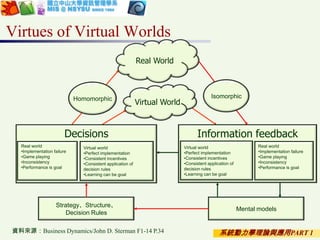
Virtues ofVirtual Worlds
資料來源:Business Dynamics/John D. Sterman F1-14 P.34
Mental models
Strategy、Structure、
Decision Rules
Decisions
Real world
•Implementation failure
•Game playing
•Inconsistency
•Performance is goal
Virtual world
•Perfect implementation
•Consistent incentives
•Consistent application of
decision rules
•Learning can be goal
Information feedback
Real world
•Implementation failure
•Game playing
•Inconsistency
•Performance is goal
Virtual world
•Perfect implementation
•Consistent incentives
•Consistent application of
decision rules
•Learning can be goal
Real World
IsomorphicHomomorphic
Virtual World
系統動力學理論與應用PART 1
Modeling isembedded in the dynamics of the System
1. Problem Articulation
(Boundary Selection)
2. Dynamic Hypothesis
3. Formulation
4. Testing
5. Policy Formulation
& Evaluation
Information
Feedback
Mental Models
Of Real WorldStrategy, Structure,
Decision Rules
Decisions
(Organizational
Experiments)
資料來源:Business Dynamics/John D. Sterman F3-2 P.88
Real World
系統動力學理論與應用PART 1
平衡計分卡之基本系統動力學模型
a
e
b
f
c
g
d
h
St rategyTargetGAP1
i
j
k
l
Action
n
o
m
KPI1
KPI2
KPI3
GAP2
GAP3
GAP4
營業
收益
顧客
數量
內部
績效
員工
效率
顧客對營收
的乘數因子
內部績效對顧客
的乘數因子
員工績效對內部績效
的乘數因子
成本
支出
顧客成長
行動方案
內部績效成長
行動方案
員工績效成長
行動方案
策略目標
策略
行動方案
顧客數量
衡量指標
內部績效
衡量指標
員工績效
衡量指標
策略目標
差距
顧客數量
差距
內部績效
差距
員工績效
差距


































![系統動力學理論與應用PART 1
某固網公司因果回饋圖-回饋的影響環路
Àç·~¦¬¤J
ÅU«Èº¡·N«×
ºô¸ô«~½è ªA°È«~½è
-û¤u§@·~
®Ä²v
+
+ +
+ +
ÅU«È¼Æ¶q
ºô¸ô³]³Æ»Ý¨D¶q
ºû¹B¤u§@¶q
-û¤uº¡·N«×
+
+
-
+
«È¤áªºªA°È»Ý¨D
+
+
ºô¸ô³]³Æ¨Ï¥Î²v
+
+
-
Â÷¾²v
+
-
-
µ¦²¤¦æ°Ê -
´£¤É-û¤u§@·~®Ä²v
+
-
-
-
資料來源:策略目標與績效指標互動機制之研究-以民營固網公司為例, 黃昭仁(2005) 圖4.8](https://image.slidesharecdn.com/2013-140322101352-phpapp02/85/2013-104-320.jpg)








![[系列活動] 智慧製造與生產線上的資料科學 (製造資料科學:從預測性思維到處方性決策)](https://cdn.slidesharecdn.com/ss_thumbnails/20170211datascienceinmanufacturing-170205150525-thumbnail.jpg?width=640&height=640&fit=bounds)


