
Doing Business 2.0
Introduction to
Social Enterprise
Starting and Sustaining a Nonprofit Organization – July 10, 2013
At Community Wealth Partners
our goal is to help change agents solve social
problems at the magnitude at which they exist.
3
Key Question
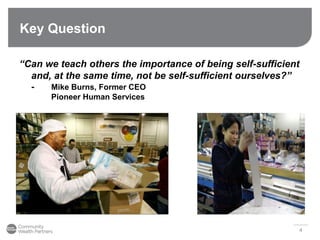
“Can we teach others the importance of being self-sufficient
and, at the same time, not be self-sufficient ourselves?”
- Mike Burns, Former CEO
Pioneer Human Services
4
What is social enterprise?
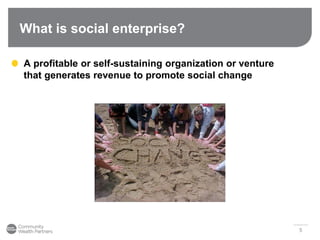
A profitable or self-sustaining organization or venture
that generates revenue to promote social change
5
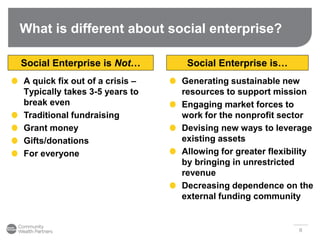
What is different about social enterprise?
A quick fix out of a crisis –
Typically takes 3-5 years to
break even
Traditional fundraising
Grant money
Gifts/donations
For everyone
Social Enterprise is Not… Social Enterprise is…
Generating sustainable new
resources to support mission
Engaging market forces to
work for the nonprofit sector
Devising new ways to leverage
existing assets
Allowing for greater flexibility
by bringing in unrestricted
revenue
Decreasing dependence on the
external funding community
6
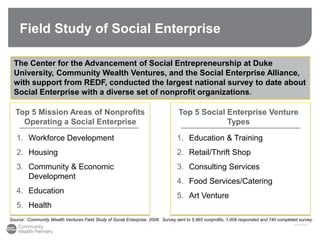
Field Study of Social Enterprise
Source: Community Wealth Ventures Field Study of Social Enterprise, 2008. Survey sent to 5,965 nonprofits, 1,008 responded and 740 completed survey.
1. Workforce Development
2. Housing
3. Community & Economic
Development
4. Education
5. Health
1. Education & Training
2. Retail/Thrift Shop
3. Consulting Services
4. Food Services/Catering
5. Art Venture
Top 5 Mission Areas of Nonprofits
Operating a Social Enterprise
Top 5 Social Enterprise Venture
Types
The Center for the Advancement of Social Entrepreneurship at Duke
University, Community Wealth Ventures, and the Social Enterprise Alliance,
with support from REDF, conducted the largest national survey to date about
Social Enterprise with a diverse set of nonprofit organizations.
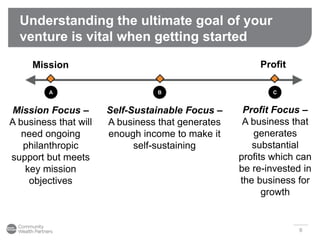
Understanding the ultimate goal of your
venture is vital when getting started
Mission Profit
A B C
Self-Sustainable Focus –
A business that generates
enough income to make it
self-sustaining
Profit Focus –
A business that
generates
substantial
profits which can
be re-invested in
the business for
growth
Mission Focus –
A business that will
need ongoing
philanthropic
support but meets
key mission
objectives
8
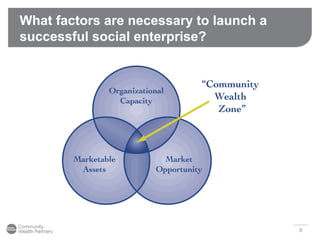
What factors are necessary to launch a
successful social enterprise?
9
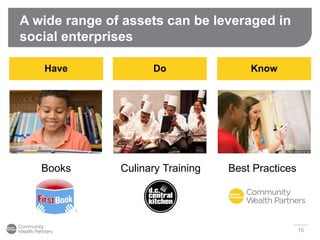
A wide range of assets can be leveraged in
social enterprises
Have Do Know
Books Culinary Training Best Practices
10
Social enterprise is legal for nonprofits
11
Nonprofits can launch community
wealth enterprises and maintain
501c3 tax status
Consult an attorney to understand
the most appropriate legal
structure for your organization
There is no standard legal
structure
• Structure often depends on size of
the venture and degree of mission
alignment
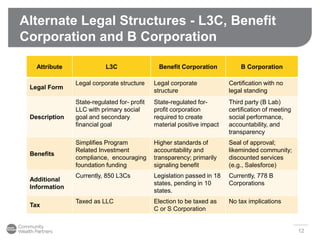
Alternate Legal Structures - L3C, Benefit
Corporation and B Corporation
12
Attribute L3C Benefit Corporation B Corporation
Legal Form
Legal corporate structure Legal corporate
structure
Certification with no
legal standing
Description
State-regulated for- profit
LLC with primary social
goal and secondary
financial goal
State-regulated for-
profit corporation
required to create
material positive impact
Third party (B Lab)
certification of meeting
social performance,
accountability, and
transparency
Benefits
Simplifies Program
Related Investment
compliance, encouraging
foundation funding
Higher standards of
accountability and
transparency; primarily
signaling benefit
Seal of approval;
likeminded community;
discounted services
(e.g., Salesforce)
Additional
Information
Currently, 850 L3Cs Legislation passed in 18
states, pending in 10
states.
Currently, 778 B
Corporations
Tax
Taxed as LLC Election to be taxed as
C or S Corporation
No tax implications
13
“Whether or not organizations succeed in creating community
wealth depends on their ability to think in new ways about
assets they may have previously taken for granted or not
initially recognized as such. …It all begins by believing and
understanding that you are worth more than you think.”
- Bill Shore, Chairman, Community Wealth Partners
& Author, The Cathedral Within

Starting a Nonprofit - Social Enterprise | OPGS | Doing Business 2.0

  • 2.
    Doing Business 2.0 Introductionto Social Enterprise Starting and Sustaining a Nonprofit Organization – July 10, 2013
  • 3.
    At Community WealthPartners our goal is to help change agents solve social problems at the magnitude at which they exist. 3
  • 4.
    Key Question “Can weteach others the importance of being self-sufficient and, at the same time, not be self-sufficient ourselves?” - Mike Burns, Former CEO Pioneer Human Services 4
  • 5.
    What is socialenterprise? A profitable or self-sustaining organization or venture that generates revenue to promote social change 5
  • 6.
    What is differentabout social enterprise? A quick fix out of a crisis – Typically takes 3-5 years to break even Traditional fundraising Grant money Gifts/donations For everyone Social Enterprise is Not… Social Enterprise is… Generating sustainable new resources to support mission Engaging market forces to work for the nonprofit sector Devising new ways to leverage existing assets Allowing for greater flexibility by bringing in unrestricted revenue Decreasing dependence on the external funding community 6
  • 7.
    Field Study ofSocial Enterprise Source: Community Wealth Ventures Field Study of Social Enterprise, 2008. Survey sent to 5,965 nonprofits, 1,008 responded and 740 completed survey. 1. Workforce Development 2. Housing 3. Community & Economic Development 4. Education 5. Health 1. Education & Training 2. Retail/Thrift Shop 3. Consulting Services 4. Food Services/Catering 5. Art Venture Top 5 Mission Areas of Nonprofits Operating a Social Enterprise Top 5 Social Enterprise Venture Types The Center for the Advancement of Social Entrepreneurship at Duke University, Community Wealth Ventures, and the Social Enterprise Alliance, with support from REDF, conducted the largest national survey to date about Social Enterprise with a diverse set of nonprofit organizations.
  • 8.
    Understanding the ultimategoal of your venture is vital when getting started Mission Profit A B C Self-Sustainable Focus – A business that generates enough income to make it self-sustaining Profit Focus – A business that generates substantial profits which can be re-invested in the business for growth Mission Focus – A business that will need ongoing philanthropic support but meets key mission objectives 8
  • 9.
    What factors arenecessary to launch a successful social enterprise? 9
  • 10.
    A wide rangeof assets can be leveraged in social enterprises Have Do Know Books Culinary Training Best Practices 10
  • 11.
    Social enterprise islegal for nonprofits 11 Nonprofits can launch community wealth enterprises and maintain 501c3 tax status Consult an attorney to understand the most appropriate legal structure for your organization There is no standard legal structure • Structure often depends on size of the venture and degree of mission alignment
  • 12.
    Alternate Legal Structures- L3C, Benefit Corporation and B Corporation 12 Attribute L3C Benefit Corporation B Corporation Legal Form Legal corporate structure Legal corporate structure Certification with no legal standing Description State-regulated for- profit LLC with primary social goal and secondary financial goal State-regulated for- profit corporation required to create material positive impact Third party (B Lab) certification of meeting social performance, accountability, and transparency Benefits Simplifies Program Related Investment compliance, encouraging foundation funding Higher standards of accountability and transparency; primarily signaling benefit Seal of approval; likeminded community; discounted services (e.g., Salesforce) Additional Information Currently, 850 L3Cs Legislation passed in 18 states, pending in 10 states. Currently, 778 B Corporations Tax Taxed as LLC Election to be taxed as C or S Corporation No tax implications
  • 13.
    13 “Whether or notorganizations succeed in creating community wealth depends on their ability to think in new ways about assets they may have previously taken for granted or not initially recognized as such. …It all begins by believing and understanding that you are worth more than you think.” - Bill Shore, Chairman, Community Wealth Partners & Author, The Cathedral Within