The Washington, DC Economic Partnership
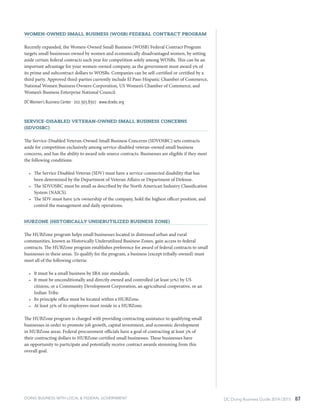
would like to acknowledge our board of
directors whose continued financial support
has made the 2014/2015 Doing Business in
DC Guide possible.
Vincent C. Gray, Mayor
PUBLIC SECTOR PARTNERS
PRIVATE SECTOR PARTNERS
BOARD MEMBERS
Jeff Miller / Co-Chair
Deputy Mayor
Office of Deputy Mayor for Planning & Economic
Development
Olivia Shay-Byrne/Vice Chair
Reed Smith, LLP
Richard Lake/Co-Chair
Roadside Development
Doug Loescher/
DMPED Representative
Office of Deputy Mayor for Planning & Economic
Development
Jennifer Eugene/Secretary
Washington Gas
Tara Scanlon
Holland & Knight
Steven C. Boyle
EDENS
Jean-Luc Brami
Gelberg Signs
Kenneth Brewer
H St. Community Development Corporation
Donna M. Cooper
Pepco
Rafael Muniz
JBG Rosenfeld Retail Properties
Lisa Mallory
DC Building Industry Association
Norman Jemal
Douglas Development Corporation
Thomas Nida
United Bank
Chris Niehaus
Microsoft
Scott Nordheimer
Urban Atlantic/A&R Development Corporation
Greg O’Dell
Events DC
Marc Ratner
Streetsense
Michael Stevens
Capitol Riverfront BID
Mitchell Weintraub
Cordia Partners, LLC
Joseph L. Askew, Jr., Esq.
Verizon
Brett Greene
American Management Corporation
Carl Hairston
M&T Bank
Greg Leisch
Delta Associates
Stan Jackson
Anacostia Economic Development Corporation
Phillip Quintana
Capital One Bank
Adam Volanth
Bohler Engineering
Angela Franco
Greater Washington Hispanic Chamber of
Commerce
Rabbiah “Robbie” Sabbakhan
DC Department of Consumer & Regulatory Affairs
Robert Summers
DC Department of Small & Local Business
Development
Eric E. Richardson
DC Office of Cable Television
Chester McPherson
DC Department of Insurance, Securities, & Banking
Sean Cahill
Property Group Partners
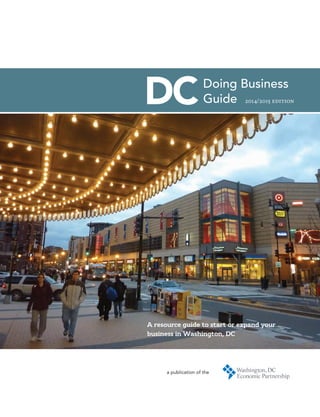
a publication of the
Doing Business
Guide 2014/2015 edition
A resource guide to start or expand your
business in Washington, DC
The DC Doing Business Guide is an updated and improved version of the sixth
edition released in 2012. The new guide covers information essential to relocating,
starting and expanding your business in DC. Whether you are an existing business
looking to relocate to DC, an entrepreneur looking for some guidance on starting
a business in DC, or a DC-based company looking to understand local business
resources, you will find the guide to be an indispensable tool.
As your first point of contact for doing business in DC, the Washington, DC
Economic Partnership (WDCEP) has a variety of resources in addition to this
publication that can assist you in your business success. To find out more about what
we can do for you, please call the WDCEP at 202.661.8670 or visit www.wdcep.com.
Content for this publication was made possible through collaboration with several
district and federal agencies, including: the Department of Small and Local Business
Development, the Department of Consumer and Regulatory Affairs, the Department
of Insurance, Securities and Banking, the Office of the Deputy Mayor for Planning
and Economic Development, the U.S. Small Business Administration, the DC Office
of Tax and Revenue, the Department of Employment Services, the DC Chamber of
Commerce, the Women’s Business Resource Center, the Washington Area Community
Investment Fund, the Greater Washington Hispanic Chamber of Commerce and the
DC Small Business Development Center Network.
DC Doing Business Guide is a publication of the Washington, DC Economic Partnership.
This document is intended to serve as a guide to starting a business and doing
business in the District of Columbia. It is not intended to supplant legal or financial
advice. Although every attempt was made to ensure the quality of the information
contained in this document, the Washington, DC Economic Partnership
makes no warranty or guarantee as to its accuracy, completeness or usefulness
for any given purpose.
This publication was funded by a grant from the Department of Consumer and
Regulatory Affairs.
ABOUT THIS
GUIDE
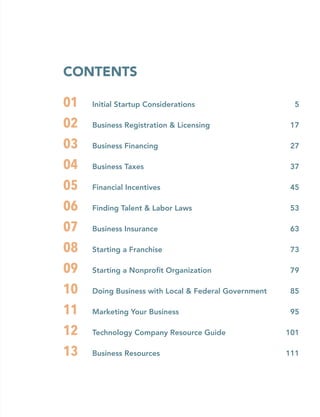
Contents
01	 Initial Startup Considerations	 5
02	 Business Registration & Licensing	 17
03	 Business Financing	 27
04	 Business Taxes	 37
05	 Financial Incentives	 45
06	 Finding Talent & Labor Laws	 53
07	 Business Insurance	 63
08	 Starting a Franchise	 73
09	 Starting a Nonprofit Organization	 79
10	 Doing Business with Local & Federal Government	 85
11	 Marketing Your Business	 95
12	 Technology Company Resource Guide	 101
13	 Business Resources	 111
Why Choose DC?
The District of Columbia is a world-class capital city that will guarantee unparalleled opportunities to small and large
businesses and organizations. More than a political and cultural center, DC is also a business capital that is experiencing an
unprecedented renaissance as one of the fastest growing and most exciting economies in the country. Choosing to locate your
business in DC will ensure advantages that are unmatched by any other city. Over the past few years, the District of Columbia’s
economy has proven to be strong and resilient while major events and cycles have shocked the rest of the nation. DC is well
established for industries such as business services, nonprofits, law firms, hospitality, technology and an increasingly vibrant
retail market. The nation’s capital has the tools, the infrastructure, the workforce, the accessibility, and the climate for businesses
to flourish.
Workforce
The District of Columbia boasts a highly skilled workforce and a strong job market. There are 646,449 people living in DC of whom
51.2% have a bachelor’s degree or higher.1
The average household income for DC residents is $89,000.2
The job market has proven to be
strengthening with an unemployment rate of 7.4% as of June 2014, down from 8.5% in June 20133
 1	 US Census Bureau (2014)
 2	 US Census Bureau (2014)
 3	 Bureau of Labor Statistics
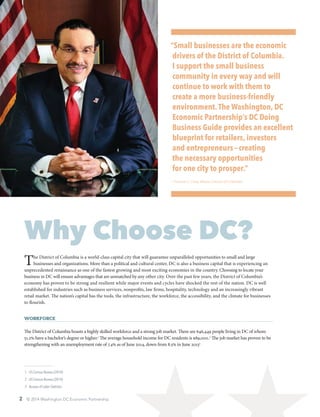
“Small businesses are the economic
drivers of the District of Columbia.
I support the small business
community in every way and will
continue to work with them to
create a more business-friendly
environment.The Washington, DC
Economic Partnership’s DC Doing
Business Guide provides an excellent
blueprint for retailers, investors
and entrepreneurs — creating
the necessary opportunities
for one city to prosper.”
—Vincent C. Gray, Mayor, District of Columbia
2 © 2014 Washington DC Economic Partnership
DC Doing Business Guide 2014 / 2015 3
Transportation
The District of Columbia’s public transportation system is highly efficient with the second largest heavy rail network and the sixth
largest bus network in the United States. Not only do people rely on the Metro system to commute to work everyday, they also use
it to explore the city’s many attractions. In 2013, there was a total of 353 million trips taken by riders4
. The average commute time
for residents is 29.3 minutes.5
Development
The District of Columbia serves as a leader in the national real estate market. There is a total of 3.9 million square feet of office
space under construction or renovation, as of August 2013.6
There are also more than 349 planned or proposed projects that
amount to $41.4 billion in development. Additionally, DC sets a national and global example of how to achieve sustainable
development by creating policy and achieving a record number of LEED certified projects.
Industries and Occupations
The top industries in the Washington metro area are Professional/Business Services, Government, Education/Healthcare,
Leisure/ Hospitality, and Retail Trade. The top three sectors leading job growth include Professional/Business Services, Leisure/
Hospitality, and Financial Services.7
The District of Columbia is a dynamic city with genuine and unique business opportunities.
DC’s economy has proven to be strong and resilient, despite the recent economic downturn, and is an ideal location to start,
expand or relocate your business.
 4	 Washington Metropolitan Area Transit Authority
 5	 US Census Bureau (2012)
 6	 Washington, DC Economic Partnership
 7	 Delta Associates (2012 Trendlines)
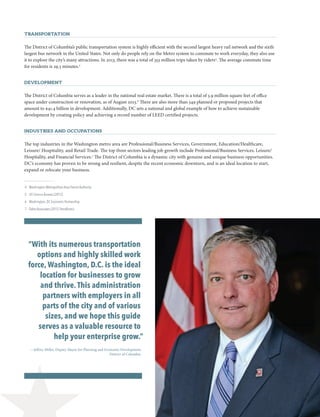
“With its numerous transportation
options and highly skilled work
force, Washington, D.C. is the ideal
location for businesses to grow
and thrive.This administration
partners with employers in all
parts of the city and of various
sizes, and we hope this guide
serves as a valuable resource to
help your enterprise grow.”
—Jeffrey Miller, Deputy Mayor for Planning and Economic Development,
District of Columbia
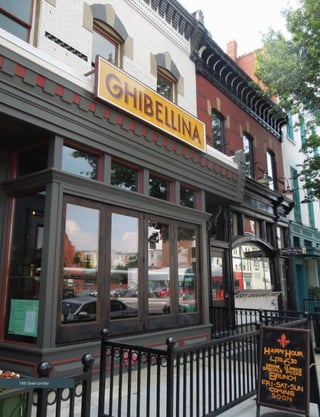
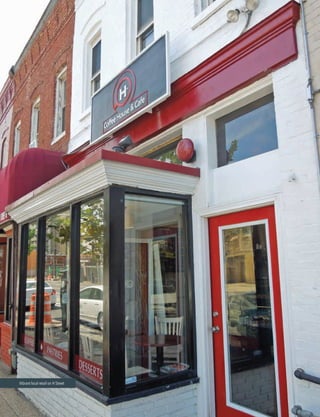
Vibrant local retail on H Street
DC Doing Business Guide 2014 / 2015 5
Whether you are starting a new business or relocating an
existing one, you will need to know the requirements to
operating a business in the District of Columbia. If this is
your first business venture in our nation’s capital, there
are a number of factors that you should consider. This
chapter will take you through the basic steps of starting
a business in DC.
Business Planning
Developing a business plan is crucial to success. A well-written business plan can help
secure funding, help to market your products and services, and help to establish strategic
partnerships. While there are different ways of writing a business plan, there are a few essential
components that should be included in every business plan.
Essential Components of a Business Plan
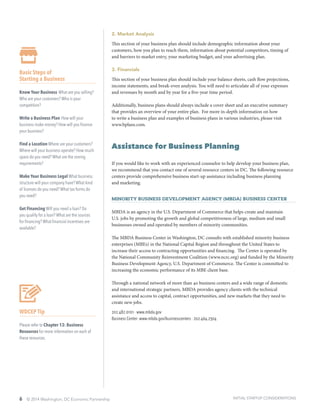
The three main sections to any business plan are:
1. Description of Business
This section of your business plan should contain the “who, what, when, where, why and how”
of your business. Some relevant points include location, products and services, employees,
management structure, labor policies, and other general information about your business.
WDCEP on YouTube
Search Starting a Business in DC at
www.youtube.com/wdcep1495
INITIAL STARTUP
CONSIDERATIONS
Business Planning, Business Locations, Ownership Structure
Contributors: DC Small Business Development Network
INITIAL STARTUP CONSIDERATIONS
6 © 2014 Washington, DC Economic Partnership
2. Market Analysis
This section of your business plan should include demographic information about your
customers, how you plan to reach them, information about potential competitors, timing of
and barriers to market entry, your marketing budget, and your advertising plan.
3. Financials
This section of your business plan should include your balance sheets, cash flow projections,
income statements, and break-even analysis. You will need to articulate all of your expenses
and revenues by month and by year for a five-year time period.
Additionally, business plans should always include a cover sheet and an executive summary
that provides an overview of your entire plan. For more in-depth information on how
to write a business plan and examples of business plans in various industries, please visit
www.bplans.com.
Assistance for Business Planning
If you would like to work with an experienced counselor to help develop your business plan,
we recommend that you contact one of several resource centers in DC. The following resource
centers provide comprehensive business start-up assistance including business planning
and marketing.
Minority Business Development Agency (MBDA) Business Center
MBDA is an agency in the U.S. Department of Commerce that helps create and maintain
U.S. jobs by promoting the growth and global competitiveness of large, medium and small
businesses owned and operated by members of minority communities.
The MBDA Business Center in Washington, DC consults with established minority business
enterprises (MBEs) in the National Capital Region and throughout the United States to
increase their access to contracting opportunities and financing.  The Center is operated by
the National Community Reinvestment Coalition (www.ncrc.org) and funded by the Minority
Business Development Agency, U.S. Department of Commerce. The Center is committed to
increasing the economic performance of its MBE client base.
Through a national network of more than 40 business centers and a wide range of domestic
and international strategic partners, MBDA provides agency clients with the technical
assistance and access to capital, contract opportunities, and new markets that they need to
create new jobs.
202.482.0101 ∙ www.mbda.gov
Business Center: www.mbda.gov/businesscenters ∙ 202.464.2304
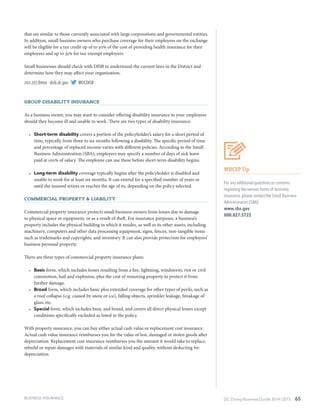
WDCEP Tip
Please refer to Chapter 13: Business
Resources for more information on each of
these resources.
Basic Steps of
Starting a Business
Know Your Business What are you selling?
Who are your customers? Who is your
competition?
Write a Business Plan How will your
business make money? How will you finance
your business?
Find a Location Where are your customers?
Where will your business operate? How much
space do you need? What are the zoning
requirements?
Make Your Business Legal What business
structure will your company have? What kind
of licenses do you need? What tax forms do
you need?
Get Financing Will you need a loan? Do
you qualify for a loan? What are the sources
for financing? What financial incentives are
available?
INITIAL STARTUP CONSIDERATIONS
DC Doing Business Guide 2014 / 2015 7
Please note
In the District of Columbia, you are required
to have a business location and submit a
certificate of occupancy permit when applying
for your business license.
INITIAL STARTUP CONSIDERATIONS
U.S. Small Business Administration (SBA)
Washington D.C. District Resource Guide
www.sba.gov/sites/default/files/files/resourceguide_3106.pdf
The U.S. Small Business Administration is a federal agency devoted to helping small businesses.
It has both resource centers and counselors to assist you with starting and growing your
business. At the SBA’s Service Corps of Retired Executives (SCORE), counselors can provide
mentoring, training and advice for both start-ups and existing businesses.
202.272.0390 ∙ 202.619-1000 ∙ http://washingtondc.score.org
Small Business Development Center
The DC Small Business Development Center (DCSBDC) network provides business counseling
and marketing resources.
The DC SBDC Network is an outreach program of Howard University, working in partnership
with the U.S. Small Business Administration (SBA), other District of Columbia universities,
and community organizations, to provide free management and technical assistance and
affordable training in all phases of business development to District of Columbia based small
businesses. Its trained and skilled business consultants provide confidential, one-on-one
management assistance in a myriad of areas, at no cost to the client. Each year, one-on-
one consulting is provided to thousands of small business owners, managers and aspiring
entrepreneurs.
202.806.1550 ∙ www.dcsbdc.org
Washington Area Community Investment Fund
The Washington Area Community Investment Fund, Inc. (WACIF) is a 24-year-old nonprofit
community development loan fund whose mission is to empower underserved communities
and individuals in the Washington, DC metropolitan area by providing access to capital and
technical assistance to small business, childcare centers, affordable housing developers, and
community organizations.. WACIF provides access to capital and technical assistance services
to existing and aspiring entrepreneurs and to nonprofit organizations in local underserved
communities. WACIF’s programs and services include: Specialized Technical Assistance, the
District of Columbia Certified Business Enterprise Revolving Microloan Fund, the Small
Business Administration (SBA) Revolving Microloan Fund, and WACIF’s Access to Capital
Loan Fund.
202.529.5505 ∙ www.wacif.org
8 © 2014 Washington, DC Economic Partnership
More organizations that assist with business planning:
Anacostia Economic Development Corporation
1800 Martin Luther King Jr.,Ave., SE #100
Washington, DC 20020
202.889.5100
www.anacostiacdc.com
ARCH Development Organization
1227 Good Hope Road SE
Washington DC 20020
202.365.5586
www.archdevelopment.org
Congress Heights Training &Development Corporation
3215 Martin Luther King Jr.Ave., SE
Washington, DC 20032
202.563.5201
http://chctdc.org
@chctdc
DC Fashion Foundation
1629 K Street NW Ste 300
Washington, DC 20006
202.355.3929
info@dcfashionfoundation.org
www.dcfashionfoundation.org
@DCFashionFdn
Emory Beacon of Light, Inc.
6203 Piney Branch Road, NW
Washington, DC 20011
202.829.5732
www.emorybeaconoflight.org
@emorybol
Greater Washington Hispanic Chamber of Commerce Foundation
910 17th Street, NW, #1150
Washington, DC 20006
and 2630 12th Street, NE Washington, DC 20018
202.728.0352
www.gwhcc.org
@gwhcc
Latino Economic Development Center
2316 18th Street, NW
Washington, DC 20009
202.540.7400
www.ledcmetro.org
@ledcmetro
INITIAL STARTUP CONSIDERATIONS
DC Doing Business Guide 2014 / 2015 9INITIAL STARTUP CONSIDERATIONS
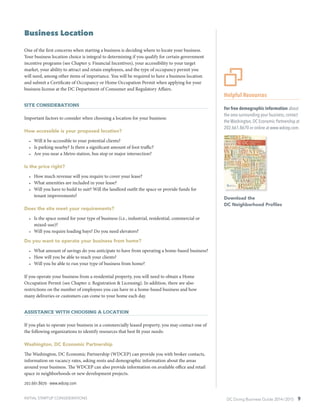
Business Location
One of the first concerns when starting a business is deciding where to locate your business.
Your business location choice is integral to determining if you qualify for certain government
incentive programs (see Chapter 5: Financial Incentives), your accessibility to your target
market, your ability to attract and retain employees, and the type of occupancy permit you
will need, among other items of importance. You will be required to have a business location
and submit a Certificate of Occupancy or Home Occupation Permit when applying for your
business license at the DC Department of Consumer and Regulatory Affairs.
Site Considerations
Important factors to consider when choosing a location for your business:
How accessible is your proposed location?
•	 Will it be accessible to your potential clients?
•	 Is parking nearby? Is there a significant amount of foot traffic?
•	 Are you near a Metro station, bus stop or major intersection?
Is the price right?
•	 How much revenue will you require to cover your lease?
•	 What amenities are included in your lease?
•	 Will you have to build to suit? Will the landlord outfit the space or provide funds for
tenant improvements?
Does the site meet your requirements?
•	 Is the space zoned for your type of business (i.e., industrial, residential, commercial or
mixed-use)?
•	 Will you require loading bays? Do you need elevators?
Do you want to operate your business from home?
•	 What amount of savings do you anticipate to have from operating a home-based business?
•	 How will you be able to reach your clients?
•	 Will you be able to run your type of business from home?
If you operate your business from a residential property, you will need to obtain a Home
Occupation Permit (see Chapter 2: Registration & Licensing). In addition, there are also
restrictions on the number of employees you can have in a home-based business and how
many deliveries or customers can come to your home each day.
Assistance with Choosing a Location
If you plan to operate your business in a commercially leased property, you may contact one of
the following organizations to identify resources that best fit your needs:
Washington, DC Economic Partnership
The Washington, DC Economic Partnership (WDCEP) can provide you with broker contacts,
information on vacancy rates, asking rents and demographic information about the areas
around your business. The WDCEP can also provide information on available office and retail
space in neighborhoods or new development projects.
202.661.8670 ∙ www.wdcep.com
Helpful Resources
For free demographic information about
the area surrounding your business, contact
the Washington, DC Economic Partnership at
202.661.8670 or online at www.wdcep.com.
Download the
DC Neighborhood Profiles
10 © 2014 Washington, DC Economic Partnership
WDCEP Tip
For more information on corporate ownership
structures in the District of Columbia, visit the
District’s online Business Resource Center at
www.brc.dc.gov.
Brokerage Firms & Real Estate Service Companies
You may directly contact a commercial real estate broker representing tenants for your space
search. Brokerage firms offer a variety of services including but not limited to investment
advice, real-time quotes, research, investment information and tools, online trading, touch-
tone trading, website account access, check-writing privileges, and margin loans.
Community Development Corporations
Community Development Corporations (CDCs) in the neighborhood of your choice can assist
you with information on neighborhood properties.
Development Corporation of Columbia Heights ∙ The Development Corporation of
Columbia Heights (DCCH) works to improve the quality of life for residents and business
owners through leadership training, the Neighborhood Jobs Initiative (NJI) program and
housing development.
H Street Community Development Corporation ∙ Since its inception in 1984, the H
Street CDC has addressed the needs of Washington area residents and businesses through
its commercial and residential projects, business services, small business loan programs,
and community empowerment projects. Services are focused on Wards 2, 5, 6 and 7.
Local Initiatives Support Corporation ∙ Local Initiatives Support Corporation (LISC)
provides grants, loans and equity investments to CDCs for neighborhood redevelopment.
When LISC begins a new program, National LISC matches locally-raised funds and gives
that much more to the community for renovation.
Marshall Heights Community Development Organization ∙ The Marshall Heights
Community Development Organization is a nonprofit organization that has undertaken
community development activities in the Ward 7 area of Washington, DC since 1979.
DC Building Industry Association
The DC Building Industry Association (DCBIA) can refer you to their member brokers
depending on your needs. Association members are engaged in all aspects of real estate
development and include developers, general contractors, architects and engineers, lenders,
attorneys, brokers, title companies, utility companies, community development organizations
and other industry members.
202.966.8665 ∙ www.dcbia.org
Department of Small & Local Business Development
The Department of Small & Local Business Development’s (DSLBD) Office of Commercial
Revitalization provides site location assistance for retail ventures.
202.727.3900 ∙ www.dslbd.dc.gov
Commercial Real Estate Brokerage Association of Greater Washington (CREBA)
CREBA is a regional trade association dedicated to serving commercial real estate interests
throughout the District of Columbia, Suburban Maryland and Northern Virginia. CREBA can
provide you with a listing of real estate brokers in the region.
301.590.2000 ∙ www.creba.org
INITIAL STARTUP CONSIDERATIONS
DC Doing Business Guide 2014 / 2015 11INITIAL STARTUP CONSIDERATIONS
Ownership Structure
As you begin planning, you will need to consider the ownership structure of your business.
Your business ownership structure will not only define who owns the business, but also will
determine who controls it, who assumes liability, how profits are divided, and how your
business will be taxed.
The list below represents eight common business types. There are, however, many ways to set
up a business, and each business is subject to its own unique tax situation. You should consult
with a qualified tax professional and a lawyer to determine the appropriate structure for
your business.
Sole Proprietorship
A business that is owned by a single individual
General Partnership
A business owned by two or more persons who have agreed—verbally or in a formal written
statement—to operate a business.
Limited Partnership
A business similar to a general partnership, however, one invests assets into the business at
their own risk and is limited to the amount of capital invested. The investor is not involved in
management and does not share in the liability for debts or losses.
Limited Liability Partnership (LLP)
A business in which partners are given the same limited liability protection as
professional corporations
C (General) Corporation
A business formed by law as a separate legal entity from its owners (stockholders
and shareholders).
S Corporation
A business similar to a General Corporation, with the exception of specific IRS requirements
Limited Liability Corporation (LLC)
A hybrid business that draws advantageous characteristics from both corporations
and partnerships.
Nonprofit
An organization that has no owners, gives no income (except salaries/expenses) to members,
directors or officers, and must have a Board of Directors
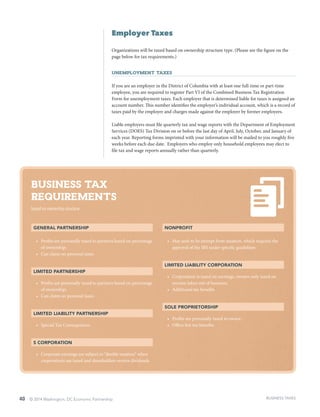
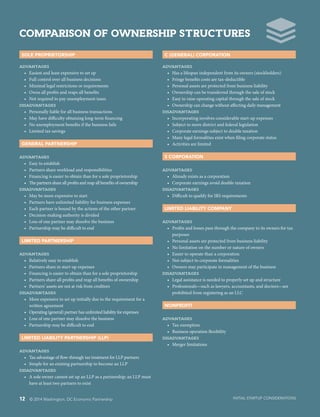
Please see the chart on page 12 for comparison information. For more information on
corporate ownership structures in the District of Columbia, visit the District’s online Business
Resource Center at www.brc.dc.gov.
Helpful Resources
Visit the District’s online Business Resource
Center for information on corporate owership
structures in DC: www.brc.dc.gov
INITIAL STARTUP CONSIDERATIONS
SOLE PROPRIETORSHIP
Advantages
•	 Easiest and least expensive to set up
•	 Full control over all business decisions
•	 Minimal legal restrictions or requirements
•	 Owns all profits and reaps all benefits
•	 Not required to pay unemployment taxes
Disadvantages
•	 Personally liable for all business transactions
•	 May have difficulty obtaining long-term financing
•	 No unemployment benefits if the business fails
•	 Limited tax savings
GENERAL PARTNERSHIP
Advantages
•	 Easy to establish
•	 Partners share workload and responsibilities
•	 Financing is easier to obtain than for a sole proprietorship
•	 The partners share all profits and reap all benefits of ownership
Disadvantages
•	 May be more expensive to start
•	 Partners have unlimited liability for business expenses
•	 Each partner is bound by the actions of the other partner
•	 Decision-making authority is divided
•	 Loss of one partner may dissolve the business
•	 Partnership may be difficult to end
LIMITED PARTNERSHIP
Advantages
•	 Relatively easy to establish
•	 Partners share in start-up expenses
•	 Financing is easier to obtain than for a sole proprietorship
•	 Partners share all profits and reap all benefits of ownership
•	 Partners’ assets are not at risk from creditors
Disadvantages
•	 More expensive to set up initially due to the requirement for a
written agreement
•	 Operating (general) partner has unlimited liability for expenses
•	 Loss of one partner may dissolve the business
•	 Partnership may be difficult to end
LIMITED LIABILITY PARTNERSHIP (LLP)
Advantages
•	 Tax advantage of flow-through tax treatment for LLP partners
•	 Simple for an existing partnership to become an LLP
Disadvantages
•	 A sole owner cannot set up an LLP as a partnership; an LLP must
have at least two partners to exist
C (GENERAL) CORPORATION
Advantages
•	 Has a lifespan independent from its owners (stockholders)
•	 Fringe benefits costs are tax-deductible
•	 Personal assets are protected from business liability
•	 Ownership can be transferred through the sale of stock
•	 Easy to raise operating capital through the sale of stock
•	 Ownership can change without affecting daily management
Disadvantages
•	 Incorporating involves considerable start-up expenses
•	 Subject to more district and federal legislation
•	 Corporate earnings subject to double taxation
•	 Many legal formalities exist when filing corporate status
•	 Activities are limited
S CORPORATION
Advantages
•	 Already exists as a corporation
•	 Corporate earnings avoid double-taxation
Disadvantages
•	 Difficult to qualify for IRS requirements
LIMITED LIABILITY COMPANY
Advantages
•	 Profits and losses pass through the company to its owners for tax
purposes
•	 Personal assets are protected from business liability
•	 No limitation on the number or nature of owners
•	 Easier to operate than a corporation
•	 Not subject to corporate formalities
•	 Owners may participate in management of the business
Disadvantages
•	 Legal assistance is needed to properly set up and structure
•	 Professionals—such as lawyers, accountants, and doctors—are
prohibited from registering as an LLC
NONPROFIT
Advantages
•	 Tax exemption
•	 Business operation flexibility
Disadvantages
•	 Merger limitations
COMPARISON OF OWNERSHIP STRUCTURES
12 © 2014 Washington, DC Economic Partnership
DC Neighborhoods
We’re creating the most accessible healthcare system in the region.
Because residents of Alexandria deserve the most innovative heart care.
Families in Takoma Park want the same orthopaedic experts who treat the pros.
And neighbors in Bowie should have access to the area’s only NCI-designated cancer center.
No matter where you go, no matter who you are, you’re never far from MedStar.
MedStarHealth.org/CloseToYou
866-9-MEDSTAR (866-963-3782)
Washington, D.C., Metro Region
MedStar Georgetown University Hospital
MedStar Montgomery Medical Center
MedStar National Rehabilitation Hospital
MedStar Southern Maryland Hospital Center
MedStar St. Mary’s Hospital
MedStar Washington Hospital Center
Baltimore Metro Region
MedStar Franklin Square Medical Center
MedStar Good Samaritan Hospital
MedStar Harbor Hospital
MedStar Union Memorial Hospital
Visit us at verizon.com/dc
VERIZON: A LEADING TECHNOLOGY
COMPANY IN WASHINGTON AND
AROUND THE GLOBE
We are proud to do business in DC.
DIVERSIFY
The office market continues to
in the Capitol Riverfront!
For more information about office space in the Capitol
Riverfront, go to www.capitolriverfront.org.
Congratulations to 1015 Half Street SE,
now 50% leased!
143,000 SF leased to NLRB
(largest lease transaction in
Washington DC for Q1 2014)
36,000 SF leased to CBS
Radio (moving to DC
from Lanham, MD)
For more information about leasing at 1015 Half Street,
contact Phillip Thomas at Cassidy Turley
202-463-1119 / Phillip.Thomas@cassidyturley.com
16 © 2014 Washington, DC Economic PartnershipINITIAL STARTUP CONSIDERATIONS
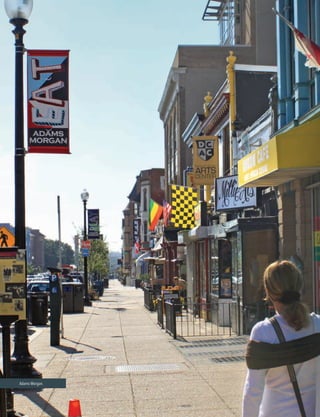
Adams Morgan.
DC Doing Business Guide 2014 / 2015 17
The process of obtaining licenses and registrations can be
streamlined if you know what you need and where to find
it. This chapter will help you navigate your way through
the process.
All businesses operating in DC are required to be licensed and/ or registered by the
Department of Consumer and Regulatory Affairs (DCRA). Additionally, DCRA also issues
permits and professional licenses and registers corporate filing entities.  Walk-in customers
are welcome to visit the Business License Center.  The Business License Center serves walk-
in customers that wish to file corporate documents, apply for various licenses, or need filing
applications. The Permit Center is responsible for issuing construction, plumbing, electrical
and HVAC permits in the District of Columbia. Both centers provide face-to-face technical
assistance for residents and businesses within the District of Columbia. DCRA’s Small Business
Resource Center (SBRC) provides customers with one-on-one assistance with the licensing
process. Please visit DCRA’s website to view services that are offered by DCRA and services
that are available online.
Visit www.dcra.dc.gov for information including:
•	 Registration forms and documents
•	 Answers to frequently asked questions
•	 Business name availability tool
•	 Registered organization search
•	 Corporate online formation services, report filings, name reservation and trade name
filings, status certificates and certified copy ordering as well as dissolution, withdrawal and
agent changes; online site for corporate filing is https://corp.dcra.dc.gov
WDCEP on YouTube
Search Business Registration and
Licensing at www.youtube.com/wdcep1495
BUSINESS REGISTRATION
& LICENSING
Step-by-step Explanation of the Licensing Process
Contributors: The Department of Small and Local Business Development ∙
The Department of Consumer and Regulatory Affairs ∙ The Alcoholic Beverage Regulation Administration
BUSINESS REGISTRATION & LICENSING
18 © 2014 Washington, DC Economic Partnership
WDCEP Tip
For more specific information about whether
you are required to obtain an EIN, refer to IRS
Publication 1635.You can obtain a copy of the
publication online at www.irs.gov.
The Licensing Process Step-by-Step
The following steps apply to all business license applicants:
•	 Step 1:	 Business Registration
•	 Step 2:	 Employer Identification Number (EIN)
•	 Step 3:	 Certificate of Occupancy (CRA-5)
•	 Step 4:	 DC Business Tax Identification Number
•	 Step 5:	 Certificate of Registration
•	 Step 6:	 Clean Hands Certificate
•	 Step 7:	 Basic Business License
•	 Step 8:	 Business Trade Name
1. Business Registration
If you will be operating as a sole proprietor, general partnership, unincorporated nonprofit
association or other special entity type, registration with Corporations Division is not required
and you can skip to step 2.
If you would like to operate in the District of Columbia as a nonprofit or for-profit corporation,
limited liability company, limited partnership, limited liability partnership, general cooperative
association, limited cooperative association or statutory trust, you must register with the
Corporations Division of DCRA that acts as Office of Corporate Registrar for the District.
To register as a domestic company, you must file for articles of incorporation (for profit or
nonprofit corporations and cooperative associations); articles of organization for Limited
Liability Company (or business trust); or statement of qualification for partnership (limited or
limited liability partnership).
To register as a foreign company (if your business is already registered outside the District
of Columbia), you must file for certificate of registration for all filing entities including
for-profit and nonprofit corporations, limited liability companies, general and limited
cooperative association, statutory trusts, limited partnerships and limited liability partnerships.
Corporate Registration can be accomplished online by using the CorpOnline site at
https://corp.dcra.dc.gov
2. Employer Identification Number (EIN)
An EIN (also known as Tax Identification Number (TIN)) is a nine-digit number assigned by
the Internal Revenue Service. The IRS uses the number to identify business taxpayers who are
required to file various tax returns. EINs are used by employers, sole proprietors, partnerships,
corporations, nonprofit organizations, trusts, estates of decedents, government agencies,
certain individuals and other business entities.
Generally, you will need an EIN if you answer “Yes” to any of the following questions:
•	 Do you have employees?
•	 Do you operate your business as a corporation, LLC or a partnership?
•	 Do you file any of these tax returns: Employment; Excise; or Alcohol, Tobacco and
Firearms?
•	 Do you withhold taxes on income, other than wages, paid to a non-resident alien?
•	 Do you have a Keogh plan (a tax-deferred pension account)?
Visit The Department of
Consumer and Regulatory
Affairs (DCRA)
1100 Fourth Street SW
Washington, DC 20024
202.442.4400
dcra@dc.gov
@DCRA
Metro:
Closest stop is Waterfront on the Green Line
Hours of Operation:
Monday,Tuesday,Wednesday and Friday
8:30 am–4:30 pm;
Thursday from 9:30 am–4:30 pm
BUSINESS REGISTRATION & LICENSING
DC Doing Business Guide 2014 / 2015 19BUSINESS REGISTRATION & LICENSING
•	 Are you involved with any of the following types of organizations: trusts (except certain
grantor-owned revocable trusts), IRAs, exempt organization business income tax returns,
estates, real estate mortgage investment conduits, nonprofit organizations, farmers’
cooperatives or plan administrators?
For more specific information about whether you are required to obtain an EIN, refer to IRS
Publication 1635. You can obtain a copy of the publication online at www.irs.gov.
The quickest and easiest way to apply for your EIN is online at www.brc.dc.gov (select
“Start a Business”). You may also fill out a copy of IRS Form SS-4 (Application for Employer
Identification Number) and apply by phone, fax or mail. This form is available at IRS and Social
Security Administration Offices, or you can request one by calling 800.829.4933.
3. Certificate of Occupancy (CRA-5)
www.dcra.dc.gov
A Certificate of Occupancy or Home Occupation Permit is required to show that your business
is operating in a building that meets building and zoning code requirements for its intended
use. However, you may not need one if you are leasing space in a building that already holds a
Certificate of Occupancy for your intended business use. For instance, a law firm can operate
under the umbrella of an office building’s Certificate of Occupancy as long as the firm operates
in a manner that conforms to office use.
Certain businesses, mostly Basic Business License applicants need to obtain a separate
certificate if the property owner’s Certificate of Occupancy does not cover their business. It’s
important, therefore, to ask the owner, property manager, or agent about the Certificate of
Occupancy when entering into a lease agreement.
To file for a Certificate of Occupancy for your business, you must have a commercially zoned
business location. However, if you operate your business from your house or apartment, you
instead need a Home Occupation Permit [see below]. Certificate of Occupancy applications
are available from the Department of Consumer and Regulatory Affairs or online at www.dcra.
dc.gov under the heading “Zoning.” Once completed, you will need to submit the application in
person to the Permit Service Center.
Commercial Properties Most commercially zoned properties will already have a Certificate
of Occupancy. You should be able to get a copy of the certificate from the building owner or
management company. If there is not a Certificate of Occupancy, you will need to apply for
one. If you are leasing a space for your business, you will need to get the property owner’s
authorization, documented in the Authorization Form. You may wish to visit www.dcra.
dc.gov/Permits /Certificates of Occupancy to read more about the process and to obtain
a C of O checklist, application, Authorization Form, and other supplemental forms that
may be required.
Home-Based businesses are subject to DCMR Title 11 Zoning Regulations; if you use your
residence as your primary business location, you must file for a Home Occupation Permit
(HOP). HOPs allow for limited home occupations, with standards, as an accessory use to the
principal residential use. See Section 203.1 of DCMR Title 11 for permitted home occupations
and limitations. You may view this Section and the District’s zoning regulations at http://dcoz.
dc.gov/info/reg.shtm.There are limitations however as you are only allowed to use the greater
of either 250 square feet or 25% of the floor area of the structure, excluding the basement or any
accessory structure, for your business operation. Check zoning regulations regarding all home-
based businesses before applying for a HOP.
Please Note
In the District of Columbia, you are required
to have a business location and submit
a Certificate of Occupancy permit when
applying for your business license.
20 © 2014 Washington, DC Economic Partnership
The Department of Consumer and Regulatory Affairs (DCRA)
1100 Fourth Street SW,Washington, DC 20024
202.442.4400 dcra@dc.gov ∙ @DCRA
Metro: Closest stop is Waterfront-SEU on the Green Line
Hours of Operation: Monday,Tuesday,Wednesday and Friday 8:30 am–4:15 pm;
Thursday 9:30 am–4:30 pm
4. DC Business Tax Identification Number
The FR-500 is a DC Combined Business Tax Registration document used to provide
information on ownership, location, and type of business. This information is needed to make
a determination of an employing unit’s liability to pay unemployment taxes.
Once you complete the document and submit it to the Office of Tax and Revenue, you will
be provided with a notice of business tax registration indicating your tax obligations and
filing frequency. It will also be the basis for your unemployment tax registration with the
Department of Employment Services. Tax forms can
be accessed online at www.otr.cfo.dc.gov. For more
information call the Office of Tax and Revenue at
202.727.4TAX. Employers with one or more employees
performing services within the District of Columbia
must complete Part VI of the Combined Registration
Application (FR-500). If the form is completed online
at the Office of Tax and Revenue’s website (www.otr.cfo.
dc.gov), Part VI will automatically be forwarded to the
Department of Employment Services (DOES). You will
be contacted by DOES if necessary and provided with a
determination of tax liability. If FR-500 is not completed
online, Part VI should be submitted to:
DC Department of Employment Services,
Office of Unemployment Compensation,Tax Division,
4058 Minnesota Avenue, NE
Washington, DC 20019 202.724-7000
The withholding and submission of employer withholding tax is optional for household
employees. If you choose to withhold, you should complete the Combined Registration
Application (FR-500), as mentioned above.
5. Certification of Registration
You will receive a Certificate of Registration from the Office of Tax and Revenue once you file
your FR-500.
6. Clean Hands Certificate
The Clean Hands Certificate is an affidavit stating that you do not owe more than $100 to the
District Government. If you owe more than $100 to the District Government, you will need to
resolve the outstanding debt before you can proceed.
A Clean Hands Certificate is required to be submitted with any application for a license or
permit, including a Basic Business License (see “STEP 7”). The form is included in the Basic
Business License application packet.
WDCEP Tip
Requirements for license and permit
fees vary greatly according to the type
of a company’s ownership structure. For
more information on DC licenses and permit
fees, to obtain a Clean Hands Certificate,
or to register a trade name, please visit the
Department of Consumer and Regulatory
Affairs (DCRA) at www.dcra.dc.gov.
WDCEP Tip
Tax forms can be accessed online at
www.otr.cfo.dc.gov.
For more information call the Office of Tax and
Revenue at 202.727.4TAX.
BUSINESS REGISTRATION & LICENSING
DC Doing Business Guide 2014 / 2015 21BUSINESS REGISTRATION & LICENSING
7. Basic Business License (BBL)
Whether a person or company requires a Basic Business License depends on the business
activity conducted in Washington, DC. There are prerequisites for obtaining a Basic Business
License such as registration with the Corporations Division, 202.442-4432, www.corp.dcra.
dc.gov; the Office of Tax and Revenue, 202.727-4829, www.otr.cfo.dc.gov; and in some cases,
the Permits Division, 202.442.4576. Please review the directory to locate the applicable
business category, which is based on the primary business activity, and determine the licensing
requirements for licensure at: http://dcra.dc.gov/node/539512.
Please note more than one license category may be applicable.
You may apply online at https://cpms.dcra.dc.gov/OSUBI/Default.aspx.
8. Business Trade Name
www.dcra.dc.gov
The District of Columbia enacted legislation establishing a registration program for trade
names. This law benefits the business community by:
•	 Allowing businesses to use fictitious names (created words and names) in conducting
business, including transacting business with vendors and financial institutions;
•	 Providing an official record of all owners associated with a fictitious name;
•	 Allowing businesses with fictitious names to undertake legal action under that name.
You can register your trade name online at www.dcra.dc.gov as an individual or organization,
by selecting the “CorpOnline” link from the main site.
Trade Name Registration Form TN-1 is also available by accessing the agency’s website,
navigating to Licensing and Registration and Corporate Registration, and clicking on the
appropriate entity type.
You may opt to obtain a trade name at any step in the process.
Other Licenses & Permits
202.478.9292 ∙ www.dcra.dc.gov ∙ @DCRA
Building Permits
You are required by law to obtain a permit for construction in the District of Columbia if
you are going to be constructing, demolishing, renovating or altering your building, home
or business. Even if you are not doing work but are changing the use of a building or space,
you will need to obtain a building permit. You may apply for permits in person at the
Permit Service Center of the Department of Consumer and Regulatory Affairs or online at
www.dcra.dc.gov.
Please note that other agencies (e.g. Department of Health, the District Department of
Transportation and the Water and Sewer Authority) are tied into the permitting process and
have their own respective approval requirements. If you need further assistance, or have
multiple permits, contact DCRA’s Building Permit Customer Service Section at 202.478.9292.
WDCEP Tip
Businesses can now apply for permits
online via DCRA’s website. Go to
www.dcra.dc.gov and click on online permit
application.You can also file your construction
permit online.
22 © 2014 Washington, DC Economic Partnership
The SBRC Network of Centers
Locations
Department of Small and Local
Business Development
Small Business Resource Center
441 4th Street NW, Suite 970N
Washington, DC 20019
202.727.3900
Department of Consumer and
Regulatory Affairs
Small Business Resource Center
1100 4th Street SW, 2nd Floor
Washington, DC 20024
202.442.8170
Services are by appointment only.To
register for SBRC offerings, please visit
dcbiz.ecenterdirect.com.
You need a permit for:
•	 New construction and foundations;
•	 Additions, alterations, or repair of existing buildings;
•	 Razes (demolition) and interior or partial demolition;
•	 Erection of a sign and awning;
•	 Layout of interior space for tenants in new or existing commercial buildings;
•	 Change of use.
(Search “DCMR Title 12 Chapter 1” online for the entire list of required permits.)
Building Plats
Building plats—drawings showing the location of all property lines—are required as the basis
for all additions and new buildings. An original and three copies can be obtained for a fee
from the District Office of the Surveyor. You are encouraged to place your order a minimum of
seven days in advance, although an expedited plat service is available. Plats show lot lines and
do not show improvements which must be added by the applicant. Plats are required for the
following types of work:
•	 New buildings and additions
•	 Retaining walls and fences
•	 Sheds and garages
•	 Awnings
Site plans are required for:
•	 New buildings, additions, interior and exterior alterations
•	 Retaining walls, sheds, garages
•	 Excavation for foundations
Public Space Permits
A Public Space Permit is required to use or install structures on public space, which is the area
between the building or property line and the curb. Restaurants with outdoor sidewalk seating
will need to apply for the Sidewalk Café Permit. You are required to complete an application
for Public Space Permits in order to:
•	 Construct sidewalks, alleys, flagpoles, fountains, planter boxes, retaining walls, fences,
and any other improvements in public spaces;
•	 Excavate in public space to construct foundations;
•	 Occupy public space temporarily for construction equipment.
Water or Sewer Excavation Permits
You must complete an application for Water or Sewer Permits to:
•	 Install water or sewer pipes;
•	 Make connections to existing water and sewer mains in the street;
•	 Excavate for water meters and meter vaults in public space.
BUSINESS REGISTRATION & LICENSING
DC Doing Business Guide 2014 / 2015 23BUSINESS REGISTRATION & LICENSING
Trade Permits
Licensed contractors are required to complete an application for Trade Permits in
order to install:
•	 HVAC Systems Plumbing installation and fixtures
•	 Electrical wiring, service and fixtures
•	 Fire Alarm and Sprinkler systems
Floor plans, elevations, cross-sections, and detailed drawings are required in various
combinations for all proposed construction, except for razes. You will need a building permit
before subcontractors apply for trade permits. Permits for simple projects can be issued over
the counter in half an hour as a “walk-through,” while more complex projects are classified as
“file jobs” and may require from 14 to 30 days for completion of reviews.
Code Compliance
Reviews of drawings and submittal documents are performed by Technical Plan Review Staff to
ensure compliance with the following, where applicable, prior to permit issuance:
•	 Structural/Non-Structural
•	 Plumbing/Mechanical
•	 Accessibility
•	 Electrical
•	 Fire
•	 Green Building
•	 Zoning
•	 DDOE -Stormwater management & Sediment & Erosion Control, Floodplain
•	 DDOT-Public space
•	 HPRB- Historic review
•	 DC Water
•	 Other-WMATA, CFA, NCPC, Secret Service
Inspections
Once permits are issued and construction commences, DCRA or approved Third Party
Inspectors conduct inspections to verify that work complies with applicable codes, regulations
and referenced standards and conforms with approved construction documents. Final
inspection approval is needed to obtain a certificate of occupancy.
Small Business Resource Center (SBRC)
SBRC Website: http://dcbiz.ecenterdirect.com
DSLBD Agency Website: http://dslbd.dc.gov
DCRAAgency Website: http://dcra.dc.gov
The Small Business Resource Center (SBRC), a partnership between the Departments of Small
and Local Business Development (DSLBD) and Consumer and Regulatory Affairs (DCRA),
provides District-based small businesses and entrepreneurs with training, consulting and
technical assistance. Service offerings include one-on-one technical assistance; pro bono
legal services; access to computers and business planning software; workshops on starting,
managing, financing, and growing a business; and assistance navigating regulatory issues. The
SBRC also provides regular updates about small business opportunities and referrals to other
small business resource providers in the area.
24 © 2014 Washington, DC Economic Partnership
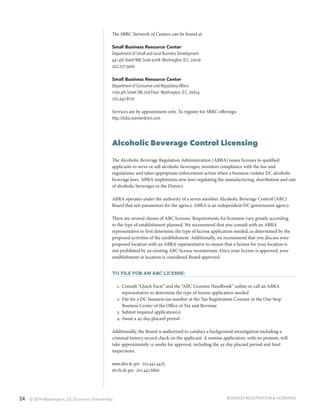
The SBRC Network of Centers can be found at:
Small Business Resource Center
Department of Small and Local Business Development
441 4th Street NW, Suite 970N Washington, D.C. 20019
202.727-3900
Small Business Resource Center
Department of Consumer and Regulatory Affairs
1100 4th Street SW, 2nd Floor Washington, D.C. 20024
202.442-8170
Services are by appointment only. To register for SBRC offerings:
http://dcbiz.ecenterdirect.com.
Alcoholic Beverage Control Licensing
The Alcoholic Beverage Regulation Administration (ABRA) issues licenses to qualified
applicants to serve or sell alcoholic beverages; monitors compliance with the law and
regulations; and takes appropriate enforcement action when a business violates DC alcoholic
beverage laws. ABRA implements new laws regulating the manufacturing, distribution and sale
of alcoholic beverages in the District.
ABRA operates under the authority of a seven member Alcoholic Beverage Control (ABC)
Board that sets parameters for the agency. ABRA is an independent DC government agency.
There are several classes of ABC licenses. Requirements for licensure vary greatly according
to the type of establishment planned. We recommend that you consult with an ABRA
representative to first determine the type of license application needed, as determined by the
proposed activities of the establishment. Additionally, we recommend that you discuss your
proposed location with an ABRA representative to ensure that a license for your location is
not prohibited by an existing ABC license moratorium. Once your license is approved, your
establishment or location is considered Board approved.
To file for an ABC License:
1.	 Consult “Quick Facts” and the “ABC Licensee Handbook” online or call an ABRA
representative to determine the type of license application needed
2.	File for a DC business tax number at the Tax Registration Counter in the One Stop
Business Center of the Office of Tax and Revenue
3.	Submit required application(s)
4.	Await a 45-day placard period
Additionally, the Board is authorized to conduct a background investigation including a
criminal history record check on the applicant. A routine application, with no protests, will
take approximately 12 weeks for approval, including the 45-day placard period and final
inspections.
www.abra.dc.gov ∙ 202.442.4423
otr.cfo.dc.gov ∙ 202.442.6890
BUSINESS REGISTRATION & LICENSING
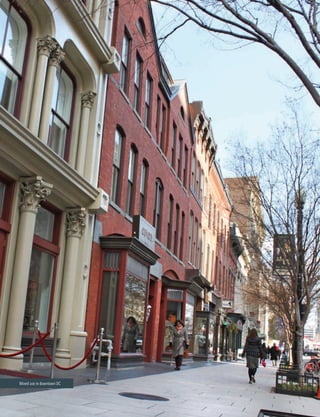
Mixed use in downtown DC
DC Doing Business Guide 2014 / 2015 27
Most businesses need outside sources of financing to get
established or to expand. With ample options available,
DC has many banking and financing institutions that can
help a business meet its needs.
Your funding options include:
•	 Obtaining a traditional bank loan
•	 Working with a lender to get a loan guarantee from the U.S. Small Business
Administration (SBA)
•	 Securing funds from an angel investor, venture capital firm or small business
investment company
•	 Obtaining a loan from an alternative, community lender
•	 Crowdfunding
The DC Department of Insurance, Securities and Banking (DISB) promotes the availability of
capital for small businesses. DISB administers the DC Certified Capital Company (CAPCO)
Program, a small business development financing program introduced in 2004 (see page 31).
DISB also has a collateral support program in partnership with local lending institutions.
Please visit their website (http://disb.dc.gov/page/district-columbia-collateral-support-
program) for more information.
Factors to Consider:
In order to determine how much business financing you will need and what is available to
you, you will need to assess your current resources, complete your financials, and obtain
a credit report.
WDCEP on YouTube
Search Business Financing at
www.youtube.com/wdcep1495
BUSINESS financing
Factors of Consideration, the Loan Process, Small Business Lenders,
Equity Financing and Other Sources of Funding
Contributors The Department of Small and Local Business Development ∙
The Department of Insurance, Securities and Banking ∙ The U.S. Small Business Administration
BUSINESS FINANCING
28 © 2014 Washington, DC Economic Partnership
Your Current Resources
Depending on your start-up and growth strategies, it is advisable to review your capital
formation strategy with an expert prior to starting operations.
Your Financials
The financial section of your business plan is a critical component of attracting investors
and securing funding. You may use the online financial tools provided by the District
Government’s Business Resource Center at www.brc.dc.gov to gain a solid understanding of
your financial position and related goals. In addition, Service Corps of Retired Executives
(SCORE) offers workshops where they teach entrepreneurs how to create a profit and
loss statement.
Your Credit Report
Regardless of whether you are going to rely on your current resources or obtain commercial
financing, you will need to obtain a copy of your credit report to ensure its accuracy and show
potential investors that you are serious about paying back their investments. You may obtain
credit reports online or via phone by contacting one of the following:
Equifax 1.800.685.1111 ∙ www.equifax.com
Experian 1.888.397.3742 ∙ www.experian.com
Trans Union 1.800.888.4213 ∙ www.transunion.com
The Loan Process
The best way to obtain financing is to work with a bank or lending company. These experts
will help you decide which type of loan suits your business and financing needs. Their advice is
valuable and learning about loan types and processes will increase your knowledge to help you
make the best decision.
Applying for a Loan
If you decide to apply for a business loan, your application should include the following
information:
•	 A description of your business: products or services, market, competitive advantages
•	 A biography with a summary of qualifications. Many applicants simply provide resumes
of key managers.
•	 A budget detailing how the funds will be used
•	 A statement of your equity injection—your personal contribution. If possible, this should
be 20% of the total budget. The remainder is the amount of the requested loan.
•	 Business financial statements and tax returns for the last three years, if applicable
•	 Cash flow projections for at least the next 12 months
•	 Personal financial statements and three years of tax returns for each owner of the business
•	 A description of the collateral you are offering, in addition to business assets, which often
include personal assets such as marketable securities or real estate
WDCEP Tip
The Fair and Accurate Credit Transaction
Act (FACTA) was passed by Congress in
2003 and allows you to obtain one free
copy of your credit report from each of
the three major credit bureaus every 12
months. For more information, please
visit www.annualcreditreport.com
The Five C’s of Credit
Capital: How much of your own funds are
invested in this business
Capacity: Your ability to repay the loan (this is
where your credit report will be crucial)
Collateral: Assets, such as real estate,
equipment or inventory that can be liquidated
to repay the loan if you default
Conditions: How you plan to use the loan
Character: The general impression of
trust-worthiness you make on the prospective
lender or investor
BUSINESS FINANCING
DC Doing Business Guide 2014 / 2015 29
The lender will evaluate all of this information before making a decision. In some cases,
the application is not quite strong enough to stand on its own. This is often true of start-up
businesses or in cases in which the collateral is insufficient or the equity injection is too small.
In those cases, the lender will sometimes agree to make the loan only with the guarantee of the
U.S. Small Business Administration (SBA). The lender will guide you through the process and
additional paper work involved in obtaining the SBA guarantee.
Types of Loans
Short-Term Loans
Short-term loans must be repaid within a year and are typically used to finance seasonal build-
up of inventory or accounts receivable.
•	 Line of Credit. A line of credit is a specific amount of money that has been approved
and set aside by the bank for you to draw upon as needed. Interest is charged only on
the amount of the line that you use. However, banks may charge a commitment fee of
0.5%–1% of the total line for reserving these funds. Lines of credit are used mostly for
construction projects and working capital.
•	 Time Loan. There are no installment payments with time loans. Instead, the entire
amount of the loan, plus interest, is paid back at one time. This type of loan is often used
to finance a temporary increase in inventory.
Long-Term Loans
With terms of one year and longer, these loans are typically used to finance permanent assets
like your core level of inventory, the expansion of a business, machinery and equipment, or
construction of a new building.
•	 Term Loan. These loans are usually repaid within five years in equal installments of
principal, plus interest on the outstanding amount of the loan. As the outstanding
principal is reduced, the amount of your total installment payments will go down over the
life of the loan.
•	 Revolving Line of Credit. A revolving line of credit differs from other lines of credit
because it does not require an annual payoff. Reviewed and renewed by the bank on a
yearly basis, revolving lines are similar to credit cards with pre-set spending limits. The
amount of available funds drops by the amount of money you withdraw and increases as
you repay the funds in monthly installments of interest plus principal.
•	 Accounts Receivable. An accounts receivable loan is based on the payment history
of your customers. This type of loan is often used for government contracts and
subcontracts. Banks will either write separate loans, or set aside funds for your use, in an
amount usually equal to 75–100% of all accounts receivable invoices that are less than 90
days old (depending on the customer). Typically, a government contract is more reliable
than one from the private sector, so the size and length of the loan changes accordingly.
Available money is drawn as needed and paid as your customers pay you. Interest is
charged only on the outstanding portion of the loan.
•	 Commercial and Industrial Mortgages. These are typically used to finance the
purchase of real property or a major expansion of the business. Depending on the
property you would like to buy or build, most banks will finance up to 75 percent of the
property’s appraised value or construction cost in the form of a mortgage.
However, commercial loans are generally offered for ten years or less. You may be able to
reduce the monthly installment payments by basing them on an amortization period that
is longer than the life of the loan. With this loan structure, when the loan is due, you pay
off the outstanding principal and interest with a lump sum “balloon payment.”
Consider Local Lenders
The Department of Small and Local
Business Development
441 4th street, NW, Suite 970 North
Washington, DC 20001
www.dslbd.dc.gov
Enterprise Development Group
1038 South Highland Street
Arlington,VA 22204
703.685.0510 · www.entdevgroup.org
BUSINESS FINANCING
30 © 2014 Washington, DC Economic Partnership BUSINESS FINANCING
•	 Personal Loans. Owners of a start-up or new business can take out long-term personal
loans from a bank. Because there is no existing track record to evaluate, a banker may base
the loan on your personal assets and borrowing record.
•	 Micro-loans Micro-loans (from $500–$50,000) are also a good source of financing.
Nontraditional lenders with less stringent financial guidelines than banks usually
offer them. They can be used for working capital, machinery, inventory and leasehold
improvements.
Local lenders you may consider:
Enterprise Development Group
1038 South Highland Street Arlington,VA 22204
703.685.0510 ∙ www.entdevgroup.org
Latino Economic Development Center
2316 18th Street NW Washington, DC 20009
(202).588.5102 ∙ www.ledcmetro.org
The Latino Economic Development Center’s microlending program provides business loans
between $5,000 and $50,000 to qualified start-ups and existing businesses that have difficulty
obtaining credit from mainstream financial institutions. Its fully bilingual staff (English-
Spanish) provides financing and related technical assistance to a broad range of small business
owners, including restaurants, catering companies, boutique shops, cleaning services and
construction companies. Since 1997, LEDC has provided more than $6 million in lending
capital to support hundreds of entrepreneurs in the Washington region.
Washington Area Community Investment Fund
2012 Rhode Island Ave NE Washington, DC 20018
202.529.5505 ∙ www.wacif.org
WACIF provides both lines of credit and term loans for businesses local to the Capital Region.
WACIF places special emphasis on borrowers that cannot get traditional financing but have
strong management and experience.
Kiva
Kiva is a nonprofit organization that works to alleviate poverty through crowdfunded
microloans. By leveraging the internet and a worldwide network of microfinance institutions,
Kiva lets individuals lend as little as $25 to help create opportunity around the world.
Kiva has two microlending platforms that help aspiring entrepreneurs and small business
owners to access capital:
Kiva City DC
A partnership between Kiva, the Latino Economic Development Center, and Capital One, Kiva
City DC enables small businesses in the DC metro area to receive crowd-funded loans of up
to $10,000 to support their business goals. Kiva DC loans are a good option for entrepreneurs
who can’t meet the collateral requirements for other microlenders; many loans made are
under $2,000, and lenders can give as little as $25. Potential borrowers can apply online at
www.kiva.org/dc.
Kiva Zip Loans
Kiva Zip is a peer-to-peer lending pilot program that provides no-interest loans to qualified
borrowers. Individual lenders can contribute as little as $5 to support a borrower. An average
loan made through Kiva Zip is $5,000 with a two-year repayment period.
Non-traditional Financing
Crowd-sourced funding opportunities
for creative projects have become
popular ways to raise capital. Kickstarter
(www.kickstarter.com) is one of the more
popular sites to offer this service.
DC Doing Business Guide 2014 / 2015 31BUSINESS FINANCING
Kiva Zip borrowers must be endorsed by a Kiva trustee.  Trustees are individuals and
organizations that identify individuals they believe would make a good Kiva Zip borrower.
Once approved, the publicly endorsed borrower will receive ongoing support from his/
her trustee. A borrower has 45 days to become fully funded through his or her online Kiva
Zip profile; fully funded loans
are disbursed to the borrower
through PayPal. After successfully
repaying a loan, the borrower is
then eligible for larger loans in
the future. More information is
available at https://zip.kiva.org.
Small Business
Administration Loans
7(a) Program: 7(a) loans are
designed to help small businesses in starting, acquiring, and expanding their interests. The
program encourages lenders to extend credit to small businesses by guaranteeing a portion
of the loan: up to 85% on loans up to $150,000, and 75% on loans greater than $150,000.
The maximum loan amount is $1.5 million. The money can be used to purchase property
or equipment, fund long-term or short-term working capital, finance against inventory or
refinance existing debts, and cover new construction or expand existing facilities.
Within the 7(a) loan framework there are multiple categories of loans designed for specific
functions. CAPLines is for loans up to $5 million for small business owners to meet their short
term and cyclical working capital needs. The Employee Trusts Program provides financial
assistance to Employee Stock Ownership Plans. Export Loans aim to help small businesses take
advantage of the world market, and can include 90% guarantees and financing up to $5 million.
Express and Pilot Programs streamline and expedite the loan process for certain community
members, by providing rapid responses (within 36 hours of submitting applications) and
lowered interest rates (often from 2.25% to 4.75%). Eligible candidates include:
•	 Veterans
•	 Service disabled veterans
•	 Eligible active duty service members
•	 Reservists and National Guard members
•	 Current spouse of any of the above
•	 Widowed spouse of a service member/veteran who died during service or of a service-
connected disability
The Small Loan Advantage Program (SLA) is designed to encourage larger, existing SBA
lenders to make smaller-dollar loans, with a maximum value of up to $250,000, which benefit
businesses in underserved markets. These loans offer a streamlined application process to the
7(a) loans, with minimal paperwork and a two-page application. Most loans will be approved
in a matter of minutes through electronic submissions; non-delegated loans will take 5-10
days. All lenders that are currently part of the SBA’s Preferred Lenders Program (PLP) are
eligible to participate.
Application procedures for SBA loans vary depending on the type of loan, as well as the lender,
so it is important to ask the local lender which format it requires. The SBA.gov website has a
thorough checklist of documents needed to apply for one of their loan programs, as well as
advice on how to put together and present your application.
32 © 2014 Washington, DC Economic Partnership BUSINESS FINANCING
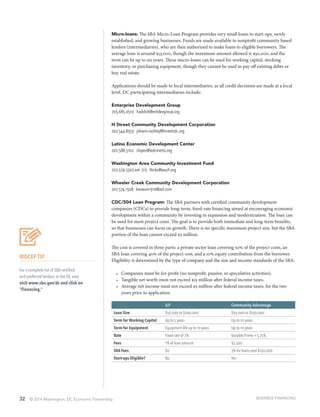
Micro-loans: The SBA Micro-Loan Program provides very small loans to start-ups, newly
established, and growing businesses. Funds are made available to nonprofit community based
lenders (intermediaries), who are then authorized to make loans to eligible borrowers. The
average loan is around $13,000, though the maximum amount allowed is $50,000, and the
term can be up to six years. These micro-loans can be used for working capital, stocking
inventory, or purchasing equipment, though they cannot be used to pay off existing debts or
buy real estate.
Applications should be made to local intermediaries, as all credit decisions are made at a local
level. DC participating intermediaries include:
Enterprise Development Group
703.685.0510 ∙ haddish@entdevgroup.org
H Street Community Development Corporation
202.544.8353 ∙ johann.lashley@hsreetcdc.org
Latino Economic Development Center
202.588.5102 ∙ clopez@ledcmetro.org
Washington Area Community Investment Fund
202.529.5505 ext. 213 ∙ lhicks@wacif.org
Wheeler Creek Community Development Corporation
202.574.1508 ∙ beswann310@aol.com
CDC/504 Loan Program: The SBA partners with certified community development
companies (CDCs) to provide long-term, fixed-rate financing aimed at encouraging economic
development within a community by investing in expansion and modernization. The loan can
be used for most project costs. The goal is to provide both immediate and long-term benefits,
so that businesses can focus on growth. There is no specific maximum project size, but the SBA
portion of the loan cannot exceed $5 million.
The cost is covered in three parts: a private sector loan covering 50% of the project costs, an
SBA loan covering 40% of the project cost, and a 10% equity contribution from the borrower.
Eligibility is determined by the type of company and the size and income standards of the SBA:
•	 Companies must be for-profit (no nonprofit, passive, or speculative activities).
•	 Tangible net worth must not exceed $15 million after federal income taxes.
•	 Average net income must not exceed $5 million after federal income taxes, for the two
years prior to application.
ILP Community Advantage
Loan Size $50,000 to $200,000 $50,000 to $250,000
Term for Working Capital Up to 5 years Up to 10 years
Term for Equipment Equipment life up to 10 years Up to 10 years
Rate Fixed rate of 7% Variable Prime +3.25%
Fees 1% of loan amount $2,500
SBA Fees $0 3% for loans over $150,000
Start-ups Eligible? No Yes
WDCEP TIP
For a complete list of SBA certified
and preferred lenders in the DC area
visit www.sba.gov/dc and click on
“Financing.”
DC Doing Business Guide 2014 / 2015 33BUSINESS FINANCING
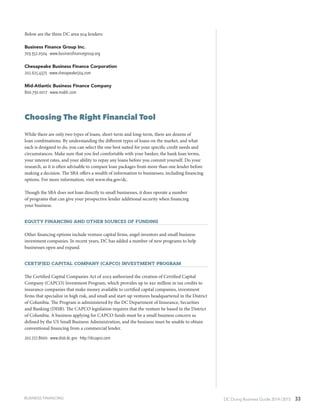
Below are the three DC area 504 lenders:
Business Finance Group Inc.
703.352.0504 ∙ www.businessfinancegroup.org
Chesapeake Business Finance Corporation
202.625.4373 ∙ www.chesapeake504.com
Mid-Atlantic Business Finance Company
800.730.0017 ∙ www.mabfc.com
Choosing The Right Financial Tool
While there are only two types of loans, short-term and long-term, there are dozens of
loan combinations. By understanding the different types of loans on the market, and what
each is designed to do, you can select the one best suited for your specific credit needs and
circumstances. Make sure that you feel comfortable with your banker, the bank loan terms,
your interest rates, and your ability to repay any loans before you commit yourself. Do your
research, as it is often advisable to compare loan packages from more than one lender before
making a decision. The SBA offers a wealth of information to businesses, including financing
options. For more information, visit www.sba.gov/dc.
Though the SBA does not loan directly to small businesses, it does operate a number
of programs that can give your prospective lender additional security when financing
your business.
Equity Financing and Other SourceS of Funding
Other financing options include venture capital firms, angel investors and small business
investment companies. In recent years, DC has added a number of new programs to help
businesses open and expand.
Certified Capital Company (CAPCO) Investment Program
The Certified Capital Companies Act of 2003 authorized the creation of Certified Capital
Company (CAPCO) Investment Program, which provides up to $50 million in tax credits to
insurance companies that make money available to certified capital companies, investment
firms that specialize in high risk, and small and start-up ventures headquartered in the District
of Columbia. The Program is administered by the DC Department of Insurance, Securities
and Banking (DISB). The CAPCO legislation requires that the venture be based in the District
of Columbia. A business applying for CAPCO funds must be a small business concern as
defined by the US Small Business Administration, and the business must be unable to obtain
conventional financing from a commercial lender.
202.727.8000 ∙ www.disb.dc.gov ∙ http://dccapco.com
34 © 2014 Washington, DC Economic Partnership
Venture Capital and Private Equity investment
Venture Capital firms and private equity
investment firms usually require some
management control, in addition to repayment,
in exchange for their financial investment. An
advantage to using private investors is that
they bring experience and their networks of
contacts to your business. To obtain a listing
of area venture capital firms or other private
equity investors, visit the Mid-Atlantic Venture
Association (MAVA) online and choose
“Member Profiles,” which allows you to search
for funders that fit your criteria of industries
and/or locations. MAVA is a membership
organization of investors, entrepreneurs,
advisors, and other company-builders.
703.506.9300 ∙ www.mava.org
VentureHouse Group
Venturehouse Group is a venture capital firm that assists in building entrepreneurial
businesses. It offers private equity financing for new businesses. In addition to providing
young private companies with investment capital, Venturehouse Group also serves as strategic
partners, providing businesses with the expertise, support, infrastructure and the network of
services they need.
www.venturehousegroup.com ∙ 202.654.7000.
Small Business Investment Companies (SBIC)
SBICs are licensed and regulated by the SBA and are investment firms that make capital
available to small businesses through investments or loans. They also provide management
assistance and expect a share of the profits from your business.
Tax-Exempt Bond
Revenue Bond financing is an attractive source of funding for businesses and nonprofit
organizations that locate or operate within the city. A qualified private business can borrow
up to $15 million of tax-exempt bonds to invest in buildings, equipment, and furnishings used
for the qualified business. Besides being tax-exempt, the bond financing is usually at least two
percentage points below market interest rates. A nonprofit organization that is located in the
District of Columbia may borrow as much as it needs. (see Chapter5: Financial Incentives for
eligibility requirements).
BUSINESS FINANCING
14th Street corridor
DC Doing Business Guide 2014 / 2015 37
There are two different classes of business taxes in the
District: general business taxes and employer taxes.
General business taxes include corporate franchise tax,
unincorporated business franchise tax, sales tax and use
tax, personal property tax, gross receipts tax, and taxes
on special events. Employer taxes apply to organizations
according to their ownership structure. In this chapter we
will cover both classes of business taxes. However, while
reviewing this chapter, it is important to bear in mind that
there are a variety of tax abatement programs for District
businesses (see Chapter 5: Financial Incentives).
General Business Taxes
Corporate Franchise Tax
If you engage in or carry on a trade or business in the District, or receive income from sources
within the District as a corporation, you are required to file Form D-20, Corporate Franchise
Tax return with the DC Office of Tax and Revenue. You must file the form by the 15th day of
the third month following the close of the corporation’s taxable year. The minimum tax payable
under the District corporate franchise tax is $250 if District gross receipts total $1 million or
less and the minimum tax payable is $1000 if District gross receipts total more than $1 million.
WDCEP on YouTube
Search Business Taxes at
www.youtube.com/wdcep1495
BUSINESS taxes
General Business Tax Requirements, Employer
Tax Requirements, Other Types
Contributors: The DC Office of Tax and Revenue
BUSINESS TAXES
38 © 2014 Washington, DC Economic Partnership
Unincorporated Business Franchise Tax
Filing the Unincorporated Business Franchise Tax Form D-30 is mandatory for any
unincorporated business (sole proprietorship, partnership, joint venture, etc.) engaged in or
carrying on a trade or business in the District that meets the following conditions: (1) The
business derives rental income or receives other income from sources within the District. (2)
District gross receipts exceed $12,000 per year. The minimum tax payable under the District
unincorporated business franchise tax is $250 if District gross receipts total between $12,000
and $1 million.
Sales Tax and Use Tax
If you engage in business activities in the District of Columbia, you must collect sales and use
tax from the purchaser on the sale of:
•	 Tangible personal property delivered to a customer in DC
•	 Certain foods and drinks sold at retail
•	 Certain services including but not limited to security, data processing, information, and
real property and maintenance services
•	 Rental of rooms to transients
•	 Admissions to certain public events that take place in DC
•	 The service of parking, storing, or keeping motor vehicles and trailers in DC
In addition, you must file the Form FR-800M (Sales and Use Tax Return) monthly by the 20th
day of the month following the reporting period; the FR-800Q (quarterly sales tax return) by
the 20th day of the month following the reporting quarter; and the FR-800A (annual sales tax
return) on the 20th of October. The annual sales tax year covers the period from October 1
through September 30 of the following year.
Personal Property Tax
For any tangible personal property (e.g. furniture, computers, fixtures, books, etc.), which is
used or available for business purposes, you are required to file Form FP-31 and pay personal
property tax on or before July 31st for each year. This includes property kept in storage or held
for rent, which is leased to third parties including governmental agencies, under a “lease-
purchase agreement.” The Form FP-31 must be based upon the current value of all tangible
personal property owned as of July 1st. The statute allows filers to exclude $225,000 of personal
property value.
Gross Receipts Tax
If your business falls under one of the following
categories, you are subject to the gross receipts tax:
•	 Utilities and telecommunications companies
providing long distance service, cable television,
satellite relay or distribution of video or radio
transmission to subscribers and paying customers
•	 Heating oil delivery companies
•	 Commercial mobile service providers and non-
public utility sellers of natural or artificial gas
Tax payer service center
To find out where to file tax forms, please
go to OTR’s taxpayer service center website:
www.taxpayerservicecenter.com. You will
also be able to file some forms online.
DC OTR
202.727.4TAX (4829)
@DC_OTR
BUSINESS TAXES
DC Doing Business Guide 2014 / 2015 39
Ballpark Fee
The Ball Park Fee was introduced with baseball’s return to DC. The Office of Tax and Revenue
(OTR) requires that all businesses file and pay a Ballpark Fee Return electronically. In order to
file and pay electronically, a fee payer must:
•	 Have a valid Federal Tax Identification Number (EIN)
•	 Have filed a completely executed FR-500 (Combined Business Tax Registration Form).
Please refer to the Ballpark Fee Schedule to see which bracket applies to your business.
Taxes on Special Events
Special events are taxable activities, which occur inside the District of Columbia at intervals
or only once. Special events include auctions, shows, celebrations, circuses, expositions,
entertainment, exhibits, fairs, festivals, fundraisers, historical re-enactments, movies, pageants,
parades, and sporting events. Vendors participating in special events are liable for sales tax on
items sold during the event.
Promoter Obligations:
The promoter must submit an FR500B registration form. The form details the information
required about the promoter, the type of event, and the listing of vendors scheduled to be
at the event.
The promoter must submit to the mayor a list of vendors and exhibitors, including their names,
addresses, representatives and telephone numbers, 30 days before the event and resubmit a
final list 10 days after the event.
Promoters are also responsible for informing vendors of the District sales tax obligations
and filing deadlines. Other obligations for vendors are supplied after the preliminary list is
submitted. Vendors, however, are still responsible for filing sales tax returns with the District.
The promoter must provide to the Office of Tax and Revenue access to the special event
premises and activities to monitor vendor and exhibitor sales as well.
A promoter who fails to submit the preliminary vendor and exhibitor list must pay a penalty in
the amount of $1,000, plus $50 for each day the list is late, with a maximum penalty of $2,500.
A promoter who fails to submit the final vendor and exhibitor list must pay a penalty in the
amount of $1,000 plus $50 for each day the list is late, with a maximum penalty of $10,000
For further questions regarding special events, contact OTR at 202.727.4829.
Ballpark Fee Schedule
Revenues Fee
$5–8M $5,500
$8–12M $10,800
$12–16M $14,000
$16M+ $16,500
otr.cfo.dc.gov
BUSINESS TAXES
40 © 2014 Washington, DC Economic Partnership
Employer Taxes
Organizations will be taxed based on ownership structure type. (Please see the figure on the
page below for tax requirements.)
Unemployment Taxes
If you are an employer in the District of Columbia with at least one full-time or part-time
employee, you are required to register Part VI of the Combined Business Tax Registration
Form for unemployment taxes. Each employer that is determined liable for taxes is assigned an
account number. This number identifies the employer’s individual account, which is a record of
taxes paid by the employer and charges made against the employer by former employees.
Liable employers must file quarterly tax and wage reports with the Department of Employment
Services (DOES) Tax Division on or before the last day of April, July, October, and January of
each year. Reporting forms imprinted with your information will be mailed to you roughly five
weeks before each due date. Employers who employ only household employees may elect to
file tax and wage reports annually rather than quarterly.
BUSINESS TAX
REQUIREMENTS
based on ownership structure
GENERAL PARTNERSHIP
•	 Profits are personally taxed to partners based on percentage
of ownership;
•	 Can claim on personal taxes
LIMITED PARTNERSHIP
•	 Profits are personally taxed to partners based on percentage
of ownership;
•	 Can claim on personal taxes
LIMITED LIABILITY PARTNERSHIP
•	 Special Tax Consequences
S CORPORATION
•	 Corporate earnings are subject to “double taxation” when
corporations are taxed and shareholders receive dividends
NONPROFIT
•	 May seek to be exempt from taxation, which requires the
approval of the IRS under specific guidelines
LIMITED LIABILITY CORPORATION
•	 Corporation is taxed on earnings, owners only taxed on
income taken out of business;
•	 Additional tax benefits
SOLE PROPRIETORSHIP
•	 Profits are personally taxed to owner;
•	 Offers few tax benefits
BUSINESS TAXES
DC Doing Business Guide 2014 / 2015 41
Office of Tax & Revenue
Office of the Chief Financial Officer
1101 4th Street, SW, Suite W270
Washington, DC 20024
202.727.4849
@DC_OTR
www.taxpayerservicecenter.com
The amount of tax due is based on a specified tax rate of taxable wages for the quarter. As
the employer you are solely responsible for the taxes—no part of the tax should be deducted
from the employee’s wages. Taxes are based on gross wages before any amount is withheld for
any purpose. Gross wages include salaries, commissions, bonuses and the cash value of any
remuneration payable to the employee in a medium other than cash (i.e., lodging, meals, etc.).
Taxes are payable for the first $9,000 paid to each employee during a calendar year. A newly
liable employer pays taxes at the rate of 2.7% or an average rate paid by all employers during the
preceding year, whichever is higher. Nonprofit organizations covered under the Unemployment
Compensation (UC) law may elect to reimburse DOES for benefits paid to their former
employees, rather than paying quarterly contributions at a predetermined rate.
For more information on the District’s compensation law pertaining to taxes, contact the Office
of Unemployment Compensation, Tax Division at 202.698.7550.
For Nonprofit Organizations
If you are exempt from federal unemployment taxes, you have two options to finance
unemployment insurance coverage:
Payment of contributions at the rate assigned by the DC Department of Employment Services.
The rate is applied to the taxable wages earned by each employee during a calendar year.
Contributions are paid on a quarterly calendar basis.
–or–
Reimbursement of the trust fund. At the end of each calendar quarter, the employer is billed
for unemployment benefits paid to its former employees during the quarter.
Employer Withholding Forms
All employers with businesses located in DC are required to deduct and withhold District
income tax from employees’ wages and pay the District the exact amount of withholding as
shown in the withholding tables.
Delinquent on Taxes
As a new business owner, it is critically important that you understand and comply with all
of the tax requirements based on your business type and operations. The DC Office of Tax
and Revenue (OTR) encourages businesses and individuals that are not in compliance with
District tax laws to voluntarily come forward to bring their accounts into compliance through
the Voluntary Disclosure Program. Participation in the Voluntary Disclosure Program can
be anonymous or under the taxpayer’s identity. OTR will waive civil penalties if the tax and
interest is paid in full.
BUSINESS TAXES
capitalone.com/investingforgood
facebook.com/capitaloneinvestingforgood
At Capital One Bank®
, we believe that when you create strong businesses, there’s a ripple effect— one
thriving enterprise can generate jobs, spur local economic growth and anchor a community. That’s why
we’re investing our time, money and expertise to better the places we call home.
©2014 Capital One. All rights reserved.
We’re proud to support organizations like Washington, DC Economic Partnership, that dedicate their
time to helping people and their communities succeed.
Holland & Knight is proud to support the
Washington, DC Economic Partnership.
Our Retail Development and Leasing Team provides solid, in-depth advice on a full range
of leasing, finance and development transactions.
Whether you are an entrepreneur or business that is relocating or expanding to Washington, D.C.,
our experienced professionals can help you make decisions that balance your business opportunities
against the risks involved.
Our firm is dedicated to achieving your vision and goals.
www.hklaw.com
Washington, DC | 202.955.3000
Copyright © 2014 Holland & Knight LLP All Rights Reserved
Connecticut Ave, NW
Georgia Ave, NW
H St, NE
Bladensburg Rd, NE7th St, NW
North Capitol St, NW/NE
Minnesota Ave/
Benning Rd, NE
Nannie Helen
Burroughs Ave, NE
Martin Luther King Jr. Ave/
South Capitol St, SE/SW
Pennsylvania Ave, SE
Rhode Island Ave, NE
Rock
Creek
Park
National Mall
$20+ million invested in small businesses and catalytic projects,
including The Howard Theatre, St Elizabeths East Gateway Pavilion,
and Digital DC Tech Fund
$2+ billion captured in retail leakage
30+ transit-oriented mixed-use developments
completed or under construction
37 miles of streetcar lines will connect neighborhoods to
commercial corridors
21 Metrorail stations located within a half-mile of a Great
Streets corridor
$100+ million invested in streetscape improvements
For more information, visit greatstreets.dc.govVincent C. Gray, Mayor
Great Streetsis the District’s multi-year, multi-agency commercial revitalization initiative to transform
emerging corridors into thriving and inviting neighborhood centers by utilizing public actions and resources to leverage private
investment in retail, housing, office space, and cultural facilities. Our goal is to boost commercial vibrancy by stimulating development and
improving transportation options along the eleven Great Streets corridors.
Shaw neighborhood
DC Doing Business Guide 2014 / 2015 45
The Government of the District of Columbia offers a
variety of incentives for entrepreneurs who are looking
to locate or expand their business in DC. This section
of the DC Doing Business Guide gives you an array of
programs set up to help businesses succeed in DC such
as the Work Opportunity Tax credit and the DC Tech
Incentive Program.
Incentives Available to Businesses
Qualified businesses may take advantage of the following incentives:
Tax-Exempt Bond Financing
The DC Revenue Bond program provides below market interest rate loans (as much as 200
basis points below the market rate) to qualified private businesses, as well as nonprofit and
manufacturing organizations citywide. Each business is eligible for up to $15 million of tax-
exempt bonds (no limit for nonprofit organizations) to finance depreciable tangible property,
including buildings, equipment, and furnishings used in the business. With tax-exempt bond
financing, the holder of the debt does not have to pay federal income tax on the interest earned
from the investment, thereby allowing the issuer to lend money at lower rates than with typical
taxable securities.
These bonds may be used to assist in financing a broad variety of capital projects and eligible
bond projects including:
WDCEP on YouTube
Search Financial Incentives at www.
youtube.com/wdcep1495
Financial Incentives
Summary of Financial Incentive Programs,
DC Technology Incentives
Contributors: The Office of the Deputy Mayor for Planning and Economic Development,The Department of Insurance, Securities and Banking,
The Department of Employment Services
FINANCIAL INCENTIVES
46 © 2014 Washington, DC Economic Partnership
•	 Construction and renovation of a building
•	 Equipment acquisition
•	 Land and building acquisition
•	 Tenant improvements
Program funds are generated through the issuance and sale of tax-exempt and taxable
municipal revenue bonds, notes, or other obligations. Proceeds from the sale of these
securities are loaned to borrowers and may be used to finance, refinance and reimburse
costs of acquiring, constructing, restoring, rehabilitating, expanding, improving, equipping
and furnishing real property and related and subordinate facilities. Because of related costs,
revenue bond financing may not be cost effective for businesses seeking less than $2 million
in financing.
Work Opportunity Credits
A business may claim up to $2,400 for each employee from targeted demographic groups.
Welfare to Work Credits
A business can claim up to $3,500 and $5,000 for the first and second years of employment,
respectively, for workers receiving long-term family assistance.
WDCEP Tip
DC Enterprise Zones are divided into
primary and secondary zones. Locate
your business in a primary zone for
maximum benefits.
WDCEP TIP
The DMPED’s online DC Business Incentives
Map can determine if your business is
located in an Hub Zone, Great Street Program,
Supermarket Tax Credit Zone and other
incentive areas.
FINANCIAL INCENTIVES
DELTA ASSOCIATES
Leading advisor and information provider to the
Washington-area commercial real estate industry
Market Studies | Repositioning Analyses | Asset Valuations | Feasibility Studies
Litigation Support | Market Data and Publications | Boardroom Presentations
Gregory H. Leisch, CRE
Chief Executive
Greg.Leisch@DeltaAssociates.com
David Weisel, CRE
President
David.Weisel@DeltaAssociates.com
Alexander (Sandy) Paul, CRE
Executive Vice President
Alexander.Paul@DeltaAssociates.com
500 MONTGOMERY STREET, SUITE 600 | ALEXANDRIA, VA 22314
P: 703.836.5700 | WWW.DELTAASSOCIATES.COM |
DC Doing Business Guide 2014 / 2015 47
Work Opportunity Tax Credits (WOTC)
DC-based businesses are eligible for up to $9,600 in WOTC tax credits over two years for each
employee who was previously a “long-term family assistance recipient.” A separate $2,400 tax
credit is available for qualified employees, including youth living within the District, veterans,
ex-felons, residents of impoverished communities, and recipients of supplemental social
security benefits in the first year of employment. These are nationwide tax credits and generally
have no employee residency requirements.
To receive certification that a new employee qualifies the employer for this tax credit, the
employer must:
1.	 Complete page one of the IRS form 8850 by the day the job offer is made.
2.	Complete page two of IRS form 8850 after the individual is hired.
3.	Complete either the one page ETA Form 9061 or Form 9062 as appropriate:
4.	If the new employee has not been conditionally certified, the employer and the new
employee must complete, sign and date ETA Form 9061.
5.	If the new employee has already been conditionally certified as belonging to a WOTC
target group by a state workforce agency (SWA) or participating agency, complete the
bottom part of ETA Form 9062, sign and date it, or
Mail the completed and signed IRS and ETA forms to the employer’s state workforce agency
within 28 days after the employee’s employment-start date. You can find these forms online at
www.irs.gov or request to receive the forms by mail by calling 1.800.829.3676.
DC Tech Incentives (Formerly Net 2000)
The District offers one of the most attractive incentive packages for high-tech businesses in
the country. DC Tech Incentives provides certain credits, exemptions and other benefits for a
Qualified High Technology Company (QHTC). A QHTC can leverage the program to develop
their workforce, secure affordable facilities for their business and benefit from reduced real
estate, personal property, sales and income taxes.
Claiming DC Tech Incentives
To qualify as a QHTC, a business will need to attach the forms listed below to any tax return
claiming the benefits of the DC Tech Incentives. You may obtain these forms online at www.
dcbiz.dc.gov or www.otr.cfo.dc.gov, or you may contact the District’s Office of Tax and
Revenue, Tax Form Center at 202.442.4829.
Required Forms for DC Tech Incentives
•	 Publication 399: Qualified High Technology Companies (description of and forms for
claiming tax benefits)
•	 QHTC-CERT 2001: Certification for Qualified High Technology Company Form
•	 D-20CR: Business Tax Credits Form (file with form D-20)
•	 D-30CR: Business Tax Credits Return Form (file with form FP-332)
•	 FP-332: Claim for Refund of Retaining Costs Form
•	 FP-331/337: Claim for Refund of Sales & Use Tax
•	 Exempt Purchase Certificate Forms
•	 NET 2000 Financial Incentives
Please Note
Revenue Bonds are eligible in all areas of
the city.
WDCEP TIP
Insert the WOTC pre-screening form into your
on-boarding documents to ensure that you
capture credits from eligible new hires. (for
more info turn to page 53)
FINANCIAL INCENTIVES
48 © 2014 Washington, DC Economic Partnership
DC Tech Incentives Financial Benefits
A QHTC can expect a significant tax break with the following abatements from DC taxes:
Franchise Tax Reduction or Exemption
•	 Zero franchise tax on unincorporated technology business
•	 Five-year elimination of franchise tax on incorporated technology companies located
within the High Technology Development Zone. Companies enjoy a reduced franchise
tax rate of 6% from the sixth year forward.
Real Property Tax Abatement
A five-year abatement of increases in property tax assessment attributable to renovations to
accommodate technology companies and for certain newly constructed buildings
Personal Property Tax Abatement
•	 A 10-year exemption of personal property taxes on certain purchases made after
December 31, 2000
•	 An allowance of up to $40,000 in personal property expense deductions
Sales and Use Tax Exemption
•	 Elimination of DC sales tax on certain sales to eligible companies
•	 Sales by eligible companies of certain intangible property or services are not taxable
Capital Gains Tax Exemption
•	 An exemption from District taxation of certain capital gains from the sale, exchange or
rollover of stock, partnership interests and other assets of qualified high tech companies
held for a minimum of five years
Workforce Development Credits
•	 DC Tech Incentives provides credits to the franchise tax for wages paid and certain
training expenditures made on behalf of employees
Relocation Expense Reimbursement
Companies that move at least two fulltime jobs to DC are eligible for:
•	 A credit of $5,000 per employee for reimbursement of employee moving expenses and
payments for the employee’s lease or purchase of a primary residence capped at $250,000
per company per year
•	 A credit of $7,500 per employee for reimbursement of employee moving expenses and
payments for the employee’s lease or purchase of a primary residence if the employee
relocates to DC from outside DC, capped at $1,000,000 per company per year
•	 You may carry forward these credits up to 10 years.
Wage Credit
•	 You may claim credit of 10% of wages paid for the first 24 months of employment, up to
$5,000 per employee per year.
•	 You may carry forward these claims for up to 10 years.
High Technology
Development Zones
To determine whether a business
is located in a high tech zone, go to
www.dcbiz.dc.gov, click on “DC Business
Incentives Map” and then click on high tech
development zones or call the Office of Tax
and Revenue at 202.442.6500.
WDCEP Tip
Insert the WOTC pre-screening form
into your on-boarding documents to
ensure that you capture credits from eligible
new hires.
FINANCIAL INCENTIVES
DC Doing Business Guide 2014 / 2015 49
Training and Wage Credits
The following training and wage credits are available to companies that hire ex-offenders,
employees that receive TANF, or employees for whom the company may claim the Work
Opportunity Tax Credit (see explanations in “Federal Tax Incentives” on page 50).
•	 A credit for each employee of up to $20,000 for costs of approved training during the first
18 months of employment
•	 A credit of 50% of wages paid for the first 24 months of employment, up to$15,000 per
employee per year
Wage and relocation credits can be carried forward ten years if a company does not have
District tax liability
District of Columbia Collateral
Support Program
The District of Columbia Collateral
Support Program is part of the U.S.
Treasury’s State Small Business Credit
Initiative created by the Small Business
Jobs Act of 2010. The Treasury has
allocated $1.5 billion nationally to
create or expand small businesses, with
$13.2 million for District businesses. The Department of Insurance, Securities and Banking
will use the money for several small business finance programs, including the D.C. Collateral
Support Program.
The program provides capital to small businesses with insufficient collateral for a loan by
depositing cash collateral with lenders (bank, credit union or community development
financial institution), who in turn, loan to these businesses. Creditworthy small businesses
can use these loans to buy equipment and inventory; for expansions or renovations; working
capital; start-up costs; leasehold improvements; or refinancing. By leveraging the capital of
private lenders, the program makes more capital available to District small businesses.
For more information on the program, contact Ifeanyi Chukwu Egbuniwe at 202.442.8584 or
ifeanyichukwu.egbuniwe@dc.gov
Green Roof Rebate Notice
The District Department of the Environment’s Green Roof Rebate Program has launched the
2013-2014 program with new funding. The program will process applications from an existing
queue. Applicants should file the necessary paperwork with the Anacostia Watershed Society
(AWS) to be added to the queue.
The 2013-2014 Green Roof Rebate Program will provide base funding of $7 per square foot,
and up to $10 per square foot in targeted subwatersheds. There is no cap on the size of projects
eligible for the rebate. Owners of properties of all sizes including residential, commercial and
institutional properties are encouraged to apply. For buildings with a footprint of 2,500 square
feet or less, funds are available to defray the cost of a structural assessment. Additional funding
Net 2000 Act
If you have questions about the DC tech
incentives, please contact the DC Office of Tax
and Revenue’s Office of the General Counsel at
202.442.6500, the Office of the Deputy Mayor
for Planning and Economic Development at
202.727.6365, or refer to DC Law 13-256 and
related regulations to determine eligibility.
FINANCIAL INCENTIVES
50 © 2014 Washington, DC Economic Partnership
REVENUE BOND PROGRAM
Provides issuance and sale of tax-exempt bonds to finance, refinance,
and reimburses costs of capital projects-- including property
acquisitions, renovations, construction and purchase of machinery
and equipment
Eligibility
Borrower must be a qualified 501(c) (3) nonprofit or manufacturer
located in DC; for-profit company must be located in a Primary EZ
DMPED ∙ 202.727.6365 ∙ www.dcbiz.dc.gov
WORK OPPORTUNITY TAX CREDIT
Businesses can receive $2,400 for each new adult hire; $1,200 for each
new summer youth hire; and
$9,600 for each new long-term family assistance recipient hired over a
two-year period
Eligibility
New employees that belong to one of the eleven target groups,
including: qualified TANF recipients; qualified ex-felons; qualified
veterans; qualified food stamp recipients; qualified SSI recipients;
long-term family assistance recipients
For a complete list and more detailed information please visit www.
doleta.gov and search for “WOTC”
DOES ∙ 202.724.700 ∙ www.does.dc.gov
CUSTOMIZED TRAINING PROGRAM
Employers are reimbursed for funds spent to train District residents as
skilled employees; maximum $500,000 per contract
Eligibility
Must submit funding request to Department of Employment Services
and negotiate single source contract
Office of the Deputy Director ∙ DOES
202.658.5810 ∙ www.does.dc.gov ∙ @ONEDOES_ONECITY
DC CAPCO
$50 million as capital to support small business and start-up business
Eligibility
Capital needs of $25,000 or more
Must be headquartered in DC and at least 75% of your employees must
work in DC and 25% must live in DC
Department of Insurance, Securities and Banking
202.727.8000 ∙ @DCDISB ∙ www.disb.dc.gov
TAX INCREMENT FINANCING (TIF)
Provides issuance and sale of tax-exempt governmental revenue bonds
to finance public infrastructure redevelopment within predetermined
geographic areas
Eligibility
Eligible projects must be consistent with statutory criteria (a
redevelopment plan) and typically are supported by project feasibility
studies, cost/benefit analysis and development agreements
DMPED ∙ 202.727.6365 ∙ www.dcbiz.dc.gov
SUPERMARKET TAX EXEMPTION
Through the Supermarket Tax Exemption Act of 2000, the District
waives certain taxes and fees to supermarkets that locate in specific
neighborhoods. Qualifying supermarkets receive the following
benefits for 10 years:
•	 Real property tax exemption;
•	 Business license fee exemption;
•	 Personal property tax exemption;
•	 Sales and use tax exemption on building materials necessary for
construction.
To qualify for the credit, the supermarket must be located in a priority
development area
DMPED ∙ 202.727.6365 ∙ www.dcbiz.dc.gov
DC TECH INCENTIVES (FORMERLY NET 2000)
Variety of incentives for technology companies
Eligibility
Must be certified as Qualified High Technology Company (QHTC),
meeting the following criteria:
•	 Individual or for-profit with two or more employees
•	 Maintain an office, headquarters or base of operations in DC
•	 Derives 51% or more of gross revenues from a high tech business
as defined by law
•	 Located in Primary Enterprise Zone
To determine eligibility:
Office of Tax & Revenue’s Office of the General Counsel
202.442.6509 ∙ www.otr.cfo.dc.gov ∙ @DC_OTR
For forms:
Office of Tax & Revenue’s Tax Forms Office
202.727.4TAX ∙ www.otr.cfo.dc.gov ∙ @DC_OTR
SUMMARY OF FINANCIAL INCENTIVE PROGRAM
FINANCIAL INCENTIVES
DC Doing Business Guide 2014 / 2015 51
may be available for features that further advance environmental goals. The webpage below will
be continuously updated with additional information.
Green.dc.gov ∙ 202.535.2600 ∙ ddoe@dc.gov
DC Commission of Arts and
Humanities Grants
DCCAH offers numerous funding programs for individuals and nonprofit organizations
located in the District of Columbia.
DCCAH utilizes an online grant portal. All applicants must submit the application
online via the online grant portal by 6:00PM on the deadline date. DCCAH will not
accept mailed, emailed or hand-delivered copies of grant applications. Visit the website at
dcarts.dc.gov/service/apply-grants to view the agency’s grant opportunities.
FINANCIAL INCENTIVES
Union Market
DC Doing Business Guide 2014 / 2015 53
In order to hire a qualified employee, companies must
consider a wide variety of traits, such as skill level, job
flexibility, and experience. However, finding talent is only
the first step in the recruitment process; companies must
also understand the relevant labor laws concerning the
governance of employees.
Finding Talent
Locating the right person to hire can be a major challenge, but bear in mind that DC has an
extensive job market with a highly skilled labor force. According to the U.S. Census Bureau,
51% of DC’s population hold a bachelors degree or higher, compared to a national rate of 28.5%8
Look broadly at ways to fill your employment needs
•	 Be flexible. Can your needs be fulfilled by part-time employees, as opposed to full-time
employees? Can student interns or recent graduates be of assistance?
•	 Consider hiring independent contractors for assignments. Contractors’ hourly rates may
be higher than the respective wages of full-time employees, but contractors are hired for a
pre-defined and limited amount of time. Additionally, contractors do not receive benefits.
•	 Develop an attractive package. Most small businesses cannot afford a pension or profit-
sharing plan but can offer perks like flexible scheduling, telecommuting, additional
vacation leave, or free transportation.
 8	 U.S. Census Bureau 2014
WDCEP on YouTube
Search Finding Talent & Labor Laws at
www.youtube.com/wdcep1495
Finding Talent
and Labor Laws
Resources for Finding Talent, Local and Federal Labor Laws,
Employment Regulation
Contributors: The DC Department of Employment Services
FINDING TALENT AND LABOR LAWS
54 © 2014 Washington, DC Economic Partnership
Suggestions for finding talent in DC:
•	 Attend professional and networking events
•	 Contact and/or join industry specific professional associations
•	 Post advertisements in newspapers, publications, journals, and online
•	 Hire an executive recruitment firm for professional staffing needs
The Department of Employment Services
(DOES)
The District government is an asset you can use to assist you with your employee recruitment
efforts. The Department of Employment Services (DOES) has implemented a number of
assistance programs to small businesses that can help attract qualified talent.
DC American Job Centers – Integrated Career Delivery System
American Job Centers are part of a nationwide system that offers job seekers, students,
businesses, and career professionals access to a comprehensive array of employment-related
services and tools in one convenient location.
DC Networks.org is the online
equivalent of the American Job
Centers System. DCNetworks.org
is an advanced, comprehensive,
and integrated web-based
system that provides job seekers,
training providers, employers,
and unemployment insurance
applicants with 24-hour access to
the agency’s employment-related
program services and resources.
It also provides access to local,
regional, and national labor
market information.
The American Job Centers and DCNetworks.org allow employers to post job openings and
review the resumes of our registered customers. The DOES offers a unique benefit to employers
by offering to pre-screen potential applicants for their workforce needs.
www.dcnetworks.org ∙ 202.724.7000
First Source
The District’s First Source law ensures that District residents are given priority for new jobs
created by municipal funding and development programs. The law requires that 51% of all new
hires on any government-assisted project or contract between $300,000 and $5,000,000 be
District residents.
WDCEP Tip
For more information about the assistance
programs for DC-based small businesses that
the Department of Employment Services has
implemented go to www.does.dc.gov.
FINDING TALENT AND LABOR LAWS
DC Doing Business Guide 2014 / 2015 55
One City ∙ One Hire
One City ∙ One Hire is an employer-driven hiring initiative with the goal of putting District
residents back to work. This innovative economic development strategy serves as a catalyst
to put all unemployed District residents – in every Ward of the city – back to work by asking
businesses in the District of Columbia and Washington metropolitan area to hire just one
unemployed District resident.
One City ∙ One Hire is a Value Added Investment for Employers
The expense to businesses to hire new employees can be a costly investment in both time
and money. The DOES can help employers defray some of these costs by facilitating training,
recruitment, and screening processes for potential hires to prepare and identify qualified
candidates. By taking advantage of these programs, services, and incentives, employers can
reap the rewards of an adequately trained workforce that meets their needs.
A new strategy for improved customer service delivery in preparing job seekers and assisting
employers with their employment needs is underway city-wide at every DC American
Job Center.
Work Opportunity Tax Credit
The Work Opportunity Tax Credit (WOTC) is a federal tax credit available to employers for
hiring individuals from certain target groups who have consistently faced significant barriers
to employment.
WOTC joins other workforce programs that incentivize workplace diversity and facilitate
access to good jobs for American workers.
The WOTC program’s legislative authority for all WOTC target groups expired on January 1,
2014. As a result, the program is currently undergoing an authorization lapse and is in hiatus.
Employers and employer representatives may continue to submit applications for those target
groups until a legislative decision to reauthorize the program is made.
Target Groups
•	 TANF Recipient
•	 Veteran
•	 Ex-felon
•	 Vocational Rehabilitation Referral
•	 Qualified Summer Youth*
•	 Food Stamp Recipient
•	 SSI Recipient
•	 Long-term Family Assistance Recipient
•	 Designated Community Resident*
•	 Qualified Summer Youth*
*Not applicable to DC Residents due to expiration on December 31, 2011.
Additional Job Development
Inititatives
In addition to First Source Agreement,Job
Order Processing and the online One Stop, the
DOES also supports job development efforts
associated with:
ŸŸ Mayor’s Retail Summit
ŸŸ Citywide Job Fair
ŸŸ Business Resource Center
ŸŸ Focused Improvement Area Initiative
ŸŸ Minority Business Development Center
FINDING TALENT AND LABOR LAWS
56 © 2014 Washington, DC Economic Partnership
Employer Benefits
Veteran Target Groups Maximum Tax Credit
Receives SNAP (food-stamp benefits) $2,400
Entitled to compensation for services-connected disability  
	 ∙ Hired one year from leaving service $4,800
	 ∙ Unemployed at least 6 months $9,600
Unemployed  
	 ∙ At least 4 weeks $2,400
	 ∙ At least 6 months $5,600
Other WOTC Target Groups  
Short-term TANF Recipient $2,400
Long-term TANF Recipient $9,000 (over 2 years)
SNAP (food stamp) Recipient $2,400
Vocational Rehabilitation Referral $2,400
Ex-Felon $2,400
SSI Recipient $2,400
Designated community Resident* $2,400
Summer youth employee $1,200
For updates to the District’s WOTC Operations, please visit: http://does.dc.gov/page/work-
opportunity-tax-credit.
Apprenticeship Program
The Apprenticeship Program offers on-the-job training opportunities, combined with
classroom instruction, to teach workers the practical and theoretical aspects of highly skilled
occupations, including construction, electrician, plumbing/HVAC, and carpentry trades.
Applicants must meet the sponsor’s eligibility requirements and demonstrate that they have the
ability, aptitude, and education to master the basics of the occupation.
Participation Eligibility Criteria
Apprenticeship sponsors must be approved by a state or federal apprenticeship registration
agency for certification. Apprenticeship sponsors may grant applicants credit toward
apprenticeship training for prior work or training in the occupation or trade area. The general
qualifications for apprenticeships vary by craft, but general qualifications for apprenticeship
selections are typically:
•	 18 years or older
•	 Drug-free
•	 Physically able to do the work of the specified trade/occupation
•	 A high-school diploma or General Education Diploma (GED)
•	 Access to reliable transportation, particularly for construction trades
•	 A high school transcript, may be required
Your Choices, Your Trade
There are more than 800 apprenticeship trades recognized nationally. For more information
contact the Office of Apprenticeship Information and Training at 202.698.5099 or
www.does.dc.gov.
FINDING TALENT AND LABOR LAWS
DC Doing Business Guide 2014 / 2015 57
Project Empowerment (PE)
The Project Empowerment Program (PE) provides subsidized work experience, adult basic
education, job coaching, life skills, and job search assistance to District of Columbia residents.
The program seeks to help alleviate widespread joblessness among the District’s hard-to-serve
population with multiple employment barriers and successfully move them into the workforce.
Employer Benefits:
•	 Protection through the Federal Bonding program. A bond can be issued to the employer
as soon as the applicant has a job offer with a date scheduled to start work. The Federal
Bond protects employers against employee dishonesty; it covers any stealing: theft, forgery,
larceny, and embezzlement.
•	 No federal regulations covering bonds issued
•	 Employers receive the Work Opportunity Tax Credit
Job Retention and Case Management
The job retention staff works with new employees for approximately six months to ensure that
they have necessary support to succeed on the job.
Target Audience
To participate in the PE Program, individuals must be District of Columbia residents, 22-54
years old, currently unemployed, and lack a secondary school educational credential (high
school diploma or its recognized equivalent, e.g. GED).
Veterans’ Employment Program
The Department of Employment Services (DOES) proudly serves veterans and other eligible
individuals by providing resources and expertise to assist and prepare them to maximize their
employment opportunities and protect their employment rights. A range of federally funded
services known as the Disabled Veterans’ Outreach Program (DVOP) and the Local Veterans’
Employment Representative (LVER) Program are provided to veterans.
Veterans Services
The DVOP and LVER programs provide various types of occupational training, employment
counseling, career readjustment assistance, and job seeker and placement services, including
resume preparation, interviewing skills and techniques, and job matching.
Veterans with Service-Related Disabilities
The law neither prohibits nor requires affirmative action on behalf of individuals with
disabilities. An employer may hire a qualified individual with a disability (including a veteran
with a service-related disability) over a qualified applicant without a disability.
Recruitment Process for Veterans with Service-Related Disabilities: Employers may post
advertisements and vacancy announcements with the DOES Job Bank. They may also send
vacancy announcements and request referrals from the DC American Job Centers.
does.dc.gov/service/american-job-center
FINDING TALENT AND LABOR LAWS
58 © 2014 Washington, DC Economic Partnership
Understanding Employment and Labor Laws
The District of Columbia has specific laws concerning the hiring, firing, and treatment of
employees. Several agencies and nonprofit organizations offer assistance to understanding
employment and labor laws in DC:
The Small Business Administration, a federal agency devoted to helping small businesses, offers
a counseling service (SCORE), and can provide guidance on a range of human resource topics.
202.272.0390 ∙ www.scoredc.org
The DC Chamber of Commerce Business Resource Center (DCCCBRC) provides technical
assistance to small business owners on many issues, including employment laws.
202.545.0220 ∙ www.brc.dc.gov/gabrc
Worker’s Protection and Labor Standards
The Department of Employment Services (DOES) plans, develops, and administers
employment-related services to all segments of the District of Columbia population.
DOES houses up-to-date information on a broad range of labor topics including:
Wage Hour Laws
Minimum Wage Effective July
1, 2014, the minimum wage in
the District of Columbia is $9.50
per hour. Employers must pay a
“service rate” of $2.77 per hour
to “tipped employees.” If an
employee’s hourly tip earnings
(averaged weekly) added to the
service rate do not equal the
minimum wage, the employer
must pay the difference.
Beginning July 1, 2015, the District’s minimum wage will increase to $10.50 per hour and
will increase to $11.50 per hour beginning July 1, 2016. Beginning July 1, 2017, the District’s
minimum wage will be increased by the increase in the Consumer Price Index for All Urban
Consumers in the Washington Metropolitan Statistical Area for the preceding twelve months.
Living Wage The 2014 Living Wage for contractors of the District of Columbia Government
is now $13.60, retroactive to January 1, 2014. As authorized by the Living Wage Act of 2006, all
recipients of government contracts or assistance of $100,000 or more are required to pay their
affiliated employees no less than the living wage authorized by the District. All subcontractors
of $15,000 contracts or more must also pay their affiliated employees the living wage.
Other wage-hour laws to take note of include the Wage Payment and Wage Collection Law, the
Wage Garnishment Law, the Seats Law, and the Wage Hours Rules.
Workers’ Compensation Program
The Workers’ Compensation program is designed to ensure that your employees who may
become injured or disabled on the job are provided with fixed monetary awards.
FINDING TALENT AND LABOR LAWS
DC Doing Business Guide 2014 / 2015 59
Occupational Safety and Health
The Office of Occupational Safety and Health (OSH) provides onsite consultation services to
private-sector employers in the District of Columbia. OSH establishes and maintains a safety
and health management program that ensures, to the maximum extent possible, a safe and
healthy work environment for employees.
Foreign Worker (Labor) Certification
Find out if you can hire workers from abroad to help grow your business. The Immigration and
Nationality Act of 1965 stipulates that certain foreign workers may obtain a visa to enter the
U.S. and engage in permanent employment.
Child Labor Laws
No minor under 18 can be employed for more than 8 hours in any one day; 6 consecutive days
in any one week; or more than 48 hours in any one week.
Leave Acts
The Accrued Sick and Safe Leave Act of 2008 requires employers in the District of Columbia
to provide paid leave to employees for their own or family members’ illnesses or medical
appointments and for absences associated with domestic violence or sexual abuse. Employers
in the District of Columbia must provide paid leave to each employee, including employees of
restaurants and bars, temporary and part-time employees, and tipped employees. Paid leave
accrues at the beginning of employment, and employees must be allowed to use paid leave no
later than after 90 days of service with the employer. Accrual of paid leave is determined by the
number of employees an employer has and the number of hours employees work.
Please visit www.does.dc.gov for comprehensive information on The Accrued Sick and Safe
Leave Act.
The DC Family Medical Leave Act requires employers with 20 or more employees in the
District of Columbia to provide 16 weeks of job-guaranteed medical leave to qualified
employees with a serious health condition every 24 months. Note that this is four (4) weeks
more than the 12 weeks required by federal law. Similarly, the DC Parental Leave Act entitles
an employee up to 24 hours of leave within a 12-month period to attend a child’s or dependent’s
school related activities. 
DC Office of Human Rights: 202.727.4559 ∙ www.ohr.dc.gov
Human Rights Laws
The federal government has strict laws that forbid employment discrimination based on
race, sex, color, religion, national origin, age, pregnancy or physical disability. DC’s Office of
Human Rights enforces laws, which expand upon federal protections, for the 19 protected
traits identified in the DC Human Rights Act of 1977, as amended. The DC Office of Human
Rights provides free Equal Employment Opportunity (EEO) training sessions. The Equal Pay
Act, which applies to all businesses, requires that women doing the same job as men be paid
the same salary. The Americans with Disabilities Act (ADA) is a federal civil rights law that
prohibits the exclusion of people with disabilities from participating in everyday activities. As a
business owner in the District, you need to be especially aware of ADA guidelines regardless of
the number of employees you have.
ADA ∙ 800.514.0301 ∙ www.ada.gov
WDCEP Tip
DOES hosts up-to-date information
on labor standards and laws on its
website. For additional information visit
www.does.dc.gov.
FINDING TALENT AND LABOR LAWS
60 © 2014 Washington, DC Economic Partnership
Additionally, take note of the Age Discrimination in Employment Act. Age discrimination
occurs when an individual is treated unfavorably by an employer because of their age. Sexual
harassment laws are another concern for growing businesses. Consider adopting written
policies that protect employees from being fired, or not being promoted, because of failure
to succumb to the sexual advances of their superiors or sexual comments or references
that can make them feel uncomfortable in the workplace. To set up a training program
at your company’s site on topics such as equal opportunity, family medical leave, ADA,
sexual harassment, or diversity, or other employment law issues, contact the DC Office
of Human Rights.
DC Office of Human Rights ∙ 202.727.4559 ∙ www.ohr.dc.gov.
Information Required to Display Visibly
Employers in the District of Columbia are required by law to display specific employment-
related posters in locations accessible to their employees. A listing of these posters, and
the appropriate District of Columbia Government offices where they may be obtained, is
provided below:
Wage and Hour
Office of Wage-Hour ∙ 202.671.1880 ∙ www.does.dc.gov
Unemployment Compensation
Office of Unemployment Compensation ∙ 202.724.7000 ∙ www.does.dc.gov
Workers’ Compensation (Private Sector)
Office of Workers’ Compensation ∙ 202.671.1000 ∙ www.does.dc.gov
Occupational Safety and Health (Private Sector)
Office of Occupational Safety and Health ∙ 202.671.1800 ∙ www.does.dc.gov
Child Labor Law
U.S. Department of Labor ∙ 1.866.487.9243 ∙ www.dol.gov
Family Medical Leave Act
DC Office of Human Rights ∙ 202.727.4559 · www.ohr.dc.gov
Equal Employment Opportunity
DC Office of Human Rights · 202.727.4559 · www.ohr.dc.gov
FINDING TALENT AND LABOR LAWS
Whenyour
businesssucceeds,
weallsucceed.
At M&T Bank, we understand the importance of building
relationships with our customers. See the difference our
personal, local and long-term commitment can make.
Stop by your neighborhood branch today.
Carl L. Hairston
Administrative Vice President &
Regional Manager
202-434-7026
chairston@mtb.com
mtb.com ©2014M&TBank.MemberFDIC.
Adams Morgan
DC Doing Business Guide 2014 / 2015 63
A significant part of any business planning is dealing
with potential exposure to loss. Commercial insurance
facilitates the transfer of potential business-related risks
to an insurance company for a price or premium.
The D.C. Department of Insurance, Securities and Banking (DISB), disb.dc.gov, regulates the
financial-services industries in the District of Columbia by administering District insurance,
securities and banking laws, rules and regulations. This District government agency oversees
insurance companies and producers, broker-dealers, mortgage lenders, check cashers and
District-chartered banks, to name a few. DISB aims to provide a positive business climate that
encourages fair and open competition, and to increase the number of financial-services firms
conducting business in the District.
One of the insurance resources DISB recommends is Insure U for Small Business. Created by
the National Association of Insurance Commissioners, of which the DISB is a member, Insure
U for Small Business is a comprehensive public education program to assist small businesses
with information about business risks and insurance options. Insure U for Small Business
includes an online education site and public service announcements in English and Spanish.
Overview of Types of Business Insurance
The Insure U for Small Business curriculum includes six categories of vital information to
small businesses:
•	 Workers’ Compensation
•	 Group Health and Disability
•	 Business Property and Liability
•	 Commercial Auto
•	 Group Life and Key Person Life
•	 Home-based Business Insurance
WDCEP on YouTube
Search Business Insurance at
www.youtube.com/wdcep1495
Business Insurance
Workers’ Compensation Insurance, Business Property and Liability,
Bonding, DC Captive Insurance
Contributors: The DC Department of Insurance, Securities and Banking
BUSINESS INSURANCE
64 © 2014 Washington, DC Economic Partnership
Workers’ Compensation Insurance
Workers’ compensation insurance protects a business owner from claims made by employees
who experience a work-related injury, illness or death sustained either on business premises
or due to business operations. In the District, most companies are required to carry workers’
compensation insurance for their employees. You will need a separate workers’ compensation
policy for this type of coverage. Check with the DISB to see what is required for your business.
Typically, workers’ compensation covers the employee’s medical expenses, rehabilitation costs
and lost wages. If you do not have workers’ compensation and one of your employees is injured
on the job, your business may be liable for expenses that individual incurs. You might also face
fines and penalties for noncompliance.
Workers’ compensation does not cover on-the-job accidents caused while committing an illegal
act, while intoxicated, or while using illegal drugs, or accidents that are self-inflicted.
The U.S. Department of Labor’s Occupational Safety & Health Administration (OSHA) offers
specific information by industry type and provides other helpful resources to small businesses
on how to comply with safety requirements that can limit work injuries. To learn more, visit the
OSHA website at www.osha.gov/dcsp/smallbusiness.
The District’s Office of Workers’ Compensation within the D.C. Department of Employment
Services (DOES) processes claims and monitors the payment of benefits to injured private-
sector employees in the District. The program mediates disputes, monitors employer
compliance, and administers the Special Fund, which provides benefits in cases of uninsured
employers or in situations where an injury combines with a pre-existing disability and causes a
greater disability.
D.C. Department of Employment Services
Labor Standards Bureau| Office of Workers’ Compensation
4058 Minnesota Avenue, NE ∙ Washington, DC 20019
202.724-7000 ∙ does.dc.gov
Group Health & Disability
Providing health insurance for employees is one of the greatest challenges many businesses face
today. As business owners know, health insurance is extremely important to most employees
and therefore, is a very powerful benefit in recruiting and retaining the best workers. Cost and
availability of health insurance are key issues.
Small group health insurance provided by insurers is regulated by the District. Federal law
mandates that an insurer cannot deny coverage to a small business due to the health status or
illness of its employees or their dependents. In addition, health plans are regulated by a federal
law called ERISA (Employees Retirement Income Security Act of 1974).
Business owners are not legally required to offer health insurance. However, under the federal
law, the Patient Protection and Affordable Care Act (PPACA), the United States is moving
in the direction of requiring health insurance for most people by 2014. Here, in the District,
efforts are underway to establish the Small Business Health Options Program (SHOP) health
insurance exchange by 2014. With authority granted by PPACA, and in conjunction with the
District’s health insurance exchange, known as DC Health Link, small businesses will gain
unprecedented leverage in purchasing health insurance coverage for their employees. The
SHOP exchange is intended to pool all eligible small businesses in the District into one group,
thereby, spreading risk across a vast number of individuals and families while yielding costs
BUSINESS INSURANCE
WDCEP Tip
The Insure U for Small Business curriculum is
available online at www.insureUonline.org/
smallbusiness.
DC Doing Business Guide 2014 / 2015 65
that are similar to those currently associated with large corporations and governmental entities.
In addition, small business owners who purchase coverage for their employees on the exchange
will be eligible for a tax credit up of to 50% of the cost of providing health insurance for their
employees and up to 35% for tax-exempt employers.
Small businesses should check with DISB to understand the current laws in the District and
determine how they may affect your organization.
202.727.8000 ∙ disb.dc.gov ∙ @DCDISB
Group Disability Insurance
As a business owner, you may want to consider offering disability insurance to your employees
should they become ill and unable to work. There are two types of disability insurance:
•	 Short-term disability covers a portion of the policyholder’s salary for a short period of
time, typically from three to six months following a disability. The specific period of time
and percentage of replaced income varies with different policies. According to the Small
Business Administration (SBA), employers may specify a number of days of sick leave
paid at 100% of salary. The employee can use these before short-term disability begins.
•	 Long-term disability coverage typically begins after the policyholder is disabled and
unable to work for at least six months. It can extend for a specified number of years or
until the insured retires or reaches the age of 65, depending on the policy selected.
Commercial Property & Liability
Commercial property insurance protects small business owners from losses due to damage
to physical space or equipment, or as a result of theft. For insurance purposes, a business’s
property includes the physical building in which it resides, as well as its other assets, including
machinery, computers and other data processing equipment, signs, fences, non-tangible items
such as trademarks and copyrights, and inventory. It can also provide protection for employees’
business personal property.
There are three types of commercial property insurance plans:
•	 Basic form, which includes losses resulting from a fire, lightning, windstorm, riot or civil
commotion, hail and explosion, plus the cost of removing property to protect it from
further damage.
•	 Broad form, which includes basic plus extended coverage for other types of perils, such as
a roof collapse (e.g. caused by snow or ice), falling objects, sprinkler leakage, breakage of
glass, etc.
•	 Special form, which includes basic and broad, and covers all direct physical losses except
conditions specifically excluded as listed in the policy.
With property insurance, you can buy either actual cash value or replacement cost insurance.
Actual cash value insurance reimburses you for the value of lost, damaged or stolen goods after
depreciation. Replacement cost insurance reimburses you the amount it would take to replace,
rebuild or repair damages with materials of similar kind and quality, without deducting for
depreciation.
WDCEP Tip
For any additional questions or concerns
regarding the various forms of business
insurance, please contact the Small Business
Administration (SBA).
www.sba.gov
800.827.5722
BUSINESS INSURANCE
66 © 2014 Washington, DC Economic Partnership
Business Interruption/Continuation Insurance
Business interruption/continuation insurance covers lost earnings due to circumstances
identified in the policy that shut down or decrease your business for an extended period of
time. Business interruption/continuation insurance covers expenses associated with running a
business—such as payroll and utility bills—based on the company’s financial records. Business
interruption/continuation coverage can be added to a property insurance policy or purchased
as part of a package insurance product.
Liability Insurance
If someone trips or falls while visiting your premises, or if a customer is hurt by a product your
business sells, you can be held responsible. That is the risk that liability insurance covers.
Liability insurance, also called Commercial General Liability (CGL), covers four categories
of events for which you could be held responsible: bodily injury; damage to others’ property;
personal injury, including slander and libel; and false or misleading advertising. CGL coverage
pays for the injured party’s medical expenses. It excludes your employees, who are covered by
workers’ compensation.
There are three types of legal damages people may sue you for that are typically covered
by a CGL policy:
•	 Compensatory damages: financial losses suffered by the injured party and future losses
they may suffer resulting from an injury they claim in a lawsuit.
•	 General damages: non-monetary losses suffered by the injured party, such as “pain and
suffering” or “mental anguish.”
•	 Punitive damages: additional penalties and charges awarded to an injured party that
go beyond that which is necessary to compensate the individual for losses, and that are
intended to punish the wrongdoer.
Standard liability insurance does not protect a business against:
•	 Claims from sexual harassment, wrongful termination of employees, failure to employ or
promote, or race and gender lawsuits;
•	 Claims related to operating an automobile or truck; or
•	 Pollution caused by your company
•	 Wrongful practices by professional service providers (e.g.: health care providers, lawyers
and consultants). Professional liability insurance, Errors and Omissions insurance
or Directors and Officers insurance is needed to cover these events. For additional
information on these specialized types of coverage, contact your insurance broker or
DISB. As with other liability insurance policies, premiums for professional liability
coverage depend on the type of professional service being provided and its level of risk.
Other types of liability insurance:
•	 An umbrella liability policy provides more comprehensive protection than a standard
policy. Umbrella policy coverage limits are typically within the $1 million to $5 million
range and are appropriate for business owners who have large assets or may be especially
vulnerable to lawsuits.
•	 Crime Insurance protects businesses from theft and malicious damage, such as employee
embezzlement.
•	 “E–insurance” or Internet Business Insurance covers web-based businesses for damages
caused by computer hackers and viruses.
WDCEP Tip
All of the following, owned or leased,
can be considered business property:
the actual building; inventory; furniture,
equipment and supplies; machinery;
computers and other data processing
equipment; valuable papers, books and
documents; artwork and antiques; television
sets,VCRs, DVD players, satellite dishes; signs,
fences and outdoor property not attached to
a building; and non-tangible items such as
trademarks and copyrights.
BUSINESS INSURANCE
DC Doing Business Guide 2014 / 2015 67
Commercial Auto Insurance
All motorized vehicles, whether used for personal or business purposes, need auto insurance.
Automobile liability insurance covers medical expenses for injured persons and damages
to the property of other individuals as a result of a motor vehicle accident caused by the
insured’s negligence.
While the types of coverage provided by personal and commercial auto insurance policies are
essentially the same, there are important distinctions. Typically, commercial auto insurance
policies have higher liability limits, for example $1 million. They may also have provisions
that cover rented and other non-owned vehicles, including employees’ cars driven for
company business.
Several factors related to ownership and use of vehicles determine whether a personal or
commercial policy is appropriate. These include:
•	 Who owns or leases the vehicle—you individually or the business as an entity?
•	 Who drives the vehicle—you or your employees?
•	 How the vehicle is principally used—for transporting people? Delivering packages? Or
carrying hazardous materials? You may also want to consider the purchase of collision
and comprehensive (other than collision) coverage to protect yourself against damage
to your vehicle.
Group Life Insurance
Some business owners offer group life insurance to employees. Group life insurance can be part
of an employee benefit plan that is paid for by the employer, or a voluntary offering, whereby
the employee pays for the coverage.
For policies paid for by a business owner, the benefit can often be equivalent to a full year’s
salary, an amount that may not be sufficient for some people. These types of policies can be
viewed as an added benefit or “supplemental” to other life coverage an employee may already
have. If an employee wants additional coverage on top of what an employer is willing to
purchase, amounting to double or triple times his/her salary, he or she may have to pay for it
individually instead. Purchasing additional coverage outside of what is offered through the
group policy will likely require that the employee undergo a medical exam to determine the
level of insurability based on his or her health. However, a voluntary life insurance policy can
provide significantly more coverage, depending on the amount of money an employee wants to
spend individually for that type of policy.
Group life insurance policies tend to be less expensive than those purchased individually based
on the fact that many group policies are only effective while an employee within the group is
employed at that particular company. Most group life insurance is sold on a term basis. Term
life insurance pays a death benefit if the policy holder passes away within a specified period.
In general, term life insurance is much less expensive than permanent life insurance. In fact,
term life premiums have decreased markedly during the past decade due to the fact that
Americans are living longer.
To figure out a group rate, the insurance company will usually consider the following factors
about a business: the number of employees within the group; average age of employees; ratio of
females to males (based on the statistic that women tend to live longer than men); number of
smokers; and risk factors associated with the business.
BUSINESS INSURANCE
68 © 2014 Washington, DC Economic Partnership
Based on the business risk, for example, a marketing firm would probably have a lower
group rate than a roofing company for equivalent coverage. Generally, group life insurance
policies are a “guaranteed issue,” meaning that employees do not need to undergo a medical
examination to be eligible. An employee who has a serious medical condition may still be a
part of the group, as long as he or she is still an active worker. However, employees out on
disability leave are not eligible for group life insurance until they return to work, unless they
went on leave after the policy had been issued.
Key Person Life Insurance
Within a small company, there are typically some
“key people” who are critical to the success of the
business. These individuals may be limited to the
business’s founders or partners, or defined more
broadly to include other employees responsible for
running a critical aspect of the business, such as the
senior marketing or sales manager, or chief engineer or
software developer in the case of a technology company.
The death of any of these key people would likely
cause a serious impact on the business’s bottom line.
Therefore, many small firms choose to purchase Key
Person life insurance policies on these very important
employees. As the policy owner, the company is the
beneficiary and receives the proceeds when the insured key employee dies. The payout can help
the company by providing:
•	 Cash to weather the loss and continue operations until a new employee can be hired and
trained to carry out the functions of the deceased; and/or
•	 The funding to buy out the key person’s heirs, if ownership rights of the business
are involved.
In some cases, a small business seeking a loan from a bank or trying to raise capital from
outside investors may be required by the lender or investor to carry life insurance for its
partners. The bank may even require that the small business provides a collateral assignment
agreement that gives the bank first rights to the policy proceeds to cover outstanding loans due
in the event of one of the owner’s deaths.
Types of Key Person Policies
Like individual life insurance policies, Key Person life insurance policies may be purchased as
term life or permanent life policies.
Term life insurance covers the insured for a term of one or more years. It pays a death benefit
only if the insured dies within that term. Term insurance generally offers the best value for
your premium dollar. However, it does not build up cash value. It may not be renewable at the
end of the term or may cost considerably more to continue.
Permanent life insurance, which goes by several names, such as whole life, universal life or
variable life, typically includes both a death benefit and cash value.
Because of the cash value element, premiums for permanent life insurance tend to be higher
than for term life insurance
BUSINESS INSURANCE
DC Doing Business Guide 2014 / 2015 69
Home-Based Business Insurance
Home-based businesses—those exclusively run from a home and no other location—comprise
roughly half of all U.S. businesses and generate a huge amount of economic activity, according
to the Small Business Administration. Major types of home-based businesses include:
•	 Professional, scientific and technical services
•	 Consultants and freelancers
•	 Construction
•	 Retail
•	 Specialized services (e.g. music instructors, day-care, etc.)
While some home-based businesses grow into full-fledged companies that employ substantial
numbers of people, most remain quite small:
•	 90% are sole proprietorships;
•	 7.2% have between 2-4 employees;
•	 Just over 1% have 5–19 employees
•	 About 0.2% have 20 or more employees.
Regardless of their exact size or type, home-based businesses, like all businesses, should be
properly insured to protect their assets and their owners against certain risks. Often, home-
based businesses are underinsured—a fact their owners discover after an incident occurs.
Types of Insurance to Consider
If you have a home-based business or are thinking about
starting one, it is a good idea to learn about the range
of insurance products available. While your specific
business may not require all types of insurance listed, it
is important to understand your potential risks and your
insurance options.
Home-based business owners should consider the
following types of insurance for their business:
•	 Workers’ compensation insurance
•	 Property and liability insurance
•	 Commercial auto insurance
•	 Disability insurance
•	 Life insurance
Bonding
An insurance bond offers assurance that one party will be responsible for the faithful
performance of another party. There are four general types of bonds available for small
businesses to perform work or services for others:
•	 Bid or Tender Bond
•	 Performance Bond
•	 Payment Bond
•	 Maintenance Bond
Definition
Tender: To make or submit a bid/offer/
proposal.
BUSINESS INSURANCE
70 © 2014 Washington, DC Economic Partnership
WDCEP Tip
For general inquiries about business insurance
in the District of Columbia, contact the D.C.
Department of Insurance, Securities and
Banking (DISB) at 202.727.8000 or visit its
website at www.disb.dc.gov.
A Bid Bond is a type of surety bond issued by surety or insurance companies specializing in
this type of product. It is taken out by an entity during the bidding process for a project. It
guarantees that the successful bidder will enter into contract once the bid is accepted, and will
furnish a Performance Bond.
A Performance Bond guarantees that the entity will perform and complete the work in
accordance with the contract and related documents and that such work, when completed, will
be free of any liens.
A Payment Bond, also known as a labor and material bonds, ensures that subcontractors and
material suppliers are paid.
A Maintenance Bond guarantees that the work is free from defects in workmanship and
materials for a designated period.
Most capital work projects put out to tender require the successful tender to lodge bonds after
being awarded the contract. Contact your insurance company to find out what they offer. You
may also visit www.businessinsurance.com for general business insurance information.
D.C. Captive Insurance
Captive Insurance is a relatively new type of insurance that allows large organizations to insure
themselves instead of seeking insurance on the commercial market.
A captive insurance company, or captive, is an insurance company owned by members of a
common industry or trade association in order to share the risks of that industry among its
members.
Captives allow associations, organizations and groups to take financial control and manage
risks by underwriting their own insurance rather than paying premiums to third-party
insurers. The potential advantages of such self-insurance include lower costs, protection
tailored to the organization’s needs, more control over risks, and tighter control over financial
resources.
Department of Insurance, Securities and Banking / Risk finance Division
202.727.8000 ∙ @DCDISB ∙ disb.dc.gov
THE AFFORDABLE CARE ACT
Signed into law by President Barack Obama in 2010, the Patient Protection and Affordable
Care Act (ACA) is responsible for the most comprehensive reforms of the United States’
healthcare system since the 1960’s passage of Medicare and Medicaid. Some of the reforms
implemented by the ACA include establishing a health insurance exchange, or marketplaces,
where individuals, families, and small businesses may purchase guaranteed issue qualified
health insurance plans with affordable premiums. These plans satisfy the ACA’s individual
mandate requiring those who don’t have health insurance buy a health insurance policy.
For more information please visit the following sites:
www.business.usa.gov ∙ www.sba.gov/healthcare ∙ www.healthcare.gov
BUSINESS INSURANCE
DC
INNOVATIVE
Land Development
SOLUTIONS
SERVING THE
EAST COAST
DC CERTIFIED
BUSINESS
ENTERPRISE
certification pending
BOHLERENGINEERING.COM
SITE CIVIL AND CONSULTING ENGINEERING
LAND SURVEYING
LANDSCAPE ARCHITECTURE
PERMITTING SERVICES
TRANSPORTATION SERVICES
SUSTAINABLE DESIGN
Is your small business having trouble securing
a loan because of a collateral shortfall?
You may be eligible for the District of Columbia Collateral
Support Program which helps D.C. small businesses qualify
for loans by providing cash collateral through local lenders.
Visit the D.C. Department of Insurance, Securities and
Banking at disb.dc.gov/smallbusinfo for more
information about our small business programs or call
202-442-8584.
Columbia Heights
DC Doing Business Guide 2014 / 2015 73
Franchising has been a driving force in the U.S. economy
for several decades. Franchising is a potential solution for
people who want to own and operate their own business,
while working under an established brand, benefiting
from the experience and know-how of the franchisor.
Franchises can offer you, as a franchisee, a system of
doing business, from branding and marketing support
to assistance with setting up the business, training,
and supply chain relationships. Franchising is not a
guarantee of success but it can provide reduced risk for
business ownership.
Think Before You Start
Ask yourself the following questions before making your decision on buying a franchise to
avoid the potential risks and difficulties:
•	 Is the business you are considering a brick and mortar operation (like a restaurant
or hotel)?
•	 Is the grant of the franchise contingent upon the franchisee being able to obtain and
maintain a lease for the selected location?
Answers to questions regarding leases and build-out requirements should be explored in the
early stages of your research. Real estate expenses, coupled with build-out and equipment
purchases, can make franchising a costly venture for up and coming entrepreneurs.
WDCEP on YouTube
Search Starting a Franchise at
www.youtube.com/wdcep1495
Starting a Franchise
Establishing an Existing Franchise, Franchising Your Business
Contributors: International Franchise Association ∙ U.S. Small Business Administration ∙
DC Small Business Resource Center ∙ Ben Litalien, Franchisewell LLC
STARTING A FRANCHISE
74 © 2014 Washington, DC Economic Partnership
Which Business to Choose
Franchises are often thought of as fast food restaurants and hotel chains. In actuality,
franchising spans more than 100 industries. When looking into franchise opportunities, think
broadly about what you would find interesting to do and what is of need and interest to the
community you would like to serve.
Franchises can be home-based or mobile-based. These operations include home cleaning
operations, on-the-go dog grooming salons, computer assistance companies, techs on call, and
mobile interior design services among others.
Understand the Information
As a potential franchise owner, you will need to review the company’s franchise disclosure
document (FDD). The Federal Trade Commission require franchisors to deliver their FDD to
prospective franchisees. The FDD covers over 20 items of information regarding the history of
the company, required fees, investment costs, and other information. This information can help
you choose the right franchise opportunity. Disclosure documents can be obtained through
a few private companies listed on the FTC website (www.ftc.gov). While franchisors typically
offer assistance during the start-up process, developing a well-written business plan is crucial
to the financing and ultimate success of your franchise operation. Your business plan should
include three main sections—description of business, marketing, and financial—as described
in Chapter 1: Starting a Business in DC.
Finance your Franchise
When considering your options for financing your franchise, it is important to remember that
financing will most likely come from multiple sources. Lending institutions such as commercial
banks and independent financing specialists will consider investing in your franchise upon
presentation of your business plan. Again, this is why it is crucial to have a clear, concise, and
well-articulated plan.
Expected Costs
Total start-up costs for a franchise can range from $50,000 to over $1,000,000, depending on
the franchise selected, and whether it is necessary to own or lease real estate to operate the
business. Typically, all franchises involve not only the initial franchise fee and expenses, along
with continuing royalty payments, but also the cost of opening shop including real estate
and equipment.
Complete financing should not be expected. According to The International Franchise
Association, a typical franchisee provides between 20–30% of the total capital required to get
their new business up and running. Depending on the type of franchise you pursue, this could
mean you need to come up with roughly $40,000 to $60,000 on a $200,000 transaction. This
capital can come from savings, stocks, bonds, pensions, IRAs, property, etc.
Benefits of Franchising
ŸŸ Buying the franchisor’s experience
eliminates some of your start-up
headaches
ŸŸ Learning and training from the franchisors
prepares you for the facets of the business
ŸŸ Buying and advertising in bulk reduces
your costs for inventory products and
advertising
ŸŸ Benefiting from brand recognition of the
trademarks that represent the quality and
integrity of the brand to consumers
STARTING A FRANCHISE
DC Doing Business Guide 2014 / 2015 75
Source of Financing
Traditional Loans
Traditional loans usually include commercial bank loans or feature independent financing
specialists. Banks and other conventional financial institutions are often more willing to work
with franchises than independent enterprises. The franchisor’s established trademark and
market experience give you a lower financial risk than an independent business. This means
that an entrepreneur’s chance of receiving a loan is significantly improved when his or her
venture is associated with a recognized franchise. In addition, your prospective franchisor may
already have connections with lending institutions that could be of use to you.
The Small Business Administration (SBA)
Consider speaking with representatives of the Small Business Administration (SBA) about
the existing programs they have with private banks and other lending institutions. The SBA
frequently offers competitive rates and longer term programs that can be of assistance to you.
www.sba.gov
Direct Franchising from the Franchisor
In some cases, franchise companies either offer financial assistance themselves or help
franchisees find lenders with whom they have pre-existing relationships, known as preferred
lenders. Ask your franchise company if they offer direct financing programs, loan guarantees,
or leasing for property or equipment.
Additional information on business financing, including factors of consideration, the loan
process, small business lenders, equity financing, and other sources of funding is available in
Chapter 3: Business Financing.
Franchise Your Existing Business
Franchising can be an ideal solution for entrepreneurs who want to expand their businesses but
may lack capital, can’t find adequate human resources, or simply don’t have the time to grow
their own operations organically.
Why Should You Franchise?
Franchising can give you the arms and the legs you need to expand more quickly and may
alleviate some of your business’s growing pains.
Franchising allows you to explore your potential
You may want to consider franchising your business if:
•	 Your product or service has a good reputation and is perceived as being credible in the
marketplace
•	 Your business can generate at least 15% return on investment for franchisees
•	 Your business is somehow different from existing businesses in the marketplace
•	 Your methodology can be transferred to a franchisee
For More Information
ŸŸ Contact the International Franchise
Association (www.franchise.org;
202.628.8000) for their Franchise
Opportunities Guide.They also offer a free
online course called Franchise Basics.
www.ifa-university.com
ŸŸ Attend the IFA’s annual International
Franchise Expo, which takes place every
spring at the Walter E.Washington
Convention Center in DC.
ŸŸ Visit the Federal Trade Commission’s
website for information on government
regulations.
www.ftc.gov
ŸŸ Establish a working relationship with the
Small Business Association.
www.sba.gov
ŸŸ Discuss disclosure documents and other
legal and financial statements with a
lawyer and an accountant with franchise
experience.
Franchising Challenges
Conformity to the franchise system
limits your ability to personalize the
business. Tremendous investment of
time and hard work is expected to manage
your business. Franchisors generally
charge royalties based on a certain
percentage of your gross income.This is an
important consideration when developing
your projected costs.
STARTING A FRANCHISE
76 © 2014 Washington, DC Economic Partnership
Franchising relieves some of your growing pains
•	 Lack of Capital: Franchising can help you expand your business without the risk of debt
of the cost of equity. It is the franchisee who signs the lease and assumes the service
contracts, leaving the franchisor with limited liability.
•	 Finding and Retaining Human Resources: Many businesses cannot expand because they
cannot find, or keep, well-qualified unit managers. The franchising model puts the onus of
finding staff on the franchisee.
•	 Time Considerations: The number of units you can open in months or years can be
significantly greater if you encourage others to assist with identifying locations, recruiting
employees, and/or purchasing equipment.
How to Franchise Your Business
If you are interested in franchising your
business, start by speaking with counselors
at the District of Columbia’s Small Business
Resource Center (SBRC). You can reach them
at 202.442.8170.
Typical steps for expanding a business
through a franchise plan include:
•	 Developing a comprehensive plan.
Elaborate in detail on issues such
as expansion timing, geographic
considerations, and support services for
franchisees, advertising programs, and a
fee structure.
•	 Subjecting your expansion plan to the scrutiny of legal and financial experts. Get feedback
and revise your plan.
•	 Hiring a lawyer and obtaining proper legal documentation such as a franchise contract
and the FDD.
•	 Developing a turn-key system for your franchisees. This includes operation manuals,
policies, and procedure checklists.
•	 Marketing your franchise. Develop brochures, collateral material, etc. that will entice
prospective buyers.
If you plan to franchise, it can be beneficial to work with an experienced franchise consultant
that can help you consider the impact of the various choices you can make in putting your
franchise plans together. Also, be certain to hire a lawyer who specializes in franchising and
fully understands the intricacies of pre-sale disclosure documents.
For more information check out www.franchisewell.com.
STARTING A FRANCHISE
www.gelbergsigns.com 202.882.7733 | 1-800-4-Gelberg (443-5237) DC CBE Certified & MWAA LDBE
project management
fabrication
installation
service
ADA Signs & Systems
Awning/Canopies
Banners
Building Identification
Campaign Signs
Channel Letters
Channel Letters
Directional Signs
Drive-Thru Menu Boards
Electronic Message Displays
LED Signs
Wayfinding Signs
Neon Signs
Pylon/Monument Signs
Sign Cabinets
Banners
Digital Signs
Posters
Suite and Office Signs
Trade Show Displays
Wall and Window Graphics
Menu Board Systems
Retractable Bannerstands
STARTING A NONPROFIT ORGANIZATION
Cleveland Park Metro
DC Doing Business Guide 2014 / 2015 79
The District of Columbia is home to the largest
concentration of non-profits and associations in the
United States with over 12,699 non-profit organizations 9
located in the city. A nonprofit organization is an
incorporated organization which exists for educational
or charitable reasons, and from which its shareholders
or trustees do not benefit financially. Nonprofit
organizations are active in humanitarian aid, education,
the arts, the environment, animal protection and
other endeavors.
Establishing A Nonprofit Business
The most important components to starting a nonprofit include a sound mission statement, a
concept paper, defined organization type (business structure), established board of directors,
bylaws, a strategic plan, and identified sources of funding.
Determine the Mission
The mission statement is a brief description of an organization’s purpose. It should be clear,
focused, and concise. It is best to limit the statement to one or two sentences. The statement
should include the organization’s name, the services it provides, and describe the population it
serves. Nonprofit mission statements generally do not change, unless the organization’s purpose
changes significantly. It should, however, be re-evaluated to ensure mission and operational
alignment every five to ten years.
 9	 Internal Revenue Service, Exempt Organizations Business Master File (June 2014)
WDCEP on YouTube
Search Starting a Nonprofit at
www.youtube.com/wdcep1495
Starting a Nonprofit
Organization
Steps in Establishing a Nonprofit Business, Grants & Other Resources
Contributors: The DC Department of Consumer and Regulatory Affairs ∙ Newmark Knight Frank
STARTING A NONPROFIT ORGANIZATION
80 © 2014 Washington, DC Economic Partnership
It is recommended that you research nonprofits with similar missions, in order to ensure your
organization provides different and better services compared to other nonprofits. Remember to
make your organization unique and focus on your values.
Develop a Strategic Vision and Plan
Much like a business plan, a nonprofit’s strategic plan details the organization’s direction,
focus, and vision for the next three to five years. Deviation from the nonprofit’s organizational
mission is often an issue that arises for nonprofits. In the quest to solicit funding, nonprofits
sometimes take on programs that are outside of their mission. Having a sound strategic plan
can help alleviate this issue. Strategic plans should include the following:
•	 Purpose and mission statement
•	 Survey of the issue(s) and problem(s)
•	 Description of the organization
•	 General goals and activities
•	 Future plans and vision
Determine the Organization Type
While the majority of nonprofits are classified under 501(c)(3) of the IRS Code as charitable
organizations, a proposed organization should review the types below to determine the right
choice for its particular group. Once the organization’s classification has been defined, articles
of incorporation, the primary rules governing the management of your organization, should be
drafted. You should have these articles reviewed by a lawyer.
The classifications for nonprofits are:
•	 501(c)(3): Charitable or Religious Organizations
•	 501(c)(4): Social Welfare Organizations
•	 501(c)(5): Labor and Agricultural Organizations
•	 501(c)(6): Business Leagues
•	 501(c)(7): Social Clubs
•	 501(c)(8) or (10): Fraternal Societies
•	 501(c)(19) or (23): Veteran’s Organizations
•	 501(c)(4) or (9): Employee Associations
Establish a Board of Directors
The board of directors ensures the organization’s mission is carried out and provides legal
accountability for its operations. It is best to develop a diverse board of directors, who offer a
variety of professional skills that represent the organization’s service recipients, contributors,
volunteers, and community members.
The primary functions of the board of directors are often financial oversight and fundraising,
yet there are many other responsibilities depending on the needs of the organization such
as: developing the organization’s mission statement; strategic planning; hiring an executive
director and staff; deciding on organizational and personnel conflicts; and evaluating the
nonprofit’s programs, services and performance.
WDCEP Tip
The strategic plan is much like a
business plan. For more detailed
information please refer to Chapter 1:
Starting a Business in DC.
STARTING A NONPROFIT ORGANIZATION
DC Doing Business Guide 2014 / 2015 81
Register Your Organization
All nonprofits need to register with both the DC Department of Consumer and
Regulatory Affairs (DCRA) and the DC Office of Tax and Revenue (OTR) in order to
operate in DC.
Register with the DCRA
To register with DCRA, visit its website and go to “Corporate Registration” (under
Licensing/Registration) to complete all forms online. If you plan to engage in charitable
solicitation activities (i.e. grants, funds, etc.), you will need to obtain a Charitable Solicitation
registration from the Basic Business License department of DCRA. If you are a church or
religious organization with tax exempt status under IRS Section 501, you do not need to
complete this form.
202.442.4400 ∙ @DCRA ∙ www.dcra.dc.gov
Register with OTR
To register with the Office of Tax and Revenue, you need to fill out the FR 500 form
(Combined Business Tax Form) regardless of your nonprofit type. If you have unrelated
business income, such as renting part of your facility, you also need to fill out Form D-20
(Corporate Franchise Tax Return).
To seek exemption in DC, you must first gain that status from the Internal Revenue Service
and attach that exemption document to Form FR 164, Application for Exemption from
Income and Franchise Tax, Sales and Use Tax, or Personal Property Tax. You can fill out
your forms online at OTR’s Electronic Taxpayer Service Center website.
202.727.4TAX (4829) ∙ @DC_OTR ∙ www.taxpayerservicecenter.com
Develop the Bylaws
Bylaws define how the nonprofit organization will be managed and operated.
The bylaws should:
•	 Define the basic organizational structure of the nonprofit
•	 Determine which staff and board members have authority and decision making
responsibilities and how those responsibilities are carried out
•	 Define the requirements and responsibilities of membership
•	 Create a framework for the organization and aid in resolving internal disputes
•	 Describe the rules for calling board meetings and specify board member
election procedures
DIRECTORS AND OFFICERS (D&O) LIABILITY INSURANCE
Provides coverage for “intentional” actions taken by an organization’s board of directors or
managers that someone else thinks are wrong. In an employment-related case, the board
affirmatively adopts personnel policies which are intentionally carried out by the management.
These are intentional, willful actions that may result in some type of damage other than bodily
injury. Example: an employee is terminated and alleges age discrimination.
STARTING A NONPROFIT ORGANIZATION
WDCEP Tip
Each category of nonprofits has different
tax benefits and is required to comply with
different restrictions. For more information on
tax exemptions for each type of nonprofit, visit
www.irs.gov/charities/nonprofits.
CONVENTIONS
& MEETINGS
SPECIAL
EVENTS
SPORTS &
ENTERTAINMENT
MAIN EVENT CATERERS is a full-service, woman-owned custom caterer
specializing in social, corporate and special events. Our award-winning culinary
style, exceptional quality and unique vision makes us an industry leader in
producing beautifully presented and delicious cuisine. Our menus are vibrant,
fresh, and always tailored to the occasion. We are constantly innovating and
developing new dishes using seasonal, regional, and international inspirations.
www.maineventcaterers.com
703-820-2028
spencer@maineventcaterers.com
DC Doing Business Guide 2014 / 2015 83
However it is important to understand that, even though D&O coverage generally provides
defense against allegations of illegal acts, such as harassment and discrimination, it is not
possible to purchase insurance for illegal acts. This means that if an organization and/
or individual is found guilty of intentional discrimination or harassment, the insurer that
defended the lawsuit will not be able to pay any damages awarded by the court and will likely
seek reimbursement for the cost of the defense.
Grants & Other Resources
A significant amount of money for nonprofits comes from grants and donations. The following
resources are helpful for searching, writing and applying for grants:
Center for Nonprofit Advancement
The Center for Nonprofit Advancement is a membership association of nonprofit organizations
based in the Washington, D.C. metropolitan area.
1666 K Street, NW ∙ Suite 440 ∙ Washington, DC 20006
202.457.0540 ∙ @CenterNonprof ∙ www.nonprofitadvancement.org
Office of Partnerships & Grant Services
The Office of Partnerships and Grant Services is a DC government agency established to
enhance the capacity of community and faith-based organizations, and nonprofits, to identify,
apply, and secure resources.  The Office holds trainings and conferences and has a free grants
information resource center that provides information about public and private grantmakers.
300 E Street, NW ∙ Washington, DC 20001
202.727.8900 ∙ @opgs.dc.gov ∙ www.opgs.dc.gov
American Society of Association Executives
The American Society of Association Executives is an organization designed to help association
professionals achieve higher levels of performance by providing them with useful tools to lead
and manage.
1575 I St. NW ∙ Washington, DC 20005
202.371.0940 ∙ @ASAEcenter ∙ www.asaecenter.org
Foundation Center
The Foundation Center is a leading authority on philanthropy. Its mission is to strengthen the
nonprofit sector by advancing knowledge about U.S. philanthropy.
1627 K Street, NW ∙ Third Floor ∙ Washington, DC 20006-1708
202.331.1400 ∙ @FCWashington ∙ www.foundationcenter.org/washington
Chronicle of Philanthropy
The Chronicle of Philanthropy is an online newspaper that has daily updated information
for grant seekers. This site also provides national reports with supplemental information and
stories on other nonprofit organizations, providing a thorough overview and best practices for
the nonprofit community.
@Philanthropy ∙ www.philanthropy.com
Grants.gov
Grants.gov allows organizations to electronically find and apply for competitive grant
opportunities from all Federal grant-making agencies.
www.grants.gov
WDCEP Tip
It is important to register for a
solicitation license so that you are able
to fundraise.You can obtain a Charitable
Solicitation registration form at the:
Business License Center at DCRA
1100 4th Street, SW
Washington, DC 20024
202.442.4400 / @DCRA
www.dcra.dc.gov
STARTING A NONPROFIT ORGANIZATION
St. Elizabeths East Campus
DC Doing Business Guide 2014 / 2015 85
District of Columbia businesses are highly favored when
the Federal and DC Governments need contracting. Both
governments have offices or administrations that do
all of their commercial contracting for them and other
special programs for small economically disadvantaged
businesses. There are an abundance of opportunities
for businesses, big and small, to do business with the
government, especially with the Department of Homeland
Security and the Department of Defense. The federal
government’s demand has been an economic engine that
helps fuel the region’s job and population growth.
The U.S. federal government is the largest buyer in the world. For step-by-step instructions
on acquiring a federal government contract, visit the “Official Business Link to the U.S.
Government” at www.business.gov, which has a wealth of information on the process and
requirements of selling to the government.
Federal Government Contracting
DC Procurement Technical Assistance Center
Located at the DC Department of Small and Local Business Development, the DC-PTAC helps
businesses with strategies to pursue state, local and federal government contracts. Whether you
already have experience working on government contracts, or are looking for help to win your
WDCEP on YouTube
Search Business with the Government at
www.youtube.com/wdcep1495
Doing Business with Local
& Federal Government
Federal Government Contracting & Certification Programs,
DC Government Contracting & Certification Programs
Contributors: The Department of Small and Local Business Development /
The U.S. Small Business Administration / The DC Office of Contracting and Procurement
DOING BUSINESS WITH LOCAL & FEDERAL GOVERNMENT
86 © 2014 Washington, DC Economic Partnership
first one navigate the procurement process more confidently and efficiently. Our assistance is
tailored to meet your specific goals in areas such as:
•	 Contract research, bid matching, marketing plans, subcontracting, proposal preparation
•	 GSA schedules, certifications [HubZone, 8(a) etc.], post-award counseling
DC-PTAC office:
DC Department of Small and Local Business Development
4041 4th Street, NW Suite · 850N · Washington DC 20416
Phone: 202.205.7341 ∙ Fax: 202.481.4547 ∙ dslbd.dc.gov
General Services Administration
For a general understanding of government contracting needs, visit the General Services
Administration’s (GSA) website at www.gsa.gov. GSA manages a large portion of the
government’s purchases, including everything from phone contracts to information technology
services. GSA also procures furniture, office supplies, cars, trucks and buses. GSA’s Office of
Small Business Utilization advocates for small businesses and conducts monthly workshops on
how to obtain a GSA Schedules Contract.
For more information and support, please call 202.501.1021 or email small.business@gsa.gov.
You can also view important information about how to become a vendor on GSA schedules at
www.gsa.gov/schedules.
FedBizOpps.gov is the only government portal for federal government procurement
opportunities over $25,000. FedBizOpps helps federal government buyers and commercial
vendors find one another. Through FedBizOpps, government buyers can post their business
opportunities directly to the site and vendors seeking to sell to the Federal markets can search,
monitor and retrieve opportunities solicited by the entire Federal contracting community. Visit
www.gsa.gov for more information and support.
Small Business Administration
The U.S. Small Business Administration (SBA) has numerous programs that provide
preferential treatment to small businesses looking to contract with the federal government.
In order to be eligible for these special considerations, your business must be certified in
one of the ways described in this section. The most basic certification is the Small Business
Certification. The business size criteria is based both on number of employees and annual
income, and is identified with the North American Industry Classification System (NAISC).
Determining the size of your business is a two step process: first find the NAISC code that best
describes your business, and then determine your industry’s size standard using the SBA Table,
available on the SBA website. Eligible businesses must meet all of the following criteria:
•	 organized for profit
•	 based and operated primarily in the US
•	 independently owned and operated
•	 must not be dominant in their fields on a national basis
The certification process involves first registering as a vendor with the government, and then
joining the Central Contractor Registration (CCR) database.
For more information, and to determine if your business is eligible, visit: www.sba.gov/content/
small-business-certifications.
Tips for Landing A Government
Contract
ŸŸ Research your intended buyer. Know
their budget
ŸŸ Develop a customer/agency
specific strategy
ŸŸ Start with a small order and work
from there
ŸŸ Allot sufficient time, resources and
knowledgeable personnel when seeking
a contract
DOING BUSINESS WITH LOCAL & FEDERAL GOVERNMENT
DC Doing Business Guide 2014 / 2015 87
Women-Owned Small Business (WOSB) Federal Contract Program
Recently expanded, the Women-Owned Small Business (WOSB) Federal Contract Program
targets small businesses owned by women and economically disadvantaged women, by setting
aside certain federal contracts each year for competition solely among WOSBs. This can be an
important advantage for your women-owned company, as the government must award 5% of
its prime and subcontract dollars to WOSBs. Companies can be self-certified or certified by a
third party. Approved third-parties currently include El Paso Hispanic Chamber of Commerce,
National Women Business Owners Corporation, US Women’s Chamber of Commerce, and
Women’s Business Enterprise National Council.
DC Women’s Business Center ∙ 202.393.8307 ∙ www.dcwbc.org
Service-Disabled Veteran-Owned Small Business Concerns
(SDVOSBC)
The Service-Disabled Veteran-Owned Small Business Concerns (SDVOSBC) sets contracts
aside for competition exclusively among service-disabled veteran-owned small business
concerns, and has the ability to award sole source contracts. Businesses are eligible if they meet
the following conditions:
•	 The Service Disabled Veteran (SDV) must have a service-connected disability that has
been determined by the Department of Veteran Affairs or Department of Defense.
•	 The SDVOSBC must be small as described by the North American Industry Classification
System (NAICS).
•	 The SDV must have 51% ownership of the company, hold the highest officer position, and
control the management and daily operations.
HUBZone (Historically Underutilized Business Zone)
The HUBZone program helps small businesses located in distressed urban and rural
communities, known as Historically Underutilized Business Zones, gain access to federal
contracts. The HUBZone program establishes preference for award of federal contracts to small
businesses in these areas. To qualify for the program, a business (except tribally-owned) must
meet all of the following criteria:
•	 It must be a small business by SBA size standards.
•	 It must be unconditionally and directly owned and controlled (at least 51%) by US
citizens, or a Community Development Corporation, an agricultural cooperative, or an
Indian Tribe.
•	 Its principle office must be located within a HUBZone.
•	 At least 35% of its employees must reside in a HUBZone.
The HUBZone program is charged with providing contracting assistance to qualifying small
businesses in order to promote job growth, capital investment, and economic development
in HUBZone areas. Federal procurement officials have a goal of contracting at least 3% of
their contracting dollars to HUBZone-certified small businesses. These businesses have
an opportunity to participate and potentially receive contract awards stemming from this
overall goal.
DOING BUSINESS WITH LOCAL & FEDERAL GOVERNMENT
88 © 2014 Washington, DC Economic Partnership
There are three types of HUBZone contracts:
•	 Set-aside contracts (if multiple HUBZone
businesses submit offers)
•	 Sole-Source contracts (with anticipated award
price ranging from $3.5 million to $5.5 million
depending on NAICS codes)
•	 Full and Open Competitive Contracts (with up to
10% price preference for HUBZone businesses)
To apply, complete the electronic application on the
HUBZone website at www.sba.gov/hubzone. Upon
verifying your application, you will be required to
submit supporting documentation demonstrating
that the firm meets the program eligibility criteria.
The HUBZone Program Office will then review your
application and render a decision, usually within 90
days, but times may vary based on the circumstances of
each applicant.
The District of Columbia has its own branch of HUBZone, HUBDC, which aims to maximize
the district’s participation in the federal program. As part of the HUBZone Outreach initiative,
HUBDC hosts a Boot Camp event aimed at encouraging businesses to join the program and
manage their application.
8(a) Business Development Program
The 8(A) Business Development Program is a business assistance program specifically designed
to help disadvantaged small businesses in entering the economic main stream. The program
also aims to assist entrepreneurs in gaining access to federal and private procurement markets.
Eligible businesses must be owned or controlled 51% by US citizens of good character who are
socially or economically disadvantaged. The program lasts for 9 years, with 2 phases: a 4-year
developmental stage and a 5-year transition stage.
Benefits of the 8(a) Program:
•	 Participants can receive sole-source contracts, up to a ceiling of $4 million for goods and
services and $6.5 million for manufacturing. The program encourages businesses to build
their competitive and institutional know-how, and also encourages them to participate in
competitive acquisitions.
•	 Firms are also able to form joint ventures and teams to bid on contracts. This enhances
the ability of 8(a) firms to perform larger prime contracts and overcome the effects of
contract bundling.
•	 Participants may take advantage of specialized business training, counseling, market
assistance, and high-level executive development provided by the SBA and their
resource partners.
8(a) firms are monitored through annual reviews, business planning, and systematic
evaluations, in order to ensure participants are on track to accomplish the goals and meet the
requirements of the program.
For More information
Find more about HUBZones at
www.sba.gov/hubzone.
DOING BUSINESS WITH LOCAL & FEDERAL GOVERNMENT
DC Doing Business Guide 2014 / 2015 89
The 8(a) Business program includes a Mentor-Protégé Program, which pairs disadvantaged
businesses with successful companies, many of whom have graduated from the 8(a) program
themselves. The aim is for mentors to teach protégés the ins and outs of government
contracting. Further collaborations are possible, through technical and managerial assistance,
financial assistance in the form of equity or loans, and collaboration in joint-venture
competition for contracts. Mentors can own equity interest of up to 40% in a protégé firm to
help it raise capital. Eligible protégés must meet the following requirements:
•	 The business must be in the developmental stage of the program.
•	 The business must not have ever received an 8(a) contract.
•	 The business must be less than half the size standard for a small business, based on its
primary NAICS code.
•	 The business must be in good standing in the 8(a) Development program and be current
with all reporting requirements.
Federal Office of Small and Disadvantaged
Business Utilization (OSDBU)
The OSDBU is a council of small business program officials who work to increase the number
of small businesses awarded government contracts. The council advocates for best-practice
policies within the ranks of those who implement and execute government programs, and
ensures that all agencies abide by policies that promote small business concerns. The OSDBU
includes members from 35 federal agencies. Officials meet informally once a month to discuss
small business interests and long-term goals, in conjunction with SBA officials.
Certificate of Competency Program (COC)
The COC program seeks to empower small businesses in the contracting process. In the event
that a small business is the low bidder on a government contract but is denied because a
contracting officer decides that the firm would be unable to fulfill the contract requirements,
the COC program allows the small business to appeal this determination. SBA industrial and
financial specialists then conduct a thorough review of the firm’s capabilities. Factors such as
credit ratings, past performance, management capabilities and schedules, and prospects for
obtaining needed financial help or equipment are all considered. If the small business is found
to be adequate, the government is required to award the business the contract. This process can
be initiated by the business or the SBA itself.
Procurement Center Representatives (PCRs)
Located at various SBA area offices, Procurement Center Representatives help assist small
businesses in obtaining federal contracts by initiating small business set-asides, reserving
procurement for competition among small business firms, providing small business sources to
Federal buying activities, and counseling small firms. For more information contact your local
PCR office:
Washington DC Metropolitan Area
409 3rd Street, SW ∙ Washington DC 20416
202.205.7341 ∙ fax: 202.481.4547 ∙ www.sba.gov
WDCEP Tip
DSLBD & OCP conduct monthly
workshops on government procurement
to assist small businesses in learning
about contracting opportunities. For
more information please contact OCP at
202.727.0252.
DOING BUSINESS WITH LOCAL & FEDERAL GOVERNMENT
90 © 2014 Washington, DC Economic Partnership
DC Government Contracting
Solicitation/Application
Follow these three steps to earn DC government contracts:
1.	 In order to apply for contract opportunities (or solicitations), a business must register
as a vendor with the Office of Contracting and Procurement (OCP). OCP advertises its
solicitation notices in print publications and on its website.
Businesses can register and apply for contracts at:
441 4th Street, NW ∙ Suite 700S ∙ Washington, DC 20001
202.727.0252 ∙ www.ocp.dc.gov
2.	The Office of Contracting and Procurement (OCP) works in partnership with the
Department of Small and Local Business Development (DSLBD) and the business
community to develop meaningful programs to benefit business owners and to promote
economic development. One such program is the DC Supply Schedule Program (DCSS),
the District’s multiple award schedule procurement program for providing commercial
products and services to District government agencies. The program is similar to the
General Services Administration (GSA) multiple award program.
Only Certified Business Enterprises (CBEs) are eligible to apply for the DCSS. Currently,
there are 16 schedules open, and there are approximately 170 contracts on the DCSS. To
view DCSS contracts, please visit www.ocp.dc.gov, click on “Contract Awards” under
Vendor Support Center.
3.	Once you have a business registration and a CBE designation, log on to the Office of
Contracting and Procurement (OCP) website to obtain a list of DCSS opportunities for
solicitation/application at www.ocp.dc.gov.
To be eligible for an award on the DCSS, you must be current with taxes for both the
Department of Employment Services (DOES) and Office of Tax & Revenue.
Certified Business Enterprise (CBE) Certification
The Department of Small and Local Business Development (DSLBD) evaluates businesses
headquartered in the District to determine their eligibility to become Certified Business
Enterprises (CBE).
The Government of the District of Columbia directs spending to CBEs, contributing to job
creation and the District’s tax base, strengthening the local economy. The CBE program
provides contracting preference to certified businesses, maximizing their ability to compete
for District Government contract opportunities. Businesses may be certified in any of the
certification categories listed below; however, only a maximum of 12 points can be applied
toward any contract award.
In evaluating requests for bids (RFB) or requests for proposals (RFP), contracting personnel
apply a percentage reduction or point preference according to the CBE designation and
procurement type.
Applicants are eligible for certification in the following categories:
Benefits of becoming a District
Certified Business Entity (CBE)
ŸŸ Bid and proposal preferences
ŸŸ Free training and education programs
ŸŸ Advocacy and assistance
ŸŸ Business opportunity alerts
WDCEP Tip
All new businesses seeking certification with
the Department of Small and Local Business
Development must attend mandatory pre-
certification orientations. Contact DSLBD at
202.727.3900 / dslbd.dc.gov
DOING BUSINESS WITH LOCAL & FEDERAL GOVERNMENT
DC Doing Business Guide 2014 / 2015 91
Local Business Enterprise (LBE) 2 Points—2% reduction
To qualify for certification as a local business enterprise (LBE):
•	 The business’s prinicpal office must be located in DC
•	 The chief executive officer and highest level managerial employees of the business
enterprise must maintain their offices and perform their managerial functions
in the District.
•	 The business must be (1) licensed pursuant to Chapter 28 of Title 47 of the DC Code;
(2) subject to tax levied under Chapter 18 of Title 47 of the DC Code; or (3) a business
enterprise identified in section 47.1808.01(1) - (5) of the DC Code and more than 50% of
the business is owned by residents of the District.
In addition, an LBE must meet 1 of the 4 following criteria:
•	 More than 50% of the assets of the business enterprise, excluding bank accounts, are
located in the District; or
•	 More than 50% of the employees of the business enterprise are residents in the District; or
•	 The owners of more than 50% of the business enterprise are residents in the District; or
•	 More than 50% of total sales or other revenue is derived from transactions of the business
enterprise in the District
Small Business Enterprise (SBE) 3 points—3% reduction
A small business enterprise (SBE) is a local
business enterprise that is independently
owned, operated, and controlled.
An SBE must meet the U.S. Small Business
Administration definition of a small
business concern under the Small Business
Act or have average annual gross receipts of
between $5 million and $300 million (based
on industry type) for the 3 years preceding
certification.
Disadvantaged Business Enterprise (DBE) 2 Points—2% reduction
A disadvantaged business enterprise (DBE) is a local business enterprise that is more than
50% operated, owned, and controlled by socially and economically disadvantaged individuals.
For the purpose of this program, socially disadvantaged individuals are those who clearly
demonstrate that they have reason to believe they have been subjected to prejudice or bias
because of their identity as members of a group without regard to their qualifications. An
economically disadvantaged individual is one whose ability to compete in the free enterprise
system has been impaired due to diminished capital and business redlining (discriminated
against by refusal for grant loans, leases, and insurance).
Other requirements apply for the business enterprises affiliated with other business enterprises
through common ownership, management, or control. To qualify, you must submit
the following:
•	 A letter that demonstrates how the owner or owners of more than 50% of the business
interest is/are socially and economically disadvantaged as described in this section.
•	 Personal income tax return
•	 Personal financial statement (signed and notarized in the District of Columbia)
DC Official Code
The DC Official Code, a compilation
of the laws in the District of
Columbia, can be viewed online at:
www.dccouncil.washington.dc.us/legislation.
DOING BUSINESS WITH LOCAL & FEDERAL GOVERNMENT
92 © 2014 Washington, DC Economic Partnership
WDCEP Tip
SBRC services are by appointment only.
To register for SBRC offerings, please
visit dcbiz.ecenterdirect.com, or visit
these websites:
ŸŸ SBRC
dcbiz.ecenterdirect.com
ŸŸ DSLBD
dslbd.dc.gov
ŸŸ DCRA
dcra.dc.gov
The owner or owners claiming to be economically disadvantaged must demonstrate that his or
her net worth, excluding the value of his or her primary residence and the value of his or her
ownership in the CBE, is less than $1 million.
Resident Owner Business (ROB) 5 Points—5% reduction
ROB certification is available for a business enterprise that is owned by an individual who
is—or a majority number of individuals who are—subject to personal income tax in the
District of Columbia.
Longtime Resident Business (LRB) 10 Points—10% reduction
A longtime resident business (LBR) is a business which has been continuously eligible for
certification as a Local Business Enterprise (LBE) for 20 consecutive years, or as a Small
Business Enterprise (SBE) for 15 consecutive years.
Development Enterprise Zone 2 points—2% reduction
A business enterprise must be located in an economic development zone designated by the
mayor and approved by the Council to be eligible for approval in this category.
Veteran Owned Business (VOB) 2 points—2% reduction
A veteran owned business (VOB) is a local business enterprise that meets the definition of a
small business enterprise and is not less than 51% owned and operated by one or more veterans
(as defined in 38 U.S.C.101 (2)).
Veteran means a person who served in the active military, naval, or air service, and who was
discharged or released therefrom under conditions other than dishonorable. In the case of any
publicly owned business, not less than 51% of the stock may be owned by one or more veterans;
and one or more veterans must control the management and daily operations of the business
enterprise.
Local Manufacturing Business
(LMB) 2 points – 2% reduction
An A local manufacturing business
(LMB) is a local business enterprise
that makes a product through a
process involving raw materials,
components, or assemblies, usually
on a large scale with different
operations divided among different
workers. An LMB must have a
principal location of manufacturing in the District of Columbia and annual revenue of $2
million or more in the manufactured product. Check with the Department of Small and Local
Business Development (DSLBD) for more information.
DSLBD ∙ 202.727.3900 ∙ www.dslbd.dc.gov
DOING BUSINESS WITH LOCAL & FEDERAL GOVERNMENT
DC Doing Business Guide 2014 / 2015 93
Small Business Resource Center (SBRC)
The Small Business Resource Center (SBRC), a partnership between the Department of Small
and Local Business Development (DSLBD) and the Department of Consumer and Regulatory
Affairs (DCRA), provides District-based small businesses and entrepreneurs with training,
consulting and technical assistance. Service offerings include one-on-one technical assistance;
pro bono legal services; access to computers and business planning software; workshops on
starting, managing, financing, and growing a business; and assistance navigating regulatory
issues. The SBRC also provides regular updates about small business opportunities and referrals
to other small business resource providers in the area.
Small Business Resource Center at Department of Small and
Local Business Development
441 4th Street NW Suite 970N Washington, D.C. 20019
202.727.3900
Small Business Resource Center at Department of Consumer and Regulatory Affairs
1100 4th Street SW 2nd Floor Washington, D.C. 20024
202.442.8170
ExportDC
ExportDC is an initiative launched by the DC Department of Small and Local Business
Development (DSLBD) designed to increase the number of DC small businesses that export,
grow the dollar value of exports from District businesses, and coordinate trade missions for
qualified District-based businesses.
ExportDC is pleased to partner with the US Small Business Administration (SBA) through
the State Trade and Export Promotion (STEP) grant, a three-year pilot program launched by
the President’s Small Business Jobs Act. In addition to the SBA, ExportDC is partnering with
regional state export promotion agencies, and the DC Chamber of Commerce Foundation to
provide comprehensive market intelligence, technical assistance, and trade advisory and export
finance services to District businesses.
To be eligible for ExportDC support, participants must have a principal office and business
registration in the District of Columbia. To be eligible for STEP-funded ExportDC support,
participants must also:
•	 Meet the SBA small business size standard(s) for the firm’s industry classification;
•	 Be currently exporting, or have the capacity to export to new international markets; and,
•	 Sell a product or service that is export ready.
DOING BUSINESS WITH LOCAL & FEDERAL GOVERNMENT
For More Information
To learn more about ExportDC, visit
DSLBD’s ExportDC and agency websites:
ŸŸ ExportDC
dslbd.dc.gov/ExportDC
ŸŸ DSLBD
dslbd.dc.gov
ŸŸ U.S. Small Business Administration
sba.gov/step
Downtown DC
DC Doing Business Guide 2014 / 2015 95
Marketing is about engagement. It is not just about the
messaging—great marketing is about the conversation
around your brand. Successful businesses market by
consistently communicating their brand to consumers
and gaining continuous feedback. This is accomplished
through marketing strategies that include utilizing
new tools and identifying opportunities to regularly
connect with consumers. In this chapter, you will
discover available resources, inexpensive tools, and key
considerations to take into account when marketing your
business in DC.
Marketing
According to the American Marketing Associations (AMA), marketing can be defined as
“the process of planning and executing the conception, pricing, promotion, and distribution
of ideas, goods, and services to create exchanges that satisfy individual and organization
objectives.” Marketing is the part of your business in which you determine customer needs
and communicate how your goods or services meet those needs. As the rest of this chapter
explores, the most successful way of marketing today is through strong customer engagement
and communication of your brand.
WDCEP on YouTube
Search Marketing Your Business at
www.youtube.com/wdcep1495
Marketing Your
Business
What is Marketing, How to Create a Marketing Plan, Social Media
Contributors: U.S. Small Business Administration / DC Small Business Development Center
MARKETING YOUR BUSINESS
96 © 2014 Washington, DC Economic Partnership
Key resources to help you with your marketing plan
•	 Washington, DC Small Business
Development Centers (DC SBDC)	 www.dcsbdc.org
•	 U.S. Small Business Administration	 www.sba.gov
•	 SBDCNet	 www.sbdcnet.org
•	 The Washington, DC Women’s Business Center	 www.dcwbc.org
The Key to Successful Marketing: Engagement
Regardless of how strong your business plan is, your business can fail if you are unable to
identify your customers and communicate effectively with them. Successful businesses create a
connection with their customers through marketing strategies that continuously engage their
customer base. Whether this is through social media, mobile applications, or more traditional
methods such as advertisements, the bottom line is that customers are more likely to pay
for your goods or services if they have a connection to the company. You can accomplish
this through:
•	 Social Media
•	 Customer Feedback Tools
•	 Responsive Marketing and Public Relations
•	 Events and Partnerships
A marketing plan is a business tool that outlines how a company will attract, acquire and retain
its target market. A great way to start a strong marketing plan is to review what your objectives
are as a business. Ask yourself the following questions:
•	 What problems is your business trying to solve?
•	 What are your marketing goals?
•	 Who are your customers?
•	 What is the best way to communicate with your customers?
Step 1: Determine who your customer is
Conducting Market Research
Before marketing your business, you need to do some analysis of your region and customer
base. A small business needs to understand who their customers in a particular region are as
well as the specifics about those customers such as what their interests are, what they use the
product for, or what the best channels to communicate with them are. Here are a few tools to
use for market research:
•	 Census.gov	 	 www.census.gov
•	 Zoom Prospector	 www.zoomprospector.com
•	 FreeLunch.com	 www.economy.com/freelunch
Target Market and Strategy
Once you have a strong understanding of your region’s consumers, the most efficient strategy is
to target a specific customer. This allows you to maximize a small budget by focusing resources
on your high-return customers. The two primary ways to segment a market are:
How to Create a
Marketing Plan
Outline Snapshot
1.	 Executive Summary
2.	 Situation Analysis
ŸŸ Industry Analysis
ŸŸ Company Analysis
ŸŸ Customer Analysis
ŸŸ Competitor Analysis
ŸŸ Collaborators
ŸŸ Keys to Success
3.	 Market Strategy
ŸŸ Marketing Objectives
ŸŸ Financial Objectives
ŸŸ Target Market
ŸŸ Market Segmentation
ŸŸ Positioning Strategy
ŸŸ Marketing Mix
4.	 Financials
ŸŸ Break-even Analysis
ŸŸ Sales Forecast
ŸŸ Marketing Expense Forecast
5.	 Controls
ŸŸ Implementation Milestones
ŸŸ Marketing Organization
ŸŸ Contingency Planning
MARKETING YOUR BUSINESS
DC Doing Business Guide 2014 / 2015 97
1.	 Geographical segmentation: Specializing in serving the needs of customers in a particular
geographical area.
2.	Customer segmentation: Identifying those people most likely to buy the product or
service and targeting those groups.
Step 2: Engage your customers
Through a combination of traditional marketing
and social media strategies, businesses can
maximize their reach and improve the visibility of
their business in front of their targeted audience.
Managing the Market Mix – The Four Ps
Every marketing plan contains four
key components:
•	 Products and Services: Product strategies
include concentrating on a narrow product
line, developing a highly specialized product or
service or providing a product-service package
containing unusually high-quality service.
•	 Promotion: Promotion strategies focus on
advertising and direct customer interaction. Good salesmanship is essential for small
businesses because of their limited advertising budgets.
•	 Price: When it comes to maximizing total revenue, the right price is crucial. Generally,
higher prices mean lower volume and vice-versa; however, small businesses can often
command higher prices because of their personalized service.
•	 Place/Distribution: The manufacturer and wholesaler must decide how to distribute
their products. Working through established distributors or manufacturers’ agents is
generally easiest for small manufacturers. Small retailers should consider cost and traffic
flow in site selection, especially because advertising and rent can be reciprocal: a low-cost,
low-traffic location means spending more on advertising to build traffic.
Integrating Social Media into Your Marketing Plan
Social media marketing is an inexpensive, quick, and easy way to ensure that your business
and product receive high visibility. Using social media, specifically, can be very inexpensive
compared to traditional media. With so many tools out there, it is important to determine
which social media sites your customers frequent the most, and focus your efforts on those
tools. Stay consistent, post updated content regularly, and know the best uses of each tool.
Below are just a few options available to you:
•	 Facebook	 www.facebook.com
•	 Twitter	 www.twitter.com
•	 LinkedIn	 www.linkedIn.com
•	 Pinterest	 www.pinterest.com
•	 Instagram	 www.instagram.com
•	 YouTube	 www.youtube.com
WDCEP Tip
Washington, DC Small Business
Development Center works with
their resource partners, other SBDCs, a
market research service, and the U.S. Small
Business Administration to offer free market
research assistance. For more information,
contact the Washington, DC Small Business
Development Center at 202.806.1550.
MARKETING YOUR BUSINESS
98 © 2014 Washington, DC Economic Partnership
Step 3: Measure your Return on Investment (ROI) in marketing
After implementing a marketing program, businesses must analyze their performance. Every
program should have performance standards to compare with actual results. Researching
industry norms and past performances will help to develop appropriate standards.
Comparing to Industry Standards
A number of free or inexpensive tools have arisen for researching information on industry
standards. Here are a few to consider:
•	 BizStats	 www.bizstats.com
•	 SEC Filings	 www.sec.gov/edgar.shtml
•	 Hoovers	 www.hoovers.com
Step 4: Re-evaluate your marketing plan
One of the hardest parts of marketing is ensuring constant and consistent re-evaluation of your
business’s messaging. The world is constantly changing. The communication of your product
and brand must be responsive to the change in popular culture and customer demographics.
•	 Ask for customer feedback.
•	 Re-analyze target market and customers.
•	 Review competitors marketing.
Top Tools for your Marketing Plan
As technology has advanced in the last 10 years, marketing strategies have become more
sophisticated and organic. Thankfully, this advancement was accompanied by the creation of
a number of free or inexpensive tools that can help you record feedback, monitor customer
interactions and organize social media. Here are just some of the tools that can take your
marketing to another level:
•	 Hootsuite		
www.hootsuite.com
This tool is one of the best ways to organize your social media strategy. By allowing users
to combine a number of social media pages to one page and post simultaneously to all
pages, small businesses can more easily control their messaging and monitor the buzz
around their company.
•	 Survey Monkey	
www.surveymonkey.com
Gaining customer feedback is easier with this inexpensive and easy-to-use survey tool.
•	 Google Analytics	
www.google.com/analytics
Google has a variety of tools that help business operators track their reach and viewer
information in order to better understand their consumers.
•	 Square Space	
www.squarespace.com
If you need a website, Square Space is an inexpensive, easy-to-use option that allows you
to market your business on a sleek, modern-looking website.
WDCEP Tip
For more information or to obtain free
one-on-one consultation on developing your
marketing plan, contact the Washington,
DC Small Business Development Center at
202.806.1550.
MARKETING YOUR BUSINESS
WE SALUTE YOUR
ENERGY.
We’re proud to support the
Washington, D.C. Economic Partnership.
pepco.com
Pepco Wash Economic Partnership Ad:Layout 1 6/26/14 11:32 AM Page 1
Established in 2006 by The H Street Community Development Corporation, the Community
Global Initiative (CGI) program offers teens from DC public and public charter high schools an
opportunity to develop global competency skills. During the year-long program, students
• Study the language and culture native to the country they will visit
• Gain knowledge of political, business and cultural practices, beliefs and customs
• Develop an appreciation for cultural differences
• Build lifelong friendships and collaborations
All donations to the CGI program are tax deductible. Please visit
our website www.cgidc.gov or call 202-544-8353 to make a donation.
“Promoting Cultural Literacy”
900 2nd Street, NE Suite 201
Washington, DC 20002
202-544-8353 fax 202-735-5340
Wallacetine Taliaferro-Curtis
Board Chair
Kenneth J. Brewer, Sr.
Executive Director
F Street in Downtown DC
DC Doing Business Guide 2014 / 2015 101
Washington, DC is rich with business, cultural, and social
assets that provide a unique ecosystem and opportunities
for an entrepreneur: the federal government is
increasingly interested in efficiency-enhancing
technology, a resilient economy led by the public sector,
travel, tourism, and a talented labor force. Moreover,
DC has the following ingredients to support a robust
community of both seasoned and young innovators–
Science & Technology Resources, Risk Capital, Facilities
(Incubators, Accelerators, and Co-working Spaces), Social
Networks, and know-how.
The following sections highlight information and resources for technology-based businesses
looking to locate and grow in the District of Columbia.
Science & Technology
A sustainable innovation economy requires access to knowledge and technology generation.
Universities and non-profit research institutions are recognized sources of new technologies
and the District is replete with both.
WDCEP on YouTube
Search DC Tech Companies at
www.youtube.com/wdcep1495
Technology Company
Resource Guide
Starting, Growing, or Relocating a
Science & Technology-Based Enterprise
TECHNOLOGY COMPANY RESOURCE GUIDE
102 © 2014 Washington, DC Economic Partnership
DC Technology Transfer Offices
Strong research and development institutions are the foundation of a technology-based
economy. These knowledge creators drive technological progress and, therefore, economic
growth. The mechanism to transfer the knowledge created in universities (i.e. intellectual
property) is their respective technology transfer offices:
The Catholic University of America
Office of Technology Transfer
213 McMahon Hall · 620 Michigan Avenue · Washington, DC 20064
202.319.5218 · CUA-techtransfer@cua.edu · ott.cua.edu
The George Washington University
Office of Technology Transfer
2033 K ST NW, Suite 750 · Washington, DC 20052
202.994.5866 · ott@gwu.edu · ott.research.gwu.edu
The George Washington University technology transfer office is housed under the Office
of Entrepreneurship, which has robust programing for entrepreneurs. Though many of
the resources are available only to GWU students, many of the events are open to public
participation such as pitch practice events and business plan competitions.
entrepreneurship.research.gwu.edu
Georgetown University
Office of Technology Commercialization
Harris Building, Suite 1500 · 3300 Whitehaven Street
NW · Washington, DC 20007
202.687.7424 · techlicensing@georgetown.edu ·
otc.georgetown.edu
The Georgetown University McDonough
School of Business houses the Georgetown
Entrepreneurship Initiative, which hosts/
sponsors events throughout the year that
are open to the public.
www.startuphoyas.com
Howard University
Intellectual Property Commercialization Center
2400 6th St., NW, Suite 321 · Washington, DC 20059
202.806.2650 · contracts@howard.edu · ip.howard.edu
Additional Resources
DC I-Corps
DC I-Corps is a regional program that is sponsored by the National Science Foundation (NSF)
and jointly run by the University of Maryland College Park, George Washington University,
and Virginia Tech. The program provides real world, hands-on training on how to successfully
incorporate innovations into successful products.
www.dcicorps.org
TECHNOLOGY COMPANY RESOURCE GUIDE
DC Doing Business Guide 2014 / 2015 103
ConnecTech
ConnecTech, a Department of Small & Local Business Development program, connects
tech firms with the resources needed to obtain funding and bring innovative ideas to
market. ConnecTech provides personalized support with research contracts, proposals, and
commercialization plans, with expertise in navigating the Federal Government’s Small Business
Innovation Research (SBIR) Program.
dslbd.dc.gov/service/connectech
The Federal Laboratory Consortium for Technology Transfer
The Federal Laboratory Consortium for Technology Transfer is the nationwide network of
federal laboratories that provides the forum to develop strategies and opportunities for linking
laboratory mission technologies and expertise with the marketplace. Broadly, the federal
laboratories accomplish technology transfer either through direct licensing of intellectual
property created at federal laboratories or through Cooperative Research & Development
Agreements (CRADAs) with private sector firms.
www.federallabs.org
Risk Capital
Funding at every level, from angel investment to institutional venture capital is available in the
District of Columbia. Below is a list of DC-based sources of capital for starting or expanding a
science and technology-based business.
Tech Fund
Digital DC Tech Fund www.digitaldc.co
Angel Investors
NextGen Angels www.nextgenangels.com
Blue Tiger Ventures www.bluetigerventures.com
Venture Capital
Fortify.vc www.fortify.vc
Revolution Growth www.revolution.com
Paladin Capital www.paladincapgroup.com
Core Capital Partners www.core-capital.com
The Grosvenor Funds www.grosvenorfund.com
Additional Resources
Mid-Atlantic Venture Association
www.mava.org
Angel Venture Forum
www.angelventureforum.com
National Venture Capital Association
www.nvca.org
TECHNOLOGY COMPANY RESOURCE GUIDE
Definition
Risk Capital
Refers to funds used for high-risk,
high-reward investments.
104 © 2014 Washington, DC Economic Partnership
For more information
For more information visit the websites
of DC-based sources of venture capital:
ŸŸ Fortify.vc
fortify.vc
ŸŸ Revolution Growth Fund
revolution.com
ŸŸ Paladin Capital
www.paladincapgroup.com
ŸŸ Core Capital Partners
www.core-capital.com
ŸŸ The Carlyle Group
www.carlyle.com
ŸŸ The Grosvenor Funds
www.grosvenorfund.com
DC tech Incentives
DC offers several incentives to technology
companies. See Chapter 5: Financial Incentives
for more information.
Federal Resources
Small Business Innovation Research (SBIR) & Small Business
Technology Transfer (STTR)
The federal Small Business Innovation Research (SBIR) and Small Business Technology
Transfer (STTR) programs are an important source of seed and early-stage capital for
technology startups through the US. Each year, SBIR and STTR are the source of more than $2
billion in proof-of-concept and very early-stage funding for qualified small businesses
www.sbir.gov
Resources from the District of Columbia
Digital DC
“Digital DC” is a marketing campaign and economic development initiative to promote
Washington, DC as the leading community in the innovation and high-tech economy.
As one of the fastest-growing cities in the world for technology companies and venture
capital investment, Digital DC represents and supports the vibrant, dedicated, and unique
community of local and international tech and innovation-based businesses that are thriving
in the District.
Digital DC Tech Fund
The Digital DC Technology Fund is a catalytic investment fund and customized mentorship
program dedicated to promoting the success of the early and growth stage technology ventures
in Washington, DC. The pilot investment round will award up to $1 million in non-dilutive
grants ranging from $25,000 to $200,000 to early- and growth-stage tech startups that locate
within the boundaries of the Digital DC Tech Opportunity Corridor. The fund will provide
grant awardees with the training, access to networks, capital, and resources they need to excel.
digitaldc.co
Incubator, Accelerator, and Co-Working
Facilities
With limited resources, another challenge for startups can be identifying and securing
appropriate and affordable physical space from which to operate. This is typically provided
by incubators, accelerators, and co-working spaces. These facilities do more than just provide
office space, however. Entrepreneurs benefit from being in proximity to each other, which
facilitates networking and information exchange. Moreover, the most successful facilities will
provide access to technical assistance services, mentors and advisors, and possibly capital.
1776
1133 15th St NW ·
Washington, DC 20005
www.1776dc.com
Acceleprise
1367 Connecticut Ave NW ·
Washington DC 20036
www.acceleprise.vc
Affinity Lab
920 U St NW ·
Washington, DC 20001
www.affinitylab.com
Canvas
1203 19th St. NW, 3rd Floor ·
Washington, DC 20036
www.canvas.co
TECHNOLOGY COMPANY RESOURCE GUIDE
DC Doing Business Guide 2014 105
Funding sources for dc-based science and
technology businesses 1
Potential funding sources are listed for each stage of development
Seed
$10K–$500K
Product Development, Patent
Filing, Proof-of-Concept
Business Plan Validation,
Market Research
Series A: Startup
$500K–$5M
Introduction to Market,
Revenue Generated, Not Yet
Profitable
Series B: Viable
$5M+
Marketing, Expanding Staff,
Establish Market Analysis
Seed
$10K–$500K
Significantly expand existing
operations to gain a large
share of the market
•	SBIR/STTR
•	 NextGen Angels
•	 Blue Tiger Ventures
•	 K Street Capital
•	 Digital DC Tech Fund
•	 The Grosvenor Funds
•	 Revolution LLC: Revolution
Venture
•	Fortify.vc
•	 Core Capital Partners
•	 Paladin Capital Group
•	 Core Capital Partners
•	 Revolution LLC: Revolution
Growth
•	 Revolution LLC: Revolution
Growth
•	 Carlyle Group: U.S. Growth
Fund III
TIPS FOR GETTING RISK CAPITAL2
A COLD CALL IS THE LEAST SUCCESSFUL WAY OF
APPROACHING AN INVESTOR
Listed below are the most common ways investors source
their partners:
•	 Referrals
•	 Networking
•	 Pitch-Events
Head to the DC Technology Network section on page 107 and get
connected!
MAKE YOUR PITCH BETTER
1.	 Establish the market need! Spend enough time on your product or
service to prove why your business has the solution.
2.	 Keep it simple! Not all investors will be experts in your field.
3.	 Don’t try to explain everything. Provide just enough to entice the
investors to seek you out.
4.	 Do not use a script; show your passion and “speak”
during your pitch.
5.	 Include a product demo.
6.	 Practice! Practice! Practice!
OWNERSHIP STRUCTURE IS VERY IMPORTANT TO TECH
STARTUPS
Seed and early-stage financing is dominated by equity financing,
which requires your business to offer stock in exchange for capital. See
Chapter 1 for additional details in ownership structure.
INCREASE YOUR CHANCES OF GETTING FUNDED
1.	 Have an amazing team! Investors like to see cofounders,
not individuals.
2.	 Know the market landscape and your customer base. Is the market
opportunity large enough to interest investors?
3.	 Show a clear path between startup, growth, and exit.
4.	 Know more about your competition than the investor does.
5.	 Show a customer track and some revenue.
6.	 Investors like experience. Consider this when choosing
a co-founder.
7.	 Do your homework! Is the investor a good match for deal size and
space (industry and geography)? Is your competition already in
their portfolio?
1	 Adapted from “Risk Financing for Knowledge-based Enterprises: Mechanisms and Policy Options”, Guy Ben-Ari and Nicholas S.Vonortas (5)
2	 Mirzakarimova, Gulnara.Two-Side Brain Interviews, n.d.Web. 15 March 2012.
TECHNOLOGY COMPANY RESOURCE GUIDE
106 © 2014 Washington, DC Economic Partnership
WDCEP Tip
The National Business Incubator
Association (NBIA) is a great resource for
entrepreneurs considering an incubation
program. More information can be found at
www.nbia.org.
Uber Offices
1200 18th Street, NW, Suite 700 ·
Washington, DC 20036
www.uberoffices.com
Cove
1730 Connecticut Ave. NW ·
Washington, DC 20009
1624 14th Street NW ·
Washington, DC 20005
910 Pennsylvania Ave. SE ·
Washington, DC 20003
www.cove.is
IdeaSpace
300 Tingey St. SE · Washington, DC 20003
www.ideaspacedc.com
Flex Office Space
1411 H St NE · Washington, DC 20002
www.flexofficespace.com
Impact Hub DC
419 7th St NW · Washington, DC 20004
www.hubdconline.org
PunchRock DC
1800 Wyoming Ave NW ·
Washington, DC 20009
www.punchrockdc.com
Metro Offices
1250 Connecticut Ave., NW, Suite 200 ·
Washington, DC 20036
700 12th Street, N.W. Suite 700 ·
Washington, DC 20005
1725 I Street, NW, Suite 300 ·
Washington, DC 20006	
www.metroffice.com
Work District
2217 14th Street NW, 2nd Floor ·
Washington, DC 20009
www.workdistrict.com
WeWork
Chinatown · 718 7th St NW ·
Washington, DC 20001
Wonder Bread Factory · 641 S St NW ·
Washington, DC 20001
Dupont Circle · 1875 Connecticut Ave NW ·
Washington, D.C. 20008
www.wework.com
AdvantEdge
1250 24th Street NW, Suite 300 ·
Washington, DC 20037
2101 L Street NW, Suite 800 ·
Washington, DC 20037
5335 Wisconsin Avenue NW, Suite 440 ·
Washington, DC 20015
www.advantedgebc.com
The DC Hive
1231-B Good Hope Rd SE ·
Washington D.C. 20020
2027 Martin Luther King,Jr.Avenue, SE ·
Washington, DC 20020
www.thedchive.com
OpenGovHub
1110 Vermont Ave NW #500 ·
Washington, DC 20005
www.opengovhub.org
Center for Green Urbanism
3938 Benning Road NE ·
Washington, DC 20019
www.centerforgreenurbanism.org
Flashpoint Incubator Residency Program
916 G Street, NW ·
Washington, DC 20001
www.culturaldc.org
H Street Greenhouse
Bearden Arts Building ·
1341 H Street, NE ·
Washington, DC 20009
www.taurusdev.com
TECHNOLOGY COMPANY RESOURCE GUIDE
WDCEP Tip
The AccelerateDC Venture Mentoring Service
(AccelerateDC VMS) is an initiative of the
Washington, DC Economic Partnership that
offers free and confidential mentoring for
technology-based businesses in the DC area.
For more information go to acceleratedc.org or
call 202.661.8670.
DC Doing Business Guide 2014 / 2015 107
The DC Technology Network
As the knowledge economy is largely based on the transfer of tacit knowledge, networking
cannot be overstressed. The obstacles and challenges encountered while launching a successful
business are not easily codified in textbooks. Thus, entrepreneurs learn best from interacting
with others who have encountered similar obstacles. Though they can be deceptively
unstructured, networking events allow entrepreneurs to exchange valuable information with
each other and members of their support community.
Digital DC List of DC Tech Events
www.digitaldc.co
DC Tech Meetup
@dctechmeetup ·
www.meetup.com/DC-Tech-Meetup
Lean Startup Machine
@lean · www.leanstartupmachine.org
Foster.ly Study Halls & Day of Fosterly
@fosterly · www.foster.ly
Startup Weekend
@sw_dc · dc.startupweekend.org
General Assembly DC
@GA_DC · www.generalassemb.ly/washington-dc
Stay Informed – Tech Community News Sources
Digital DC
@the_digital_dc · www.digitaldc.co
Tech Cocktail
@techcocktail · www.tech.co
InTheCapital
@InTheCapital · www.inthecapital.com
Elevation DC
@ElevationDC · www.elevationDCmedia.com
Know-How
Young entrepreneurs face an unusually fast-moving and competitive business environment.
The speed of technological changes, accelerated product cycles, global competition and
sophisticated financing strategies often demand resources and experience beyond the reach of
the typical start-up entrepreneur. Access to qualified mentors can provide young entrepreneurs
the guidance they need to navigate through some of these tough business decisions. Below is a
list of mentor networks available to DC technology entrepreneurs.
Mentorship Networks & Services
AccelerateDC Venture Mentoring Service
@wdcep · www.acceleratedc.org
DC I-Corps
@DCICorps · www.dcicorps.org
Springboard Enterprises
@springboardent · www.springboardenterprises.org
Founder Institute
@founding · http://fi.co
FounderCorps
@foundercorps · http://foundercorps.org/
WDCEP Tip
Need a change of scenery after a long coding
session? Or, maybe you need to arrange an
impromptu business meeting. Check out the
DC Wi-Fi Hot Spot Map at wifi.dc.gov to
find convenient access to the web!
WDCEP Tip
Please refer to Chapter 5: Financial Incentives
for information on DC Tech Incentives for
qualified high technology companies.
TECHNOLOGY COMPANY RESOURCE GUIDE
108 © 2014 Washington, DC Economic Partnership
CO-WORKING SPACES
1. 1776DC
Incubator/Accelerator
1133 15th Street NW,Washington, DC 20005
1776dc.com
1776 is a platform to reinvent the world by
connecting the hottest startups with the resources
they need to excel. From their campus a few blocks
from the White House, 1776 serves as a global hub
for startups tackling major challenges in education,
energy, health care, government, and other critical
industries. 1776 startups receive mentorship,
corporate connections, access to capital, media
attention, and a pipeline of top talent—the raw
materials critical for innovators to succeed.
2. ACCELEPRISE
Accelerator
1367 Connecticut Avenue NW,Washington, DC 20036
www.acceleprise.vc
Founded in 2012,Acceleprise is the preeminent
community for enterprise technology startups and
founders. Founded and anchored by investor and
entrepreneur Sean Glass, it was the first independent
accelerator focused solely on enterprise technology
in the United States.With almost forty investments,
Acceleprise helps the world’s best enterprise
entrepreneurs scale their companies
3. ADVANTEDGE
Shared Work Space
3a:	 1250 24th Street NW, Suite 300
	 Washington, DC 20037 202.466.0500
3b:	 2101 L Street NW, Suite 800
	 Washington, DC 20037 202.448.1010
3c:	 5335 Wisconsin Avenue NW, Suite 440
	 Washington, DC 20015 202.686.2888
www.advantedgebc.com
For over 25 years,AdvantEdge has been a leader
in the Washington, DC executive suites industry,
providing distinctive and customized full-time office
space for lease.With more than 80 years of combined
managerial experience, they guarantee each client
unparalleled support, individualized attention, and
on-site assistance. Consisting of three locations in
‘Class A’ buildings,AdvantEdge offers high-end office
space while maintaining affordability.
4. AFFINITY LAB
Shared Work Space
920 U Street NW,Washington, DC 20001
www.affinitylab.com
202.332.1360
Affinity Lab simplifies the process of starting and
growing entrepreneurial ventures.They provide
their member organizations with tiered business
space, tools, and services in an environment that
engenders sharing knowledge, resources and
opportunities.
5. CANVAS
Co-Working
1203 19th Street NW, 3rd Floor
Washington, DC 20036
canvas.co
202.556.1203
There are no closed doors at Canvas; it’s true co-working
for community-centric creativity and collaboration. It’s
more than just space, beyond sharing and no one gets
incubated there.
6. CENTER FOR GREEN URBANISM
Incubator
3938 Benning Road NE,
Washington, DC 20019
centerforgreenurbanism.org
202.506.3867
The Center for Green Urbanism, LLC – a green business
incubator.Always looking for ways to decrease their
carbon footprints, the Center offers temporary and
long-term office space at affordable rates.Tenants share
offices with the amenities of a professional environment
including Wi-Fi, copying and fax capabilities.A large
space is also utilized for conferences, meetings, classes,
and special events.
7. COVE
Co-Working
7a:	 1730 Connecticut Avenue NW
7b:	 1624 14th Street NW
7c:	 910 Pennsylvania Avenue SE
https://cove.is
cove is an alternative to working from home, coffee
shops, or even the office.Their locations offer all the tools
you need to be productive: unlimited printing, scanning,
fast WiFi and free coffee.And working alongside other
cove members means you can get things done, with
company when you want it.
8. FLASHPOINT
Incubator
916 G Street, NW,Washington, DC 20001
www.culturaldc.org
202.315.1305
The Flashpoint Incubator Residency program,
a Cultural Development Corporation project, is
designed to assist arts organizations and creative
businesses in developing the administrative
blueprint and financial capacity to flourish. Flashpoint
provides valuable management resources and
technical assistance to resident organizations for 2
to 5 years.The creative, open environment makes
collaboration a daily practice. Get access to office,
exhibit, rehearsal and performance spaces in the
heart of DC!
1
4
5 17
7a
7b
7c
12
10
14a
14b
14c
19 18b
3a
3b
3c
11a
11b
15
6
8
918a
16
13
2
TECHNOLOGY COMPANY RESOURCE GUIDE
DC Doing Business Guide 2014 / 2015 109
9. FLEX OFFICE SPACE
Co-Working
1411 H Street NE
Washington, DC 20002
www.flexofficespace.com
202.864.6622
Flex Office Space is the home to dozens of amazing
small businesses, entrepreneurs, and freelancers
who are serious about building their business.They
foster the optimal collaborative atmosphere by
opening their doors to individuals from a variety
of professional backgrounds with all levels of
experience. Coworking at Flex Office Space provides
the opportunity to meet, mingle, and network with
innovative companies that share the same desire
for serious work.At Flex Office Space, you can make
business connections, learn from your neighbors, and
establish relationships for life.
10. H STREET GREENHOUSE
Incubator
Bearden Arts Building
1341 H Street, NE
Washington, DC 20009
www.taurusdev.com
202.330.8745
The H Street Greenhouse is a unique incubator office
space located in the heart of the District’s burgeoning
H Street, NE corridor. Members have controlled
24-hour, 7-days-a-week access to their workspace and
all the office tools necessary to build a new or existing
business.The H Street Greenhouse provides a
comfortable, friendly atmosphere with common desk
space, private offices, a shared kitchen and meeting
spaces in a vibrant neighborhood of complementary
small businesses. Members join an ever-expanding
group of diverse businesses, from real estate
development and consulting to environmental
stewardship and graphic design.
11. THE DC HIVE
Co-Working/Incubator
11a:	 1231-B Good Hope Road SE
	 Washington D.C. 20020
11b:	 2027 Martin Luther King,Jr.Avenue, SE
	 Washington, DC 20020
	202.507.8072
www.thedchive.com
202.733.6810
HIVE 2.0 memberships include 24/7 access, wi-fi,
flexible membership terms, meeting space, and access
to office equipment.They even have a washer and dryer
for those marathon brainstorming sessions! Thanks to
the support of Capital One Bank they host small business
workshops and networking events that are free and open
to the public!
12. IDEASPACE (opening 2014)
Co-Working/Maker Lab
300 Tingey Street SE
Washington, DC 20003
www.ideaspacedc.com
Not a co-working space. Not a maker lab. Not a
classroom. ideaspace brings the best of these (and
more) together under the same roof. ideaspace
members enjoy access to a state-of-the-art maker lab,
open collaboration space, classes and experiential
workshops, and world-class speakers and events.
ideaspace is a unique space for thinkers, makers, and
doers to be inspired, learn, collaborate, create, and build.
13. IMPACT HUB DC
Co-Working
419 7th Street NW
Washington, DC 20004
hubdconline.org
Impact Hub DC provides space and a supportive
community for people working on solutions to our
social and environmental challenges.There are more
than 10,000 members in 40 Hubs around the world,
including in Oakland, Philadelphia, Boulder, Oaxaca, Sao
Paolo, London, and Johannesburg. Each Hub is a home
for a community of people working to create a more just,
equitable, and sustainable world.
14. METRO OFFICES
Shared Work Space
14a:	 Connecticut Avenue & N Street
14b:	 Metro Center (12th Street)
14c:	 Farragut (17th & I Streets)
www.metroffice.com
Locally owned and operated for over 25 years, Metro
Offices appears on the Inc. 5000 List and Smart CEO’s
100 Best-Run companies.Their team is uniquely
positioned to provide small to Fortune 100 companies
as well as government agencies and contractors with the
facilities, services and technology to achieve excellence.
15. OPEN GOV HUB
Co-Working
1110 Vermont Avenue NW #500
Washington, DC 20005
opengovhub.org
202.449.8124
The OpenGov Hub physically collocates historically
distinct but like-minded communities of practice
under a single shared physical workspace in downtown
Washington, DC. The OpenGov Hub is the day-to-
day home to a range of people and organizations
working on the open government agenda while also
serving as a community gathering point for open
government learning and networking activities in the
Washington area.
16. PUNCH ROCK DC
Co-Working
1800 Wyoming Avenue NW
Washington, DC 20009
www.punchrockdc.com
202.588.0218
PunchRock is a co-working and workshop space for social
entrepreneurs and changemakers in Adams Morgan, DC.
17. UBER OFFICES
Shared Work Space
1200 18th Street, NW, Suite 700
Washington, DC 20036
uberoffices.com
At UberOffices, they build tight-knit communities
filled with inspiring and passionate members.
Their offices are home to dozens of amazing
small businesses, startups, freelancers, and
entrepreneurs.
18. WE WORK
Co-Working
18a:	Chinatown
	 718 7th St NW,Washington, DC 20001
	www.wework.com
	202.640.4181
18b:	 Wonder Bread Factory
	 641 S St NW,Washington, DC 20001
	www.wework.com
	202.688.0971
18c:	 Dupont Circle
	 1875 Connecticut Avenue, NW,
	 Washington, DC 20008
	www.wework.com
	202.688.0971
We Work knows you need super fast Internet,
conference rooms and coffee, but that’s just the
beginning. Each of their communities has unique
amenities like Xbox lounges, movie screening
theaters, recording studios, relaxation rooms, and
production suites.WeWork is so much more than an
office space.They are concentrated on helping you
with the resources that matter most.
19. WORK DISTRICT
Co-Working/Incubator
2217 14th Street NW, Second Floor,
Washington, DC 20009
workdistrict.com
WorkDistrict provides a collaborative workspace in which
to operate and grow your business. Want to crowdfund?
Through an exclusive partnership with Crowdfund
Capital Advisors,WorkDistrict has the resources to help
you make it happen.
TECHNOLOGY COMPANY RESOURCE GUIDE
CityCenter DC
DC Doing Business Guide 2014 / 2015 111
The resources below are all public resources provided by
government agencies and nonprofits. Complete contact
information for all of the resources below can be found at
the quick reference section at the back of this guide.
DC Government Agencies
Deputy Mayor’s Office for Planning and Economic Development
The Office of the Deputy Mayor for Planning and Economic Development (ODMPED) is
charged with executing the Mayor’s economic development strategy. The purpose of the
ODMPED is to encourage growth and investment across the District of Columbia, attract
and retain high quality retail, provide and preserve affordable housing, and revitalize its
neighborhoods and waterfronts. The goal of the ODMPED is to make the District of Columbia
a world-class, globally competitive city. Programs include:
•	 Anacostia Waterfront Initiative
•	 Great Streets
•	 Neighborhood Revitalization Projects
•	 Business Attraction and Retention
•	 Mayor’s Housing Initiatives
•	 Neighborhood Investment Fund
•	 New Communities
•	 Financial incentives
1350 Pennsylvania Avenue, NW, Suite 317,Washington, DC 20004
202.727.6365 · www.dmped.dc.gov · dmped.eom@dc.gov
Business Resources
Contributors: Colleen Dailey, Community Impact Consulting
BUSINESS RESOURCES
112 © 2014 Washington, DC Economic Partnership
DC Department of Employment Services
The DC Department of Employment Services (DOES) has a One-Stop Business Resource
Center for employers and small business owners to encourage job creation and economic
growth in the District of Columbia. Its services include, but are not limited to:
•	 Incubator space providing basic office services and equipment
•	 Technology support services
•	 Meeting space
•	 Assistance with financing and marketing
•	 Computers and audiovisual equipment
4058 Minnesota Avenue, NE,Washington, DC 20019
202.724.7000 · www.does.dc.gov · does@dc.gov
@ONEDOES_ONECITY
DC Department of Insurance, Securities and Banking (DISB)
The DC Department of Insurance, Securities and Banking (DISB) efficiently and effectively
regulates most financial services activities in the District of Columbia. The DISB provides
maximum information and regulatory protection to the customers and consumers of financial
services as well as District of Columbia residents, while encouraging the growth of the financial
services business sector in order to increase jobs and tax revenue to the District of Columbia.
The DISB regulates the business of insurance, the securities industry, the business of banking,
trust companies, mortgage lenders and brokers, check cashers, money transmitters, consumer
sales finance companies, money lenders, consumer credit service organizations and non-bank
ATMs that operate in the District. Businesses are encouraged to contact the Department of
Insurance, Securities and Banking to find out specific financial services licensing requirements.
810 First Street, NE, Suite 701 Washington, DC 20002
202.727.8000 · www.disb.dc.gov · @DCDISB
DC Department of Small and Local Business Development
The DC Department of Small and Local Business Development (DSLBD) fosters economic
growth, development, retention of businesses, and job creation in the District of Columbia.
Among other services, the DSLBD offers small business certification through its Certified
Business Enterprise (CBE) program so that they may better compete for contracting
opportunities in the District. A description of the department’s divisions follows.
The Division of Business Opportunities and Access to Capital
This division provides value added services as an advocate of small and local business owners.
It is responsible for ensuring CBE participation in the procurement process within the public
and private sectors. In addition, the division conducts research and identifies new avenues of
business opportunities and access to capital.
The Division of Certification
This division monitors, reviews, and processes applications for potential CBE certification. In
addition, it assists in overseeing both District agencies and public/ private contractors to ensure
that they meet and maintain their obligations to contract with CBEs.
BUSINESS RESOURCES
DC Doing Business Guide 2014 / 2015 113
The Division of Training and Education
This division coordinates training and mentoring programs for local businesses. It provides
assessment and identification of business needs and also connections to the wealth of business
assistance organizations in the District. In addition, this division furnishes small business
development, technical assistance, and training at the DSLBD’s Small Business Resource Center
located within the DCRA’s offices at 1100 4th street, SW Washington, DC 20024. To contact the
SBRC call 202.442.4400
The Division of Commercial Revitalization
This division supports the revitalization of DC’s neighborhood commercial districts and small
businesses by: providing technical and funding assistance in targeted neighborhoods to retain
DC businesses; design and improve storefronts and streetscapes; promoting DC’s business
neighborhood districts; and managing the certification, annual tax assessment projections, and
the charter extension process for DC’s Business Improvement Districts (BIDS).
441 4th Street, NW, Suite 850 North,Washington, DC 20001
202.727.3900 · www.dslbd.dc.gov · dslbd@dc.gov
DC Procurement Technical Assistance Center
The DC Procurement Technical Assistance Center (DC-PTAC) provides eligible entities with
specialized and professional technical assistance to individuals and businesses seeking to
pursue and successfully perform under contracting and subcontracting opportunities with the
Department of Defense, other federal agencies, and/or state and local governments.
DC Procurement Technical Assistance Center - Department of Small and Local Business Development
One Judiciary Square 441 Fourth Street, NW Suite 850N Washington, DC 20001
202.727.3900
DC Office of Contracting and Procurement
The DC Office of Contracting and Procurement (OCP) provides contracting services to over
60 District agencies so they can deliver quality goods and services in a timely and cost-
effective manner. To begin doing business with the DC Government, potential vendors are
invited to use the OCP online vendor registration to view solicitations, awarded contracts, and
business requirements.
441 4th Street Suite 700 South,Washington, DC 20001
Bids may be left at the OCP office or, when appropriate, at the OCP location at the Department
of Public Works.
202.727.0252 · www.ocp.dc.gov · ocp@dc.gov
BUSINESS RESOURCES
114 © 2014 Washington, DC Economic Partnership
goDCgo Employer Services
goDCgo Employer Services provides complimentary assistance to organizations in the DC
area to implement and promote commuter benefits programs that are strategically designed
to mutually benefit your organization and our nation’s capital. An initiative of the District
Department of Transportation (DDOT), goDCgo provides employees, residents and visitors
with the education and assistance they need to make more informed choices about their daily
travel. Your organization will work one-on-one with a goDCgo consultant to customize and
promote commuter services and benefits to your employees that benefit both your business’
bottom line and your employees’ well-being.
202.299.2186 · www.goDCgo.com · @goDCgo
Non-Governmental Organizations
Washington, DC Economic Partnership
The Washington, DC Economic Partnership (WDCEP) is a public/private partnership
dedicated to facilitating economic development in the District of Columbia. The WDCEP
promotes the creation of jobs, growth of tax revenues, attraction and retention of businesses,
and distribution of community resources for local DC residents and business owners.
1495 F Street, NW,Washington, DC 20004
202.661.8670 · www.wdcep.com · @WDCEP
Coalition for Nonprofit Housing and Economic Development
The Coalition for Nonprofit Housing and Economic Development (CNHED) is a membership
association of organizations that are engaged in the production and preservation of affordable
housing and inclusive economic development in the District of Columbia. The Coalition leads
nonprofit community development organizations in ensuring that residents with low and
moderate incomes have housing and economic opportunities in neighborhoods throughout the
District of Columbia. The Coalition achieves its objects through advocacy, training, research,
communication, and information sharing in support of its 140 member organizations.
1432 U Street, NW 1st floor annex,Washington, DC 20009
202.745.0902 · www.cnhed.org
DC Bar Pro Bono Program
The D.C. Bar is the second largest unified bar association in the United States. The
organization’s mission is to enhance access to justice, improve the legal system and empower
lawyers to achieve excellence. For more information please check their website at
1101 K Street, NW Suite 200,Washington, DC 20005
202.737.4300 · www.dcbar.org
WDCEP Tip
Check out www.wdcep.com for
information about available locations for small
businesses, new construction projects and
neighborhood demographics.
BUSINESS RESOURCES
DC Doing Business Guide 2014 / 2015 115
DC Chamber of Commerce
The DC Chamber of Commerce is a nonprofit organization that advocates the growth and
development of business in the District of Columbia. Since 1938, the Chamber has nurtured
business creation and expansion throughout the city. Its 2,000 plus members include small and
large local and international businesses and associations.
The Chamber’s primary functions include:
•	 Improve the climate for business in the District
•	 Assist businesses in succeeding through education, information and outreach
•	 Provide networking and procurement opportunities
•	 Reduce the cost of doing business through regulatory reform
•	 Advocate for changes in federal and local laws that impact business growth and
development in the District
506 9th Street, NW,Washington, DC 20004
202.347.7201 · www.dcchamber.org · contact@dcchamber.org · @dcchamber
U.S. Chamber of Commerce
The U.S. Chamber of Commerce is the world’s largest business federation representing
more than three million businesses of all sizes, sectors and regions. It includes hundreds
of associations, thousands of local chambers and more than 100 American Chambers of
Commerce in 91 countries. The U.S. Chamber offers small business toolkits to help businesses
with hiring, printing and shipping, sales and marketing, security and start-up assistance.
1615 H Street, NW,Washington, DC 20062
202.659.6000 · www.uschamber.com · @USChamber
Greater Washington Hispanic Chamber of Commerce
The Greater Washington Hispanic Chamber of Commerce (GWHCC) is a membership
driven organization. The GWHCC supports the economic development of the DC region by
facilitating the success of Latino and other minority-owned businesses through networking,
advocacy and education. Its programs include technical assistance for Hispanic and other
minority owned businesses in the District of Columbia and Arlington county, bilingual
(Spanish) business education and a monthly series of networking events.
910 17th Street, NW #1150,Washington, DC 20006
202.728.0352 · www.gwhcc.org · @GWHCC
DC Fashion Foundation
DC Fashion Foundation is a fashion trade association that serves the greater DC metropolitan
area. Its purpose is to promote common interests, while simultaneously improving the business
conditions of the greater metro area’s fashion industry. It accomplishes this through advocacy,
outreach, training, technical assistance, marketing and economic development activities that
specifically support its members and the greater fashion community.
1629 K Street NW Suite 300 Washington, DC 20006
202.355.3929 · www.gwfcc.org · @DCFashionFdn
BUSINESS RESOURCES
116 © 2014 Washington, DC Economic Partnership
CHAMPS – Capitol Hill Chamber of Commerce
CHAMPS is the Chamber of Commerce for Capitol Hill in the District of Columbia. The
Chamber educates and advocates for Capitol Hill businesses and connects them with the
greater community. Representing over 350 businesses and residents in the Capitol Hill
neighborhood, CHAMPS runs regular local promotions and provides various publicity
opportunities for its members. CHAMPS has an education program that consists of lunches,
seminars, forums, and gatherings, each of which focuses on a different facet of running a
business. In addition, it offers several events that focus on networking, giving members,
non-members, and residents the chance to connect with one another. As the only business
organization on Capitol Hill with the ability to lobby, CHAMPS has an active Government
Affairs Committee that sets policy agendas annually, and looks out for and represents the voice
of Capitol Hill businesses on pending legislation.
PO Box 15486,Washington, DC 20003
202.547.7788 · www.champsdc.org · champs@capitolhill.org
Service Corps of Retired Executives (SCORE)
The Service Corps of Retired Executives (SCORE) is a nationwide nonprofit volunteer
association with more than 12,000 retired and active small business owners, executives, and
professionals who donate their time to council aspiring and existing small business owners.
As a resource partner of the US Small Business Association, it provides free counseling and
low-cost workshops to small businesses. In 2009, SCORE helped to create over 20,000 new
businesses. The DC Chapter has over 46 members experienced in owning and operating both
small and large businesses in almost every field.
409 3rd Street, SW Suite 100A,Washington, DC 20024
202.619.1000 · www.washingtondc.score.org · @SCOREDC
DC Small Business Development Center Network
The Small Business Development Center (DCSBDC) Network promotes the growth, expansion,
innovation, and increased productivity of small business owners in the DC metropolitan
area. Opportunities for small business success are enhanced through the delivery of training
and counseling services and strategic alliances with organizations and individuals in the field
of entrepreneurship. Throughout the year, DCSBDC Network conducts affordable training
courses designed for small business owners and managers in the following areas: business
planning, management of a small business, accounting and financial systems development,
marketing, 8(a) certification, international business, and more. Counseling is provided on a
pre-scheduled appointment basis. Contact the Lead Center at Howard University or visit the
website to schedule an appointment or obtain information about upcoming training courses
and events.
2600 6th Street, NW Washington DC 20059
202.806.1550 · www.dcsbdc.org · @DCSBDC
Washington Area Community Investment Fund
The Washington Area Community Investment Fund, Inc (WACIF) is a 24-year-old nonprofit
community development loan fund. WACIF provides access to capital and technical assistance
services to existing and aspiring entrepreneurs and to nonprofit organizations in local
underserved communities. WACIF’s programs and services include: Specialized Technical
BUSINESS RESOURCES
DC Doing Business Guide 2014 / 2015 117
Assistance, the District of Colombia Certified Business Enterprise Revolving Microloan Fund,
Small Business Administration (SBA) Revolving Microloan Fund, and WACIF’s Access to
Capital Loan Fund.
2012 Rhode Island Ave, NE,Washington, DC 20018
202.529.5505 · www.wacif.org · info@wacif.org · @WACIF
Minority Business Development Agency (MBDA)
The MBDA Business Center in Washington, DC consults established minority business
enterprises (MBEs) in the National Capitol Region and throughout the United States to
increase their access to contracting opportunities and financing. The Center is operated by
the National Community Reinvestment Coalition (www.ncrc.org) and funded by the Minority
Business Development Agency, U.S. Department of Commerce. The Center is committed to
increasing the economic performance of its MBE client base.
1401 Constitution Avenue, NW,Washington, DC 20230
202.482.1960 · MBDA Business Center · www.mbda.gov · @USMBDA
Small Business Resource Center (SBRC)
SBRC: http://bizdc.ecenterdirect.com
DSLBD Agency: http://dslbd.dc.gov · @bizDC
DCRAAgency: http://dcra.dc.gov · @AdMoBID@DCRA
The Small Business Resource Center (SBRC), a partnership between the Departments of Small
and Local Business Development (DSLBD) and Consumer and Regulatory Affairs (DCRA),
provides District-based small businesses and entrepreneurs with training, consulting and
technical assistance. Service offerings include one-on-one technical assistance; pro bono
legal services; access to computers and business planning software; workshops on starting,
managing, financing, and growing a business; and navigating regulatory issues. It also provides
regular updates about small business opportunities and referrals to other small business
resource providers in the area.
The SBRC Network of Centers can be found at:
Small Business Resource Center
Department of Small and Local Business Development
441 4th Street NW, Suite 850 NW Washington, D.C. 20019
202.727.3900
Small Business Resource Center
Department of Consumer and Regulatory Affairs
1100 4th Street SW, 2nd Floor Washington, D.C. 20024
202.442.8170
Services are by appointment only. To register for SBRC offerings, please visit
http://bizdc.ecenterdirect.com
BUSINESS RESOURCES
118 © 2014 Washington DC Economic Partnership
DC Business
Improvement Districts (BIDs)
BUSINESS RESOURCES
395
395
295
295
395
66
395
Capitol
Hill BID
Capitol
Hill BID
Capitol
Riverfront BID
Capitol
Riverfront BID
NoMa BIDNoMa BID
Mount Vernon
Triangle CID
Mount Vernon
Triangle CID
Downtown DC BIDDowntown DC BID
Golden
Triangle BID
Golden
Triangle BID
Georgetown BIDGeorgetown BID
Adams
Morgan BID
Adams
Morgan BID
Anacostia BIDAnacostia BID
DC Doing Business Guide 2014 / 2015 119
295
295
Neighborhood Resources
Business Improvement Districts (BIDs)
The Department of Small and Local Business Development (DSLBD) manages the certification,
charter extension and annual tax projections for Business Improvement Districts (BIDs) and
Community Improvement Districts (CIDs). These are commercial areas of the District that
collect a “self tax” from property owners, which is used to provide services and programs that
address commercial corridor-wide issues such as cleanliness, safety, parking and transportation
management, streetscape improvements, promotion, economic development and other
collective business issues.
Adams Morgan Partnership BID
The Adams Morgan Partnership Business Improvement District (AMPBID) is a private,
non-profit organization that was started in 2006. This business improvement area assures the
vitality of many businesses in the neighborhood. The AMPBID provides safety, hospitality,
maintenance and beautification, transportation, streetscape and marketing services to
the commercial property owners in Adams Morgan. Property owners have agreed to tax
themselves to provide these services to the Adams Morgan community. The AMPBID is
pleased to have two public parking garages that are close to the Adams Morgan/Woodley Park
Metro station, as well as numerous Metro Bus routes, including the Circulator Bus running
through the heart of Adams Morgan. Adams Morgan is designated a DC Historic District,
which enables qualified property owners of contributing commercial properties to access tax
credits and other incentive to rehabilitate their space.
1804 Belmont Road, NW,Washington DC 20009
202.997.0783 · www.adamsmorganonline.org · info@adamsmorgan.org · @AdMoBID
Capitol Hill BID
The Capitol Hill Business Improvement District (BID) is a 501(c)(6) nonprofit organization
funded through a tax assessment on commercial property owners who are dedicated to
making Capitol Hill clean and safe. The BID provides enhanced services designed to augment,
not replace, those provided by the DC Government including: security, street cleaning,
maintenance and graffiti removal, streetscape improvements, community outreach, marketing
and promotional services. The BID is led by a 26-member board representing a cross section
of Capitol Hill stakeholders, including merchants, tenants, property owners, cultural and
nonprofit organizations, ex-officio representatives and elected officials. Patrolling 81 blocks of
the Business Improvement District by foot and bicycle, the Safety Ambassadors of the Capitol
Hill BID provide pedestrian and visitor information, merchant visits, vehicular assistance,
homeless outreach and act as the eyes and ears for the police department. The dedicated
workers of Ready, Willing & Working (RWW) are on the streets of Capitol Hill seven days a
week, rain or shine—keeping our sidewalks and curbs clean, reporting and removing graffiti,
and collecting over 200 bags of rubbish and recycling daily. The ‘Men in Blue’ have fostered a
meaningful connection with the Capitol Hill business community and residents alike. Their
blue uniforms are instantly recognizable and have become synonymous with hard work and
friendly personalities.
30 Massachusetts Avenue, NE, Union Station Parking Garage,Washington, DC 20002
202.842.3333 · www.capitolhillbid.org · @CapitolHillBID
BUSINESS RESOURCES
Definition
Business Improvement Districts (BIDs)
Commercial areas of the District that collect a
“self tax” from property owners, which is used
to provide services and programs that address
commercial corridor-wide issues
120 © 2014 Washington, DC Economic Partnership
Capitol Riverfront BID
The Capitol Riverfront BID spreads over the area of 500 acres within the Southeast Corridor
of the District. Among the services it provides are Clean Teams and hospitality/ safety
ambassadors; marketing, branding, and special events; economic development; office, retail,
and residential attraction; and community building.
1100 New Jersey Avenue SE, Suite 1010,Washington, D.C. 20003
202.465.7093 · www.capitolriverfront.org · info@capitolriverfront.org · @CapitolRvrFront
Downtown DC BID
The Downtown DC Business Improvement District (BID) is a private non-profit organization
that provides capital improvements, resources and research to help diversify the economy
and enhance the Downtown experience for all. This special district, where property owners
have agreed to tax themselves to fund services, encompasses a 138-acre of properties
from Massachusetts Avenue on the north to Constitution Avenue on the South, and from
Louisiana Avenue on the east to 16th Street on the west. As a catalyst, facilitator and thought
leader, the Downtown BID promotes public/private partnerships to create a remarkable
urban environment.
1250 H St NW,Washington, DC 20005
202.638.3232 · www.downtowndc.org · @DowntownDCBID
Georgetown BID
The Georgetown Business Improvement District (BID) is a nonprofit organization dedicated
to protecting and enhancing the accessibility, attractiveness and overall appeal of Georgetown.
Established in 1999 by its property owners and merchants, the Georgetown BID has more than
1,600 members. The organization is located in the heart of Georgetown and sets a standard of
excellence in preserving historic charm while meeting contemporary needs. From marketing
and special events, to transportation and streetscape, the Georgetown BID contributes to the
vitality and quality of life in Georgetown.
1000 Potomac Street, NW, Suite 122,Washington, DC 20007
202.298.9222 · www.georgetowndc.com · info@georgetowndc.com · @georgetowndc
Golden Triangle BID
The Golden Triangle BID is a 43-block area that stretches from the front yard of the White
House to Dupont Circle, encompassing the western section of DC’s Central Business District
and representing approximately 3,000 businesses. The Golden Triangle BID supplements
District of Columbia services by providing maintenance, hospitality, public safety, promotional
programs, as well as capital improvements and advocacy. The BID’s Ambassador Program
comprised of hospitality and maintenance Ambassadors who provide supplemental services to
create a clean, safe and friendly environment.
1120 Connecticut Avenue, NW, Suite 260,Washington, DC 20036
202.463.3400 · www.goldentriangledc.com · feedback@goldentriangledc.com · @GoldenTriDC
The NoMa BID
To support the development of the neighborhood, the NoMa Business Improvement District
was approved in March 2007 by the DC Council, and has since supported $1.5 billion in
recent private investment, and more than 8 million square feet of development. This area is
transforming into a mixed-use neighborhood of sleek sustainable offices, shops, restaurants,
apartments, and hotels, with an additional 17.5 million square feet planned over the next
BUSINESS RESOURCES
DC Doing Business Guide 2014 / 2015 121
20 years. The NoMa BID promotes these changes by providing a clean, safe and friendly
environment for businesses, residents and visitors.
1200 First Street, NE, Suite 310,Washington, DC 20002
202.289.0111 · www.nomabid.org · @NOMABID
The Mount Vernon Triangle CID
The Mount Vernon Triangle Community Improvement District was the fifth BID to open its
doors in the city of Washington and is the first to tax commercial and residential buildings.
Comprised of 30 acres (15 city blocks) around New York Avenue, New Jersey Avenue, and
Massachusetts Avenue NW, the MVTCID currently has 1,142 members. It provides services to
the neighborhood, such as cleaning, landscaping, safety, marketing and planning.
901 4th St NW,Washington, DC 20001
202.216.0511 · www.mountvernontriangle.org info@mvtcid.org · @MVTCID
Community Development Corporations (CDCs)
Community Development Corporations (CDCs) work to revitalize distressed neighborhoods
throughout the District of Columbia. CDCs are great resources for understanding
neighborhood culture and dynamics and for providing site locations assistance
to your business.
For more information turn to page 124 for a list of CDCs.
Department of Small and Local Business Development (DSLBD) DC Main Streets
The Department of Small and Local Business Development’s Division of Commercial
Revitalization manages the DC Main Streets program, which fosters retail investment in
the District by providing funding and technical assistance to help communities retain and
recruit businesses, improve commercial properties and streetscapes and attract consumers to
neighborhood commercial districts. This citywide program, which is based on the National
Trust’s Main Street Approach model, builds the capacity of neighborhood partner organizations
and residents to sustain community driven revitalization efforts.
441 4th Street, NW, Suite 850 North,Washington, DC 20001
202.727.3900 · www.dslbd.dc.gov · dslbd@dc.gov · @SmallBizDC
Great Streets
The Great Streets Initiative is a multi-year, multiple-agency effort to transform nine under-
invested corridors into thriving and inviting neighborhood centers using public actions and
tools as needed to leverage private investment. The Office of the Deputy Mayor for Planning
and Economic Development (ODMPED) is partnering with the District Department of
Transportation (DDOT) and the DC Office of Planning (OP) to manage the program. More
than $200 million is being invested in new mixed use development projects, storefront
improvements, and transportation, streetscape, and transit improvements along these
corridors. In late January 2008, the District of Columbia made available $95 million in targeted
Tax Increment Financing for neighborhood economic development projects which include
over 10,000 square feet of quality local and national retail.
1350 Pennsylvania Avenue, NW, Suite 317,Washington, DC 20004
202.615.6625 · www.greatstreets.dc.gov (“Great Street” link) · Great.Streets@dc.gov
BUSINESS RESOURCES
122 © 2014 Washington, DC Economic Partnership
New Communities
The New Communities Initiative is a comprehensive, District-led redevelopment initiative
aimed at addressing the physical and human architecture of identified DC neighborhoods that
include: Barry Farm (Ward 8), Lincoln Heights/Richardson Dwellings (Ward 7), Northwest
One (Ward 6) and Park Morton (Ward 1). The Initiative seeks to create healthy mixed-income
communities with integrated public facilities and services that offer families better quality
housing, real economic opportunity and access to human services. The New Communities
Initiative is a partnership between the District’s Office of the Deputy Mayor for Planning and
Economic Development, Office of the City Administrator, Office of Planning, the Department
of Housing and community Development, and the District of Columbia Housing Authority.
www.dmped.dc.gov/page/new-communities-initiative-nci
202.727.6365 · dmped.eom@dc.gov
Legal Resources
American University Washington College of Law and Economic Development Law
Clinic (CEDLC)
CEDLC provides transactional legal services for client groups engaged in different kinds of
neighborhood-based community development. They represent and help organized small
nonprofits and businesses.
4801 Massachusetts Avenue, NW,Washington DC, 20016
202.274.4147 · www.wcl.american.edu/clinical/community.cfm
The George Washington University (GWU) Small Business & Community Economic
Development Law Clinic (SBCED Clinic)
The GWU SBCED Clinic provides free start-up legal assistance to selected DC area small
businesses and nonprofit organizations that cannot afford to pay a lawyer.
2000 H Street, NW,Washington, DC 20052
202.994.7463 · www.law.gwu.edu/sbced
University of the District of Columbia (UDC) David A. Clarke School of Law
UDC operates a Small Business Law Center (SBLC) under a grant for the Small Business
Administration to provide small, disadvantaged businesses with comprehensive legal services
and business consulting to the DC community. This organization of student case workers can
help with articles of incorporation or partnership agreements, tax laws, business structure or
contracts, etc.
4200 Connecticut Avenue, NW,Washington, DC 20008
202.274.7400 · www.law.udc.edu · lawwebmaster@udc.edu
BUSINESS RESOURCES
DC Doing Business Guide 2014 / 2015 123
Utility and Small Business Energy Efficiency
Resources
DC-Net/DC-CAN
655 15th Street, NW,Washington, DC 20005
202.715.3800 · www.dcnet.dc.gov dcnet@dc.gov · @DCNETgov
District Department of the Environment (DDOE)
The Small Business Energy Efficiency Program (SBEEP) provides assistance to qualified
District of Columbia for-profit small businesses by identifying and installing energy
efficiency measures.
1200 First Street NE,Washington, DC 20002
202.535.2600 · www.green.dc.gov · ddoe@dc.gov · @DDOE_DC
PEPCO
Pepco, a subsidiary of Pepco Holdings, Inc., provides safe and reliable electric service to
more than 750,000 residential and commercial customers in the District of Columbia and
Montgomery and Prince George’s counties in Maryland.
701 Ninth Street, NW,Washington, DC or 2300 Martin Luther King,Jr.,Avenue, SE,Washington, DC
202.833.7500 · www.pepco.com
BUSINESS RESOURCES
MOVING
HISPANIC
BUSINESSES
FORWARD
SINCE 1976
Networking & Connections
Visibility & Access
Business Education & Training
Advocacy & Economic Development
BECOME A MEMBER TODAY!
(202) 728 - 0352 | gwhcc.org
124 © 2014 Washington, DC Economic Partnership
Verizon
Verizon’s mission is to improve education, literacy, family safety and healthcare by supporting Verizon’s commitment to
deliver technology that touches life. It provides telephone and internet services to the community.
800.256.4646 · www.verizon.com · @VZSmallBiz
Washington Gas
Washington Gas, a regulated subsidiary of WGL Holdings, Inc., delivers natural gas to more than one million residential,
commercial and industrial customers throughout the District of Columbia, and the surrounding region.
101 Constitution Avenue, NW,Washington, DC 20080
800.752.7520 · www.washgas.com
Small Business Technical Assistance Providers
The following community organizations are funded by the DC Department of Housing and Community Development to provide technical
assistance, support and training to small and retail businesses focusing on neglected commercial corridors in low and moderate income areas
in DC. Assistance provided includes micro-loan packaging, business planning, entrepreneurial training, one-on-one business technical
assistance, tax preparation assistance, accounting assistance, or legal assistance.
Anacostia Economic Development Corporation
1800 Martin Luther King Jr.,Ave., SE #100 Washington, DC 20020
202.889.5100
www.anacostiacdc.com
ARCH Development Organization
1227 Good Hope Road SE Washington DC 20020
202.365.5586
www.archdevelopment.org
Congress Heights Training &
Development Corporation
3215 Martin Luther King Jr.Ave., SE Washington, DC 20032
202.563.5201
http://chctdc.org
@chctdc
DC Fashion Foundation
1629 K Street NW Ste 300 Washington, DC 20006
202.355.3929
info@dcfashionfoundation.org
www.dcfashionfoundation.org
@DCFashionFdn
Emory Beacon of Light, Inc.
6203 Piney Branch Road, NW Washington, DC 20011
202.829.5732
www.emorybeaconoflight.org
@emorybol
Greater Washington Hispanic Chamber of Commerce
910 17th Street, NW, #1150 Washington, DC 20006
2630 12th Street, NE Washington, DC 20018
202.728.0352
www.gwhcc.org
@gwhcc
Latino Economic Development Center
2316 – 18th Street, NW Washington, DC 20009
202.540.7400
www.ledcmetro.org
@ledcmetro
Washington Area Community Investment Fund
2012 Rhode Island Avenue, NE Washington, DC 20018
202.529.5505
www.wacif.org
@wacif
BUSINESS RESOURCES
DC Doing Business Guide 2014 / 2015 125
Quick References
DC Government Agencies
District Government Hotline—Mayor’s Call Center
Call 311 · www.dc.gov
Office of the Deputy Mayor for Planning & Economic
Development
1350 Pennsylvania Avenue, NW Suite 317 Washington, DC 20004
202.727.6365 · www.dmped.dc.gov · dmped.eom@dc.gov
Alcoholic Beverage Regulation Administration (ABRA)
2000 14th Street, NW, S400,Washington, DC 20009
202.442.4423 · www.abra.dc.gov · abra@dc.gov
@DCGov_ABRA
DC Main Streets (DSLBD reSTORE DC Program)
441 4th Street, NW, Suite 850 North Washington, DC 20001
202.727.3900 · www.restore.dc.gov · dslbd@dc.gov
@SmallBizDC
Department of Consumer & Regulatory Affairs (DCRA)
1100 4th Street, SW Washington, DC 20024
202.442.4400 · www.dcra.dc.gov · dcra@dc.gov
@dcra
Department of Employment Services (DOES)
4058 Minnesota Avenue, NE Washington, DC 20019
202.724.7000 · www.does.dc.gov · does@dc.gov
@ONEDOES_ONECITY
District Department of the Environment
1200 First Street, NE 5th Floor Washington, DC 20002
202.535.2600 · www.green.dc.gov · ddoe@dc.gov
@DDOE_DC
Department of Housing and Community Development
(DHCD)
1800 Martin Luther King,Jr.Avenue, SE Washington, DC 20020
202.442.7200 · www.dhcd.dc.gov
@DCDHCD
Department of Insurance, Securities, and Banking (DISB)
810 First Street, NE Suite 701 Washington, DC 20002
202.727.8000 · www.disb.dc.gov · disb@dc.gov
@DCDISB
DISB Insurance Bureau · 202.442.7766
DISB Risk Finance Bureau · 202.727.5074
Department of Small & Local Business Development
441 4th Street, NW Suite 850 North Washington, DC 20001
202.727.3900 · www.dslbd.dc.gov · dslbd@dc.gov
@SmallBizDC
Metropolitan Police Department Business Service Division
300 Indiana Avenue, NW Washington, DC 20001
202.727.9099 · www.mpdc.dc.gov · mpd@dc.gov
@DCPoliceDept
Office of Contracting and Procurement (OCP)
441 4th Street, NW, Suite 700 South Washington, DC 20001
202.727.0252 · www.ocp.dc.gov · ocp@dc.gov
Office of Partnerships and Grants Development Executive
Office of the Mayor
300 E Street, NW,Washington, DC 20001
202.727.8900 · www.opgd.dc.gov · opgs.eom@dc.gov
Office of Planning
1100 4th Street, SW
Suite E650,Washington, DC 20024
202.442.7600 · www.planning.dc.gov · planning@dc.gov
@OPinDC
Office of Tax and Revenue Taxpayer Service Center
1101 4th Street, SW
Suite 270 West Washington, DC 20024
202.727.4TAX · www.otr.cfo.dc.gov · taxhelp@dc.gov
@DC_OTR
Office of Unemployment Compensation Tax Division
Department of Employment Services
4058 Minnesota Avenue, NE
Washington, DC 20019
202.724.7000 · www.does.dc.gov · does@dc.gov
@ONEDOES_ONECITY
State Data Center (Office of Planning)
1100 4th Street, SW Suite E650
Washington, DC 20024
202.442.7600 · www.planning.dc.gov · planning@dc.gov
@OPinDC
Federal Government Agencies
SBA’s SCORE Program (main office)
US Small Business Administration
409 3rd Street, SW,Washington DC 20416
(800) 827.5722 · www.sba.gov · www.sba.gov · answerdesk@sba.gov
@SBAgov
Social Security Administration Offices
2100 M Street NW Washington, DC 20037
800.772.1213 · www.ssa.gov
@SocialSecurity
BUSINESS RESOURCES
126 © 2014 Washington, DC Economic Partnership
U.S. Department of Housing and Urban Development
451 7th Street S.W.,Washington, DC 20410
202.708.1112 · www.hud.gov
@HUDgov
U.S. Internal Revenue Service
1111 Constitution Ave NW #5480,Washington, DC 20224
202.622.5000 · www.irs.gov
800.829.4933 (Toll-free for Businesses)
@IRSnews
DC Small Business Development
Centers (DCSBDC)
DCSBDC at AEDC
1800 Martin Luther King Jr.Ave. SE Suite 100 Washington, DC 20020
202.889.5090 · www.dcsbdc.org
@DCSBDC
DCSBDC at Howard University Lead Center
2600 6th Street NW,Washington, DC 20059
202.806.1550 · www.dcsbdc.org
@DCSBDC
DCSBDC at DC Chamber of Commerce
1213 K Street, NW Washington, DC 20005
202.347.7201 · www.dcsbdc.org
@DCSBDC
DCSBDC at DC Chamber of Commerce Business Resource
Center
7059 Blair Road, NW Suite 203 Washington, DC 20012
202.545.0220
@DCSBDC
DCSBDC at University of District of Columbia
4340 Connecticut Avenue, NW Washington, DC 20008
202.274.7030 · www.dcsbdc.org
@DCSBDC
DCSBDC at Howard University GADGET Center
2801 Georgia Avenue, NW Washington, DC 20008
202.319.1393 · www.dcsbdc.org
@DCSBDC
General Business Support Resources
Washington, DC Economic Partnership
1495 F Street, NW Washington, DC 20004
202.661.8670 · www.wdcep.com
@WDCEP
CHAMPS—Capitol Hill Chamber of Commerce
P.O. Box 15486 Washington, DC 20003
202.547.7788 · www.champsdc.org · champs@capitolhill.org
DC Building Industry Association (DCBIA)
5100 Wisconsin Avenue, NW, Suite 301 Washington, DC 20016
202.966.8665 · www.dcbia.org · info@dcbia.org
@dcbia
DC Chamber of Commerce
506 9th street NW Washington, DC 20004
202.347.7201 · www.dcchamber.org · contact@dcchamber.org
@dcchamber
DC Women’s Business Center
727 15th street, NW Washington, DC 20005
202.393.8307 · www.dcwbc.org · info@dcwbc.org
Greater Washington Board of Trade
1725 I Street NW, Suite 200 Washington, DC 20006
202.857.5900 · www.bot.org
DC Fashion Foundation
1629 K Street, NW Suite 300 Washington, DC 20006
202.355.3929 · www.gwfcc.org
@DCFashionFdn
Greater Washington Hispanic Chamber of Commerce
910 17th Street NW, Suite 1150 Washington, DC 20006
202.728.0352 · www.gwhcc.org
@GWHCC
Greater Washington Initiative
1725 I Street, NW, Suite 200 Washington, DC 20006
202.857.5900 · www.bot.org
National Association of Minority Contractors
910 17th Street, NW, Suite 413,Washington, DC 20006
202.204.3093 · www.namcnational.org
@NAMCNational
Society of Industrial and Office Realtors
1201 New York Ave., NW Suite 350 Washington, DC 20005
202.449.8200 · www.sior.com
@SIORglobal
Washington Area Better Business Bureau
1411 K Street, NW 10th Floor Washington, DC 20005
202.393.8000 · www.dc-easternpa.bbb.org
@bbb_us
Washington Area Community Investment Fund Inc.
2012 Rhode Island Ave, NE,Washington, DC 20018
202.529.5505 · www.wacif.org · info@wacif.org
@WACIF
BUSINESS RESOURCES
DC Doing Business Guide 2014 / 2015 127BUSINESS RESOURCES
Neighborhood Resources
Business Improvement Districts (BIDs)
Adams Morgan Partnership
1804 Belmont Road, NW Washington, DC 20009
202.997.0783 · www.adamsmorganonline.org · info@adamsmorgan.org
@AdMoBID
Capitol Hill BID
30 Massachusetts Avenue, NE Washington, DC 20002
202.842.3333 · www.capitolhillbid.org
@CapitolHillBID
Capitol Riverfront BID
1100 New Jersey Avenue, SE Suite 1010 Washington, DC 20003
202.465.7093 · www.capitolriverfront.org · info@capitolriverfront.org
@CapitolRvrFront
Downtown DC BID
1250 H Street, NW, Suite 1000 Washington, DC 20005
202.638.3232 · www.downtowndc.org
@DowntownDCBID
Georgetown BID
1000 Potomac Street, NW, Suite 122,Washington, DC 20007
202.298.9222 · www.georgetowndc.com · info@georgetowndc.com
@georgetowndc
Golden Triangle BID
1120 Connecticut Ave., NW Suite 260 Washington, DC 20036
202.463.3400 · www.goldentriangledc.com · feedback@goldentriangledc.com
@GoldenTriDC
Mount Vernon Triangle CID
901 4th Street NW,Washington, DC 20001
202.216.0511 · www.mountvernontriangle.org · info@mvtcid.org
@MVTCID
NoMa BID
1200 First Street, NE, Suite 310 Washington, DC 20002
202.289.0111 · www.nomabid.org
@NOMABID
Export/Import Services
Bureau of Industry and Security
14th and Pennsylvania Avenue, NW Room 2705 Washington, DC 20230
202.482.4811 · www.bis.doc.gov
Franchise
International Franchise Association
1501 K Street, NW Suite 350 Washington, DC 20005
202.628.8000 · www.franchise.org
@Franchising411
Legal Clinics
American University Washington College of Law
4801 Massachusetts Avenue, NW Washington, DC 20016
202.274.4147 · www.wcl.american.edu
@auwcl
GWU Small Business & Community Economic
Development Clinic
2000 H Street, NW Suite 200 Washington, DC 20052
202.994.7463 · www.law.gwu.edu/sbced
D.C. Bar Pro Bono Program
1101 K Street, NW Suite 200 Washington, DC 20005
202.737.4700 · www.dcbar.org
University of District of Columbia Law School
4200 Connecticut Avenue, NW Washington, DC 20008
202.274.7341 · www.law.udc.edu
Nonprofit Assistance
American Society of Association Executives
1575 I Street, NW Washington, DC 20005
202.626.2723 · www.asaecenter.org
@asaecenter
Center for Non-Profit Advancement
1666 K Street NW, Suite 440 Washington, DC 20006
202.457.0549 · www.nonprofitadvancement.org
@CenterNonprof
Foundation Center
1627 K Street, NW, 3rd Floor Washington, DC 20006
202.331.1400 · www.foundationcenter.org/washington
@fdncenter
128 © 2014 Washington, DC Economic Partnership BUSINESS RESOURCES
Department of Small and Local Business
Development DC Main Street Programs
Visit www.restore.dc.gov and click on “DC Main Streets” for
descriptions on each program.
Barracks Row Main Street
731 8th St SE, DC 20003
202.544.3188 · www.barracksrow.org
@BarracksRow
Congress Heights Main Street
3127 Martin Luther King Jr Ave SE, Suite D,Washington, DC 20032
202.562.1405 · www.congressheights.org
Deanwood Heights Main Street
4645 Nannie H. Burroughs Avenue, NE, Suite 202,Washington, DC 20019-3622
202.621.2288 · www.dhmainstreets.org
Dupont Circle Main Street
9 Dupont Circle, NW Washington, DC 20036
202.656.4487 · www.dupontcircle.biz · execdirector@dupontcircle.biz
H Street Main Street
729 10th Street, NE,Washington, DC 20002
202.543.0161 · www.hstreet.org
@HStreetDC
Rhode Island Avenue
P.O. Box 10041,Washington, DC 20018
202.525.7286 · www.friendsofria.org
North Capitol Main Street
1703 N. Capitol St. NE,Washington, DC 20002
202.670.1703 · www.ncmsinc.org
Shaw Main Streets
875 N Street, NW #201,Washington, DC 20001
202.265.7429 · www.shawmainstreets.com
@shawmainstreets
Community Development
Corporations (CDCs)
The following is a partial listing of CDCs. For a complete listing,
please visit: www.brc.dc.gov, under “Community Development.”
Anacostia Economic Development Corporation
1800 Martin Luther King Jr.Avenue, SE Suite 100 Washington, DC 20020
202.889.5100 · www.anacostiacdc.com
Development Corporation of Columbia Heights
3419 14th Street, NW Washington, DC 20010
202.483.4986 · www.dcch.org
Far Southwest/Southeast CDC
Lydia’s House 4101 Martin Luther King Jr.Avenue, SW,Washington, DC, 20032
202.373.1054 · www.lydiashousendc.org
H Street CDC
900 2nd Street N.E. Suite 201 Washington, DC 20002
202.544-8353 · www.hstreetcdc.org
@HStreetCDC
Latino Economic Development Center
2316 18th Street, NW Washington, DC 20009
202.588.5102 · www.ledcmetro.org
@ledcmetro
MANNA CDC
828 Evarts Street, NE Washington, DC 20018
202.832.1845 · www.mannadc.org
Marshall Heights CDO
3939 Benning Road, NE Washington, DC 20019
202.396.1200 · www.mhcdo.org
@MHCDO
DC Doing Business Guide 2014 / 2015 129
It is the mission of the Washington, DC Economic Partnership, a 501(c)3 organization to
promote business opportunities throughout the District of Columbia and to contribute to
business retention and attraction activities.
© 2014 Washington, DC Economic Partnership Published August 2014
Washington, DC Economic Partnership Ÿ 1495 F Street, NW Ÿ Washington, DC 20004 Ÿ 202.661.8670 Ÿ www.wdcep.com
Department of Consumer and Regulatory Affairs
Office Hours
Monday, Tuesday, Wednesday, Friday 8:30 am to 4:30 pm and Thursday 9:30 am to 4:30 pm
Connect With Us
1100 4th Street, SW, Washington, DC 20024
Phone: (202) 442-4400
Fax: (202) 442-9445
TTY: (202) 123-4567
Email: dcra@dc.gov
Ask the Director
Grade.DC.Gov
Language Support
Spanish (Español)
French (Français)

DC Doing Business Guide: 2014/2015 Edition

  • 2.
    The Washington, DC EconomicPartnership would like to acknowledge our board of directors whose continued financial support has made the 2014/2015 Doing Business in DC Guide possible. Vincent C. Gray, Mayor PUBLIC SECTOR PARTNERS PRIVATE SECTOR PARTNERS BOARD MEMBERS Jeff Miller / Co-Chair Deputy Mayor Office of Deputy Mayor for Planning & Economic Development Olivia Shay-Byrne/Vice Chair Reed Smith, LLP Richard Lake/Co-Chair Roadside Development Doug Loescher/ DMPED Representative DMPED Representative Office of Deputy Mayor for Planning & Economic Development Jennifer Eugene/Secretary Washington Gas Tara Scanlon Holland & Knight Steven C. Boyle EDENS Jean-Luc Brami Gelberg Signs Kenneth Brewer H St. Community Development Corporation Donna M. Cooper Pepco Rafael Muniz JBG Rosenfeld Retail Properties Lisa Mallory DC Building Industry Association Norman Jemal Douglas Development Corporation Thomas Nida United Bank Chris Niehaus Microsoft Scott Nordheimer Urban Atlantic/A&R Development Corporation Greg O’Dell Events DC Marc Ratner Streetsense Michael Stevens Capitol Riverfront BID Mitchell Weintraub Cordia Partners, LLC Joseph L. Askew, Jr., Esq. Verizon Brett Greene American Management Corporation Carl Hairston M&T Bank Greg Leisch Delta Associates Stan Jackson Anacostia Economic Development Corporation Phillip Quintana Capital One Bank Adam Volanth Bohler Engineering Angela Franco Greater Washington Hispanic Chamber of Commerce Rabbiah “Robbie” Sabbakhan DC Department of Consumer & Regulatory Affairs Robert Summers DC Department of Small & Local Business Development Eric E. Richardson DC Office of Cable Television Chester McPherson DC Department of Insurance, Securities, & Banking Sean Cahill Property Group Partners
  • 3.
    a publication ofthe Doing Business Guide 2014/2015 edition A resource guide to start or expand your business in Washington, DC
  • 4.
    The DC DoingBusiness Guide is an updated and improved version of the sixth edition released in 2012. The new guide covers information essential to relocating, starting and expanding your business in DC. Whether you are an existing business looking to relocate to DC, an entrepreneur looking for some guidance on starting a business in DC, or a DC-based company looking to understand local business resources, you will find the guide to be an indispensable tool. As your first point of contact for doing business in DC, the Washington, DC Economic Partnership (WDCEP) has a variety of resources in addition to this publication that can assist you in your business success. To find out more about what we can do for you, please call the WDCEP at 202.661.8670 or visit www.wdcep.com. Content for this publication was made possible through collaboration with several district and federal agencies, including: the Department of Small and Local Business Development, the Department of Consumer and Regulatory Affairs, the Department of Insurance, Securities and Banking, the Office of the Deputy Mayor for Planning and Economic Development, the U.S. Small Business Administration, the DC Office of Tax and Revenue, the Department of Employment Services, the DC Chamber of Commerce, the Women’s Business Resource Center, the Washington Area Community Investment Fund, the Greater Washington Hispanic Chamber of Commerce and the DC Small Business Development Center Network. DC Doing Business Guide is a publication of the Washington, DC Economic Partnership. This document is intended to serve as a guide to starting a business and doing business in the District of Columbia. It is not intended to supplant legal or financial advice. Although every attempt was made to ensure the quality of the information contained in this document, the Washington, DC Economic Partnership makes no warranty or guarantee as to its accuracy, completeness or usefulness for any given purpose. This publication was funded by a grant from the Department of Consumer and Regulatory Affairs. ABOUT THIS GUIDE
  • 5.
    Contents 01 Initial StartupConsiderations 5 02 Business Registration & Licensing 17 03 Business Financing 27 04 Business Taxes 37 05 Financial Incentives 45 06 Finding Talent & Labor Laws 53 07 Business Insurance 63 08 Starting a Franchise 73 09 Starting a Nonprofit Organization 79 10 Doing Business with Local & Federal Government 85 11 Marketing Your Business 95 12 Technology Company Resource Guide 101 13 Business Resources 111
  • 6.
    Why Choose DC? TheDistrict of Columbia is a world-class capital city that will guarantee unparalleled opportunities to small and large businesses and organizations. More than a political and cultural center, DC is also a business capital that is experiencing an unprecedented renaissance as one of the fastest growing and most exciting economies in the country. Choosing to locate your business in DC will ensure advantages that are unmatched by any other city. Over the past few years, the District of Columbia’s economy has proven to be strong and resilient while major events and cycles have shocked the rest of the nation. DC is well established for industries such as business services, nonprofits, law firms, hospitality, technology and an increasingly vibrant retail market. The nation’s capital has the tools, the infrastructure, the workforce, the accessibility, and the climate for businesses to flourish. Workforce The District of Columbia boasts a highly skilled workforce and a strong job market. There are 646,449 people living in DC of whom 51.2% have a bachelor’s degree or higher.1 The average household income for DC residents is $89,000.2 The job market has proven to be strengthening with an unemployment rate of 7.4% as of June 2014, down from 8.5% in June 20133  1 US Census Bureau (2014)  2 US Census Bureau (2014)  3 Bureau of Labor Statistics “Small businesses are the economic drivers of the District of Columbia. I support the small business community in every way and will continue to work with them to create a more business-friendly environment.The Washington, DC Economic Partnership’s DC Doing Business Guide provides an excellent blueprint for retailers, investors and entrepreneurs — creating the necessary opportunities for one city to prosper.” —Vincent C. Gray, Mayor, District of Columbia 2 © 2014 Washington DC Economic Partnership
  • 7.
    DC Doing BusinessGuide 2014 / 2015 3 Transportation The District of Columbia’s public transportation system is highly efficient with the second largest heavy rail network and the sixth largest bus network in the United States. Not only do people rely on the Metro system to commute to work everyday, they also use it to explore the city’s many attractions. In 2013, there was a total of 353 million trips taken by riders4 . The average commute time for residents is 29.3 minutes.5 Development The District of Columbia serves as a leader in the national real estate market. There is a total of 3.9 million square feet of office space under construction or renovation, as of August 2013.6 There are also more than 349 planned or proposed projects that amount to $41.4 billion in development. Additionally, DC sets a national and global example of how to achieve sustainable development by creating policy and achieving a record number of LEED certified projects. Industries and Occupations The top industries in the Washington metro area are Professional/Business Services, Government, Education/Healthcare, Leisure/ Hospitality, and Retail Trade. The top three sectors leading job growth include Professional/Business Services, Leisure/ Hospitality, and Financial Services.7 The District of Columbia is a dynamic city with genuine and unique business opportunities. DC’s economy has proven to be strong and resilient, despite the recent economic downturn, and is an ideal location to start, expand or relocate your business.  4 Washington Metropolitan Area Transit Authority  5 US Census Bureau (2012)  6 Washington, DC Economic Partnership  7 Delta Associates (2012 Trendlines) “With its numerous transportation options and highly skilled work force, Washington, D.C. is the ideal location for businesses to grow and thrive.This administration partners with employers in all parts of the city and of various sizes, and we hope this guide serves as a valuable resource to help your enterprise grow.” —Jeffrey Miller, Deputy Mayor for Planning and Economic Development, District of Columbia
  • 8.
  • 9.
    DC Doing BusinessGuide 2014 / 2015 5 Whether you are starting a new business or relocating an existing one, you will need to know the requirements to operating a business in the District of Columbia. If this is your first business venture in our nation’s capital, there are a number of factors that you should consider. This chapter will take you through the basic steps of starting a business in DC. Business Planning Developing a business plan is crucial to success. A well-written business plan can help secure funding, help to market your products and services, and help to establish strategic partnerships. While there are different ways of writing a business plan, there are a few essential components that should be included in every business plan. Essential Components of a Business Plan The three main sections to any business plan are: 1. Description of Business This section of your business plan should contain the “who, what, when, where, why and how” of your business. Some relevant points include location, products and services, employees, management structure, labor policies, and other general information about your business. WDCEP on YouTube Search Starting a Business in DC at www.youtube.com/wdcep1495 INITIAL STARTUP CONSIDERATIONS Business Planning, Business Locations, Ownership Structure Contributors: DC Small Business Development Network INITIAL STARTUP CONSIDERATIONS
  • 10.
    6 © 2014Washington, DC Economic Partnership 2. Market Analysis This section of your business plan should include demographic information about your customers, how you plan to reach them, information about potential competitors, timing of and barriers to market entry, your marketing budget, and your advertising plan. 3. Financials This section of your business plan should include your balance sheets, cash flow projections, income statements, and break-even analysis. You will need to articulate all of your expenses and revenues by month and by year for a five-year time period. Additionally, business plans should always include a cover sheet and an executive summary that provides an overview of your entire plan. For more in-depth information on how to write a business plan and examples of business plans in various industries, please visit www.bplans.com. Assistance for Business Planning If you would like to work with an experienced counselor to help develop your business plan, we recommend that you contact one of several resource centers in DC. The following resource centers provide comprehensive business start-up assistance including business planning and marketing. Minority Business Development Agency (MBDA) Business Center MBDA is an agency in the U.S. Department of Commerce that helps create and maintain U.S. jobs by promoting the growth and global competitiveness of large, medium and small businesses owned and operated by members of minority communities. The MBDA Business Center in Washington, DC consults with established minority business enterprises (MBEs) in the National Capital Region and throughout the United States to increase their access to contracting opportunities and financing.  The Center is operated by the National Community Reinvestment Coalition (www.ncrc.org) and funded by the Minority Business Development Agency, U.S. Department of Commerce. The Center is committed to increasing the economic performance of its MBE client base. Through a national network of more than 40 business centers and a wide range of domestic and international strategic partners, MBDA provides agency clients with the technical assistance and access to capital, contract opportunities, and new markets that they need to create new jobs. 202.482.0101 ∙ www.mbda.gov Business Center: www.mbda.gov/businesscenters ∙ 202.464.2304 WDCEP Tip Please refer to Chapter 13: Business Resources for more information on each of these resources. Basic Steps of Starting a Business Know Your Business What are you selling? Who are your customers? Who is your competition? Write a Business Plan How will your business make money? How will you finance your business? Find a Location Where are your customers? Where will your business operate? How much space do you need? What are the zoning requirements? Make Your Business Legal What business structure will your company have? What kind of licenses do you need? What tax forms do you need? Get Financing Will you need a loan? Do you qualify for a loan? What are the sources for financing? What financial incentives are available? INITIAL STARTUP CONSIDERATIONS
  • 11.
    DC Doing BusinessGuide 2014 / 2015 7 Please note In the District of Columbia, you are required to have a business location and submit a certificate of occupancy permit when applying for your business license. INITIAL STARTUP CONSIDERATIONS U.S. Small Business Administration (SBA) Washington D.C. District Resource Guide www.sba.gov/sites/default/files/files/resourceguide_3106.pdf The U.S. Small Business Administration is a federal agency devoted to helping small businesses. It has both resource centers and counselors to assist you with starting and growing your business. At the SBA’s Service Corps of Retired Executives (SCORE), counselors can provide mentoring, training and advice for both start-ups and existing businesses. 202.272.0390 ∙ 202.619-1000 ∙ http://washingtondc.score.org Small Business Development Center The DC Small Business Development Center (DCSBDC) network provides business counseling and marketing resources. The DC SBDC Network is an outreach program of Howard University, working in partnership with the U.S. Small Business Administration (SBA), other District of Columbia universities, and community organizations, to provide free management and technical assistance and affordable training in all phases of business development to District of Columbia based small businesses. Its trained and skilled business consultants provide confidential, one-on-one management assistance in a myriad of areas, at no cost to the client. Each year, one-on- one consulting is provided to thousands of small business owners, managers and aspiring entrepreneurs. 202.806.1550 ∙ www.dcsbdc.org Washington Area Community Investment Fund The Washington Area Community Investment Fund, Inc. (WACIF) is a 24-year-old nonprofit community development loan fund whose mission is to empower underserved communities and individuals in the Washington, DC metropolitan area by providing access to capital and technical assistance to small business, childcare centers, affordable housing developers, and community organizations.. WACIF provides access to capital and technical assistance services to existing and aspiring entrepreneurs and to nonprofit organizations in local underserved communities. WACIF’s programs and services include: Specialized Technical Assistance, the District of Columbia Certified Business Enterprise Revolving Microloan Fund, the Small Business Administration (SBA) Revolving Microloan Fund, and WACIF’s Access to Capital Loan Fund. 202.529.5505 ∙ www.wacif.org
  • 12.
    8 © 2014Washington, DC Economic Partnership More organizations that assist with business planning: Anacostia Economic Development Corporation 1800 Martin Luther King Jr.,Ave., SE #100 Washington, DC 20020 202.889.5100 www.anacostiacdc.com ARCH Development Organization 1227 Good Hope Road SE Washington DC 20020 202.365.5586 www.archdevelopment.org Congress Heights Training &Development Corporation 3215 Martin Luther King Jr.Ave., SE Washington, DC 20032 202.563.5201 http://chctdc.org @chctdc DC Fashion Foundation 1629 K Street NW Ste 300 Washington, DC 20006 202.355.3929 info@dcfashionfoundation.org www.dcfashionfoundation.org @DCFashionFdn Emory Beacon of Light, Inc. 6203 Piney Branch Road, NW Washington, DC 20011 202.829.5732 www.emorybeaconoflight.org @emorybol Greater Washington Hispanic Chamber of Commerce Foundation 910 17th Street, NW, #1150 Washington, DC 20006 and 2630 12th Street, NE Washington, DC 20018 202.728.0352 www.gwhcc.org @gwhcc Latino Economic Development Center 2316 18th Street, NW Washington, DC 20009 202.540.7400 www.ledcmetro.org @ledcmetro INITIAL STARTUP CONSIDERATIONS
  • 13.
    DC Doing BusinessGuide 2014 / 2015 9INITIAL STARTUP CONSIDERATIONS Business Location One of the first concerns when starting a business is deciding where to locate your business. Your business location choice is integral to determining if you qualify for certain government incentive programs (see Chapter 5: Financial Incentives), your accessibility to your target market, your ability to attract and retain employees, and the type of occupancy permit you will need, among other items of importance. You will be required to have a business location and submit a Certificate of Occupancy or Home Occupation Permit when applying for your business license at the DC Department of Consumer and Regulatory Affairs. Site Considerations Important factors to consider when choosing a location for your business: How accessible is your proposed location? • Will it be accessible to your potential clients? • Is parking nearby? Is there a significant amount of foot traffic? • Are you near a Metro station, bus stop or major intersection? Is the price right? • How much revenue will you require to cover your lease? • What amenities are included in your lease? • Will you have to build to suit? Will the landlord outfit the space or provide funds for tenant improvements? Does the site meet your requirements? • Is the space zoned for your type of business (i.e., industrial, residential, commercial or mixed-use)? • Will you require loading bays? Do you need elevators? Do you want to operate your business from home? • What amount of savings do you anticipate to have from operating a home-based business? • How will you be able to reach your clients? • Will you be able to run your type of business from home? If you operate your business from a residential property, you will need to obtain a Home Occupation Permit (see Chapter 2: Registration & Licensing). In addition, there are also restrictions on the number of employees you can have in a home-based business and how many deliveries or customers can come to your home each day. Assistance with Choosing a Location If you plan to operate your business in a commercially leased property, you may contact one of the following organizations to identify resources that best fit your needs: Washington, DC Economic Partnership The Washington, DC Economic Partnership (WDCEP) can provide you with broker contacts, information on vacancy rates, asking rents and demographic information about the areas around your business. The WDCEP can also provide information on available office and retail space in neighborhoods or new development projects. 202.661.8670 ∙ www.wdcep.com Helpful Resources For free demographic information about the area surrounding your business, contact the Washington, DC Economic Partnership at 202.661.8670 or online at www.wdcep.com. Download the DC Neighborhood Profiles
  • 14.
    10 © 2014Washington, DC Economic Partnership WDCEP Tip For more information on corporate ownership structures in the District of Columbia, visit the District’s online Business Resource Center at www.brc.dc.gov. Brokerage Firms & Real Estate Service Companies You may directly contact a commercial real estate broker representing tenants for your space search. Brokerage firms offer a variety of services including but not limited to investment advice, real-time quotes, research, investment information and tools, online trading, touch- tone trading, website account access, check-writing privileges, and margin loans. Community Development Corporations Community Development Corporations (CDCs) in the neighborhood of your choice can assist you with information on neighborhood properties. Development Corporation of Columbia Heights ∙ The Development Corporation of Columbia Heights (DCCH) works to improve the quality of life for residents and business owners through leadership training, the Neighborhood Jobs Initiative (NJI) program and housing development. H Street Community Development Corporation ∙ Since its inception in 1984, the H Street CDC has addressed the needs of Washington area residents and businesses through its commercial and residential projects, business services, small business loan programs, and community empowerment projects. Services are focused on Wards 2, 5, 6 and 7. Local Initiatives Support Corporation ∙ Local Initiatives Support Corporation (LISC) provides grants, loans and equity investments to CDCs for neighborhood redevelopment. When LISC begins a new program, National LISC matches locally-raised funds and gives that much more to the community for renovation. Marshall Heights Community Development Organization ∙ The Marshall Heights Community Development Organization is a nonprofit organization that has undertaken community development activities in the Ward 7 area of Washington, DC since 1979. DC Building Industry Association The DC Building Industry Association (DCBIA) can refer you to their member brokers depending on your needs. Association members are engaged in all aspects of real estate development and include developers, general contractors, architects and engineers, lenders, attorneys, brokers, title companies, utility companies, community development organizations and other industry members. 202.966.8665 ∙ www.dcbia.org Department of Small & Local Business Development The Department of Small & Local Business Development’s (DSLBD) Office of Commercial Revitalization provides site location assistance for retail ventures. 202.727.3900 ∙ www.dslbd.dc.gov Commercial Real Estate Brokerage Association of Greater Washington (CREBA) CREBA is a regional trade association dedicated to serving commercial real estate interests throughout the District of Columbia, Suburban Maryland and Northern Virginia. CREBA can provide you with a listing of real estate brokers in the region. 301.590.2000 ∙ www.creba.org INITIAL STARTUP CONSIDERATIONS
  • 15.
    DC Doing BusinessGuide 2014 / 2015 11INITIAL STARTUP CONSIDERATIONS Ownership Structure As you begin planning, you will need to consider the ownership structure of your business. Your business ownership structure will not only define who owns the business, but also will determine who controls it, who assumes liability, how profits are divided, and how your business will be taxed. The list below represents eight common business types. There are, however, many ways to set up a business, and each business is subject to its own unique tax situation. You should consult with a qualified tax professional and a lawyer to determine the appropriate structure for your business. Sole Proprietorship A business that is owned by a single individual General Partnership A business owned by two or more persons who have agreed—verbally or in a formal written statement—to operate a business. Limited Partnership A business similar to a general partnership, however, one invests assets into the business at their own risk and is limited to the amount of capital invested. The investor is not involved in management and does not share in the liability for debts or losses. Limited Liability Partnership (LLP) A business in which partners are given the same limited liability protection as professional corporations C (General) Corporation A business formed by law as a separate legal entity from its owners (stockholders and shareholders). S Corporation A business similar to a General Corporation, with the exception of specific IRS requirements Limited Liability Corporation (LLC) A hybrid business that draws advantageous characteristics from both corporations and partnerships. Nonprofit An organization that has no owners, gives no income (except salaries/expenses) to members, directors or officers, and must have a Board of Directors Please see the chart on page 12 for comparison information. For more information on corporate ownership structures in the District of Columbia, visit the District’s online Business Resource Center at www.brc.dc.gov. Helpful Resources Visit the District’s online Business Resource Center for information on corporate owership structures in DC: www.brc.dc.gov
  • 16.
    INITIAL STARTUP CONSIDERATIONS SOLEPROPRIETORSHIP Advantages • Easiest and least expensive to set up • Full control over all business decisions • Minimal legal restrictions or requirements • Owns all profits and reaps all benefits • Not required to pay unemployment taxes Disadvantages • Personally liable for all business transactions • May have difficulty obtaining long-term financing • No unemployment benefits if the business fails • Limited tax savings GENERAL PARTNERSHIP Advantages • Easy to establish • Partners share workload and responsibilities • Financing is easier to obtain than for a sole proprietorship • The partners share all profits and reap all benefits of ownership Disadvantages • May be more expensive to start • Partners have unlimited liability for business expenses • Each partner is bound by the actions of the other partner • Decision-making authority is divided • Loss of one partner may dissolve the business • Partnership may be difficult to end LIMITED PARTNERSHIP Advantages • Relatively easy to establish • Partners share in start-up expenses • Financing is easier to obtain than for a sole proprietorship • Partners share all profits and reap all benefits of ownership • Partners’ assets are not at risk from creditors Disadvantages • More expensive to set up initially due to the requirement for a written agreement • Operating (general) partner has unlimited liability for expenses • Loss of one partner may dissolve the business • Partnership may be difficult to end LIMITED LIABILITY PARTNERSHIP (LLP) Advantages • Tax advantage of flow-through tax treatment for LLP partners • Simple for an existing partnership to become an LLP Disadvantages • A sole owner cannot set up an LLP as a partnership; an LLP must have at least two partners to exist C (GENERAL) CORPORATION Advantages • Has a lifespan independent from its owners (stockholders) • Fringe benefits costs are tax-deductible • Personal assets are protected from business liability • Ownership can be transferred through the sale of stock • Easy to raise operating capital through the sale of stock • Ownership can change without affecting daily management Disadvantages • Incorporating involves considerable start-up expenses • Subject to more district and federal legislation • Corporate earnings subject to double taxation • Many legal formalities exist when filing corporate status • Activities are limited S CORPORATION Advantages • Already exists as a corporation • Corporate earnings avoid double-taxation Disadvantages • Difficult to qualify for IRS requirements LIMITED LIABILITY COMPANY Advantages • Profits and losses pass through the company to its owners for tax purposes • Personal assets are protected from business liability • No limitation on the number or nature of owners • Easier to operate than a corporation • Not subject to corporate formalities • Owners may participate in management of the business Disadvantages • Legal assistance is needed to properly set up and structure • Professionals—such as lawyers, accountants, and doctors—are prohibited from registering as an LLC NONPROFIT Advantages • Tax exemption • Business operation flexibility Disadvantages • Merger limitations COMPARISON OF OWNERSHIP STRUCTURES 12 © 2014 Washington, DC Economic Partnership
  • 17.
  • 18.
    We’re creating themost accessible healthcare system in the region. Because residents of Alexandria deserve the most innovative heart care. Families in Takoma Park want the same orthopaedic experts who treat the pros. And neighbors in Bowie should have access to the area’s only NCI-designated cancer center. No matter where you go, no matter who you are, you’re never far from MedStar. MedStarHealth.org/CloseToYou 866-9-MEDSTAR (866-963-3782) Washington, D.C., Metro Region MedStar Georgetown University Hospital MedStar Montgomery Medical Center MedStar National Rehabilitation Hospital MedStar Southern Maryland Hospital Center MedStar St. Mary’s Hospital MedStar Washington Hospital Center Baltimore Metro Region MedStar Franklin Square Medical Center MedStar Good Samaritan Hospital MedStar Harbor Hospital MedStar Union Memorial Hospital
  • 19.
    Visit us atverizon.com/dc VERIZON: A LEADING TECHNOLOGY COMPANY IN WASHINGTON AND AROUND THE GLOBE We are proud to do business in DC. DIVERSIFY The office market continues to in the Capitol Riverfront! For more information about office space in the Capitol Riverfront, go to www.capitolriverfront.org. Congratulations to 1015 Half Street SE, now 50% leased! 143,000 SF leased to NLRB (largest lease transaction in Washington DC for Q1 2014) 36,000 SF leased to CBS Radio (moving to DC from Lanham, MD) For more information about leasing at 1015 Half Street, contact Phillip Thomas at Cassidy Turley 202-463-1119 / Phillip.Thomas@cassidyturley.com
  • 20.
    16 © 2014Washington, DC Economic PartnershipINITIAL STARTUP CONSIDERATIONS Adams Morgan.
  • 21.
    DC Doing BusinessGuide 2014 / 2015 17 The process of obtaining licenses and registrations can be streamlined if you know what you need and where to find it. This chapter will help you navigate your way through the process. All businesses operating in DC are required to be licensed and/ or registered by the Department of Consumer and Regulatory Affairs (DCRA). Additionally, DCRA also issues permits and professional licenses and registers corporate filing entities.  Walk-in customers are welcome to visit the Business License Center.  The Business License Center serves walk- in customers that wish to file corporate documents, apply for various licenses, or need filing applications. The Permit Center is responsible for issuing construction, plumbing, electrical and HVAC permits in the District of Columbia. Both centers provide face-to-face technical assistance for residents and businesses within the District of Columbia. DCRA’s Small Business Resource Center (SBRC) provides customers with one-on-one assistance with the licensing process. Please visit DCRA’s website to view services that are offered by DCRA and services that are available online. Visit www.dcra.dc.gov for information including: • Registration forms and documents • Answers to frequently asked questions • Business name availability tool • Registered organization search • Corporate online formation services, report filings, name reservation and trade name filings, status certificates and certified copy ordering as well as dissolution, withdrawal and agent changes; online site for corporate filing is https://corp.dcra.dc.gov WDCEP on YouTube Search Business Registration and Licensing at www.youtube.com/wdcep1495 BUSINESS REGISTRATION & LICENSING Step-by-step Explanation of the Licensing Process Contributors: The Department of Small and Local Business Development ∙ The Department of Consumer and Regulatory Affairs ∙ The Alcoholic Beverage Regulation Administration BUSINESS REGISTRATION & LICENSING
  • 22.
    18 © 2014Washington, DC Economic Partnership WDCEP Tip For more specific information about whether you are required to obtain an EIN, refer to IRS Publication 1635.You can obtain a copy of the publication online at www.irs.gov. The Licensing Process Step-by-Step The following steps apply to all business license applicants: • Step 1: Business Registration • Step 2: Employer Identification Number (EIN) • Step 3: Certificate of Occupancy (CRA-5) • Step 4: DC Business Tax Identification Number • Step 5: Certificate of Registration • Step 6: Clean Hands Certificate • Step 7: Basic Business License • Step 8: Business Trade Name 1. Business Registration If you will be operating as a sole proprietor, general partnership, unincorporated nonprofit association or other special entity type, registration with Corporations Division is not required and you can skip to step 2. If you would like to operate in the District of Columbia as a nonprofit or for-profit corporation, limited liability company, limited partnership, limited liability partnership, general cooperative association, limited cooperative association or statutory trust, you must register with the Corporations Division of DCRA that acts as Office of Corporate Registrar for the District. To register as a domestic company, you must file for articles of incorporation (for profit or nonprofit corporations and cooperative associations); articles of organization for Limited Liability Company (or business trust); or statement of qualification for partnership (limited or limited liability partnership). To register as a foreign company (if your business is already registered outside the District of Columbia), you must file for certificate of registration for all filing entities including for-profit and nonprofit corporations, limited liability companies, general and limited cooperative association, statutory trusts, limited partnerships and limited liability partnerships. Corporate Registration can be accomplished online by using the CorpOnline site at https://corp.dcra.dc.gov 2. Employer Identification Number (EIN) An EIN (also known as Tax Identification Number (TIN)) is a nine-digit number assigned by the Internal Revenue Service. The IRS uses the number to identify business taxpayers who are required to file various tax returns. EINs are used by employers, sole proprietors, partnerships, corporations, nonprofit organizations, trusts, estates of decedents, government agencies, certain individuals and other business entities. Generally, you will need an EIN if you answer “Yes” to any of the following questions: • Do you have employees? • Do you operate your business as a corporation, LLC or a partnership? • Do you file any of these tax returns: Employment; Excise; or Alcohol, Tobacco and Firearms? • Do you withhold taxes on income, other than wages, paid to a non-resident alien? • Do you have a Keogh plan (a tax-deferred pension account)? Visit The Department of Consumer and Regulatory Affairs (DCRA) 1100 Fourth Street SW Washington, DC 20024 202.442.4400 dcra@dc.gov @DCRA Metro: Closest stop is Waterfront on the Green Line Hours of Operation: Monday,Tuesday,Wednesday and Friday 8:30 am–4:30 pm; Thursday from 9:30 am–4:30 pm BUSINESS REGISTRATION & LICENSING
  • 23.
    DC Doing BusinessGuide 2014 / 2015 19BUSINESS REGISTRATION & LICENSING • Are you involved with any of the following types of organizations: trusts (except certain grantor-owned revocable trusts), IRAs, exempt organization business income tax returns, estates, real estate mortgage investment conduits, nonprofit organizations, farmers’ cooperatives or plan administrators? For more specific information about whether you are required to obtain an EIN, refer to IRS Publication 1635. You can obtain a copy of the publication online at www.irs.gov. The quickest and easiest way to apply for your EIN is online at www.brc.dc.gov (select “Start a Business”). You may also fill out a copy of IRS Form SS-4 (Application for Employer Identification Number) and apply by phone, fax or mail. This form is available at IRS and Social Security Administration Offices, or you can request one by calling 800.829.4933. 3. Certificate of Occupancy (CRA-5) www.dcra.dc.gov A Certificate of Occupancy or Home Occupation Permit is required to show that your business is operating in a building that meets building and zoning code requirements for its intended use. However, you may not need one if you are leasing space in a building that already holds a Certificate of Occupancy for your intended business use. For instance, a law firm can operate under the umbrella of an office building’s Certificate of Occupancy as long as the firm operates in a manner that conforms to office use. Certain businesses, mostly Basic Business License applicants need to obtain a separate certificate if the property owner’s Certificate of Occupancy does not cover their business. It’s important, therefore, to ask the owner, property manager, or agent about the Certificate of Occupancy when entering into a lease agreement. To file for a Certificate of Occupancy for your business, you must have a commercially zoned business location. However, if you operate your business from your house or apartment, you instead need a Home Occupation Permit [see below]. Certificate of Occupancy applications are available from the Department of Consumer and Regulatory Affairs or online at www.dcra. dc.gov under the heading “Zoning.” Once completed, you will need to submit the application in person to the Permit Service Center. Commercial Properties Most commercially zoned properties will already have a Certificate of Occupancy. You should be able to get a copy of the certificate from the building owner or management company. If there is not a Certificate of Occupancy, you will need to apply for one. If you are leasing a space for your business, you will need to get the property owner’s authorization, documented in the Authorization Form. You may wish to visit www.dcra. dc.gov/Permits /Certificates of Occupancy to read more about the process and to obtain a C of O checklist, application, Authorization Form, and other supplemental forms that may be required. Home-Based businesses are subject to DCMR Title 11 Zoning Regulations; if you use your residence as your primary business location, you must file for a Home Occupation Permit (HOP). HOPs allow for limited home occupations, with standards, as an accessory use to the principal residential use. See Section 203.1 of DCMR Title 11 for permitted home occupations and limitations. You may view this Section and the District’s zoning regulations at http://dcoz. dc.gov/info/reg.shtm.There are limitations however as you are only allowed to use the greater of either 250 square feet or 25% of the floor area of the structure, excluding the basement or any accessory structure, for your business operation. Check zoning regulations regarding all home- based businesses before applying for a HOP. Please Note In the District of Columbia, you are required to have a business location and submit a Certificate of Occupancy permit when applying for your business license.
  • 24.
    20 © 2014Washington, DC Economic Partnership The Department of Consumer and Regulatory Affairs (DCRA) 1100 Fourth Street SW,Washington, DC 20024 202.442.4400 dcra@dc.gov ∙ @DCRA Metro: Closest stop is Waterfront-SEU on the Green Line Hours of Operation: Monday,Tuesday,Wednesday and Friday 8:30 am–4:15 pm; Thursday 9:30 am–4:30 pm 4. DC Business Tax Identification Number The FR-500 is a DC Combined Business Tax Registration document used to provide information on ownership, location, and type of business. This information is needed to make a determination of an employing unit’s liability to pay unemployment taxes. Once you complete the document and submit it to the Office of Tax and Revenue, you will be provided with a notice of business tax registration indicating your tax obligations and filing frequency. It will also be the basis for your unemployment tax registration with the Department of Employment Services. Tax forms can be accessed online at www.otr.cfo.dc.gov. For more information call the Office of Tax and Revenue at 202.727.4TAX. Employers with one or more employees performing services within the District of Columbia must complete Part VI of the Combined Registration Application (FR-500). If the form is completed online at the Office of Tax and Revenue’s website (www.otr.cfo. dc.gov), Part VI will automatically be forwarded to the Department of Employment Services (DOES). You will be contacted by DOES if necessary and provided with a determination of tax liability. If FR-500 is not completed online, Part VI should be submitted to: DC Department of Employment Services, Office of Unemployment Compensation,Tax Division, 4058 Minnesota Avenue, NE Washington, DC 20019 202.724-7000 The withholding and submission of employer withholding tax is optional for household employees. If you choose to withhold, you should complete the Combined Registration Application (FR-500), as mentioned above. 5. Certification of Registration You will receive a Certificate of Registration from the Office of Tax and Revenue once you file your FR-500. 6. Clean Hands Certificate The Clean Hands Certificate is an affidavit stating that you do not owe more than $100 to the District Government. If you owe more than $100 to the District Government, you will need to resolve the outstanding debt before you can proceed. A Clean Hands Certificate is required to be submitted with any application for a license or permit, including a Basic Business License (see “STEP 7”). The form is included in the Basic Business License application packet. WDCEP Tip Requirements for license and permit fees vary greatly according to the type of a company’s ownership structure. For more information on DC licenses and permit fees, to obtain a Clean Hands Certificate, or to register a trade name, please visit the Department of Consumer and Regulatory Affairs (DCRA) at www.dcra.dc.gov. WDCEP Tip Tax forms can be accessed online at www.otr.cfo.dc.gov. For more information call the Office of Tax and Revenue at 202.727.4TAX. BUSINESS REGISTRATION & LICENSING
  • 25.
    DC Doing BusinessGuide 2014 / 2015 21BUSINESS REGISTRATION & LICENSING 7. Basic Business License (BBL) Whether a person or company requires a Basic Business License depends on the business activity conducted in Washington, DC. There are prerequisites for obtaining a Basic Business License such as registration with the Corporations Division, 202.442-4432, www.corp.dcra. dc.gov; the Office of Tax and Revenue, 202.727-4829, www.otr.cfo.dc.gov; and in some cases, the Permits Division, 202.442.4576. Please review the directory to locate the applicable business category, which is based on the primary business activity, and determine the licensing requirements for licensure at: http://dcra.dc.gov/node/539512. Please note more than one license category may be applicable. You may apply online at https://cpms.dcra.dc.gov/OSUBI/Default.aspx. 8. Business Trade Name www.dcra.dc.gov The District of Columbia enacted legislation establishing a registration program for trade names. This law benefits the business community by: • Allowing businesses to use fictitious names (created words and names) in conducting business, including transacting business with vendors and financial institutions; • Providing an official record of all owners associated with a fictitious name; • Allowing businesses with fictitious names to undertake legal action under that name. You can register your trade name online at www.dcra.dc.gov as an individual or organization, by selecting the “CorpOnline” link from the main site. Trade Name Registration Form TN-1 is also available by accessing the agency’s website, navigating to Licensing and Registration and Corporate Registration, and clicking on the appropriate entity type. You may opt to obtain a trade name at any step in the process. Other Licenses & Permits 202.478.9292 ∙ www.dcra.dc.gov ∙ @DCRA Building Permits You are required by law to obtain a permit for construction in the District of Columbia if you are going to be constructing, demolishing, renovating or altering your building, home or business. Even if you are not doing work but are changing the use of a building or space, you will need to obtain a building permit. You may apply for permits in person at the Permit Service Center of the Department of Consumer and Regulatory Affairs or online at www.dcra.dc.gov. Please note that other agencies (e.g. Department of Health, the District Department of Transportation and the Water and Sewer Authority) are tied into the permitting process and have their own respective approval requirements. If you need further assistance, or have multiple permits, contact DCRA’s Building Permit Customer Service Section at 202.478.9292. WDCEP Tip Businesses can now apply for permits online via DCRA’s website. Go to www.dcra.dc.gov and click on online permit application.You can also file your construction permit online.
  • 26.
    22 © 2014Washington, DC Economic Partnership The SBRC Network of Centers Locations Department of Small and Local Business Development Small Business Resource Center 441 4th Street NW, Suite 970N Washington, DC 20019 202.727.3900 Department of Consumer and Regulatory Affairs Small Business Resource Center 1100 4th Street SW, 2nd Floor Washington, DC 20024 202.442.8170 Services are by appointment only.To register for SBRC offerings, please visit dcbiz.ecenterdirect.com. You need a permit for: • New construction and foundations; • Additions, alterations, or repair of existing buildings; • Razes (demolition) and interior or partial demolition; • Erection of a sign and awning; • Layout of interior space for tenants in new or existing commercial buildings; • Change of use. (Search “DCMR Title 12 Chapter 1” online for the entire list of required permits.) Building Plats Building plats—drawings showing the location of all property lines—are required as the basis for all additions and new buildings. An original and three copies can be obtained for a fee from the District Office of the Surveyor. You are encouraged to place your order a minimum of seven days in advance, although an expedited plat service is available. Plats show lot lines and do not show improvements which must be added by the applicant. Plats are required for the following types of work: • New buildings and additions • Retaining walls and fences • Sheds and garages • Awnings Site plans are required for: • New buildings, additions, interior and exterior alterations • Retaining walls, sheds, garages • Excavation for foundations Public Space Permits A Public Space Permit is required to use or install structures on public space, which is the area between the building or property line and the curb. Restaurants with outdoor sidewalk seating will need to apply for the Sidewalk Café Permit. You are required to complete an application for Public Space Permits in order to: • Construct sidewalks, alleys, flagpoles, fountains, planter boxes, retaining walls, fences, and any other improvements in public spaces; • Excavate in public space to construct foundations; • Occupy public space temporarily for construction equipment. Water or Sewer Excavation Permits You must complete an application for Water or Sewer Permits to: • Install water or sewer pipes; • Make connections to existing water and sewer mains in the street; • Excavate for water meters and meter vaults in public space. BUSINESS REGISTRATION & LICENSING
  • 27.
    DC Doing BusinessGuide 2014 / 2015 23BUSINESS REGISTRATION & LICENSING Trade Permits Licensed contractors are required to complete an application for Trade Permits in order to install: • HVAC Systems Plumbing installation and fixtures • Electrical wiring, service and fixtures • Fire Alarm and Sprinkler systems Floor plans, elevations, cross-sections, and detailed drawings are required in various combinations for all proposed construction, except for razes. You will need a building permit before subcontractors apply for trade permits. Permits for simple projects can be issued over the counter in half an hour as a “walk-through,” while more complex projects are classified as “file jobs” and may require from 14 to 30 days for completion of reviews. Code Compliance Reviews of drawings and submittal documents are performed by Technical Plan Review Staff to ensure compliance with the following, where applicable, prior to permit issuance: • Structural/Non-Structural • Plumbing/Mechanical • Accessibility • Electrical • Fire • Green Building • Zoning • DDOE -Stormwater management & Sediment & Erosion Control, Floodplain • DDOT-Public space • HPRB- Historic review • DC Water • Other-WMATA, CFA, NCPC, Secret Service Inspections Once permits are issued and construction commences, DCRA or approved Third Party Inspectors conduct inspections to verify that work complies with applicable codes, regulations and referenced standards and conforms with approved construction documents. Final inspection approval is needed to obtain a certificate of occupancy. Small Business Resource Center (SBRC) SBRC Website: http://dcbiz.ecenterdirect.com DSLBD Agency Website: http://dslbd.dc.gov DCRAAgency Website: http://dcra.dc.gov The Small Business Resource Center (SBRC), a partnership between the Departments of Small and Local Business Development (DSLBD) and Consumer and Regulatory Affairs (DCRA), provides District-based small businesses and entrepreneurs with training, consulting and technical assistance. Service offerings include one-on-one technical assistance; pro bono legal services; access to computers and business planning software; workshops on starting, managing, financing, and growing a business; and assistance navigating regulatory issues. The SBRC also provides regular updates about small business opportunities and referrals to other small business resource providers in the area.
  • 28.
    24 © 2014Washington, DC Economic Partnership The SBRC Network of Centers can be found at: Small Business Resource Center Department of Small and Local Business Development 441 4th Street NW, Suite 970N Washington, D.C. 20019 202.727-3900 Small Business Resource Center Department of Consumer and Regulatory Affairs 1100 4th Street SW, 2nd Floor Washington, D.C. 20024 202.442-8170 Services are by appointment only. To register for SBRC offerings: http://dcbiz.ecenterdirect.com. Alcoholic Beverage Control Licensing The Alcoholic Beverage Regulation Administration (ABRA) issues licenses to qualified applicants to serve or sell alcoholic beverages; monitors compliance with the law and regulations; and takes appropriate enforcement action when a business violates DC alcoholic beverage laws. ABRA implements new laws regulating the manufacturing, distribution and sale of alcoholic beverages in the District. ABRA operates under the authority of a seven member Alcoholic Beverage Control (ABC) Board that sets parameters for the agency. ABRA is an independent DC government agency. There are several classes of ABC licenses. Requirements for licensure vary greatly according to the type of establishment planned. We recommend that you consult with an ABRA representative to first determine the type of license application needed, as determined by the proposed activities of the establishment. Additionally, we recommend that you discuss your proposed location with an ABRA representative to ensure that a license for your location is not prohibited by an existing ABC license moratorium. Once your license is approved, your establishment or location is considered Board approved. To file for an ABC License: 1. Consult “Quick Facts” and the “ABC Licensee Handbook” online or call an ABRA representative to determine the type of license application needed 2. File for a DC business tax number at the Tax Registration Counter in the One Stop Business Center of the Office of Tax and Revenue 3. Submit required application(s) 4. Await a 45-day placard period Additionally, the Board is authorized to conduct a background investigation including a criminal history record check on the applicant. A routine application, with no protests, will take approximately 12 weeks for approval, including the 45-day placard period and final inspections. www.abra.dc.gov ∙ 202.442.4423 otr.cfo.dc.gov ∙ 202.442.6890 BUSINESS REGISTRATION & LICENSING
  • 30.
    Mixed use indowntown DC
  • 31.
    DC Doing BusinessGuide 2014 / 2015 27 Most businesses need outside sources of financing to get established or to expand. With ample options available, DC has many banking and financing institutions that can help a business meet its needs. Your funding options include: • Obtaining a traditional bank loan • Working with a lender to get a loan guarantee from the U.S. Small Business Administration (SBA) • Securing funds from an angel investor, venture capital firm or small business investment company • Obtaining a loan from an alternative, community lender • Crowdfunding The DC Department of Insurance, Securities and Banking (DISB) promotes the availability of capital for small businesses. DISB administers the DC Certified Capital Company (CAPCO) Program, a small business development financing program introduced in 2004 (see page 31). DISB also has a collateral support program in partnership with local lending institutions. Please visit their website (http://disb.dc.gov/page/district-columbia-collateral-support- program) for more information. Factors to Consider: In order to determine how much business financing you will need and what is available to you, you will need to assess your current resources, complete your financials, and obtain a credit report. WDCEP on YouTube Search Business Financing at www.youtube.com/wdcep1495 BUSINESS financing Factors of Consideration, the Loan Process, Small Business Lenders, Equity Financing and Other Sources of Funding Contributors The Department of Small and Local Business Development ∙ The Department of Insurance, Securities and Banking ∙ The U.S. Small Business Administration BUSINESS FINANCING
  • 32.
    28 © 2014Washington, DC Economic Partnership Your Current Resources Depending on your start-up and growth strategies, it is advisable to review your capital formation strategy with an expert prior to starting operations. Your Financials The financial section of your business plan is a critical component of attracting investors and securing funding. You may use the online financial tools provided by the District Government’s Business Resource Center at www.brc.dc.gov to gain a solid understanding of your financial position and related goals. In addition, Service Corps of Retired Executives (SCORE) offers workshops where they teach entrepreneurs how to create a profit and loss statement. Your Credit Report Regardless of whether you are going to rely on your current resources or obtain commercial financing, you will need to obtain a copy of your credit report to ensure its accuracy and show potential investors that you are serious about paying back their investments. You may obtain credit reports online or via phone by contacting one of the following: Equifax 1.800.685.1111 ∙ www.equifax.com Experian 1.888.397.3742 ∙ www.experian.com Trans Union 1.800.888.4213 ∙ www.transunion.com The Loan Process The best way to obtain financing is to work with a bank or lending company. These experts will help you decide which type of loan suits your business and financing needs. Their advice is valuable and learning about loan types and processes will increase your knowledge to help you make the best decision. Applying for a Loan If you decide to apply for a business loan, your application should include the following information: • A description of your business: products or services, market, competitive advantages • A biography with a summary of qualifications. Many applicants simply provide resumes of key managers. • A budget detailing how the funds will be used • A statement of your equity injection—your personal contribution. If possible, this should be 20% of the total budget. The remainder is the amount of the requested loan. • Business financial statements and tax returns for the last three years, if applicable • Cash flow projections for at least the next 12 months • Personal financial statements and three years of tax returns for each owner of the business • A description of the collateral you are offering, in addition to business assets, which often include personal assets such as marketable securities or real estate WDCEP Tip The Fair and Accurate Credit Transaction Act (FACTA) was passed by Congress in 2003 and allows you to obtain one free copy of your credit report from each of the three major credit bureaus every 12 months. For more information, please visit www.annualcreditreport.com The Five C’s of Credit Capital: How much of your own funds are invested in this business Capacity: Your ability to repay the loan (this is where your credit report will be crucial) Collateral: Assets, such as real estate, equipment or inventory that can be liquidated to repay the loan if you default Conditions: How you plan to use the loan Character: The general impression of trust-worthiness you make on the prospective lender or investor BUSINESS FINANCING
  • 33.
    DC Doing BusinessGuide 2014 / 2015 29 The lender will evaluate all of this information before making a decision. In some cases, the application is not quite strong enough to stand on its own. This is often true of start-up businesses or in cases in which the collateral is insufficient or the equity injection is too small. In those cases, the lender will sometimes agree to make the loan only with the guarantee of the U.S. Small Business Administration (SBA). The lender will guide you through the process and additional paper work involved in obtaining the SBA guarantee. Types of Loans Short-Term Loans Short-term loans must be repaid within a year and are typically used to finance seasonal build- up of inventory or accounts receivable. • Line of Credit. A line of credit is a specific amount of money that has been approved and set aside by the bank for you to draw upon as needed. Interest is charged only on the amount of the line that you use. However, banks may charge a commitment fee of 0.5%–1% of the total line for reserving these funds. Lines of credit are used mostly for construction projects and working capital. • Time Loan. There are no installment payments with time loans. Instead, the entire amount of the loan, plus interest, is paid back at one time. This type of loan is often used to finance a temporary increase in inventory. Long-Term Loans With terms of one year and longer, these loans are typically used to finance permanent assets like your core level of inventory, the expansion of a business, machinery and equipment, or construction of a new building. • Term Loan. These loans are usually repaid within five years in equal installments of principal, plus interest on the outstanding amount of the loan. As the outstanding principal is reduced, the amount of your total installment payments will go down over the life of the loan. • Revolving Line of Credit. A revolving line of credit differs from other lines of credit because it does not require an annual payoff. Reviewed and renewed by the bank on a yearly basis, revolving lines are similar to credit cards with pre-set spending limits. The amount of available funds drops by the amount of money you withdraw and increases as you repay the funds in monthly installments of interest plus principal. • Accounts Receivable. An accounts receivable loan is based on the payment history of your customers. This type of loan is often used for government contracts and subcontracts. Banks will either write separate loans, or set aside funds for your use, in an amount usually equal to 75–100% of all accounts receivable invoices that are less than 90 days old (depending on the customer). Typically, a government contract is more reliable than one from the private sector, so the size and length of the loan changes accordingly. Available money is drawn as needed and paid as your customers pay you. Interest is charged only on the outstanding portion of the loan. • Commercial and Industrial Mortgages. These are typically used to finance the purchase of real property or a major expansion of the business. Depending on the property you would like to buy or build, most banks will finance up to 75 percent of the property’s appraised value or construction cost in the form of a mortgage. However, commercial loans are generally offered for ten years or less. You may be able to reduce the monthly installment payments by basing them on an amortization period that is longer than the life of the loan. With this loan structure, when the loan is due, you pay off the outstanding principal and interest with a lump sum “balloon payment.” Consider Local Lenders The Department of Small and Local Business Development 441 4th street, NW, Suite 970 North Washington, DC 20001 www.dslbd.dc.gov Enterprise Development Group 1038 South Highland Street Arlington,VA 22204 703.685.0510 · www.entdevgroup.org BUSINESS FINANCING
  • 34.
    30 © 2014Washington, DC Economic Partnership BUSINESS FINANCING • Personal Loans. Owners of a start-up or new business can take out long-term personal loans from a bank. Because there is no existing track record to evaluate, a banker may base the loan on your personal assets and borrowing record. • Micro-loans Micro-loans (from $500–$50,000) are also a good source of financing. Nontraditional lenders with less stringent financial guidelines than banks usually offer them. They can be used for working capital, machinery, inventory and leasehold improvements. Local lenders you may consider: Enterprise Development Group 1038 South Highland Street Arlington,VA 22204 703.685.0510 ∙ www.entdevgroup.org Latino Economic Development Center 2316 18th Street NW Washington, DC 20009 (202).588.5102 ∙ www.ledcmetro.org The Latino Economic Development Center’s microlending program provides business loans between $5,000 and $50,000 to qualified start-ups and existing businesses that have difficulty obtaining credit from mainstream financial institutions. Its fully bilingual staff (English- Spanish) provides financing and related technical assistance to a broad range of small business owners, including restaurants, catering companies, boutique shops, cleaning services and construction companies. Since 1997, LEDC has provided more than $6 million in lending capital to support hundreds of entrepreneurs in the Washington region. Washington Area Community Investment Fund 2012 Rhode Island Ave NE Washington, DC 20018 202.529.5505 ∙ www.wacif.org WACIF provides both lines of credit and term loans for businesses local to the Capital Region. WACIF places special emphasis on borrowers that cannot get traditional financing but have strong management and experience. Kiva Kiva is a nonprofit organization that works to alleviate poverty through crowdfunded microloans. By leveraging the internet and a worldwide network of microfinance institutions, Kiva lets individuals lend as little as $25 to help create opportunity around the world. Kiva has two microlending platforms that help aspiring entrepreneurs and small business owners to access capital: Kiva City DC A partnership between Kiva, the Latino Economic Development Center, and Capital One, Kiva City DC enables small businesses in the DC metro area to receive crowd-funded loans of up to $10,000 to support their business goals. Kiva DC loans are a good option for entrepreneurs who can’t meet the collateral requirements for other microlenders; many loans made are under $2,000, and lenders can give as little as $25. Potential borrowers can apply online at www.kiva.org/dc. Kiva Zip Loans Kiva Zip is a peer-to-peer lending pilot program that provides no-interest loans to qualified borrowers. Individual lenders can contribute as little as $5 to support a borrower. An average loan made through Kiva Zip is $5,000 with a two-year repayment period. Non-traditional Financing Crowd-sourced funding opportunities for creative projects have become popular ways to raise capital. Kickstarter (www.kickstarter.com) is one of the more popular sites to offer this service.
  • 35.
    DC Doing BusinessGuide 2014 / 2015 31BUSINESS FINANCING Kiva Zip borrowers must be endorsed by a Kiva trustee.  Trustees are individuals and organizations that identify individuals they believe would make a good Kiva Zip borrower. Once approved, the publicly endorsed borrower will receive ongoing support from his/ her trustee. A borrower has 45 days to become fully funded through his or her online Kiva Zip profile; fully funded loans are disbursed to the borrower through PayPal. After successfully repaying a loan, the borrower is then eligible for larger loans in the future. More information is available at https://zip.kiva.org. Small Business Administration Loans 7(a) Program: 7(a) loans are designed to help small businesses in starting, acquiring, and expanding their interests. The program encourages lenders to extend credit to small businesses by guaranteeing a portion of the loan: up to 85% on loans up to $150,000, and 75% on loans greater than $150,000. The maximum loan amount is $1.5 million. The money can be used to purchase property or equipment, fund long-term or short-term working capital, finance against inventory or refinance existing debts, and cover new construction or expand existing facilities. Within the 7(a) loan framework there are multiple categories of loans designed for specific functions. CAPLines is for loans up to $5 million for small business owners to meet their short term and cyclical working capital needs. The Employee Trusts Program provides financial assistance to Employee Stock Ownership Plans. Export Loans aim to help small businesses take advantage of the world market, and can include 90% guarantees and financing up to $5 million. Express and Pilot Programs streamline and expedite the loan process for certain community members, by providing rapid responses (within 36 hours of submitting applications) and lowered interest rates (often from 2.25% to 4.75%). Eligible candidates include: • Veterans • Service disabled veterans • Eligible active duty service members • Reservists and National Guard members • Current spouse of any of the above • Widowed spouse of a service member/veteran who died during service or of a service- connected disability The Small Loan Advantage Program (SLA) is designed to encourage larger, existing SBA lenders to make smaller-dollar loans, with a maximum value of up to $250,000, which benefit businesses in underserved markets. These loans offer a streamlined application process to the 7(a) loans, with minimal paperwork and a two-page application. Most loans will be approved in a matter of minutes through electronic submissions; non-delegated loans will take 5-10 days. All lenders that are currently part of the SBA’s Preferred Lenders Program (PLP) are eligible to participate. Application procedures for SBA loans vary depending on the type of loan, as well as the lender, so it is important to ask the local lender which format it requires. The SBA.gov website has a thorough checklist of documents needed to apply for one of their loan programs, as well as advice on how to put together and present your application.
  • 36.
    32 © 2014Washington, DC Economic Partnership BUSINESS FINANCING Micro-loans: The SBA Micro-Loan Program provides very small loans to start-ups, newly established, and growing businesses. Funds are made available to nonprofit community based lenders (intermediaries), who are then authorized to make loans to eligible borrowers. The average loan is around $13,000, though the maximum amount allowed is $50,000, and the term can be up to six years. These micro-loans can be used for working capital, stocking inventory, or purchasing equipment, though they cannot be used to pay off existing debts or buy real estate. Applications should be made to local intermediaries, as all credit decisions are made at a local level. DC participating intermediaries include: Enterprise Development Group 703.685.0510 ∙ haddish@entdevgroup.org H Street Community Development Corporation 202.544.8353 ∙ johann.lashley@hsreetcdc.org Latino Economic Development Center 202.588.5102 ∙ clopez@ledcmetro.org Washington Area Community Investment Fund 202.529.5505 ext. 213 ∙ lhicks@wacif.org Wheeler Creek Community Development Corporation 202.574.1508 ∙ beswann310@aol.com CDC/504 Loan Program: The SBA partners with certified community development companies (CDCs) to provide long-term, fixed-rate financing aimed at encouraging economic development within a community by investing in expansion and modernization. The loan can be used for most project costs. The goal is to provide both immediate and long-term benefits, so that businesses can focus on growth. There is no specific maximum project size, but the SBA portion of the loan cannot exceed $5 million. The cost is covered in three parts: a private sector loan covering 50% of the project costs, an SBA loan covering 40% of the project cost, and a 10% equity contribution from the borrower. Eligibility is determined by the type of company and the size and income standards of the SBA: • Companies must be for-profit (no nonprofit, passive, or speculative activities). • Tangible net worth must not exceed $15 million after federal income taxes. • Average net income must not exceed $5 million after federal income taxes, for the two years prior to application. ILP Community Advantage Loan Size $50,000 to $200,000 $50,000 to $250,000 Term for Working Capital Up to 5 years Up to 10 years Term for Equipment Equipment life up to 10 years Up to 10 years Rate Fixed rate of 7% Variable Prime +3.25% Fees 1% of loan amount $2,500 SBA Fees $0 3% for loans over $150,000 Start-ups Eligible? No Yes WDCEP TIP For a complete list of SBA certified and preferred lenders in the DC area visit www.sba.gov/dc and click on “Financing.”
  • 37.
    DC Doing BusinessGuide 2014 / 2015 33BUSINESS FINANCING Below are the three DC area 504 lenders: Business Finance Group Inc. 703.352.0504 ∙ www.businessfinancegroup.org Chesapeake Business Finance Corporation 202.625.4373 ∙ www.chesapeake504.com Mid-Atlantic Business Finance Company 800.730.0017 ∙ www.mabfc.com Choosing The Right Financial Tool While there are only two types of loans, short-term and long-term, there are dozens of loan combinations. By understanding the different types of loans on the market, and what each is designed to do, you can select the one best suited for your specific credit needs and circumstances. Make sure that you feel comfortable with your banker, the bank loan terms, your interest rates, and your ability to repay any loans before you commit yourself. Do your research, as it is often advisable to compare loan packages from more than one lender before making a decision. The SBA offers a wealth of information to businesses, including financing options. For more information, visit www.sba.gov/dc. Though the SBA does not loan directly to small businesses, it does operate a number of programs that can give your prospective lender additional security when financing your business. Equity Financing and Other SourceS of Funding Other financing options include venture capital firms, angel investors and small business investment companies. In recent years, DC has added a number of new programs to help businesses open and expand. Certified Capital Company (CAPCO) Investment Program The Certified Capital Companies Act of 2003 authorized the creation of Certified Capital Company (CAPCO) Investment Program, which provides up to $50 million in tax credits to insurance companies that make money available to certified capital companies, investment firms that specialize in high risk, and small and start-up ventures headquartered in the District of Columbia. The Program is administered by the DC Department of Insurance, Securities and Banking (DISB). The CAPCO legislation requires that the venture be based in the District of Columbia. A business applying for CAPCO funds must be a small business concern as defined by the US Small Business Administration, and the business must be unable to obtain conventional financing from a commercial lender. 202.727.8000 ∙ www.disb.dc.gov ∙ http://dccapco.com
  • 38.
    34 © 2014Washington, DC Economic Partnership Venture Capital and Private Equity investment Venture Capital firms and private equity investment firms usually require some management control, in addition to repayment, in exchange for their financial investment. An advantage to using private investors is that they bring experience and their networks of contacts to your business. To obtain a listing of area venture capital firms or other private equity investors, visit the Mid-Atlantic Venture Association (MAVA) online and choose “Member Profiles,” which allows you to search for funders that fit your criteria of industries and/or locations. MAVA is a membership organization of investors, entrepreneurs, advisors, and other company-builders. 703.506.9300 ∙ www.mava.org VentureHouse Group Venturehouse Group is a venture capital firm that assists in building entrepreneurial businesses. It offers private equity financing for new businesses. In addition to providing young private companies with investment capital, Venturehouse Group also serves as strategic partners, providing businesses with the expertise, support, infrastructure and the network of services they need. www.venturehousegroup.com ∙ 202.654.7000. Small Business Investment Companies (SBIC) SBICs are licensed and regulated by the SBA and are investment firms that make capital available to small businesses through investments or loans. They also provide management assistance and expect a share of the profits from your business. Tax-Exempt Bond Revenue Bond financing is an attractive source of funding for businesses and nonprofit organizations that locate or operate within the city. A qualified private business can borrow up to $15 million of tax-exempt bonds to invest in buildings, equipment, and furnishings used for the qualified business. Besides being tax-exempt, the bond financing is usually at least two percentage points below market interest rates. A nonprofit organization that is located in the District of Columbia may borrow as much as it needs. (see Chapter5: Financial Incentives for eligibility requirements). BUSINESS FINANCING
  • 40.
  • 41.
    DC Doing BusinessGuide 2014 / 2015 37 There are two different classes of business taxes in the District: general business taxes and employer taxes. General business taxes include corporate franchise tax, unincorporated business franchise tax, sales tax and use tax, personal property tax, gross receipts tax, and taxes on special events. Employer taxes apply to organizations according to their ownership structure. In this chapter we will cover both classes of business taxes. However, while reviewing this chapter, it is important to bear in mind that there are a variety of tax abatement programs for District businesses (see Chapter 5: Financial Incentives). General Business Taxes Corporate Franchise Tax If you engage in or carry on a trade or business in the District, or receive income from sources within the District as a corporation, you are required to file Form D-20, Corporate Franchise Tax return with the DC Office of Tax and Revenue. You must file the form by the 15th day of the third month following the close of the corporation’s taxable year. The minimum tax payable under the District corporate franchise tax is $250 if District gross receipts total $1 million or less and the minimum tax payable is $1000 if District gross receipts total more than $1 million. WDCEP on YouTube Search Business Taxes at www.youtube.com/wdcep1495 BUSINESS taxes General Business Tax Requirements, Employer Tax Requirements, Other Types Contributors: The DC Office of Tax and Revenue BUSINESS TAXES
  • 42.
    38 © 2014Washington, DC Economic Partnership Unincorporated Business Franchise Tax Filing the Unincorporated Business Franchise Tax Form D-30 is mandatory for any unincorporated business (sole proprietorship, partnership, joint venture, etc.) engaged in or carrying on a trade or business in the District that meets the following conditions: (1) The business derives rental income or receives other income from sources within the District. (2) District gross receipts exceed $12,000 per year. The minimum tax payable under the District unincorporated business franchise tax is $250 if District gross receipts total between $12,000 and $1 million. Sales Tax and Use Tax If you engage in business activities in the District of Columbia, you must collect sales and use tax from the purchaser on the sale of: • Tangible personal property delivered to a customer in DC • Certain foods and drinks sold at retail • Certain services including but not limited to security, data processing, information, and real property and maintenance services • Rental of rooms to transients • Admissions to certain public events that take place in DC • The service of parking, storing, or keeping motor vehicles and trailers in DC In addition, you must file the Form FR-800M (Sales and Use Tax Return) monthly by the 20th day of the month following the reporting period; the FR-800Q (quarterly sales tax return) by the 20th day of the month following the reporting quarter; and the FR-800A (annual sales tax return) on the 20th of October. The annual sales tax year covers the period from October 1 through September 30 of the following year. Personal Property Tax For any tangible personal property (e.g. furniture, computers, fixtures, books, etc.), which is used or available for business purposes, you are required to file Form FP-31 and pay personal property tax on or before July 31st for each year. This includes property kept in storage or held for rent, which is leased to third parties including governmental agencies, under a “lease- purchase agreement.” The Form FP-31 must be based upon the current value of all tangible personal property owned as of July 1st. The statute allows filers to exclude $225,000 of personal property value. Gross Receipts Tax If your business falls under one of the following categories, you are subject to the gross receipts tax: • Utilities and telecommunications companies providing long distance service, cable television, satellite relay or distribution of video or radio transmission to subscribers and paying customers • Heating oil delivery companies • Commercial mobile service providers and non- public utility sellers of natural or artificial gas Tax payer service center To find out where to file tax forms, please go to OTR’s taxpayer service center website: www.taxpayerservicecenter.com. You will also be able to file some forms online. DC OTR 202.727.4TAX (4829) @DC_OTR BUSINESS TAXES
  • 43.
    DC Doing BusinessGuide 2014 / 2015 39 Ballpark Fee The Ball Park Fee was introduced with baseball’s return to DC. The Office of Tax and Revenue (OTR) requires that all businesses file and pay a Ballpark Fee Return electronically. In order to file and pay electronically, a fee payer must: • Have a valid Federal Tax Identification Number (EIN) • Have filed a completely executed FR-500 (Combined Business Tax Registration Form). Please refer to the Ballpark Fee Schedule to see which bracket applies to your business. Taxes on Special Events Special events are taxable activities, which occur inside the District of Columbia at intervals or only once. Special events include auctions, shows, celebrations, circuses, expositions, entertainment, exhibits, fairs, festivals, fundraisers, historical re-enactments, movies, pageants, parades, and sporting events. Vendors participating in special events are liable for sales tax on items sold during the event. Promoter Obligations: The promoter must submit an FR500B registration form. The form details the information required about the promoter, the type of event, and the listing of vendors scheduled to be at the event. The promoter must submit to the mayor a list of vendors and exhibitors, including their names, addresses, representatives and telephone numbers, 30 days before the event and resubmit a final list 10 days after the event. Promoters are also responsible for informing vendors of the District sales tax obligations and filing deadlines. Other obligations for vendors are supplied after the preliminary list is submitted. Vendors, however, are still responsible for filing sales tax returns with the District. The promoter must provide to the Office of Tax and Revenue access to the special event premises and activities to monitor vendor and exhibitor sales as well. A promoter who fails to submit the preliminary vendor and exhibitor list must pay a penalty in the amount of $1,000, plus $50 for each day the list is late, with a maximum penalty of $2,500. A promoter who fails to submit the final vendor and exhibitor list must pay a penalty in the amount of $1,000 plus $50 for each day the list is late, with a maximum penalty of $10,000 For further questions regarding special events, contact OTR at 202.727.4829. Ballpark Fee Schedule Revenues Fee $5–8M $5,500 $8–12M $10,800 $12–16M $14,000 $16M+ $16,500 otr.cfo.dc.gov BUSINESS TAXES
  • 44.
    40 © 2014Washington, DC Economic Partnership Employer Taxes Organizations will be taxed based on ownership structure type. (Please see the figure on the page below for tax requirements.) Unemployment Taxes If you are an employer in the District of Columbia with at least one full-time or part-time employee, you are required to register Part VI of the Combined Business Tax Registration Form for unemployment taxes. Each employer that is determined liable for taxes is assigned an account number. This number identifies the employer’s individual account, which is a record of taxes paid by the employer and charges made against the employer by former employees. Liable employers must file quarterly tax and wage reports with the Department of Employment Services (DOES) Tax Division on or before the last day of April, July, October, and January of each year. Reporting forms imprinted with your information will be mailed to you roughly five weeks before each due date. Employers who employ only household employees may elect to file tax and wage reports annually rather than quarterly. BUSINESS TAX REQUIREMENTS based on ownership structure GENERAL PARTNERSHIP • Profits are personally taxed to partners based on percentage of ownership; • Can claim on personal taxes LIMITED PARTNERSHIP • Profits are personally taxed to partners based on percentage of ownership; • Can claim on personal taxes LIMITED LIABILITY PARTNERSHIP • Special Tax Consequences S CORPORATION • Corporate earnings are subject to “double taxation” when corporations are taxed and shareholders receive dividends NONPROFIT • May seek to be exempt from taxation, which requires the approval of the IRS under specific guidelines LIMITED LIABILITY CORPORATION • Corporation is taxed on earnings, owners only taxed on income taken out of business; • Additional tax benefits SOLE PROPRIETORSHIP • Profits are personally taxed to owner; • Offers few tax benefits BUSINESS TAXES
  • 45.
    DC Doing BusinessGuide 2014 / 2015 41 Office of Tax & Revenue Office of the Chief Financial Officer 1101 4th Street, SW, Suite W270 Washington, DC 20024 202.727.4849 @DC_OTR www.taxpayerservicecenter.com The amount of tax due is based on a specified tax rate of taxable wages for the quarter. As the employer you are solely responsible for the taxes—no part of the tax should be deducted from the employee’s wages. Taxes are based on gross wages before any amount is withheld for any purpose. Gross wages include salaries, commissions, bonuses and the cash value of any remuneration payable to the employee in a medium other than cash (i.e., lodging, meals, etc.). Taxes are payable for the first $9,000 paid to each employee during a calendar year. A newly liable employer pays taxes at the rate of 2.7% or an average rate paid by all employers during the preceding year, whichever is higher. Nonprofit organizations covered under the Unemployment Compensation (UC) law may elect to reimburse DOES for benefits paid to their former employees, rather than paying quarterly contributions at a predetermined rate. For more information on the District’s compensation law pertaining to taxes, contact the Office of Unemployment Compensation, Tax Division at 202.698.7550. For Nonprofit Organizations If you are exempt from federal unemployment taxes, you have two options to finance unemployment insurance coverage: Payment of contributions at the rate assigned by the DC Department of Employment Services. The rate is applied to the taxable wages earned by each employee during a calendar year. Contributions are paid on a quarterly calendar basis. –or– Reimbursement of the trust fund. At the end of each calendar quarter, the employer is billed for unemployment benefits paid to its former employees during the quarter. Employer Withholding Forms All employers with businesses located in DC are required to deduct and withhold District income tax from employees’ wages and pay the District the exact amount of withholding as shown in the withholding tables. Delinquent on Taxes As a new business owner, it is critically important that you understand and comply with all of the tax requirements based on your business type and operations. The DC Office of Tax and Revenue (OTR) encourages businesses and individuals that are not in compliance with District tax laws to voluntarily come forward to bring their accounts into compliance through the Voluntary Disclosure Program. Participation in the Voluntary Disclosure Program can be anonymous or under the taxpayer’s identity. OTR will waive civil penalties if the tax and interest is paid in full. BUSINESS TAXES
  • 46.
    capitalone.com/investingforgood facebook.com/capitaloneinvestingforgood At Capital OneBank® , we believe that when you create strong businesses, there’s a ripple effect— one thriving enterprise can generate jobs, spur local economic growth and anchor a community. That’s why we’re investing our time, money and expertise to better the places we call home. ©2014 Capital One. All rights reserved. We’re proud to support organizations like Washington, DC Economic Partnership, that dedicate their time to helping people and their communities succeed. Holland & Knight is proud to support the Washington, DC Economic Partnership. Our Retail Development and Leasing Team provides solid, in-depth advice on a full range of leasing, finance and development transactions. Whether you are an entrepreneur or business that is relocating or expanding to Washington, D.C., our experienced professionals can help you make decisions that balance your business opportunities against the risks involved. Our firm is dedicated to achieving your vision and goals. www.hklaw.com Washington, DC | 202.955.3000 Copyright © 2014 Holland & Knight LLP All Rights Reserved
  • 47.
    Connecticut Ave, NW GeorgiaAve, NW H St, NE Bladensburg Rd, NE7th St, NW North Capitol St, NW/NE Minnesota Ave/ Benning Rd, NE Nannie Helen Burroughs Ave, NE Martin Luther King Jr. Ave/ South Capitol St, SE/SW Pennsylvania Ave, SE Rhode Island Ave, NE Rock Creek Park National Mall $20+ million invested in small businesses and catalytic projects, including The Howard Theatre, St Elizabeths East Gateway Pavilion, and Digital DC Tech Fund $2+ billion captured in retail leakage 30+ transit-oriented mixed-use developments completed or under construction 37 miles of streetcar lines will connect neighborhoods to commercial corridors 21 Metrorail stations located within a half-mile of a Great Streets corridor $100+ million invested in streetscape improvements For more information, visit greatstreets.dc.govVincent C. Gray, Mayor Great Streetsis the District’s multi-year, multi-agency commercial revitalization initiative to transform emerging corridors into thriving and inviting neighborhood centers by utilizing public actions and resources to leverage private investment in retail, housing, office space, and cultural facilities. Our goal is to boost commercial vibrancy by stimulating development and improving transportation options along the eleven Great Streets corridors.
  • 48.
  • 49.
    DC Doing BusinessGuide 2014 / 2015 45 The Government of the District of Columbia offers a variety of incentives for entrepreneurs who are looking to locate or expand their business in DC. This section of the DC Doing Business Guide gives you an array of programs set up to help businesses succeed in DC such as the Work Opportunity Tax credit and the DC Tech Incentive Program. Incentives Available to Businesses Qualified businesses may take advantage of the following incentives: Tax-Exempt Bond Financing The DC Revenue Bond program provides below market interest rate loans (as much as 200 basis points below the market rate) to qualified private businesses, as well as nonprofit and manufacturing organizations citywide. Each business is eligible for up to $15 million of tax- exempt bonds (no limit for nonprofit organizations) to finance depreciable tangible property, including buildings, equipment, and furnishings used in the business. With tax-exempt bond financing, the holder of the debt does not have to pay federal income tax on the interest earned from the investment, thereby allowing the issuer to lend money at lower rates than with typical taxable securities. These bonds may be used to assist in financing a broad variety of capital projects and eligible bond projects including: WDCEP on YouTube Search Financial Incentives at www. youtube.com/wdcep1495 Financial Incentives Summary of Financial Incentive Programs, DC Technology Incentives Contributors: The Office of the Deputy Mayor for Planning and Economic Development,The Department of Insurance, Securities and Banking, The Department of Employment Services FINANCIAL INCENTIVES
  • 50.
    46 © 2014Washington, DC Economic Partnership • Construction and renovation of a building • Equipment acquisition • Land and building acquisition • Tenant improvements Program funds are generated through the issuance and sale of tax-exempt and taxable municipal revenue bonds, notes, or other obligations. Proceeds from the sale of these securities are loaned to borrowers and may be used to finance, refinance and reimburse costs of acquiring, constructing, restoring, rehabilitating, expanding, improving, equipping and furnishing real property and related and subordinate facilities. Because of related costs, revenue bond financing may not be cost effective for businesses seeking less than $2 million in financing. Work Opportunity Credits A business may claim up to $2,400 for each employee from targeted demographic groups. Welfare to Work Credits A business can claim up to $3,500 and $5,000 for the first and second years of employment, respectively, for workers receiving long-term family assistance. WDCEP Tip DC Enterprise Zones are divided into primary and secondary zones. Locate your business in a primary zone for maximum benefits. WDCEP TIP The DMPED’s online DC Business Incentives Map can determine if your business is located in an Hub Zone, Great Street Program, Supermarket Tax Credit Zone and other incentive areas. FINANCIAL INCENTIVES DELTA ASSOCIATES Leading advisor and information provider to the Washington-area commercial real estate industry Market Studies | Repositioning Analyses | Asset Valuations | Feasibility Studies Litigation Support | Market Data and Publications | Boardroom Presentations Gregory H. Leisch, CRE Chief Executive Greg.Leisch@DeltaAssociates.com David Weisel, CRE President David.Weisel@DeltaAssociates.com Alexander (Sandy) Paul, CRE Executive Vice President Alexander.Paul@DeltaAssociates.com 500 MONTGOMERY STREET, SUITE 600 | ALEXANDRIA, VA 22314 P: 703.836.5700 | WWW.DELTAASSOCIATES.COM |
  • 51.
    DC Doing BusinessGuide 2014 / 2015 47 Work Opportunity Tax Credits (WOTC) DC-based businesses are eligible for up to $9,600 in WOTC tax credits over two years for each employee who was previously a “long-term family assistance recipient.” A separate $2,400 tax credit is available for qualified employees, including youth living within the District, veterans, ex-felons, residents of impoverished communities, and recipients of supplemental social security benefits in the first year of employment. These are nationwide tax credits and generally have no employee residency requirements. To receive certification that a new employee qualifies the employer for this tax credit, the employer must: 1. Complete page one of the IRS form 8850 by the day the job offer is made. 2. Complete page two of IRS form 8850 after the individual is hired. 3. Complete either the one page ETA Form 9061 or Form 9062 as appropriate: 4. If the new employee has not been conditionally certified, the employer and the new employee must complete, sign and date ETA Form 9061. 5. If the new employee has already been conditionally certified as belonging to a WOTC target group by a state workforce agency (SWA) or participating agency, complete the bottom part of ETA Form 9062, sign and date it, or Mail the completed and signed IRS and ETA forms to the employer’s state workforce agency within 28 days after the employee’s employment-start date. You can find these forms online at www.irs.gov or request to receive the forms by mail by calling 1.800.829.3676. DC Tech Incentives (Formerly Net 2000) The District offers one of the most attractive incentive packages for high-tech businesses in the country. DC Tech Incentives provides certain credits, exemptions and other benefits for a Qualified High Technology Company (QHTC). A QHTC can leverage the program to develop their workforce, secure affordable facilities for their business and benefit from reduced real estate, personal property, sales and income taxes. Claiming DC Tech Incentives To qualify as a QHTC, a business will need to attach the forms listed below to any tax return claiming the benefits of the DC Tech Incentives. You may obtain these forms online at www. dcbiz.dc.gov or www.otr.cfo.dc.gov, or you may contact the District’s Office of Tax and Revenue, Tax Form Center at 202.442.4829. Required Forms for DC Tech Incentives • Publication 399: Qualified High Technology Companies (description of and forms for claiming tax benefits) • QHTC-CERT 2001: Certification for Qualified High Technology Company Form • D-20CR: Business Tax Credits Form (file with form D-20) • D-30CR: Business Tax Credits Return Form (file with form FP-332) • FP-332: Claim for Refund of Retaining Costs Form • FP-331/337: Claim for Refund of Sales & Use Tax • Exempt Purchase Certificate Forms • NET 2000 Financial Incentives Please Note Revenue Bonds are eligible in all areas of the city. WDCEP TIP Insert the WOTC pre-screening form into your on-boarding documents to ensure that you capture credits from eligible new hires. (for more info turn to page 53) FINANCIAL INCENTIVES
  • 52.
    48 © 2014Washington, DC Economic Partnership DC Tech Incentives Financial Benefits A QHTC can expect a significant tax break with the following abatements from DC taxes: Franchise Tax Reduction or Exemption • Zero franchise tax on unincorporated technology business • Five-year elimination of franchise tax on incorporated technology companies located within the High Technology Development Zone. Companies enjoy a reduced franchise tax rate of 6% from the sixth year forward. Real Property Tax Abatement A five-year abatement of increases in property tax assessment attributable to renovations to accommodate technology companies and for certain newly constructed buildings Personal Property Tax Abatement • A 10-year exemption of personal property taxes on certain purchases made after December 31, 2000 • An allowance of up to $40,000 in personal property expense deductions Sales and Use Tax Exemption • Elimination of DC sales tax on certain sales to eligible companies • Sales by eligible companies of certain intangible property or services are not taxable Capital Gains Tax Exemption • An exemption from District taxation of certain capital gains from the sale, exchange or rollover of stock, partnership interests and other assets of qualified high tech companies held for a minimum of five years Workforce Development Credits • DC Tech Incentives provides credits to the franchise tax for wages paid and certain training expenditures made on behalf of employees Relocation Expense Reimbursement Companies that move at least two fulltime jobs to DC are eligible for: • A credit of $5,000 per employee for reimbursement of employee moving expenses and payments for the employee’s lease or purchase of a primary residence capped at $250,000 per company per year • A credit of $7,500 per employee for reimbursement of employee moving expenses and payments for the employee’s lease or purchase of a primary residence if the employee relocates to DC from outside DC, capped at $1,000,000 per company per year • You may carry forward these credits up to 10 years. Wage Credit • You may claim credit of 10% of wages paid for the first 24 months of employment, up to $5,000 per employee per year. • You may carry forward these claims for up to 10 years. High Technology Development Zones To determine whether a business is located in a high tech zone, go to www.dcbiz.dc.gov, click on “DC Business Incentives Map” and then click on high tech development zones or call the Office of Tax and Revenue at 202.442.6500. WDCEP Tip Insert the WOTC pre-screening form into your on-boarding documents to ensure that you capture credits from eligible new hires. FINANCIAL INCENTIVES
  • 53.
    DC Doing BusinessGuide 2014 / 2015 49 Training and Wage Credits The following training and wage credits are available to companies that hire ex-offenders, employees that receive TANF, or employees for whom the company may claim the Work Opportunity Tax Credit (see explanations in “Federal Tax Incentives” on page 50). • A credit for each employee of up to $20,000 for costs of approved training during the first 18 months of employment • A credit of 50% of wages paid for the first 24 months of employment, up to$15,000 per employee per year Wage and relocation credits can be carried forward ten years if a company does not have District tax liability District of Columbia Collateral Support Program The District of Columbia Collateral Support Program is part of the U.S. Treasury’s State Small Business Credit Initiative created by the Small Business Jobs Act of 2010. The Treasury has allocated $1.5 billion nationally to create or expand small businesses, with $13.2 million for District businesses. The Department of Insurance, Securities and Banking will use the money for several small business finance programs, including the D.C. Collateral Support Program. The program provides capital to small businesses with insufficient collateral for a loan by depositing cash collateral with lenders (bank, credit union or community development financial institution), who in turn, loan to these businesses. Creditworthy small businesses can use these loans to buy equipment and inventory; for expansions or renovations; working capital; start-up costs; leasehold improvements; or refinancing. By leveraging the capital of private lenders, the program makes more capital available to District small businesses. For more information on the program, contact Ifeanyi Chukwu Egbuniwe at 202.442.8584 or ifeanyichukwu.egbuniwe@dc.gov Green Roof Rebate Notice The District Department of the Environment’s Green Roof Rebate Program has launched the 2013-2014 program with new funding. The program will process applications from an existing queue. Applicants should file the necessary paperwork with the Anacostia Watershed Society (AWS) to be added to the queue. The 2013-2014 Green Roof Rebate Program will provide base funding of $7 per square foot, and up to $10 per square foot in targeted subwatersheds. There is no cap on the size of projects eligible for the rebate. Owners of properties of all sizes including residential, commercial and institutional properties are encouraged to apply. For buildings with a footprint of 2,500 square feet or less, funds are available to defray the cost of a structural assessment. Additional funding Net 2000 Act If you have questions about the DC tech incentives, please contact the DC Office of Tax and Revenue’s Office of the General Counsel at 202.442.6500, the Office of the Deputy Mayor for Planning and Economic Development at 202.727.6365, or refer to DC Law 13-256 and related regulations to determine eligibility. FINANCIAL INCENTIVES
  • 54.
    50 © 2014Washington, DC Economic Partnership REVENUE BOND PROGRAM Provides issuance and sale of tax-exempt bonds to finance, refinance, and reimburses costs of capital projects-- including property acquisitions, renovations, construction and purchase of machinery and equipment Eligibility Borrower must be a qualified 501(c) (3) nonprofit or manufacturer located in DC; for-profit company must be located in a Primary EZ DMPED ∙ 202.727.6365 ∙ www.dcbiz.dc.gov WORK OPPORTUNITY TAX CREDIT Businesses can receive $2,400 for each new adult hire; $1,200 for each new summer youth hire; and $9,600 for each new long-term family assistance recipient hired over a two-year period Eligibility New employees that belong to one of the eleven target groups, including: qualified TANF recipients; qualified ex-felons; qualified veterans; qualified food stamp recipients; qualified SSI recipients; long-term family assistance recipients For a complete list and more detailed information please visit www. doleta.gov and search for “WOTC” DOES ∙ 202.724.700 ∙ www.does.dc.gov CUSTOMIZED TRAINING PROGRAM Employers are reimbursed for funds spent to train District residents as skilled employees; maximum $500,000 per contract Eligibility Must submit funding request to Department of Employment Services and negotiate single source contract Office of the Deputy Director ∙ DOES 202.658.5810 ∙ www.does.dc.gov ∙ @ONEDOES_ONECITY DC CAPCO $50 million as capital to support small business and start-up business Eligibility Capital needs of $25,000 or more Must be headquartered in DC and at least 75% of your employees must work in DC and 25% must live in DC Department of Insurance, Securities and Banking 202.727.8000 ∙ @DCDISB ∙ www.disb.dc.gov TAX INCREMENT FINANCING (TIF) Provides issuance and sale of tax-exempt governmental revenue bonds to finance public infrastructure redevelopment within predetermined geographic areas Eligibility Eligible projects must be consistent with statutory criteria (a redevelopment plan) and typically are supported by project feasibility studies, cost/benefit analysis and development agreements DMPED ∙ 202.727.6365 ∙ www.dcbiz.dc.gov SUPERMARKET TAX EXEMPTION Through the Supermarket Tax Exemption Act of 2000, the District waives certain taxes and fees to supermarkets that locate in specific neighborhoods. Qualifying supermarkets receive the following benefits for 10 years: • Real property tax exemption; • Business license fee exemption; • Personal property tax exemption; • Sales and use tax exemption on building materials necessary for construction. To qualify for the credit, the supermarket must be located in a priority development area DMPED ∙ 202.727.6365 ∙ www.dcbiz.dc.gov DC TECH INCENTIVES (FORMERLY NET 2000) Variety of incentives for technology companies Eligibility Must be certified as Qualified High Technology Company (QHTC), meeting the following criteria: • Individual or for-profit with two or more employees • Maintain an office, headquarters or base of operations in DC • Derives 51% or more of gross revenues from a high tech business as defined by law • Located in Primary Enterprise Zone To determine eligibility: Office of Tax & Revenue’s Office of the General Counsel 202.442.6509 ∙ www.otr.cfo.dc.gov ∙ @DC_OTR For forms: Office of Tax & Revenue’s Tax Forms Office 202.727.4TAX ∙ www.otr.cfo.dc.gov ∙ @DC_OTR SUMMARY OF FINANCIAL INCENTIVE PROGRAM FINANCIAL INCENTIVES
  • 55.
    DC Doing BusinessGuide 2014 / 2015 51 may be available for features that further advance environmental goals. The webpage below will be continuously updated with additional information. Green.dc.gov ∙ 202.535.2600 ∙ ddoe@dc.gov DC Commission of Arts and Humanities Grants DCCAH offers numerous funding programs for individuals and nonprofit organizations located in the District of Columbia. DCCAH utilizes an online grant portal. All applicants must submit the application online via the online grant portal by 6:00PM on the deadline date. DCCAH will not accept mailed, emailed or hand-delivered copies of grant applications. Visit the website at dcarts.dc.gov/service/apply-grants to view the agency’s grant opportunities. FINANCIAL INCENTIVES
  • 56.
  • 57.
    DC Doing BusinessGuide 2014 / 2015 53 In order to hire a qualified employee, companies must consider a wide variety of traits, such as skill level, job flexibility, and experience. However, finding talent is only the first step in the recruitment process; companies must also understand the relevant labor laws concerning the governance of employees. Finding Talent Locating the right person to hire can be a major challenge, but bear in mind that DC has an extensive job market with a highly skilled labor force. According to the U.S. Census Bureau, 51% of DC’s population hold a bachelors degree or higher, compared to a national rate of 28.5%8 Look broadly at ways to fill your employment needs • Be flexible. Can your needs be fulfilled by part-time employees, as opposed to full-time employees? Can student interns or recent graduates be of assistance? • Consider hiring independent contractors for assignments. Contractors’ hourly rates may be higher than the respective wages of full-time employees, but contractors are hired for a pre-defined and limited amount of time. Additionally, contractors do not receive benefits. • Develop an attractive package. Most small businesses cannot afford a pension or profit- sharing plan but can offer perks like flexible scheduling, telecommuting, additional vacation leave, or free transportation.  8 U.S. Census Bureau 2014 WDCEP on YouTube Search Finding Talent & Labor Laws at www.youtube.com/wdcep1495 Finding Talent and Labor Laws Resources for Finding Talent, Local and Federal Labor Laws, Employment Regulation Contributors: The DC Department of Employment Services FINDING TALENT AND LABOR LAWS
  • 58.
    54 © 2014Washington, DC Economic Partnership Suggestions for finding talent in DC: • Attend professional and networking events • Contact and/or join industry specific professional associations • Post advertisements in newspapers, publications, journals, and online • Hire an executive recruitment firm for professional staffing needs The Department of Employment Services (DOES) The District government is an asset you can use to assist you with your employee recruitment efforts. The Department of Employment Services (DOES) has implemented a number of assistance programs to small businesses that can help attract qualified talent. DC American Job Centers – Integrated Career Delivery System American Job Centers are part of a nationwide system that offers job seekers, students, businesses, and career professionals access to a comprehensive array of employment-related services and tools in one convenient location. DC Networks.org is the online equivalent of the American Job Centers System. DCNetworks.org is an advanced, comprehensive, and integrated web-based system that provides job seekers, training providers, employers, and unemployment insurance applicants with 24-hour access to the agency’s employment-related program services and resources. It also provides access to local, regional, and national labor market information. The American Job Centers and DCNetworks.org allow employers to post job openings and review the resumes of our registered customers. The DOES offers a unique benefit to employers by offering to pre-screen potential applicants for their workforce needs. www.dcnetworks.org ∙ 202.724.7000 First Source The District’s First Source law ensures that District residents are given priority for new jobs created by municipal funding and development programs. The law requires that 51% of all new hires on any government-assisted project or contract between $300,000 and $5,000,000 be District residents. WDCEP Tip For more information about the assistance programs for DC-based small businesses that the Department of Employment Services has implemented go to www.does.dc.gov. FINDING TALENT AND LABOR LAWS
  • 59.
    DC Doing BusinessGuide 2014 / 2015 55 One City ∙ One Hire One City ∙ One Hire is an employer-driven hiring initiative with the goal of putting District residents back to work. This innovative economic development strategy serves as a catalyst to put all unemployed District residents – in every Ward of the city – back to work by asking businesses in the District of Columbia and Washington metropolitan area to hire just one unemployed District resident. One City ∙ One Hire is a Value Added Investment for Employers The expense to businesses to hire new employees can be a costly investment in both time and money. The DOES can help employers defray some of these costs by facilitating training, recruitment, and screening processes for potential hires to prepare and identify qualified candidates. By taking advantage of these programs, services, and incentives, employers can reap the rewards of an adequately trained workforce that meets their needs. A new strategy for improved customer service delivery in preparing job seekers and assisting employers with their employment needs is underway city-wide at every DC American Job Center. Work Opportunity Tax Credit The Work Opportunity Tax Credit (WOTC) is a federal tax credit available to employers for hiring individuals from certain target groups who have consistently faced significant barriers to employment. WOTC joins other workforce programs that incentivize workplace diversity and facilitate access to good jobs for American workers. The WOTC program’s legislative authority for all WOTC target groups expired on January 1, 2014. As a result, the program is currently undergoing an authorization lapse and is in hiatus. Employers and employer representatives may continue to submit applications for those target groups until a legislative decision to reauthorize the program is made. Target Groups • TANF Recipient • Veteran • Ex-felon • Vocational Rehabilitation Referral • Qualified Summer Youth* • Food Stamp Recipient • SSI Recipient • Long-term Family Assistance Recipient • Designated Community Resident* • Qualified Summer Youth* *Not applicable to DC Residents due to expiration on December 31, 2011. Additional Job Development Inititatives In addition to First Source Agreement,Job Order Processing and the online One Stop, the DOES also supports job development efforts associated with: ŸŸ Mayor’s Retail Summit ŸŸ Citywide Job Fair ŸŸ Business Resource Center ŸŸ Focused Improvement Area Initiative ŸŸ Minority Business Development Center FINDING TALENT AND LABOR LAWS
  • 60.
    56 © 2014Washington, DC Economic Partnership Employer Benefits Veteran Target Groups Maximum Tax Credit Receives SNAP (food-stamp benefits) $2,400 Entitled to compensation for services-connected disability   ∙ Hired one year from leaving service $4,800 ∙ Unemployed at least 6 months $9,600 Unemployed   ∙ At least 4 weeks $2,400 ∙ At least 6 months $5,600 Other WOTC Target Groups   Short-term TANF Recipient $2,400 Long-term TANF Recipient $9,000 (over 2 years) SNAP (food stamp) Recipient $2,400 Vocational Rehabilitation Referral $2,400 Ex-Felon $2,400 SSI Recipient $2,400 Designated community Resident* $2,400 Summer youth employee $1,200 For updates to the District’s WOTC Operations, please visit: http://does.dc.gov/page/work- opportunity-tax-credit. Apprenticeship Program The Apprenticeship Program offers on-the-job training opportunities, combined with classroom instruction, to teach workers the practical and theoretical aspects of highly skilled occupations, including construction, electrician, plumbing/HVAC, and carpentry trades. Applicants must meet the sponsor’s eligibility requirements and demonstrate that they have the ability, aptitude, and education to master the basics of the occupation. Participation Eligibility Criteria Apprenticeship sponsors must be approved by a state or federal apprenticeship registration agency for certification. Apprenticeship sponsors may grant applicants credit toward apprenticeship training for prior work or training in the occupation or trade area. The general qualifications for apprenticeships vary by craft, but general qualifications for apprenticeship selections are typically: • 18 years or older • Drug-free • Physically able to do the work of the specified trade/occupation • A high-school diploma or General Education Diploma (GED) • Access to reliable transportation, particularly for construction trades • A high school transcript, may be required Your Choices, Your Trade There are more than 800 apprenticeship trades recognized nationally. For more information contact the Office of Apprenticeship Information and Training at 202.698.5099 or www.does.dc.gov. FINDING TALENT AND LABOR LAWS
  • 61.
    DC Doing BusinessGuide 2014 / 2015 57 Project Empowerment (PE) The Project Empowerment Program (PE) provides subsidized work experience, adult basic education, job coaching, life skills, and job search assistance to District of Columbia residents. The program seeks to help alleviate widespread joblessness among the District’s hard-to-serve population with multiple employment barriers and successfully move them into the workforce. Employer Benefits: • Protection through the Federal Bonding program. A bond can be issued to the employer as soon as the applicant has a job offer with a date scheduled to start work. The Federal Bond protects employers against employee dishonesty; it covers any stealing: theft, forgery, larceny, and embezzlement. • No federal regulations covering bonds issued • Employers receive the Work Opportunity Tax Credit Job Retention and Case Management The job retention staff works with new employees for approximately six months to ensure that they have necessary support to succeed on the job. Target Audience To participate in the PE Program, individuals must be District of Columbia residents, 22-54 years old, currently unemployed, and lack a secondary school educational credential (high school diploma or its recognized equivalent, e.g. GED). Veterans’ Employment Program The Department of Employment Services (DOES) proudly serves veterans and other eligible individuals by providing resources and expertise to assist and prepare them to maximize their employment opportunities and protect their employment rights. A range of federally funded services known as the Disabled Veterans’ Outreach Program (DVOP) and the Local Veterans’ Employment Representative (LVER) Program are provided to veterans. Veterans Services The DVOP and LVER programs provide various types of occupational training, employment counseling, career readjustment assistance, and job seeker and placement services, including resume preparation, interviewing skills and techniques, and job matching. Veterans with Service-Related Disabilities The law neither prohibits nor requires affirmative action on behalf of individuals with disabilities. An employer may hire a qualified individual with a disability (including a veteran with a service-related disability) over a qualified applicant without a disability. Recruitment Process for Veterans with Service-Related Disabilities: Employers may post advertisements and vacancy announcements with the DOES Job Bank. They may also send vacancy announcements and request referrals from the DC American Job Centers. does.dc.gov/service/american-job-center FINDING TALENT AND LABOR LAWS
  • 62.
    58 © 2014Washington, DC Economic Partnership Understanding Employment and Labor Laws The District of Columbia has specific laws concerning the hiring, firing, and treatment of employees. Several agencies and nonprofit organizations offer assistance to understanding employment and labor laws in DC: The Small Business Administration, a federal agency devoted to helping small businesses, offers a counseling service (SCORE), and can provide guidance on a range of human resource topics. 202.272.0390 ∙ www.scoredc.org The DC Chamber of Commerce Business Resource Center (DCCCBRC) provides technical assistance to small business owners on many issues, including employment laws. 202.545.0220 ∙ www.brc.dc.gov/gabrc Worker’s Protection and Labor Standards The Department of Employment Services (DOES) plans, develops, and administers employment-related services to all segments of the District of Columbia population. DOES houses up-to-date information on a broad range of labor topics including: Wage Hour Laws Minimum Wage Effective July 1, 2014, the minimum wage in the District of Columbia is $9.50 per hour. Employers must pay a “service rate” of $2.77 per hour to “tipped employees.” If an employee’s hourly tip earnings (averaged weekly) added to the service rate do not equal the minimum wage, the employer must pay the difference. Beginning July 1, 2015, the District’s minimum wage will increase to $10.50 per hour and will increase to $11.50 per hour beginning July 1, 2016. Beginning July 1, 2017, the District’s minimum wage will be increased by the increase in the Consumer Price Index for All Urban Consumers in the Washington Metropolitan Statistical Area for the preceding twelve months. Living Wage The 2014 Living Wage for contractors of the District of Columbia Government is now $13.60, retroactive to January 1, 2014. As authorized by the Living Wage Act of 2006, all recipients of government contracts or assistance of $100,000 or more are required to pay their affiliated employees no less than the living wage authorized by the District. All subcontractors of $15,000 contracts or more must also pay their affiliated employees the living wage. Other wage-hour laws to take note of include the Wage Payment and Wage Collection Law, the Wage Garnishment Law, the Seats Law, and the Wage Hours Rules. Workers’ Compensation Program The Workers’ Compensation program is designed to ensure that your employees who may become injured or disabled on the job are provided with fixed monetary awards. FINDING TALENT AND LABOR LAWS
  • 63.
    DC Doing BusinessGuide 2014 / 2015 59 Occupational Safety and Health The Office of Occupational Safety and Health (OSH) provides onsite consultation services to private-sector employers in the District of Columbia. OSH establishes and maintains a safety and health management program that ensures, to the maximum extent possible, a safe and healthy work environment for employees. Foreign Worker (Labor) Certification Find out if you can hire workers from abroad to help grow your business. The Immigration and Nationality Act of 1965 stipulates that certain foreign workers may obtain a visa to enter the U.S. and engage in permanent employment. Child Labor Laws No minor under 18 can be employed for more than 8 hours in any one day; 6 consecutive days in any one week; or more than 48 hours in any one week. Leave Acts The Accrued Sick and Safe Leave Act of 2008 requires employers in the District of Columbia to provide paid leave to employees for their own or family members’ illnesses or medical appointments and for absences associated with domestic violence or sexual abuse. Employers in the District of Columbia must provide paid leave to each employee, including employees of restaurants and bars, temporary and part-time employees, and tipped employees. Paid leave accrues at the beginning of employment, and employees must be allowed to use paid leave no later than after 90 days of service with the employer. Accrual of paid leave is determined by the number of employees an employer has and the number of hours employees work. Please visit www.does.dc.gov for comprehensive information on The Accrued Sick and Safe Leave Act. The DC Family Medical Leave Act requires employers with 20 or more employees in the District of Columbia to provide 16 weeks of job-guaranteed medical leave to qualified employees with a serious health condition every 24 months. Note that this is four (4) weeks more than the 12 weeks required by federal law. Similarly, the DC Parental Leave Act entitles an employee up to 24 hours of leave within a 12-month period to attend a child’s or dependent’s school related activities.  DC Office of Human Rights: 202.727.4559 ∙ www.ohr.dc.gov Human Rights Laws The federal government has strict laws that forbid employment discrimination based on race, sex, color, religion, national origin, age, pregnancy or physical disability. DC’s Office of Human Rights enforces laws, which expand upon federal protections, for the 19 protected traits identified in the DC Human Rights Act of 1977, as amended. The DC Office of Human Rights provides free Equal Employment Opportunity (EEO) training sessions. The Equal Pay Act, which applies to all businesses, requires that women doing the same job as men be paid the same salary. The Americans with Disabilities Act (ADA) is a federal civil rights law that prohibits the exclusion of people with disabilities from participating in everyday activities. As a business owner in the District, you need to be especially aware of ADA guidelines regardless of the number of employees you have. ADA ∙ 800.514.0301 ∙ www.ada.gov WDCEP Tip DOES hosts up-to-date information on labor standards and laws on its website. For additional information visit www.does.dc.gov. FINDING TALENT AND LABOR LAWS
  • 64.
    60 © 2014Washington, DC Economic Partnership Additionally, take note of the Age Discrimination in Employment Act. Age discrimination occurs when an individual is treated unfavorably by an employer because of their age. Sexual harassment laws are another concern for growing businesses. Consider adopting written policies that protect employees from being fired, or not being promoted, because of failure to succumb to the sexual advances of their superiors or sexual comments or references that can make them feel uncomfortable in the workplace. To set up a training program at your company’s site on topics such as equal opportunity, family medical leave, ADA, sexual harassment, or diversity, or other employment law issues, contact the DC Office of Human Rights. DC Office of Human Rights ∙ 202.727.4559 ∙ www.ohr.dc.gov. Information Required to Display Visibly Employers in the District of Columbia are required by law to display specific employment- related posters in locations accessible to their employees. A listing of these posters, and the appropriate District of Columbia Government offices where they may be obtained, is provided below: Wage and Hour Office of Wage-Hour ∙ 202.671.1880 ∙ www.does.dc.gov Unemployment Compensation Office of Unemployment Compensation ∙ 202.724.7000 ∙ www.does.dc.gov Workers’ Compensation (Private Sector) Office of Workers’ Compensation ∙ 202.671.1000 ∙ www.does.dc.gov Occupational Safety and Health (Private Sector) Office of Occupational Safety and Health ∙ 202.671.1800 ∙ www.does.dc.gov Child Labor Law U.S. Department of Labor ∙ 1.866.487.9243 ∙ www.dol.gov Family Medical Leave Act DC Office of Human Rights ∙ 202.727.4559 · www.ohr.dc.gov Equal Employment Opportunity DC Office of Human Rights · 202.727.4559 · www.ohr.dc.gov FINDING TALENT AND LABOR LAWS
  • 65.
    Whenyour businesssucceeds, weallsucceed. At M&T Bank,we understand the importance of building relationships with our customers. See the difference our personal, local and long-term commitment can make. Stop by your neighborhood branch today. Carl L. Hairston Administrative Vice President & Regional Manager 202-434-7026 chairston@mtb.com mtb.com ©2014M&TBank.MemberFDIC.
  • 66.
  • 67.
    DC Doing BusinessGuide 2014 / 2015 63 A significant part of any business planning is dealing with potential exposure to loss. Commercial insurance facilitates the transfer of potential business-related risks to an insurance company for a price or premium. The D.C. Department of Insurance, Securities and Banking (DISB), disb.dc.gov, regulates the financial-services industries in the District of Columbia by administering District insurance, securities and banking laws, rules and regulations. This District government agency oversees insurance companies and producers, broker-dealers, mortgage lenders, check cashers and District-chartered banks, to name a few. DISB aims to provide a positive business climate that encourages fair and open competition, and to increase the number of financial-services firms conducting business in the District. One of the insurance resources DISB recommends is Insure U for Small Business. Created by the National Association of Insurance Commissioners, of which the DISB is a member, Insure U for Small Business is a comprehensive public education program to assist small businesses with information about business risks and insurance options. Insure U for Small Business includes an online education site and public service announcements in English and Spanish. Overview of Types of Business Insurance The Insure U for Small Business curriculum includes six categories of vital information to small businesses: • Workers’ Compensation • Group Health and Disability • Business Property and Liability • Commercial Auto • Group Life and Key Person Life • Home-based Business Insurance WDCEP on YouTube Search Business Insurance at www.youtube.com/wdcep1495 Business Insurance Workers’ Compensation Insurance, Business Property and Liability, Bonding, DC Captive Insurance Contributors: The DC Department of Insurance, Securities and Banking BUSINESS INSURANCE
  • 68.
    64 © 2014Washington, DC Economic Partnership Workers’ Compensation Insurance Workers’ compensation insurance protects a business owner from claims made by employees who experience a work-related injury, illness or death sustained either on business premises or due to business operations. In the District, most companies are required to carry workers’ compensation insurance for their employees. You will need a separate workers’ compensation policy for this type of coverage. Check with the DISB to see what is required for your business. Typically, workers’ compensation covers the employee’s medical expenses, rehabilitation costs and lost wages. If you do not have workers’ compensation and one of your employees is injured on the job, your business may be liable for expenses that individual incurs. You might also face fines and penalties for noncompliance. Workers’ compensation does not cover on-the-job accidents caused while committing an illegal act, while intoxicated, or while using illegal drugs, or accidents that are self-inflicted. The U.S. Department of Labor’s Occupational Safety & Health Administration (OSHA) offers specific information by industry type and provides other helpful resources to small businesses on how to comply with safety requirements that can limit work injuries. To learn more, visit the OSHA website at www.osha.gov/dcsp/smallbusiness. The District’s Office of Workers’ Compensation within the D.C. Department of Employment Services (DOES) processes claims and monitors the payment of benefits to injured private- sector employees in the District. The program mediates disputes, monitors employer compliance, and administers the Special Fund, which provides benefits in cases of uninsured employers or in situations where an injury combines with a pre-existing disability and causes a greater disability. D.C. Department of Employment Services Labor Standards Bureau| Office of Workers’ Compensation 4058 Minnesota Avenue, NE ∙ Washington, DC 20019 202.724-7000 ∙ does.dc.gov Group Health & Disability Providing health insurance for employees is one of the greatest challenges many businesses face today. As business owners know, health insurance is extremely important to most employees and therefore, is a very powerful benefit in recruiting and retaining the best workers. Cost and availability of health insurance are key issues. Small group health insurance provided by insurers is regulated by the District. Federal law mandates that an insurer cannot deny coverage to a small business due to the health status or illness of its employees or their dependents. In addition, health plans are regulated by a federal law called ERISA (Employees Retirement Income Security Act of 1974). Business owners are not legally required to offer health insurance. However, under the federal law, the Patient Protection and Affordable Care Act (PPACA), the United States is moving in the direction of requiring health insurance for most people by 2014. Here, in the District, efforts are underway to establish the Small Business Health Options Program (SHOP) health insurance exchange by 2014. With authority granted by PPACA, and in conjunction with the District’s health insurance exchange, known as DC Health Link, small businesses will gain unprecedented leverage in purchasing health insurance coverage for their employees. The SHOP exchange is intended to pool all eligible small businesses in the District into one group, thereby, spreading risk across a vast number of individuals and families while yielding costs BUSINESS INSURANCE WDCEP Tip The Insure U for Small Business curriculum is available online at www.insureUonline.org/ smallbusiness.
  • 69.
    DC Doing BusinessGuide 2014 / 2015 65 that are similar to those currently associated with large corporations and governmental entities. In addition, small business owners who purchase coverage for their employees on the exchange will be eligible for a tax credit up of to 50% of the cost of providing health insurance for their employees and up to 35% for tax-exempt employers. Small businesses should check with DISB to understand the current laws in the District and determine how they may affect your organization. 202.727.8000 ∙ disb.dc.gov ∙ @DCDISB Group Disability Insurance As a business owner, you may want to consider offering disability insurance to your employees should they become ill and unable to work. There are two types of disability insurance: • Short-term disability covers a portion of the policyholder’s salary for a short period of time, typically from three to six months following a disability. The specific period of time and percentage of replaced income varies with different policies. According to the Small Business Administration (SBA), employers may specify a number of days of sick leave paid at 100% of salary. The employee can use these before short-term disability begins. • Long-term disability coverage typically begins after the policyholder is disabled and unable to work for at least six months. It can extend for a specified number of years or until the insured retires or reaches the age of 65, depending on the policy selected. Commercial Property & Liability Commercial property insurance protects small business owners from losses due to damage to physical space or equipment, or as a result of theft. For insurance purposes, a business’s property includes the physical building in which it resides, as well as its other assets, including machinery, computers and other data processing equipment, signs, fences, non-tangible items such as trademarks and copyrights, and inventory. It can also provide protection for employees’ business personal property. There are three types of commercial property insurance plans: • Basic form, which includes losses resulting from a fire, lightning, windstorm, riot or civil commotion, hail and explosion, plus the cost of removing property to protect it from further damage. • Broad form, which includes basic plus extended coverage for other types of perils, such as a roof collapse (e.g. caused by snow or ice), falling objects, sprinkler leakage, breakage of glass, etc. • Special form, which includes basic and broad, and covers all direct physical losses except conditions specifically excluded as listed in the policy. With property insurance, you can buy either actual cash value or replacement cost insurance. Actual cash value insurance reimburses you for the value of lost, damaged or stolen goods after depreciation. Replacement cost insurance reimburses you the amount it would take to replace, rebuild or repair damages with materials of similar kind and quality, without deducting for depreciation. WDCEP Tip For any additional questions or concerns regarding the various forms of business insurance, please contact the Small Business Administration (SBA). www.sba.gov 800.827.5722 BUSINESS INSURANCE
  • 70.
    66 © 2014Washington, DC Economic Partnership Business Interruption/Continuation Insurance Business interruption/continuation insurance covers lost earnings due to circumstances identified in the policy that shut down or decrease your business for an extended period of time. Business interruption/continuation insurance covers expenses associated with running a business—such as payroll and utility bills—based on the company’s financial records. Business interruption/continuation coverage can be added to a property insurance policy or purchased as part of a package insurance product. Liability Insurance If someone trips or falls while visiting your premises, or if a customer is hurt by a product your business sells, you can be held responsible. That is the risk that liability insurance covers. Liability insurance, also called Commercial General Liability (CGL), covers four categories of events for which you could be held responsible: bodily injury; damage to others’ property; personal injury, including slander and libel; and false or misleading advertising. CGL coverage pays for the injured party’s medical expenses. It excludes your employees, who are covered by workers’ compensation. There are three types of legal damages people may sue you for that are typically covered by a CGL policy: • Compensatory damages: financial losses suffered by the injured party and future losses they may suffer resulting from an injury they claim in a lawsuit. • General damages: non-monetary losses suffered by the injured party, such as “pain and suffering” or “mental anguish.” • Punitive damages: additional penalties and charges awarded to an injured party that go beyond that which is necessary to compensate the individual for losses, and that are intended to punish the wrongdoer. Standard liability insurance does not protect a business against: • Claims from sexual harassment, wrongful termination of employees, failure to employ or promote, or race and gender lawsuits; • Claims related to operating an automobile or truck; or • Pollution caused by your company • Wrongful practices by professional service providers (e.g.: health care providers, lawyers and consultants). Professional liability insurance, Errors and Omissions insurance or Directors and Officers insurance is needed to cover these events. For additional information on these specialized types of coverage, contact your insurance broker or DISB. As with other liability insurance policies, premiums for professional liability coverage depend on the type of professional service being provided and its level of risk. Other types of liability insurance: • An umbrella liability policy provides more comprehensive protection than a standard policy. Umbrella policy coverage limits are typically within the $1 million to $5 million range and are appropriate for business owners who have large assets or may be especially vulnerable to lawsuits. • Crime Insurance protects businesses from theft and malicious damage, such as employee embezzlement. • “E–insurance” or Internet Business Insurance covers web-based businesses for damages caused by computer hackers and viruses. WDCEP Tip All of the following, owned or leased, can be considered business property: the actual building; inventory; furniture, equipment and supplies; machinery; computers and other data processing equipment; valuable papers, books and documents; artwork and antiques; television sets,VCRs, DVD players, satellite dishes; signs, fences and outdoor property not attached to a building; and non-tangible items such as trademarks and copyrights. BUSINESS INSURANCE
  • 71.
    DC Doing BusinessGuide 2014 / 2015 67 Commercial Auto Insurance All motorized vehicles, whether used for personal or business purposes, need auto insurance. Automobile liability insurance covers medical expenses for injured persons and damages to the property of other individuals as a result of a motor vehicle accident caused by the insured’s negligence. While the types of coverage provided by personal and commercial auto insurance policies are essentially the same, there are important distinctions. Typically, commercial auto insurance policies have higher liability limits, for example $1 million. They may also have provisions that cover rented and other non-owned vehicles, including employees’ cars driven for company business. Several factors related to ownership and use of vehicles determine whether a personal or commercial policy is appropriate. These include: • Who owns or leases the vehicle—you individually or the business as an entity? • Who drives the vehicle—you or your employees? • How the vehicle is principally used—for transporting people? Delivering packages? Or carrying hazardous materials? You may also want to consider the purchase of collision and comprehensive (other than collision) coverage to protect yourself against damage to your vehicle. Group Life Insurance Some business owners offer group life insurance to employees. Group life insurance can be part of an employee benefit plan that is paid for by the employer, or a voluntary offering, whereby the employee pays for the coverage. For policies paid for by a business owner, the benefit can often be equivalent to a full year’s salary, an amount that may not be sufficient for some people. These types of policies can be viewed as an added benefit or “supplemental” to other life coverage an employee may already have. If an employee wants additional coverage on top of what an employer is willing to purchase, amounting to double or triple times his/her salary, he or she may have to pay for it individually instead. Purchasing additional coverage outside of what is offered through the group policy will likely require that the employee undergo a medical exam to determine the level of insurability based on his or her health. However, a voluntary life insurance policy can provide significantly more coverage, depending on the amount of money an employee wants to spend individually for that type of policy. Group life insurance policies tend to be less expensive than those purchased individually based on the fact that many group policies are only effective while an employee within the group is employed at that particular company. Most group life insurance is sold on a term basis. Term life insurance pays a death benefit if the policy holder passes away within a specified period. In general, term life insurance is much less expensive than permanent life insurance. In fact, term life premiums have decreased markedly during the past decade due to the fact that Americans are living longer. To figure out a group rate, the insurance company will usually consider the following factors about a business: the number of employees within the group; average age of employees; ratio of females to males (based on the statistic that women tend to live longer than men); number of smokers; and risk factors associated with the business. BUSINESS INSURANCE
  • 72.
    68 © 2014Washington, DC Economic Partnership Based on the business risk, for example, a marketing firm would probably have a lower group rate than a roofing company for equivalent coverage. Generally, group life insurance policies are a “guaranteed issue,” meaning that employees do not need to undergo a medical examination to be eligible. An employee who has a serious medical condition may still be a part of the group, as long as he or she is still an active worker. However, employees out on disability leave are not eligible for group life insurance until they return to work, unless they went on leave after the policy had been issued. Key Person Life Insurance Within a small company, there are typically some “key people” who are critical to the success of the business. These individuals may be limited to the business’s founders or partners, or defined more broadly to include other employees responsible for running a critical aspect of the business, such as the senior marketing or sales manager, or chief engineer or software developer in the case of a technology company. The death of any of these key people would likely cause a serious impact on the business’s bottom line. Therefore, many small firms choose to purchase Key Person life insurance policies on these very important employees. As the policy owner, the company is the beneficiary and receives the proceeds when the insured key employee dies. The payout can help the company by providing: • Cash to weather the loss and continue operations until a new employee can be hired and trained to carry out the functions of the deceased; and/or • The funding to buy out the key person’s heirs, if ownership rights of the business are involved. In some cases, a small business seeking a loan from a bank or trying to raise capital from outside investors may be required by the lender or investor to carry life insurance for its partners. The bank may even require that the small business provides a collateral assignment agreement that gives the bank first rights to the policy proceeds to cover outstanding loans due in the event of one of the owner’s deaths. Types of Key Person Policies Like individual life insurance policies, Key Person life insurance policies may be purchased as term life or permanent life policies. Term life insurance covers the insured for a term of one or more years. It pays a death benefit only if the insured dies within that term. Term insurance generally offers the best value for your premium dollar. However, it does not build up cash value. It may not be renewable at the end of the term or may cost considerably more to continue. Permanent life insurance, which goes by several names, such as whole life, universal life or variable life, typically includes both a death benefit and cash value. Because of the cash value element, premiums for permanent life insurance tend to be higher than for term life insurance BUSINESS INSURANCE
  • 73.
    DC Doing BusinessGuide 2014 / 2015 69 Home-Based Business Insurance Home-based businesses—those exclusively run from a home and no other location—comprise roughly half of all U.S. businesses and generate a huge amount of economic activity, according to the Small Business Administration. Major types of home-based businesses include: • Professional, scientific and technical services • Consultants and freelancers • Construction • Retail • Specialized services (e.g. music instructors, day-care, etc.) While some home-based businesses grow into full-fledged companies that employ substantial numbers of people, most remain quite small: • 90% are sole proprietorships; • 7.2% have between 2-4 employees; • Just over 1% have 5–19 employees • About 0.2% have 20 or more employees. Regardless of their exact size or type, home-based businesses, like all businesses, should be properly insured to protect their assets and their owners against certain risks. Often, home- based businesses are underinsured—a fact their owners discover after an incident occurs. Types of Insurance to Consider If you have a home-based business or are thinking about starting one, it is a good idea to learn about the range of insurance products available. While your specific business may not require all types of insurance listed, it is important to understand your potential risks and your insurance options. Home-based business owners should consider the following types of insurance for their business: • Workers’ compensation insurance • Property and liability insurance • Commercial auto insurance • Disability insurance • Life insurance Bonding An insurance bond offers assurance that one party will be responsible for the faithful performance of another party. There are four general types of bonds available for small businesses to perform work or services for others: • Bid or Tender Bond • Performance Bond • Payment Bond • Maintenance Bond Definition Tender: To make or submit a bid/offer/ proposal. BUSINESS INSURANCE
  • 74.
    70 © 2014Washington, DC Economic Partnership WDCEP Tip For general inquiries about business insurance in the District of Columbia, contact the D.C. Department of Insurance, Securities and Banking (DISB) at 202.727.8000 or visit its website at www.disb.dc.gov. A Bid Bond is a type of surety bond issued by surety or insurance companies specializing in this type of product. It is taken out by an entity during the bidding process for a project. It guarantees that the successful bidder will enter into contract once the bid is accepted, and will furnish a Performance Bond. A Performance Bond guarantees that the entity will perform and complete the work in accordance with the contract and related documents and that such work, when completed, will be free of any liens. A Payment Bond, also known as a labor and material bonds, ensures that subcontractors and material suppliers are paid. A Maintenance Bond guarantees that the work is free from defects in workmanship and materials for a designated period. Most capital work projects put out to tender require the successful tender to lodge bonds after being awarded the contract. Contact your insurance company to find out what they offer. You may also visit www.businessinsurance.com for general business insurance information. D.C. Captive Insurance Captive Insurance is a relatively new type of insurance that allows large organizations to insure themselves instead of seeking insurance on the commercial market. A captive insurance company, or captive, is an insurance company owned by members of a common industry or trade association in order to share the risks of that industry among its members. Captives allow associations, organizations and groups to take financial control and manage risks by underwriting their own insurance rather than paying premiums to third-party insurers. The potential advantages of such self-insurance include lower costs, protection tailored to the organization’s needs, more control over risks, and tighter control over financial resources. Department of Insurance, Securities and Banking / Risk finance Division 202.727.8000 ∙ @DCDISB ∙ disb.dc.gov THE AFFORDABLE CARE ACT Signed into law by President Barack Obama in 2010, the Patient Protection and Affordable Care Act (ACA) is responsible for the most comprehensive reforms of the United States’ healthcare system since the 1960’s passage of Medicare and Medicaid. Some of the reforms implemented by the ACA include establishing a health insurance exchange, or marketplaces, where individuals, families, and small businesses may purchase guaranteed issue qualified health insurance plans with affordable premiums. These plans satisfy the ACA’s individual mandate requiring those who don’t have health insurance buy a health insurance policy. For more information please visit the following sites: www.business.usa.gov ∙ www.sba.gov/healthcare ∙ www.healthcare.gov BUSINESS INSURANCE
  • 75.
    DC INNOVATIVE Land Development SOLUTIONS SERVING THE EASTCOAST DC CERTIFIED BUSINESS ENTERPRISE certification pending BOHLERENGINEERING.COM SITE CIVIL AND CONSULTING ENGINEERING LAND SURVEYING LANDSCAPE ARCHITECTURE PERMITTING SERVICES TRANSPORTATION SERVICES SUSTAINABLE DESIGN Is your small business having trouble securing a loan because of a collateral shortfall? You may be eligible for the District of Columbia Collateral Support Program which helps D.C. small businesses qualify for loans by providing cash collateral through local lenders. Visit the D.C. Department of Insurance, Securities and Banking at disb.dc.gov/smallbusinfo for more information about our small business programs or call 202-442-8584.
  • 76.
  • 77.
    DC Doing BusinessGuide 2014 / 2015 73 Franchising has been a driving force in the U.S. economy for several decades. Franchising is a potential solution for people who want to own and operate their own business, while working under an established brand, benefiting from the experience and know-how of the franchisor. Franchises can offer you, as a franchisee, a system of doing business, from branding and marketing support to assistance with setting up the business, training, and supply chain relationships. Franchising is not a guarantee of success but it can provide reduced risk for business ownership. Think Before You Start Ask yourself the following questions before making your decision on buying a franchise to avoid the potential risks and difficulties: • Is the business you are considering a brick and mortar operation (like a restaurant or hotel)? • Is the grant of the franchise contingent upon the franchisee being able to obtain and maintain a lease for the selected location? Answers to questions regarding leases and build-out requirements should be explored in the early stages of your research. Real estate expenses, coupled with build-out and equipment purchases, can make franchising a costly venture for up and coming entrepreneurs. WDCEP on YouTube Search Starting a Franchise at www.youtube.com/wdcep1495 Starting a Franchise Establishing an Existing Franchise, Franchising Your Business Contributors: International Franchise Association ∙ U.S. Small Business Administration ∙ DC Small Business Resource Center ∙ Ben Litalien, Franchisewell LLC STARTING A FRANCHISE
  • 78.
    74 © 2014Washington, DC Economic Partnership Which Business to Choose Franchises are often thought of as fast food restaurants and hotel chains. In actuality, franchising spans more than 100 industries. When looking into franchise opportunities, think broadly about what you would find interesting to do and what is of need and interest to the community you would like to serve. Franchises can be home-based or mobile-based. These operations include home cleaning operations, on-the-go dog grooming salons, computer assistance companies, techs on call, and mobile interior design services among others. Understand the Information As a potential franchise owner, you will need to review the company’s franchise disclosure document (FDD). The Federal Trade Commission require franchisors to deliver their FDD to prospective franchisees. The FDD covers over 20 items of information regarding the history of the company, required fees, investment costs, and other information. This information can help you choose the right franchise opportunity. Disclosure documents can be obtained through a few private companies listed on the FTC website (www.ftc.gov). While franchisors typically offer assistance during the start-up process, developing a well-written business plan is crucial to the financing and ultimate success of your franchise operation. Your business plan should include three main sections—description of business, marketing, and financial—as described in Chapter 1: Starting a Business in DC. Finance your Franchise When considering your options for financing your franchise, it is important to remember that financing will most likely come from multiple sources. Lending institutions such as commercial banks and independent financing specialists will consider investing in your franchise upon presentation of your business plan. Again, this is why it is crucial to have a clear, concise, and well-articulated plan. Expected Costs Total start-up costs for a franchise can range from $50,000 to over $1,000,000, depending on the franchise selected, and whether it is necessary to own or lease real estate to operate the business. Typically, all franchises involve not only the initial franchise fee and expenses, along with continuing royalty payments, but also the cost of opening shop including real estate and equipment. Complete financing should not be expected. According to The International Franchise Association, a typical franchisee provides between 20–30% of the total capital required to get their new business up and running. Depending on the type of franchise you pursue, this could mean you need to come up with roughly $40,000 to $60,000 on a $200,000 transaction. This capital can come from savings, stocks, bonds, pensions, IRAs, property, etc. Benefits of Franchising ŸŸ Buying the franchisor’s experience eliminates some of your start-up headaches ŸŸ Learning and training from the franchisors prepares you for the facets of the business ŸŸ Buying and advertising in bulk reduces your costs for inventory products and advertising ŸŸ Benefiting from brand recognition of the trademarks that represent the quality and integrity of the brand to consumers STARTING A FRANCHISE
  • 79.
    DC Doing BusinessGuide 2014 / 2015 75 Source of Financing Traditional Loans Traditional loans usually include commercial bank loans or feature independent financing specialists. Banks and other conventional financial institutions are often more willing to work with franchises than independent enterprises. The franchisor’s established trademark and market experience give you a lower financial risk than an independent business. This means that an entrepreneur’s chance of receiving a loan is significantly improved when his or her venture is associated with a recognized franchise. In addition, your prospective franchisor may already have connections with lending institutions that could be of use to you. The Small Business Administration (SBA) Consider speaking with representatives of the Small Business Administration (SBA) about the existing programs they have with private banks and other lending institutions. The SBA frequently offers competitive rates and longer term programs that can be of assistance to you. www.sba.gov Direct Franchising from the Franchisor In some cases, franchise companies either offer financial assistance themselves or help franchisees find lenders with whom they have pre-existing relationships, known as preferred lenders. Ask your franchise company if they offer direct financing programs, loan guarantees, or leasing for property or equipment. Additional information on business financing, including factors of consideration, the loan process, small business lenders, equity financing, and other sources of funding is available in Chapter 3: Business Financing. Franchise Your Existing Business Franchising can be an ideal solution for entrepreneurs who want to expand their businesses but may lack capital, can’t find adequate human resources, or simply don’t have the time to grow their own operations organically. Why Should You Franchise? Franchising can give you the arms and the legs you need to expand more quickly and may alleviate some of your business’s growing pains. Franchising allows you to explore your potential You may want to consider franchising your business if: • Your product or service has a good reputation and is perceived as being credible in the marketplace • Your business can generate at least 15% return on investment for franchisees • Your business is somehow different from existing businesses in the marketplace • Your methodology can be transferred to a franchisee For More Information ŸŸ Contact the International Franchise Association (www.franchise.org; 202.628.8000) for their Franchise Opportunities Guide.They also offer a free online course called Franchise Basics. www.ifa-university.com ŸŸ Attend the IFA’s annual International Franchise Expo, which takes place every spring at the Walter E.Washington Convention Center in DC. ŸŸ Visit the Federal Trade Commission’s website for information on government regulations. www.ftc.gov ŸŸ Establish a working relationship with the Small Business Association. www.sba.gov ŸŸ Discuss disclosure documents and other legal and financial statements with a lawyer and an accountant with franchise experience. Franchising Challenges Conformity to the franchise system limits your ability to personalize the business. Tremendous investment of time and hard work is expected to manage your business. Franchisors generally charge royalties based on a certain percentage of your gross income.This is an important consideration when developing your projected costs. STARTING A FRANCHISE
  • 80.
    76 © 2014Washington, DC Economic Partnership Franchising relieves some of your growing pains • Lack of Capital: Franchising can help you expand your business without the risk of debt of the cost of equity. It is the franchisee who signs the lease and assumes the service contracts, leaving the franchisor with limited liability. • Finding and Retaining Human Resources: Many businesses cannot expand because they cannot find, or keep, well-qualified unit managers. The franchising model puts the onus of finding staff on the franchisee. • Time Considerations: The number of units you can open in months or years can be significantly greater if you encourage others to assist with identifying locations, recruiting employees, and/or purchasing equipment. How to Franchise Your Business If you are interested in franchising your business, start by speaking with counselors at the District of Columbia’s Small Business Resource Center (SBRC). You can reach them at 202.442.8170. Typical steps for expanding a business through a franchise plan include: • Developing a comprehensive plan. Elaborate in detail on issues such as expansion timing, geographic considerations, and support services for franchisees, advertising programs, and a fee structure. • Subjecting your expansion plan to the scrutiny of legal and financial experts. Get feedback and revise your plan. • Hiring a lawyer and obtaining proper legal documentation such as a franchise contract and the FDD. • Developing a turn-key system for your franchisees. This includes operation manuals, policies, and procedure checklists. • Marketing your franchise. Develop brochures, collateral material, etc. that will entice prospective buyers. If you plan to franchise, it can be beneficial to work with an experienced franchise consultant that can help you consider the impact of the various choices you can make in putting your franchise plans together. Also, be certain to hire a lawyer who specializes in franchising and fully understands the intricacies of pre-sale disclosure documents. For more information check out www.franchisewell.com. STARTING A FRANCHISE
  • 81.
    www.gelbergsigns.com 202.882.7733 |1-800-4-Gelberg (443-5237) DC CBE Certified & MWAA LDBE project management fabrication installation service ADA Signs & Systems Awning/Canopies Banners Building Identification Campaign Signs Channel Letters Channel Letters Directional Signs Drive-Thru Menu Boards Electronic Message Displays LED Signs Wayfinding Signs Neon Signs Pylon/Monument Signs Sign Cabinets Banners Digital Signs Posters Suite and Office Signs Trade Show Displays Wall and Window Graphics Menu Board Systems Retractable Bannerstands
  • 82.
    STARTING A NONPROFITORGANIZATION Cleveland Park Metro
  • 83.
    DC Doing BusinessGuide 2014 / 2015 79 The District of Columbia is home to the largest concentration of non-profits and associations in the United States with over 12,699 non-profit organizations 9 located in the city. A nonprofit organization is an incorporated organization which exists for educational or charitable reasons, and from which its shareholders or trustees do not benefit financially. Nonprofit organizations are active in humanitarian aid, education, the arts, the environment, animal protection and other endeavors. Establishing A Nonprofit Business The most important components to starting a nonprofit include a sound mission statement, a concept paper, defined organization type (business structure), established board of directors, bylaws, a strategic plan, and identified sources of funding. Determine the Mission The mission statement is a brief description of an organization’s purpose. It should be clear, focused, and concise. It is best to limit the statement to one or two sentences. The statement should include the organization’s name, the services it provides, and describe the population it serves. Nonprofit mission statements generally do not change, unless the organization’s purpose changes significantly. It should, however, be re-evaluated to ensure mission and operational alignment every five to ten years.  9 Internal Revenue Service, Exempt Organizations Business Master File (June 2014) WDCEP on YouTube Search Starting a Nonprofit at www.youtube.com/wdcep1495 Starting a Nonprofit Organization Steps in Establishing a Nonprofit Business, Grants & Other Resources Contributors: The DC Department of Consumer and Regulatory Affairs ∙ Newmark Knight Frank STARTING A NONPROFIT ORGANIZATION
  • 84.
    80 © 2014Washington, DC Economic Partnership It is recommended that you research nonprofits with similar missions, in order to ensure your organization provides different and better services compared to other nonprofits. Remember to make your organization unique and focus on your values. Develop a Strategic Vision and Plan Much like a business plan, a nonprofit’s strategic plan details the organization’s direction, focus, and vision for the next three to five years. Deviation from the nonprofit’s organizational mission is often an issue that arises for nonprofits. In the quest to solicit funding, nonprofits sometimes take on programs that are outside of their mission. Having a sound strategic plan can help alleviate this issue. Strategic plans should include the following: • Purpose and mission statement • Survey of the issue(s) and problem(s) • Description of the organization • General goals and activities • Future plans and vision Determine the Organization Type While the majority of nonprofits are classified under 501(c)(3) of the IRS Code as charitable organizations, a proposed organization should review the types below to determine the right choice for its particular group. Once the organization’s classification has been defined, articles of incorporation, the primary rules governing the management of your organization, should be drafted. You should have these articles reviewed by a lawyer. The classifications for nonprofits are: • 501(c)(3): Charitable or Religious Organizations • 501(c)(4): Social Welfare Organizations • 501(c)(5): Labor and Agricultural Organizations • 501(c)(6): Business Leagues • 501(c)(7): Social Clubs • 501(c)(8) or (10): Fraternal Societies • 501(c)(19) or (23): Veteran’s Organizations • 501(c)(4) or (9): Employee Associations Establish a Board of Directors The board of directors ensures the organization’s mission is carried out and provides legal accountability for its operations. It is best to develop a diverse board of directors, who offer a variety of professional skills that represent the organization’s service recipients, contributors, volunteers, and community members. The primary functions of the board of directors are often financial oversight and fundraising, yet there are many other responsibilities depending on the needs of the organization such as: developing the organization’s mission statement; strategic planning; hiring an executive director and staff; deciding on organizational and personnel conflicts; and evaluating the nonprofit’s programs, services and performance. WDCEP Tip The strategic plan is much like a business plan. For more detailed information please refer to Chapter 1: Starting a Business in DC. STARTING A NONPROFIT ORGANIZATION
  • 85.
    DC Doing BusinessGuide 2014 / 2015 81 Register Your Organization All nonprofits need to register with both the DC Department of Consumer and Regulatory Affairs (DCRA) and the DC Office of Tax and Revenue (OTR) in order to operate in DC. Register with the DCRA To register with DCRA, visit its website and go to “Corporate Registration” (under Licensing/Registration) to complete all forms online. If you plan to engage in charitable solicitation activities (i.e. grants, funds, etc.), you will need to obtain a Charitable Solicitation registration from the Basic Business License department of DCRA. If you are a church or religious organization with tax exempt status under IRS Section 501, you do not need to complete this form. 202.442.4400 ∙ @DCRA ∙ www.dcra.dc.gov Register with OTR To register with the Office of Tax and Revenue, you need to fill out the FR 500 form (Combined Business Tax Form) regardless of your nonprofit type. If you have unrelated business income, such as renting part of your facility, you also need to fill out Form D-20 (Corporate Franchise Tax Return). To seek exemption in DC, you must first gain that status from the Internal Revenue Service and attach that exemption document to Form FR 164, Application for Exemption from Income and Franchise Tax, Sales and Use Tax, or Personal Property Tax. You can fill out your forms online at OTR’s Electronic Taxpayer Service Center website. 202.727.4TAX (4829) ∙ @DC_OTR ∙ www.taxpayerservicecenter.com Develop the Bylaws Bylaws define how the nonprofit organization will be managed and operated. The bylaws should: • Define the basic organizational structure of the nonprofit • Determine which staff and board members have authority and decision making responsibilities and how those responsibilities are carried out • Define the requirements and responsibilities of membership • Create a framework for the organization and aid in resolving internal disputes • Describe the rules for calling board meetings and specify board member election procedures DIRECTORS AND OFFICERS (D&O) LIABILITY INSURANCE Provides coverage for “intentional” actions taken by an organization’s board of directors or managers that someone else thinks are wrong. In an employment-related case, the board affirmatively adopts personnel policies which are intentionally carried out by the management. These are intentional, willful actions that may result in some type of damage other than bodily injury. Example: an employee is terminated and alleges age discrimination. STARTING A NONPROFIT ORGANIZATION WDCEP Tip Each category of nonprofits has different tax benefits and is required to comply with different restrictions. For more information on tax exemptions for each type of nonprofit, visit www.irs.gov/charities/nonprofits.
  • 86.
    CONVENTIONS & MEETINGS SPECIAL EVENTS SPORTS & ENTERTAINMENT MAINEVENT CATERERS is a full-service, woman-owned custom caterer specializing in social, corporate and special events. Our award-winning culinary style, exceptional quality and unique vision makes us an industry leader in producing beautifully presented and delicious cuisine. Our menus are vibrant, fresh, and always tailored to the occasion. We are constantly innovating and developing new dishes using seasonal, regional, and international inspirations. www.maineventcaterers.com 703-820-2028 spencer@maineventcaterers.com
  • 87.
    DC Doing BusinessGuide 2014 / 2015 83 However it is important to understand that, even though D&O coverage generally provides defense against allegations of illegal acts, such as harassment and discrimination, it is not possible to purchase insurance for illegal acts. This means that if an organization and/ or individual is found guilty of intentional discrimination or harassment, the insurer that defended the lawsuit will not be able to pay any damages awarded by the court and will likely seek reimbursement for the cost of the defense. Grants & Other Resources A significant amount of money for nonprofits comes from grants and donations. The following resources are helpful for searching, writing and applying for grants: Center for Nonprofit Advancement The Center for Nonprofit Advancement is a membership association of nonprofit organizations based in the Washington, D.C. metropolitan area. 1666 K Street, NW ∙ Suite 440 ∙ Washington, DC 20006 202.457.0540 ∙ @CenterNonprof ∙ www.nonprofitadvancement.org Office of Partnerships & Grant Services The Office of Partnerships and Grant Services is a DC government agency established to enhance the capacity of community and faith-based organizations, and nonprofits, to identify, apply, and secure resources.  The Office holds trainings and conferences and has a free grants information resource center that provides information about public and private grantmakers. 300 E Street, NW ∙ Washington, DC 20001 202.727.8900 ∙ @opgs.dc.gov ∙ www.opgs.dc.gov American Society of Association Executives The American Society of Association Executives is an organization designed to help association professionals achieve higher levels of performance by providing them with useful tools to lead and manage. 1575 I St. NW ∙ Washington, DC 20005 202.371.0940 ∙ @ASAEcenter ∙ www.asaecenter.org Foundation Center The Foundation Center is a leading authority on philanthropy. Its mission is to strengthen the nonprofit sector by advancing knowledge about U.S. philanthropy. 1627 K Street, NW ∙ Third Floor ∙ Washington, DC 20006-1708 202.331.1400 ∙ @FCWashington ∙ www.foundationcenter.org/washington Chronicle of Philanthropy The Chronicle of Philanthropy is an online newspaper that has daily updated information for grant seekers. This site also provides national reports with supplemental information and stories on other nonprofit organizations, providing a thorough overview and best practices for the nonprofit community. @Philanthropy ∙ www.philanthropy.com Grants.gov Grants.gov allows organizations to electronically find and apply for competitive grant opportunities from all Federal grant-making agencies. www.grants.gov WDCEP Tip It is important to register for a solicitation license so that you are able to fundraise.You can obtain a Charitable Solicitation registration form at the: Business License Center at DCRA 1100 4th Street, SW Washington, DC 20024 202.442.4400 / @DCRA www.dcra.dc.gov STARTING A NONPROFIT ORGANIZATION
  • 88.
  • 89.
    DC Doing BusinessGuide 2014 / 2015 85 District of Columbia businesses are highly favored when the Federal and DC Governments need contracting. Both governments have offices or administrations that do all of their commercial contracting for them and other special programs for small economically disadvantaged businesses. There are an abundance of opportunities for businesses, big and small, to do business with the government, especially with the Department of Homeland Security and the Department of Defense. The federal government’s demand has been an economic engine that helps fuel the region’s job and population growth. The U.S. federal government is the largest buyer in the world. For step-by-step instructions on acquiring a federal government contract, visit the “Official Business Link to the U.S. Government” at www.business.gov, which has a wealth of information on the process and requirements of selling to the government. Federal Government Contracting DC Procurement Technical Assistance Center Located at the DC Department of Small and Local Business Development, the DC-PTAC helps businesses with strategies to pursue state, local and federal government contracts. Whether you already have experience working on government contracts, or are looking for help to win your WDCEP on YouTube Search Business with the Government at www.youtube.com/wdcep1495 Doing Business with Local & Federal Government Federal Government Contracting & Certification Programs, DC Government Contracting & Certification Programs Contributors: The Department of Small and Local Business Development / The U.S. Small Business Administration / The DC Office of Contracting and Procurement DOING BUSINESS WITH LOCAL & FEDERAL GOVERNMENT
  • 90.
    86 © 2014Washington, DC Economic Partnership first one navigate the procurement process more confidently and efficiently. Our assistance is tailored to meet your specific goals in areas such as: • Contract research, bid matching, marketing plans, subcontracting, proposal preparation • GSA schedules, certifications [HubZone, 8(a) etc.], post-award counseling DC-PTAC office: DC Department of Small and Local Business Development 4041 4th Street, NW Suite · 850N · Washington DC 20416 Phone: 202.205.7341 ∙ Fax: 202.481.4547 ∙ dslbd.dc.gov General Services Administration For a general understanding of government contracting needs, visit the General Services Administration’s (GSA) website at www.gsa.gov. GSA manages a large portion of the government’s purchases, including everything from phone contracts to information technology services. GSA also procures furniture, office supplies, cars, trucks and buses. GSA’s Office of Small Business Utilization advocates for small businesses and conducts monthly workshops on how to obtain a GSA Schedules Contract. For more information and support, please call 202.501.1021 or email small.business@gsa.gov. You can also view important information about how to become a vendor on GSA schedules at www.gsa.gov/schedules. FedBizOpps.gov is the only government portal for federal government procurement opportunities over $25,000. FedBizOpps helps federal government buyers and commercial vendors find one another. Through FedBizOpps, government buyers can post their business opportunities directly to the site and vendors seeking to sell to the Federal markets can search, monitor and retrieve opportunities solicited by the entire Federal contracting community. Visit www.gsa.gov for more information and support. Small Business Administration The U.S. Small Business Administration (SBA) has numerous programs that provide preferential treatment to small businesses looking to contract with the federal government. In order to be eligible for these special considerations, your business must be certified in one of the ways described in this section. The most basic certification is the Small Business Certification. The business size criteria is based both on number of employees and annual income, and is identified with the North American Industry Classification System (NAISC). Determining the size of your business is a two step process: first find the NAISC code that best describes your business, and then determine your industry’s size standard using the SBA Table, available on the SBA website. Eligible businesses must meet all of the following criteria: • organized for profit • based and operated primarily in the US • independently owned and operated • must not be dominant in their fields on a national basis The certification process involves first registering as a vendor with the government, and then joining the Central Contractor Registration (CCR) database. For more information, and to determine if your business is eligible, visit: www.sba.gov/content/ small-business-certifications. Tips for Landing A Government Contract ŸŸ Research your intended buyer. Know their budget ŸŸ Develop a customer/agency specific strategy ŸŸ Start with a small order and work from there ŸŸ Allot sufficient time, resources and knowledgeable personnel when seeking a contract DOING BUSINESS WITH LOCAL & FEDERAL GOVERNMENT
  • 91.
    DC Doing BusinessGuide 2014 / 2015 87 Women-Owned Small Business (WOSB) Federal Contract Program Recently expanded, the Women-Owned Small Business (WOSB) Federal Contract Program targets small businesses owned by women and economically disadvantaged women, by setting aside certain federal contracts each year for competition solely among WOSBs. This can be an important advantage for your women-owned company, as the government must award 5% of its prime and subcontract dollars to WOSBs. Companies can be self-certified or certified by a third party. Approved third-parties currently include El Paso Hispanic Chamber of Commerce, National Women Business Owners Corporation, US Women’s Chamber of Commerce, and Women’s Business Enterprise National Council. DC Women’s Business Center ∙ 202.393.8307 ∙ www.dcwbc.org Service-Disabled Veteran-Owned Small Business Concerns (SDVOSBC) The Service-Disabled Veteran-Owned Small Business Concerns (SDVOSBC) sets contracts aside for competition exclusively among service-disabled veteran-owned small business concerns, and has the ability to award sole source contracts. Businesses are eligible if they meet the following conditions: • The Service Disabled Veteran (SDV) must have a service-connected disability that has been determined by the Department of Veteran Affairs or Department of Defense. • The SDVOSBC must be small as described by the North American Industry Classification System (NAICS). • The SDV must have 51% ownership of the company, hold the highest officer position, and control the management and daily operations. HUBZone (Historically Underutilized Business Zone) The HUBZone program helps small businesses located in distressed urban and rural communities, known as Historically Underutilized Business Zones, gain access to federal contracts. The HUBZone program establishes preference for award of federal contracts to small businesses in these areas. To qualify for the program, a business (except tribally-owned) must meet all of the following criteria: • It must be a small business by SBA size standards. • It must be unconditionally and directly owned and controlled (at least 51%) by US citizens, or a Community Development Corporation, an agricultural cooperative, or an Indian Tribe. • Its principle office must be located within a HUBZone. • At least 35% of its employees must reside in a HUBZone. The HUBZone program is charged with providing contracting assistance to qualifying small businesses in order to promote job growth, capital investment, and economic development in HUBZone areas. Federal procurement officials have a goal of contracting at least 3% of their contracting dollars to HUBZone-certified small businesses. These businesses have an opportunity to participate and potentially receive contract awards stemming from this overall goal. DOING BUSINESS WITH LOCAL & FEDERAL GOVERNMENT
  • 92.
    88 © 2014Washington, DC Economic Partnership There are three types of HUBZone contracts: • Set-aside contracts (if multiple HUBZone businesses submit offers) • Sole-Source contracts (with anticipated award price ranging from $3.5 million to $5.5 million depending on NAICS codes) • Full and Open Competitive Contracts (with up to 10% price preference for HUBZone businesses) To apply, complete the electronic application on the HUBZone website at www.sba.gov/hubzone. Upon verifying your application, you will be required to submit supporting documentation demonstrating that the firm meets the program eligibility criteria. The HUBZone Program Office will then review your application and render a decision, usually within 90 days, but times may vary based on the circumstances of each applicant. The District of Columbia has its own branch of HUBZone, HUBDC, which aims to maximize the district’s participation in the federal program. As part of the HUBZone Outreach initiative, HUBDC hosts a Boot Camp event aimed at encouraging businesses to join the program and manage their application. 8(a) Business Development Program The 8(A) Business Development Program is a business assistance program specifically designed to help disadvantaged small businesses in entering the economic main stream. The program also aims to assist entrepreneurs in gaining access to federal and private procurement markets. Eligible businesses must be owned or controlled 51% by US citizens of good character who are socially or economically disadvantaged. The program lasts for 9 years, with 2 phases: a 4-year developmental stage and a 5-year transition stage. Benefits of the 8(a) Program: • Participants can receive sole-source contracts, up to a ceiling of $4 million for goods and services and $6.5 million for manufacturing. The program encourages businesses to build their competitive and institutional know-how, and also encourages them to participate in competitive acquisitions. • Firms are also able to form joint ventures and teams to bid on contracts. This enhances the ability of 8(a) firms to perform larger prime contracts and overcome the effects of contract bundling. • Participants may take advantage of specialized business training, counseling, market assistance, and high-level executive development provided by the SBA and their resource partners. 8(a) firms are monitored through annual reviews, business planning, and systematic evaluations, in order to ensure participants are on track to accomplish the goals and meet the requirements of the program. For More information Find more about HUBZones at www.sba.gov/hubzone. DOING BUSINESS WITH LOCAL & FEDERAL GOVERNMENT
  • 93.
    DC Doing BusinessGuide 2014 / 2015 89 The 8(a) Business program includes a Mentor-Protégé Program, which pairs disadvantaged businesses with successful companies, many of whom have graduated from the 8(a) program themselves. The aim is for mentors to teach protégés the ins and outs of government contracting. Further collaborations are possible, through technical and managerial assistance, financial assistance in the form of equity or loans, and collaboration in joint-venture competition for contracts. Mentors can own equity interest of up to 40% in a protégé firm to help it raise capital. Eligible protégés must meet the following requirements: • The business must be in the developmental stage of the program. • The business must not have ever received an 8(a) contract. • The business must be less than half the size standard for a small business, based on its primary NAICS code. • The business must be in good standing in the 8(a) Development program and be current with all reporting requirements. Federal Office of Small and Disadvantaged Business Utilization (OSDBU) The OSDBU is a council of small business program officials who work to increase the number of small businesses awarded government contracts. The council advocates for best-practice policies within the ranks of those who implement and execute government programs, and ensures that all agencies abide by policies that promote small business concerns. The OSDBU includes members from 35 federal agencies. Officials meet informally once a month to discuss small business interests and long-term goals, in conjunction with SBA officials. Certificate of Competency Program (COC) The COC program seeks to empower small businesses in the contracting process. In the event that a small business is the low bidder on a government contract but is denied because a contracting officer decides that the firm would be unable to fulfill the contract requirements, the COC program allows the small business to appeal this determination. SBA industrial and financial specialists then conduct a thorough review of the firm’s capabilities. Factors such as credit ratings, past performance, management capabilities and schedules, and prospects for obtaining needed financial help or equipment are all considered. If the small business is found to be adequate, the government is required to award the business the contract. This process can be initiated by the business or the SBA itself. Procurement Center Representatives (PCRs) Located at various SBA area offices, Procurement Center Representatives help assist small businesses in obtaining federal contracts by initiating small business set-asides, reserving procurement for competition among small business firms, providing small business sources to Federal buying activities, and counseling small firms. For more information contact your local PCR office: Washington DC Metropolitan Area 409 3rd Street, SW ∙ Washington DC 20416 202.205.7341 ∙ fax: 202.481.4547 ∙ www.sba.gov WDCEP Tip DSLBD & OCP conduct monthly workshops on government procurement to assist small businesses in learning about contracting opportunities. For more information please contact OCP at 202.727.0252. DOING BUSINESS WITH LOCAL & FEDERAL GOVERNMENT
  • 94.
    90 © 2014Washington, DC Economic Partnership DC Government Contracting Solicitation/Application Follow these three steps to earn DC government contracts: 1. In order to apply for contract opportunities (or solicitations), a business must register as a vendor with the Office of Contracting and Procurement (OCP). OCP advertises its solicitation notices in print publications and on its website. Businesses can register and apply for contracts at: 441 4th Street, NW ∙ Suite 700S ∙ Washington, DC 20001 202.727.0252 ∙ www.ocp.dc.gov 2. The Office of Contracting and Procurement (OCP) works in partnership with the Department of Small and Local Business Development (DSLBD) and the business community to develop meaningful programs to benefit business owners and to promote economic development. One such program is the DC Supply Schedule Program (DCSS), the District’s multiple award schedule procurement program for providing commercial products and services to District government agencies. The program is similar to the General Services Administration (GSA) multiple award program. Only Certified Business Enterprises (CBEs) are eligible to apply for the DCSS. Currently, there are 16 schedules open, and there are approximately 170 contracts on the DCSS. To view DCSS contracts, please visit www.ocp.dc.gov, click on “Contract Awards” under Vendor Support Center. 3. Once you have a business registration and a CBE designation, log on to the Office of Contracting and Procurement (OCP) website to obtain a list of DCSS opportunities for solicitation/application at www.ocp.dc.gov. To be eligible for an award on the DCSS, you must be current with taxes for both the Department of Employment Services (DOES) and Office of Tax & Revenue. Certified Business Enterprise (CBE) Certification The Department of Small and Local Business Development (DSLBD) evaluates businesses headquartered in the District to determine their eligibility to become Certified Business Enterprises (CBE). The Government of the District of Columbia directs spending to CBEs, contributing to job creation and the District’s tax base, strengthening the local economy. The CBE program provides contracting preference to certified businesses, maximizing their ability to compete for District Government contract opportunities. Businesses may be certified in any of the certification categories listed below; however, only a maximum of 12 points can be applied toward any contract award. In evaluating requests for bids (RFB) or requests for proposals (RFP), contracting personnel apply a percentage reduction or point preference according to the CBE designation and procurement type. Applicants are eligible for certification in the following categories: Benefits of becoming a District Certified Business Entity (CBE) ŸŸ Bid and proposal preferences ŸŸ Free training and education programs ŸŸ Advocacy and assistance ŸŸ Business opportunity alerts WDCEP Tip All new businesses seeking certification with the Department of Small and Local Business Development must attend mandatory pre- certification orientations. Contact DSLBD at 202.727.3900 / dslbd.dc.gov DOING BUSINESS WITH LOCAL & FEDERAL GOVERNMENT
  • 95.
    DC Doing BusinessGuide 2014 / 2015 91 Local Business Enterprise (LBE) 2 Points—2% reduction To qualify for certification as a local business enterprise (LBE): • The business’s prinicpal office must be located in DC • The chief executive officer and highest level managerial employees of the business enterprise must maintain their offices and perform their managerial functions in the District. • The business must be (1) licensed pursuant to Chapter 28 of Title 47 of the DC Code; (2) subject to tax levied under Chapter 18 of Title 47 of the DC Code; or (3) a business enterprise identified in section 47.1808.01(1) - (5) of the DC Code and more than 50% of the business is owned by residents of the District. In addition, an LBE must meet 1 of the 4 following criteria: • More than 50% of the assets of the business enterprise, excluding bank accounts, are located in the District; or • More than 50% of the employees of the business enterprise are residents in the District; or • The owners of more than 50% of the business enterprise are residents in the District; or • More than 50% of total sales or other revenue is derived from transactions of the business enterprise in the District Small Business Enterprise (SBE) 3 points—3% reduction A small business enterprise (SBE) is a local business enterprise that is independently owned, operated, and controlled. An SBE must meet the U.S. Small Business Administration definition of a small business concern under the Small Business Act or have average annual gross receipts of between $5 million and $300 million (based on industry type) for the 3 years preceding certification. Disadvantaged Business Enterprise (DBE) 2 Points—2% reduction A disadvantaged business enterprise (DBE) is a local business enterprise that is more than 50% operated, owned, and controlled by socially and economically disadvantaged individuals. For the purpose of this program, socially disadvantaged individuals are those who clearly demonstrate that they have reason to believe they have been subjected to prejudice or bias because of their identity as members of a group without regard to their qualifications. An economically disadvantaged individual is one whose ability to compete in the free enterprise system has been impaired due to diminished capital and business redlining (discriminated against by refusal for grant loans, leases, and insurance). Other requirements apply for the business enterprises affiliated with other business enterprises through common ownership, management, or control. To qualify, you must submit the following: • A letter that demonstrates how the owner or owners of more than 50% of the business interest is/are socially and economically disadvantaged as described in this section. • Personal income tax return • Personal financial statement (signed and notarized in the District of Columbia) DC Official Code The DC Official Code, a compilation of the laws in the District of Columbia, can be viewed online at: www.dccouncil.washington.dc.us/legislation. DOING BUSINESS WITH LOCAL & FEDERAL GOVERNMENT
  • 96.
    92 © 2014Washington, DC Economic Partnership WDCEP Tip SBRC services are by appointment only. To register for SBRC offerings, please visit dcbiz.ecenterdirect.com, or visit these websites: ŸŸ SBRC dcbiz.ecenterdirect.com ŸŸ DSLBD dslbd.dc.gov ŸŸ DCRA dcra.dc.gov The owner or owners claiming to be economically disadvantaged must demonstrate that his or her net worth, excluding the value of his or her primary residence and the value of his or her ownership in the CBE, is less than $1 million. Resident Owner Business (ROB) 5 Points—5% reduction ROB certification is available for a business enterprise that is owned by an individual who is—or a majority number of individuals who are—subject to personal income tax in the District of Columbia. Longtime Resident Business (LRB) 10 Points—10% reduction A longtime resident business (LBR) is a business which has been continuously eligible for certification as a Local Business Enterprise (LBE) for 20 consecutive years, or as a Small Business Enterprise (SBE) for 15 consecutive years. Development Enterprise Zone 2 points—2% reduction A business enterprise must be located in an economic development zone designated by the mayor and approved by the Council to be eligible for approval in this category. Veteran Owned Business (VOB) 2 points—2% reduction A veteran owned business (VOB) is a local business enterprise that meets the definition of a small business enterprise and is not less than 51% owned and operated by one or more veterans (as defined in 38 U.S.C.101 (2)). Veteran means a person who served in the active military, naval, or air service, and who was discharged or released therefrom under conditions other than dishonorable. In the case of any publicly owned business, not less than 51% of the stock may be owned by one or more veterans; and one or more veterans must control the management and daily operations of the business enterprise. Local Manufacturing Business (LMB) 2 points – 2% reduction An A local manufacturing business (LMB) is a local business enterprise that makes a product through a process involving raw materials, components, or assemblies, usually on a large scale with different operations divided among different workers. An LMB must have a principal location of manufacturing in the District of Columbia and annual revenue of $2 million or more in the manufactured product. Check with the Department of Small and Local Business Development (DSLBD) for more information. DSLBD ∙ 202.727.3900 ∙ www.dslbd.dc.gov DOING BUSINESS WITH LOCAL & FEDERAL GOVERNMENT
  • 97.
    DC Doing BusinessGuide 2014 / 2015 93 Small Business Resource Center (SBRC) The Small Business Resource Center (SBRC), a partnership between the Department of Small and Local Business Development (DSLBD) and the Department of Consumer and Regulatory Affairs (DCRA), provides District-based small businesses and entrepreneurs with training, consulting and technical assistance. Service offerings include one-on-one technical assistance; pro bono legal services; access to computers and business planning software; workshops on starting, managing, financing, and growing a business; and assistance navigating regulatory issues. The SBRC also provides regular updates about small business opportunities and referrals to other small business resource providers in the area. Small Business Resource Center at Department of Small and Local Business Development 441 4th Street NW Suite 970N Washington, D.C. 20019 202.727.3900 Small Business Resource Center at Department of Consumer and Regulatory Affairs 1100 4th Street SW 2nd Floor Washington, D.C. 20024 202.442.8170 ExportDC ExportDC is an initiative launched by the DC Department of Small and Local Business Development (DSLBD) designed to increase the number of DC small businesses that export, grow the dollar value of exports from District businesses, and coordinate trade missions for qualified District-based businesses. ExportDC is pleased to partner with the US Small Business Administration (SBA) through the State Trade and Export Promotion (STEP) grant, a three-year pilot program launched by the President’s Small Business Jobs Act. In addition to the SBA, ExportDC is partnering with regional state export promotion agencies, and the DC Chamber of Commerce Foundation to provide comprehensive market intelligence, technical assistance, and trade advisory and export finance services to District businesses. To be eligible for ExportDC support, participants must have a principal office and business registration in the District of Columbia. To be eligible for STEP-funded ExportDC support, participants must also: • Meet the SBA small business size standard(s) for the firm’s industry classification; • Be currently exporting, or have the capacity to export to new international markets; and, • Sell a product or service that is export ready. DOING BUSINESS WITH LOCAL & FEDERAL GOVERNMENT For More Information To learn more about ExportDC, visit DSLBD’s ExportDC and agency websites: ŸŸ ExportDC dslbd.dc.gov/ExportDC ŸŸ DSLBD dslbd.dc.gov ŸŸ U.S. Small Business Administration sba.gov/step
  • 98.
  • 99.
    DC Doing BusinessGuide 2014 / 2015 95 Marketing is about engagement. It is not just about the messaging—great marketing is about the conversation around your brand. Successful businesses market by consistently communicating their brand to consumers and gaining continuous feedback. This is accomplished through marketing strategies that include utilizing new tools and identifying opportunities to regularly connect with consumers. In this chapter, you will discover available resources, inexpensive tools, and key considerations to take into account when marketing your business in DC. Marketing According to the American Marketing Associations (AMA), marketing can be defined as “the process of planning and executing the conception, pricing, promotion, and distribution of ideas, goods, and services to create exchanges that satisfy individual and organization objectives.” Marketing is the part of your business in which you determine customer needs and communicate how your goods or services meet those needs. As the rest of this chapter explores, the most successful way of marketing today is through strong customer engagement and communication of your brand. WDCEP on YouTube Search Marketing Your Business at www.youtube.com/wdcep1495 Marketing Your Business What is Marketing, How to Create a Marketing Plan, Social Media Contributors: U.S. Small Business Administration / DC Small Business Development Center MARKETING YOUR BUSINESS
  • 100.
    96 © 2014Washington, DC Economic Partnership Key resources to help you with your marketing plan • Washington, DC Small Business Development Centers (DC SBDC) www.dcsbdc.org • U.S. Small Business Administration www.sba.gov • SBDCNet www.sbdcnet.org • The Washington, DC Women’s Business Center www.dcwbc.org The Key to Successful Marketing: Engagement Regardless of how strong your business plan is, your business can fail if you are unable to identify your customers and communicate effectively with them. Successful businesses create a connection with their customers through marketing strategies that continuously engage their customer base. Whether this is through social media, mobile applications, or more traditional methods such as advertisements, the bottom line is that customers are more likely to pay for your goods or services if they have a connection to the company. You can accomplish this through: • Social Media • Customer Feedback Tools • Responsive Marketing and Public Relations • Events and Partnerships A marketing plan is a business tool that outlines how a company will attract, acquire and retain its target market. A great way to start a strong marketing plan is to review what your objectives are as a business. Ask yourself the following questions: • What problems is your business trying to solve? • What are your marketing goals? • Who are your customers? • What is the best way to communicate with your customers? Step 1: Determine who your customer is Conducting Market Research Before marketing your business, you need to do some analysis of your region and customer base. A small business needs to understand who their customers in a particular region are as well as the specifics about those customers such as what their interests are, what they use the product for, or what the best channels to communicate with them are. Here are a few tools to use for market research: • Census.gov www.census.gov • Zoom Prospector www.zoomprospector.com • FreeLunch.com www.economy.com/freelunch Target Market and Strategy Once you have a strong understanding of your region’s consumers, the most efficient strategy is to target a specific customer. This allows you to maximize a small budget by focusing resources on your high-return customers. The two primary ways to segment a market are: How to Create a Marketing Plan Outline Snapshot 1. Executive Summary 2. Situation Analysis ŸŸ Industry Analysis ŸŸ Company Analysis ŸŸ Customer Analysis ŸŸ Competitor Analysis ŸŸ Collaborators ŸŸ Keys to Success 3. Market Strategy ŸŸ Marketing Objectives ŸŸ Financial Objectives ŸŸ Target Market ŸŸ Market Segmentation ŸŸ Positioning Strategy ŸŸ Marketing Mix 4. Financials ŸŸ Break-even Analysis ŸŸ Sales Forecast ŸŸ Marketing Expense Forecast 5. Controls ŸŸ Implementation Milestones ŸŸ Marketing Organization ŸŸ Contingency Planning MARKETING YOUR BUSINESS
  • 101.
    DC Doing BusinessGuide 2014 / 2015 97 1. Geographical segmentation: Specializing in serving the needs of customers in a particular geographical area. 2. Customer segmentation: Identifying those people most likely to buy the product or service and targeting those groups. Step 2: Engage your customers Through a combination of traditional marketing and social media strategies, businesses can maximize their reach and improve the visibility of their business in front of their targeted audience. Managing the Market Mix – The Four Ps Every marketing plan contains four key components: • Products and Services: Product strategies include concentrating on a narrow product line, developing a highly specialized product or service or providing a product-service package containing unusually high-quality service. • Promotion: Promotion strategies focus on advertising and direct customer interaction. Good salesmanship is essential for small businesses because of their limited advertising budgets. • Price: When it comes to maximizing total revenue, the right price is crucial. Generally, higher prices mean lower volume and vice-versa; however, small businesses can often command higher prices because of their personalized service. • Place/Distribution: The manufacturer and wholesaler must decide how to distribute their products. Working through established distributors or manufacturers’ agents is generally easiest for small manufacturers. Small retailers should consider cost and traffic flow in site selection, especially because advertising and rent can be reciprocal: a low-cost, low-traffic location means spending more on advertising to build traffic. Integrating Social Media into Your Marketing Plan Social media marketing is an inexpensive, quick, and easy way to ensure that your business and product receive high visibility. Using social media, specifically, can be very inexpensive compared to traditional media. With so many tools out there, it is important to determine which social media sites your customers frequent the most, and focus your efforts on those tools. Stay consistent, post updated content regularly, and know the best uses of each tool. Below are just a few options available to you: • Facebook www.facebook.com • Twitter www.twitter.com • LinkedIn www.linkedIn.com • Pinterest www.pinterest.com • Instagram www.instagram.com • YouTube www.youtube.com WDCEP Tip Washington, DC Small Business Development Center works with their resource partners, other SBDCs, a market research service, and the U.S. Small Business Administration to offer free market research assistance. For more information, contact the Washington, DC Small Business Development Center at 202.806.1550. MARKETING YOUR BUSINESS
  • 102.
    98 © 2014Washington, DC Economic Partnership Step 3: Measure your Return on Investment (ROI) in marketing After implementing a marketing program, businesses must analyze their performance. Every program should have performance standards to compare with actual results. Researching industry norms and past performances will help to develop appropriate standards. Comparing to Industry Standards A number of free or inexpensive tools have arisen for researching information on industry standards. Here are a few to consider: • BizStats www.bizstats.com • SEC Filings www.sec.gov/edgar.shtml • Hoovers www.hoovers.com Step 4: Re-evaluate your marketing plan One of the hardest parts of marketing is ensuring constant and consistent re-evaluation of your business’s messaging. The world is constantly changing. The communication of your product and brand must be responsive to the change in popular culture and customer demographics. • Ask for customer feedback. • Re-analyze target market and customers. • Review competitors marketing. Top Tools for your Marketing Plan As technology has advanced in the last 10 years, marketing strategies have become more sophisticated and organic. Thankfully, this advancement was accompanied by the creation of a number of free or inexpensive tools that can help you record feedback, monitor customer interactions and organize social media. Here are just some of the tools that can take your marketing to another level: • Hootsuite www.hootsuite.com This tool is one of the best ways to organize your social media strategy. By allowing users to combine a number of social media pages to one page and post simultaneously to all pages, small businesses can more easily control their messaging and monitor the buzz around their company. • Survey Monkey www.surveymonkey.com Gaining customer feedback is easier with this inexpensive and easy-to-use survey tool. • Google Analytics www.google.com/analytics Google has a variety of tools that help business operators track their reach and viewer information in order to better understand their consumers. • Square Space www.squarespace.com If you need a website, Square Space is an inexpensive, easy-to-use option that allows you to market your business on a sleek, modern-looking website. WDCEP Tip For more information or to obtain free one-on-one consultation on developing your marketing plan, contact the Washington, DC Small Business Development Center at 202.806.1550. MARKETING YOUR BUSINESS
  • 103.
    WE SALUTE YOUR ENERGY. We’reproud to support the Washington, D.C. Economic Partnership. pepco.com Pepco Wash Economic Partnership Ad:Layout 1 6/26/14 11:32 AM Page 1 Established in 2006 by The H Street Community Development Corporation, the Community Global Initiative (CGI) program offers teens from DC public and public charter high schools an opportunity to develop global competency skills. During the year-long program, students • Study the language and culture native to the country they will visit • Gain knowledge of political, business and cultural practices, beliefs and customs • Develop an appreciation for cultural differences • Build lifelong friendships and collaborations All donations to the CGI program are tax deductible. Please visit our website www.cgidc.gov or call 202-544-8353 to make a donation. “Promoting Cultural Literacy” 900 2nd Street, NE Suite 201 Washington, DC 20002 202-544-8353 fax 202-735-5340 Wallacetine Taliaferro-Curtis Board Chair Kenneth J. Brewer, Sr. Executive Director
  • 104.
    F Street inDowntown DC
  • 105.
    DC Doing BusinessGuide 2014 / 2015 101 Washington, DC is rich with business, cultural, and social assets that provide a unique ecosystem and opportunities for an entrepreneur: the federal government is increasingly interested in efficiency-enhancing technology, a resilient economy led by the public sector, travel, tourism, and a talented labor force. Moreover, DC has the following ingredients to support a robust community of both seasoned and young innovators– Science & Technology Resources, Risk Capital, Facilities (Incubators, Accelerators, and Co-working Spaces), Social Networks, and know-how. The following sections highlight information and resources for technology-based businesses looking to locate and grow in the District of Columbia. Science & Technology A sustainable innovation economy requires access to knowledge and technology generation. Universities and non-profit research institutions are recognized sources of new technologies and the District is replete with both. WDCEP on YouTube Search DC Tech Companies at www.youtube.com/wdcep1495 Technology Company Resource Guide Starting, Growing, or Relocating a Science & Technology-Based Enterprise TECHNOLOGY COMPANY RESOURCE GUIDE
  • 106.
    102 © 2014Washington, DC Economic Partnership DC Technology Transfer Offices Strong research and development institutions are the foundation of a technology-based economy. These knowledge creators drive technological progress and, therefore, economic growth. The mechanism to transfer the knowledge created in universities (i.e. intellectual property) is their respective technology transfer offices: The Catholic University of America Office of Technology Transfer 213 McMahon Hall · 620 Michigan Avenue · Washington, DC 20064 202.319.5218 · CUA-techtransfer@cua.edu · ott.cua.edu The George Washington University Office of Technology Transfer 2033 K ST NW, Suite 750 · Washington, DC 20052 202.994.5866 · ott@gwu.edu · ott.research.gwu.edu The George Washington University technology transfer office is housed under the Office of Entrepreneurship, which has robust programing for entrepreneurs. Though many of the resources are available only to GWU students, many of the events are open to public participation such as pitch practice events and business plan competitions. entrepreneurship.research.gwu.edu Georgetown University Office of Technology Commercialization Harris Building, Suite 1500 · 3300 Whitehaven Street NW · Washington, DC 20007 202.687.7424 · techlicensing@georgetown.edu · otc.georgetown.edu The Georgetown University McDonough School of Business houses the Georgetown Entrepreneurship Initiative, which hosts/ sponsors events throughout the year that are open to the public. www.startuphoyas.com Howard University Intellectual Property Commercialization Center 2400 6th St., NW, Suite 321 · Washington, DC 20059 202.806.2650 · contracts@howard.edu · ip.howard.edu Additional Resources DC I-Corps DC I-Corps is a regional program that is sponsored by the National Science Foundation (NSF) and jointly run by the University of Maryland College Park, George Washington University, and Virginia Tech. The program provides real world, hands-on training on how to successfully incorporate innovations into successful products. www.dcicorps.org TECHNOLOGY COMPANY RESOURCE GUIDE
  • 107.
    DC Doing BusinessGuide 2014 / 2015 103 ConnecTech ConnecTech, a Department of Small & Local Business Development program, connects tech firms with the resources needed to obtain funding and bring innovative ideas to market. ConnecTech provides personalized support with research contracts, proposals, and commercialization plans, with expertise in navigating the Federal Government’s Small Business Innovation Research (SBIR) Program. dslbd.dc.gov/service/connectech The Federal Laboratory Consortium for Technology Transfer The Federal Laboratory Consortium for Technology Transfer is the nationwide network of federal laboratories that provides the forum to develop strategies and opportunities for linking laboratory mission technologies and expertise with the marketplace. Broadly, the federal laboratories accomplish technology transfer either through direct licensing of intellectual property created at federal laboratories or through Cooperative Research & Development Agreements (CRADAs) with private sector firms. www.federallabs.org Risk Capital Funding at every level, from angel investment to institutional venture capital is available in the District of Columbia. Below is a list of DC-based sources of capital for starting or expanding a science and technology-based business. Tech Fund Digital DC Tech Fund www.digitaldc.co Angel Investors NextGen Angels www.nextgenangels.com Blue Tiger Ventures www.bluetigerventures.com Venture Capital Fortify.vc www.fortify.vc Revolution Growth www.revolution.com Paladin Capital www.paladincapgroup.com Core Capital Partners www.core-capital.com The Grosvenor Funds www.grosvenorfund.com Additional Resources Mid-Atlantic Venture Association www.mava.org Angel Venture Forum www.angelventureforum.com National Venture Capital Association www.nvca.org TECHNOLOGY COMPANY RESOURCE GUIDE Definition Risk Capital Refers to funds used for high-risk, high-reward investments.
  • 108.
    104 © 2014Washington, DC Economic Partnership For more information For more information visit the websites of DC-based sources of venture capital: ŸŸ Fortify.vc fortify.vc ŸŸ Revolution Growth Fund revolution.com ŸŸ Paladin Capital www.paladincapgroup.com ŸŸ Core Capital Partners www.core-capital.com ŸŸ The Carlyle Group www.carlyle.com ŸŸ The Grosvenor Funds www.grosvenorfund.com DC tech Incentives DC offers several incentives to technology companies. See Chapter 5: Financial Incentives for more information. Federal Resources Small Business Innovation Research (SBIR) & Small Business Technology Transfer (STTR) The federal Small Business Innovation Research (SBIR) and Small Business Technology Transfer (STTR) programs are an important source of seed and early-stage capital for technology startups through the US. Each year, SBIR and STTR are the source of more than $2 billion in proof-of-concept and very early-stage funding for qualified small businesses www.sbir.gov Resources from the District of Columbia Digital DC “Digital DC” is a marketing campaign and economic development initiative to promote Washington, DC as the leading community in the innovation and high-tech economy. As one of the fastest-growing cities in the world for technology companies and venture capital investment, Digital DC represents and supports the vibrant, dedicated, and unique community of local and international tech and innovation-based businesses that are thriving in the District. Digital DC Tech Fund The Digital DC Technology Fund is a catalytic investment fund and customized mentorship program dedicated to promoting the success of the early and growth stage technology ventures in Washington, DC. The pilot investment round will award up to $1 million in non-dilutive grants ranging from $25,000 to $200,000 to early- and growth-stage tech startups that locate within the boundaries of the Digital DC Tech Opportunity Corridor. The fund will provide grant awardees with the training, access to networks, capital, and resources they need to excel. digitaldc.co Incubator, Accelerator, and Co-Working Facilities With limited resources, another challenge for startups can be identifying and securing appropriate and affordable physical space from which to operate. This is typically provided by incubators, accelerators, and co-working spaces. These facilities do more than just provide office space, however. Entrepreneurs benefit from being in proximity to each other, which facilitates networking and information exchange. Moreover, the most successful facilities will provide access to technical assistance services, mentors and advisors, and possibly capital. 1776 1133 15th St NW · Washington, DC 20005 www.1776dc.com Acceleprise 1367 Connecticut Ave NW · Washington DC 20036 www.acceleprise.vc Affinity Lab 920 U St NW · Washington, DC 20001 www.affinitylab.com Canvas 1203 19th St. NW, 3rd Floor · Washington, DC 20036 www.canvas.co TECHNOLOGY COMPANY RESOURCE GUIDE
  • 109.
    DC Doing BusinessGuide 2014 105 Funding sources for dc-based science and technology businesses 1 Potential funding sources are listed for each stage of development Seed $10K–$500K Product Development, Patent Filing, Proof-of-Concept Business Plan Validation, Market Research Series A: Startup $500K–$5M Introduction to Market, Revenue Generated, Not Yet Profitable Series B: Viable $5M+ Marketing, Expanding Staff, Establish Market Analysis Seed $10K–$500K Significantly expand existing operations to gain a large share of the market • SBIR/STTR • NextGen Angels • Blue Tiger Ventures • K Street Capital • Digital DC Tech Fund • The Grosvenor Funds • Revolution LLC: Revolution Venture • Fortify.vc • Core Capital Partners • Paladin Capital Group • Core Capital Partners • Revolution LLC: Revolution Growth • Revolution LLC: Revolution Growth • Carlyle Group: U.S. Growth Fund III TIPS FOR GETTING RISK CAPITAL2 A COLD CALL IS THE LEAST SUCCESSFUL WAY OF APPROACHING AN INVESTOR Listed below are the most common ways investors source their partners: • Referrals • Networking • Pitch-Events Head to the DC Technology Network section on page 107 and get connected! MAKE YOUR PITCH BETTER 1. Establish the market need! Spend enough time on your product or service to prove why your business has the solution. 2. Keep it simple! Not all investors will be experts in your field. 3. Don’t try to explain everything. Provide just enough to entice the investors to seek you out. 4. Do not use a script; show your passion and “speak” during your pitch. 5. Include a product demo. 6. Practice! Practice! Practice! OWNERSHIP STRUCTURE IS VERY IMPORTANT TO TECH STARTUPS Seed and early-stage financing is dominated by equity financing, which requires your business to offer stock in exchange for capital. See Chapter 1 for additional details in ownership structure. INCREASE YOUR CHANCES OF GETTING FUNDED 1. Have an amazing team! Investors like to see cofounders, not individuals. 2. Know the market landscape and your customer base. Is the market opportunity large enough to interest investors? 3. Show a clear path between startup, growth, and exit. 4. Know more about your competition than the investor does. 5. Show a customer track and some revenue. 6. Investors like experience. Consider this when choosing a co-founder. 7. Do your homework! Is the investor a good match for deal size and space (industry and geography)? Is your competition already in their portfolio? 1 Adapted from “Risk Financing for Knowledge-based Enterprises: Mechanisms and Policy Options”, Guy Ben-Ari and Nicholas S.Vonortas (5) 2 Mirzakarimova, Gulnara.Two-Side Brain Interviews, n.d.Web. 15 March 2012. TECHNOLOGY COMPANY RESOURCE GUIDE
  • 110.
    106 © 2014Washington, DC Economic Partnership WDCEP Tip The National Business Incubator Association (NBIA) is a great resource for entrepreneurs considering an incubation program. More information can be found at www.nbia.org. Uber Offices 1200 18th Street, NW, Suite 700 · Washington, DC 20036 www.uberoffices.com Cove 1730 Connecticut Ave. NW · Washington, DC 20009 1624 14th Street NW · Washington, DC 20005 910 Pennsylvania Ave. SE · Washington, DC 20003 www.cove.is IdeaSpace 300 Tingey St. SE · Washington, DC 20003 www.ideaspacedc.com Flex Office Space 1411 H St NE · Washington, DC 20002 www.flexofficespace.com Impact Hub DC 419 7th St NW · Washington, DC 20004 www.hubdconline.org PunchRock DC 1800 Wyoming Ave NW · Washington, DC 20009 www.punchrockdc.com Metro Offices 1250 Connecticut Ave., NW, Suite 200 · Washington, DC 20036 700 12th Street, N.W. Suite 700 · Washington, DC 20005 1725 I Street, NW, Suite 300 · Washington, DC 20006 www.metroffice.com Work District 2217 14th Street NW, 2nd Floor · Washington, DC 20009 www.workdistrict.com WeWork Chinatown · 718 7th St NW · Washington, DC 20001 Wonder Bread Factory · 641 S St NW · Washington, DC 20001 Dupont Circle · 1875 Connecticut Ave NW · Washington, D.C. 20008 www.wework.com AdvantEdge 1250 24th Street NW, Suite 300 · Washington, DC 20037 2101 L Street NW, Suite 800 · Washington, DC 20037 5335 Wisconsin Avenue NW, Suite 440 · Washington, DC 20015 www.advantedgebc.com The DC Hive 1231-B Good Hope Rd SE · Washington D.C. 20020 2027 Martin Luther King,Jr.Avenue, SE · Washington, DC 20020 www.thedchive.com OpenGovHub 1110 Vermont Ave NW #500 · Washington, DC 20005 www.opengovhub.org Center for Green Urbanism 3938 Benning Road NE · Washington, DC 20019 www.centerforgreenurbanism.org Flashpoint Incubator Residency Program 916 G Street, NW · Washington, DC 20001 www.culturaldc.org H Street Greenhouse Bearden Arts Building · 1341 H Street, NE · Washington, DC 20009 www.taurusdev.com TECHNOLOGY COMPANY RESOURCE GUIDE WDCEP Tip The AccelerateDC Venture Mentoring Service (AccelerateDC VMS) is an initiative of the Washington, DC Economic Partnership that offers free and confidential mentoring for technology-based businesses in the DC area. For more information go to acceleratedc.org or call 202.661.8670.
  • 111.
    DC Doing BusinessGuide 2014 / 2015 107 The DC Technology Network As the knowledge economy is largely based on the transfer of tacit knowledge, networking cannot be overstressed. The obstacles and challenges encountered while launching a successful business are not easily codified in textbooks. Thus, entrepreneurs learn best from interacting with others who have encountered similar obstacles. Though they can be deceptively unstructured, networking events allow entrepreneurs to exchange valuable information with each other and members of their support community. Digital DC List of DC Tech Events www.digitaldc.co DC Tech Meetup @dctechmeetup · www.meetup.com/DC-Tech-Meetup Lean Startup Machine @lean · www.leanstartupmachine.org Foster.ly Study Halls & Day of Fosterly @fosterly · www.foster.ly Startup Weekend @sw_dc · dc.startupweekend.org General Assembly DC @GA_DC · www.generalassemb.ly/washington-dc Stay Informed – Tech Community News Sources Digital DC @the_digital_dc · www.digitaldc.co Tech Cocktail @techcocktail · www.tech.co InTheCapital @InTheCapital · www.inthecapital.com Elevation DC @ElevationDC · www.elevationDCmedia.com Know-How Young entrepreneurs face an unusually fast-moving and competitive business environment. The speed of technological changes, accelerated product cycles, global competition and sophisticated financing strategies often demand resources and experience beyond the reach of the typical start-up entrepreneur. Access to qualified mentors can provide young entrepreneurs the guidance they need to navigate through some of these tough business decisions. Below is a list of mentor networks available to DC technology entrepreneurs. Mentorship Networks & Services AccelerateDC Venture Mentoring Service @wdcep · www.acceleratedc.org DC I-Corps @DCICorps · www.dcicorps.org Springboard Enterprises @springboardent · www.springboardenterprises.org Founder Institute @founding · http://fi.co FounderCorps @foundercorps · http://foundercorps.org/ WDCEP Tip Need a change of scenery after a long coding session? Or, maybe you need to arrange an impromptu business meeting. Check out the DC Wi-Fi Hot Spot Map at wifi.dc.gov to find convenient access to the web! WDCEP Tip Please refer to Chapter 5: Financial Incentives for information on DC Tech Incentives for qualified high technology companies. TECHNOLOGY COMPANY RESOURCE GUIDE
  • 112.
    108 © 2014Washington, DC Economic Partnership CO-WORKING SPACES 1. 1776DC Incubator/Accelerator 1133 15th Street NW,Washington, DC 20005 1776dc.com 1776 is a platform to reinvent the world by connecting the hottest startups with the resources they need to excel. From their campus a few blocks from the White House, 1776 serves as a global hub for startups tackling major challenges in education, energy, health care, government, and other critical industries. 1776 startups receive mentorship, corporate connections, access to capital, media attention, and a pipeline of top talent—the raw materials critical for innovators to succeed. 2. ACCELEPRISE Accelerator 1367 Connecticut Avenue NW,Washington, DC 20036 www.acceleprise.vc Founded in 2012,Acceleprise is the preeminent community for enterprise technology startups and founders. Founded and anchored by investor and entrepreneur Sean Glass, it was the first independent accelerator focused solely on enterprise technology in the United States.With almost forty investments, Acceleprise helps the world’s best enterprise entrepreneurs scale their companies 3. ADVANTEDGE Shared Work Space 3a: 1250 24th Street NW, Suite 300 Washington, DC 20037 202.466.0500 3b: 2101 L Street NW, Suite 800 Washington, DC 20037 202.448.1010 3c: 5335 Wisconsin Avenue NW, Suite 440 Washington, DC 20015 202.686.2888 www.advantedgebc.com For over 25 years,AdvantEdge has been a leader in the Washington, DC executive suites industry, providing distinctive and customized full-time office space for lease.With more than 80 years of combined managerial experience, they guarantee each client unparalleled support, individualized attention, and on-site assistance. Consisting of three locations in ‘Class A’ buildings,AdvantEdge offers high-end office space while maintaining affordability. 4. AFFINITY LAB Shared Work Space 920 U Street NW,Washington, DC 20001 www.affinitylab.com 202.332.1360 Affinity Lab simplifies the process of starting and growing entrepreneurial ventures.They provide their member organizations with tiered business space, tools, and services in an environment that engenders sharing knowledge, resources and opportunities. 5. CANVAS Co-Working 1203 19th Street NW, 3rd Floor Washington, DC 20036 canvas.co 202.556.1203 There are no closed doors at Canvas; it’s true co-working for community-centric creativity and collaboration. It’s more than just space, beyond sharing and no one gets incubated there. 6. CENTER FOR GREEN URBANISM Incubator 3938 Benning Road NE, Washington, DC 20019 centerforgreenurbanism.org 202.506.3867 The Center for Green Urbanism, LLC – a green business incubator.Always looking for ways to decrease their carbon footprints, the Center offers temporary and long-term office space at affordable rates.Tenants share offices with the amenities of a professional environment including Wi-Fi, copying and fax capabilities.A large space is also utilized for conferences, meetings, classes, and special events. 7. COVE Co-Working 7a: 1730 Connecticut Avenue NW 7b: 1624 14th Street NW 7c: 910 Pennsylvania Avenue SE https://cove.is cove is an alternative to working from home, coffee shops, or even the office.Their locations offer all the tools you need to be productive: unlimited printing, scanning, fast WiFi and free coffee.And working alongside other cove members means you can get things done, with company when you want it. 8. FLASHPOINT Incubator 916 G Street, NW,Washington, DC 20001 www.culturaldc.org 202.315.1305 The Flashpoint Incubator Residency program, a Cultural Development Corporation project, is designed to assist arts organizations and creative businesses in developing the administrative blueprint and financial capacity to flourish. Flashpoint provides valuable management resources and technical assistance to resident organizations for 2 to 5 years.The creative, open environment makes collaboration a daily practice. Get access to office, exhibit, rehearsal and performance spaces in the heart of DC! 1 4 5 17 7a 7b 7c 12 10 14a 14b 14c 19 18b 3a 3b 3c 11a 11b 15 6 8 918a 16 13 2 TECHNOLOGY COMPANY RESOURCE GUIDE
  • 113.
    DC Doing BusinessGuide 2014 / 2015 109 9. FLEX OFFICE SPACE Co-Working 1411 H Street NE Washington, DC 20002 www.flexofficespace.com 202.864.6622 Flex Office Space is the home to dozens of amazing small businesses, entrepreneurs, and freelancers who are serious about building their business.They foster the optimal collaborative atmosphere by opening their doors to individuals from a variety of professional backgrounds with all levels of experience. Coworking at Flex Office Space provides the opportunity to meet, mingle, and network with innovative companies that share the same desire for serious work.At Flex Office Space, you can make business connections, learn from your neighbors, and establish relationships for life. 10. H STREET GREENHOUSE Incubator Bearden Arts Building 1341 H Street, NE Washington, DC 20009 www.taurusdev.com 202.330.8745 The H Street Greenhouse is a unique incubator office space located in the heart of the District’s burgeoning H Street, NE corridor. Members have controlled 24-hour, 7-days-a-week access to their workspace and all the office tools necessary to build a new or existing business.The H Street Greenhouse provides a comfortable, friendly atmosphere with common desk space, private offices, a shared kitchen and meeting spaces in a vibrant neighborhood of complementary small businesses. Members join an ever-expanding group of diverse businesses, from real estate development and consulting to environmental stewardship and graphic design. 11. THE DC HIVE Co-Working/Incubator 11a: 1231-B Good Hope Road SE Washington D.C. 20020 11b: 2027 Martin Luther King,Jr.Avenue, SE Washington, DC 20020 202.507.8072 www.thedchive.com 202.733.6810 HIVE 2.0 memberships include 24/7 access, wi-fi, flexible membership terms, meeting space, and access to office equipment.They even have a washer and dryer for those marathon brainstorming sessions! Thanks to the support of Capital One Bank they host small business workshops and networking events that are free and open to the public! 12. IDEASPACE (opening 2014) Co-Working/Maker Lab 300 Tingey Street SE Washington, DC 20003 www.ideaspacedc.com Not a co-working space. Not a maker lab. Not a classroom. ideaspace brings the best of these (and more) together under the same roof. ideaspace members enjoy access to a state-of-the-art maker lab, open collaboration space, classes and experiential workshops, and world-class speakers and events. ideaspace is a unique space for thinkers, makers, and doers to be inspired, learn, collaborate, create, and build. 13. IMPACT HUB DC Co-Working 419 7th Street NW Washington, DC 20004 hubdconline.org Impact Hub DC provides space and a supportive community for people working on solutions to our social and environmental challenges.There are more than 10,000 members in 40 Hubs around the world, including in Oakland, Philadelphia, Boulder, Oaxaca, Sao Paolo, London, and Johannesburg. Each Hub is a home for a community of people working to create a more just, equitable, and sustainable world. 14. METRO OFFICES Shared Work Space 14a: Connecticut Avenue & N Street 14b: Metro Center (12th Street) 14c: Farragut (17th & I Streets) www.metroffice.com Locally owned and operated for over 25 years, Metro Offices appears on the Inc. 5000 List and Smart CEO’s 100 Best-Run companies.Their team is uniquely positioned to provide small to Fortune 100 companies as well as government agencies and contractors with the facilities, services and technology to achieve excellence. 15. OPEN GOV HUB Co-Working 1110 Vermont Avenue NW #500 Washington, DC 20005 opengovhub.org 202.449.8124 The OpenGov Hub physically collocates historically distinct but like-minded communities of practice under a single shared physical workspace in downtown Washington, DC. The OpenGov Hub is the day-to- day home to a range of people and organizations working on the open government agenda while also serving as a community gathering point for open government learning and networking activities in the Washington area. 16. PUNCH ROCK DC Co-Working 1800 Wyoming Avenue NW Washington, DC 20009 www.punchrockdc.com 202.588.0218 PunchRock is a co-working and workshop space for social entrepreneurs and changemakers in Adams Morgan, DC. 17. UBER OFFICES Shared Work Space 1200 18th Street, NW, Suite 700 Washington, DC 20036 uberoffices.com At UberOffices, they build tight-knit communities filled with inspiring and passionate members. Their offices are home to dozens of amazing small businesses, startups, freelancers, and entrepreneurs. 18. WE WORK Co-Working 18a: Chinatown 718 7th St NW,Washington, DC 20001 www.wework.com 202.640.4181 18b: Wonder Bread Factory 641 S St NW,Washington, DC 20001 www.wework.com 202.688.0971 18c: Dupont Circle 1875 Connecticut Avenue, NW, Washington, DC 20008 www.wework.com 202.688.0971 We Work knows you need super fast Internet, conference rooms and coffee, but that’s just the beginning. Each of their communities has unique amenities like Xbox lounges, movie screening theaters, recording studios, relaxation rooms, and production suites.WeWork is so much more than an office space.They are concentrated on helping you with the resources that matter most. 19. WORK DISTRICT Co-Working/Incubator 2217 14th Street NW, Second Floor, Washington, DC 20009 workdistrict.com WorkDistrict provides a collaborative workspace in which to operate and grow your business. Want to crowdfund? Through an exclusive partnership with Crowdfund Capital Advisors,WorkDistrict has the resources to help you make it happen. TECHNOLOGY COMPANY RESOURCE GUIDE
  • 114.
  • 115.
    DC Doing BusinessGuide 2014 / 2015 111 The resources below are all public resources provided by government agencies and nonprofits. Complete contact information for all of the resources below can be found at the quick reference section at the back of this guide. DC Government Agencies Deputy Mayor’s Office for Planning and Economic Development The Office of the Deputy Mayor for Planning and Economic Development (ODMPED) is charged with executing the Mayor’s economic development strategy. The purpose of the ODMPED is to encourage growth and investment across the District of Columbia, attract and retain high quality retail, provide and preserve affordable housing, and revitalize its neighborhoods and waterfronts. The goal of the ODMPED is to make the District of Columbia a world-class, globally competitive city. Programs include: • Anacostia Waterfront Initiative • Great Streets • Neighborhood Revitalization Projects • Business Attraction and Retention • Mayor’s Housing Initiatives • Neighborhood Investment Fund • New Communities • Financial incentives 1350 Pennsylvania Avenue, NW, Suite 317,Washington, DC 20004 202.727.6365 · www.dmped.dc.gov · dmped.eom@dc.gov Business Resources Contributors: Colleen Dailey, Community Impact Consulting BUSINESS RESOURCES
  • 116.
    112 © 2014Washington, DC Economic Partnership DC Department of Employment Services The DC Department of Employment Services (DOES) has a One-Stop Business Resource Center for employers and small business owners to encourage job creation and economic growth in the District of Columbia. Its services include, but are not limited to: • Incubator space providing basic office services and equipment • Technology support services • Meeting space • Assistance with financing and marketing • Computers and audiovisual equipment 4058 Minnesota Avenue, NE,Washington, DC 20019 202.724.7000 · www.does.dc.gov · does@dc.gov @ONEDOES_ONECITY DC Department of Insurance, Securities and Banking (DISB) The DC Department of Insurance, Securities and Banking (DISB) efficiently and effectively regulates most financial services activities in the District of Columbia. The DISB provides maximum information and regulatory protection to the customers and consumers of financial services as well as District of Columbia residents, while encouraging the growth of the financial services business sector in order to increase jobs and tax revenue to the District of Columbia. The DISB regulates the business of insurance, the securities industry, the business of banking, trust companies, mortgage lenders and brokers, check cashers, money transmitters, consumer sales finance companies, money lenders, consumer credit service organizations and non-bank ATMs that operate in the District. Businesses are encouraged to contact the Department of Insurance, Securities and Banking to find out specific financial services licensing requirements. 810 First Street, NE, Suite 701 Washington, DC 20002 202.727.8000 · www.disb.dc.gov · @DCDISB DC Department of Small and Local Business Development The DC Department of Small and Local Business Development (DSLBD) fosters economic growth, development, retention of businesses, and job creation in the District of Columbia. Among other services, the DSLBD offers small business certification through its Certified Business Enterprise (CBE) program so that they may better compete for contracting opportunities in the District. A description of the department’s divisions follows. The Division of Business Opportunities and Access to Capital This division provides value added services as an advocate of small and local business owners. It is responsible for ensuring CBE participation in the procurement process within the public and private sectors. In addition, the division conducts research and identifies new avenues of business opportunities and access to capital. The Division of Certification This division monitors, reviews, and processes applications for potential CBE certification. In addition, it assists in overseeing both District agencies and public/ private contractors to ensure that they meet and maintain their obligations to contract with CBEs. BUSINESS RESOURCES
  • 117.
    DC Doing BusinessGuide 2014 / 2015 113 The Division of Training and Education This division coordinates training and mentoring programs for local businesses. It provides assessment and identification of business needs and also connections to the wealth of business assistance organizations in the District. In addition, this division furnishes small business development, technical assistance, and training at the DSLBD’s Small Business Resource Center located within the DCRA’s offices at 1100 4th street, SW Washington, DC 20024. To contact the SBRC call 202.442.4400 The Division of Commercial Revitalization This division supports the revitalization of DC’s neighborhood commercial districts and small businesses by: providing technical and funding assistance in targeted neighborhoods to retain DC businesses; design and improve storefronts and streetscapes; promoting DC’s business neighborhood districts; and managing the certification, annual tax assessment projections, and the charter extension process for DC’s Business Improvement Districts (BIDS). 441 4th Street, NW, Suite 850 North,Washington, DC 20001 202.727.3900 · www.dslbd.dc.gov · dslbd@dc.gov DC Procurement Technical Assistance Center The DC Procurement Technical Assistance Center (DC-PTAC) provides eligible entities with specialized and professional technical assistance to individuals and businesses seeking to pursue and successfully perform under contracting and subcontracting opportunities with the Department of Defense, other federal agencies, and/or state and local governments. DC Procurement Technical Assistance Center - Department of Small and Local Business Development One Judiciary Square 441 Fourth Street, NW Suite 850N Washington, DC 20001 202.727.3900 DC Office of Contracting and Procurement The DC Office of Contracting and Procurement (OCP) provides contracting services to over 60 District agencies so they can deliver quality goods and services in a timely and cost- effective manner. To begin doing business with the DC Government, potential vendors are invited to use the OCP online vendor registration to view solicitations, awarded contracts, and business requirements. 441 4th Street Suite 700 South,Washington, DC 20001 Bids may be left at the OCP office or, when appropriate, at the OCP location at the Department of Public Works. 202.727.0252 · www.ocp.dc.gov · ocp@dc.gov BUSINESS RESOURCES
  • 118.
    114 © 2014Washington, DC Economic Partnership goDCgo Employer Services goDCgo Employer Services provides complimentary assistance to organizations in the DC area to implement and promote commuter benefits programs that are strategically designed to mutually benefit your organization and our nation’s capital. An initiative of the District Department of Transportation (DDOT), goDCgo provides employees, residents and visitors with the education and assistance they need to make more informed choices about their daily travel. Your organization will work one-on-one with a goDCgo consultant to customize and promote commuter services and benefits to your employees that benefit both your business’ bottom line and your employees’ well-being. 202.299.2186 · www.goDCgo.com · @goDCgo Non-Governmental Organizations Washington, DC Economic Partnership The Washington, DC Economic Partnership (WDCEP) is a public/private partnership dedicated to facilitating economic development in the District of Columbia. The WDCEP promotes the creation of jobs, growth of tax revenues, attraction and retention of businesses, and distribution of community resources for local DC residents and business owners. 1495 F Street, NW,Washington, DC 20004 202.661.8670 · www.wdcep.com · @WDCEP Coalition for Nonprofit Housing and Economic Development The Coalition for Nonprofit Housing and Economic Development (CNHED) is a membership association of organizations that are engaged in the production and preservation of affordable housing and inclusive economic development in the District of Columbia. The Coalition leads nonprofit community development organizations in ensuring that residents with low and moderate incomes have housing and economic opportunities in neighborhoods throughout the District of Columbia. The Coalition achieves its objects through advocacy, training, research, communication, and information sharing in support of its 140 member organizations. 1432 U Street, NW 1st floor annex,Washington, DC 20009 202.745.0902 · www.cnhed.org DC Bar Pro Bono Program The D.C. Bar is the second largest unified bar association in the United States. The organization’s mission is to enhance access to justice, improve the legal system and empower lawyers to achieve excellence. For more information please check their website at 1101 K Street, NW Suite 200,Washington, DC 20005 202.737.4300 · www.dcbar.org WDCEP Tip Check out www.wdcep.com for information about available locations for small businesses, new construction projects and neighborhood demographics. BUSINESS RESOURCES
  • 119.
    DC Doing BusinessGuide 2014 / 2015 115 DC Chamber of Commerce The DC Chamber of Commerce is a nonprofit organization that advocates the growth and development of business in the District of Columbia. Since 1938, the Chamber has nurtured business creation and expansion throughout the city. Its 2,000 plus members include small and large local and international businesses and associations. The Chamber’s primary functions include: • Improve the climate for business in the District • Assist businesses in succeeding through education, information and outreach • Provide networking and procurement opportunities • Reduce the cost of doing business through regulatory reform • Advocate for changes in federal and local laws that impact business growth and development in the District 506 9th Street, NW,Washington, DC 20004 202.347.7201 · www.dcchamber.org · contact@dcchamber.org · @dcchamber U.S. Chamber of Commerce The U.S. Chamber of Commerce is the world’s largest business federation representing more than three million businesses of all sizes, sectors and regions. It includes hundreds of associations, thousands of local chambers and more than 100 American Chambers of Commerce in 91 countries. The U.S. Chamber offers small business toolkits to help businesses with hiring, printing and shipping, sales and marketing, security and start-up assistance. 1615 H Street, NW,Washington, DC 20062 202.659.6000 · www.uschamber.com · @USChamber Greater Washington Hispanic Chamber of Commerce The Greater Washington Hispanic Chamber of Commerce (GWHCC) is a membership driven organization. The GWHCC supports the economic development of the DC region by facilitating the success of Latino and other minority-owned businesses through networking, advocacy and education. Its programs include technical assistance for Hispanic and other minority owned businesses in the District of Columbia and Arlington county, bilingual (Spanish) business education and a monthly series of networking events. 910 17th Street, NW #1150,Washington, DC 20006 202.728.0352 · www.gwhcc.org · @GWHCC DC Fashion Foundation DC Fashion Foundation is a fashion trade association that serves the greater DC metropolitan area. Its purpose is to promote common interests, while simultaneously improving the business conditions of the greater metro area’s fashion industry. It accomplishes this through advocacy, outreach, training, technical assistance, marketing and economic development activities that specifically support its members and the greater fashion community. 1629 K Street NW Suite 300 Washington, DC 20006 202.355.3929 · www.gwfcc.org · @DCFashionFdn BUSINESS RESOURCES
  • 120.
    116 © 2014Washington, DC Economic Partnership CHAMPS – Capitol Hill Chamber of Commerce CHAMPS is the Chamber of Commerce for Capitol Hill in the District of Columbia. The Chamber educates and advocates for Capitol Hill businesses and connects them with the greater community. Representing over 350 businesses and residents in the Capitol Hill neighborhood, CHAMPS runs regular local promotions and provides various publicity opportunities for its members. CHAMPS has an education program that consists of lunches, seminars, forums, and gatherings, each of which focuses on a different facet of running a business. In addition, it offers several events that focus on networking, giving members, non-members, and residents the chance to connect with one another. As the only business organization on Capitol Hill with the ability to lobby, CHAMPS has an active Government Affairs Committee that sets policy agendas annually, and looks out for and represents the voice of Capitol Hill businesses on pending legislation. PO Box 15486,Washington, DC 20003 202.547.7788 · www.champsdc.org · champs@capitolhill.org Service Corps of Retired Executives (SCORE) The Service Corps of Retired Executives (SCORE) is a nationwide nonprofit volunteer association with more than 12,000 retired and active small business owners, executives, and professionals who donate their time to council aspiring and existing small business owners. As a resource partner of the US Small Business Association, it provides free counseling and low-cost workshops to small businesses. In 2009, SCORE helped to create over 20,000 new businesses. The DC Chapter has over 46 members experienced in owning and operating both small and large businesses in almost every field. 409 3rd Street, SW Suite 100A,Washington, DC 20024 202.619.1000 · www.washingtondc.score.org · @SCOREDC DC Small Business Development Center Network The Small Business Development Center (DCSBDC) Network promotes the growth, expansion, innovation, and increased productivity of small business owners in the DC metropolitan area. Opportunities for small business success are enhanced through the delivery of training and counseling services and strategic alliances with organizations and individuals in the field of entrepreneurship. Throughout the year, DCSBDC Network conducts affordable training courses designed for small business owners and managers in the following areas: business planning, management of a small business, accounting and financial systems development, marketing, 8(a) certification, international business, and more. Counseling is provided on a pre-scheduled appointment basis. Contact the Lead Center at Howard University or visit the website to schedule an appointment or obtain information about upcoming training courses and events. 2600 6th Street, NW Washington DC 20059 202.806.1550 · www.dcsbdc.org · @DCSBDC Washington Area Community Investment Fund The Washington Area Community Investment Fund, Inc (WACIF) is a 24-year-old nonprofit community development loan fund. WACIF provides access to capital and technical assistance services to existing and aspiring entrepreneurs and to nonprofit organizations in local underserved communities. WACIF’s programs and services include: Specialized Technical BUSINESS RESOURCES
  • 121.
    DC Doing BusinessGuide 2014 / 2015 117 Assistance, the District of Colombia Certified Business Enterprise Revolving Microloan Fund, Small Business Administration (SBA) Revolving Microloan Fund, and WACIF’s Access to Capital Loan Fund. 2012 Rhode Island Ave, NE,Washington, DC 20018 202.529.5505 · www.wacif.org · info@wacif.org · @WACIF Minority Business Development Agency (MBDA) The MBDA Business Center in Washington, DC consults established minority business enterprises (MBEs) in the National Capitol Region and throughout the United States to increase their access to contracting opportunities and financing. The Center is operated by the National Community Reinvestment Coalition (www.ncrc.org) and funded by the Minority Business Development Agency, U.S. Department of Commerce. The Center is committed to increasing the economic performance of its MBE client base. 1401 Constitution Avenue, NW,Washington, DC 20230 202.482.1960 · MBDA Business Center · www.mbda.gov · @USMBDA Small Business Resource Center (SBRC) SBRC: http://bizdc.ecenterdirect.com DSLBD Agency: http://dslbd.dc.gov · @bizDC DCRAAgency: http://dcra.dc.gov · @AdMoBID@DCRA The Small Business Resource Center (SBRC), a partnership between the Departments of Small and Local Business Development (DSLBD) and Consumer and Regulatory Affairs (DCRA), provides District-based small businesses and entrepreneurs with training, consulting and technical assistance. Service offerings include one-on-one technical assistance; pro bono legal services; access to computers and business planning software; workshops on starting, managing, financing, and growing a business; and navigating regulatory issues. It also provides regular updates about small business opportunities and referrals to other small business resource providers in the area. The SBRC Network of Centers can be found at: Small Business Resource Center Department of Small and Local Business Development 441 4th Street NW, Suite 850 NW Washington, D.C. 20019 202.727.3900 Small Business Resource Center Department of Consumer and Regulatory Affairs 1100 4th Street SW, 2nd Floor Washington, D.C. 20024 202.442.8170 Services are by appointment only. To register for SBRC offerings, please visit http://bizdc.ecenterdirect.com BUSINESS RESOURCES
  • 122.
    118 © 2014Washington DC Economic Partnership DC Business Improvement Districts (BIDs) BUSINESS RESOURCES 395 395 295 295 395 66 395 Capitol Hill BID Capitol Hill BID Capitol Riverfront BID Capitol Riverfront BID NoMa BIDNoMa BID Mount Vernon Triangle CID Mount Vernon Triangle CID Downtown DC BIDDowntown DC BID Golden Triangle BID Golden Triangle BID Georgetown BIDGeorgetown BID Adams Morgan BID Adams Morgan BID Anacostia BIDAnacostia BID
  • 123.
    DC Doing BusinessGuide 2014 / 2015 119 295 295 Neighborhood Resources Business Improvement Districts (BIDs) The Department of Small and Local Business Development (DSLBD) manages the certification, charter extension and annual tax projections for Business Improvement Districts (BIDs) and Community Improvement Districts (CIDs). These are commercial areas of the District that collect a “self tax” from property owners, which is used to provide services and programs that address commercial corridor-wide issues such as cleanliness, safety, parking and transportation management, streetscape improvements, promotion, economic development and other collective business issues. Adams Morgan Partnership BID The Adams Morgan Partnership Business Improvement District (AMPBID) is a private, non-profit organization that was started in 2006. This business improvement area assures the vitality of many businesses in the neighborhood. The AMPBID provides safety, hospitality, maintenance and beautification, transportation, streetscape and marketing services to the commercial property owners in Adams Morgan. Property owners have agreed to tax themselves to provide these services to the Adams Morgan community. The AMPBID is pleased to have two public parking garages that are close to the Adams Morgan/Woodley Park Metro station, as well as numerous Metro Bus routes, including the Circulator Bus running through the heart of Adams Morgan. Adams Morgan is designated a DC Historic District, which enables qualified property owners of contributing commercial properties to access tax credits and other incentive to rehabilitate their space. 1804 Belmont Road, NW,Washington DC 20009 202.997.0783 · www.adamsmorganonline.org · info@adamsmorgan.org · @AdMoBID Capitol Hill BID The Capitol Hill Business Improvement District (BID) is a 501(c)(6) nonprofit organization funded through a tax assessment on commercial property owners who are dedicated to making Capitol Hill clean and safe. The BID provides enhanced services designed to augment, not replace, those provided by the DC Government including: security, street cleaning, maintenance and graffiti removal, streetscape improvements, community outreach, marketing and promotional services. The BID is led by a 26-member board representing a cross section of Capitol Hill stakeholders, including merchants, tenants, property owners, cultural and nonprofit organizations, ex-officio representatives and elected officials. Patrolling 81 blocks of the Business Improvement District by foot and bicycle, the Safety Ambassadors of the Capitol Hill BID provide pedestrian and visitor information, merchant visits, vehicular assistance, homeless outreach and act as the eyes and ears for the police department. The dedicated workers of Ready, Willing & Working (RWW) are on the streets of Capitol Hill seven days a week, rain or shine—keeping our sidewalks and curbs clean, reporting and removing graffiti, and collecting over 200 bags of rubbish and recycling daily. The ‘Men in Blue’ have fostered a meaningful connection with the Capitol Hill business community and residents alike. Their blue uniforms are instantly recognizable and have become synonymous with hard work and friendly personalities. 30 Massachusetts Avenue, NE, Union Station Parking Garage,Washington, DC 20002 202.842.3333 · www.capitolhillbid.org · @CapitolHillBID BUSINESS RESOURCES Definition Business Improvement Districts (BIDs) Commercial areas of the District that collect a “self tax” from property owners, which is used to provide services and programs that address commercial corridor-wide issues
  • 124.
    120 © 2014Washington, DC Economic Partnership Capitol Riverfront BID The Capitol Riverfront BID spreads over the area of 500 acres within the Southeast Corridor of the District. Among the services it provides are Clean Teams and hospitality/ safety ambassadors; marketing, branding, and special events; economic development; office, retail, and residential attraction; and community building. 1100 New Jersey Avenue SE, Suite 1010,Washington, D.C. 20003 202.465.7093 · www.capitolriverfront.org · info@capitolriverfront.org · @CapitolRvrFront Downtown DC BID The Downtown DC Business Improvement District (BID) is a private non-profit organization that provides capital improvements, resources and research to help diversify the economy and enhance the Downtown experience for all. This special district, where property owners have agreed to tax themselves to fund services, encompasses a 138-acre of properties from Massachusetts Avenue on the north to Constitution Avenue on the South, and from Louisiana Avenue on the east to 16th Street on the west. As a catalyst, facilitator and thought leader, the Downtown BID promotes public/private partnerships to create a remarkable urban environment. 1250 H St NW,Washington, DC 20005 202.638.3232 · www.downtowndc.org · @DowntownDCBID Georgetown BID The Georgetown Business Improvement District (BID) is a nonprofit organization dedicated to protecting and enhancing the accessibility, attractiveness and overall appeal of Georgetown. Established in 1999 by its property owners and merchants, the Georgetown BID has more than 1,600 members. The organization is located in the heart of Georgetown and sets a standard of excellence in preserving historic charm while meeting contemporary needs. From marketing and special events, to transportation and streetscape, the Georgetown BID contributes to the vitality and quality of life in Georgetown. 1000 Potomac Street, NW, Suite 122,Washington, DC 20007 202.298.9222 · www.georgetowndc.com · info@georgetowndc.com · @georgetowndc Golden Triangle BID The Golden Triangle BID is a 43-block area that stretches from the front yard of the White House to Dupont Circle, encompassing the western section of DC’s Central Business District and representing approximately 3,000 businesses. The Golden Triangle BID supplements District of Columbia services by providing maintenance, hospitality, public safety, promotional programs, as well as capital improvements and advocacy. The BID’s Ambassador Program comprised of hospitality and maintenance Ambassadors who provide supplemental services to create a clean, safe and friendly environment. 1120 Connecticut Avenue, NW, Suite 260,Washington, DC 20036 202.463.3400 · www.goldentriangledc.com · feedback@goldentriangledc.com · @GoldenTriDC The NoMa BID To support the development of the neighborhood, the NoMa Business Improvement District was approved in March 2007 by the DC Council, and has since supported $1.5 billion in recent private investment, and more than 8 million square feet of development. This area is transforming into a mixed-use neighborhood of sleek sustainable offices, shops, restaurants, apartments, and hotels, with an additional 17.5 million square feet planned over the next BUSINESS RESOURCES
  • 125.
    DC Doing BusinessGuide 2014 / 2015 121 20 years. The NoMa BID promotes these changes by providing a clean, safe and friendly environment for businesses, residents and visitors. 1200 First Street, NE, Suite 310,Washington, DC 20002 202.289.0111 · www.nomabid.org · @NOMABID The Mount Vernon Triangle CID The Mount Vernon Triangle Community Improvement District was the fifth BID to open its doors in the city of Washington and is the first to tax commercial and residential buildings. Comprised of 30 acres (15 city blocks) around New York Avenue, New Jersey Avenue, and Massachusetts Avenue NW, the MVTCID currently has 1,142 members. It provides services to the neighborhood, such as cleaning, landscaping, safety, marketing and planning. 901 4th St NW,Washington, DC 20001 202.216.0511 · www.mountvernontriangle.org info@mvtcid.org · @MVTCID Community Development Corporations (CDCs) Community Development Corporations (CDCs) work to revitalize distressed neighborhoods throughout the District of Columbia. CDCs are great resources for understanding neighborhood culture and dynamics and for providing site locations assistance to your business. For more information turn to page 124 for a list of CDCs. Department of Small and Local Business Development (DSLBD) DC Main Streets The Department of Small and Local Business Development’s Division of Commercial Revitalization manages the DC Main Streets program, which fosters retail investment in the District by providing funding and technical assistance to help communities retain and recruit businesses, improve commercial properties and streetscapes and attract consumers to neighborhood commercial districts. This citywide program, which is based on the National Trust’s Main Street Approach model, builds the capacity of neighborhood partner organizations and residents to sustain community driven revitalization efforts. 441 4th Street, NW, Suite 850 North,Washington, DC 20001 202.727.3900 · www.dslbd.dc.gov · dslbd@dc.gov · @SmallBizDC Great Streets The Great Streets Initiative is a multi-year, multiple-agency effort to transform nine under- invested corridors into thriving and inviting neighborhood centers using public actions and tools as needed to leverage private investment. The Office of the Deputy Mayor for Planning and Economic Development (ODMPED) is partnering with the District Department of Transportation (DDOT) and the DC Office of Planning (OP) to manage the program. More than $200 million is being invested in new mixed use development projects, storefront improvements, and transportation, streetscape, and transit improvements along these corridors. In late January 2008, the District of Columbia made available $95 million in targeted Tax Increment Financing for neighborhood economic development projects which include over 10,000 square feet of quality local and national retail. 1350 Pennsylvania Avenue, NW, Suite 317,Washington, DC 20004 202.615.6625 · www.greatstreets.dc.gov (“Great Street” link) · Great.Streets@dc.gov BUSINESS RESOURCES
  • 126.
    122 © 2014Washington, DC Economic Partnership New Communities The New Communities Initiative is a comprehensive, District-led redevelopment initiative aimed at addressing the physical and human architecture of identified DC neighborhoods that include: Barry Farm (Ward 8), Lincoln Heights/Richardson Dwellings (Ward 7), Northwest One (Ward 6) and Park Morton (Ward 1). The Initiative seeks to create healthy mixed-income communities with integrated public facilities and services that offer families better quality housing, real economic opportunity and access to human services. The New Communities Initiative is a partnership between the District’s Office of the Deputy Mayor for Planning and Economic Development, Office of the City Administrator, Office of Planning, the Department of Housing and community Development, and the District of Columbia Housing Authority. www.dmped.dc.gov/page/new-communities-initiative-nci 202.727.6365 · dmped.eom@dc.gov Legal Resources American University Washington College of Law and Economic Development Law Clinic (CEDLC) CEDLC provides transactional legal services for client groups engaged in different kinds of neighborhood-based community development. They represent and help organized small nonprofits and businesses. 4801 Massachusetts Avenue, NW,Washington DC, 20016 202.274.4147 · www.wcl.american.edu/clinical/community.cfm The George Washington University (GWU) Small Business & Community Economic Development Law Clinic (SBCED Clinic) The GWU SBCED Clinic provides free start-up legal assistance to selected DC area small businesses and nonprofit organizations that cannot afford to pay a lawyer. 2000 H Street, NW,Washington, DC 20052 202.994.7463 · www.law.gwu.edu/sbced University of the District of Columbia (UDC) David A. Clarke School of Law UDC operates a Small Business Law Center (SBLC) under a grant for the Small Business Administration to provide small, disadvantaged businesses with comprehensive legal services and business consulting to the DC community. This organization of student case workers can help with articles of incorporation or partnership agreements, tax laws, business structure or contracts, etc. 4200 Connecticut Avenue, NW,Washington, DC 20008 202.274.7400 · www.law.udc.edu · lawwebmaster@udc.edu BUSINESS RESOURCES
  • 127.
    DC Doing BusinessGuide 2014 / 2015 123 Utility and Small Business Energy Efficiency Resources DC-Net/DC-CAN 655 15th Street, NW,Washington, DC 20005 202.715.3800 · www.dcnet.dc.gov dcnet@dc.gov · @DCNETgov District Department of the Environment (DDOE) The Small Business Energy Efficiency Program (SBEEP) provides assistance to qualified District of Columbia for-profit small businesses by identifying and installing energy efficiency measures. 1200 First Street NE,Washington, DC 20002 202.535.2600 · www.green.dc.gov · ddoe@dc.gov · @DDOE_DC PEPCO Pepco, a subsidiary of Pepco Holdings, Inc., provides safe and reliable electric service to more than 750,000 residential and commercial customers in the District of Columbia and Montgomery and Prince George’s counties in Maryland. 701 Ninth Street, NW,Washington, DC or 2300 Martin Luther King,Jr.,Avenue, SE,Washington, DC 202.833.7500 · www.pepco.com BUSINESS RESOURCES MOVING HISPANIC BUSINESSES FORWARD SINCE 1976 Networking & Connections Visibility & Access Business Education & Training Advocacy & Economic Development BECOME A MEMBER TODAY! (202) 728 - 0352 | gwhcc.org
  • 128.
    124 © 2014Washington, DC Economic Partnership Verizon Verizon’s mission is to improve education, literacy, family safety and healthcare by supporting Verizon’s commitment to deliver technology that touches life. It provides telephone and internet services to the community. 800.256.4646 · www.verizon.com · @VZSmallBiz Washington Gas Washington Gas, a regulated subsidiary of WGL Holdings, Inc., delivers natural gas to more than one million residential, commercial and industrial customers throughout the District of Columbia, and the surrounding region. 101 Constitution Avenue, NW,Washington, DC 20080 800.752.7520 · www.washgas.com Small Business Technical Assistance Providers The following community organizations are funded by the DC Department of Housing and Community Development to provide technical assistance, support and training to small and retail businesses focusing on neglected commercial corridors in low and moderate income areas in DC. Assistance provided includes micro-loan packaging, business planning, entrepreneurial training, one-on-one business technical assistance, tax preparation assistance, accounting assistance, or legal assistance. Anacostia Economic Development Corporation 1800 Martin Luther King Jr.,Ave., SE #100 Washington, DC 20020 202.889.5100 www.anacostiacdc.com ARCH Development Organization 1227 Good Hope Road SE Washington DC 20020 202.365.5586 www.archdevelopment.org Congress Heights Training & Development Corporation 3215 Martin Luther King Jr.Ave., SE Washington, DC 20032 202.563.5201 http://chctdc.org @chctdc DC Fashion Foundation 1629 K Street NW Ste 300 Washington, DC 20006 202.355.3929 info@dcfashionfoundation.org www.dcfashionfoundation.org @DCFashionFdn Emory Beacon of Light, Inc. 6203 Piney Branch Road, NW Washington, DC 20011 202.829.5732 www.emorybeaconoflight.org @emorybol Greater Washington Hispanic Chamber of Commerce 910 17th Street, NW, #1150 Washington, DC 20006 2630 12th Street, NE Washington, DC 20018 202.728.0352 www.gwhcc.org @gwhcc Latino Economic Development Center 2316 – 18th Street, NW Washington, DC 20009 202.540.7400 www.ledcmetro.org @ledcmetro Washington Area Community Investment Fund 2012 Rhode Island Avenue, NE Washington, DC 20018 202.529.5505 www.wacif.org @wacif BUSINESS RESOURCES
  • 129.
    DC Doing BusinessGuide 2014 / 2015 125 Quick References DC Government Agencies District Government Hotline—Mayor’s Call Center Call 311 · www.dc.gov Office of the Deputy Mayor for Planning & Economic Development 1350 Pennsylvania Avenue, NW Suite 317 Washington, DC 20004 202.727.6365 · www.dmped.dc.gov · dmped.eom@dc.gov Alcoholic Beverage Regulation Administration (ABRA) 2000 14th Street, NW, S400,Washington, DC 20009 202.442.4423 · www.abra.dc.gov · abra@dc.gov @DCGov_ABRA DC Main Streets (DSLBD reSTORE DC Program) 441 4th Street, NW, Suite 850 North Washington, DC 20001 202.727.3900 · www.restore.dc.gov · dslbd@dc.gov @SmallBizDC Department of Consumer & Regulatory Affairs (DCRA) 1100 4th Street, SW Washington, DC 20024 202.442.4400 · www.dcra.dc.gov · dcra@dc.gov @dcra Department of Employment Services (DOES) 4058 Minnesota Avenue, NE Washington, DC 20019 202.724.7000 · www.does.dc.gov · does@dc.gov @ONEDOES_ONECITY District Department of the Environment 1200 First Street, NE 5th Floor Washington, DC 20002 202.535.2600 · www.green.dc.gov · ddoe@dc.gov @DDOE_DC Department of Housing and Community Development (DHCD) 1800 Martin Luther King,Jr.Avenue, SE Washington, DC 20020 202.442.7200 · www.dhcd.dc.gov @DCDHCD Department of Insurance, Securities, and Banking (DISB) 810 First Street, NE Suite 701 Washington, DC 20002 202.727.8000 · www.disb.dc.gov · disb@dc.gov @DCDISB DISB Insurance Bureau · 202.442.7766 DISB Risk Finance Bureau · 202.727.5074 Department of Small & Local Business Development 441 4th Street, NW Suite 850 North Washington, DC 20001 202.727.3900 · www.dslbd.dc.gov · dslbd@dc.gov @SmallBizDC Metropolitan Police Department Business Service Division 300 Indiana Avenue, NW Washington, DC 20001 202.727.9099 · www.mpdc.dc.gov · mpd@dc.gov @DCPoliceDept Office of Contracting and Procurement (OCP) 441 4th Street, NW, Suite 700 South Washington, DC 20001 202.727.0252 · www.ocp.dc.gov · ocp@dc.gov Office of Partnerships and Grants Development Executive Office of the Mayor 300 E Street, NW,Washington, DC 20001 202.727.8900 · www.opgd.dc.gov · opgs.eom@dc.gov Office of Planning 1100 4th Street, SW Suite E650,Washington, DC 20024 202.442.7600 · www.planning.dc.gov · planning@dc.gov @OPinDC Office of Tax and Revenue Taxpayer Service Center 1101 4th Street, SW Suite 270 West Washington, DC 20024 202.727.4TAX · www.otr.cfo.dc.gov · taxhelp@dc.gov @DC_OTR Office of Unemployment Compensation Tax Division Department of Employment Services 4058 Minnesota Avenue, NE Washington, DC 20019 202.724.7000 · www.does.dc.gov · does@dc.gov @ONEDOES_ONECITY State Data Center (Office of Planning) 1100 4th Street, SW Suite E650 Washington, DC 20024 202.442.7600 · www.planning.dc.gov · planning@dc.gov @OPinDC Federal Government Agencies SBA’s SCORE Program (main office) US Small Business Administration 409 3rd Street, SW,Washington DC 20416 (800) 827.5722 · www.sba.gov · www.sba.gov · answerdesk@sba.gov @SBAgov Social Security Administration Offices 2100 M Street NW Washington, DC 20037 800.772.1213 · www.ssa.gov @SocialSecurity BUSINESS RESOURCES
  • 130.
    126 © 2014Washington, DC Economic Partnership U.S. Department of Housing and Urban Development 451 7th Street S.W.,Washington, DC 20410 202.708.1112 · www.hud.gov @HUDgov U.S. Internal Revenue Service 1111 Constitution Ave NW #5480,Washington, DC 20224 202.622.5000 · www.irs.gov 800.829.4933 (Toll-free for Businesses) @IRSnews DC Small Business Development Centers (DCSBDC) DCSBDC at AEDC 1800 Martin Luther King Jr.Ave. SE Suite 100 Washington, DC 20020 202.889.5090 · www.dcsbdc.org @DCSBDC DCSBDC at Howard University Lead Center 2600 6th Street NW,Washington, DC 20059 202.806.1550 · www.dcsbdc.org @DCSBDC DCSBDC at DC Chamber of Commerce 1213 K Street, NW Washington, DC 20005 202.347.7201 · www.dcsbdc.org @DCSBDC DCSBDC at DC Chamber of Commerce Business Resource Center 7059 Blair Road, NW Suite 203 Washington, DC 20012 202.545.0220 @DCSBDC DCSBDC at University of District of Columbia 4340 Connecticut Avenue, NW Washington, DC 20008 202.274.7030 · www.dcsbdc.org @DCSBDC DCSBDC at Howard University GADGET Center 2801 Georgia Avenue, NW Washington, DC 20008 202.319.1393 · www.dcsbdc.org @DCSBDC General Business Support Resources Washington, DC Economic Partnership 1495 F Street, NW Washington, DC 20004 202.661.8670 · www.wdcep.com @WDCEP CHAMPS—Capitol Hill Chamber of Commerce P.O. Box 15486 Washington, DC 20003 202.547.7788 · www.champsdc.org · champs@capitolhill.org DC Building Industry Association (DCBIA) 5100 Wisconsin Avenue, NW, Suite 301 Washington, DC 20016 202.966.8665 · www.dcbia.org · info@dcbia.org @dcbia DC Chamber of Commerce 506 9th street NW Washington, DC 20004 202.347.7201 · www.dcchamber.org · contact@dcchamber.org @dcchamber DC Women’s Business Center 727 15th street, NW Washington, DC 20005 202.393.8307 · www.dcwbc.org · info@dcwbc.org Greater Washington Board of Trade 1725 I Street NW, Suite 200 Washington, DC 20006 202.857.5900 · www.bot.org DC Fashion Foundation 1629 K Street, NW Suite 300 Washington, DC 20006 202.355.3929 · www.gwfcc.org @DCFashionFdn Greater Washington Hispanic Chamber of Commerce 910 17th Street NW, Suite 1150 Washington, DC 20006 202.728.0352 · www.gwhcc.org @GWHCC Greater Washington Initiative 1725 I Street, NW, Suite 200 Washington, DC 20006 202.857.5900 · www.bot.org National Association of Minority Contractors 910 17th Street, NW, Suite 413,Washington, DC 20006 202.204.3093 · www.namcnational.org @NAMCNational Society of Industrial and Office Realtors 1201 New York Ave., NW Suite 350 Washington, DC 20005 202.449.8200 · www.sior.com @SIORglobal Washington Area Better Business Bureau 1411 K Street, NW 10th Floor Washington, DC 20005 202.393.8000 · www.dc-easternpa.bbb.org @bbb_us Washington Area Community Investment Fund Inc. 2012 Rhode Island Ave, NE,Washington, DC 20018 202.529.5505 · www.wacif.org · info@wacif.org @WACIF BUSINESS RESOURCES
  • 131.
    DC Doing BusinessGuide 2014 / 2015 127BUSINESS RESOURCES Neighborhood Resources Business Improvement Districts (BIDs) Adams Morgan Partnership 1804 Belmont Road, NW Washington, DC 20009 202.997.0783 · www.adamsmorganonline.org · info@adamsmorgan.org @AdMoBID Capitol Hill BID 30 Massachusetts Avenue, NE Washington, DC 20002 202.842.3333 · www.capitolhillbid.org @CapitolHillBID Capitol Riverfront BID 1100 New Jersey Avenue, SE Suite 1010 Washington, DC 20003 202.465.7093 · www.capitolriverfront.org · info@capitolriverfront.org @CapitolRvrFront Downtown DC BID 1250 H Street, NW, Suite 1000 Washington, DC 20005 202.638.3232 · www.downtowndc.org @DowntownDCBID Georgetown BID 1000 Potomac Street, NW, Suite 122,Washington, DC 20007 202.298.9222 · www.georgetowndc.com · info@georgetowndc.com @georgetowndc Golden Triangle BID 1120 Connecticut Ave., NW Suite 260 Washington, DC 20036 202.463.3400 · www.goldentriangledc.com · feedback@goldentriangledc.com @GoldenTriDC Mount Vernon Triangle CID 901 4th Street NW,Washington, DC 20001 202.216.0511 · www.mountvernontriangle.org · info@mvtcid.org @MVTCID NoMa BID 1200 First Street, NE, Suite 310 Washington, DC 20002 202.289.0111 · www.nomabid.org @NOMABID Export/Import Services Bureau of Industry and Security 14th and Pennsylvania Avenue, NW Room 2705 Washington, DC 20230 202.482.4811 · www.bis.doc.gov Franchise International Franchise Association 1501 K Street, NW Suite 350 Washington, DC 20005 202.628.8000 · www.franchise.org @Franchising411 Legal Clinics American University Washington College of Law 4801 Massachusetts Avenue, NW Washington, DC 20016 202.274.4147 · www.wcl.american.edu @auwcl GWU Small Business & Community Economic Development Clinic 2000 H Street, NW Suite 200 Washington, DC 20052 202.994.7463 · www.law.gwu.edu/sbced D.C. Bar Pro Bono Program 1101 K Street, NW Suite 200 Washington, DC 20005 202.737.4700 · www.dcbar.org University of District of Columbia Law School 4200 Connecticut Avenue, NW Washington, DC 20008 202.274.7341 · www.law.udc.edu Nonprofit Assistance American Society of Association Executives 1575 I Street, NW Washington, DC 20005 202.626.2723 · www.asaecenter.org @asaecenter Center for Non-Profit Advancement 1666 K Street NW, Suite 440 Washington, DC 20006 202.457.0549 · www.nonprofitadvancement.org @CenterNonprof Foundation Center 1627 K Street, NW, 3rd Floor Washington, DC 20006 202.331.1400 · www.foundationcenter.org/washington @fdncenter
  • 132.
    128 © 2014Washington, DC Economic Partnership BUSINESS RESOURCES Department of Small and Local Business Development DC Main Street Programs Visit www.restore.dc.gov and click on “DC Main Streets” for descriptions on each program. Barracks Row Main Street 731 8th St SE, DC 20003 202.544.3188 · www.barracksrow.org @BarracksRow Congress Heights Main Street 3127 Martin Luther King Jr Ave SE, Suite D,Washington, DC 20032 202.562.1405 · www.congressheights.org Deanwood Heights Main Street 4645 Nannie H. Burroughs Avenue, NE, Suite 202,Washington, DC 20019-3622 202.621.2288 · www.dhmainstreets.org Dupont Circle Main Street 9 Dupont Circle, NW Washington, DC 20036 202.656.4487 · www.dupontcircle.biz · execdirector@dupontcircle.biz H Street Main Street 729 10th Street, NE,Washington, DC 20002 202.543.0161 · www.hstreet.org @HStreetDC Rhode Island Avenue P.O. Box 10041,Washington, DC 20018 202.525.7286 · www.friendsofria.org North Capitol Main Street 1703 N. Capitol St. NE,Washington, DC 20002 202.670.1703 · www.ncmsinc.org Shaw Main Streets 875 N Street, NW #201,Washington, DC 20001 202.265.7429 · www.shawmainstreets.com @shawmainstreets Community Development Corporations (CDCs) The following is a partial listing of CDCs. For a complete listing, please visit: www.brc.dc.gov, under “Community Development.” Anacostia Economic Development Corporation 1800 Martin Luther King Jr.Avenue, SE Suite 100 Washington, DC 20020 202.889.5100 · www.anacostiacdc.com Development Corporation of Columbia Heights 3419 14th Street, NW Washington, DC 20010 202.483.4986 · www.dcch.org Far Southwest/Southeast CDC Lydia’s House 4101 Martin Luther King Jr.Avenue, SW,Washington, DC, 20032 202.373.1054 · www.lydiashousendc.org H Street CDC 900 2nd Street N.E. Suite 201 Washington, DC 20002 202.544-8353 · www.hstreetcdc.org @HStreetCDC Latino Economic Development Center 2316 18th Street, NW Washington, DC 20009 202.588.5102 · www.ledcmetro.org @ledcmetro MANNA CDC 828 Evarts Street, NE Washington, DC 20018 202.832.1845 · www.mannadc.org Marshall Heights CDO 3939 Benning Road, NE Washington, DC 20019 202.396.1200 · www.mhcdo.org @MHCDO
  • 133.
    DC Doing BusinessGuide 2014 / 2015 129
  • 134.
    It is themission of the Washington, DC Economic Partnership, a 501(c)3 organization to promote business opportunities throughout the District of Columbia and to contribute to business retention and attraction activities. © 2014 Washington, DC Economic Partnership Published August 2014
  • 135.
    Washington, DC EconomicPartnership Ÿ 1495 F Street, NW Ÿ Washington, DC 20004 Ÿ 202.661.8670 Ÿ www.wdcep.com
  • 136.
    Department of Consumerand Regulatory Affairs Office Hours Monday, Tuesday, Wednesday, Friday 8:30 am to 4:30 pm and Thursday 9:30 am to 4:30 pm Connect With Us 1100 4th Street, SW, Washington, DC 20024 Phone: (202) 442-4400 Fax: (202) 442-9445 TTY: (202) 123-4567 Email: dcra@dc.gov Ask the Director Grade.DC.Gov Language Support Spanish (Español) French (Français)