UNDERSTANDINGSOCIAL ENTERPRISES
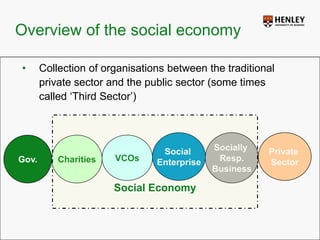
Overview of the social economyCollection of organisations between the traditional private sector and the public sector (some times called ‘Third Sector’)Social EconomySocial EnterpriseSocially Resp.BusinessPrivate SectorGov.CharitiesVCOs
Why is the social economy important?Job creation in new enterprisesContributes to efficient competition Offers potential for new forms of entrepreneurshipMeets new needs especially of marginalised communitiesFavors local participation and voluntary work Enhances solidarity and cohesion Provides training and employment to disadvantaged communities
Common Characteristics of Social EnterprisesEnterprise Orientation- directly involved in producing goods or providing services to market, part of third sector but characterised as more entrepreneurial and self financingSocial Aims- have explicit social aims such as job creation, providing goods or services.Social Ownership- based on participation by stakeholder groups (DTI- Strategy for Success & SE Coalition 2002)
The accepted definition…“……businesses with primarily social objectives whose surpluses are principally reinvested for that purpose in the business or in the community, rather than being driven by the need to maximise profit for shareholders”DTI, 2002
The Locus of social enterpriseSource: AMION Consulting 2001
Types of Social Enterprises (1)Employee-owned business : creates and preserves jobsCo-operative : association of persons united to meet common economic and social needs through jointly owned enterpriseSocial Firm : commercial enterprise that employs and trains disadvantaged or disabled peopleIntermediate Labour Market Company: provides training and work experience for the long term unemployedCommunity Business: social enterprise focusing on local markets and services
Types of Social Enterprises (2)Charity Trading Arm: enable charities to meet their objectives in innovative waysSocial Business: not-for-profit business, supports the work of a charity or non-governmental organisationCredit Union: provide access to financeDevelopment Trust: focus on community based regenerationHousing Association: provides social or low cost housing to people in need
Characteristics of Social  EnterprisesSocial Enterprises:9© Third Sector Enterprise Ltd (3SE) 2006
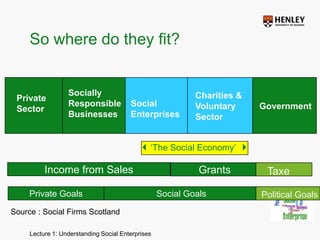
So where do they fit?Socially Responsible BusinessesCharities & Voluntary Sector GovernmentPrivate SectorSocial Enterprises‘The Social Economy’Income from SalesGrantsTaxesPrivate GoalsSocial GoalsPolitical GoalsSource : Social Firms Scotland
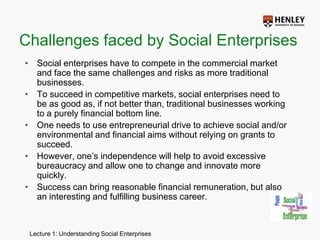
Challenges faced by Social EnterprisesSocial enterprises have to compete in the commercial market and face the same challenges and risks as more traditional businesses. To succeed in competitive markets, social enterprises need to be as good as, if not better than, traditional businesses working to a purely financial bottom line.One needs to use entrepreneurial drive to achieve social and/or environmental and financial aims without relying on grants to succeed. However, one’s independence will help to avoid excessive bureaucracy and allow one to change and innovate more quickly. Success can bring reasonable financial remuneration, but also an interesting and fulfilling business career.
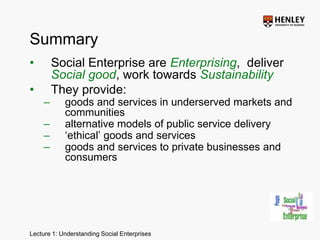
SummarySocial Enterprise are Enterprising,  deliver Social good, work towards SustainabilityThey provide:goods and services in underserved markets and communitiesalternative models of public service delivery ‘ethical’ goods and servicesgoods and services to private businesses and consumers
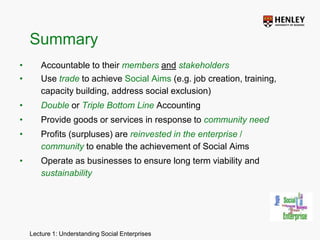
SummaryAccountable to their membersandstakeholdersUsetrade to achieve Social Aims (e.g. job creation, training, capacity building, address social exclusion) Doubleor Triple Bottom LineAccountingProvide goods or services in response to community needProfits (surpluses) are reinvested in the enterprise / communityto enable the achievement of Social AimsOperate as businesses to ensure long term viability and sustainability
Social Enterprise Success Storieshttp://www.youtube.com/watch?v=jk5LI_WcosQ

Understanding Social Enterprises

  • 1.
  • 2.
    Overview of thesocial economyCollection of organisations between the traditional private sector and the public sector (some times called ‘Third Sector’)Social EconomySocial EnterpriseSocially Resp.BusinessPrivate SectorGov.CharitiesVCOs
  • 3.
    Why is thesocial economy important?Job creation in new enterprisesContributes to efficient competition Offers potential for new forms of entrepreneurshipMeets new needs especially of marginalised communitiesFavors local participation and voluntary work Enhances solidarity and cohesion Provides training and employment to disadvantaged communities
  • 4.
    Common Characteristics ofSocial EnterprisesEnterprise Orientation- directly involved in producing goods or providing services to market, part of third sector but characterised as more entrepreneurial and self financingSocial Aims- have explicit social aims such as job creation, providing goods or services.Social Ownership- based on participation by stakeholder groups (DTI- Strategy for Success & SE Coalition 2002)
  • 5.
    The accepted definition…“……businesseswith primarily social objectives whose surpluses are principally reinvested for that purpose in the business or in the community, rather than being driven by the need to maximise profit for shareholders”DTI, 2002
  • 6.
    The Locus ofsocial enterpriseSource: AMION Consulting 2001
  • 7.
    Types of SocialEnterprises (1)Employee-owned business : creates and preserves jobsCo-operative : association of persons united to meet common economic and social needs through jointly owned enterpriseSocial Firm : commercial enterprise that employs and trains disadvantaged or disabled peopleIntermediate Labour Market Company: provides training and work experience for the long term unemployedCommunity Business: social enterprise focusing on local markets and services
  • 8.
    Types of SocialEnterprises (2)Charity Trading Arm: enable charities to meet their objectives in innovative waysSocial Business: not-for-profit business, supports the work of a charity or non-governmental organisationCredit Union: provide access to financeDevelopment Trust: focus on community based regenerationHousing Association: provides social or low cost housing to people in need
  • 9.
    Characteristics of Social EnterprisesSocial Enterprises:9© Third Sector Enterprise Ltd (3SE) 2006
  • 10.
    So where dothey fit?Socially Responsible BusinessesCharities & Voluntary Sector GovernmentPrivate SectorSocial Enterprises‘The Social Economy’Income from SalesGrantsTaxesPrivate GoalsSocial GoalsPolitical GoalsSource : Social Firms Scotland
  • 11.
    Challenges faced bySocial EnterprisesSocial enterprises have to compete in the commercial market and face the same challenges and risks as more traditional businesses. To succeed in competitive markets, social enterprises need to be as good as, if not better than, traditional businesses working to a purely financial bottom line.One needs to use entrepreneurial drive to achieve social and/or environmental and financial aims without relying on grants to succeed. However, one’s independence will help to avoid excessive bureaucracy and allow one to change and innovate more quickly. Success can bring reasonable financial remuneration, but also an interesting and fulfilling business career.
  • 12.
    SummarySocial Enterprise areEnterprising, deliver Social good, work towards SustainabilityThey provide:goods and services in underserved markets and communitiesalternative models of public service delivery ‘ethical’ goods and servicesgoods and services to private businesses and consumers
  • 13.
    SummaryAccountable to theirmembersandstakeholdersUsetrade to achieve Social Aims (e.g. job creation, training, capacity building, address social exclusion) Doubleor Triple Bottom LineAccountingProvide goods or services in response to community needProfits (surpluses) are reinvested in the enterprise / communityto enable the achievement of Social AimsOperate as businesses to ensure long term viability and sustainability
  • 14.
    Social Enterprise SuccessStorieshttp://www.youtube.com/watch?v=jk5LI_WcosQ