


Social Enterprise Workshop
Government Office for South West
&
SWRDA
Julie Harris
RISE
22nd
October 2010
Overview
• RISE
• Context and current reports
• Social enterprise standards
• Broad underpinning knowledge
• Understanding social enterprise
RISE
• RISE is the voice for South West social enterprise and supports
the development of sustainable social enterprise in the region.
• Membership
• BAN
• Newsletter
• Projects – marketing, leadership, food,
housing, health and social care
The Big Picture
• Private Sector
• Civil Sector/ Social Economy
• Public Sector
What are they?
• Social enterprises have 2 primary aims:
– They trade
– They apply profits to social purpose
What are they?
• Some definitions:
– A business with primarily social objectives whose surpluses
are principally reinvested for that purpose in the business or
in the community, rather than being driven by the need to
maximise profit for shareholders and owners (dti)
– Businesses that aim not only to make money, but also to
have a positive effect on the communities they serve, the
people with whom they work and their own employees
(Co-active Ltd)
– Social enterprises are businesses that trade in order to
pursue a social aim (Business Link)
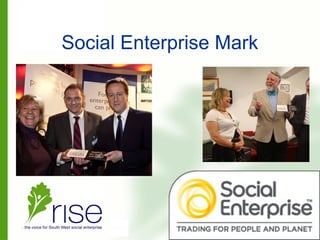
Social Enterprise Mark
• National programme
• 290 holders (and growing)
• Marketing
• www.socialenterprisemark.org.uk
Social Enterprise Mark
What are they?
• Social enterprises are:
– ‘More than profit’ organisations
– Seek to meet social aims by engaging in economic and
trading activities
– Have legal structures which ensure that all assets are not in
the ownership of individuals but are held in trust for the
benefit of those persons and/or areas that are the intended
beneficiaries of the enterprise’s social aims.
– Have organisational structures in which full participation of
members is encouraged on a co-operative basis with equal
rights accorded to all members
What are they?
• Characteristics
– Enterprise orientation – they are directly involved in
producing goods or providing services to a market
– Social aims – they have explicit social ethical values
including a commitment to local capacity building. They are
accountable to their members/stakeholders and the wider
community for their social, environmental and economic
impact (RISE)
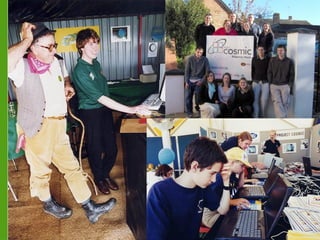
Example - COSMIC
• Providing ICT support and services
• Turnover £500k, 13 employees
• > 50% income from trading
• Membership
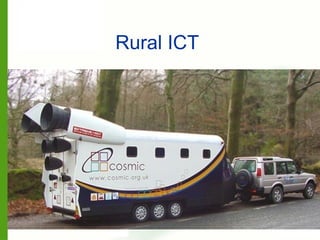
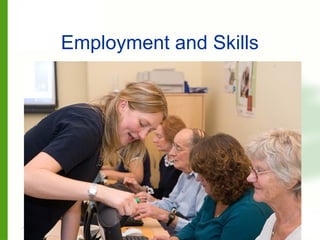
• Focus on rural ICT, skills, employment
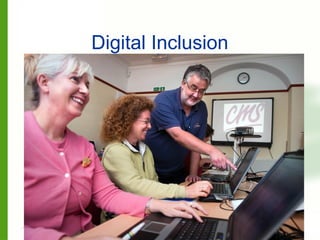
• Digital Inclusion …and now .. leadership
Rural ICT
Digital Inclusion
Employment and Skills
Leadership Development
How are they different?
How are social enterprises different from
– ‘traditional business’?
– voluntary and community organisations?
– public sector?
Clear focus on social objectives
Trading and generating profits – financial, social,
environmental
How are they different?
• Measures of success
– Traditional business
• Operates in the interest of the owner or shareholders
• To make profit
– A social enterprise has broader measures
• Profits are invested in social purpose
• Local good-quality employment
• Spending money in the local economy
• Providing an alternative business model
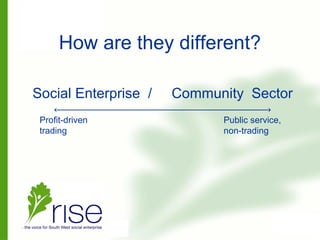
How are they different?
Social Enterprise / Community Sector
Profit-driven
trading
Public service,
non-trading
Where do Social Enterprises fit
in Big Society?
• Public services – delivery and support
– Health and social care
– Community Land Trusts
– Free schools
– Probation, rehabilitation and offender schemes
– Worklessness
– Asset Management and Community Buildings
– Supply chains
Characteristics of a successful
social enterprise
– Gaining independence and autonomy through trading
– Entrepreneurial, innovative, risk-taking behaviour
– Flexible and adaptable practices
– Customer and community focus
– Stakeholder engagement
Their values
– Not just to make a profit – having social purpose
– To make a difference:
• In the way they are managed, owned and accountable
• In the way they deliver goods and services
• In the way they work with their community and
stakeholders
• In the way they do business
Forms of social enterprise
• Community Interest Companies (run by and for a particular
community)
– www.cicregulator.gov.uk
• Co-operatives (businesses owned and run by a group of people
for the benefit of their members)
– www.coop.co.uk
• Development Trusts (community based and owned regeneration
enterprises)
– ( www.dta.org.uk )
Forms of social enterprise
• Social Firms (businesses that have a significant number of
employees with a disability)
– (www.socialfirms.co.uk )
• Trading arms of some charities
– Charitable company with a community business that
transfers surplus to the charity
• Industrial and Provident Societies
– Credit Unions, community owns shares in a shop or centre
What do they do?
– Offer social or environmental goods and services
• e.g. recycling or childcare
– Trading to provide (or cross-subsidise) social or
environmental goods or services
• Trading arms of some charities
– Use processes or ways of working that have significant
social benefit
• Care workers organise themselves as a co-operative in
order to take control of their work environment
Why choose
social enterprise?
• Founders of social enterprises are motivated by
– A desire to improve their community
– Values that motivate partnership working
– Member involvement
– Concern for local services
Where do they come from?
• Local residents are offered a community facility if a sustainable business
plan can be written
• A crèche is becoming large and parents would like to develop to a full-time
nursery
• Local residents in partnership with the local council develop a disused site
as business units to improve employment opportunities
• Community recycling project develops into sustainable business with local
employment
• Voluntary group wishes to expand its activities and become more
commercial
• A group of workers buys a business from their retiring manager
Where do they come from?
• A community centre offers training and skills development
through accredited courses
• A group of workers creates a co-operative catering business
• A funded project coming to the end of its funding package wants
to continue by charging for services and delivering under
contract
• Regeneration activity has inspired a community to set up a
development trust to continue managing community assets
• Community composting through volunteers has grown and
needs to become a community business
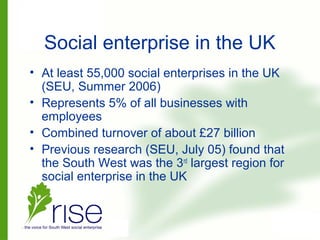
Social enterprise in the UK
• At least 55,000 social enterprises in the UK
(SEU, Summer 2006)
• Represents 5% of all businesses with
employees
• Combined turnover of about £27 billion
• Previous research (SEU, July 05) found that
the South West was the 3rd
largest region for
social enterprise in the UK
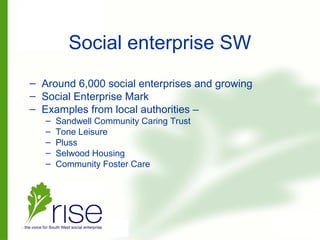
Social enterprise SW
– Around 6,000 social enterprises and growing
– Social Enterprise Mark
– Examples from local authorities –
– Sandwell Community Caring Trust
– Tone Leisure
– Pluss
– Selwood Housing
– Community Foster Care
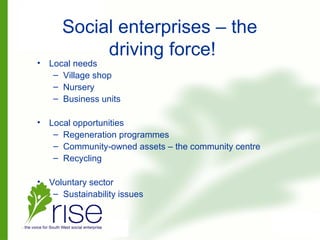
Social enterprises – the
driving force!
• Local needs
– Village shop
– Nursery
– Business units
• Local opportunities
– Regeneration programmes
– Community-owned assets – the community centre
– Recycling
• Voluntary sector
– Sustainability issues
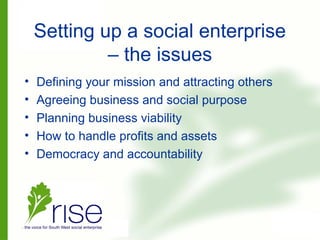
Setting up a social enterprise
– the issues
• Defining your mission and attracting others
• Agreeing business and social purpose
• Planning business viability
• How to handle profits and assets
• Democracy and accountability
Voluntary organisation to
social enterprise
• The big issues include:
• Culture change
• Business structures
• Business planning
• Accountability (funding bodies - stakeholders)
• The workforce can be a mix of staff and volunteers
Incorporation
• A social enterprise is usually an incorporated body (a company)
– Protects individuals from personal liability
– Winding up – debt
– Something going wrong
– Needs to be seen to be accountable and open
– Difficulties of engaging people if no safeguards
– Own legal identity
– Limits of protection
Forms of Incorporation
• Private sector company options
– Company limited by guarantee
– Company limited by shares (private or public)
• Social enterprise sector company options
– Company limited by guarantee
– Community Interest Company
– Industrial and Provident Society (IPS)
Charitable or not charitable?
Forms of Incorporation
• Social enterprise constitutions enable
– One member one vote
– Clear membership terms supporting the objects of the
society
– Surplus distribution for social purpose
– Community assets to be safeguarded
– Distribution of assets or bonuses evenly among the
members of a co-operative
Models of social enterprise
• Co-operatives – IPS
– Workers own the business – worker co-operatives
– Co-operative Consortium – self-employed people or other
businesses come together to form a consortium or
marketing co-operative
• Community Business – CIC, Company Ltd by Guarantee
– Owned and run by a community
– Representation from the workforce, the locality, other
organisations
• Development Trusts
– Asset-based development with community ownership
– Often a range of projects under one umbrella organisation
Sources of start-up capital
• Membership subscriptions or share capital
• Start-up grants and loans
• Borrowing from financial institutions
• Community Development Finance
• Leasing and hire purchase
• Personal funds
• Fundraising
• Volunteer labour
• Asset transfer
Sources of start-up capital
• Commercial Loan
• Community Development Finance Institutions:
www.cdfa.org.uk
–Bridges Community Ventures Ltd
–Charity Bank
–Cooperative and Community Finance
–South West Investment Group
–Triodos Bank
–Wessex Reinvestment Trust Group
Trading Income
• Consider:
– Reinvestment in the social enterprise
– Keeping adequate reserves
– Looking beyond grants
– Making use of tax incentives
Trading income
• Robust financial management is needed
Why?
- Accountability
- Communication between board and operational management
- Trading income, managing cash flows, reporting on grant targets
- A mix of trading income and other income
- Impacts on profit/loss, health of the business
Support systems
National
• Co-operatives UK www.cooperatives-uk.coop
• Social Firms UK www.socialfirms.co.uk
• Social Enterprise Coalition
www.socialenterprise.org.uk
• Development Trust Association www.dta.org.uk
Support systems
Regional
• Regional Infrastructure for Social Enterprise (RISE) –
or often equivalent in other regions
• Networks for advisors (in the South West RISE runs the Business
Advisors Network)
• Business Links
• Regional Development Agency
Local
• Look up your local support organisations. The RISE
website gives a list of these in the South West.
www.rise-sw.co.uk
There is also a list on the Social Enterprise Coalition
website www.socialenterprise.org.uk
Questions and Discussions
• Contact details –
• Julie Harris
• 01392 435775
• julieharris@rise-sw.co.uk

GOSW Social Enterprise Workshop Oct 2010

  • 1.
    Social Enterprise Workshop GovernmentOffice for South West & SWRDA Julie Harris RISE 22nd October 2010
  • 2.
    Overview • RISE • Contextand current reports • Social enterprise standards • Broad underpinning knowledge • Understanding social enterprise
  • 3.
    RISE • RISE isthe voice for South West social enterprise and supports the development of sustainable social enterprise in the region. • Membership • BAN • Newsletter • Projects – marketing, leadership, food, housing, health and social care
  • 4.
    The Big Picture •Private Sector • Civil Sector/ Social Economy • Public Sector
  • 5.
    What are they? •Social enterprises have 2 primary aims: – They trade – They apply profits to social purpose
  • 6.
    What are they? •Some definitions: – A business with primarily social objectives whose surpluses are principally reinvested for that purpose in the business or in the community, rather than being driven by the need to maximise profit for shareholders and owners (dti) – Businesses that aim not only to make money, but also to have a positive effect on the communities they serve, the people with whom they work and their own employees (Co-active Ltd) – Social enterprises are businesses that trade in order to pursue a social aim (Business Link)
  • 7.
    Social Enterprise Mark •National programme • 290 holders (and growing) • Marketing • www.socialenterprisemark.org.uk
  • 8.
  • 9.
    What are they? •Social enterprises are: – ‘More than profit’ organisations – Seek to meet social aims by engaging in economic and trading activities – Have legal structures which ensure that all assets are not in the ownership of individuals but are held in trust for the benefit of those persons and/or areas that are the intended beneficiaries of the enterprise’s social aims. – Have organisational structures in which full participation of members is encouraged on a co-operative basis with equal rights accorded to all members
  • 10.
    What are they? •Characteristics – Enterprise orientation – they are directly involved in producing goods or providing services to a market – Social aims – they have explicit social ethical values including a commitment to local capacity building. They are accountable to their members/stakeholders and the wider community for their social, environmental and economic impact (RISE)
  • 11.
    Example - COSMIC •Providing ICT support and services • Turnover £500k, 13 employees • > 50% income from trading • Membership • Focus on rural ICT, skills, employment • Digital Inclusion …and now .. leadership
  • 13.
  • 14.
  • 15.
  • 16.
  • 17.
    How are theydifferent? How are social enterprises different from – ‘traditional business’? – voluntary and community organisations? – public sector? Clear focus on social objectives Trading and generating profits – financial, social, environmental
  • 18.
    How are theydifferent? • Measures of success – Traditional business • Operates in the interest of the owner or shareholders • To make profit – A social enterprise has broader measures • Profits are invested in social purpose • Local good-quality employment • Spending money in the local economy • Providing an alternative business model
  • 19.
    How are theydifferent? Social Enterprise / Community Sector Profit-driven trading Public service, non-trading
  • 20.
    Where do SocialEnterprises fit in Big Society? • Public services – delivery and support – Health and social care – Community Land Trusts – Free schools – Probation, rehabilitation and offender schemes – Worklessness – Asset Management and Community Buildings – Supply chains
  • 21.
    Characteristics of asuccessful social enterprise – Gaining independence and autonomy through trading – Entrepreneurial, innovative, risk-taking behaviour – Flexible and adaptable practices – Customer and community focus – Stakeholder engagement
  • 22.
    Their values – Notjust to make a profit – having social purpose – To make a difference: • In the way they are managed, owned and accountable • In the way they deliver goods and services • In the way they work with their community and stakeholders • In the way they do business
  • 23.
    Forms of socialenterprise • Community Interest Companies (run by and for a particular community) – www.cicregulator.gov.uk • Co-operatives (businesses owned and run by a group of people for the benefit of their members) – www.coop.co.uk • Development Trusts (community based and owned regeneration enterprises) – ( www.dta.org.uk )
  • 24.
    Forms of socialenterprise • Social Firms (businesses that have a significant number of employees with a disability) – (www.socialfirms.co.uk ) • Trading arms of some charities – Charitable company with a community business that transfers surplus to the charity • Industrial and Provident Societies – Credit Unions, community owns shares in a shop or centre
  • 25.
    What do theydo? – Offer social or environmental goods and services • e.g. recycling or childcare – Trading to provide (or cross-subsidise) social or environmental goods or services • Trading arms of some charities – Use processes or ways of working that have significant social benefit • Care workers organise themselves as a co-operative in order to take control of their work environment
  • 27.
    Why choose social enterprise? •Founders of social enterprises are motivated by – A desire to improve their community – Values that motivate partnership working – Member involvement – Concern for local services
  • 28.
    Where do theycome from? • Local residents are offered a community facility if a sustainable business plan can be written • A crèche is becoming large and parents would like to develop to a full-time nursery • Local residents in partnership with the local council develop a disused site as business units to improve employment opportunities • Community recycling project develops into sustainable business with local employment • Voluntary group wishes to expand its activities and become more commercial • A group of workers buys a business from their retiring manager
  • 29.
    Where do theycome from? • A community centre offers training and skills development through accredited courses • A group of workers creates a co-operative catering business • A funded project coming to the end of its funding package wants to continue by charging for services and delivering under contract • Regeneration activity has inspired a community to set up a development trust to continue managing community assets • Community composting through volunteers has grown and needs to become a community business
  • 30.
    Social enterprise inthe UK • At least 55,000 social enterprises in the UK (SEU, Summer 2006) • Represents 5% of all businesses with employees • Combined turnover of about £27 billion • Previous research (SEU, July 05) found that the South West was the 3rd largest region for social enterprise in the UK
  • 31.
    Social enterprise SW –Around 6,000 social enterprises and growing – Social Enterprise Mark – Examples from local authorities – – Sandwell Community Caring Trust – Tone Leisure – Pluss – Selwood Housing – Community Foster Care
  • 32.
    Social enterprises –the driving force! • Local needs – Village shop – Nursery – Business units • Local opportunities – Regeneration programmes – Community-owned assets – the community centre – Recycling • Voluntary sector – Sustainability issues
  • 33.
    Setting up asocial enterprise – the issues • Defining your mission and attracting others • Agreeing business and social purpose • Planning business viability • How to handle profits and assets • Democracy and accountability
  • 34.
    Voluntary organisation to socialenterprise • The big issues include: • Culture change • Business structures • Business planning • Accountability (funding bodies - stakeholders) • The workforce can be a mix of staff and volunteers
  • 35.
    Incorporation • A socialenterprise is usually an incorporated body (a company) – Protects individuals from personal liability – Winding up – debt – Something going wrong – Needs to be seen to be accountable and open – Difficulties of engaging people if no safeguards – Own legal identity – Limits of protection
  • 36.
    Forms of Incorporation •Private sector company options – Company limited by guarantee – Company limited by shares (private or public) • Social enterprise sector company options – Company limited by guarantee – Community Interest Company – Industrial and Provident Society (IPS) Charitable or not charitable?
  • 37.
    Forms of Incorporation •Social enterprise constitutions enable – One member one vote – Clear membership terms supporting the objects of the society – Surplus distribution for social purpose – Community assets to be safeguarded – Distribution of assets or bonuses evenly among the members of a co-operative
  • 38.
    Models of socialenterprise • Co-operatives – IPS – Workers own the business – worker co-operatives – Co-operative Consortium – self-employed people or other businesses come together to form a consortium or marketing co-operative • Community Business – CIC, Company Ltd by Guarantee – Owned and run by a community – Representation from the workforce, the locality, other organisations • Development Trusts – Asset-based development with community ownership – Often a range of projects under one umbrella organisation
  • 39.
    Sources of start-upcapital • Membership subscriptions or share capital • Start-up grants and loans • Borrowing from financial institutions • Community Development Finance • Leasing and hire purchase • Personal funds • Fundraising • Volunteer labour • Asset transfer
  • 40.
    Sources of start-upcapital • Commercial Loan • Community Development Finance Institutions: www.cdfa.org.uk –Bridges Community Ventures Ltd –Charity Bank –Cooperative and Community Finance –South West Investment Group –Triodos Bank –Wessex Reinvestment Trust Group
  • 41.
    Trading Income • Consider: –Reinvestment in the social enterprise – Keeping adequate reserves – Looking beyond grants – Making use of tax incentives
  • 42.
    Trading income • Robustfinancial management is needed Why? - Accountability - Communication between board and operational management - Trading income, managing cash flows, reporting on grant targets - A mix of trading income and other income - Impacts on profit/loss, health of the business
  • 43.
    Support systems National • Co-operativesUK www.cooperatives-uk.coop • Social Firms UK www.socialfirms.co.uk • Social Enterprise Coalition www.socialenterprise.org.uk • Development Trust Association www.dta.org.uk
  • 44.
    Support systems Regional • RegionalInfrastructure for Social Enterprise (RISE) – or often equivalent in other regions • Networks for advisors (in the South West RISE runs the Business Advisors Network) • Business Links • Regional Development Agency Local • Look up your local support organisations. The RISE website gives a list of these in the South West. www.rise-sw.co.uk There is also a list on the Social Enterprise Coalition website www.socialenterprise.org.uk
  • 45.
    Questions and Discussions •Contact details – • Julie Harris • 01392 435775 • julieharris@rise-sw.co.uk

Editor's Notes

  • #3 Put course in context. Refer to other 3X1 day modules that provide more detail from the advisor’s persective.
  • #5 Introduce the concept of the third sector. Point out the dynamics between the sectors and current directions of change.
  • #10 This definition is from the Concise Project, Middlesex University. Use this more detailed definition to go through the various aspects of the definition and their fit into practice and the issues around defining such a wide and diverse sector
  • #11 Bring the group back to the core aspects of the definition
  • #12 Bring the group back to the core aspects of the definition
  • #18 Discuss in small groups and feedback to the class.
  • #20 Refer also to the larger chart of the social economy at the back of the pack.
  • #35 Introduce Case Study. Put Questions 1 and 2.
  • #37 Discuss commercial risk, trade, and charity
  • #45 Case Scenarios Question 4