Ontologies:
What Librarians Need to Know
Barry Smith
Department of Philosophy
University at Buffalo
presented at the conference on Research Data: Management, Access and Control,
University at Buffalo, November 14, 2011
http://libweb1.lib.buffalo.edu/blog/scholarly/?p=85 1
2
3/24
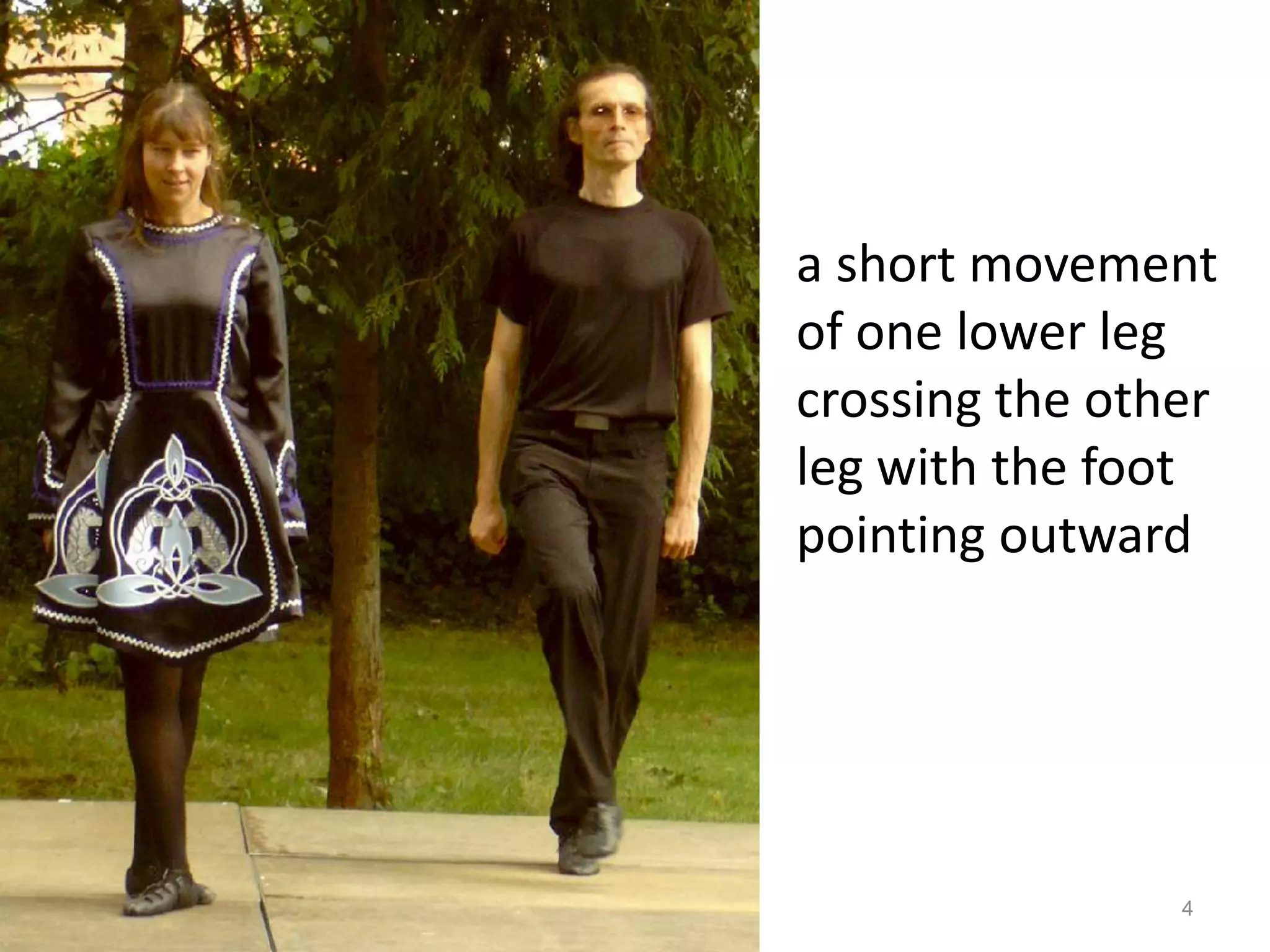
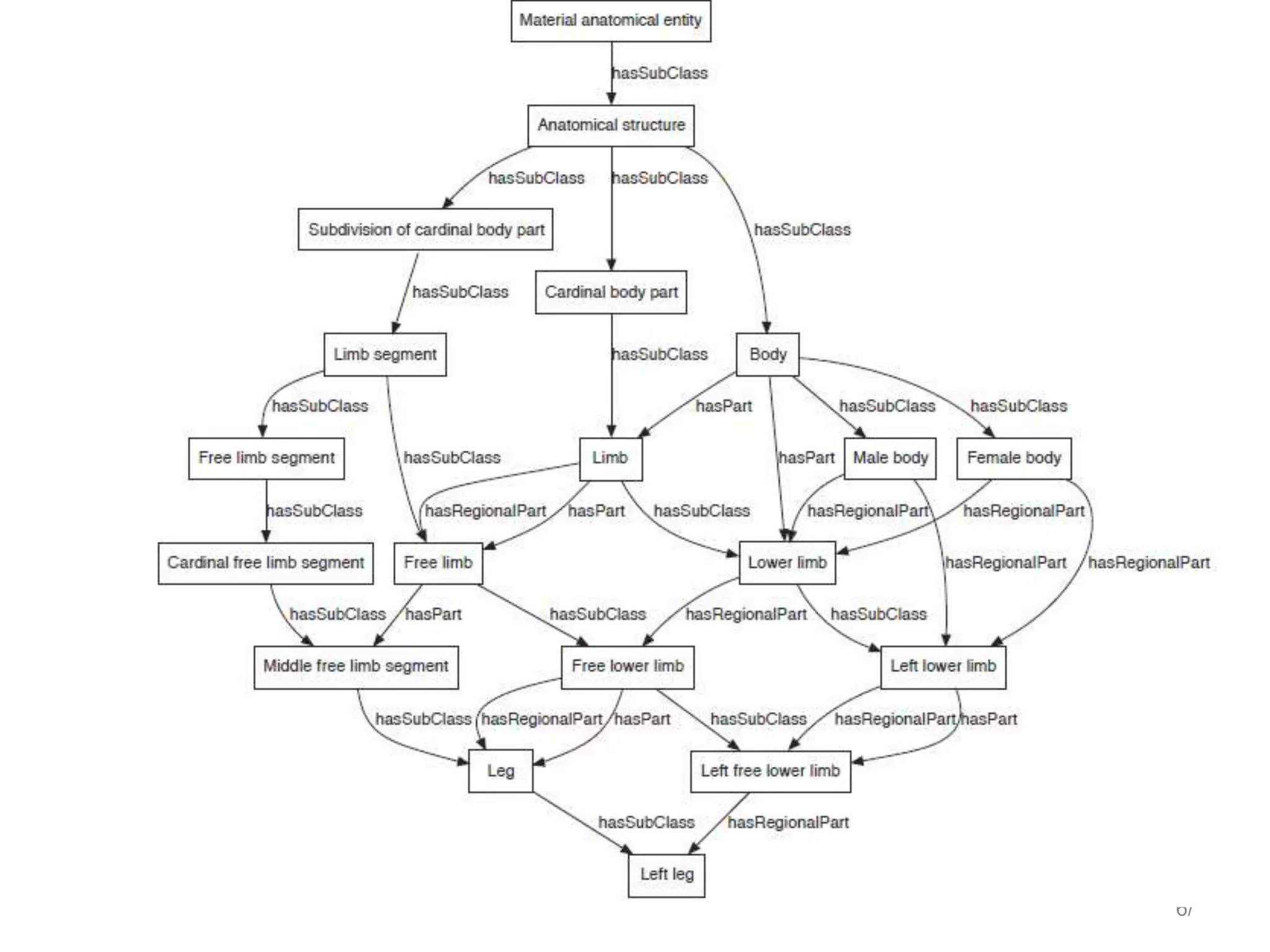
a short movement
of one lower leg
crossing the other
leg with the foot
pointing outward
4
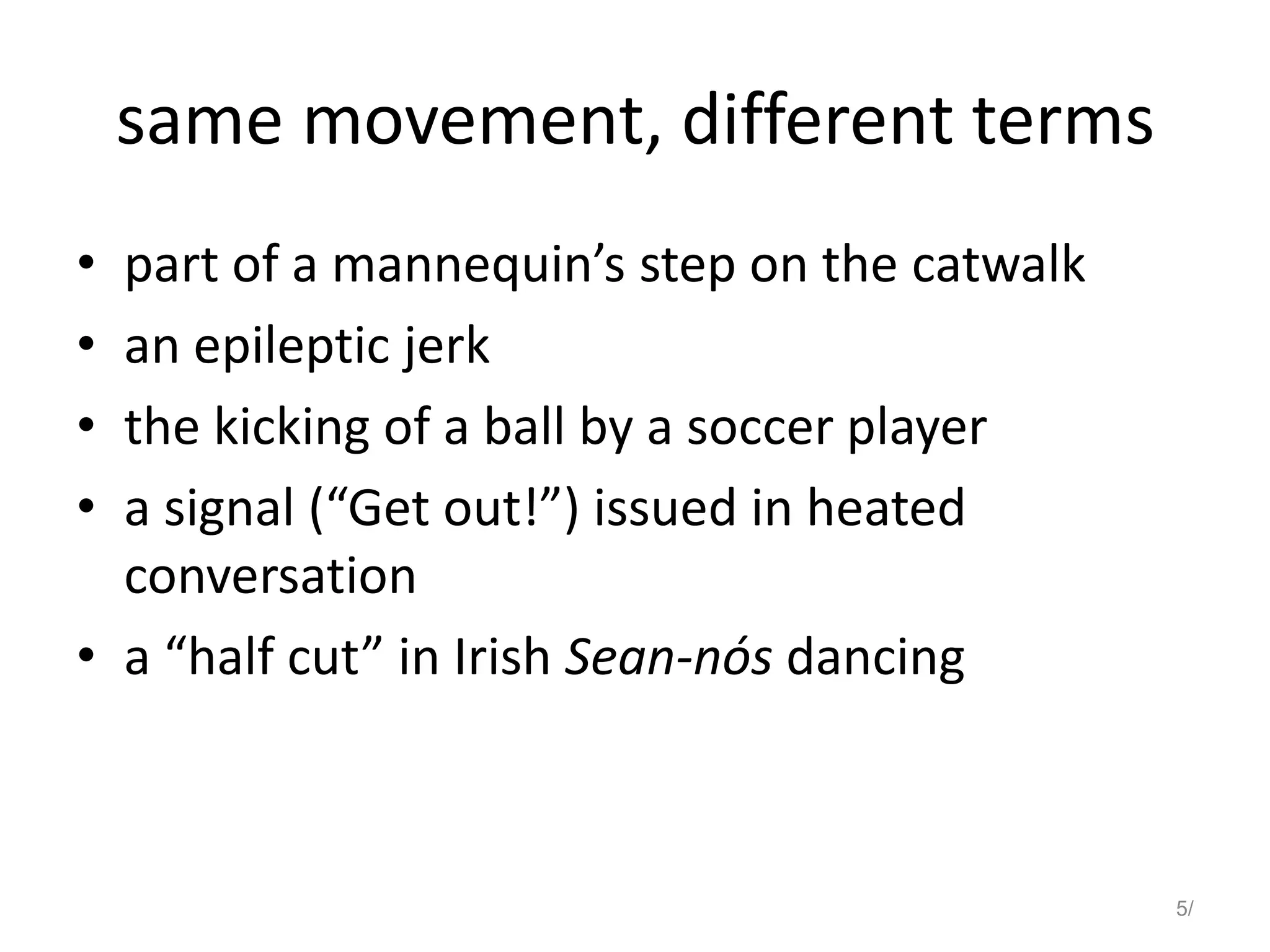
same movement, different terms
• part of a mannequin’s step on the catwalk
• an epileptic jerk
• the kicking of a ball by a soccer player
• a signal (“Get out!”) issued in heated
conversation
• a “half cut” in Irish Sean-nós dancing
5/
6/
Some questions
• How to find data?
• How to understand data when you find it?
• How to use data when you find it, for example in hypothesis-
checking and reasoning?
• How to integrate with other data?
• How to label the data you are collecting?
• How to build a set of labels for a new domain that will
integrate well with labels used in neighboring domains?
7
Network effects of the Web
• You build a site.
• Others discover the site and they link to it
• The more they link to it, the more important and well known
the page becomes (this is what Google exploits)
• Your page becomes important, and others begin to rely on it
• The same network effect works on the raw data
– Many people link to the data, use it
– Many more (and diverse) applications will be created
than the authors would even dream of
• New ‘secondary uses’ are discovered
Ivan Herman 8
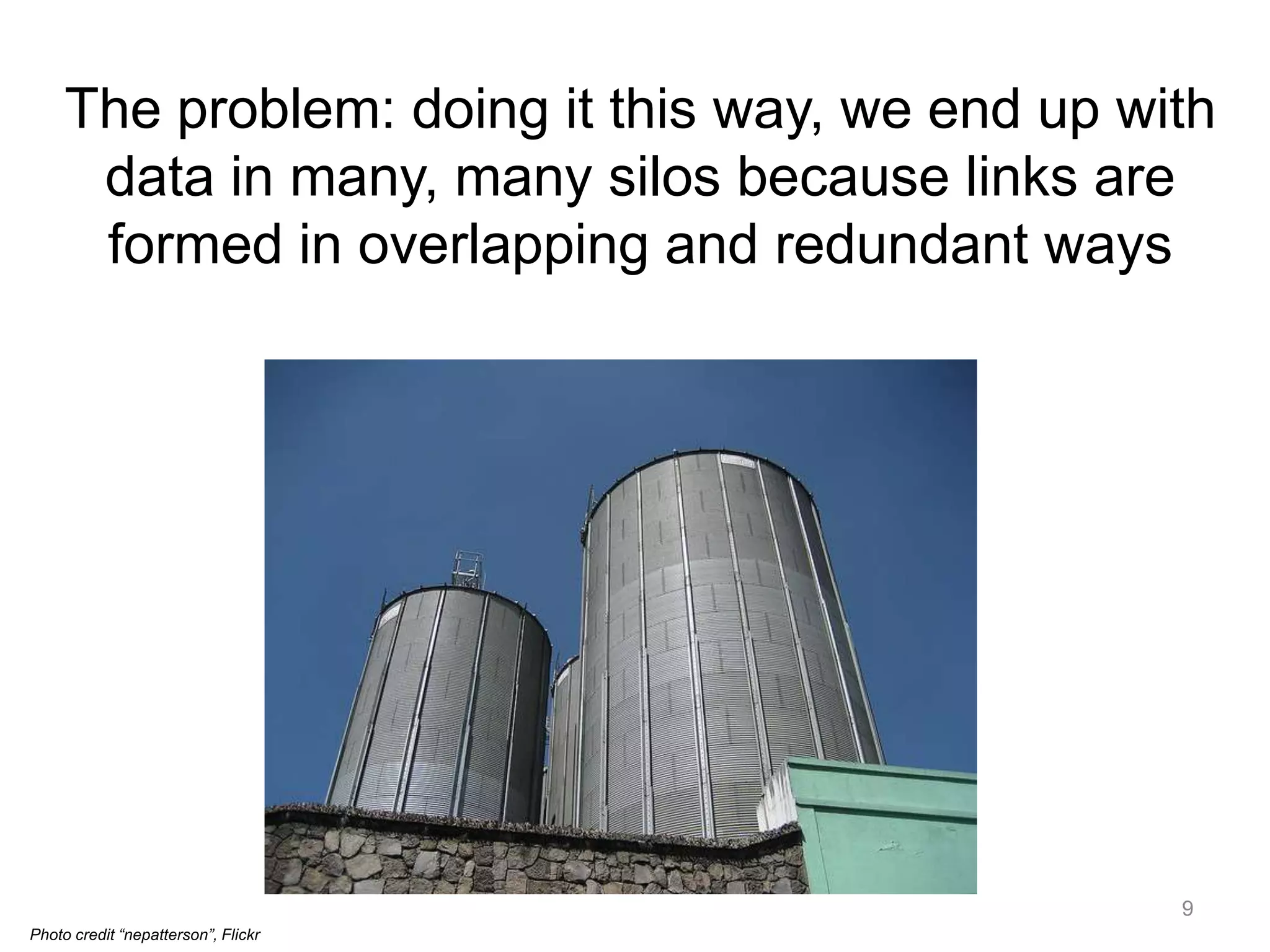
The problem: doing it this way, we end up with
data in many, many silos because links are
formed in overlapping and redundant ways
Photo credit “nepatterson”, Flickr
9
To avoid silos:
1. The raw data must be available in a
standard way on the Web.
2. There must be links among the
datasets to create a ‘web of data’
Use ontologies to capture common
meanings with definitions that are
understandable to both humans and
computers
The roots of Semantic Technology
Ontologies as controlled
vocabularies for the tagging of data
• Hardware changes rapidly
• Organizations rapidly forming and
disbanding collaborations
• Data is exploding
• Meanings of common words change slowly
• Use web architecture to annotate exploding
data stores using ontologies exploiting
these common meanings
11
Mandates for Data Reuse
• Organizations such as the NIH now require use
of common standards in a way that will ensure
that the results obtained through funded
research are more easily accessible to external
groups
• http://grants.nih.gov/grants/policy/data_sharing/
• http://www.nsf.gov/bfa/dias/policy/dmp.jsp
• Data Ontologies for Biomedical Research (R01):
http://grants.nih.gov/grants/guide/pa-files/par-07-
425.html
12/24
NCBO: National Center for
Biomedical Ontology
• Stanford Biomedical Research Informatics
• Mayo Clinic Department of Bioinformatics
• University at Buffalo, Department of
Philosophy
http://bioportal.bioontology.org/
13/24
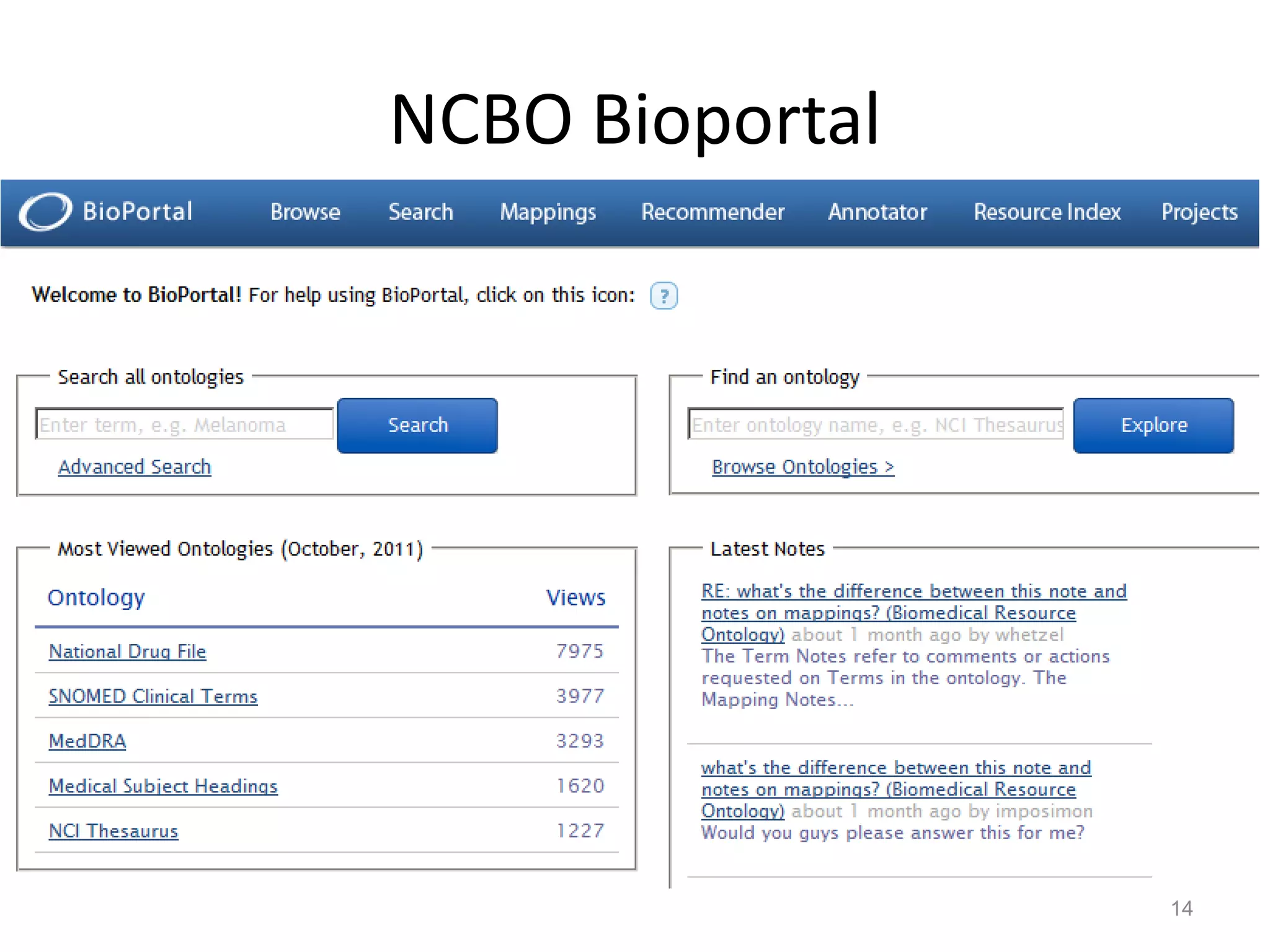
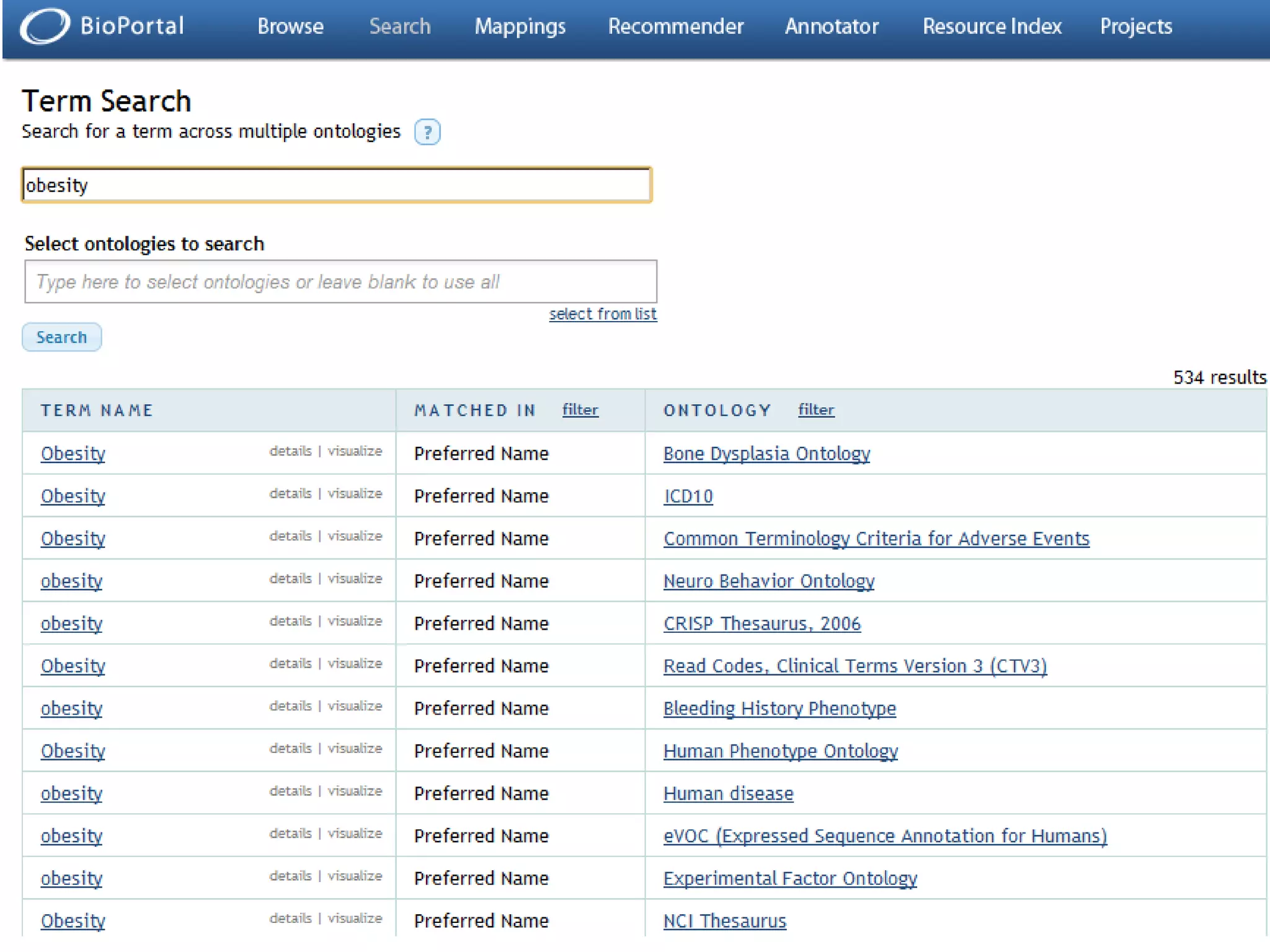
NCBO Bioportal
14
Goals of Semantic Technology
To support data reuse
To enable data registries
Metadata management
Support for Natural Language Understanding
Semantic Wikis
via ontologies formulated for example in
the Web Ontology Language (OWL)
15
Where we stand today
• html demonstrated the power of the Web to
allow sharing of information
• increasing availability of semantically enhanced
data
• increasing power of semantic software toallow
automatic reasoning with online information
• increasing use of OWL in attempts to break down
silos, and create useful integration of on-line
data and information
16
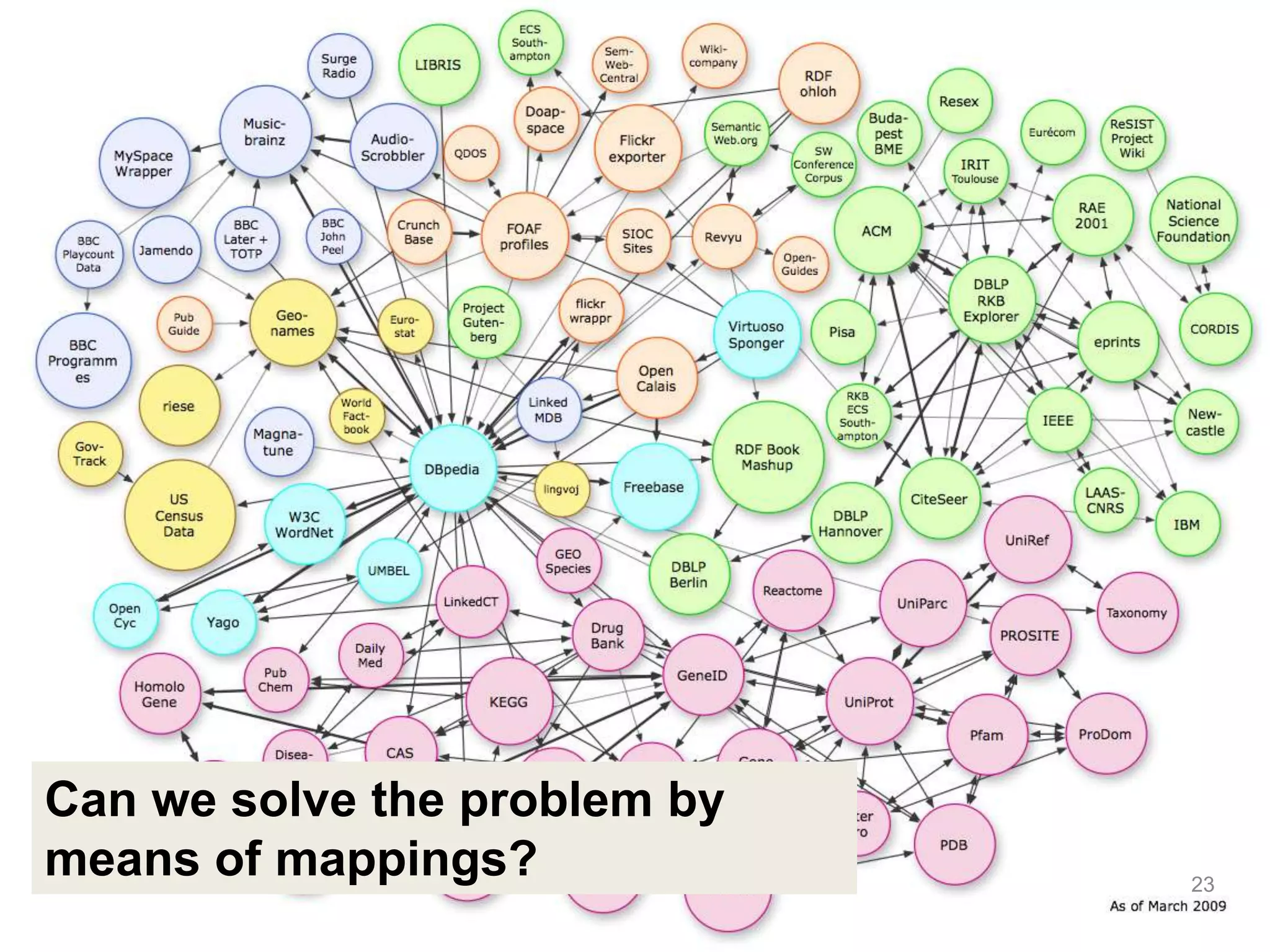
Ontology success stories, and some
reasons for failure
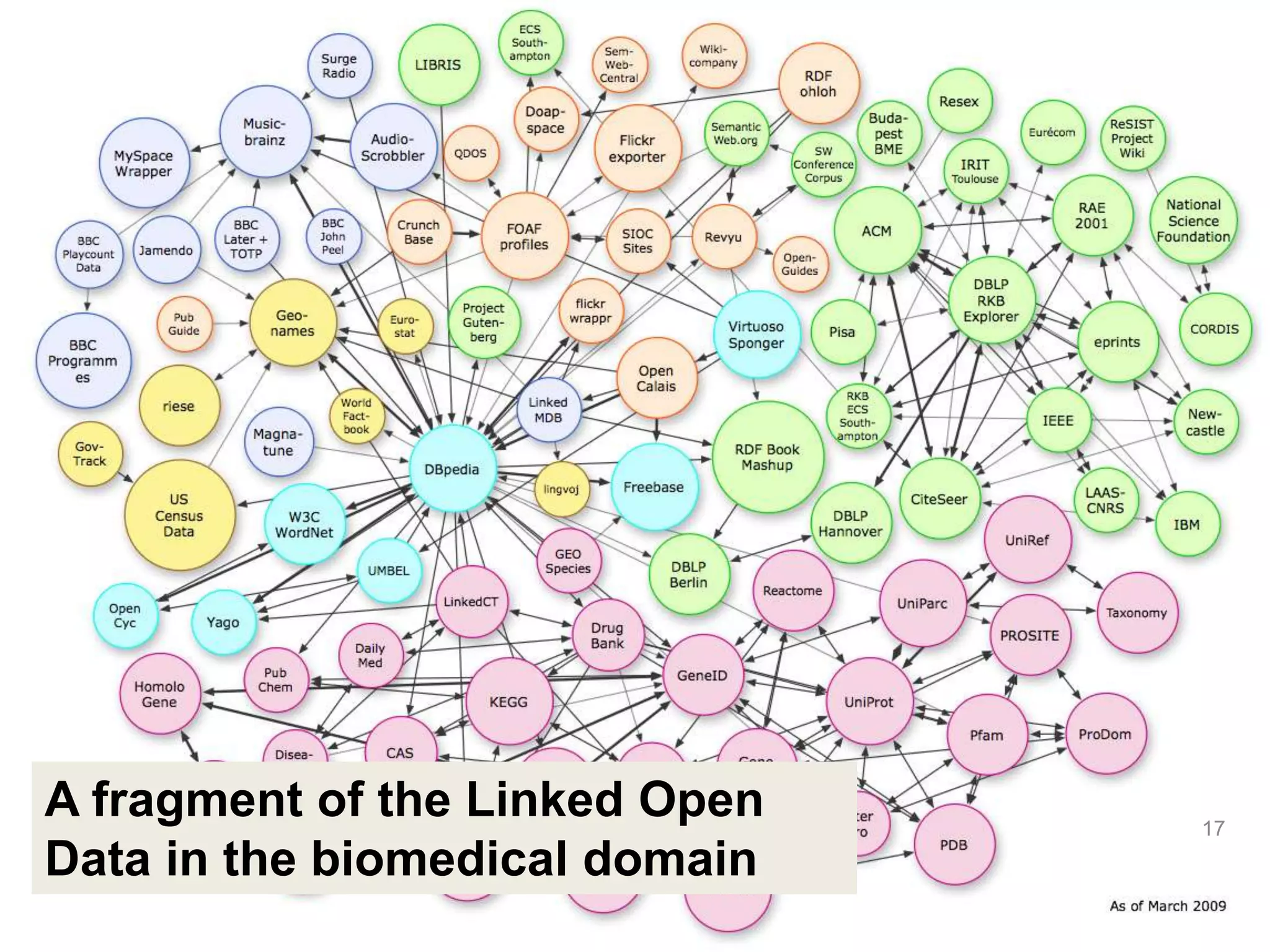
•
A fragment of the Linked Open
Data in the biomedical domain
17
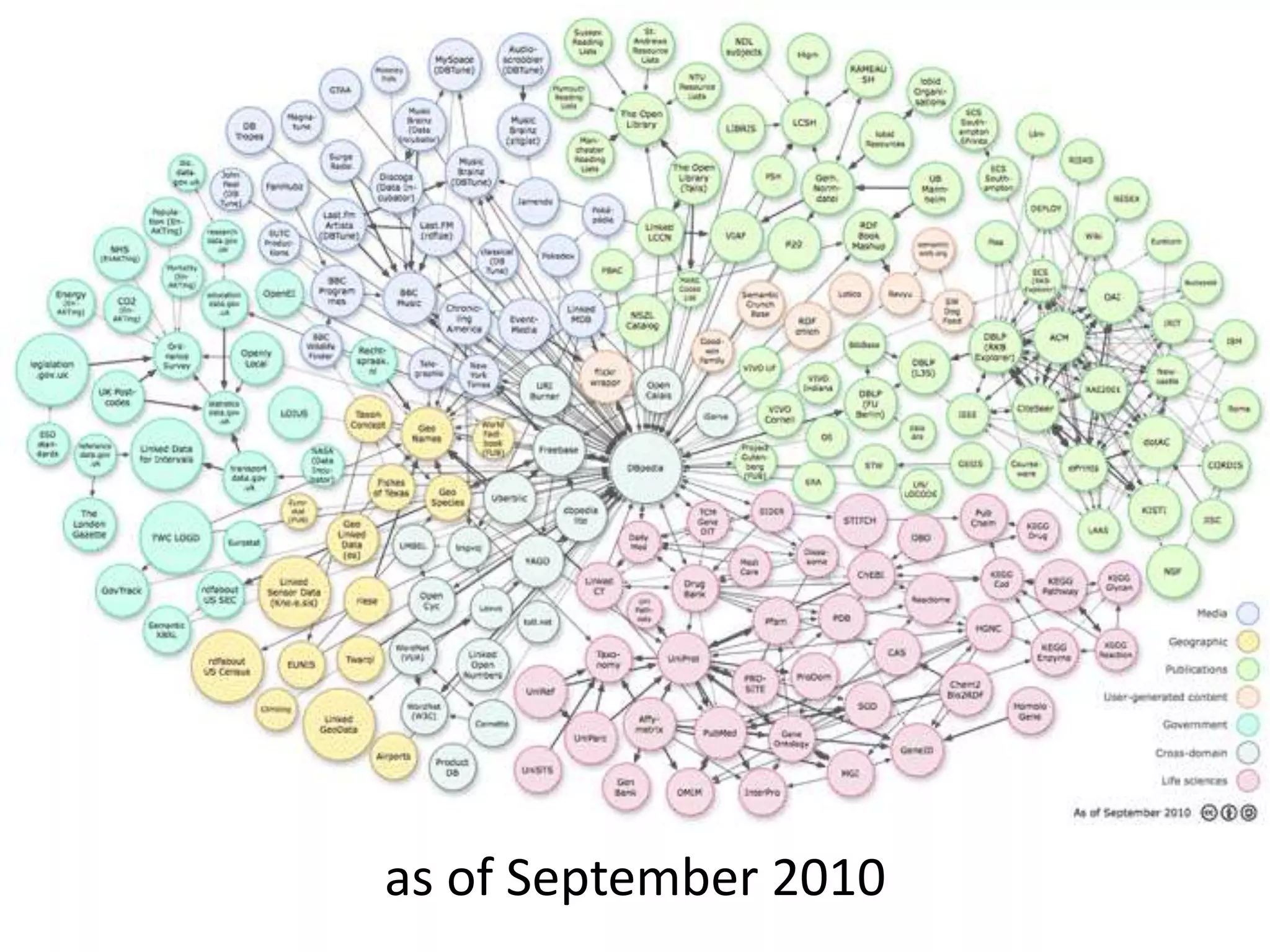
as of September 2010
The result: the more Semantic Technology
is successful, they more it fails to achieve
it goals
As we break down silos via controlled
vocabularies for the tagging of data
the very success of the approach leads to the
creation of ever new controlled vocabularies ,
semantic silos – because multiple ontologies
are being created in ad hoc ways
The Semantic Web framework as currently
conceived and governed by the W3C yields
minimal standardization
Creates data cemeteries
19
20/24
21/24
Reasons for this effect
• Shrink-wrapped software mentality – you will not
get paid for reusing old and good ontologies (Let
a million ‘lite’ ontologies bloom)
• Belief that there are no ‘good’ ontologies (just
arbitrary choices of terms and relations …)
• No licensing regime (database inspection tax …)
• Information technology (hardware) changes
constantly, not worth the effort of getting things
right
• We have done it this way for 30 years, we are not
going to change now
22
Ontology success stories, and some
reasons for failure
•
Can we solve the problem by
means of mappings? 23
Unified Medical Language System of
the National Library of Medicine
• let a million ontologies bloom, each one close
to the terminological habits of its authors
• in concordance with the “not invented here”
syndrome
• then map these ontologies, and use these
mappings to integrate your different pots of
data
24/24
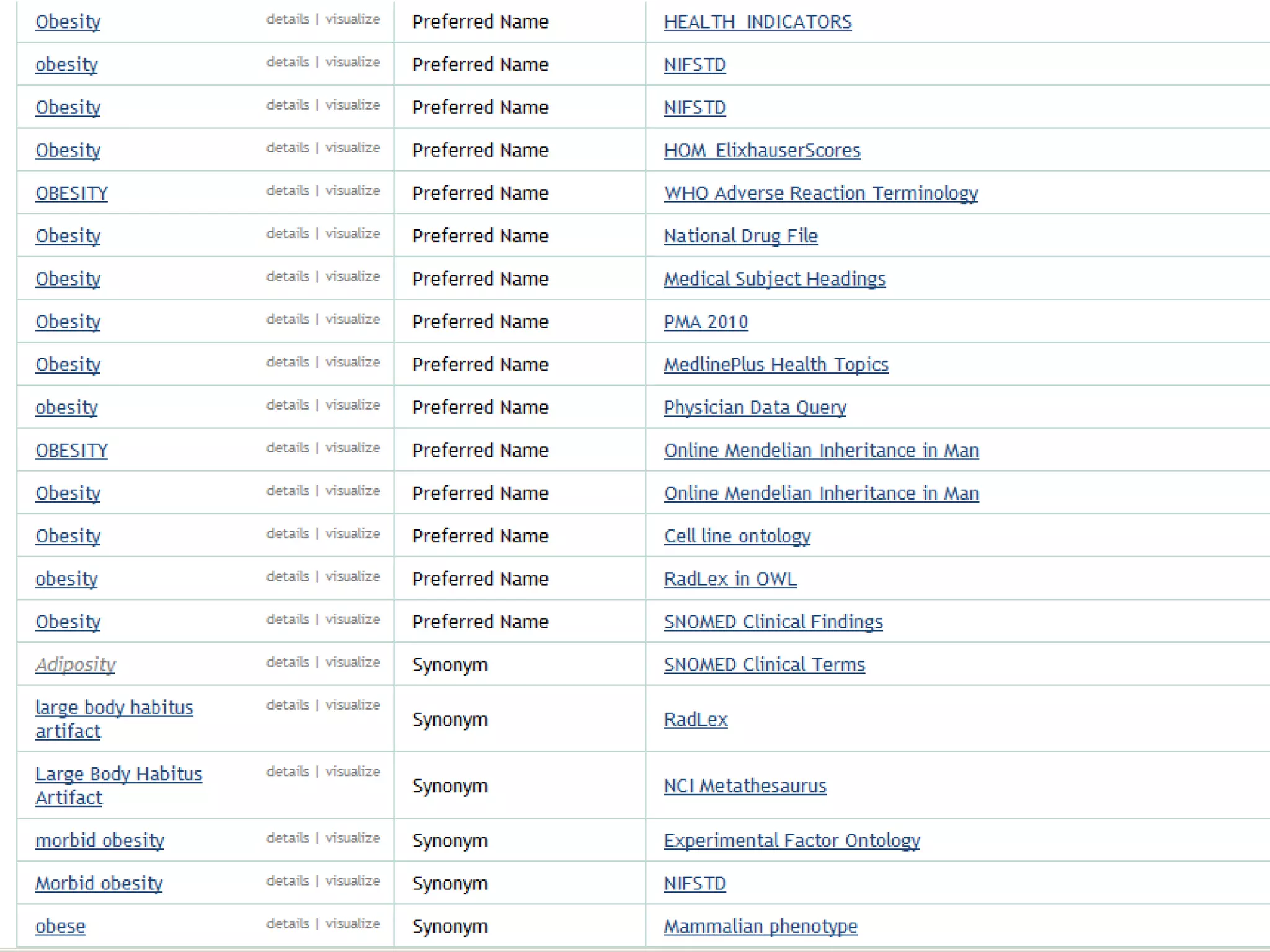
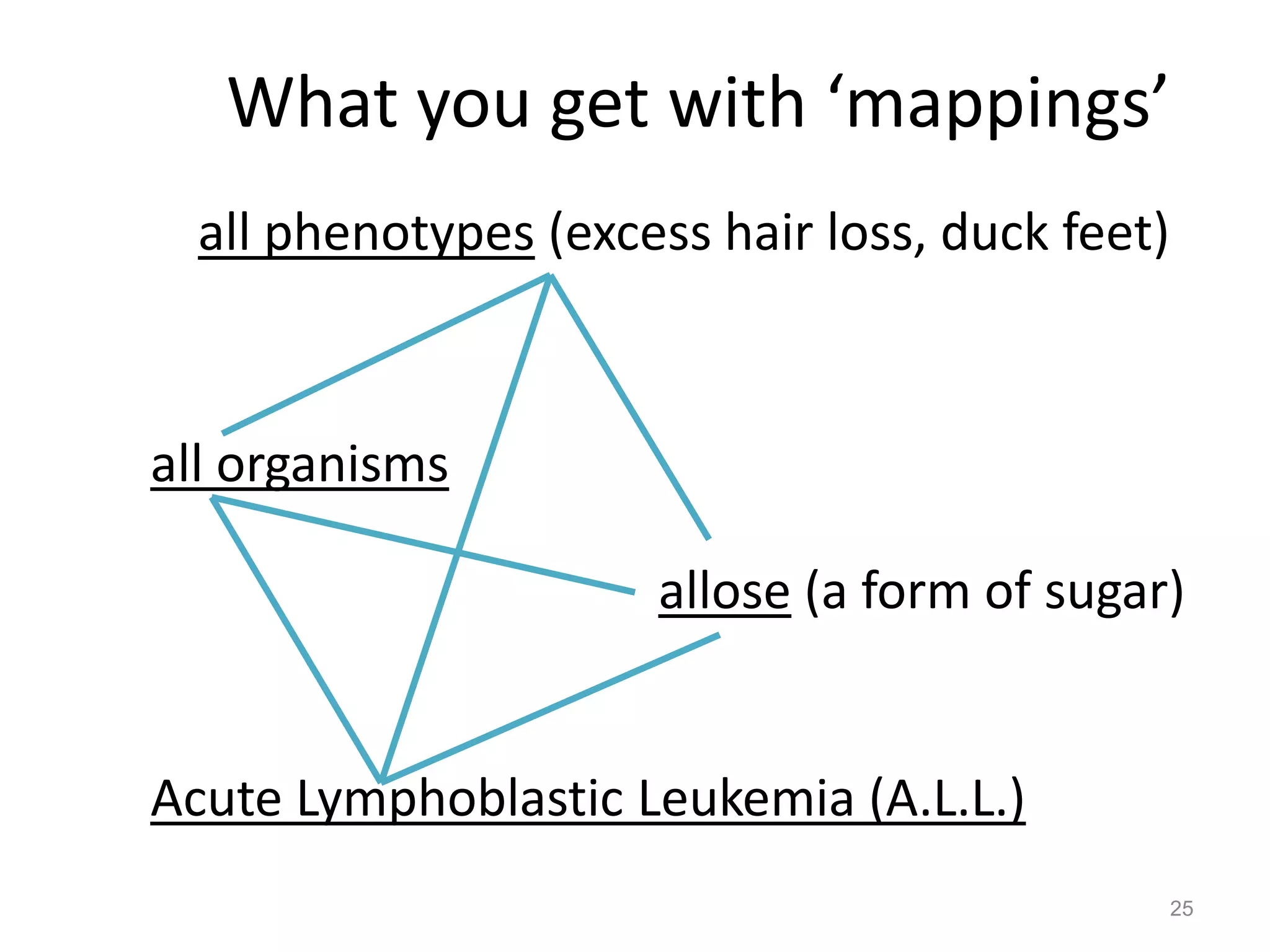
What you get with ‘mappings’
all phenotypes (excess hair loss, duck feet)
all organisms
allose (a form of sugar)
Acute Lymphoblastic Leukemia (A.L.L.)
25
Mappings are hard
They are fragile, and expensive to maintain
Need a new authority to maintain, yielding new
risk of forking
The goal should be to minimize the need for
mappings
Invest resources in disjoint ontology modules
which work well together
26
Why should you care?
• you need to create systems for data mining
and text processing which will yield useful
output for library users
• if the codes you use are constantly in need of
ad hoc repair huge resources will be wasted,
manual effort will be needed on each occasion
of use
• DoD alone spends $6 billion per annum on
this problem
27/24
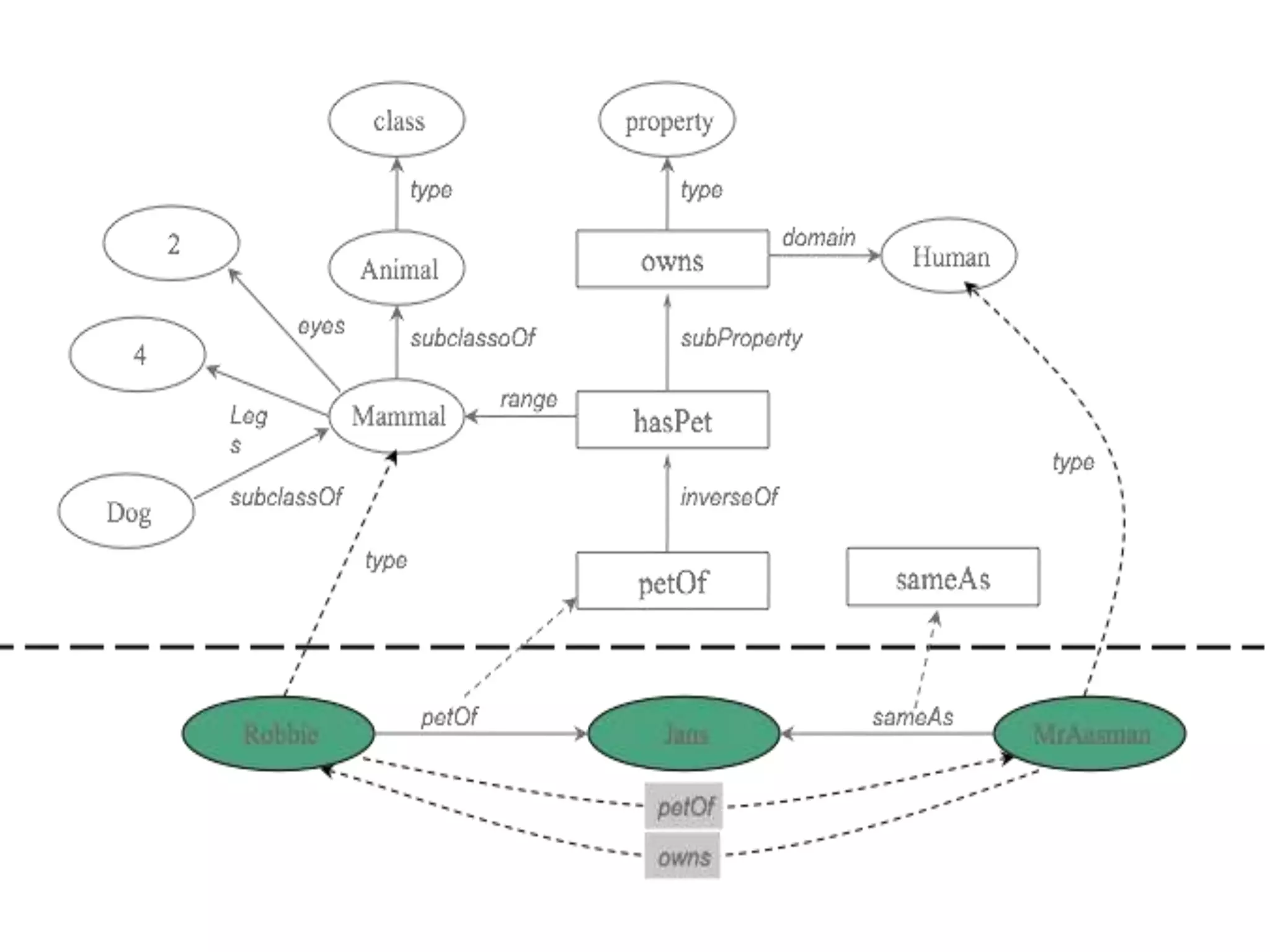
And there are other problems
• Weak expressivity of OWL
• Poor quality coding, poor quality ontologies,
poor quality ontology management
• Strategy often serves only retrieval, not
reasoning
• Confusion as to the meaning of ‘linked’
28
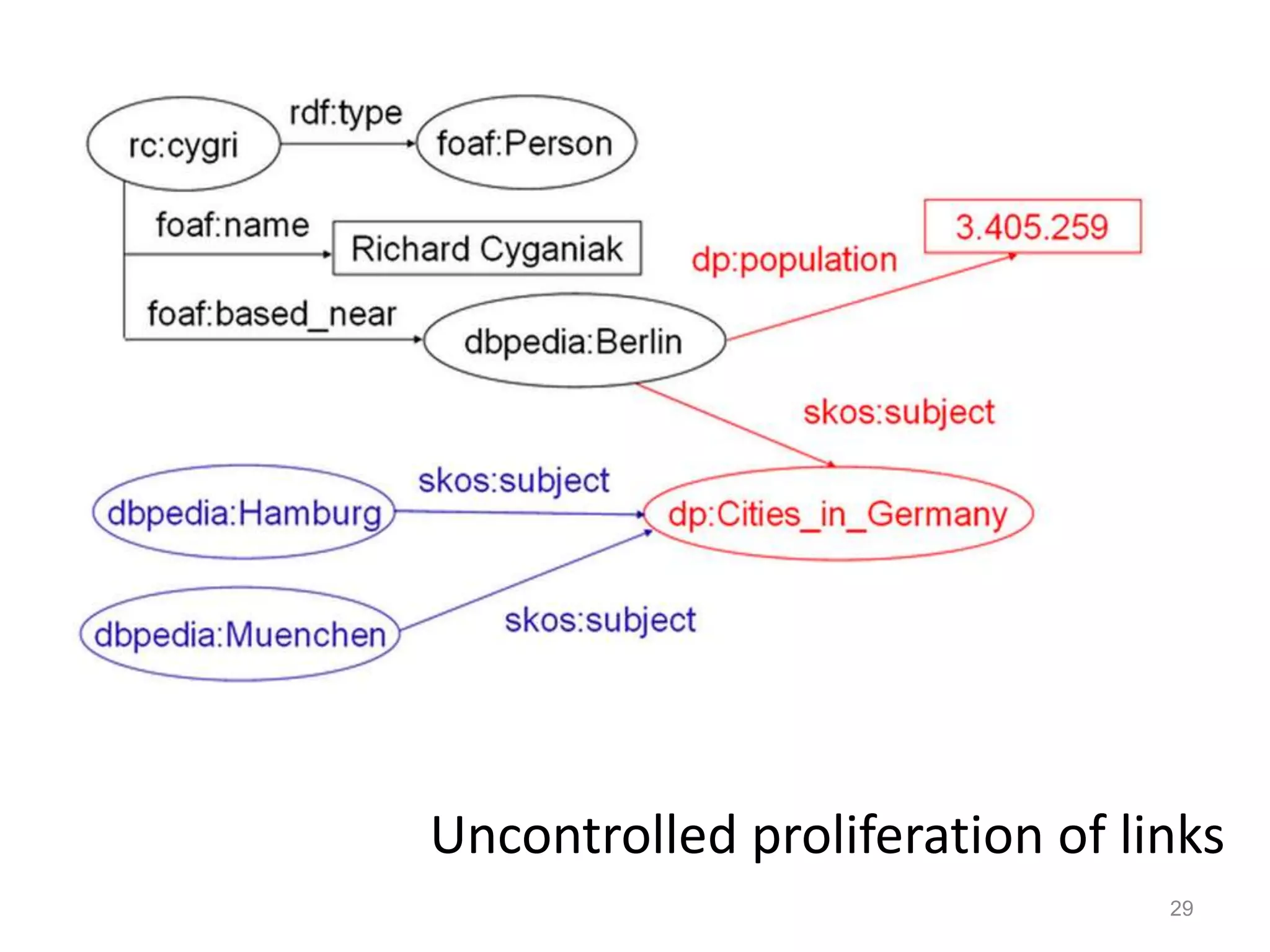
Uncontrolled proliferation of links
29
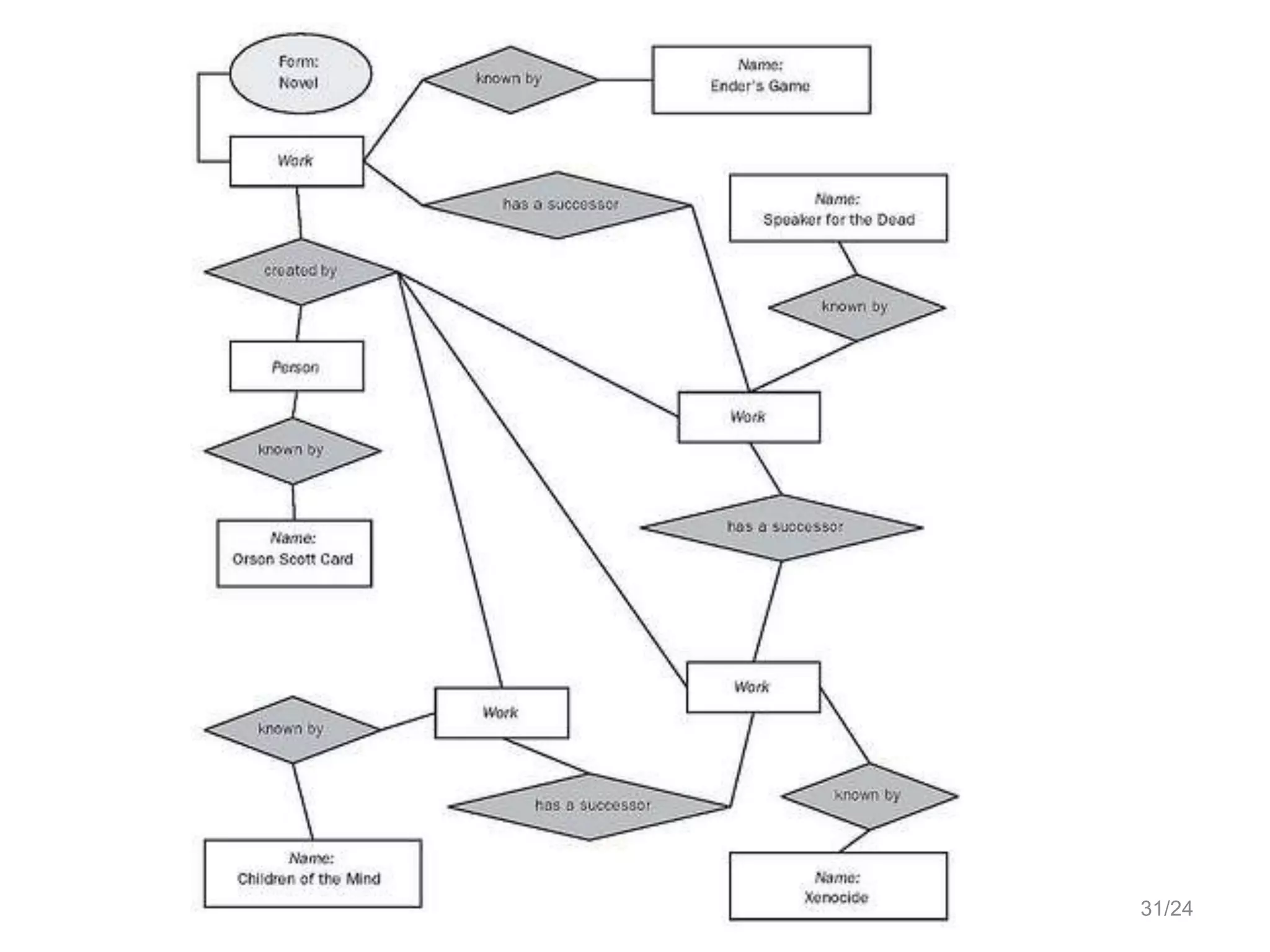
31/24
How to do it right?
• how create an incremental, evolutionary process,
where what is good survives, and what is bad fails
• create a scenario in which people will find it
profitable to reuse ontologies, terminologies and
coding systems which have been tried and tested
• silo effects will be avoided and results of
investment in Semantic Technology will cumulate
effectively
32
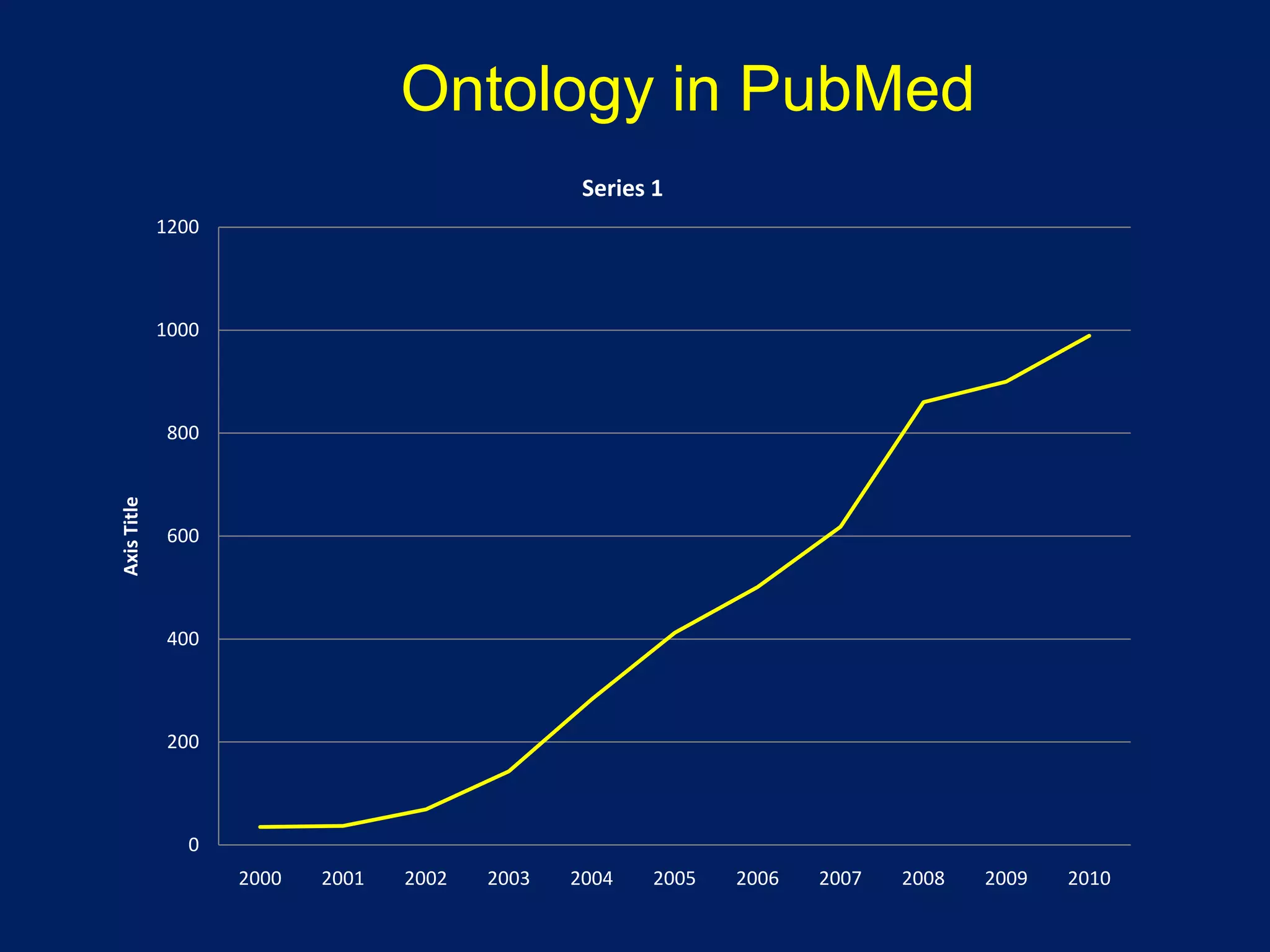
0
200
400
600
800
1000
1200
2000 2001 2002 2003 2004 2005 2006 2007 2008 2009 2010
AxisTitle
Series 1
Ontology in PubMed
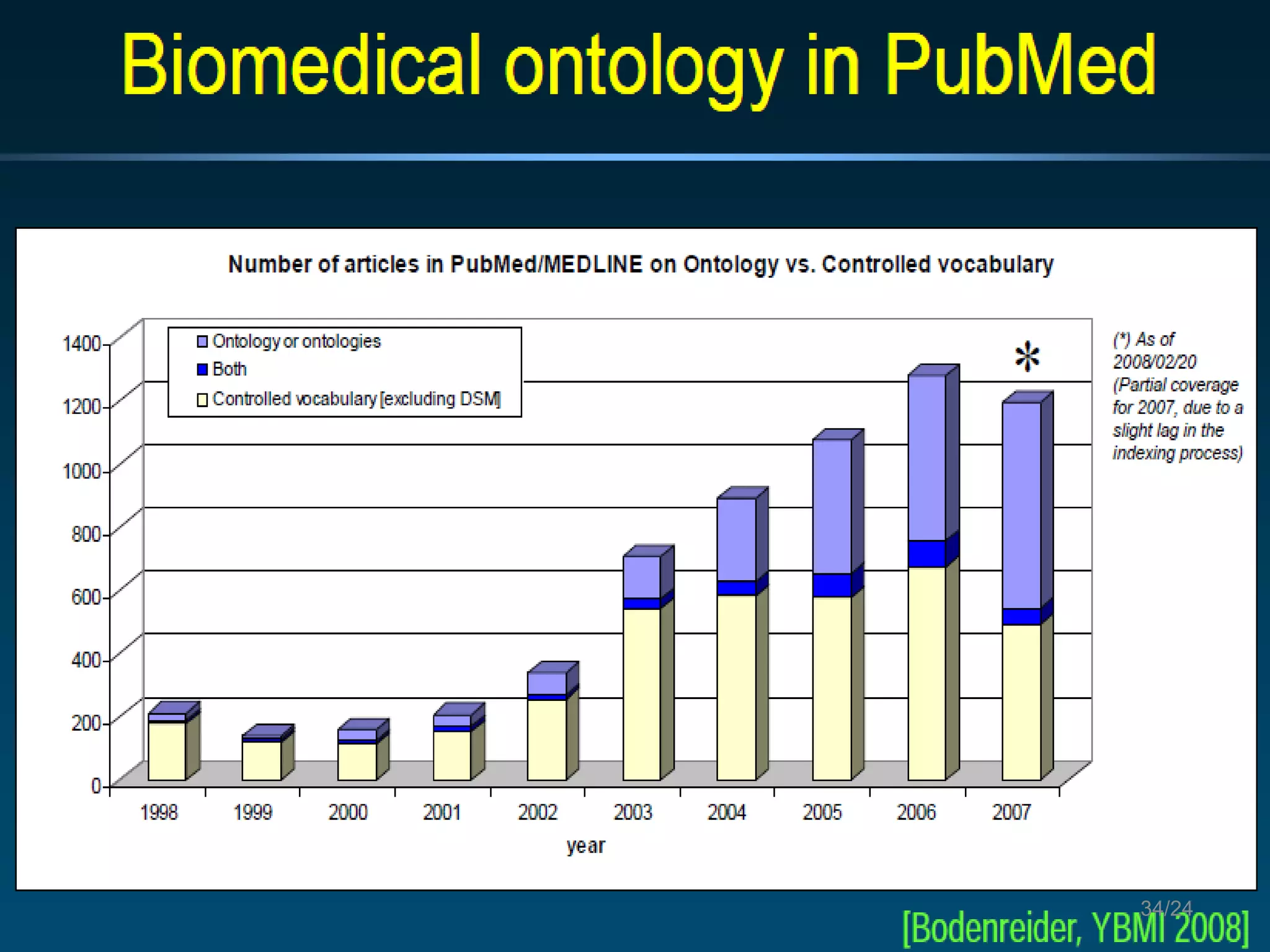
Uses of ‘ontology’ in PubMed abstracts
34/24
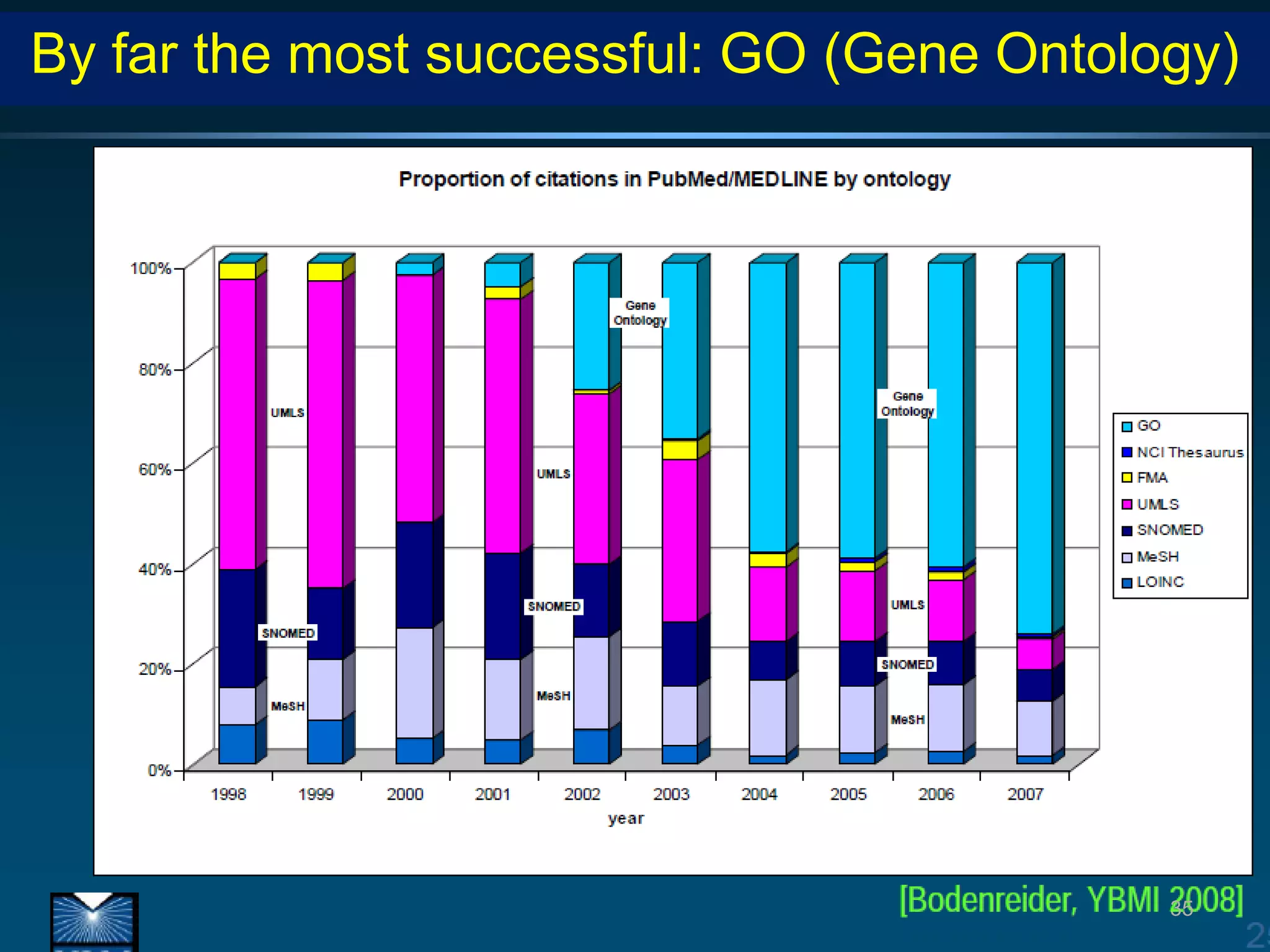
By far the most successful: GO (Gene Ontology)
35
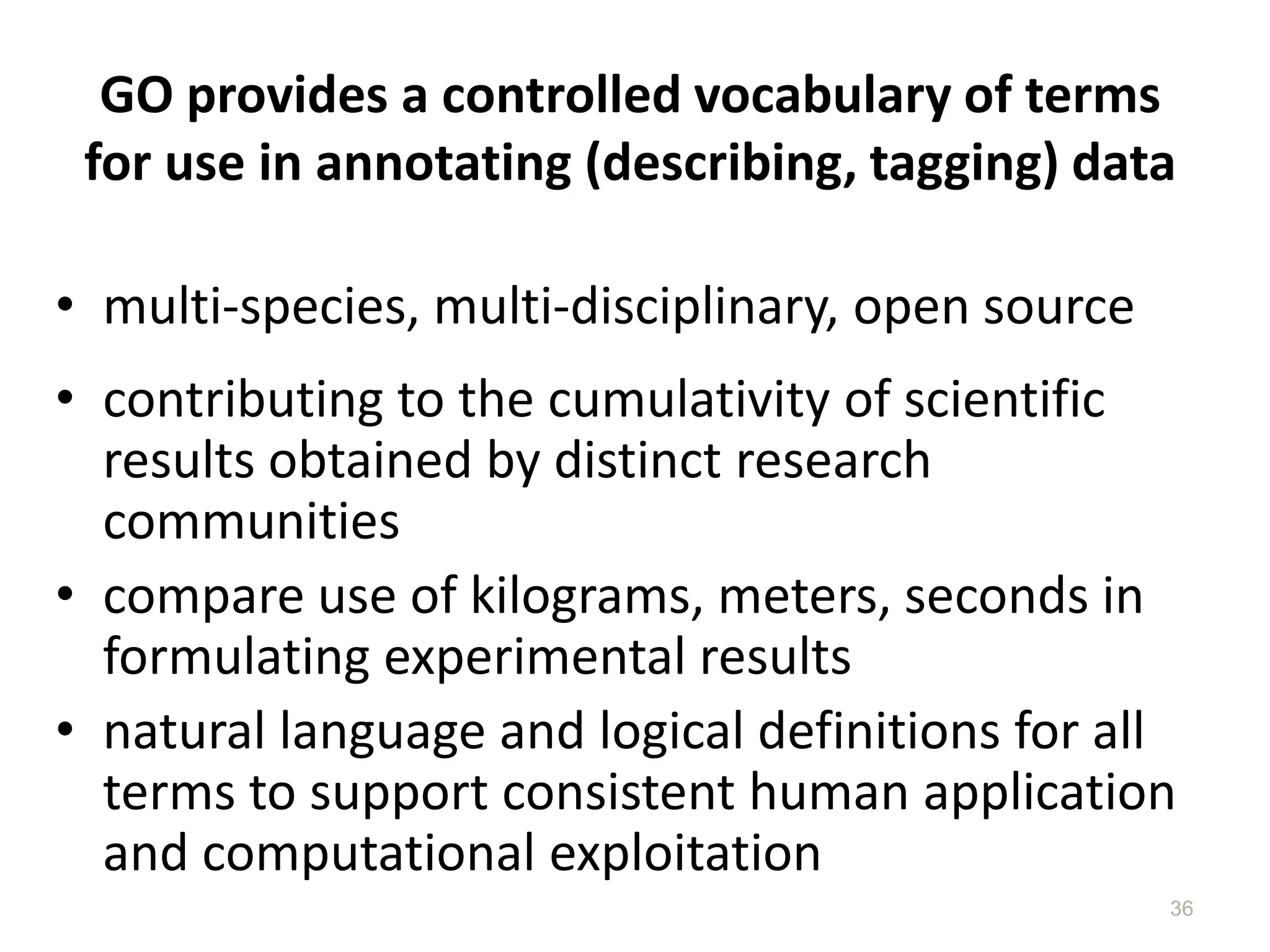
GO provides a controlled vocabulary of terms
for use in annotating (describing, tagging) data
• multi-species, multi-disciplinary, open source
• contributing to the cumulativity of scientific
results obtained by distinct research
communities
• compare use of kilograms, meters, seconds in
formulating experimental results
• natural language and logical definitions for all
terms to support consistent human application
and computational exploitation
36
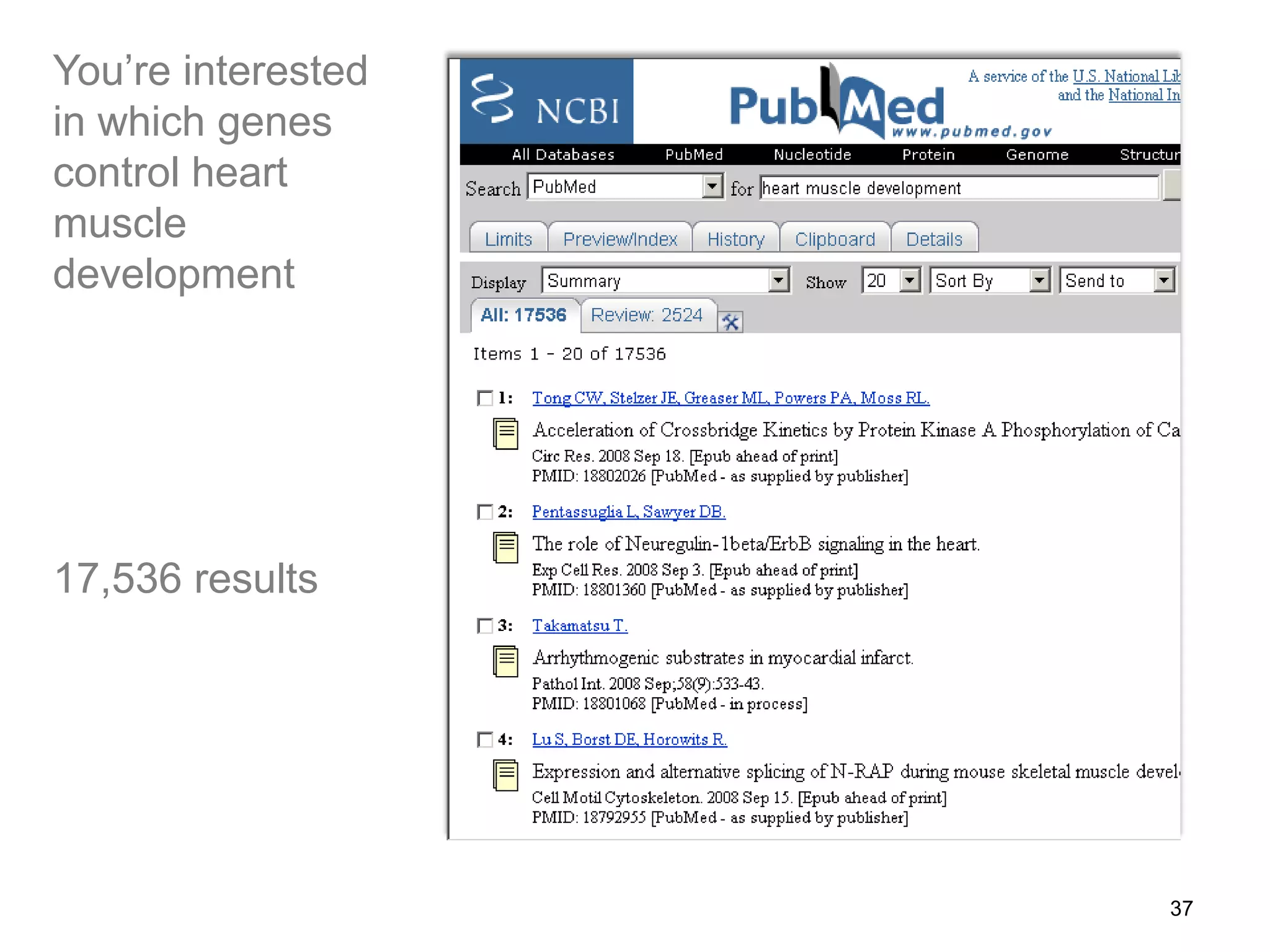
You’re interested
in which genes
control heart
muscle
development
17,536 results
37
arson lw n3d ...
t_LW_n3 d_5p_...
Colored by: Copy of Copy of C5_RMA (Defa...
Gene List: all genes (1 4010)
attacked
time
control
Puparial adhesion
Molting cycle
hemocyanin
Defense response
Immune response
Response to stimulus
Toll regulated genes
JAK-STAT regulated genes
Immune response
Toll regulated genes
Amino acid catabolism
Lipid metobolism
Peptidase activity
Protein catabloism
Immune response
e Tree: pearson lw n3d ...
lassification: Set_LW_n3d_5p_...
Colored by: Copy of Copy of C5_RMA (Defa...
Gene List: all genes (14010)
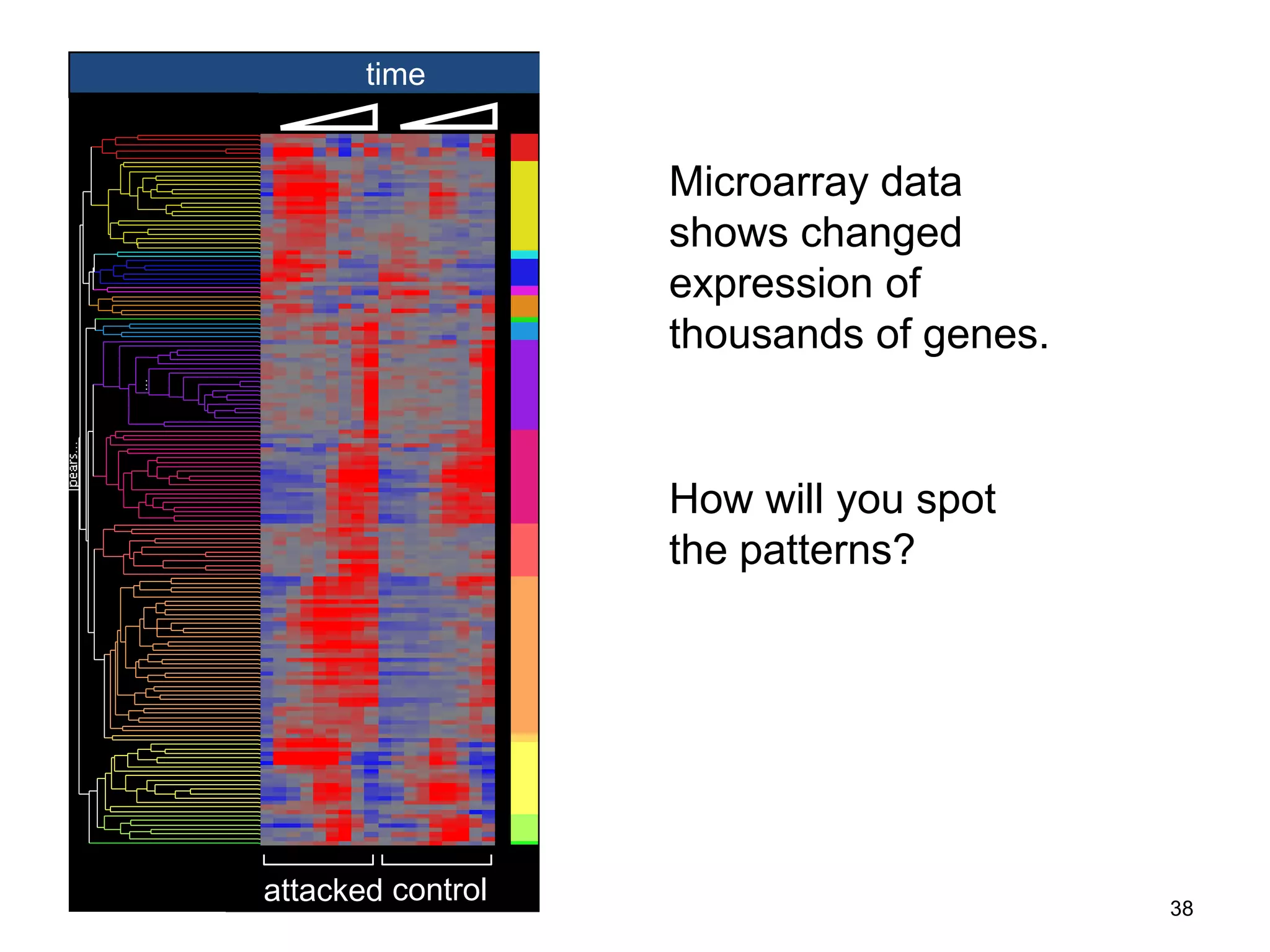
Microarray data
shows changed
expression of
thousands of genes.
How will you spot
the patterns?
38
You’re interested in which
of your hospital’s patient
data is relevant to
understanding how genes
control heart muscle
development
39
Lab / pathology data
EHR data
Clinical trial data
Family history data
Medical imaging
Microarray data
Model organism data
Flow cytometry
Mass spec
Genotype / SNP data
How will you spot the patterns?
How will you find the data you
need?
40
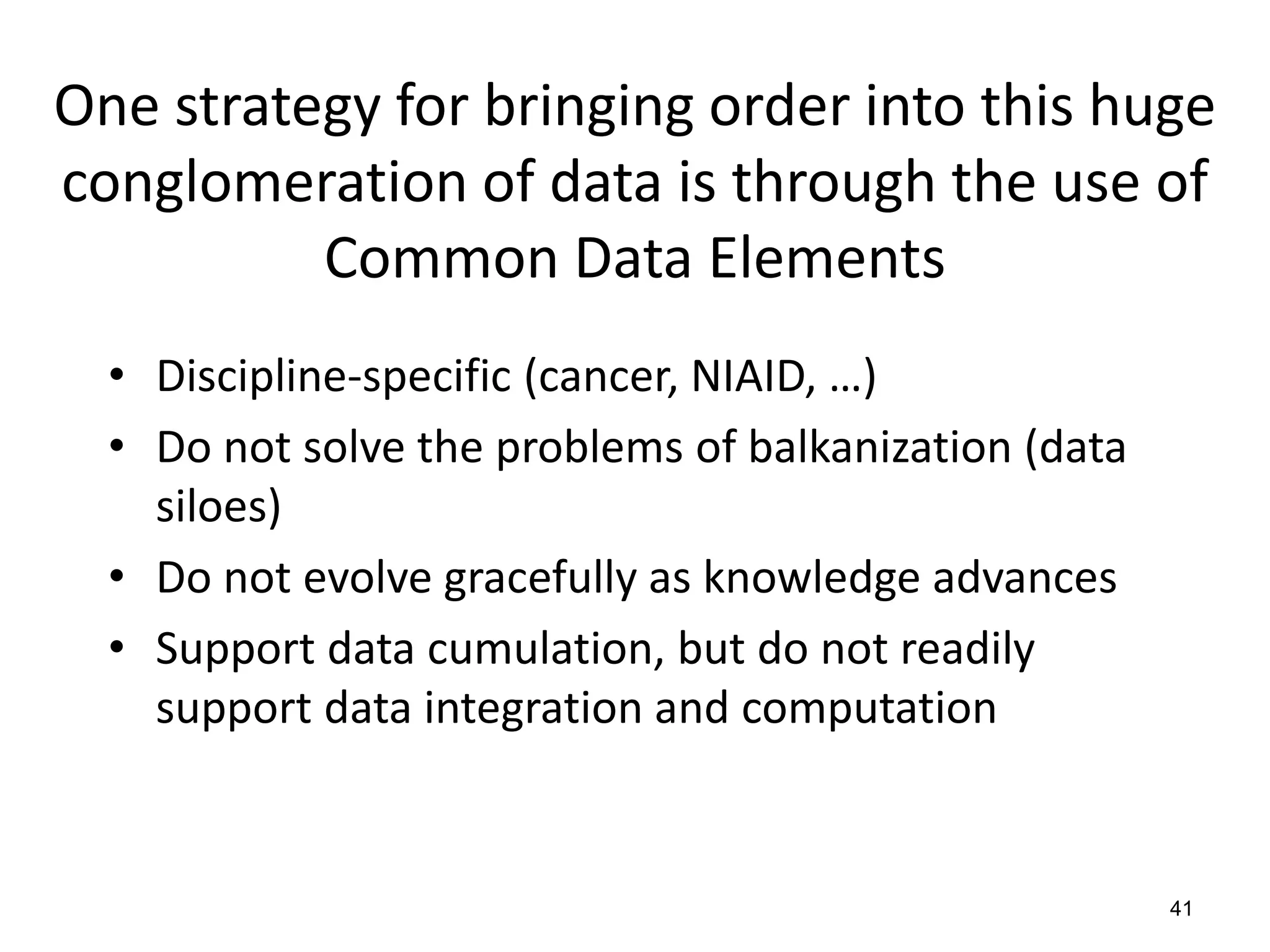
One strategy for bringing order into this huge
conglomeration of data is through the use of
Common Data Elements
• Discipline-specific (cancer, NIAID, …)
• Do not solve the problems of balkanization (data
siloes)
• Do not evolve gracefully as knowledge advances
• Support data cumulation, but do not readily
support data integration and computation
41
How does the
Gene Ontology work?
with thanks to
Jane Lomax, Gene Ontology Consortium
42
GO provides a controlled system of
representations for use in annotating data
• multi-species, multi-disciplinary, open
source
• contributing to the cumulativity of scientific
results obtained by distinct research
communities
• compare use of kilograms, meters, seconds
… in formulating experimental results
43
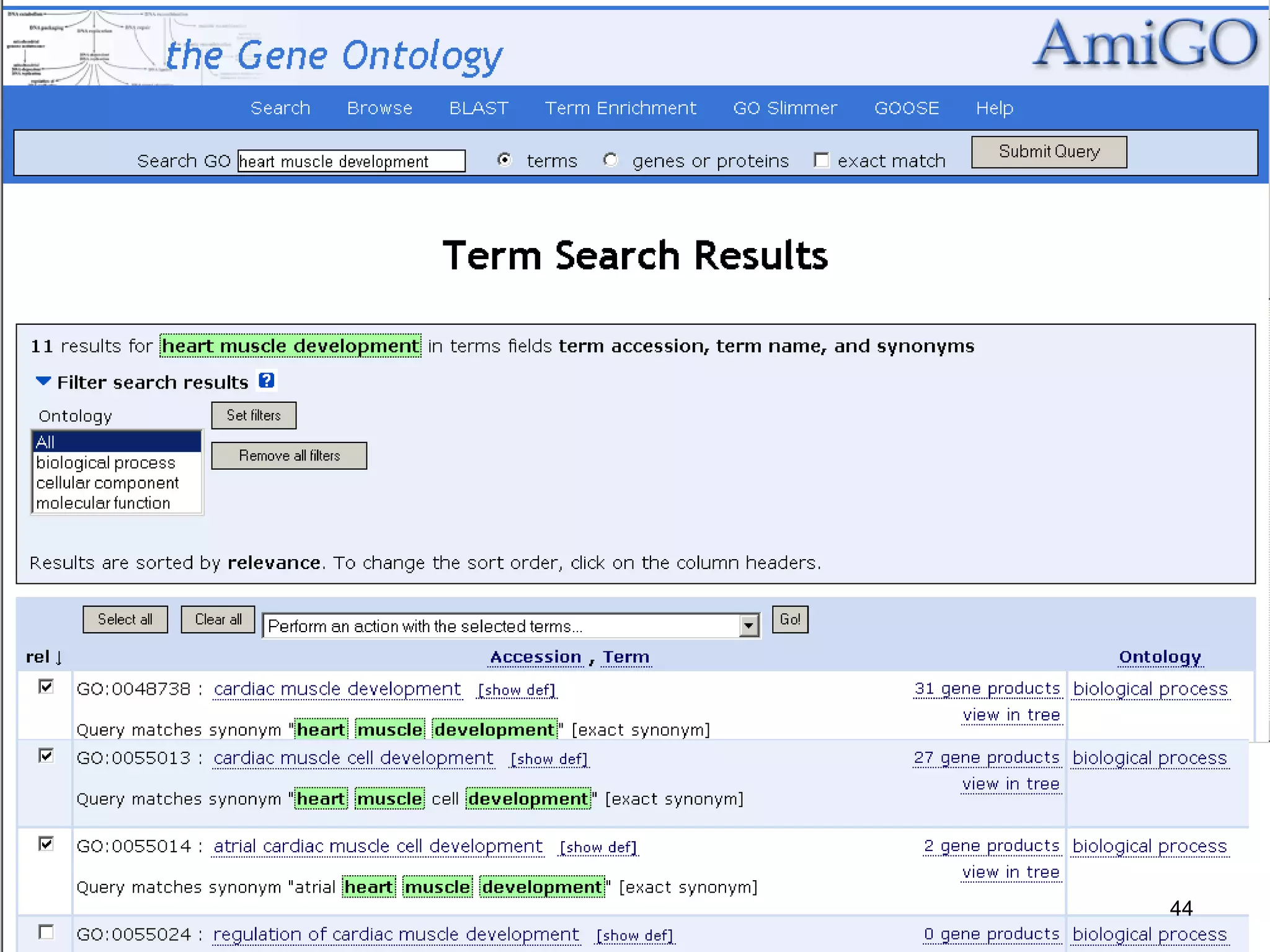
44
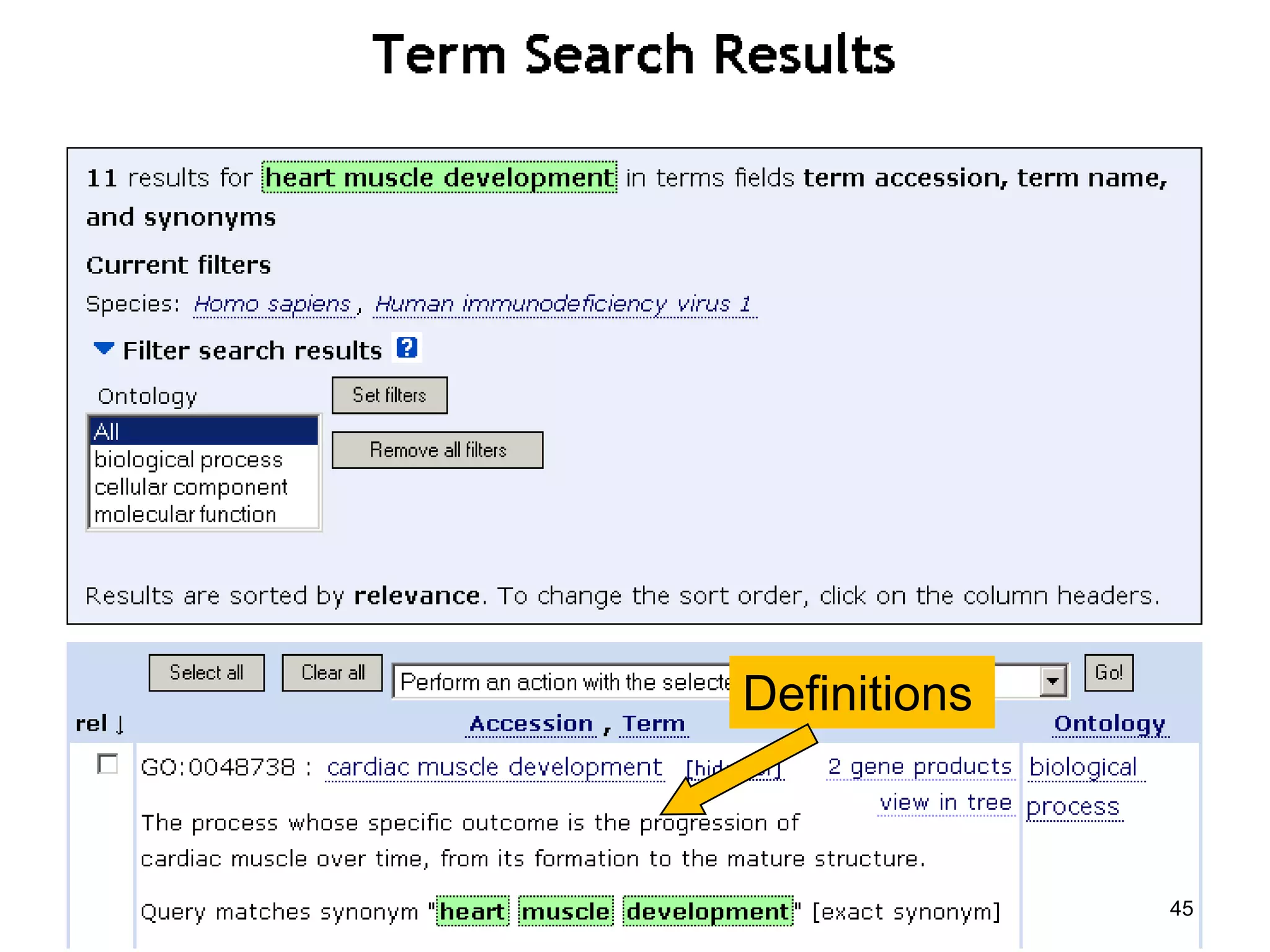
Definitions
45
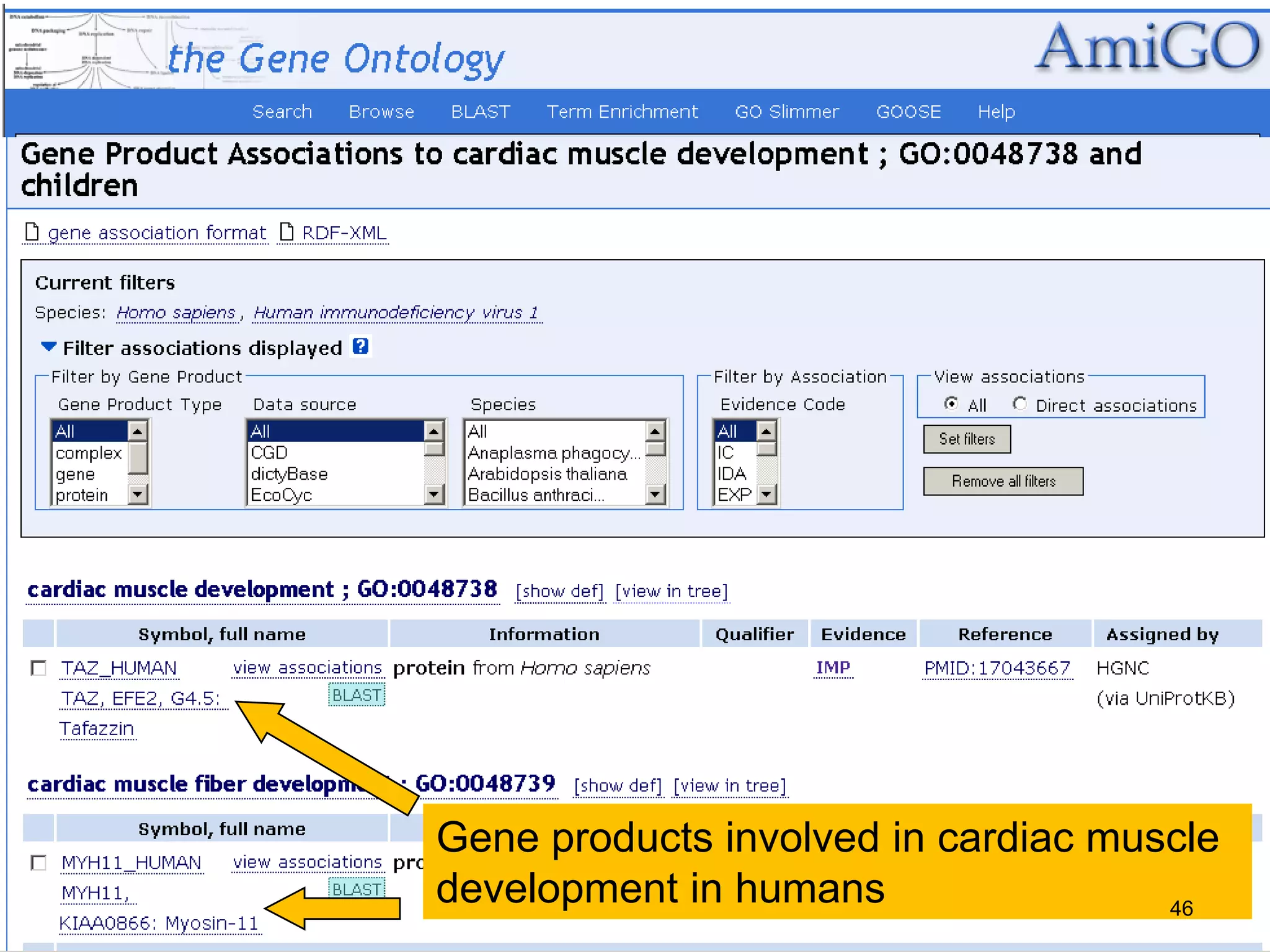
Gene products involved in cardiac muscle
development in humans 46
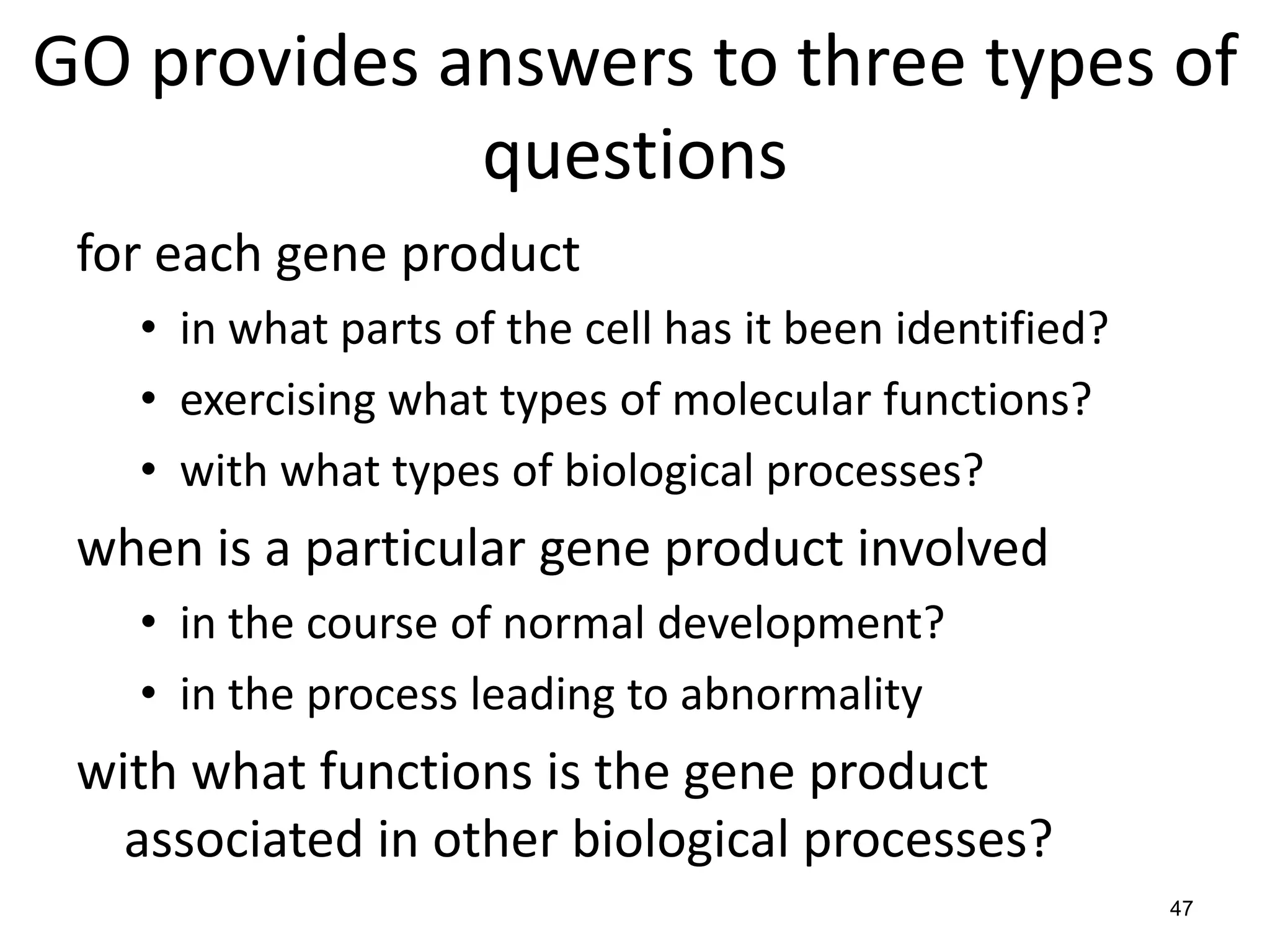
GO provides answers to three types of
questions
for each gene product
• in what parts of the cell has it been identified?
• exercising what types of molecular functions?
• with what types of biological processes?
when is a particular gene product involved
• in the course of normal development?
• in the process leading to abnormality
with what functions is the gene product
associated in other biological processes?
47
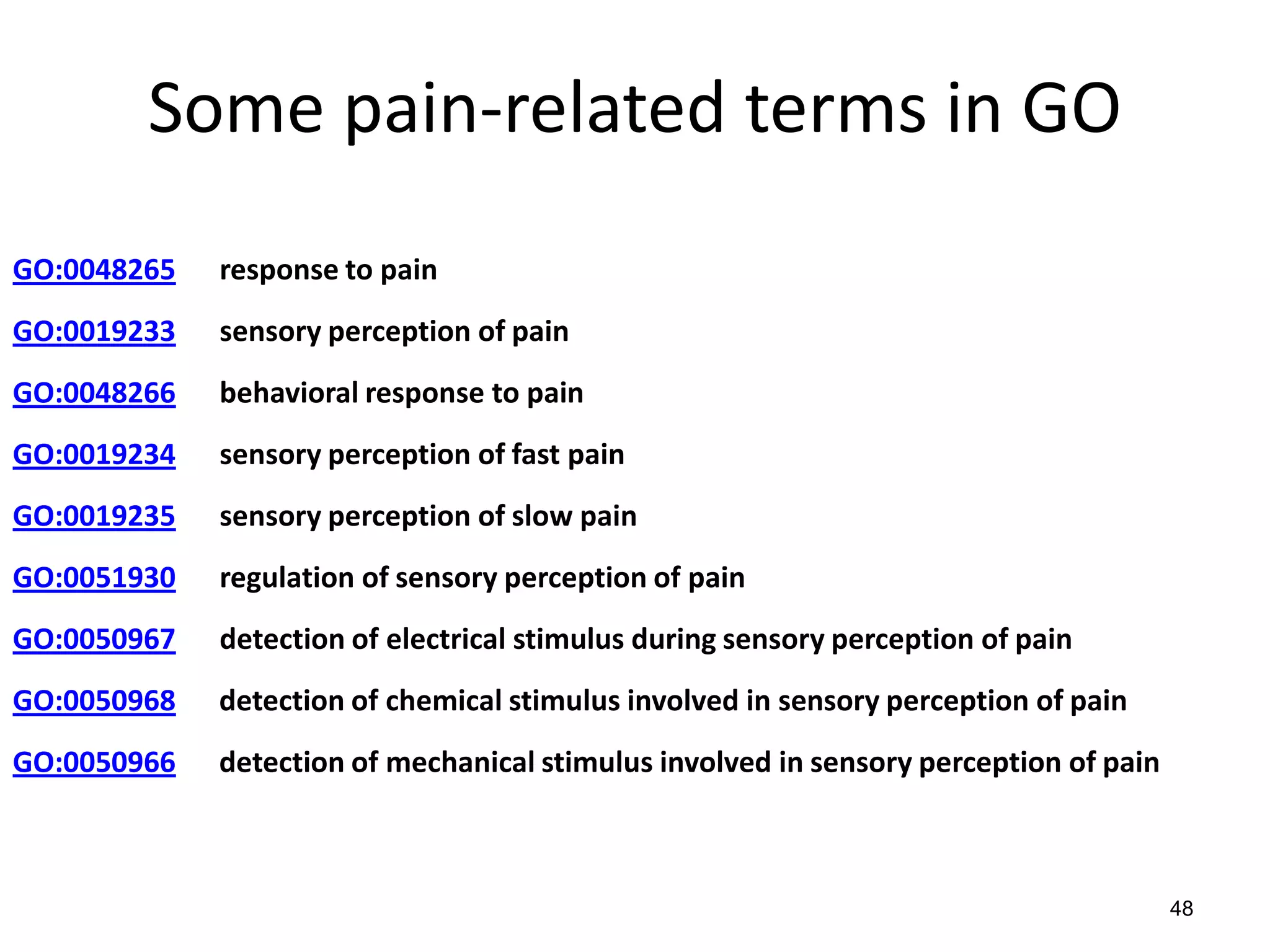
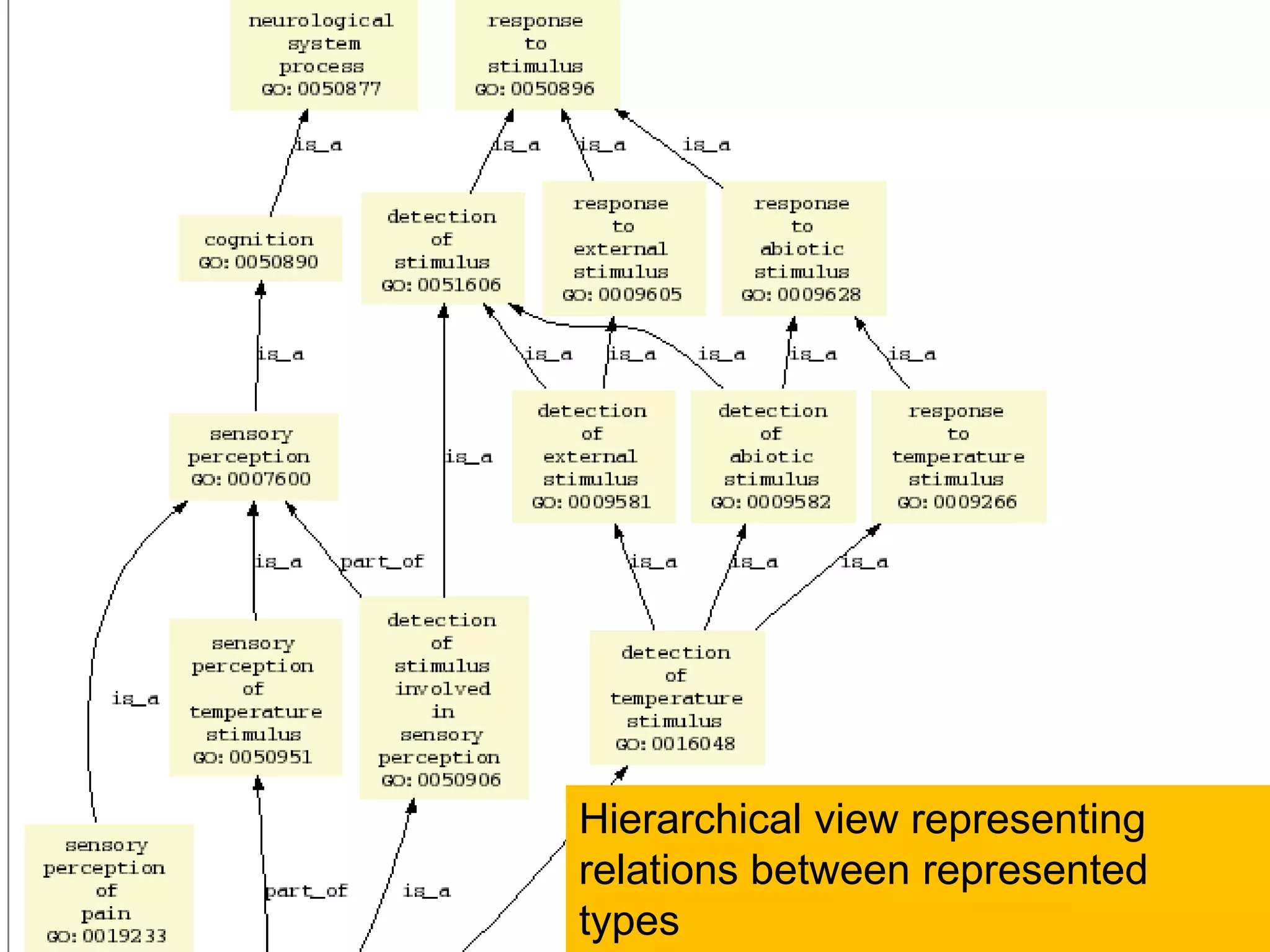
Some pain-related terms in GO
GO:0048265 response to pain
GO:0019233 sensory perception of pain
GO:0048266 behavioral response to pain
GO:0019234 sensory perception of fast pain
GO:0019235 sensory perception of slow pain
GO:0051930 regulation of sensory perception of pain
GO:0050967 detection of electrical stimulus during sensory perception of pain
GO:0050968 detection of chemical stimulus involved in sensory perception of pain
GO:0050966 detection of mechanical stimulus involved in sensory perception of pain
48
49
Hierarchical view representing
relations between represented
types
A new kind of biological research
based on analysis and comparison of the massive
quantities of annotations linking ontology terms
to raw data, including genomic data, clinical data,
public health data
What 10 years ago took multiple groups of
researchers months of data comparison effort,
can now be performed in milliseconds
50
One standard method
Sjöblöm T, et al. analyzed13,023 genes in 11
breast and 11 colorectal cancers
using functional information captured by GO for
given gene product types
identified 189 as being mutated at significant
frequency and thus as providing targets for
diagnostic and therapeutic intervention.
Science. 2006 Oct 13;314(5797):268-74.
51
What is the key to GO’s success?
• GO is developed, maintained and by experts
who adhere to ontology best practices
• over 11 million annotations relating gene
products described in the UniProt, Ensembl and
other databases to terms in the GO
• experimental results reported in 52,000
scientific journal articles manually annoted by
expert biologists using GO
• ontology building and ontology QA are two
sides of the same coin
52
If controlled vocabularies are to serve
to remove silos
they have to be updated by respected experts
who are trained in best practices of ontology
maintenance
they have to be respected by many owners of
data as resources that ensure accurate
description of their data
– GO maintained not by computer scientists but
by biologists
they have to be willingly used in annotations by
many owners of data
53
54
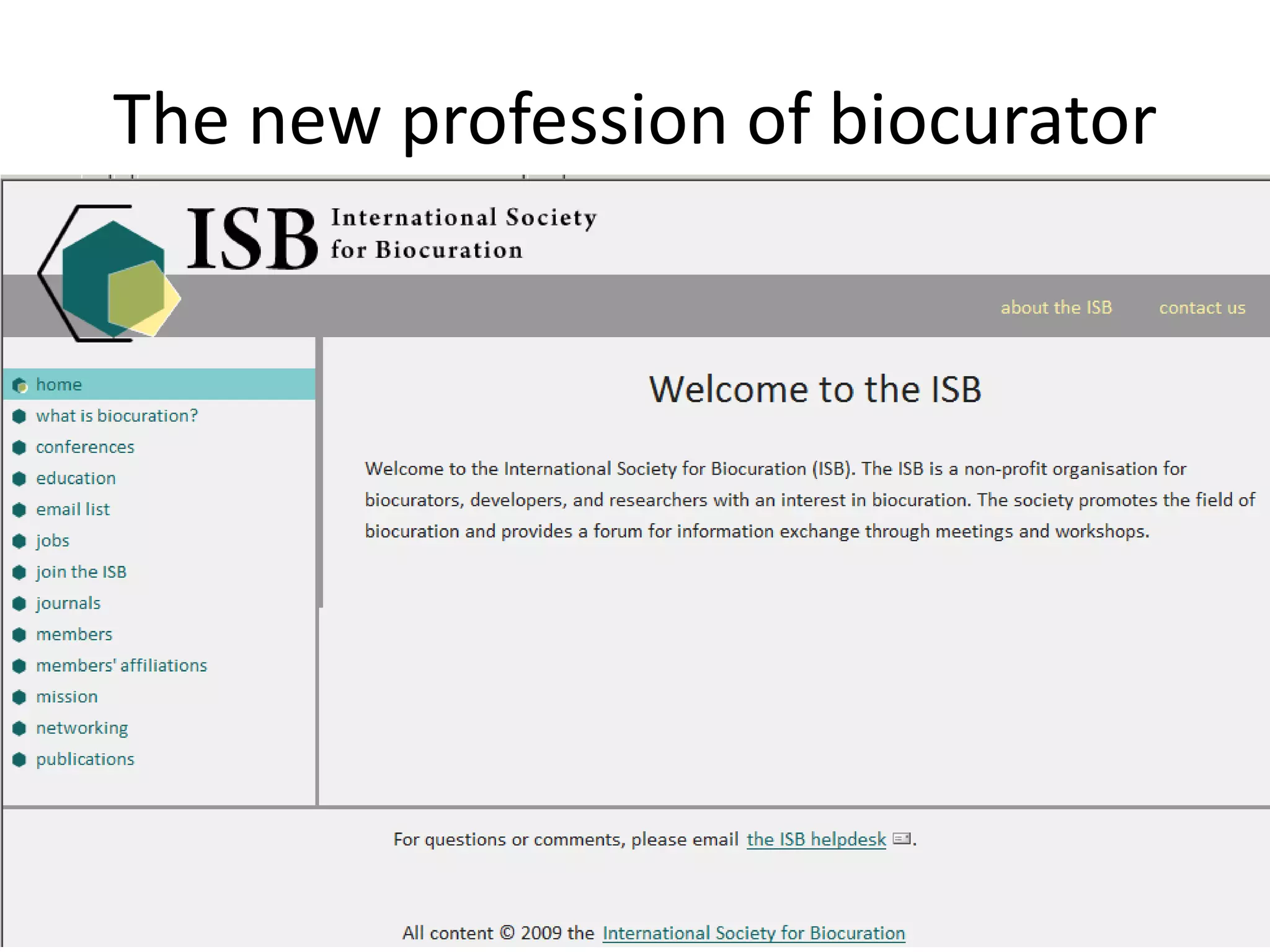
The new profession of biocurator
55
How to do it right?
• how create an incremental, evolutionary process,
where what is good survives, and what is bad fails
• where the number of ontologies needing to be
linked is small
• where links are stable
• create a scenario in which people will find it
profitable to reuse ontologies, terminologies and
coding systems which have been tried and tested
• and in which ontologies will evolve on the basis of
feedback from users
56
Reasons why GO has been successful
It is a system for prospective standardization built with
coherent top level but with content contributed and
monitored by domain specialists
Based on community consensus
Clear versioning principles ensure backwards
compatibility; prior annotations do not lose their
value
Initially low-tech to encourage adoption by new
communities of users
Tracker for user input with rapid turnaround and help
desk
57
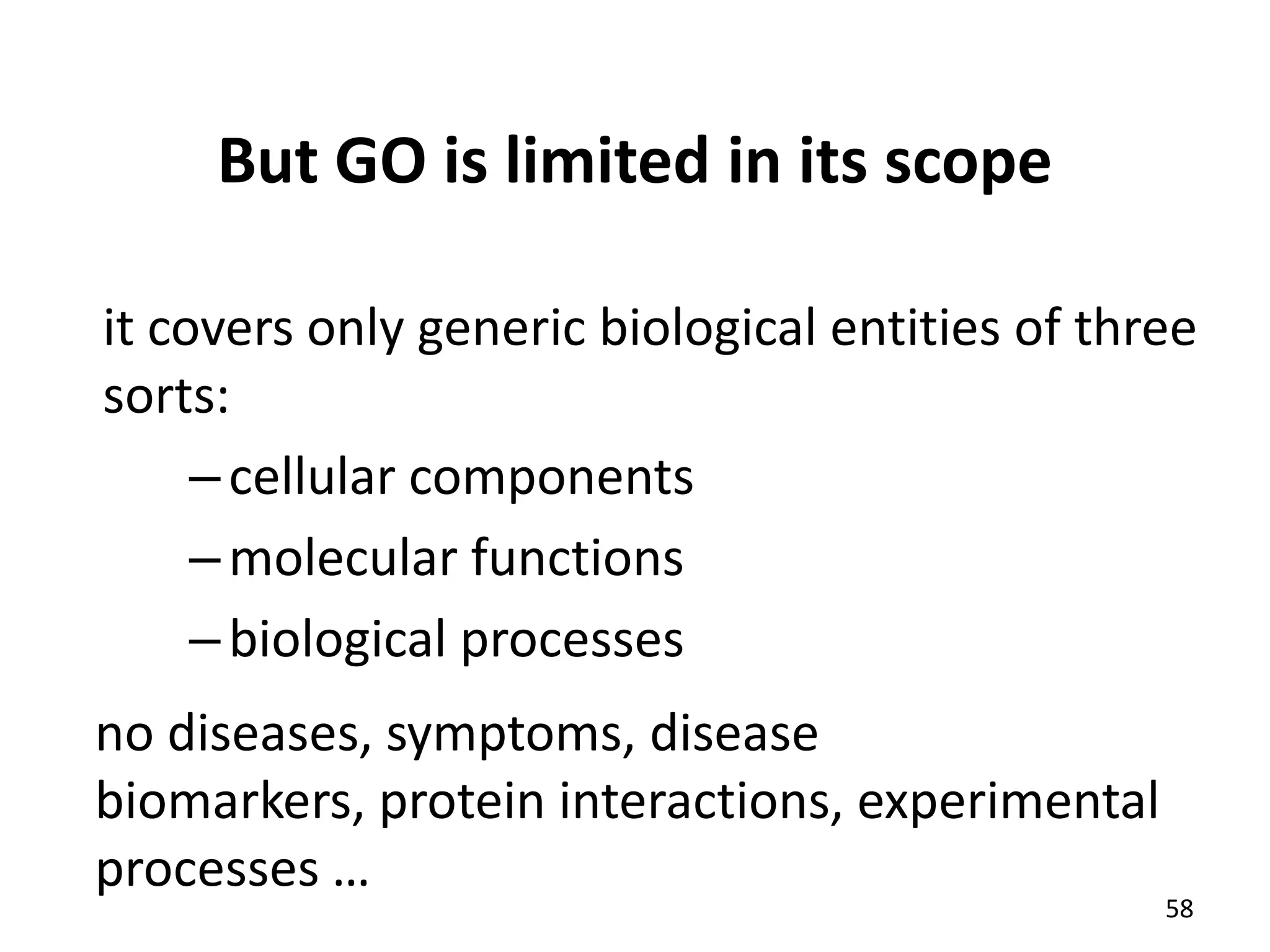
But GO is limited in its scope
it covers only generic biological entities of three
sorts:
–cellular components
–molecular functions
–biological processes
no diseases, symptoms, disease
biomarkers, protein interactions, experimental
processes …
58
Extending the GO methodology to
other domains of biology and
medicine
59
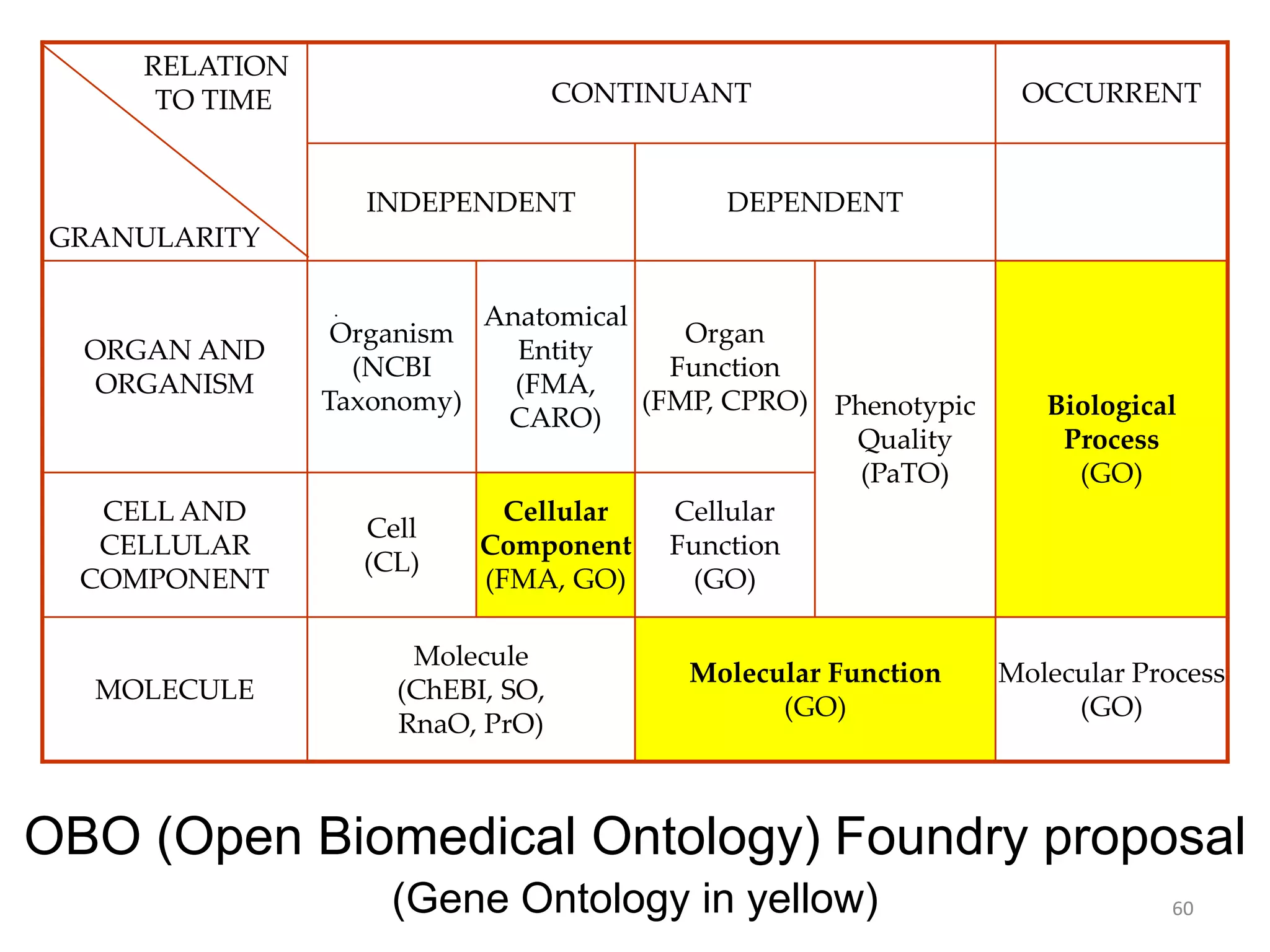
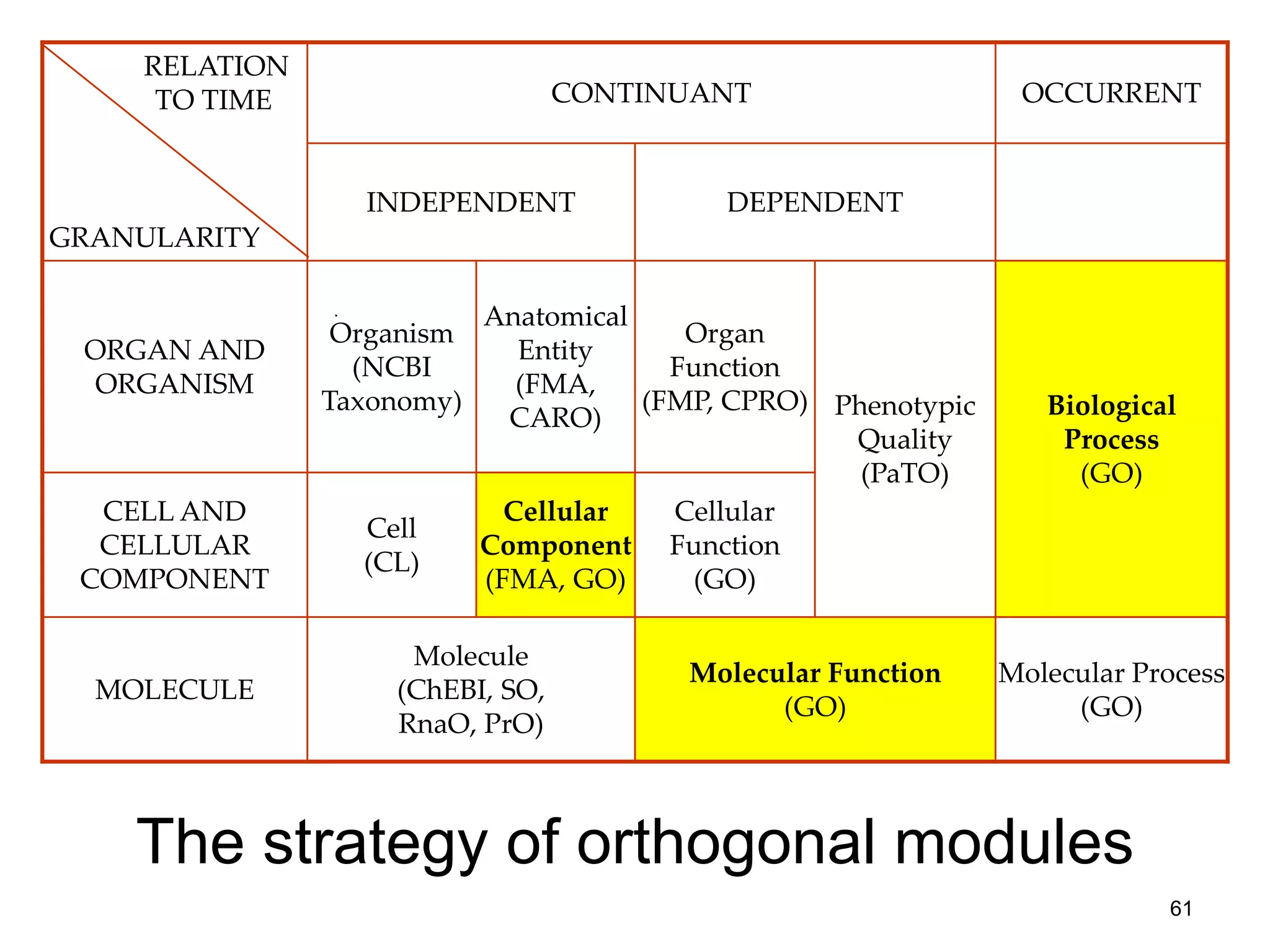
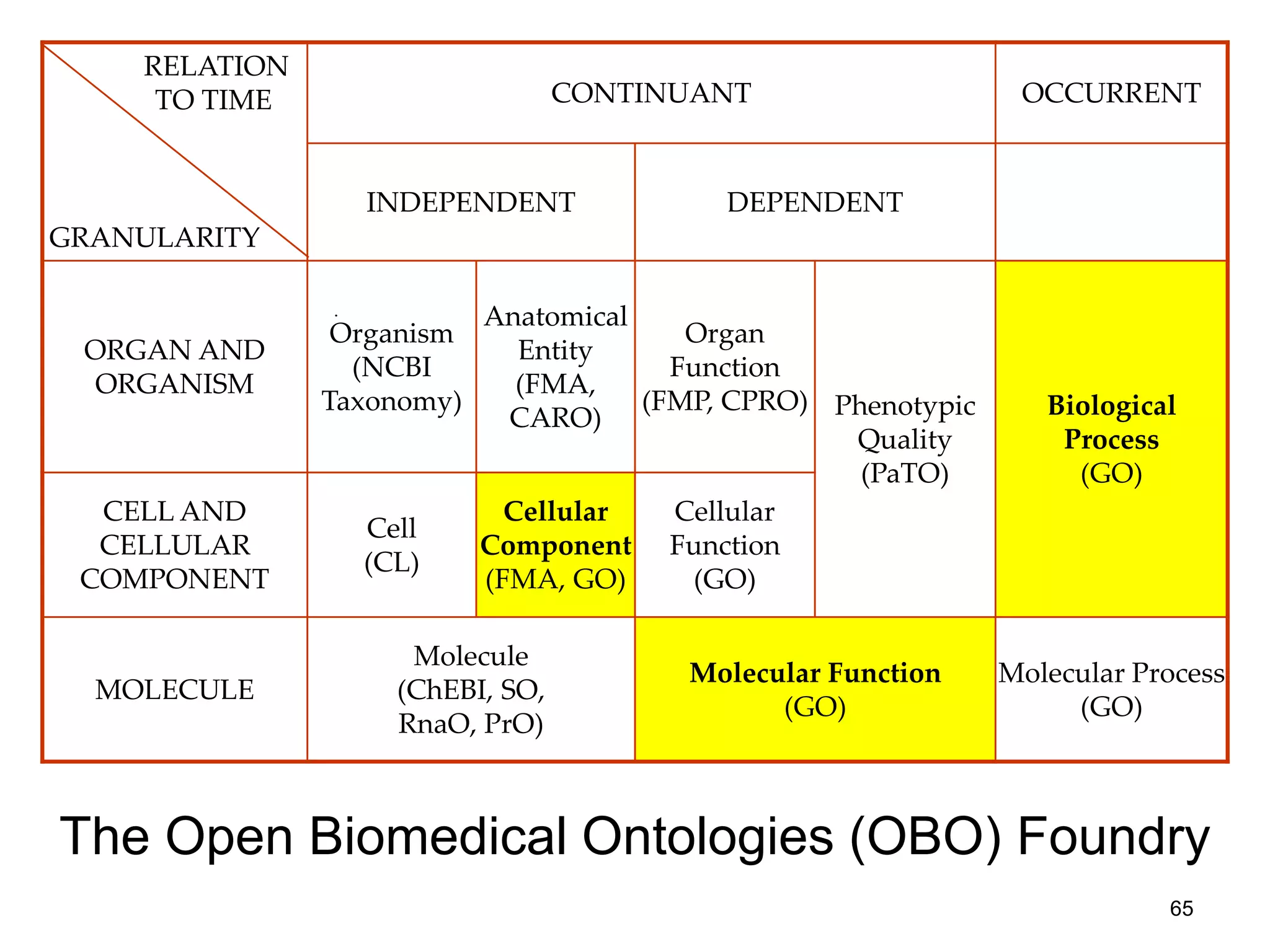
RELATION
TO TIME
GRANULARITY
CONTINUANT OCCURRENT
INDEPENDENT DEPENDENT
ORGAN AND
ORGANISM
Organism
(NCBI
Taxonomy)
Anatomical
Entity
(FMA,
CARO)
Organ
Function
(FMP, CPRO) Phenotypic
Quality
(PaTO)
Biological
Process
(GO)
CELL AND
CELLULAR
COMPONENT
Cell
(CL)
Cellular
Component
(FMA, GO)
Cellular
Function
(GO)
MOLECULE
Molecule
(ChEBI, SO,
RnaO, PrO)
Molecular Function
(GO)
Molecular Process
(GO)
OBO (Open Biomedical Ontology) Foundry proposal
(Gene Ontology in yellow) 60
RELATION
TO TIME
GRANULARITY
CONTINUANT OCCURRENT
INDEPENDENT DEPENDENT
ORGAN AND
ORGANISM
Organism
(NCBI
Taxonomy)
Anatomical
Entity
(FMA,
CARO)
Organ
Function
(FMP, CPRO) Phenotypic
Quality
(PaTO)
Biological
Process
(GO)
CELL AND
CELLULAR
COMPONENT
Cell
(CL)
Cellular
Component
(FMA, GO)
Cellular
Function
(GO)
MOLECULE
Molecule
(ChEBI, SO,
RnaO, PrO)
Molecular Function
(GO)
Molecular Process
(GO)
The strategy of orthogonal modules
61
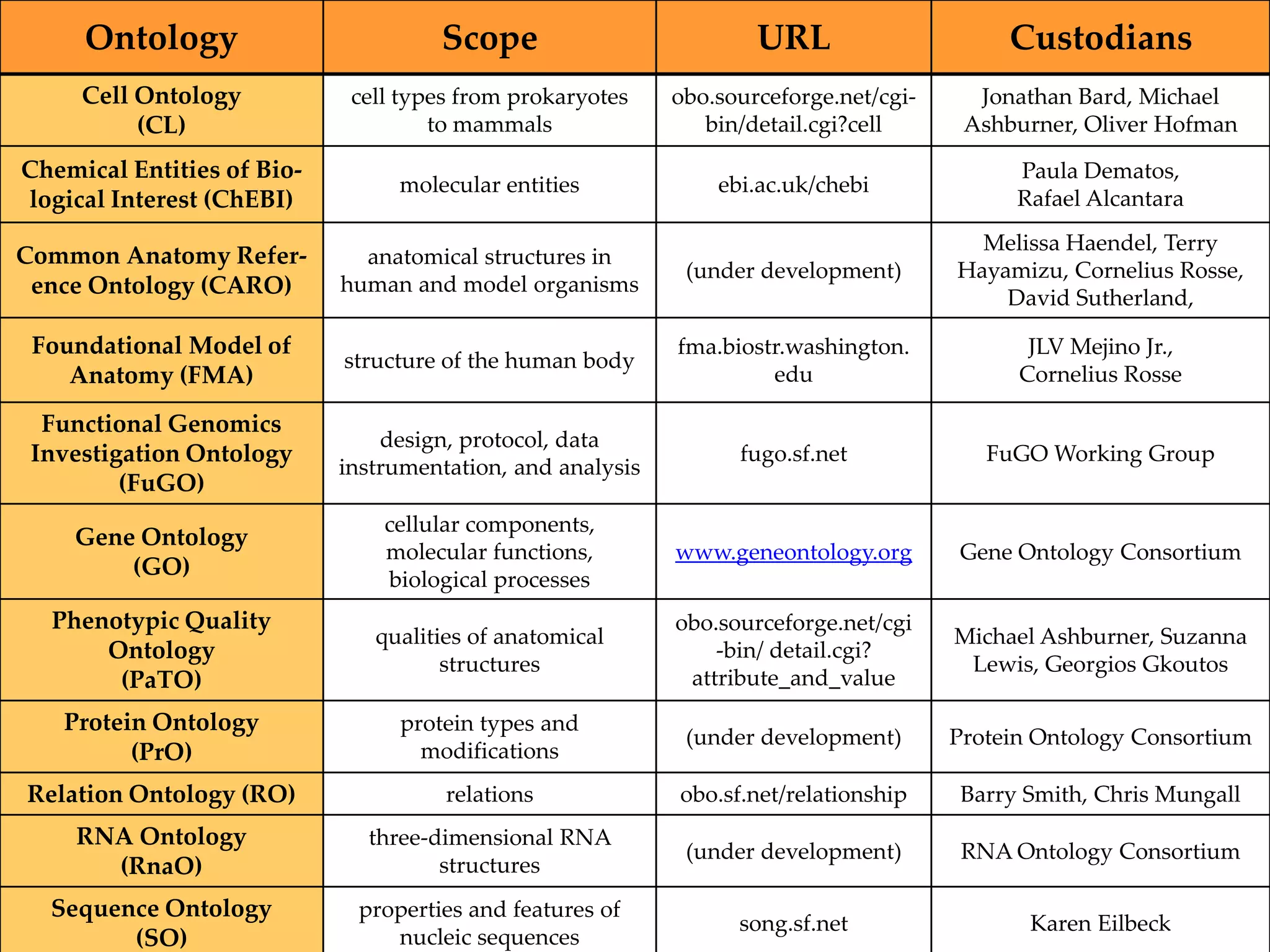
Ontology Scope URL Custodians
Cell Ontology
(CL)
cell types from prokaryotes
to mammals
obo.sourceforge.net/cgi-
bin/detail.cgi?cell
Jonathan Bard, Michael
Ashburner, Oliver Hofman
Chemical Entities of Bio-
logical Interest (ChEBI)
molecular entities ebi.ac.uk/chebi
Paula Dematos,
Rafael Alcantara
Common Anatomy Refer-
ence Ontology (CARO)
anatomical structures in
human and model organisms
(under development)
Melissa Haendel, Terry
Hayamizu, Cornelius Rosse,
David Sutherland,
Foundational Model of
Anatomy (FMA)
structure of the human body
fma.biostr.washington.
edu
JLV Mejino Jr.,
Cornelius Rosse
Functional Genomics
Investigation Ontology
(FuGO)
design, protocol, data
instrumentation, and analysis
fugo.sf.net FuGO Working Group
Gene Ontology
(GO)
cellular components,
molecular functions,
biological processes
www.geneontology.org Gene Ontology Consortium
Phenotypic Quality
Ontology
(PaTO)
qualities of anatomical
structures
obo.sourceforge.net/cgi
-bin/ detail.cgi?
attribute_and_value
Michael Ashburner, Suzanna
Lewis, Georgios Gkoutos
Protein Ontology
(PrO)
protein types and
modifications
(under development) Protein Ontology Consortium
Relation Ontology (RO) relations obo.sf.net/relationship Barry Smith, Chris Mungall
RNA Ontology
(RnaO)
three-dimensional RNA
structures
(under development) RNA Ontology Consortium
Sequence Ontology
(SO)
properties and features of
nucleic sequences
song.sf.net Karen Eilbeck
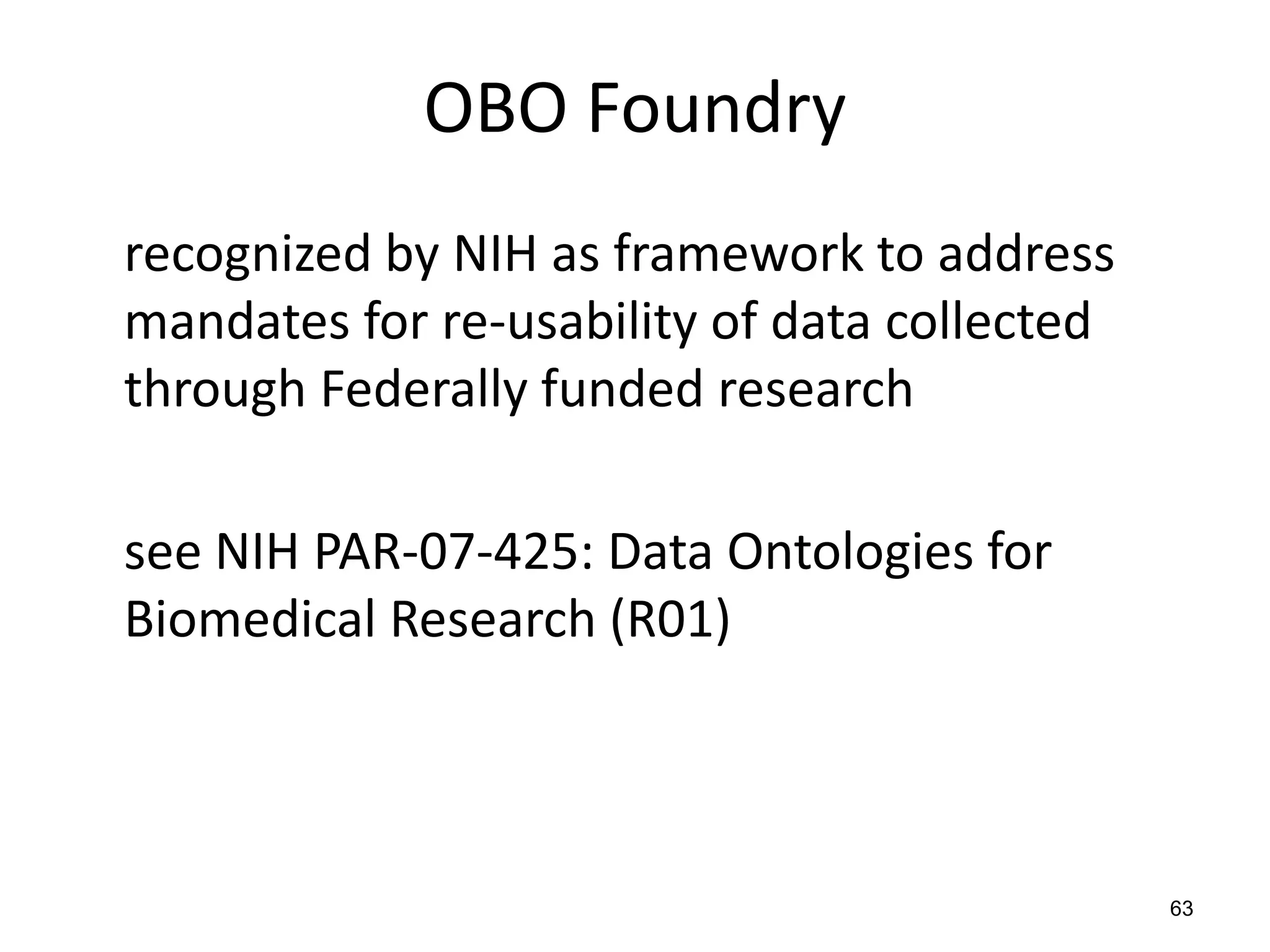
OBO Foundry
recognized by NIH as framework to address
mandates for re-usability of data collected
through Federally funded research
see NIH PAR-07-425: Data Ontologies for
Biomedical Research (R01)
63
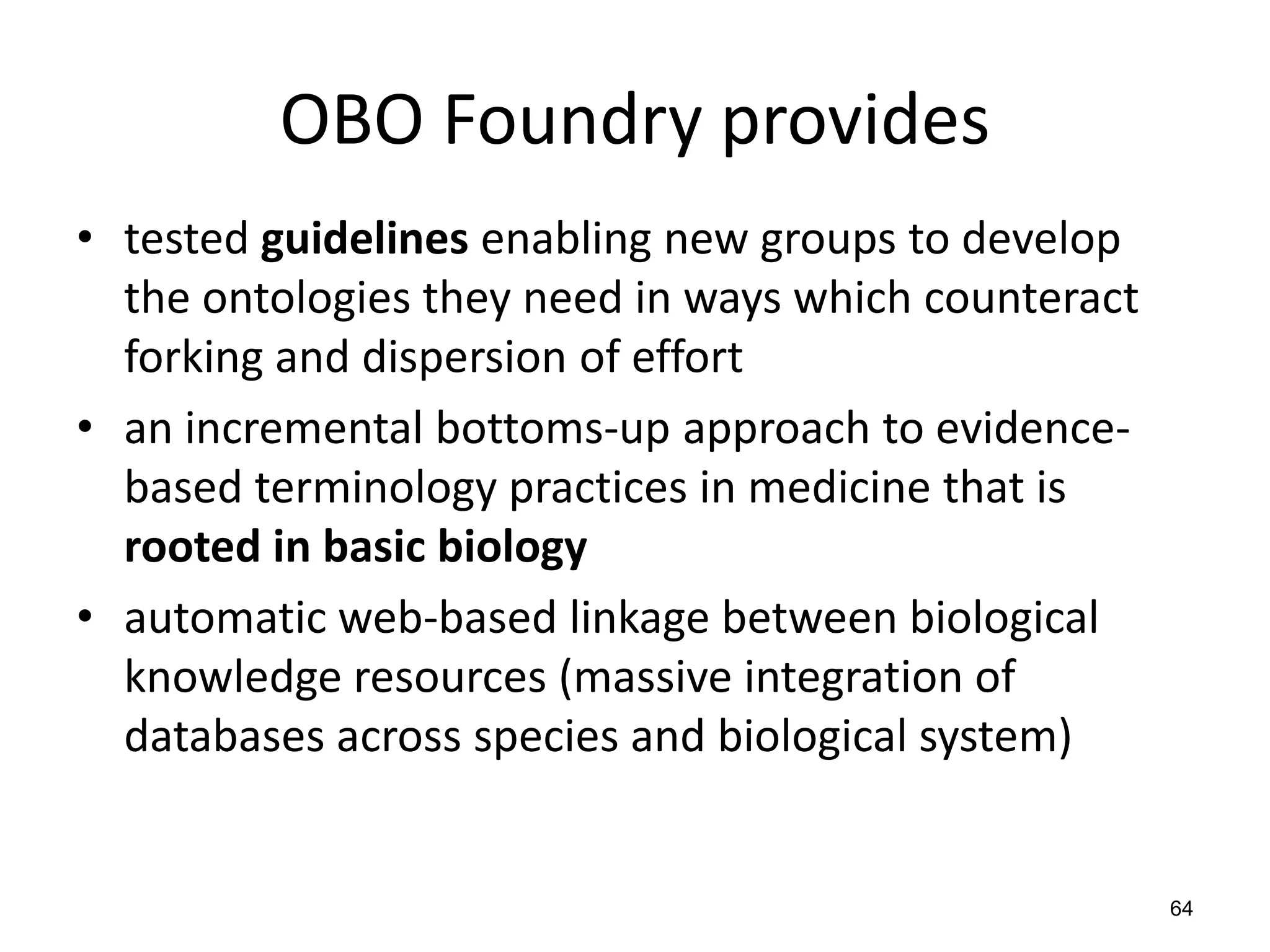
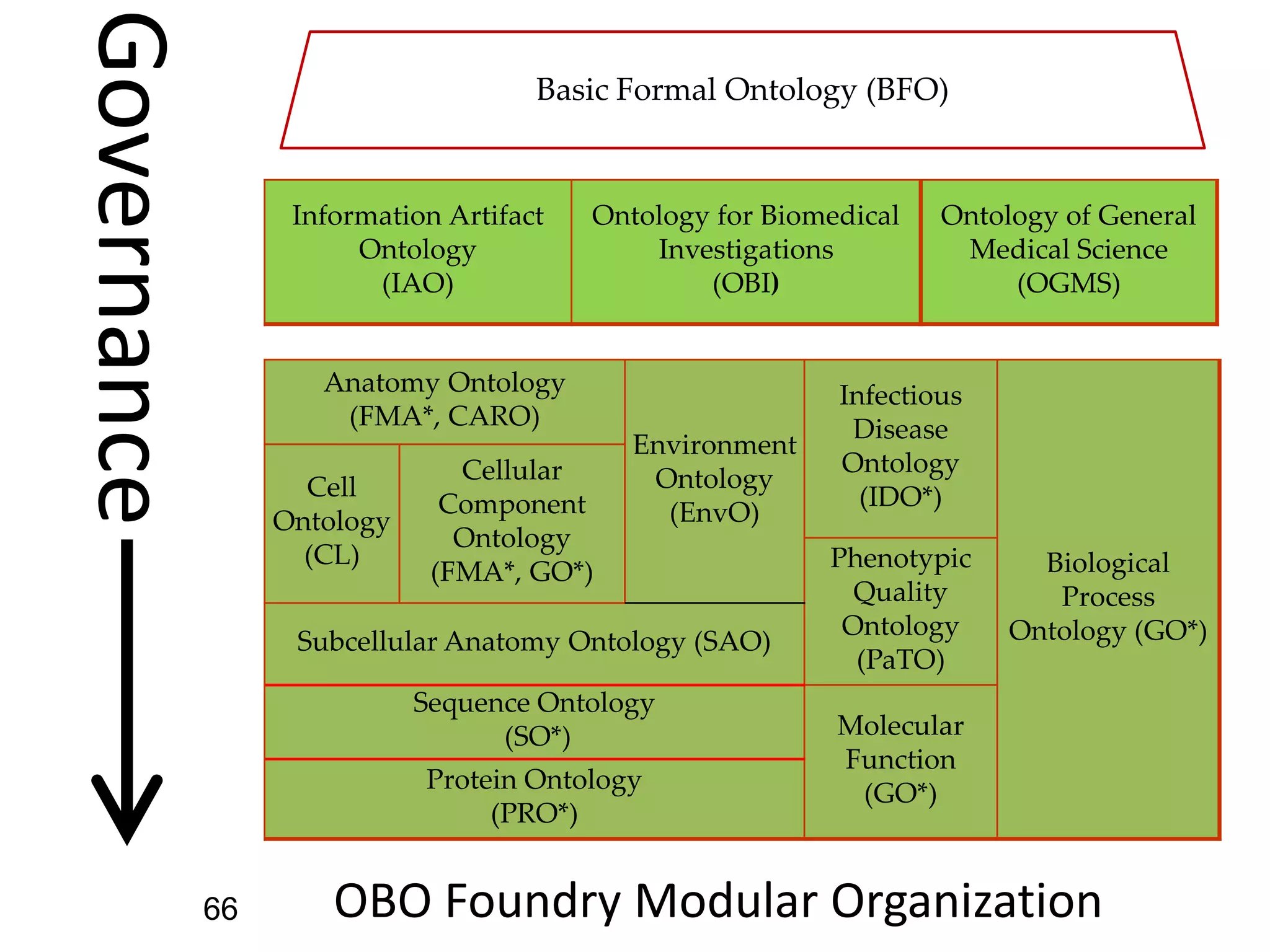
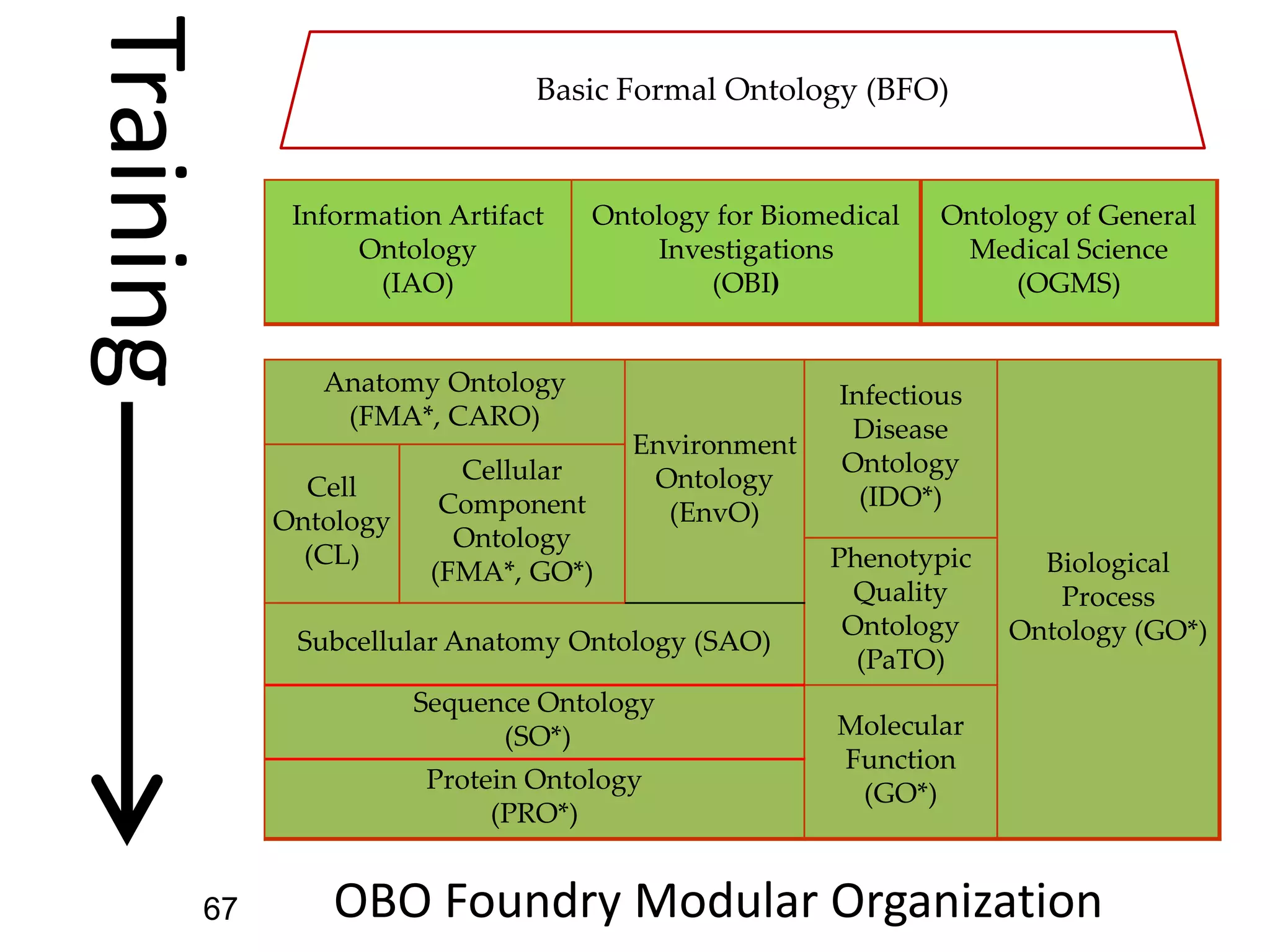
OBO Foundry provides
• tested guidelines enabling new groups to develop
the ontologies they need in ways which counteract
forking and dispersion of effort
• an incremental bottoms-up approach to evidence-
based terminology practices in medicine that is
rooted in basic biology
• automatic web-based linkage between biological
knowledge resources (massive integration of
databases across species and biological system)
64
RELATION
TO TIME
GRANULARITY
CONTINUANT OCCURRENT
INDEPENDENT DEPENDENT
ORGAN AND
ORGANISM
Organism
(NCBI
Taxonomy)
Anatomical
Entity
(FMA,
CARO)
Organ
Function
(FMP, CPRO) Phenotypic
Quality
(PaTO)
Biological
Process
(GO)
CELL AND
CELLULAR
COMPONENT
Cell
(CL)
Cellular
Component
(FMA, GO)
Cellular
Function
(GO)
MOLECULE
Molecule
(ChEBI, SO,
RnaO, PrO)
Molecular Function
(GO)
Molecular Process
(GO)
The Open Biomedical Ontologies (OBO) Foundry
65
Anatomy Ontology
(FMA*, CARO)
Environment
Ontology
(EnvO)
Infectious
Disease
Ontology
(IDO*)
Biological
Process
Ontology (GO*)
Cell
Ontology
(CL)
Cellular
Component
Ontology
(FMA*, GO*) Phenotypic
Quality
Ontology
(PaTO)
Subcellular Anatomy Ontology (SAO)
Sequence Ontology
(SO*) Molecular
Function
(GO*)Protein Ontology
(PRO*)
OBO Foundry Modular Organization
Governance
Information Artifact
Ontology
(IAO)
Ontology for Biomedical
Investigations
(OBI)
Ontology of General
Medical Science
(OGMS)
Basic Formal Ontology (BFO)
66
Anatomy Ontology
(FMA*, CARO)
Environment
Ontology
(EnvO)
Infectious
Disease
Ontology
(IDO*)
Biological
Process
Ontology (GO*)
Cell
Ontology
(CL)
Cellular
Component
Ontology
(FMA*, GO*) Phenotypic
Quality
Ontology
(PaTO)
Subcellular Anatomy Ontology (SAO)
Sequence Ontology
(SO*) Molecular
Function
(GO*)Protein Ontology
(PRO*)
OBO Foundry Modular Organization
Training
Information Artifact
Ontology
(IAO)
Ontology for Biomedical
Investigations
(OBI)
Ontology of General
Medical Science
(OGMS)
Basic Formal Ontology (BFO)
67
Anatomy Ontology
(FMA*, CARO)
Environment
Ontology
(EnvO)
Infectious
Disease
Ontology
(IDO*)
Biological
Process
Ontology (GO*)
Cell
Ontology
(CL)
Cellular
Component
Ontology
(FMA*, GO*) Phenotypic
Quality
Ontology
(PaTO)
Subcellular Anatomy Ontology (SAO)
Sequence Ontology
(SO*) Molecular
Function
(GO*)Protein Ontology
(PRO*)
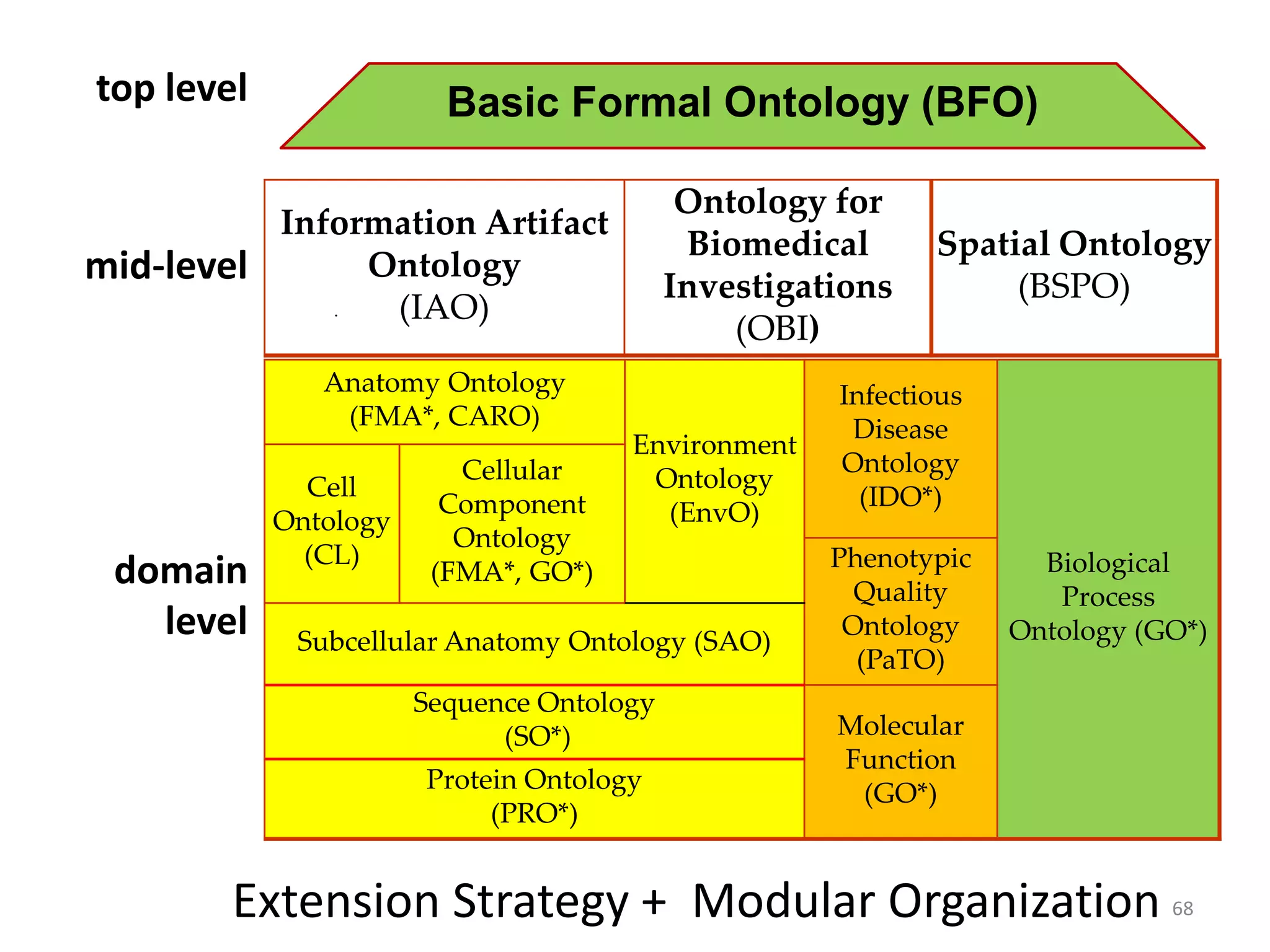
Extension Strategy + Modular Organization 68
top level
mid-level
domain
level
Information Artifact
Ontology
(IAO)
Ontology for
Biomedical
Investigations
(OBI)
Spatial Ontology
(BSPO)
Basic Formal Ontology (BFO)
69
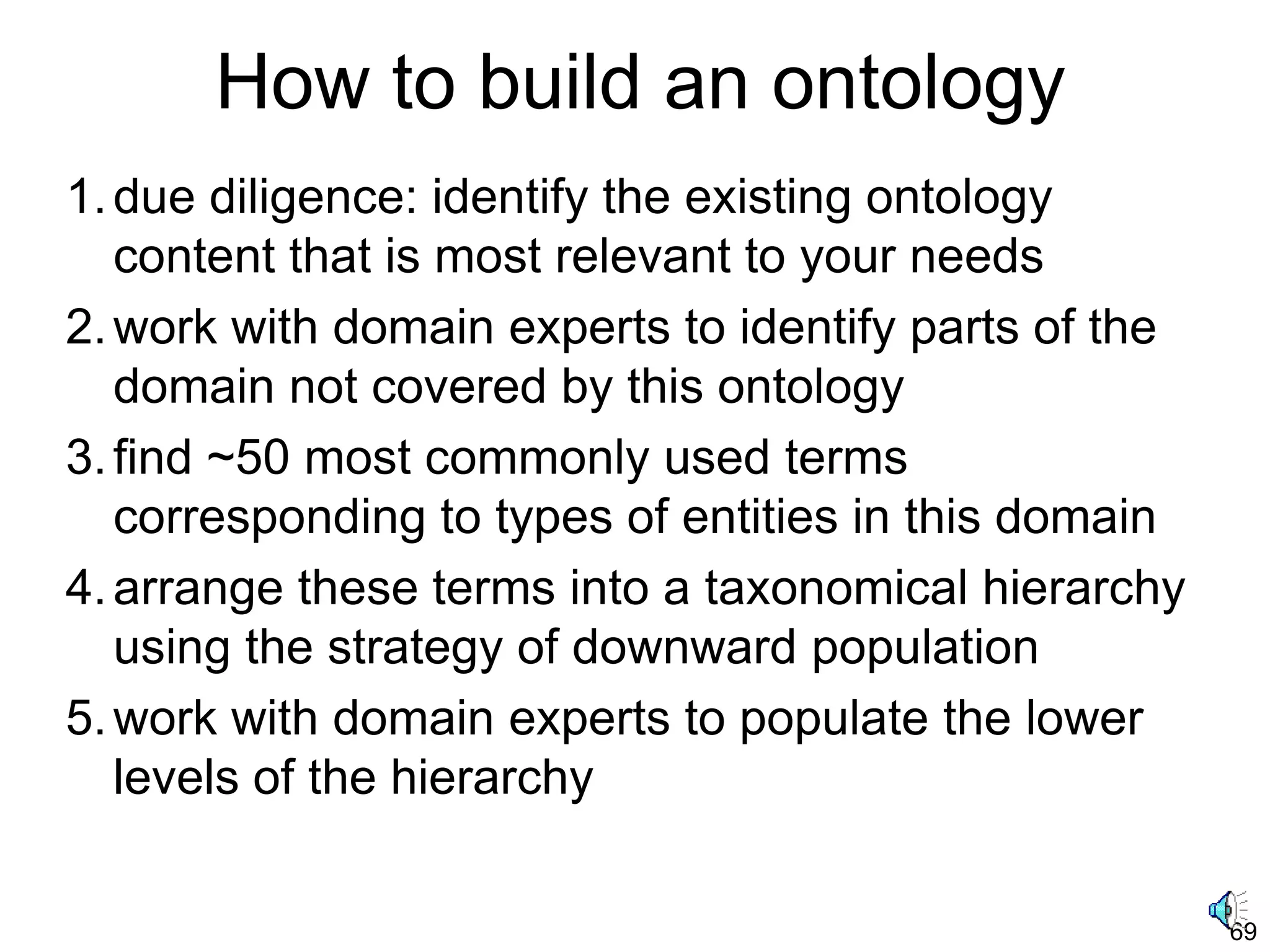
How to build an ontology
1.due diligence: identify the existing ontology
content that is most relevant to your needs
2.work with domain experts to identify parts of the
domain not covered by this ontology
3.find ~50 most commonly used terms
corresponding to types of entities in this domain
4.arrange these terms into a taxonomical hierarchy
using the strategy of downward population
5.work with domain experts to populate the lower
levels of the hierarchy
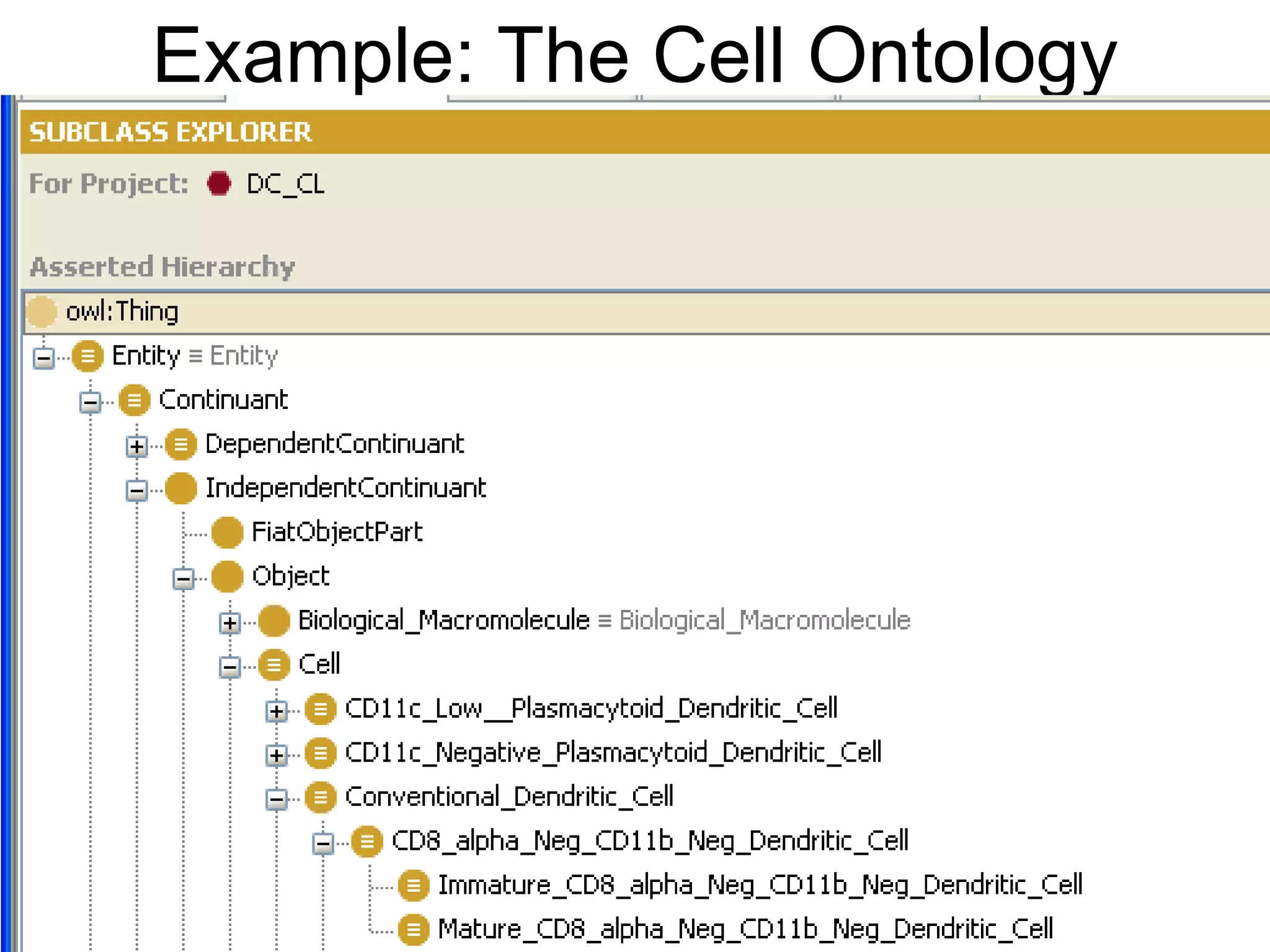
Example: The Cell Ontology
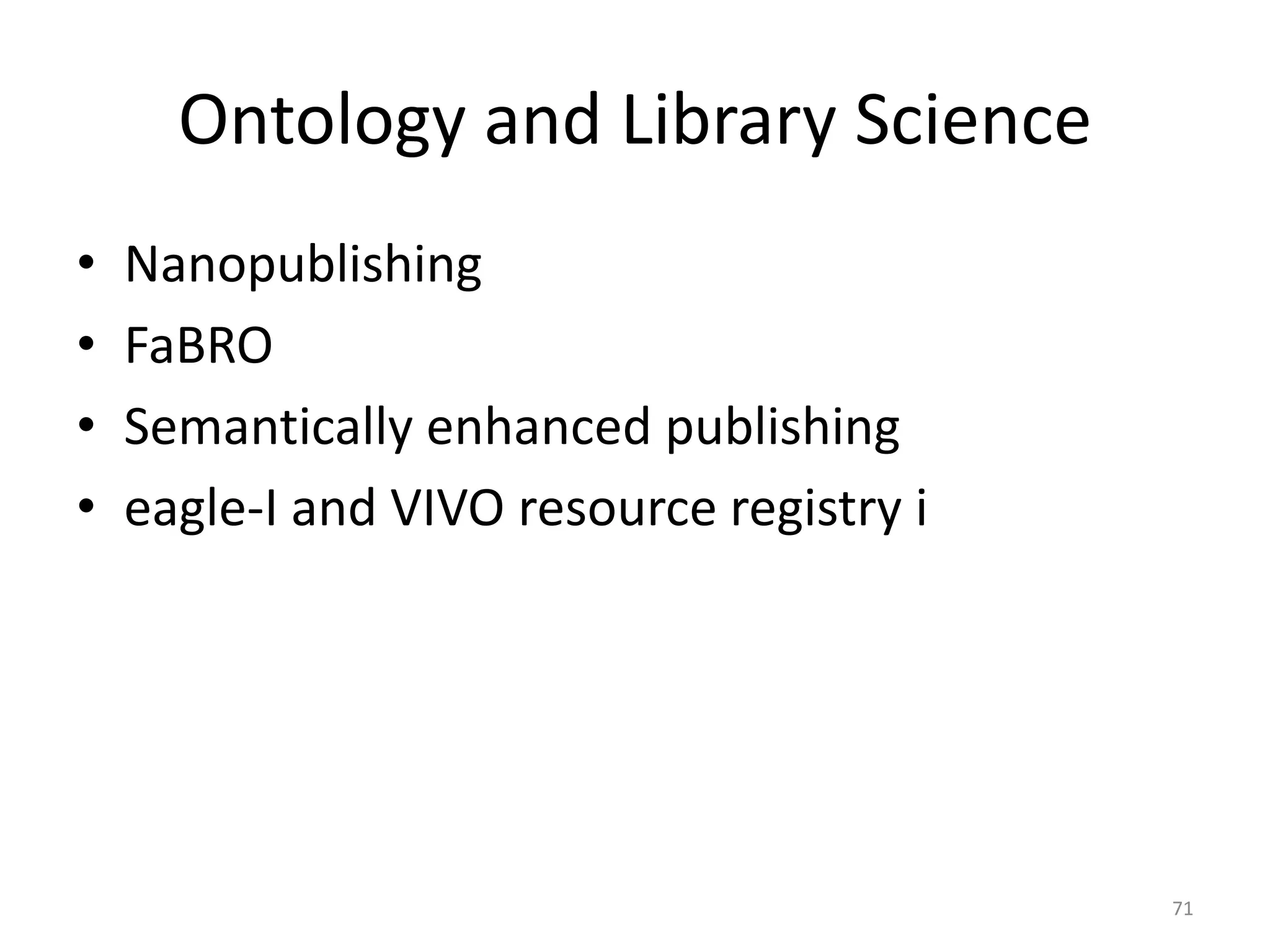
Ontology and Library Science
• Nanopublishing
• FaBRO
• Semantically enhanced publishing
• eagle-I and VIVO resource registry i
71
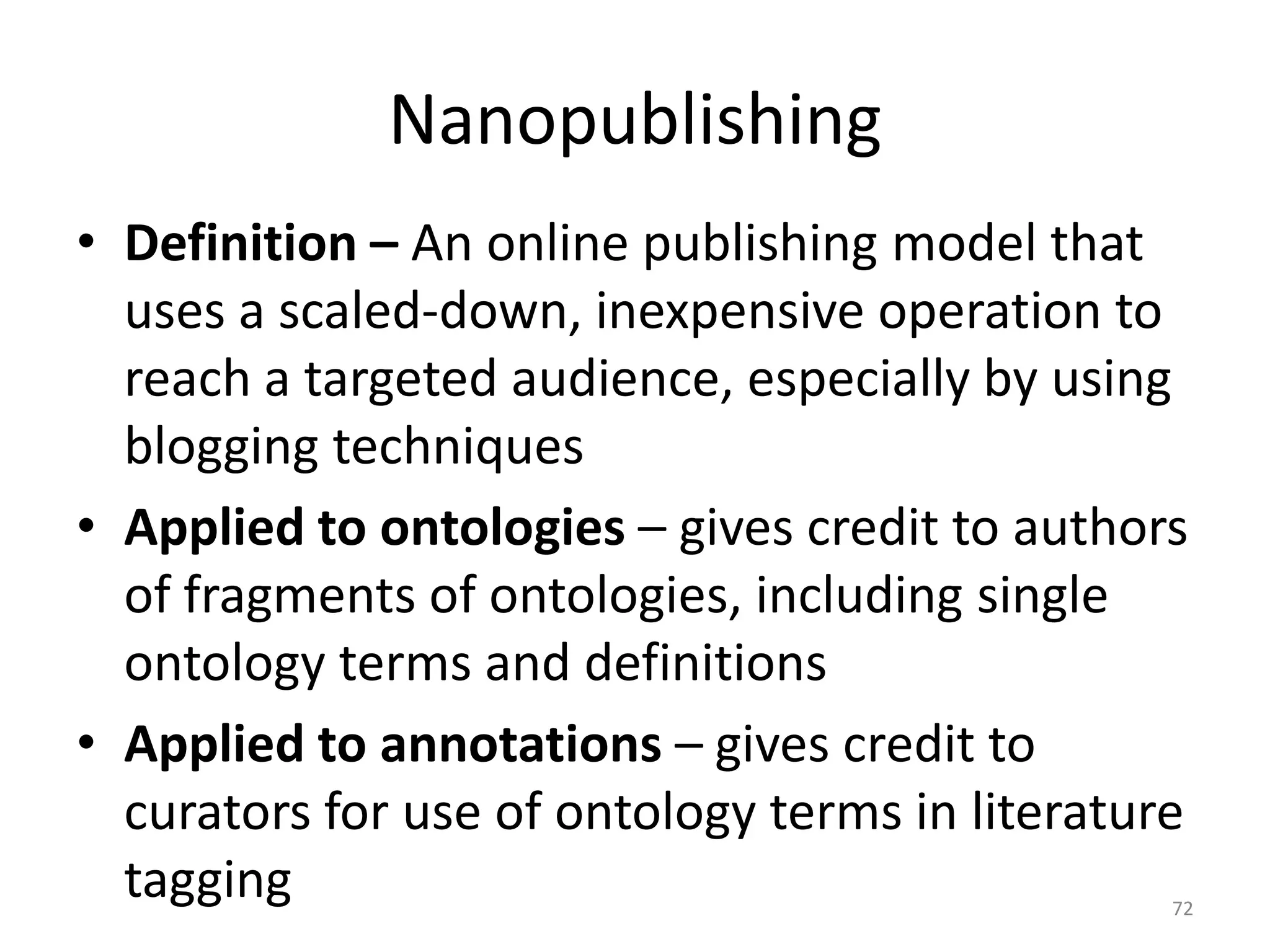
Nanopublishing
• Definition – An online publishing model that
uses a scaled-down, inexpensive operation to
reach a targeted audience, especially by using
blogging techniques
• Applied to ontologies – gives credit to authors
of fragments of ontologies, including single
ontology terms and definitions
• Applied to annotations – gives credit to
curators for use of ontology terms in literature
tagging 72
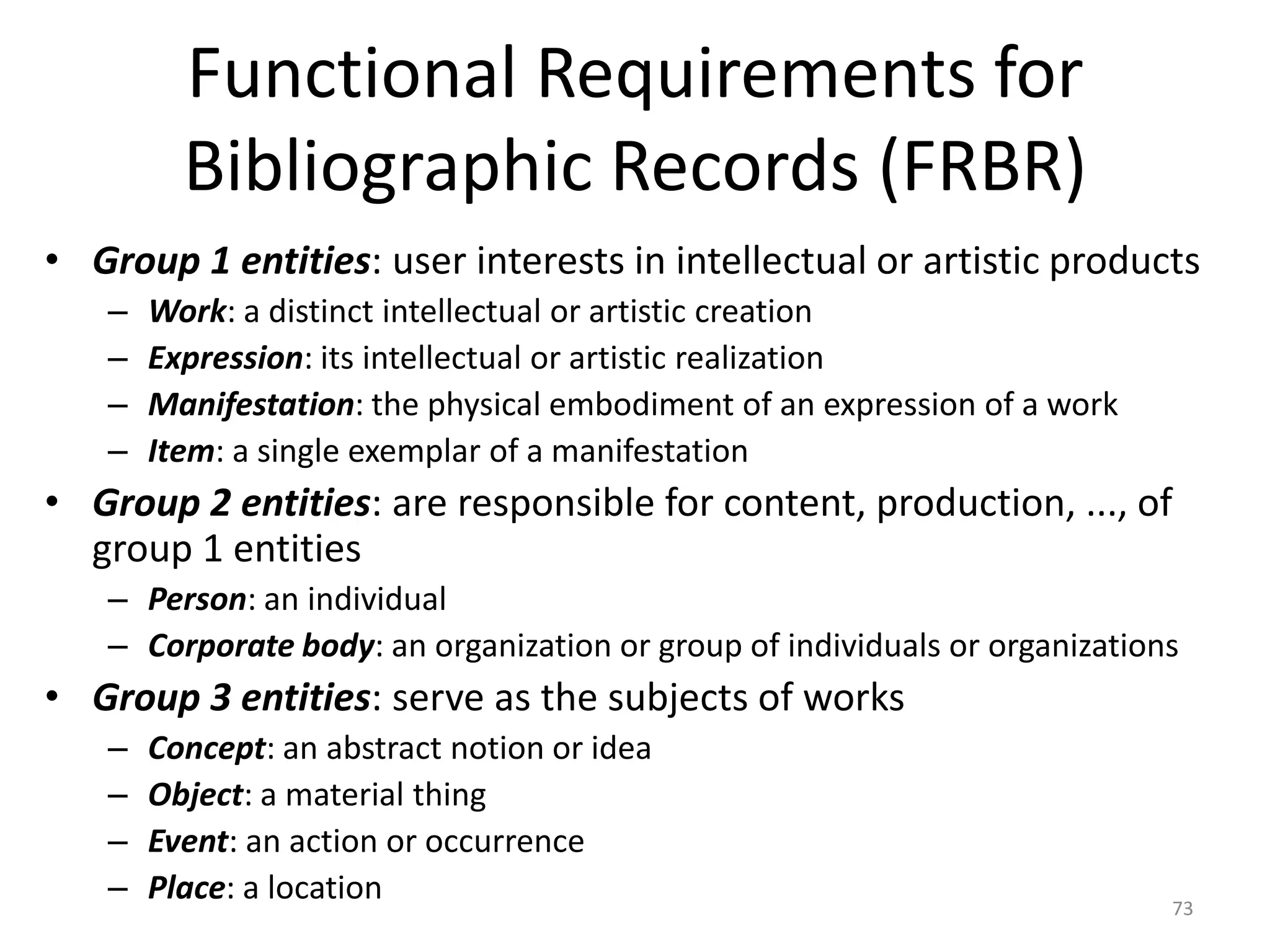
Functional Requirements for
Bibliographic Records (FRBR)
• Group 1 entities: user interests in intellectual or artistic products
– Work: a distinct intellectual or artistic creation
– Expression: its intellectual or artistic realization
– Manifestation: the physical embodiment of an expression of a work
– Item: a single exemplar of a manifestation
• Group 2 entities: are responsible for content, production, ..., of
group 1 entities
– Person: an individual
– Corporate body: an organization or group of individuals or organizations
• Group 3 entities: serve as the subjects of works
– Concept: an abstract notion or idea
– Object: a material thing
– Event: an action or occurrence
– Place: a location 73
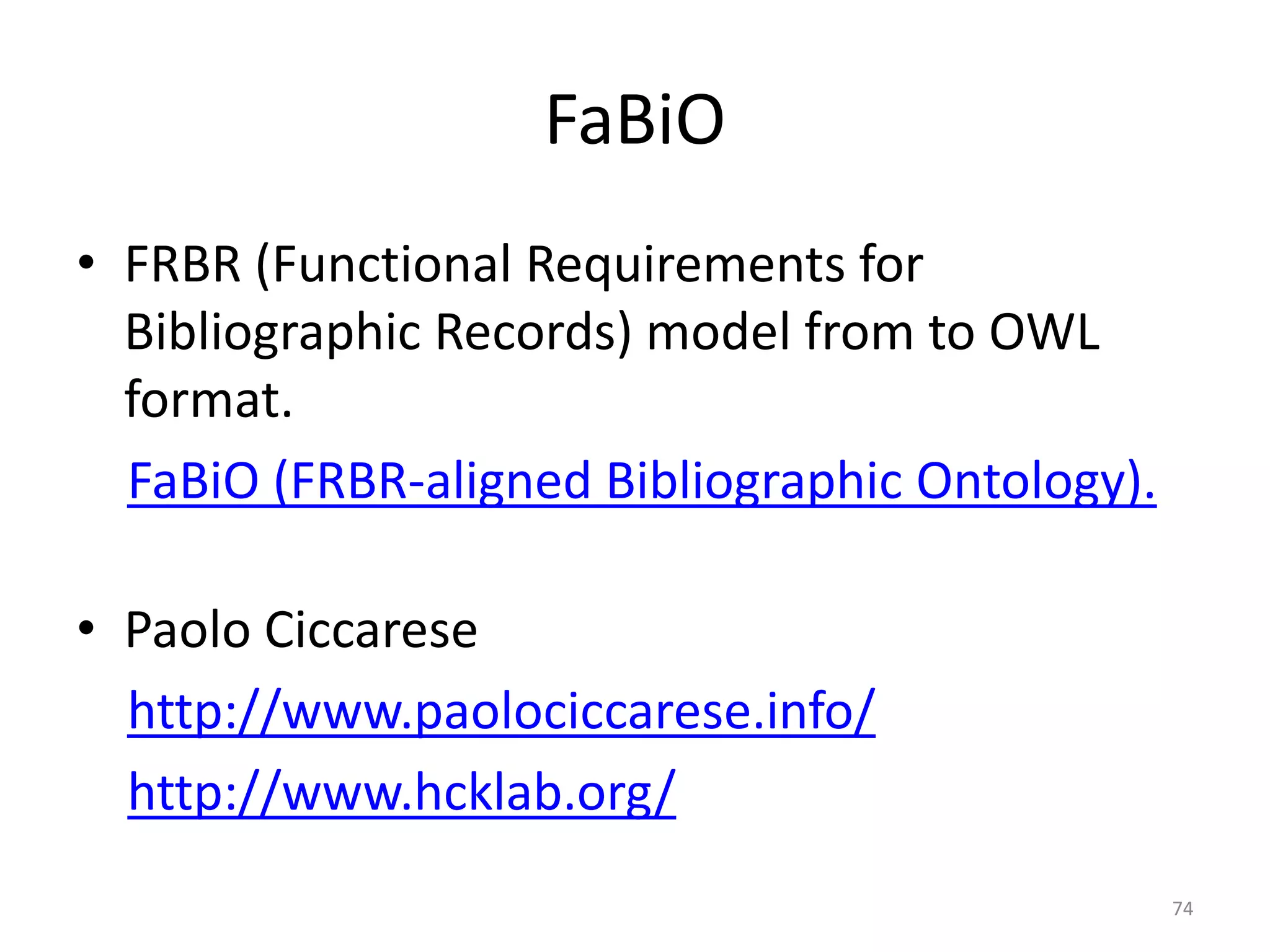
FaBiO
• FRBR (Functional Requirements for
Bibliographic Records) model from to OWL
format.
FaBiO (FRBR-aligned Bibliographic Ontology).
• Paolo Ciccarese
http://www.paolociccarese.info/
http://www.hcklab.org/
74
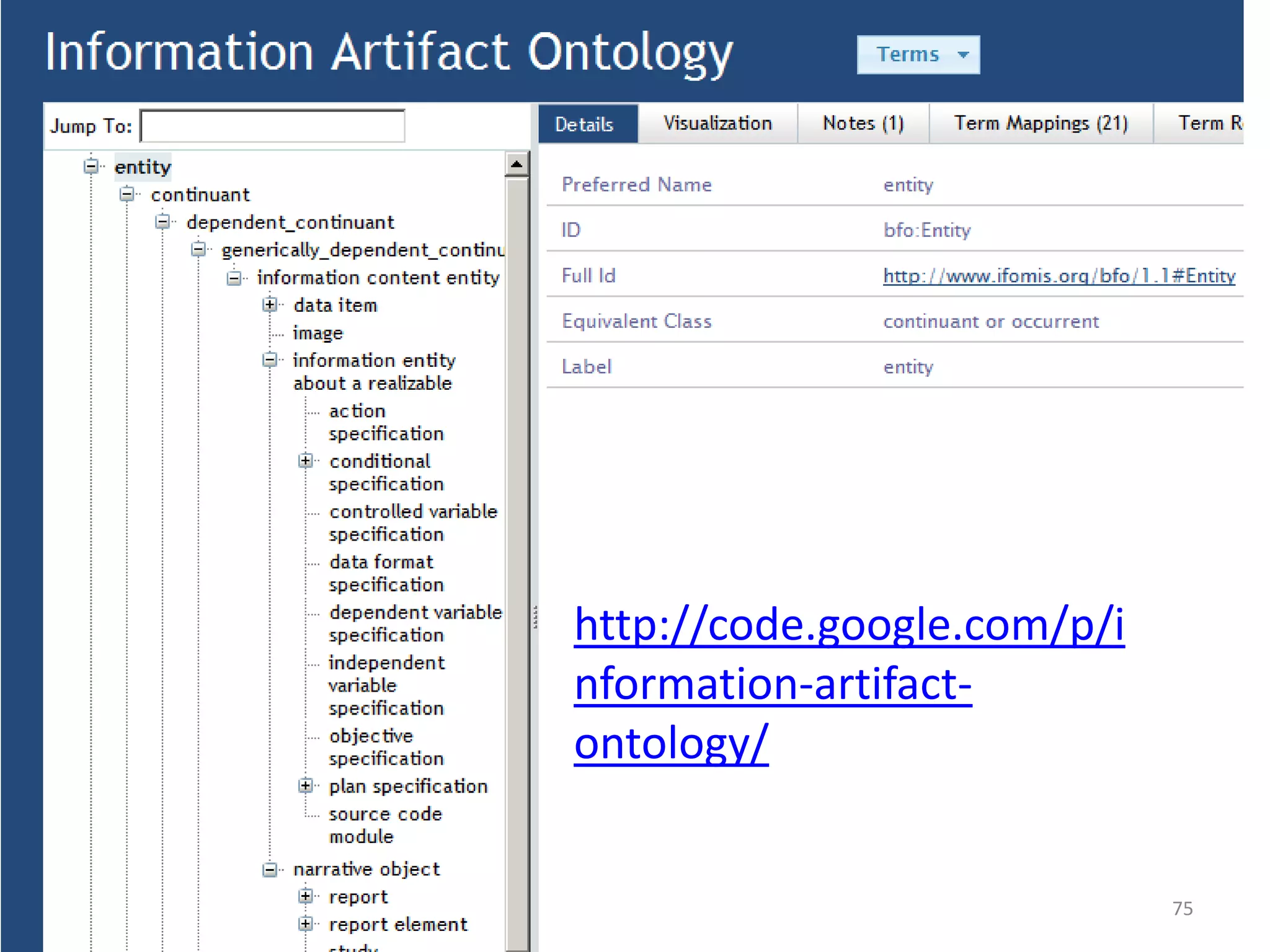
75
http://code.google.com/p/i
nformation-artifact-
ontology/
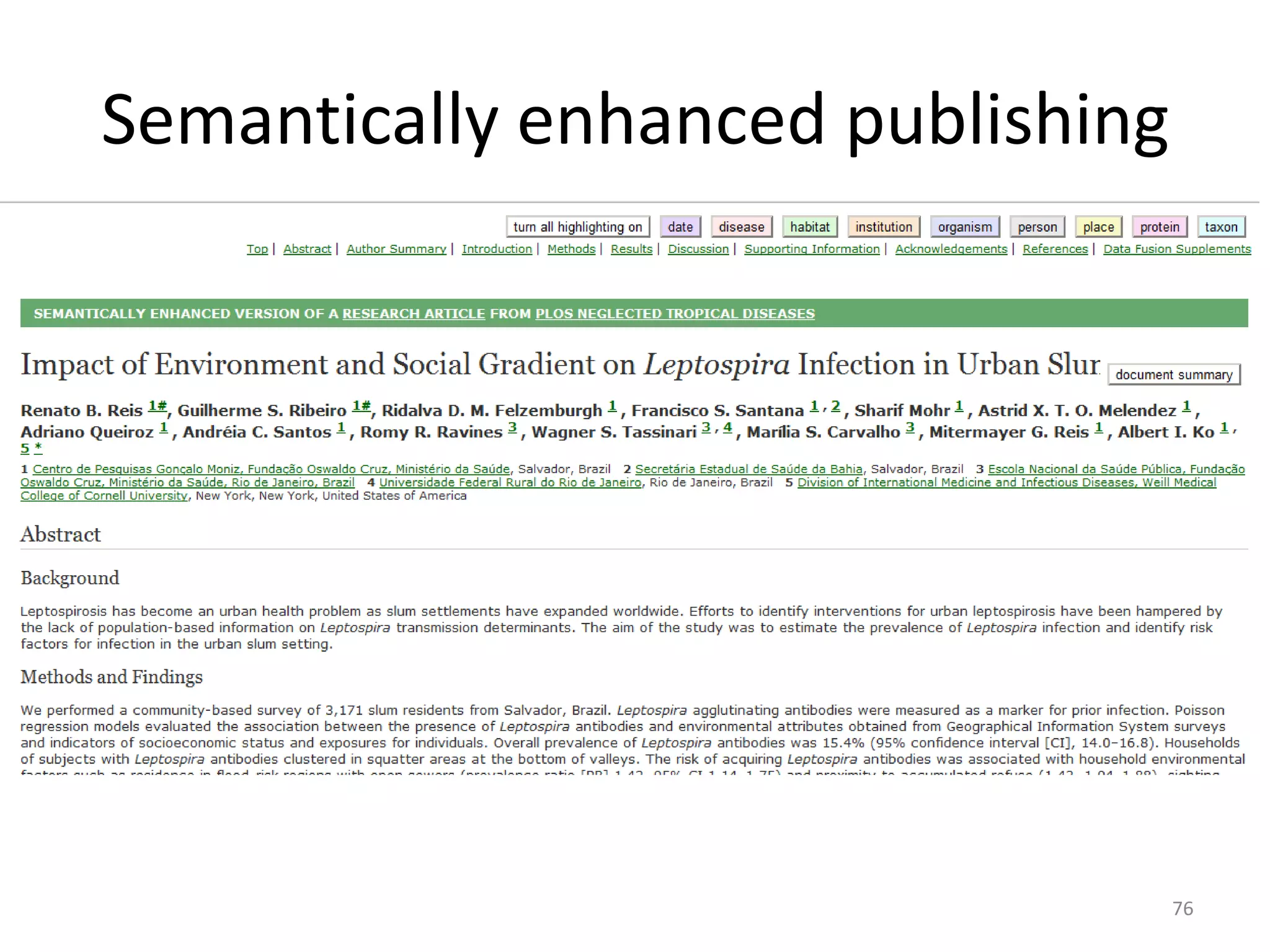
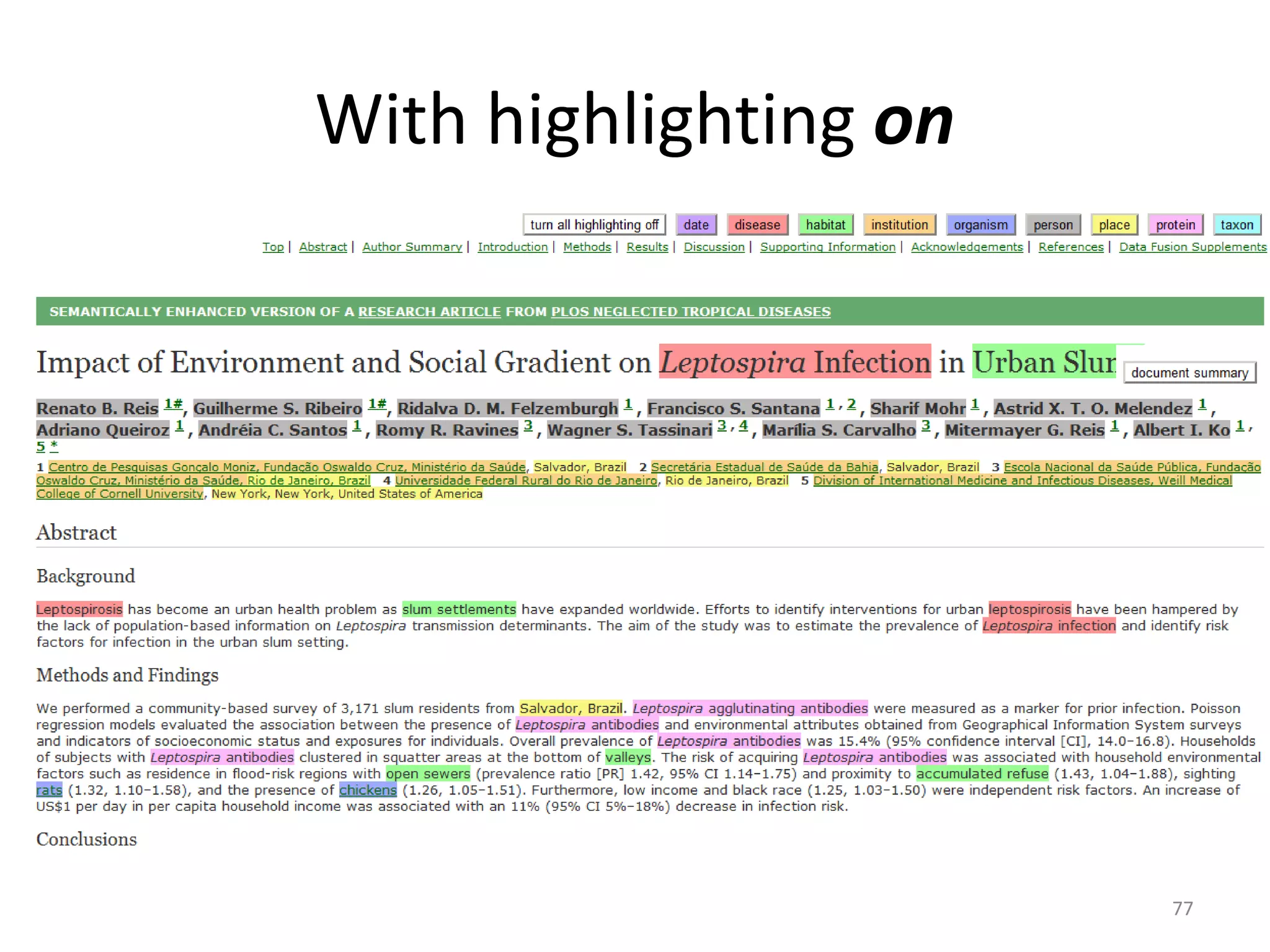
Semantically enhanced publishing
76
With highlighting on
77
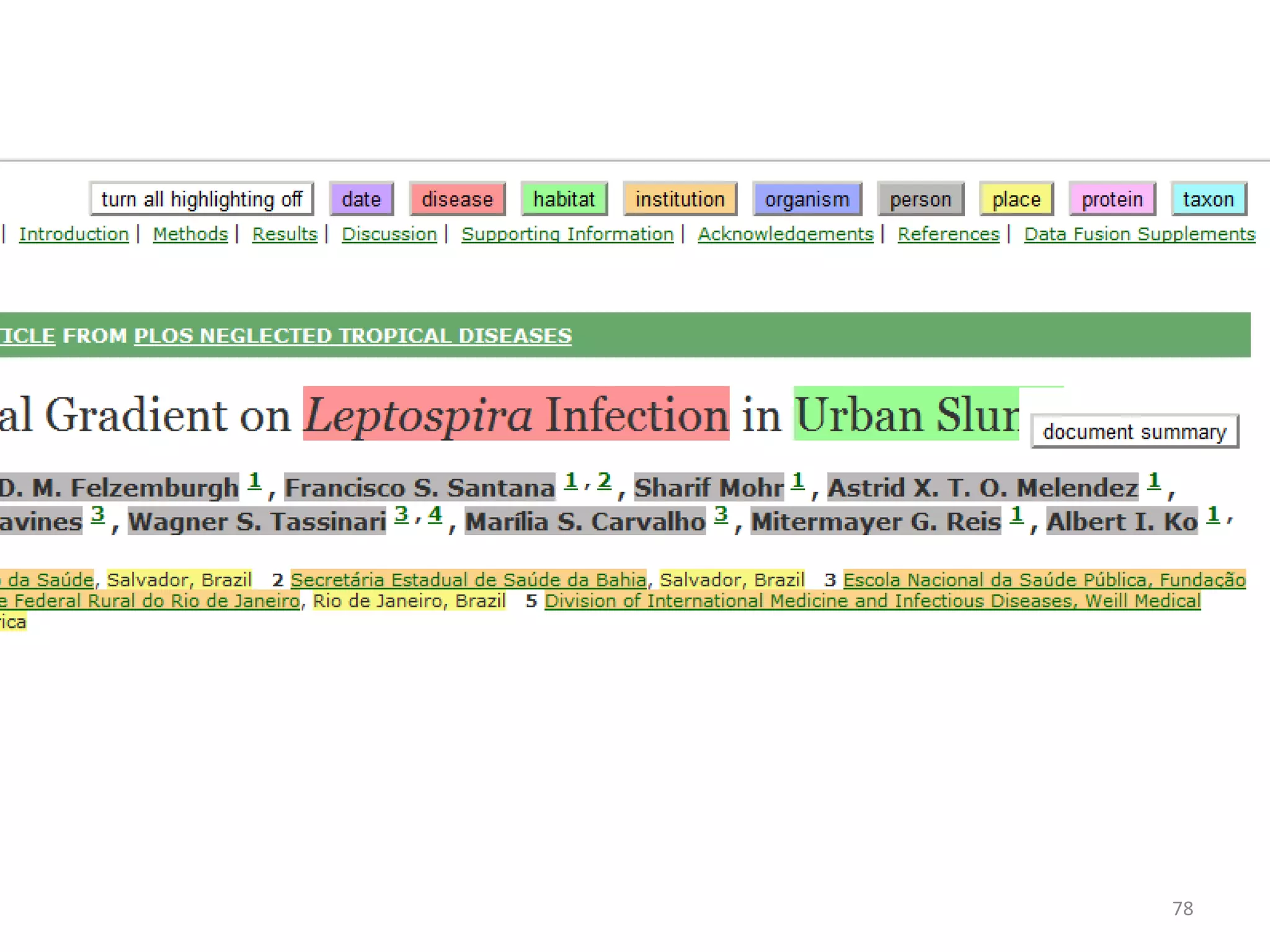
78
eagle-i and VIVO resource registry
initiatives
eagle-i: Ontology for indexing and querying
biomedical research resources
http://code.google.com/p/eagle-i/
VIVO: An interdisciplinary national network
enabling collaboration and discovery
among scientists across all disciplines
http://vivoweb.org/
Shared ontology resources in OBO Foundry
79
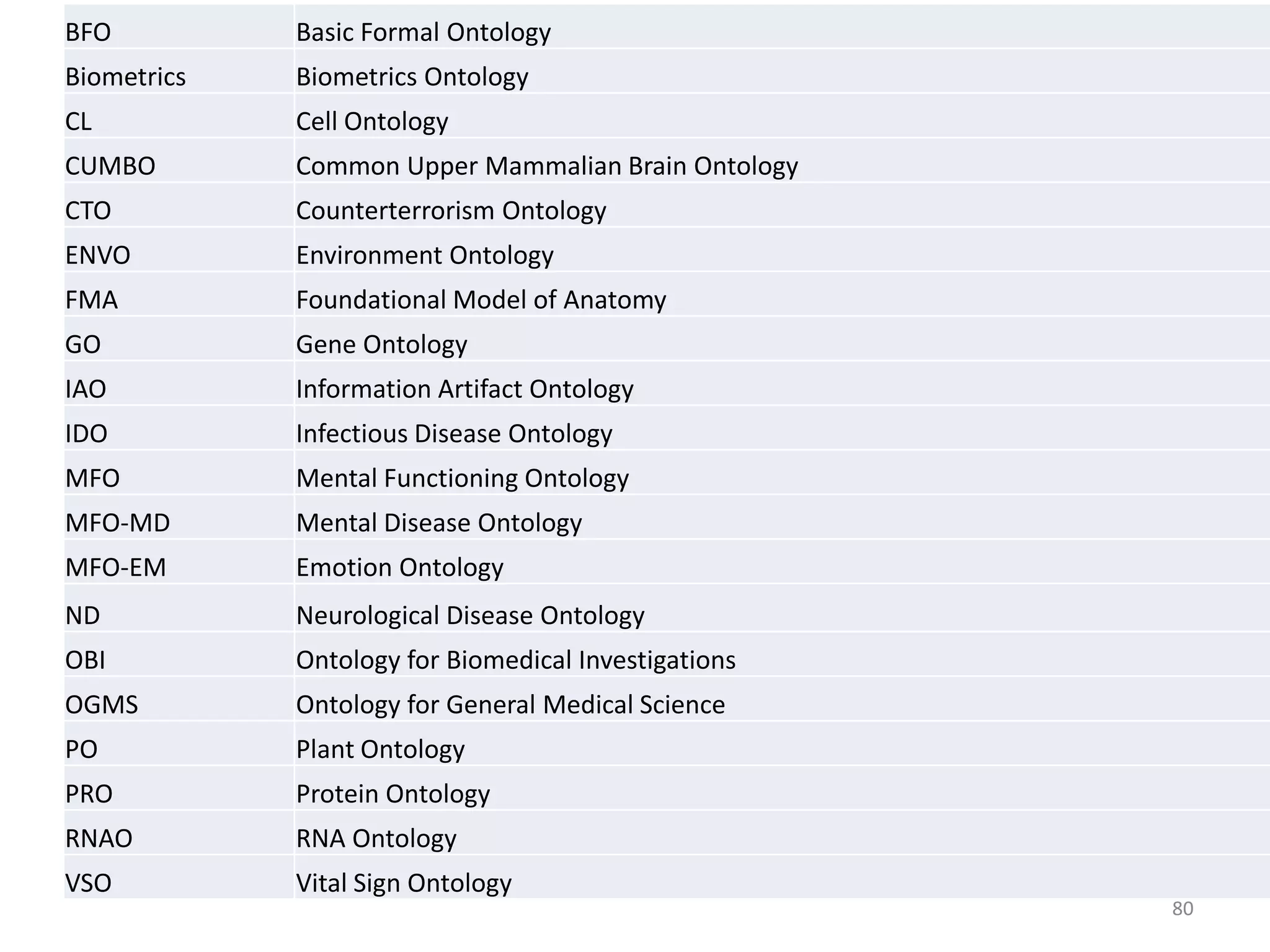
BFO Basic Formal Ontology
Biometrics Biometrics Ontology
CL Cell Ontology
CUMBO Common Upper Mammalian Brain Ontology
CTO Counterterrorism Ontology
ENVO Environment Ontology
FMA Foundational Model of Anatomy
GO Gene Ontology
IAO Information Artifact Ontology
IDO Infectious Disease Ontology
MFO Mental Functioning Ontology
MFO-MD Mental Disease Ontology
MFO-EM Emotion Ontology
ND Neurological Disease Ontology
OBI Ontology for Biomedical Investigations
OGMS Ontology for General Medical Science
PO Plant Ontology
PRO Protein Ontology
RNAO RNA Ontology
VSO Vital Sign Ontology
80
New role for librarians as stewards
of ‘local’ digital data repositories
81
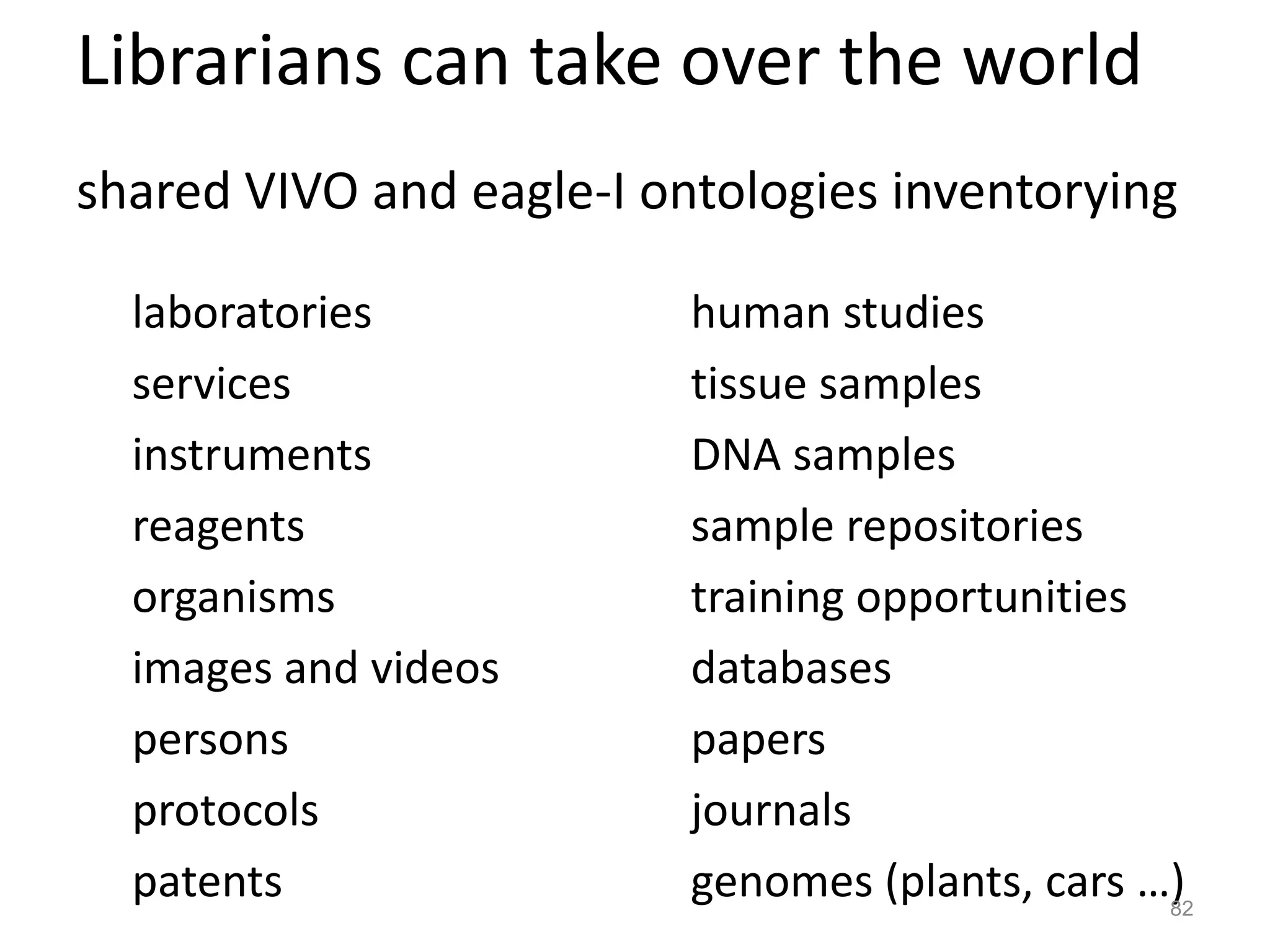
Librarians can take over the world
shared VIVO and eagle-I ontologies inventorying
laboratories
services
instruments
reagents
organisms
images and videos
persons
protocols
patents
human studies
tissue samples
DNA samples
sample repositories
training opportunities
databases
papers
journals
genomes (plants, cars …)82

Ontologies: What Librarians Need to Know

  • 1.
    Ontologies: What Librarians Needto Know Barry Smith Department of Philosophy University at Buffalo presented at the conference on Research Data: Management, Access and Control, University at Buffalo, November 14, 2011 http://libweb1.lib.buffalo.edu/blog/scholarly/?p=85 1
  • 2.
  • 3.
  • 4.
    a short movement ofone lower leg crossing the other leg with the foot pointing outward 4
  • 5.
    same movement, differentterms • part of a mannequin’s step on the catwalk • an epileptic jerk • the kicking of a ball by a soccer player • a signal (“Get out!”) issued in heated conversation • a “half cut” in Irish Sean-nós dancing 5/
  • 6.
  • 7.
    Some questions • Howto find data? • How to understand data when you find it? • How to use data when you find it, for example in hypothesis- checking and reasoning? • How to integrate with other data? • How to label the data you are collecting? • How to build a set of labels for a new domain that will integrate well with labels used in neighboring domains? 7
  • 8.
    Network effects ofthe Web • You build a site. • Others discover the site and they link to it • The more they link to it, the more important and well known the page becomes (this is what Google exploits) • Your page becomes important, and others begin to rely on it • The same network effect works on the raw data – Many people link to the data, use it – Many more (and diverse) applications will be created than the authors would even dream of • New ‘secondary uses’ are discovered Ivan Herman 8
  • 9.
    The problem: doingit this way, we end up with data in many, many silos because links are formed in overlapping and redundant ways Photo credit “nepatterson”, Flickr 9
  • 10.
    To avoid silos: 1.The raw data must be available in a standard way on the Web. 2. There must be links among the datasets to create a ‘web of data’ Use ontologies to capture common meanings with definitions that are understandable to both humans and computers The roots of Semantic Technology
  • 11.
    Ontologies as controlled vocabulariesfor the tagging of data • Hardware changes rapidly • Organizations rapidly forming and disbanding collaborations • Data is exploding • Meanings of common words change slowly • Use web architecture to annotate exploding data stores using ontologies exploiting these common meanings 11
  • 12.
    Mandates for DataReuse • Organizations such as the NIH now require use of common standards in a way that will ensure that the results obtained through funded research are more easily accessible to external groups • http://grants.nih.gov/grants/policy/data_sharing/ • http://www.nsf.gov/bfa/dias/policy/dmp.jsp • Data Ontologies for Biomedical Research (R01): http://grants.nih.gov/grants/guide/pa-files/par-07- 425.html 12/24
  • 13.
    NCBO: National Centerfor Biomedical Ontology • Stanford Biomedical Research Informatics • Mayo Clinic Department of Bioinformatics • University at Buffalo, Department of Philosophy http://bioportal.bioontology.org/ 13/24
  • 14.
  • 15.
    Goals of SemanticTechnology To support data reuse To enable data registries Metadata management Support for Natural Language Understanding Semantic Wikis via ontologies formulated for example in the Web Ontology Language (OWL) 15
  • 16.
    Where we standtoday • html demonstrated the power of the Web to allow sharing of information • increasing availability of semantically enhanced data • increasing power of semantic software toallow automatic reasoning with online information • increasing use of OWL in attempts to break down silos, and create useful integration of on-line data and information 16
  • 17.
    Ontology success stories,and some reasons for failure • A fragment of the Linked Open Data in the biomedical domain 17
  • 18.
  • 19.
    The result: themore Semantic Technology is successful, they more it fails to achieve it goals As we break down silos via controlled vocabularies for the tagging of data the very success of the approach leads to the creation of ever new controlled vocabularies , semantic silos – because multiple ontologies are being created in ad hoc ways The Semantic Web framework as currently conceived and governed by the W3C yields minimal standardization Creates data cemeteries 19
  • 20.
  • 21.
  • 22.
    Reasons for thiseffect • Shrink-wrapped software mentality – you will not get paid for reusing old and good ontologies (Let a million ‘lite’ ontologies bloom) • Belief that there are no ‘good’ ontologies (just arbitrary choices of terms and relations …) • No licensing regime (database inspection tax …) • Information technology (hardware) changes constantly, not worth the effort of getting things right • We have done it this way for 30 years, we are not going to change now 22
  • 23.
    Ontology success stories,and some reasons for failure • Can we solve the problem by means of mappings? 23
  • 24.
    Unified Medical LanguageSystem of the National Library of Medicine • let a million ontologies bloom, each one close to the terminological habits of its authors • in concordance with the “not invented here” syndrome • then map these ontologies, and use these mappings to integrate your different pots of data 24/24
  • 25.
    What you getwith ‘mappings’ all phenotypes (excess hair loss, duck feet) all organisms allose (a form of sugar) Acute Lymphoblastic Leukemia (A.L.L.) 25
  • 26.
    Mappings are hard Theyare fragile, and expensive to maintain Need a new authority to maintain, yielding new risk of forking The goal should be to minimize the need for mappings Invest resources in disjoint ontology modules which work well together 26
  • 27.
    Why should youcare? • you need to create systems for data mining and text processing which will yield useful output for library users • if the codes you use are constantly in need of ad hoc repair huge resources will be wasted, manual effort will be needed on each occasion of use • DoD alone spends $6 billion per annum on this problem 27/24
  • 28.
    And there areother problems • Weak expressivity of OWL • Poor quality coding, poor quality ontologies, poor quality ontology management • Strategy often serves only retrieval, not reasoning • Confusion as to the meaning of ‘linked’ 28
  • 29.
  • 31.
  • 32.
    How to doit right? • how create an incremental, evolutionary process, where what is good survives, and what is bad fails • create a scenario in which people will find it profitable to reuse ontologies, terminologies and coding systems which have been tried and tested • silo effects will be avoided and results of investment in Semantic Technology will cumulate effectively 32
  • 33.
    0 200 400 600 800 1000 1200 2000 2001 20022003 2004 2005 2006 2007 2008 2009 2010 AxisTitle Series 1 Ontology in PubMed
  • 34.
    Uses of ‘ontology’in PubMed abstracts 34/24
  • 35.
    By far themost successful: GO (Gene Ontology) 35
  • 36.
    GO provides acontrolled vocabulary of terms for use in annotating (describing, tagging) data • multi-species, multi-disciplinary, open source • contributing to the cumulativity of scientific results obtained by distinct research communities • compare use of kilograms, meters, seconds in formulating experimental results • natural language and logical definitions for all terms to support consistent human application and computational exploitation 36
  • 37.
    You’re interested in whichgenes control heart muscle development 17,536 results 37
  • 38.
    arson lw n3d... t_LW_n3 d_5p_... Colored by: Copy of Copy of C5_RMA (Defa... Gene List: all genes (1 4010) attacked time control Puparial adhesion Molting cycle hemocyanin Defense response Immune response Response to stimulus Toll regulated genes JAK-STAT regulated genes Immune response Toll regulated genes Amino acid catabolism Lipid metobolism Peptidase activity Protein catabloism Immune response e Tree: pearson lw n3d ... lassification: Set_LW_n3d_5p_... Colored by: Copy of Copy of C5_RMA (Defa... Gene List: all genes (14010) Microarray data shows changed expression of thousands of genes. How will you spot the patterns? 38
  • 39.
    You’re interested inwhich of your hospital’s patient data is relevant to understanding how genes control heart muscle development 39
  • 40.
    Lab / pathologydata EHR data Clinical trial data Family history data Medical imaging Microarray data Model organism data Flow cytometry Mass spec Genotype / SNP data How will you spot the patterns? How will you find the data you need? 40
  • 41.
    One strategy forbringing order into this huge conglomeration of data is through the use of Common Data Elements • Discipline-specific (cancer, NIAID, …) • Do not solve the problems of balkanization (data siloes) • Do not evolve gracefully as knowledge advances • Support data cumulation, but do not readily support data integration and computation 41
  • 42.
    How does the GeneOntology work? with thanks to Jane Lomax, Gene Ontology Consortium 42
  • 43.
    GO provides acontrolled system of representations for use in annotating data • multi-species, multi-disciplinary, open source • contributing to the cumulativity of scientific results obtained by distinct research communities • compare use of kilograms, meters, seconds … in formulating experimental results 43
  • 44.
  • 45.
  • 46.
    Gene products involvedin cardiac muscle development in humans 46
  • 47.
    GO provides answersto three types of questions for each gene product • in what parts of the cell has it been identified? • exercising what types of molecular functions? • with what types of biological processes? when is a particular gene product involved • in the course of normal development? • in the process leading to abnormality with what functions is the gene product associated in other biological processes? 47
  • 48.
    Some pain-related termsin GO GO:0048265 response to pain GO:0019233 sensory perception of pain GO:0048266 behavioral response to pain GO:0019234 sensory perception of fast pain GO:0019235 sensory perception of slow pain GO:0051930 regulation of sensory perception of pain GO:0050967 detection of electrical stimulus during sensory perception of pain GO:0050968 detection of chemical stimulus involved in sensory perception of pain GO:0050966 detection of mechanical stimulus involved in sensory perception of pain 48
  • 49.
  • 50.
    A new kindof biological research based on analysis and comparison of the massive quantities of annotations linking ontology terms to raw data, including genomic data, clinical data, public health data What 10 years ago took multiple groups of researchers months of data comparison effort, can now be performed in milliseconds 50
  • 51.
    One standard method SjöblömT, et al. analyzed13,023 genes in 11 breast and 11 colorectal cancers using functional information captured by GO for given gene product types identified 189 as being mutated at significant frequency and thus as providing targets for diagnostic and therapeutic intervention. Science. 2006 Oct 13;314(5797):268-74. 51
  • 52.
    What is thekey to GO’s success? • GO is developed, maintained and by experts who adhere to ontology best practices • over 11 million annotations relating gene products described in the UniProt, Ensembl and other databases to terms in the GO • experimental results reported in 52,000 scientific journal articles manually annoted by expert biologists using GO • ontology building and ontology QA are two sides of the same coin 52
  • 53.
    If controlled vocabulariesare to serve to remove silos they have to be updated by respected experts who are trained in best practices of ontology maintenance they have to be respected by many owners of data as resources that ensure accurate description of their data – GO maintained not by computer scientists but by biologists they have to be willingly used in annotations by many owners of data 53
  • 54.
    54 The new professionof biocurator
  • 55.
  • 56.
    How to doit right? • how create an incremental, evolutionary process, where what is good survives, and what is bad fails • where the number of ontologies needing to be linked is small • where links are stable • create a scenario in which people will find it profitable to reuse ontologies, terminologies and coding systems which have been tried and tested • and in which ontologies will evolve on the basis of feedback from users 56
  • 57.
    Reasons why GOhas been successful It is a system for prospective standardization built with coherent top level but with content contributed and monitored by domain specialists Based on community consensus Clear versioning principles ensure backwards compatibility; prior annotations do not lose their value Initially low-tech to encourage adoption by new communities of users Tracker for user input with rapid turnaround and help desk 57
  • 58.
    But GO islimited in its scope it covers only generic biological entities of three sorts: –cellular components –molecular functions –biological processes no diseases, symptoms, disease biomarkers, protein interactions, experimental processes … 58
  • 59.
    Extending the GOmethodology to other domains of biology and medicine 59
  • 60.
    RELATION TO TIME GRANULARITY CONTINUANT OCCURRENT INDEPENDENTDEPENDENT ORGAN AND ORGANISM Organism (NCBI Taxonomy) Anatomical Entity (FMA, CARO) Organ Function (FMP, CPRO) Phenotypic Quality (PaTO) Biological Process (GO) CELL AND CELLULAR COMPONENT Cell (CL) Cellular Component (FMA, GO) Cellular Function (GO) MOLECULE Molecule (ChEBI, SO, RnaO, PrO) Molecular Function (GO) Molecular Process (GO) OBO (Open Biomedical Ontology) Foundry proposal (Gene Ontology in yellow) 60
  • 61.
    RELATION TO TIME GRANULARITY CONTINUANT OCCURRENT INDEPENDENTDEPENDENT ORGAN AND ORGANISM Organism (NCBI Taxonomy) Anatomical Entity (FMA, CARO) Organ Function (FMP, CPRO) Phenotypic Quality (PaTO) Biological Process (GO) CELL AND CELLULAR COMPONENT Cell (CL) Cellular Component (FMA, GO) Cellular Function (GO) MOLECULE Molecule (ChEBI, SO, RnaO, PrO) Molecular Function (GO) Molecular Process (GO) The strategy of orthogonal modules 61
  • 62.
    Ontology Scope URLCustodians Cell Ontology (CL) cell types from prokaryotes to mammals obo.sourceforge.net/cgi- bin/detail.cgi?cell Jonathan Bard, Michael Ashburner, Oliver Hofman Chemical Entities of Bio- logical Interest (ChEBI) molecular entities ebi.ac.uk/chebi Paula Dematos, Rafael Alcantara Common Anatomy Refer- ence Ontology (CARO) anatomical structures in human and model organisms (under development) Melissa Haendel, Terry Hayamizu, Cornelius Rosse, David Sutherland, Foundational Model of Anatomy (FMA) structure of the human body fma.biostr.washington. edu JLV Mejino Jr., Cornelius Rosse Functional Genomics Investigation Ontology (FuGO) design, protocol, data instrumentation, and analysis fugo.sf.net FuGO Working Group Gene Ontology (GO) cellular components, molecular functions, biological processes www.geneontology.org Gene Ontology Consortium Phenotypic Quality Ontology (PaTO) qualities of anatomical structures obo.sourceforge.net/cgi -bin/ detail.cgi? attribute_and_value Michael Ashburner, Suzanna Lewis, Georgios Gkoutos Protein Ontology (PrO) protein types and modifications (under development) Protein Ontology Consortium Relation Ontology (RO) relations obo.sf.net/relationship Barry Smith, Chris Mungall RNA Ontology (RnaO) three-dimensional RNA structures (under development) RNA Ontology Consortium Sequence Ontology (SO) properties and features of nucleic sequences song.sf.net Karen Eilbeck
  • 63.
    OBO Foundry recognized byNIH as framework to address mandates for re-usability of data collected through Federally funded research see NIH PAR-07-425: Data Ontologies for Biomedical Research (R01) 63
  • 64.
    OBO Foundry provides •tested guidelines enabling new groups to develop the ontologies they need in ways which counteract forking and dispersion of effort • an incremental bottoms-up approach to evidence- based terminology practices in medicine that is rooted in basic biology • automatic web-based linkage between biological knowledge resources (massive integration of databases across species and biological system) 64
  • 65.
    RELATION TO TIME GRANULARITY CONTINUANT OCCURRENT INDEPENDENTDEPENDENT ORGAN AND ORGANISM Organism (NCBI Taxonomy) Anatomical Entity (FMA, CARO) Organ Function (FMP, CPRO) Phenotypic Quality (PaTO) Biological Process (GO) CELL AND CELLULAR COMPONENT Cell (CL) Cellular Component (FMA, GO) Cellular Function (GO) MOLECULE Molecule (ChEBI, SO, RnaO, PrO) Molecular Function (GO) Molecular Process (GO) The Open Biomedical Ontologies (OBO) Foundry 65
  • 66.
    Anatomy Ontology (FMA*, CARO) Environment Ontology (EnvO) Infectious Disease Ontology (IDO*) Biological Process Ontology(GO*) Cell Ontology (CL) Cellular Component Ontology (FMA*, GO*) Phenotypic Quality Ontology (PaTO) Subcellular Anatomy Ontology (SAO) Sequence Ontology (SO*) Molecular Function (GO*)Protein Ontology (PRO*) OBO Foundry Modular Organization Governance Information Artifact Ontology (IAO) Ontology for Biomedical Investigations (OBI) Ontology of General Medical Science (OGMS) Basic Formal Ontology (BFO) 66
  • 67.
    Anatomy Ontology (FMA*, CARO) Environment Ontology (EnvO) Infectious Disease Ontology (IDO*) Biological Process Ontology(GO*) Cell Ontology (CL) Cellular Component Ontology (FMA*, GO*) Phenotypic Quality Ontology (PaTO) Subcellular Anatomy Ontology (SAO) Sequence Ontology (SO*) Molecular Function (GO*)Protein Ontology (PRO*) OBO Foundry Modular Organization Training Information Artifact Ontology (IAO) Ontology for Biomedical Investigations (OBI) Ontology of General Medical Science (OGMS) Basic Formal Ontology (BFO) 67
  • 68.
    Anatomy Ontology (FMA*, CARO) Environment Ontology (EnvO) Infectious Disease Ontology (IDO*) Biological Process Ontology(GO*) Cell Ontology (CL) Cellular Component Ontology (FMA*, GO*) Phenotypic Quality Ontology (PaTO) Subcellular Anatomy Ontology (SAO) Sequence Ontology (SO*) Molecular Function (GO*)Protein Ontology (PRO*) Extension Strategy + Modular Organization 68 top level mid-level domain level Information Artifact Ontology (IAO) Ontology for Biomedical Investigations (OBI) Spatial Ontology (BSPO) Basic Formal Ontology (BFO)
  • 69.
    69 How to buildan ontology 1.due diligence: identify the existing ontology content that is most relevant to your needs 2.work with domain experts to identify parts of the domain not covered by this ontology 3.find ~50 most commonly used terms corresponding to types of entities in this domain 4.arrange these terms into a taxonomical hierarchy using the strategy of downward population 5.work with domain experts to populate the lower levels of the hierarchy
  • 70.
  • 71.
    Ontology and LibraryScience • Nanopublishing • FaBRO • Semantically enhanced publishing • eagle-I and VIVO resource registry i 71
  • 72.
    Nanopublishing • Definition –An online publishing model that uses a scaled-down, inexpensive operation to reach a targeted audience, especially by using blogging techniques • Applied to ontologies – gives credit to authors of fragments of ontologies, including single ontology terms and definitions • Applied to annotations – gives credit to curators for use of ontology terms in literature tagging 72
  • 73.
    Functional Requirements for BibliographicRecords (FRBR) • Group 1 entities: user interests in intellectual or artistic products – Work: a distinct intellectual or artistic creation – Expression: its intellectual or artistic realization – Manifestation: the physical embodiment of an expression of a work – Item: a single exemplar of a manifestation • Group 2 entities: are responsible for content, production, ..., of group 1 entities – Person: an individual – Corporate body: an organization or group of individuals or organizations • Group 3 entities: serve as the subjects of works – Concept: an abstract notion or idea – Object: a material thing – Event: an action or occurrence – Place: a location 73
  • 74.
    FaBiO • FRBR (FunctionalRequirements for Bibliographic Records) model from to OWL format. FaBiO (FRBR-aligned Bibliographic Ontology). • Paolo Ciccarese http://www.paolociccarese.info/ http://www.hcklab.org/ 74
  • 75.
  • 76.
  • 77.
  • 78.
  • 79.
    eagle-i and VIVOresource registry initiatives eagle-i: Ontology for indexing and querying biomedical research resources http://code.google.com/p/eagle-i/ VIVO: An interdisciplinary national network enabling collaboration and discovery among scientists across all disciplines http://vivoweb.org/ Shared ontology resources in OBO Foundry 79
  • 80.
    BFO Basic FormalOntology Biometrics Biometrics Ontology CL Cell Ontology CUMBO Common Upper Mammalian Brain Ontology CTO Counterterrorism Ontology ENVO Environment Ontology FMA Foundational Model of Anatomy GO Gene Ontology IAO Information Artifact Ontology IDO Infectious Disease Ontology MFO Mental Functioning Ontology MFO-MD Mental Disease Ontology MFO-EM Emotion Ontology ND Neurological Disease Ontology OBI Ontology for Biomedical Investigations OGMS Ontology for General Medical Science PO Plant Ontology PRO Protein Ontology RNAO RNA Ontology VSO Vital Sign Ontology 80
  • 81.
    New role forlibrarians as stewards of ‘local’ digital data repositories 81
  • 82.
    Librarians can takeover the world shared VIVO and eagle-I ontologies inventorying laboratories services instruments reagents organisms images and videos persons protocols patents human studies tissue samples DNA samples sample repositories training opportunities databases papers journals genomes (plants, cars …)82

Editor's Notes

  • #8 http://www.w3.org/People/Ivan/CorePresentations/HighLevelIntro/
  • #9 http://www.w3.org/People/Ivan/CorePresentations/HighLevelIntro/
  • #10 http://www.w3.org/People/Ivan/CorePresentations/HighLevelIntro/
  • #11 http://www.w3.org/People/Ivan/CorePresentations/HighLevelIntro/
  • #12 Ivan Herman
  • #16 http://www.scribd.com/doc/26643569/INCOSE-MBSE-Putting-Ontologies-to-Work-MESA-AZ-Feb-2010
  • #18 http://dbpedia.org/fct/images/lod-datasets_2009-03-27_colored.png
  • #24 http://dbpedia.org/fct/images/lod-datasets_2009-03-27_colored.png
  • #26 http://bioportal.bioontology.org/visualize/42182/?id=HP:0000001#mappingsaccessed 1/25/2010
  • #30 http://www4.wiwiss.fu-berlin.de/bizer/pub/LinkedDataTutorial/
  • #31 http://www.franz.com/agraph/support/documentation/current/agraph-introduction.html
  • #32 http://www.alatechsource.org/blog/2010/01/rda-vocabularies-for-a-twenty-first-century-data-environment.html