LIS 764: LIBRARY USER INSTRUCTION


 Teaching in an online
     environment
          &
   Creating tools for
Asynchronous Instruction

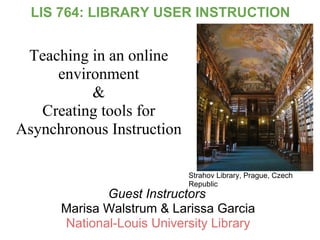
                           Strahov Library, Prague, Czech
                           Republic
             Guest Instructors
      Marisa Walstrum & Larissa Garcia
      National-Louis University Library
Tonight's outline
 1.   Introduction
 2.   NLU history & perspective
 3.   Teaching Adult Learners         Mitchell Library, Glasgow, Scotland
 4.   Teaching in an Online Environment
 5.   Why Tutorials?
 6.   Tips & Best Practices
 7.   Evaluating Tutorials
 8.   Tutorial Creation Software
 9.   Additional Resources
10.   Q&A - your chance to ask library, career, or school-
      related questions of recent DU grads!
National-Louis University

                                             A bit of background

                                                  Founded in 1886
                                                  Private, non-denominational
                                                  Strong tradition of service to
                                                  urban, immigrant, & minority
                                                  populations
                                                  Average age: 36
                                                  (undergraduate); 38 (graduate)
                                                  Online degree programs: 8
                                                  (BlackBoard)
                                                  U.S. Campus locations: 8

Elizabeth Harrison & Edna Dean Baker - the 1st and 2nd presidents of the college. Image from NLU
Archives.
Teaching Adult Learners

 Non-traditional students bring a diverse background and
 varying skill sets to the classroom
 Critical thinking and library anxiety (Kwon)
 Authenticity in library instruction
 Motivation & Self directed learners
 Learning Preferences
 Time management & balance
 Teach skills to accomplish
 student goals (Gold)


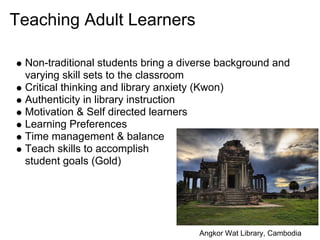
                                     Angkor Wat Library, Cambodia
Teaching in an Online Environment

Opportunities:

   Student engagement
   Assessing student learning
   Addressing Learning Styles
   Active Learning
   Self directed learning
   Mobility and scheduling


                                Roger Clark Memorial
                                Library, Pittsfield, VT
Teaching in an Online Environment
Challenges for students:
  Student engagement
  Bandwidth
  Immediacy
  Student technical skill levels
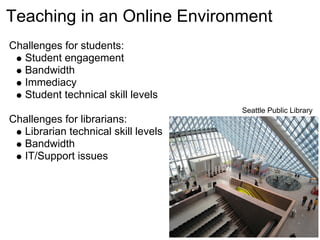
                                     Seattle Public Library
Challenges for librarians:
  Librarian technical skill levels
  Bandwidth
  IT/Support issues
Teaching in an Online Environment
What we do at NLU

  Library instruction sessions for F2F, online, blended courses
  Online instruction includes
     Tutorials & short assignment
     BlackBoard, email, or LibGuides
     approximately 1 week long
  Email or chat reference
Creating tools for
Asynchronous Instruction

Why use tutorials?

     Supplement classroom instruction
     Online library instructions
     Outreach to courses without library
     instruction
     Frequently Asked Questions
     After hours or distance learning support
     Address different learning styles
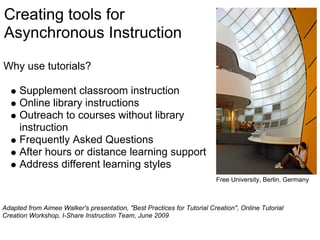
                                                                         Free University, Berlin, Germany


Adapted from Aimee Walker's presentation, "Best Practices for Tutorial Creation", Online Tutorial
Creation Workshop, I-Share Instruction Team, June 2009
A Few Tips for Creating Tutorials
KISS: Keep it short and simple

     Length: no longer than 5 minutes
     Outline important points and consider computer actions
     (search examples, mouse clicks, etc.)
     Write a script
     Include objectives in the tutorial
     Practice, practice, practice!
     Record in a room with a door that shuts
     Consider your speaking style (speed, tone, and vocabulary)
     Currency
Adapted from Aimee Walker's presentation, "Best Practices for Tutorial Creation", Online Tutorial
Creation Workshop, I-Share Instruction Team, June 2009
Other things to think about...

 Where will the tutorials be
 available?

 It's a good idea to evaluate
 your tutorials. Maybe
 include a link to a survey
 for students to complete?

 Accessibility issues - text
 versions available


                                Vancouver Public Library, British Columbia
Tutorial Examples
How to Find Books - Western New England College (Wink)
http://mars.wnec.edu/~infolit/flash/findbook.html

Reserves - University of Washington (Jing)
http://tinyurl.com/dfx7qp

How to Identify Scholarly Articles - Cornell University
http://www.youtube.com/watch?v=uDGJ2CYfY9A

Interlibrary Loan - Southwest Minnesota State University
(Camtasia Studio)
http://www.smsu.edu/Library/tutorials/booksill2.html

Boolean Searching - Colorado State University
http://lib.colostate.edu/tutorials/boolean_info.html
Screencasting / Tutorial
Creation Software
Just a small sample of software
you might want to try...

FREE!!!
Jing: http://www.jingproject.com/
CamStudio:http://camstudio.org/
ScreenJelly: http://www.screenjelly.com/
Wink: http://www.debugmode.com/wink/download.php
How to use wink: http://www.olupus.com/wink/

NOT FREE ;(
Adobe Captivate
Camtasia Studio from TechSmith
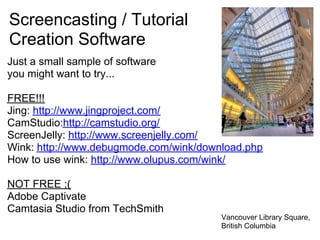
                                        Vancouver Library Square,
                                        British Columbia
Additional Resources
Sharing Resources
  Animated Tutorial Sharing Project
  LION: Library Information Literacy Online Network

Best Practices
   7 Things You Should Know About Screencasting -
   Educause
   An Introducation to Screencasting - TechSoup
   Screencasting Best Practices - Screencast.com
   That's Infotainment! How to Create your own Screencasts -
   School Library Journal
   Top Ten Tips for Creating Effective Screencasts - Bill Myers
   Online
Additional Resources cont. - Adult
Learners and Information Literacy
Bellard, Eloise M. “Information Literacy Needs of Nontraditional Graduate
Students in Social Work.” Research Strategies. 20 (2007):494-505.
Faust, Judith. “Teaching Information Literacy in 50 Minutes a Week: The CSUH
Experience” Journal of Southern Academic and Special Librarianship. 2 (2001):
1-15.
http://southernlibrarianship.icaap.org/content/v02n03/faust_j01.htm

Gold, Helene E. “Engaging the Adult Learner: Creating Effective Library
Instruction.” Portal: Libraries & the Academy. 5 (2005): 467-481.

Kwon, Nahyun, Anthony J. Onwuegbuzie, and Linda Alexander. "Critical
Thinking Disposition and Library Anxiety: Affective Domains on the Space of
Information Seeking and use in Academic Libraries." 68.3 (2007): 268-78.
Photo Credits
Library images from Flickr:

Mitchell Library, Glasgow http://www.flickr.
com/photos/alephnaught/7295078/
Vancouver Library Square http://www.flickr.
com/photos/darrenstone/395110954/
Vancouver Public Library
http://www.flickr.com/photos/selva/90046278/
Roger Clark Memorial Library
http://www.flickr.com/photos/iamthebestartist/889772535/
Angkor Wat Library at Sunset
http://www.flickr.com/photos/stuckincustoms/533005659/
Strahov Library, Prague
http://www.flickr.com/photos/perreira/207156947/
Royal Library, Copenhagen, Denmark
http://www.flickr.com/photos/admean/4591778/
Seattle Public Library
http://www.flickr.com/photos/jeffwilcox/416840579/
QUESTIONS?


 Royal Library, Copenhagen,
 Denmark

Lis764 Online Library Instruction

  • 1.
    LIS 764: LIBRARYUSER INSTRUCTION Teaching in an online environment & Creating tools for Asynchronous Instruction Strahov Library, Prague, Czech Republic Guest Instructors Marisa Walstrum & Larissa Garcia National-Louis University Library
  • 2.
    Tonight's outline 1. Introduction 2. NLU history & perspective 3. Teaching Adult Learners Mitchell Library, Glasgow, Scotland 4. Teaching in an Online Environment 5. Why Tutorials? 6. Tips & Best Practices 7. Evaluating Tutorials 8. Tutorial Creation Software 9. Additional Resources 10. Q&A - your chance to ask library, career, or school- related questions of recent DU grads!
  • 3.
    National-Louis University A bit of background Founded in 1886 Private, non-denominational Strong tradition of service to urban, immigrant, & minority populations Average age: 36 (undergraduate); 38 (graduate) Online degree programs: 8 (BlackBoard) U.S. Campus locations: 8 Elizabeth Harrison & Edna Dean Baker - the 1st and 2nd presidents of the college. Image from NLU Archives.
  • 4.
    Teaching Adult Learners Non-traditional students bring a diverse background and varying skill sets to the classroom Critical thinking and library anxiety (Kwon) Authenticity in library instruction Motivation & Self directed learners Learning Preferences Time management & balance Teach skills to accomplish student goals (Gold) Angkor Wat Library, Cambodia
  • 5.
    Teaching in anOnline Environment Opportunities: Student engagement Assessing student learning Addressing Learning Styles Active Learning Self directed learning Mobility and scheduling Roger Clark Memorial Library, Pittsfield, VT
  • 6.
    Teaching in anOnline Environment Challenges for students: Student engagement Bandwidth Immediacy Student technical skill levels Seattle Public Library Challenges for librarians: Librarian technical skill levels Bandwidth IT/Support issues
  • 7.
    Teaching in anOnline Environment What we do at NLU Library instruction sessions for F2F, online, blended courses Online instruction includes Tutorials & short assignment BlackBoard, email, or LibGuides approximately 1 week long Email or chat reference
  • 8.
    Creating tools for AsynchronousInstruction Why use tutorials? Supplement classroom instruction Online library instructions Outreach to courses without library instruction Frequently Asked Questions After hours or distance learning support Address different learning styles Free University, Berlin, Germany Adapted from Aimee Walker's presentation, "Best Practices for Tutorial Creation", Online Tutorial Creation Workshop, I-Share Instruction Team, June 2009
  • 9.
    A Few Tipsfor Creating Tutorials KISS: Keep it short and simple Length: no longer than 5 minutes Outline important points and consider computer actions (search examples, mouse clicks, etc.) Write a script Include objectives in the tutorial Practice, practice, practice! Record in a room with a door that shuts Consider your speaking style (speed, tone, and vocabulary) Currency Adapted from Aimee Walker's presentation, "Best Practices for Tutorial Creation", Online Tutorial Creation Workshop, I-Share Instruction Team, June 2009
  • 10.
    Other things tothink about... Where will the tutorials be available? It's a good idea to evaluate your tutorials. Maybe include a link to a survey for students to complete? Accessibility issues - text versions available Vancouver Public Library, British Columbia
  • 11.
    Tutorial Examples How toFind Books - Western New England College (Wink) http://mars.wnec.edu/~infolit/flash/findbook.html Reserves - University of Washington (Jing) http://tinyurl.com/dfx7qp How to Identify Scholarly Articles - Cornell University http://www.youtube.com/watch?v=uDGJ2CYfY9A Interlibrary Loan - Southwest Minnesota State University (Camtasia Studio) http://www.smsu.edu/Library/tutorials/booksill2.html Boolean Searching - Colorado State University http://lib.colostate.edu/tutorials/boolean_info.html
  • 12.
    Screencasting / Tutorial CreationSoftware Just a small sample of software you might want to try... FREE!!! Jing: http://www.jingproject.com/ CamStudio:http://camstudio.org/ ScreenJelly: http://www.screenjelly.com/ Wink: http://www.debugmode.com/wink/download.php How to use wink: http://www.olupus.com/wink/ NOT FREE ;( Adobe Captivate Camtasia Studio from TechSmith Vancouver Library Square, British Columbia
  • 13.
    Additional Resources Sharing Resources Animated Tutorial Sharing Project LION: Library Information Literacy Online Network Best Practices 7 Things You Should Know About Screencasting - Educause An Introducation to Screencasting - TechSoup Screencasting Best Practices - Screencast.com That's Infotainment! How to Create your own Screencasts - School Library Journal Top Ten Tips for Creating Effective Screencasts - Bill Myers Online
  • 14.
    Additional Resources cont.- Adult Learners and Information Literacy Bellard, Eloise M. “Information Literacy Needs of Nontraditional Graduate Students in Social Work.” Research Strategies. 20 (2007):494-505. Faust, Judith. “Teaching Information Literacy in 50 Minutes a Week: The CSUH Experience” Journal of Southern Academic and Special Librarianship. 2 (2001): 1-15. http://southernlibrarianship.icaap.org/content/v02n03/faust_j01.htm Gold, Helene E. “Engaging the Adult Learner: Creating Effective Library Instruction.” Portal: Libraries & the Academy. 5 (2005): 467-481. Kwon, Nahyun, Anthony J. Onwuegbuzie, and Linda Alexander. "Critical Thinking Disposition and Library Anxiety: Affective Domains on the Space of Information Seeking and use in Academic Libraries." 68.3 (2007): 268-78.
  • 15.
    Photo Credits Library imagesfrom Flickr: Mitchell Library, Glasgow http://www.flickr. com/photos/alephnaught/7295078/ Vancouver Library Square http://www.flickr. com/photos/darrenstone/395110954/ Vancouver Public Library http://www.flickr.com/photos/selva/90046278/ Roger Clark Memorial Library http://www.flickr.com/photos/iamthebestartist/889772535/ Angkor Wat Library at Sunset http://www.flickr.com/photos/stuckincustoms/533005659/ Strahov Library, Prague http://www.flickr.com/photos/perreira/207156947/ Royal Library, Copenhagen, Denmark http://www.flickr.com/photos/admean/4591778/ Seattle Public Library http://www.flickr.com/photos/jeffwilcox/416840579/
  • 16.
    QUESTIONS? Royal Library,Copenhagen, Denmark

Editor's Notes

  • #2 Introduction: We each introduce ourselves...
  • #3 Larissa
  • #4 Marisa   Founded as the first Kindergarten college.  Access to education extends to working adults, catering specifically to bachelor completion programs in management, and teacher certifications. Student population: mostly graduate. Accelerated programs with mostly evening and online offerings make support from the library a challenge.
  • #5 Marisa   1. Different work and life experience should be valued as students often go back to school to improve upon these skill sets. Varying degrees of skills can be a challenge. 2. In Kwon's article studying links between critical thinking skills and library/research anxiety the authors found that students often feel overwhlemed and think their skills are inadequate. When students who mistrust their ability to identify good information the researchers found that they are lacking in their analytical, problem solving, and decision making skills. 3. These students want to learn pertinent information - how does this help me with my project? 4. Adult learners are motivated, they take on school in addition to family, job and community responsibilities. 5. Learning preferences must be addressed as many students have been out of school for a period of time - the lecture only model may not help students to learn. 6. Students have other obligations besides school and may need additional time, or last minute help due to time management issues 7. Adult learners are goal oriented - they want to learn what is applicable to their project/class/program/job skills. They will also tell you when you are teaching something irrelevant.  
  • #6 Marisa   1. Online requires you to build a learning space in which students enter and interact - more control than the classroom set up. 2. Periodic assessment is needed to track student progress and helps to identify early any concepts that students dont "get". 3. Online environment allows more flexibility with learning styles and allows you to embed different student experiences to meet learning preferences. 4. Active learning is inherent since students must create a product and interact/collaborate in order to participate. 5. Self directed learners thrive online because they go at their own pace/schedule. 6. Online courses can be taken anywhere at any time.
  • #7 Marisa   1. Students can get disengaged with the learning materials if their learning preferences aren't being met, or if they are missing key concepts. This can usually be seen while doing assessment. 2. Bandwidth and internet speeds and accessibility is an ongoing issue. 3. The lack of an instructor present in online asynchronous classes means less off the cuff questions and "aha" moments. 4. Students have varying levels of technical skills and can get hung up in learning how to post and meeting student participation expectations. 1. Many librarians haven't taught online and don't have access to instrucitonal design specialists to help with curriculum development. 2. Bandwidth goes both ways - problem for us too. 3. IT issues and technical difficulties may arise derailing your original instructional plan.
  • #8 Larissa Before moving onto the next slide, ask the class: So why are tutorials useful for library instruction?
  • #9 Larissa
  • #10 Larissa
  • #11 Larissa Ask the class: where would you want to make the tutorials available? Web site, but where specifically? -database pages -Help page -on the home page? YouTube? Available in various formats? Downloadable?
  • #12 Marisa Evaluating Tutorials Show each tutorial and ask the class to tell us things about each tutorial that they liked and didn't like.   Write down student comments on the board to facilitate discussion.
  • #13 Marisa Perhaps demo ScreenJelly since it does not require a download.  AND/OR Depending on time and student interest, show tutorial on using Wink
  • #14 Larissa Click on Sharing Resources to show students you don't have to reinvent the wheel.