Trends In Social Networking Thursday – 29 July, 2010 Mike Gotta Research  VP Collaboration & Content [email_address]
 
Trends In Social Networking Dr. Marc A. Smith Chief Social Scientist, Connected Action Consulting Group Marc Smith is a sociologist specializing in the social organization of online communities and computer mediated interaction. He founded and managed the Community Technologies Group at Microsoft and led the development of social media reporting and analysis tools for Telligent Systems.  Smith now  leads the Connected Action consulting group. The Connected Action consulting group applies social science methods in general and social network analysis techniques in particular to enterprise and internet social media usage.  Smith also co-founded the Social Media Research Foundation, a non-profit devoted to open tools, data, and scholarship related to social media research. Smith received a B.S. in International Area Studies from Drexel University in Philadelphia in 1988, an M.Phil. in social theory from Cambridge University in 1990, and a Ph.D. in Sociology from UCLA in 2001. He is an affiliate faculty at the Department of Sociology at the University of Washington and the College of Information Studies at the University of Maryland.  Smith is also a Distinguished Visiting Scholar at the Media-X Program at Stanford University.
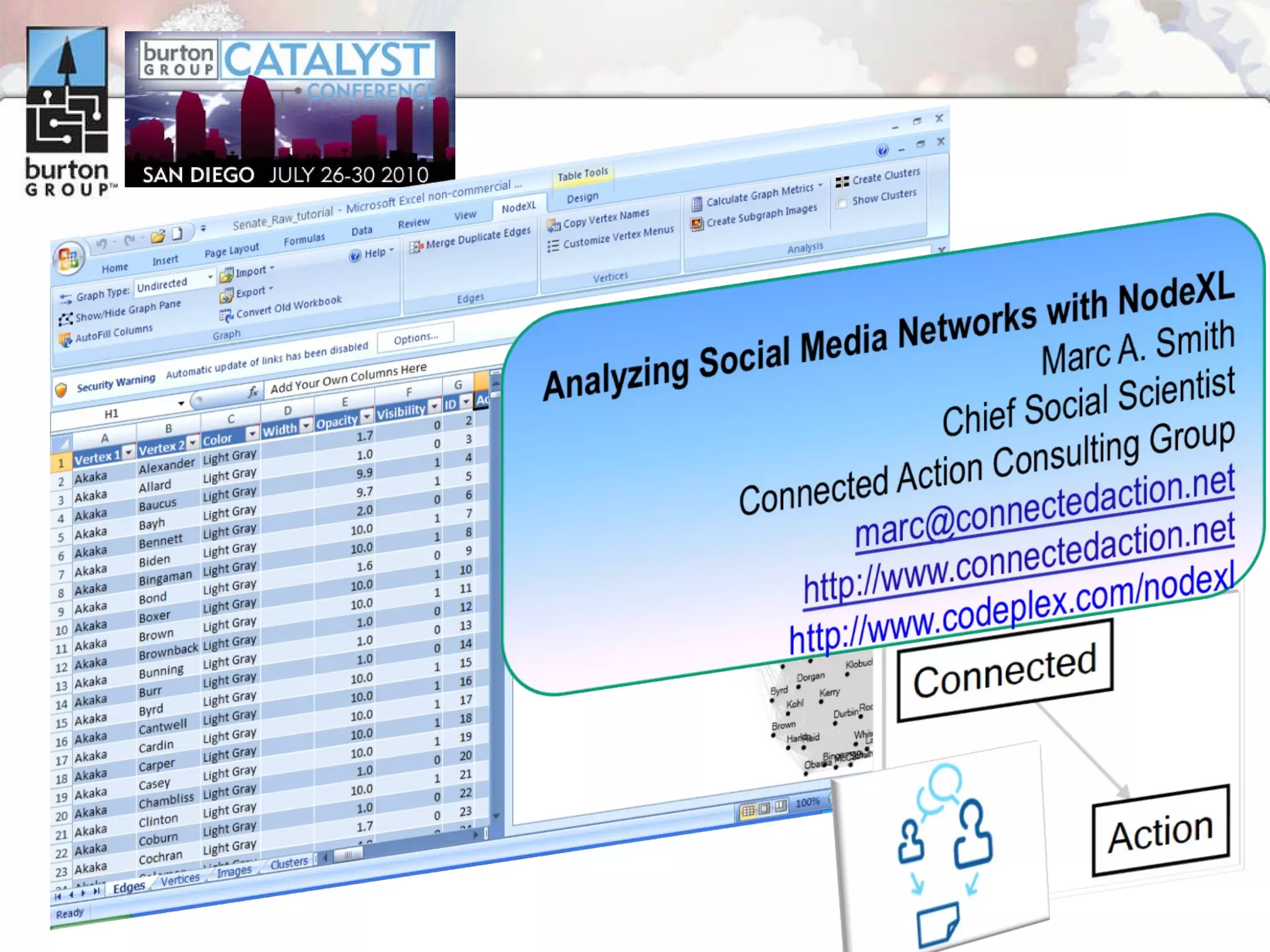
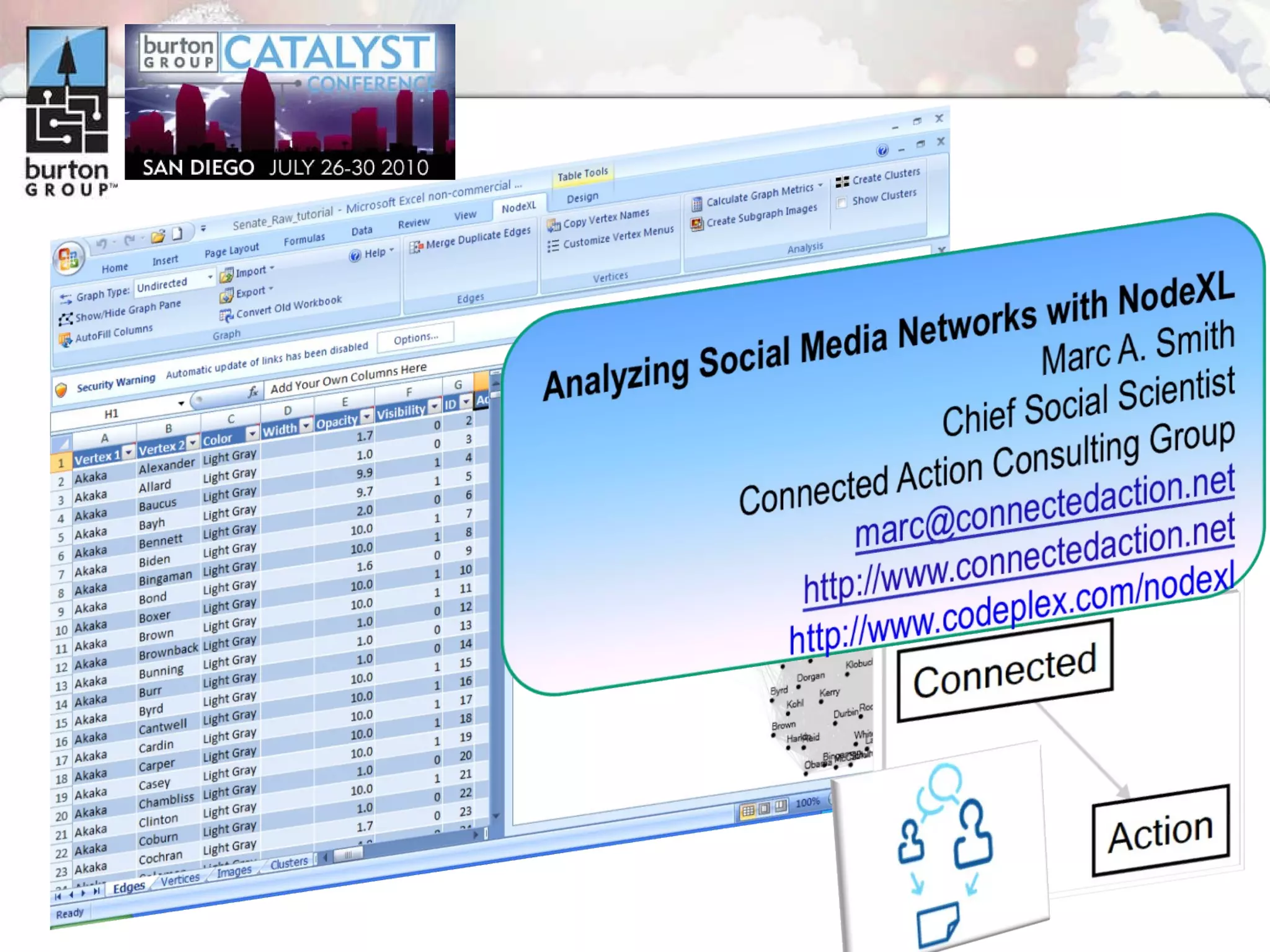
Trends In Social Networking Dr. Marc A. Smith Chief Social Scientist, Connected Action Consulting Group [email_address] http://www.connectedaction.net http://nodexl.codeplex.com http://twitter.com/marc_smith http://www.smrfoundation.org/
Trends In Social Networking Agenda The state of social network analysis (SNA) Graph engines, API’s, and standards How-to guide to analyzing networks  Risks – the dark side of SNA Risks to privacy, confidentiality… Implications to the IT organization Skill sets, data management strategies Social Media & SNA Impact of social media on SNA Visualization of Twitter posts referencing #CAT10
 
S o c i a l  M e d I a  R e s e a r c h F o u n d a t i o n  Open Tools Open Data Open Scholarship http://smrfoundation.org
http://connectedaction.net Enterprise Internet Social media network analysis
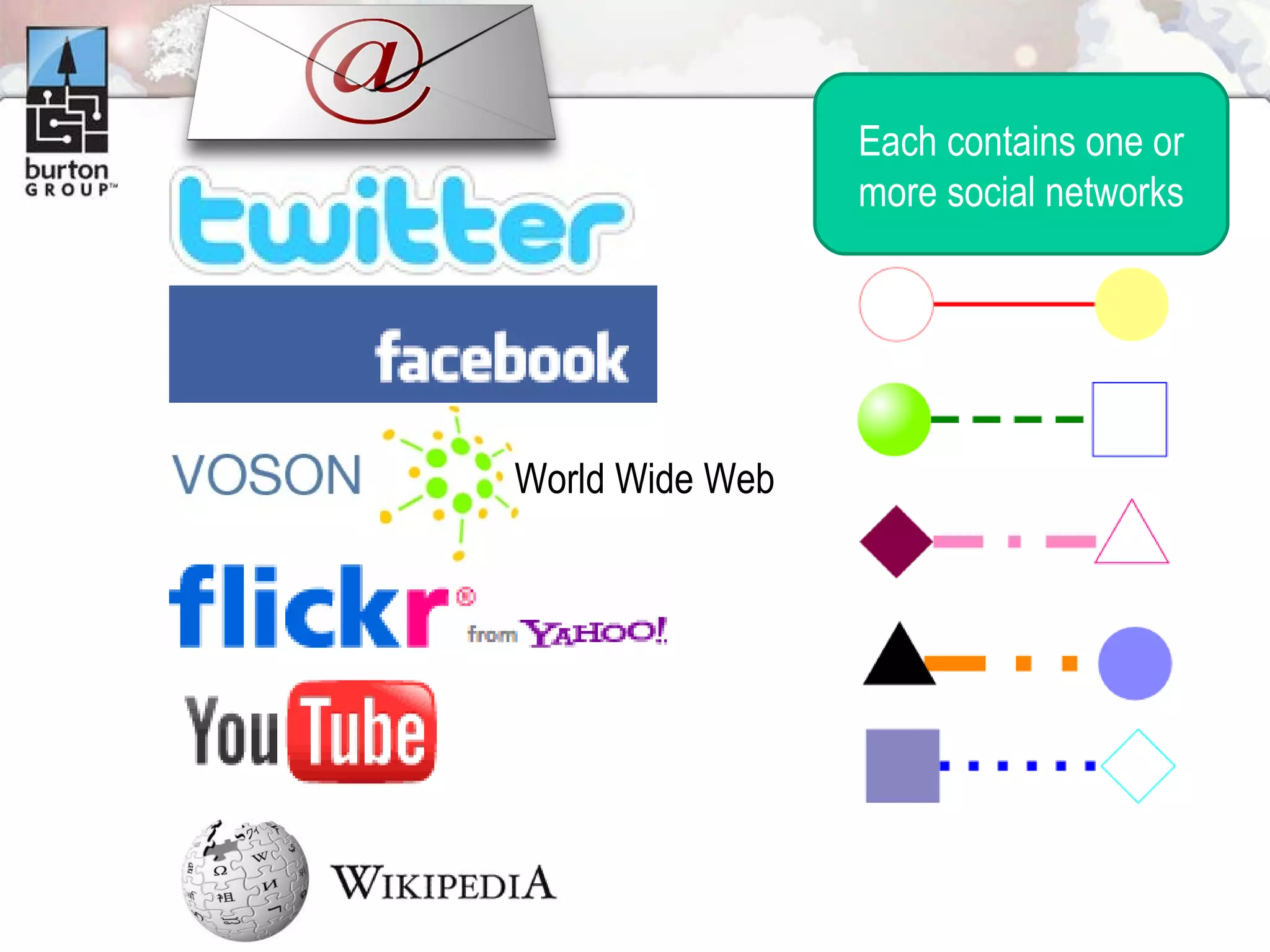
World Wide Web Each contains one or more social networks
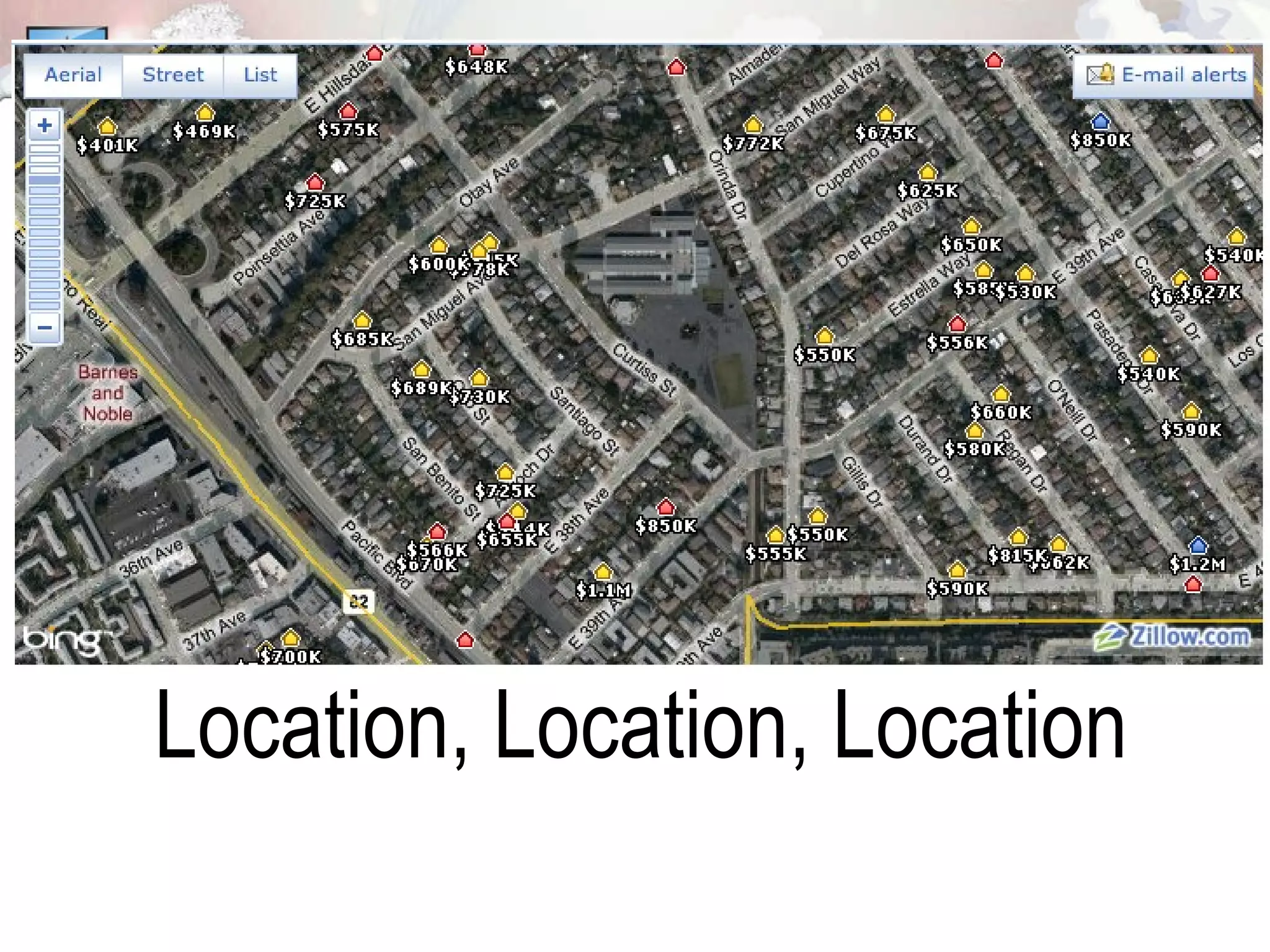
Location, Location, Location
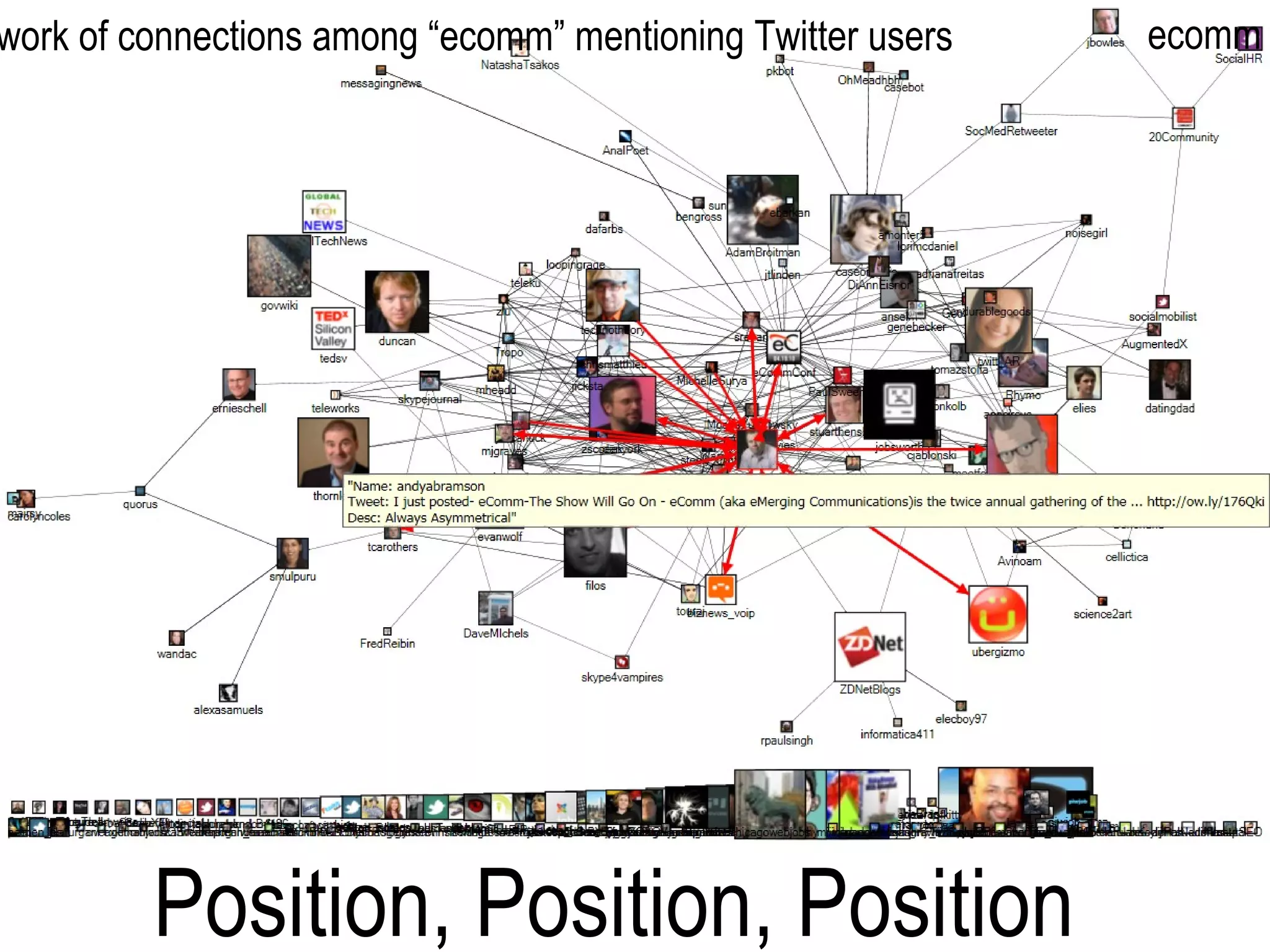
ecomm Network of connections among “ecomm” mentioning Twitter users Position, Position, Position
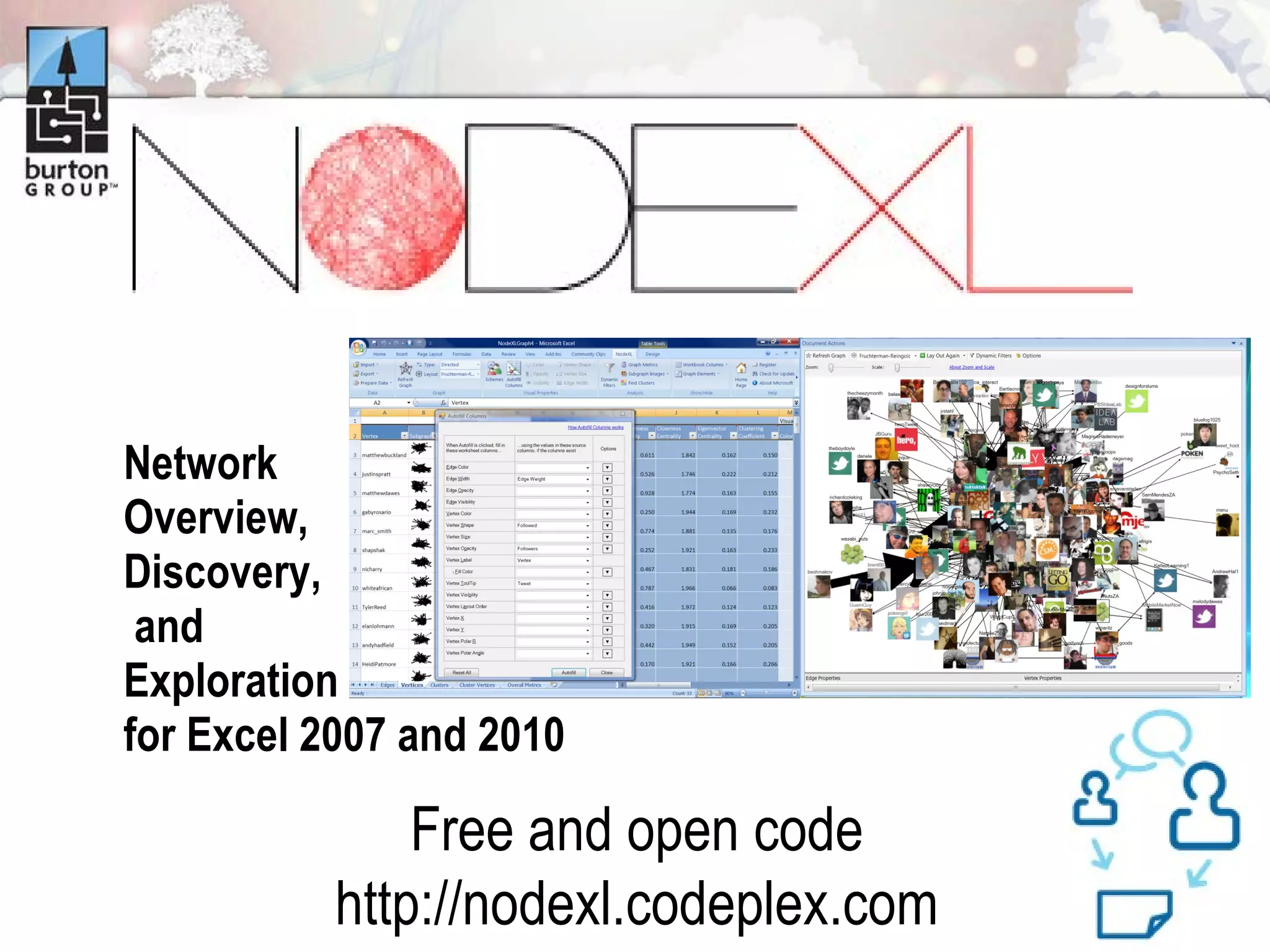
Network  Overview,  Discovery,   and  Exploration  for Excel 2007 and 2010 Free and open code http://nodexl.codeplex.com
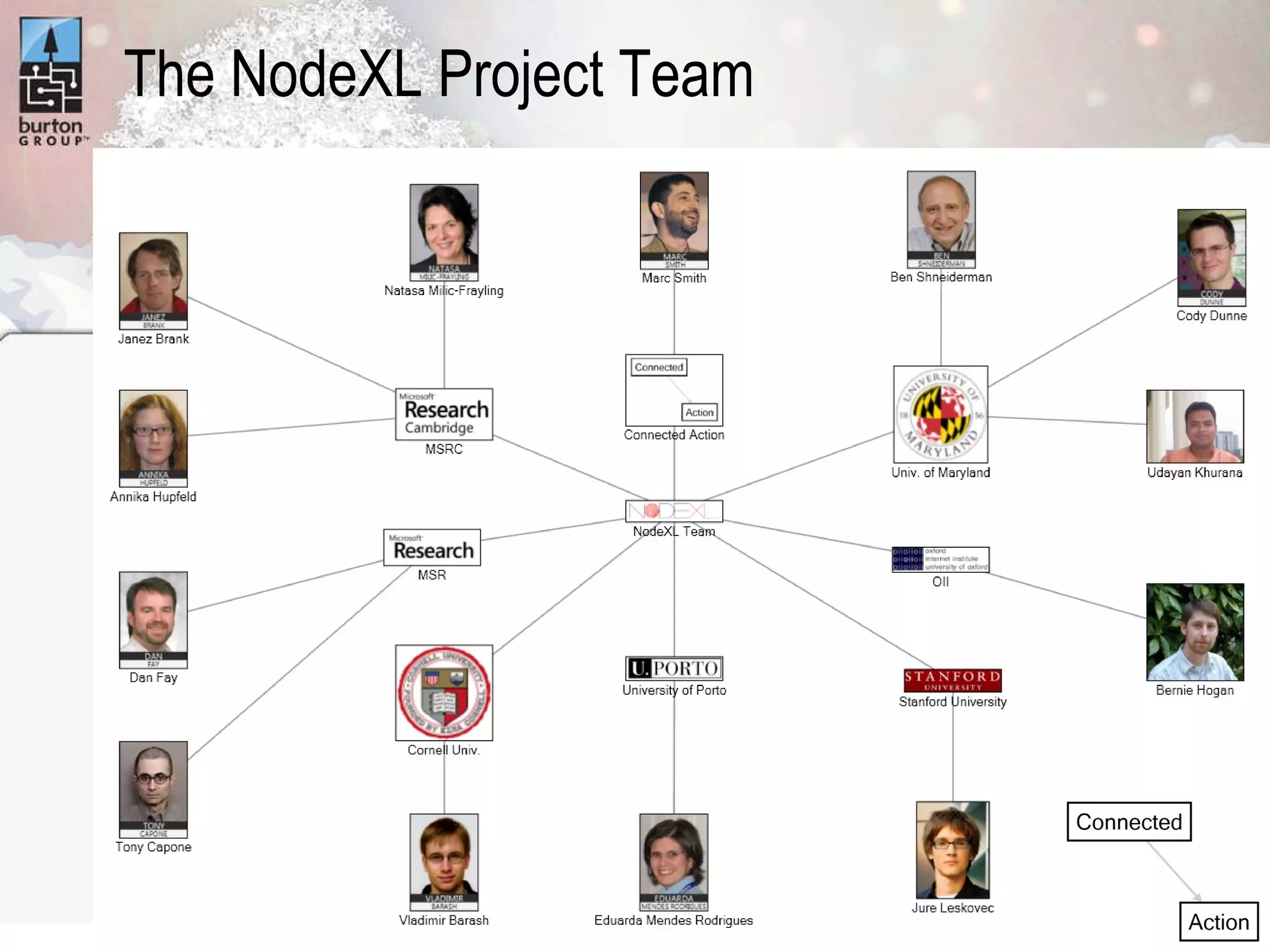
The NodeXL Project Team
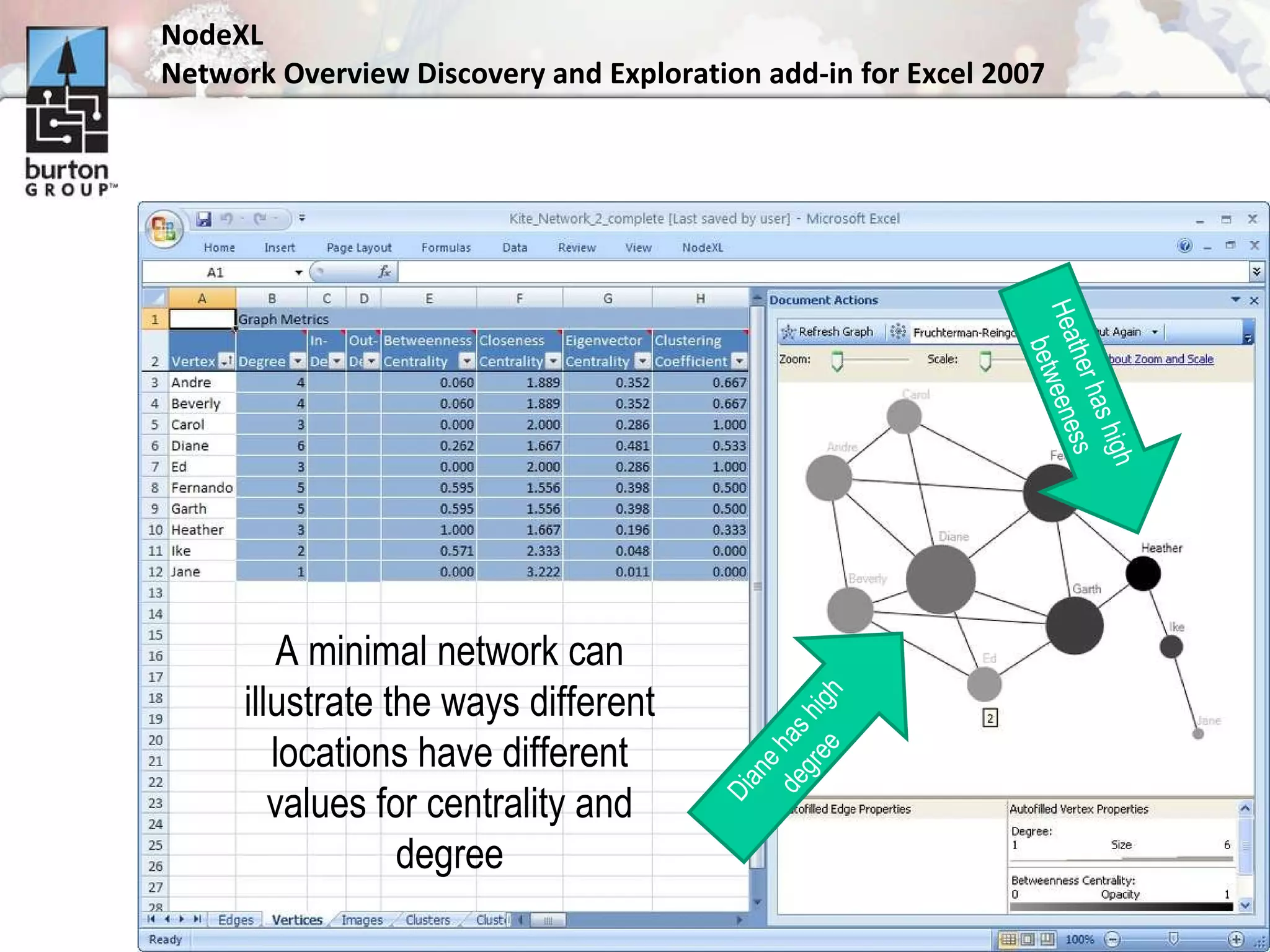
NodeXL Network Overview Discovery and Exploration add-in for Excel 2007 A minimal network can illustrate the ways different locations have different values for centrality and degree Diane has high degree Heather has high betweeness
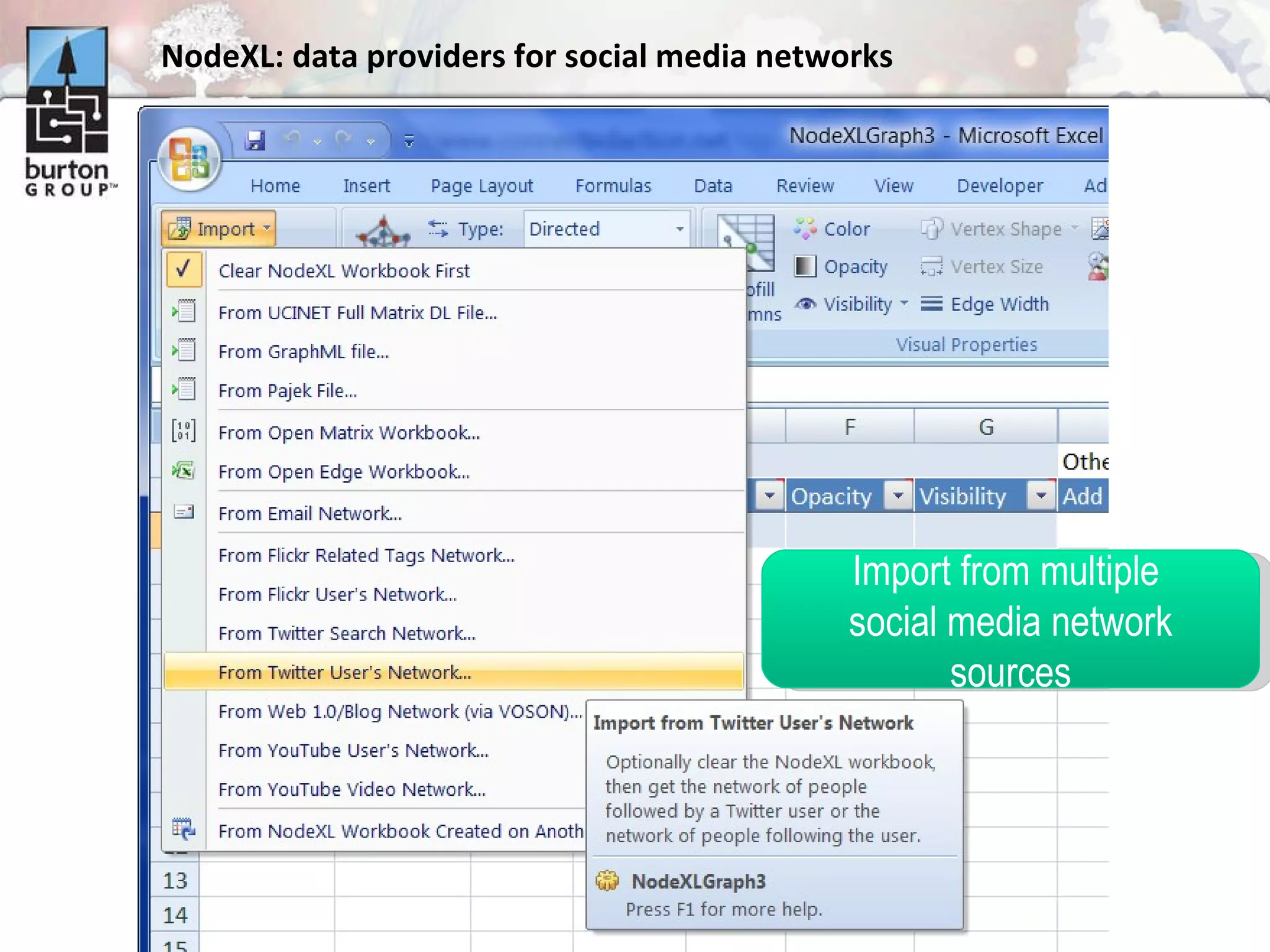
Import from multiple  social media network sources NodeXL: data providers for social media networks
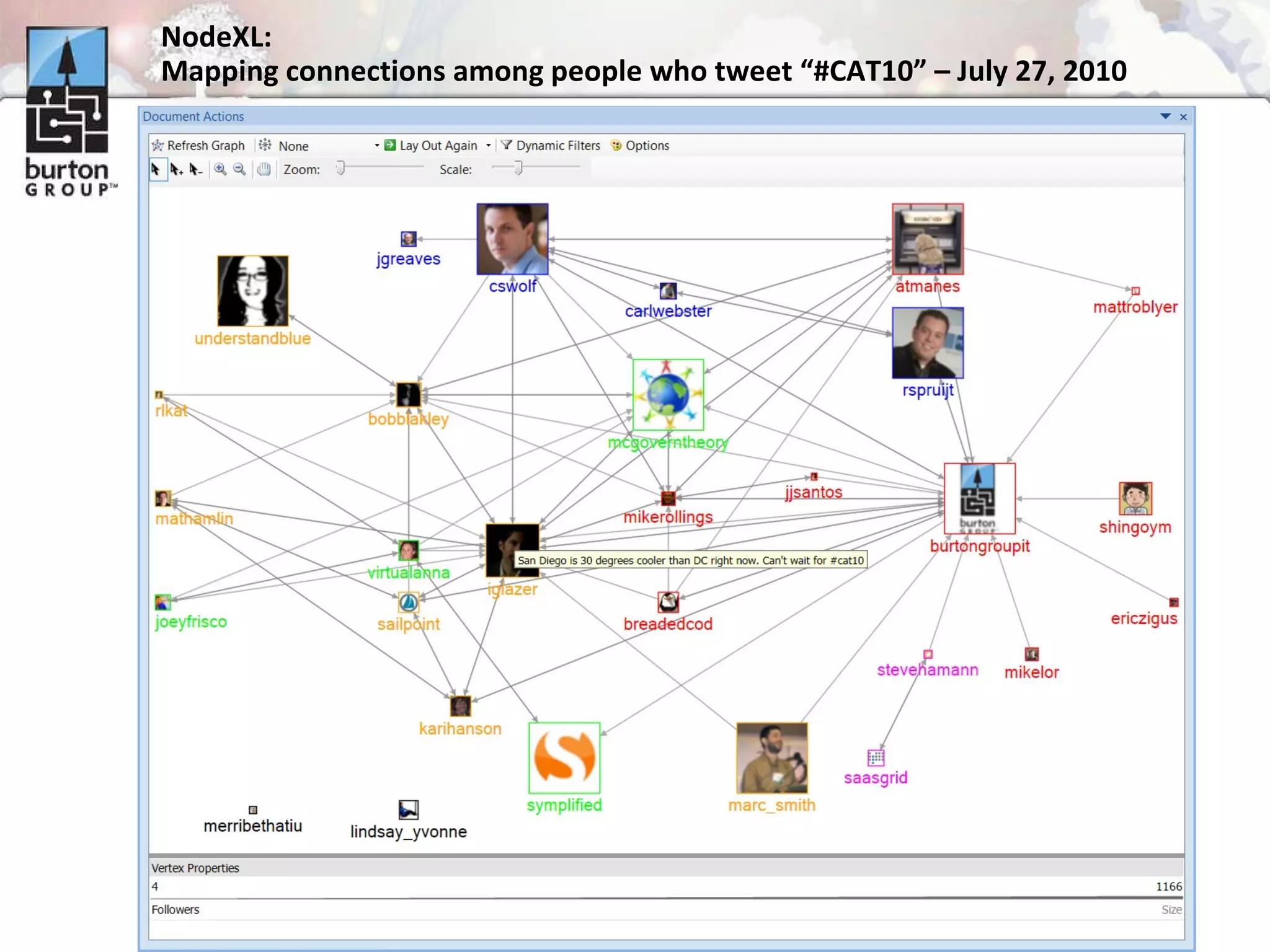
NodeXL:  Mapping connections among people who tweet “#CAT10” – July 27, 2010
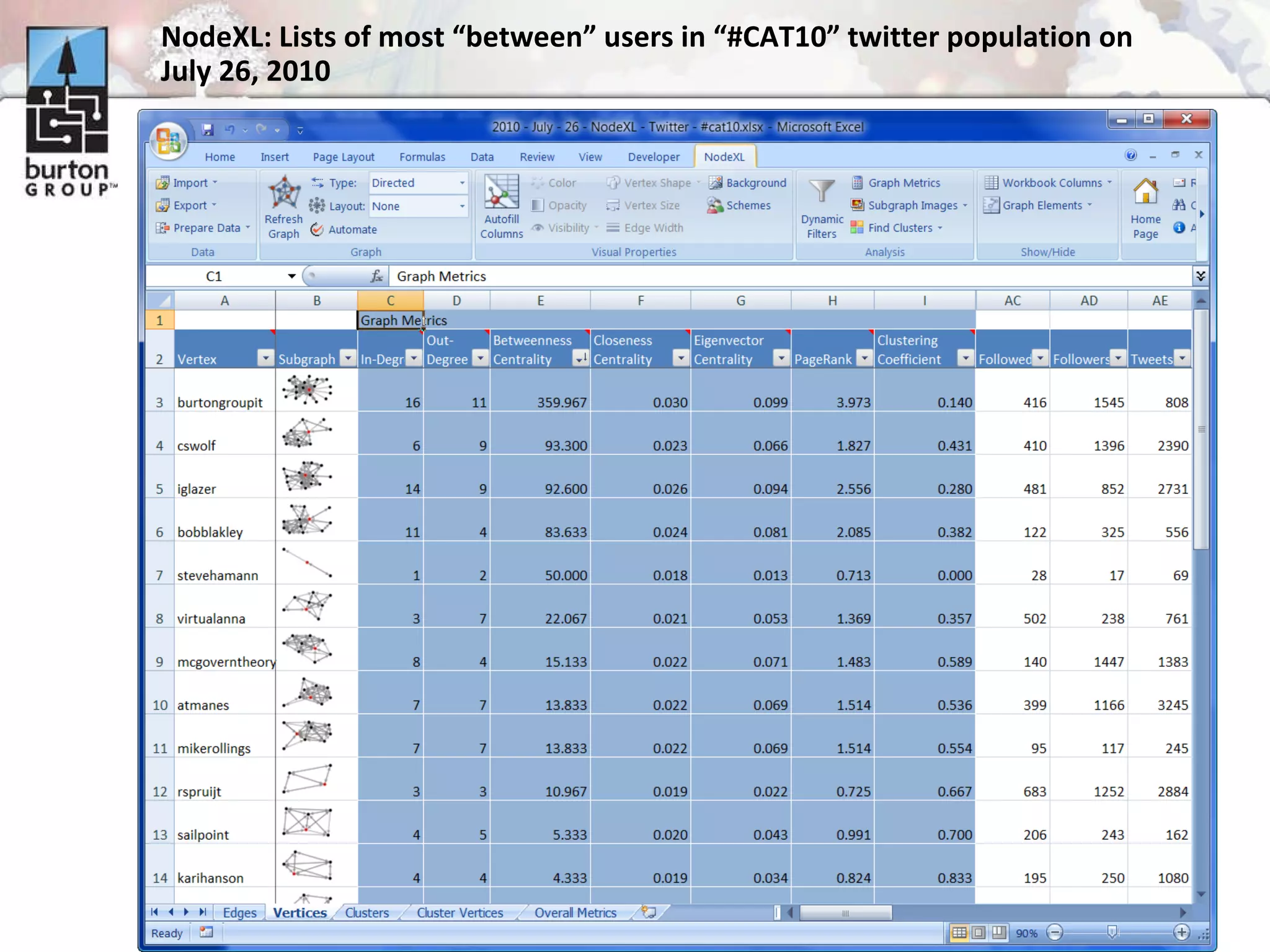
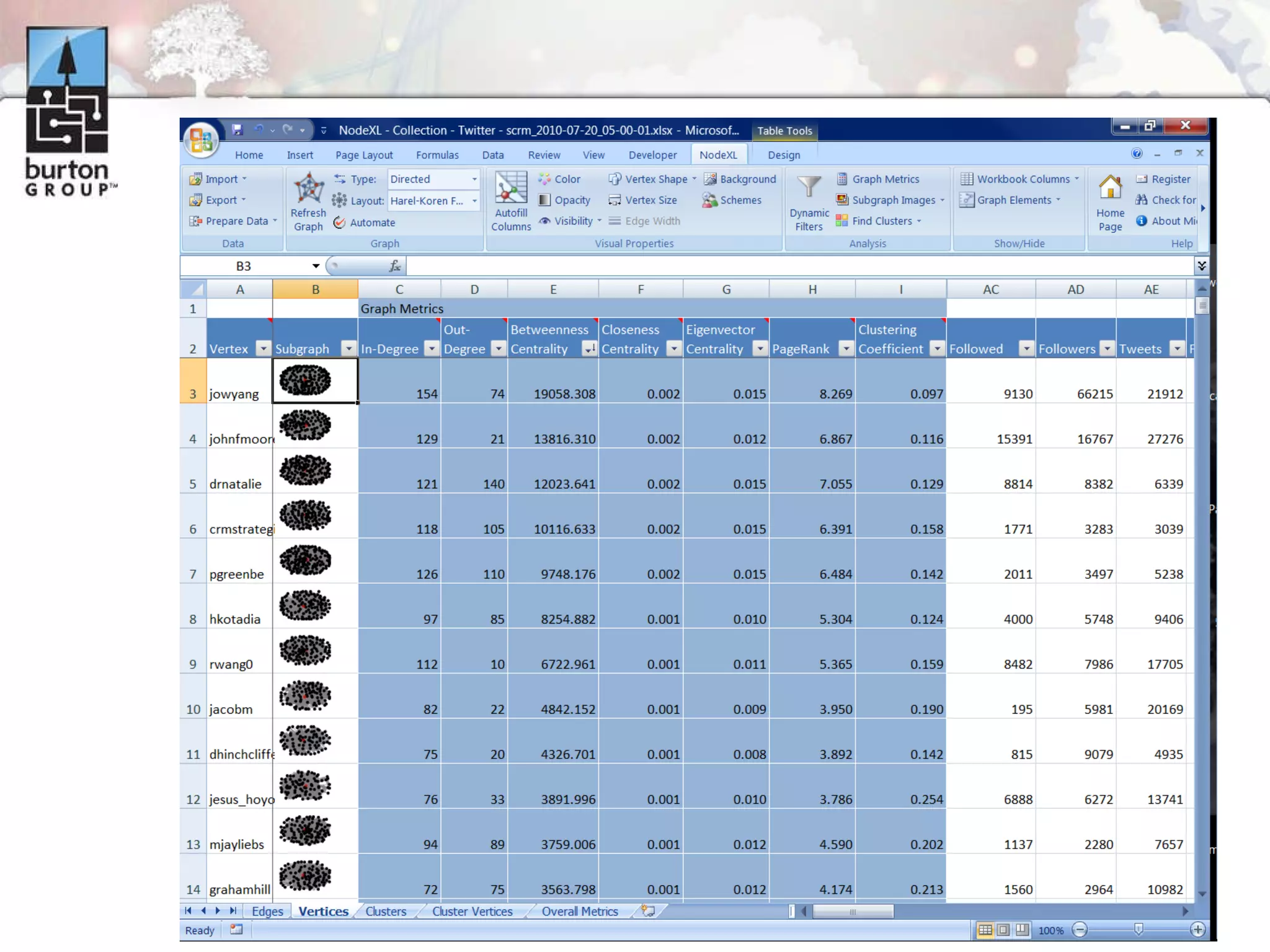
NodeXL: Lists of most “between” users in “#CAT10” twitter population on July 26, 2010
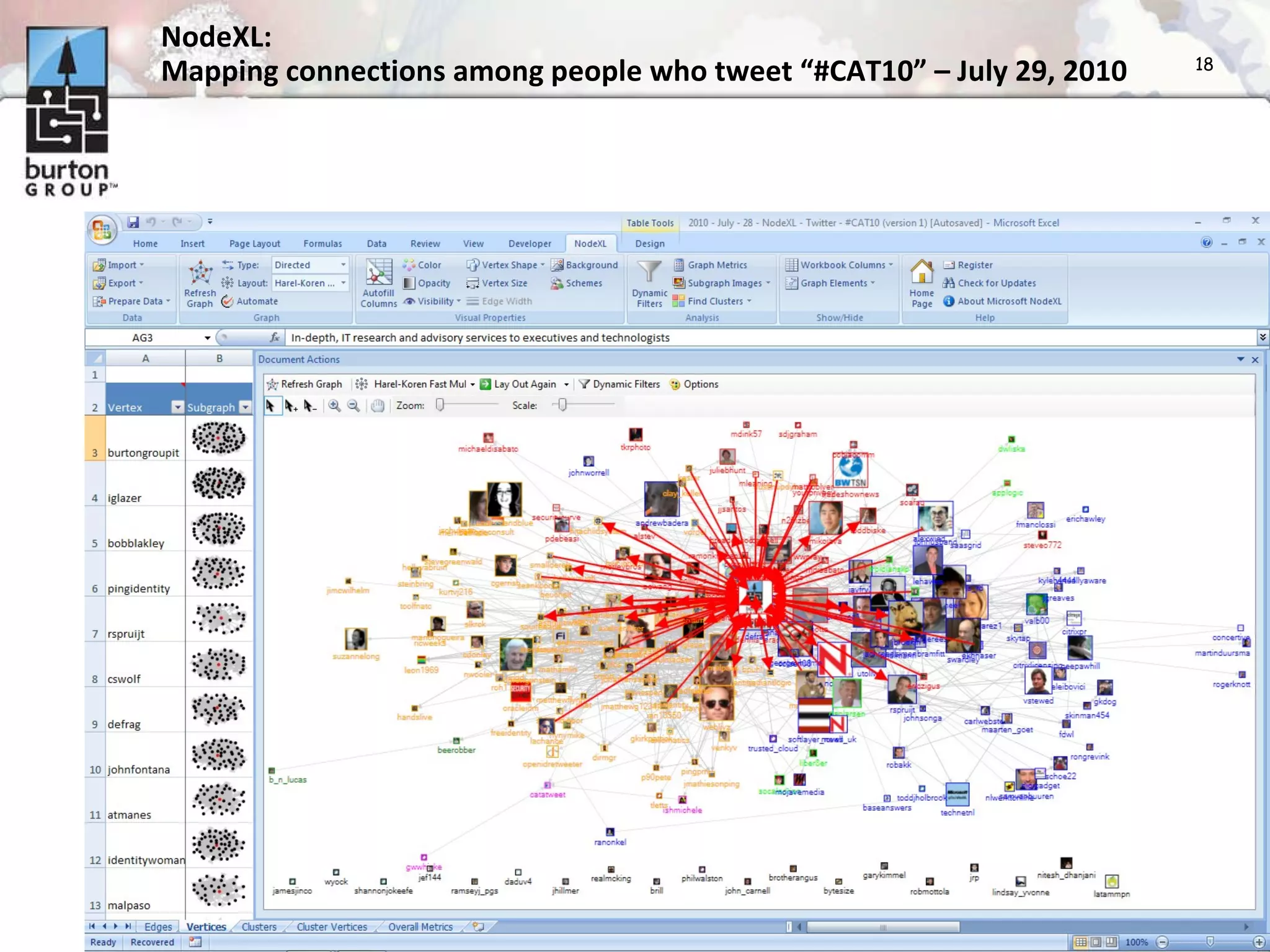
NodeXL:  Mapping connections among people who tweet “#CAT10” – July 29, 2010
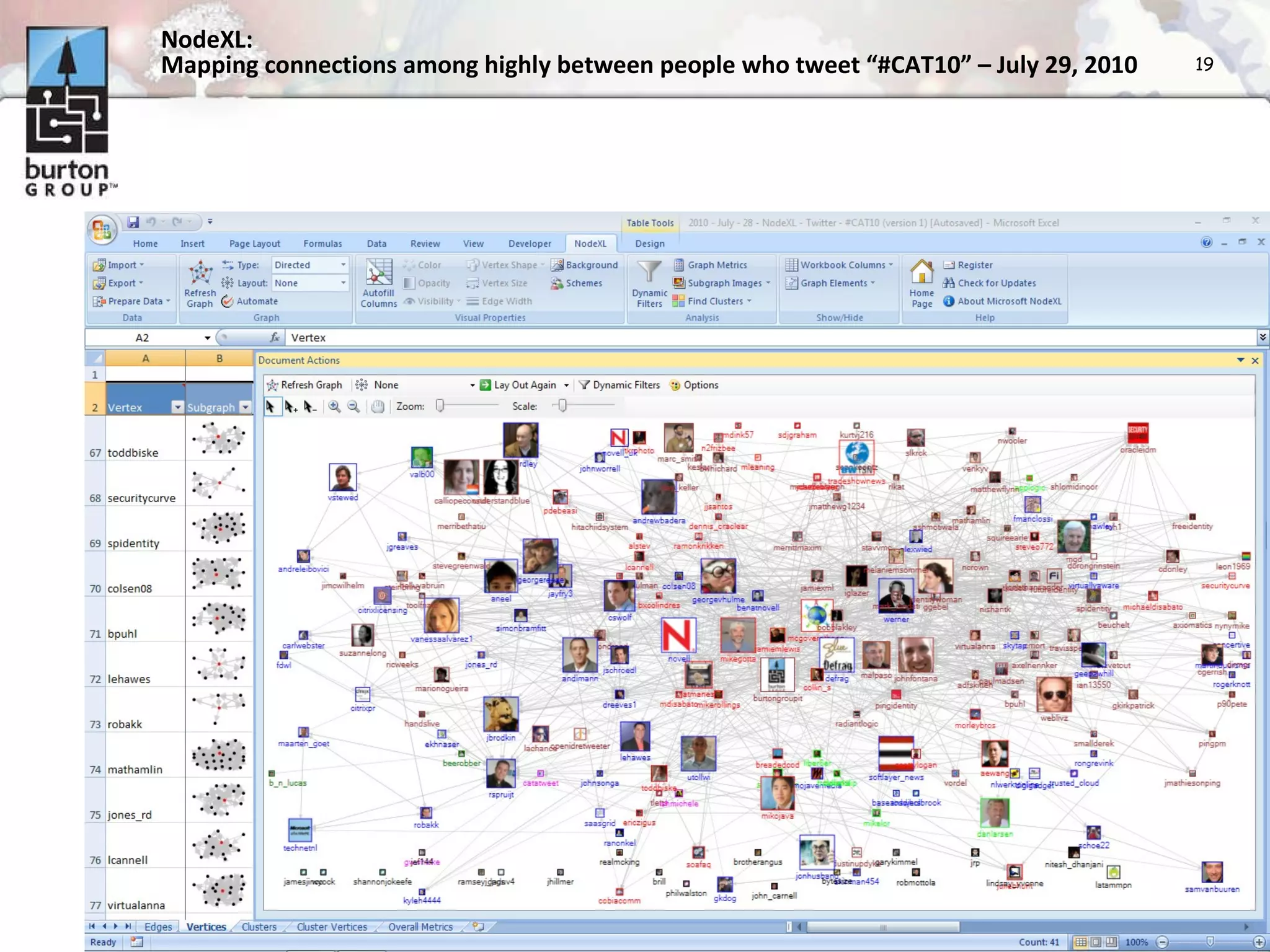
NodeXL:  Mapping connections among highly between people who tweet “#CAT10” – July 29, 2010
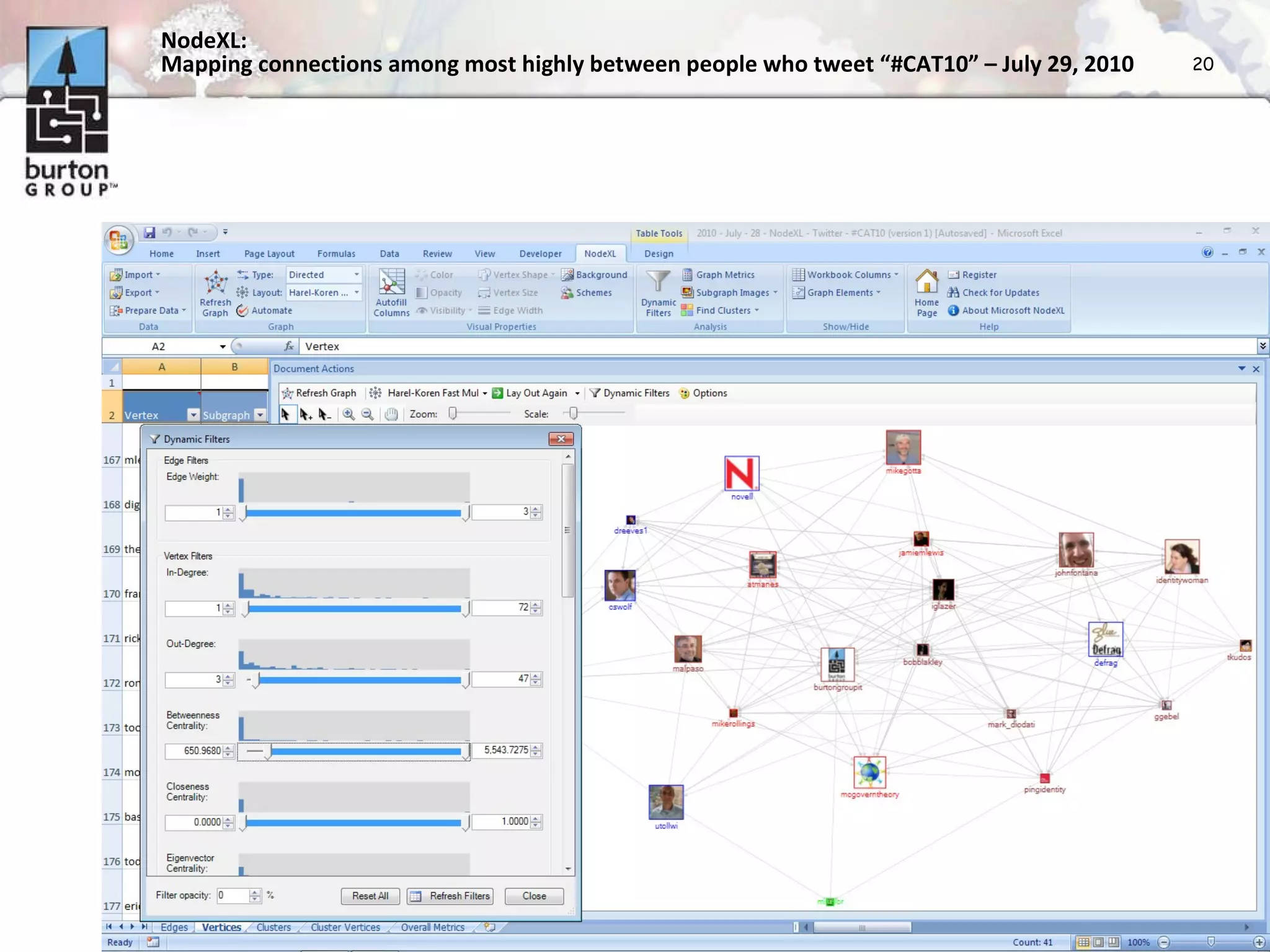
NodeXL:  Mapping connections among most highly between people who tweet “#CAT10” – July 29, 2010
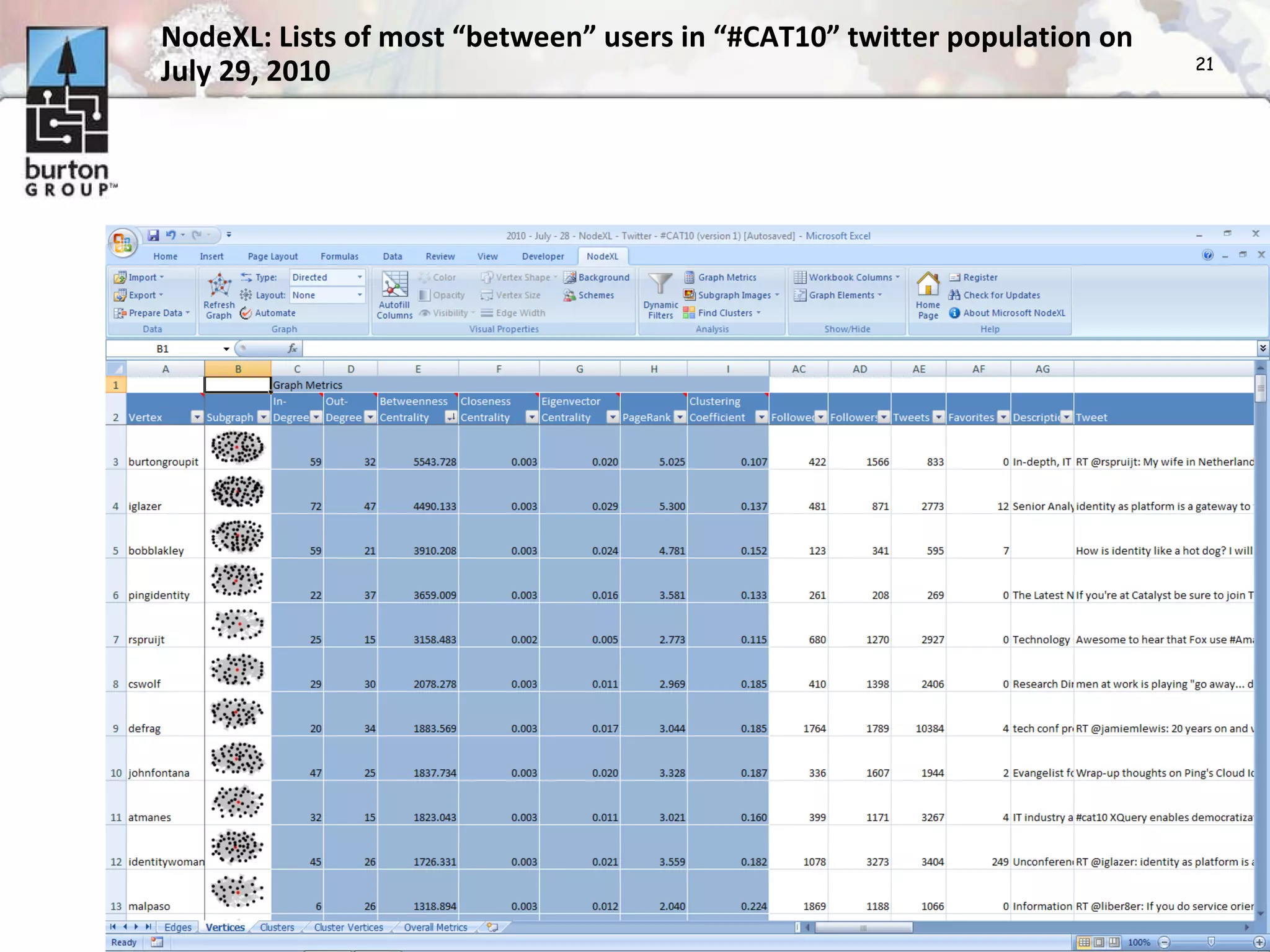
NodeXL: Lists of most “between” users in “#CAT10” twitter population on July 29, 2010
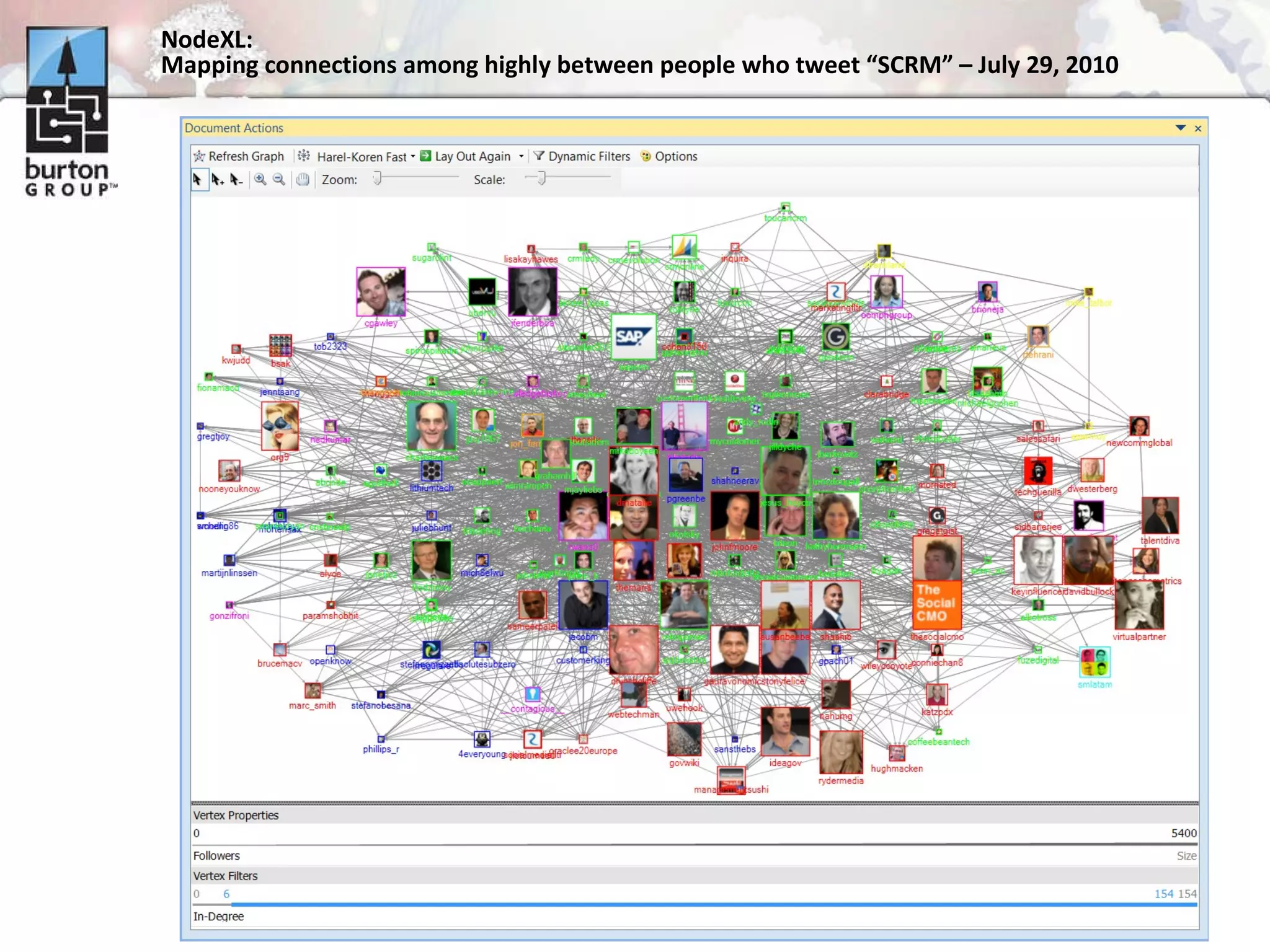
NodeXL:  Mapping connections among highly between people who tweet “SCRM” – July 29, 2010
 
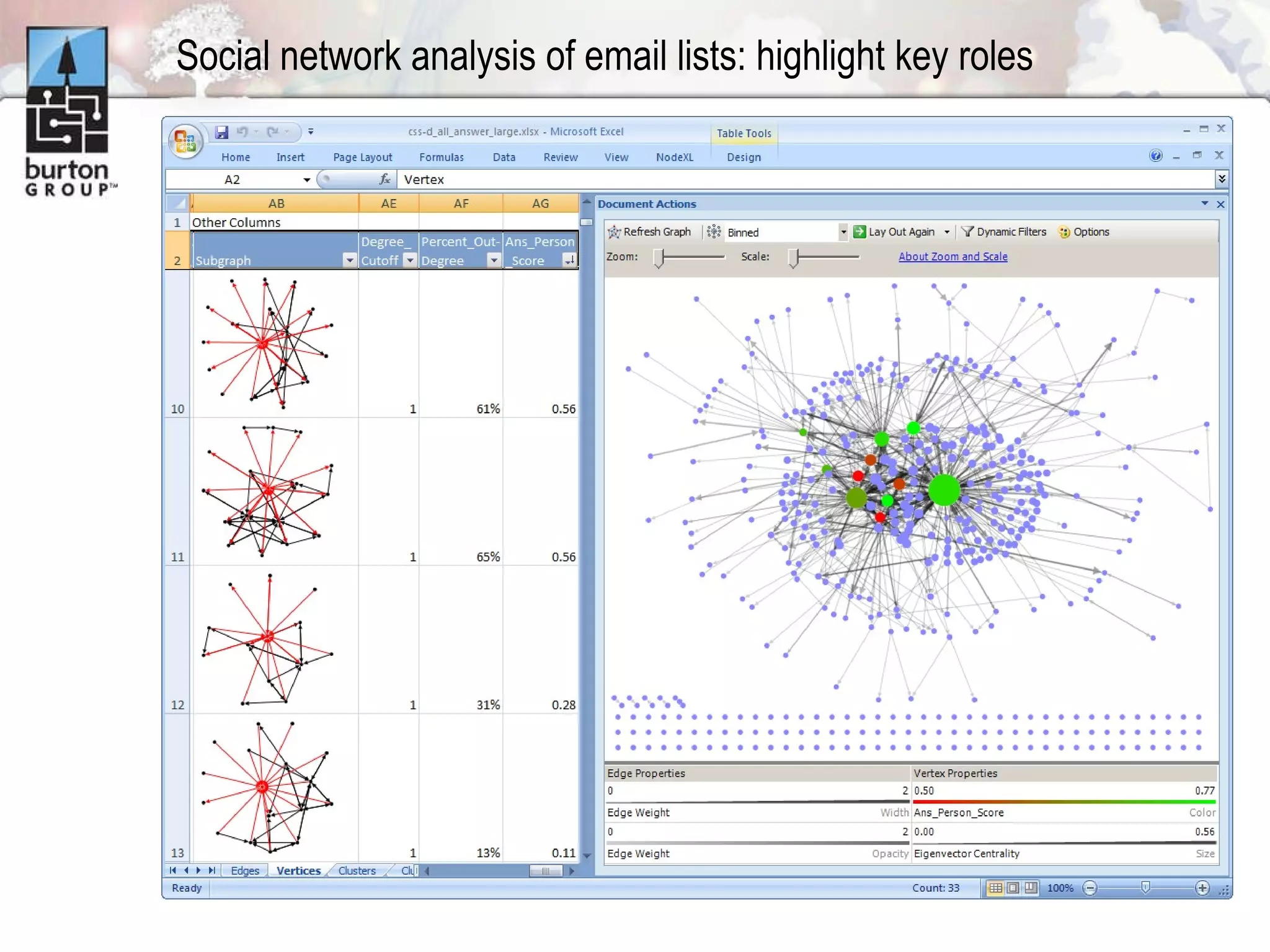
Social network analysis of email lists: highlight key roles
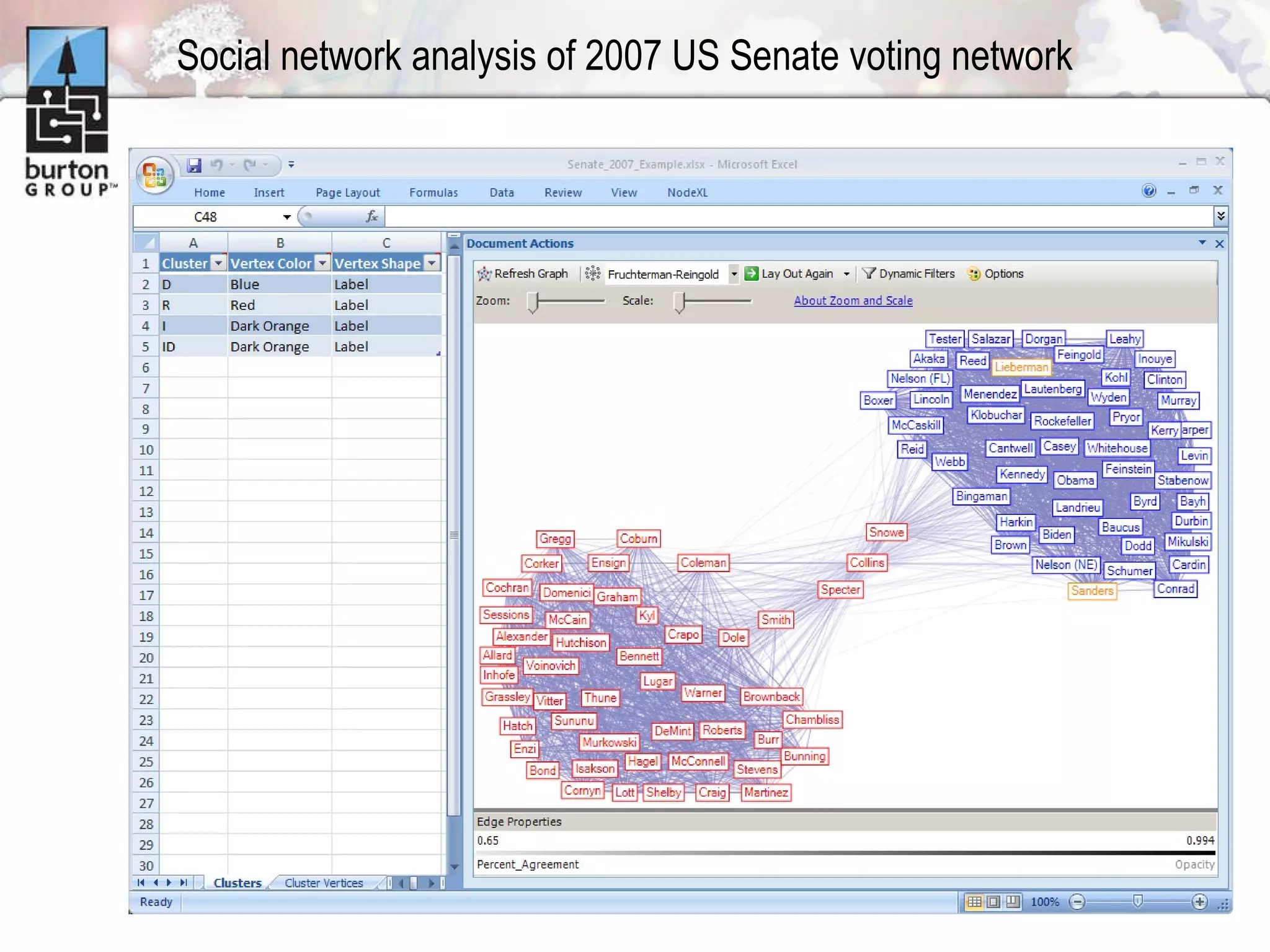
Social network analysis of 2007 US Senate voting network
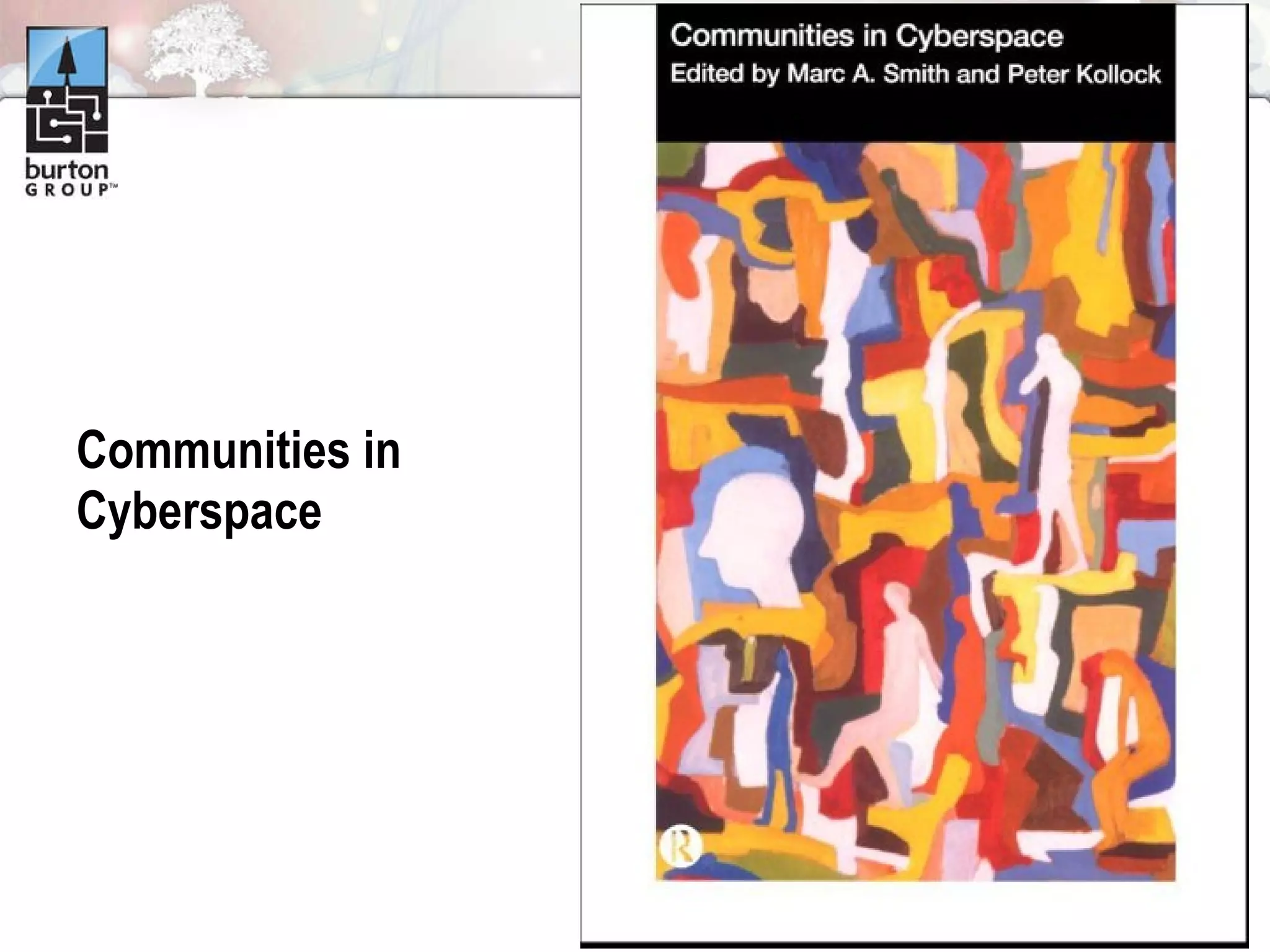
Communities in Cyberspace
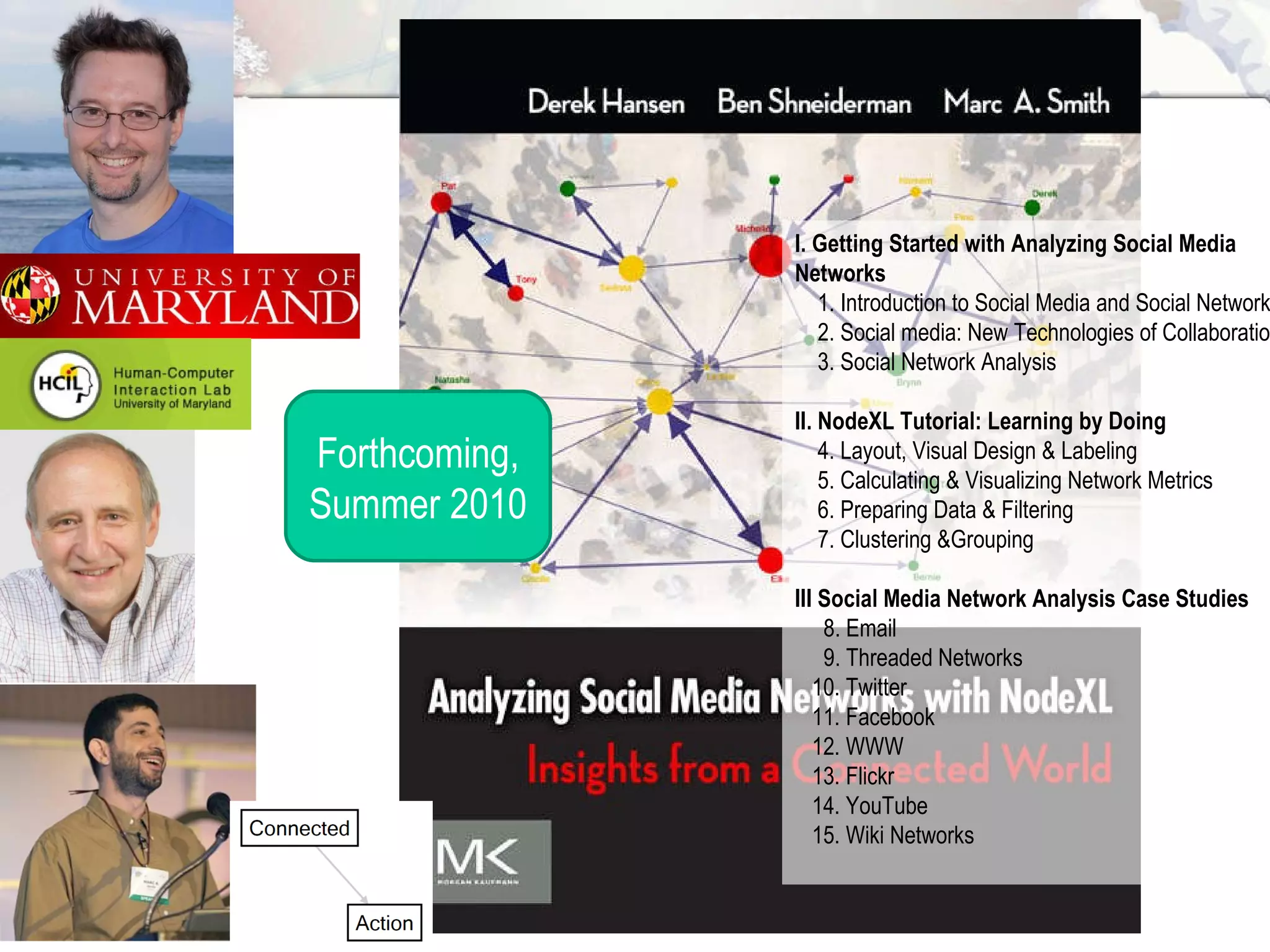
Forthcoming, Summer 2010 I. Getting Started with Analyzing Social Media Networks     1. Introduction to Social Media and Social Networks   2. Social media: New Technologies of Collaboration   3. Social Network Analysis II. NodeXL Tutorial: Learning by Doing     4. Layout, Visual Design & Labeling   5. Calculating & Visualizing Network Metrics    6. Preparing Data & Filtering   7. Clustering &Grouping III Social Media Network Analysis Case Studies     8. Email   9. Threaded Networks   10. Twitter   11. Facebook     12. WWW   13. Flickr   14. YouTube    15. Wiki Networks 
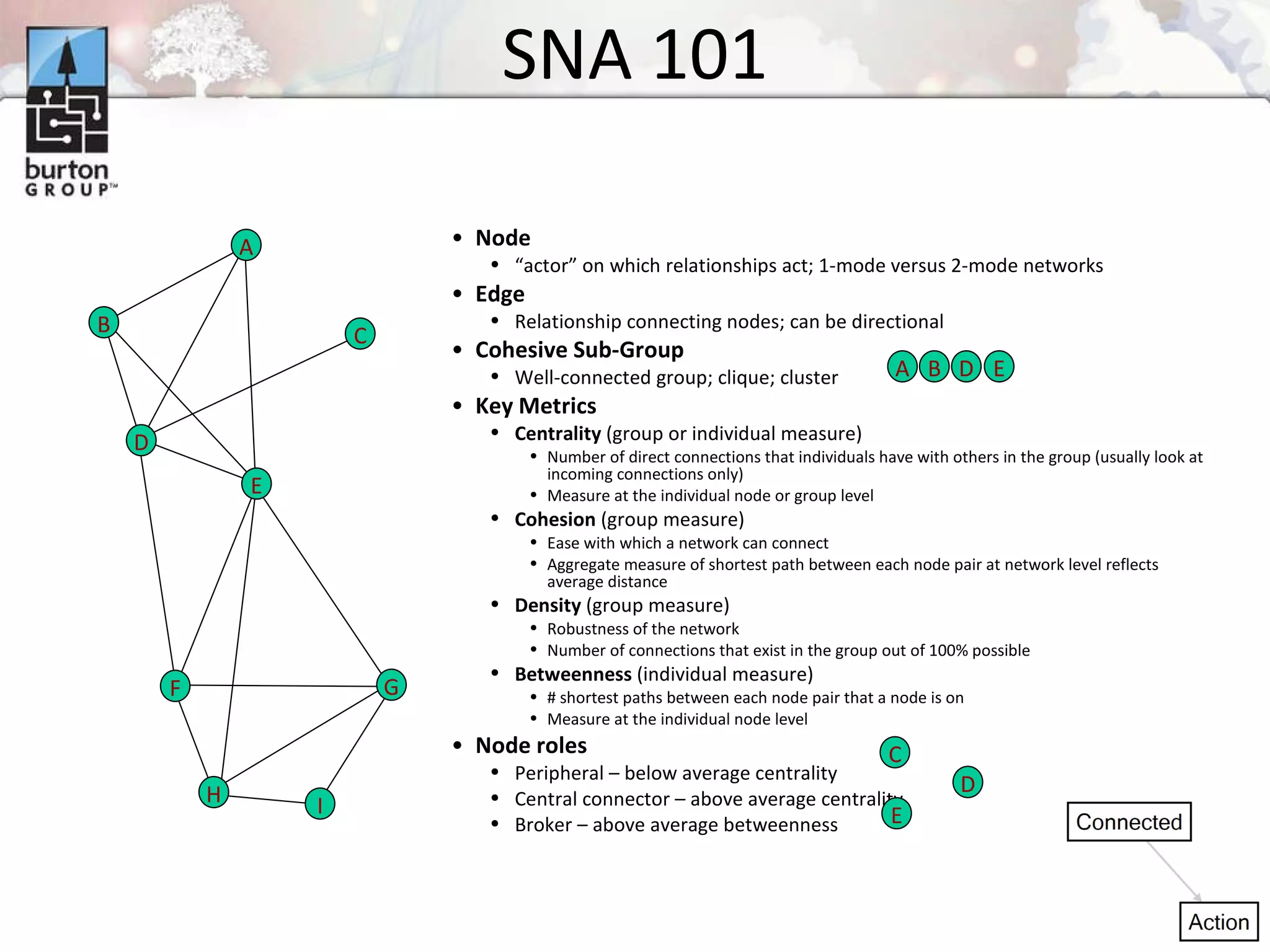
SNA 101 Node “ actor” on which relationships act; 1-mode versus 2-mode networks Edge Relationship connecting nodes; can be directional Cohesive Sub-Group Well-connected group; clique; cluster Key Metrics Centrality  (group or individual measure) Number of direct connections that individuals have with others in the group (usually look at incoming connections only) Measure at the individual node or group level Cohesion  (group measure) Ease with which a network can connect Aggregate measure of shortest path between each node pair at network level reflects average distance Density  (group measure) Robustness of the network Number of connections that exist in the group out of 100% possible  Betweenness  (individual measure) # shortest paths between each node pair that a node is on Measure at the individual node level Node roles Peripheral – below average centrality Central connector – above average centrality Broker – above average betweenness E D F A C B H G I C D E A B D E
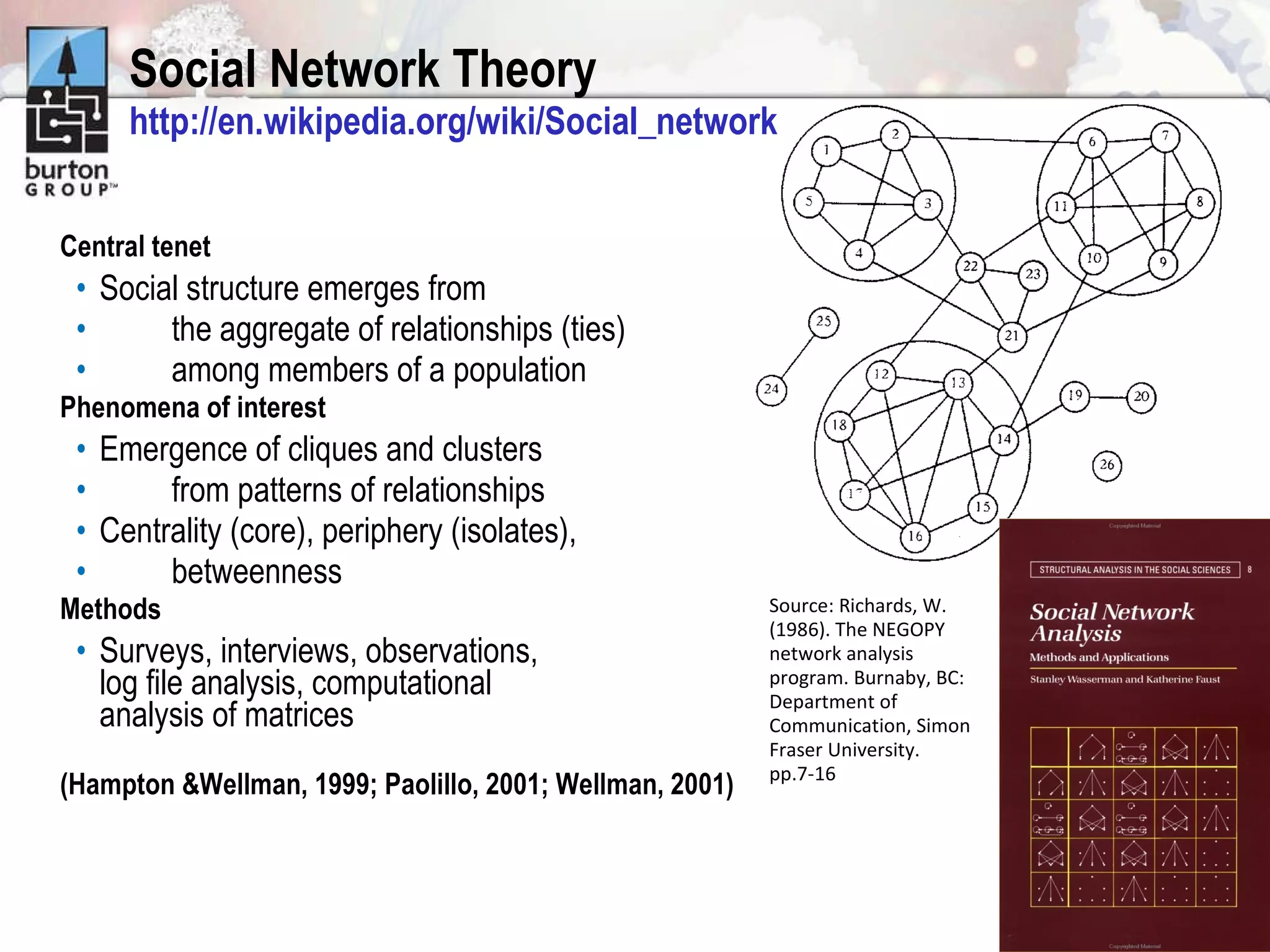
Central tenet  Social structure emerges from  the aggregate of relationships (ties)  among members of a population Phenomena of interest Emergence of cliques and clusters  from patterns of relationships Centrality (core), periphery (isolates),  betweenness Methods Surveys, interviews, observations,  log file analysis, computational  analysis of matrices (Hampton &Wellman, 1999; Paolillo, 2001; Wellman, 2001) Social Network Theory http://en.wikipedia.org/wiki/Social_network Source: Richards, W. (1986). The NEGOPY network analysis program. Burnaby, BC: Department of  Communication, Simon Fraser University. pp.7-16
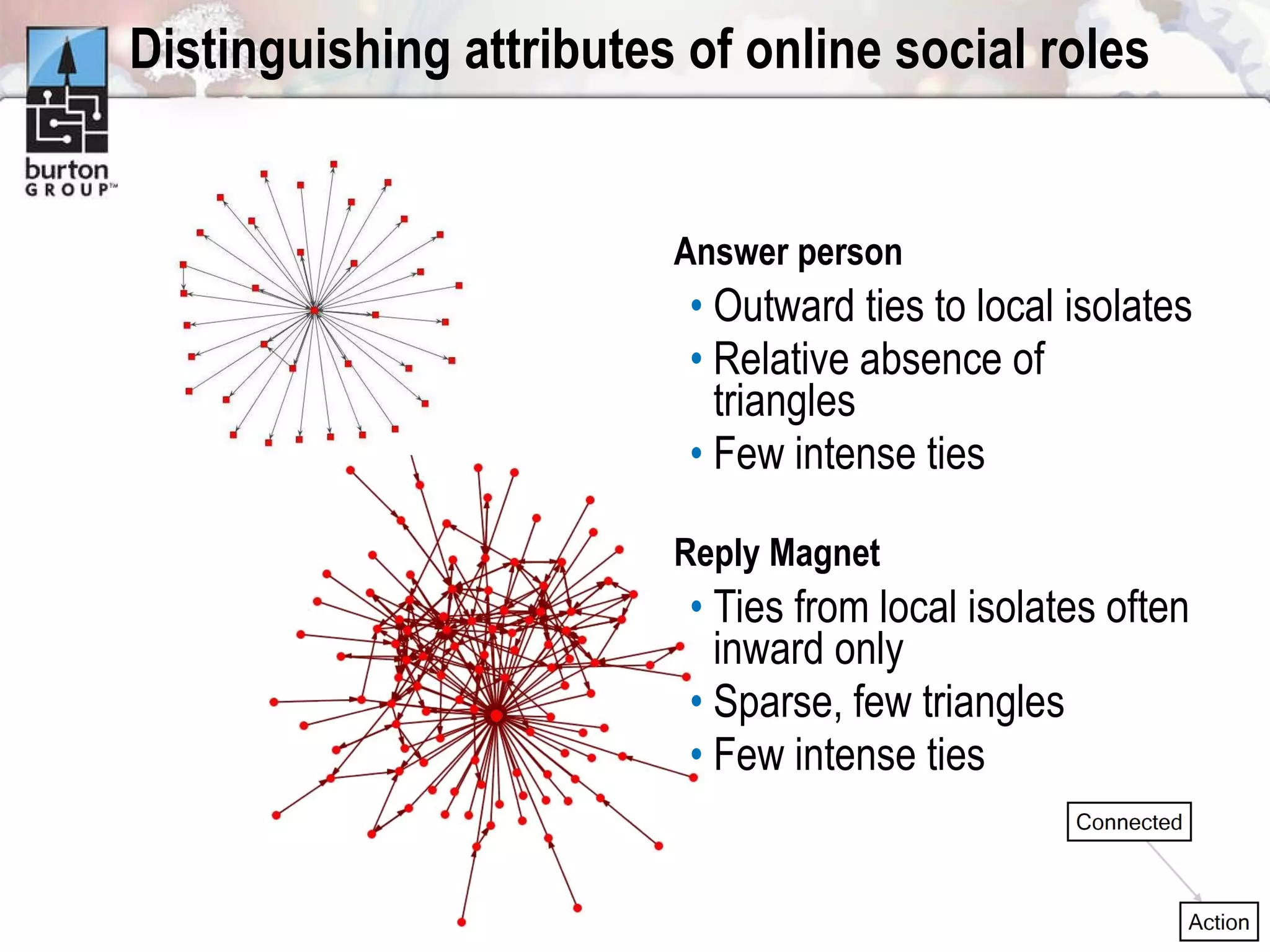
Distinguishing attributes of online social roles Answer person Outward ties to local isolates Relative absence of triangles Few intense ties Reply Magnet Ties from local isolates often inward only Sparse, few triangles Few intense ties
The State Of Social Network Analysis Topic: State Of The Market & Profession What’s our current understanding of social networks and SNA? What’s emerging in terms of graph engines and standards that we should know and care about? Sunbelt 2010 conference just concluded – findings?
The State Of Social Network Analysis Topic: Risks – The Dark Side of Social Networks & SNA With all this social data out in the public – what are the risk aspects we need to be concerned about? Social network sites like Facebook and LinkedIn Social media and the impact of Twitter Social feedback (ratings, “like”, “favorite”, ranking, tags…) Mobility and use of location data Connecting identity facets and correlating the results (e.g., social roles)
The State Of Social Network Analysis Topic: Implications of SNA to the IT organization How do social networks, SNA, and the collection of massive amounts of social data mean to data management strategies (e.g., business intelligence, “data clouds”)? Related enterprise concerns: Intellectual property Confidentiality Privacy Compliance What skills are now needed for IT organizations to play a role in SNA?
The State Of Social Network Analysis Topic: Social Media How has social media re-kindled interest in SNA – what are the implications of having access to so much public data (re: how do organizations best leverage this information)? You’ve done some visualizations for this conference using the #CAT10 tag – what did the results show?
Reference Materials Additional Information Reports Social Media: Identity, Privacy, and Security Considerations Social Media and FINRA: Twitter and LinkedIn Considerations Social Media’s Cautionary Tale: A Management Overview Field Research Study: Social Networking within the Enterprise Field Research Study: Getting Started with Enterprise Social Networks Field Research Study: Addressing Business and Cultural Needs Field Research Study: Enabling Social Platforms Field Research Study: Facilitating Social Participation Field Research: Actions to Take on Enterprise Social Networking Social Network Sites  (reference architecture template) Upcoming Research From Twitter to Enterprise Micro-blogging Enterprise Micro-blogging (reference architecture template)
 
 
S o c i a l  M e d I a  R e s e a r c h F o u n d a t i o n  Open Tools Open Data Open Scholarship http://smrfoundation.org

2010 Catalyst Conference - Trends in Social Network Analysis

  • 1.
    Trends In SocialNetworking Thursday – 29 July, 2010 Mike Gotta Research VP Collaboration & Content [email_address]
  • 2.
  • 3.
    Trends In SocialNetworking Dr. Marc A. Smith Chief Social Scientist, Connected Action Consulting Group Marc Smith is a sociologist specializing in the social organization of online communities and computer mediated interaction. He founded and managed the Community Technologies Group at Microsoft and led the development of social media reporting and analysis tools for Telligent Systems. Smith now leads the Connected Action consulting group. The Connected Action consulting group applies social science methods in general and social network analysis techniques in particular to enterprise and internet social media usage. Smith also co-founded the Social Media Research Foundation, a non-profit devoted to open tools, data, and scholarship related to social media research. Smith received a B.S. in International Area Studies from Drexel University in Philadelphia in 1988, an M.Phil. in social theory from Cambridge University in 1990, and a Ph.D. in Sociology from UCLA in 2001. He is an affiliate faculty at the Department of Sociology at the University of Washington and the College of Information Studies at the University of Maryland. Smith is also a Distinguished Visiting Scholar at the Media-X Program at Stanford University.
  • 4.
    Trends In SocialNetworking Dr. Marc A. Smith Chief Social Scientist, Connected Action Consulting Group [email_address] http://www.connectedaction.net http://nodexl.codeplex.com http://twitter.com/marc_smith http://www.smrfoundation.org/
  • 5.
    Trends In SocialNetworking Agenda The state of social network analysis (SNA) Graph engines, API’s, and standards How-to guide to analyzing networks Risks – the dark side of SNA Risks to privacy, confidentiality… Implications to the IT organization Skill sets, data management strategies Social Media & SNA Impact of social media on SNA Visualization of Twitter posts referencing #CAT10
  • 6.
  • 7.
    S o ci a l M e d I a R e s e a r c h F o u n d a t i o n Open Tools Open Data Open Scholarship http://smrfoundation.org
  • 8.
  • 9.
    World Wide WebEach contains one or more social networks
  • 10.
  • 11.
    ecomm Network ofconnections among “ecomm” mentioning Twitter users Position, Position, Position
  • 12.
    Network Overview, Discovery, and Exploration for Excel 2007 and 2010 Free and open code http://nodexl.codeplex.com
  • 13.
  • 14.
    NodeXL Network OverviewDiscovery and Exploration add-in for Excel 2007 A minimal network can illustrate the ways different locations have different values for centrality and degree Diane has high degree Heather has high betweeness
  • 15.
    Import from multiple social media network sources NodeXL: data providers for social media networks
  • 16.
    NodeXL: Mappingconnections among people who tweet “#CAT10” – July 27, 2010
  • 17.
    NodeXL: Lists ofmost “between” users in “#CAT10” twitter population on July 26, 2010
  • 18.
    NodeXL: Mappingconnections among people who tweet “#CAT10” – July 29, 2010
  • 19.
    NodeXL: Mappingconnections among highly between people who tweet “#CAT10” – July 29, 2010
  • 20.
    NodeXL: Mappingconnections among most highly between people who tweet “#CAT10” – July 29, 2010
  • 21.
    NodeXL: Lists ofmost “between” users in “#CAT10” twitter population on July 29, 2010
  • 22.
    NodeXL: Mappingconnections among highly between people who tweet “SCRM” – July 29, 2010
  • 23.
  • 24.
    Social network analysisof email lists: highlight key roles
  • 25.
    Social network analysisof 2007 US Senate voting network
  • 26.
  • 27.
    Forthcoming, Summer 2010I. Getting Started with Analyzing Social Media Networks 1. Introduction to Social Media and Social Networks 2. Social media: New Technologies of Collaboration 3. Social Network Analysis II. NodeXL Tutorial: Learning by Doing 4. Layout, Visual Design & Labeling 5. Calculating & Visualizing Network Metrics  6. Preparing Data & Filtering 7. Clustering &Grouping III Social Media Network Analysis Case Studies 8. Email 9. Threaded Networks 10. Twitter 11. Facebook   12. WWW 13. Flickr 14. YouTube  15. Wiki Networks 
  • 28.
    SNA 101 Node“ actor” on which relationships act; 1-mode versus 2-mode networks Edge Relationship connecting nodes; can be directional Cohesive Sub-Group Well-connected group; clique; cluster Key Metrics Centrality (group or individual measure) Number of direct connections that individuals have with others in the group (usually look at incoming connections only) Measure at the individual node or group level Cohesion (group measure) Ease with which a network can connect Aggregate measure of shortest path between each node pair at network level reflects average distance Density (group measure) Robustness of the network Number of connections that exist in the group out of 100% possible Betweenness (individual measure) # shortest paths between each node pair that a node is on Measure at the individual node level Node roles Peripheral – below average centrality Central connector – above average centrality Broker – above average betweenness E D F A C B H G I C D E A B D E
  • 29.
    Central tenet Social structure emerges from the aggregate of relationships (ties) among members of a population Phenomena of interest Emergence of cliques and clusters from patterns of relationships Centrality (core), periphery (isolates), betweenness Methods Surveys, interviews, observations, log file analysis, computational analysis of matrices (Hampton &Wellman, 1999; Paolillo, 2001; Wellman, 2001) Social Network Theory http://en.wikipedia.org/wiki/Social_network Source: Richards, W. (1986). The NEGOPY network analysis program. Burnaby, BC: Department of Communication, Simon Fraser University. pp.7-16
  • 30.
    Distinguishing attributes ofonline social roles Answer person Outward ties to local isolates Relative absence of triangles Few intense ties Reply Magnet Ties from local isolates often inward only Sparse, few triangles Few intense ties
  • 31.
    The State OfSocial Network Analysis Topic: State Of The Market & Profession What’s our current understanding of social networks and SNA? What’s emerging in terms of graph engines and standards that we should know and care about? Sunbelt 2010 conference just concluded – findings?
  • 32.
    The State OfSocial Network Analysis Topic: Risks – The Dark Side of Social Networks & SNA With all this social data out in the public – what are the risk aspects we need to be concerned about? Social network sites like Facebook and LinkedIn Social media and the impact of Twitter Social feedback (ratings, “like”, “favorite”, ranking, tags…) Mobility and use of location data Connecting identity facets and correlating the results (e.g., social roles)
  • 33.
    The State OfSocial Network Analysis Topic: Implications of SNA to the IT organization How do social networks, SNA, and the collection of massive amounts of social data mean to data management strategies (e.g., business intelligence, “data clouds”)? Related enterprise concerns: Intellectual property Confidentiality Privacy Compliance What skills are now needed for IT organizations to play a role in SNA?
  • 34.
    The State OfSocial Network Analysis Topic: Social Media How has social media re-kindled interest in SNA – what are the implications of having access to so much public data (re: how do organizations best leverage this information)? You’ve done some visualizations for this conference using the #CAT10 tag – what did the results show?
  • 35.
    Reference Materials AdditionalInformation Reports Social Media: Identity, Privacy, and Security Considerations Social Media and FINRA: Twitter and LinkedIn Considerations Social Media’s Cautionary Tale: A Management Overview Field Research Study: Social Networking within the Enterprise Field Research Study: Getting Started with Enterprise Social Networks Field Research Study: Addressing Business and Cultural Needs Field Research Study: Enabling Social Platforms Field Research Study: Facilitating Social Participation Field Research: Actions to Take on Enterprise Social Networking Social Network Sites (reference architecture template) Upcoming Research From Twitter to Enterprise Micro-blogging Enterprise Micro-blogging (reference architecture template)
  • 36.
  • 37.
  • 38.
    S o ci a l M e d I a R e s e a r c h F o u n d a t i o n Open Tools Open Data Open Scholarship http://smrfoundation.org

Editor's Notes

  • #15 A tutorial on analyzing social media networks is available from: casci.umd.edu/NodeXL_Teaching Different positions within a network can be measured using network metrics.
  • #30 CSCW 2004 - Analyzing Social CMC