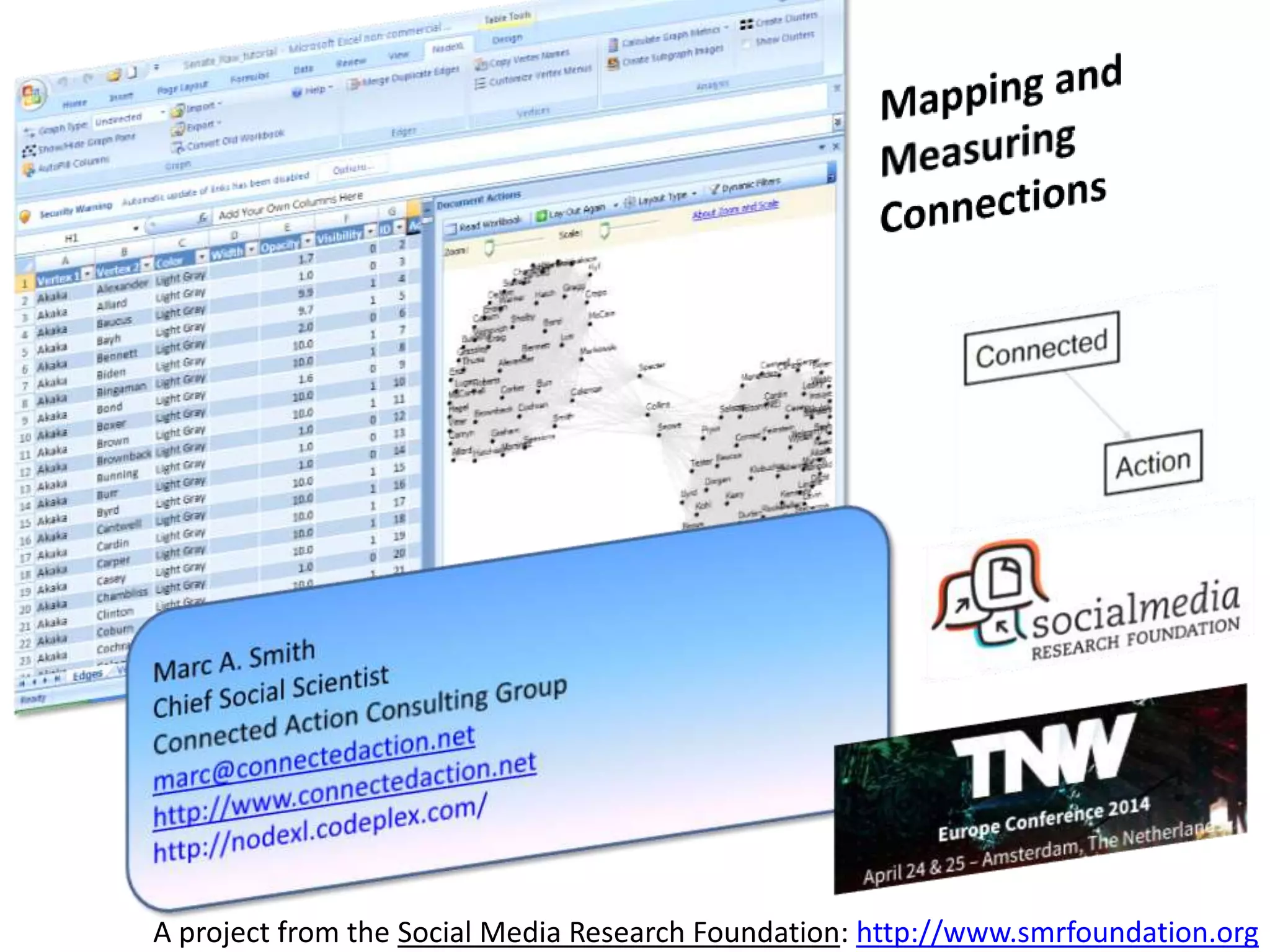
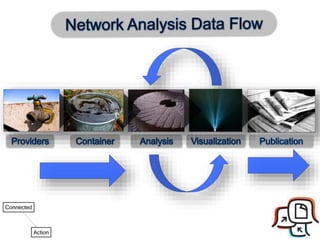
A project from the Social Media Research Foundation: http://www.smrfoundation.org
About Me
Introductions
Marc A. Smith
Chief Social Scientist
Connected Action Consulting Group
Marc@connectedaction.net
http://www.connectedaction.net
http://www.codeplex.com/nodexl
http://www.twitter.com/marc_smith
http://www.flickr.com/photos/marc_smith
http://www.facebook.com/marc.smith.sociologist
http://www.linkedin.com/in/marcasmith
http://www.slideshare.net/Marc_A_Smith
http://www.smrfoundation.org
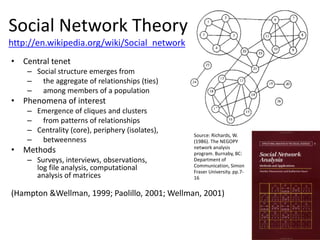
• Central tenet
– Social structure emerges from
– the aggregate of relationships (ties)
– among members of a population
• Phenomena of interest
– Emergence of cliques and clusters
– from patterns of relationships
– Centrality (core), periphery (isolates),
– betweenness
• Methods
– Surveys, interviews, observations,
log file analysis, computational
analysis of matrices
(Hampton &Wellman, 1999; Paolillo, 2001; Wellman, 2001)
Source: Richards, W.
(1986). The NEGOPY
network analysis
program. Burnaby, BC:
Department of
Communication, Simon
Fraser University. pp.7-
16
Social Network Theory
http://en.wikipedia.org/wiki/Social_network
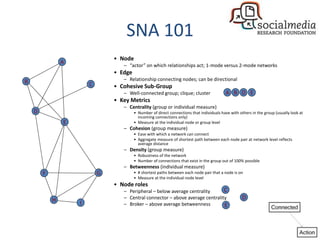
SNA 101
• Node
– “actor” on which relationships act; 1-mode versus 2-mode networks
• Edge
– Relationship connecting nodes; can be directional
• Cohesive Sub-Group
– Well-connected group; clique; cluster
• Key Metrics
– Centrality (group or individual measure)
• Number of direct connections that individuals have with others in the group (usually look at
incoming connections only)
• Measure at the individual node or group level
– Cohesion (group measure)
• Ease with which a network can connect
• Aggregate measure of shortest path between each node pair at network level reflects
average distance
– Density (group measure)
• Robustness of the network
• Number of connections that exist in the group out of 100% possible
– Betweenness (individual measure)
• # shortest paths between each node pair that a node is on
• Measure at the individual node level
• Node roles
– Peripheral – below average centrality
– Central connector – above average centrality
– Broker – above average betweenness
E
D
F
A
CB
H
G
I
C
D
E
A B D E
OF
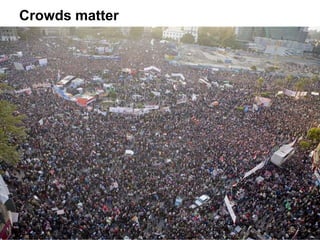
Crowds matter
Kodak
Brownie
Snap-
Shot
Camera
The first
easy to use
point and shoot!
http://www.flickr.com/photos/amycgx/3119640267/
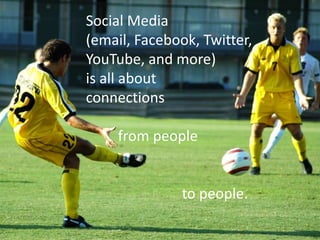
Social Media
(email, Facebook, Twitter,
YouTube, and more)
is all about
connections
from people
to people.
10
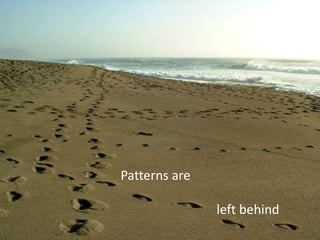
Patterns are
left behind
11
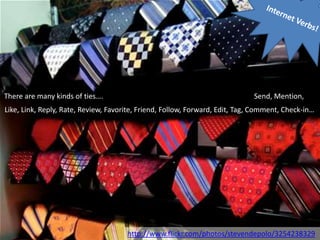
There are many kinds of ties…. Send, Mention,
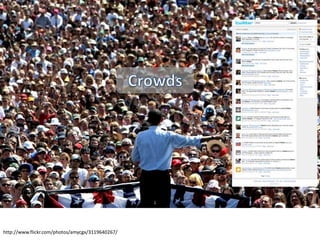
http://www.flickr.com/photos/stevendepolo/3254238329
Like, Link, Reply, Rate, Review, Favorite, Friend, Follow, Forward, Edit, Tag, Comment, Check-in…
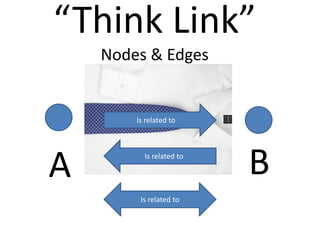
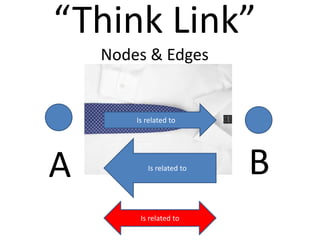
“Think Link”
Nodes & Edges
Is related to
A BIs related to
Is related to
“Think Link”
Nodes & Edges
Is related to
A BIs related to
Is related to
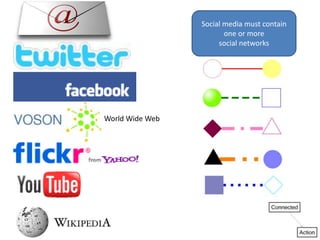
World Wide Web
Social media must contain
one or more
social networks
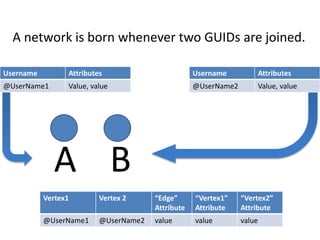
Vertex1 Vertex 2 “Edge”
Attribute
“Vertex1”
Attribute
“Vertex2”
Attribute
@UserName1 @UserName2 value value value
A network is born whenever two GUIDs are joined.
Username Attributes
@UserName1 Value, value
Username Attributes
@UserName2 Value, value
A B
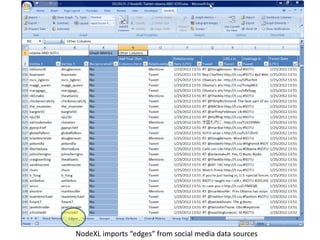
NodeXL imports “edges” from social media data sources
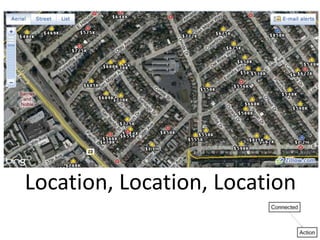
Location, Location, Location
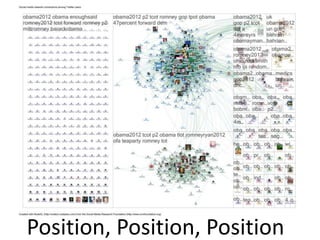
Position, Position, Position
Mapping and Measuring Connections
with
Like MSPaint™ for graphs.
— the Community
Now Available
Communities
in Cyberspace
What we are trying to do:
Open Tools, Open Data, Open Scholarship
• Build the “Firefox of GraphML” – open tools for
collecting and visualizing social media data
• Connect users to network analysis – make
network charts as easy as making a pie chart
• Connect researchers to social media data sources
• Archive: Be the “Allen Very Large Telescope Array”
for Social Media data – coordinate and aggregate
the results of many user’s data collection and
analysis
• Create open access research papers & findings
• Make “collections of connections” easy for users
to manage
Goal: Make SNA easier
• Existing Social Network Tools are challenging
for many novice users
• Tools like Excel are widely used
• Leveraging a spreadsheet as a host for SNA
lowers barriers to network data analysis and
display
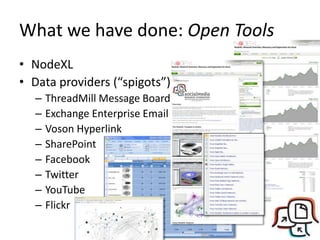
What we have done: Open Tools
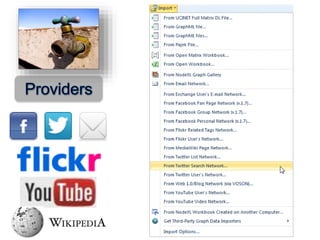
• NodeXL
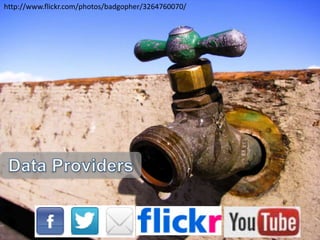
• Data providers (“spigots”)
– ThreadMill Message Board
– Exchange Enterprise Email
– Voson Hyperlink
– SharePoint
– Facebook
– Twitter
– YouTube
– Flickr
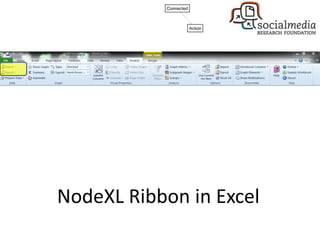
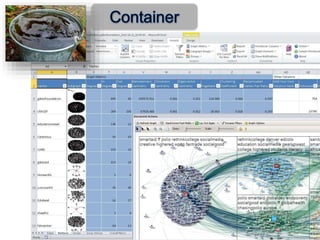
NodeXL Ribbon in Excel
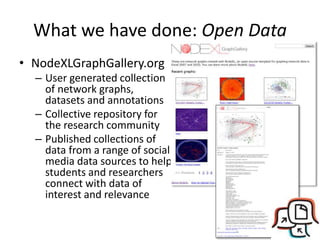
What we have done: Open Data
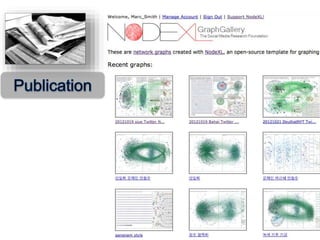
• NodeXLGraphGallery.org
– User generated collection
of network graphs,
datasets and annotations
– Collective repository for
the research community
– Published collections of
data from a range of social
media data sources to help
students and researchers
connect with data of
interest and relevance
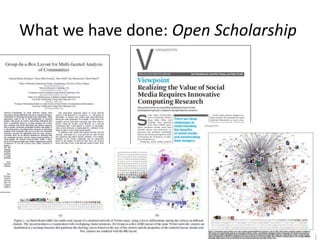
What we have done: Open Scholarship
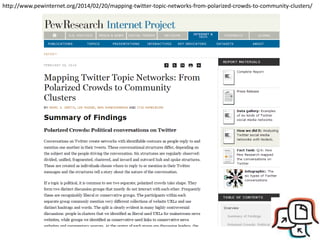
http://www.pewinternet.org/2014/02/20/mapping-twitter-topic-networks-from-polarized-crowds-to-community-clusters/
http://www.flickr.com/photos/badgopher/3264760070/
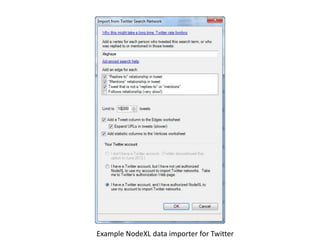
Example NodeXL data importer for Twitter
http://www.flickr.com/photos/druclimb/2212572259/in/photostream/
http://www.flickr.com/photos/hchalkley/47839243/
http://www.flickr.com/photos/rvwithtito/4236716778
http://www.flickr.com/photos/62693815@N03/6277208708/
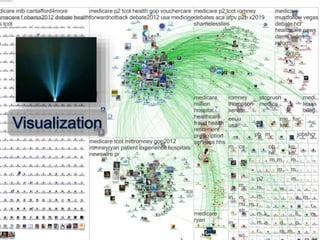
Social Network Maps Reveal
Key influencers in any topic.
Sub-groups.
Bridges.
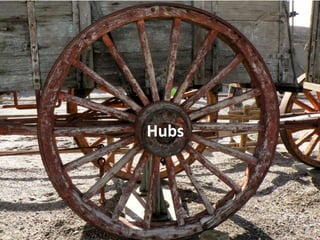
Hubs
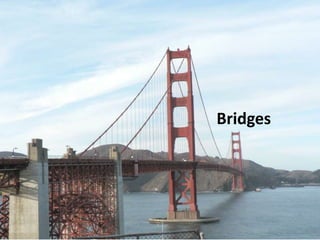
Bridges
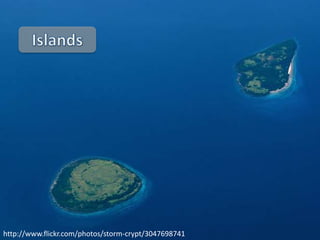
http://www.flickr.com/photos/storm-crypt/3047698741
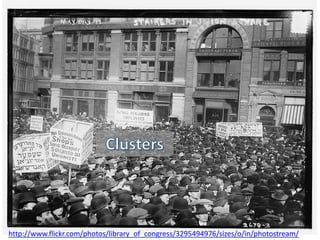
http://www.flickr.com/photos/library_of_congress/3295494976/sizes/o/in/photostream/
[Divided]
Polarized Crowds
[Unified]
Tight Crowd
[Fragmented]
Brand Clusters
[Clustered]
Community Clusters
[In-Hub & Spoke]
Broadcast Network
[Out-Hub & Spoke]
Support Network
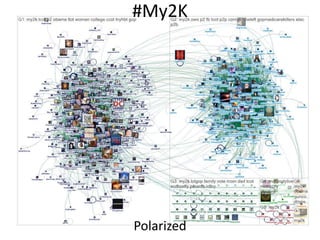
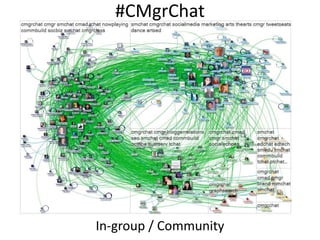
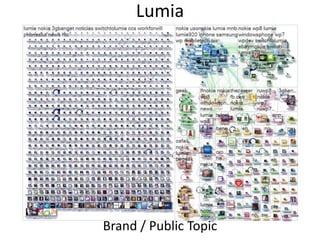
6 kinds of Twitter social media networks
[Divided]
Polarized Crowds
[Unified]
Tight Crowd
[Fragmented]
Brand Clusters
[Clustered]
Community Clusters
[In-Hub & Spoke]
Broadcast Network
[Out-Hub & Spoke]
Support Network
6 kinds of Twitter social media networks
#My2K
Polarized
#CMgrChat
In-group / Community
Lumia
Brand / Public Topic
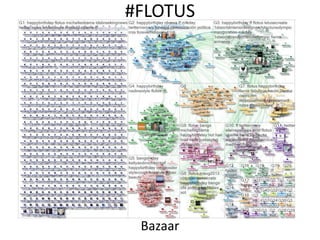
#FLOTUS
Bazaar
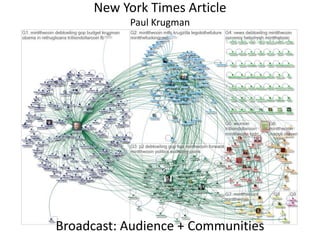
New York Times Article
Paul Krugman
Broadcast: Audience + Communities
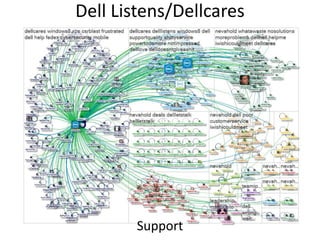
Dell Listens/Dellcares
Support
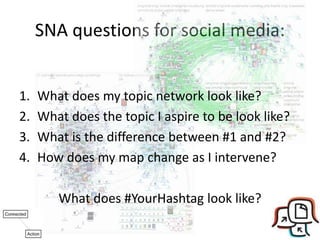
SNA questions for social media:
1. What does my topic network look like?
2. What does the topic I aspire to be look like?
3. What is the difference between #1 and #2?
4. How does my map change as I intervene?
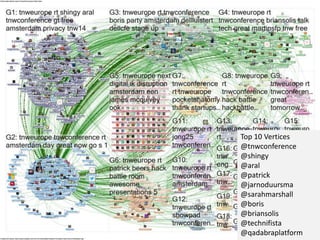
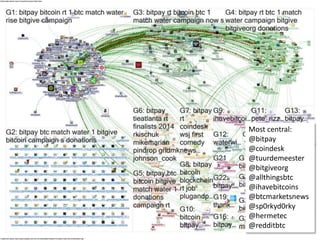
What does #YourHashtag look like?
Top 10 Vertices
@tnwconference
@shingy
@aral
@patrick
@jarnoduursma
@sarahmarshall
@boris
@briansolis
@technifista
@qadabraplatform
Most central:
@bitpay
@coindesk
@tuurdemeester
@bitgiveorg
@allthingsbtc
@ihavebitcoins
@btcmarketsnews
@sp0rkyd0rky
@hermetec
@redditbtc
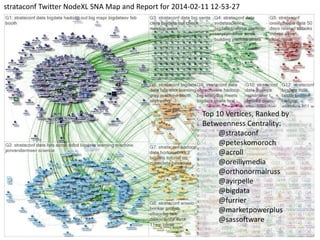
strataconf Twitter NodeXL SNA Map and Report for 2014-02-11 12-53-27
Top 10 Vertices, Ranked by
Betweenness Centrality:
@strataconf
@peteskomoroch
@acroll
@oreillymedia
@orthonormalruss
@ayirpelle
@bigdata
@furrier
@marketpowerplus
@sassoftware
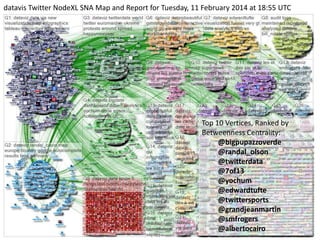
datavis Twitter NodeXL SNA Map and Report for Tuesday, 11 February 2014 at 18:55 UTC
Top 10 Vertices, Ranked by
Betweenness Centrality:
@bigpupazzoverde
@randal_olson
@twitterdata
@7of13
@yochum
@edwardtufte
@twittersports
@grandjeanmartin
@smfrogers
@albertocairo
[Divided]
Polarized Crowds
[Unified]
Tight Crowd
[Fragmented]
Brand Clusters
[Clustered]
Community Clusters
[In-Hub & Spoke]
Broadcast Network
[Out-Hub & Spoke]
Support Network
6 kinds of Twitter social media networks
[Divided]Polarize
d Crowds
[Unified]Tig
ht Crowd
[Fragmented]
Brand Clusters
[Clustered]
Communities
[In-Hub &
Spoke]Broadcast
Network
[Out-Hub &
Spoke]Support
Network
[Low probability]
Find bridge users.
Encourage shared
material.
[Low probability]
Get message out to
disconnected
communities.
[Possible transition]
Draw in new
participants.
[Possible transition]
Regularly create
content.
[Possible transition]
Reply to multiple
users.
[Undesirable
transition]
Remove bridges,
highlight divisions.
[Low probability]
Get message out to
disconnected
communities.
[High probability]
Draw in new
participants.
[Possible transition]
Regularly create
content.
[Possible transition]
Reply to multiple
users.
[Undesirable
transition]
Increase density of
connections in two
groups.
[Low probability]
Dramatically increase
density of
connections.
[High probability]
Increase retention,
build connections.
[Possible transition]
Regularly create
content.
[Possible transition]
Reply to multiple
users.
[Undesirable
transition]
Increase density of
connections in two
groups.
[Low probability]
Dramatically increase
density of
connections.
[Undesirable
transition]
Increase population,
reduce connections.
[Possible transition]
Regularly create
content.
[Possible transition]
Reply to multiple
users.
[Undesirable
transition]
Increase density of
connections in two
groups.
[Low probability]
Dramatically increase
density of
connections.
[Low probability]
Get message out to
disconnected
communities.
[Possible transition]
Increase retention,
build connections.
[High probability]
Increase reply rate,
reply to multiple
users.
[Undesirable
transition]
Increase density of
connections in two
groups.
[Low probability]
Dramatically increase
density of
connections.
[Possible transition]
Get message out to
disconnected
communities.
[High probability]
Increase retention,
build connections.
[High probability]
Increase publication
of new content and
regularly create
content.
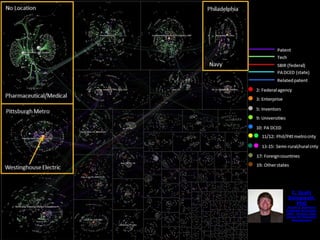
C. Scott
Dempwolf,
PhD
Research Assistant
Professor & Director
UMD - Morgan State
Center for Economic
Development
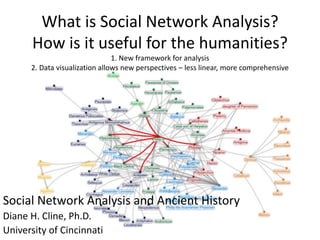
What is Social Network Analysis?
How is it useful for the humanities?
1. New framework for analysis
2. Data visualization allows new perspectives – less linear, more comprehensive
Social Network Analysis and Ancient History
Diane H. Cline, Ph.D.
University of Cincinnati
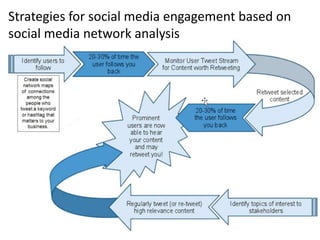
Strategies for social media engagement based on
social media network analysis
Request your own network map and report
http://connectedaction.net
What we want to do:
(Build the tools to) map the social web
• Move NodeXL to the web: (Node[NOT]XL)
– Node for Google Doc Spreadsheets?
– WebGL Canvas? D3.JS? Sigma.JS
• Connect to more data sources of interest:
– RDF, MediaWikis, Gmail, NYT, Citation Networks
• Solve hard network manipulation UI problems:
– Modal transform, Time series, Automated layouts
• Grow and maintain archives of social media network data sets for
research use.
• Improve network science education:
– Workshops on social media network analysis
– Live lectures and presentations
– Videos and training materials
How you can help
• Sponsor a feature
• Sponsor workshops
• Sponsor a student
• Schedule training
• Sponsor the foundation
• Donate your money, code, computation, storage,
bandwidth, data or employee’s time
• Help promote the work of the Social Media
Research Foundation
Thank you!
A project from the Social Media Research Foundation: http://www.smrfoundation.org
2014 TheNextWeb-Mapping connections with NodeXL

2014 TheNextWeb-Mapping connections with NodeXL

  • 1.
    A project fromthe Social Media Research Foundation: http://www.smrfoundation.org
  • 2.
    About Me Introductions Marc A.Smith Chief Social Scientist Connected Action Consulting Group Marc@connectedaction.net http://www.connectedaction.net http://www.codeplex.com/nodexl http://www.twitter.com/marc_smith http://www.flickr.com/photos/marc_smith http://www.facebook.com/marc.smith.sociologist http://www.linkedin.com/in/marcasmith http://www.slideshare.net/Marc_A_Smith http://www.smrfoundation.org
  • 3.
    • Central tenet –Social structure emerges from – the aggregate of relationships (ties) – among members of a population • Phenomena of interest – Emergence of cliques and clusters – from patterns of relationships – Centrality (core), periphery (isolates), – betweenness • Methods – Surveys, interviews, observations, log file analysis, computational analysis of matrices (Hampton &Wellman, 1999; Paolillo, 2001; Wellman, 2001) Source: Richards, W. (1986). The NEGOPY network analysis program. Burnaby, BC: Department of Communication, Simon Fraser University. pp.7- 16 Social Network Theory http://en.wikipedia.org/wiki/Social_network
  • 4.
    SNA 101 • Node –“actor” on which relationships act; 1-mode versus 2-mode networks • Edge – Relationship connecting nodes; can be directional • Cohesive Sub-Group – Well-connected group; clique; cluster • Key Metrics – Centrality (group or individual measure) • Number of direct connections that individuals have with others in the group (usually look at incoming connections only) • Measure at the individual node or group level – Cohesion (group measure) • Ease with which a network can connect • Aggregate measure of shortest path between each node pair at network level reflects average distance – Density (group measure) • Robustness of the network • Number of connections that exist in the group out of 100% possible – Betweenness (individual measure) • # shortest paths between each node pair that a node is on • Measure at the individual node level • Node roles – Peripheral – below average centrality – Central connector – above average centrality – Broker – above average betweenness E D F A CB H G I C D E A B D E
  • 5.
  • 6.
  • 7.
  • 8.
  • 10.
    Social Media (email, Facebook,Twitter, YouTube, and more) is all about connections from people to people. 10
  • 11.
  • 12.
    There are manykinds of ties…. Send, Mention, http://www.flickr.com/photos/stevendepolo/3254238329 Like, Link, Reply, Rate, Review, Favorite, Friend, Follow, Forward, Edit, Tag, Comment, Check-in…
  • 13.
    “Think Link” Nodes &Edges Is related to A BIs related to Is related to
  • 14.
    “Think Link” Nodes &Edges Is related to A BIs related to Is related to
  • 15.
    World Wide Web Socialmedia must contain one or more social networks
  • 16.
    Vertex1 Vertex 2“Edge” Attribute “Vertex1” Attribute “Vertex2” Attribute @UserName1 @UserName2 value value value A network is born whenever two GUIDs are joined. Username Attributes @UserName1 Value, value Username Attributes @UserName2 Value, value A B
  • 17.
    NodeXL imports “edges”from social media data sources
  • 18.
  • 19.
  • 21.
    Mapping and MeasuringConnections with Like MSPaint™ for graphs. — the Community
  • 22.
  • 23.
  • 24.
    What we aretrying to do: Open Tools, Open Data, Open Scholarship • Build the “Firefox of GraphML” – open tools for collecting and visualizing social media data • Connect users to network analysis – make network charts as easy as making a pie chart • Connect researchers to social media data sources • Archive: Be the “Allen Very Large Telescope Array” for Social Media data – coordinate and aggregate the results of many user’s data collection and analysis • Create open access research papers & findings • Make “collections of connections” easy for users to manage
  • 25.
    Goal: Make SNAeasier • Existing Social Network Tools are challenging for many novice users • Tools like Excel are widely used • Leveraging a spreadsheet as a host for SNA lowers barriers to network data analysis and display
  • 26.
    What we havedone: Open Tools • NodeXL • Data providers (“spigots”) – ThreadMill Message Board – Exchange Enterprise Email – Voson Hyperlink – SharePoint – Facebook – Twitter – YouTube – Flickr
  • 27.
  • 28.
    What we havedone: Open Data • NodeXLGraphGallery.org – User generated collection of network graphs, datasets and annotations – Collective repository for the research community – Published collections of data from a range of social media data sources to help students and researchers connect with data of interest and relevance
  • 29.
    What we havedone: Open Scholarship
  • 30.
  • 32.
  • 34.
    Example NodeXL dataimporter for Twitter
  • 35.
  • 37.
  • 39.
  • 41.
  • 43.
    Social Network MapsReveal Key influencers in any topic. Sub-groups. Bridges.
  • 44.
  • 45.
  • 46.
  • 47.
  • 48.
    [Divided] Polarized Crowds [Unified] Tight Crowd [Fragmented] BrandClusters [Clustered] Community Clusters [In-Hub & Spoke] Broadcast Network [Out-Hub & Spoke] Support Network 6 kinds of Twitter social media networks
  • 49.
    [Divided] Polarized Crowds [Unified] Tight Crowd [Fragmented] BrandClusters [Clustered] Community Clusters [In-Hub & Spoke] Broadcast Network [Out-Hub & Spoke] Support Network 6 kinds of Twitter social media networks
  • 50.
  • 51.
  • 52.
  • 53.
  • 54.
    New York TimesArticle Paul Krugman Broadcast: Audience + Communities
  • 55.
  • 56.
    SNA questions forsocial media: 1. What does my topic network look like? 2. What does the topic I aspire to be look like? 3. What is the difference between #1 and #2? 4. How does my map change as I intervene? What does #YourHashtag look like?
  • 58.
  • 59.
  • 60.
    strataconf Twitter NodeXLSNA Map and Report for 2014-02-11 12-53-27 Top 10 Vertices, Ranked by Betweenness Centrality: @strataconf @peteskomoroch @acroll @oreillymedia @orthonormalruss @ayirpelle @bigdata @furrier @marketpowerplus @sassoftware
  • 61.
    datavis Twitter NodeXLSNA Map and Report for Tuesday, 11 February 2014 at 18:55 UTC Top 10 Vertices, Ranked by Betweenness Centrality: @bigpupazzoverde @randal_olson @twitterdata @7of13 @yochum @edwardtufte @twittersports @grandjeanmartin @smfrogers @albertocairo
  • 62.
    [Divided] Polarized Crowds [Unified] Tight Crowd [Fragmented] BrandClusters [Clustered] Community Clusters [In-Hub & Spoke] Broadcast Network [Out-Hub & Spoke] Support Network 6 kinds of Twitter social media networks
  • 63.
    [Divided]Polarize d Crowds [Unified]Tig ht Crowd [Fragmented] BrandClusters [Clustered] Communities [In-Hub & Spoke]Broadcast Network [Out-Hub & Spoke]Support Network [Low probability] Find bridge users. Encourage shared material. [Low probability] Get message out to disconnected communities. [Possible transition] Draw in new participants. [Possible transition] Regularly create content. [Possible transition] Reply to multiple users. [Undesirable transition] Remove bridges, highlight divisions. [Low probability] Get message out to disconnected communities. [High probability] Draw in new participants. [Possible transition] Regularly create content. [Possible transition] Reply to multiple users. [Undesirable transition] Increase density of connections in two groups. [Low probability] Dramatically increase density of connections. [High probability] Increase retention, build connections. [Possible transition] Regularly create content. [Possible transition] Reply to multiple users. [Undesirable transition] Increase density of connections in two groups. [Low probability] Dramatically increase density of connections. [Undesirable transition] Increase population, reduce connections. [Possible transition] Regularly create content. [Possible transition] Reply to multiple users. [Undesirable transition] Increase density of connections in two groups. [Low probability] Dramatically increase density of connections. [Low probability] Get message out to disconnected communities. [Possible transition] Increase retention, build connections. [High probability] Increase reply rate, reply to multiple users. [Undesirable transition] Increase density of connections in two groups. [Low probability] Dramatically increase density of connections. [Possible transition] Get message out to disconnected communities. [High probability] Increase retention, build connections. [High probability] Increase publication of new content and regularly create content.
  • 65.
    C. Scott Dempwolf, PhD Research Assistant Professor& Director UMD - Morgan State Center for Economic Development
  • 66.
    What is SocialNetwork Analysis? How is it useful for the humanities? 1. New framework for analysis 2. Data visualization allows new perspectives – less linear, more comprehensive Social Network Analysis and Ancient History Diane H. Cline, Ph.D. University of Cincinnati
  • 67.
    Strategies for socialmedia engagement based on social media network analysis
  • 68.
    Request your ownnetwork map and report http://connectedaction.net
  • 69.
    What we wantto do: (Build the tools to) map the social web • Move NodeXL to the web: (Node[NOT]XL) – Node for Google Doc Spreadsheets? – WebGL Canvas? D3.JS? Sigma.JS • Connect to more data sources of interest: – RDF, MediaWikis, Gmail, NYT, Citation Networks • Solve hard network manipulation UI problems: – Modal transform, Time series, Automated layouts • Grow and maintain archives of social media network data sets for research use. • Improve network science education: – Workshops on social media network analysis – Live lectures and presentations – Videos and training materials
  • 70.
    How you canhelp • Sponsor a feature • Sponsor workshops • Sponsor a student • Schedule training • Sponsor the foundation • Donate your money, code, computation, storage, bandwidth, data or employee’s time • Help promote the work of the Social Media Research Foundation
  • 71.
  • 72.
    A project fromthe Social Media Research Foundation: http://www.smrfoundation.org