
Game of Documentation: 
Winter is Coming – Surviving ICD-10 
Nick van Terheyden, MD (aka @drnic1) 
Chief Medical Information Officer 
Nuance Communications, Inc.
Harrison Ford Injury and ICD-10 
• Injured by the Hydraulic Door of the 
Millennium Falcon 
• 2014 ICD-10-CM Diagnosis Code 
V95.40XA 
• Unspecified Spacecraft Accident Injuring 
Occupant, Initial Encounter
Changes in the Healthcare System 
and What it Means to You 
• Entire healthcare system in transition 
– Meaningful use in full swing 
– EHR adoption is mandatory 
– Entire IT infrastructures are being replaced 
– Transition to pay-for-performance and value-based 
models 
• Hospitals and Healthcare facilities have to do more with less 
• Fair reimbursement in a tighter regulatory environment
Survey Question 
Where are you on the continuum of preparing 
your office for ICD-10? 
A. We’re ready 
B. We have a plan and are on 
our way to being ready 
C. We might be ready because 
D. We’ve talked about it 
E. Uh, when do we have to start? 
F. No need to prepare.. it will be delayed again
ICD-10 History 
• ICD-10 adopted by the World Health Organization in 1990 
– Implemented in the United Kingdom in 1995 
– Australian modification released in 1998 
– Canadian version 2001 
• US development 
– US evaluation by the National Center for Health Statistics began 1994 
– Numerous subsequent versions 
– Final implementation date 10/01/14 
• The official documents 
– International Classification of Diseases, Tenth Revision, Clinical 
Modification [ICD-10-CM] 
– International Classification of Diseases, Tenth Revision, Procedure 
Coding System [ICD-10-PCS]
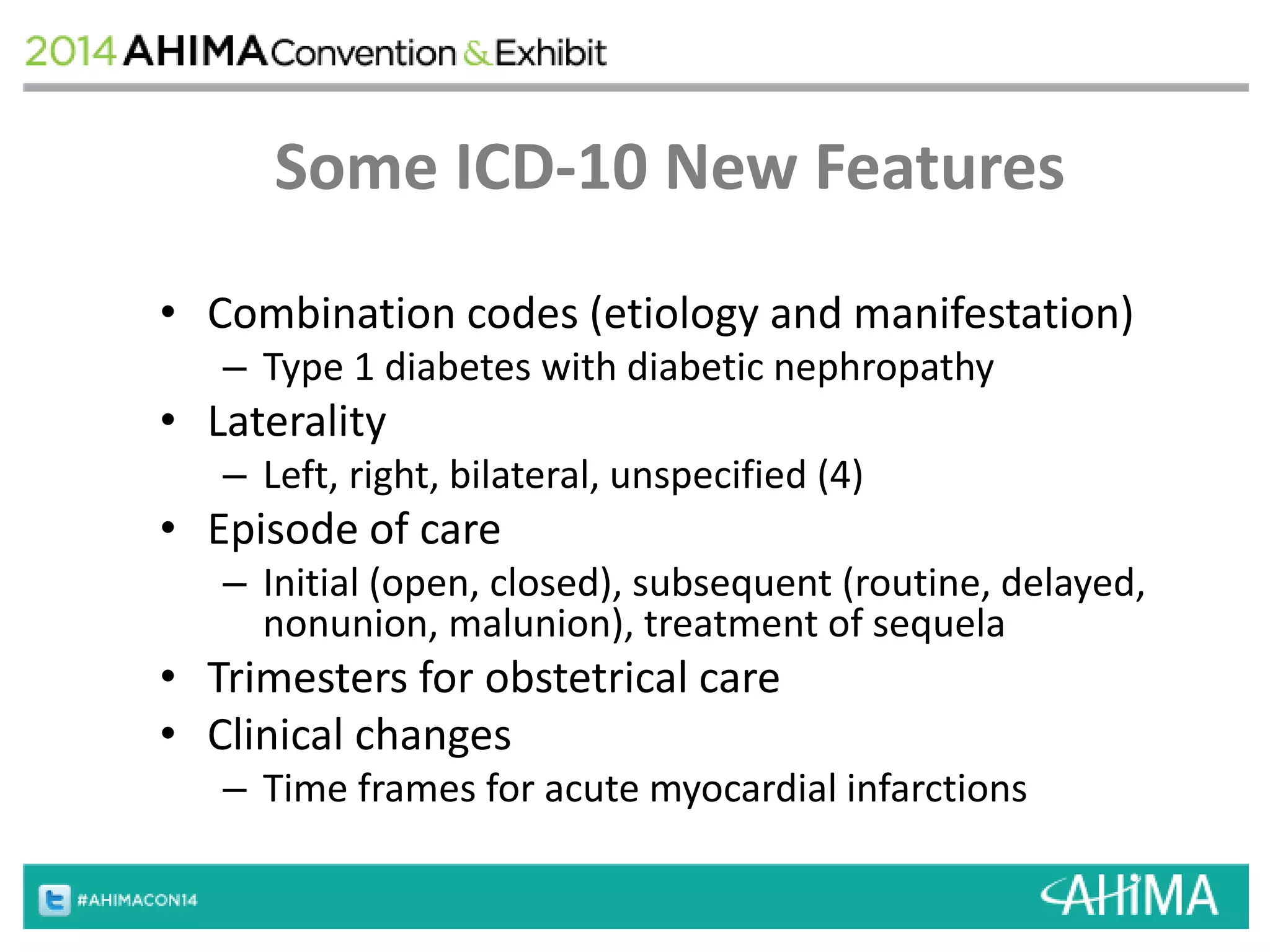
Some ICD-10 New Features 
• Combination codes (etiology and manifestation) 
– Type 1 diabetes with diabetic nephropathy 
• Laterality 
– Left, right, bilateral, unspecified (4) 
• Episode of care 
– Initial (open, closed), subsequent (routine, delayed, 
nonunion, malunion), treatment of sequela 
• Trimesters for obstetrical care 
• Clinical changes 
– Time frames for acute myocardial infarctions
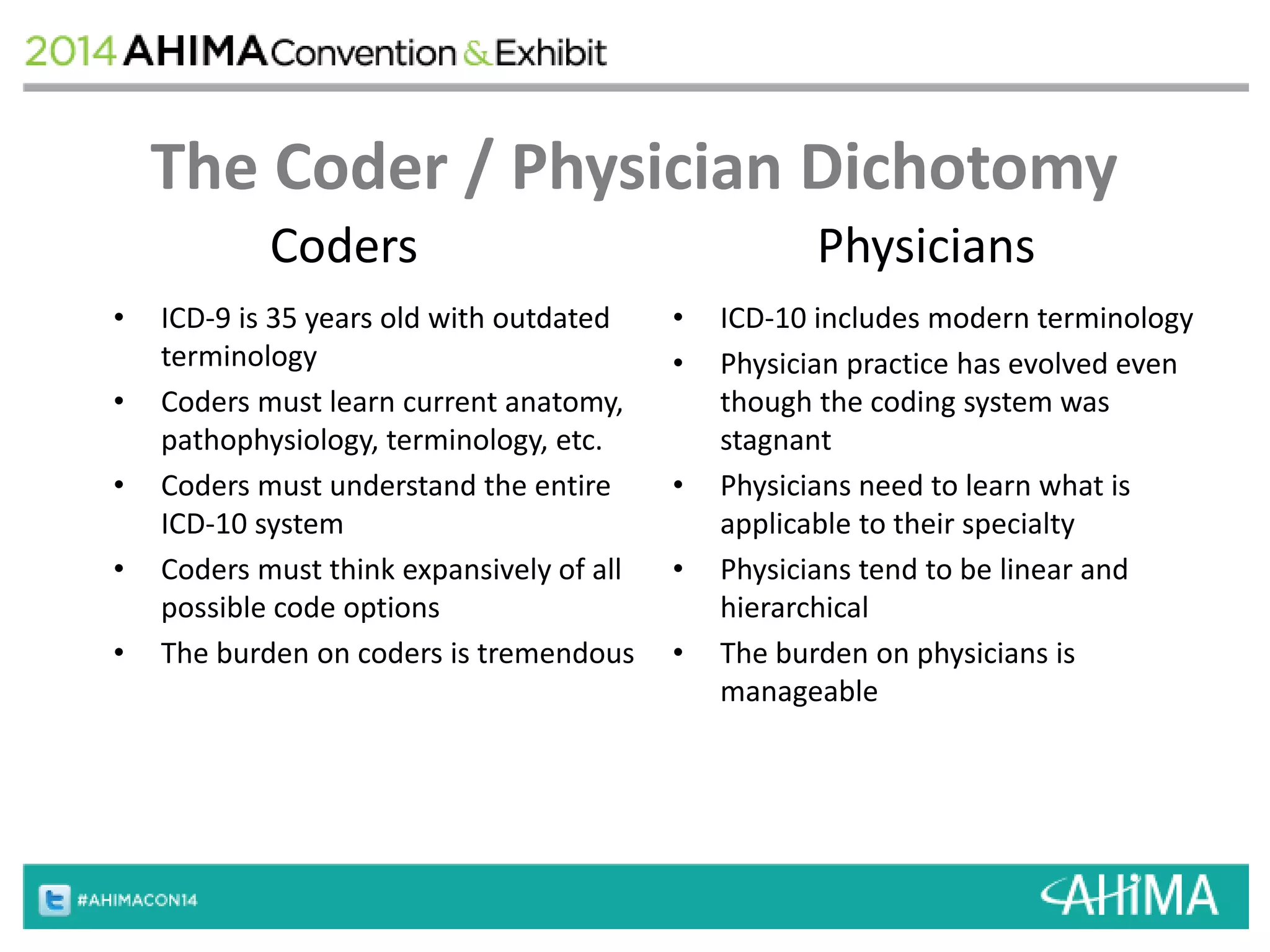
The Coder / Physician Dichotomy 
Coders Physicians 
• ICD-9 is 35 years old with outdated 
terminology 
• Coders must learn current anatomy, 
pathophysiology, terminology, etc. 
• Coders must understand the entire 
ICD-10 system 
• Coders must think expansively of all 
possible code options 
• The burden on coders is tremendous 
• ICD-10 includes modern terminology 
• Physician practice has evolved even 
though the coding system was 
stagnant 
• Physicians need to learn what is 
applicable to their specialty 
• Physicians tend to be linear and 
hierarchical 
• The burden on physicians is 
manageable
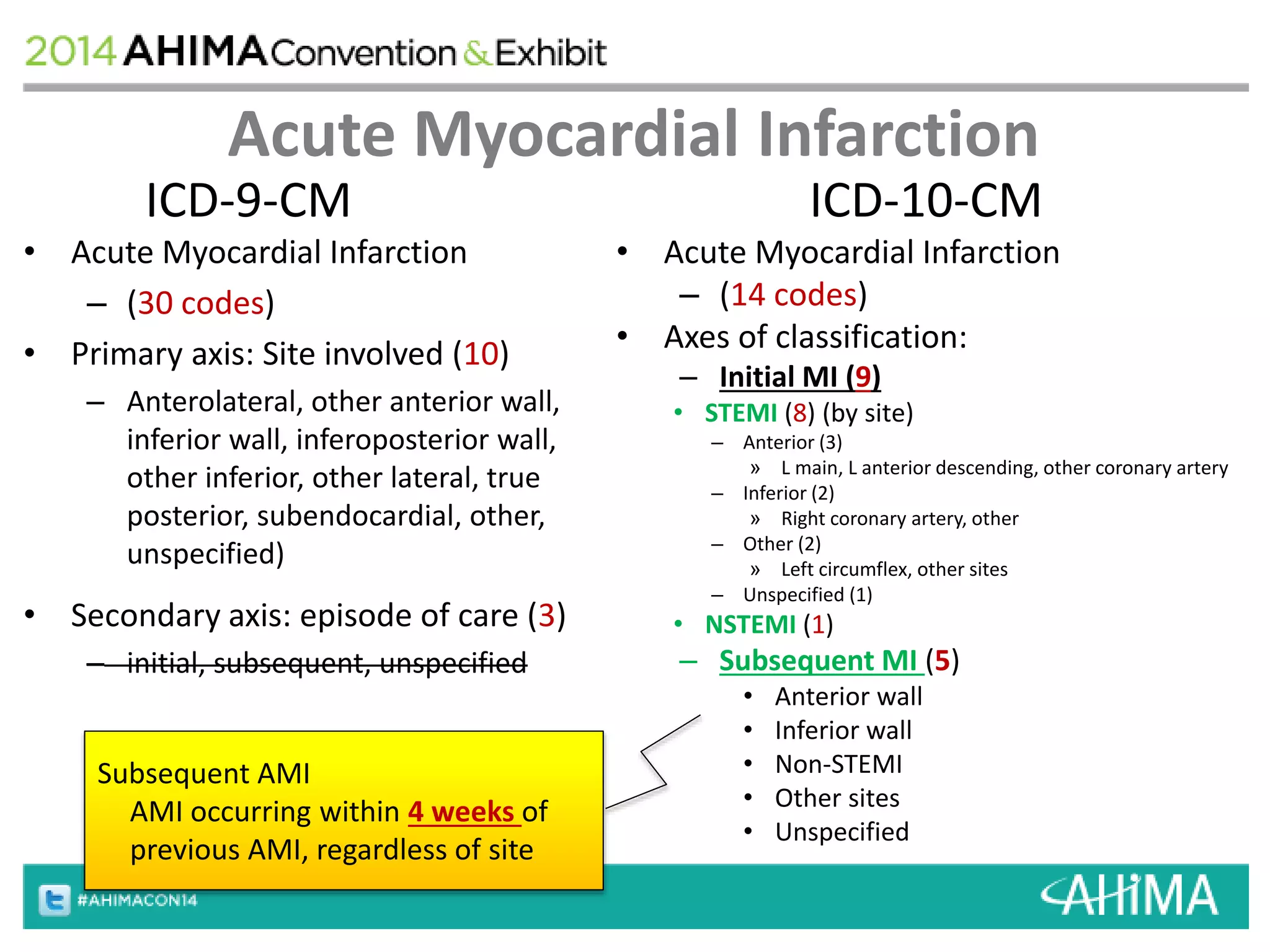
Acute Myocardial Infarction 
ICD-9-CM ICD-10-CM 
• Acute Myocardial Infarction 
– (30 codes) 
• Primary axis: Site involved (10) 
– Anterolateral, other anterior wall, 
inferior wall, inferoposterior wall, 
other inferior, other lateral, true 
posterior, subendocardial, other, 
unspecified) 
• Secondary axis: episode of care (3) 
– initial, subsequent, unspecified 
• Acute Myocardial Infarction 
– (14 codes) 
• Axes of classification: 
– Initial MI (9) 
• STEMI (8) (by site) 
– Anterior (3) 
» L main, L anterior descending, other coronary artery 
– Inferior (2) 
» Right coronary artery, other 
– Other (2) 
» Left circumflex, other sites 
– Unspecified (1) 
• NSTEMI (1) 
– Subsequent MI (5) 
• Anterior wall 
• Inferior wall 
• Non-STEMI 
• Other sites 
• Unspecified 
Subsequent AMI 
AMI occurring within 4 weeks of 
previous AMI, regardless of site
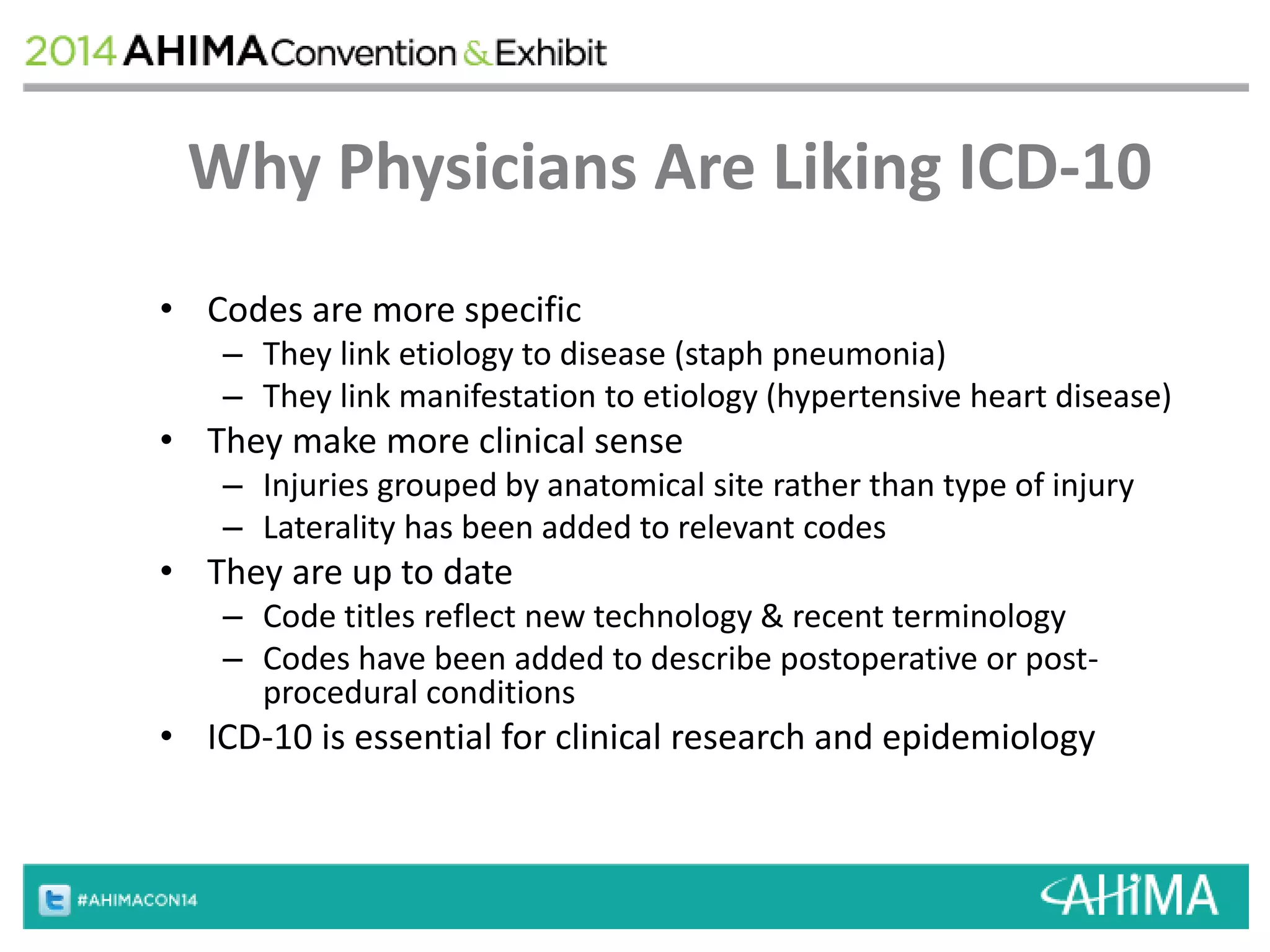
Why Physicians Are Liking ICD-10 
• Codes are more specific 
– They link etiology to disease (staph pneumonia) 
– They link manifestation to etiology (hypertensive heart disease) 
• They make more clinical sense 
– Injuries grouped by anatomical site rather than type of injury 
– Laterality has been added to relevant codes 
• They are up to date 
– Code titles reflect new technology & recent terminology 
– Codes have been added to describe postoperative or post-procedural 
conditions 
• ICD-10 is essential for clinical research and epidemiology
High Level Message 
• ICD-10 implementation will improve patient care 
• ICD-10 is not being imposed on physicians by the 
hospital 
• The hospital is collaborating to reduce impact on 
physicians by building knowledgeable infrastructure 
• Independent physicians need to focus now on their 
practice, specifically their systems and staff 
• Further education will be coming at the appropriate 
time for every specialty and subspecialty.
The Risk to Providers 
• The only way your clinical performance is adjudicated by those 
outside of your medical staff is through Billing Data 
• If you do not get the billing data correct then your performance 
will be adjudicated incorrectly… 
• This will be vital in the changing healthcare environment 
– “My patients are sicker” is no longer an acceptable excuse for 
less than expected performance because severity adjustment is 
built into the coding system 
• But only if you get it right 
– In a population based payment system those that have less than 
expected performance in quality and cost will be marginalized 
• It would be a shame for your hospital and clinicians were to be 
affected just because you didn’t understand the Documentation, 
Regulatory, and Compliance environment we live in today
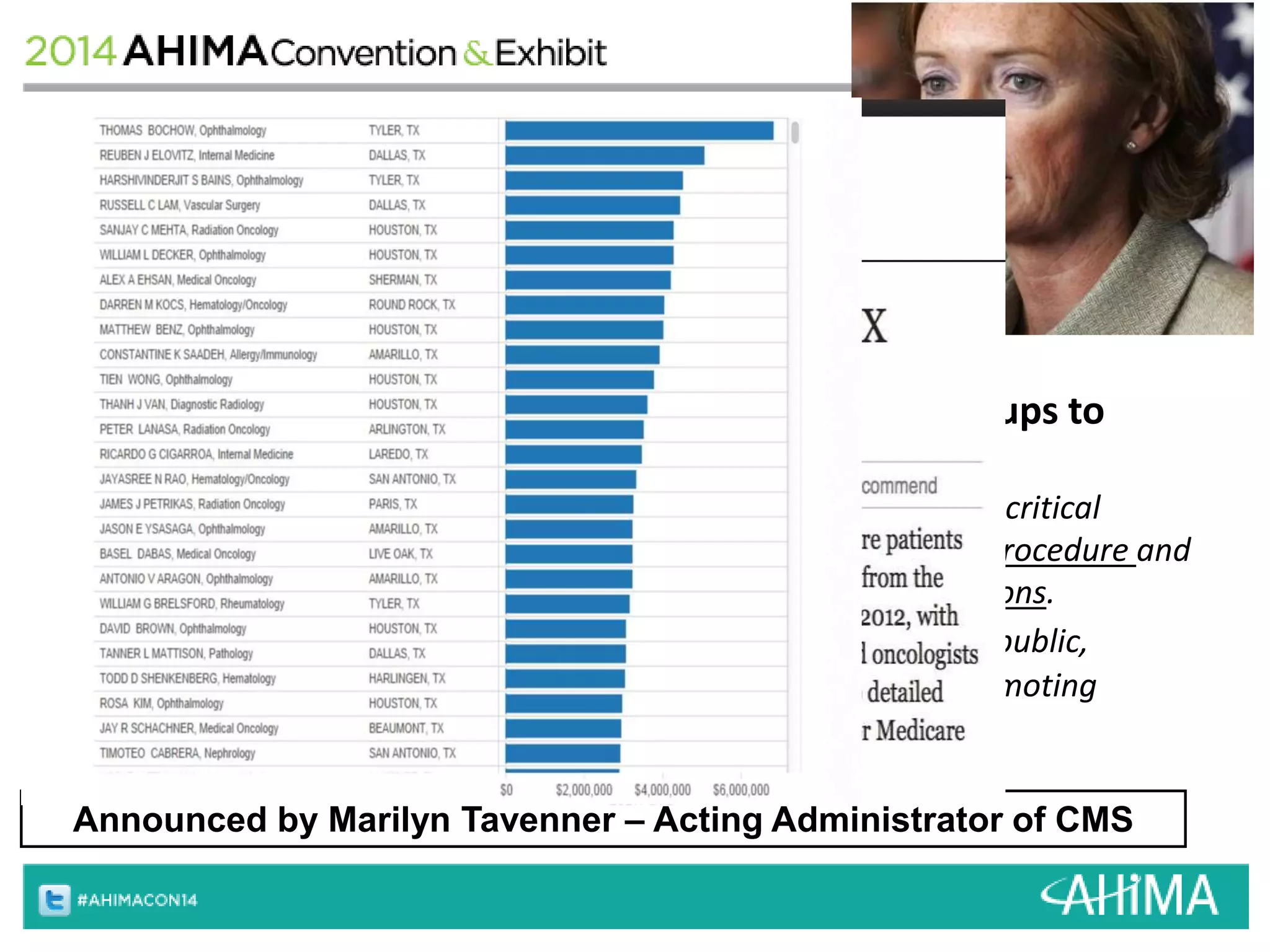
“Feds to Allow Use of Medicare Data 
To Rate Doctors” – USA Today 12/5/11 
The federal government announced 
that Medicare will now allow use of its 
extensive medical claims database by 
employers, insurance companies and consumer groups to 
produce report cards on local doctors and hospitals. 
…By analyzing masses of billing records, experts can glean such critical 
information as how often a doctor has performed a particular procedure and 
get a general sense of problems such as preventable complications. 
Compiled in an easily understood format and released to the public, 
medical report cards could become a very powerful tool for promoting 
quality care and reducing waste… 
Announced by Marilyn Tavenner – Acting Administrator of CMS
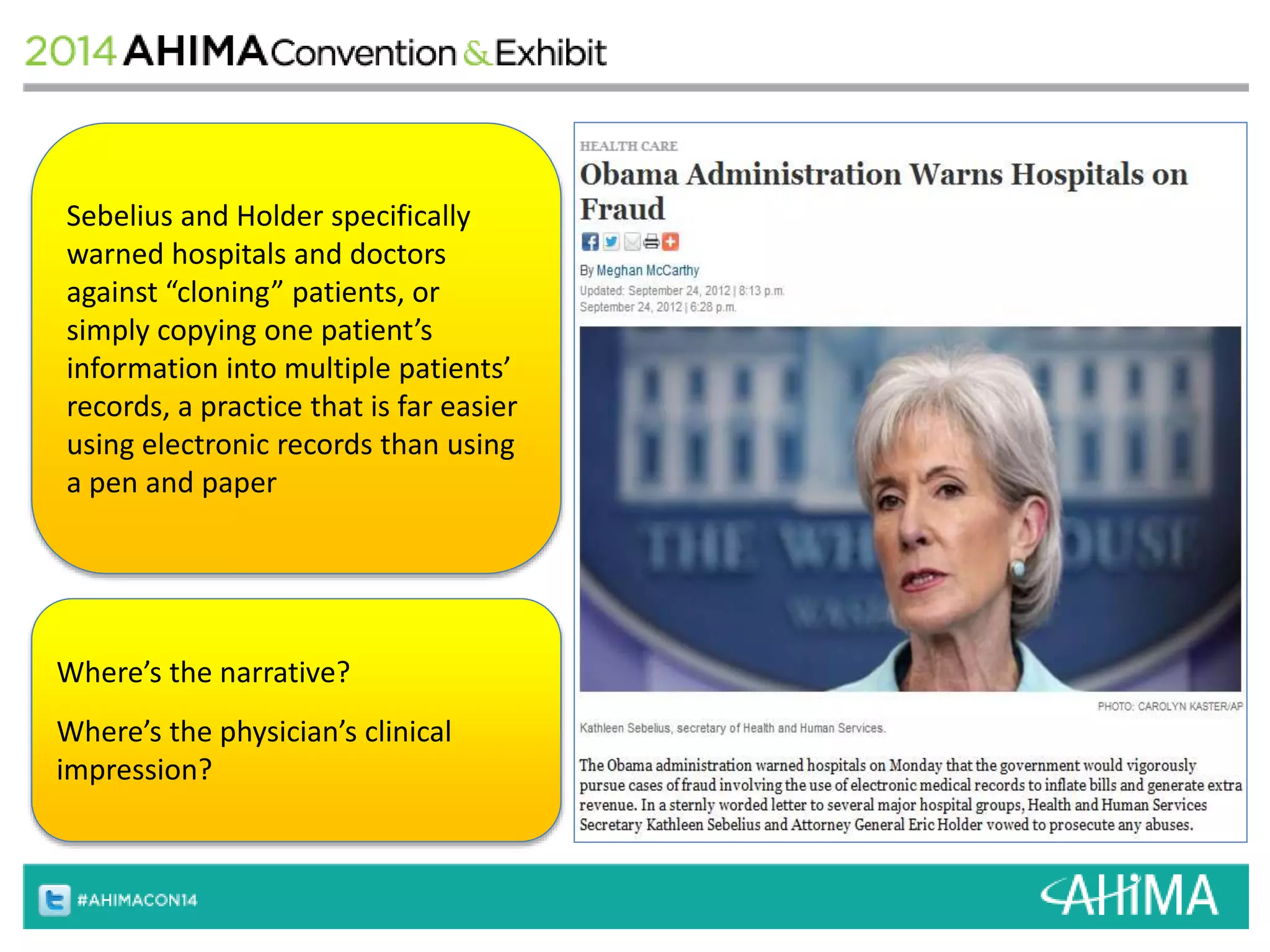
Sebelius and Holder specifically 
warned hospitals and doctors 
against “cloning” patients, or 
simply copying one patient’s 
information into multiple patients’ 
records, a practice that is far easier 
using electronic records than using 
a pen and paper 
Where’s the narrative? 
Where’s the physician’s clinical 
impression?
Unfair Advantage? United Healthcare Boots 
Thousands of MDs From Its Part C Medicare Plans 
"Our decisions are based on providing a network of physicians 
whom we can collaborate with to help enhance health plan 
quality, improve healthcare outcomes, and curb the growth in 
healthcare costs," he wrote. "Factors include geography and 
ensuring ready access to care, the relative performance of 
providers on a range of industry quality metrics, and a provider's 
ability to deliver high-quality care for the most members in the 
most cost-efficient manner.“ 
Medscape/Heartwire 
auth. Steve Stiles; October 28, 2013
The Healthcare Environment 
has Changed 
The Hospital Chart 
– Has changed from an accounting of the care we were providing with limited 
information that could be put into a written record to an expansive record full 
of data and information that no one can know every data point in it 
– Yet Physicians are responsible for every data point 
The Environment 
– With all the information available in the record others have the ability to come 
to conclusions about the care you provided based on that information. 
– If you let the record tell the story with just its information and Physicians 
are not discussing their judgment in that record then their decisions will 
more likely be questioned by outsider reviewer 
 Fraud Enforcement 
 Malpractice 
 Denial
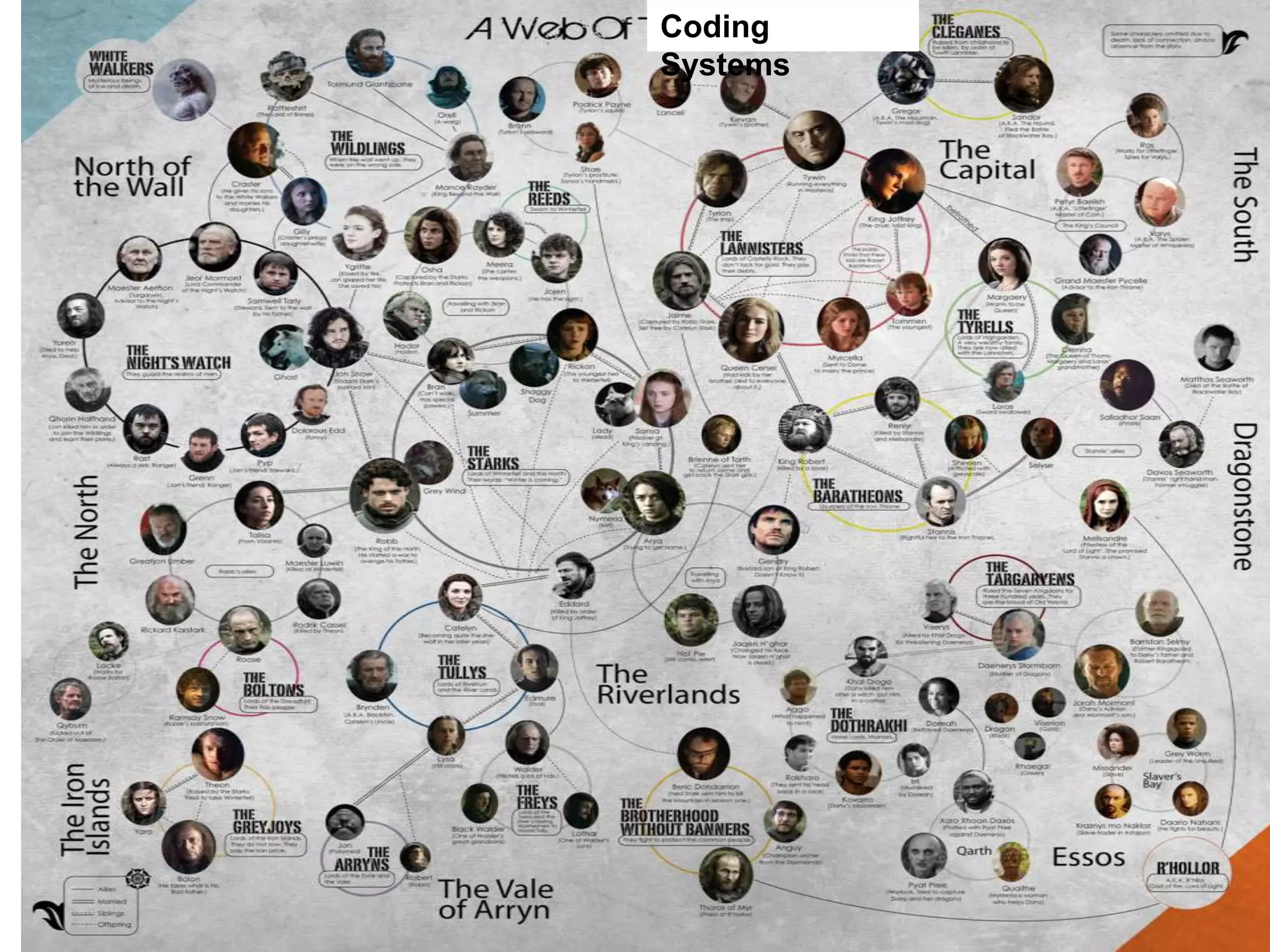
Coding 
Systems 
Understanding The System 
• The MS-DRG system 
• Medicare Severity-Adjusted Diagnosis 
Related Groups
MS DRGs: 
DRG Assignment Based Upon… 
• Medicare Severity Diagnosis Related Groups (MS-DRGs) 
– The Principle Diagnosis or Procedure; plus 
– Severity (Acuity) - CC or MCCs 
• DRG Assignment 
– DRGs are groups of diagnoses determined by Medicare to be 
related clinically and have similar resource consumption 
– Many different diagnoses exist within one DRG 
– One DRG per hospitalization, assigned at discharge 
• Each DRG is assigned a “Relative Weight” (RW) 
– Average of 1.00 
– Originally designed for hospital payment 
– The RW has become the proxy for severity of illness
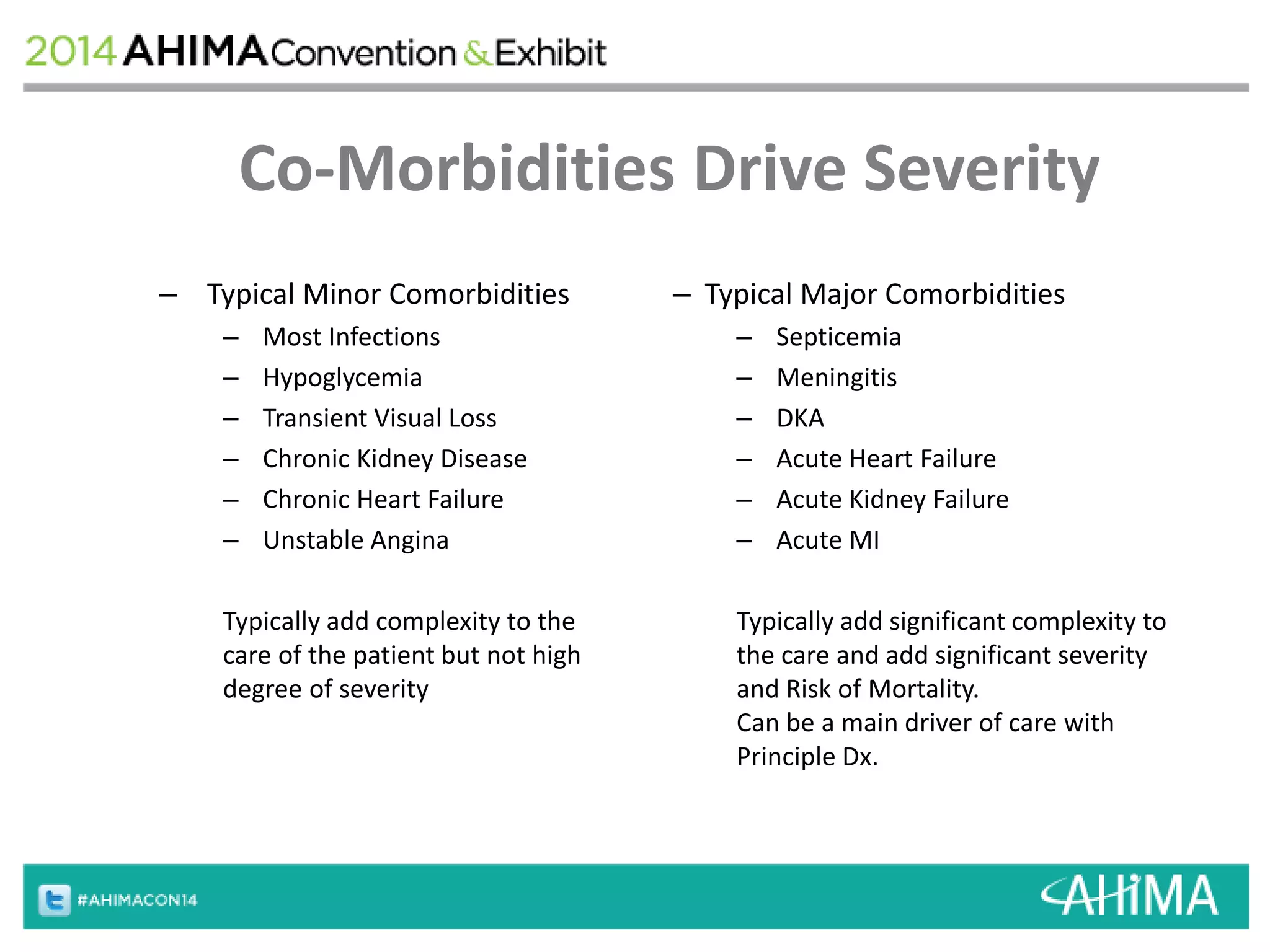
Co-Morbidities Drive Severity 
– Typical Minor Comorbidities 
– Most Infections 
– Hypoglycemia 
– Transient Visual Loss 
– Chronic Kidney Disease 
– Chronic Heart Failure 
– Unstable Angina 
Typically add complexity to the 
care of the patient but not high 
degree of severity 
– Typical Major Comorbidities 
– Septicemia 
– Meningitis 
– DKA 
– Acute Heart Failure 
– Acute Kidney Failure 
– Acute MI 
Typically add significant complexity to 
the care and add significant severity 
and Risk of Mortality. 
Can be a main driver of care with 
Principle Dx.
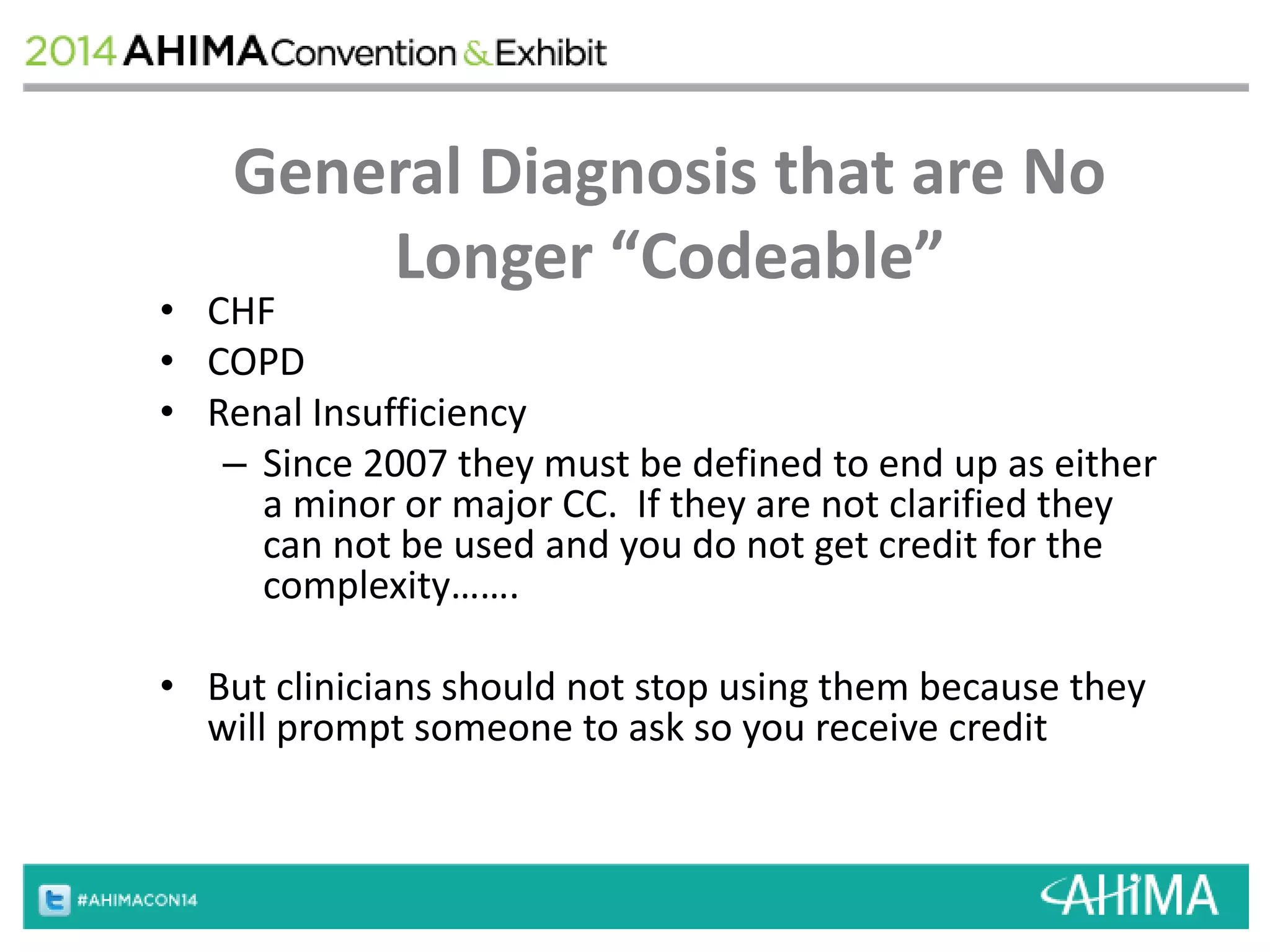
General Diagnosis that are No 
Longer “Codeable” 
• CHF 
• COPD 
• Renal Insufficiency 
– Since 2007 they must be defined to end up as either 
a minor or major CC. If they are not clarified they 
can not be used and you do not get credit for the 
complexity……. 
• But clinicians should not stop using them because they 
will prompt someone to ask so you receive credit
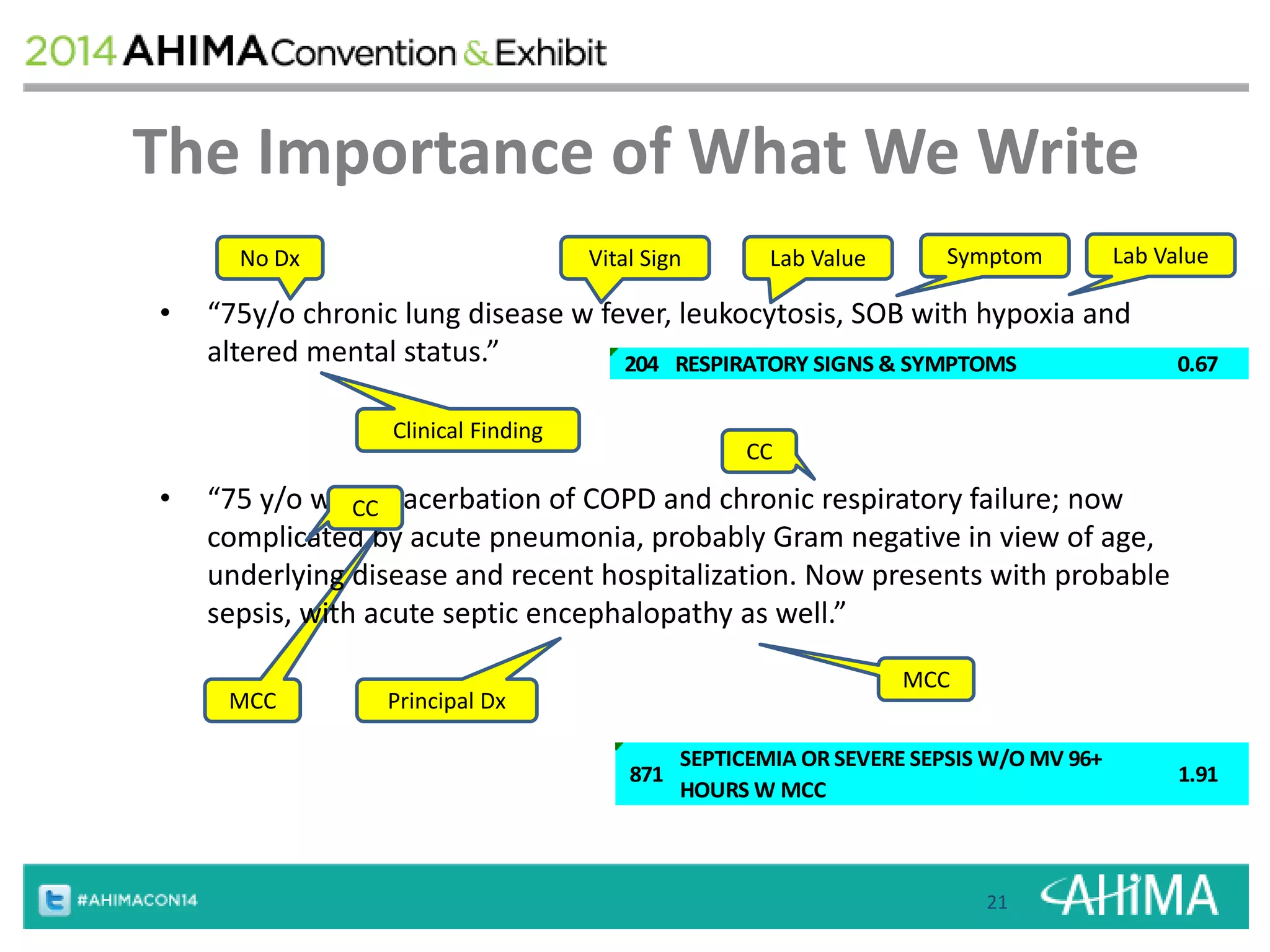
The Importance of What We Write 
No Dx Vital Sign Lab Value Symptom 
• “75y/o chronic lung disease w fever, leukocytosis, SOB with hypoxia and 
altered mental status.” 
• “75 y/o with Exacerbation of COPD and chronic respiratory failure; now 
complicated by acute pneumonia, probably Gram negative in view of age, 
underlying disease and recent hospitalization. Now presents with probable 
sepsis, with acute septic encephalopathy as well.” 
MCC 
21 
Clinical Finding 
Principal Dx 
CC 
CC 
MCC 
Lab Value 
204 RESPIRATORY SIGNS & SYMPTOMS 0.67 
871 
SEPTICEMIA OR SEVERE SEPSIS W/O MV 96+ 
HOURS W MCC 
1.91
THE QUALITY PERSPECTIVE 
THE EFFECT OF 
DOCUMENTATION ON 
OUTCOME PERFORMANCE 
What Happens if you 
don’t get it right
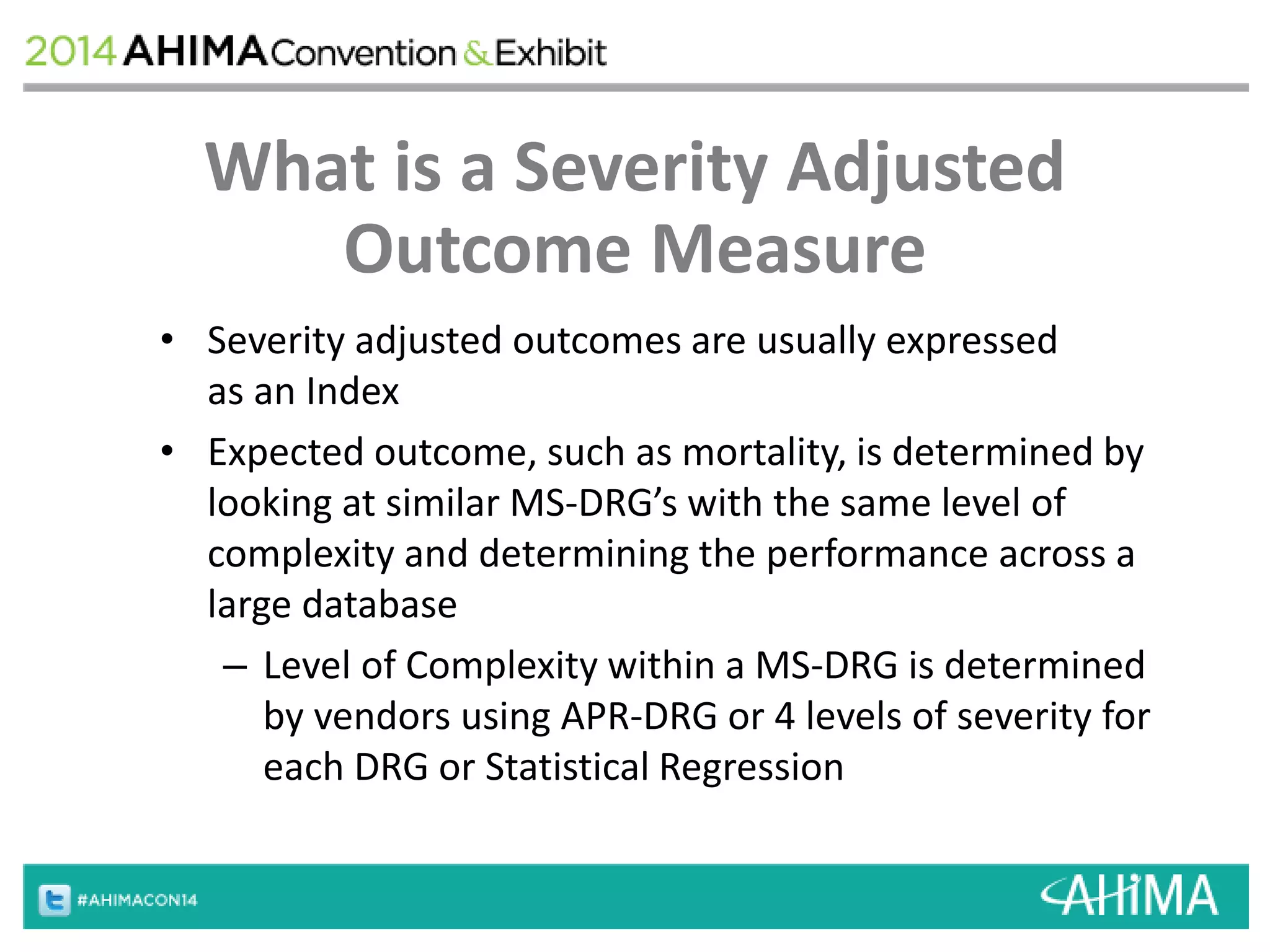
What is a Severity Adjusted 
Outcome Measure 
• Severity adjusted outcomes are usually expressed 
as an Index 
• Expected outcome, such as mortality, is determined by 
looking at similar MS-DRG’s with the same level of 
complexity and determining the performance across a 
large database 
– Level of Complexity within a MS-DRG is determined 
by vendors using APR-DRG or 4 levels of severity for 
each DRG or Statistical Regression
What is a Severity Adjusted 
Outcome Measure? 
– Once you have established the expected outcome of a MS-DRG 
at similar level of complexity then your observed 
outcome can be compared as a ratio 
– Observed Outcomes/Expected Outcome = Severity Adjusted 
Outcome Index 
– Determining your performance just becomes simple math 
 If your Index is less than 1 meaning your expected outcome was 
greater than your observed then your performance is better than 
expected 
 If your index is greater than 1 meaning your observed outcome is 
greater than expected then your performance is worse than expected
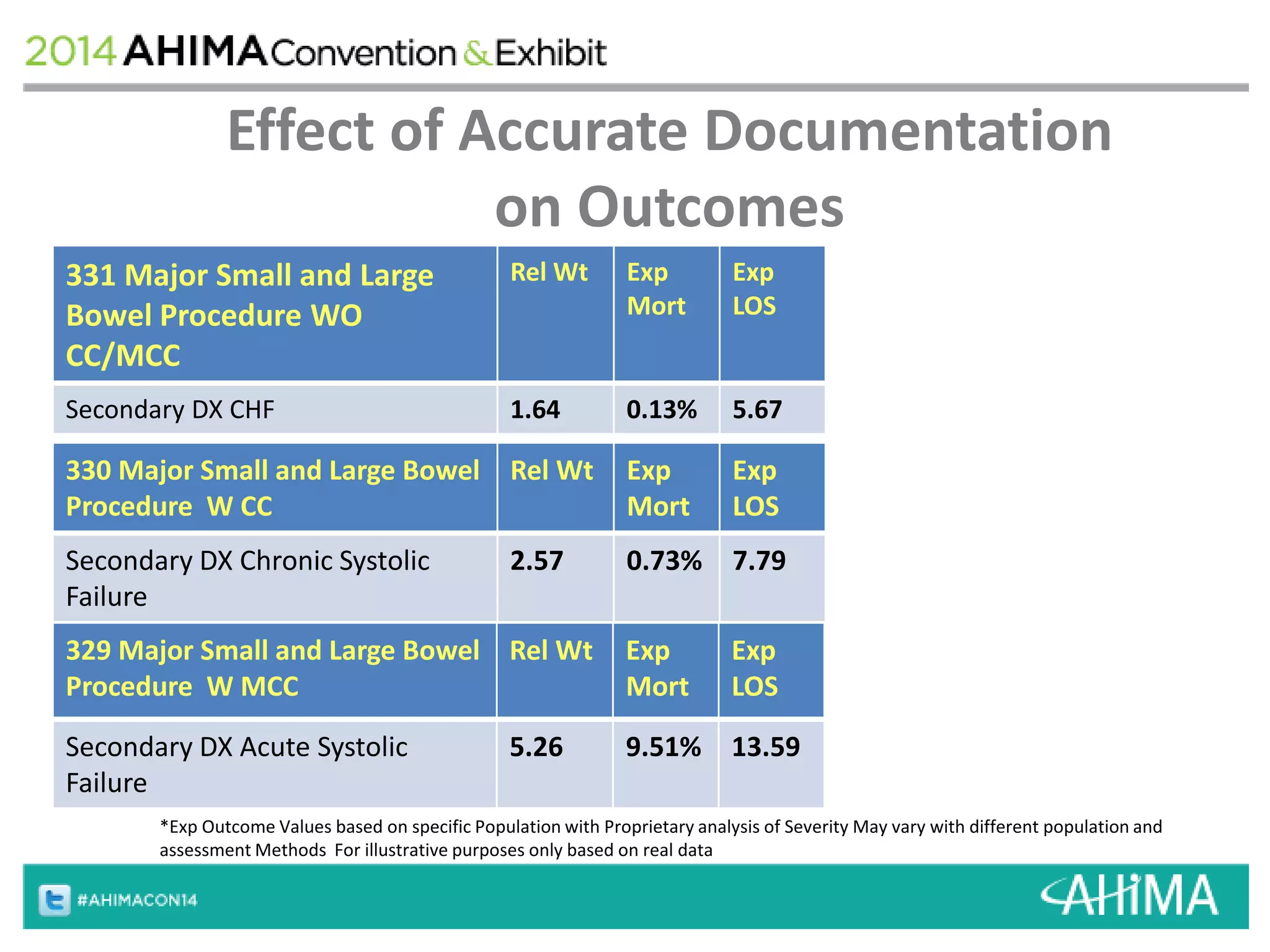
Effect of Accurate Documentation 
331 Major Small and Large 
Bowel Procedure WO 
CC/MCC 
on Outcomes 
Secondary DX CHF 1.64 0.13% 5.67 
329 Major Small and Large Bowel 
Procedure W MCC 
Rel Wt Exp 
Mort 
Rel Wt Exp 
Mort 
Exp 
LOS 
Exp 
LOS 
Secondary DX Acute Systolic 
Failure 
5.26 9.51% 13.59 
330 Major Small and Large Bowel 
Procedure W CC 
Rel Wt Exp 
Mort 
Exp 
LOS 
Secondary DX Chronic Systolic 
Failure 
2.57 0.73% 7.79 
*Exp Outcome Values based on specific Population with Proprietary analysis of Severity May vary with different population and 
assessment Methods For illustrative purposes only based on real data
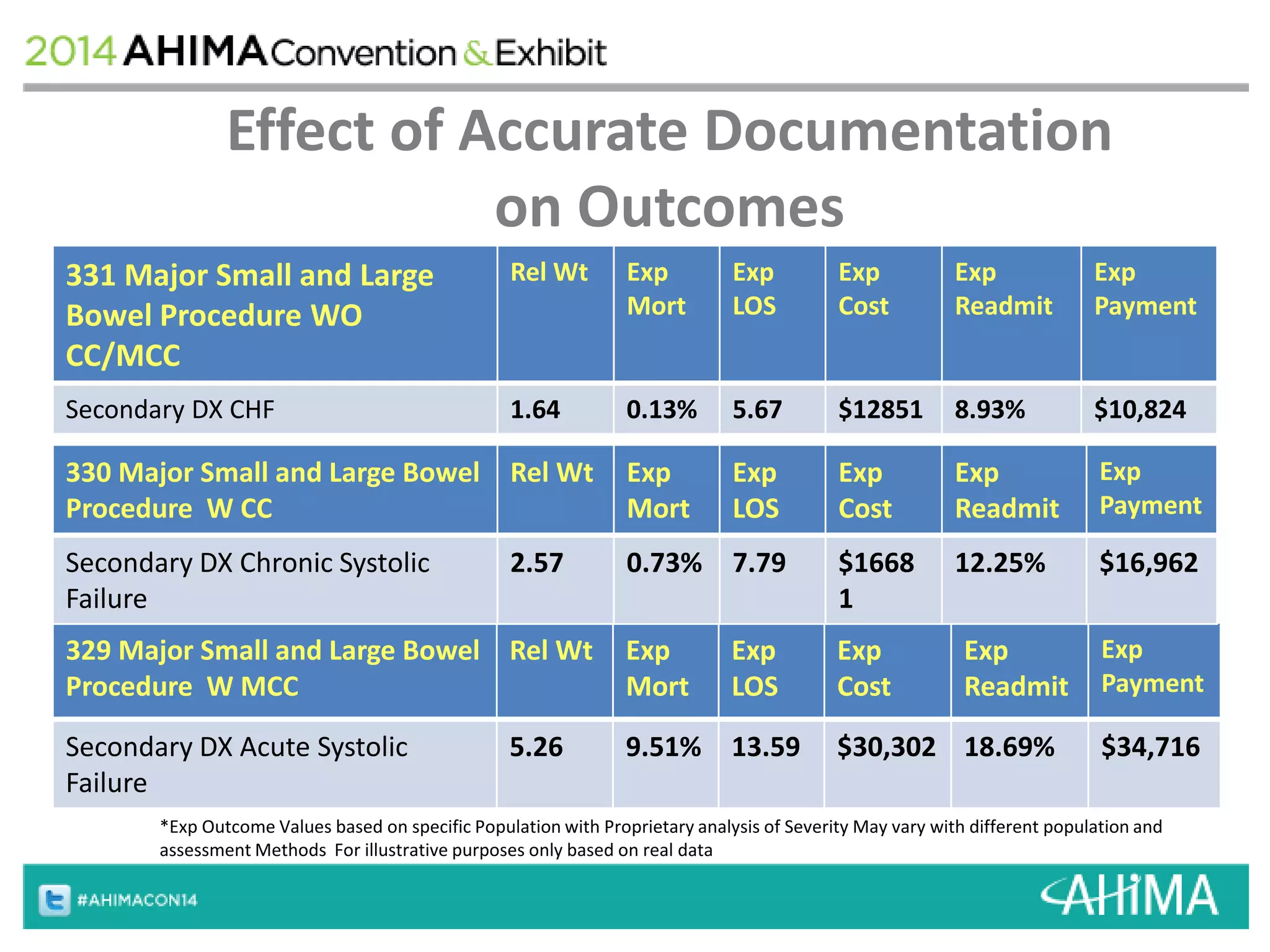
Effect of Accurate Documentation 
331 Major Small and Large 
Bowel Procedure WO 
CC/MCC 
on Outcomes 
Secondary DX CHF 1.64 0.13% 5.67 $12851 8.93% $10,824 
329 Major Small and Large Bowel 
Procedure W MCC 
Rel Wt Exp 
Mort 
Rel Wt Exp 
Mort 
Exp 
LOS 
Exp 
LOS 
Exp 
Cost 
Exp 
Cost 
Exp 
Readmit 
Exp 
Readmit 
Exp 
Payment 
Exp 
Payment 
Secondary DX Acute Systolic 
Failure 
5.26 9.51% 13.59 $30,302 18.69% $34,716 
330 Major Small and Large Bowel 
Procedure W CC 
Rel Wt Exp 
Mort 
Exp 
LOS 
Exp 
Cost 
Exp 
Readmit 
Exp 
Payment 
Secondary DX Chronic Systolic 
Failure 
2.57 0.73% 7.79 $1668 
1 
12.25% $16,962 
*Exp Outcome Values based on specific Population with Proprietary analysis of Severity May vary with different population and 
assessment Methods For illustrative purposes only based on real data
The Denial Industry 
It is being “ramped up” dramatically 
Tywin Lannister 
could learn a thing 
or to from the 
Denial Industry
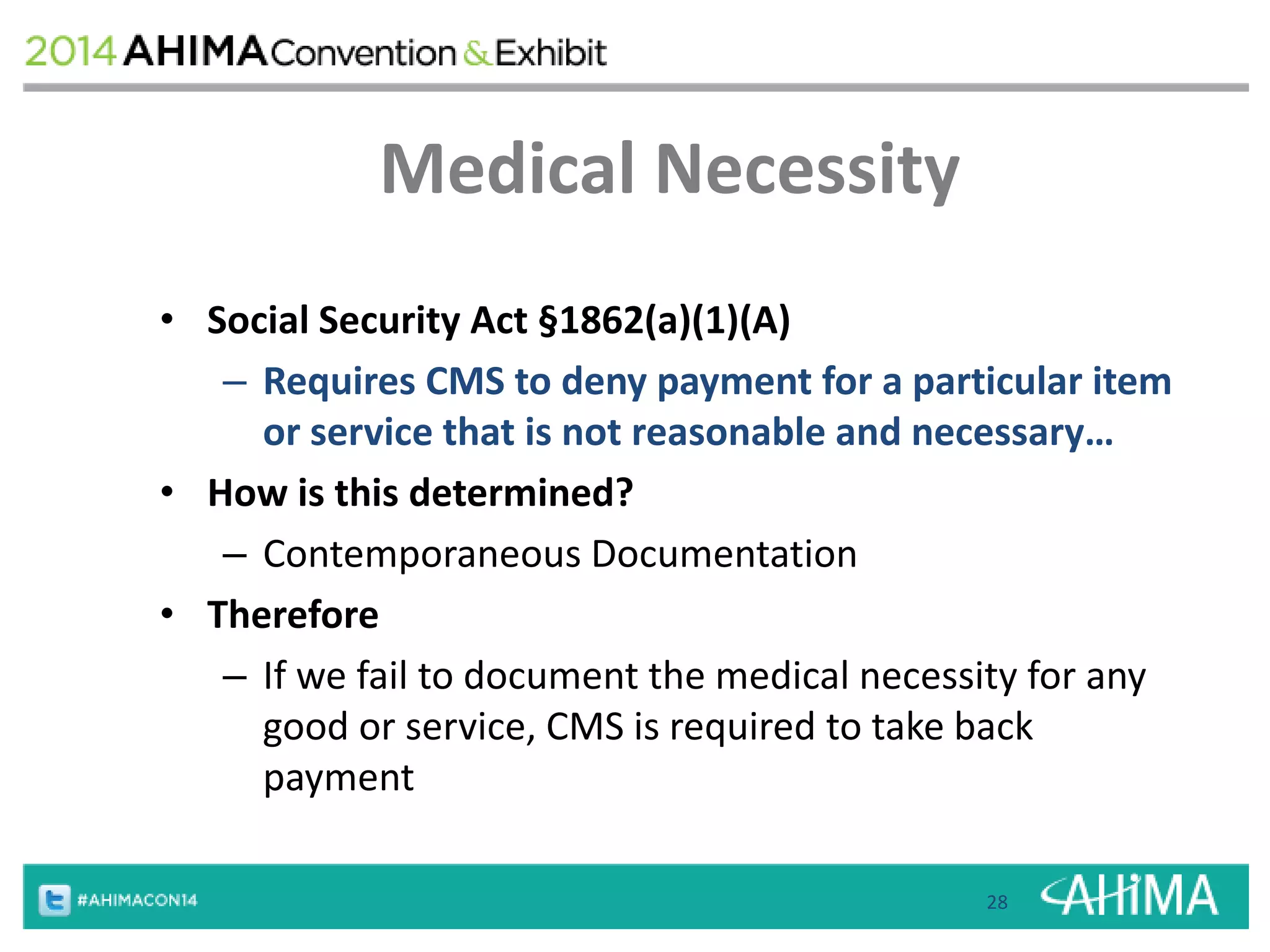
Medical Necessity 
• Social Security Act §1862(a)(1)(A) 
– Requires CMS to deny payment for a particular item 
or service that is not reasonable and necessary… 
• How is this determined? 
– Contemporaneous Documentation 
• Therefore 
– If we fail to document the medical necessity for any 
good or service, CMS is required to take back 
payment 
28
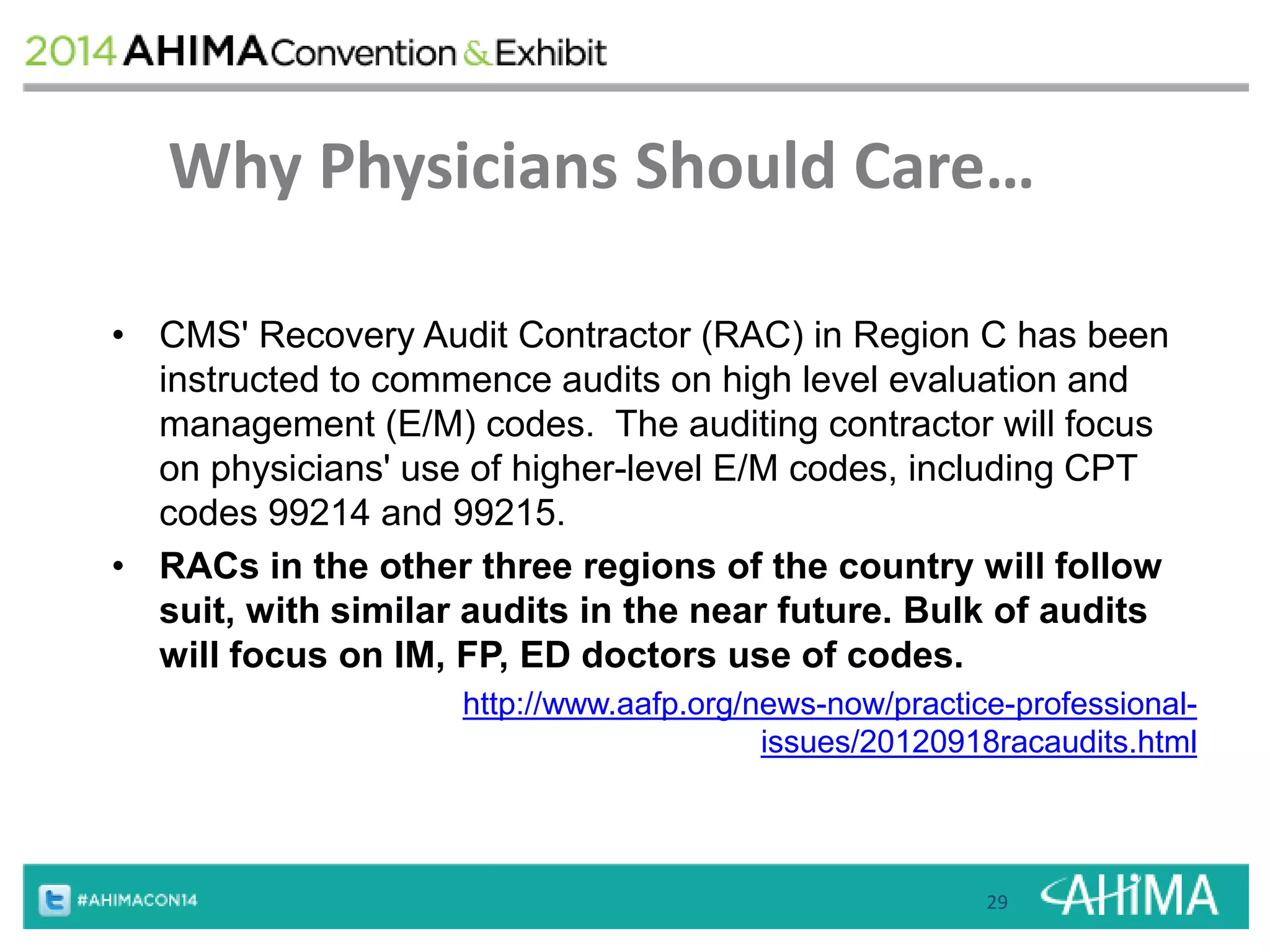
Why Physicians Should Care… 
• CMS' Recovery Audit Contractor (RAC) in Region C has been 
instructed to commence audits on high level evaluation and 
management (E/M) codes. The auditing contractor will focus 
on physicians' use of higher-level E/M codes, including CPT 
codes 99214 and 99215. 
• RACs in the other three regions of the country will follow 
suit, with similar audits in the near future. Bulk of audits 
will focus on IM, FP, ED doctors use of codes. 
http://www.aafp.org/news-now/practice-professional-issues/ 
20120918racaudits.html 
29
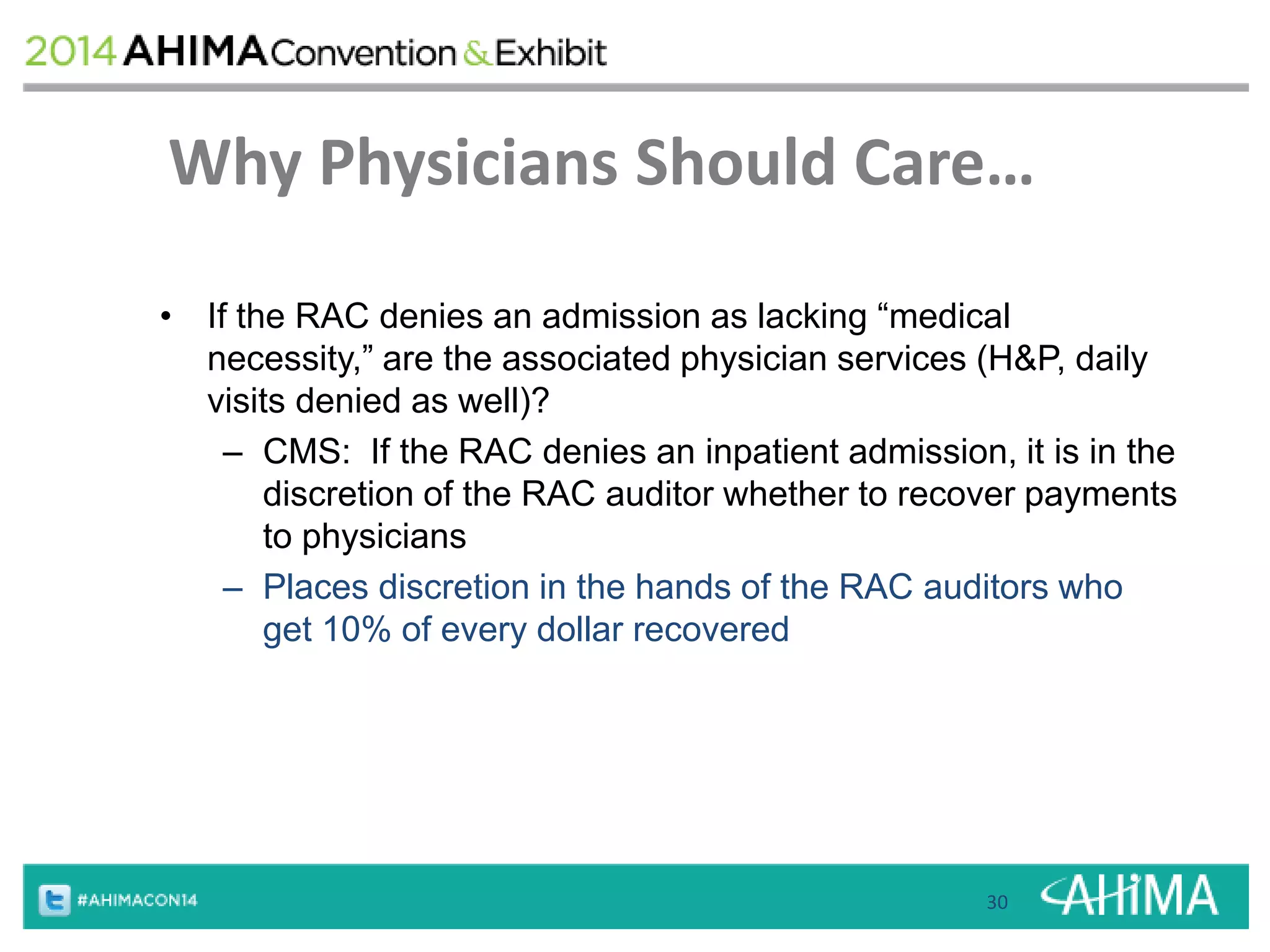
Why Physicians Should Care… 
• If the RAC denies an admission as lacking “medical 
necessity,” are the associated physician services (H&P, daily 
visits denied as well)? 
– CMS: If the RAC denies an inpatient admission, it is in the 
discretion of the RAC auditor whether to recover payments 
to physicians 
– Places discretion in the hands of the RAC auditors who 
get 10% of every dollar recovered 
30
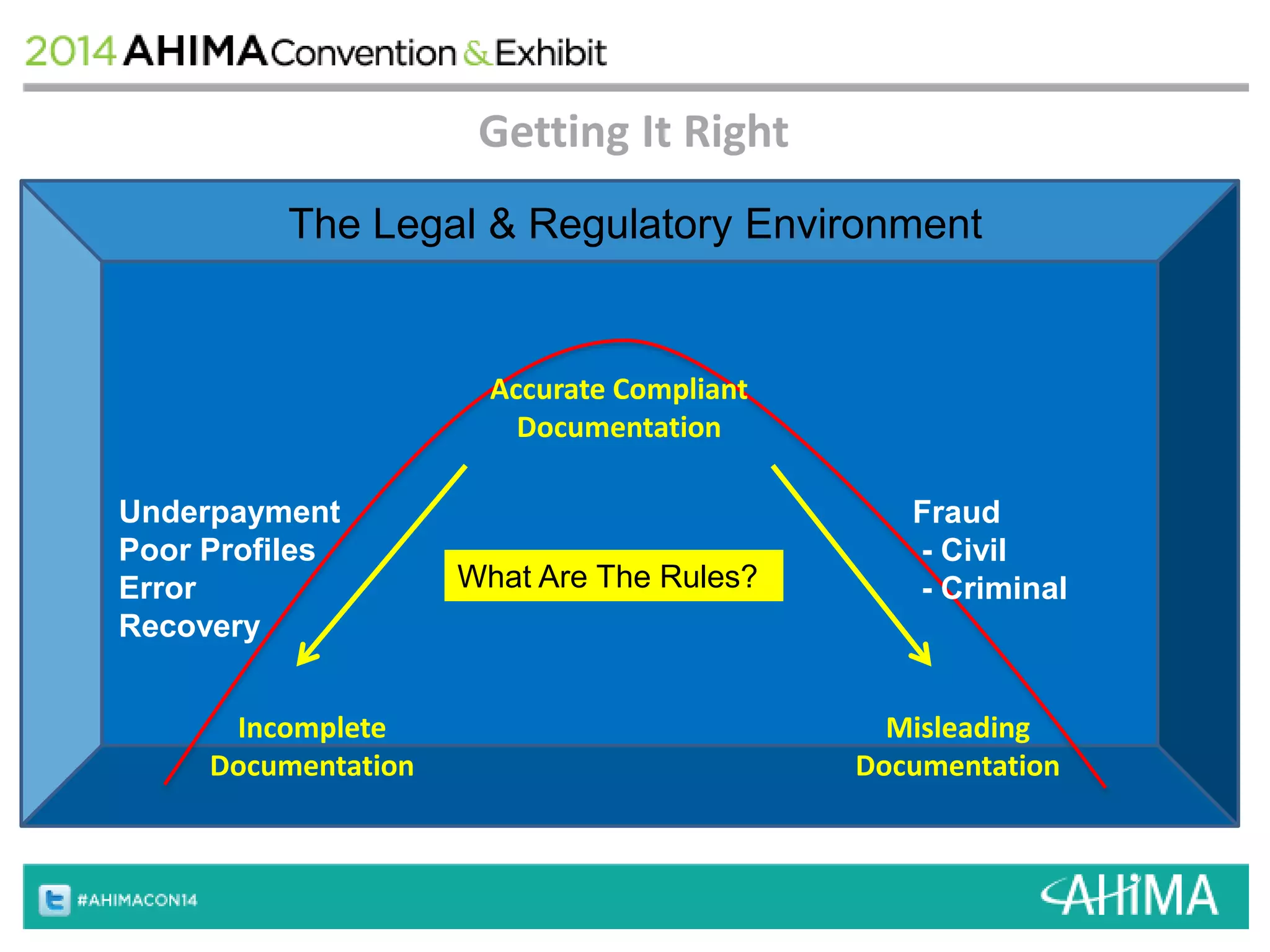
Getting It Right 
The Legal & Regulatory Environment 
Accurate Compliant 
Documentation 
Misleading 
Documentation 
Underpayment 
Poor Profiles 
Error 
Recovery 
Incomplete 
Documentation 
Fraud 
- Civil 
What Are The Rules? - Criminal
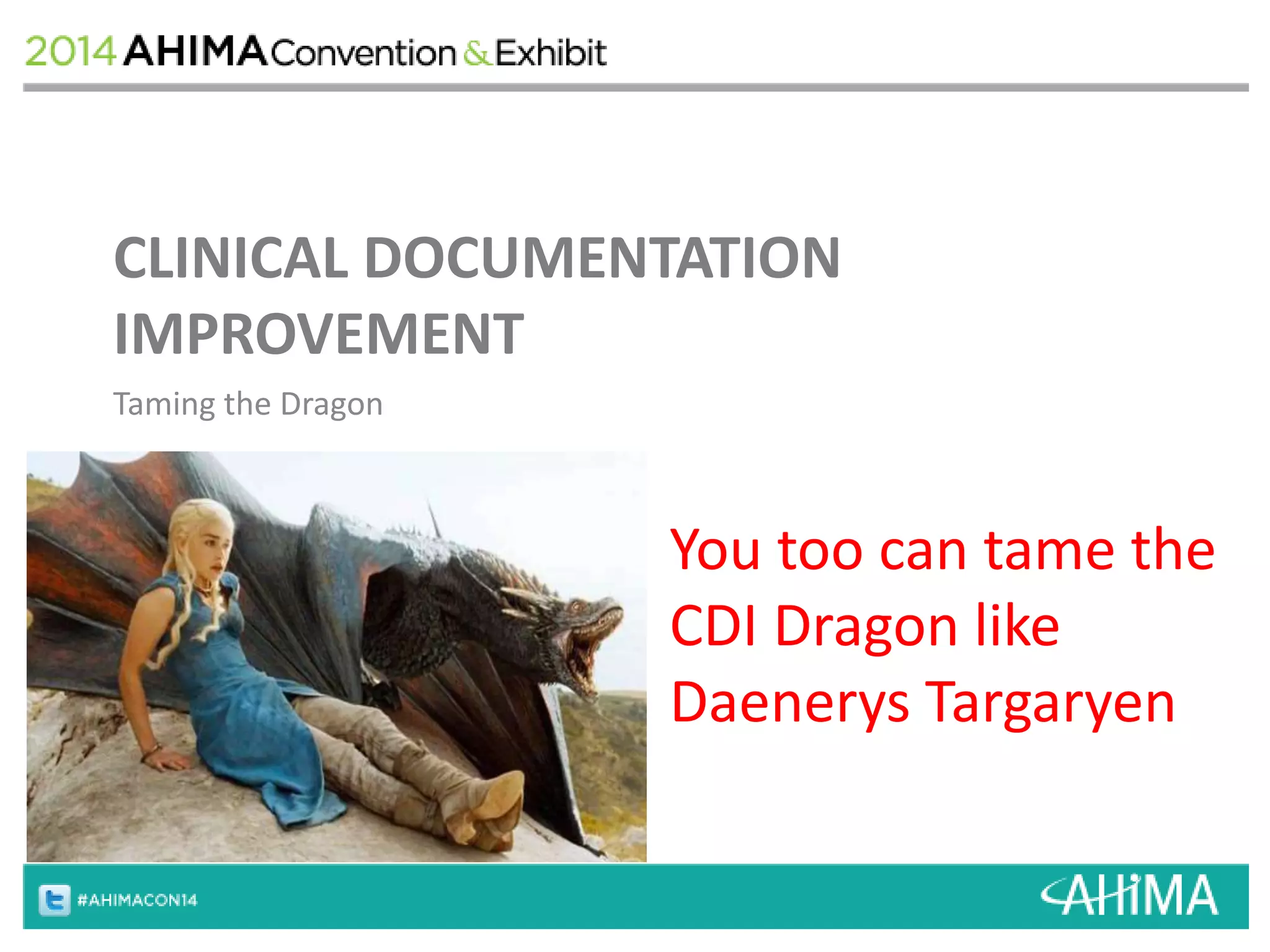
CLINICAL DOCUMENTATION 
IMPROVEMENT 
Taming the Dragon 
You too can tame the 
CDI Dragon like 
Daenerys Targaryen
Hospital 
Inpatient Care 
Physician 
Documentation 
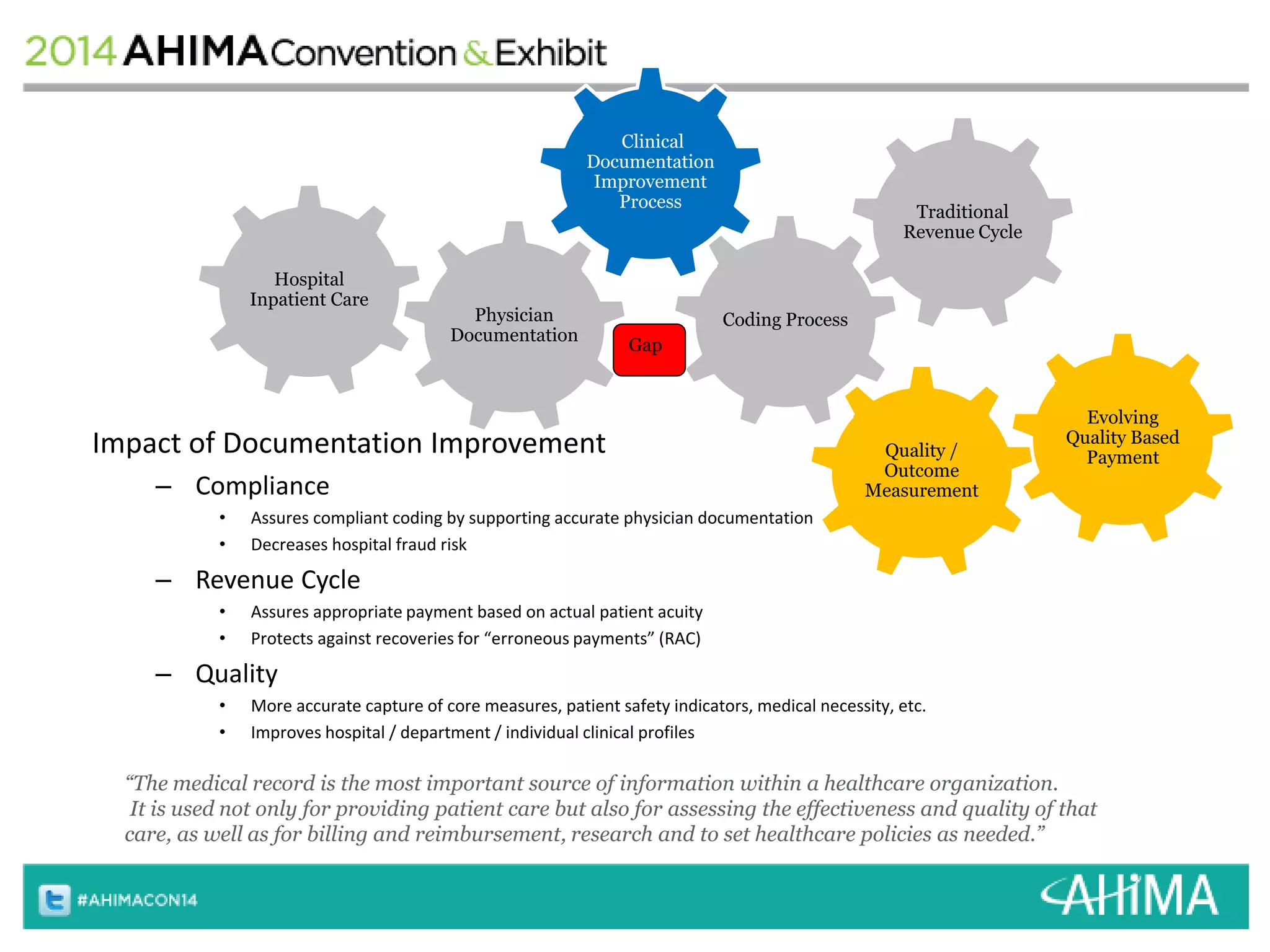
Impact of Documentation Improvement 
– Compliance 
Coding Process 
Gap 
• Assures compliant coding by supporting accurate physician documentation 
• Decreases hospital fraud risk 
– Revenue Cycle 
• Assures appropriate payment based on actual patient acuity 
• Protects against recoveries for “erroneous payments” (RAC) 
– Quality 
Traditional 
Revenue Cycle 
Quality / 
Outcome 
Measurement 
• More accurate capture of core measures, patient safety indicators, medical necessity, etc. 
• Improves hospital / department / individual clinical profiles 
Evolving 
Quality Based 
Payment 
Clinical 
Documentation 
Improvement 
Process 
“The medical record is the most important source of information within a healthcare organization. 
It is used not only for providing patient care but also for assessing the effectiveness and quality of that 
care, as well as for billing and reimbursement, research and to set healthcare policies as needed.”
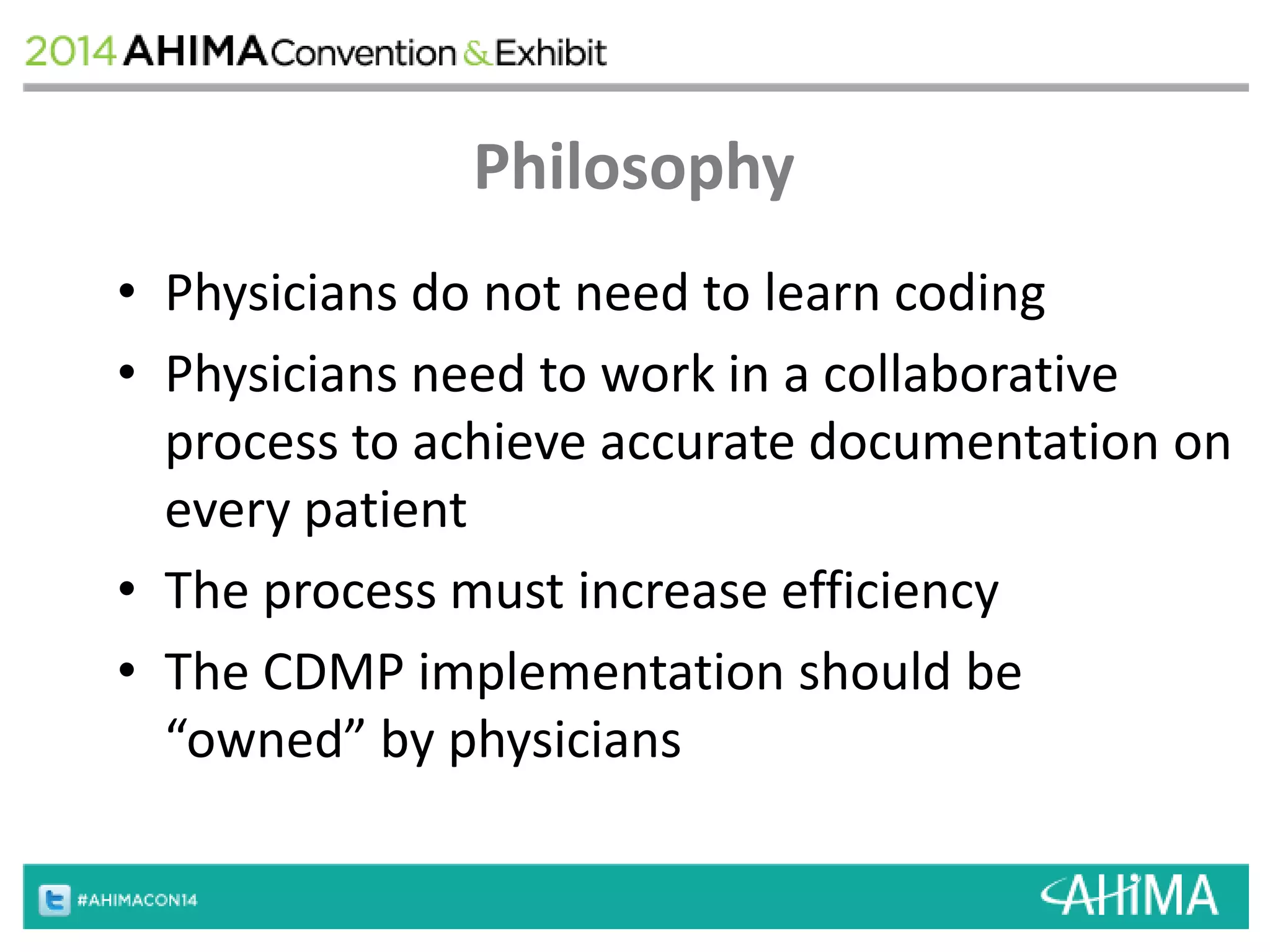
Philosophy 
• Physicians do not need to learn coding 
• Physicians need to work in a collaborative 
process to achieve accurate documentation on 
every patient 
• The process must increase efficiency 
• The CDMP implementation should be 
“owned” by physicians
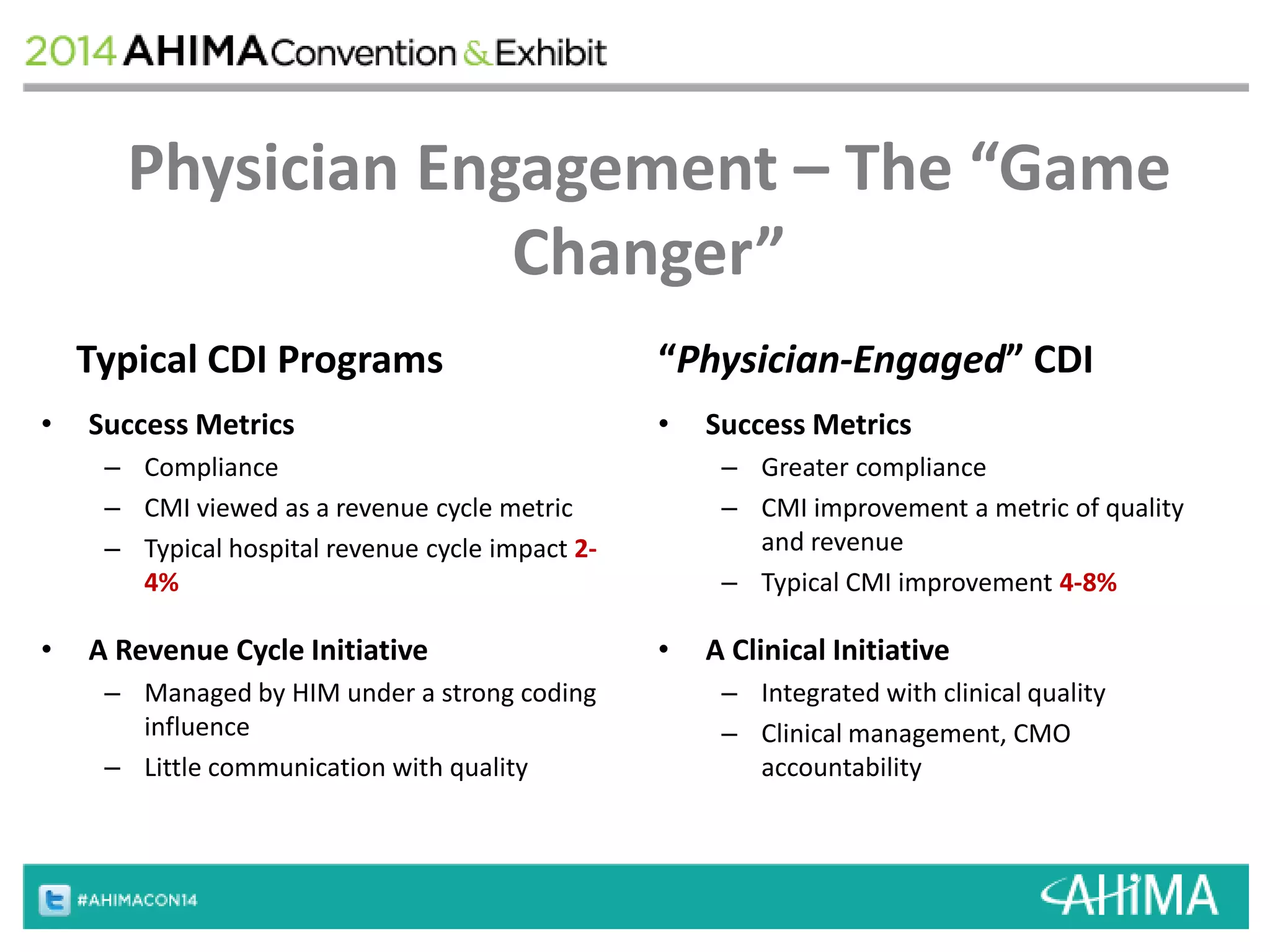
Physician Engagement – The “Game 
Typical CDI Programs 
• Success Metrics 
Changer” 
– Compliance 
– CMI viewed as a revenue cycle metric 
– Typical hospital revenue cycle impact 2- 
4% 
• A Revenue Cycle Initiative 
– Managed by HIM under a strong coding 
influence 
– Little communication with quality 
“Physician-Engaged” CDI 
• Success Metrics 
– Greater compliance 
– CMI improvement a metric of quality 
and revenue 
– Typical CMI improvement 4-8% 
• A Clinical Initiative 
– Integrated with clinical quality 
– Clinical management, CMO 
accountability
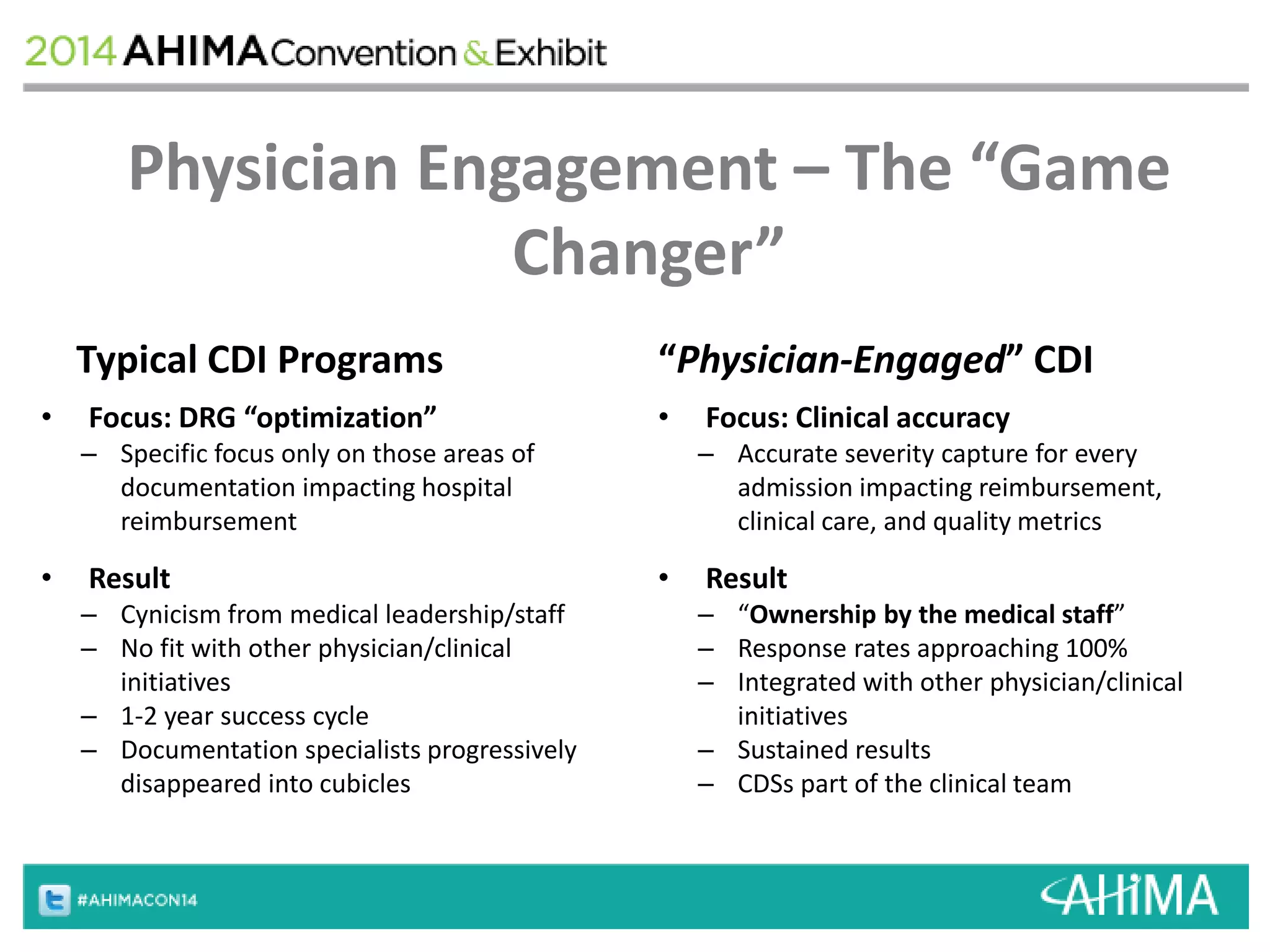
Physician Engagement – The “Game 
Changer” 
Typical CDI Programs 
• Focus: DRG “optimization” 
– Specific focus only on those areas of 
documentation impacting hospital 
reimbursement 
• Result 
– Cynicism from medical leadership/staff 
– No fit with other physician/clinical 
initiatives 
– 1-2 year success cycle 
– Documentation specialists progressively 
disappeared into cubicles 
“Physician-Engaged” CDI 
• Focus: Clinical accuracy 
– Accurate severity capture for every 
admission impacting reimbursement, 
clinical care, and quality metrics 
• Result 
– “Ownership by the medical staff” 
– Response rates approaching 100% 
– Integrated with other physician/clinical 
initiatives 
– Sustained results 
– CDSs part of the clinical team
How Do You Leverage Physician 
Engagement? 
• Involve physician leadership in planning, 
execution, and ongoing performance of CDI 
• Integrate physician / CDS / coder into a 
collaborative group 
• Measure, But measure no need and for measure 
WildFire 
• Show results 
Much like Tyrion Lannister marshaling 
resources and involving everyone as he 
did at the Battle of Blackwater
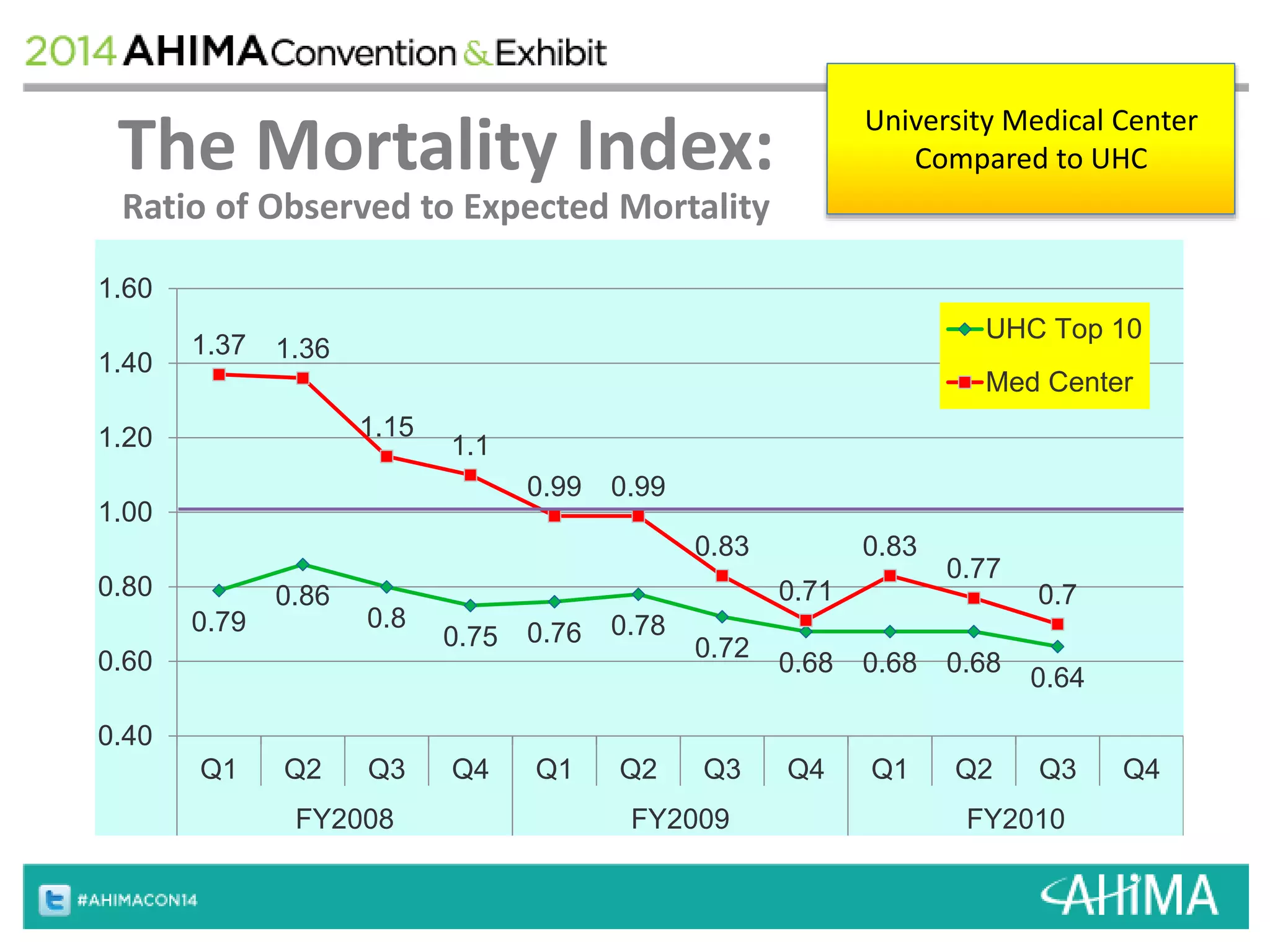
The Mortality Index: 
Ratio of Observed to Expected Mortality 
0.79 
0.86 
0.8 
0.75 0.76 0.78 
0.72 
University Medical Center 
Compared to UHC 
UHC Top 10 
Med Center 
0.68 0.68 0.68 
0.64 
1.37 1.36 
1.15 
1.1 
0.99 0.99 
0.83 
0.71 
0.83 
0.77 
0.7 
1.60 
1.40 
1.20 
1.00 
0.80 
0.60 
0.40 
Q1 Q2 Q3 Q4 Q1 Q2 Q3 Q4 Q1 Q2 Q3 Q4 
FY2008 FY2009 FY2010
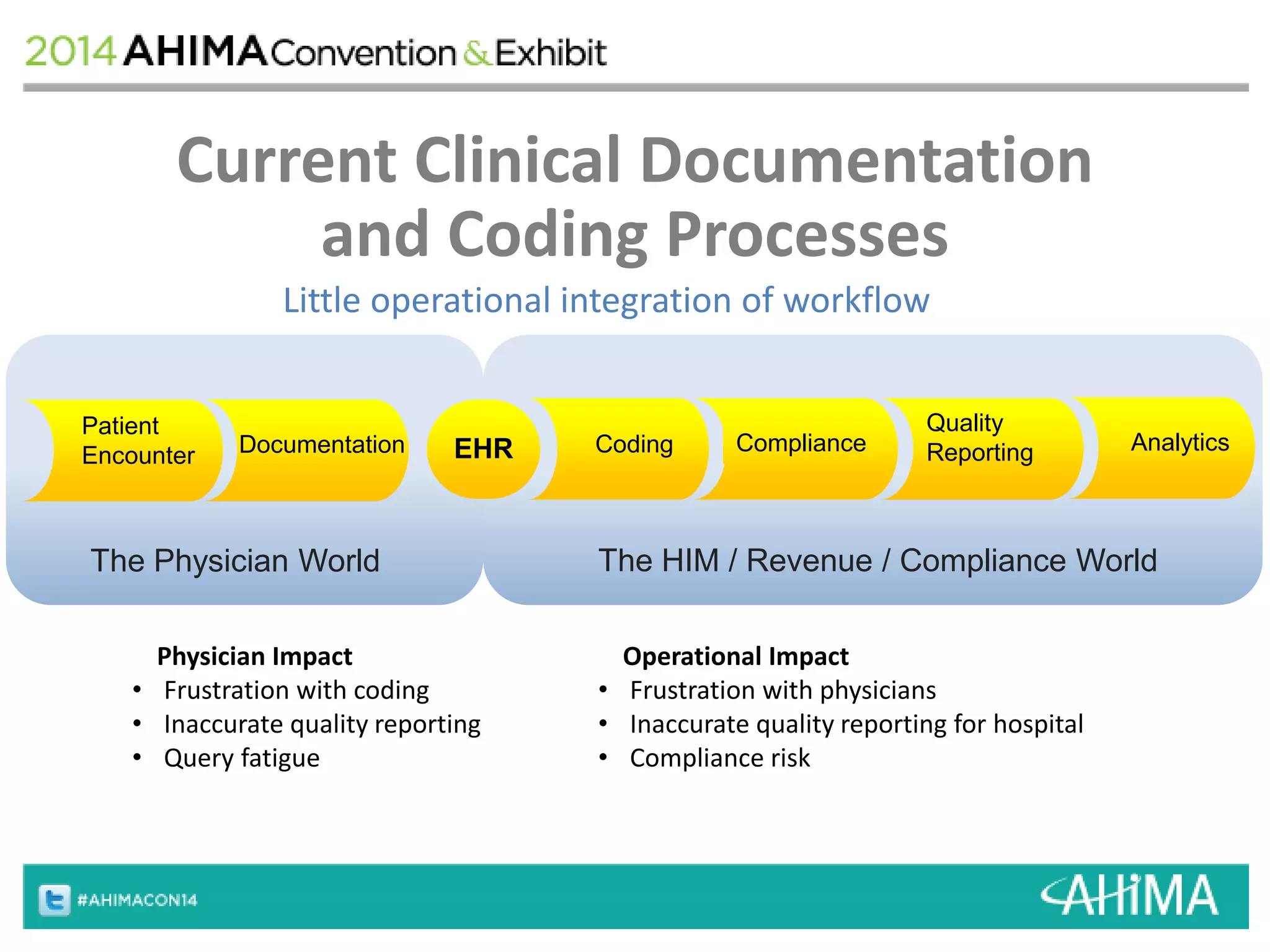
Current Clinical Documentation 
and Coding Processes 
Little operational integration of workflow 
Quality 
EHR Analytics 
Documentation Coding Compliance Reporting 
Patient 
Encounter 
The Physician World The HIM / Revenue / Compliance World 
Physician Impact 
• Frustration with coding 
• Inaccurate quality reporting 
• Query fatigue 
Operational Impact 
• Frustration with physicians 
• Inaccurate quality reporting for hospital 
• Compliance risk
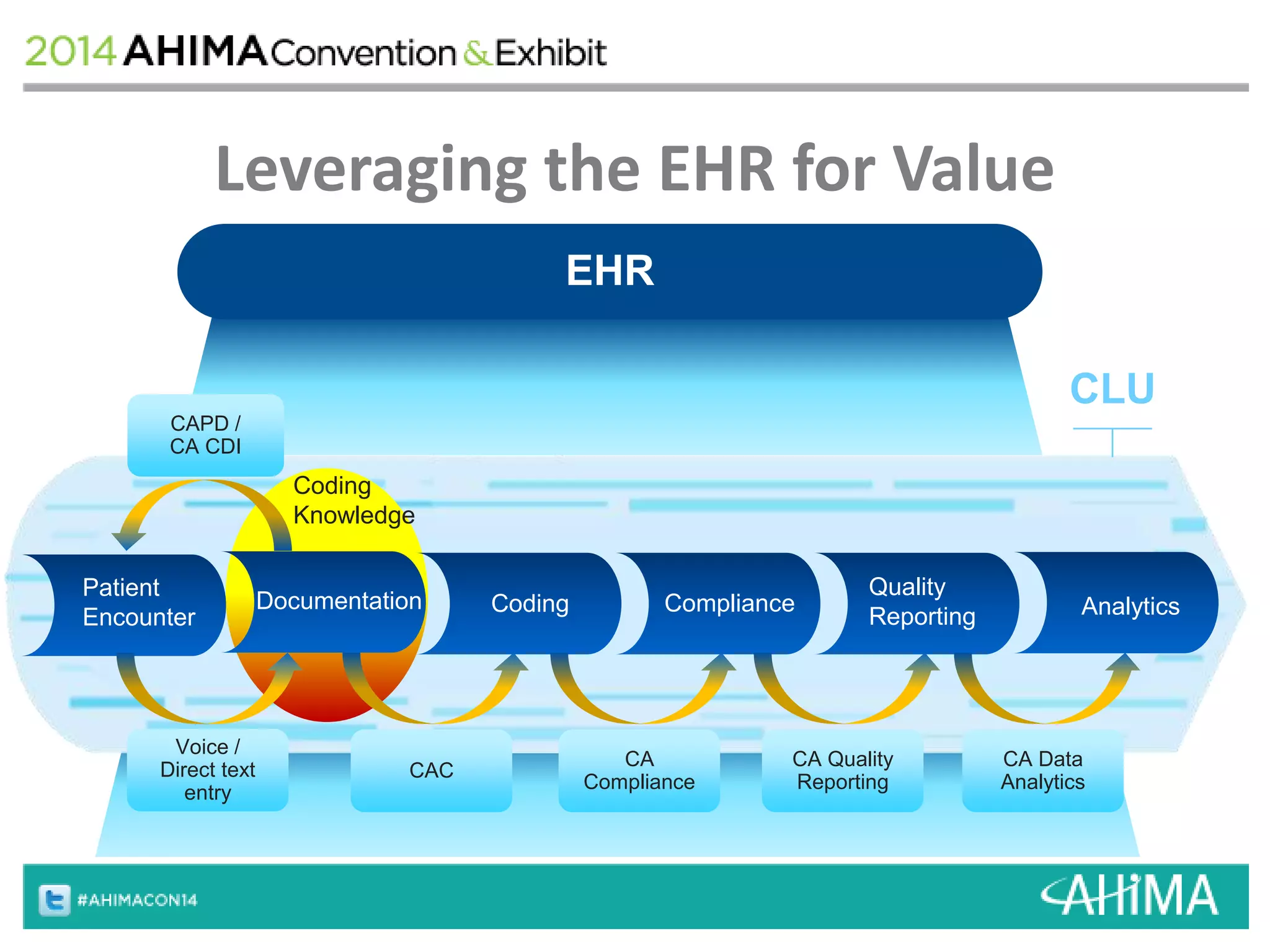
Leveraging the EHR for Value 
CLU 
EHR 
CAPD / 
CA CDI 
Analytics 
Quality 
Reporting 
Documentation Coding Compliance 
Patient 
Encounter 
Coding 
Knowledge 
CA 
Compliance 
CA Quality 
Reporting 
CA Data 
Analytics 
CAC 
Voice / 
Direct text 
entry
HOW DOES CODING IMPACT ALL OF THIS? 
A LOOK AT CURRENT CDI PROGRAMS
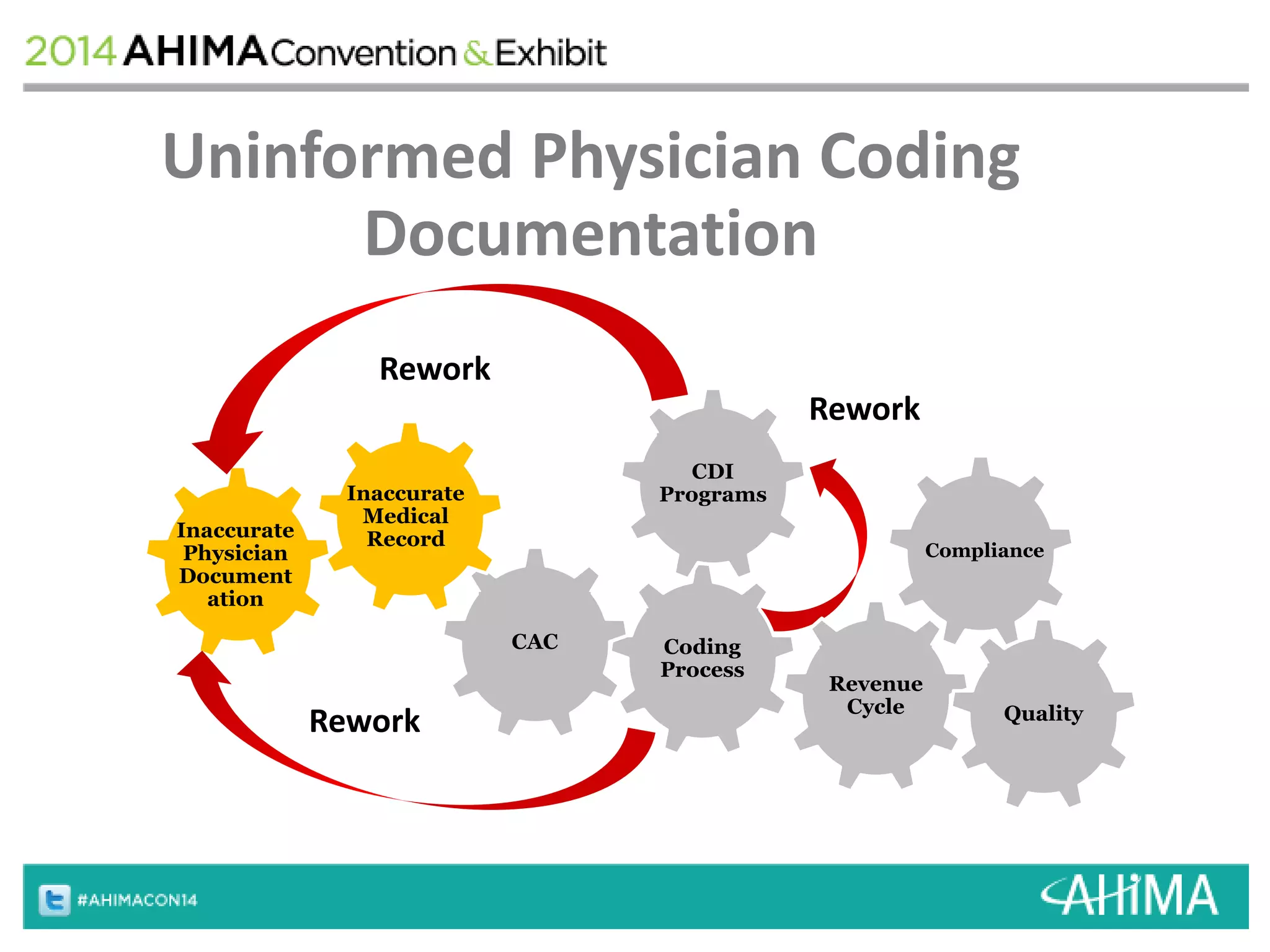
Uninformed Physician Coding 
Inaccurate 
Physician 
Document 
ation 
Documentation 
Coding 
Process 
Revenue 
Cycle 
CDI 
Programs 
CAC 
Compliance 
Inaccurate 
Medical 
Record 
Quality 
Rework 
Rework 
Rework
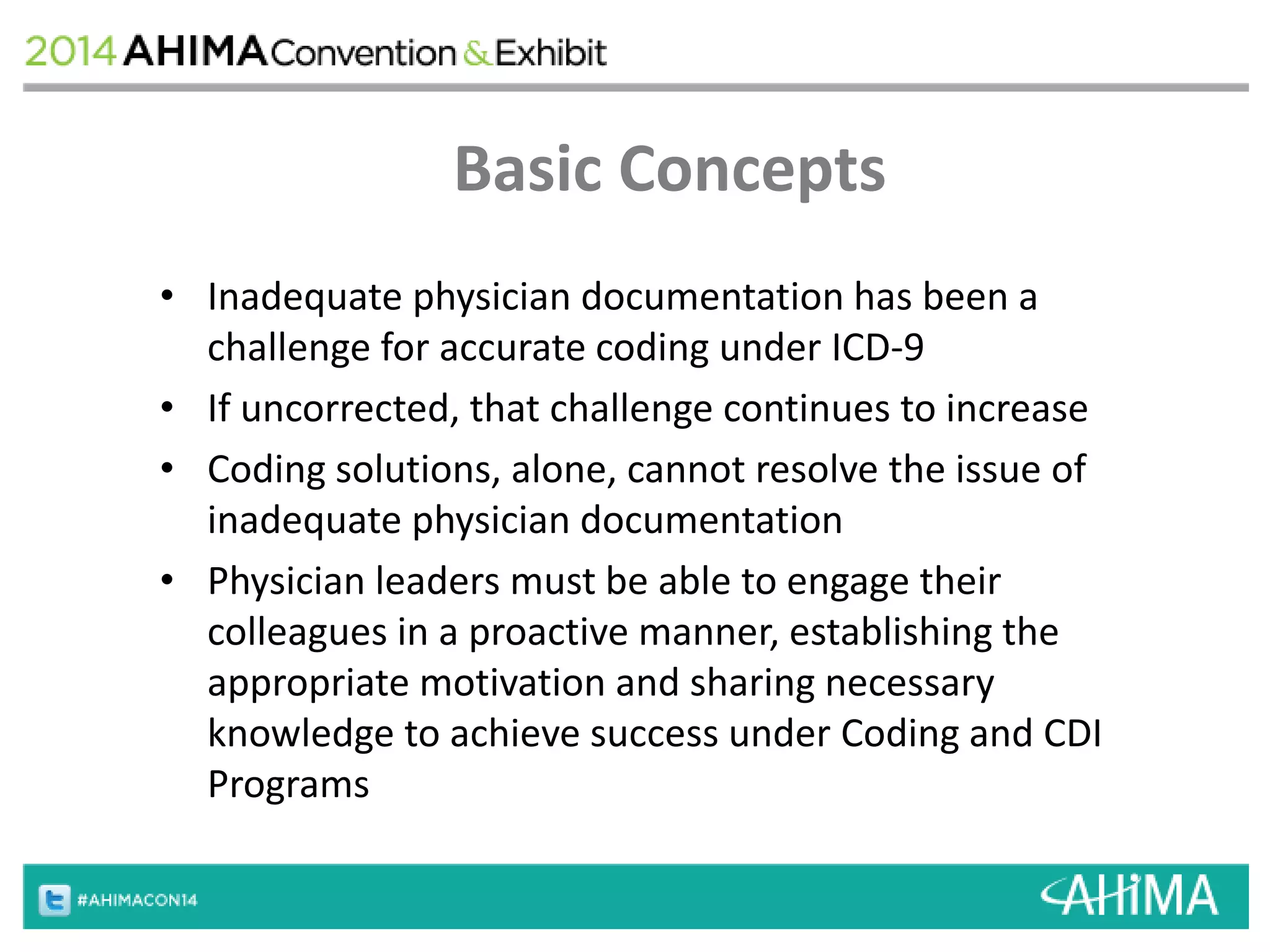
Basic Concepts 
• Inadequate physician documentation has been a 
challenge for accurate coding under ICD-9 
• If uncorrected, that challenge continues to increase 
• Coding solutions, alone, cannot resolve the issue of 
inadequate physician documentation 
• Physician leaders must be able to engage their 
colleagues in a proactive manner, establishing the 
appropriate motivation and sharing necessary 
knowledge to achieve success under Coding and CDI 
Programs
Leveraging Technology 
Applying a little magic like Arya Stark and her unusal 
friend Jaqen H'ghar
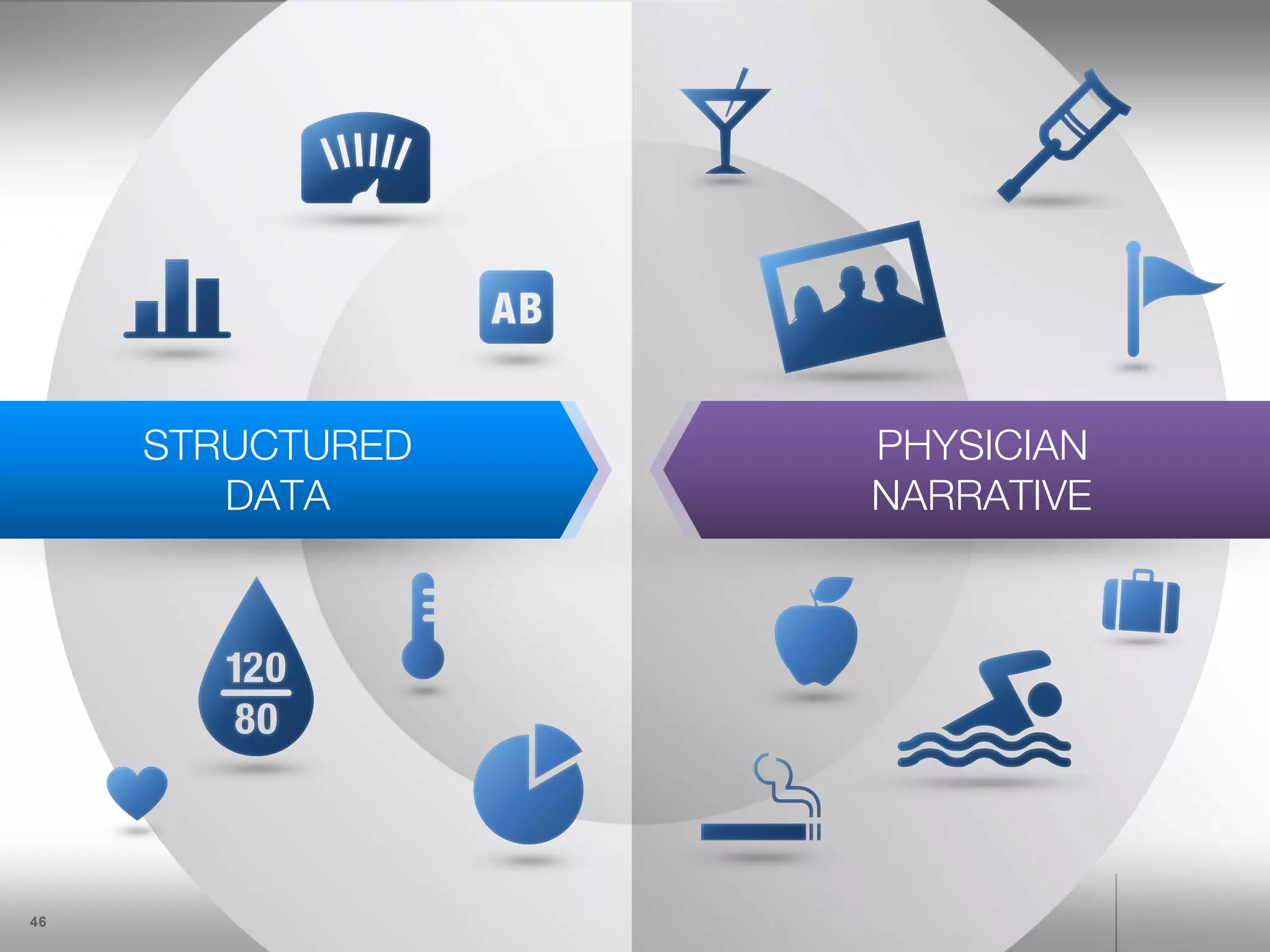
Clinical Documentation is 
Everything
46
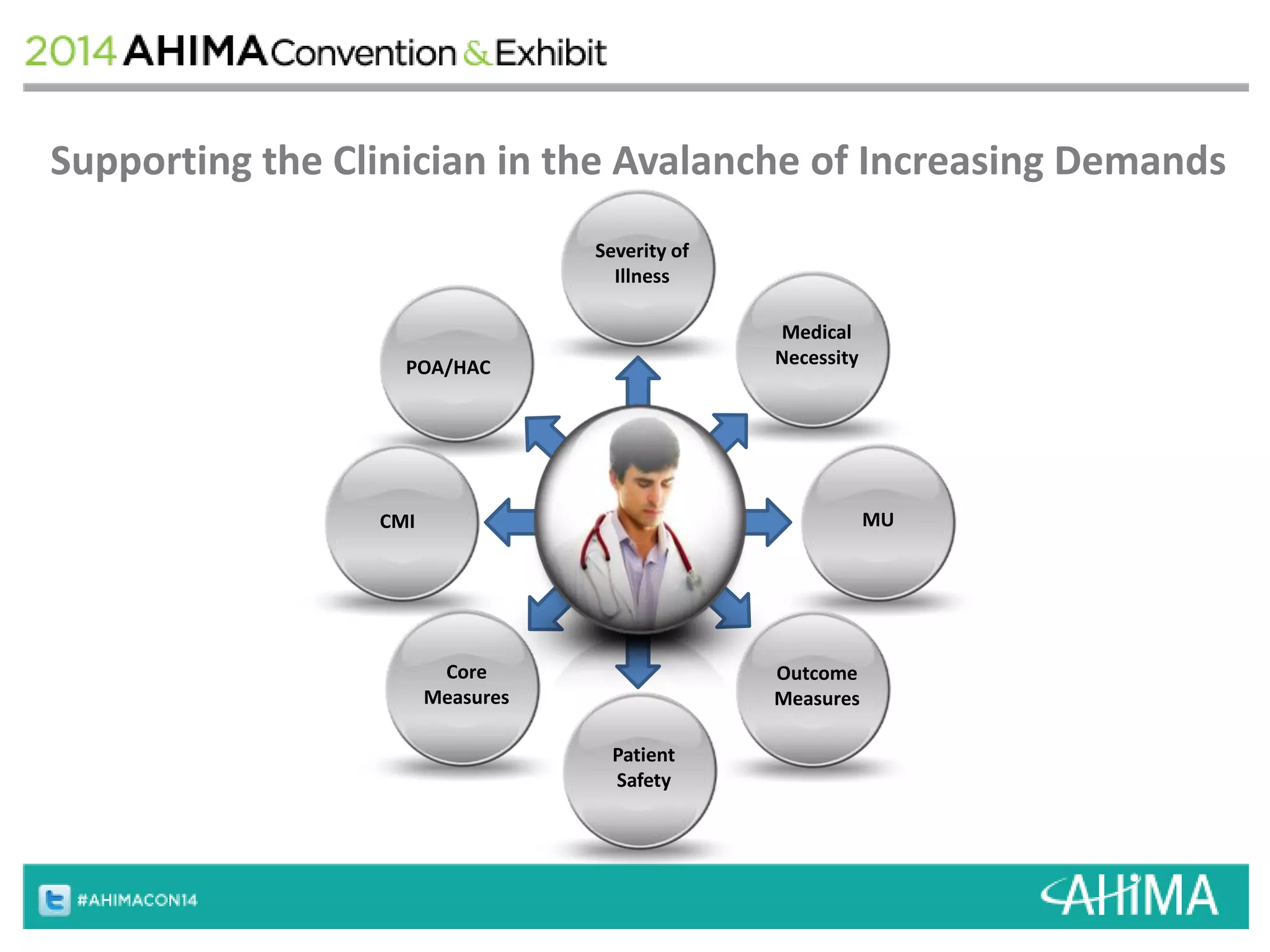
Supporting the Clinician in the Avalanche of Increasing Demands 
POA/HAC 
Medical 
Necessity 
Core 
Measures 
MU 
Patient 
Safety 
Outcome 
Measures 
CMI 
Severity of 
Illness
CHIEF COMPLAINT 
PAST MEDICAL HISTORY
PAST MEDICAL HISTORY 
CHIEF COMPLAINT
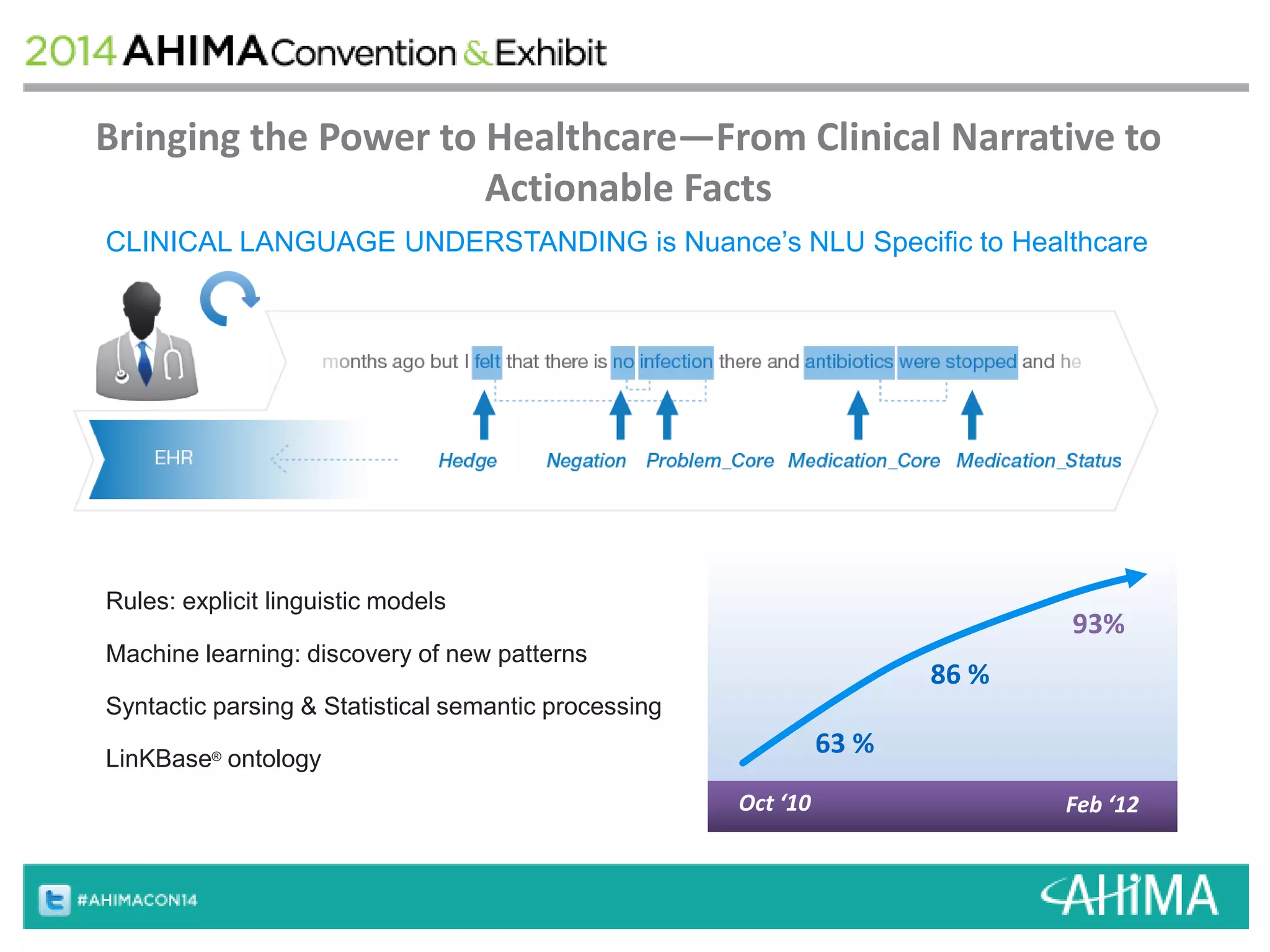
Bringing the Power to Healthcare—From Clinical Narrative to 
Actionable Facts 
CLINICAL LANGUAGE UNDERSTANDING is Nuance’s NLU Specific to Healthcare 
63 % 
93% 
86 % 
Oct ‘10 Feb ‘12 
Rules: explicit linguistic models 
Machine learning: discovery of new patterns 
Syntactic parsing & Statistical semantic processing 
LinKBase® ontology
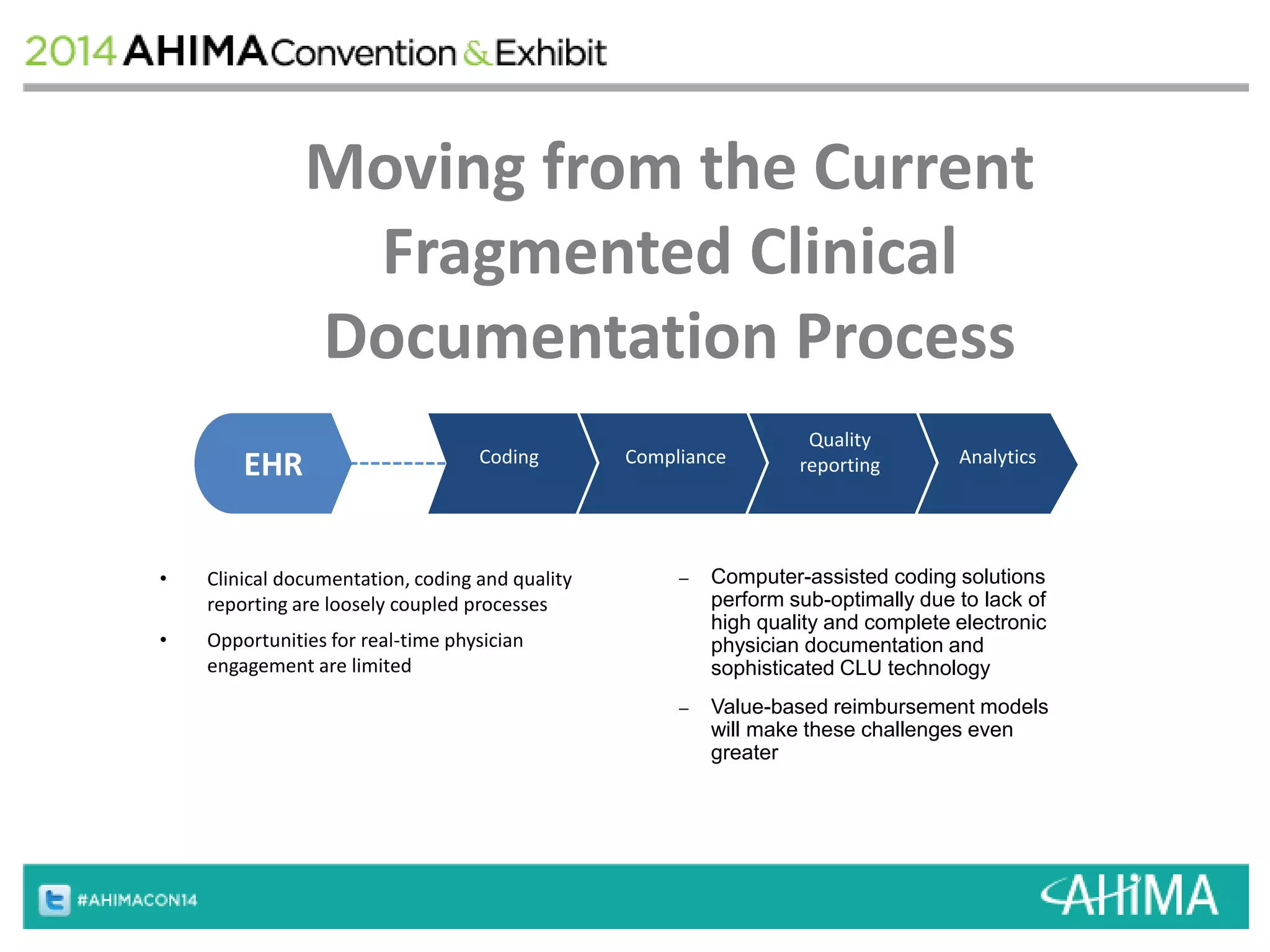
Moving from the Current 
Fragmented Clinical 
Documentation Process 
EHR Compliance 
• Clinical documentation, coding and quality 
reporting are loosely coupled processes 
• Opportunities for real-time physician 
engagement are limited 
Quality 
Coding reporting Analytics 
– Computer-assisted coding solutions 
perform sub-optimally due to lack of 
high quality and complete electronic 
physician documentation and 
sophisticated CLU technology 
– Value-based reimbursement models 
will make these challenges even 
greater
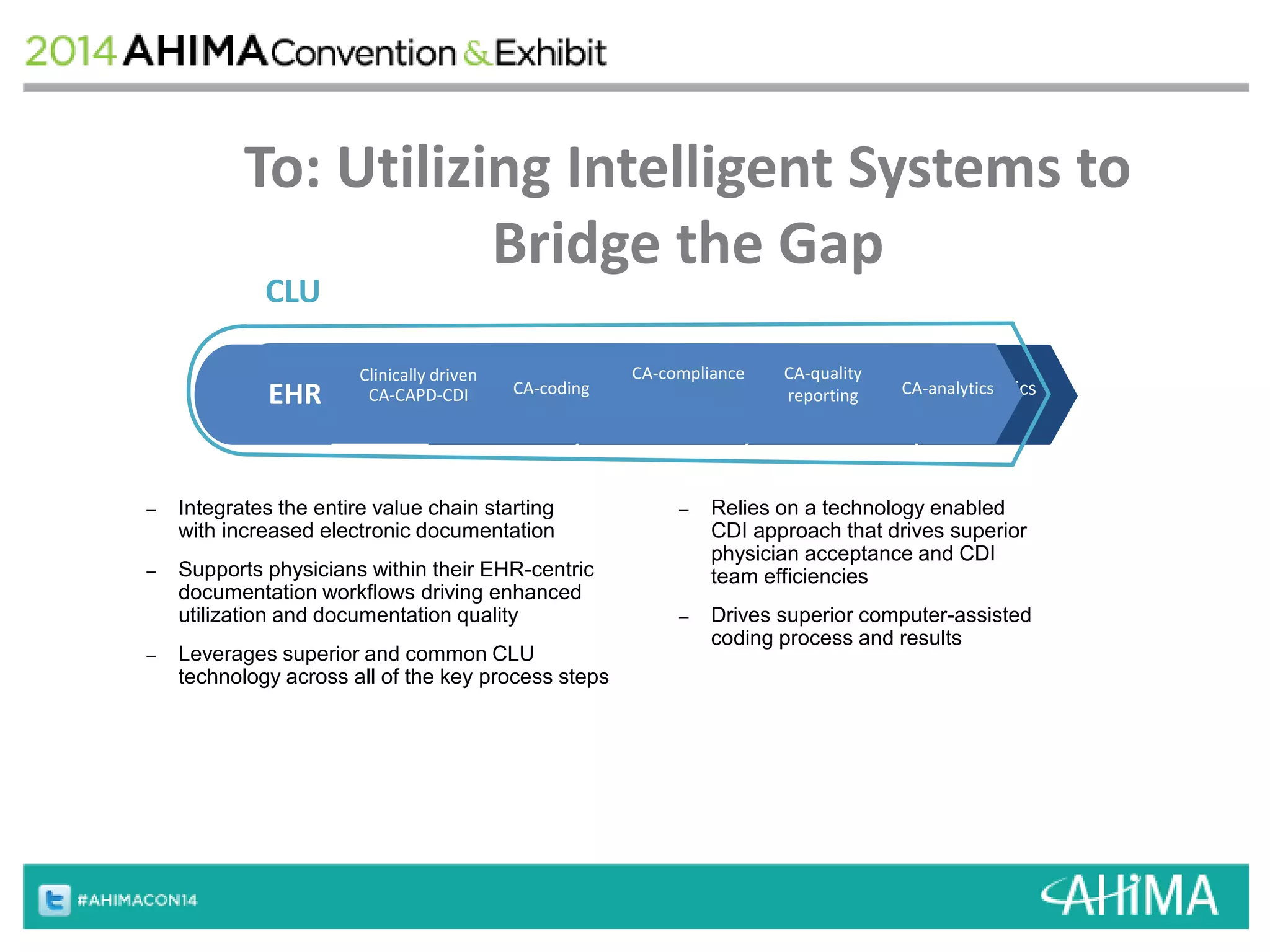
To: Utilizing Intelligent Systems to 
Bridge the Gap 
CA-compliance CA-quality 
EHR Compliance 
EHR CodiCnAg-coding reporting Analytics 
– Integrates the entire value chain starting 
with increased electronic documentation 
– Supports physicians within their EHR-centric 
documentation workflows driving enhanced 
utilization and documentation quality 
– Leverages superior and common CLU 
technology across all of the key process steps 
Quality 
reporting CA-analytics 
– Relies on a technology enabled 
CDI approach that drives superior 
physician acceptance and CDI 
team efficiencies 
– Drives superior computer-assisted 
coding process and results 
Clinically driven 
CA-CAPD-CDI 
CLU
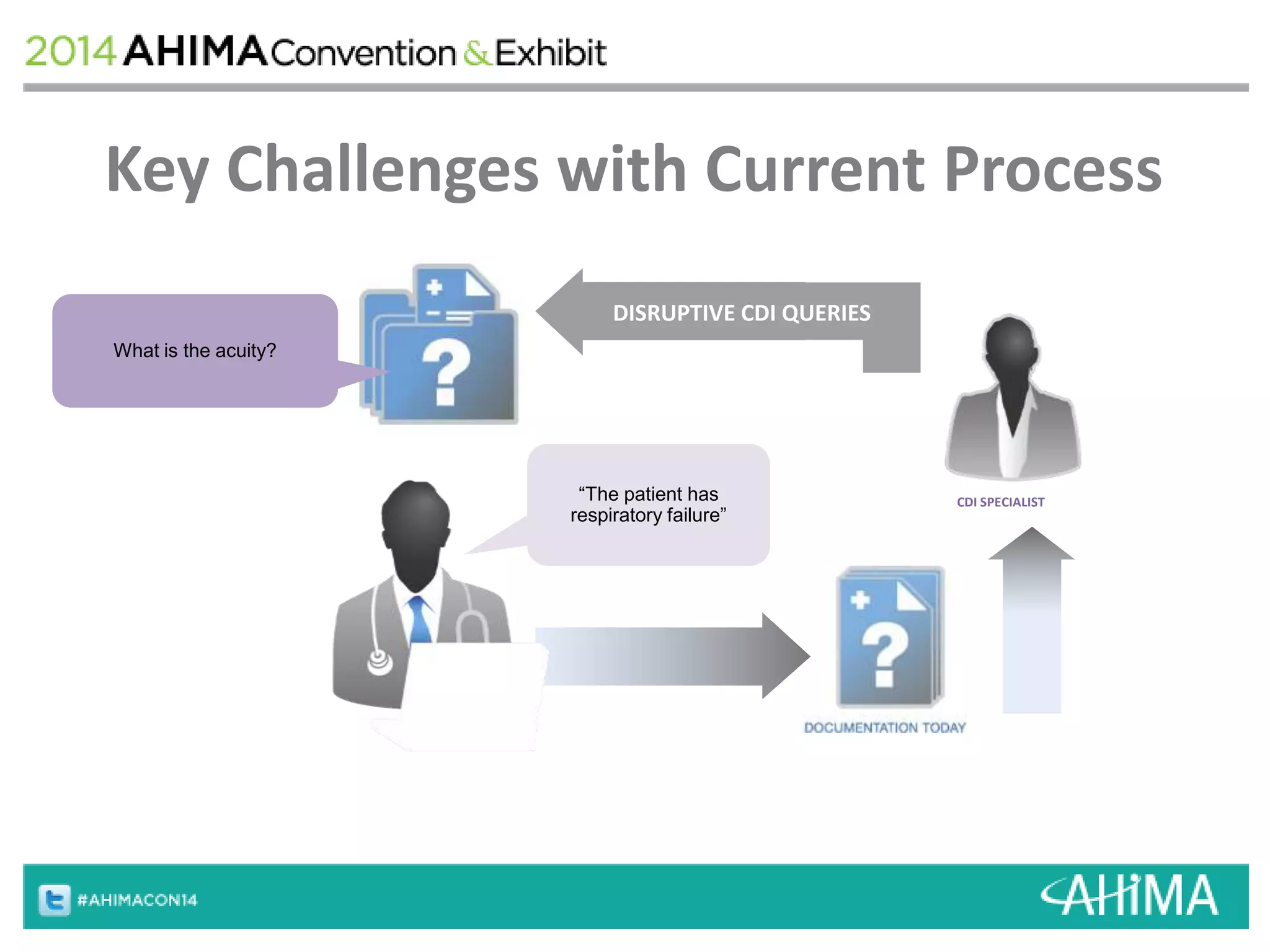
Key Challenges with Current Process 
DISRUPTIVE CDI QUERIES 
CDI SPECIALIST “The patient has 
respiratory failure” 
What is the acuity?
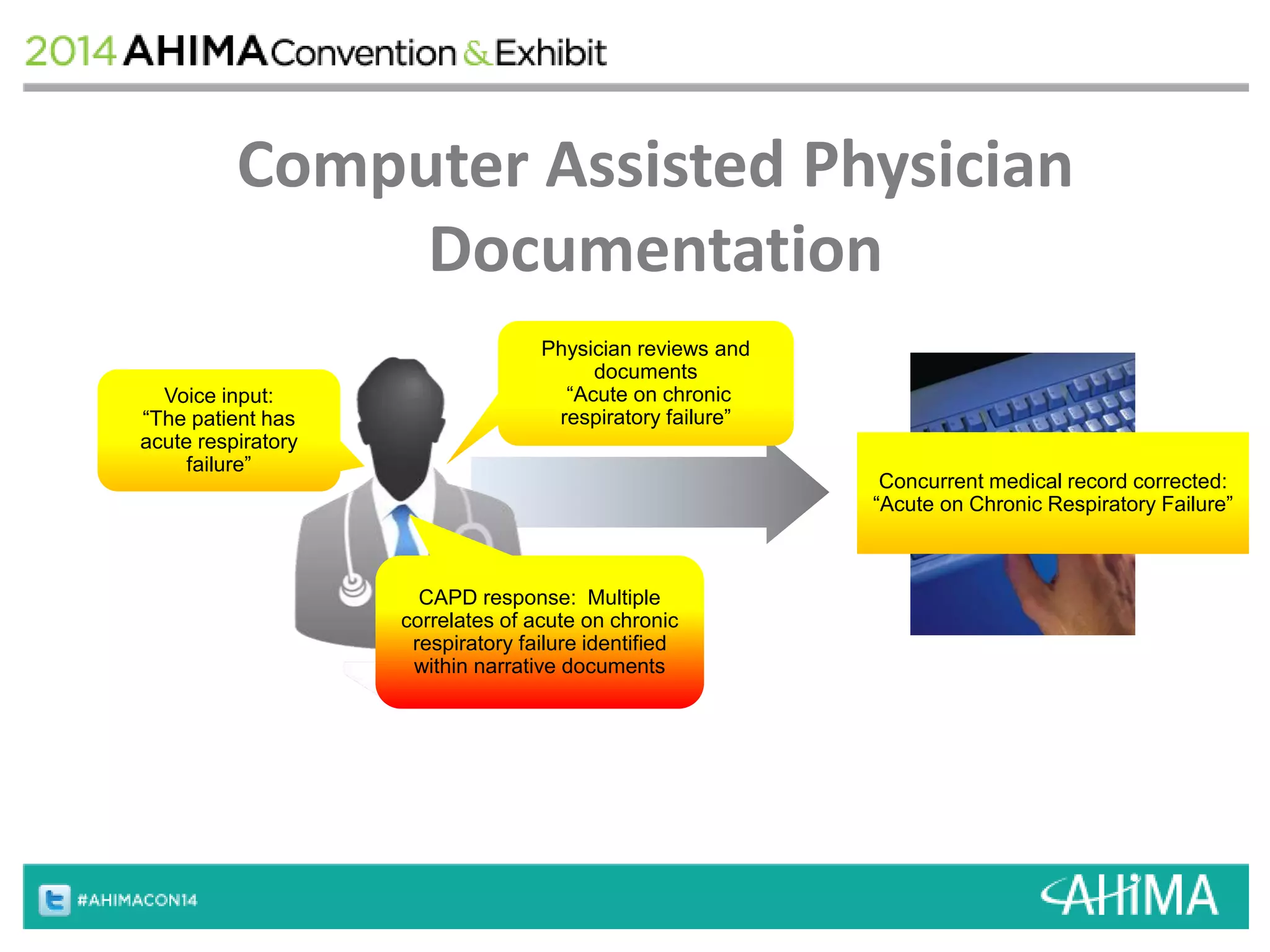
Computer Assisted Physician 
Documentation 
Voice input: 
“The patient has 
acute respiratory 
failure” 
Physician reviews and 
documents 
“Acute on chronic 
respiratory failure” 
CAPD response: Multiple 
correlates of acute on chronic 
respiratory failure identified 
within narrative documents 
Concurrent medical record corrected: 
“Acute on Chronic Respiratory Failure”
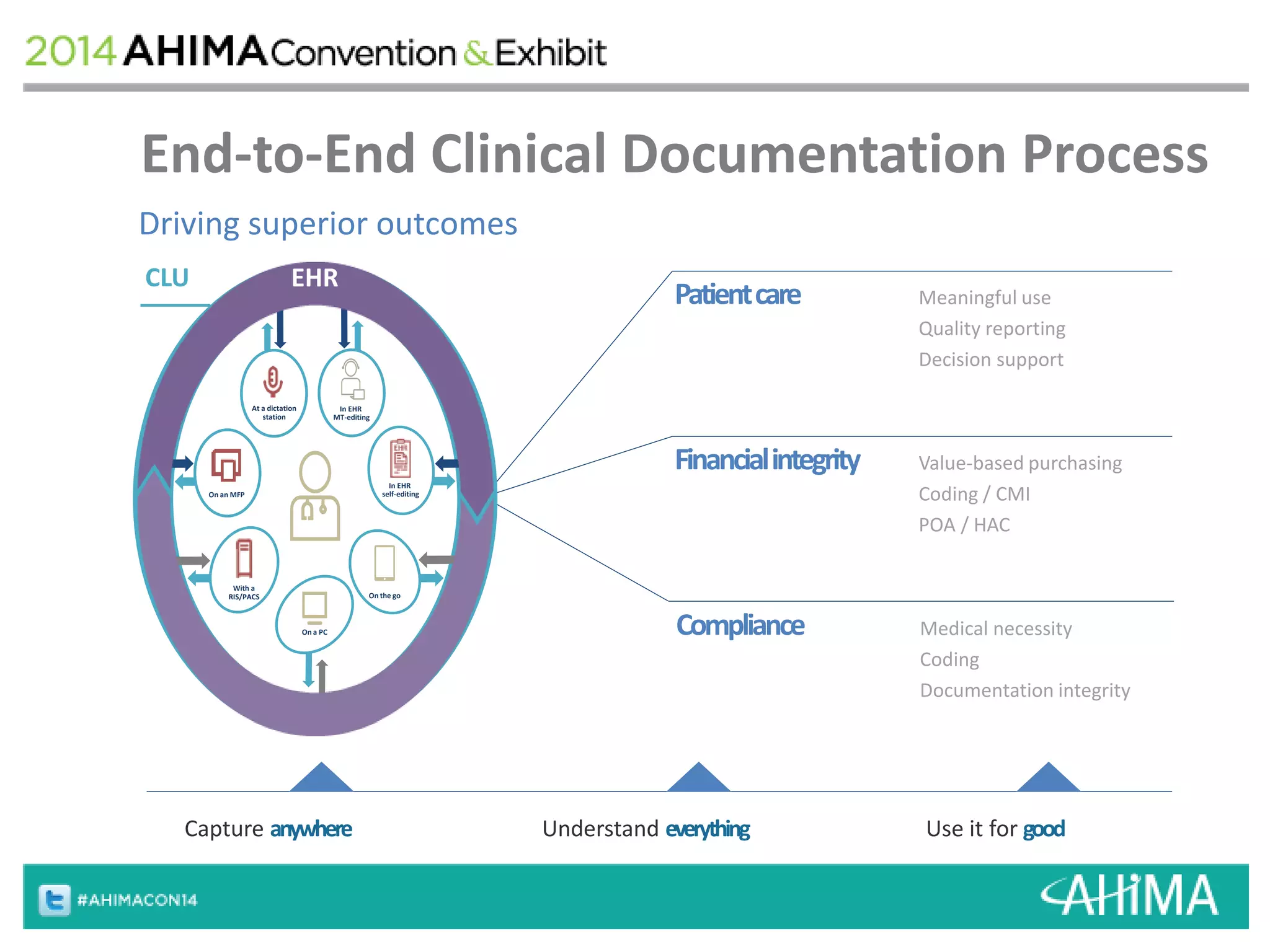
End-to-End Clinical Documentation Process 
Driving superior outcomes 
Meaningful use 
Quality reporting 
Decision support 
Value-based purchasing 
Coding / CMI 
POA / HAC 
Medical necessity 
Coding 
Documentation integrity 
CLU EHR 
On a PC 
In EHR 
self-editing 
In EHR 
MT-editing 
On the go 
Patient care 
Financial integrity 
Compliance 
On an MFP 
At a dictation 
With a 
RIS/PACS 
station 
Capture anywhere Understand everything Use it for good
Where You Can Find Me 
Nick van Terheyden, MD CMIO, Nuance Communications 
AboutMe http://about.me/obiwan 
Twitter http://twitter.com/drnic1 
LinkedIn http://www.linkedin.com/in/nickvt 
Voice of the Doctor http://drvoice.blogspot.com/ 
FaceBook http://profile.to/drnick 
E-Mail drnick@nuance.com, drnic1@gmail.com 
Google Voice (301) 355-0877
Thank You 
Nick van Terheyden, MD (Aka @DrNic1) 
Chief Medical Information Office – CLU 
Nuance Communications, Inc.

Game of documentation, Winter is coming Surviving ICD10

  • 1.
    Game of Documentation: Winter is Coming – Surviving ICD-10 Nick van Terheyden, MD (aka @drnic1) Chief Medical Information Officer Nuance Communications, Inc.
  • 2.
    Harrison Ford Injuryand ICD-10 • Injured by the Hydraulic Door of the Millennium Falcon • 2014 ICD-10-CM Diagnosis Code V95.40XA • Unspecified Spacecraft Accident Injuring Occupant, Initial Encounter
  • 3.
    Changes in theHealthcare System and What it Means to You • Entire healthcare system in transition – Meaningful use in full swing – EHR adoption is mandatory – Entire IT infrastructures are being replaced – Transition to pay-for-performance and value-based models • Hospitals and Healthcare facilities have to do more with less • Fair reimbursement in a tighter regulatory environment
  • 4.
    Survey Question Whereare you on the continuum of preparing your office for ICD-10? A. We’re ready B. We have a plan and are on our way to being ready C. We might be ready because D. We’ve talked about it E. Uh, when do we have to start? F. No need to prepare.. it will be delayed again
  • 5.
    ICD-10 History •ICD-10 adopted by the World Health Organization in 1990 – Implemented in the United Kingdom in 1995 – Australian modification released in 1998 – Canadian version 2001 • US development – US evaluation by the National Center for Health Statistics began 1994 – Numerous subsequent versions – Final implementation date 10/01/14 • The official documents – International Classification of Diseases, Tenth Revision, Clinical Modification [ICD-10-CM] – International Classification of Diseases, Tenth Revision, Procedure Coding System [ICD-10-PCS]
  • 6.
    Some ICD-10 NewFeatures • Combination codes (etiology and manifestation) – Type 1 diabetes with diabetic nephropathy • Laterality – Left, right, bilateral, unspecified (4) • Episode of care – Initial (open, closed), subsequent (routine, delayed, nonunion, malunion), treatment of sequela • Trimesters for obstetrical care • Clinical changes – Time frames for acute myocardial infarctions
  • 7.
    The Coder /Physician Dichotomy Coders Physicians • ICD-9 is 35 years old with outdated terminology • Coders must learn current anatomy, pathophysiology, terminology, etc. • Coders must understand the entire ICD-10 system • Coders must think expansively of all possible code options • The burden on coders is tremendous • ICD-10 includes modern terminology • Physician practice has evolved even though the coding system was stagnant • Physicians need to learn what is applicable to their specialty • Physicians tend to be linear and hierarchical • The burden on physicians is manageable
  • 8.
    Acute Myocardial Infarction ICD-9-CM ICD-10-CM • Acute Myocardial Infarction – (30 codes) • Primary axis: Site involved (10) – Anterolateral, other anterior wall, inferior wall, inferoposterior wall, other inferior, other lateral, true posterior, subendocardial, other, unspecified) • Secondary axis: episode of care (3) – initial, subsequent, unspecified • Acute Myocardial Infarction – (14 codes) • Axes of classification: – Initial MI (9) • STEMI (8) (by site) – Anterior (3) » L main, L anterior descending, other coronary artery – Inferior (2) » Right coronary artery, other – Other (2) » Left circumflex, other sites – Unspecified (1) • NSTEMI (1) – Subsequent MI (5) • Anterior wall • Inferior wall • Non-STEMI • Other sites • Unspecified Subsequent AMI AMI occurring within 4 weeks of previous AMI, regardless of site
  • 9.
    Why Physicians AreLiking ICD-10 • Codes are more specific – They link etiology to disease (staph pneumonia) – They link manifestation to etiology (hypertensive heart disease) • They make more clinical sense – Injuries grouped by anatomical site rather than type of injury – Laterality has been added to relevant codes • They are up to date – Code titles reflect new technology & recent terminology – Codes have been added to describe postoperative or post-procedural conditions • ICD-10 is essential for clinical research and epidemiology
  • 10.
    High Level Message • ICD-10 implementation will improve patient care • ICD-10 is not being imposed on physicians by the hospital • The hospital is collaborating to reduce impact on physicians by building knowledgeable infrastructure • Independent physicians need to focus now on their practice, specifically their systems and staff • Further education will be coming at the appropriate time for every specialty and subspecialty.
  • 11.
    The Risk toProviders • The only way your clinical performance is adjudicated by those outside of your medical staff is through Billing Data • If you do not get the billing data correct then your performance will be adjudicated incorrectly… • This will be vital in the changing healthcare environment – “My patients are sicker” is no longer an acceptable excuse for less than expected performance because severity adjustment is built into the coding system • But only if you get it right – In a population based payment system those that have less than expected performance in quality and cost will be marginalized • It would be a shame for your hospital and clinicians were to be affected just because you didn’t understand the Documentation, Regulatory, and Compliance environment we live in today
  • 12.
    “Feds to AllowUse of Medicare Data To Rate Doctors” – USA Today 12/5/11 The federal government announced that Medicare will now allow use of its extensive medical claims database by employers, insurance companies and consumer groups to produce report cards on local doctors and hospitals. …By analyzing masses of billing records, experts can glean such critical information as how often a doctor has performed a particular procedure and get a general sense of problems such as preventable complications. Compiled in an easily understood format and released to the public, medical report cards could become a very powerful tool for promoting quality care and reducing waste… Announced by Marilyn Tavenner – Acting Administrator of CMS
  • 13.
    Sebelius and Holderspecifically warned hospitals and doctors against “cloning” patients, or simply copying one patient’s information into multiple patients’ records, a practice that is far easier using electronic records than using a pen and paper Where’s the narrative? Where’s the physician’s clinical impression?
  • 14.
    Unfair Advantage? UnitedHealthcare Boots Thousands of MDs From Its Part C Medicare Plans "Our decisions are based on providing a network of physicians whom we can collaborate with to help enhance health plan quality, improve healthcare outcomes, and curb the growth in healthcare costs," he wrote. "Factors include geography and ensuring ready access to care, the relative performance of providers on a range of industry quality metrics, and a provider's ability to deliver high-quality care for the most members in the most cost-efficient manner.“ Medscape/Heartwire auth. Steve Stiles; October 28, 2013
  • 15.
    The Healthcare Environment has Changed The Hospital Chart – Has changed from an accounting of the care we were providing with limited information that could be put into a written record to an expansive record full of data and information that no one can know every data point in it – Yet Physicians are responsible for every data point The Environment – With all the information available in the record others have the ability to come to conclusions about the care you provided based on that information. – If you let the record tell the story with just its information and Physicians are not discussing their judgment in that record then their decisions will more likely be questioned by outsider reviewer  Fraud Enforcement  Malpractice  Denial
  • 16.
    Coding Systems UnderstandingThe System • The MS-DRG system • Medicare Severity-Adjusted Diagnosis Related Groups
  • 17.
    MS DRGs: DRGAssignment Based Upon… • Medicare Severity Diagnosis Related Groups (MS-DRGs) – The Principle Diagnosis or Procedure; plus – Severity (Acuity) - CC or MCCs • DRG Assignment – DRGs are groups of diagnoses determined by Medicare to be related clinically and have similar resource consumption – Many different diagnoses exist within one DRG – One DRG per hospitalization, assigned at discharge • Each DRG is assigned a “Relative Weight” (RW) – Average of 1.00 – Originally designed for hospital payment – The RW has become the proxy for severity of illness
  • 18.
    Co-Morbidities Drive Severity – Typical Minor Comorbidities – Most Infections – Hypoglycemia – Transient Visual Loss – Chronic Kidney Disease – Chronic Heart Failure – Unstable Angina Typically add complexity to the care of the patient but not high degree of severity – Typical Major Comorbidities – Septicemia – Meningitis – DKA – Acute Heart Failure – Acute Kidney Failure – Acute MI Typically add significant complexity to the care and add significant severity and Risk of Mortality. Can be a main driver of care with Principle Dx.
  • 19.
    General Diagnosis thatare No Longer “Codeable” • CHF • COPD • Renal Insufficiency – Since 2007 they must be defined to end up as either a minor or major CC. If they are not clarified they can not be used and you do not get credit for the complexity……. • But clinicians should not stop using them because they will prompt someone to ask so you receive credit
  • 20.
    The Importance ofWhat We Write No Dx Vital Sign Lab Value Symptom • “75y/o chronic lung disease w fever, leukocytosis, SOB with hypoxia and altered mental status.” • “75 y/o with Exacerbation of COPD and chronic respiratory failure; now complicated by acute pneumonia, probably Gram negative in view of age, underlying disease and recent hospitalization. Now presents with probable sepsis, with acute septic encephalopathy as well.” MCC 21 Clinical Finding Principal Dx CC CC MCC Lab Value 204 RESPIRATORY SIGNS & SYMPTOMS 0.67 871 SEPTICEMIA OR SEVERE SEPSIS W/O MV 96+ HOURS W MCC 1.91
  • 21.
    THE QUALITY PERSPECTIVE THE EFFECT OF DOCUMENTATION ON OUTCOME PERFORMANCE What Happens if you don’t get it right
  • 22.
    What is aSeverity Adjusted Outcome Measure • Severity adjusted outcomes are usually expressed as an Index • Expected outcome, such as mortality, is determined by looking at similar MS-DRG’s with the same level of complexity and determining the performance across a large database – Level of Complexity within a MS-DRG is determined by vendors using APR-DRG or 4 levels of severity for each DRG or Statistical Regression
  • 23.
    What is aSeverity Adjusted Outcome Measure? – Once you have established the expected outcome of a MS-DRG at similar level of complexity then your observed outcome can be compared as a ratio – Observed Outcomes/Expected Outcome = Severity Adjusted Outcome Index – Determining your performance just becomes simple math  If your Index is less than 1 meaning your expected outcome was greater than your observed then your performance is better than expected  If your index is greater than 1 meaning your observed outcome is greater than expected then your performance is worse than expected
  • 24.
    Effect of AccurateDocumentation 331 Major Small and Large Bowel Procedure WO CC/MCC on Outcomes Secondary DX CHF 1.64 0.13% 5.67 329 Major Small and Large Bowel Procedure W MCC Rel Wt Exp Mort Rel Wt Exp Mort Exp LOS Exp LOS Secondary DX Acute Systolic Failure 5.26 9.51% 13.59 330 Major Small and Large Bowel Procedure W CC Rel Wt Exp Mort Exp LOS Secondary DX Chronic Systolic Failure 2.57 0.73% 7.79 *Exp Outcome Values based on specific Population with Proprietary analysis of Severity May vary with different population and assessment Methods For illustrative purposes only based on real data
  • 25.
    Effect of AccurateDocumentation 331 Major Small and Large Bowel Procedure WO CC/MCC on Outcomes Secondary DX CHF 1.64 0.13% 5.67 $12851 8.93% $10,824 329 Major Small and Large Bowel Procedure W MCC Rel Wt Exp Mort Rel Wt Exp Mort Exp LOS Exp LOS Exp Cost Exp Cost Exp Readmit Exp Readmit Exp Payment Exp Payment Secondary DX Acute Systolic Failure 5.26 9.51% 13.59 $30,302 18.69% $34,716 330 Major Small and Large Bowel Procedure W CC Rel Wt Exp Mort Exp LOS Exp Cost Exp Readmit Exp Payment Secondary DX Chronic Systolic Failure 2.57 0.73% 7.79 $1668 1 12.25% $16,962 *Exp Outcome Values based on specific Population with Proprietary analysis of Severity May vary with different population and assessment Methods For illustrative purposes only based on real data
  • 26.
    The Denial Industry It is being “ramped up” dramatically Tywin Lannister could learn a thing or to from the Denial Industry
  • 27.
    Medical Necessity •Social Security Act §1862(a)(1)(A) – Requires CMS to deny payment for a particular item or service that is not reasonable and necessary… • How is this determined? – Contemporaneous Documentation • Therefore – If we fail to document the medical necessity for any good or service, CMS is required to take back payment 28
  • 28.
    Why Physicians ShouldCare… • CMS' Recovery Audit Contractor (RAC) in Region C has been instructed to commence audits on high level evaluation and management (E/M) codes. The auditing contractor will focus on physicians' use of higher-level E/M codes, including CPT codes 99214 and 99215. • RACs in the other three regions of the country will follow suit, with similar audits in the near future. Bulk of audits will focus on IM, FP, ED doctors use of codes. http://www.aafp.org/news-now/practice-professional-issues/ 20120918racaudits.html 29
  • 29.
    Why Physicians ShouldCare… • If the RAC denies an admission as lacking “medical necessity,” are the associated physician services (H&P, daily visits denied as well)? – CMS: If the RAC denies an inpatient admission, it is in the discretion of the RAC auditor whether to recover payments to physicians – Places discretion in the hands of the RAC auditors who get 10% of every dollar recovered 30
  • 30.
    Getting It Right The Legal & Regulatory Environment Accurate Compliant Documentation Misleading Documentation Underpayment Poor Profiles Error Recovery Incomplete Documentation Fraud - Civil What Are The Rules? - Criminal
  • 31.
    CLINICAL DOCUMENTATION IMPROVEMENT Taming the Dragon You too can tame the CDI Dragon like Daenerys Targaryen
  • 32.
    Hospital Inpatient Care Physician Documentation Impact of Documentation Improvement – Compliance Coding Process Gap • Assures compliant coding by supporting accurate physician documentation • Decreases hospital fraud risk – Revenue Cycle • Assures appropriate payment based on actual patient acuity • Protects against recoveries for “erroneous payments” (RAC) – Quality Traditional Revenue Cycle Quality / Outcome Measurement • More accurate capture of core measures, patient safety indicators, medical necessity, etc. • Improves hospital / department / individual clinical profiles Evolving Quality Based Payment Clinical Documentation Improvement Process “The medical record is the most important source of information within a healthcare organization. It is used not only for providing patient care but also for assessing the effectiveness and quality of that care, as well as for billing and reimbursement, research and to set healthcare policies as needed.”
  • 33.
    Philosophy • Physiciansdo not need to learn coding • Physicians need to work in a collaborative process to achieve accurate documentation on every patient • The process must increase efficiency • The CDMP implementation should be “owned” by physicians
  • 34.
    Physician Engagement –The “Game Typical CDI Programs • Success Metrics Changer” – Compliance – CMI viewed as a revenue cycle metric – Typical hospital revenue cycle impact 2- 4% • A Revenue Cycle Initiative – Managed by HIM under a strong coding influence – Little communication with quality “Physician-Engaged” CDI • Success Metrics – Greater compliance – CMI improvement a metric of quality and revenue – Typical CMI improvement 4-8% • A Clinical Initiative – Integrated with clinical quality – Clinical management, CMO accountability
  • 35.
    Physician Engagement –The “Game Changer” Typical CDI Programs • Focus: DRG “optimization” – Specific focus only on those areas of documentation impacting hospital reimbursement • Result – Cynicism from medical leadership/staff – No fit with other physician/clinical initiatives – 1-2 year success cycle – Documentation specialists progressively disappeared into cubicles “Physician-Engaged” CDI • Focus: Clinical accuracy – Accurate severity capture for every admission impacting reimbursement, clinical care, and quality metrics • Result – “Ownership by the medical staff” – Response rates approaching 100% – Integrated with other physician/clinical initiatives – Sustained results – CDSs part of the clinical team
  • 36.
    How Do YouLeverage Physician Engagement? • Involve physician leadership in planning, execution, and ongoing performance of CDI • Integrate physician / CDS / coder into a collaborative group • Measure, But measure no need and for measure WildFire • Show results Much like Tyrion Lannister marshaling resources and involving everyone as he did at the Battle of Blackwater
  • 37.
    The Mortality Index: Ratio of Observed to Expected Mortality 0.79 0.86 0.8 0.75 0.76 0.78 0.72 University Medical Center Compared to UHC UHC Top 10 Med Center 0.68 0.68 0.68 0.64 1.37 1.36 1.15 1.1 0.99 0.99 0.83 0.71 0.83 0.77 0.7 1.60 1.40 1.20 1.00 0.80 0.60 0.40 Q1 Q2 Q3 Q4 Q1 Q2 Q3 Q4 Q1 Q2 Q3 Q4 FY2008 FY2009 FY2010
  • 38.
    Current Clinical Documentation and Coding Processes Little operational integration of workflow Quality EHR Analytics Documentation Coding Compliance Reporting Patient Encounter The Physician World The HIM / Revenue / Compliance World Physician Impact • Frustration with coding • Inaccurate quality reporting • Query fatigue Operational Impact • Frustration with physicians • Inaccurate quality reporting for hospital • Compliance risk
  • 39.
    Leveraging the EHRfor Value CLU EHR CAPD / CA CDI Analytics Quality Reporting Documentation Coding Compliance Patient Encounter Coding Knowledge CA Compliance CA Quality Reporting CA Data Analytics CAC Voice / Direct text entry
  • 40.
    HOW DOES CODINGIMPACT ALL OF THIS? A LOOK AT CURRENT CDI PROGRAMS
  • 41.
    Uninformed Physician Coding Inaccurate Physician Document ation Documentation Coding Process Revenue Cycle CDI Programs CAC Compliance Inaccurate Medical Record Quality Rework Rework Rework
  • 42.
    Basic Concepts •Inadequate physician documentation has been a challenge for accurate coding under ICD-9 • If uncorrected, that challenge continues to increase • Coding solutions, alone, cannot resolve the issue of inadequate physician documentation • Physician leaders must be able to engage their colleagues in a proactive manner, establishing the appropriate motivation and sharing necessary knowledge to achieve success under Coding and CDI Programs
  • 43.
    Leveraging Technology LeveragingTechnology Applying a little magic like Arya Stark and her unusal friend Jaqen H'ghar
  • 44.
  • 45.
  • 46.
    Supporting the Clinicianin the Avalanche of Increasing Demands POA/HAC Medical Necessity Core Measures MU Patient Safety Outcome Measures CMI Severity of Illness
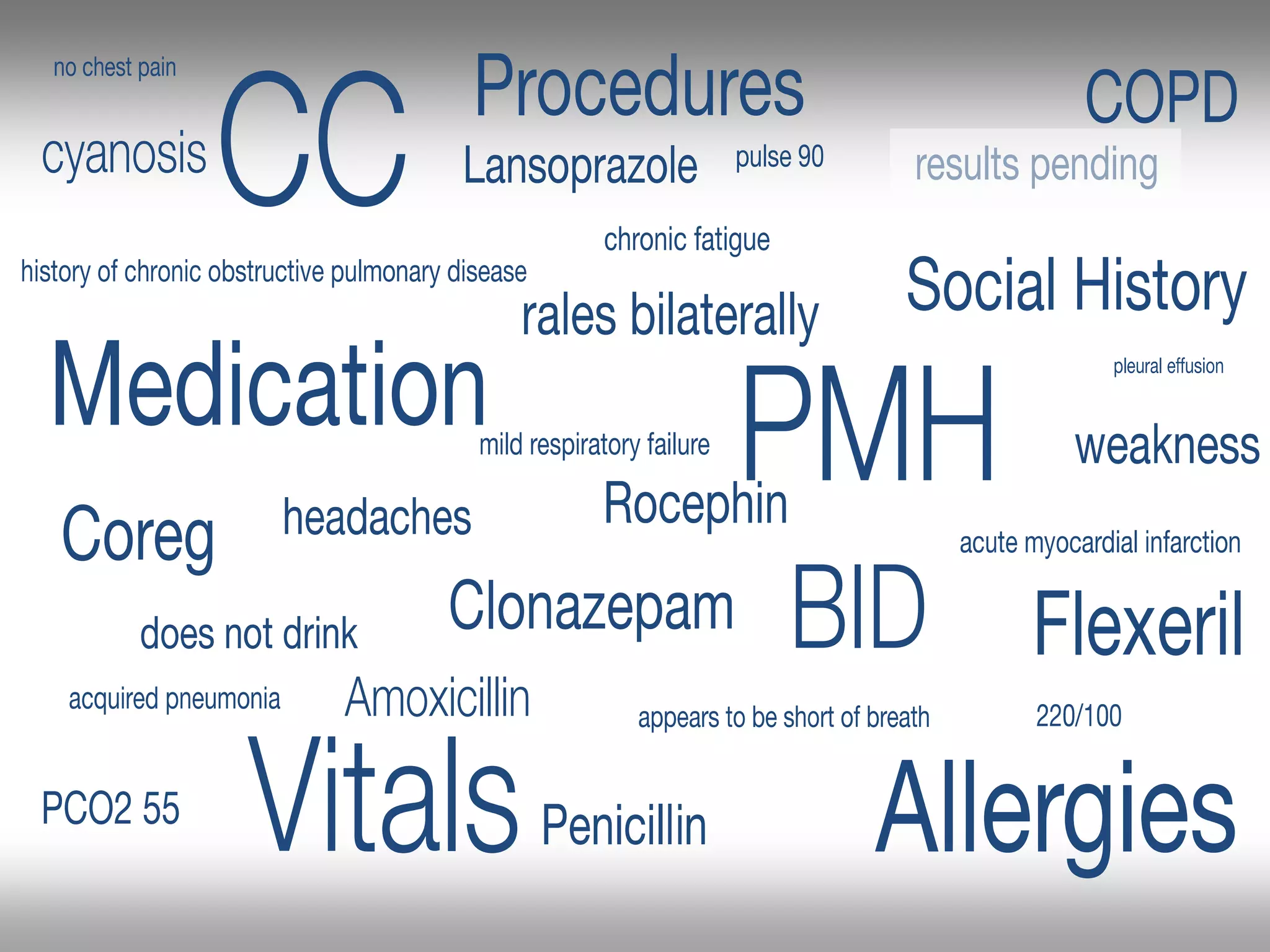
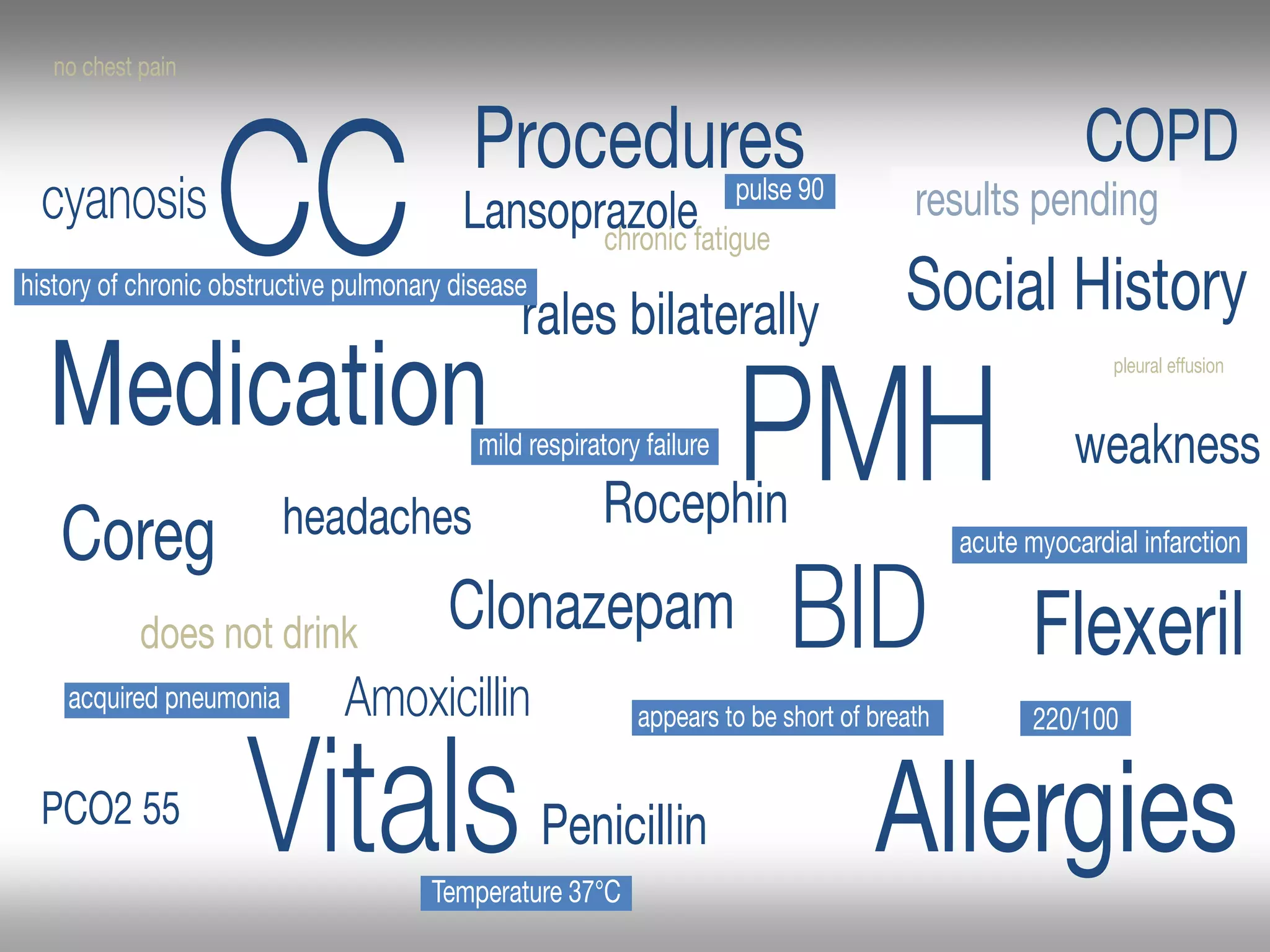
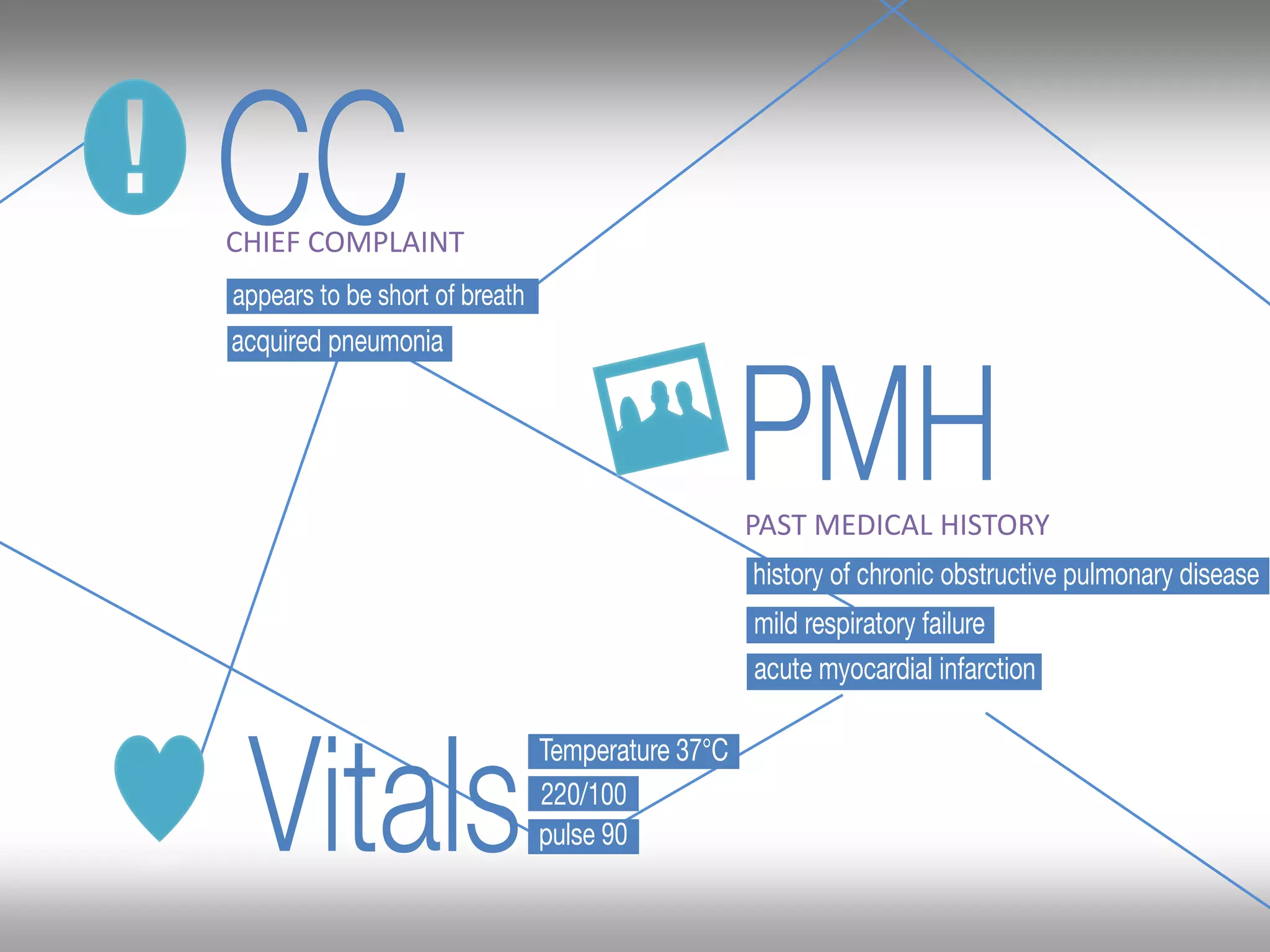
  • 49.
    CHIEF COMPLAINT PASTMEDICAL HISTORY
  • 50.
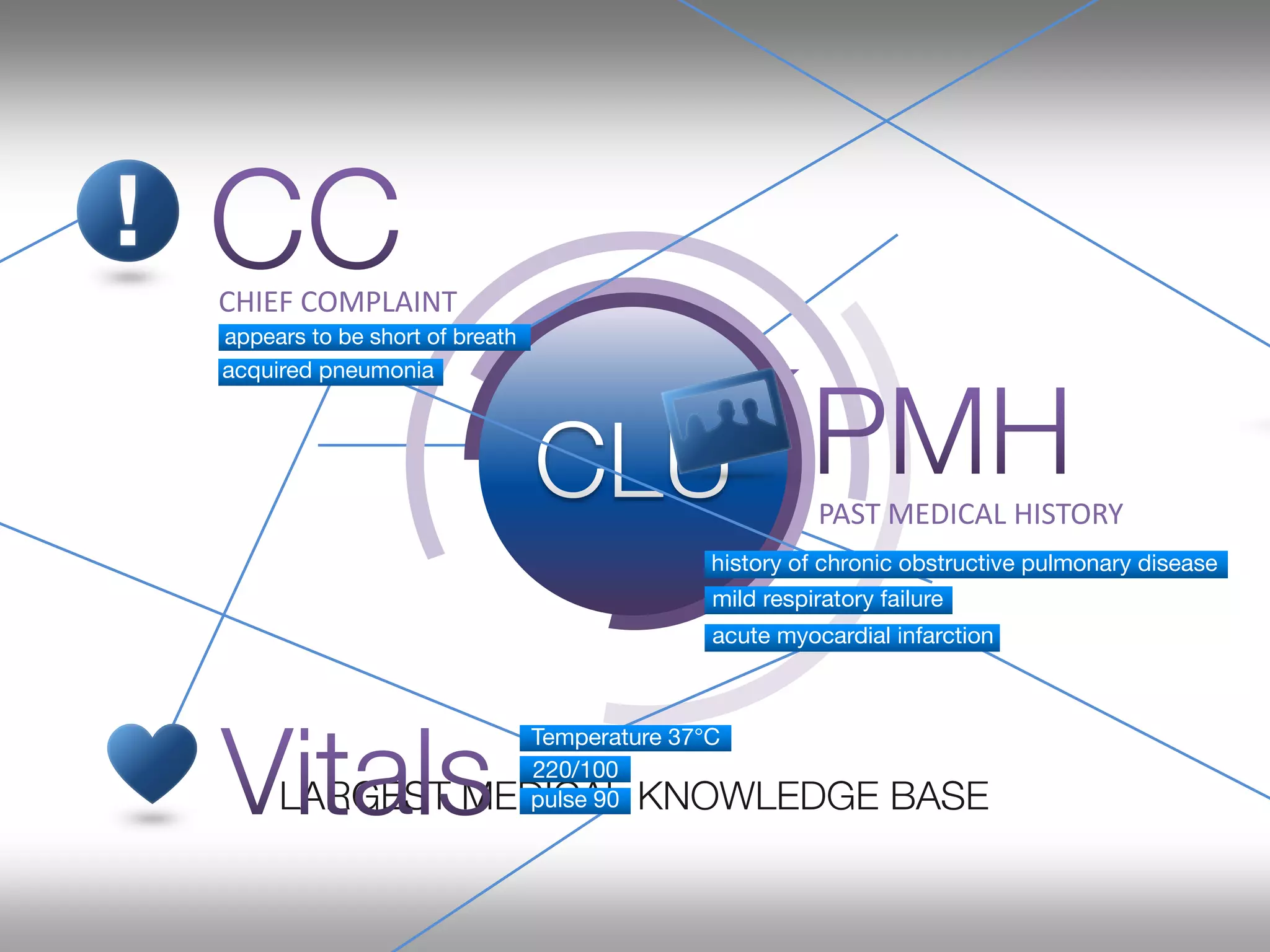
    PAST MEDICAL HISTORY CHIEF COMPLAINT
  • 51.
    Bringing the Powerto Healthcare—From Clinical Narrative to Actionable Facts CLINICAL LANGUAGE UNDERSTANDING is Nuance’s NLU Specific to Healthcare 63 % 93% 86 % Oct ‘10 Feb ‘12 Rules: explicit linguistic models Machine learning: discovery of new patterns Syntactic parsing & Statistical semantic processing LinKBase® ontology
  • 52.
    Moving from theCurrent Fragmented Clinical Documentation Process EHR Compliance • Clinical documentation, coding and quality reporting are loosely coupled processes • Opportunities for real-time physician engagement are limited Quality Coding reporting Analytics – Computer-assisted coding solutions perform sub-optimally due to lack of high quality and complete electronic physician documentation and sophisticated CLU technology – Value-based reimbursement models will make these challenges even greater
  • 53.
    To: Utilizing IntelligentSystems to Bridge the Gap CA-compliance CA-quality EHR Compliance EHR CodiCnAg-coding reporting Analytics – Integrates the entire value chain starting with increased electronic documentation – Supports physicians within their EHR-centric documentation workflows driving enhanced utilization and documentation quality – Leverages superior and common CLU technology across all of the key process steps Quality reporting CA-analytics – Relies on a technology enabled CDI approach that drives superior physician acceptance and CDI team efficiencies – Drives superior computer-assisted coding process and results Clinically driven CA-CAPD-CDI CLU
  • 54.
    Key Challenges withCurrent Process DISRUPTIVE CDI QUERIES CDI SPECIALIST “The patient has respiratory failure” What is the acuity?
  • 55.
    Computer Assisted Physician Documentation Voice input: “The patient has acute respiratory failure” Physician reviews and documents “Acute on chronic respiratory failure” CAPD response: Multiple correlates of acute on chronic respiratory failure identified within narrative documents Concurrent medical record corrected: “Acute on Chronic Respiratory Failure”
  • 56.
    End-to-End Clinical DocumentationProcess Driving superior outcomes Meaningful use Quality reporting Decision support Value-based purchasing Coding / CMI POA / HAC Medical necessity Coding Documentation integrity CLU EHR On a PC In EHR self-editing In EHR MT-editing On the go Patient care Financial integrity Compliance On an MFP At a dictation With a RIS/PACS station Capture anywhere Understand everything Use it for good
  • 57.
    Where You CanFind Me Nick van Terheyden, MD CMIO, Nuance Communications AboutMe http://about.me/obiwan Twitter http://twitter.com/drnic1 LinkedIn http://www.linkedin.com/in/nickvt Voice of the Doctor http://drvoice.blogspot.com/ FaceBook http://profile.to/drnick E-Mail drnick@nuance.com, drnic1@gmail.com Google Voice (301) 355-0877
  • 58.
    Thank You Nickvan Terheyden, MD (Aka @DrNic1) Chief Medical Information Office – CLU Nuance Communications, Inc.

Editor's Notes

  • #28 Like Tywin Lannister
  • #30 According to the OIG, it was able to look at Part B claims data and then identify individual physicians who frequently billed the more expensive and complex E/M codes, including 99214 and 99215, in 2010. However, the OIG did not make any determination as to whether the claims were appropriate. The OIG said it identified 1,700 physicians who "consistently billed higher E/M codes in 2010." Physicians billing higher E/M codes were not grouped in any particular state or region and treated Medicare patients of similar ages and with similar diagnoses as physicians who coded claims with lower-level E/M codes.
  • #46 Clinical documentation is everything, document findings, communication to the care team about patient and treatment, used for reimbursement, MU reporting (quality reports MU 2menu item for Acute), quality reporting (HAC/POA indicators) VBP.
  • #47 We also live in a world where data comes from multiple sources and utilizing pdoc we have the flexability to use different workflows (template, front and back end speech, Formatted data, we even have access to routines such as the problem list to update them in real-time. How many of you have their physicians documenting their progress notes in pdoc? How many are scanned in? Listening to Tony and how a clinically focused CDI program is the most effective way to have complete and accurate documentation to assist with revenue preservation and have the opportunity to evaluate processes to effect change. We want to have as much electronic documentation available We want to continue to have our providers have the flexability they require and still capture the required. There is still one problem……. So while everyone works hard to adapt to the new structure They still need to make the existing system more and more efficient Reduce costs And continue to improve the quality of care
  • #48 And at the eye of the storm if you will is the physician. They are being asked to change the way they practice To use EHRs in ways they never have before To document everything and in much more detail – to be sure clinical documentation reflects if a patient was admitted with a high risk condition or infection because if the patient acquires that condition in the hospital, reimbursement will be denied Specific details required for Meaningful Use are identified and available for quality scoring and MU attestation reporting That the physician documents the appropriate diagnosis and reason for treatments to show how they are medically necessary They are being asked to clarify and explain their choices and decisions, often retrospectively and for what they often feel is for reimbursement reasons not for improving care The level of information that must be captured in clinical documentation required to support these major trends and initiatives can be overwhelming It’s important, not just for the hospital because what happens to the hospital can also impact physicians Fraud investigation is growing and audits and take backs are significant Cut and paste notes and templates just don’t provide enough detail to hold up to investigation The volume of documentation captured is not the key – it’s the detail and meaning in the documentation that is so important But in the end, physicians care about their patients, they care about the quality and safety of the care delivery process and their patients’ outcomes And they also care that they are appropriately acknowledged for how well they care for their patients, and that profiling and quality scores accurately reflect the how sick their patient population is and that the care provided is of the highest quality And that the process of capturing high quality documentation is appropriately balanced with the time they want to spend with their patients, and their families Our solutions help with a combination of speech and understanding technology, education services, guidance and strategies to make it easy for physicians to create high quality documentation as a by product of the care process, easily and naturally and without disprupting the clinical throught process Let’s look at how we do this…
  • #49 Tthese slides articulate the fact that data even in an electronic state still would benefit from the intelligent systems that are powered by the CLU engine. I want to give the customer the understanding that the CLU engine is going to bring the data together and make it meaningful and actionable based on our CLU normalizes and translates data into standard medical terminology. Our CLU engine contains the largest medical knowledge base in the world and brings ontology, syntastic parsing, NLP rules and statistical analysis together.
  • #50 Tthese slides articulate the fact that data even in an electronic state still would benefit from the intelligent systems that are powered by the CLU engine. I want to give the customer the understanding that the CLU engine is going to bring the data together and make it meaningful and actionable based on our CLU normalizes and translates data into standard medical terminology. Our CLU engine contains the largest medical knowledge base in the world and brings ontology, syntastic parsing, NLP rules and statistical analysis together.