NEW DRUGS OF ABUSE &  NEW MEDICATIONS FOR THE TREATMENT OF ADDICTION Randall Webber, M.P.H. Director of External Training TASC, Inc.
Trends in Adolescent Drug Use: 2008 Update Randall Webber, M.P.H. Director of External Training TASC, Inc of Illinois
Overall Trends for Adolescents Less use of cocaine, PCP, LSD and other street drugs More use of both Rx drugs and over-the-counter (OTC) medications Greater “recreational” use of Adderall Marijuana use relatively unchanged Younger age of first use
The Problem with Pill Identifications: New York City May 2000 Amphetamine Chicago May 2000 MDMA Tucson AZ July 2000 PMA Portland Oct 2000 MDMA
PMA Effects - Sudden blood pressure rise (> 55mm) Hyperthermia usual cause of death Brain hemorrhage can occur Does NOT produce the pleasant Ecstasy effects so users take more causing an overdose. No hospital tests available for PMA.
Major Neurotransmitters Inhibitory Endorphins Excitatory Acetylcholine  Inhibitory GABA  Excitatory Glutamate Inhibitory Serotonin Inhibitory/Excitatory Dopamine
Methamphetamine Methamphetamine
Methamphetamine and MDMA A hydrogen atom shifts position   two oxygen atoms are added MDMA Methamphetamine
DXM Examples – No Urine Test Available Produces  Olney’s Lesions  On Lower Cortex “ Pink Molly” Buffalo NY “ Star” Indianapolis IN “ Clover” Wide spread across US “ Orange Julius” Seattle WA  “ Green Triangle” Wide spread
Age of First Non-Medical Use of Rx Drugs & Lifetime Diagnosis of Substance Abuse
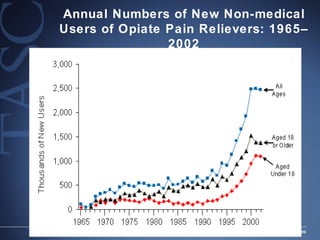
Annual Numbers of New Non-medical Users of Opiate Pain Relievers: 1965–2002
Number of New Users  of Illicit Drugs: 2006
Number of Rx Opiate Users: 2005 Vs 2006
Source of Rx Opiates
Number of American 12+ y.o. who have used OxyContin VS Heroin (In Millions)
% of Youth Who Believe that Trying Heroin Once or Twice Does NOT pose a  “Great Risk”
Types of Opiates Naturally Occurring Opiates Opium Morphine Codeine Thebaine  Semi-Synthetic Opiates • Vicodin •  Heroin
Brown & White Heroin
Black Tar Heroin (“El Chicle”)
Vicodin
Vicodin
Generic Hydrocodone
Types of Opiates Synthetic opiates Demerol (meperidine) Dilaudid (hydromorphone) Percodan/OxyContin (oxycodone) Numorphan (oxymorphone) Sublimaze (fentanyl) Methadone (dolophine) diphenoxylate/atropine (Lomotil)
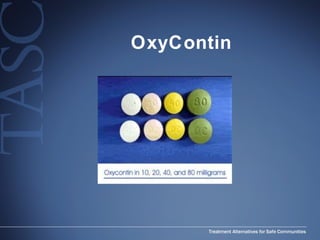
OxyContin
OxyContin
Types of Opiates Karachi (Chicago area only) No as common now as in 1990s Drug composition varies. Usually includes an opiate (ex: Methadone) and at least one sedative  (ex: CNS diazepam, phenobarbital).
Opiate Withdrawal Drug hunger (craving) Dilated pupils Yawning Lacrimation (eyes tear) Rhinitis (runny nose) Restlessness Anxiety Depression Muscle and bone pain
Opiate Withdrawal Stomach, leg and back cramps Nausea Insomnia  Diarrhea  Vomiting  Chills/cold flashes with goose bumps ("cold turkey") Sweating  Leg spasms (“kicking the habit”)      
ADHD Medications
Two Major ADD Medications Ritalin Adderall (dextroamphetamine)
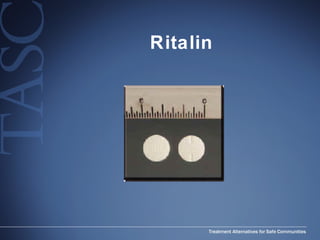
Ritalin
Reported Sources of Rx ADHD Medications Among Past-Year Non-medical Users, 2005* * Among adults ages 18 to 49 without a prior diagnosis of or prescription for ADHD
Consequences of Long-Term ADHD Medication Use (One Study ) Prescribed use of Ritalin among preadolescents Depression Anxiety  Decreased ability to derive pleasure from alcohol and other drugs (AOD) Decreased ability to derive pleasure from natural rewards (food, sex, etc.) Potential outcome: Increased use of AOD
“ NEW” DRUGS  Ambien (zolpidem tartrate) Lunesta   (eszopiclone ) Rozerem   (Ramelteon) DXM- Dextromethorphan
DEXTROMETHORPHAN
Dextromethorphan Coricidin Cough and Cold  “ 3-C”, “triple C”, “Skittles”
Dextromethorphan Robitussin DM (‘Tussin”)
Medicines containing DXM may also contain other substances
DXM- Dextromethorphan May be mixed with or substituted for MDMA  (“ecstasy”) In one study, 21% of  “ecstasy” contained DXM Common cough suppressant drug In therapeutic doses, is sedating In larger doses, behaves like PCP
DXM Plateaus  Abusers describe the DXM experience as occurring on four different plateaus.      First Plateau:  Mild inebriation.  Second Plateau:   ♦ Effects similar to alcohol intoxication (slurred speech) ♦ May be  mild hallucinations.  ♦ Sh ort-term memory may be temporarily impaired.      Third Plateau:   ♦ Impaired sense,  particularly vision
DXM Plateaus  Fourth Plateau:   ♦  Mind and body dissociation/"out-of-body"  experience ♦  Loss of some or all of  senses ♦  Ef fects at this plateau to ketamine or PCP. detachment disorientation nystagmus  stupor  vomiting  “ Robo Rash” itching.
SEDATIVE/HYPNOTICS
Ambien: Regular Release
Ambien: Sustained Release
Ambien (zolpidem tartrate   ) Non-benzodiazepine hypnotic Available in 5-mg and 10-mg tablets Schedule IV substance Effect of 40 mg similar to Valium 20 mg
Ambien Mechanism of action: Subunit modulation of the GABA-A receptor chloride channel macromolecular complex GABA-A receptor complex: Is located on GABA alpha subunit Referred to as the benzodiazepine (BZ) or  Ω  (omega) receptor.   At least three subtypes of this receptor have been identified.
Ambien Indicated for the short-term treatment of insomnia Use should be limited to 7 to 10 days Abnormal thinking and behavior changes have been reported: decreased inhibition (e.g., aggressiveness and extroversion that seems out of character) Sleep walking, driving, eating, cooking...
 
Ambien: Abnormal thinking and behavior agitation hallucinations depersonalization amnesia  In primarily depressed patients-worsening of depression including suicidal thinking
Ambien:  Withdrawal Symptoms Dysphoria Panic attack & nervousness Insomnia  Abdominal and muscle cramps Nausea & Vomiting Sweating Lightheadedness Tremors Convulsions
Lunesta (eszopiclone   )
Lunesta (eszopiclone   ) Thought to also work through various GABA subreceptors.  Addiction potential unclear.
ZIMOVANE (Zopiclone) First introduced in 1988 as hypnotic agent  Marketed in 85 foreign countries as Imovane®, but has never been registered in the U.S.   Closely related to eszopiclone (Lunesta) Abuse and dependency has been documented
ZIMOVANE (Zopiclone) Rarely seen as a street drug in the U.S., but common in Canada
Rozerem (Ramelteon ) Appears to work through MT 1  and MT 2  (melatonin) receptors.  Has an addiction potential, but the degree of this potential is unclear. A  highly unusual hypnotic, which appears to work through melatonin receptors.  Melatonin A neurotransmitter that is manufactured from serotonin Involved in regulating circadian rhythms, and physical responses to changes in seasons.
Rozerem (Ramelteon )
Rozerem (Ramelteon ) In clinical testing has shown no potential for abuse.  Does not bind or attached to receptors that affect memory, balance, cognition, or respiratory depression.
Nystagmus

Cc Juv 03 2008

  • 1.
    NEW DRUGS OFABUSE & NEW MEDICATIONS FOR THE TREATMENT OF ADDICTION Randall Webber, M.P.H. Director of External Training TASC, Inc.
  • 2.
    Trends in AdolescentDrug Use: 2008 Update Randall Webber, M.P.H. Director of External Training TASC, Inc of Illinois
  • 3.
    Overall Trends forAdolescents Less use of cocaine, PCP, LSD and other street drugs More use of both Rx drugs and over-the-counter (OTC) medications Greater “recreational” use of Adderall Marijuana use relatively unchanged Younger age of first use
  • 4.
    The Problem withPill Identifications: New York City May 2000 Amphetamine Chicago May 2000 MDMA Tucson AZ July 2000 PMA Portland Oct 2000 MDMA
  • 5.
    PMA Effects -Sudden blood pressure rise (> 55mm) Hyperthermia usual cause of death Brain hemorrhage can occur Does NOT produce the pleasant Ecstasy effects so users take more causing an overdose. No hospital tests available for PMA.
  • 6.
    Major Neurotransmitters InhibitoryEndorphins Excitatory Acetylcholine Inhibitory GABA Excitatory Glutamate Inhibitory Serotonin Inhibitory/Excitatory Dopamine
  • 7.
  • 8.
    Methamphetamine and MDMAA hydrogen atom shifts position   two oxygen atoms are added MDMA Methamphetamine
  • 9.
    DXM Examples –No Urine Test Available Produces Olney’s Lesions On Lower Cortex “ Pink Molly” Buffalo NY “ Star” Indianapolis IN “ Clover” Wide spread across US “ Orange Julius” Seattle WA “ Green Triangle” Wide spread
  • 10.
    Age of FirstNon-Medical Use of Rx Drugs & Lifetime Diagnosis of Substance Abuse
  • 11.
    Annual Numbers ofNew Non-medical Users of Opiate Pain Relievers: 1965–2002
  • 12.
    Number of NewUsers of Illicit Drugs: 2006
  • 13.
    Number of RxOpiate Users: 2005 Vs 2006
  • 14.
    Source of RxOpiates
  • 15.
    Number of American12+ y.o. who have used OxyContin VS Heroin (In Millions)
  • 16.
    % of YouthWho Believe that Trying Heroin Once or Twice Does NOT pose a “Great Risk”
  • 17.
    Types of OpiatesNaturally Occurring Opiates Opium Morphine Codeine Thebaine Semi-Synthetic Opiates • Vicodin • Heroin
  • 18.
  • 19.
    Black Tar Heroin(“El Chicle”)
  • 20.
  • 21.
  • 22.
  • 23.
    Types of OpiatesSynthetic opiates Demerol (meperidine) Dilaudid (hydromorphone) Percodan/OxyContin (oxycodone) Numorphan (oxymorphone) Sublimaze (fentanyl) Methadone (dolophine) diphenoxylate/atropine (Lomotil)
  • 24.
  • 25.
  • 26.
    Types of OpiatesKarachi (Chicago area only) No as common now as in 1990s Drug composition varies. Usually includes an opiate (ex: Methadone) and at least one sedative (ex: CNS diazepam, phenobarbital).
  • 27.
    Opiate Withdrawal Drughunger (craving) Dilated pupils Yawning Lacrimation (eyes tear) Rhinitis (runny nose) Restlessness Anxiety Depression Muscle and bone pain
  • 28.
    Opiate Withdrawal Stomach,leg and back cramps Nausea Insomnia Diarrhea Vomiting Chills/cold flashes with goose bumps ("cold turkey") Sweating Leg spasms (“kicking the habit”)     
  • 29.
  • 30.
    Two Major ADDMedications Ritalin Adderall (dextroamphetamine)
  • 31.
  • 32.
    Reported Sources ofRx ADHD Medications Among Past-Year Non-medical Users, 2005* * Among adults ages 18 to 49 without a prior diagnosis of or prescription for ADHD
  • 33.
    Consequences of Long-TermADHD Medication Use (One Study ) Prescribed use of Ritalin among preadolescents Depression Anxiety Decreased ability to derive pleasure from alcohol and other drugs (AOD) Decreased ability to derive pleasure from natural rewards (food, sex, etc.) Potential outcome: Increased use of AOD
  • 34.
    “ NEW” DRUGS Ambien (zolpidem tartrate) Lunesta (eszopiclone ) Rozerem (Ramelteon) DXM- Dextromethorphan
  • 35.
  • 36.
    Dextromethorphan Coricidin Coughand Cold “ 3-C”, “triple C”, “Skittles”
  • 37.
  • 38.
    Medicines containing DXMmay also contain other substances
  • 39.
    DXM- Dextromethorphan Maybe mixed with or substituted for MDMA (“ecstasy”) In one study, 21% of “ecstasy” contained DXM Common cough suppressant drug In therapeutic doses, is sedating In larger doses, behaves like PCP
  • 40.
    DXM Plateaus Abusers describe the DXM experience as occurring on four different plateaus.  First Plateau: Mild inebriation. Second Plateau: ♦ Effects similar to alcohol intoxication (slurred speech) ♦ May be mild hallucinations. ♦ Sh ort-term memory may be temporarily impaired.  Third Plateau: ♦ Impaired sense, particularly vision
  • 41.
    DXM Plateaus Fourth Plateau: ♦ Mind and body dissociation/"out-of-body" experience ♦ Loss of some or all of senses ♦ Ef fects at this plateau to ketamine or PCP. detachment disorientation nystagmus stupor vomiting “ Robo Rash” itching.
  • 42.
  • 43.
  • 44.
  • 45.
    Ambien (zolpidem tartrate ) Non-benzodiazepine hypnotic Available in 5-mg and 10-mg tablets Schedule IV substance Effect of 40 mg similar to Valium 20 mg
  • 46.
    Ambien Mechanism ofaction: Subunit modulation of the GABA-A receptor chloride channel macromolecular complex GABA-A receptor complex: Is located on GABA alpha subunit Referred to as the benzodiazepine (BZ) or Ω (omega) receptor. At least three subtypes of this receptor have been identified.
  • 47.
    Ambien Indicated forthe short-term treatment of insomnia Use should be limited to 7 to 10 days Abnormal thinking and behavior changes have been reported: decreased inhibition (e.g., aggressiveness and extroversion that seems out of character) Sleep walking, driving, eating, cooking...
  • 48.
  • 49.
    Ambien: Abnormal thinkingand behavior agitation hallucinations depersonalization amnesia In primarily depressed patients-worsening of depression including suicidal thinking
  • 50.
    Ambien: WithdrawalSymptoms Dysphoria Panic attack & nervousness Insomnia Abdominal and muscle cramps Nausea & Vomiting Sweating Lightheadedness Tremors Convulsions
  • 51.
  • 52.
    Lunesta (eszopiclone ) Thought to also work through various GABA subreceptors. Addiction potential unclear.
  • 53.
    ZIMOVANE (Zopiclone) Firstintroduced in 1988 as hypnotic agent Marketed in 85 foreign countries as Imovane®, but has never been registered in the U.S. Closely related to eszopiclone (Lunesta) Abuse and dependency has been documented
  • 54.
    ZIMOVANE (Zopiclone) Rarelyseen as a street drug in the U.S., but common in Canada
  • 55.
    Rozerem (Ramelteon )Appears to work through MT 1 and MT 2 (melatonin) receptors. Has an addiction potential, but the degree of this potential is unclear. A highly unusual hypnotic, which appears to work through melatonin receptors. Melatonin A neurotransmitter that is manufactured from serotonin Involved in regulating circadian rhythms, and physical responses to changes in seasons.
  • 56.
  • 57.
  • 58.
    Rozerem (Ramelteon )In clinical testing has shown no potential for abuse. Does not bind or attached to receptors that affect memory, balance, cognition, or respiratory depression.
  • 59.