reservoir present, the intended production operations,
                                                                 and many other factors. Dyson et al. (1999) described
                                                                 several sand-control and nonsand-control completion
                                                                 methods, focusing mostly on single-string
                                                                 completions. The following are examples of standard
                                                                 industry methods currently being applied.
          2009 NATIONAL TECHNICAL CONFERENCE &
            EXHIBITION, NEW ORLEANS, LOUISIANA
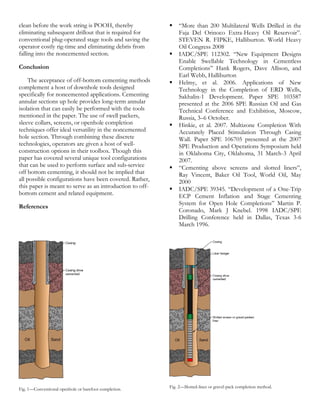
                                                                       The most simple and cost-effective
AADE 2009NTCE-11-01:                                                    completion method available is the openhole
                                                                        or “barefoot” completion. This method is
OFF-BOTTOM CEMENTING                                                    used in hard formations where the oil-
                                                                        producing zone is consolidated and not loose.
PROCESS USED SUCCESSFULLY                                               The oil-producing zone is completely open,
WITH CONVENTIONAL LINER-                                                and no liner or perforated casing is used to
HANGER SYSTEMS WITH NEWLY                                               case the hole (Fig. 1) (Helmy, et al. 2006).
DESIGNED SELECTIVE-RELEASE-                                            A second completion method involves the use
PLUG ASSEMBLIES                                                         of a slotted liner or gravel-pack liner.
                                                                        Typically, the liner is suspended or hung from
AUTHOR(S) & AFFILIATIONS:                                               the bottom of an intermediate string and does
HANK ROGERS, HALLIBURTON                                                not reach surface. These types of liners
                                                                        prevent the entry of sands and solids into the
                                                                        liner ID using either a series of slots or
EARL WEBB, HALLIBURTON
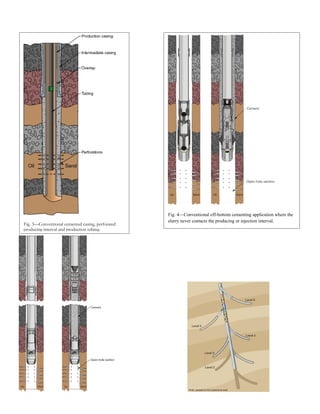
                                                                        screens, or using gravel (Fig. 2).
                                                                       One of the most common methods of
STEVEN FIPKE, HALLIBURTON                                               completion is cementing production casing in
                                                                        place through the producing formation, and
                                                                        then perforating the casing. Because the liner
                                                                        or casing must remain in place for the life of
Abstract
                                                                        the well and its replacement would be very
Operators and drilling contractors are continually                      costly, another string of pipe called tubing is
searching for better drilling, cementing, and                           run into the well to act as the flow string
completion techniques to improve well-construction                      (Fig. 3).
operations. In many cases, combining proven
technologies from cementing and completion                            With the ever-increasing drive to improve the
operations can provide economical advantages to                  productivity of the well-construction process,
both the operator and/or turnkey drilling contractor.            conventional construction plans are being challenged.
                                                                 Specifically, one configuration that is gaining in
During the well-construction phase, when production              popularity is a combination of cemented and
liners are being installed, a newly designed selective-          noncemented sections of the production casing.
release-plug system allows stage cementing                       Typically, this type of cementing technique dates back
procedures to be used with both conventional and                 to the mid 1940s, when the diverter-valve (DV) stage-
expandable liner hangers. This paper documents the               cementing tool was first introduced. The DV stage-
successful application of selective-release stage-               cementing tool allowed casing to be cemented at
cementing equipment and completion techniques                    several levels throughout the length of the casing
together to provide improved well-construction                   string by dividing the cement into stages or batches.
operations.                                                      Each batch is then introduced at the needed level or
                                                                 depth through ports in the DV tool that was run into
Background                                                       the well as an integral component of the casing. This
                                                                 process allowed for critical isolation to be achieved
Numerous completion methods are available for                    while not requiring slurry to be displaced from TD to
producing oil wells and injection wells. The type of             the surface.
completion method used is governed by the type of


Page 1 of 9, 2009ntce-11-01techpaper-110223211712-phpapp02.doc
When in the well-construction-planning phase,          zones, as the flapper prevents the migration of
some operators consider nontraditional completion          formation gas into the column of cement during
methods to either reduce construction cost, reduce         transition.
completion cost, or to improve production capacity
by reducing formation damage. The use of DV stage-             When compared to surface-launch applications,
cementing type tools, external casing packers, swell       subsurface-launch equipment have functional
packers, etc. have provided a host of possible             limitations that are not common to surface launch
configurations to well planners. By providing so many      jobs and therefore increase their complexity,
options, casing-equipment suppliers must design their      limitations such as dual-plug/plug-launch equipment
tools to “plug and play” to provide the versatility that   set up where plug/plug means DV tool operating
is demanded.                                               plugs are suspended below the running tool and
                                                           launched when drillpipe wiper plugs launched from
    The use of DV (or similar) tools above                 the surface are displaced from the surface to the DV
noncemented sections of casing over producing              operating plugs. Once the two plugs join together, the
intervals allows an upper hole section to be cemented      combined plug/plug assembly is then displaced down
without contaminating production intervals with            the liner or casing to perform their intended function.
cement, thus eliminating contact between the cement
and cement-sensitive zones where damage to the                 Multilateral (MLT) junctions present a unique
zone can occur when contact with cement is made. In        opportunity to address the challenges of off-bottom
some cases, cement solids that contact sensitive zones     cementing. Many types or classifications of MLT are
can plug pores, vugs, or fractures; thereby reducing       commonly used in well-construction. In 1998,
production potential. Additionally, spacers or flushes     Technology Advancement for Multi-Lateral Inc.
used to clean filter cake from the wellbore can alter      (TAML) formed a JIP to create the TAML
some formation clays, further affecting production         Classification System (Fig. 6), a detailed multilateral
potential. Therefore, performing second-stage              technical guide and manual. The original TAML
cementing only has become a very popular isolation         membership included 18 companies, which were later
package. The practice of cementing an upper section        reduced to 14 by mergers in the industry (see
of casing while not cementing a lower section is           www.TAML-INTL.org). TAML Level 4 (Fig. 7)
commonly referred to as “off-bottom” cementing.            cemented-wellbore junction often uses DV stage
One type of off-bottom cementing application is            cementers to achieve the cemented junction with the
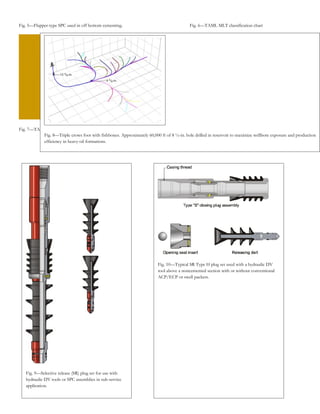
represented in Fig. 4. This practice is typically          main bore where the main body of the lateral is either
performed with some type of DV stage-cementing             cemented or uncemented. Experience with different
tool and in many cases can be performed on surface         multilateral-well plans has led to the common use of
launch or subsurface-launch applications such as           several terms: pitchfork (two parallel laterals), stacked
liners, multilaterals or subsea applications. A modified   lateral (one lateral directly above the other), gull wing
DV stage-cementing tool that incorporates a                (dual-opposing laterals), crow’s foot trilateral (three
mechanical set packer element (stage packer collar or      laterals at ninety degrees to one other, as shown in
SPC) to seal below the cementing ports between the         Fig. 8), and combinations of designs. Fishbone
casing and the wellbore is also represented in Fig. 4.     designs are commonly drilled off to the side of each
Two common SPCs are used extensively in the                main lateral because of the sand-shale laminations
domestic US market. Flapper-type and poppet-type           that are characteristic of some reservoirs.
are commonly used to perform second-stage
cementing above openhole sections where the                Application-Specific Subsurface Plug Types
mechanical set packer element provides low-pressure
annular isolation just before cementing. The poppet-       A single or dual-stage subsurface (Type H selective
style SPC incorporates a back-pressure valve to retain     release or SR) plug assembly (Fig. 9) can be used
the cement in place once displacement is complete          with hydraulic DV stage tools to perform stage
and allows a conventional cementing plug to be used.       cementing in operations where the casing being
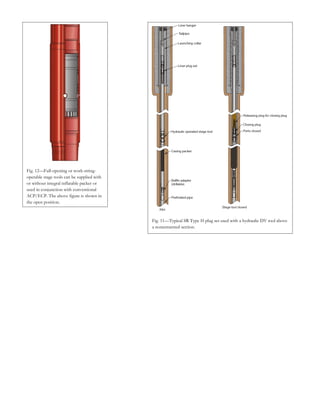
The flapper-type SPC (Fig. 5) requires a latch-down        cemented does not come to the surface. This type of
cementing plug to be used in conjunction with a latch      plug assembly can be used in vertical or horizontal
down seat or baffle to retain the cement in place once     applications below a host of running-tool types and
cementing is complete. The flapper valve is                can be used with inflatable-type annular casing
specifically designed to be used above gas-producing       packers (ACP). A single or dual-stage subsurface plug
assembly typically includes the following features and    to prevent sand influx through the exposed area of
advantages:                                               the casing-window.

      The plug set allows two-stage cementing of              Since the mid-1990s, off-bottom stage-cementing
       liners or casing strings suspended from a          techniques have been used to pump a limited volume
       casing hanger.                                     of cement around the multilateral junction. Typically
      The plug set is compatible with both               less than 50 bbl of cement are required cover the
       hydraulic-set and mechanical-set hanger            junction +/- 300 ft of the lateral liner. The cement is
       systems. The setting ball for hydraulic-set        displaced through a hydraulically opened stage tool to
       hangers must be small enough to pass               bring the cement top up into the parent wellbore
       through the plug set and first-stage shutoff       casing. An external casing packer is used to keep the
       baffle adapter.                                    cement above the slotted liner that was used in the
      The selective-release feature helps prevent the    horizontal section, to not damage the completion. A
       closing plug from releasing prematurely            drillpipe dart displaces the drillpipe and engages a
       before the first-stage latch-down shutoff plug     subsurface-release closing plug to displace the liner
       has been released.                                 and close the cementer. The liner is released by way
      It can be used to cement a slotted liner           of a special adaptation of the subsurface release plug
       suspended below a hydraulic DV stage               set that holds the multilateral liner running tool in the
       cementing combo tool or below an ACP               locked position until the closing plug has been
       below a hydraulic DV stage-cementing tool.         displaced. This prevents premature release of the liner
                                                          string and allows for a simple mechanical release
     The second stage-only or off-bottom cementing        mechanism that can be activated without turning or
(Type S selective release or SR) plug assembly (Fig.      moving the lateral liner.
10) is designed to be used with plug operated DV
stage cementers where no first-stage cementing is              The excess cement is allowed to harden and is
performed. This application is primarily used above       then cleaned out of the inside of the lateral liner via a
openhole completions where slotted pipe, screens, or      3½-in. x 4½-in. combo string, which also drills out
other noncemented lower sections are employed             the plugs and stage tools. In some applications, the
(Fig. 11). In most cases, this plug assembly is           string is run all the way to the shoe of the liner to be
designed for near vertical wells. However, many jobs      sure the slotted liner is clear of obstructions.
have been performed successfully where the deviation
at the stage tool has reached horizontal.                      After the lateral liner has been cemented, the
                                                          Level 4 junction is completed, which recovers the
     Either of these two plug sets or combinations        drilling whipstock and restores full ID access through
between the two can be used to perform various            the wellbore junction. Lateral reentry can be
types of well configurations where multiple-stage         accomplished by the use of a special Completion
cementing operations are performed in a subsurface        whipstock, which can be latched into position relative
application. Though a host of well-specific equipment     to the original casing window.
must be employed while using the selective-release-
plug sets above, this paper will not attempt to           Full-Opening Stage-Cementing Tool
elaborate on the complex combinations available to
                                                              Full-opening stage tools (Fig. 12) enable
drilling engineers performing such cementing
                                                          operators to run casing, cement, and upper-hole
operations. Rather, only a general overview of the
                                                          sections without the need for drilling operations
options available will be covered.
                                                          before stimulation or production operations. The full-
Successful Off-Bottom Cementing Applications              opening multiple-stage cementer or FO cementer
                                                          (FOC) is used to place any number of stages of
    Multilateral-well designs have seen extensive use     cement or other fluids outside a casing string at
in the Latin heavy oil fields to enable cold production   different selected points along the casing. The FOC is
of some very high viscosity fluids. In these wells,       operated manually and requires the use of a drill or
reservoir exposure must be maximized to achieve           tubing string and the sleeve positioner operating tools
economic production, but adding branches to these         (Fig. 13 and 14). After cementing operations are
wells requires an economical way to seal the junction     complete, the work string and casing can be circulated
clean before the work string is POOH, thereby                “More than 200 Multilateral Wells Drilled in the
eliminating subsequent drillout that is required for          Faja Del Orinoco Extra-Heavy Oil Reservoir”.
conventional plug-operated stage tools and saving the         STEVEN R. FIPKE, Halliburton. World Heavy
operator costly rig-time and eliminating debris from          Oil Congress 2008
falling into the noncemented section.                        IADC/SPE 112302. “New Equipment Designs
                                                              Enable Swellable Technology in Cementless
Conclusion                                                    Completions” Hank Rogers, Dave Allison, and
                                                              Earl Webb, Halliburton
     The acceptance of off-bottom cementing methods          Helmy, et al. 2006. Applications of New
complement a host of downhole tools designed                  Technology in the Completion of ERD Wells,
specifically for noncemented applications. Cementing          Sakhalin-1 Development. Paper SPE 103587
annular sections up hole provides long-term annular           presented at the 2006 SPE Russian Oil and Gas
isolation that can easily be performed with the tools         Technical Conference and Exhibition, Moscow,
mentioned in the paper. The use of swell packers,             Russia, 3–6 October.
sleeve collars, screens, or openhole completion              Hinkie, et al. 2007. Multizone Completion With
techniques offer ideal versatility in the noncemented         Accurately Placed Stimulation Through Casing
hole section. Through combining these discrete                Wall. Paper SPE 106705 presented at the 2007
technologies, operators are given a host of well-             SPE Production and Operations Symposium held
construction options in their toolbox. Though this            in Oklahoma City, Oklahoma, 31 March-3 April
paper has covered several unique tool configurations          2007.
that can be used to perform surface and sub-service          “Cementing above screens and slotted liners”,
off bottom cementing, it should not be implied that           Ray Vincent, Baker Oil Tool, World Oil, May
all possible configurations have been covered. Rather,        2000
this paper is meant to serve as an introduction to off-      IADC/SPE 39345. “Development of a One-Trip
bottom cement and related equipment.                          ECP Cement Inflation and Stage Cementing
                                                              System for Open Hole Completions” Martin P.
References
                                                              Coronado, Mark J Knebel. 1998 IADC/SPE
                                                              Drilling Conference held in Dallas, Texas 3-6
                                                              March 1996.


Fig. 1—Conventional openhole or barefoot completion.      Fig. 2—Slotted-liner or gravel-pack completion method.
Fig. 4—Conventional off-bottom cementing application where the
                                                  slurry never contacts the producing or injection interval.
Fig. 3—Conventional cemented casing, perforated
producing interval and production tubing.
Fig. 5—Flapper-type SPC used in off bottom cementing.                                    Fig. 6—TAML MLT classification chart


Fig. 7—TAML Level 4 junction.
          Fig. 8—Triple crows foot with fishbones. Approximately 60,000 ft of 8 ½-in. hole drilled in reservoir to maximize wellbore exposure and production
          efficiency in heavy-oil formations.


                                                                         Fig. 10—Typical SR Type H plug set used with a hydraulic DV
                                                                         tool above a noncemented section with or without conventional
                                                                         ACP/ECP or swell packers.


   Fig. 9—Selective release (SR) plug set for use with
   hydraulic DV tools or SPC assemblies in sub-service
   application.
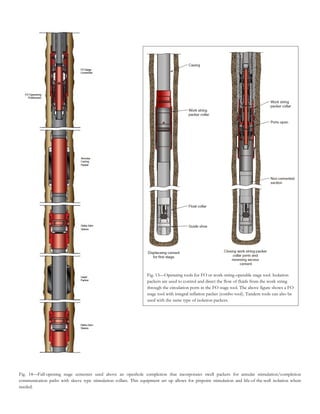
Fig. 12—Full-opening or work-string-
operable stage tools can be supplied with
or without integral inflatable packer or
used in conjunction with conventional
ACP/ECP. The above figure is shown in
the open position.


                                            Fig. 11—Typical SR Type H plug set used with a hydraulic DV tool above
                                            a noncemented section.
Fig. 13—Operating tools for FO or work-string-operable stage tool. Isolation
                                                                   packers are used to control and direct the flow of fluids from the work string
                                                                   through the circulation ports in the FO stage tool. The above figure shows a FO
                                                                   stage tool with integral inflation packer (combo tool). Tandem tools can also be
                                                                   used with the same type of isolation packers.


Fig. 14—Full-opening stage cementer used above an openhole completion that incorporates swell packers for annular stimulation/completion
communication paths with sleeve type stimulation collars. This equipment set up allows for pinpoint stimulation and life-of-the-well isolation where
needed.
off-bottom cementing process used successfully with conventional liner-hanger systems with newly designed selective-release-plug assemblies

off-bottom cementing process used successfully with conventional liner-hanger systems with newly designed selective-release-plug assemblies

  • 1.
    reservoir present, theintended production operations, and many other factors. Dyson et al. (1999) described several sand-control and nonsand-control completion methods, focusing mostly on single-string completions. The following are examples of standard industry methods currently being applied. 2009 NATIONAL TECHNICAL CONFERENCE & EXHIBITION, NEW ORLEANS, LOUISIANA  The most simple and cost-effective AADE 2009NTCE-11-01: completion method available is the openhole or “barefoot” completion. This method is OFF-BOTTOM CEMENTING used in hard formations where the oil- producing zone is consolidated and not loose. PROCESS USED SUCCESSFULLY The oil-producing zone is completely open, WITH CONVENTIONAL LINER- and no liner or perforated casing is used to HANGER SYSTEMS WITH NEWLY case the hole (Fig. 1) (Helmy, et al. 2006). DESIGNED SELECTIVE-RELEASE-  A second completion method involves the use PLUG ASSEMBLIES of a slotted liner or gravel-pack liner. Typically, the liner is suspended or hung from AUTHOR(S) & AFFILIATIONS: the bottom of an intermediate string and does HANK ROGERS, HALLIBURTON not reach surface. These types of liners prevent the entry of sands and solids into the liner ID using either a series of slots or EARL WEBB, HALLIBURTON screens, or using gravel (Fig. 2).  One of the most common methods of STEVEN FIPKE, HALLIBURTON completion is cementing production casing in place through the producing formation, and then perforating the casing. Because the liner or casing must remain in place for the life of Abstract the well and its replacement would be very Operators and drilling contractors are continually costly, another string of pipe called tubing is searching for better drilling, cementing, and run into the well to act as the flow string completion techniques to improve well-construction (Fig. 3). operations. In many cases, combining proven technologies from cementing and completion With the ever-increasing drive to improve the operations can provide economical advantages to productivity of the well-construction process, both the operator and/or turnkey drilling contractor. conventional construction plans are being challenged. Specifically, one configuration that is gaining in During the well-construction phase, when production popularity is a combination of cemented and liners are being installed, a newly designed selective- noncemented sections of the production casing. release-plug system allows stage cementing Typically, this type of cementing technique dates back procedures to be used with both conventional and to the mid 1940s, when the diverter-valve (DV) stage- expandable liner hangers. This paper documents the cementing tool was first introduced. The DV stage- successful application of selective-release stage- cementing tool allowed casing to be cemented at cementing equipment and completion techniques several levels throughout the length of the casing together to provide improved well-construction string by dividing the cement into stages or batches. operations. Each batch is then introduced at the needed level or depth through ports in the DV tool that was run into Background the well as an integral component of the casing. This process allowed for critical isolation to be achieved Numerous completion methods are available for while not requiring slurry to be displaced from TD to producing oil wells and injection wells. The type of the surface. completion method used is governed by the type of Page 1 of 9, 2009ntce-11-01techpaper-110223211712-phpapp02.doc
  • 2.
    When in thewell-construction-planning phase, zones, as the flapper prevents the migration of some operators consider nontraditional completion formation gas into the column of cement during methods to either reduce construction cost, reduce transition. completion cost, or to improve production capacity by reducing formation damage. The use of DV stage- When compared to surface-launch applications, cementing type tools, external casing packers, swell subsurface-launch equipment have functional packers, etc. have provided a host of possible limitations that are not common to surface launch configurations to well planners. By providing so many jobs and therefore increase their complexity, options, casing-equipment suppliers must design their limitations such as dual-plug/plug-launch equipment tools to “plug and play” to provide the versatility that set up where plug/plug means DV tool operating is demanded. plugs are suspended below the running tool and launched when drillpipe wiper plugs launched from The use of DV (or similar) tools above the surface are displaced from the surface to the DV noncemented sections of casing over producing operating plugs. Once the two plugs join together, the intervals allows an upper hole section to be cemented combined plug/plug assembly is then displaced down without contaminating production intervals with the liner or casing to perform their intended function. cement, thus eliminating contact between the cement and cement-sensitive zones where damage to the Multilateral (MLT) junctions present a unique zone can occur when contact with cement is made. In opportunity to address the challenges of off-bottom some cases, cement solids that contact sensitive zones cementing. Many types or classifications of MLT are can plug pores, vugs, or fractures; thereby reducing commonly used in well-construction. In 1998, production potential. Additionally, spacers or flushes Technology Advancement for Multi-Lateral Inc. used to clean filter cake from the wellbore can alter (TAML) formed a JIP to create the TAML some formation clays, further affecting production Classification System (Fig. 6), a detailed multilateral potential. Therefore, performing second-stage technical guide and manual. The original TAML cementing only has become a very popular isolation membership included 18 companies, which were later package. The practice of cementing an upper section reduced to 14 by mergers in the industry (see of casing while not cementing a lower section is www.TAML-INTL.org). TAML Level 4 (Fig. 7) commonly referred to as “off-bottom” cementing. cemented-wellbore junction often uses DV stage One type of off-bottom cementing application is cementers to achieve the cemented junction with the represented in Fig. 4. This practice is typically main bore where the main body of the lateral is either performed with some type of DV stage-cementing cemented or uncemented. Experience with different tool and in many cases can be performed on surface multilateral-well plans has led to the common use of launch or subsurface-launch applications such as several terms: pitchfork (two parallel laterals), stacked liners, multilaterals or subsea applications. A modified lateral (one lateral directly above the other), gull wing DV stage-cementing tool that incorporates a (dual-opposing laterals), crow’s foot trilateral (three mechanical set packer element (stage packer collar or laterals at ninety degrees to one other, as shown in SPC) to seal below the cementing ports between the Fig. 8), and combinations of designs. Fishbone casing and the wellbore is also represented in Fig. 4. designs are commonly drilled off to the side of each Two common SPCs are used extensively in the main lateral because of the sand-shale laminations domestic US market. Flapper-type and poppet-type that are characteristic of some reservoirs. are commonly used to perform second-stage cementing above openhole sections where the Application-Specific Subsurface Plug Types mechanical set packer element provides low-pressure annular isolation just before cementing. The poppet- A single or dual-stage subsurface (Type H selective style SPC incorporates a back-pressure valve to retain release or SR) plug assembly (Fig. 9) can be used the cement in place once displacement is complete with hydraulic DV stage tools to perform stage and allows a conventional cementing plug to be used. cementing in operations where the casing being The flapper-type SPC (Fig. 5) requires a latch-down cemented does not come to the surface. This type of cementing plug to be used in conjunction with a latch plug assembly can be used in vertical or horizontal down seat or baffle to retain the cement in place once applications below a host of running-tool types and cementing is complete. The flapper valve is can be used with inflatable-type annular casing specifically designed to be used above gas-producing packers (ACP). A single or dual-stage subsurface plug
  • 3.
    assembly typically includesthe following features and to prevent sand influx through the exposed area of advantages: the casing-window.  The plug set allows two-stage cementing of Since the mid-1990s, off-bottom stage-cementing liners or casing strings suspended from a techniques have been used to pump a limited volume casing hanger. of cement around the multilateral junction. Typically  The plug set is compatible with both less than 50 bbl of cement are required cover the hydraulic-set and mechanical-set hanger junction +/- 300 ft of the lateral liner. The cement is systems. The setting ball for hydraulic-set displaced through a hydraulically opened stage tool to hangers must be small enough to pass bring the cement top up into the parent wellbore through the plug set and first-stage shutoff casing. An external casing packer is used to keep the baffle adapter. cement above the slotted liner that was used in the  The selective-release feature helps prevent the horizontal section, to not damage the completion. A closing plug from releasing prematurely drillpipe dart displaces the drillpipe and engages a before the first-stage latch-down shutoff plug subsurface-release closing plug to displace the liner has been released. and close the cementer. The liner is released by way  It can be used to cement a slotted liner of a special adaptation of the subsurface release plug suspended below a hydraulic DV stage set that holds the multilateral liner running tool in the cementing combo tool or below an ACP locked position until the closing plug has been below a hydraulic DV stage-cementing tool. displaced. This prevents premature release of the liner string and allows for a simple mechanical release The second stage-only or off-bottom cementing mechanism that can be activated without turning or (Type S selective release or SR) plug assembly (Fig. moving the lateral liner. 10) is designed to be used with plug operated DV stage cementers where no first-stage cementing is The excess cement is allowed to harden and is performed. This application is primarily used above then cleaned out of the inside of the lateral liner via a openhole completions where slotted pipe, screens, or 3½-in. x 4½-in. combo string, which also drills out other noncemented lower sections are employed the plugs and stage tools. In some applications, the (Fig. 11). In most cases, this plug assembly is string is run all the way to the shoe of the liner to be designed for near vertical wells. However, many jobs sure the slotted liner is clear of obstructions. have been performed successfully where the deviation at the stage tool has reached horizontal. After the lateral liner has been cemented, the Level 4 junction is completed, which recovers the Either of these two plug sets or combinations drilling whipstock and restores full ID access through between the two can be used to perform various the wellbore junction. Lateral reentry can be types of well configurations where multiple-stage accomplished by the use of a special Completion cementing operations are performed in a subsurface whipstock, which can be latched into position relative application. Though a host of well-specific equipment to the original casing window. must be employed while using the selective-release- plug sets above, this paper will not attempt to Full-Opening Stage-Cementing Tool elaborate on the complex combinations available to Full-opening stage tools (Fig. 12) enable drilling engineers performing such cementing operators to run casing, cement, and upper-hole operations. Rather, only a general overview of the sections without the need for drilling operations options available will be covered. before stimulation or production operations. The full- Successful Off-Bottom Cementing Applications opening multiple-stage cementer or FO cementer (FOC) is used to place any number of stages of Multilateral-well designs have seen extensive use cement or other fluids outside a casing string at in the Latin heavy oil fields to enable cold production different selected points along the casing. The FOC is of some very high viscosity fluids. In these wells, operated manually and requires the use of a drill or reservoir exposure must be maximized to achieve tubing string and the sleeve positioner operating tools economic production, but adding branches to these (Fig. 13 and 14). After cementing operations are wells requires an economical way to seal the junction complete, the work string and casing can be circulated
  • 4.
    clean before thework string is POOH, thereby  “More than 200 Multilateral Wells Drilled in the eliminating subsequent drillout that is required for Faja Del Orinoco Extra-Heavy Oil Reservoir”. conventional plug-operated stage tools and saving the STEVEN R. FIPKE, Halliburton. World Heavy operator costly rig-time and eliminating debris from Oil Congress 2008 falling into the noncemented section.  IADC/SPE 112302. “New Equipment Designs Enable Swellable Technology in Cementless Conclusion Completions” Hank Rogers, Dave Allison, and Earl Webb, Halliburton The acceptance of off-bottom cementing methods  Helmy, et al. 2006. Applications of New complement a host of downhole tools designed Technology in the Completion of ERD Wells, specifically for noncemented applications. Cementing Sakhalin-1 Development. Paper SPE 103587 annular sections up hole provides long-term annular presented at the 2006 SPE Russian Oil and Gas isolation that can easily be performed with the tools Technical Conference and Exhibition, Moscow, mentioned in the paper. The use of swell packers, Russia, 3–6 October. sleeve collars, screens, or openhole completion  Hinkie, et al. 2007. Multizone Completion With techniques offer ideal versatility in the noncemented Accurately Placed Stimulation Through Casing hole section. Through combining these discrete Wall. Paper SPE 106705 presented at the 2007 technologies, operators are given a host of well- SPE Production and Operations Symposium held construction options in their toolbox. Though this in Oklahoma City, Oklahoma, 31 March-3 April paper has covered several unique tool configurations 2007. that can be used to perform surface and sub-service  “Cementing above screens and slotted liners”, off bottom cementing, it should not be implied that Ray Vincent, Baker Oil Tool, World Oil, May all possible configurations have been covered. Rather, 2000 this paper is meant to serve as an introduction to off-  IADC/SPE 39345. “Development of a One-Trip bottom cement and related equipment. ECP Cement Inflation and Stage Cementing System for Open Hole Completions” Martin P. References Coronado, Mark J Knebel. 1998 IADC/SPE Drilling Conference held in Dallas, Texas 3-6 March 1996. Fig. 1—Conventional openhole or barefoot completion. Fig. 2—Slotted-liner or gravel-pack completion method.
  • 5.
    Fig. 4—Conventional off-bottomcementing application where the slurry never contacts the producing or injection interval. Fig. 3—Conventional cemented casing, perforated producing interval and production tubing.
  • 6.
    Fig. 5—Flapper-type SPCused in off bottom cementing. Fig. 6—TAML MLT classification chart Fig. 7—TAML Level 4 junction. Fig. 8—Triple crows foot with fishbones. Approximately 60,000 ft of 8 ½-in. hole drilled in reservoir to maximize wellbore exposure and production efficiency in heavy-oil formations. Fig. 10—Typical SR Type H plug set used with a hydraulic DV tool above a noncemented section with or without conventional ACP/ECP or swell packers. Fig. 9—Selective release (SR) plug set for use with hydraulic DV tools or SPC assemblies in sub-service application.
  • 7.
    Fig. 12—Full-opening orwork-string- operable stage tools can be supplied with or without integral inflatable packer or used in conjunction with conventional ACP/ECP. The above figure is shown in the open position. Fig. 11—Typical SR Type H plug set used with a hydraulic DV tool above a noncemented section.
  • 8.
    Fig. 13—Operating toolsfor FO or work-string-operable stage tool. Isolation packers are used to control and direct the flow of fluids from the work string through the circulation ports in the FO stage tool. The above figure shows a FO stage tool with integral inflation packer (combo tool). Tandem tools can also be used with the same type of isolation packers. Fig. 14—Full-opening stage cementer used above an openhole completion that incorporates swell packers for annular stimulation/completion communication paths with sleeve type stimulation collars. This equipment set up allows for pinpoint stimulation and life-of-the-well isolation where needed.