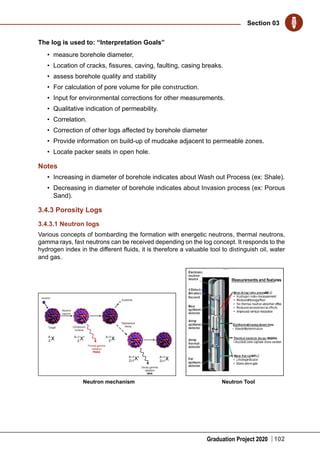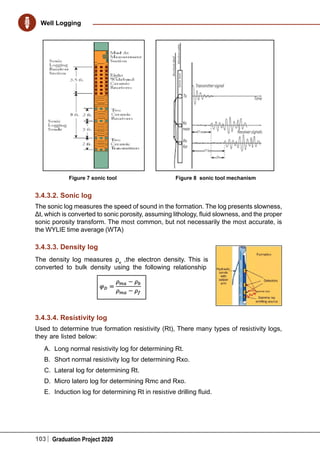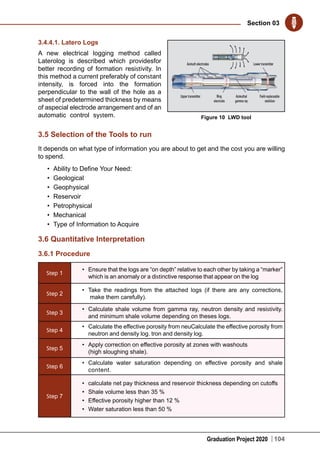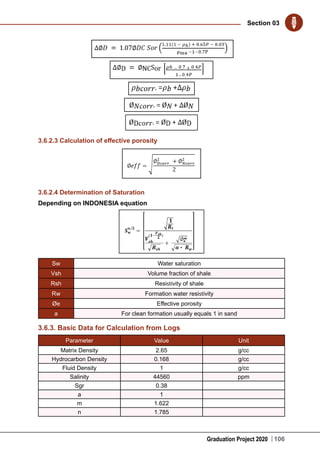





SUEZ UNIVERSITY
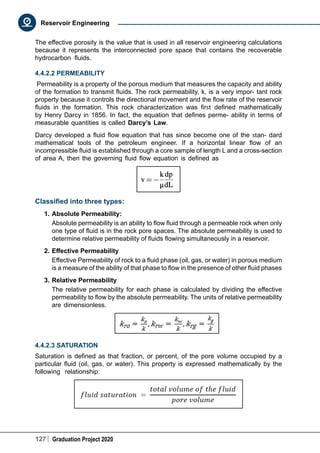
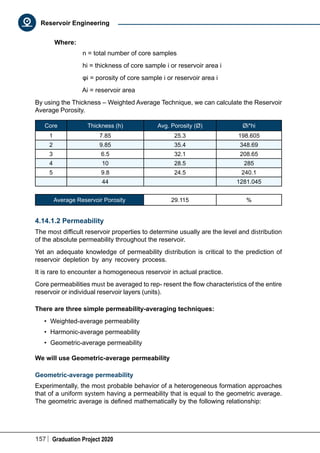
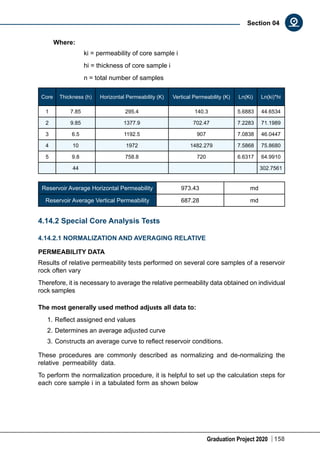
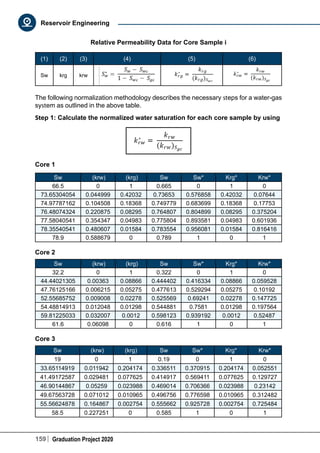
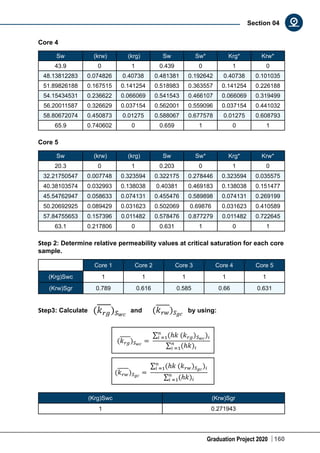
FACULTY OF PETROLEUM AND MINING ENGINEERING
GRADUATION PROJECT 2020
STUDY ON
SIMIAN FIELD
Graduation Project 2020
Chapter 02
6
The study includes the integration between different majors to construct a complete plan
about SIMIAN field. Majors that will be taken in consideration through this study are :
•	 Petroleum Geology and Exploration
•	 Drilling Engineering
•	 Well Logging
•	 Reservoir Engineering
•	 Well Testing
•	 Production Engineering
Petroleum Geology and Exploration
Geology is the science that comprises the study of the solid Earth and the processes by
which it is shaped and changed. Geology provides primary evidence for plate tectonics,
the history of life and evolution, and past climates.
Petroleum geology is the study of origin, occurrence, movement, accumulation, and
exploration of hydrocarbon fuels. It refers to the specific set of geological disciplines that
are applied to the search for hydrocarbons & oil exploration.
Subsurface geology is the combination of underground stratigraphy, structure and geologic
history. The obtained data are placed on maps to help to visualize and understand the
geologic conditions underground and so we can locate wildcat wells and extension wells.
The objective of subsurface petroleum geology is to find and develop oil and gas
reserves. This objective is best achieved by the use and integration of all the available
data and the correct application of these data.
The study will include the following
•	 Constructing structure contour maps (for both top and bottom of reservoir formation)
•	 Constructing Isopach maps
•	 Calculating the OGIP, using both the above two types of maps
7 Graduation Project 2020
Content
Drilling Engineering
Drilling is a process whereby a hole is bored using a drill bit to create a well for oil and
natural gas production. There are various kinds of oil wells with different functions:
•	 Exploration wells (or wildcat wells) are drilled for exploration purposes in new areas
•	 Appraisal wells are those drilled to assess the characteristics of a proven petroleum
reserve such as flow rate.
•	 Development or production wells are drilled for the production of oil or gas in fields
of proven economic and recoverable oil or gas reserves.
•	 Relief wells are drilled to stop the flow from a reservoir when a production well has
experienced a blowout.
•	 An injection well is drilled to enable petroleum engineers to inject steam, carbon
dioxide and other substances into an oil producing unit so as to maintain reservoir
pressure or to lower the viscosity of the oil, allowing it to flow into a nearby well.
The study will include the following
•	 Determine the number of casing strings needed for SEMIAN-3 and select the casing
setting depth for each one
•	 Design the typical program for selecting the weight and grade by using analytical
method for each casing in SIMIAN-3
•	 Design the cement program required
•	 Predicting the drilling problems that can be encountered during drilling SIMIAN-3
and how these problems can be treated in this field
•	 Design the drill string for each section in SIMIAN-3
•	 Design the well trajectory for proposed well by applying directional drilling
•	 Selecting the suitable rig type and its components
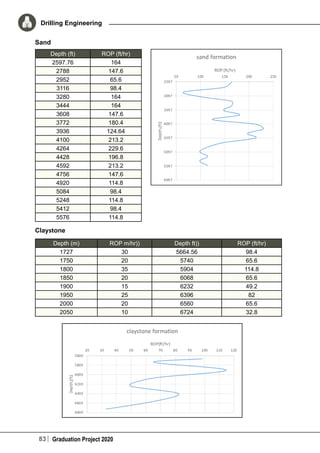
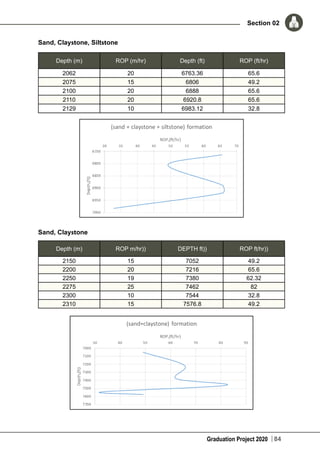
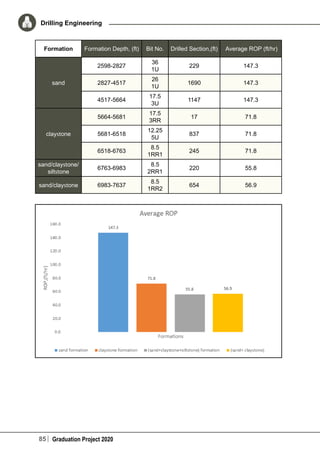
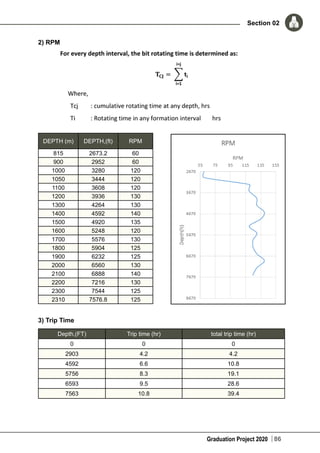
•	 Plotting some drilling parameters (ROP , RPM )
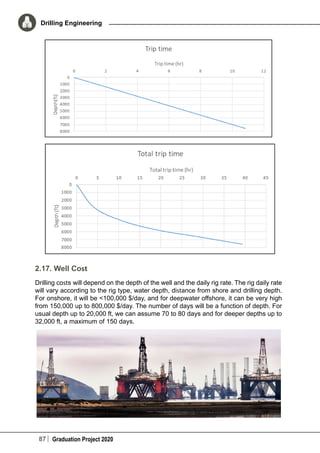
•	 Making a plot for trip and total (trip time ) VS depth
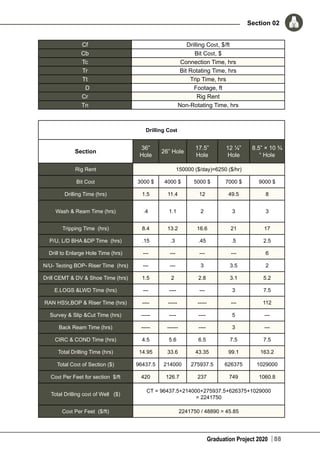
•	 Calculating the total drilling cost for SIMIAN-3
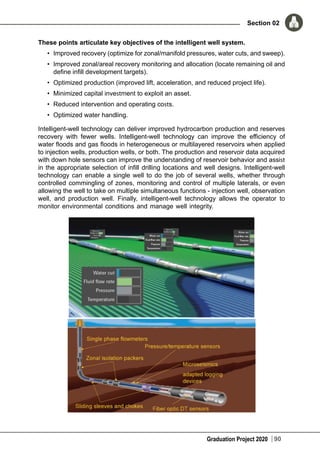
•	 A brief description about intelligent well completion
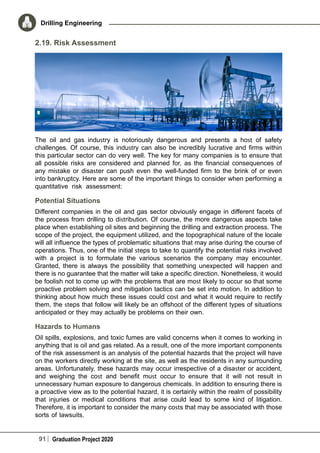
•	 A brief description about risk assessment in drilling
Graduation Project 2020
Chapter 02
8
Well Logging
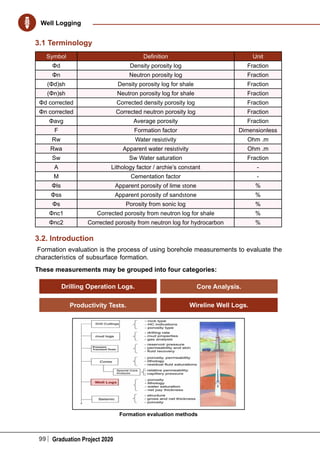
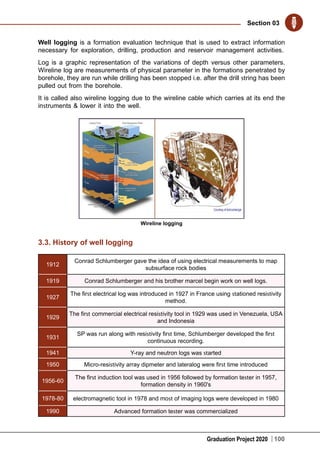
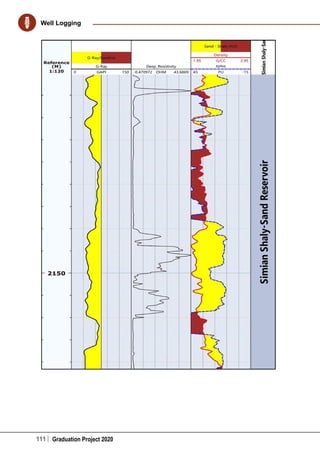
Well logging, also known as borehole logging is the practice of making a detailed record
(a well log) of the geologic formations penetrated by a borehole. The log may be based
either on visual inspection of samples brought to the surface (geological logs) or on
physical measurements made by instruments lowered into the hole (geophysical logs.
Some types of geophysical well logs can be done during any phase of a well’s history:
drilling, completing, producing, or abandoning. Well logging is performed in boreholes
drilled for the oil and gas, groundwater, mineral and geothermal exploration, as well as
part of environmental and geotechnical studies.
The study will include the following
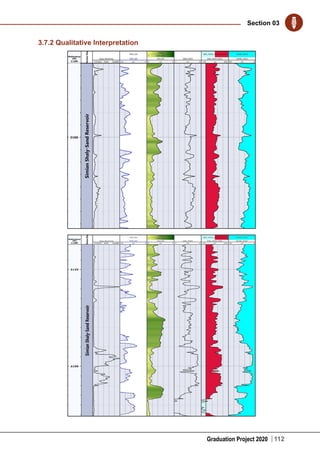
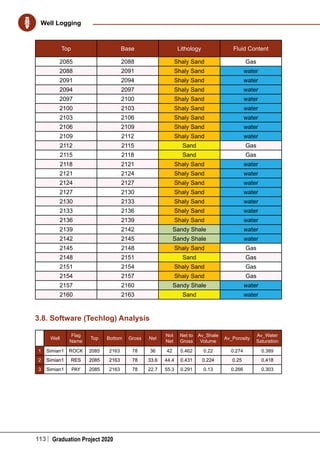
•	 Making qualitative and quantitative interpretation for (Resistivity, Neutron porosity,
Density, Gamma ray) logs
•	 Correlation between different wells
Reservoir Engineering
Reservoir engineering is the technology concerned with the prediction of the optimum
economic recovery of oil or gas from hydrocarbon-bearing reservoirs. It is an eclectic
technology requiring coordinated application of many disciplines: physics, chemistry,
mathematics, geology, and chemical engineering.
Originally, the role of reservoir engineering was exclusively that of counting oil and
natural gas reserves. The reserves are the amount of oil or gas that can be economically
recovered from the reservoir and are a measure of the wealth available to the owner and
operator. It is also necessary to know the reserves in order to make proper decisions
concerning the viability of downstream pipeline, refining, and marketing facilities that will
rely on the production as feed stocks. The scope of reservoir engineering has broadened
to include the analysis of optimum ways for recovering oil and natural gas, and the study
and implementation of enhanced recovery techniques for increasing the recovery above
that which can be expected from the use of conventional technology.
Reservoir engineers also play a central role in field development planning, recommending
appropriate and cost effective reservoir depletion schemes such as water flooding or
gas injection to maximize hydrocarbon recovery. Due to legislative changes in many
hydrocarbon producing countries, they are also involved in the design and implementation
of carbon sequestration projects in order to minimize the emission of greenhouse gases.
The study will include the following
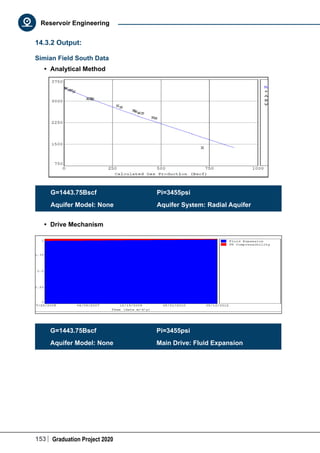
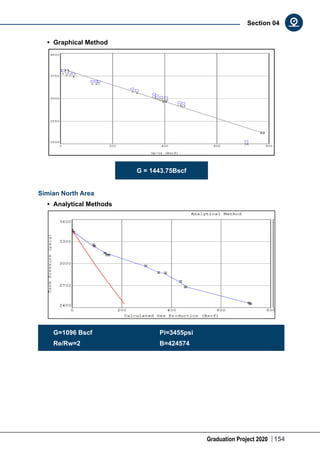
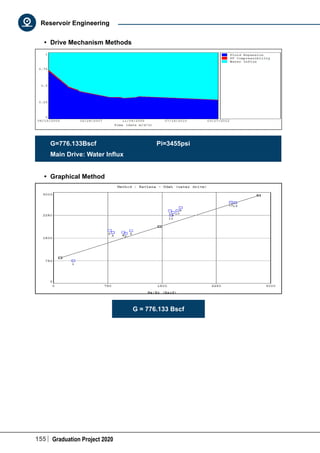
•	 Identifying the reservoir driving mechanism and use the proper MBE for:
•	 Calculating IGIP
•	 Determine the water influx model (if exist)
•	 Run prediction for appropriate constrains
•	 MBAL software Material Balance Tool
9 Graduation Project 2020
Content
Well Testing
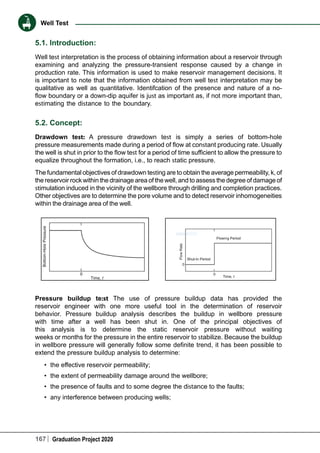
Well test interpretation is the process of obtaining information about a reservoir through
examining and analysing the pressure-transient response caused by a change in
production rate. This information is used to make reservoir management decisions. It
is important to note that the information obtained from well test interpretation may be
qualitative as well as quantitative. Identification of the presence and nature of a no
flow boundary or a down-dip aquifer is just as important as, if not more important than,
estimating the distance to the boundary
The study will include the following
•	 Determine the reservoir boundaries
•	 Determine the reservoir properties
•	 Determine the degree of heterogeneity in the reservoir
Graduation Project 2020
Chapter 02
10
Production Engineering
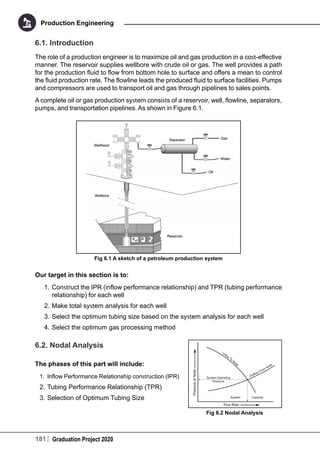
The role of a production engineer is to maximize oil and gas production in a cost-effective
manner. The reservoir supplies wellbore with crude oil or gas. The well provides a path
for the production fluid to flow from bottom hole to surface and offers a mean to control
the fluid production rate. The flow line leads the produced fluid to surface facilities.
Pumps and compressors are used to transport oil and gas through pipelines to sales
points. A complete oil or gas production system consists of a reservoir, well, flow line,
separators, pumps, and transportation pipelines
The study will include the following
•	 Draw the IPR for selected wells (current and future )
•	 Select the optimum tubing size
•	 Make total system analysis for selected wells
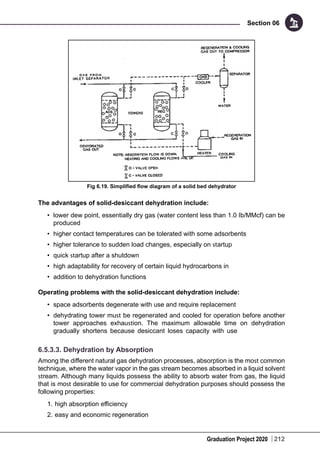
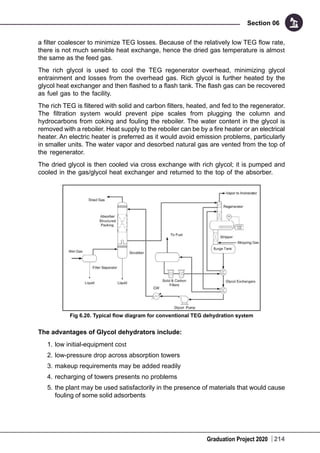
•	 Selecting the optimum gas processing method
15 Graduation Project 2020
Petroleum Geology & Exploration
1.1 Introduction
Geology is the science that comprises the study of the solid Earth and the processes by
which it is shaped and changed. Geology provides primary evidence for plate tectonics,
the history of life and evolution, and past climates.
Petroleum geology is the study of origin, occurrence, movement, accumulation, and
exploration of hydrocarbon fuels. It refers to the specific set of geological disciplines that
are applied to the search for hydrocarbons & oil exploration.
Subsurface geology is the combination of underground stratigraphy, structure and geologic
history. The obtained data are placed on maps to help to visualize and understand the
geologic conditions underground and so we can locate wildcat wells and extension wells.
The objective of subsurface petroleum geology is to find and develop oil and gas
reserves. This objective is best achieved by the use and integration of all the available
data and the correct application of these data.
Data are obtained from:
- Geophysical surveys.
- Pressure and temperature surveys.
- The production history of the producing oil
and gas pools.
1.2 General Overview
1.2.1 Company Foundation
Burullus Gas Company
•	 Business Summary: Provides exploration,
drilling and production of natural gas.
•	 Country of Incorporation: Egypt
•	 Ownership Type: Government
•	 Established In: 1997
•	 Primary Sector: Oil and Gas
•	 Number of Employees: 650
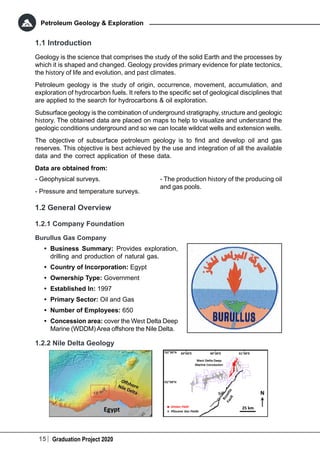
•	 Concession area: cover the West Delta Deep
Marine (WDDM) Area offshore the Nile Delta.
1.2.2 Nile Delta Geology
Graduation Project 2020
Section 01
16
The Nile Delta is one of the classical deltas in the world, with a great history created by the
different civilizations. Beside its great history, the Nile Delta area is one of the major gas provinces
and one of the most promising areas for future petroleum exploration in north eastern Africa.
The Nile Delta is located in northern Egypt, where the Nile River spreads out and drains into the
Mediterranean Sea. It has an area of about 12,500 km2, very flat at the north and reaches up
to 18 m above sea level at Cairo. The Nile Delta is considered one of the world’s largest river
deltas. It covers approximately 230 km of Mediterranean coastline from Alexandria in the west
to Port Said in the east. The outer edges of the delta are eroding, and some coastal lakes such
as El Manzala and Burulls have experienced an increasing salinity levels as their connection to
the Mediterranean Sea increases.
The study area is part of the West Delta Deep Marine (WDDM) license which extends from 90
to 100 km offshore (250 - 1500 m water depth) of the present Nile Delta.
The WDDM license covers 8200 km2 on the north-western margin of the Nile delta cone.
Exploration activities at WDDM started in 1997. A series of successive successful exploration
and appraisal wells were drilled by British Gas (BG)-Egypt and Rashpetco. The main drilling
target was the Pliocene gas-bearing sands in slope canyon settings on the concession.
The studied area contains Simian and Sienna fields, located in WDDM in Simian/Sienna
development lease. The fields are approximately 120 kilometers offshore Idku, near Alexandria.
1.2.3 Simian Field
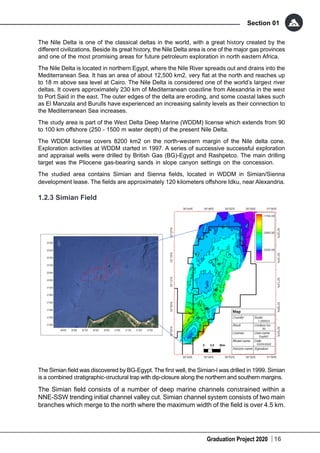
The Simian field was discovered by BG-Egypt. The first well, the Simian-l was drilled in 1999. Simian
is a combined stratigraphic-structural trap with dip-closure along the northern and southern margins.
The Simian field consists of a number of deep marine channels constrained within a
NNE-SSW trending initial channel valley cut. Simian channel system consists of two main
branches which merge to the north where the maximum width of the field is over 4.5 km.
17 Graduation Project 2020
Petroleum Geology & Exploration
1.2.4 Stratigraphy
Late Pliocene to Early Pleistocene is represented by El Wastani Formation. It forms a
regressive sequence that unconformably overlies the Kafr El Sheikh Formation. The
depth of El Wastani Formation ranges from 900 m to 1000 m. The thickness appears
to be controlled by the Rosetta fault that was active in the top of the Kafr El-Sheikh
Formation due to the dipping of the formation to the NW and SW.
El Wastani Formation consists of clean and shaley Sandstones with interbedded
Claystones and Siltstone laminations
The depositional setting of the Plio-Pliestocene, Wastani Formation, is largely controlled
by both relative sea level changes and slope generated by major structural trends
(Rosetta and NDOA). The channel evolution through time is not very clearly defined
due to the lack of drilled wells, cores and stratigraphic heterogeneities of the reservoirs.
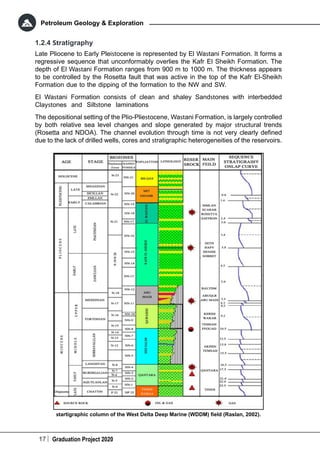
startigraphic column of the West Delta Deep Marine (WDDM) field (Raslan, 2002).
Graduation Project 2020
Section 01
18
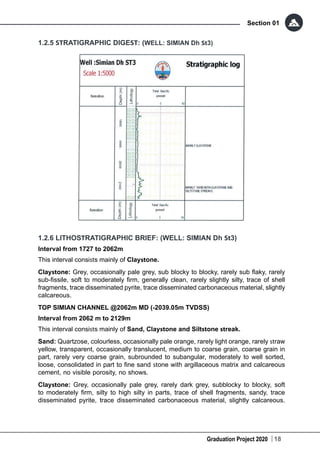
1.2.5 STRATIGRAPHIC DIGEST: (WELL: SIMIAN Dh St3)
1.2.6 LITHOSTRATIGRAPHIC BRIEF: (WELL: SIMIAN Dh St3)
Interval from 1727 to 2062m
This interval consists mainly of CIaystone.
Claystone: Grey, occasionally pale grey, sub blocky to blocky, rarely sub flaky, rarely
sub-fissile, soft to moderately firm, generally clean, rarely slightly silty, trace of shell
fragments, trace disseminated pyrite, trace disseminated carbonaceous material, slightly
calcareous.
TOP SIMIAN CHANNEL @2062m MD (-2039.05m TVDSS)
Interval from 2062 m to 2129m
This interval consists mainly of Sand, Claystone and Siltstone streak.
Sand: Quartzose, colourless, occasionally pale orange, rarely light orange, rarely straw
yellow, transparent, occasionally translucent, medium to coarse grain, coarse grain in
part, rarely very coarse grain, subrounded to subangular, moderately to well sorted,
loose, consolidated in part to fine sand stone with argillaceous matrix and calcareous
cement, no visible porosity, no shows.
Claystone: Grey, occasionally pale grey, rarely dark grey, subblocky to blocky, soft
to moderately firm, silty to high silty in parts, trace of shell fragments, sandy, trace
disseminated pyrite, trace disseminated carbonaceous material, slightly calcareous.
19 Graduation Project 2020
Petroleum Geology & Exploration
Siltstone: Pale grey, occasionally greenish grey, rarely light grey, sub blocky, soft to
moderately firm, occasionally grading to very fine sandstone glauconitic in parts highly
argillaceous, non calcareous.
Interval from 2129m to 2164m (F.T.D)
This interval consists mainly Sand with Claystone.
Sand: Quartzose, colourless, rarely light orange, transparent to translucent, fine to
medium grain, occasionally coarse grain, rarely very fine grain, loose, subrounded to
subangular, rarely rounded moderately to ill sorted, no visible porosIty, no shows.
Claystone: Grey, occasionally pale grey, rarely dark grey, subblocky to blocky, soft
to moderately firm, silty to high silty in parts, trace of shell fragments, sandy, trace
disseminated pyrite, trace disseminated carbonaceous material, slightly calcareous.
1.3 Geologic Maps
Geologic maps are used to:
1.	Show the geologic history of the region.
2.	Determine the kind of trap.
3.	Estimate the initial hydrocarbon in place.
4.	Predict the location of petroleum pools of the new geologic data uncovered.
5.	Determine the location of source rock and the reservoir rock.
Contour lines:
•	 A contour line is a line that passes through points having the same elevation.
•	 Contour lines are characterized by the following:
•	 Contour lines are continuous.
•	 Contour lines are relatively parallel unless one of two conditions exist.
•	 A series of V-shape indicates a valley and the V’s point to higher elevation.
•	 A series U shape indicates a ridge. The U shapes will point to lower elevation.
•	 Evenly spaced lines indicate an area of uniform slope.
1.3.1 Types of Geologic Maps
•	 Surface maps: for surface anomalies.
•	 Subsurface maps: for subsurface anomalies.
Graduation Project 2020
Section 01
20
1.3.2 Types of Subsurface Maps
	– Structure contour maps, and Cross sections
–	 Isofacies maps
–	 Paleogeologic and subcrop maps
–	 Hydrodynamic maps
–	 Geophysical maps
–	 Geochemical maps
–	 Internal property maps = Miscellaneous maps
–	 Isohydrocarbon map
–	 Isopach map
1.3.2.1 Structure Contour Maps and Cross Sections
Subsurface structures may be mapped on any formation boundary, unconformity, or
producing formation that can be identified and correlated by well data. Structure may be
shown by contour elevation maps or by cross-sections.
1.3.2.2 Isofacies Maps
There are several kinds of facies maps, but the most common type used in petroleum
geology are Lithofacies Maps, they can be divided into:
Lithofacies maps:
These maps distinguish the various lithologic types rather than formations.
Isolith maps:
These maps show the net thickness of certain lithology specially sandstone.
1.3.2.3 Paleo-Geologic and Sub-Crop Maps
Paleogeology may be defined as the science that treats the geology as it was during
various geologic periods.
A paleogeologic map: A map that shows the paleogeology of an ancient surface.
A subcrop map: A paleogeologic map in which the overlying formation is still present
where as a paleogeologic map shows the formation boundaries projected in part into the
area from which the overlying formation has been eroded.
1.3.2.4 Hydrodynamic Maps
These maps represent the relation between equipotential surface of oil and water in the
reservoir.
They represent the surface normal to which the movement of two fluids takes place.
It gives information about the direction of fluid movement, density of water and density of oil.
21 Graduation Project 2020
Petroleum Geology & Exploration
1.3.2.5 Geophysical Maps
These maps depend on geophysical anomaly (such as local variations or irregularity in the
normal pattern) which after correction may be attributed to some geologic phenomena.
1.3.2.6 Geochemical Maps
These maps are used for mapping various kinds of chemical analysis of rocks and
their fluid contents. It may show the surface distribution of hydrocarbons where those
hydrocarbons are found at the surface in large amounts than normal indicating that there
is a seepage of oil or gas.
1.3.2.7 Miscellaneous Maps
These maps are prepared to show and illustrate specific phenomena. There are many
types of miscellaneous maps such as:
•	 Isoporosity maps: which show the lines of equal porosity in the potential reservoir
rock.
•	 Isobar maps: which show by contours the reservoir pressure in a pool.
•	 Isopotential maps: which show the initial or calculated daily rate production of
wells in a pool.
•	 Iso concentration maps: which show the concentration of salts in oil-field waters
by contours.
•	 Water encroachment maps: which show the position of wells from which water is
produced along with the oil.
•	 Isochore maps: which are lines joining points of equal vertical thickness. So
isochors maps record the vertical thickness of geological unit’s. These maps
illustrate such features as the depth of overburden above some deposits.
•	 Isovolume maps: which show the contours of equal porosity porosity-ft (net
thickness X porosity).
1.3.2.8 Isohydrocarbon Maps
Hydrocarbon potential = net pay thickness * porosity * hydrocarbon saturation
1.3.2.9 Isopach Maps
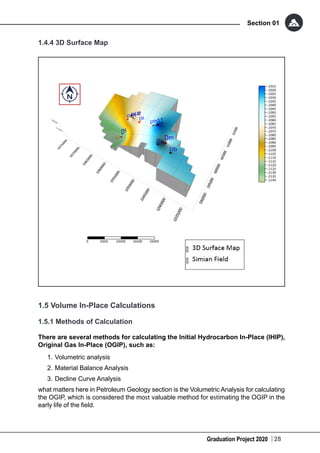
Isopach maps show by means of contour the varying thickness of the rock intervening
between two reference planes commonly bedding planes or surfaces of unconformity.
Isopach maps Offer a simple method of showing the distribution of a geological unit in
three-dimension (3D) thickness of individual formations of reservoir rocks of groups
of formations of intervals between unconformities or of intervals between a surface of
unconformity and a normal stratigraphic contactor formation boundary, may be mapped
in this manner. An Isochore map delineates the true vertical thickness, while isopach
illustrates the stratigraphic thickness.
Graduation Project 2020
Section 01
22
Isopach maps are used to:
•	 Determine the type of faulting and folding.
•	 The type of traps formation in regional studies.
•	 Development of a pool especially in showing the thickness of the pay formation.
Some Concepts
A. Pay determination
Several terms are used to describe the thickness of reservoir rock at a well. The
reservoir engineer must know what gross reservoir thickness, gross pay thickness and
net pay thickness are. Reservoir intervals that will contribute to reservoir production
are known as “pay”. Intervals that are accepted or eliminated from consideration as
pay are done so on the basis of their fluid saturation content, porosity, permeability,
and shaliness. The recognition of pay zones is an essential part of reservoir evaluation
both as a guide to perforation depths and in the computation of field reserves. The
terminology of pay determination is rather loose, but the criteria defined below are
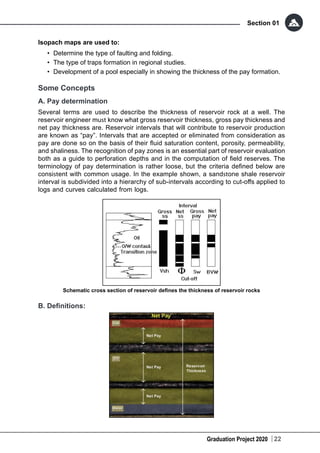
consistent with common usage. In the example shown, a sandstone shale reservoir
interval is subdivided into a hierarchy of sub-intervals according to cut-offs applied to
logs and curves calculated from logs.
Schematic cross section of reservoir defines the thickness of reservoir rocks
B. Definitions:
23 Graduation Project 2020
Petroleum Geology & Exploration
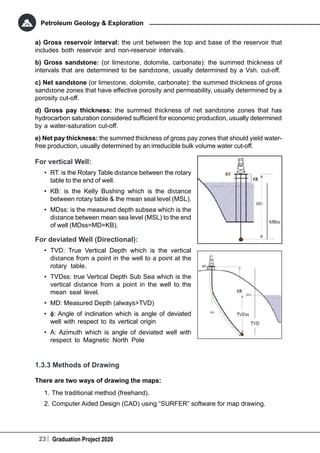
a) Gross reservoir interval: the unit between the top and base of the reservoir that
includes both reservoir and non-reservoir intervals.
b) Gross sandstone: (or limestone, dolomite, carbonate): the summed thickness of
intervals that are determined to be sandstone, usually determined by a Vsh. cut-off.
c) Net sandstone (or limestone, dolomite, carbonate): the summed thickness of gross
sandstone zones that have effective porosity and permeability, usually determined by a
porosity cut-off.
d) Gross pay thickness: the summed thickness of net sandstone zones that has
hydrocarbon saturation considered sufficient for economic production, usually determined
by a water-saturation cut-off.
e) Net pay thickness: the summed thickness of gross pay zones that should yield water-
free production, usually determined by an irreducible bulk volume water cut-off.
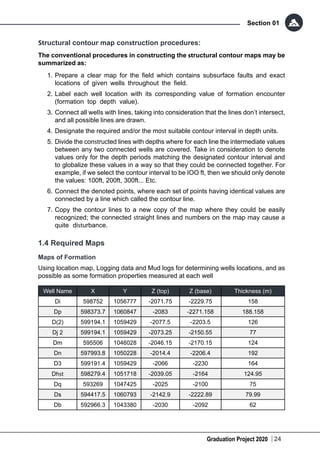
For vertical Well:
•	 RT: is the Rotary Table distance between the rotary
table to the end of well.
•	 KB: is the Kelly Bushing which is the distance
between rotary table & the mean seal level (MSL).
•	 MDss: is the measured depth subsea which is the
distance between mean sea level (MSL) to the end
of well (MDss=MD=KB).
For deviated Well (Directional):
•	 TVD: True Vertical Depth which is the vertical
distance from a point in the well to a point at the
rotary table.
•	 TVDss: true Vertical Depth Sub Sea which is the
vertical distance from a point in the well to the
mean seal level.
•	 MD: Measured Depth (always>TVD)
•	 ɸ: Angle of inclination which is angle of deviated
well with respect to its vertical origin
•	 A: Azimuth which is angle of deviated well with
respect to Magnetic North Pole
1.3.3 Methods of Drawing
There are two ways of drawing the maps:
1.	The traditional method (freehand).
2.	Computer Aided Design (CAD) using “SURFER” software for map drawing.
Graduation Project 2020
Section 01
24
Structural contour map construction procedures:
The conventional procedures in constructing the structural contour maps may be
summarized as:
1.	Prepare a clear map for the field which contains subsurface faults and exact
locations of given wells throughout the field.
2.	Label each well location with its corresponding value of formation encounter
(formation top depth value).
3.	Connect all welIs with lines, taking into consideration that the lines don’t intersect,
and all possible lines are drawn.
4.	Designate the required and/or the most suitable contour interval in depth units.
5.	Divide the constructed lines with depths where for each line the intermediate values
between any two connected wells are covered. Take in consideration to denote
values only for the depth periods matching the designated contour interval and
to globalize these values in a way so that they could be connected together. For
example, if we select the contour interval to be IOO ft, then we should only denote
the values: 100ft, 200ft, 300ft... Etc.
6.	Connect the denoted points, where each set of points having identical values are
connected by a line which called the contour line.
7.	Copy the contour lines to a new copy of the map where they could be easily
recognized; the connected straight lines and numbers on the map may cause a
quite disturbance.
1.4 Required Maps
Maps of Formation
Using location map, Logging data and Mud logs for determining wells locations, and as
possible as some formation properties measured at each well
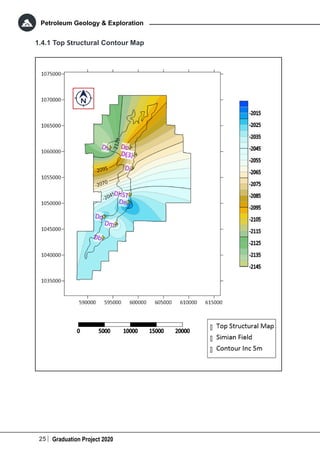
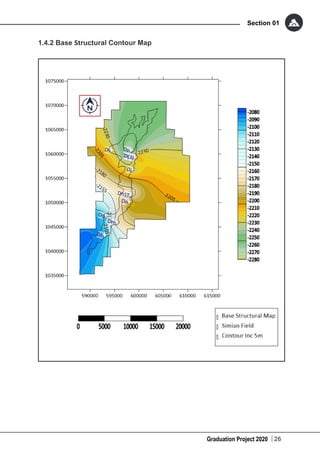
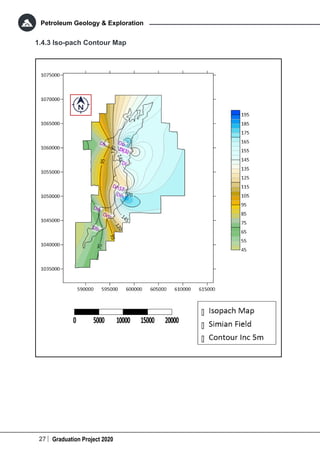
Well Name X Y Z (top) Z (base) Thickness (m)
Di 598752 1056777 -2071.75 -2229.75 158
Dp 598373.7 1060847 -2083 -2271.158 188.158
D(2) 599194.1 1059429 -2077.5 -2203.5 126
Dj 2 599194.1 1059429 -2073.25 -2150.55 77
Dm 595506 1046028 -2046.15 -2170.15 124
Dn 597993.8 1050228 -2014.4 -2206.4 192
D3 599191.4 1059429 -2066 -2230 164
Dhst 598279.4 1051718 -2039.05 -2164 124.95
Dq 593269 1047425 -2025 -2100 75
Ds 594417.5 1060793 -2142.9 -2222.89 79.99
Db 592966.3 1043380 -2030 -2092 62
25 Graduation Project 2020
Petroleum Geology & Exploration
1.4.1 Top Structural Contour Map
Graduation Project 2020
Section 01
26
1.4.2 Base Structural Contour Map
27 Graduation Project 2020
Petroleum Geology & Exploration
1.4.3 Iso-pach Contour Map
Graduation Project 2020
Section 01
28
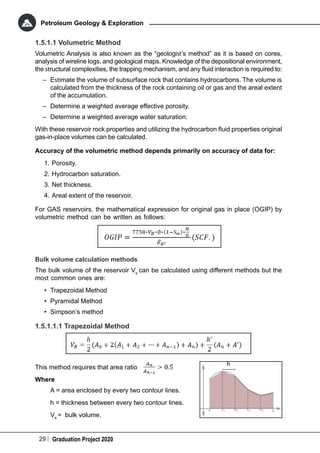
1.4.4 3D Surface Map
1.5 Volume In-Place Calculations
1.5.1 Methods of Calculation
There are several methods for calculating the Initial Hydrocarbon In-Place (IHIP),
Original Gas In-Place (OGIP), such as:
1.	Volumetric analysis
2.	Material Balance Analysis
3.	Decline Curve Analysis
what matters here in Petroleum Geology section is the Volumetric Analysis for calculating
the OGIP, which is considered the most valuable method for estimating the OGIP in the
early life of the field.
29 Graduation Project 2020
Petroleum Geology & Exploration
1.5.1.1 Volumetric Method
Volumetric Analysis is also known as the “geologist’s method” as it is based on cores,
analysis of wireline logs, and geological maps. Knowledge of the depositional environment,
the structural complexities, the trapping mechanism, and any fluid interaction is required to:
–	 Estimate the volume of subsurface rock that contains hydrocarbons. The volume is
calculated from the thickness of the rock containing oil or gas and the areal extent
of the accumulation.
–	 Determine a weighted average effective porosity.
–	 Determine a weighted average water saturation.
With these reservoir rock properties and utilizing the hydrocarbon fluid properties original
gas-in-place volumes can be calculated.
Accuracy of the volumetric method depends primarily on accuracy of data for:
1.	Porosity.
2.	Hydrocarbon saturation.
3.	Net thickness.
4.	Areal extent of the reservoir.
For GAS reservoirs, the mathematical expression for original gas in place (OGIP) by
volumetric method can be written as follows:
Bulk volume calculation methods
The bulk volume of the reservoir Vb
can be calculated using different methods but the
most common ones are:
•	 Trapezoidal Method
•	 Pyramidal Method
•	 Simpson’s method
1.5.1.1.1 Trapezoidal Method
This method requires that area ratio
Where
A = area enclosed by every two contour lines.
h = thickness between every two contour lines.
Vb
= bulk volume.
Graduation Project 2020
Section 01
30
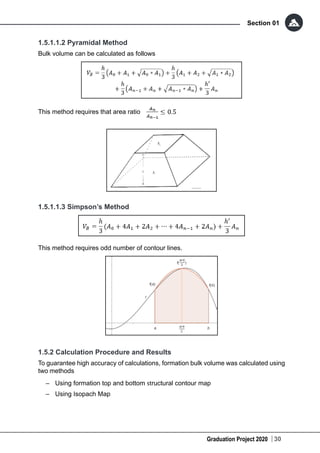
1.5.1.1.2 Pyramidal Method
Bulk volume can be calculated as follows
This method requires that area ratio
1.5.1.1.3 Simpson’s Method
This method requires odd number of contour lines.
1.5.2 Calculation Procedure and Results
To guarantee high accuracy of calculations, formation bulk volume was calculated using
two methods
–	 Using formation top and bottom structural contour map
–	 Using Isopach Map
31 Graduation Project 2020
Petroleum Geology & Exploration
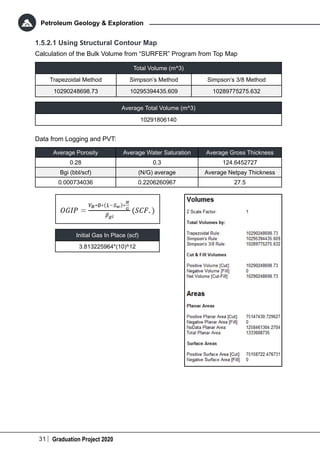
1.5.2.1 Using Structural Contour Map
Calculation of the Bulk Volume from “SURFER” Program from Top Map
Total Volume (m^3)
Trapezoidal Method Simpson’s Method Simpson’s 3/8 Method
10290248698.73 10295394435.609 10289775275.632
Average Total Volume (m^3)
10291806140
Data from Logging and PVT:
Average Porosity Average Water Saturation Average Gross Thickness
0.28 0.3 124.6452727
Bgi (bbl/scf) (N/G) average Average Netpay Thickness
0.000734036 0.2206260967 27.5
Initial Gas In Place (scf)
3.813225964*(10)^12
Graduation Project 2020
Section 01
32
1.6 References
1. Prof. Dr S. E. Shalaby, ‘’Petroleum Geology’’, Faculty of Petroleum and Mining
Engineering, Suez University.
2. Prof. Dr S. E. Shalaby, ‘’An Introduction To Petroleum Engineering’’, Faculty of
Petroleum and Mining Engineering, Suez University.
3. Prof. Dr Hamed Khatab notes, Faculty of Petroleum and Mining Engineering,
Suez University.
4. Research Paper “ Seismic Imaging and Reservoir Architecture of Sub-Marine
Channel Systems Offshore West Nile Delta of Egypt”, Essam F Sharaf, Hamdy Seisa,
I.M. Korrat and Eslam Esmaiel.
35 Graduation Project 2020
Drilling Engineering
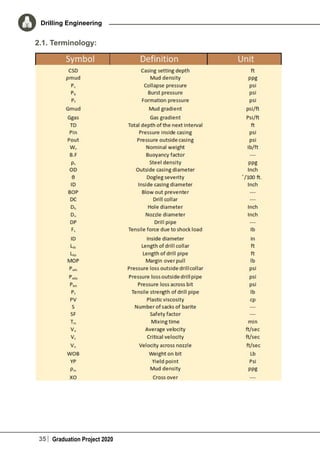
2.1. Terminology:
Graduation Project 2020
Section 02
36
2.2. Well Summary:
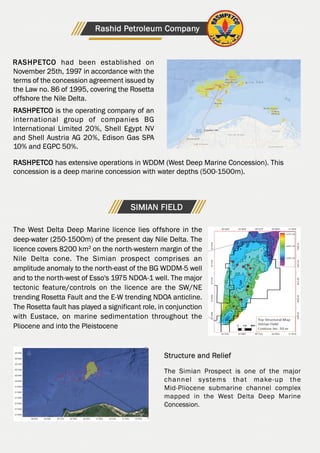
The appraisal well Simian-3, operated by Rashid Petroleum Company (Rashpetco), was
drilled using the Atwood Oceanics semi-submersible ‘Eagle’ between 22nd June 2000
and 7th July 2000.
Located northeast of Alexandria, Simian-3 was sited in the eastern portion of the West
Delta Deep Marine concession, which lies offshore in the deep water (250-1500m) of
the present day Nile Delta.  The license covers 8050 km2 on the north-western margin
of the Nile delta cone. The major tectonic features/controls on the license are the SW/
NE trending Rosetta Fault and the ENE-WSW trending NDOA anticline.
Simian is one of the major channel systems that make up the Mid-Pliocene submarine
channel complex mapped in the West Delta Deep Marine Concession. Simian is broadly
orientated NNE-SSW in direction and has two distinct branches that merge to the north.
Numerous, meandering channels are concentrated within the main branch.
The Simian-3 location was chosen to penetrate the central part of the Simian Channel
system approximately half-way between the successful Simian-1 and Simian-2 wells.
The objectives were to assess the reservoir facies distribution, petrophysical quality and
hydrocarbon charge by cuttings, cores and log analysis of the Simian Channel, as well
as to confirm the mapped continuity of the Simian Channel system through reservoir
pressures, fluid samples and fluid contacts.
A vertical hole was drilled to a TD of 2310mMD (-2286.5mTVDSS), successfully
penetrating the gas bearing Simian Channel unit within the Late Pliocene El Wastani
Formation, which comprised of clean and shaley Sandstones with interbedded
Claystones and Siltstone laminations. Top Simian reservoir was found at 2065.5mMD
(-2042.0mTVDSS), 11.0m high to prognosis.
A full Schlumberger openhole logging suite was made at final TD of the 8 ½” hole
over the Simian Channel. An intermediate DSI/TLD/APSGR run was made in the 12 ¼”
section. LWD was provided by Sperry Sun throughout the 12 ¼” (EWR/GR/MWD) and
8 ½” (EWR/GR/MWD) drilling phases.
Wireline MDT pressure measurements over the Simian Channel gave well defined gas
and water gradients of 0.232psi/m (0.163g/cc) and 1.432psi/m (1.007g/cc) respectively,
confirming connectivity between all the individual gas bearing beds with a continuous
119.0m gas column at this location. Pressures were also consistent with a single gas
reservoir between the current three Simian wells, though with a gas/water contact in
Simian-3 at 2184.5m MD (-2161.0m TVDSS), some 22m deeper than found in Simian-1
and 13.5m shallower than at the Simian-2 location. Top reservoir pressure was 3436psia
(9.73ppgEMW). Petrophysical analysis of the Simian gas leg gave a high case result
of 93.7m of net pay (78.7% net/gross) with average porosity 21.7% and average water
saturation 41.7%.
Gas samples were obtained in the Simian Channel with the MDT tool at 2078.4m and
2169.2m. A good water sample was also obtained in the Simian Channel.
No conventional cores were cut in this well, though 60 sidewall cores were shot in the
Simian reservoir and non-reservoir intervals with 47 recovered.
37 Graduation Project 2020
Drilling Engineering
2.3. Introduction:
Drilling is a process whereby a hole is bored using a drill bit to create a well for oil and 
natural gas production.  There are various kinds of oil wells with different functions:
•	 Exploration wells (or wildcat wells) are drilled for exploration purposes in new areas.
The location of the exploration well is determined by geologists.  
•	 Appraisal wells are those drilled to assess the characteristics of a proven petroleum
reserve such as flow rate.
•	 Development or production wells are drilled for the production of oil or gas in fields
of proven economic and recoverable oil or gas reserves.
•	 Relief wells are drilled to stop the flow from a reservoir when a production well has
experienced a blowout.
•	 An injection well is drilled to enable petroleum engineers to inject steam, carbon
dioxide and other substances into an oil producing unit so as to maintain reservoir
pressure or to lower the viscosity of the oil, allowing it to flow into a nearby well.
The process of drilling an oil and natural gas production well involves several
important steps:
•	 Boring - a drill bit and pipe are used to create a hole vertically into the
ground. Sometimes, drilling operations cannot be completed directly above
an oil or gas reservoir, for example, when reserves are situated under residential
areas. Fortunately, a process called directional drilling can be done to bore a well at
an angle. This process is done by boring a vertical well and then angling it towards
the reservoir. 
•	 Circulation - drilling mud is circulated into the hole and back to the surface for
various functions including the removal of rock cuttings from the hole and the
maintenance of working temperatures and pressures.
•	 Casing - once the hole is at the desired depth, the well requires a cement casing
to prevent collapse.
•	 Completion - after a well has been cased, it needs to be readied for production.  Small
holes called perforations are made in the portion of the casing which passed
through the production zone, to provide a path for the oil or gas to flow.
•	 Production - this is the phase of the well’s life where it actually produces oil and/
or gas.
•	 Abandonment - when a well has reached the end of its useful life (this is usually
determined by economics), it is plugged and abandoned to protect the surrounding
environment.
Graduation Project 2020
Section 02
38
2.4. Offshore Drilling Rigs:
An offshore rig is a large structure on or in water with facilities to drill wells, to extract
and process oil and natural gas, and to temporarily store product until it can be brought
to shore for refining and marketing. In many cases, the platform contains facilities to
house the workforce as well.
Offshore rigs are similar to land rigs but with several additional features to adapt them
to the marine environment. Those features include
•	 Heliport
•	 Living quarters
•	 Cranes
•	 Risers
The heliport, also known as the helipad, is a large deck area that is placed high and to
the side of offshore rigs. It is an important feature since helicopters are often the primary
means of transportation. The living quarters usually comprise bedrooms, a dining hall, a
recreation room, office space, and an infirmary. Escape boats are usually located near
the living quarters.
Cranes are used to move equipment and material from work boats onto the rig and to
shift the loads around on the rig. Most rigs have more than one crane to ensure that
all areas are accessible. A riser is used to extend the wellhead from the mudline to
the surface. On platforms and jackup rigs, the blowout preventers (BOPs) are mounted
above sea level. On floaters, the BOPs are mounted on the seafloor.
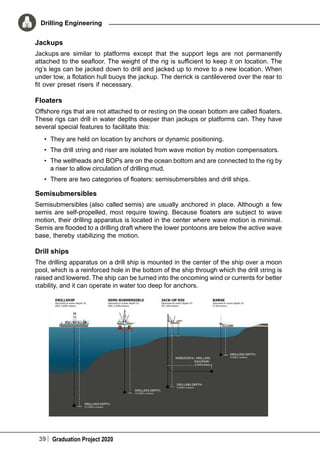
The various types of offshore rigs include barges, submersibles, platforms,
jackups, and floaters (the latter of which include semisubmersibles and drill
ships).
Barges
A barge rig is designed to work in shallow water (less than 20 ft deep). The rig is floated
to the drillsite, and the lower hull is sunk to rest on the sea bottom. The large surface
area of the lower hull keeps the rig from sinking into the soft mud and provides a stable
drilling platform.
Submersibles
A submersible rig is a barge that is designed to work in deeper water (to 50 ft deep). It
has extensions that allow it to raise its upper hull above the water level.
Platforms
Platforms use a jacket (a steel tubular framework anchored to the ocean bottom) to support
the surface production equipment, living quarters, and drilling rig. Multiple directional
wells are drilled from the platform by using a rig with a movable substructure. The rig is
positioned over preset wellheads by jacking across on skid beams. After all the wells
are drilled, the rig and quarters are removed from the platform. Smaller platforms use a
jackup rig to drill the wells.
39 Graduation Project 2020
Drilling Engineering
Jackups
Jackups are similar to platforms except that the support legs are not permanently
attached to the seafloor. The weight of the rig is sufficient to keep it on location. The
rig’s legs can be jacked down to drill and jacked up to move to a new location. When
under tow, a flotation hull buoys the jackup. The derrick is cantilevered over the rear to
fit over preset risers if necessary.
Floaters
Offshore rigs that are not attached to or resting on the ocean bottom are called floaters.
These rigs can drill in water depths deeper than jackups or platforms can. They have
several special features to facilitate this:
•	 They are held on location by anchors or dynamic positioning.
•	 The drill string and riser are isolated from wave motion by motion compensators.
•	 The wellheads and BOPs are on the ocean bottom and are connected to the rig by
a riser to allow circulation of drilling mud.
•	 There are two categories of floaters: semisubmersibles and drill ships.
Semisubmersibles
Semisubmersibles (also called semis) are usually anchored in place. Although a few
semis are self-propelled, most require towing. Because floaters are subject to wave
motion, their drilling apparatus is located in the center where wave motion is minimal.
Semis are flooded to a drilling draft where the lower pontoons are below the active wave
base, thereby stabilizing the motion.
Drill ships
The drilling apparatus on a drill ship is mounted in the center of the ship over a moon
pool, which is a reinforced hole in the bottom of the ship through which the drill string is
raised and lowered. The ship can be turned into the oncoming wind or currents for better
stability, and it can operate in water too deep for anchors.
Graduation Project 2020
Section 02
40
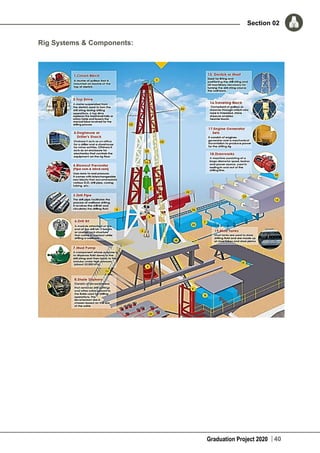
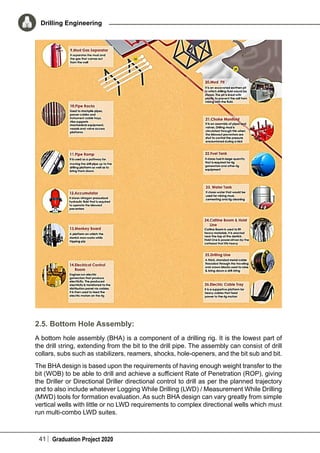
Rig Systems & Components:
41 Graduation Project 2020
Drilling Engineering
2.5. Bottom Hole Assembly:
A bottom hole assembly (BHA) is a component of a drilling rig. It is the lowest part of
the drill string, extending from the bit to the drill pipe. The assembly can consist of drill
collars, subs such as stabilizers, reamers, shocks, hole-openers, and the bit sub and bit.
The BHA design is based upon the requirements of having enough weight transfer to the
bit (WOB) to be able to drill and achieve a sufficient Rate of Penetration (ROP), giving
the Driller or Directional Driller directional control to drill as per the planned trajectory
and to also include whatever Logging While Drilling (LWD) / Measurement While Drilling
(MWD) tools for formation evaluation. As such BHA design can vary greatly from simple
vertical wells with little or no LWD requirements to complex directional wells which must
run multi-combo LWD suites.
Graduation Project 2020
Section 02
42
Prior to running a BHA most oilfield service providers have software to model the
BHA behaviour such as the maximum WOB achievable, the directional tendencies &
capabilities and even the natural harmonics of the assembly as to avoid vibration brought
about by exciting natural frequencies.
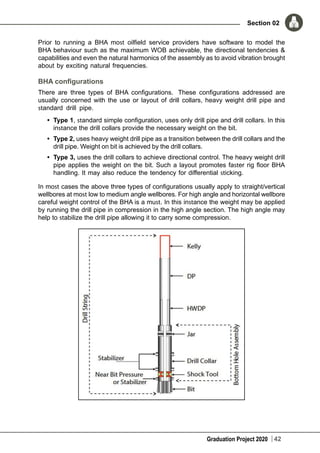
BHA configurations
There are three types of BHA configurations.  These configurations addressed are
usually concerned with the use or layout of drill collars, heavy weight drill pipe and
standard drill pipe.
•	 Type 1, standard simple configuration, uses only drill pipe and drill collars. In this
instance the drill collars provide the necessary weight on the bit.
•	 Type 2, uses heavy weight drill pipe as a transition between the drill collars and the
drill pipe. Weight on bit is achieved by the drill collars.
•	 Type 3, uses the drill collars to achieve directional control. The heavy weight drill
pipe applies the weight on the bit. Such a layout promotes faster rig floor BHA
handling. It may also reduce the tendency for differential sticking.
In most cases the above three types of configurations usually apply to straight/vertical
wellbores at most low to medium angle wellbores. For high angle and horizontal wellbore
careful weight control of the BHA is a must. In this instance the weight may be applied
by running the drill pipe in compression in the high angle section. The high angle may
help to stabilize the drill pipe allowing it to carry some compression.
43 Graduation Project 2020
Drilling Engineering
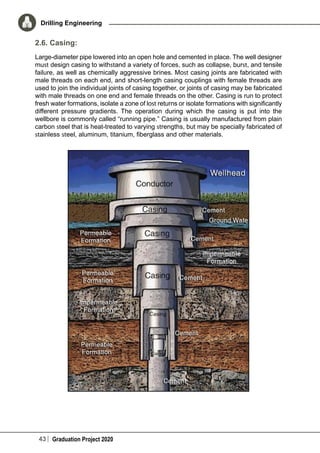
2.6. Casing:
Large-diameter pipe lowered into an open hole and cemented in place. The well designer
must design casing to withstand a variety of forces, such as collapse, burst, and tensile
failure, as well as chemically aggressive brines. Most casing joints are fabricated with
male threads on each end, and short-length casing couplings with female threads are
used to join the individual joints of casing together, or joints of casing may be fabricated
with male threads on one end and female threads on the other. Casing is run to protect
fresh water formations, isolate a zone of lost returns or isolate formations with significantly
different pressure gradients. The operation during which the casing is put into the
wellbore is commonly called “running pipe.” Casing is usually manufactured from plain
carbon steel that is heat-treated to varying strengths, but may be specially fabricated of
stainless steel, aluminum, titanium, fiberglass and other materials.
Graduation Project 2020
Section 02
44
2.7. Cement:
Well cementing is the process of introducing cement to the annular space between the
well-bore and casing or to the annular space between two successive casing strings.
Cementing Principle
•	 To support the vertical and radial loads applied to the casing
•	 Isolate porous formations from the producing zone formations
•	 Exclude unwanted sub-surface fluids from the producing interval
•	 Protect casing from corrosion
•	 Resist chemical deterioration of cement
•	 Confine abnormal pore pressure
•	 To increase the possibility to hit the target
Cement is introduced into the well by means of a cementing head. It helps
in pumping cement between the running of the top and bottom plugs.
The most important function of cementing is to achieve zonal isolation. Another purpose
of cementing is to achieve a good cement-to-pipe bond. Too low an effective confining
pressure may cause the cement to become ductile.
For cement, one thing to note is that there is no correlation between
the shear and compressive strength. Another fact to note is that cement strength ranges
between 1000 and 1800 psi, and for reservoir pressures > 1000 psi; this means that the
pipe cement bond will fail first. This would lead to the development of micro-annuli along
the pipe.
Cement Classes
A.	 0–6000 ft used when special properties are not required.
B.	 0–6000 ft used when conditions require moderate to high sulfate resistance
C.	 0–6000 ft used when conditions require high early strength
D.	 6000–10000 ft used under moderately high temperatures and pressures
E.		 10000–14000 ft used under conditions of high temperatures and pressures
F.		 10000–16000 ft used under conditions of extremely high temperatures and
pressures
G.	 0–8000 ft can be used with accelerators and retarders to cover a wide range of
well depths and temperatures.
H.	 0–8000 ft can be used with accelerators and retarders to cover a wide range of
well depths and temperatures.
I.	12000–16000 ft can be used under conditions of extremely high temperatures and
pressures or can be mixed with accelerators and retarders to cover a range of well
depth and temperatures.
45 Graduation Project 2020
Drilling Engineering
Additives
There are 8 general categories of additives.
•	 Accelerators reduce setting time and increases the rate of compressive strength
build up.
•	 Retarders extend the setting time.
•	 Extenders lower the density
•	 Weighting Agents increase density.
•	 Dispersants reduce viscosity.
•	 Fluid loss control agents.
•	 Lost circulation control agents.
•	 Specialty agents.
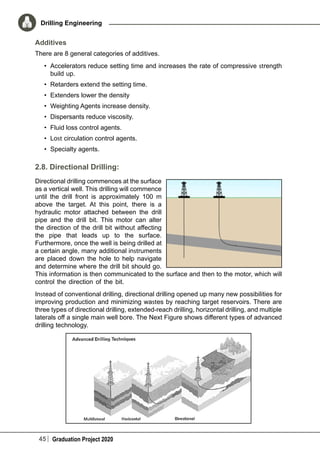
2.8. Directional Drilling:
Directional drilling commences at the surface
as a vertical well. This drilling will commence
until the drill front is approximately 100 m
above the target. At this point, there is a
hydraulic motor attached between the drill
pipe and the drill bit. This motor can alter
the direction of the drill bit without affecting
the pipe that leads up to the surface.
Furthermore, once the well is being drilled at
a certain angle, many additional instruments
are placed down the hole to help navigate
and determine where the drill bit should go.
This information is then communicated to the surface and then to the motor, which will
control the direction of the bit.
Instead of conventional drilling, directional drilling opened up many new possibilities for
improving production and minimizing wastes by reaching target reservoirs. There are
three types of directional drilling, extended-reach drilling, horizontal drilling, and multiple
laterals off a single main well bore. The Next Figure shows different types of advanced
drilling technology.
Graduation Project 2020
Section 02
46
Directional program
A directional drilling program might be necessary if the target horizon is not accessible
from a location directly above it. This could be due to topographical obstacles (lakes or
mountains) or legal barriers (eg, protected land). The advantage of directional drilling
includes intersecting a liquid-bearing fracture at a more beneficial angle compared to a
vertical intersection. Moreover, directional drilling allows having multiple wells originating
at the same surface location and deflecting into different directions (angles) as they go
deeper. This enables tapping one resource from different positions (angles) or to explore
further into the underground. Multiple wells on a given drill pad also reduce the total costs
of drill site construction since only one access road is needed, the rig is skidded within
a short time and distance, only one disposal pit is needed, steam gathering pipe work
costs are lowered, and overall supply costs are reduced.
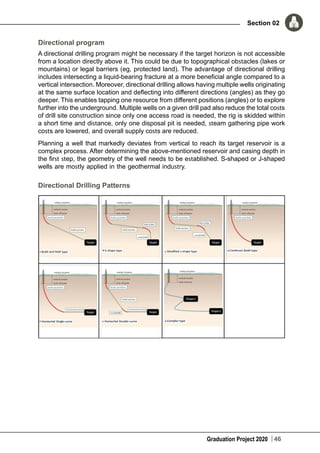
Planning a well that markedly deviates from vertical to reach its target reservoir is a
complex process. After determining the above-mentioned reservoir and casing depth in
the first step, the geometry of the well needs to be established. S-shaped or J-shaped
wells are mostly applied in the geothermal industry.
Directional Drilling Patterns
47 Graduation Project 2020
Drilling Engineering
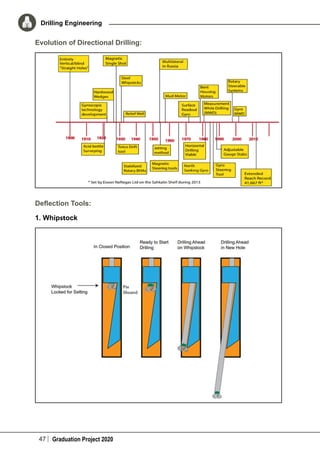
Evolution of Directional Drilling:
Deflection Tools:
1. Whipstock
Graduation Project 2020
Section 02
48
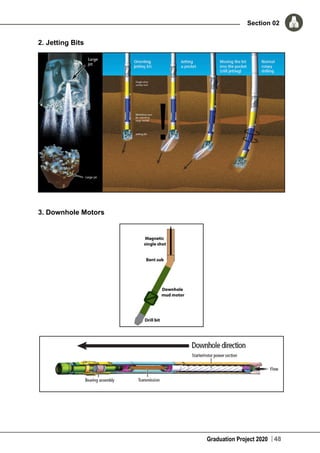
2. Jetting Bits
3. Downhole Motors
49 Graduation Project 2020
Drilling Engineering
2.9. Drilling Problems:
Sources of abnormal pressures in Nile Delta & Offshore Mediterranean
Basins
1. Compaction
Due to the clay-based marine sediments associated with turbodite sequences in the
Mediterranean Basin.
2. Tectonics
The Mediterranean Basin had been subjected to very active tectonics during Pliocene
and Miocene ages as following:
•	 Tectonic Stresses
•	 Faults and Fractures
3. High Sedimentation Rate
Due to rapid subsidence rate, beginning from the early Miocene and continuing to the
present day.
4. Thermal Mechanism
Due to hydrocarbon generation and clay dehydration
5. Pressure Communication along permeable faults and fractures
6. Sand / Shale Ratio
It is relatively high near the Top, Middle, West, and North West of the basin especially in
the Pleistocene and Pliocene formations.
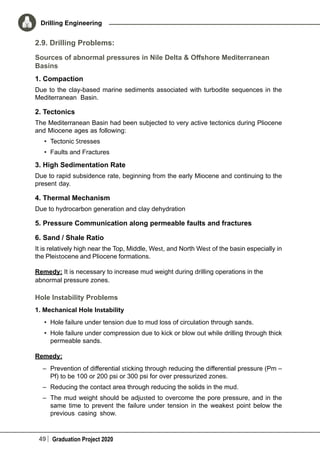
Remedy: It is necessary to increase mud weight during drilling operations in the
abnormal pressure zones.
Hole Instability Problems
1. Mechanical Hole Instability
•	 Hole failure under tension due to mud loss of circulation through sands.
•	 Hole failure under compression due to kick or blow out while drilling through thick
permeable sands.
Remedy:
–	 Prevention of differential sticking through reducing the differential pressure (Pm –
Pf) to be 100 or 200 psi or 300 psi for over pressurized zones.
–	 Reducing the contact area through reducing the solids in the mud.
–	 The mud weight should be adjusted to overcome the pore pressure, and in the
same time to prevent the failure under tension in the weakest point below the
previous casing show.
Graduation Project 2020
Section 02
50
2. Chemical Hole Instability
The main composition of formations lithology in the basin is shale that make up over 80%
of thr drilled formations and causes more than 85% of the wellbore instability problems
like: Shale Sloughing & Swelling.
Remedy: Increasing the mud weight to counteract this swelling or sloughing shale, and
to well predict the mud weight before drilling.
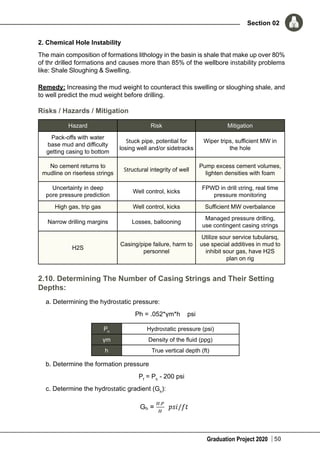
Risks / Hazards / Mitigation
Hazard Risk Mitigation
Pack-offs with water
base mud and difficulty
getting casing to bottom
Stuck pipe, potential for
losing well and/or sidetracks
Wiper trips, sufficient MW in
the hole
No cement returns to
mudline on riserless strings
Structural integrity of well
Pump excess cement volumes,
lighten densities with foam
Uncertainty in deep
pore pressure prediction
Well control, kicks
FPWD in drill string, real time
pressure monitoring
High gas, trip gas Well control, kicks Sufficient MW overbalance
Narrow drilling margins Losses, ballooning
Managed pressure drilling,
use contingent casing strings
H2S
Casing/pipe failure, harm to
personnel
Utilize sour service tubularsq,
use special additives in mud to
inhibit sour gas, have H2S
plan on rig
2.10. Determining The Number of Casing Strings and Their Setting
Depths:
a. Determining the hydrostatic pressure:
Ph = .052*γm*h psi
Ph
Hydrostatic pressure (psi)
γm Density of the fluid (ppg)
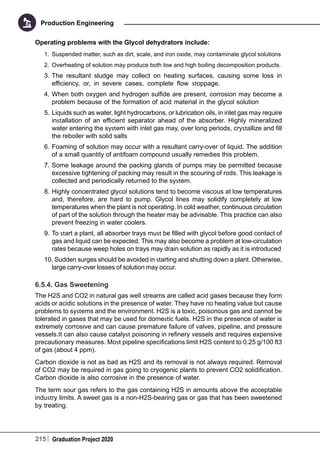
h True vertical depth (ft)
b. Determine the formation pressure
Pf
= Ph
- 200 psi
c. Determine the hydrostatic gradient (Gh
):
51 Graduation Project 2020
Drilling Engineering
d. Determine the fracture gradient:
	 Where,
v Poision’s ratio (.4)
σv Overburden stress (.8 psi/ft)
e. Determine safe fracture gradient:
Gfs
= Gf
- .052*.5 (psi/ft)
g. Plot Hydrostatic, formation, and fracture pressure gradient against depth.
h. From plotting we can find the number and setting depth of the casing string.
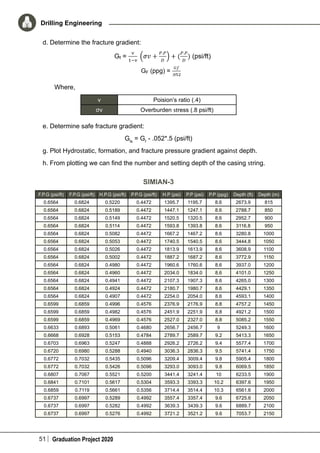
SIMIAN-3
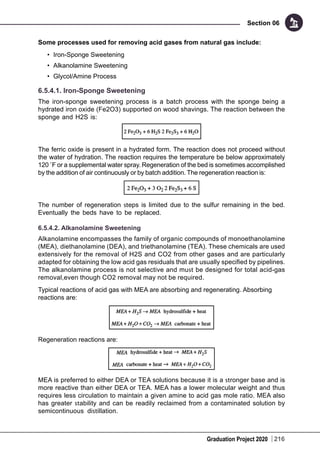
F.P.G (psi/ft) F.P.G (psi/ft) H.P.G (psi/ft) P.P.G (psi/ft) H.P (psi) P.P (psi) P.P (ppg) Depth (ft) Depth (m)
0.6564 0.6824 0.5220 0.4472 1395.7 1195.7 8.6 2673.9 815
0.6564 0.6824 0.5189 0.4472 1447.1 1247.1 8.6 2788.7 850
0.6564 0.6824 0.5149 0.4472 1520.5 1320.5 8.6 2952.7 900
0.6564 0.6824 0.5114 0.4472 1593.8 1393.8 8.6 3116.8 950
0.6564 0.6824 0.5082 0.4472 1667.2 1467.2 8.6 3280.8 1000
0.6564 0.6824 0.5053 0.4472 1740.5 1540.5 8.6 3444.8 1050
0.6564 0.6824 0.5026 0.4472 1813.9 1613.9 8.6 3608.9 1100
0.6564 0.6824 0.5002 0.4472 1887.2 1687.2 8.6 3772.9 1150
0.6564 0.6824 0.4980 0.4472 1960.6 1760.6 8.6 3937.0 1200
0.6564 0.6824 0.4960 0.4472 2034.0 1834.0 8.6 4101.0 1250
0.6564 0.6824 0.4941 0.4472 2107.3 1907.3 8.6 4265.0 1300
0.6564 0.6824 0.4924 0.4472 2180.7 1980.7 8.6 4429.1 1350
0.6564 0.6824 0.4907 0.4472 2254.0 2054.0 8.6 4593.1 1400
0.6599 0.6859 0.4996 0.4576 2376.9 2176.9 8.8 4757.2 1450
0.6599 0.6859 0.4982 0.4576 2451.9 2251.9 8.8 4921.2 1500
0.6599 0.6859 0.4969 0.4576 2527.0 2327.0 8.8 5085.2 1550
0.6633 0.6893 0.5061 0.4680 2656.7 2456.7 9 5249.3 1600
0.6668 0.6928 0.5153 0.4784 2789.7 2589.7 9.2 5413.3 1650
0.6703 0.6963 0.5247 0.4888 2926.2 2726.2 9.4 5577.4 1700
0.6720 0.6980 0.5288 0.4940 3036.3 2836.3 9.5 5741.4 1750
0.6772 0.7032 0.5435 0.5096 3209.4 3009.4 9.8 5905.4 1800
0.6772 0.7032 0.5426 0.5096 3293.0 3093.0 9.8 6069.5 1850
0.6807 0.7067 0.5521 0.5200 3441.4 3241.4 10 6233.5 1900
0.6841 0.7101 0.5617 0.5304 3593.3 3393.3 10.2 6397.6 1950
0.6859 0.7119 0.5661 0.5356 3714.4 3514.4 10.3 6561.6 2000
0.6737 0.6997 0.5289 0.4992 3557.4 3357.4 9.6 6725.6 2050
0.6737 0.6997 0.5282 0.4992 3639.3 3439.3 9.6 6889.7 2100
0.6737 0.6997 0.5276 0.4992 3721.2 3521.2 9.6 7053.7 2150
Graduation Project 2020
Section 02
52
0.6772 0.7032 0.5373 0.5096 3878.2 3678.2 9.8 7217.8 2200
0.6720 0.6980 0.5211 0.4940 3846.6 3646.6 9.5 7381.8 2250
0.6755 0.7015 0.5309 0.5044 4006.1 3806.1 9.7 7545.8 2300
0.6755 0.7015 0.5308 0.5044 4022.7 3822.7 9.7 7578.6 2310
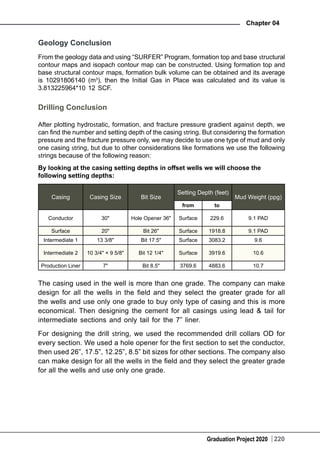
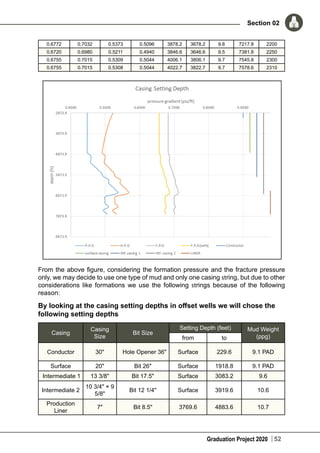
From the above figure, considering the formation pressure and the fracture pressure
only, we may decide to use one type of mud and only one casing string, but due to other
considerations like formations we use the following strings because of the following
reason:
By looking at the casing setting depths in offset wells we will chose the
following setting depths
Casing
Casing
Size
Bit Size
Setting Depth (feet) Mud Weight
(ppg)from to
Conductor 30" Hole Opener 36" Surface 229.6 9.1 PAD
Surface 20" Bit 26" Surface 1918.8 9.1 PAD
Intermediate 1 13 3/8" Bit 17.5" Surface 3083.2 9.6
Intermediate 2
10 3/4" × 9
5/8"
Bit 12 1/4" Surface 3919.6 10.6
Production
Liner
7" Bit 8.5" 3769.6 4883.6 10.7
53 Graduation Project 2020
Drilling Engineering
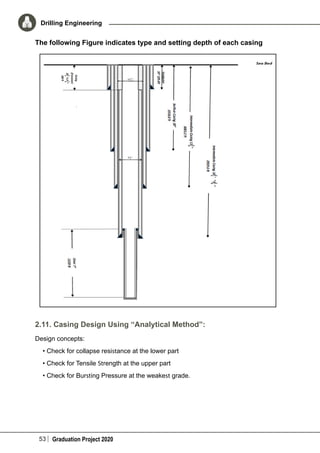
The following Figure indicates type and setting depth of each casing
2.11. Casing Design Using “Analytical Method”:
Design concepts:
• Check for collapse resistance at the lower part
• Check for Tensile Strength at the upper part
• Check for Bursting Pressure at the weakest grade.
Graduation Project 2020
Section 02
54
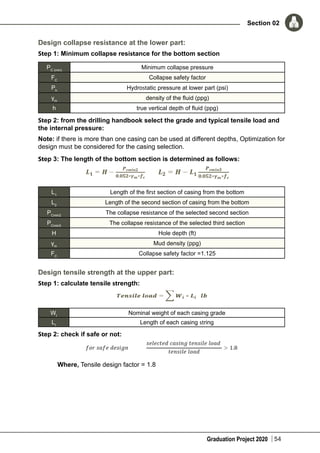
Design collapse resistance at the lower part:
Step 1: Minimum collapse resistance for the bottom section
PC (min)
Minimum collapse pressure
FC
Collapse safety factor
Ph
Hydrostatic pressure at lower part (psi)
γm
density of the fluid (ppg)
h true vertical depth of fluid (ppg)
Step 2: from the drilling handbook select the grade and typical tensile load and
the internal pressure:
Note: if there is more than one casing can be used at different depths, Optimization for
design must be considered for the casing selection.
Step 3: The length of the bottom section is determined as follows:
L1
Length of the first section of casing from the bottom
L2
Length of the second section of casing from the bottom
PCmin2
The collapse resistance of the selected second section
PCmin3
The collapse resistance of the selected third section
H Hole depth (ft)
γm
Mud density (ppg)
FC
Collapse safety factor =1.125
Design tensile strength at the upper part:
Step 1: calculate tensile strength:
WI
Nominal weight of each casing grade
LI
Length of each casing string
Step 2: check if safe or not:
	 Where, Tensile design factor = 1.8
55 Graduation Project 2020
Drilling Engineering
Design bursting pressure at the weakest part:
Step 1: The weakest section (lowest grade or min. thickens) is checked of
internal pressure as follows:
Where, Pi bursting pressure resistance of the weakest section equals to internal yield
pressure, psi.
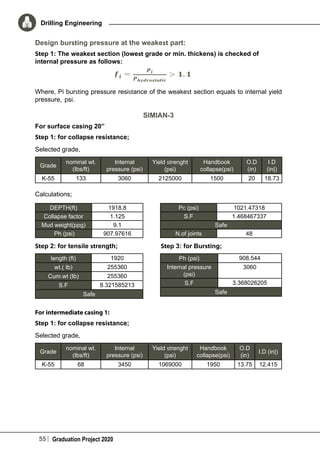
SIMIAN-3
For surface casing 20”
Step 1: for collapse resistance;
Selected grade,
Grade
nominal wt.
(Ibs/ft)
Internal
pressure (psi)
Yield strenght
(psi)
Handbook
collapse(psi)
O.D
(in)
I.D
(in|)
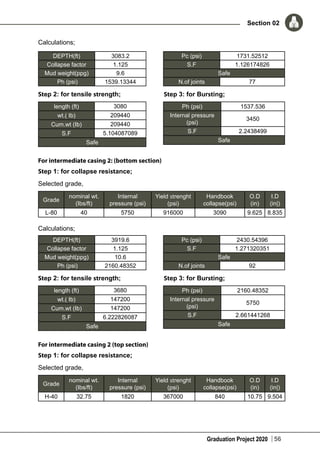
K-55 133 3060 2125000 1500 20 18.73
Calculations;
DEPTH(ft) 1918.8
Collapse factor 1.125
Mud weight(ppg) 9.1
Ph (psi) 907.97616
Pc (psi) 1021.47318
S.F 1.468467337
Safe
N.of joints 48
Step 2: for tensile strength; Step 3: for Bursting;
length (ft) 1920
wt.( Ib) 255360
Cum.wt (Ib) 255360
S.F 8.321585213
Safe
Ph (psi) 908.544
Internal pressure
(psi)
3060
S.F 3.368026205
Safe
For intermediate casing 1:
Step 1: for collapse resistance;
Selected grade,
Grade
nominal wt.
(Ibs/ft)
Internal
pressure (psi)
Yield strenght
(psi)
Handbook
collapse(psi)
O.D
(in)
I.D (in|)
K-55 68 3450 1069000 1950 13.75 12.415
Graduation Project 2020
Section 02
56
Calculations;
DEPTH(ft) 3083.2
Collapse factor 1.125
Mud weight(ppg) 9.6
Ph (psi) 1539.13344
Pc (psi) 1731.52512
S.F 1.126174826
Safe
N.of joints 77
Step 2: for tensile strength; Step 3: for Bursting;
length (ft) 3080
wt.( Ib) 209440
Cum.wt (Ib) 209440
S.F 5.104087089
Safe
Ph (psi) 1537.536
Internal pressure
(psi)
3450
S.F 2.2438499
Safe
For intermediate casing 2: (bottom section)
Step 1: for collapse resistance;
Selected grade,
Grade
nominal wt.
(Ibs/ft)
Internal
pressure (psi)
Yield strenght
(psi)
Handbook
collapse(psi)
O.D
(in)
I.D
(in|)
L-80 40 5750 916000 3090 9.625 8.835
Calculations;
DEPTH(ft) 3919.6
Collapse factor 1.125
Mud weight(ppg) 10.6
Ph (psi) 2160.48352
Pc (psi) 2430.54396
S.F 1.271320351
Safe
N.of joints 92
Step 2: for tensile strength; Step 3: for Bursting;
length (ft) 3680
wt.( Ib) 147200
Cum.wt (Ib) 147200
S.F 6.222826087
Safe
Ph (psi) 2160.48352
Internal pressure
(psi)
5750
S.F 2.661441268
Safe
For intermediate casing 2 (top section)
Step 1: for collapse resistance;
Selected grade,
Grade
nominal wt.
(Ibs/ft)
Internal
pressure (psi)
Yield strenght
(psi)
Handbook
collapse(psi)
O.D
(in)
I.D
(in|)
H-40 32.75 1820 367000 840 10.75 9.504
57 Graduation Project 2020
Drilling Engineering
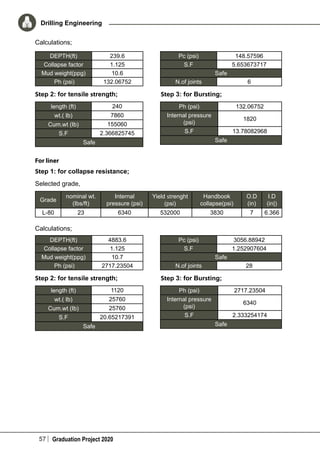
Calculations;
DEPTH(ft) 239.6
Collapse factor 1.125
Mud weight(ppg) 10.6
Ph (psi) 132.06752
Pc (psi) 148.57596
S.F 5.653673717
Safe
N.of joints 6
Step 2: for tensile strength; Step 3: for Bursting;
length (ft) 240
wt.( Ib) 7860
Cum.wt (Ib) 155060
S.F 2.366825745
Safe
Ph (psi) 132.06752
Internal pressure
(psi)
1820
S.F 13.78082968
Safe
For liner
Step 1: for collapse resistance;
Selected grade,
Grade
nominal wt.
(Ibs/ft)
Internal
pressure (psi)
Yield strenght
(psi)
Handbook
collapse(psi)
O.D
(in)
I.D
(in|)
L-80 23 6340 532000 3830 7 6.366
Calculations;
DEPTH(ft) 4883.6
Collapse factor 1.125
Mud weight(ppg) 10.7
Ph (psi) 2717.23504
Pc (psi) 3056.88942
S.F 1.252907604
Safe
N.of joints 28
Step 2: for tensile strength; Step 3: for Bursting;
length (ft) 1120
wt.( Ib) 25760
Cum.wt (Ib) 25760
S.F 20.65217391
Safe
Ph (psi) 2717.23504
Internal pressure
(psi)
6340
S.F 2.333254174
Safe
Graduation Project 2020
Section 02
58
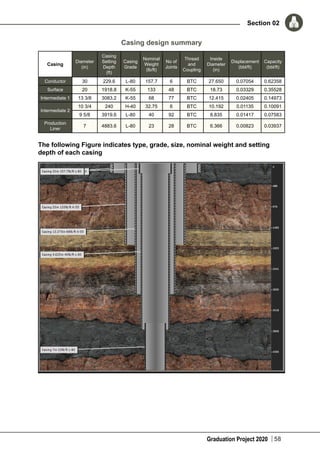
Casing design summary
Casing
Diameter
(in)
Casing
Setting
Depth
(ft)
Casing
Grade
Nominal
Weight
(lb/ft)
No of
Joints
Thread
and
Coupling
Inside
Diameter
(in)
Displacement
(bbl/ft)
Capacity
(bbl/ft)
Conductor 30 229.6 L-80 157.7 6 BTC 27.650 0.07054 0.62358
Surface 20 1918.8 K-55 133 48 BTC 18.73 0.03329 0.35528
Intermediate 1 13 3/8 3083.2 K-55 68 77 BTC 12.415 0.02405 0.14973
Intermediate 2
10 3/4 240 H-40 32.75 6 BTC 10.192 0.01135 0.10091
9 5/8 3919.6 L-80 40 92 BTC 8.835 0.01417 0.07583
Production
Liner
7 4883.6 L-80 23 28 BTC 6.366 0.00823 0.03937
The following Figure indicates type, grade, size, nominal weight and setting
depth of each casing
59 Graduation Project 2020
Drilling Engineering
2.12. Cementing Design
General procedure
1.	slurry weight of one sack = weight of dry cement + weight of water +weight of
additives
2.	slurry volume of one sack= volume of dry cement + volume of water + volume of
additives
3.	slurry volume required = volume of slurry in the shoe track + volume of slurry in
the pocket + volume of slurry to be displaced in annulus
4.	No. of sacks =
5.	Slurry yield =
6.	Total amount of water required = cement mixing water + required water for
additives + spacer volume
7.	Displacement volume = volume inside the casing – volume of shoe track
8.	Job time = mixing time + surface time + plug release time + displacement time
9.	Mixing time =
10.	displacement time =
11.	plug release time = 15 min
12.	thickening time = job time + 30 (min)
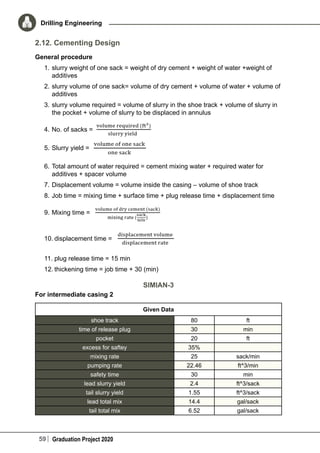
SIMIAN-3
For intermediate casing 2
Given Data
shoe track 80 ft
time of release plug 30 min
pocket 20 ft
excess for saftey 35%  
mixing rate 25 sack/min
pumping rate 22.46 ft^3/min
safety time 30 min
lead slurry yield 2.4 ft^3/sack
tail slurry yield 1.55 ft^3/sack
lead total mix 14.4 gal/sack
tail total mix 6.52 gal/sack
Graduation Project 2020
Section 02
60
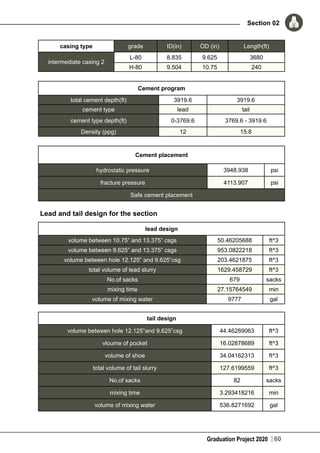
casing type grade ID(in) OD (in) Length(ft)
intermediate casing 2
L-80 8.835 9.625 3680
H-80 9.504 10.75 240
Cement program
total cement depth(ft) 3919.6 3919.6
cement type lead tail
cement type depth(ft) 0-3769.6 3769.6 - 3919.6
Density (ppg) 12 15.8
Cement placement
hydrostatic pressure 3948.938 psi
fracture pressure 4113.907 psi
Safe cement placement
Lead and tail design for the section
lead design
volume between 10.75” and 13.375” csgs 50.46205688 ft^3
volume between 9.625” and 13.375” csgs 953.0822218 ft^3
volume between hole 12.125” and 9.625”csg 203.4621875 ft^3
total volume of lead slurry 1629.458729 ft^3
No.of sacks 679 sacks
mixing time 27.15764549 min
volume of mixing water 9777 gal
tail design
volume between hole 12.125”and 9.625”csg 44.46289063 ft^3
vloume of pocket 16.02878689 ft^3
volume of shoe 34.04162313 ft^3
total volume of tail slurry 127.6199559 ft^3
No.of sacks 82 sacks
mixing time 3.293418216 min
volume of mixing water 536.8271692 gal
61 Graduation Project 2020
Drilling Engineering
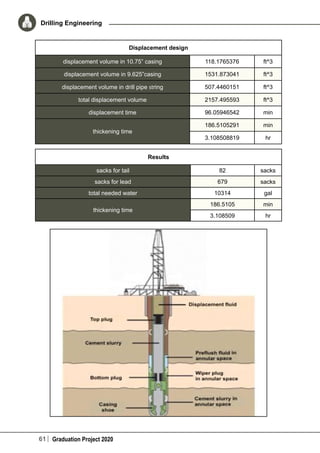
Displacement design
displacement volume in 10.75” casing 118.1765376 ft^3
displacement volume in 9.625”casing 1531.873041 ft^3
displacement volume in drill pipe string 507.4460151 ft^3
total displacement volume 2157.495593 ft^3
displacement time 96.05946542 min
thickening time
186.5105291 min
3.108508819 hr
Results
sacks for tail 82 sacks
sacks for lead 679 sacks
total needed water 10314 gal
thickening time
186.5105 min
3.108509 hr
Graduation Project 2020
Section 02
62
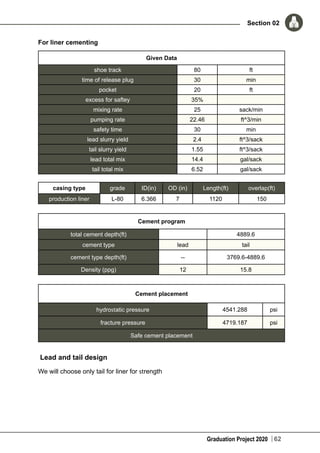
For liner cementing
Given Data
shoe track 80 ft
time of release plug 30 min
pocket 20 ft
excess for saftey 35%  
mixing rate 25 sack/min
pumping rate 22.46 ft^3/min
safety time 30 min
lead slurry yield 2.4 ft^3/sack
tail slurry yield 1.55 ft^3/sack
lead total mix 14.4 gal/sack
tail total mix 6.52 gal/sack
casing type grade ID(in) OD (in) Length(ft) overlap(ft)
production liner L-80 6.366 7 1120 150
Cement program
total cement depth(ft) 4889.6
cement type lead tail
cement type depth(ft) -- 3769.6-4889.6
Density (ppg) 12 15.8
Cement placement
hydrostatic pressure 4541.288 psi
fracture pressure 4719.187 psi
Safe cement placement
Lead and tail design
We will choose only tail for liner for strength
63 Graduation Project 2020
Drilling Engineering
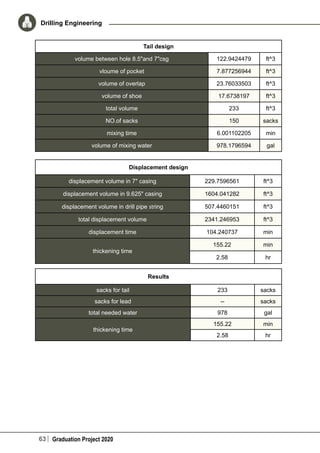
Tail design
volume between hole 8.5"and 7"csg 122.9424479 ft^3
vloume of pocket 7.877256944 ft^3
volume of overlap 23.76033503 ft^3
volume of shoe 17.6738197 ft^3
total volume 233 ft^3
NO.of sacks 150 sacks
mixing time 6.001102205 min
volume of mixing water 978.1796594 gal
Displacement design
displacement volume in 7" casing 229.7596561 ft^3
displacement volume in 9.625" casing 1604.041282 ft^3
displacement volume in drill pipe string 507.4460151 ft^3
total displacement volume 2341.246953 ft^3
displacement time 104.240737 min
thickening time
155.22 min
2.58 hr
Results
sacks for tail 233 sacks
sacks for lead -- sacks
total needed water 978 gal
thickening time
155.22 min
2.58 hr
Graduation Project 2020
Section 02
64
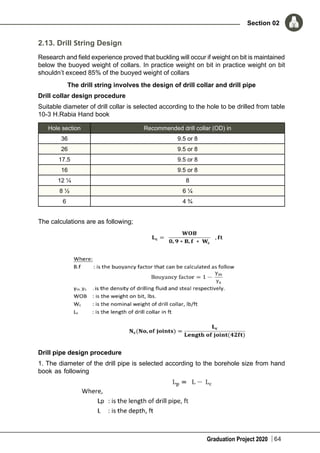
2.13. Drill String Design
Research and field experience proved that buckling will occur if weight on bit is maintained
below the buoyed weight of collars. In practice weight on bit in practice weight on bit
shouldn’t exceed 85% of the buoyed weight of collars
The drill string involves the design of drill collar and drill pipe
Drill collar design procedure
Suitable diameter of drill collar is selected according to the hole to be drilled from table
10-3 H.Rabia Hand book
Hole section Recommended drill collar (OD) in
36 9.5 or 8
26 9.5 or 8
17.5 9.5 or 8
16 9.5 or 8
12 ¼ 8
8 ½ 6 ¼
6 4 ¾
The calculations are as following;
Drill pipe design procedure
1. The diameter of the drill pipe is selected according to the borehole size from hand
book as following
65 Graduation Project 2020
Drilling Engineering
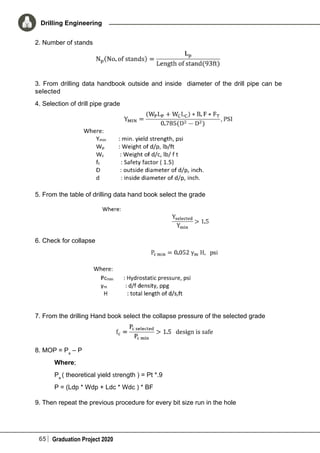
2. Number of stands
3. From drilling data handbook outside and inside diameter of the drill pipe can be
selected
4. Selection of drill pipe grade
5. From the table of drilling data hand book select the grade
6. Check for collapse
7. From the drilling Hand book select the collapse pressure of the selected grade
8. MOP = Pa
– P
	 Where;
	Pa
( theoretical yield strength ) = Pt *.9
	 P = (Ldp * Wdp + Ldc * Wdc ) * BF
9. Then repeat the previous procedure for every bit size run in the hole
Graduation Project 2020
Section 02
66
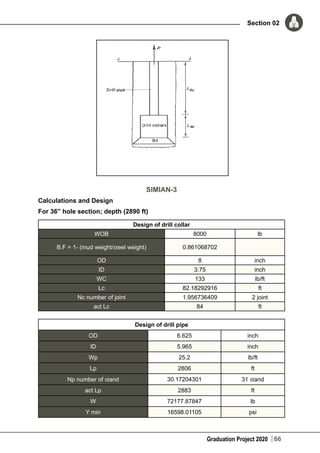
SIMIAN-3
Calculations and Design
For 36” hole section; depth (2890 ft)
Design of drill collar
WOB 8000 lb
B.F = 1- (mud weight/steel weight) 0.861068702
OD 8 inch
ID 3.75 inch
WC 133 lb/ft
Lc 82.18292916 ft
Nc number of joint 1.956736409 2 joint
act Lc 84 ft
Design of drill pipe
OD 6.625 inch
ID 5.965 inch
Wp 25.2 lb/ft
Lp 2806 ft
Np number of stand 30.17204301 31 stand
act Lp 2883 ft
W 72177.87847 lb
Y min 16598.01105 psi
67 Graduation Project 2020
Drilling Engineering
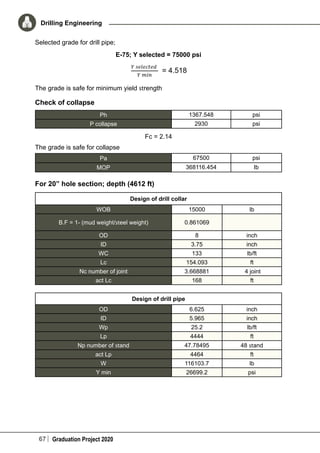
Selected grade for drill pipe;
E-75; Y selected = 75000 psi
The grade is safe for minimum yield strength
Check of collapse
Ph 1367.548 psi
P collapse 2930 psi
Fc = 2.14
The grade is safe for collapse
Pa 67500 psi
MOP 368116.454 Ib
For 20” hole section; depth (4612 ft)
Design of drill collar
WOB 15000 lb
B.F = 1- (mud weight/steel weight) 0.861069
OD 8 inch
ID 3.75 inch
WC 133 lb/ft
Lc 154.093 ft
Nc number of joint 3.668881 4 joint
act Lc 168 ft
Design of drill pipe
OD 6.625 inch
ID 5.965 inch
Wp 25.2 lb/ft
Lp 4444 ft
Np number of stand 47.78495 48 stand
act Lp 4464 ft
W 116103.7 lb
Y min 26699.2 psi
Graduation Project 2020
Section 02
68
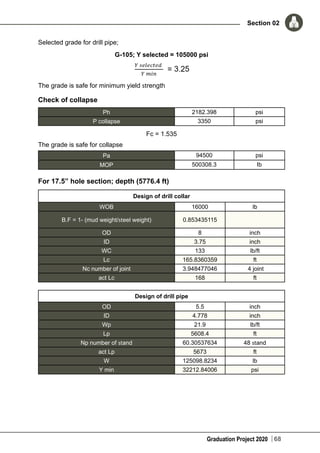
Selected grade for drill pipe;
G-105; Y selected = 105000 psi
The grade is safe for minimum yield strength
Check of collapse
Ph 2182.398 psi
P collapse 3350 psi
Fc = 1.535
The grade is safe for collapse
Pa 94500 psi
MOP 500308.3 Ib
For 17.5” hole section; depth (5776.4 ft)
Design of drill collar
WOB 16000 lb
B.F = 1- (mud weight/steel weight) 0.853435115
OD 8 inch
ID 3.75 inch
WC 133 lb/ft
Lc 165.8360359 ft
Nc number of joint 3.948477046 4 joint
act Lc 168 ft
Design of drill pipe
OD 5.5 inch
ID 4.778 inch
Wp 21.9 lb/ft
Lp 5608.4 ft
Np number of stand 60.30537634 48 stand
act Lp 5673 ft
W 125098.8234 lb
Y min 32212.84006 psi
69 Graduation Project 2020
Drilling Engineering
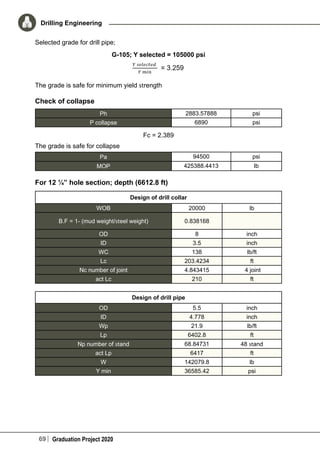
Selected grade for drill pipe;
G-105; Y selected = 105000 psi
The grade is safe for minimum yield strength
Check of collapse
Ph 2883.57888 psi
P collapse 6890 psi
Fc = 2.389
The grade is safe for collapse
Pa 94500 psi
MOP 425388.4413 Ib
For 12 ¼” hole section; depth (6612.8 ft)
Design of drill collar
WOB 20000 lb
B.F = 1- (mud weight/steel weight) 0.838168
OD 8 inch
ID 3.5 inch
WC 138 lb/ft
Lc 203.4234 ft
Nc number of joint 4.843415 4 joint
act Lc 210 ft
Design of drill pipe
OD 5.5 inch
ID 4.778 inch
Wp 21.9 lb/ft
Lp 6402.8 ft
Np number of stand 68.84731 48 stand
act Lp 6417 ft
W 142079.8 lb
Y min 36585.42 psi
Graduation Project 2020
Section 02
70
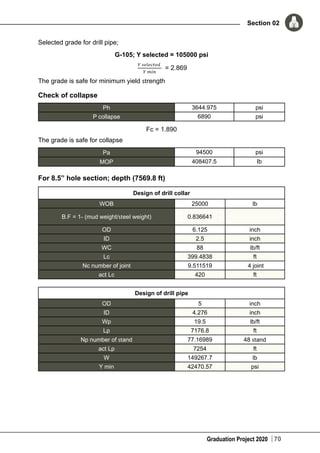
Selected grade for drill pipe;
G-105; Y selected = 105000 psi
The grade is safe for minimum yield strength
Check of collapse
Ph 3644.975 psi
P collapse 6890 psi
Fc = 1.890
The grade is safe for collapse
Pa 94500 psi
MOP 408407.5 Ib
For 8.5” hole section; depth (7569.8 ft)
Design of drill collar
WOB 25000 lb
B.F = 1- (mud weight/steel weight) 0.836641
OD 6.125 inch
ID 2.5 inch
WC 88 lb/ft
Lc 399.4838 ft
Nc number of joint 9.511519 4 joint
act Lc 420 ft
Design of drill pipe
OD 5 inch
ID 4.276 inch
Wp 19.5 lb/ft
Lp 7176.8 ft
Np number of stand 77.16989 48 stand
act Lp 7254 ft
W 149267.7 lb
Y min 42470.57 psi
71 Graduation Project 2020
Drilling Engineering
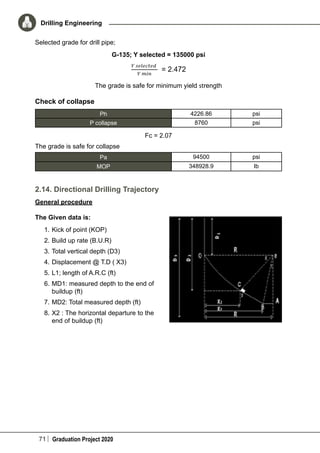
Selected grade for drill pipe;
G-135; Y selected = 135000 psi
The grade is safe for minimum yield strength
Check of collapse
Ph 4226.86 psi
P collapse 8760 psi
Fc = 2.07
The grade is safe for collapse
Pa 94500 psi
MOP 348928.9 Ib
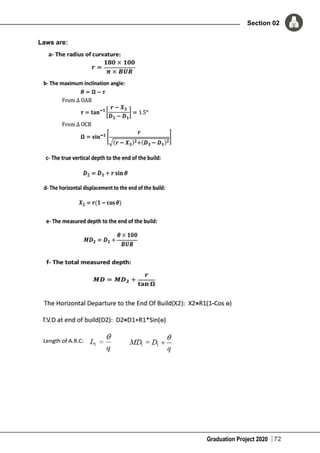
2.14. Directional Drilling Trajectory
General procedure
The Given data is:
1.	Kick of point (KOP)
2.	Build up rate (B.U.R)
3.	Total vertical depth (D3)
4.	Displacement @ T.D ( X3)
5.	L1; length of A.R.C (ft)
6.	MD1: measured depth to the end of
buildup (ft)
7.	MD2: Total measured depth (ft)
8.	X2 : The horizontal departure to the
end of buildup (ft)
Graduation Project 2020
Section 02
72
Laws are:
73 Graduation Project 2020
Drilling Engineering
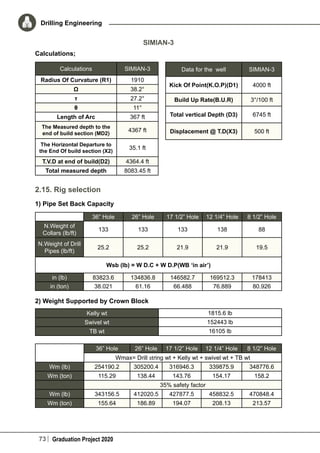
SIMIAN-3
Calculations;
Calculations SIMIAN-3
Radius Of Curvature (R1) 1910
Ω 38.2°
τ 27.2°
θ 11°
Length of Arc 367 ft
The Measured depth to the
end of build section (MD2)
4367 ft
The Horizontal Departure to
the End Of build section (X2)
35.1 ft
T.V.D at end of build(D2) 4364.4 ft
Total measured depth 8083.45 ft
Data for the well SIMIAN-3
Kick Of Point(K.O.P)(D1) 4000 ft
Build Up Rate(B.U.R) 3°/100 ft
Total vertical Depth (D3) 6745 ft
Displacement @ T.D(X3) 500 ft
2.15. Rig selection
1) Pipe Set Back Capacity
36” Hole 26” Hole 17 1/2” Hole 12 1/4” Hole 8 1/2” Hole
N.Weight of
Collars (lb/ft)
133 133 133 138 88
N.Weight of Drill
Pipes (lb/ft)
25.2 25.2 21.9 21.9 19.5
Wsb (lb) = W D.C + W D.P(WB ‘in air’)
in (lb) 83823.6 134836.8 146582.7 169512.3 178413
in (ton) 38.021 61.16 66.488 76.889 80.926
2) Weight Supported by Crown Block
Kelly wt 1815.6 lb
Swivel wt 152443 lb
TB wt 16105 lb
36” Hole 26” Hole 17 1/2” Hole 12 1/4” Hole 8 1/2” Hole
Wmax= Drill string wt + Kelly wt + swivel wt + TB wt
Wm (lb) 254190.2 305200.4 316946.3 339875.9 348776.6
Wm (ton) 115.29 138.44 143.76 154.17 158.2
35% safety factor
Wm (lb) 343156.5 412020.5 427877.5 458832.5 470848.4
Wm (ton) 155.64 186.89 194.07 208.13 213.57
Graduation Project 2020
Section 02
74
3) The Maximum Casing Capacity
COND 30” CSG 20” CSG 13 3/8”
CSG 10 3/4”
× 9 5/8”
LINER 7”
+ Landing String
B.F 0.844 0.845 0.85 0.86 0.875
weight in air (lb) 36207.92 255200.4 209657.6 155044 111991.2
effective weight
(lb)
30559.48 215644.3 178208.96 133337.8 97992.3
35% Safety factor
41255.3 291119.4 240582 180006 132289.6
in (ton) 18.7 132 109.13 81.65 60
*Design for Maximum derrick load = 213.57 ton
4) Swivel Selection
*Determination of Maximum Swivel Load Capacity
Maximum Swivel Load = D/Smax
+ Kelly Weight
	 = 178413 + 1815.6
	 = 180228.6 lb = 81.75 ton
From Drilling Hand Book, we select the proper swivel:
Depth Capacity 8000 ft
Main bearing dia. 12 1/2 in
Rated dead load capacity 150 ton
Fluid passage dia. 2.25 in
Bail pin dia. 3.5 in
Bail diameter at bend 4 in
Net approximate weight 1480 lb
5) Hook selection:
•	 Hook is selected according to the maximum weight that will be supported either
during drilling or lowering the casing
•	 For total hook load during drilling:
Max. Weight = Drill String wt. + Kelly+ Swivel wt = 178413 + 1815.6 + 1480 =
181708.6 lb = 82.421 ton (the maximum)
•	 For total hook load during casing:
H. L = wt. of heaviest casing in mud + swivel wt =215644.3+ 1480
	 = 217124.3 lb = 98.485 ton
We will select our hook depending upon the highest load. From Sovonex Tech (A supplier
provides Hooks and Blocks) we will choose HK90.
75 Graduation Project 2020
Drilling Engineering
Max hook load KN 900
Opening size of main hook mm (in) 12 1/2 in
Rated dead load capacity 155 (6 1/6)
Spring trip mm (in) 180 (7)
Dimensions (LxWxH) 2000*680*600
Weight 1800 kg
6) Hoisting System Selection:
1- For maximum traveling block load:
Maximum traveling block load = Hook load + Hook wt
	 = 217124.3+1800 = 218924.3 lb = 99.302 ton
From Rotary Drilling Handbook:
API working load strength 100 ton
No. of sheaves 6
Sheave diameter 36 inch
Line size 1 1/8 inch
Overall length 69.5 inch
Weight with no hook 5470 lb
Thickness 20.75 inch
Clevis width 8 1/2 inch
Length with hook 204 3/4 inch
Hook length 19 1/2 inch
Hook width 30 1/2 inch
2- For hoisting cable design:
*From Drilling equipment and machinery (Dr. M. S. Farahat):
Total load supported by hoisting cable = T.B. load + T.B. weight itself
	 = 218924.3 + 5470 = 224394.3 lb = 101.78 ton
- Consider the maximum tension in the line in pounds, which expected for the drilling
operation:-
Where;
N the number of lines strung, assuming 8 lines
E system efficiency 0.842
TF.L the fast line tension lb
TF.L= 224394.3 / (8*0.842) = 33312.69 Ib
Graduation Project 2020
Section 02
76
- Multiply this tension by (3) as safety factor to obtain the safe ultimate strength of the
required cable = 99938.07 lb
- From Drilling Data Handbook, select the cable which has the closest ultimate strength
and has the suitable diameter for hoisting sheaves.
Select 6 * 19 classification wire rope, bright (UN coated)
or Drawn-Galvanized wire independent wire rope core
Nominal
diameter, in
Approximate
mass
Nominal strength ,Ib
Improved plow steel Extra improved plow steel
1.25 2.89 138800 lb 159880 lb
Deadline-load is given by:
TDL= (224394.3*0.9615^8) / (8*0.842) = 24333.47 Ib
7) Crown Block Design:
E.F = 0.842
F.L= 32233.42 lb
D.L= 23545.1 lb
Total crown block load T.C.L = T.B. load + T.B. weight + TFL + TDL
	 = 218924.3 + 5470 + 32233.42 + 23545.1
	 = 280172.82 lb = 127.28 ton
*Note: Sheaves of C/B = Sheaves of T/B + 1
- From Drilling Data Handbook, Brantly … We will select the following crown block
depending upon economics and safety considerations:
77 Graduation Project 2020
Drilling Engineering
API Working Load Strength 325 tons
No. of sheaves 7
Sheave diameter 54 in
Approximate weight 13995 lb
Length “I” beam 108 inch
Diameter of sand line sheaves 24 inch
Drilling line 1 1/2 inch
Length shaft, width block 49 1/2 inch
Cat line 1 1/2 inch
Diameter of cat line sheaves 15 inch
8) Draw-Works Design:
Power = 969 hp
(We will select a motor with 1000 hp rating)
Graduation Project 2020
Section 02
78
9) Ton-Mile:
79 Graduation Project 2020
Drilling Engineering
10) Calculation of Derrick Efficiency Factor:
Graduation Project 2020
Section 02
80
11) Pressure Losses
12) Mud Pump Horse Power Calculations
13) BOP EQUIPMENT
•	 Diverter System
Regan KFDS-CSO with 14” diverter lines, 16” flowline and 10 degree flex
•	 Flex Joint
18¾” with 21” Vetco HMF connection and 10 degree flex
•	 Riser Connector
Vetco H-4, 18¾” 10,000 PSI WP
81 Graduation Project 2020
Drilling Engineering
•	 Annular BOP’s
Two (2) Shaffer 18¾” 5,000 PSI WP
•	 Ram Preventers
Two (2) Cameron double type “U” 18¾” 10,000 PSI WP
•	 Wellhead Connector
Vetco H-4, 18¾” 10,000 PSI WP
•	 BOP Accumulator Unit
NL Shaffer air-electric, 3,000 PSI
•	 Hydraulic Control Pods
Two (2) NL Shaffer fully redundant with pressure bias system
The selected rig is (ATWOOD EAGLE)
THE EAGLE CAN OPERATE AT WATER DEPTHS OF UP TO 5,000 FEET AND CAN
DRILL DOWN APPROXIMATELY 25,000 FEET.
Graduation Project 2020
Section 02
82
Drilling Instrumentation
Petron driller cabin containing Petron Networked Distributed Drilling Data (3D)
Instrumentation System consisting of:
1. Integrated drilling recorder function
2. Dual rig floor touch screen display with dual master panel capability
3. Drilling data hub monitoring:
a) Top drive torque	 f) Mud pump pressure (2) each
b) Top Drive RPM 	 g) Cement pump pressure
c) Hydraulic hook load	 h) Casing/annular pressure
d) Hydraulic tong torque	 i) Flow sensor
e) Crown sensor depth and ROP
4. Mud pit data hub monitoring:
a) Riser boost pressure
b) Mud pump strokes (3 each)
c) Mud pit volume – thirteen (13) sensors in main mud pit system (three [3] pits
have dual sensors) and two (2) sensors in trip tank
5. Drilling data hub and Mud pit data hub are networked to workstation in Toolpusher’s
office and Company Rep’s office (optional)
6. Drillers console consisting of controls, gauges, and lights for the control and
monitoring of approximately 90 items
2.16. Graphically Plots
1) ROP
83 Graduation Project 2020
Drilling Engineering
Sand
Depth (ft) ROP (ft/hr)
2597.76 164
2788 147.6
2952 65.6
3116 98.4
3280 164
3444 164
3608 147.6
3772 180.4
3936 124.64
4100 213.2
4264 229.6
4428 196.8
4592 213.2
4756 147.6
4920 114.8
5084 98.4
5248 114.8
5412 98.4
5576 114.8
Claystone
Depth (m) ROP m/hr)) Depth ft)) ROP (ft/hr)
1727 30 5664.56 98.4
1750 20 5740 65.6
1800 35 5904 114.8
1850 20 6068 65.6
1900 15 6232 49.2
1950 25 6396 82
2000 20 6560 65.6
2050 10 6724 32.8
Graduation Project 2020
Section 02
84
Sand, Claystone, Siltstone
Depth (m) ROP (m/hr) Depth (ft) ROP (ft/hr)
2062 20 6763.36 65.6
2075 15 6806 49.2
2100 20 6888 65.6
2110 20 6920.8 65.6
2129 10 6983.12 32.8
Sand, Claystone
Depth (m) ROP m/hr)) DEPTH ft)) ROP ft/hr))
2150 15 7052 49.2
2200 20 7216 65.6
2250 19 7380 62.32
2275 25 7462 82
2300 10 7544 32.8
2310 15 7576.8 49.2
85 Graduation Project 2020
Drilling Engineering
Formation Formation Depth, (ft) Bit No. Drilled Section,(ft) Average ROP (ft/hr)
sand
2598-2827
36
1U
229 147.3
2827-4517
26
1U
1690 147.3
4517-5664
17.5
3U
1147 147.3
claystone
5664-5681
17.5
3RR
17 71.8
5681-6518
12.25
5U
837 71.8
6518-6763
8.5
1RR1
245 71.8
sand/claystone/
siltstone
6763-6983
8.5
2RR1
220 55.8
sand/claystone 6983-7637
8.5
1RR2
654 56.9
Graduation Project 2020
Section 02
86
2) RPM
DEPTH (m) DEPTH,(ft) RPM
815 2673.2 60
900 2952 60
1000 3280 120
1050 3444 120
1100 3608 120
1200 3936 130
1300 4264 130
1400 4592 140
1500 4920 135
1600 5248 120
1700 5576 130
1800 5904 125
1900 6232 125
2000 6560 130
2100 6888 140
2200 7216 130
2300 7544 125
2310 7576.8 125
3) Trip Time
Depth,(FT) Trip time (hr) total trip time (hr)
0 0 0
2903 4.2 4.2
4592 6.6 10.8
5756 8.3 19.1
6593 9.5 28.6
7563 10.8 39.4
87 Graduation Project 2020
Drilling Engineering
2.17. Well Cost
Drilling costs will depend on the depth of the well and the daily rig rate. The rig daily rate
will vary according to the rig type, water depth, distance from shore and drilling depth.
For onshore, it will be <100,000 $/day, and for deepwater offshore, it can be very high
from 150,000 up to 800,000 $/day. The number of days will be a function of depth. For
usual depth up to 20,000 ft, we can assume 70 to 80 days and for deeper depths up to
32,000 ft, a maximum of 150 days.
Graduation Project 2020
Section 02
88
Cf Drilling Cost, $/ft
Cb Bit Cost, $
Tc Connection Time, hrs
Tr Bit Rotating Time, hrs
Tt Trip Time, hrs
D Footage, ft
Cr Rig Rent
Tn Non-Rotating Time, hrs
Drilling Cost
Section
36”
Hole
26” Hole
17.5”
Hole
12 ¼”
Hole
8.5” × 10 ¾
“ Hole
Rig Rent 150000 ($/day)=6250 ($/hr)
Bit Cost 3000 $ 4000 $ 5000 $ 7000 $ 9000 $
Drilling Time (hrs) 1.5 11.4 12 49.5 8
Wash & Ream Time (hrs) .4 1.1 2 3 3
Tripping Time (hrs) 8.4 13.2 16.6 21 17
P/U, L/D BHA &DP Time (hrs) .15 .3 .45 .5 2.5
Drill to Enlarge Hole Time (hrs) --- --- --- --- 6
N/U- Testing BOP- Riser Time (hrs) --- --- 3 3.5 2
Drill CEMT & DV & Shoe Time (hrs) 1.5 2 2.8 3.1 5.2
E.LOGS &LWD Time (hrs) --- ---- --- 3 7.5
RAN HSSt,BOP & Riser Time (hrs) ---- ----- ----- --- 112
Survey & Slip &Cut Time (hrs) ----- ---- ---- 5 ---
Back Ream Time (hrs) ----- ------ ---- 3 ---
CIRC & COND Time (hrs) 4.5 5.6 6.5 7.5 7.5
Total Drilling Time (hrs) 14.95 33.6 43.35 99.1 163.2
Total Cost of Section ($) 96437.5 214000 275937.5 626375 1029000
Cost Per Feet for section $/ft 420 126.7 237 749 1060.8
Total Drilling cost of Well ($)
CT = 96437.5+214000+275937.5+626375+1029000
= 2241750
Cost Per Feet ($/ft) 2241750 / 48890 = 45.85
89 Graduation Project 2020
Drilling Engineering
Cost Table
Phase 36” H 30” C 26” H 20” C
17.5”
H
13 “ C 12”H 9 ” C
8.5” x
10” H
7” liner Completion
Depth( ft) 229.6 229.6 1919 1919 3083 3083 3920 3920 4890 4890 4890
Time (days) .7 .3 1.4 .5 2 .5 4 .6 6.8 .8 3
Material
Tangible ($)
0 15600 0 15000 0 64200 0 54540 0 185749 63000
Material
Intangible ($)
10000 13500 60000 58800 65000 51900 70000 67000 80000 21600 29100
Drilling Rig ($) 105000 45000 210000 75000 300000 75000 600000 90000 1020000 120000 450000
Axillary
Services ($)
15000 19630 23000 138320 35000 10200 56000 69300 89000 9930 317080
Logistics
Services ($)
1500 1400 1650 1800 900 900 850 1000 400 300 1350
Well Cost ($) 131500 95130 294650 288920 400900 202200 726850 281840 1189400 337579 860530
Total Cost ($) 4809499 $
So SIMIAN-3 Will Cost
7051249 $
2.18. Intelligent Well Completion:
The generic term “intelligent well” is used to signify that some degree of direct
monitoring and/or remote control equipment is installed within the well completion.
An intelligent well has the following characteristics:
•	 It is capable of collecting, transmitting, and analyzing wellbore production and
reservoir and completion integrity data
•	 It allows remote action to control reservoir, well, and production processes
Intelligent well systems	
The objective of the intelligent-well system is to maximize value, which could include:
increased production, improved reserves recovery, minimized capital and operating
expenditures. Systems are monitored and operated to optimize a given parameter by
varying, for example, the inflow profile from various zones or perhaps the gas lift rate.
Remote monitoring and control capabilities include: pressure and temperature sensors;
multiphase flow meters; flow-control devices.
Graduation Project 2020
Section 02
90
These points articulate key objectives of the intelligent well system.
•	 Improved recovery (optimize for zonal/manifold pressures, water cuts, and sweep).
•	 Improved zonal/areal recovery monitoring and allocation (locate remaining oil and
define infill development targets).
•	 Optimized production (improved lift, acceleration, and reduced project life).
•	 Minimized capital investment to exploit an asset.
•	 Reduced intervention and operating costs.
•	 Optimized water handling.
Intelligent-well technology can deliver improved hydrocarbon production and reserves
recovery with fewer wells. Intelligent-well technology can improve the efficiency of
water floods and gas floods in heterogeneous or multilayered reservoirs when applied
to injection wells, production wells, or both. The production and reservoir data acquired
with down hole sensors can improve the understanding of reservoir behavior and assist
in the appropriate selection of infill drilling locations and well designs. Intelligent-well
technology can enable a single well to do the job of several wells, whether through
controlled commingling of zones, monitoring and control of multiple laterals, or even
allowing the well to take on multiple simultaneous functions - injection well, observation
well, and production well. Finally, intelligent-well technology allows the operator to
monitor environmental conditions and manage well integrity.
91 Graduation Project 2020
Drilling Engineering
2.19. Risk Assessment
The oil and gas industry is notoriously dangerous and presents a host of safety
challenges. Of course, this industry can also be incredibly lucrative and firms within
this particular sector can do very well. The key for many companies is to ensure that
all possible risks are considered and planned for, as the financial consequences of
any mistake or disaster can push even the well-funded firm to the brink of or even
into bankruptcy. Here are some of the important things to consider when performing a
quantitative risk assessment:
Potential Situations
Different companies in the oil and gas sector obviously engage in different facets of
the process from drilling to distribution. Of course, the more dangerous aspects take
place when establishing oil sites and beginning the drilling and extraction process. The
scope of the project, the equipment utilized, and the topographical nature of the locale
will all influence the types of problematic situations that may arise during the course of
operations. Thus, one of the initial steps to take to quantify the potential risks involved
with a project is to formulate the various scenarios the company may encounter.
Granted, there is always the possibility that something unexpected will happen and
there is no guarantee that the matter will take a specific direction. Nonetheless, it would
be foolish not to come up with the problems that are most likely to occur so that some
proactive problem solving and mitigation tactics can be set into motion. In addition to
thinking about how much these issues could cost and what it would require to rectify
them, the steps that follow will likely be an offshoot of the different types of situations
anticipated or they may actually be problems on their own. 
Hazards to Humans
Oil spills, explosions, and toxic fumes are valid concerns when it comes to working in
anything that is oil and gas related. As a result, one of the more important components
of the risk assessment is an analysis of the potential hazards that the project will have
on the workers directly working at the site, as well as the residents in any surrounding
areas. Unfortunately, these hazards may occur irrespective of a disaster or accident,
and weighing the cost and benefit must occur to ensure that it will not result in
unnecessary human exposure to dangerous chemicals. In addition to ensuring there is
a proactive view as to the potential hazard, it is certainly within the realm of possibility
that injuries or medical conditions that arise could lead to some kind of litigation.
Therefore, it is important to consider the many costs that may be associated with those
sorts of lawsuits.
Graduation Project 2020
Section 02
92
Environmental Impact
Even if the risk to humans is relatively low, there is always the possibility of harming
the environment, which can end up having long term deleterious effects on local
residents. Plus, if the environment becomes polluted, whether by massive spill or
unknown leakage, this can disrupt the local food supply, as recently happened in the
Gulf. The environmental impact can end up costing significant sums of money, as the
price of cleanup and restitution to those affected can be an ongoing issue for years
and years into the future. Of course, it is also unwise to be the company that destroys
precious land, and the damaged reputation will result in a whole bunch of other financial
ramifications that are difficult to quantify. 
Economic Implications
It is highly unlikely that the oil and gas industry will disappear any time soon, as there
is continued global dependence on fuel and a fair amount of resistance to or simple
disinterest in seeking viable alternatives. And, as mentioned and widely known, there is
no denying the fact that this is a highly lucrative business, even though it is also a highly
risky one. The reality is that all businesses must engage in risk assessments and take
steps to mitigate risks as much as feasible. In this sector, it is obviously vital to perform
these assessments on a regular basis and to ensure that they are accounted for in the
annual budget. This requires sophisticated modeling and financial projections, so it is
best to seek the advice and counsel of a seasoned professional.
93 Graduation Project 2020
Drilling Engineering
Drilling Analysis
Graduation Project 2020
Section 02
94
Casing Operation Analysis
95 Graduation Project 2020
Drilling Engineering
Probability Determination
Graduation Project 2020
Section 02
96
2.20. References
1. Farahat, M.S. Drilling Engineering 1. 2nd. Suez: Suez University, Faculty of
Petroleum and Mining Engineering.
2. Brantley, J. E., Rotary Drilling Handbook. s.l.: Pulmer Publishing, 1961.
3. Adams, N. J. A Complete Well Planning Approach. 2nd. Tulsa: PennWell Books, 1985.
4. Rabia, H. Oil well Drilling Engineering Principles and Practice. U. K.: Graham and
Trotaman, 1985.
5. Bourgoyne, A. T. Applied Drilling Engineering. s.l.: SPE Text Book Series, 1991.
6. Gabolde, Gilles and Nguyen, Jean –Paul. Drilling Data Handbook. s.l.: Editions
Technip, 2006.
7. Nelson, E. B. Well Cementing. s.l.: Schlumberger Educational Services, 1990.
8. C., Gatlin. Drilling Engineeing. Texas: Petroleum engineering, Department of
Petroleum engineering, University of Texas, 1960.
9. Droppert, V.5. Application of Smart Well Technology. s.l.: Delft University of
Technology, December 2000.
10. Al-Mejed, M. E. Hossain & A. A. Fundamentals of Sustainable Drilling Engineering. 2015.
99 Graduation Project 2020
Well Logging
3.1 Terminology
Symbol Definition Unit
Φd Density porosity log Fraction
Φn Neutron porosity log Fraction
(Φd)sh Density porosity log for shale Fraction
(Φn)sh Neutron porosity log for shale Fraction
Φd corrected Corrected density porosity log Fraction
Φn corrected Corrected neutron porosity log Fraction
Φavg Average porosity Fraction
F Formation factor Dimensionless
Rw Water resistivity Ohm .m
Rwa Apparent water resistivity Ohm .m
Sw Sw Water saturation Fraction
A Lithology factor / archie’s constant -
M Cementation factor -
Φls Apparent porosity of lime stone %
Φss Apparent porosity of sandstone %
Φs Porosity from sonic log %
Φnc1 Corrected porosity from neutron log for shale %
Φnc2 Corrected porosity from neutron log for hydrocarbon %
3.2. Introduction
Formation evaluation is the process of using borehole measurements to evaluate the
characteristics of subsurface formation.
These measurements may be grouped into four categories:
Drilling Operation Logs. Core Analysis.
Productivity Tests. Wireline Well Logs.
Formation evaluation methods
Graduation Project 2020
Section 03
100
Well logging is a formation evaluation technique that is used to extract information
necessary for exploration, drilling, production and reservoir management activities.
Log is a graphic representation of the variations of depth versus other parameters.
Wireline log are measurements of physical parameter in the formations penetrated by
borehole, they are run while drilling has been stopped i.e. after the drill string has been
pulled out from the borehole.
It is called also wireline logging due to the wireline cable which carries at its end the
instruments & lower it into the well.
Wireline logging
3.3. History of well logging
1912
Conrad Schlumberger gave the idea of using electrical measurements to map
subsurface rock bodies
1919 Conrad Schlumberger and his brother marcel begin work on well logs.
1927
The first electrical log was introduced in 1927 in France using stationed resistivity
method.
1929
The first commercial electrical resistivity tool in 1929 was used in Venezuela, USA
and Indonesia
1931
SP was run along with resistivity first time, Schlumberger developed the first
continuous recording.
1941 Υ-ray and neutron logs was started
1950 Micro-resistivity array dipmeter and lateralog were first time introduced
1956-60
The first induction tool was used in 1956 followed by formation tester in 1957,
formation density in 1960's
1978-80 electromagnetic tool in 1978 and most of imaging logs were developed in 1980
1990 Advanced formation tester was commercialized
101 Graduation Project 2020
Well Logging
3.4. Logging tools
3.4.1. GAMMA RAY LOG
The gamma ray log measures the total natural gamma
radiation emanating from a formation. This gamma radiation
originates from potassium-40 and the isotopes of the
Uranium-Radium and Thorium series. The gamma ray log
is commonly given the symbol GR.
3.4.2. Caliper logging
It is used to:
•	 Evaluate the borehole environment for logging
measurements.
•	 Identification of mudcake deposition, evidence of
formation permeability.
Caliper Tool:
The Caliper Tool is a 3 armed device that measures the internal
diameter (I.D.) of casing or open borehole completions. This
information is crucial to all types of production logging. The
caliper probe provides a “first look” at borehole conditions in
preparation for additional logging. It uses a tool which has 2,
4, or more extendable arms. The caliper is a useful first log to
determine the borehole conditions before running more costly
probes or those containing radioactive sources.
Graduation Project 2020
Section 03
102
The log is used to: “Interpretation Goals”
•	 measure borehole diameter,
•	 Location of cracks, fissures, caving, faulting, casing breaks.
•	 assess borehole quality and stability
•	 For calculation of pore volume for pile construction.
•	 Input for environmental corrections for other measurements.
•	 Qualitative indication of permeability.
•	 Correlation.
•	 Correction of other logs affected by borehole diameter
•	 Provide information on build-up of mudcake adjacent to permeable zones.
•	 Locate packer seats in open hole.
Notes
•	 Increasing in diameter of borehole indicates about Wash out Process (ex: Shale).
•	 Decreasing in diameter of borehole indicates about Invasion process (ex: Porous
Sand).
3.4.3 Porosity Logs
3.4.3.1 Neutron logs
Various concepts of bombarding the formation with energetic neutrons, thermal neutrons,
gamma rays, fast neutrons can be received depending on the log concept. It responds to the
hydrogen index in the different fluids, it is therefore a valuable tool to distinguish oil, water
and gas.
Neutron ToolNeutron mechanism
103 Graduation Project 2020
Well Logging
3.4.3.2. Sonic log
The sonic log measures the speed of sound in the formation. The log presents slowness,
Δt, which is converted to sonic porosity, assuming lithology, fluid slowness, and the proper
sonic porosity transform. The most common, but not necessarily the most accurate, is
the WYLIE time average (WTA)
3.4.3.3. Density log
The density log measures ρe
,the electron density. This is
converted to bulk density using the following relationship
3.4.3.4. Resistivity log
Used to determine true formation resistivity (Rt), There many types of resistivity logs,
they are listed below:
A.		 Long normal resistivity log for determining Rt.
B.		 Short normal resistivity log for determining Rxo.
C.	 Lateral log for determining Rt.
D.	 Micro latero log for determining Rmc and Rxo.
E.		 Induction log for determining Rt in resistive drilling fluid.
Figure 7 sonic tool Figure 8 sonic tool mechanism
Graduation Project 2020
Section 03
104
3.4.4.1. Latero Logs
A new electrical logging method called
Laterolog is described which providesfor
better recording of formation resistivity. In
this method a current preferably of constant
intensity, is forced into the formation
perpendicular to the wall of the hole as a
sheet of predetermined thickness by means
of aspecial electrode arrangement and of an
automatic control system.
3.5 Selection of the Tools to run
It depends on what type of information you are about to get and the cost you are willing
to spend.
•	 Ability to Define Your Need:
•	 Geological
•	 Geophysical
•	 Reservoir
•	 Petrophysical
•	 Mechanical
•	 Type of Information to Acquire
3.6 Quantitative Interpretation
3.6.1 Procedure
Step 1
•	 Ensure that the logs are “on depth” relative to each other by taking a “marker”
which is an anomaly or a distinctive response that appear on the log
Step 2
•	 Take the readings from the attached logs (if there are any corrections,
make them carefully).
Step 3
•	 Calculate shale volume from gamma ray, neutron density and resistivity.
and minimum shale volume depending on theses logs.
Step 4
•	 Calculate the effective porosity from neuCalculate the effective porosity from
neutron and density log. tron and density log.
Step 5
•	 Apply correction on effective porosity at zones with washouts
(high sloughing shale).
Step 6
•	 Calculate water saturation depending on effective porosity and shale
content.
Step 7
•	 calculate net pay thickness and reservoir thickness depending on cutoffs
•	 Shale volume less than 35 %
•	 Effective porosity higher than 12 %
•	 Water saturation less than 50 %
Figure 10 LWD tool
105 Graduation Project 2020
Well Logging
3.6.2. Correlations
3.6.2.1 Calculation of shale index (Ish):
From gamma ray log:
Where
Υ gamma ray response in the zone of interest.
γ min the average gamma ray response in the clean sand formation.
γ max the average gamma ray response in the cleanest shale formation
3.6.2.2 Calculation of Vshale (Vsh)
From gamma ray log:
- For linear relationship:
Vsh
= Ish
- For larionov equation for tertiary rocks
V = 0.083 × (23.7×Ish
− 1) sh
- For stieper equation
V =Ish
/(3−2Ish
)
- For older rocks, larionov equation
V = 0.33(22 Ish
− 1) sh
- For clavier et. Al equation
V = 1.7−[3.38−(I +0.7)2
]1/2
- From neutron porosity log
Where
Vsh
= (ØN
/ ØNsh
)
3.6.2.2.1 Density correction Neutron correction
ØN
Neutron porosity log reading at zone of interest.
ØNsh
Neutron porosity log reading opposite to the cleanest shale zone.
Porosities corrections
ØDC
= ØDC
− ØDSH
VSH
ØNC
= ØDC
− ØNSH
VSH
3.6.2.2.2 Correction for hydrocarbon effect
Light oil or gas will cause the formation density (ρb) to decrease by an amount of ∆ ρb &
apparent porosity (ØD & ØN) to increase by an amount of ( ∆ØD & ∆ØN ) respectively.
Graduation Project 2020
Section 03
106
3.6.2.3 Calculation of effective porosity
3.6.2.4 Determination of Saturation
Depending on INDONESIA equation
Sw Water saturation
Vsh Volume fraction of shale
Rsh Resistivity of shale
Rw Formation water resistivity
Øe Effective porosity
a For clean formation usually equals 1 in sand
3.6.3. Basic Data for Calculation from Logs
Parameter Value Unit
Matrix Density 2.65 g/cc
Hydrocarbon Density 0.168 g/cc
Fluid Density 1 g/cc
Salinity 44560 ppm
Sgr 0.38  
a 1  
m 1.622  
n 1.785  
107 Graduation Project 2020
Well Logging
3.6.4. Determination of Shale Parameters
Parameter Value Unit
(GR)max 72.72 API unit
Shale Bulk Density 2.34 gm/cc
Density Porosity of Shale 30 %
Neutron Porosity of Shale 55 %
3.6.5. Determination of Cleanest Formation Parameters:
(GR) min 31.3 API unit
3.6.6. Determination of Water Resistivity:
Rw 0.1214 Ohm.meter
Note: For Well Simian 1
Top 2085 meter
Base 2163 meter
Average Porosity 23 %
Average Saturation 34 %
Average Shale Volume 11 %
Net Pay thickness 21 meter
Hydrocarbon Volume Estimation 3.4 TSCF
Graduation Project 2020
Section 03
108
3.6.7. The Reading of Some Logs and Quantitative Interpretation:
Depth Φd Φn Vsh-final Sh correcation HC Correction Sw (indo) Potentiality
        ϕN corr ΦDcorr ϕNc ϕDc    
2085 0.3791 50.7469 0.5296 21.6190 0.2234 0.2162 0.2234 0.5794  
2086 0.3477 25.9578 0.0972 20.6093 0.3191 0.2221 0.2664 0.3727 Potential
2087 0.3116 18.8213 0.2909 2.8237 0.2261 0.0342 0.1702 0.6482  
2088 0.3477 25.9578 0.0972 20.6093 0.3191 0.2221 0.2664 0.3727 Potential
2089 0.3116 18.8213 0.2909 2.8237 0.2261 0.0342 0.1702 0.6482  
2090 0.2791 39.6371 0.5743 8.0483 0.1103 0.0805 0.1103 0.7275  
2091 0.2680 40.5068 0.3980 18.6141 0.1510 0.1861 0.1510 0.6994  
2092 0.2750 34.4648 0.2939 18.3013 0.1886 0.1830 0.1886 0.6360  
2093 0.3045 24.2430 0.3568 4.6203 0.1997 0.0519 0.1559 0.7560  
2094 0.2800 38.7763 0.5681 7.5315 0.1130 0.0753 0.1130 0.7329  
2095 0.2657 39.3872 0.4479 14.7508 0.1340 0.1475 0.1340 0.7165  
2096 0.2601 35.6686 0.3256 17.7607 0.1644 0.1776 0.1644 0.6750  
2097 0.2915 27.1790 0.2418 13.8781 0.2204 0.1607 0.1807 0.5819  
2098 0.3407 16.4440 0.0654 12.8444 0.3214 0.1554 0.2419 0.5063  
2099 0.3261 16.4371 0.0993 10.9760 0.2969 0.1328 0.2235 0.6610  
2100 0.2816 22.7746 0.1358 15.3080 0.2417 0.1853 0.1819 0.7597  
2101 0.3276 22.3721 0.1637 13.3711 0.2795 0.1618 0.2104 0.5577  
2102 0.3390 30.0390 0.4382 5.9400 0.2102 0.0716 0.1707 0.6565  
2103 0.3318 36.8419 0.3738 16.2802 0.2219 0.1628 0.2219 0.6749  
2104 0.3198 40.9530 0.4425 16.6163 0.1897 0.1662 0.1897 0.6491  
2105 0.3821 25.6735 0.3368 7.1477 0.2831 0.0845 0.2211 0.4637 Potential
2106 0.3286 20.3185 0.1447 12.3581 0.2861 0.1496 0.2154 0.5748  
2107 0.3510 17.0081 0.0698 13.1705 0.3305 0.1594 0.2488 0.5452  
2108 0.3320 21.9454 0.0944 16.7519 0.3043 0.2027 0.2290 0.5939  
2109 0.3034 26.7845 0.1683 17.5287 0.2539 0.2121 0.1911 0.6431  
2110 0.2989 24.6683 0.1574 16.0091 0.2526 0.1937 0.1902 0.6670  
2111 0.3706 17.2461 0.1094 11.2316 0.3384 0.1359 0.2547 0.4560 Potential
2112 0.4265 14.4920 0.0681 10.7465 0.4065 0.1301 0.3060 0.2952 Potential
2113 0.4177 12.7423 0.0597 9.4598 0.4002 0.1145 0.3012 0.3371 Potential
2114 0.4021 13.5350 0.0975 8.1747 0.3734 0.0989 0.2811 0.3616 Potential
2115 0.3747 16.0945 0.0921 11.0269 0.3476 0.1335 0.2617 0.4415 Potential
2116 0.3810 14.6210 0.1117 8.4778 0.3481 0.1026 0.2620 0.4416 Potential
2117 0.3246 17.8251 0.0795 13.4532 0.3013 0.1628 0.2268 0.6791  
2118 0.3251 19.6770 0.1695 10.3552 0.2753 0.1253 0.2072 0.7751  
2119 0.2798 28.8027 0.2671 14.1128 0.2013 0.1529 0.1802 0.7055  
2120 0.2611 38.6573 0.3473 19.5549 0.1590 0.1955 0.1590 0.6554  
2121 0.2474 23.9802 0.1638 14.9715 0.1992 0.1657 0.1694 0.8041  
2122 0.2354 28.6645 0.2184 16.6526 0.1712 0.1689 0.1669 0.7752  
2123 0.2908 27.5486 0.2895 11.6285 0.2057 0.1269 0.1732 0.6893  
109 Graduation Project 2020
Well Logging
2124 0.3428 25.6718 0.1492 17.4673 0.2990 0.2024 0.2382 0.6430  
2125 0.2981 30.8367 0.2279 18.3035 0.2311 0.2023 0.1967 0.7450  
2126 0.2578 23.9685 0.1195 17.3940 0.2226 0.2078 0.1723 0.8995  
2127 0.2738 42.4115 0.3435 23.5186 0.1728 0.2432 0.1614 0.7101  
2128 0.2819 32.9238 0.4521 8.0582 0.1490 0.0879 0.1322 0.7590  
2129 0.3047 32.2214 0.2237 19.9173 0.2389 0.2089 0.2124 0.6960  
2130 0.2976 14.5530 0.0823 10.0286 0.2734 0.1214 0.2058 0.6959  
2131 0.3301 18.7988 0.0579 15.6163 0.3131 0.1762 0.2489 0.3567 Potential
2132 0.2654 38.6562 0.2957 22.3933 0.1784 0.2239 0.1784 0.6009  
2133 0.2629 32.1703 0.3798 11.2833 0.1513 0.1128 0.1513 0.7472  
2134 0.3291 17.2433 0.1738 7.6834 0.2780 0.0930 0.2093 0.7523  
2135 0.3273 36.8416 0.0807 32.4035 0.3036 0.3314 0.2938 0.5563  
2136 0.2813 33.1953 0.2313 20.4742 0.2134 0.2086 0.2039 0.7586  
2137 0.2805 33.3770 0.2429 20.0183 0.2091 0.2002 0.2091 0.8055  
2138 0.2520 37.9528 0.2286 25.3801 0.1848 0.2538 0.1848 0.7436  
2139 0.3280 52.3357 0.6324 17.5515 0.1421 0.1755 0.1421 0.6864  
2140 0.3164 48.1841 0.8356 2.2280 0.0708 0.0223 0.0708 0.7940  
2141 0.3297 53.2500 0.7039 14.5334 0.1228 0.1453 0.1228 0.7063  
2142 0.2794 46.8108 0.6287 12.2349 0.0947 0.1223 0.0947 0.7663  
2143 0.2630 38.3125 0.5533 7.8791 0.1003 0.0788 0.1003 0.8172  
2144 0.2681 33.6738 0.4914 6.6467 0.1237 0.0665 0.1237 0.7510  
2145 0.2759 36.2918 0.5156 7.9360 0.1243 0.0755 0.1189 0.6548  
2146 0.3547 16.0510 0.1889 5.6596 0.2992 0.0685 0.2252 0.3711 Potential
2147 0.3895 13.0866 0.1333 5.7527 0.3504 0.0696 0.2637 0.4113 Potential
2148 0.4020 11.6647 0.0623 8.2359 0.3837 0.0997 0.2888 0.1559 Potential
2149 0.3744 12.4038 0.0667 8.7364 0.3548 0.1057 0.2671 0.1680 Potential
2150 0.3796 14.9395 0.1108 8.8454 0.3471 0.1071 0.2612 0.1974 Potential
2151 0.3694 25.7426 0.1563 17.1441 0.3234 0.2075 0.2435 0.4668 Potential
2152 0.3369 17.9739 0.2200 5.8758 0.2723 0.0711 0.2049 0.6240  
2153 0.3401 10.4711 0.0931 5.3499 0.3127 0.0647 0.2354 0.2404 Potential
2154 0.3309 13.3143 0.0700 9.4625 0.3103 0.1145 0.2336 0.2506 Potential
2155 0.3600 20.3699 0.0721 16.4059 0.3388 0.1912 0.2624 0.3140 Potential
2156 0.2943 50.8582 0.5677 19.6328 0.1274 0.1963 0.1274 0.6797  
2157 0.3013 48.7101 0.7446 7.7590 0.0825 0.0776 0.0825 0.7508  
2158 0.2822 34.8753 0.6460 -0.6536 0.0923 -0.0167 0.0793 0.7088  
2159 0.2698 19.7961 0.2071 8.4066 0.2089 0.0924 0.1678 1.1117  
2160 0.2195 15.3800 0.0192 14.3220 0.2139 0.1733 0.1610 1.5462  
2161 0.1258 12.9754 0.0260 11.5450 0.1181 0.1254 0.1041 1.7232  
2162 0.0951 17.5914 0.0317 15.8489 0.0858 0.1585 0.0858 1.4563  
2163 0.1752 24.9140 0.0488 22.2286 0.1608 0.2223 0.1608 1.2181  
Graduation Project 2020
Section 03
110
3.7 Interpretation Results
3.7.1 Pay zone determination:
From the crossover between neutron and density logs, gas zone is detected as shown
below. To verify the selected zones, resistivity log is checked which displays high
resistivity opposite to the selected zone indicating presence of HC “gas”
For well Simian-01
111 Graduation Project 2020
Well Logging
Graduation Project 2020
Section 03
112
3.7.2 Qualitative Interpretation
113 Graduation Project 2020
Well Logging
Top Base Lithology Fluid Content
2085 2088 Shaly Sand Gas
2088 2091 Shaly Sand water
2091 2094 Shaly Sand water
2094 2097 Shaly Sand water
2097 2100 Shaly Sand water
2100 2103 Shaly Sand water
2103 2106 Shaly Sand water
2106 2109 Shaly Sand water
2109 2112 Shaly Sand water
2112 2115 Sand Gas
2115 2118 Sand Gas
2118 2121 Shaly Sand water
2121 2124 Shaly Sand water
2124 2127 Shaly Sand water
2127 2130 Shaly Sand water
2130 2133 Shaly Sand water
2133 2136 Shaly Sand water
2136 2139 Shaly Sand water
2139 2142 Sandy Shale water
2142 2145 Sandy Shale water
2145 2148 Shaly Sand Gas
2148 2151 Sand Gas
2151 2154 Shaly Sand Gas
2154 2157 Shaly Sand Gas
2157 2160 Sandy Shale water
2160 2163 Sand water
3.8. Software (Techlog) Analysis
  Well
Flag
Name
Top Bottom Gross Net
Not
Net
Net to
Gross
Av_Shale
Volume
Av_Porosity
Av_Water
Saturation
1 Simian1 ROCK 2085 2163 78 36 42 0.462 0.22 0.274 0.389
2 Simian1 RES 2085 2163 78 33.6 44.4 0.431 0.224 0.25 0.418
3 Simian1 PAY 2085 2163 78 22.7 55.3 0.291 0.13 0.266 0.303
Graduation Project 2020
Section 03
114
3.9 References
1.	Schlumberger - Log Interpretation Principles & Applications. (1989). texas.
1.	Helander, D. P. (1983). Fundamentals of formation evaluation-OGCI
Publications.
1.	Mohamed M. Gadallah, Ahmed .Samir, and Mohamed A. Nabih, (2009).
Integrated Reservoir Characterization Studies of Bahariya Formation in
the Meleiha-NE Oil Field, North Western. Society Of Petroleum
Engineers,SPE.
1.	Serra, O. (2007). Well Logging, Volume 3 - Well Logging and Reservoir
Evaluation-Editions Technip .
117 Graduation Project 2020
Reservoir Engineering
4.1 Terminology
Symbol Definition Unit
Δρ
Density difference between the
displacing and displaced fluid
lb / ft3
Reservoir dip angle degree
Kh Horizontal reservoir permeability md
Kv Vertical reservoir permeability md
H Reservoir thickness ft
L Reservoir length m
R.F Recovery factor
OGIP (G) Original Gas in Place SCF
Pwf Flowing bottom hole pressure Psi
Pws Static bottom hole pressure psi
h Thickness of pay zone Ft
ΔP Difference in pressure between pws-pwf Psi
Φ Porosity Fraction
rw Well bore radius ft
Gp Cumulative Gas produced SCf
βi
Gas formation volume factor at initial
pressure
ft3/SCF
βt Total formation volume factor bbl/StB
βw Water formation volume factor bbl/StB
K Reservoir permeability md
Z Gas compressibility factor --
K Effective permeability md
μg Gas viscosity cp
CGR Condensate gas ratio bbl/MMscf
Ct Total compressibility psi-1
Co Oil compressibility psi-1
Cw Water compressibility psi-1
Cf Formation compressibility psi-1
GOR Production gas/oil ratio SCF/StB
C Isothermal compressibility psi-1
Tsc Temperature at standard conditions °F
Psc Pressure at standard conditions psi
Swi Initial water saturation fraction
We Water influx Bbl
Wp Cumulative water production StB
Δt Time starting from shut in hr
S Skin factor --
Graduation Project 2020 118
Section 04
4.2 Introduction
Reservoir engineering is the technology concerned with the prediction of the optimum
economic recovery of oil or gas from hydrocarbon-bearing reservoirs. It is an eclectic
technology requiring coordinated application of many disciplines: physics, chemistry,
mathematics, geology, and chemical engineering. Originally, the role of reservoir
engineering was exclusively that of counting oil and natural gas reserves. The reserves
are the amount of oil or gas that can be economically recovered from the reservoir and are
a measure of the wealth available to the owner and operator. It is also necessary to know
the reserves in order to make proper decisions concerning the viability of downstream
pipeline, refining, and marketing facilities that will rely on the production as feed stocks.
The scope of reservoir engineering has broadened to include the analysis of optimum
ways for recovering oil and natural gas, and the study and implementation of enhanced
recovery techniques for increasing the recovery above that which can be expected from
the use of conventional technology.
Reservoir engineers also play a central role in field development planning, recommending
appropriate and cost effective reservoir depletion schemes such as water flooding or
gas injection to maximize hydrocarbon recovery. Due to legislative changes in many
hydrocarbon producing countries, they are also involved in the design and implementation
of carbon sequestration projects in order to minimize the emission of greenhouse gases.
4.3 Gas Reservoir Types and Behavior
4.3.1 Types of Gas Reservoir
Petroleum reservoirs are broadly classified as oil or gas reservoirs. These broad
classifications are further subdivided depending on:
•	 The composition of the reservoir hydrocarbon mixture
•	 Initial reservoir pressure and temperature
•	 Pressure and temperature of the surface production
But in this book we will focus on Gas Reservoir Types
In general, if the reservoir temperature is above the critical temperature of the hydrocarbon
system, the reservoir is classified as a natural gas reservoir. On the basis of their
phase diagrams and the prevailing reservoir conditions, natural gases can be classified
into four categories:
•	 Retrograde gas condensate
•	 Dry gas
•	 Wet gas
•	 Near critical gas
119 Graduation Project 2020
Reservoir Engineering
4.3.1.1 Retrograde gas condensate
If the reservoir temperature T lies between the critical temperature Tc and cricondentherm
Tct of the reservoir fluid, the reservoir is classified as a retrograde gas- condensate
reservoir.
The associated physical characteristics of this category are:
•	 Gas-oil ratios between 8,000 to 70,000 scf/StB. Generally, the gas- oil ratio for a
condensate system increases with time due to the liquid dropout and the loss of
heavy components in the liquid.
•	 Condensate gravity above 50° API
•	 Stock-tank liquid is usually water-white or slightly colored
typical phase diagram of a retrograde system
4.3.1.2 Dry Gas
Dry gas is primarily methane with some intermediates. The hydrocarbon mixture exists
as a gas both in the reservoir and in the surface facilities. The only liquid associated with
the gas from a dry-gas reservoir is water.
The associated physical characteristics of this category are:
•	 gas-oil ratio greater than 100,000 scf/StB
Phase diagram for a dry gas
Graduation Project 2020 120
Section 04
4.3.1.3 Wet Gas
Occurs when reservoir temperature is greater than the cricondentherm of the
hydrocarbon mixture. Because the reservoir temperature exceeds the cricondentherm
of the hydrocarbon system, the reservoir fluid will always remain in the vapor phase
region as the reservoir is depleted isothermally, along the vertical line A-B.
As the produced gas flows to the surface, however, the pressure and temperature of
the gas will decline. If the gas enters the two-phase region, a liquid phase will condense
out of the gas and be produced from the surface separators.
The associated physical characteristics of this category are:
•	 Gas oil ratios between 60,000 to 100,000 scf/StB
•	 Stock-tank oil gravity above 60° API
•	 Liquid is water-white in color
Phase diagram for a wet gas.
4.3.1.4 Near-critical gas-condensate reservoir
If the reservoir temperature is near the critical temperature, the hydrocarbon mixture is
classified as a near-critical gas-condensate.
Phase diagram for Near-critical gas-condensate reservoir
121 Graduation Project 2020
Reservoir Engineering
4.3.2 Sources of Reservoir Energy “Primary Production”
•	 Rock and liquid expansion drive
•	 Gravity drainage drive
•	 Water drive
•	 Gas cap drive
•	 Depletion drive
•	 Combination drive
4.3.2.1 Rock and Liquid Expansion
When an oil reservoir initially exists at a pressure higher than its bubble point pressure,
the reservoir is called under saturated reservoir. As the reservoir pressure declines, the
rock and fluids expand due to their individual compressibility so the expansion of the fluid
and reduction in the pore volume, force the crude oil and water out of the pore space to
the wellbore. This driving mechanism is considered the least efficient driving force and
usually results in the recovery of only a small percentage of the total oil in place.
4.3.2.2 The Depletion Drive Mechanism
In this type of reservoir, the principal source of energy is a result of gas liberation from
the crude oil Figure 10- Depletion drive reservoir and the subsequent expansion of the
solution gas as the reservoir pressure is reduced.
Maximum recovery factor ranges 10:15%
Depletion drive reservoir
4.3.2.3 Gas Cap Drive
Gas-cap-drive reservoirs can be identified by the presence of a gas cap with little
or no water drive. Due to the ability of the gas cap to expand, these reservoirs are
characterized by a slow decline in the reservoir pressure.
The expected oil recovery ranges from 20% to 40%.
Graduation Project 2020 122
Section 04
Gas-cap-drive reservoir
4.3.2.4 Water-Drive Mechanism
Many reservoirs are bounded on a portion or all of their peripheries by water bearing
rocks called aquifers. The water in an aquifer is compressed. As reservoir pressure
is reduced by oil production, the water expands, creating a natural water flood at the
reservoir aquifer boundary.
Maximum recovery factor = 60:80%
4.3.2.5 Gravity drainage drive
The mechanism of gravity drainage occurs in petroleum reservoirs as a result of
differences in densities of the reservoir fluids. Gravity segregation of fluids is probably
present to some degree in all petroleum reservoirs, but it may contribute substantially to
oil production in some reservoirs.
4.3.2.6 Combination drive
When the reservoir has both gas cap in the top and an aquifer at the bottom, so that with
the oil production, the gas expands in the gas cap and the water expands in the aquifer
displacing the oil from the reservoir.
4.4 Reservoir Properties
4.4.1 Reservoir Fluid Properties
4.4.1.1 Gas Properties
A gas is defined as a homogeneous fluid of low viscosity and density that has no definite
volume but expands to completely fill the vessel in which it is placed. Generally, the
natural gas is a mixture of hydrocarbon and nonhydrocarbon gases. The hydrocarbon
gases that are normally found in a natural gas are methanes, ethanes, propanes,
butanes, pentanes, and small amounts of hexanes and heavier. The nonhydrocarbon
gases (i.e., impurities) include carbon dioxide, hydrogen sulfide, and nitrogen.
123 Graduation Project 2020
Reservoir Engineering
Knowledge of pressure-volume-temperature (PVT) relationships and other physical and
chemical properties of gases is essential for solving problems in natural gas reservoir
engineering.
These properties include:
–	 Apparent molecular weight, Ma
–	 Specific gravity, γg
–	 Compressibility factor, z
–	 Density, ρg
–	 Specific volume, v
–	 Isothermal gas compressibility coefficient, cg
–	 Gas formation volume factor, Bg
–	 Gas expansion factor, Eg
–	 Viscosity, μg
4.4.1.1.1 Apparent Molecular Weight
One of the main gas properties that is frequently of interest to engineers is the apparent
molecular weight. If y¡ represents the mole fraction of the ith component in a gas mixture,
the apparent molecular weight is defined mathematically by the following equation:
4.4.1.1.2 Density
The density of an ideal gas mixture is calculated by simply replacing the molecular weight
of the pure component with the apparent molecular weight of the gas mixture to give:
4.4.1.1.3 Specific Volume
The specific volume is defined as the volume occupied by a unit mass of the gas. Can
be calculated by the following equation
4.4.1.1.4 Specific Gravity
The specific gravity is defined as the ratio of the gas density to that of the air. Both
densities are measured or expressed at the same pressure and temperature. Commonly,
the standard pressure psc and standard temperature Tsc are used in defining the gas
specific gravity:
Graduation Project 2020 124
Section 04
4.4.1.1.5 Gas Compressibility Factor
The gas compressibility factor z is a dimensionless quantity and is defined as the ratio of
the actual volume of n-moles of gas at T and p to the ideal volume of the same number
of moles at the same T and p :
4.4.1.1.6 Isothermal gas compressibility coefficient
The isothermal gas compressibility is the change in volume per unit volume for a unit
change in pressure or, in equation form:
4.4.1.1.7 GAS FORMATION VOLUME FACTOR
The actual volume occupied by a certain amount of gas at a specified pressure
and temperature, divided by the volume occupied by the same amount of gas at
standard conditions. In an equation form, the relationship is expressed as
Then we can make another formula for Bg as the following:
4.4.1.1.8 Gas expansion factor
The reciprocal of the gas formation volume factor
And in another units
125 Graduation Project 2020
Reservoir Engineering
4.4.1.1.9 Gas Viscosity
The viscosity of a fluid is a measure of the internal fluid friction (resistance) to flow. If the
friction between layers of the fluid is small, i.e., low viscosity, an applied shearing force
will result in a large velocity gradient. As the viscosity increases, each fluid layer exerts
a larger frictional drag on the adjacent layers and velocity gradient decreases.
The viscosity of a fluid is generally defined as the ratio of the shear force per unit area
to the local velocity gradient. Viscosities are expressed in terms of poises, centipoise,
or micropoises.
The gas viscosity is not commonly measured in the laboratory because it can be
estimated precisely from empirical correlations.
4.4.1.2 Water Properties
4.4.1.2.1 Water Formation Volume Factor
The water formation volume factor can be calculated by the following mathematical
expression:
Bw
= A1
+ A2p
+ A3p
2
where the coefficients A1 – A3 are given by the following expression:
with a1 – a3 given for gas–free and gas–saturated water as the following:
4.4.1.2.2 Water Viscosity
Can be calculated by the following equation:
Graduation Project 2020 126
Section 04
4.4.1.2.3 Gas Solubility in Water
The following correlation can be used to determine the gas solubility in water:
Rsw
= A + Bp
+ Cp
2
Where:
	 A = 2.12 + 3.457(10–3
)T – 3.59(10–5
)T2
	 B = 0.0107 – 5.26 (10–5
)T + 1.48 (10–7
)T2
	 C = 8.75(10–7
) + 3.9 (10–9
) T – 1.02 (10–11
) T2
The temperature T in above equations is expressed in °F
4.4.2 Reservoir Characteristics
4.4.2.1 POROSITY
The porosity of a rock is a measure of the storage capacity (pore volume) that is capable
of holding fluids. Quantitatively, the porosity is the ratio of the pore volume to the
total volume (bulk volume). This important rock property is determined mathematically
by the following generalized relationship:
As the sediments were deposited and the rocks were being formed during past geological
times, some void spaces that developed became isolated from the other void spaces by
excessive cementation. Thus, many of the void spaces are interconnected while some
of the pore spaces are completely isolated.
This leads to two distinct types of porosity, namely:
•	 Absolute porosity
•	 Effective porosity
Absolute porosity
The absolute porosity is defined as the ratio of the total pore space in the rock to that
of the bulk volume. A rock may have considerable absolute porosity and yet have no
conductivity to fluid for lack of pore interconnection. The absolute porosity is generally
expressed mathematically by the following relationships:
or
Effective porosity
The effective porosity is the percentage of interconnected pore space with respect to
the bulk volume, or
127 Graduation Project 2020
Reservoir Engineering
The effective porosity is the value that is used in all reservoir engineering calculations
because it represents the interconnected pore space that contains the recoverable
hydrocarbon fluids.
4.4.2.2 PERMEABILITY
Permeability is a property of the porous medium that measures the capacity and ability
of the formation to transmit fluids. The rock permeability, k, is a very impor- tant rock
property because it controls the directional movement and the flow rate of the reservoir
fluids in the formation. This rock characterization was first defined mathematically
by Henry Darcy in 1856. In fact, the equation that defines perme- ability in terms of
measurable quantities is called Darcy’s Law.
Darcy developed a fluid flow equation that has since become one of the stan- dard
mathematical tools of the petroleum engineer. If a horizontal linear flow of an
incompressible fluid is established through a core sample of length L and a cross-section
of area A, then the governing fluid flow equation is defined as
Classified into three types:
1.	Absolute Permeability:
Absolute permeability is an ability to flow fluid through a permeable rock when only
one type of fluid is in the rock pore spaces. The absolute permeability is used to
determine relative permeability of fluids flowing simultaneously in a reservoir.
2.	Effective Permeability
Effective Permeability of rock to a fluid phase (oil, gas, or water) in porous medium
is a measure of the ability of that phase to flow in the presence of other fluid phases
3.	Relative Permeability
The relative permeability for each phase is calculated by dividing the effective
permeability to flow by the absolute permeability. The units of relative permeability
are dimensionless.
4.4.2.3 SATURATION
Saturation is defined as that fraction, or percent, of the pore volume occupied by a
particular fluid (oil, gas, or water). This property is expressed mathematically by the
following relationship:
Graduation Project 2020 128
Section 04
For gas and water :
Critical gas saturation, Sgc
As the reservoir pressure declines below the bubble-point pressure, gas evolves from
the oil phase and consequently the saturation of the gas increases as the reservoir
pressure declines. The gas phase remains immobile until its saturation exceeds a certain
saturation, called critical gas saturation, above which gas begins to move.
Critical water saturation, Swc
The critical water saturation, connate water saturation, and irreducible water saturation
are extensively used interchangeably to define the maximum water saturation at which
the water phase will remain immobile.
Average Saturation
Proper averaging of saturation data requires that the saturation values be weighted by
both the interval thickness hi and interval porosity φ. The average saturation of gas and
water is calculated from the following equations:
4.4.2.4 WETTABILITY
Wettability is defined as the tendency of one fluid to spread on or adhere to a solid
surface in the presence of other immiscible fluid.
Illustration of wettability.
4.4.2.5 SURFACE TENSION
In dealing with multiphase systems, it is necessary to consider the effect of the forces at
the interface when two immiscible fluids are in contact. When these two fluids are liquid
and gas, the term surface tension is used to describe the forces acting on the interface.
129 Graduation Project 2020
Reservoir Engineering
4.4.2.6 CAPILLARY PRESSURE
The capillary forces in a petroleum reservoir are the result of the combined effect of the
surface and interfacial tensions of the rock and fluids, the pore size and geometry, and
the wetting characteristics of the system. Any curved surface between two immiscible
fluids has the tendency to contract into the smallest possible area per unit volume. This is
true whether the fluids are oil and water, water and gas (even air), or oil and gas. When
two immiscible fluids are in con- tact, a discontinuity in pressure exists between the two
fluids, which depends upon the curvature of the interface separating the fluids. We call
this pressure difference the capillary pressure and it is referred to by pc
.
The displacement of one fluid by another in the pores of a porous medium is either
aided or opposed by the surface forces of capillary pressure. As a consequence, in
order to maintain a porous medium partially saturated with nonwetting fluid and while the
medium is also exposed to wetting fluid, it is necessary to maintain the pressure of the
nonwetting fluid at a value greater than that in the wetting fluid.
Denoting the pressure in the wetting fluid by pw
and that in the nonwetting fluid
by pnw
, the capillary pressure can be expressed as:
Capillary pressure = pressure of the nonwetting phase - pressure of the wetting phase
pc
= pnw
- pw
4.5 Data Acquisition and Processing
4.5.1 PVT data adjustment
4.5.1.1 Constant-Composition Test
This test involves measuring the pressure-volume relations of the reservoir fluid
at reservoir temperature with a visual cell. This usual PVT cell allows the visual
observation of the condensation process that results from changing the pressures.
The experimental test procedure is similar to that conducted on crude oil systems. The
CCE test is designed to provide the dew-point pressure pd
at reservoir temperature and
the total relative volume Vrel
of the reservoir fluid (relative to the dew-point volume) as a
function of pressure. The relative volume is equal to one at pd
. The gas compressibility
factor at pressures greater than or equal to the saturation pressure is also reported.
It is only necessary to experimentally measure the z-factor at one pressure p1 and
determine the gas deviation factor at the other pressure p from:
If the gas compressibility factor is measured at the dew-point pressure, then:
Graduation Project 2020 130
Section 04
4.5.1.2 Constant-Volume Depletion (CVD) Test
Constant-volume depletion (CVD) experiments are performed on gas condensates and
volatile oils to simulate reservoir depletion performance and compositional variation.
The test provides a variety of useful and important information that is used in reservoir
engineering calculations.
The laboratory procedure of the test is shown schematically in below figure and
is summarized in the following steps:
4.6 The volume of hydrocarbons Estimation
The volume of hydrocarbons contained in a reservoir maybe calculated either:
1. Directly by volumetric methods
2. Indirectly by material balance
4.6.1 Volumetric Analysis:
The volumetric method for estimating hydrocarbon volume is based on the use of
geologic maps, usually derived from log and core data.
Accuracy of the volumetric method depends primarily on accuracy of data for:
1.	Porosity,
2.	Net thickness,
3.	Hydrocarbon saturation,
4.	Areal extent of the reservoir
4.6.2 Material Balance Analysis:
The term “material balance” is well accepted in reservoir engineering that it can’t be
changed, however the subject could more accurately be called “volumetric balance”
When a volume of oil is produced from a reservoir the space once occupied by this oil
must be filled by something else.
131 Graduation Project 2020
Reservoir Engineering
4.6.2.1 Applications Of Material Balance:
Material balance equation has been in general used for:
1.	Determining the initial oil in place
2.	Calculating water influx
3.	Predicting reservoir pressure
4.6.2.2 Accuracy of material balance calculations:
Increases as more hydrocarbons are produced from the reservoir. Unfortunately, this
means that the calculations are least reliable when accurate information on reservoir
volume would be most useful: early in the life of the reservoir.
Satisfactory accuracy from material balance calculations can usually be achieved after
roughly five to ten percent of the hydrocarbons originally in place have been produced.
4.6.2.3 General Difficulties in Applying Material Balance:
1.	Accuracy of production data
2.	Accuracy of reservoir pressure data.
3.	Lack of PVT data for specific reservoirs
4.	The assumption of constant liberated gas composition
4.6.2.4 Limitations of Material Balance:
1. Thicker formations of high permeability and low oil viscosities where the average
reservoir pressures are easily obtained.
2. Producing formations composed of homogenous strata of nearly the same
Permeability
3. In case of no very active water drives and no gas caps which are large compared
with oil zone because of the very small pressure decline in case of very active water
drive and large gas cap
4.7 Pressure maintenance
Ultimate recovery from oil reservoir can often be increased by augmenting the natural
reservoir energy.
This increased recovery is due to one or both of the following factors:
1.	Decreasing the depletion drive index by maintaining reservoir pressure the
maximum possible.
2.	Replacing the natural displacing force, as for example: replacing the gas cap drive
with an artificial water drive Returning gas to the reservoir to maintain the reservoir
pressure and displace the oil from the reservoir by an expanding artificial gas cap
(secondary gas cap), could be classified in both of the above categories, since the
depletion drive index will be reduced and expanding external gas drive is certain
to be more efficient than the dissolved gas drive.
Graduation Project 2020 132
Section 04
Pressure maintenance operations can be divided into four distinct categories:
1.	Gas injection
2.	Water injection
3.	Miscible fluid injection
4.	Combinations of the aforementioned fluid The installation of pressure maintenance
facilities often requires the expenditure of large sums of money, and although
addition oil recovery must be more than the pay cost of the installing and operating
the pressure maintenance facilities.
Maintaining reservoir pressure at a high level offers several advantages:
1.	Oil viscosity is reduced because of the larger amount of gas retained in solution
2.	Effective permeability to oil is increased as a direct result of the decreased liberation
of gas from the oil
3.	The flowing life of the reservoir is extended.
4.7.1 Pressure maintenance by the gas injection:
Gas is the widely used fluid for Pressure maintenance operation for the following
reasons:
1.	Gas is readily available in many areas, either from the reservoir being produced
or from extraneous sources.
2.	So, it has low costs.
3.	The gas is nonreactive with the reservoir rock
4.	It may be desirable to conserve the produced gas for a future gas injection
processes where it will not only stored in the reservoir, but will also displace oil.
The problems of the gas injection: (especially for heavy oil and/or high viscous oil):
1.	Lower efficiency of displacing Gas
2.	Gas fingering (fingering effect)
3.	Trapping oil in the gas zone
4.7.2 Pressure maintenance by the water injection:
Commonly used where suitable water is available, (as near the shore or supply water wells).
Pressure maintenance by the gas injection and also has additional advantages of:
•	 A more efficient displacing fluid
•	 The displacing water travels more uniformly through the reservoir with less oil by
passing
Disadvantages of water injection “the principle problems”:
•	 Being the reaction of water injection with reservoir rock
•	 The corrosion of both surface and subsurface mechanical equipments by corrosion
materials in water
133 Graduation Project 2020
Reservoir Engineering
•	 Sometimes be very costly (for treatment to be compatible with the reservoir
conditions)
•	 Source of water may not be available
4.8 Past History
Data About The Reservoir:
Field Name Simian North Area Simian South Area
Initial Reservoir Pressure 3455 Psia 3455 Psia
Current Reservoir Pressure 2442.7 Psia 1648.81 Psia
Reservoir Temperature 120 F 120 F
Reservoir Permeability 20 md 200 md
Average Reservoir Porosity 28% 28%
Connate Water Saturation 31% 31%
Formation Compressability 3.50E-06 3.60E-06
Salinity 45000-50000 ppm 45000-50000 ppm
Initial Gas Formation Volume Factor 0.000734 bbl/scf 0.000734 bbl/scf
4.8.1 Simian Field North Area
Graduation Project 2020 134
Section 04
4.8.1.1 Production data Table:
Date Time (Day)
Reservoir
Pressure (Psia)
Cum Gas Prod
(MMMscf)
Cum Water
(10^4 bbl)
6/15/2005 0 236.196 5.4259 0.001681
3/23/2006 0 224.555 85.3242 0.026431
4/4/2006 12 223.289 89.7367 0.027799
7/26/2006 125 216.763 131.079 0.040605
8/21/2006 151 214.95 139.185 0.043116
9/9/2006 170 214.95 146.786 0.04547
11/25/2007 612 204.694 295.907 0.091664
4/24/2008 763 198.399 347.65 0.109931
6/15/2008 815 197.971 375.405 0.116029
11/29/2008 982 190.085 435.718 0.134777
1/28/2009 1042 184.779 455.601 0.140077
1/18/2012 2127 170 712.15 4.416
3/27/2012 2196 169 717.66 4.84264
5/12/2012 2242 169.15 721.711 5.15091
4.8.1.2 WATER PVT DATA:
Before proceeding with any further calculations, water formation volume factor and water
compressibility vs pressure data should be calculated.
4.8.1.2.1 Water Formation Volume Factor Calculations
It is given by the following equation
Where
Equation 1 - Water Formation Volume Factor Correlation
So for our <<Reservoir Name>> reservoirs where temperature (T) = Reservoir Temp and
salinity of Reservoir Salinity ppm.
135 Graduation Project 2020
Reservoir Engineering
Water Formation volume factor (Table 2):
constant values
T ͦF 120
Y (north) ppm 51306.75
C1 1.01096
C2 7.39168E-07
C3 6.556E-12
Y (south) ppm 44649.5
Water Formation Volume Factor of North Area
Date
Reservoir
Pressure (Psia)
X Bwp (bbl/scf) Bw (bbl/scf)
4/26/2005 3455 0.000358274 1.013592085 1.015455256
4/26/2006 3225.5 0.000348552 1.013412394 1.015224687
4/26/2007 3049.5 0.000341097 1.01327506 1.015048349
4/26/2008 2861.6 0.000333137 1.013128889 1.014860548
4/26/2009 2693.3 0.000326008 1.012998358 1.014692741
4/26/2010 2559.9 0.000320357 1.012895158 1.014560003
4/26/2011 2476.5 0.000316825 1.012830758 1.014477138
4/26/2012 2442.7 0.000315393 1.012804684 1.014443582
4.8.1.2.2 Water Compressibility
It is given by the following equation
Where
Graduation Project 2020 136
Section 04
Water compressibility (Table 3):
Water Formation Volume Factor of North Area
Date
Reservoir
Pressure
C1 C2 C3 Cwp X Cw
4/26/2005 3455 3.39163 -0.008871965 3.62266E-05 2.76171E-06 0.000358274 2.76679E-06
4/26/2006 3225.5 3.422383 -0.008981437 3.64286E-05 2.78175E-06 0.000348552 2.78673E-06
4/26/2007 3049.5 3.445967 -0.009065389 3.65834E-05 2.79712E-06 0.000341097 2.80202E-06
4/26/2008 2861.6 3.4711456 -0.009155017 3.67488E-05 2.81353E-06 0.000333137 2.81834E-06
4/26/2009 2693.3 3.4936978 -0.009235296 3.68969E-05 2.82823E-06 0.000326008 2.83296E-06
4/26/2010 2559.9 3.5115734 -0.009298928 3.70143E-05 2.83987E-06 0.000320357 2.84454E-06
4/26/2011 2476.5 3.522749 -0.00933871 3.70877E-05 2.84716E-06 0.000316825 2.85178E-06
4/26/2012 2442.7 3.5272782 -0.009354832 3.71174E-05 2.85011E-06 0.000315393 2.85472E-06
4.8.1.2.3 Water Viscosity:
μw = μwD*[1+3.5*10^-2*P^-2*(T-40)]
Where
μwD = A+B/T
A = 4.518*10^-2+9.313*10^-7*Y-3.93*10^-12*Y^2
B = 70.634+9.576*10^-10*Y^2
Where
μw = brine viscosity at P and T,CP
μwD = brine viscosity at P=14.7,T,CP
P = Reservoir pressure, Psi
T = reservoir temperature
Y = Water Salinity.ppm
Water Viscosity of North Area
Date Reservoir Pressure (Psia) μw
4/26/2005 3455 20117032.16
4/26/2006 3225.5 17533228.84
4/26/2007 3049.5 15672023.92
4/26/2008 2861.6 13800209.11
4/26/2009 2693.3 12224673.75
4/26/2010 2559.9 11043680.11
4/26/2011 2476.5 10335809.2
4/26/2012 2442.7 10055602.21
constant values (north)
T ͦF 120
A -0.007743287
B 73.15476957
μwD 0.601879792
137 Graduation Project 2020
Reservoir Engineering
4.8.1.3 Gas PVT Data:
Constant Values
T F Tpc R Tpr Ppc psia SP.Gr µ1 N2 µ2 CO2 µ1 HC µ1 Y N2 Y CO2 Y N2 Y CO2
120 349.2 1.661 663.4 0.57 1E-05 1E-05 0.012 0.012 0.002 0.003 0.002 0.003
a0 a1 a2 a3 a4 a5 a6 a7 a8 a9 a10 a11 a12
-2.462 2.971 -0.286 0.008 2.809 -3.498 0.36 -0.01 -0.793 1.396 -0.149 0.004 0.084
a13 a14 a15
-0.186 0.02 -6E-04
						
Gas PVT Data Simian North Area
Date Time(Days) P"Psia" Ppr Z-Factor Bg bbl/scf µ r µ g Cg
4/26/2005 0 3455 5.20828426 0.86757483 0.00073404 1.07692507 0.02054186
4/26/2006 365 3225.5 4.86232153 0.8600517 0.00077945 1.35970556 0.02725522 0.00027191
4/26/2007 730 3049.5 4.59700806 0.85541734 0.00081999 1.54697879 0.03286862 0.00029714
4/26/2008 1096 2861.6 4.31375579 0.8516011 0.00086993 1.72023877 0.03908655 0.00032561
4/26/2009 1461 2693.3 4.06004978 0.84921328 0.0009217 1.85335262 0.0446517 0.00035458
4/26/2010 1826 2559.9 3.85895424 0.84803836 0.00096839 1.94485555 0.04893022 0.00038025
4/26/2011 2191 2476.5 3.73323183 0.84763628 0.00100053 1.99605593 0.05150071 0.00039811
4/26/2012 2557 2442.7 3.68227959 0.84754769 0.00101427 2.01553122 0.05251353 0.00040629
From the pressure history and PVT data the reservoir is
Gas Reservoir
4.9 Determination of Reservoir Drive Mechanism
4.9.1 Check For Without Water Drive Reservoir:
The material balance equation is as follow:
Where
G = the original gas in place, SCF
Gp = the cumulative gas produced, SCF
Bg = the gas formation volume factor, bbl/scf
Wp = the cumulative water production, stb
Bgi = the initial gas formation volume factor, bbl/scf
Graduation Project 2020 138
Section 04
Check for water drive (Table 5):
Date
Pressure
(Psia)
Gp Wp Time (Days) Bg bbl/scf Bw (bbl/StB) F Eg
4/26/2005 3455 0 0 0 0.000734462 1.008878569 0 0
4/26/2006 3225.5 97.94435024 0.041385818 365.25 0.000780134 1.009399168 76410115.43 4.56716E-05
4/26/2007 3049.5 224.0177851 0.088546585 730.5 0.000820881 1.0097806 183892863.7 8.64189E-05
4/26/2008 2861.6 356.8414412 0.110650467 1095.75 0.000871047 1.010170761 310826812.7 0.000136585
4/26/2009 2693.3 480.47785 0.550380203 1461 0.000923018 1.010505267 443495045.2 0.000188555
4/26/2010 2559.9 585.0445442 1.200341629 1826.25 0.000969868 1.010760365 567428272.6 0.000235406
4/26/2011 2476.5 665.2876339 2.756283768 2191.5 0.001002107 1.010915337 666717330.3 0.000267645
4/26/2012 2442.7 720.7392721 5.040945267 2556.75 0.001015887 1.010977156 732240425.8 0.000281425
The relation is not straight line so there is water drive
4.9.2 Check for Steady-State Water Influx
Assume that the water drive is steady state then
We = K. Σ (Pi-P) .dt
Where
–	 K = Water influx constant, (bbl/day/psi)
–	 dt = time, (days)
So from the above equation
Where
–	 ΔP = Pi-P Pisa
From MBE,
We = GpBg+ WpBw – WiBw – G (Bg-Bgi)
dWe / dT = (dGp / dt ) Bg +(dWp / dT ) Bw - (dWi / dT ) Bw
139 Graduation Project 2020
Reservoir Engineering
Where
dt (n) = (t (n) – t (n - 1))
dGp(n) = ( Gp(n+ 1) – Gp (n – 1 )) / 2
dWp(n) = (Wp(n+ 1) – Wp (n – 1)) / 2
dWi(n) = (Wi(n + 1) – Wi (n – 1 )) / 2
Table For Steady State
Table for Steady State
Time (Days)
Pressure
(Psia)
F Eg ∆T (Pi-P) ∑ (Pi-P) *∆ T F/Eg (Pi-P)*∆T /Eg
0 3455 0 0 365.25 0 0 - -
365.25 3225.5 76410115.43 4.56716E-05 365.25 229.5 41912.4375 1.67303E+12 917690897
730.5 3049.5 183892863.7 8.64189E-05 365.25 405.5 505779.9375 2.12792E+12 5852650847
1095.75 2861.6 310826812.7 0.000136585 365.25 593.4 1235476.387 2.2757E+12 9045482186
1461 2693.3 443495045.2 0.000188555 365.25 761.7 2225376.937 2.35207E+12 11802246153
1826.25 2559.9 567428272.6 0.000235406 365.25 895.1 3435669.337 2.41042E+12 14594648541
2191.5 2476.5 666717330.3 0.000267645 365.25 978.5 4804334.137 2.49105E+12 17950401473
2556.75 2442.7 732240425.8 0.000281425 365.25 1012.3 6258613.537 2.60191E+12 22239044989
The relation is not straight line so There is no steady state
4.9.3 Unsteady state water influx:
M.B.E as straight line:
Where:
We = β∑∆P.Qt
β = water influx constant
Graduation Project 2020 140
Section 04
Date Pressure (Psia) ∆P ((P0-P2)/2) Time (Days) tD Bg (bbl/scf)
4/26/2005 3455 0 0 0 0.000734462
4/26/2006 3225.5 114.75 365.25 0.36525 0.000780134
4/26/2007 3049.5 202.75 730.5 0.7305 0.000820881
4/26/2008 2861.6 181.95 1095.75 1.09575 0.000871047
4/26/2009 2693.3 178.1 1461 1.461 0.000923018
4/26/2010 2559.9 150.85 1826.25 1.82625 0.000969868
4/26/2011 2476.5 108.4 2191.5 2.1915 0.001002107
4/26/2012 2442.7 58.6 2556.75 2.55675 0.001015887
4.9.3.1 Check for infinite Aquifer:
Qt ∑(Qt.∆P) F/Eg ∑ (Qt.∆P)/Eg
0 0    
0.89 102.1275 1.67303E+12 2236125.663
0.3 214.8725 2.12792E+12 2486404.908
1.586 404.754 2.2757E+12 2963387.349
2.018 766.221 2.35207E+12 4063639.151
2.4 1160.8087 2.41042E+12 4931090.083
2.447 1558.76595 2.49105E+12 5824006.783
2.74 1930.55215 2.60191E+12 6859927.66
4.9.3.2 Check for Finite Aquifer:
Re/Rw = 6
Qt ∑ (Qt.∆P) F/Eg ∑ (Qt.∆P)/Eg
0 0
2.862 328.4145 1.67303E+12 7190777.131
5.724 1237.0995 2.12792E+12 14315141.63
7.767 2572.54515 2.2757E+12 18834768.16
9.466 4212.18675 2.35207E+12 22339255.89
10.53 5991.93175 2.41042E+12 25453595.61
11.74 7761.4701 2.49105E+12 28999128.77
15.5 9720.58485 2.60191E+12 34540641.07
141 Graduation Project 2020
Reservoir Engineering
Re/Rw = 4.5
Qt ∑ (Qt.∆P) F/Eg ∑ (Qt.∆P)/Eg
0 0
3.859 442.82025 1.67303E+12 9695740.374
5.464 1409.40625 2.12792E+12 16308995.42
6.621 2569.7308 2.2757E+12 18814163.03
7.88 3928.10045 2.35207E+12 20832609.36
8.365 5317.51325 2.41042E+12 22588680.51
8.809 6562.3626 2.49105E+12 24518911.45
9 7561.42735 2.60191E+12 26868398.57
Re/Rw = 3.5
Qt ∑ (Qt.∆P) F/Eg ∑ (Qt.∆P)/Eg
0 0
1.571 180.27225 1.67303E+12 3947138.67
1.571 498.7925 2.12792E+12 5771795.461
1.571 784.63595 2.2757E+12 5744675.155
1.94 1106.7738 2.35207E+12 5869754.738
2.273 1456.78565 2.41042E+12 6188393.723
2.3 1764.8356 2.49105E+12 6593943.437
2.75 2040.3162 2.60191E+12 7249957.757
Graduation Project 2020 142
Section 04
Re/Rw = 2
Qt ∑ (Qt.∆P) F/Eg ∑ (Qt.∆P)/Eg
0 0
0.83 95.2425 1.67303E+12 2085375.618
1.16 301.3925 2.12792E+12 3487574.219
1.33 538.826 2.2757E+12 3944989.183
1.402 789.422 2.35207E+12 4186685.233
1.453 1024.78225 2.41042E+12 4353252.685
1.47 1220.20315 2.49105E+12 4559036.86
1.488 1357.87255 2.60191E+12 4824996.55
From the graph we find that:
Re/Rw = 2 & G = 1*10^12 SCF & B= 333581
143 Graduation Project 2020
Reservoir Engineering
4.10 PREDICTION OF Reservoir Future Performance
The procedure is as follow:
•	 Selecting the production data (P Pisa), from the past history of reservoir performance.
•	 Assume five values of (Np, Wp)
•	 Calculate the values of (We,MB) and (We,uss) at the assumed pressures.
•	 A plot of (We) from both (MBE &USS) versus pressure is introduced yields
•	 Tow curves, the point of interception will give the correct pressure and (We)
We(MB) = Gp Bg+ Wp Bw – G (Bg – Bgi )
We(uss) =β.Σ ΔP.Qt
4.10.1 Prediction for year 2013:
Date t P Bg Gp Wp G (Bg-Bgi)G We (MB) We (USS)
2013 2922 2400 0.00103225 750 6 1.00E+12 297790319 476459910 485510466
2922 2400 0.00103225 760 8 1.00E+12 297790319 486802722 485510466
2922 2400 0.00103225 770 10 1.00E+12 297790319 497145535 485510466
Gp=758.75 MMMSCF
Wp=7.75*10^4 bbl
4.10.2 Prediction for year 2014:
Date t P Bg Gp Wp G (Bg-Bgi)G We (MB) We (USS)
2014 3287 2350 0.00105425 780 8 1.00E+12 3.20E+08 502607487 515875161
3287 2350 0.00105425 800 9.5 1.00E+12 319791596 523707778 515875161
3287 2350 0.00105425 820 11 1.00E+12 3.20E+08 544808068 515875161
Gp=792.5 MMMSCF
Wp=9.13*10^4 bbl
Graduation Project 2020 144
Section 04
4.10.3 Prediction for year 2015:
Date t P Bg Gp Wp G (Bg-Bgi)G We (MB) We (USS)
2015 3653 2300 0.00107734 805 10.5 1.00E+12 342873276 524488257 544264538
3652.5 2300 0.00107734 820 12.5 1.00E+12 342873276 540668575 544264538
3652.5 2300 0.00107734 835 14.5 1.00E+12 342873276 556848893 544264538
Gp=823.3 MMMSCF
Wp=12.93*10^4 bbl
4.11 Simian Field South Area
145 Graduation Project 2020
Reservoir Engineering
4.11.1 Production data Table:
Date
Reservoir Pressure
(Psia)
Cum Gas Prod
(MMMscf)
Cum Water (10^4 bbl)
7/28/2005 237.45 10.1052 0.003131
9/22/2005 233.373 24.2763 0.007522
11/8/2005 232.775 37.2419 0.01154
12/11/2005 229.285 50.18 0.015549
7/5/2006 212.355 122.192 0.037863
8/21/2006 212.173 138.16 0.042811
9/9/2006 211.921 146.579 0.04542
7/28/2007 195.301 276.211 0.085589
9/8/2007 192.114 293.596 0.090975
2/11/2008 184.13 359.232 0.111236
3/9/2008 181.481 369.345 0.114352
4/22/2008 178.23 385.977 0.119393
6/15/2008 177.338 404.592 0.125107
12/6/2008 167.584 456.604 0.142202
4/1/2009 166 471.455 0.15196
5/12/2012 95 712.952 1.6709
4.11.2 WATER PVT DATA:
4.11.2.1 Water Formation Volume factor:
Bw = Bwp(1+A*y*10^-4)
Water Formation Volume Factor of South Area
Date
Reservoir
Pressure bar
Reservoir
Pressure psia
X Bwp bbl/stb Bw bbl/stb
4/26/2005 237.6359056 3445.720632 0.000357881 1.013584806 1.015204433
4/26/2006 233.5557137 3386.557848 0.000355375 1.013538424 1.015146636
4/26/2007 232.9572455 3377.880059 0.000355007 1.013531625 1.015138163
4/26/2008 229.4645131 3327.235439 0.000352862 1.013491964 1.015088731
4/26/2009 212.5212581 3081.558243 0.000342455 1.013300045 1.014849425
4/26/2010 212.3391156 3078.917177 0.000342343 1.013297986 1.014846857
4/26/2011 212.0869183 3075.260316 0.000342188 1.013295136 1.014843301
4/26/2012 195.4539061 2834.081639 0.000331972 1.01310752 1.014609186
constant values (north)
T ͦF 120
C1 1.01096
C2 7.392E-07
C3 6.556E-12
Y (south) ppm 44649.5
Graduation Project 2020 146
Section 04
4.11.2.2 Wate compressibility:
Cw =Cwp * (1+X*Y*10^-4)
Date
Reservoir
Pressure psia
C1 C2 C3 Cwp X Cw
4/26/2005 3455 3.39163 -0.008872 3.623E-05 2.762E-06 1.762E+12 21727684
4/26/2006 3276.345715 3.4155697 -0.0089572 3.638E-05 2.777E-06 1.671E+12 20720556
4/26/2007 2936.462757 3.461114 -0.0091193 3.668E-05 2.807E-06 1.498E+12 18769489
4/26/2008 2596.980702 3.5066046 -0.0092812 3.698E-05 2.837E-06 1.324E+12 16774866
4/26/2009 2304.018793 3.5458615 -0.009421 3.724E-05 2.862E-06 1.175E+12 15016730
4/26/2010 2045.198566 3.5805434 -0.0095444 3.747E-05 2.885E-06 1.043E+12 13435089
4/26/2011 1819.933325 3.6107289 -0.0096519 3.767E-05 2.904E-06 9.282E+11 12036820
4/26/2012 1648.81514 3.6336588 -0.0097335 3.782E-05 2.919E-06 8.409E+11 10961165
4/26/2013 1444.934097 3.6609788 -0.0098308 3.8E-05 2.937E-06 7.369E+11 9664360.4
4/26/2014 1308.396909 3.6792748 -0.0098959 3.812E-05 2.949E-06 6.673E+11 8786660.6
4/26/2015 1251.874266 3.6868488 -0.0099229 3.817E-05 2.954E-06 6.385E+11 8421147.2
4.11.2.3 Water Viscosity:
μw= μwD*[1+3.5*10^-2*P^-2*(T-40)]
Water Viscosity
Date Reservoir Pressure psia μw cp
4/26/2005 3455 19823336.49
4/26/2006 3276.345715 17826254.16
4/26/2007 2936.462757 14319559.18
4/26/2008 2596.980702 11200002.11
4/26/2009 2304.018793 8815616.721
4/26/2010 2045.198566 6946269.561
4/26/2011 1819.933325 5500366.624
4/26/2012 1648.81514 4514655.613
4.11.3 PVT Data for Gas:
Constant Values
T F Tpc R Tpr Ppc psia SP.Gr µ1 N2 µ2 CO2 µ1 HC µ1 Y N2 Y CO2 Y N2 Y CO2
120 349.18875 1.6609928 663.36625 0.57 1.181E-05 1.171E-05 0.0115991 0.0116226 0.00157 0.00291 0.002 0.003
a0 a1 a2 a3 a4 a5 a6 a7 a8 a9 a10 a11 a12
-2.4621 2.9705 -0.2862 0.008 2.8086 -3.498 0.3603 -0.0104 -0.7933 1.3964 -0.1491 0.004 0.084
a11 a12 a13 a14 a15
0.0044 0.0839 -0.1864 0.0203 -0.0006
147 Graduation Project 2020
Reservoir Engineering
Gas PVT Data of South Area
Date Time(Days) P"Psia" Ppr Z-Factor Bg bbl/scf µ r µ g Cg
4/26/2005 0 3455 5.2082843 0.8675748 0.000734 1.0769251 0.0205419
4/26/2006 365 3276.3457 4.9389696 0.8615761 0.0007687 1.3009063 0.0256988 0.0002662
4/26/2007 730 2936.4628 4.4266086 0.8529787 0.0008491 1.6544095 0.0365964 0.0003109
4/26/2008 1096 2596.9807 3.914852 0.8482999 0.0009549 1.9206249 0.0477589 0.0003688
4/26/2009 1461 2304.0188 3.4732228 0.8476432 0.0010754 2.0879916 0.0564599 0.0004314
4/26/2010 1826 2045.1986 3.0830609 0.8498754 0.0012147 2.1930235 0.0627127 0.0004991
4/26/2011 2191 1819.9333 2.7434819 0.8541324 0.0013719 2.2552248 0.0667373 0.0005716
4/26/2012 2557 1648.8151 2.4855276 0.8589112 0.0015228 2.2861342 0.0688324 0.000639
4.11.4 Determination of Reservoir Drive Mechanism
4.11.4.1 Check for Without Water Drive Reservoir:
Date P Gp(MMMscf)
Wp
(10^4StB)
Bw Bg Bg-Bgi F Eg
4/26/2005 3455 0 0 0.000734 0.000734 0 0 0
4/26/2006 3276.3457 97.824948 0.0301378 0.0007687 0.0007687 3.467E-05 75199003 4.56716E-05
4/26/2007 2936.4628 240.30781 0.070572 0.0008491 0.0008491 0.0001151 204051643 8.64189E-05
4/26/2008 2596.9807 381.91386 0.1205111 0.0009549 0.0009549 0.0002208 364673874 0.000136585
4/26/2009 2304.0188 502.16624 0.2554606 0.0010754 0.0010754 0.0003414 540048961 0.000188555
4/26/2010 2045.1986 595.33441 0.5742733 0.0012147 0.0012147 0.0004807 723168139 0.000235406
4/26/2011 1819.9333 663.10458 1.0609097 0.0013719 0.0013719 0.0006379 909725353 0.000267645
4/26/2012 1648.8151 710.69142 1.6003479 0.0015228 0.0015228 0.0007887 1.082E+09 0.000281425
4.11.4.2 Check for Steady-State Water Influx
Date Eg F Time (Days) P ∆T (Pi-P) ∑(Pi-P)*∆T F/Eg ∑(Pi-P)*∆T/Eg
4/26/2005 0 0 0 3455 365.25 0 0 - -
4/26/2006 3.5E-05 7.5E+07 365.25 3276.35 365.25 178.654 32626.7 2.16876E+12 940963490.5
4/26/2007 0.00012 2E+08 730.5 2936.46 365.25 518.537 541925 1.77297E+12 4708706120
4/26/2008 0.00022 3.6E+08 1095.75 2596.98 365.25 858.019 1547500 1.65143E+12 7007878071
4/26/2009 0.00034 5.4E+08 1461 2304.02 365.25 1150.98 3015075 1.58185E+12 8831436911
4/26/2010 0.00048 7.2E+08 1826.25 2045.2 365.25 1409.8 4885726 1.50444E+12 10163989841
4/26/2011 0.00064 9.1E+08 2191.5 1819.93 365.25 1635.07 7110002 1.42617E+12 11146261671
4/26/2012 0.00079 1.1E+09 2556.75 1648.82 365.25 1806.18 9623837 1.3721E+12 12201598645
Graduation Project 2020 148
Section 04
4.11.4.3 Unsteady state water influx:
Check for infinite:
Qt ∑(Qt.∆P) F/Eg ∑(Qt.∆P)/Eg
0 0    
3.5 312.6449982 2.16876E+12 9016761.716
5.8 1425.5376 1.77297E+12 12386281.81
7.94 3401.904287 1.65143E+12 15405579.99
9.6 5993.068896 1.58185E+12 17554262.29
11.5 9013.026239 1.50444E+12 18750192.23
13.233 12382.72759 1.42617E+12 19412246.75
14.7 15974.18445 1.3721E+12 20252898.46
Check for Re/Rw = 4.5:
Qt ∑(Qt.∆P) F/Eg ∑(Qt.∆P)/Eg
0 0    
3.5 312.6449982 2.16876E+12 9016761.716
5.8 1425.5376 1.77297E+12 12386281.81
7.94 3401.904287 1.65143E+12 15405579.99
9.6 5993.068896 1.58185E+12 17554262.29
11.5 9013.026239 1.50444E+12 18750192.23
13.233 12382.72759 1.42617E+12 19412246.75
14.7 15974.18445 1.3721E+12 20252898.46
Check for Re/Rw = 4:
Qt ∑(Qt.∆P) F/Eg ∑(Qt.∆P)/Eg
0 0    
3.5 312.6449982 2.16876E+12 9016761.716
5.8 1425.5376 1.77297E+12 12386281.81
7.94 3401.904287 1.65143E+12 15405579.99
9.6 5993.068896 1.58185E+12 17554262.29
11.5 9013.026239 1.50444E+12 18750192.23
13.233 12382.72759 1.42617E+12 19412246.75
14.7 15974.18445 1.3721E+12 20252898.46
149 Graduation Project 2020
Reservoir Engineering
Check for Re/Rw = 3.5:
Qt ∑(Qt.∆P) F/Eg ∑(Qt.∆P)/Eg
0 0    
3.5 312.6449982 2.16876E+12 9016761.716
5.8 1425.5376 1.77297E+12 12386281.81
7.94 3401.904287 1.65143E+12 15405579.99
9.6 5993.068896 1.58185E+12 17554262.29
11.5 9013.026239 1.50444E+12 18750192.23
13.233 12382.72759 1.42617E+12 19412246.75
14.7 15974.18445 1.3721E+12 20252898.46
Check for Re/Rw = 3:
Qt ∑(Qt.∆P) F/Eg ∑(Qt.∆P)/Eg
0 0    
3.5 312.6449982 2.16876E+12 9016761.716
5.8 1425.5376 1.77297E+12 12386281.81
7.94 3401.904287 1.65143E+12 15405579.99
9.6 5993.068896 1.58185E+12 17554262.29
11.5 9013.026239 1.50444E+12 18750192.23
13.233 12382.72759 1.42617E+12 19412246.75
14.7 15974.18445 1.3721E+12 20252898.46
For the previous Checks the Drive Mechanism is :
Without Bottom Water Drive
G = 1.44*10^12 SCF
4.12 PREDICTION OF Reservoir Future Performance
The procedure is as follow:
•	 Selecting the production data (P Pisa) , from the past history of reservoir performance.
•	 Assume five values of (Np, Wp)
•	 Calculate the values of (We,MB) and (We,uss) at the assumed pressures.
•	 A plot of (We) from both (MBE &USS) versus pressure is introduced yieldstow
curves, the point of interception will give the correct pressure and (We)
Graduation Project 2020 150
Section 04
We(MB) = Gp Bg+ Wp Bw – G (Bg – Bgi )
We(uss) =β.Σ ΔP.Qt
4.12.1 Prediction for year 2013:
Date P
Gp
(MMMScf)
Wp
(10^4StB)
Bg Bw Bg-Bgi G(Bg-Bgi) F We (USS)
2013 1400 800 2 0.0018133 1.013233228 0.001079264 1554140003 1450660265 515875161
1400 850 2.5 0.0018133 1.013233228 0.001079264 1554140003 1541330331 515875161
1400 900 3 0.0018133 1.013233228 0.001079264 1554140003 1632000397 515875161
Gp=857.06MMMSCF
Wp=6.26*10^4BBL
4.12.2 Prediction for year 2014:
Date P
Gp
(MMMScf)
Wp
(10^4StB)
Bg Bw Bg-Bgi G(Bg-Bgi) F We (USS)
2014 1300 870 3.5 0.0019635 1.013043526 0.001229464 1770428003 1708280457 515875161
1300 890 4 0.0019635 1.013043526 0.001229464 1770428003 1747555522 515875161
1300 920 4.5 0.0019635 1.013043526 0.001229464 1770428003 1806465587 515875161
Gp=902 MMMSCF
Wp=4.168*10^4 BBL
4.12.3 Prediction for year 2015:
Date P
Gp
(MMMScf)
Wp (10^4StB) Bg Bw Bg-Bgi G(Bg-Bgi) F We (USS)
2015 1200 930 4.4 0.002140037 1.013043526 0.001406001 2024640810 1990278679 515875161
1200 945 4.8 0.002140037 1.013043526 0.001406001 2024640810 2022383281 515875161
1200 960 5.2 0.002140037 1.013043526 0.001406001 2024640810 2054487883 515875161
151 Graduation Project 2020
Reservoir Engineering
Gp=947MMMSCF
Wp=4.82*10^4BBL
4.13 Software (MBAL) Analysis
4.13.1 Data Input:
•	 Tank Parameters Data
Tank Type Gas
Name Simian Field
Temperature 120 F
Porosity .25
Initial Pressure 3455 Psia
Swc .38
OGIP 1320.69 Bscf
Start of Production 4/26/2005
Simian North Area
•	 Production History
Date Time (Day)
Reservoir Pressure
(Psia)
Cum Gas Prod
(MMMscf)
Cum Water (10^4
bbl)
6/15/2005 0 236.196 5.4259 0.001681
3/23/2006 0 224.555 85.3242 0.026431
4/4/2006 12 223.289 89.7367 0.027799
7/26/2006 125 216.763 131.079 0.040605
8/21/2006 151 214.95 139.185 0.043116
9/9/2006 170 214.95 146.786 0.04547
11/25/2007 612 204.694 295.907 0.091664
4/24/2008 763 198.399 347.65 0.109931
6/15/2008 815 197.971 375.405 0.116029
11/29/2008 982 190.085 435.718 0.134777
1/28/2009 1042 184.779 455.601 0.140077
1/18/2012 2127 170 712.15 4.416
3/27/2012 2196 169 717.66 4.84264
5/12/2012 2242 169.15 721.711 5.15091
Graduation Project 2020 152
Section 04
Simian South Area
•	 Production History
Date Reservoir Pressure (Psia) Cum Gas Prod (MMMscf) Cum Water (10^4 bbl)
7/28/2005 237.45 10.1052 0.003131
9/22/2005 233.373 24.2763 0.007522
11/8/2005 232.775 37.2419 0.01154
12/11/2005 229.285 50.18 0.015549
7/5/2006 212.355 122.192 0.037863
8/21/2006 212.173 138.16 0.042811
9/9/2006 211.921 146.579 0.04542
7/28/2007 195.301 276.211 0.085589
9/8/2007 192.114 293.596 0.090975
2/11/2008 184.13 359.232 0.111236
3/9/2008 181.481 369.345 0.114352
4/22/2008 178.23 385.977 0.119393
6/15/2008 177.338 404.592 0.125107
12/6/2008 167.584 456.604 0.142202
4/1/2009 166 471.455 0.15196
5/12/2012 95 712.952 1.6709
•	 Relative Permeability Data
Sw Krw sg Krg
0.360522667 0 0.639477333 1
0.3899354 0.004023068 0.6100646 0.693825356
0.419348133 0.009695653 0.580651867 0.46186732
0.448760867 0.017965458 0.551239133 0.292620462
0.4781736 0.02849721 0.5218264 0.175744041
0.507586333 0.048904223 0.492413667 0.100897313
0.536999067 0.075168989 0.463000933 0.057739536
0.5664118 0.107903116 0.4335882 0.035929968
0.595824533 0.147969657 0.404175467 0.025127867
0.625237267 0.206258349 0.374762733 0.01499249
0.65465 0.271942506 0.34535 0
153 Graduation Project 2020
Reservoir Engineering
14.3.2 Output:
Simian Field South Data
•	 Analytical Method
•	 Drive Mechanism
G=1443.75Bscf	Pi=3455psi
Aquifer Model: None	 Main Drive: Fluid Expansion
G=1443.75Bscf	Pi=3455psi
Aquifer Model: None	 Aquifer System: Radial Aquifer
Graduation Project 2020 154
Section 04
•	 Graphical Method
G = 1443.75Bscf
Simian North Area
•	 Analytical Methods
G=1096 Bscf	 Pi=3455psi
Re/Rw=2	B=424574
155 Graduation Project 2020
Reservoir Engineering
•	 Drive Mechanism Methods
G=776.133Bscf	Pi=3455psi
Main Drive: Water Influx
•	 Graphical Method
G = 776.133 Bscf
Graduation Project 2020 156
Section 04
4.14 Core Analysis Tests
Knowledge of the physical properties of the rock and the existing interaction between
the hydrocarbon system and the formation is essential in understanding and evaluating
the performance of a given reservoir.
Rock properties are determined by performing laboratory analyses on cores from the
reservoir to be evaluated
There are basically two main categories of core analysis tests that are performed on core
samples regarding physical properties of reservoir rocks. These are:
Routine Core analysis tests
•	 Porosity
•	 Permeability
Special Core analysis tests
•	 Overburden pressure
•	  Capillary pressure
•	 Relative permeability
•	 Wettability
•	 Surface and interfacial tension
The above rock property data are essential for reservoir engineering calculations as
they directly affect both the quantity and the distribution of hydrocarbons and, when
combined with fluid properties, control the flow of the existing phases (i.e., gas, oil, and
water) within the reservoir.
4.14.1 Routine Core Analysis Tests
4.14.1.1 Porosity
We used the arithmetic average porosity or the thickness-weighted average porosity
to describe the average reservoir porosity when the reservoir rock does not show very
great variations in porosity parallel to the bedding planes.
We used the areal-weighted average or the volume-weighted average porosity to
characterize the average rock porosity when there is a a change in sedimentation or
depositional conditions
Arithmetic average φ = Σφi / n
Thickness - weighted average φ = Σφi hi / Σhi
Areal - weighted average φ = Σφi Ai / ΣAi
Volumetric - weighted average φ = Σφi Ai hi / ΣAi hi
157 Graduation Project 2020
Reservoir Engineering
	 Where:
n = total number of core samples
hi = thickness of core sample i or reservoir area i
φi = porosity of core sample i or reservoir area i
Ai = reservoir area
By using the Thickness – Weighted Average Technique, we can calculate the Reservoir
Average Porosity.
Core Thickness (h) Avg. Porosity (Ø) Øi*hi
1 7.85 25.3 198.605
2 9.85 35.4 348.69
3 6.5 32.1 208.65
4 10 28.5 285
5 9.8 24.5 240.1
  44   1281.045
Average Reservoir Porosity 29.115 %
4.14.1.2 Permeability
The most difficult reservoir properties to determine usually are the level and distribution
of the absolute permeability throughout the reservoir.
Yet an adequate knowledge of permeability distribution is critical to the prediction of
reservoir depletion by any recovery process.
It is rare to encounter a homogeneous reservoir in actual practice.
Core permeabilities must be averaged to rep- resent the flow characteristics of the entire
reservoir or individual reservoir layers (units).
There are three simple permeability-averaging techniques:
•	 Weighted-average permeability
•	 Harmonic-average permeability
•	 Geometric-average permeability
We will use Geometric-average permeability
Geometric-average permeability
Experimentally, the most probable behavior of a heterogeneous formation approaches
that of a uniform system having a permeability that is equal to the geometric average.
The geometric average is defined mathematically by the following relationship:
Graduation Project 2020 158
Section 04
Where:
ki = permeability of core sample i
hi = thickness of core sample i
n = total number of samples
Core Thickness (h) Horizontal Permeability (K) Vertical Permeability (K) Ln(Ki) Ln(ki)*hi
1 7.85 295.4 140.3 5.6883 44.6534
2 9.85 1377.9 702.47 7.2283 71.1989
3 6.5 1192.5 907 7.0838 46.0447
4 10 1972 1482.279 7.5868 75.8680
5 9.8 758.8 720 6.6317 64.9910
  44       302.7561
Reservoir Average Horizontal Permeability 973.43 md
Reservoir Average Vertical Permeability 687.28 md
4.14.2 Special Core Analysis Tests
4.14.2.1 NORMALIZATION AND AVERAGING RELATIVE
PERMEABILITY DATA
Results of relative permeability tests performed on several core samples of a reservoir
rock often vary
Therefore, it is necessary to average the relative permeability data obtained on individual
rock samples
The most generally used method adjusts all data to:
1.	Reflect assigned end values
2.	Determines an average adjusted curve
3.	Constructs an average curve to reflect reservoir conditions.
These procedures are commonly described as normalizing and de-normalizing the
relative permeability data.
To perform the normalization procedure, it is helpful to set up the calculation steps for
each core sample i in a tabulated form as shown below
159 Graduation Project 2020
Reservoir Engineering
Relative Permeability Data for Core Sample i
(1) (2) (3) (4) (5) (6)
Sw krg krw
The following normalization methodology describes the necessary steps for a water-gas
system as outlined in the above table.
Step 1: Calculate the normalized water saturation for each core sample by using
Core 1
Sw (krw) (krg) Sw Sw* Krg* Krw*
66.5 0 1 0.665 0 1 0
73.65304054 0.044999 0.42032 0.73653 0.576858 0.42032 0.07644
74.97787162 0.104508 0.18368 0.749779 0.683699 0.18368 0.17753
76.48074324 0.220875 0.08295 0.764807 0.804899 0.08295 0.375204
77.58040541 0.354347 0.04983 0.775804 0.893581 0.04983 0.601936
78.35540541 0.480607 0.01584 0.783554 0.956081 0.01584 0.816416
78.9 0.588679 0 0.789 1 0 1
Core 2
Sw (krw) (krg) Sw Sw* Krg* Krw*
32.2 0 1 0.322 0 1 0
44.44021305 0.00363 0.08866 0.444402 0.416334 0.08866 0.059528
47.76125166 0.006215 0.05275 0.477613 0.529294 0.05275 0.10192
52.55685752 0.009008 0.02278 0.525569 0.69241 0.02278 0.147725
54.48814913 0.012048 0.01298 0.544881 0.7581 0.01298 0.197564
59.81225033 0.032007 0.0012 0.598123 0.939192 0.0012 0.52487
61.6 0.06098 0 0.616 1 0 1
Core 3
Sw (krw) (krg) Sw Sw* Krg* Krw*
19 0 1 0.19 0 1 0
33.65114919 0.011942 0.204174 0.336511 0.370915 0.204174 0.052551
41.49172587 0.029481 0.077625 0.414917 0.569411 0.077625 0.129727
46.90144867 0.05259 0.023988 0.469014 0.706366 0.023988 0.23142
49.67563728 0.071012 0.010965 0.496756 0.776598 0.010965 0.312482
55.56624878 0.164867 0.002754 0.555662 0.925728 0.002754 0.725484
58.5 0.227251 0 0.585 1 0 1
Graduation Project 2020 160
Section 04
Core 4
Sw (krw) (krg) Sw Sw* Krg* Krw*
43.9 0 1 0.439 0 1 0
48.13812283 0.074826 0.40738 0.481381 0.192642 0.40738 0.101035
51.89826188 0.167515 0.141254 0.518983 0.363557 0.141254 0.226188
54.15434531 0.236622 0.066069 0.541543 0.466107 0.066069 0.319499
56.20011587 0.326629 0.037154 0.562001 0.559096 0.037154 0.441032
58.80672074 0.450873 0.01275 0.588067 0.677578 0.01275 0.608793
65.9 0.740602 0 0.659 1 0 1
Core 5
Sw (krw) (krg) Sw Sw* Krg* Krw*
20.3 0 1 0.203 0 1 0
32.21750547 0.007748 0.323594 0.322175 0.278446 0.323594 0.035575
40.38103574 0.032993 0.138038 0.40381 0.469183 0.138038 0.151477
45.54762947 0.058633 0.074131 0.455476 0.589898 0.074131 0.269199
50.20692925 0.089429 0.031623 0.502069 0.69876 0.031623 0.410589
57.84755653 0.157396 0.011482 0.578476 0.877279 0.011482 0.722645
63.1 0.217806 0 0.631 1 0 1
Step 2: Determine relative permeability values at critical saturation for each core
sample.
  Core 1 Core 2 Core 3 Core 4 Core 5
(Krg)Swc 1 1 1 1 1
(Krw)Sgr 0.789 0.616 0.585 0.66 0.631
Step3: Calculate and by using:
(Krg)Swc (Krw)Sgr
1 0.271943
161 Graduation Project 2020
Reservoir Engineering
Step 4 Calculate the normalized and for all core samples:
Sw* Krg* (Krg*)avg
  Core 1 Core 2 Core 3 Core 4 Core 5  
0 1 1 1 1 1 1
0.1 0.8777 0.6545 0.7019 0.6501 0.6991 0.6938
0.2 0.7543 0.4012 0.4724 0.3951 0.4706 0.4619
0.3 0.6365 0.2253 0.3017 0.2193 0.3025 0.2926
0.4 0.5246 0.1130 0.1808 0.1083 0.1850 0.1757
0.5 0.4184 0.0503 0.1007 0.0478 0.1085 0.1009
0.6 0.3179 0.0233 0.0524 0.0234 0.0630 0.0577
0.7 0.2232 0.0179 0.0268 0.0206 0.0387 0.0359
0.8 0.1342 0.0203 0.0149 0.0253 0.0260 0.0251
0.9 0.0510 0.0165 0.0078 0.0229 0.0149 0.0150
1 0 0 0 0 0 0
Sw* Krg* (Krg*)avg
  Core 1 Core 2 Core 3 Core 4 Core 5  
0 0 0 0 0 0 0
0.1 0.0481 0.0058 0.0350 0.0050 0.0030 0.0148
0.2 0.0588 0.0225 0.0909 0.0118 0.0040 0.0357
0.3 0.0505 0.0418 0.1688 0.0450 0.0050 0.0661
0.4 0.0414 0.0625 0.2648 0.0994 0.0064 0.1048
0.5 0.0499 0.0901 0.3751 0.1773 0.0751 0.1798
0.6 0.0942 0.1372 0.4956 0.2810 0.1721 0.2764
0.7 0.1928 0.2229 0.6225 0.4128 0.2974 0.3968
0.8 0.3638 0.3736 0.7519 0.5751 0.4509 0.5441
0.9 0.6256 0.6222 0.8798 0.7700 0.7200 0.7585
1 1 1 1 1 1 1
Graduation Project 2020 162
Section 04
Step 5 Select arbitrary values of Sw
* and calculate the average Krg
* and Krw
* by Using
Sw* (Krg*)avg (Krw*)avg
0 1 0
0.1 0.6938 0.0148
0.2 0.4619 0.0357
0.3 0.2926 0.0661
0.4 0.1757 0.1048
0.5 0.1009 0.1798
0.6 0.0577 0.2764
0.7 0.0359 0.3968
0.8 0.0251 0.5441
0.9 0.0150 0.7585
1 0 1
163 Graduation Project 2020
Reservoir Engineering
Step 6 Using the desired formation Soc and Swc denormalize the data to generate
the required relative permeability data
Desired Values of Swi and Sgr
Sgr 0.34535
Swi 0.360522667
Sw Krw sg Krg
0.360523 0 0.639477 1
0.3899 0.0040 0.6101 0.6938
0.4193 0.0097 0.5807 0.4619
0.4488 0.0180 0.5512 0.2926
0.4782 0.0285 0.5218 0.1757
0.5076 0.0489 0.4924 0.1009
0.5370 0.0752 0.4630 0.0577
0.5664 0.1079 0.4336 0.0359
0.5958 0.1480 0.4042 0.0251
0.6252 0.2063 0.3748 0.0150
0.6547 0.2719 0.3454 0
Graduation Project 2020 164
Section 04
4.15. References
1. Khattab, Hamed. Applied reservoir engineering.
2. Ahmed, Tarek H. Reservoir Engineering Handbook. 4th. s.l. : Gulf Professional
Publishing, 2010.
3. William D. McCain, jr. The properties of petroleum fluids. 2nd. Texas, Oklahoma :
Penwell Publishing Company, 1990
167 Graduation Project 2020
Well Test
5.1. Introduction:
Well test interpretation is the process of obtaining information about a reservoir through
examining and analyzing the pressure-transient response caused by a change in
production rate. This information is used to make reservoir management decisions. It
is important to note that the information obtained from well test interpretation may be
qualitative as well as quantitative. Identifcation of the presence and nature of a no-
flow boundary or a down-dip aquifer is just as important as, if not more important than,
estimating the distance to the boundary.
5.2. Concept:
Drawdown test: A pressure drawdown test is simply a series of bottom-hole
pressure measurements made during a period of flow at constant producing rate. Usually
the well is shut in prior to the flow test for a period of time sufficient to allow the pressure to
equalize throughout the formation, i.e., to reach static pressure.
The fundamental objectives of drawdown testing are to obtain the average permeability, k, of
the reservoir rock within the drainage area of the well, and to assess the degree of damage of
stimulation induced in the vicinity of the wellbore through drilling and completion practices.
Other objectives are to determine the pore volume and to detect reservoir inhomogeneities
within the drainage area of the well.
Pressure buildup te:st The use of pressure buildup data has provided the
reservoir engineer with one more useful tool in the determination of reservoir
behavior. Pressure buildup analysis describes the buildup in wellbore pressure
with time after a well has been shut in. One of the principal objectives of
this analysis is to determine the static reservoir pressure without waiting
weeks or months for the pressure in the entire reservoir to stabilize. Because the buildup
in wellbore pressure will generally follow some definite trend, it has been possible to
extend the pressure buildup analysis to determine:
•	 the effective reservoir permeability;
•	 the extent of permeability damage around the wellbore;
•	 the presence of faults and to some degree the distance to the faults;
•	 any interference between producing wells;
Graduation Project 2020
Section 05
168
•	 the limits of the reservoir where there is not a strong water drive or where the
aquifer is no larger than the hydrocarbon reservoir.
5.3. Analysis with Microsoft Excel:
Log(tP+dt)-log(dt) M(P) Log(tp+dt)-log(dt) M(P) Log(tP+dt)-log(dt) M(P)
3.427397576 3.48E+08 2.436795575 4E+08 2.159889837 4.05E+08
3.146718494 3.48E+08 2.394834125 4.04E+08 2.137351184 4.05E+08
2.963950083 3.84E+08 2.359938377 4.04E+08 2.115940247 4.05E+08
2.835793765 3.84E+08 2.324561705 4.04E+08 2.097364226 4.07E+08
2.737030597 3.84E+08 2.291874376 4.04E+08 2.077821953 4.07E+08
2.656673046 3.84E+08 2.261497841 4.04E+08 2.059134866 4.07E+08
2.594672408 3.84E+08 2.233128215 4.05E+08 2.041231808 4.08E+08
2.535397174 4E+08 2.208869963 4.05E+08 2.024050129 4.08E+08
2.483285766 4E+08 2.183680679 4.05E+08 2.009009662 4.08E+08
1.993056476 4.08E+08 1.396172426 4.15E+08 0.92752244 4.2E+08
1.977679786 4.08E+08 1.385480315 4.16E+08 0.918226124 4.21E+08
1.962839763 4.09E+08 1.374745519 4.16E+08 0.909176713 4.21E+08
1.948500552 4.09E+08 1.364604673 4.16E+08 0.900362612 4.21E+08
1.9358722 4.09E+08 1.35441049 4.16E+08 0.891685593 4.21E+08
1.922401774 4.09E+08 1.344768773 4.16E+08 0.882376156 4.22E+08
1.90934612 4.09E+08 1.332171111 4.16E+08 0.873319451 4.22E+08
1.896680743 4.09E+08 1.319962195 4.16E+08 0.864503434 4.22E+08
1.884383236 4.09E+08 1.307848478 4.16E+08 0.855916888 4.22E+08
1.873505614 4.09E+08 1.296359743 4.16E+08 0.846785312 4.22E+08
1.861854839 4.1E+08 1.285197739 4.16E+08 0.837828244 4.22E+08
1.850516723 4.1E+08 1.274345188 4.17E+08 0.829112056 4.22E+08
1.839475139 4.1E+08 1.263786145 4.17E+08 0.820625472 4.22E+08
1.828715165 4.1E+08 1.253269991 4.17E+08 0.811672897 4.23E+08
1.808906215 4.1E+08 1.243260814 4.17E+08 0.802898748 4.23E+08
169 Graduation Project 2020
Well Test
1.79889042 4.11E+08 1.23350376 4.17E+08 0.794361541 4.23E+08
1.789107539 4.11E+08 1.223987051 4.17E+08 0.785419947 4.23E+08
1.771040712 4.11E+08 1.212359466 4.17E+08 0.776727494 4.23E+08
1.752912152 4.11E+08 1.201073547 4.17E+08 0.768212673 4.23E+08
1.735535144 4.11E+08 1.190110803 4.17E+08 0.75998508 4.23E+08
1.719594919 4.12E+08 1.179454199 4.17E+08 0.751352468 4.23E+08
1.703522964 4.12E+08 1.169088009 4.17E+08 0.742903796 4.23E+08
1.68873806 4.12E+08 1.158997685 4.17E+08 0.734738895 4.23E+08
1.673791749 4.12E+08 1.149169741 4.17E+08 0.726220112 4.23E+08
1.65936354 4.12E+08 1.139591651 4.17E+08 0.71793891 4.24E+08
1.646043155 4.12E+08 1.130251764 4.17E+08 0.709884043 4.24E+08
1.632532275 4.12E+08 1.11930991 4.17E+08 0.701520324 4.24E+08
1.620033768 4.13E+08 1.108679933 4.17E+08 0.693437217 4.24E+08
1.607332659 4.13E+08 1.098345631 4.17E+08 0.685529711 4.24E+08
1.595010204 4.13E+08 1.088444646 4.17E+08 0.677352857 4.24E+08
1.583581379 4.13E+08 1.07865387 4.17E+08 0.669447889 4.24E+08
1.571938763 4.14E+08 1.06911724 4.17E+08 0.661262246 4.24E+08
1.561124355 4.14E+08 1.059822776 4.17E+08 0.653350331 4.24E+08
1.550092083 4.14E+08 1.050759318 4.17E+08 0.645619492 4.24E+08
1.539348568 4.14E+08 1.040574969 4.17E+08 0.637720682 4.24E+08
1.529349563 4.14E+08 1.03053922 4.18E+08 0.630045016 4.24E+08
1.519129951 4.14E+08 1.02090225 4.18E+08 0.622187387 4.24E+08
1.504706887 4.14E+08 1.011393932 4.18E+08 0.614554458 4.25E+08
1.495078726 4.14E+08 1.002132165 4.18E+08 0.606763326 4.25E+08
1.481468325 4.14E+08 0.99322275 4.18E+08 0.59919713 4.25E+08
1.467894107 4.15E+08 0.983161051 4.19E+08 0.591526062 4.25E+08
1.45515123 4.15E+08 0.973489498 4.19E+08 0.584046206 4.25E+08
1.44279721 4.15E+08 0.964077418 4.19E+08 0.576478923 4.25E+08
1.430440806 4.15E+08 0.954807219 4.2E+08 0.569102857 4.25E+08
1.418809935 4.15E+08 0.945880337 4.2E+08 0.561654902 4.25E+08
1.407157636 4.15E+08 0.937078128 4.2E+08 0.554424716 4.25E+08
0.547108105 4.25E+08 0.272620337 4.3E+08 0.115497749 4.36E+08
0.540005939 4.25E+08 0.268025424 4.31E+08 0.113197458 4.36E+08
0.53283118 4.25E+08 0.263469785 4.31E+08 0.110944856 4.36E+08
0.525622848 4.25E+08 0.258951922 4.31E+08 0.108730365 4.36E+08
0.518605529 4.26E+08 0.254481148 4.31E+08 0.106554731 4.36E+08
0.511564204 4.26E+08 0.250110922 4.31E+08 0.104419399 4.37E+08
0.504709932 4.26E+08 0.245785304 4.31E+08 0.102314002 4.37E+08
0.497839997 4.26E+08 0.241512125 4.31E+08 0.100249514 4.37E+08
Graduation Project 2020
Section 05
170
0.490943074 4.26E+08 0.237289174 4.31E+08 0.098226829 4.37E+08
0.484253706 4.26E+08 0.233118949 4.31E+08 0.096236416 4.37E+08
0.477544856 4.26E+08 0.229007841 4.32E+08 0.094280654 4.37E+08
0.470845648 4.27E+08 0.224953255 4.32E+08 0.092359513 4.37E+08
0.464126632 4.27E+08 0.220960748 4.32E+08 0.090473566 4.37E+08
0.457631768 4.27E+08 0.217027536 4.32E+08 0.088623862 4.38E+08
0.45114032 4.27E+08 0.213154804 4.32E+08 0.086809448 4.38E+08
0.444660301 4.27E+08 0.209308552 4.32E+08 0.085031719 4.38E+08
0.438199169 4.28E+08 0.205527052 4.32E+08 0.083284152 4.38E+08
0.431763843 4.28E+08 0.20181399 4.32E+08 0.081567987 4.38E+08
0.425544769 4.28E+08 0.198134893 4.32E+08 0.079883232 4.38E+08
0.419337323 4.28E+08 0.194520444 4.33E+08 0.07823033 4.38E+08
0.413177548 4.28E+08 0.190947641 4.33E+08 0.076610059 4.39E+08
0.407055493 4.28E+08 0.187444245 4.33E+08 0.075022128 4.39E+08
0.400976109 4.28E+08 0.183980187 4.33E+08 0.073462411 4.39E+08
0.394956997 4.28E+08 0.180560769 4.33E+08 0.071935507 4.39E+08
0.388975719 4.28E+08 0.177213017 4.33E+08 0.070437435 4.39E+08
0.383061771 4.28E+08 0.173911965 4.33E+08
0.377205495 4.28E+08 0.170659275 4.33E+08
0.371409961 4.29E+08 0.167454138 4.34E+08
0.365689013 4.29E+08 0.164300129 4.34E+08
0.360022527 4.29E+08 0.161196155 4.34E+08
0.354434513 4.29E+08 0.158145196 4.34E+08
0.34891578 4.29E+08 0.155126889 4.34E+08
0.343467981 4.29E+08 0.152164181 4.34E+08
0.337998482 4.29E+08 0.14925548 4.34E+08
0.332608713 4.29E+08 0.146382395 4.34E+08
0.327299353 4.29E+08 0.143568332 4.35E+08
0.322070899 4.29E+08 0.140792453 4.35E+08
0.316833324 4.29E+08 0.138058046 4.35E+08
0.311691116 4.3E+08 0.135382377 4.35E+08
0.306635524 4.3E+08 0.132748052 4.35E+08
0.301592055 4.3E+08 0.130157571 4.35E+08
0.296632168 4.3E+08 0.127611744 4.35E+08
0.291693503 4.3E+08 0.125111204 4.35E+08
0.286848952 4.3E+08 0.122643384 4.36E+08
0.282032748 4.3E+08 0.120221533 4.36E+08
0.277312457 4.3E+08 0.11783607 4.36E+08
171 Graduation Project 2020
Well Test
Graduation Project 2020
Section 05
172
173 Graduation Project 2020
Well Test
5.3. Analysis with Ecrin v4.02:
Graduation Project 2020
Section 05
174
175 Graduation Project 2020
Well Test
Graduation Project 2020
Section 05
176
5.4.Result:
slope -1.29E+07
intercept 4.33E+08
porosity 0.268
Rw(ft) 0.345
ct (psi^-1) 2.39E-04
Average viscosity(c.p) 0.019642727
T(F) 120
Production time tp (hr) 8.2
m(Pwf) 300194324.4
m(P)1hr@H.T.R=9.2 4.21E+08
Qg (MSCF/d) 33500
h (ft) 112
Kh(md.ft) 2465.651938
K(md) 22.01474945
skin (S) 17.64383669
Well Model:
Model Option Standard Model
Well Vertical
Reservoir Homogenous
Boundary Rectangle
Pavg 2350 psia
K 22.014
S 17.643
177 Graduation Project 2020
Well Test
Boundary characteristics:
L (to fault)
S – No Flow 71.7 ft
E – No Flow 109 ft
N – No Flow 127 ft
W - None N/A ft
Graduation Project 2020
Section 05
178
5.5. References:
1.	Advanced Reservoir Engineering,Tarek Ahmed & Paul D.McKinney.
2.	Applied Well Test Interpretation, John P.Spivey& W. John Lee.
3.	Modern Well Test Analysis (A computer-Aided approach).
4.	Well Testing (SPE Textbook Series Vol.1 ) [John Lee].
5.	SPETextbookSeries_Volume9_PressureTransientTesting.
181 Graduation Project 2020
Production Engineering
6.1. Introduction
The role of a production engineer is to maximize oil and gas production in a cost-effective
manner. The reservoir supplies wellbore with crude oil or gas. The well provides a path
for the production fluid to flow from bottom hole to surface and offers a mean to control
the fluid production rate. The flowline leads the produced fluid to surface facilities. Pumps
and compressors are used to transport oil and gas through pipelines to sales points.
A complete oil or gas production system consists of a reservoir, well, flowline, separators,
pumps, and transportation pipelines. As shown in Figure 6.1.
Fig 6.1 A sketch of a petroleum production system
Our target in this section is to:
1.	Construct the IPR (inflow performance relationship) and TPR (tubing performance
relationship) for each well
2.	Make total system analysis for each well
3.	Select the optimum tubing size based on the system analysis for each well
4.	Select the optimum gas processing method
6.2. Nodal Analysis
The phases of this part will include:
1.	 Inflow Performance Relationship construction (IPR)
2.	Tubing Performance Relationship (TPR)
3.	Selection of Optimum Tubing Size
Fig 6.2 Nodal Analysis
Graduation Project 2020
Section 06
182
6.2.1. Inflow Performance Relationship (IPR)
6.2.1.1. Current IPR
Well Simian Ds
Using backpressure model:
Given data:
•	 Two Test Points
•	 Reservoir Pressure
  Pwf, Psia Qg, Mscf/day
Test Point 1 2899 83680
Test Point 2 2856 87430
PR 3430 Psia
Solution Steps:
Step 1 calculating c & n values using two given test points
Step 2 assuming different Pwf
values and calculating q values using backpressure model equation
Simian Ds Current IPR using Excel
c & n calculated values:
183 Graduation Project 2020
Production Engineering
Then assuming Pwf to calculate gas flow rate:
Present IPR
Qg, Mscf/day Pwf, psia Pwf, psig
0 3430 3415.3
14894.50414 3400 3385.3
51389.18296 3200 3185.3
74187.39339 3000 2985.3
92088.92284 2800 2785.3
106989.9482 2600 2585.3
119716.6969 2400 2385.3
130723.0883 2200 2185.3
140291.5142 2000 1985.3
148611.7672 1800 1785.3
155818.115 1600 1585.3
162008.8863 1400 1385.3
167257.7141 1200 1185.3
171620.3973 1000 985.3
175139.2774 800 785.3
177846.115 600 585.3
179764.0092 400 385.3
180908.6699 200 185.3
181287.1707 14.7 0
Simian Ds Current IPR using Prosper
By matching PVT data
AOF 181.287171 MMscf/day
Graduation Project 2020
Section 06
184
Then selecting model and enter c& n to construct present IPR:
The result is Simian Ds current IPR:
6.2.1.2. Predictive IPR
Simian Ds Predictive IPR using Excel
Predictive IPR @ 3200 Psia
Qg, Mscf/day Pwf, psia Pwf, psig
0 3200 3185.3
42199.57668 3000 2985.3
63424.87157 2800 2785.3
79767.31499 2600 2585.3
93220.19607 2400 2385.3
104606.601 2200 2185.3
114367.2152 2000 1985.3
122771.7803 1800 1785.3
129999.3751 1600 1585.3
136175.3114 1400 1385.3
141390.3222 1200 1185.3
145711.4417 1000 985.3
149188.5646 800 785.3
151858.5755 600 585.3
153748.0111 400 385.3
154874.7813 200 185.3
155247.2201 14.7 0
185 Graduation Project 2020
Production Engineering
Simian Ds Predictive IPR using Prosper
By selecting reservoir pressure as variable for future prediction, then constructing
predictive IPR
6.2.2. Tubing Performance Relationship (TPR)
Using mist flow Model as we have gas & water production:
Where the group parameters are defined as:
Graduation Project 2020
Section 06
186
Where:
A = cross-sectional area of conduit, ft2
DH = hydraulic diameter, ft
fM = friction factor (Moody factor)
g = gravitational acceleration, 32 ft/s2
L = conduit length, f
p = pressure, psia
phf = wellhead flowing pressure, psia
qg = gas production rate, scf/d
qo = oil production rate, bbl/d
qs = sand production rate, ft2
/day
qw = water production rate, bbl/d
Tav = average temperature, ˚R
ɣg = specific gravity of gas, air = 1
ɣo = specific gravity of produced oil, freshwater = 1
ɣs = specific gravity of produced solid, fresh water = 1
ɣw = specific gravity of produced water, fresh water = 1
Well Simian Ds
6.2.3. Total System Analysis (IPR + TPR)
Using Excel
System analysis for well simian Ds will be by using different tbg sizes with different well
head pressures to select the optimum condition that will give high production rate with
enough well head pressure to meet separator and facilities required pressure.
The result as following:
187 Graduation Project 2020
Production Engineering
The result IPR & TPR Plot is:
From Plot:
It is so clear that tbg 4.5-in is the optimum tubing size.
For Pwh:
To select the optimum Pwh, we need to know which one will be able to deliver the gas
to facilities with the required pressure. This is calculated via choke performance.
Choke Performance for well Simian Ds
Selecting 32/64 in choke and testing for downstream pressure via below equations:
The gas operating rate is more than the flow rate at minimum sonic flow condition
“6.14MMscd” so that we will use sonic flow equation:
The result downstream pressure is: 534.81 psia
Graduation Project 2020
Section 06
188
We have a 90 km pipeline with 3 psi/km losses so that total losses until the separator is
270 psia which means that the gas will reach facilities with pressure 264.81 psia equals
about 18 bar.
The minimum separator pressure is 15 bar so that our gas will reach safely with 18 bar
slightly above required separator pressure.
Well Simian DS final result is using 4.5-in tbg with Pwh = 980 psia
Well Simian Ds Nodal analysis Using Prosper
First we enter deviation survey for Ds well: Then, Geothermal gradient:
and select different tbg sizes & different Pwh for Total System Analysis. Finally Total
System Analysis for Simian Ds Well:
We select 4.5in as optimum tubing size with Pwh=980psia for Simian Ds well.
189 Graduation Project 2020
Production Engineering
6.2.1. Inflow Performance Relationship (IPR)
6.2.1.1. Current IPR
Well Simian Di
Using Analytical Method:
•	 D: non-Darcy flow coefficient, d/Mscf
•	 β: The turbulence factor
By using given properties of the gas we assume different Pwf to calculate q
Simian Di Current IPR using Excel
Present IPR
Qg, Mscf/day Pwf, psia Pwf, psig
2428 2442.7 0
2385.3 2400 2856.596872
2185.3 2200 15316.58108
1985.3 2000 26360.64078
1785.3 1800 36101.17775
1585.3 1600 44627.62776
1385.3 1400 52011.66353
1185.3 1200 58310.85267
985.3 1000 63571.2783
785.3 800 67829.43974
585.3 600 71113.63681
385.3 400 73444.97111
185.3 200 74838.05254
0 14.7 75298.96634
AOF 75298.96634 Mscf/day
Graduation Project 2020
Section 06
190
Simian Di Current IPR using Prosper
By matching PVT data
Then selecting model to get result Simian Di current IPR:
191 Graduation Project 2020
Production Engineering
6.2.1.2. Predictive IPR
Simian Di Predictive IPR using Excel
Predictive IPR @ 2200 Psia
Pwf, psig Pwf, psia Qg, Mscf/day
2185.3 2200 0
1985.3 2000 11929.85117
1785.3 1800 22407.13601
1585.3 1600 31546.99501
1385.3 1400 39440.10151
1185.3 1200 46158.25703
985.3 1000 51758.28042
785.3 800 56284.75864
585.3 600 59772.00958
385.3 400 62245.47853
185.3 200 63722.71083
0 14.7 64211.33938
Simian Di Predictive IPR using Prosper
By selecting reservoir pressure as variable for future prediction, then constructing
predictive IPR
Well Simian Di
6.2.2. Tubing Performance Relationship (TPR)
6.2.3. Total System Analysis (IPR + TPR)
Using Excel
System analysis for well simian Di will be by using different tbg sizes with different well
head pressures to select the optimum condition that will give high production rate with
enough well head pressure to meet separator and facilities required pressure.
Graduation Project 2020
Section 06
192
The result as following:
The result IPR & TPR Plot is:
From Plot:
It is so clear that tbg 4.5-in is the optimum tubing size.
For Pwh:
To select the optimum Pwh, we need to know which one will be able to deliver the gas
to facilities with the required pressure. This is calculated via choke performance.
193 Graduation Project 2020
Production Engineering
Choke Performance for well Simian Di
Selecting 32/64 in choke and testing for downstream pressure via these equations:
The gas operating rate is more than the flow rate at minimum sonic flow condition
(6.14 MMscfd) so that we will use sonic flow equation:
The result downstream pressure is: 534.81 psia
We have 90 km pipeline with 3 psi/km losses so that total losses until the separator is
270 psia which means that the gas will reach facilities with pressure 264.81 psia equals
about 18 bar
The minimum separator pressure is 15 bar so that our gas will reach safely with 18 bar
slightly above required separator pressure.
Well Simian Di final result is using 4.5-in tbg with Pwh = 980 psia
Well Simian Di Nodal analysis Using Prosper
First we enter deviation survey for Di well: 	 Then, Geothermal gradient:
and select different tbg sizes & different Pwh for Total System Analysis. Finally Total
System Analysis for Simian Di Well:
Graduation Project 2020
Section 06
194
We select 4.5in as optimum tubing size with Pwh=980psia for Simian Di well.
In case we use pseudo pressure calculations for simian Ds it gave very close results as
given below:
6.3. Well Completion
6.3.1. Introduction
Completions are the interface between the reservoir and surface production. The role of
the completion designer is to take a well that has been drilled and convert it into a safe
and efficient production or injection conduit.
Completion Functions
•	 The main primary function is to produce/inject fluids
•	 Protecting the casing from corrosion attack by the formation fluids
•	 Prevent the hydrocarbon escape in case of surface leaks
•	 Allow production from single or multiple zones
•	 Allow perforation under/over balance
•	 Allow installation of permanent downhole monitoring devices
•	 Prevent the hydrocarbon escape in case of surface leaks
Types of Completions
Completions are often divided into the reservoir completion (the connection between the
reservoir and the well) and the upper completion (conduit from reservoir completion to
surface facilities).
Reservoir Completions Upper Completions
195 Graduation Project 2020
Production Engineering
Reservoir Completions:
The Interface between the reservoir and the well
Major decisions in the reservoir completions are:
1.	Well trajectory and inclination
2.	Open hole versus cased hole
3.	Sand control requirement and type of sand control
4.	 Stimulation (hydraulic fracturing or acidization)
5.	Single or multi-zone (commingled or selective)
Fig 6.3. Reservoir Completion Methods
Upper Completions:
The Conduit from reservoir completion to
surface facilities.
Major decisions in the upper
completions are:
1.	Artificial lift and type
2.	Tubing size
3.	Single or dual completion
4.	Tubing isolation or not
Fig 6.4. Upper Completion Methods
Graduation Project 2020
Section 06
196
6.3.2. Completion Equipment
Well head Tubing Completion accessories
Well head
The well head transfers the casing and completion loads to the ground via the surface
casing and provides a seal system and valves to control access to the tubing and annulus.
It is made up of one or more casing head spools, the tubing head spool, the hanger and
the Xmas tree.
Christmas Tree
The Christmas tree is a pressure control system located at the well head. The tree consists
of a series of valves that provides the interface between the reservoir, completion and
through to the production facilities.
Purpose of the christmas tree:
1.	To provide a pressure tight barrier between the reservoir and surface
2.	A method that allows controlled production or injection.
3.	To kill the well prior to workover operations or maintenance.
4.	A system that permits the deployment of intervention work strings.
Typically Xmas Tree will contain the following
valves:
•	 Swab valve
•	 Kill wing valve
•	 Flow wing valve
•	 Upper master valve
•	 Lower master valve
Tubing hunger
The tubing hanger is a completion component which
is landed and locked inside the tubing head spool and
provides the following functions:
•	 Suspends the tubing
•	 Provides a seal between the tubing and the tubing
head spool
•	 Installation point for barrier protection
Fig 6.5. Typical Xmas Tree
Fig 6.6. Ram Type Tubing Hanger System
197 Graduation Project 2020
Production Engineering
Sliding Side Door
A sliding side door (SSD) or sliding sleeve allows communication between the tubing
and the annulus. Sliding side doors consist of two concentric sleeves, each with slots or
holes. The inner sleeve can be moved with well intervention tools, usually wireline, to
align the openings to provide a communication path for the circulation of fluids.
It is used to:
•	 Bring a well onto production after drilling or workover by unloading, (i.e. circulating
the completion fluid in the tubing out with a lighter fluid)
•	 Kill a well prior to pulling the tubing during a workover operation
•	 Allow selective zone production in a multiple zone well completion
Fig 6.7. SSD
Landing Nipples
Typically landing nipples are short tubular sections with an internally machined profile.
This profile usually consists of a landing and locking profile to locate and hold the wireline
lock, and a polished packing bore or sealing section.
Landing Nipples are incorporated at various points in the completion string depending
on their functional requirement.
Common uses for landing nipples:
•	 Installation points for setting plugs for pressure testing, setting hydraulic-set packers
or isolating zones.
•	 Installation point for a sub-surface safety valve (SSSV)
•	 Installation point for a downhole regulator or choke
•	 Installation point for bottom hole pressure and temperature gauges
Graduation Project 2020
Section 06
198
Fig 6.8. Landing Nipples & Lock Mandrels
FLOW COUPLING
A Thick wall tubular manufactured in 2 to 4 ft lengths made of high-grade alloy steel
with tubing threads at the ends installed at points in the tubing string where excessive
turbulence is expected to provide protection against internal erosion.
It can be installed:
•	 above and below cross-overs
•	 above and below a landing nipple, SSSV nipple, etc
Blast Joint
Flow couplings are designed to withstand internal erosion caused by turbulent flow. Blast
joints differ by with withstanding erosion externally, and are normally positioned either
side of a sliding sleeve situated at perforated production zones where the jetting action
of the fluid can erode the outside of the tubing.
Pup Joint
Pup joints are short tubing joints that give flexibility in attaining a desired tubing length
e.g. when spacing out the completion this is important particularly while landing off the
completion. They are also utilized above and below completion accessories as part of a
completion module assembly and transported to the well site.
Subsurface safety valve (SSSV)
A sub-surface safety valve (SSSV) is a downhole safety device installed in a well which
can be closed in emergency situations that can either be surface controlled or subsurface
controlled.
Subsurface controlled valves are controlled by well pressure, by the flow itself or as a
result of a pressure differential caused by the flow.
Surface controlled subsurface safety valves are normally closed, and they are usually
held open by an external pressure applied from surface.
Some SCSSVs are controlled by electric, electromagnetic or acoustic signals.
However, by far the most common form of control is hydraulic pressure applied. from
surface via a control line.
199 Graduation Project 2020
Production Engineering
Fig 6.9. SSSV
Re-Entry Guide:
A Re-Entry Guide generally takes one of two forms:
1.	Bell guide 2.	Mule shoe
The bell guide has a 45 degree lead in taper to allow easy re-entry into the tubing of well.
The mule shoe guide is essentially the same as the bell guide with the exception of a
large 45 degree shoulder.
Packer
A packer is a device used to provide a seal between the tubing and the casing. In
conjunction with a properly designed completion string, this seal directs the flow of
reservoir fluids from the producing formation up through tubing to the surface. The packer
seal keeps well pressure and corrosive fluids from entering the annular space between
the casing and the tubing, hence providing a higher degree of safety throughout
the life of the well.
Production packers may be grouped according to their ability to be
removed from a well, that is, retrievable or permanent
Setting procedures:
1.	Mechanically set
2.	Hydraulically set
3.	Electric Wireline set
Fig 6.10. Mule shoe guide Fig 6.11. Bell guide
Fig 6.12. Typical Packer
Graduation Project 2020
Section 06
200
6.3.4. Typical Completion Program
A typical completion program will have the following steps assuming that the 7 inch liner
has already been set:
1.	Pressure test the liner casing
2.	Displace the drilling mud by completion fluid
3.	Run, tubing, including packer, safety valve and any other completion equipment
4.	Land tubing hanger
5.	Set packer
6.	Pressure test tubing
7.	Pressure test annulus
8.	Install barriers (wireline plugs)
9.	Nipple down BOP
10.	Install and test Xmas tree
11.	Hook up to production facilities
12.	Recover plugs
13.	Offload and produce well
We recommend using these completion equipment in our string:
Component Function
Tubing hanger
Tubing support
Tubing to casing seal
Barrier installation point
Sub-surface safety valve (SSSV) Emergency containment
Flow couplings
Tubing protection against internal corrosion due to
CO2 and water production
Sliding side door (SSD)
Tubing to annulus circulation
Barrier installation Point
Landing nipple
Pressure testing of tubing string
Barrier installation point
Retrievable packer
Protect the casing from well fluids
Ensure retrievability of all components
Landing nipple
Pressure testing of tubing string
Barrier installation Point
Installation point for plug to set packer
Landing nipple (No-Go)
Installation point for pressure/temperature gauges
Catches fallen well intervention tools
Re-entry guide
Allows unrestricted re-entry of well intervention tools
into the tubing
201 Graduation Project 2020
Production Engineering
6.3.5. Perforation Methodology
The final step in a natural cased and perforated completion requires a way to establish
communication between the reservoir and the wellbore to efficiently produce or inject fluids.
The most common method involves perforating with shaped charge explosives to get
through the casing and cement sheath.
There are several advantages of the cased and perforated completion over the
open-hole completion including:
1.	Upfront selectivity in production and injection
2.	Ability to shut-off water, gas or sand through relatively simple techniques such as
plugs or cement squeeze treatments
3.	Ability to add zones at a later date. It is also possible to re-perforate zones plugged
by scales and other deposits
4.	Ease of application of chemical treatments, especially those treatments requiring
diversion such as scale squeezes, acidization and other chemical dissolvers
5.	Reduced sand production than open hole completion
6.	Ease of use with smart completions or where isolation packers are used, for
example with sliding side doors (SSDs)
The main disadvantage is the increased cost, especially with respect to high angles or
long intervals.
Although many years ago bullet perforating was used to open up cased and cemented
intervals to flow, a vast majority of perforated wells now use the shaped charge
(sometimes called jet perforators).
The bullet perforator still finds a niche application in creating a controlled entrance hole
suitable for limited-entry stimulation.
The shaped charge was a development for armor piercing shells in the Second World
War. It creates a very high pressure, but a highly focused jet that is designed to penetrate
the casing, the cement and, as far as possible, into the formation.
The components of the shaped charge are shown in Figure below, with a typical
configuration inside a perforating gun shown.
Fig 6.13. Carrier Gun Components Fig 6.14. Shaped Charge
Graduation Project 2020
Section 06
202
Gun Conveyance
A. Wireline Conveyed Perforating
It has several applications including:
•	 Completion of relatively short zones
•	 Very high reservoir temperature
•	 When the well may be shot overbalance
•	 Perforating for squeeze
B. Tubing Conveyed Perforating
It has several applications including:
•	 Large intervals or multi-zone wells
•	 Gravel packed wells
•	 Wells containing sour gases (H2S)
C. Coiled Tubing Conveyed Perforating
•	 It is very useful for saving time and minimizing cost.
•	 Used in highly deviated or horizontal wells
Perforating Environment
A. Underbalanced-Pressure Perforating
•	 Provides optimum perforating cleanup and minimum skin
•	 Eliminates the risk of formation damage as a result of completion fluid
•	 Perforations are not plugged by the completion fluid
•	 Perforating is made after well equipment have been run in
B. Overbalanced-Pressure Perforating
•	 Provides good well performance with clean well fluid and minimum level of
overbalance
•	 Perforations are made before well equipment have been run in
Used in the cases of:
•	 Long interval
•	 Over-pressured gas reservoir
We recommend using tubing conveyed perforation as we have slightly long interval
& using overbalanced pressure perforating with minimum overbalance to minimize
formation damage
203 Graduation Project 2020
Production Engineering
6.4. Stimulation
Sometimes once the well is fully completed, further stimulation is necessary to achieve
the planned productivity. Stimulation techniques include:
6.4.1. Acidizing
This involves the injection of chemicals to eat away any skin damage, “cleaning up”
the formation, thereby improving the flow of reservoir fluids. A strong acid (usually
hydrochloric acid) is used to dissolve rock formations, but this acid does not react with
the hydrocarbons. As a result the hydrocarbons are more accessible. Acid can also be
used to clean the wellbore of some scales that form from mineral laden produced water.
6.4.2. Fracturing
This means creating and extending fractures from the perforation tunnels deeper into
the formation, increasing the surface area for formation fluids to flow into the well,
as well as extending past any possible damage near the wellbore. This may be done
by injecting fluids at high pressure (hydraulic fracturing), injecting fluids laced with
round granular material (proppant fracturing), or using explosives to generate a high
pressure and high speed flow (TNT or PETN up to 1,900,000 psi) and (propellant
stimulation up to 4,000 psi). Acidizing and fracturing (combined method) involves use
of explosives and injection of chemicals to increase acid-rock contact.
We do not recommend stimulation currently as we have low skin so we do not have
high formation damage.
6.5. Gas Processing
Natural gases produced from gas wells are normally complex mixtures of hundreds
of different compounds. The well stream should be processed as soon possible after
bringing it to the surface.
Gas in Simian field is dry gas that contains up to 97% methane. It contains Zero H2S
and very small amounts of CO2 about 0.291%. Therefore the processing facilities will
not contain sweetening unit. We will use first slug catcher or inlet separator to make
separation of free water from gas. Then, we will use dehydration unit to remove the water
vapor from gas so that our gas will meet specifications for sales line “water content 6-8
lbm/MMscf”.
Slug Catcher or Inlet Separator
Dehydration Unit
Sales Line
Graduation Project 2020
Section 06
204
6.5.1. Separators
Separators form the heart of the production process which can be vertical, horizontal
or spherical.
6.5.1.1. Vertical Separator
The welt stream enters the separator through the
tangential inlet, which imparts a circular motion to the
fluids.
A Centrifugal and gravity force provides efficient
primary separation. A conical baffle separates the liquid
accumulation system from primary section to ensure a
quiet liquid Surface releasing solution gas.
The separated gas travels up ward through the
secondary separation section where the heavier
entrained liquid particles settle out.
The gas flows through the mist extractor and particles
accumulate until sufficient weight to fall into the liquid
accumulation section. Sediments enter the separator
and accumulate in the bottom and flushed out through
the drain connection.
6.5.1.2. Horizontal Separator:
Single Tube:
The well stream enters through the inlet and strikes an
angle baffle or dished deflector and strikes the side of
the separator, producing maximum primary separation.
Horizontal divider plates separate the liquid accumulation
and gas separation section to ensure quick removal of
solution gas.
The separated gas passes through the mist extractor
where liquid particles 10 micron and larger size are
removed.
Advantages:
•	 Lower initial cost.
•	 They are easier to insulate for cold weather
operation.
•	 The liquid remains warmer, minimize freezing and
paraffin deposition.
Fig 6.13. Three Phase Vertical Separator
Fig 6.14. Three Phase Horizontal Separator
Fig 6.15. Single Tube Horizontal Separator
205 Graduation Project 2020
Production Engineering
Double Tube:
consist of an upper separator section and lower liquid
chamber.
The mixed stream of oil and gas enters the upper
tube. Liquid fall through the first connecting pipe into
the liquid reservoir and wet gas flows through the
upper tube where the entrained liquid separate owing
to difference in density and to scrubbing action of mist
extractor.
Advantages:
•	 The larger capacity under surging conditions.
•	 The better separation of solution gas in the quiescent lower chamber.
•	 Better separation of gases and liquids of similar densities.
•	 More stable liquid level control.
6.5.1.3. Spherical Separator
Vertical Separator Horizontal Separator Spherical Separator
Liquid level control not as
Critical
Successfully used in
handling foaming oils
Cheaper than either
horizontal or vertical types
Easier to clean
Cheaper than vertical
Separators
Better clean-out and
bottom drain feature than vertical
type
Fewer tendencies for
revaporization of liquid
Easier to ship on skid
Assemblies
More compact than other types
Has greater liquid surge
capacity.
More economical and
efficient for processing
large volume of gas
Used mainly in off-shore operations
Will handle larger
quantities of sand
Smaller diameter for a
given gas capacity
We recommend using single tube horizontal separator as we do not have large
amount of liquid water, and it is more economical and efficient for processing large
volume of gas
Fig 6.16. Double Tube Horizontal Separator
Graduation Project 2020
Section 06
206
6.5.1.4. Separator Design
We select single tube horizontal separator as it is more economical and efficient for
processing large volume of gas in surface facilities.
Data for design:
Operating Pressure: 230 psia
Operating Temperature: 80 ˚F
Gas Flow Rate: 35 MMscf/Day
Water Flow Rate: 105 bbl/day
Gas Gravity: 0.57
qst: gas capacity at standard conditions, MMscf/day
D: internal diameter of vessel, ft
P: operating pressure, psia
T: operating temperature, ˚F
Z: gas compressibility factor
qL: liquid capacity, bbl/day
VL: Liquid settling volume, bbl
t: retention time, min
K: empirical factor from table according to separator type
Select 48 in * 7.5 ft half full horizontal separator with VL= 9.28 bbl
Calculated qst = 41.93 MMscf/day for half full which is larger than required flow rate 38
MMscf/d
Check for liquid handling: VL from table = 9.28 bbl so qL = 13363 bbl/day more than
water flow rate 105 bbl/day so it is ok
207 Graduation Project 2020
Production Engineering
6.5.2. Slug Catcher
Slug catchers are used at the terminus of large gas-condensate transmission pipelines to
catch large slugs of liquid in pipelines, to hold these slugs temporarily, and then to allow
them to follow into downstream equipment and facilities at a rate at which the liquid can
be properly handled.
Types of slug catcher
•	 Vessel type slug catcher
•	 Finger type slug catcher
•	 Parking Loop slug catcher
6.5.2.1. Vessel type slug catcher
Vessel type slug catcher is a simple two phase knockout separation vessel. The vessel
needs to be large enough to accommodate large liquid slugs produced by a pipeline,
especially during pipeline pigging. Since an oil and gas pipeline usually sees a very high
pressure the large vessel has to be designed to withstand a high design pressure as well.
Vessel-type slug catchers can only be used if the incoming liquid volume is small. When
large liquid volumes have to be accommodated, say of more than 1000 (3531 ), the
pipe-type slug catcher should be used.
6.5.2.2. Finger type slug catcher
Finger type slug catcher provides an answer to the economic problem of having to design
a large buffer vessel at high design pressure. Finger type slug catchers use pieces of
large diameter pipes instead of a conventional vessel to provide a buffer volume. Since
pipe is easier to be designed to withstand high pressure compared to a vessel, this
design is advantageous in that respect. However, large number of pipes is required to
provide sufficient volume and this results in a large footprint for the slug catcher.
Pipe-type slug catchers are frequently less expensive than vessel-type slug catchers of
the same capacity due to thinner wall requirements of smaller pipe diameter.
The manifold nature of multiple pipe-type slug catchers also makes possible the later
addition of additional capacity by laying more parallel pipes.
A schematic of a pipe-type slug catcher is shown in fig.6.18. The general configuration
consists of the following parts:
•	 Fingers with dual slope and three distinct sections: gas-liquid separation,
intermediate and storage sections
•	 Gas risers connected to each finger at the transition zone between the separation
and intermediate sections
•	 Gas equalization lines located on each finger. These lines are located within the
slug storage section
•	 Liquid header collecting liquid from each finger. This header will not be sloped and
is configured perpendicular to the fingers
Graduation Project 2020
Section 06
208
Note that it has been assumed that all liquids (condensate and water) are collected and
sent to an inlet three-phase separator, although it is possible to separate condensate
and water at the fingers directly. When doing condensate-water separation at the slug
catcher itself, we have to allow separately for the maximum condensate slug and the
maximum water slug to ensure continuous level control.
Fig 6.18. Three-dimensional rendering of finger-type slug catcher
Separation of gas and liquid phases is achieved in the first section of the fingers. The
length of this section will promote a stratified flow pattern and permit primary separation
to occur. Ideally liquid droplets, 600 micron and below, will be removed from the gas
disengaged into the gas risers, which are located at the end of this section. The length of
the intermediate section is minimal such that there is no liquid level beneath the gas riser
when the slug catcher is full, i.e., storage section completely full. This section comprises
of a change in elevation between the gas risers and the storage section that allows
a clear distinction between liquid and gas phases. The length of the storage section
ensures that the maximum slug volume can be retained without liquid carryover in the
gas outlet. During normal operations, the normal liquid level is kept at around the top of
the riser from each finger into the main liquid collection header, which is equivalent to
approximately 5 min operation of the condensate stabilization units at maximum capacity.
6.5.2.3. Parking Loop slug catcher
Parking Loop slug catcher combines features of the vessel and finger type slug catchers.
A vessel is used for basic gas liquid separation, while the liquid buffer volume is provided
by parking loop shaped fingers. From these fingers the liquid is slowly drained to the
downstream processing equipment.
209 Graduation Project 2020
Production Engineering
6.5.3. Gas Dehydration
Natural gas stream from production wells is saturated with water vapor, which will
condense and form gas hydrates if the gas temperature is cooled below its hydrate
formation temperature. Gas hydrates are solids which can agglomerate and plug
pipelines and equipment, interrupting operations and stopping gas production. This may
create an unsafe condition, especially if significant pressure differential occurs across
the hydrate plug.
Water content can affect long-distance transmission of natural gas due to the
following facts:
•	 Liquid water and natural gas can form hydrates that may plug the pipeline and
other equipment.
•	 Natural gas containing CO2 and/or H2S is corrosive when liquid water is present.
•	 Liquid water in a natural gas pipeline potentially causes slugging flow conditions
resulting in lower flow efficiency of the pipeline.
•	 Water content decreases the heating value of natural gas being transported.
To avoid these potential problems, the gas stream needs to be dried to lower its water
dew point in other words, Dehydration “removal of water vapor” is required.
Dehydration Methods:
Dehydration by Direct Cooling Dehydration by Absorption Dehydration by Adsorption
6.5.3.1. Dehydration by Cooling
The ability of natural gas to contain water vapor decreases as the temperature is lowered
at constant pressure. During the cooling process, the excess water in the vapor state
becomes liquid and is removed from the system. Natural gas containing less water vapor
at low temperature is output from the cooling unit.
The gas dehydrated by cooling is still at its water dew point unless the temperature is
raised again or the pressure is decreased. Cooling for the purpose of gas dehydration
is sometimes economical if the gas temperature is unusually high. It is often a good
practice that cooling is used in conjunction with other dehydration processes.
Gas compressors can be used partially as dehydrators. Because the saturation water
content of gases decreases at higher pressure, some water is condensed and removed
from gas at compressor stations by the compressor discharge coolers.
6.5.3.2. Dehydration by Adsorption
Adsorption is defined as the ability of a substance to hold gases or liquids on its surface.
In adsorption dehydration, a solid desiccant (adsorbent) is used for the removal of water
vapor from a gas stream to meet water dew points less than -40°F. The desiccant material
becomes saturated as moisture is adsorbed onto its surface. A good desiccant should
therefore have the greatest surface area available for adsorption.
Graduation Project 2020
Section 06
210
The mechanisms of adsorption on a desiccant surface are of two types: physical and
chemical.
In physical adsorption (or physisorption), the bonding between the adsorbed species
and the solid-phase hold liquids (condensed water vapors) and solids together give them
their structure.
In chemical adsorption, involving a chemical reaction that is termed “chemisorption,”
a much stronger chemical bonding occurs between the surface and the adsorbed
molecules. Chemical adsorption processes find very limited application in gas processing.
Solid desiccants have very large surface areas per unit weight to take advantage of these
surface forces. The most common solid adsorbents used today are silica, alumina, and
certain silicates known as molecular sieves. The initial cost for a solid bed dehydration
unit generally exceeds that of a glycol unit.
Dehydration plants can remove practically all water from natural gas using solid
desiccants. Because of their great drying ability, solid desiccants are employed where
higher efficiencies are required.
Figure 6.19 is a flow diagram for a typical two-tower solid desiccant dehydration
unit. The essential components of any solid desiccant dehydration system are:
1.	Inlet gas separator
2.	Two or more adsorption towers (contactors) filled with a solid desiccant
3.	A high temperature heater to provide hot regeneration gas to reactivate the
desiccant in the towers
4.	A regeneration gas cooler to condense water from the hot regeneration gas
5.	 Aregeneration gas separator to remove the condensed water from the regeneration gas
6.	Piping, manifolds, switching valves and controls to direct and control the flow of
gases according to the process requirements
In the drying cycle, the wet inlet gas first passes through an inlet separator where free
liquids, entrained mist, and solid particles are removed. This is a very important part of
the system because free liquids can damage or destroy the desiccant bed and solids
may plug it.
In the adsorption cycle, the wet inlet gas flows downward through the tower. The
adsorbable components are adsorbed at rates dependent on their chemical nature, the
size of their molecules, and the size of the pores. The water molecules are adsorbed
first in the top layers of the desiccant bed. Dry hydrocarbons are adsorbed throughout
the bed. As the upper layers of desiccant become saturated with water, the water in the
wet gas stream begins displacing the previously adsorbed hydrocarbons in the lower
desiccant layers. Liquid hydrocarbons will also be adsorbed and will fill pore spaces that
would otherwise be available for water molecules.
For each component in the inlet gas stream, there will be a section of bed depth, from top
to bottom, where the desiccant is saturated with that component and where the desiccant
211 Graduation Project 2020
Production Engineering
below is just starting to adsorb that component. The depth of bed from saturation to initial
adsorption is known as the mass transfer zone. This is simply a zone or section of the
bed where a component is transferring its mass from the gas stream to the surface of
the desiccant.
As the flow of gas continues, the mass transfer zones move downward through the bed
and water displaces the previously adsorbed gases until finally the entire bed is saturated
with water vapor. If the entire bed becomes completely saturated with water vapor, the
outlet gas is just as wet as the inlet gas. Obviously, the towers must be switched from
the adsorption cycle to the regeneration cycle (heating and cooling) before the desiccant
bed is completely saturated with water.
At any given time, at least one of the towers will be adsorbing while the other towers
will be in the process of being heated or cooled to regenerate the desiccant. When a
tower is switched to the regeneration cycle, some wet gas is heated to temperatures
of 450 OF to 600 OF in the high-temperature heater and routed to the tower to remove
the previously adsorbed water. As the temperature within the tower increased, the water
captured within the pores of the desiccant turns to steam and is absorbed by the natural
gas. This gas leaves the top of the tower and is cooled by the regeneration gas cooler.
When the gas is cooled, the saturation level of water vapor is lowered significantly and
water is condensed. The water is separated in the regeneration gas separator and the
cool, saturated regeneration gas is recycled to be dehydrated. This can be done by
operating the dehydration tower at a lower pressure than the tower being regenerated
or by recompressing the regeneration gas.
Once the bed has been dried in this manner, it is necessary to flow cool gas through the
tower to return it to normal operating temperatures (about 100 OF to 120 OF) before
putting it back in service to dehydrate gas. The cooling gas could either be wet gas or
gas that has already been dehydrated. If wet gas is used, it must be dehydrated after
being used as cooling gas. A hot tower will not sufficiently dehydrate the gas.
The switching of the beds is controlled by a time controller that performs switching
operations at specified times in the cycle. The length of the different phases can vary
considerably. Longer cycle times will require larger beds, but will increase the bed life.
A typical two-bed cycle might have an eight-hour adsorption period with six hours of
heating and two hours of cooling for regeneration. Adsorption units with three beds
typically have one bed being regenerated, one fresh bed adsorbing, and one bed in the
middle of the drying cycle.
Internal or external insulation for the adsorbers may be used. The main purpose of
internal insulation is to reduce the total regeneration gas requirements and costs. Internal
insulation eliminate the need to heat and cool the steel walls of the adsorber vessel.
Normally, a castable refractory lining is used for internal insulation. The refractory must
be applied and properly cured to prevent liner cracks. Liner cracks will permit some of
the wet gas to bypass the desiccant bed. Only a small amount of wet, bypassed gas is
needed to cause freezeups in cryogenic plants. Ledges installed every few feet along
the vessel wall can help eliminate this problem.
Graduation Project 2020
Section 06
212
Fig 6.19. Simplified flow diagram of a solid bed dehydrator
The advantages of solid-desiccant dehydration include:
•	 lower dew point, essentially dry gas (water content less than 1.0 Ib/MMcf) can be
produced
•	 higher contact temperatures can be tolerated with some adsorbents
•	 higher tolerance to sudden load changes, especially on startup
•	 quick startup after a shutdown
•	 high adaptability for recovery of certain liquid hydrocarbons in
•	 addition to dehydration functions
Operating problems with the solid-desiccant dehydration include:
•	 space adsorbents degenerate with use and require replacement
•	 dehydrating tower must be regenerated and cooled for operation before another
tower approaches exhaustion. The maximum allowable time on dehydration
gradually shortens because desiccant loses capacity with use
6.5.3.3. Dehydration by Absorption
Among the different natural gas dehydration processes, absorption is the most common
technique, where the water vapor in the gas stream becomes absorbed in a liquid solvent
stream. Although many liquids possess the ability to absorb water from gas, the liquid
that is most desirable to use for commercial dehydration purposes should possess the
following properties:
1.	high absorption efficiency
2.	easy and economic regeneration
213 Graduation Project 2020
Production Engineering
3.	noncorrosive and nontoxic
4.	no operational problems, such as high viscosity when used in high concentrations
5.	minimum absorption of hydrocarbons in the gas and no potential contamination
by acid gases
Dehydration by absorption with glycol is usually economically more attractive than
dehydration by solid desiccant when both processes are capable of meeting the required
dew point.
Glycols are the most widely used absorption liquids as they approximate the properties
that meet the commercial application criteria. Several glycols have been found suitable
for commercial application as follows:
•	 Monoethylene glycol (MEG)
•	 Diethylene glycol (DEG)
•	 Triethylene glycol (TEG)
•	 Tetraethylene glycol (TREG)
TEG is the most common liquid desiccant used in natural gas dehydration.
Conventional TEG Dehydration Process
Fig 6.20 shows the scheme of a typical TEG dehydration unit. As can be seen, wet
natural gas is processed in an inlet filter separator to remove liquid hydrocarbons and
free water. The separator gas is then fed to the bottom chamber of an absorber where
residual liquid is further removed. It should be cautioned that hydrocarbon liquids must
be removed as any entrainments will result in fouling of the processing equipment and
produce carbon emissions. The separator gas is then contacted counter-currently with
TEG, typically in a packed column.
Typically, the liquid loading on the tray (GPM per square foot) is very low, due to the low
liquid to gas ratio. To avoid liquid maldistribution, structured packing or bubble cap trays
should be used.
The wet gas enters the bottom of the contactor and contacts the “richest” glycol (glycol
containing water in solution) just before the glycol leaves the column. The gas encounters
leaner and leaner glycol as it rises through the contactor. At each successive tray the
leaner glycol is able to absorb additional amounts of water vapor from the gas. The
counter-current flow in the contactor makes it possible for the gas to transfer a significant
amount of water to the glycol and still approach equilibrium with the leanest glycol
concentration. Glycol contactors will typically have between 6 and 12 trays, depending
upon the water dew point required. To obtain a 7 lb/MMscf specification, 6 to 8 trays are
common.
TEG will absorb the water content, and the extent depends on the lean glycol concentration
and flow rate. TEG will not absorb heavy hydrocarbons to any degrees; however, it will
remove a significant portion (up to 20%) of the BTEX (benzene, toluene, ethylbenzene,
and xylenes) components. BTEX is considered as VOC (volatile organic compounds),
which must be incinerated to comply with emission requirements.
Dry natural gas exiting the absorber passes through a demister, and sometimes through
Graduation Project 2020
Section 06
214
a filter coalescer to minimize TEG losses. Because of the relatively low TEG flow rate,
there is not much sensible heat exchange, hence the dried gas temperature is almost
the same as the feed gas.
The rich glycol is used to cool the TEG regenerator overhead, minimizing glycol
entrainment and losses from the overhead gas. Rich glycol is further heated by the
glycol heat exchanger and then flashed to a flash tank. The flash gas can be recovered
as fuel gas to the facility.
The rich TEG is filtered with solid and carbon filters, heated, and fed to the regenerator.
The filtration system would prevent pipe scales from plugging the column and
hydrocarbons from coking and fouling the reboiler. The water content in the glycol is
removed with a reboiler. Heat supply to the reboiler can be by a fire heater or an electrical
heater. An electric heater is preferred as it would avoid emission problems, particularly
in smaller units. The water vapor and desorbed natural gas are vented from the top of
the regenerator.
The dried glycol is then cooled via cross exchange with rich glycol; it is pumped and
cooled in the gas/glycol heat exchanger and returned to the top of the absorber.
Fig 6.20. Typical flow diagram for conventional TEG dehydration system
The advantages of Glycol dehydrators include:
1.	low initial-equipment cost
2.	low-pressure drop across absorption towers
3.	makeup requirements may be added readily
4.	recharging of towers presents no problems
5.	the plant may be used satisfactorily in the presence of materials that would cause
fouling of some solid adsorbents
215 Graduation Project 2020
Production Engineering
Operating problems with the Glycol dehydrators include:
1.	 Suspended matter, such as dirt, scale, and iron oxide, may contaminate glycol solutions
2.	 Overheating of solution may produce both low and high boiling decomposition products.
3.	The resultant sludge may collect on heating surfaces, causing some loss in
efficiency, or, in severe cases, complete flow stoppage.
4.	When both oxygen and hydrogen sulfide are present, corrosion may become a
problem because of the formation of acid material in the glycol solution
5.	Liquids such as water, light hydrocarbons, or lubrication oils, in inlet gas may require
installation of an efficient separator ahead of the absorber. Highly mineralized
water entering the system with inlet gas may, over long periods, crystallize and fill
the reboiler with solid salts
6.	Foaming of solution may occur with a resultant carry-over of liquid. The addition
of a small quantity of antifoam compound usually remedies this problem.
7.	Some leakage around the packing glands of pumps may be permitted because
excessive tightening of packing may result in the scouring of rods. This leakage is
collected and periodically returned to the system.
8.	Highly concentrated glycol solutions tend to become viscous at low temperatures
and, therefore, are hard to pump. Glycol lines may solidify completely at low
temperatures when the plant is not operating. In cold weather, continuous circulation
of part of the solution through the heater may be advisable. This practice can also
prevent freezing in water coolers.
9.	To start a plant, all absorber trays must be filled with glycol before good contact of
gas and liquid can be expected. This may also become a problem at low-circulation
rates because weep holes on trays may drain solution as rapidly as it is introduced
10.	Sudden surges should be avoided in starting and shutting down a plant. Otherwise,
large carry-over losses of solution may occur.
6.5.4. Gas Sweetening
The H2S and CO2 in natural gas well streams are called acid gases because they form
acids or acidic solutions in the presence of water. They have no heating value but cause
problems to systems and the environment. H2S is a toxic, poisonous gas and cannot be
tolerated in gases that may be used for domestic fuels. H2S in the presence of water is
extremely corrosive and can cause premature failure of valves, pipeline, and pressure
vessels.It can also cause catalyst poisoning in refinery vessels and requires expensive
precautionary measures. Most pipeline specifications limit H2S content to 0.25 g/100 ft3
of gas (about 4 ppm).
Carbon dioxide is not as bad as H2S and its removal is not always required. Removal
of CO2 may be required in gas going to cryogenic plants to prevent CO2 solidification.
Carbon dioxide is also corrosive in the presence of water.
The term sour gas refers to the gas containing H2S in amounts above the acceptable
industry limits. A sweet gas is a non-H2S-bearing gas or gas that has been sweetened
by treating.
Graduation Project 2020
Section 06
216
Some processes used for removing acid gases from natural gas include:
•	 Iron-Sponge Sweetening
•	 Alkanolamine Sweetening
•	 Glycol/Amine Process
6.5.4.1. Iron-Sponge Sweetening
The iron-sponge sweetening process is a batch process with the sponge being a
hydrated iron oxide (Fe2O3) supported on wood shavings. The reaction between the
sponge and H2S is:
The ferric oxide is present in a hydrated form. The reaction does not proceed without
the water of hydration. The reaction requires the temperature be below approximately
120 ˚F or a supplemental water spray. Regeneration of the bed is sometimes accomplished
by the addition of air continuously or by batch addition. The regeneration reaction is:
The number of regeneration steps is limited due to the sulfur remaining in the bed.
Eventually the beds have to be replaced.
6.5.4.2. Alkanolamine Sweetening
Alkanolamine encompasses the family of organic compounds of monoethanolamine
(MEA), diethanolamine (DEA), and triethanolamine (TEA). These chemicals are used
extensively for the removal of H2S and CO2 from other gases and are particularly
adapted for obtaining the low acid gas residuals that are usually specified by pipelines.
The alkanolamine process is not selective and must be designed for total acid-gas
removal,even though CO2 removal may not be required.
Typical reactions of acid gas with MEA are absorbing and regenerating. Absorbing
reactions are:
Regeneration reactions are:
MEA is preferred to either DEA or TEA solutions because it is a stronger base and is
more reactive than either DEA or TEA. MEA has a lower molecular weight and thus
requires less circulation to maintain a given amine to acid gas mole ratio. MEA also
has greater stability and can be readily reclaimed from a contaminated solution by
semicontinuous distillation.
217 Graduation Project 2020
Production Engineering
6.5.4.3. Glycol/Amine Process
The glycol/amine process uses a solution composed of 10% to 30% weight MEA, 45%
to 85% glycol, and 5% to 25% water for the simultaneous removal of water vapor, H2S,
and CO2 from gas streams.
The advantage of the process is that the combination dehydration and sweetening
unit results in lower equipment cost than would be required with the standard MEA
unit followed by a separate glycol/amine glycol dehydrator. The main disadvantages
of the glycol/amine process include increased vaporization losses of MEA due to high
regeneration temperatures, corrosion problems in the operating units, and limited
applications for achieving low dew points.
6.5.4.4. Sulfinol Process
The sulfinol process uses a mixture of solvents allowing it to behave as both a chemical
and physical solvent process. The solvent is composed of sulfolane, diisopropanolamine
(DIPA), and water. The sulfolane acts as the physical solvent, while DIPA acts as the
chemical solvent.
The main advantages of sulfinol are low solvent circulation rates; smaller equipment
and lower plant cost; low heat capacity of the solvent; low utility costs; low degradation
rates; low corrosion rates; low foaming tendency; high effectiveness for removal of
carbonyl sulfide, carbon disulfide, and mercaptans; low vaporization losses of the
solvent; low heat-exchanger fouling tendency; and nonexpansion of the solvent
when it freezes. Some of the disadvantages of sulfinol include absorption of heavy
hydrocarbons and aromatics, and expense.
In our case, we have Zero H2S and 0.291% CO2 so that Gas Sweetening is not
required for our gas.
Graduation Project 2020
Section 06
218
6.6. References
1. Elgebaly, Ahmed A. Production Engineering Equipments. s.l. :Suez University,
Faculty of Petroleum and Mining Engineering.
2. Beggs, Dale. Production Optimization Using Nodal Analysis.
3. Natural Gas Engineering Handbook
4. Boyun Guo, and Ali Ghalambor “Natural Gas Engineering Handbook”.
5. University, H. W. Production Technology I. 2000.
6. University, Heriot Watt. Production Technology II. 2000.
7. Boyun Guo, William C.Lyons and Ali Ghalambor “Petroleum Production
Engineering A Computer-Assisted Approach”.
Graduation Project 2020
Chapter 04
220
Geology Conclusion
From the geology data and using “SURFER” Program, formation top and base structural
contour maps and isopach contour map can be constructed. Using formation top and
base structural contour maps, formation bulk volume can be obtained and its average
is 10291806140 (m3
), then the Initial Gas in Place was calculated and its value is
3.813225964*10 12 SCF.
Drilling Conclusion
After plotting hydrostatic, formation, and fracture pressure gradient against depth, we
can find the number and setting depth of the casing string. But considering the formation
pressure and the fracture pressure only, we may decide to use one type of mud and only
one casing string, but due to other considerations like formations we use the following
strings because of the following reason:
By looking at the casing setting depths in offset wells we will choose the
following setting depths:
Casing Casing Size Bit Size
Setting Depth (feet)
Mud Weight (ppg)
from to
Conductor 30" Hole Opener 36" Surface 229.6 9.1 PAD
Surface 20" Bit 26" Surface 1918.8 9.1 PAD
Intermediate 1 13 3/8" Bit 17.5" Surface 3083.2 9.6
Intermediate 2 10 3/4" × 9 5/8" Bit 12 1/4" Surface 3919.6 10.6
Production Liner 7" Bit 8.5" 3769.6 4883.6 10.7
The casing used in the well is more than one grade. The company can make
design for all the wells in the field and they select the greater grade for all
the wells and use only one grade to buy only type of casing and this is more
economical. Then designing the cement for all casings using lead & tail for
intermediate sections and only tail for the 7” liner.
For designing the drill string, we used the recommended drill collars OD for
every section. We used a hole opener for the first section to set the conductor,
then used 26”, 17.5”, 12.25”, 8.5” bit sizes for other sections. The company also
can make design for all the wells in the field and they select the greater grade
for all the wells and use only one grade.
221 Graduation Project 2020
Conclusion
Considering the ROP data from offset wells, the highest rate of penetration will be
in sand formation. The total trip time will be 39.4.
The selected rig is (ATWOOD EAGLE). THE EAGLE CAN OPERATE AT WATER
DEPTHS OF UP TO 5,000 FEET AND CAN DRILL DOWN APPROXIMATELY
25,000 FEET.
Costs are based on offset benchmark exploration wells offshore Egypt. The
offshore Egypt drilling benchmarking data will be used as the basis of the drilling
time estimate. Drilling costs will depend on the depth of the well and the daily rig
rate. The rig daily rate will vary according to the rig type, water depth, distance
from shore and drilling depth. For onshore, it will be <100,000 $/day, and for
deepwater offshore, it can be very high— from 150,000 up to 800,000 $/day. The
number of days will be a function of depth. For usual depth up to 20,000 ft, we
can assume 70 to 80 days and for deeper depths up to 32,000 ft, a maximum of
150 days. From calculations, SIMIAN 3 Will Cost 7051249 $.
Logging Conclusion
After the intensive Interpretation of attached logs of Simian-01 Well qualitatively
and quantitatively, we can conclude that:
–	 The gross thickness of reservoir is in between 2085 and 2163m
–	 The main lithology is Shaly Sand
–	 Reservoir Average Porisity is 23%
–	 Reservoir Water Saturation is 34%
–	 Net pay thickness is 21m
–	 Hydrocarbon Volume Estimation is 3.4 TSCF
Reservoir Conclusion
1.	From the pressure history and PVT data the reservoir is Gas Reservoir
2.	We have two areas:
a.	Simian North Area
b.	 Simian South Area
Graduation Project 2020
Chapter 04
222
a. (Simian North Area)
1- Reservoir Drive mechanism Determination
•	 Check for Without Water Drive + The relation is not straight line So, there is Water
Drive
2- Water Model Determination
•	 Check for Steady state + The relation is not Straight line So, there is No Steady State
•	 Check for infinite Aquifer + The relation is not Straight line So, there is No Infinite
Aquifer
•	 Check for Finite Aquifer
For Re/Rw = 2
There is Straight Line and we can find that:
–	 G = 1E+12 SCF
–	 B = 333581
3- Prediction for 2013
•	 Gp = 758.75 MMMSCF
•	 Wp = 7.75*10^4 bbl
4- Prediction for 2014
•	 Gp = 792.5 MMMSCF
•	 Wp = 9.13*10^4 bbl
5- Prediction for 2015
•	 Gp = 823.3 MMMSCF
•	 Wp = 12.93*10^4 bbl
223 Graduation Project 2020
Conclusion
b. (Simian South Area)
1- Reservoir Drive mechanism Determination
Check for Without Water Drive + The relation is straight line So, The Reservoir has
not Water Drive
And we can find that:
–	 G = 1E+12 SCF
–	 B = 333581
2- Prediction for 2013
•	 Gp = 758.75 MMMSCF
•	 Wp = 7.75*10^4 bbl
3- Prediction for 2014
•	 Gp = 792.5 MMMSCF
•	 Wp = 9.13*10^4 bbl
4- Prediction for 2015
•	 Gp = 823.3 MMMSCF
•	 Wp = 12.93*10^4 bbl
Well Test Conclusion
Well test analysis is great tool to identify the characteristics of the reservoir and
know its permeability, skin, boundary, and therefore initial view of the volume
of hydrocarbon. From the well test analysis we conclude that; the permeability
of the reservoir is near to 22 md and that go along with reservoir engineering.
The skin value is about (17) and there are many reasons for high skin, one
of them is due to formation damage due to drilling or other completion jobs
,that effect is small and can be eliminated by acidizing or hydraulic frac. The
second reason may be due to geometric skin (converting flow to perforation,
partial penetration, Deviated well bore). Because the interested well is a gas
well the geometric skin effect is minimal .The last type of damage is RDD (Rate
Dependent Damage) is damage as turbulent flow and that in turn due to high
production rate this can be eliminated by reducing flow rate.
From the analysis we know that the extension of reservoir in four directions as
follow: distance to south is about 72 (ft), to East is about 109 (ft), to North is
about 127 (ft), to West is not reached yet by the time of the test , and we can
imagine that the reservoir is like a channel in the west direction . The reservoir
boundary established by intersecting faults. From the model we know that
reservoir is homogenous at some extent.
Graduation Project 2020
Chapter 04
224
Production Conclusion
In production engineering section we worked in two different wells, Simian Di
and Simian Ds, We started with constructing Inflow Performance Relationship
“IPR” and Tubing Performance Relationship “TPR” then making total system
analysis for them to determine the optimum tubing size to be used in these wells
and finally going through natural gas processing to determine which surface
facilities are required to condition our gas to sales line specifications. For well
Simian Ds, this well started production in June 2012 with reservoir pressure
equals 236.5 bar “3430 Psia”.
To construct IPR for this well we selected two test points as we do not have flow
after flow test to get C “Flow coefficient” and n exponent values. We selected
the two test points “2899 Psia & 83680 Mscf/day” and “2856 Psia & 87430
Mscf/day”. We calculated C value equals to 7.866 Mscf/day/ psia1.234 and
n equals to 0.617, then we assumed different bottom hole flowing pressures
and calculated the absolute open flow “AOF” equals 181.28 MMscf/day. Then
we decide to construct predictive IPR at future reservoir pressure equals 3200
Psia by calculating future value of C and using future reservoir pressure. This
future reservoir pressure may be after two years from production according to
pressure decline trend that reduced AOF to about 155 MMscf/day which is a
good value.
Then we constructed Tubing Performance Relationship “TPR” for this well
using mist flow equations because there is water production with the gas in
this reservoir. Finally, the total system analysis done at pwf node by changing
variables Pwh “well head flowing pressure” and tubing size to get the optimum
production condition that is high flow rate with enough well head pressure to
be able to reach facilities with required pressure. So, we selected 4.5 in tubing
with 980 psia well head pressure as optimum condition after making choke
performance by using 32/64 inch choke at well head the downstream pressure
was 534.81 psia and by removing losses in the 90 km pipeline, which is 3 psi/
km, this will result in 264.81 psia “18bar” which is larger than required facilities
pressure “15bar”. This will sustain high flow rate with safe condition by reaching
facilities with pressure higher than required. We repeated all these designs
using PROSPER Software and reached very close results. For well Simian Di,
this well started production in May 2005.
To construct IPR for this well we took the reservoir pressure from reservoir
engineering study equals to 2442.7 Psia. We decide to work with analytical
method for constructing IPR for this well as we didn’t find stabilized points to use.
We assumed different Pwf also and calculated the absolute open flow “AOF”
equals 75.29 MMscf/day. Then we decide to construct predictive IPR at future
reservoir pressure equals 2200 Psia and found that AOF reduced to about 64.2
MMscf/day which is a good value. Then we constructed Tubing Performance
Relationship “TPR” for this well using mist flow equations also because there
is water production with the gas in this reservoir.
Graduation Project 2020
Chapter 04
225
Finally, the total system analysis done at pwf node by changing variables Pwh
“well head flowing pressure” and tubing size to get the optimum production
condition that is high flow rate with enough well head pressure to be able to
reach facilities with required pressure. So, we selected 4.5 in tubing with 980
psia well head pressure as optimum condition after making choke performance
also by the same method of Simian Ds well that yielded 534.81 psia with 32/64
inch choke at well head and by removing losses in the 90 km pipeline, which
is 3 psi/km, this will result in 264.81 psia “18bar” which is larger than required
facilities pressure “15bar”. This will sustain high flow rate with safe condition
by reaching facilities with pressure higher than required. We repeated all these
designs using PROSPER Software and reached very close results.
For well completion, we have cased hole wells with 7 in liner and single zone
completion. We selected some equipment to use in the completion string such
as tubing hanger, SSSV, landing nipple, SSD, retrievable packer and re-entry
guide. We recommend also using tubing conveyed perforation as we have
slightly long interval and using overbalanced pressure perforating with minimum
overbalance to minimize formation damage. We do not recommend stimulation
currently as we have low skin so we do not have high formation damage.
Gas in Simian field is dry gas that contains up to 97% methane. It contains Zero
H2S and very small amounts of CO2 about 0.291%. Therefore the processing
facilities will not contain sweetening unit. We will use first slug catcher or
inlet separator to make separation of free water from gas. Then, we will use
dehydration unit to remove the water vapour from gas so that our gas will meet
specifications for sales line “water content 6-8 lbm/MMscf”. We recommend
using single tube horizontal separator as we do not have large amount of liquid
water, and it is more economical and efficient for processing large volume of
gas. We made design for half full horizontal separator and chose 48 in * 7.5 ft
half full horizontal separator that gave gas capacity equals 41.93 MMscf/day
which is more than designed to and also safe for liquid water handling
Graduation Project Book 2020

Graduation Project Book 2020

  • 2.
    SUEZ UNIVERSITY FACULTY OFPETROLEUM AND MINING ENGINEERING GRADUATION PROJECT 2020 STUDY ON SIMIAN FIELD
  • 10.
    Graduation Project 2020 Chapter02 6 The study includes the integration between different majors to construct a complete plan about SIMIAN field. Majors that will be taken in consideration through this study are : • Petroleum Geology and Exploration • Drilling Engineering • Well Logging • Reservoir Engineering • Well Testing • Production Engineering Petroleum Geology and Exploration Geology is the science that comprises the study of the solid Earth and the processes by which it is shaped and changed. Geology provides primary evidence for plate tectonics, the history of life and evolution, and past climates. Petroleum geology is the study of origin, occurrence, movement, accumulation, and exploration of hydrocarbon fuels. It refers to the specific set of geological disciplines that are applied to the search for hydrocarbons & oil exploration. Subsurface geology is the combination of underground stratigraphy, structure and geologic history. The obtained data are placed on maps to help to visualize and understand the geologic conditions underground and so we can locate wildcat wells and extension wells. The objective of subsurface petroleum geology is to find and develop oil and gas reserves. This objective is best achieved by the use and integration of all the available data and the correct application of these data. The study will include the following • Constructing structure contour maps (for both top and bottom of reservoir formation) • Constructing Isopach maps • Calculating the OGIP, using both the above two types of maps
  • 11.
    7 Graduation Project2020 Content Drilling Engineering Drilling is a process whereby a hole is bored using a drill bit to create a well for oil and natural gas production. There are various kinds of oil wells with different functions: • Exploration wells (or wildcat wells) are drilled for exploration purposes in new areas • Appraisal wells are those drilled to assess the characteristics of a proven petroleum reserve such as flow rate. • Development or production wells are drilled for the production of oil or gas in fields of proven economic and recoverable oil or gas reserves. • Relief wells are drilled to stop the flow from a reservoir when a production well has experienced a blowout. • An injection well is drilled to enable petroleum engineers to inject steam, carbon dioxide and other substances into an oil producing unit so as to maintain reservoir pressure or to lower the viscosity of the oil, allowing it to flow into a nearby well. The study will include the following • Determine the number of casing strings needed for SEMIAN-3 and select the casing setting depth for each one • Design the typical program for selecting the weight and grade by using analytical method for each casing in SIMIAN-3 • Design the cement program required • Predicting the drilling problems that can be encountered during drilling SIMIAN-3 and how these problems can be treated in this field • Design the drill string for each section in SIMIAN-3 • Design the well trajectory for proposed well by applying directional drilling • Selecting the suitable rig type and its components • Plotting some drilling parameters (ROP , RPM ) • Making a plot for trip and total (trip time ) VS depth • Calculating the total drilling cost for SIMIAN-3 • A brief description about intelligent well completion • A brief description about risk assessment in drilling
  • 12.
    Graduation Project 2020 Chapter02 8 Well Logging Well logging, also known as borehole logging is the practice of making a detailed record (a well log) of the geologic formations penetrated by a borehole. The log may be based either on visual inspection of samples brought to the surface (geological logs) or on physical measurements made by instruments lowered into the hole (geophysical logs. Some types of geophysical well logs can be done during any phase of a well’s history: drilling, completing, producing, or abandoning. Well logging is performed in boreholes drilled for the oil and gas, groundwater, mineral and geothermal exploration, as well as part of environmental and geotechnical studies. The study will include the following • Making qualitative and quantitative interpretation for (Resistivity, Neutron porosity, Density, Gamma ray) logs • Correlation between different wells Reservoir Engineering Reservoir engineering is the technology concerned with the prediction of the optimum economic recovery of oil or gas from hydrocarbon-bearing reservoirs. It is an eclectic technology requiring coordinated application of many disciplines: physics, chemistry, mathematics, geology, and chemical engineering. Originally, the role of reservoir engineering was exclusively that of counting oil and natural gas reserves. The reserves are the amount of oil or gas that can be economically recovered from the reservoir and are a measure of the wealth available to the owner and operator. It is also necessary to know the reserves in order to make proper decisions concerning the viability of downstream pipeline, refining, and marketing facilities that will rely on the production as feed stocks. The scope of reservoir engineering has broadened to include the analysis of optimum ways for recovering oil and natural gas, and the study and implementation of enhanced recovery techniques for increasing the recovery above that which can be expected from the use of conventional technology. Reservoir engineers also play a central role in field development planning, recommending appropriate and cost effective reservoir depletion schemes such as water flooding or gas injection to maximize hydrocarbon recovery. Due to legislative changes in many hydrocarbon producing countries, they are also involved in the design and implementation of carbon sequestration projects in order to minimize the emission of greenhouse gases. The study will include the following • Identifying the reservoir driving mechanism and use the proper MBE for: • Calculating IGIP • Determine the water influx model (if exist) • Run prediction for appropriate constrains • MBAL software Material Balance Tool
  • 13.
    9 Graduation Project2020 Content Well Testing Well test interpretation is the process of obtaining information about a reservoir through examining and analysing the pressure-transient response caused by a change in production rate. This information is used to make reservoir management decisions. It is important to note that the information obtained from well test interpretation may be qualitative as well as quantitative. Identification of the presence and nature of a no flow boundary or a down-dip aquifer is just as important as, if not more important than, estimating the distance to the boundary The study will include the following • Determine the reservoir boundaries • Determine the reservoir properties • Determine the degree of heterogeneity in the reservoir
  • 14.
    Graduation Project 2020 Chapter02 10 Production Engineering The role of a production engineer is to maximize oil and gas production in a cost-effective manner. The reservoir supplies wellbore with crude oil or gas. The well provides a path for the production fluid to flow from bottom hole to surface and offers a mean to control the fluid production rate. The flow line leads the produced fluid to surface facilities. Pumps and compressors are used to transport oil and gas through pipelines to sales points. A complete oil or gas production system consists of a reservoir, well, flow line, separators, pumps, and transportation pipelines The study will include the following • Draw the IPR for selected wells (current and future ) • Select the optimum tubing size • Make total system analysis for selected wells • Selecting the optimum gas processing method
  • 19.
    15 Graduation Project2020 Petroleum Geology & Exploration 1.1 Introduction Geology is the science that comprises the study of the solid Earth and the processes by which it is shaped and changed. Geology provides primary evidence for plate tectonics, the history of life and evolution, and past climates. Petroleum geology is the study of origin, occurrence, movement, accumulation, and exploration of hydrocarbon fuels. It refers to the specific set of geological disciplines that are applied to the search for hydrocarbons & oil exploration. Subsurface geology is the combination of underground stratigraphy, structure and geologic history. The obtained data are placed on maps to help to visualize and understand the geologic conditions underground and so we can locate wildcat wells and extension wells. The objective of subsurface petroleum geology is to find and develop oil and gas reserves. This objective is best achieved by the use and integration of all the available data and the correct application of these data. Data are obtained from: - Geophysical surveys. - Pressure and temperature surveys. - The production history of the producing oil and gas pools. 1.2 General Overview 1.2.1 Company Foundation Burullus Gas Company • Business Summary: Provides exploration, drilling and production of natural gas. • Country of Incorporation: Egypt • Ownership Type: Government • Established In: 1997 • Primary Sector: Oil and Gas • Number of Employees: 650 • Concession area: cover the West Delta Deep Marine (WDDM) Area offshore the Nile Delta. 1.2.2 Nile Delta Geology
  • 20.
    Graduation Project 2020 Section01 16 The Nile Delta is one of the classical deltas in the world, with a great history created by the different civilizations. Beside its great history, the Nile Delta area is one of the major gas provinces and one of the most promising areas for future petroleum exploration in north eastern Africa. The Nile Delta is located in northern Egypt, where the Nile River spreads out and drains into the Mediterranean Sea. It has an area of about 12,500 km2, very flat at the north and reaches up to 18 m above sea level at Cairo. The Nile Delta is considered one of the world’s largest river deltas. It covers approximately 230 km of Mediterranean coastline from Alexandria in the west to Port Said in the east. The outer edges of the delta are eroding, and some coastal lakes such as El Manzala and Burulls have experienced an increasing salinity levels as their connection to the Mediterranean Sea increases. The study area is part of the West Delta Deep Marine (WDDM) license which extends from 90 to 100 km offshore (250 - 1500 m water depth) of the present Nile Delta. The WDDM license covers 8200 km2 on the north-western margin of the Nile delta cone. Exploration activities at WDDM started in 1997. A series of successive successful exploration and appraisal wells were drilled by British Gas (BG)-Egypt and Rashpetco. The main drilling target was the Pliocene gas-bearing sands in slope canyon settings on the concession. The studied area contains Simian and Sienna fields, located in WDDM in Simian/Sienna development lease. The fields are approximately 120 kilometers offshore Idku, near Alexandria. 1.2.3 Simian Field The Simian field was discovered by BG-Egypt. The first well, the Simian-l was drilled in 1999. Simian is a combined stratigraphic-structural trap with dip-closure along the northern and southern margins. The Simian field consists of a number of deep marine channels constrained within a NNE-SSW trending initial channel valley cut. Simian channel system consists of two main branches which merge to the north where the maximum width of the field is over 4.5 km.
  • 21.
    17 Graduation Project2020 Petroleum Geology & Exploration 1.2.4 Stratigraphy Late Pliocene to Early Pleistocene is represented by El Wastani Formation. It forms a regressive sequence that unconformably overlies the Kafr El Sheikh Formation. The depth of El Wastani Formation ranges from 900 m to 1000 m. The thickness appears to be controlled by the Rosetta fault that was active in the top of the Kafr El-Sheikh Formation due to the dipping of the formation to the NW and SW. El Wastani Formation consists of clean and shaley Sandstones with interbedded Claystones and Siltstone laminations The depositional setting of the Plio-Pliestocene, Wastani Formation, is largely controlled by both relative sea level changes and slope generated by major structural trends (Rosetta and NDOA). The channel evolution through time is not very clearly defined due to the lack of drilled wells, cores and stratigraphic heterogeneities of the reservoirs. startigraphic column of the West Delta Deep Marine (WDDM) field (Raslan, 2002).
  • 22.
    Graduation Project 2020 Section01 18 1.2.5 STRATIGRAPHIC DIGEST: (WELL: SIMIAN Dh St3) 1.2.6 LITHOSTRATIGRAPHIC BRIEF: (WELL: SIMIAN Dh St3) Interval from 1727 to 2062m This interval consists mainly of CIaystone. Claystone: Grey, occasionally pale grey, sub blocky to blocky, rarely sub flaky, rarely sub-fissile, soft to moderately firm, generally clean, rarely slightly silty, trace of shell fragments, trace disseminated pyrite, trace disseminated carbonaceous material, slightly calcareous. TOP SIMIAN CHANNEL @2062m MD (-2039.05m TVDSS) Interval from 2062 m to 2129m This interval consists mainly of Sand, Claystone and Siltstone streak. Sand: Quartzose, colourless, occasionally pale orange, rarely light orange, rarely straw yellow, transparent, occasionally translucent, medium to coarse grain, coarse grain in part, rarely very coarse grain, subrounded to subangular, moderately to well sorted, loose, consolidated in part to fine sand stone with argillaceous matrix and calcareous cement, no visible porosity, no shows. Claystone: Grey, occasionally pale grey, rarely dark grey, subblocky to blocky, soft to moderately firm, silty to high silty in parts, trace of shell fragments, sandy, trace disseminated pyrite, trace disseminated carbonaceous material, slightly calcareous.
  • 23.
    19 Graduation Project2020 Petroleum Geology & Exploration Siltstone: Pale grey, occasionally greenish grey, rarely light grey, sub blocky, soft to moderately firm, occasionally grading to very fine sandstone glauconitic in parts highly argillaceous, non calcareous. Interval from 2129m to 2164m (F.T.D) This interval consists mainly Sand with Claystone. Sand: Quartzose, colourless, rarely light orange, transparent to translucent, fine to medium grain, occasionally coarse grain, rarely very fine grain, loose, subrounded to subangular, rarely rounded moderately to ill sorted, no visible porosIty, no shows. Claystone: Grey, occasionally pale grey, rarely dark grey, subblocky to blocky, soft to moderately firm, silty to high silty in parts, trace of shell fragments, sandy, trace disseminated pyrite, trace disseminated carbonaceous material, slightly calcareous. 1.3 Geologic Maps Geologic maps are used to: 1. Show the geologic history of the region. 2. Determine the kind of trap. 3. Estimate the initial hydrocarbon in place. 4. Predict the location of petroleum pools of the new geologic data uncovered. 5. Determine the location of source rock and the reservoir rock. Contour lines: • A contour line is a line that passes through points having the same elevation. • Contour lines are characterized by the following: • Contour lines are continuous. • Contour lines are relatively parallel unless one of two conditions exist. • A series of V-shape indicates a valley and the V’s point to higher elevation. • A series U shape indicates a ridge. The U shapes will point to lower elevation. • Evenly spaced lines indicate an area of uniform slope. 1.3.1 Types of Geologic Maps • Surface maps: for surface anomalies. • Subsurface maps: for subsurface anomalies.
  • 24.
    Graduation Project 2020 Section01 20 1.3.2 Types of Subsurface Maps – Structure contour maps, and Cross sections – Isofacies maps – Paleogeologic and subcrop maps – Hydrodynamic maps – Geophysical maps – Geochemical maps – Internal property maps = Miscellaneous maps – Isohydrocarbon map – Isopach map 1.3.2.1 Structure Contour Maps and Cross Sections Subsurface structures may be mapped on any formation boundary, unconformity, or producing formation that can be identified and correlated by well data. Structure may be shown by contour elevation maps or by cross-sections. 1.3.2.2 Isofacies Maps There are several kinds of facies maps, but the most common type used in petroleum geology are Lithofacies Maps, they can be divided into: Lithofacies maps: These maps distinguish the various lithologic types rather than formations. Isolith maps: These maps show the net thickness of certain lithology specially sandstone. 1.3.2.3 Paleo-Geologic and Sub-Crop Maps Paleogeology may be defined as the science that treats the geology as it was during various geologic periods. A paleogeologic map: A map that shows the paleogeology of an ancient surface. A subcrop map: A paleogeologic map in which the overlying formation is still present where as a paleogeologic map shows the formation boundaries projected in part into the area from which the overlying formation has been eroded. 1.3.2.4 Hydrodynamic Maps These maps represent the relation between equipotential surface of oil and water in the reservoir. They represent the surface normal to which the movement of two fluids takes place. It gives information about the direction of fluid movement, density of water and density of oil.
  • 25.
    21 Graduation Project2020 Petroleum Geology & Exploration 1.3.2.5 Geophysical Maps These maps depend on geophysical anomaly (such as local variations or irregularity in the normal pattern) which after correction may be attributed to some geologic phenomena. 1.3.2.6 Geochemical Maps These maps are used for mapping various kinds of chemical analysis of rocks and their fluid contents. It may show the surface distribution of hydrocarbons where those hydrocarbons are found at the surface in large amounts than normal indicating that there is a seepage of oil or gas. 1.3.2.7 Miscellaneous Maps These maps are prepared to show and illustrate specific phenomena. There are many types of miscellaneous maps such as: • Isoporosity maps: which show the lines of equal porosity in the potential reservoir rock. • Isobar maps: which show by contours the reservoir pressure in a pool. • Isopotential maps: which show the initial or calculated daily rate production of wells in a pool. • Iso concentration maps: which show the concentration of salts in oil-field waters by contours. • Water encroachment maps: which show the position of wells from which water is produced along with the oil. • Isochore maps: which are lines joining points of equal vertical thickness. So isochors maps record the vertical thickness of geological unit’s. These maps illustrate such features as the depth of overburden above some deposits. • Isovolume maps: which show the contours of equal porosity porosity-ft (net thickness X porosity). 1.3.2.8 Isohydrocarbon Maps Hydrocarbon potential = net pay thickness * porosity * hydrocarbon saturation 1.3.2.9 Isopach Maps Isopach maps show by means of contour the varying thickness of the rock intervening between two reference planes commonly bedding planes or surfaces of unconformity. Isopach maps Offer a simple method of showing the distribution of a geological unit in three-dimension (3D) thickness of individual formations of reservoir rocks of groups of formations of intervals between unconformities or of intervals between a surface of unconformity and a normal stratigraphic contactor formation boundary, may be mapped in this manner. An Isochore map delineates the true vertical thickness, while isopach illustrates the stratigraphic thickness.
  • 26.
    Graduation Project 2020 Section01 22 Isopach maps are used to: • Determine the type of faulting and folding. • The type of traps formation in regional studies. • Development of a pool especially in showing the thickness of the pay formation. Some Concepts A. Pay determination Several terms are used to describe the thickness of reservoir rock at a well. The reservoir engineer must know what gross reservoir thickness, gross pay thickness and net pay thickness are. Reservoir intervals that will contribute to reservoir production are known as “pay”. Intervals that are accepted or eliminated from consideration as pay are done so on the basis of their fluid saturation content, porosity, permeability, and shaliness. The recognition of pay zones is an essential part of reservoir evaluation both as a guide to perforation depths and in the computation of field reserves. The terminology of pay determination is rather loose, but the criteria defined below are consistent with common usage. In the example shown, a sandstone shale reservoir interval is subdivided into a hierarchy of sub-intervals according to cut-offs applied to logs and curves calculated from logs. Schematic cross section of reservoir defines the thickness of reservoir rocks B. Definitions:
  • 27.
    23 Graduation Project2020 Petroleum Geology & Exploration a) Gross reservoir interval: the unit between the top and base of the reservoir that includes both reservoir and non-reservoir intervals. b) Gross sandstone: (or limestone, dolomite, carbonate): the summed thickness of intervals that are determined to be sandstone, usually determined by a Vsh. cut-off. c) Net sandstone (or limestone, dolomite, carbonate): the summed thickness of gross sandstone zones that have effective porosity and permeability, usually determined by a porosity cut-off. d) Gross pay thickness: the summed thickness of net sandstone zones that has hydrocarbon saturation considered sufficient for economic production, usually determined by a water-saturation cut-off. e) Net pay thickness: the summed thickness of gross pay zones that should yield water- free production, usually determined by an irreducible bulk volume water cut-off. For vertical Well: • RT: is the Rotary Table distance between the rotary table to the end of well. • KB: is the Kelly Bushing which is the distance between rotary table & the mean seal level (MSL). • MDss: is the measured depth subsea which is the distance between mean sea level (MSL) to the end of well (MDss=MD=KB). For deviated Well (Directional): • TVD: True Vertical Depth which is the vertical distance from a point in the well to a point at the rotary table. • TVDss: true Vertical Depth Sub Sea which is the vertical distance from a point in the well to the mean seal level. • MD: Measured Depth (always>TVD) • ɸ: Angle of inclination which is angle of deviated well with respect to its vertical origin • A: Azimuth which is angle of deviated well with respect to Magnetic North Pole 1.3.3 Methods of Drawing There are two ways of drawing the maps: 1. The traditional method (freehand). 2. Computer Aided Design (CAD) using “SURFER” software for map drawing.
  • 28.
    Graduation Project 2020 Section01 24 Structural contour map construction procedures: The conventional procedures in constructing the structural contour maps may be summarized as: 1. Prepare a clear map for the field which contains subsurface faults and exact locations of given wells throughout the field. 2. Label each well location with its corresponding value of formation encounter (formation top depth value). 3. Connect all welIs with lines, taking into consideration that the lines don’t intersect, and all possible lines are drawn. 4. Designate the required and/or the most suitable contour interval in depth units. 5. Divide the constructed lines with depths where for each line the intermediate values between any two connected wells are covered. Take in consideration to denote values only for the depth periods matching the designated contour interval and to globalize these values in a way so that they could be connected together. For example, if we select the contour interval to be IOO ft, then we should only denote the values: 100ft, 200ft, 300ft... Etc. 6. Connect the denoted points, where each set of points having identical values are connected by a line which called the contour line. 7. Copy the contour lines to a new copy of the map where they could be easily recognized; the connected straight lines and numbers on the map may cause a quite disturbance. 1.4 Required Maps Maps of Formation Using location map, Logging data and Mud logs for determining wells locations, and as possible as some formation properties measured at each well Well Name X Y Z (top) Z (base) Thickness (m) Di 598752 1056777 -2071.75 -2229.75 158 Dp 598373.7 1060847 -2083 -2271.158 188.158 D(2) 599194.1 1059429 -2077.5 -2203.5 126 Dj 2 599194.1 1059429 -2073.25 -2150.55 77 Dm 595506 1046028 -2046.15 -2170.15 124 Dn 597993.8 1050228 -2014.4 -2206.4 192 D3 599191.4 1059429 -2066 -2230 164 Dhst 598279.4 1051718 -2039.05 -2164 124.95 Dq 593269 1047425 -2025 -2100 75 Ds 594417.5 1060793 -2142.9 -2222.89 79.99 Db 592966.3 1043380 -2030 -2092 62
  • 29.
    25 Graduation Project2020 Petroleum Geology & Exploration 1.4.1 Top Structural Contour Map
  • 30.
    Graduation Project 2020 Section01 26 1.4.2 Base Structural Contour Map
  • 31.
    27 Graduation Project2020 Petroleum Geology & Exploration 1.4.3 Iso-pach Contour Map
  • 32.
    Graduation Project 2020 Section01 28 1.4.4 3D Surface Map 1.5 Volume In-Place Calculations 1.5.1 Methods of Calculation There are several methods for calculating the Initial Hydrocarbon In-Place (IHIP), Original Gas In-Place (OGIP), such as: 1. Volumetric analysis 2. Material Balance Analysis 3. Decline Curve Analysis what matters here in Petroleum Geology section is the Volumetric Analysis for calculating the OGIP, which is considered the most valuable method for estimating the OGIP in the early life of the field.
  • 33.
    29 Graduation Project2020 Petroleum Geology & Exploration 1.5.1.1 Volumetric Method Volumetric Analysis is also known as the “geologist’s method” as it is based on cores, analysis of wireline logs, and geological maps. Knowledge of the depositional environment, the structural complexities, the trapping mechanism, and any fluid interaction is required to: – Estimate the volume of subsurface rock that contains hydrocarbons. The volume is calculated from the thickness of the rock containing oil or gas and the areal extent of the accumulation. – Determine a weighted average effective porosity. – Determine a weighted average water saturation. With these reservoir rock properties and utilizing the hydrocarbon fluid properties original gas-in-place volumes can be calculated. Accuracy of the volumetric method depends primarily on accuracy of data for: 1. Porosity. 2. Hydrocarbon saturation. 3. Net thickness. 4. Areal extent of the reservoir. For GAS reservoirs, the mathematical expression for original gas in place (OGIP) by volumetric method can be written as follows: Bulk volume calculation methods The bulk volume of the reservoir Vb can be calculated using different methods but the most common ones are: • Trapezoidal Method • Pyramidal Method • Simpson’s method 1.5.1.1.1 Trapezoidal Method This method requires that area ratio Where A = area enclosed by every two contour lines. h = thickness between every two contour lines. Vb = bulk volume.
  • 34.
    Graduation Project 2020 Section01 30 1.5.1.1.2 Pyramidal Method Bulk volume can be calculated as follows This method requires that area ratio 1.5.1.1.3 Simpson’s Method This method requires odd number of contour lines. 1.5.2 Calculation Procedure and Results To guarantee high accuracy of calculations, formation bulk volume was calculated using two methods – Using formation top and bottom structural contour map – Using Isopach Map
  • 35.
    31 Graduation Project2020 Petroleum Geology & Exploration 1.5.2.1 Using Structural Contour Map Calculation of the Bulk Volume from “SURFER” Program from Top Map Total Volume (m^3) Trapezoidal Method Simpson’s Method Simpson’s 3/8 Method 10290248698.73 10295394435.609 10289775275.632 Average Total Volume (m^3) 10291806140 Data from Logging and PVT: Average Porosity Average Water Saturation Average Gross Thickness 0.28 0.3 124.6452727 Bgi (bbl/scf) (N/G) average Average Netpay Thickness 0.000734036 0.2206260967 27.5 Initial Gas In Place (scf) 3.813225964*(10)^12
  • 36.
    Graduation Project 2020 Section01 32 1.6 References 1. Prof. Dr S. E. Shalaby, ‘’Petroleum Geology’’, Faculty of Petroleum and Mining Engineering, Suez University. 2. Prof. Dr S. E. Shalaby, ‘’An Introduction To Petroleum Engineering’’, Faculty of Petroleum and Mining Engineering, Suez University. 3. Prof. Dr Hamed Khatab notes, Faculty of Petroleum and Mining Engineering, Suez University. 4. Research Paper “ Seismic Imaging and Reservoir Architecture of Sub-Marine Channel Systems Offshore West Nile Delta of Egypt”, Essam F Sharaf, Hamdy Seisa, I.M. Korrat and Eslam Esmaiel.
  • 39.
    35 Graduation Project2020 Drilling Engineering 2.1. Terminology:
  • 40.
    Graduation Project 2020 Section02 36 2.2. Well Summary: The appraisal well Simian-3, operated by Rashid Petroleum Company (Rashpetco), was drilled using the Atwood Oceanics semi-submersible ‘Eagle’ between 22nd June 2000 and 7th July 2000. Located northeast of Alexandria, Simian-3 was sited in the eastern portion of the West Delta Deep Marine concession, which lies offshore in the deep water (250-1500m) of the present day Nile Delta.  The license covers 8050 km2 on the north-western margin of the Nile delta cone. The major tectonic features/controls on the license are the SW/ NE trending Rosetta Fault and the ENE-WSW trending NDOA anticline. Simian is one of the major channel systems that make up the Mid-Pliocene submarine channel complex mapped in the West Delta Deep Marine Concession. Simian is broadly orientated NNE-SSW in direction and has two distinct branches that merge to the north. Numerous, meandering channels are concentrated within the main branch. The Simian-3 location was chosen to penetrate the central part of the Simian Channel system approximately half-way between the successful Simian-1 and Simian-2 wells. The objectives were to assess the reservoir facies distribution, petrophysical quality and hydrocarbon charge by cuttings, cores and log analysis of the Simian Channel, as well as to confirm the mapped continuity of the Simian Channel system through reservoir pressures, fluid samples and fluid contacts. A vertical hole was drilled to a TD of 2310mMD (-2286.5mTVDSS), successfully penetrating the gas bearing Simian Channel unit within the Late Pliocene El Wastani Formation, which comprised of clean and shaley Sandstones with interbedded Claystones and Siltstone laminations. Top Simian reservoir was found at 2065.5mMD (-2042.0mTVDSS), 11.0m high to prognosis. A full Schlumberger openhole logging suite was made at final TD of the 8 ½” hole over the Simian Channel. An intermediate DSI/TLD/APSGR run was made in the 12 ¼” section. LWD was provided by Sperry Sun throughout the 12 ¼” (EWR/GR/MWD) and 8 ½” (EWR/GR/MWD) drilling phases. Wireline MDT pressure measurements over the Simian Channel gave well defined gas and water gradients of 0.232psi/m (0.163g/cc) and 1.432psi/m (1.007g/cc) respectively, confirming connectivity between all the individual gas bearing beds with a continuous 119.0m gas column at this location. Pressures were also consistent with a single gas reservoir between the current three Simian wells, though with a gas/water contact in Simian-3 at 2184.5m MD (-2161.0m TVDSS), some 22m deeper than found in Simian-1 and 13.5m shallower than at the Simian-2 location. Top reservoir pressure was 3436psia (9.73ppgEMW). Petrophysical analysis of the Simian gas leg gave a high case result of 93.7m of net pay (78.7% net/gross) with average porosity 21.7% and average water saturation 41.7%. Gas samples were obtained in the Simian Channel with the MDT tool at 2078.4m and 2169.2m. A good water sample was also obtained in the Simian Channel. No conventional cores were cut in this well, though 60 sidewall cores were shot in the Simian reservoir and non-reservoir intervals with 47 recovered.
  • 41.
    37 Graduation Project2020 Drilling Engineering 2.3. Introduction: Drilling is a process whereby a hole is bored using a drill bit to create a well for oil and  natural gas production.  There are various kinds of oil wells with different functions: • Exploration wells (or wildcat wells) are drilled for exploration purposes in new areas. The location of the exploration well is determined by geologists.   • Appraisal wells are those drilled to assess the characteristics of a proven petroleum reserve such as flow rate. • Development or production wells are drilled for the production of oil or gas in fields of proven economic and recoverable oil or gas reserves. • Relief wells are drilled to stop the flow from a reservoir when a production well has experienced a blowout. • An injection well is drilled to enable petroleum engineers to inject steam, carbon dioxide and other substances into an oil producing unit so as to maintain reservoir pressure or to lower the viscosity of the oil, allowing it to flow into a nearby well. The process of drilling an oil and natural gas production well involves several important steps: • Boring - a drill bit and pipe are used to create a hole vertically into the ground. Sometimes, drilling operations cannot be completed directly above an oil or gas reservoir, for example, when reserves are situated under residential areas. Fortunately, a process called directional drilling can be done to bore a well at an angle. This process is done by boring a vertical well and then angling it towards the reservoir.  • Circulation - drilling mud is circulated into the hole and back to the surface for various functions including the removal of rock cuttings from the hole and the maintenance of working temperatures and pressures. • Casing - once the hole is at the desired depth, the well requires a cement casing to prevent collapse. • Completion - after a well has been cased, it needs to be readied for production.  Small holes called perforations are made in the portion of the casing which passed through the production zone, to provide a path for the oil or gas to flow. • Production - this is the phase of the well’s life where it actually produces oil and/ or gas. • Abandonment - when a well has reached the end of its useful life (this is usually determined by economics), it is plugged and abandoned to protect the surrounding environment.
  • 42.
    Graduation Project 2020 Section02 38 2.4. Offshore Drilling Rigs: An offshore rig is a large structure on or in water with facilities to drill wells, to extract and process oil and natural gas, and to temporarily store product until it can be brought to shore for refining and marketing. In many cases, the platform contains facilities to house the workforce as well. Offshore rigs are similar to land rigs but with several additional features to adapt them to the marine environment. Those features include • Heliport • Living quarters • Cranes • Risers The heliport, also known as the helipad, is a large deck area that is placed high and to the side of offshore rigs. It is an important feature since helicopters are often the primary means of transportation. The living quarters usually comprise bedrooms, a dining hall, a recreation room, office space, and an infirmary. Escape boats are usually located near the living quarters. Cranes are used to move equipment and material from work boats onto the rig and to shift the loads around on the rig. Most rigs have more than one crane to ensure that all areas are accessible. A riser is used to extend the wellhead from the mudline to the surface. On platforms and jackup rigs, the blowout preventers (BOPs) are mounted above sea level. On floaters, the BOPs are mounted on the seafloor. The various types of offshore rigs include barges, submersibles, platforms, jackups, and floaters (the latter of which include semisubmersibles and drill ships). Barges A barge rig is designed to work in shallow water (less than 20 ft deep). The rig is floated to the drillsite, and the lower hull is sunk to rest on the sea bottom. The large surface area of the lower hull keeps the rig from sinking into the soft mud and provides a stable drilling platform. Submersibles A submersible rig is a barge that is designed to work in deeper water (to 50 ft deep). It has extensions that allow it to raise its upper hull above the water level. Platforms Platforms use a jacket (a steel tubular framework anchored to the ocean bottom) to support the surface production equipment, living quarters, and drilling rig. Multiple directional wells are drilled from the platform by using a rig with a movable substructure. The rig is positioned over preset wellheads by jacking across on skid beams. After all the wells are drilled, the rig and quarters are removed from the platform. Smaller platforms use a jackup rig to drill the wells.
  • 43.
    39 Graduation Project2020 Drilling Engineering Jackups Jackups are similar to platforms except that the support legs are not permanently attached to the seafloor. The weight of the rig is sufficient to keep it on location. The rig’s legs can be jacked down to drill and jacked up to move to a new location. When under tow, a flotation hull buoys the jackup. The derrick is cantilevered over the rear to fit over preset risers if necessary. Floaters Offshore rigs that are not attached to or resting on the ocean bottom are called floaters. These rigs can drill in water depths deeper than jackups or platforms can. They have several special features to facilitate this: • They are held on location by anchors or dynamic positioning. • The drill string and riser are isolated from wave motion by motion compensators. • The wellheads and BOPs are on the ocean bottom and are connected to the rig by a riser to allow circulation of drilling mud. • There are two categories of floaters: semisubmersibles and drill ships. Semisubmersibles Semisubmersibles (also called semis) are usually anchored in place. Although a few semis are self-propelled, most require towing. Because floaters are subject to wave motion, their drilling apparatus is located in the center where wave motion is minimal. Semis are flooded to a drilling draft where the lower pontoons are below the active wave base, thereby stabilizing the motion. Drill ships The drilling apparatus on a drill ship is mounted in the center of the ship over a moon pool, which is a reinforced hole in the bottom of the ship through which the drill string is raised and lowered. The ship can be turned into the oncoming wind or currents for better stability, and it can operate in water too deep for anchors.
  • 44.
    Graduation Project 2020 Section02 40 Rig Systems & Components:
  • 45.
    41 Graduation Project2020 Drilling Engineering 2.5. Bottom Hole Assembly: A bottom hole assembly (BHA) is a component of a drilling rig. It is the lowest part of the drill string, extending from the bit to the drill pipe. The assembly can consist of drill collars, subs such as stabilizers, reamers, shocks, hole-openers, and the bit sub and bit. The BHA design is based upon the requirements of having enough weight transfer to the bit (WOB) to be able to drill and achieve a sufficient Rate of Penetration (ROP), giving the Driller or Directional Driller directional control to drill as per the planned trajectory and to also include whatever Logging While Drilling (LWD) / Measurement While Drilling (MWD) tools for formation evaluation. As such BHA design can vary greatly from simple vertical wells with little or no LWD requirements to complex directional wells which must run multi-combo LWD suites.
  • 46.
    Graduation Project 2020 Section02 42 Prior to running a BHA most oilfield service providers have software to model the BHA behaviour such as the maximum WOB achievable, the directional tendencies & capabilities and even the natural harmonics of the assembly as to avoid vibration brought about by exciting natural frequencies. BHA configurations There are three types of BHA configurations.  These configurations addressed are usually concerned with the use or layout of drill collars, heavy weight drill pipe and standard drill pipe. • Type 1, standard simple configuration, uses only drill pipe and drill collars. In this instance the drill collars provide the necessary weight on the bit. • Type 2, uses heavy weight drill pipe as a transition between the drill collars and the drill pipe. Weight on bit is achieved by the drill collars. • Type 3, uses the drill collars to achieve directional control. The heavy weight drill pipe applies the weight on the bit. Such a layout promotes faster rig floor BHA handling. It may also reduce the tendency for differential sticking. In most cases the above three types of configurations usually apply to straight/vertical wellbores at most low to medium angle wellbores. For high angle and horizontal wellbore careful weight control of the BHA is a must. In this instance the weight may be applied by running the drill pipe in compression in the high angle section. The high angle may help to stabilize the drill pipe allowing it to carry some compression.
  • 47.
    43 Graduation Project2020 Drilling Engineering 2.6. Casing: Large-diameter pipe lowered into an open hole and cemented in place. The well designer must design casing to withstand a variety of forces, such as collapse, burst, and tensile failure, as well as chemically aggressive brines. Most casing joints are fabricated with male threads on each end, and short-length casing couplings with female threads are used to join the individual joints of casing together, or joints of casing may be fabricated with male threads on one end and female threads on the other. Casing is run to protect fresh water formations, isolate a zone of lost returns or isolate formations with significantly different pressure gradients. The operation during which the casing is put into the wellbore is commonly called “running pipe.” Casing is usually manufactured from plain carbon steel that is heat-treated to varying strengths, but may be specially fabricated of stainless steel, aluminum, titanium, fiberglass and other materials.
  • 48.
    Graduation Project 2020 Section02 44 2.7. Cement: Well cementing is the process of introducing cement to the annular space between the well-bore and casing or to the annular space between two successive casing strings. Cementing Principle • To support the vertical and radial loads applied to the casing • Isolate porous formations from the producing zone formations • Exclude unwanted sub-surface fluids from the producing interval • Protect casing from corrosion • Resist chemical deterioration of cement • Confine abnormal pore pressure • To increase the possibility to hit the target Cement is introduced into the well by means of a cementing head. It helps in pumping cement between the running of the top and bottom plugs. The most important function of cementing is to achieve zonal isolation. Another purpose of cementing is to achieve a good cement-to-pipe bond. Too low an effective confining pressure may cause the cement to become ductile. For cement, one thing to note is that there is no correlation between the shear and compressive strength. Another fact to note is that cement strength ranges between 1000 and 1800 psi, and for reservoir pressures > 1000 psi; this means that the pipe cement bond will fail first. This would lead to the development of micro-annuli along the pipe. Cement Classes A. 0–6000 ft used when special properties are not required. B. 0–6000 ft used when conditions require moderate to high sulfate resistance C. 0–6000 ft used when conditions require high early strength D. 6000–10000 ft used under moderately high temperatures and pressures E. 10000–14000 ft used under conditions of high temperatures and pressures F. 10000–16000 ft used under conditions of extremely high temperatures and pressures G. 0–8000 ft can be used with accelerators and retarders to cover a wide range of well depths and temperatures. H. 0–8000 ft can be used with accelerators and retarders to cover a wide range of well depths and temperatures. I. 12000–16000 ft can be used under conditions of extremely high temperatures and pressures or can be mixed with accelerators and retarders to cover a range of well depth and temperatures.
  • 49.
    45 Graduation Project2020 Drilling Engineering Additives There are 8 general categories of additives. • Accelerators reduce setting time and increases the rate of compressive strength build up. • Retarders extend the setting time. • Extenders lower the density • Weighting Agents increase density. • Dispersants reduce viscosity. • Fluid loss control agents. • Lost circulation control agents. • Specialty agents. 2.8. Directional Drilling: Directional drilling commences at the surface as a vertical well. This drilling will commence until the drill front is approximately 100 m above the target. At this point, there is a hydraulic motor attached between the drill pipe and the drill bit. This motor can alter the direction of the drill bit without affecting the pipe that leads up to the surface. Furthermore, once the well is being drilled at a certain angle, many additional instruments are placed down the hole to help navigate and determine where the drill bit should go. This information is then communicated to the surface and then to the motor, which will control the direction of the bit. Instead of conventional drilling, directional drilling opened up many new possibilities for improving production and minimizing wastes by reaching target reservoirs. There are three types of directional drilling, extended-reach drilling, horizontal drilling, and multiple laterals off a single main well bore. The Next Figure shows different types of advanced drilling technology.
  • 50.
    Graduation Project 2020 Section02 46 Directional program A directional drilling program might be necessary if the target horizon is not accessible from a location directly above it. This could be due to topographical obstacles (lakes or mountains) or legal barriers (eg, protected land). The advantage of directional drilling includes intersecting a liquid-bearing fracture at a more beneficial angle compared to a vertical intersection. Moreover, directional drilling allows having multiple wells originating at the same surface location and deflecting into different directions (angles) as they go deeper. This enables tapping one resource from different positions (angles) or to explore further into the underground. Multiple wells on a given drill pad also reduce the total costs of drill site construction since only one access road is needed, the rig is skidded within a short time and distance, only one disposal pit is needed, steam gathering pipe work costs are lowered, and overall supply costs are reduced. Planning a well that markedly deviates from vertical to reach its target reservoir is a complex process. After determining the above-mentioned reservoir and casing depth in the first step, the geometry of the well needs to be established. S-shaped or J-shaped wells are mostly applied in the geothermal industry. Directional Drilling Patterns
  • 51.
    47 Graduation Project2020 Drilling Engineering Evolution of Directional Drilling: Deflection Tools: 1. Whipstock
  • 52.
    Graduation Project 2020 Section02 48 2. Jetting Bits 3. Downhole Motors
  • 53.
    49 Graduation Project2020 Drilling Engineering 2.9. Drilling Problems: Sources of abnormal pressures in Nile Delta & Offshore Mediterranean Basins 1. Compaction Due to the clay-based marine sediments associated with turbodite sequences in the Mediterranean Basin. 2. Tectonics The Mediterranean Basin had been subjected to very active tectonics during Pliocene and Miocene ages as following: • Tectonic Stresses • Faults and Fractures 3. High Sedimentation Rate Due to rapid subsidence rate, beginning from the early Miocene and continuing to the present day. 4. Thermal Mechanism Due to hydrocarbon generation and clay dehydration 5. Pressure Communication along permeable faults and fractures 6. Sand / Shale Ratio It is relatively high near the Top, Middle, West, and North West of the basin especially in the Pleistocene and Pliocene formations. Remedy: It is necessary to increase mud weight during drilling operations in the abnormal pressure zones. Hole Instability Problems 1. Mechanical Hole Instability • Hole failure under tension due to mud loss of circulation through sands. • Hole failure under compression due to kick or blow out while drilling through thick permeable sands. Remedy: – Prevention of differential sticking through reducing the differential pressure (Pm – Pf) to be 100 or 200 psi or 300 psi for over pressurized zones. – Reducing the contact area through reducing the solids in the mud. – The mud weight should be adjusted to overcome the pore pressure, and in the same time to prevent the failure under tension in the weakest point below the previous casing show.
  • 54.
    Graduation Project 2020 Section02 50 2. Chemical Hole Instability The main composition of formations lithology in the basin is shale that make up over 80% of thr drilled formations and causes more than 85% of the wellbore instability problems like: Shale Sloughing & Swelling. Remedy: Increasing the mud weight to counteract this swelling or sloughing shale, and to well predict the mud weight before drilling. Risks / Hazards / Mitigation Hazard Risk Mitigation Pack-offs with water base mud and difficulty getting casing to bottom Stuck pipe, potential for losing well and/or sidetracks Wiper trips, sufficient MW in the hole No cement returns to mudline on riserless strings Structural integrity of well Pump excess cement volumes, lighten densities with foam Uncertainty in deep pore pressure prediction Well control, kicks FPWD in drill string, real time pressure monitoring High gas, trip gas Well control, kicks Sufficient MW overbalance Narrow drilling margins Losses, ballooning Managed pressure drilling, use contingent casing strings H2S Casing/pipe failure, harm to personnel Utilize sour service tubularsq, use special additives in mud to inhibit sour gas, have H2S plan on rig 2.10. Determining The Number of Casing Strings and Their Setting Depths: a. Determining the hydrostatic pressure: Ph = .052*γm*h psi Ph Hydrostatic pressure (psi) γm Density of the fluid (ppg) h True vertical depth (ft) b. Determine the formation pressure Pf = Ph - 200 psi c. Determine the hydrostatic gradient (Gh ):
  • 55.
    51 Graduation Project2020 Drilling Engineering d. Determine the fracture gradient: Where, v Poision’s ratio (.4) σv Overburden stress (.8 psi/ft) e. Determine safe fracture gradient: Gfs = Gf - .052*.5 (psi/ft) g. Plot Hydrostatic, formation, and fracture pressure gradient against depth. h. From plotting we can find the number and setting depth of the casing string. SIMIAN-3 F.P.G (psi/ft) F.P.G (psi/ft) H.P.G (psi/ft) P.P.G (psi/ft) H.P (psi) P.P (psi) P.P (ppg) Depth (ft) Depth (m) 0.6564 0.6824 0.5220 0.4472 1395.7 1195.7 8.6 2673.9 815 0.6564 0.6824 0.5189 0.4472 1447.1 1247.1 8.6 2788.7 850 0.6564 0.6824 0.5149 0.4472 1520.5 1320.5 8.6 2952.7 900 0.6564 0.6824 0.5114 0.4472 1593.8 1393.8 8.6 3116.8 950 0.6564 0.6824 0.5082 0.4472 1667.2 1467.2 8.6 3280.8 1000 0.6564 0.6824 0.5053 0.4472 1740.5 1540.5 8.6 3444.8 1050 0.6564 0.6824 0.5026 0.4472 1813.9 1613.9 8.6 3608.9 1100 0.6564 0.6824 0.5002 0.4472 1887.2 1687.2 8.6 3772.9 1150 0.6564 0.6824 0.4980 0.4472 1960.6 1760.6 8.6 3937.0 1200 0.6564 0.6824 0.4960 0.4472 2034.0 1834.0 8.6 4101.0 1250 0.6564 0.6824 0.4941 0.4472 2107.3 1907.3 8.6 4265.0 1300 0.6564 0.6824 0.4924 0.4472 2180.7 1980.7 8.6 4429.1 1350 0.6564 0.6824 0.4907 0.4472 2254.0 2054.0 8.6 4593.1 1400 0.6599 0.6859 0.4996 0.4576 2376.9 2176.9 8.8 4757.2 1450 0.6599 0.6859 0.4982 0.4576 2451.9 2251.9 8.8 4921.2 1500 0.6599 0.6859 0.4969 0.4576 2527.0 2327.0 8.8 5085.2 1550 0.6633 0.6893 0.5061 0.4680 2656.7 2456.7 9 5249.3 1600 0.6668 0.6928 0.5153 0.4784 2789.7 2589.7 9.2 5413.3 1650 0.6703 0.6963 0.5247 0.4888 2926.2 2726.2 9.4 5577.4 1700 0.6720 0.6980 0.5288 0.4940 3036.3 2836.3 9.5 5741.4 1750 0.6772 0.7032 0.5435 0.5096 3209.4 3009.4 9.8 5905.4 1800 0.6772 0.7032 0.5426 0.5096 3293.0 3093.0 9.8 6069.5 1850 0.6807 0.7067 0.5521 0.5200 3441.4 3241.4 10 6233.5 1900 0.6841 0.7101 0.5617 0.5304 3593.3 3393.3 10.2 6397.6 1950 0.6859 0.7119 0.5661 0.5356 3714.4 3514.4 10.3 6561.6 2000 0.6737 0.6997 0.5289 0.4992 3557.4 3357.4 9.6 6725.6 2050 0.6737 0.6997 0.5282 0.4992 3639.3 3439.3 9.6 6889.7 2100 0.6737 0.6997 0.5276 0.4992 3721.2 3521.2 9.6 7053.7 2150
  • 56.
    Graduation Project 2020 Section02 52 0.6772 0.7032 0.5373 0.5096 3878.2 3678.2 9.8 7217.8 2200 0.6720 0.6980 0.5211 0.4940 3846.6 3646.6 9.5 7381.8 2250 0.6755 0.7015 0.5309 0.5044 4006.1 3806.1 9.7 7545.8 2300 0.6755 0.7015 0.5308 0.5044 4022.7 3822.7 9.7 7578.6 2310 From the above figure, considering the formation pressure and the fracture pressure only, we may decide to use one type of mud and only one casing string, but due to other considerations like formations we use the following strings because of the following reason: By looking at the casing setting depths in offset wells we will chose the following setting depths Casing Casing Size Bit Size Setting Depth (feet) Mud Weight (ppg)from to Conductor 30" Hole Opener 36" Surface 229.6 9.1 PAD Surface 20" Bit 26" Surface 1918.8 9.1 PAD Intermediate 1 13 3/8" Bit 17.5" Surface 3083.2 9.6 Intermediate 2 10 3/4" × 9 5/8" Bit 12 1/4" Surface 3919.6 10.6 Production Liner 7" Bit 8.5" 3769.6 4883.6 10.7
  • 57.
    53 Graduation Project2020 Drilling Engineering The following Figure indicates type and setting depth of each casing 2.11. Casing Design Using “Analytical Method”: Design concepts: • Check for collapse resistance at the lower part • Check for Tensile Strength at the upper part • Check for Bursting Pressure at the weakest grade.
  • 58.
    Graduation Project 2020 Section02 54 Design collapse resistance at the lower part: Step 1: Minimum collapse resistance for the bottom section PC (min) Minimum collapse pressure FC Collapse safety factor Ph Hydrostatic pressure at lower part (psi) γm density of the fluid (ppg) h true vertical depth of fluid (ppg) Step 2: from the drilling handbook select the grade and typical tensile load and the internal pressure: Note: if there is more than one casing can be used at different depths, Optimization for design must be considered for the casing selection. Step 3: The length of the bottom section is determined as follows: L1 Length of the first section of casing from the bottom L2 Length of the second section of casing from the bottom PCmin2 The collapse resistance of the selected second section PCmin3 The collapse resistance of the selected third section H Hole depth (ft) γm Mud density (ppg) FC Collapse safety factor =1.125 Design tensile strength at the upper part: Step 1: calculate tensile strength: WI Nominal weight of each casing grade LI Length of each casing string Step 2: check if safe or not: Where, Tensile design factor = 1.8
  • 59.
    55 Graduation Project2020 Drilling Engineering Design bursting pressure at the weakest part: Step 1: The weakest section (lowest grade or min. thickens) is checked of internal pressure as follows: Where, Pi bursting pressure resistance of the weakest section equals to internal yield pressure, psi. SIMIAN-3 For surface casing 20” Step 1: for collapse resistance; Selected grade, Grade nominal wt. (Ibs/ft) Internal pressure (psi) Yield strenght (psi) Handbook collapse(psi) O.D (in) I.D (in|) K-55 133 3060 2125000 1500 20 18.73 Calculations; DEPTH(ft) 1918.8 Collapse factor 1.125 Mud weight(ppg) 9.1 Ph (psi) 907.97616 Pc (psi) 1021.47318 S.F 1.468467337 Safe N.of joints 48 Step 2: for tensile strength; Step 3: for Bursting; length (ft) 1920 wt.( Ib) 255360 Cum.wt (Ib) 255360 S.F 8.321585213 Safe Ph (psi) 908.544 Internal pressure (psi) 3060 S.F 3.368026205 Safe For intermediate casing 1: Step 1: for collapse resistance; Selected grade, Grade nominal wt. (Ibs/ft) Internal pressure (psi) Yield strenght (psi) Handbook collapse(psi) O.D (in) I.D (in|) K-55 68 3450 1069000 1950 13.75 12.415
  • 60.
    Graduation Project 2020 Section02 56 Calculations; DEPTH(ft) 3083.2 Collapse factor 1.125 Mud weight(ppg) 9.6 Ph (psi) 1539.13344 Pc (psi) 1731.52512 S.F 1.126174826 Safe N.of joints 77 Step 2: for tensile strength; Step 3: for Bursting; length (ft) 3080 wt.( Ib) 209440 Cum.wt (Ib) 209440 S.F 5.104087089 Safe Ph (psi) 1537.536 Internal pressure (psi) 3450 S.F 2.2438499 Safe For intermediate casing 2: (bottom section) Step 1: for collapse resistance; Selected grade, Grade nominal wt. (Ibs/ft) Internal pressure (psi) Yield strenght (psi) Handbook collapse(psi) O.D (in) I.D (in|) L-80 40 5750 916000 3090 9.625 8.835 Calculations; DEPTH(ft) 3919.6 Collapse factor 1.125 Mud weight(ppg) 10.6 Ph (psi) 2160.48352 Pc (psi) 2430.54396 S.F 1.271320351 Safe N.of joints 92 Step 2: for tensile strength; Step 3: for Bursting; length (ft) 3680 wt.( Ib) 147200 Cum.wt (Ib) 147200 S.F 6.222826087 Safe Ph (psi) 2160.48352 Internal pressure (psi) 5750 S.F 2.661441268 Safe For intermediate casing 2 (top section) Step 1: for collapse resistance; Selected grade, Grade nominal wt. (Ibs/ft) Internal pressure (psi) Yield strenght (psi) Handbook collapse(psi) O.D (in) I.D (in|) H-40 32.75 1820 367000 840 10.75 9.504
  • 61.
    57 Graduation Project2020 Drilling Engineering Calculations; DEPTH(ft) 239.6 Collapse factor 1.125 Mud weight(ppg) 10.6 Ph (psi) 132.06752 Pc (psi) 148.57596 S.F 5.653673717 Safe N.of joints 6 Step 2: for tensile strength; Step 3: for Bursting; length (ft) 240 wt.( Ib) 7860 Cum.wt (Ib) 155060 S.F 2.366825745 Safe Ph (psi) 132.06752 Internal pressure (psi) 1820 S.F 13.78082968 Safe For liner Step 1: for collapse resistance; Selected grade, Grade nominal wt. (Ibs/ft) Internal pressure (psi) Yield strenght (psi) Handbook collapse(psi) O.D (in) I.D (in|) L-80 23 6340 532000 3830 7 6.366 Calculations; DEPTH(ft) 4883.6 Collapse factor 1.125 Mud weight(ppg) 10.7 Ph (psi) 2717.23504 Pc (psi) 3056.88942 S.F 1.252907604 Safe N.of joints 28 Step 2: for tensile strength; Step 3: for Bursting; length (ft) 1120 wt.( Ib) 25760 Cum.wt (Ib) 25760 S.F 20.65217391 Safe Ph (psi) 2717.23504 Internal pressure (psi) 6340 S.F 2.333254174 Safe
  • 62.
    Graduation Project 2020 Section02 58 Casing design summary Casing Diameter (in) Casing Setting Depth (ft) Casing Grade Nominal Weight (lb/ft) No of Joints Thread and Coupling Inside Diameter (in) Displacement (bbl/ft) Capacity (bbl/ft) Conductor 30 229.6 L-80 157.7 6 BTC 27.650 0.07054 0.62358 Surface 20 1918.8 K-55 133 48 BTC 18.73 0.03329 0.35528 Intermediate 1 13 3/8 3083.2 K-55 68 77 BTC 12.415 0.02405 0.14973 Intermediate 2 10 3/4 240 H-40 32.75 6 BTC 10.192 0.01135 0.10091 9 5/8 3919.6 L-80 40 92 BTC 8.835 0.01417 0.07583 Production Liner 7 4883.6 L-80 23 28 BTC 6.366 0.00823 0.03937 The following Figure indicates type, grade, size, nominal weight and setting depth of each casing
  • 63.
    59 Graduation Project2020 Drilling Engineering 2.12. Cementing Design General procedure 1. slurry weight of one sack = weight of dry cement + weight of water +weight of additives 2. slurry volume of one sack= volume of dry cement + volume of water + volume of additives 3. slurry volume required = volume of slurry in the shoe track + volume of slurry in the pocket + volume of slurry to be displaced in annulus 4. No. of sacks = 5. Slurry yield = 6. Total amount of water required = cement mixing water + required water for additives + spacer volume 7. Displacement volume = volume inside the casing – volume of shoe track 8. Job time = mixing time + surface time + plug release time + displacement time 9. Mixing time = 10. displacement time = 11. plug release time = 15 min 12. thickening time = job time + 30 (min) SIMIAN-3 For intermediate casing 2 Given Data shoe track 80 ft time of release plug 30 min pocket 20 ft excess for saftey 35%   mixing rate 25 sack/min pumping rate 22.46 ft^3/min safety time 30 min lead slurry yield 2.4 ft^3/sack tail slurry yield 1.55 ft^3/sack lead total mix 14.4 gal/sack tail total mix 6.52 gal/sack
  • 64.
    Graduation Project 2020 Section02 60 casing type grade ID(in) OD (in) Length(ft) intermediate casing 2 L-80 8.835 9.625 3680 H-80 9.504 10.75 240 Cement program total cement depth(ft) 3919.6 3919.6 cement type lead tail cement type depth(ft) 0-3769.6 3769.6 - 3919.6 Density (ppg) 12 15.8 Cement placement hydrostatic pressure 3948.938 psi fracture pressure 4113.907 psi Safe cement placement Lead and tail design for the section lead design volume between 10.75” and 13.375” csgs 50.46205688 ft^3 volume between 9.625” and 13.375” csgs 953.0822218 ft^3 volume between hole 12.125” and 9.625”csg 203.4621875 ft^3 total volume of lead slurry 1629.458729 ft^3 No.of sacks 679 sacks mixing time 27.15764549 min volume of mixing water 9777 gal tail design volume between hole 12.125”and 9.625”csg 44.46289063 ft^3 vloume of pocket 16.02878689 ft^3 volume of shoe 34.04162313 ft^3 total volume of tail slurry 127.6199559 ft^3 No.of sacks 82 sacks mixing time 3.293418216 min volume of mixing water 536.8271692 gal
  • 65.
    61 Graduation Project2020 Drilling Engineering Displacement design displacement volume in 10.75” casing 118.1765376 ft^3 displacement volume in 9.625”casing 1531.873041 ft^3 displacement volume in drill pipe string 507.4460151 ft^3 total displacement volume 2157.495593 ft^3 displacement time 96.05946542 min thickening time 186.5105291 min 3.108508819 hr Results sacks for tail 82 sacks sacks for lead 679 sacks total needed water 10314 gal thickening time 186.5105 min 3.108509 hr
  • 66.
    Graduation Project 2020 Section02 62 For liner cementing Given Data shoe track 80 ft time of release plug 30 min pocket 20 ft excess for saftey 35%   mixing rate 25 sack/min pumping rate 22.46 ft^3/min safety time 30 min lead slurry yield 2.4 ft^3/sack tail slurry yield 1.55 ft^3/sack lead total mix 14.4 gal/sack tail total mix 6.52 gal/sack casing type grade ID(in) OD (in) Length(ft) overlap(ft) production liner L-80 6.366 7 1120 150 Cement program total cement depth(ft) 4889.6 cement type lead tail cement type depth(ft) -- 3769.6-4889.6 Density (ppg) 12 15.8 Cement placement hydrostatic pressure 4541.288 psi fracture pressure 4719.187 psi Safe cement placement Lead and tail design We will choose only tail for liner for strength
  • 67.
    63 Graduation Project2020 Drilling Engineering Tail design volume between hole 8.5"and 7"csg 122.9424479 ft^3 vloume of pocket 7.877256944 ft^3 volume of overlap 23.76033503 ft^3 volume of shoe 17.6738197 ft^3 total volume 233 ft^3 NO.of sacks 150 sacks mixing time 6.001102205 min volume of mixing water 978.1796594 gal Displacement design displacement volume in 7" casing 229.7596561 ft^3 displacement volume in 9.625" casing 1604.041282 ft^3 displacement volume in drill pipe string 507.4460151 ft^3 total displacement volume 2341.246953 ft^3 displacement time 104.240737 min thickening time 155.22 min 2.58 hr Results sacks for tail 233 sacks sacks for lead -- sacks total needed water 978 gal thickening time 155.22 min 2.58 hr
  • 68.
    Graduation Project 2020 Section02 64 2.13. Drill String Design Research and field experience proved that buckling will occur if weight on bit is maintained below the buoyed weight of collars. In practice weight on bit in practice weight on bit shouldn’t exceed 85% of the buoyed weight of collars The drill string involves the design of drill collar and drill pipe Drill collar design procedure Suitable diameter of drill collar is selected according to the hole to be drilled from table 10-3 H.Rabia Hand book Hole section Recommended drill collar (OD) in 36 9.5 or 8 26 9.5 or 8 17.5 9.5 or 8 16 9.5 or 8 12 ¼ 8 8 ½ 6 ¼ 6 4 ¾ The calculations are as following; Drill pipe design procedure 1. The diameter of the drill pipe is selected according to the borehole size from hand book as following
  • 69.
    65 Graduation Project2020 Drilling Engineering 2. Number of stands 3. From drilling data handbook outside and inside diameter of the drill pipe can be selected 4. Selection of drill pipe grade 5. From the table of drilling data hand book select the grade 6. Check for collapse 7. From the drilling Hand book select the collapse pressure of the selected grade 8. MOP = Pa – P Where; Pa ( theoretical yield strength ) = Pt *.9 P = (Ldp * Wdp + Ldc * Wdc ) * BF 9. Then repeat the previous procedure for every bit size run in the hole
  • 70.
    Graduation Project 2020 Section02 66 SIMIAN-3 Calculations and Design For 36” hole section; depth (2890 ft) Design of drill collar WOB 8000 lb B.F = 1- (mud weight/steel weight) 0.861068702 OD 8 inch ID 3.75 inch WC 133 lb/ft Lc 82.18292916 ft Nc number of joint 1.956736409 2 joint act Lc 84 ft Design of drill pipe OD 6.625 inch ID 5.965 inch Wp 25.2 lb/ft Lp 2806 ft Np number of stand 30.17204301 31 stand act Lp 2883 ft W 72177.87847 lb Y min 16598.01105 psi
  • 71.
    67 Graduation Project2020 Drilling Engineering Selected grade for drill pipe; E-75; Y selected = 75000 psi The grade is safe for minimum yield strength Check of collapse Ph 1367.548 psi P collapse 2930 psi Fc = 2.14 The grade is safe for collapse Pa 67500 psi MOP 368116.454 Ib For 20” hole section; depth (4612 ft) Design of drill collar WOB 15000 lb B.F = 1- (mud weight/steel weight) 0.861069 OD 8 inch ID 3.75 inch WC 133 lb/ft Lc 154.093 ft Nc number of joint 3.668881 4 joint act Lc 168 ft Design of drill pipe OD 6.625 inch ID 5.965 inch Wp 25.2 lb/ft Lp 4444 ft Np number of stand 47.78495 48 stand act Lp 4464 ft W 116103.7 lb Y min 26699.2 psi
  • 72.
    Graduation Project 2020 Section02 68 Selected grade for drill pipe; G-105; Y selected = 105000 psi The grade is safe for minimum yield strength Check of collapse Ph 2182.398 psi P collapse 3350 psi Fc = 1.535 The grade is safe for collapse Pa 94500 psi MOP 500308.3 Ib For 17.5” hole section; depth (5776.4 ft) Design of drill collar WOB 16000 lb B.F = 1- (mud weight/steel weight) 0.853435115 OD 8 inch ID 3.75 inch WC 133 lb/ft Lc 165.8360359 ft Nc number of joint 3.948477046 4 joint act Lc 168 ft Design of drill pipe OD 5.5 inch ID 4.778 inch Wp 21.9 lb/ft Lp 5608.4 ft Np number of stand 60.30537634 48 stand act Lp 5673 ft W 125098.8234 lb Y min 32212.84006 psi
  • 73.
    69 Graduation Project2020 Drilling Engineering Selected grade for drill pipe; G-105; Y selected = 105000 psi The grade is safe for minimum yield strength Check of collapse Ph 2883.57888 psi P collapse 6890 psi Fc = 2.389 The grade is safe for collapse Pa 94500 psi MOP 425388.4413 Ib For 12 ¼” hole section; depth (6612.8 ft) Design of drill collar WOB 20000 lb B.F = 1- (mud weight/steel weight) 0.838168 OD 8 inch ID 3.5 inch WC 138 lb/ft Lc 203.4234 ft Nc number of joint 4.843415 4 joint act Lc 210 ft Design of drill pipe OD 5.5 inch ID 4.778 inch Wp 21.9 lb/ft Lp 6402.8 ft Np number of stand 68.84731 48 stand act Lp 6417 ft W 142079.8 lb Y min 36585.42 psi
  • 74.
    Graduation Project 2020 Section02 70 Selected grade for drill pipe; G-105; Y selected = 105000 psi The grade is safe for minimum yield strength Check of collapse Ph 3644.975 psi P collapse 6890 psi Fc = 1.890 The grade is safe for collapse Pa 94500 psi MOP 408407.5 Ib For 8.5” hole section; depth (7569.8 ft) Design of drill collar WOB 25000 lb B.F = 1- (mud weight/steel weight) 0.836641 OD 6.125 inch ID 2.5 inch WC 88 lb/ft Lc 399.4838 ft Nc number of joint 9.511519 4 joint act Lc 420 ft Design of drill pipe OD 5 inch ID 4.276 inch Wp 19.5 lb/ft Lp 7176.8 ft Np number of stand 77.16989 48 stand act Lp 7254 ft W 149267.7 lb Y min 42470.57 psi
  • 75.
    71 Graduation Project2020 Drilling Engineering Selected grade for drill pipe; G-135; Y selected = 135000 psi The grade is safe for minimum yield strength Check of collapse Ph 4226.86 psi P collapse 8760 psi Fc = 2.07 The grade is safe for collapse Pa 94500 psi MOP 348928.9 Ib 2.14. Directional Drilling Trajectory General procedure The Given data is: 1. Kick of point (KOP) 2. Build up rate (B.U.R) 3. Total vertical depth (D3) 4. Displacement @ T.D ( X3) 5. L1; length of A.R.C (ft) 6. MD1: measured depth to the end of buildup (ft) 7. MD2: Total measured depth (ft) 8. X2 : The horizontal departure to the end of buildup (ft)
  • 76.
  • 77.
    73 Graduation Project2020 Drilling Engineering SIMIAN-3 Calculations; Calculations SIMIAN-3 Radius Of Curvature (R1) 1910 Ω 38.2° τ 27.2° θ 11° Length of Arc 367 ft The Measured depth to the end of build section (MD2) 4367 ft The Horizontal Departure to the End Of build section (X2) 35.1 ft T.V.D at end of build(D2) 4364.4 ft Total measured depth 8083.45 ft Data for the well SIMIAN-3 Kick Of Point(K.O.P)(D1) 4000 ft Build Up Rate(B.U.R) 3°/100 ft Total vertical Depth (D3) 6745 ft Displacement @ T.D(X3) 500 ft 2.15. Rig selection 1) Pipe Set Back Capacity 36” Hole 26” Hole 17 1/2” Hole 12 1/4” Hole 8 1/2” Hole N.Weight of Collars (lb/ft) 133 133 133 138 88 N.Weight of Drill Pipes (lb/ft) 25.2 25.2 21.9 21.9 19.5 Wsb (lb) = W D.C + W D.P(WB ‘in air’) in (lb) 83823.6 134836.8 146582.7 169512.3 178413 in (ton) 38.021 61.16 66.488 76.889 80.926 2) Weight Supported by Crown Block Kelly wt 1815.6 lb Swivel wt 152443 lb TB wt 16105 lb 36” Hole 26” Hole 17 1/2” Hole 12 1/4” Hole 8 1/2” Hole Wmax= Drill string wt + Kelly wt + swivel wt + TB wt Wm (lb) 254190.2 305200.4 316946.3 339875.9 348776.6 Wm (ton) 115.29 138.44 143.76 154.17 158.2 35% safety factor Wm (lb) 343156.5 412020.5 427877.5 458832.5 470848.4 Wm (ton) 155.64 186.89 194.07 208.13 213.57
  • 78.
    Graduation Project 2020 Section02 74 3) The Maximum Casing Capacity COND 30” CSG 20” CSG 13 3/8” CSG 10 3/4” × 9 5/8” LINER 7” + Landing String B.F 0.844 0.845 0.85 0.86 0.875 weight in air (lb) 36207.92 255200.4 209657.6 155044 111991.2 effective weight (lb) 30559.48 215644.3 178208.96 133337.8 97992.3 35% Safety factor 41255.3 291119.4 240582 180006 132289.6 in (ton) 18.7 132 109.13 81.65 60 *Design for Maximum derrick load = 213.57 ton 4) Swivel Selection *Determination of Maximum Swivel Load Capacity Maximum Swivel Load = D/Smax + Kelly Weight = 178413 + 1815.6 = 180228.6 lb = 81.75 ton From Drilling Hand Book, we select the proper swivel: Depth Capacity 8000 ft Main bearing dia. 12 1/2 in Rated dead load capacity 150 ton Fluid passage dia. 2.25 in Bail pin dia. 3.5 in Bail diameter at bend 4 in Net approximate weight 1480 lb 5) Hook selection: • Hook is selected according to the maximum weight that will be supported either during drilling or lowering the casing • For total hook load during drilling: Max. Weight = Drill String wt. + Kelly+ Swivel wt = 178413 + 1815.6 + 1480 = 181708.6 lb = 82.421 ton (the maximum) • For total hook load during casing: H. L = wt. of heaviest casing in mud + swivel wt =215644.3+ 1480 = 217124.3 lb = 98.485 ton We will select our hook depending upon the highest load. From Sovonex Tech (A supplier provides Hooks and Blocks) we will choose HK90.
  • 79.
    75 Graduation Project2020 Drilling Engineering Max hook load KN 900 Opening size of main hook mm (in) 12 1/2 in Rated dead load capacity 155 (6 1/6) Spring trip mm (in) 180 (7) Dimensions (LxWxH) 2000*680*600 Weight 1800 kg 6) Hoisting System Selection: 1- For maximum traveling block load: Maximum traveling block load = Hook load + Hook wt = 217124.3+1800 = 218924.3 lb = 99.302 ton From Rotary Drilling Handbook: API working load strength 100 ton No. of sheaves 6 Sheave diameter 36 inch Line size 1 1/8 inch Overall length 69.5 inch Weight with no hook 5470 lb Thickness 20.75 inch Clevis width 8 1/2 inch Length with hook 204 3/4 inch Hook length 19 1/2 inch Hook width 30 1/2 inch 2- For hoisting cable design: *From Drilling equipment and machinery (Dr. M. S. Farahat): Total load supported by hoisting cable = T.B. load + T.B. weight itself = 218924.3 + 5470 = 224394.3 lb = 101.78 ton - Consider the maximum tension in the line in pounds, which expected for the drilling operation:- Where; N the number of lines strung, assuming 8 lines E system efficiency 0.842 TF.L the fast line tension lb TF.L= 224394.3 / (8*0.842) = 33312.69 Ib
  • 80.
    Graduation Project 2020 Section02 76 - Multiply this tension by (3) as safety factor to obtain the safe ultimate strength of the required cable = 99938.07 lb - From Drilling Data Handbook, select the cable which has the closest ultimate strength and has the suitable diameter for hoisting sheaves. Select 6 * 19 classification wire rope, bright (UN coated) or Drawn-Galvanized wire independent wire rope core Nominal diameter, in Approximate mass Nominal strength ,Ib Improved plow steel Extra improved plow steel 1.25 2.89 138800 lb 159880 lb Deadline-load is given by: TDL= (224394.3*0.9615^8) / (8*0.842) = 24333.47 Ib 7) Crown Block Design: E.F = 0.842 F.L= 32233.42 lb D.L= 23545.1 lb Total crown block load T.C.L = T.B. load + T.B. weight + TFL + TDL = 218924.3 + 5470 + 32233.42 + 23545.1 = 280172.82 lb = 127.28 ton *Note: Sheaves of C/B = Sheaves of T/B + 1 - From Drilling Data Handbook, Brantly … We will select the following crown block depending upon economics and safety considerations:
  • 81.
    77 Graduation Project2020 Drilling Engineering API Working Load Strength 325 tons No. of sheaves 7 Sheave diameter 54 in Approximate weight 13995 lb Length “I” beam 108 inch Diameter of sand line sheaves 24 inch Drilling line 1 1/2 inch Length shaft, width block 49 1/2 inch Cat line 1 1/2 inch Diameter of cat line sheaves 15 inch 8) Draw-Works Design: Power = 969 hp (We will select a motor with 1000 hp rating)
  • 82.
  • 83.
    79 Graduation Project2020 Drilling Engineering 10) Calculation of Derrick Efficiency Factor:
  • 84.
    Graduation Project 2020 Section02 80 11) Pressure Losses 12) Mud Pump Horse Power Calculations 13) BOP EQUIPMENT • Diverter System Regan KFDS-CSO with 14” diverter lines, 16” flowline and 10 degree flex • Flex Joint 18¾” with 21” Vetco HMF connection and 10 degree flex • Riser Connector Vetco H-4, 18¾” 10,000 PSI WP
  • 85.
    81 Graduation Project2020 Drilling Engineering • Annular BOP’s Two (2) Shaffer 18¾” 5,000 PSI WP • Ram Preventers Two (2) Cameron double type “U” 18¾” 10,000 PSI WP • Wellhead Connector Vetco H-4, 18¾” 10,000 PSI WP • BOP Accumulator Unit NL Shaffer air-electric, 3,000 PSI • Hydraulic Control Pods Two (2) NL Shaffer fully redundant with pressure bias system The selected rig is (ATWOOD EAGLE) THE EAGLE CAN OPERATE AT WATER DEPTHS OF UP TO 5,000 FEET AND CAN DRILL DOWN APPROXIMATELY 25,000 FEET.
  • 86.
    Graduation Project 2020 Section02 82 Drilling Instrumentation Petron driller cabin containing Petron Networked Distributed Drilling Data (3D) Instrumentation System consisting of: 1. Integrated drilling recorder function 2. Dual rig floor touch screen display with dual master panel capability 3. Drilling data hub monitoring: a) Top drive torque f) Mud pump pressure (2) each b) Top Drive RPM g) Cement pump pressure c) Hydraulic hook load h) Casing/annular pressure d) Hydraulic tong torque i) Flow sensor e) Crown sensor depth and ROP 4. Mud pit data hub monitoring: a) Riser boost pressure b) Mud pump strokes (3 each) c) Mud pit volume – thirteen (13) sensors in main mud pit system (three [3] pits have dual sensors) and two (2) sensors in trip tank 5. Drilling data hub and Mud pit data hub are networked to workstation in Toolpusher’s office and Company Rep’s office (optional) 6. Drillers console consisting of controls, gauges, and lights for the control and monitoring of approximately 90 items 2.16. Graphically Plots 1) ROP
  • 87.
    83 Graduation Project2020 Drilling Engineering Sand Depth (ft) ROP (ft/hr) 2597.76 164 2788 147.6 2952 65.6 3116 98.4 3280 164 3444 164 3608 147.6 3772 180.4 3936 124.64 4100 213.2 4264 229.6 4428 196.8 4592 213.2 4756 147.6 4920 114.8 5084 98.4 5248 114.8 5412 98.4 5576 114.8 Claystone Depth (m) ROP m/hr)) Depth ft)) ROP (ft/hr) 1727 30 5664.56 98.4 1750 20 5740 65.6 1800 35 5904 114.8 1850 20 6068 65.6 1900 15 6232 49.2 1950 25 6396 82 2000 20 6560 65.6 2050 10 6724 32.8
  • 88.
    Graduation Project 2020 Section02 84 Sand, Claystone, Siltstone Depth (m) ROP (m/hr) Depth (ft) ROP (ft/hr) 2062 20 6763.36 65.6 2075 15 6806 49.2 2100 20 6888 65.6 2110 20 6920.8 65.6 2129 10 6983.12 32.8 Sand, Claystone Depth (m) ROP m/hr)) DEPTH ft)) ROP ft/hr)) 2150 15 7052 49.2 2200 20 7216 65.6 2250 19 7380 62.32 2275 25 7462 82 2300 10 7544 32.8 2310 15 7576.8 49.2
  • 89.
    85 Graduation Project2020 Drilling Engineering Formation Formation Depth, (ft) Bit No. Drilled Section,(ft) Average ROP (ft/hr) sand 2598-2827 36 1U 229 147.3 2827-4517 26 1U 1690 147.3 4517-5664 17.5 3U 1147 147.3 claystone 5664-5681 17.5 3RR 17 71.8 5681-6518 12.25 5U 837 71.8 6518-6763 8.5 1RR1 245 71.8 sand/claystone/ siltstone 6763-6983 8.5 2RR1 220 55.8 sand/claystone 6983-7637 8.5 1RR2 654 56.9
  • 90.
    Graduation Project 2020 Section02 86 2) RPM DEPTH (m) DEPTH,(ft) RPM 815 2673.2 60 900 2952 60 1000 3280 120 1050 3444 120 1100 3608 120 1200 3936 130 1300 4264 130 1400 4592 140 1500 4920 135 1600 5248 120 1700 5576 130 1800 5904 125 1900 6232 125 2000 6560 130 2100 6888 140 2200 7216 130 2300 7544 125 2310 7576.8 125 3) Trip Time Depth,(FT) Trip time (hr) total trip time (hr) 0 0 0 2903 4.2 4.2 4592 6.6 10.8 5756 8.3 19.1 6593 9.5 28.6 7563 10.8 39.4
  • 91.
    87 Graduation Project2020 Drilling Engineering 2.17. Well Cost Drilling costs will depend on the depth of the well and the daily rig rate. The rig daily rate will vary according to the rig type, water depth, distance from shore and drilling depth. For onshore, it will be <100,000 $/day, and for deepwater offshore, it can be very high from 150,000 up to 800,000 $/day. The number of days will be a function of depth. For usual depth up to 20,000 ft, we can assume 70 to 80 days and for deeper depths up to 32,000 ft, a maximum of 150 days.
  • 92.
    Graduation Project 2020 Section02 88 Cf Drilling Cost, $/ft Cb Bit Cost, $ Tc Connection Time, hrs Tr Bit Rotating Time, hrs Tt Trip Time, hrs D Footage, ft Cr Rig Rent Tn Non-Rotating Time, hrs Drilling Cost Section 36” Hole 26” Hole 17.5” Hole 12 ¼” Hole 8.5” × 10 ¾ “ Hole Rig Rent 150000 ($/day)=6250 ($/hr) Bit Cost 3000 $ 4000 $ 5000 $ 7000 $ 9000 $ Drilling Time (hrs) 1.5 11.4 12 49.5 8 Wash & Ream Time (hrs) .4 1.1 2 3 3 Tripping Time (hrs) 8.4 13.2 16.6 21 17 P/U, L/D BHA &DP Time (hrs) .15 .3 .45 .5 2.5 Drill to Enlarge Hole Time (hrs) --- --- --- --- 6 N/U- Testing BOP- Riser Time (hrs) --- --- 3 3.5 2 Drill CEMT & DV & Shoe Time (hrs) 1.5 2 2.8 3.1 5.2 E.LOGS &LWD Time (hrs) --- ---- --- 3 7.5 RAN HSSt,BOP & Riser Time (hrs) ---- ----- ----- --- 112 Survey & Slip &Cut Time (hrs) ----- ---- ---- 5 --- Back Ream Time (hrs) ----- ------ ---- 3 --- CIRC & COND Time (hrs) 4.5 5.6 6.5 7.5 7.5 Total Drilling Time (hrs) 14.95 33.6 43.35 99.1 163.2 Total Cost of Section ($) 96437.5 214000 275937.5 626375 1029000 Cost Per Feet for section $/ft 420 126.7 237 749 1060.8 Total Drilling cost of Well ($) CT = 96437.5+214000+275937.5+626375+1029000 = 2241750 Cost Per Feet ($/ft) 2241750 / 48890 = 45.85
  • 93.
    89 Graduation Project2020 Drilling Engineering Cost Table Phase 36” H 30” C 26” H 20” C 17.5” H 13 “ C 12”H 9 ” C 8.5” x 10” H 7” liner Completion Depth( ft) 229.6 229.6 1919 1919 3083 3083 3920 3920 4890 4890 4890 Time (days) .7 .3 1.4 .5 2 .5 4 .6 6.8 .8 3 Material Tangible ($) 0 15600 0 15000 0 64200 0 54540 0 185749 63000 Material Intangible ($) 10000 13500 60000 58800 65000 51900 70000 67000 80000 21600 29100 Drilling Rig ($) 105000 45000 210000 75000 300000 75000 600000 90000 1020000 120000 450000 Axillary Services ($) 15000 19630 23000 138320 35000 10200 56000 69300 89000 9930 317080 Logistics Services ($) 1500 1400 1650 1800 900 900 850 1000 400 300 1350 Well Cost ($) 131500 95130 294650 288920 400900 202200 726850 281840 1189400 337579 860530 Total Cost ($) 4809499 $ So SIMIAN-3 Will Cost 7051249 $ 2.18. Intelligent Well Completion: The generic term “intelligent well” is used to signify that some degree of direct monitoring and/or remote control equipment is installed within the well completion. An intelligent well has the following characteristics: • It is capable of collecting, transmitting, and analyzing wellbore production and reservoir and completion integrity data • It allows remote action to control reservoir, well, and production processes Intelligent well systems The objective of the intelligent-well system is to maximize value, which could include: increased production, improved reserves recovery, minimized capital and operating expenditures. Systems are monitored and operated to optimize a given parameter by varying, for example, the inflow profile from various zones or perhaps the gas lift rate. Remote monitoring and control capabilities include: pressure and temperature sensors; multiphase flow meters; flow-control devices.
  • 94.
    Graduation Project 2020 Section02 90 These points articulate key objectives of the intelligent well system. • Improved recovery (optimize for zonal/manifold pressures, water cuts, and sweep). • Improved zonal/areal recovery monitoring and allocation (locate remaining oil and define infill development targets). • Optimized production (improved lift, acceleration, and reduced project life). • Minimized capital investment to exploit an asset. • Reduced intervention and operating costs. • Optimized water handling. Intelligent-well technology can deliver improved hydrocarbon production and reserves recovery with fewer wells. Intelligent-well technology can improve the efficiency of water floods and gas floods in heterogeneous or multilayered reservoirs when applied to injection wells, production wells, or both. The production and reservoir data acquired with down hole sensors can improve the understanding of reservoir behavior and assist in the appropriate selection of infill drilling locations and well designs. Intelligent-well technology can enable a single well to do the job of several wells, whether through controlled commingling of zones, monitoring and control of multiple laterals, or even allowing the well to take on multiple simultaneous functions - injection well, observation well, and production well. Finally, intelligent-well technology allows the operator to monitor environmental conditions and manage well integrity.
  • 95.
    91 Graduation Project2020 Drilling Engineering 2.19. Risk Assessment The oil and gas industry is notoriously dangerous and presents a host of safety challenges. Of course, this industry can also be incredibly lucrative and firms within this particular sector can do very well. The key for many companies is to ensure that all possible risks are considered and planned for, as the financial consequences of any mistake or disaster can push even the well-funded firm to the brink of or even into bankruptcy. Here are some of the important things to consider when performing a quantitative risk assessment: Potential Situations Different companies in the oil and gas sector obviously engage in different facets of the process from drilling to distribution. Of course, the more dangerous aspects take place when establishing oil sites and beginning the drilling and extraction process. The scope of the project, the equipment utilized, and the topographical nature of the locale will all influence the types of problematic situations that may arise during the course of operations. Thus, one of the initial steps to take to quantify the potential risks involved with a project is to formulate the various scenarios the company may encounter. Granted, there is always the possibility that something unexpected will happen and there is no guarantee that the matter will take a specific direction. Nonetheless, it would be foolish not to come up with the problems that are most likely to occur so that some proactive problem solving and mitigation tactics can be set into motion. In addition to thinking about how much these issues could cost and what it would require to rectify them, the steps that follow will likely be an offshoot of the different types of situations anticipated or they may actually be problems on their own.  Hazards to Humans Oil spills, explosions, and toxic fumes are valid concerns when it comes to working in anything that is oil and gas related. As a result, one of the more important components of the risk assessment is an analysis of the potential hazards that the project will have on the workers directly working at the site, as well as the residents in any surrounding areas. Unfortunately, these hazards may occur irrespective of a disaster or accident, and weighing the cost and benefit must occur to ensure that it will not result in unnecessary human exposure to dangerous chemicals. In addition to ensuring there is a proactive view as to the potential hazard, it is certainly within the realm of possibility that injuries or medical conditions that arise could lead to some kind of litigation. Therefore, it is important to consider the many costs that may be associated with those sorts of lawsuits.
  • 96.
    Graduation Project 2020 Section02 92 Environmental Impact Even if the risk to humans is relatively low, there is always the possibility of harming the environment, which can end up having long term deleterious effects on local residents. Plus, if the environment becomes polluted, whether by massive spill or unknown leakage, this can disrupt the local food supply, as recently happened in the Gulf. The environmental impact can end up costing significant sums of money, as the price of cleanup and restitution to those affected can be an ongoing issue for years and years into the future. Of course, it is also unwise to be the company that destroys precious land, and the damaged reputation will result in a whole bunch of other financial ramifications that are difficult to quantify.  Economic Implications It is highly unlikely that the oil and gas industry will disappear any time soon, as there is continued global dependence on fuel and a fair amount of resistance to or simple disinterest in seeking viable alternatives. And, as mentioned and widely known, there is no denying the fact that this is a highly lucrative business, even though it is also a highly risky one. The reality is that all businesses must engage in risk assessments and take steps to mitigate risks as much as feasible. In this sector, it is obviously vital to perform these assessments on a regular basis and to ensure that they are accounted for in the annual budget. This requires sophisticated modeling and financial projections, so it is best to seek the advice and counsel of a seasoned professional.
  • 97.
    93 Graduation Project2020 Drilling Engineering Drilling Analysis
  • 98.
    Graduation Project 2020 Section02 94 Casing Operation Analysis
  • 99.
    95 Graduation Project2020 Drilling Engineering Probability Determination
  • 100.
    Graduation Project 2020 Section02 96 2.20. References 1. Farahat, M.S. Drilling Engineering 1. 2nd. Suez: Suez University, Faculty of Petroleum and Mining Engineering. 2. Brantley, J. E., Rotary Drilling Handbook. s.l.: Pulmer Publishing, 1961. 3. Adams, N. J. A Complete Well Planning Approach. 2nd. Tulsa: PennWell Books, 1985. 4. Rabia, H. Oil well Drilling Engineering Principles and Practice. U. K.: Graham and Trotaman, 1985. 5. Bourgoyne, A. T. Applied Drilling Engineering. s.l.: SPE Text Book Series, 1991. 6. Gabolde, Gilles and Nguyen, Jean –Paul. Drilling Data Handbook. s.l.: Editions Technip, 2006. 7. Nelson, E. B. Well Cementing. s.l.: Schlumberger Educational Services, 1990. 8. C., Gatlin. Drilling Engineeing. Texas: Petroleum engineering, Department of Petroleum engineering, University of Texas, 1960. 9. Droppert, V.5. Application of Smart Well Technology. s.l.: Delft University of Technology, December 2000. 10. Al-Mejed, M. E. Hossain & A. A. Fundamentals of Sustainable Drilling Engineering. 2015.
  • 103.
    99 Graduation Project2020 Well Logging 3.1 Terminology Symbol Definition Unit Φd Density porosity log Fraction Φn Neutron porosity log Fraction (Φd)sh Density porosity log for shale Fraction (Φn)sh Neutron porosity log for shale Fraction Φd corrected Corrected density porosity log Fraction Φn corrected Corrected neutron porosity log Fraction Φavg Average porosity Fraction F Formation factor Dimensionless Rw Water resistivity Ohm .m Rwa Apparent water resistivity Ohm .m Sw Sw Water saturation Fraction A Lithology factor / archie’s constant - M Cementation factor - Φls Apparent porosity of lime stone % Φss Apparent porosity of sandstone % Φs Porosity from sonic log % Φnc1 Corrected porosity from neutron log for shale % Φnc2 Corrected porosity from neutron log for hydrocarbon % 3.2. Introduction Formation evaluation is the process of using borehole measurements to evaluate the characteristics of subsurface formation. These measurements may be grouped into four categories: Drilling Operation Logs. Core Analysis. Productivity Tests. Wireline Well Logs. Formation evaluation methods
  • 104.
    Graduation Project 2020 Section03 100 Well logging is a formation evaluation technique that is used to extract information necessary for exploration, drilling, production and reservoir management activities. Log is a graphic representation of the variations of depth versus other parameters. Wireline log are measurements of physical parameter in the formations penetrated by borehole, they are run while drilling has been stopped i.e. after the drill string has been pulled out from the borehole. It is called also wireline logging due to the wireline cable which carries at its end the instruments & lower it into the well. Wireline logging 3.3. History of well logging 1912 Conrad Schlumberger gave the idea of using electrical measurements to map subsurface rock bodies 1919 Conrad Schlumberger and his brother marcel begin work on well logs. 1927 The first electrical log was introduced in 1927 in France using stationed resistivity method. 1929 The first commercial electrical resistivity tool in 1929 was used in Venezuela, USA and Indonesia 1931 SP was run along with resistivity first time, Schlumberger developed the first continuous recording. 1941 Υ-ray and neutron logs was started 1950 Micro-resistivity array dipmeter and lateralog were first time introduced 1956-60 The first induction tool was used in 1956 followed by formation tester in 1957, formation density in 1960's 1978-80 electromagnetic tool in 1978 and most of imaging logs were developed in 1980 1990 Advanced formation tester was commercialized
  • 105.
    101 Graduation Project2020 Well Logging 3.4. Logging tools 3.4.1. GAMMA RAY LOG The gamma ray log measures the total natural gamma radiation emanating from a formation. This gamma radiation originates from potassium-40 and the isotopes of the Uranium-Radium and Thorium series. The gamma ray log is commonly given the symbol GR. 3.4.2. Caliper logging It is used to: • Evaluate the borehole environment for logging measurements. • Identification of mudcake deposition, evidence of formation permeability. Caliper Tool: The Caliper Tool is a 3 armed device that measures the internal diameter (I.D.) of casing or open borehole completions. This information is crucial to all types of production logging. The caliper probe provides a “first look” at borehole conditions in preparation for additional logging. It uses a tool which has 2, 4, or more extendable arms. The caliper is a useful first log to determine the borehole conditions before running more costly probes or those containing radioactive sources.
  • 106.
    Graduation Project 2020 Section03 102 The log is used to: “Interpretation Goals” • measure borehole diameter, • Location of cracks, fissures, caving, faulting, casing breaks. • assess borehole quality and stability • For calculation of pore volume for pile construction. • Input for environmental corrections for other measurements. • Qualitative indication of permeability. • Correlation. • Correction of other logs affected by borehole diameter • Provide information on build-up of mudcake adjacent to permeable zones. • Locate packer seats in open hole. Notes • Increasing in diameter of borehole indicates about Wash out Process (ex: Shale). • Decreasing in diameter of borehole indicates about Invasion process (ex: Porous Sand). 3.4.3 Porosity Logs 3.4.3.1 Neutron logs Various concepts of bombarding the formation with energetic neutrons, thermal neutrons, gamma rays, fast neutrons can be received depending on the log concept. It responds to the hydrogen index in the different fluids, it is therefore a valuable tool to distinguish oil, water and gas. Neutron ToolNeutron mechanism
  • 107.
    103 Graduation Project2020 Well Logging 3.4.3.2. Sonic log The sonic log measures the speed of sound in the formation. The log presents slowness, Δt, which is converted to sonic porosity, assuming lithology, fluid slowness, and the proper sonic porosity transform. The most common, but not necessarily the most accurate, is the WYLIE time average (WTA) 3.4.3.3. Density log The density log measures ρe ,the electron density. This is converted to bulk density using the following relationship 3.4.3.4. Resistivity log Used to determine true formation resistivity (Rt), There many types of resistivity logs, they are listed below: A. Long normal resistivity log for determining Rt. B. Short normal resistivity log for determining Rxo. C. Lateral log for determining Rt. D. Micro latero log for determining Rmc and Rxo. E. Induction log for determining Rt in resistive drilling fluid. Figure 7 sonic tool Figure 8 sonic tool mechanism
  • 108.
    Graduation Project 2020 Section03 104 3.4.4.1. Latero Logs A new electrical logging method called Laterolog is described which providesfor better recording of formation resistivity. In this method a current preferably of constant intensity, is forced into the formation perpendicular to the wall of the hole as a sheet of predetermined thickness by means of aspecial electrode arrangement and of an automatic control system. 3.5 Selection of the Tools to run It depends on what type of information you are about to get and the cost you are willing to spend. • Ability to Define Your Need: • Geological • Geophysical • Reservoir • Petrophysical • Mechanical • Type of Information to Acquire 3.6 Quantitative Interpretation 3.6.1 Procedure Step 1 • Ensure that the logs are “on depth” relative to each other by taking a “marker” which is an anomaly or a distinctive response that appear on the log Step 2 • Take the readings from the attached logs (if there are any corrections, make them carefully). Step 3 • Calculate shale volume from gamma ray, neutron density and resistivity. and minimum shale volume depending on theses logs. Step 4 • Calculate the effective porosity from neuCalculate the effective porosity from neutron and density log. tron and density log. Step 5 • Apply correction on effective porosity at zones with washouts (high sloughing shale). Step 6 • Calculate water saturation depending on effective porosity and shale content. Step 7 • calculate net pay thickness and reservoir thickness depending on cutoffs • Shale volume less than 35 % • Effective porosity higher than 12 % • Water saturation less than 50 % Figure 10 LWD tool
  • 109.
    105 Graduation Project2020 Well Logging 3.6.2. Correlations 3.6.2.1 Calculation of shale index (Ish): From gamma ray log: Where Υ gamma ray response in the zone of interest. γ min the average gamma ray response in the clean sand formation. γ max the average gamma ray response in the cleanest shale formation 3.6.2.2 Calculation of Vshale (Vsh) From gamma ray log: - For linear relationship: Vsh = Ish - For larionov equation for tertiary rocks V = 0.083 × (23.7×Ish − 1) sh - For stieper equation V =Ish /(3−2Ish ) - For older rocks, larionov equation V = 0.33(22 Ish − 1) sh - For clavier et. Al equation V = 1.7−[3.38−(I +0.7)2 ]1/2 - From neutron porosity log Where Vsh = (ØN / ØNsh ) 3.6.2.2.1 Density correction Neutron correction ØN Neutron porosity log reading at zone of interest. ØNsh Neutron porosity log reading opposite to the cleanest shale zone. Porosities corrections ØDC = ØDC − ØDSH VSH ØNC = ØDC − ØNSH VSH 3.6.2.2.2 Correction for hydrocarbon effect Light oil or gas will cause the formation density (ρb) to decrease by an amount of ∆ ρb & apparent porosity (ØD & ØN) to increase by an amount of ( ∆ØD & ∆ØN ) respectively.
  • 110.
    Graduation Project 2020 Section03 106 3.6.2.3 Calculation of effective porosity 3.6.2.4 Determination of Saturation Depending on INDONESIA equation Sw Water saturation Vsh Volume fraction of shale Rsh Resistivity of shale Rw Formation water resistivity Øe Effective porosity a For clean formation usually equals 1 in sand 3.6.3. Basic Data for Calculation from Logs Parameter Value Unit Matrix Density 2.65 g/cc Hydrocarbon Density 0.168 g/cc Fluid Density 1 g/cc Salinity 44560 ppm Sgr 0.38   a 1   m 1.622   n 1.785  
  • 111.
    107 Graduation Project2020 Well Logging 3.6.4. Determination of Shale Parameters Parameter Value Unit (GR)max 72.72 API unit Shale Bulk Density 2.34 gm/cc Density Porosity of Shale 30 % Neutron Porosity of Shale 55 % 3.6.5. Determination of Cleanest Formation Parameters: (GR) min 31.3 API unit 3.6.6. Determination of Water Resistivity: Rw 0.1214 Ohm.meter Note: For Well Simian 1 Top 2085 meter Base 2163 meter Average Porosity 23 % Average Saturation 34 % Average Shale Volume 11 % Net Pay thickness 21 meter Hydrocarbon Volume Estimation 3.4 TSCF
  • 112.
    Graduation Project 2020 Section03 108 3.6.7. The Reading of Some Logs and Quantitative Interpretation: Depth Φd Φn Vsh-final Sh correcation HC Correction Sw (indo) Potentiality         ϕN corr ΦDcorr ϕNc ϕDc     2085 0.3791 50.7469 0.5296 21.6190 0.2234 0.2162 0.2234 0.5794   2086 0.3477 25.9578 0.0972 20.6093 0.3191 0.2221 0.2664 0.3727 Potential 2087 0.3116 18.8213 0.2909 2.8237 0.2261 0.0342 0.1702 0.6482   2088 0.3477 25.9578 0.0972 20.6093 0.3191 0.2221 0.2664 0.3727 Potential 2089 0.3116 18.8213 0.2909 2.8237 0.2261 0.0342 0.1702 0.6482   2090 0.2791 39.6371 0.5743 8.0483 0.1103 0.0805 0.1103 0.7275   2091 0.2680 40.5068 0.3980 18.6141 0.1510 0.1861 0.1510 0.6994   2092 0.2750 34.4648 0.2939 18.3013 0.1886 0.1830 0.1886 0.6360   2093 0.3045 24.2430 0.3568 4.6203 0.1997 0.0519 0.1559 0.7560   2094 0.2800 38.7763 0.5681 7.5315 0.1130 0.0753 0.1130 0.7329   2095 0.2657 39.3872 0.4479 14.7508 0.1340 0.1475 0.1340 0.7165   2096 0.2601 35.6686 0.3256 17.7607 0.1644 0.1776 0.1644 0.6750   2097 0.2915 27.1790 0.2418 13.8781 0.2204 0.1607 0.1807 0.5819   2098 0.3407 16.4440 0.0654 12.8444 0.3214 0.1554 0.2419 0.5063   2099 0.3261 16.4371 0.0993 10.9760 0.2969 0.1328 0.2235 0.6610   2100 0.2816 22.7746 0.1358 15.3080 0.2417 0.1853 0.1819 0.7597   2101 0.3276 22.3721 0.1637 13.3711 0.2795 0.1618 0.2104 0.5577   2102 0.3390 30.0390 0.4382 5.9400 0.2102 0.0716 0.1707 0.6565   2103 0.3318 36.8419 0.3738 16.2802 0.2219 0.1628 0.2219 0.6749   2104 0.3198 40.9530 0.4425 16.6163 0.1897 0.1662 0.1897 0.6491   2105 0.3821 25.6735 0.3368 7.1477 0.2831 0.0845 0.2211 0.4637 Potential 2106 0.3286 20.3185 0.1447 12.3581 0.2861 0.1496 0.2154 0.5748   2107 0.3510 17.0081 0.0698 13.1705 0.3305 0.1594 0.2488 0.5452   2108 0.3320 21.9454 0.0944 16.7519 0.3043 0.2027 0.2290 0.5939   2109 0.3034 26.7845 0.1683 17.5287 0.2539 0.2121 0.1911 0.6431   2110 0.2989 24.6683 0.1574 16.0091 0.2526 0.1937 0.1902 0.6670   2111 0.3706 17.2461 0.1094 11.2316 0.3384 0.1359 0.2547 0.4560 Potential 2112 0.4265 14.4920 0.0681 10.7465 0.4065 0.1301 0.3060 0.2952 Potential 2113 0.4177 12.7423 0.0597 9.4598 0.4002 0.1145 0.3012 0.3371 Potential 2114 0.4021 13.5350 0.0975 8.1747 0.3734 0.0989 0.2811 0.3616 Potential 2115 0.3747 16.0945 0.0921 11.0269 0.3476 0.1335 0.2617 0.4415 Potential 2116 0.3810 14.6210 0.1117 8.4778 0.3481 0.1026 0.2620 0.4416 Potential 2117 0.3246 17.8251 0.0795 13.4532 0.3013 0.1628 0.2268 0.6791   2118 0.3251 19.6770 0.1695 10.3552 0.2753 0.1253 0.2072 0.7751   2119 0.2798 28.8027 0.2671 14.1128 0.2013 0.1529 0.1802 0.7055   2120 0.2611 38.6573 0.3473 19.5549 0.1590 0.1955 0.1590 0.6554   2121 0.2474 23.9802 0.1638 14.9715 0.1992 0.1657 0.1694 0.8041   2122 0.2354 28.6645 0.2184 16.6526 0.1712 0.1689 0.1669 0.7752   2123 0.2908 27.5486 0.2895 11.6285 0.2057 0.1269 0.1732 0.6893  
  • 113.
    109 Graduation Project2020 Well Logging 2124 0.3428 25.6718 0.1492 17.4673 0.2990 0.2024 0.2382 0.6430   2125 0.2981 30.8367 0.2279 18.3035 0.2311 0.2023 0.1967 0.7450   2126 0.2578 23.9685 0.1195 17.3940 0.2226 0.2078 0.1723 0.8995   2127 0.2738 42.4115 0.3435 23.5186 0.1728 0.2432 0.1614 0.7101   2128 0.2819 32.9238 0.4521 8.0582 0.1490 0.0879 0.1322 0.7590   2129 0.3047 32.2214 0.2237 19.9173 0.2389 0.2089 0.2124 0.6960   2130 0.2976 14.5530 0.0823 10.0286 0.2734 0.1214 0.2058 0.6959   2131 0.3301 18.7988 0.0579 15.6163 0.3131 0.1762 0.2489 0.3567 Potential 2132 0.2654 38.6562 0.2957 22.3933 0.1784 0.2239 0.1784 0.6009   2133 0.2629 32.1703 0.3798 11.2833 0.1513 0.1128 0.1513 0.7472   2134 0.3291 17.2433 0.1738 7.6834 0.2780 0.0930 0.2093 0.7523   2135 0.3273 36.8416 0.0807 32.4035 0.3036 0.3314 0.2938 0.5563   2136 0.2813 33.1953 0.2313 20.4742 0.2134 0.2086 0.2039 0.7586   2137 0.2805 33.3770 0.2429 20.0183 0.2091 0.2002 0.2091 0.8055   2138 0.2520 37.9528 0.2286 25.3801 0.1848 0.2538 0.1848 0.7436   2139 0.3280 52.3357 0.6324 17.5515 0.1421 0.1755 0.1421 0.6864   2140 0.3164 48.1841 0.8356 2.2280 0.0708 0.0223 0.0708 0.7940   2141 0.3297 53.2500 0.7039 14.5334 0.1228 0.1453 0.1228 0.7063   2142 0.2794 46.8108 0.6287 12.2349 0.0947 0.1223 0.0947 0.7663   2143 0.2630 38.3125 0.5533 7.8791 0.1003 0.0788 0.1003 0.8172   2144 0.2681 33.6738 0.4914 6.6467 0.1237 0.0665 0.1237 0.7510   2145 0.2759 36.2918 0.5156 7.9360 0.1243 0.0755 0.1189 0.6548   2146 0.3547 16.0510 0.1889 5.6596 0.2992 0.0685 0.2252 0.3711 Potential 2147 0.3895 13.0866 0.1333 5.7527 0.3504 0.0696 0.2637 0.4113 Potential 2148 0.4020 11.6647 0.0623 8.2359 0.3837 0.0997 0.2888 0.1559 Potential 2149 0.3744 12.4038 0.0667 8.7364 0.3548 0.1057 0.2671 0.1680 Potential 2150 0.3796 14.9395 0.1108 8.8454 0.3471 0.1071 0.2612 0.1974 Potential 2151 0.3694 25.7426 0.1563 17.1441 0.3234 0.2075 0.2435 0.4668 Potential 2152 0.3369 17.9739 0.2200 5.8758 0.2723 0.0711 0.2049 0.6240   2153 0.3401 10.4711 0.0931 5.3499 0.3127 0.0647 0.2354 0.2404 Potential 2154 0.3309 13.3143 0.0700 9.4625 0.3103 0.1145 0.2336 0.2506 Potential 2155 0.3600 20.3699 0.0721 16.4059 0.3388 0.1912 0.2624 0.3140 Potential 2156 0.2943 50.8582 0.5677 19.6328 0.1274 0.1963 0.1274 0.6797   2157 0.3013 48.7101 0.7446 7.7590 0.0825 0.0776 0.0825 0.7508   2158 0.2822 34.8753 0.6460 -0.6536 0.0923 -0.0167 0.0793 0.7088   2159 0.2698 19.7961 0.2071 8.4066 0.2089 0.0924 0.1678 1.1117   2160 0.2195 15.3800 0.0192 14.3220 0.2139 0.1733 0.1610 1.5462   2161 0.1258 12.9754 0.0260 11.5450 0.1181 0.1254 0.1041 1.7232   2162 0.0951 17.5914 0.0317 15.8489 0.0858 0.1585 0.0858 1.4563   2163 0.1752 24.9140 0.0488 22.2286 0.1608 0.2223 0.1608 1.2181  
  • 114.
    Graduation Project 2020 Section03 110 3.7 Interpretation Results 3.7.1 Pay zone determination: From the crossover between neutron and density logs, gas zone is detected as shown below. To verify the selected zones, resistivity log is checked which displays high resistivity opposite to the selected zone indicating presence of HC “gas” For well Simian-01
  • 115.
    111 Graduation Project2020 Well Logging
  • 116.
    Graduation Project 2020 Section03 112 3.7.2 Qualitative Interpretation
  • 117.
    113 Graduation Project2020 Well Logging Top Base Lithology Fluid Content 2085 2088 Shaly Sand Gas 2088 2091 Shaly Sand water 2091 2094 Shaly Sand water 2094 2097 Shaly Sand water 2097 2100 Shaly Sand water 2100 2103 Shaly Sand water 2103 2106 Shaly Sand water 2106 2109 Shaly Sand water 2109 2112 Shaly Sand water 2112 2115 Sand Gas 2115 2118 Sand Gas 2118 2121 Shaly Sand water 2121 2124 Shaly Sand water 2124 2127 Shaly Sand water 2127 2130 Shaly Sand water 2130 2133 Shaly Sand water 2133 2136 Shaly Sand water 2136 2139 Shaly Sand water 2139 2142 Sandy Shale water 2142 2145 Sandy Shale water 2145 2148 Shaly Sand Gas 2148 2151 Sand Gas 2151 2154 Shaly Sand Gas 2154 2157 Shaly Sand Gas 2157 2160 Sandy Shale water 2160 2163 Sand water 3.8. Software (Techlog) Analysis   Well Flag Name Top Bottom Gross Net Not Net Net to Gross Av_Shale Volume Av_Porosity Av_Water Saturation 1 Simian1 ROCK 2085 2163 78 36 42 0.462 0.22 0.274 0.389 2 Simian1 RES 2085 2163 78 33.6 44.4 0.431 0.224 0.25 0.418 3 Simian1 PAY 2085 2163 78 22.7 55.3 0.291 0.13 0.266 0.303
  • 118.
    Graduation Project 2020 Section03 114 3.9 References 1. Schlumberger - Log Interpretation Principles & Applications. (1989). texas. 1. Helander, D. P. (1983). Fundamentals of formation evaluation-OGCI Publications. 1. Mohamed M. Gadallah, Ahmed .Samir, and Mohamed A. Nabih, (2009). Integrated Reservoir Characterization Studies of Bahariya Formation in the Meleiha-NE Oil Field, North Western. Society Of Petroleum Engineers,SPE. 1. Serra, O. (2007). Well Logging, Volume 3 - Well Logging and Reservoir Evaluation-Editions Technip .
  • 121.
    117 Graduation Project2020 Reservoir Engineering 4.1 Terminology Symbol Definition Unit Δρ Density difference between the displacing and displaced fluid lb / ft3 Reservoir dip angle degree Kh Horizontal reservoir permeability md Kv Vertical reservoir permeability md H Reservoir thickness ft L Reservoir length m R.F Recovery factor OGIP (G) Original Gas in Place SCF Pwf Flowing bottom hole pressure Psi Pws Static bottom hole pressure psi h Thickness of pay zone Ft ΔP Difference in pressure between pws-pwf Psi Φ Porosity Fraction rw Well bore radius ft Gp Cumulative Gas produced SCf βi Gas formation volume factor at initial pressure ft3/SCF βt Total formation volume factor bbl/StB βw Water formation volume factor bbl/StB K Reservoir permeability md Z Gas compressibility factor -- K Effective permeability md μg Gas viscosity cp CGR Condensate gas ratio bbl/MMscf Ct Total compressibility psi-1 Co Oil compressibility psi-1 Cw Water compressibility psi-1 Cf Formation compressibility psi-1 GOR Production gas/oil ratio SCF/StB C Isothermal compressibility psi-1 Tsc Temperature at standard conditions °F Psc Pressure at standard conditions psi Swi Initial water saturation fraction We Water influx Bbl Wp Cumulative water production StB Δt Time starting from shut in hr S Skin factor --
  • 122.
    Graduation Project 2020118 Section 04 4.2 Introduction Reservoir engineering is the technology concerned with the prediction of the optimum economic recovery of oil or gas from hydrocarbon-bearing reservoirs. It is an eclectic technology requiring coordinated application of many disciplines: physics, chemistry, mathematics, geology, and chemical engineering. Originally, the role of reservoir engineering was exclusively that of counting oil and natural gas reserves. The reserves are the amount of oil or gas that can be economically recovered from the reservoir and are a measure of the wealth available to the owner and operator. It is also necessary to know the reserves in order to make proper decisions concerning the viability of downstream pipeline, refining, and marketing facilities that will rely on the production as feed stocks. The scope of reservoir engineering has broadened to include the analysis of optimum ways for recovering oil and natural gas, and the study and implementation of enhanced recovery techniques for increasing the recovery above that which can be expected from the use of conventional technology. Reservoir engineers also play a central role in field development planning, recommending appropriate and cost effective reservoir depletion schemes such as water flooding or gas injection to maximize hydrocarbon recovery. Due to legislative changes in many hydrocarbon producing countries, they are also involved in the design and implementation of carbon sequestration projects in order to minimize the emission of greenhouse gases. 4.3 Gas Reservoir Types and Behavior 4.3.1 Types of Gas Reservoir Petroleum reservoirs are broadly classified as oil or gas reservoirs. These broad classifications are further subdivided depending on: • The composition of the reservoir hydrocarbon mixture • Initial reservoir pressure and temperature • Pressure and temperature of the surface production But in this book we will focus on Gas Reservoir Types In general, if the reservoir temperature is above the critical temperature of the hydrocarbon system, the reservoir is classified as a natural gas reservoir. On the basis of their phase diagrams and the prevailing reservoir conditions, natural gases can be classified into four categories: • Retrograde gas condensate • Dry gas • Wet gas • Near critical gas
  • 123.
    119 Graduation Project2020 Reservoir Engineering 4.3.1.1 Retrograde gas condensate If the reservoir temperature T lies between the critical temperature Tc and cricondentherm Tct of the reservoir fluid, the reservoir is classified as a retrograde gas- condensate reservoir. The associated physical characteristics of this category are: • Gas-oil ratios between 8,000 to 70,000 scf/StB. Generally, the gas- oil ratio for a condensate system increases with time due to the liquid dropout and the loss of heavy components in the liquid. • Condensate gravity above 50° API • Stock-tank liquid is usually water-white or slightly colored typical phase diagram of a retrograde system 4.3.1.2 Dry Gas Dry gas is primarily methane with some intermediates. The hydrocarbon mixture exists as a gas both in the reservoir and in the surface facilities. The only liquid associated with the gas from a dry-gas reservoir is water. The associated physical characteristics of this category are: • gas-oil ratio greater than 100,000 scf/StB Phase diagram for a dry gas
  • 124.
    Graduation Project 2020120 Section 04 4.3.1.3 Wet Gas Occurs when reservoir temperature is greater than the cricondentherm of the hydrocarbon mixture. Because the reservoir temperature exceeds the cricondentherm of the hydrocarbon system, the reservoir fluid will always remain in the vapor phase region as the reservoir is depleted isothermally, along the vertical line A-B. As the produced gas flows to the surface, however, the pressure and temperature of the gas will decline. If the gas enters the two-phase region, a liquid phase will condense out of the gas and be produced from the surface separators. The associated physical characteristics of this category are: • Gas oil ratios between 60,000 to 100,000 scf/StB • Stock-tank oil gravity above 60° API • Liquid is water-white in color Phase diagram for a wet gas. 4.3.1.4 Near-critical gas-condensate reservoir If the reservoir temperature is near the critical temperature, the hydrocarbon mixture is classified as a near-critical gas-condensate. Phase diagram for Near-critical gas-condensate reservoir
  • 125.
    121 Graduation Project2020 Reservoir Engineering 4.3.2 Sources of Reservoir Energy “Primary Production” • Rock and liquid expansion drive • Gravity drainage drive • Water drive • Gas cap drive • Depletion drive • Combination drive 4.3.2.1 Rock and Liquid Expansion When an oil reservoir initially exists at a pressure higher than its bubble point pressure, the reservoir is called under saturated reservoir. As the reservoir pressure declines, the rock and fluids expand due to their individual compressibility so the expansion of the fluid and reduction in the pore volume, force the crude oil and water out of the pore space to the wellbore. This driving mechanism is considered the least efficient driving force and usually results in the recovery of only a small percentage of the total oil in place. 4.3.2.2 The Depletion Drive Mechanism In this type of reservoir, the principal source of energy is a result of gas liberation from the crude oil Figure 10- Depletion drive reservoir and the subsequent expansion of the solution gas as the reservoir pressure is reduced. Maximum recovery factor ranges 10:15% Depletion drive reservoir 4.3.2.3 Gas Cap Drive Gas-cap-drive reservoirs can be identified by the presence of a gas cap with little or no water drive. Due to the ability of the gas cap to expand, these reservoirs are characterized by a slow decline in the reservoir pressure. The expected oil recovery ranges from 20% to 40%.
  • 126.
    Graduation Project 2020122 Section 04 Gas-cap-drive reservoir 4.3.2.4 Water-Drive Mechanism Many reservoirs are bounded on a portion or all of their peripheries by water bearing rocks called aquifers. The water in an aquifer is compressed. As reservoir pressure is reduced by oil production, the water expands, creating a natural water flood at the reservoir aquifer boundary. Maximum recovery factor = 60:80% 4.3.2.5 Gravity drainage drive The mechanism of gravity drainage occurs in petroleum reservoirs as a result of differences in densities of the reservoir fluids. Gravity segregation of fluids is probably present to some degree in all petroleum reservoirs, but it may contribute substantially to oil production in some reservoirs. 4.3.2.6 Combination drive When the reservoir has both gas cap in the top and an aquifer at the bottom, so that with the oil production, the gas expands in the gas cap and the water expands in the aquifer displacing the oil from the reservoir. 4.4 Reservoir Properties 4.4.1 Reservoir Fluid Properties 4.4.1.1 Gas Properties A gas is defined as a homogeneous fluid of low viscosity and density that has no definite volume but expands to completely fill the vessel in which it is placed. Generally, the natural gas is a mixture of hydrocarbon and nonhydrocarbon gases. The hydrocarbon gases that are normally found in a natural gas are methanes, ethanes, propanes, butanes, pentanes, and small amounts of hexanes and heavier. The nonhydrocarbon gases (i.e., impurities) include carbon dioxide, hydrogen sulfide, and nitrogen.
  • 127.
    123 Graduation Project2020 Reservoir Engineering Knowledge of pressure-volume-temperature (PVT) relationships and other physical and chemical properties of gases is essential for solving problems in natural gas reservoir engineering. These properties include: – Apparent molecular weight, Ma – Specific gravity, γg – Compressibility factor, z – Density, ρg – Specific volume, v – Isothermal gas compressibility coefficient, cg – Gas formation volume factor, Bg – Gas expansion factor, Eg – Viscosity, μg 4.4.1.1.1 Apparent Molecular Weight One of the main gas properties that is frequently of interest to engineers is the apparent molecular weight. If y¡ represents the mole fraction of the ith component in a gas mixture, the apparent molecular weight is defined mathematically by the following equation: 4.4.1.1.2 Density The density of an ideal gas mixture is calculated by simply replacing the molecular weight of the pure component with the apparent molecular weight of the gas mixture to give: 4.4.1.1.3 Specific Volume The specific volume is defined as the volume occupied by a unit mass of the gas. Can be calculated by the following equation 4.4.1.1.4 Specific Gravity The specific gravity is defined as the ratio of the gas density to that of the air. Both densities are measured or expressed at the same pressure and temperature. Commonly, the standard pressure psc and standard temperature Tsc are used in defining the gas specific gravity:
  • 128.
    Graduation Project 2020124 Section 04 4.4.1.1.5 Gas Compressibility Factor The gas compressibility factor z is a dimensionless quantity and is defined as the ratio of the actual volume of n-moles of gas at T and p to the ideal volume of the same number of moles at the same T and p : 4.4.1.1.6 Isothermal gas compressibility coefficient The isothermal gas compressibility is the change in volume per unit volume for a unit change in pressure or, in equation form: 4.4.1.1.7 GAS FORMATION VOLUME FACTOR The actual volume occupied by a certain amount of gas at a specified pressure and temperature, divided by the volume occupied by the same amount of gas at standard conditions. In an equation form, the relationship is expressed as Then we can make another formula for Bg as the following: 4.4.1.1.8 Gas expansion factor The reciprocal of the gas formation volume factor And in another units
  • 129.
    125 Graduation Project2020 Reservoir Engineering 4.4.1.1.9 Gas Viscosity The viscosity of a fluid is a measure of the internal fluid friction (resistance) to flow. If the friction between layers of the fluid is small, i.e., low viscosity, an applied shearing force will result in a large velocity gradient. As the viscosity increases, each fluid layer exerts a larger frictional drag on the adjacent layers and velocity gradient decreases. The viscosity of a fluid is generally defined as the ratio of the shear force per unit area to the local velocity gradient. Viscosities are expressed in terms of poises, centipoise, or micropoises. The gas viscosity is not commonly measured in the laboratory because it can be estimated precisely from empirical correlations. 4.4.1.2 Water Properties 4.4.1.2.1 Water Formation Volume Factor The water formation volume factor can be calculated by the following mathematical expression: Bw = A1 + A2p + A3p 2 where the coefficients A1 – A3 are given by the following expression: with a1 – a3 given for gas–free and gas–saturated water as the following: 4.4.1.2.2 Water Viscosity Can be calculated by the following equation:
  • 130.
    Graduation Project 2020126 Section 04 4.4.1.2.3 Gas Solubility in Water The following correlation can be used to determine the gas solubility in water: Rsw = A + Bp + Cp 2 Where: A = 2.12 + 3.457(10–3 )T – 3.59(10–5 )T2 B = 0.0107 – 5.26 (10–5 )T + 1.48 (10–7 )T2 C = 8.75(10–7 ) + 3.9 (10–9 ) T – 1.02 (10–11 ) T2 The temperature T in above equations is expressed in °F 4.4.2 Reservoir Characteristics 4.4.2.1 POROSITY The porosity of a rock is a measure of the storage capacity (pore volume) that is capable of holding fluids. Quantitatively, the porosity is the ratio of the pore volume to the total volume (bulk volume). This important rock property is determined mathematically by the following generalized relationship: As the sediments were deposited and the rocks were being formed during past geological times, some void spaces that developed became isolated from the other void spaces by excessive cementation. Thus, many of the void spaces are interconnected while some of the pore spaces are completely isolated. This leads to two distinct types of porosity, namely: • Absolute porosity • Effective porosity Absolute porosity The absolute porosity is defined as the ratio of the total pore space in the rock to that of the bulk volume. A rock may have considerable absolute porosity and yet have no conductivity to fluid for lack of pore interconnection. The absolute porosity is generally expressed mathematically by the following relationships: or Effective porosity The effective porosity is the percentage of interconnected pore space with respect to the bulk volume, or
  • 131.
    127 Graduation Project2020 Reservoir Engineering The effective porosity is the value that is used in all reservoir engineering calculations because it represents the interconnected pore space that contains the recoverable hydrocarbon fluids. 4.4.2.2 PERMEABILITY Permeability is a property of the porous medium that measures the capacity and ability of the formation to transmit fluids. The rock permeability, k, is a very impor- tant rock property because it controls the directional movement and the flow rate of the reservoir fluids in the formation. This rock characterization was first defined mathematically by Henry Darcy in 1856. In fact, the equation that defines perme- ability in terms of measurable quantities is called Darcy’s Law. Darcy developed a fluid flow equation that has since become one of the stan- dard mathematical tools of the petroleum engineer. If a horizontal linear flow of an incompressible fluid is established through a core sample of length L and a cross-section of area A, then the governing fluid flow equation is defined as Classified into three types: 1. Absolute Permeability: Absolute permeability is an ability to flow fluid through a permeable rock when only one type of fluid is in the rock pore spaces. The absolute permeability is used to determine relative permeability of fluids flowing simultaneously in a reservoir. 2. Effective Permeability Effective Permeability of rock to a fluid phase (oil, gas, or water) in porous medium is a measure of the ability of that phase to flow in the presence of other fluid phases 3. Relative Permeability The relative permeability for each phase is calculated by dividing the effective permeability to flow by the absolute permeability. The units of relative permeability are dimensionless. 4.4.2.3 SATURATION Saturation is defined as that fraction, or percent, of the pore volume occupied by a particular fluid (oil, gas, or water). This property is expressed mathematically by the following relationship:
  • 132.
    Graduation Project 2020128 Section 04 For gas and water : Critical gas saturation, Sgc As the reservoir pressure declines below the bubble-point pressure, gas evolves from the oil phase and consequently the saturation of the gas increases as the reservoir pressure declines. The gas phase remains immobile until its saturation exceeds a certain saturation, called critical gas saturation, above which gas begins to move. Critical water saturation, Swc The critical water saturation, connate water saturation, and irreducible water saturation are extensively used interchangeably to define the maximum water saturation at which the water phase will remain immobile. Average Saturation Proper averaging of saturation data requires that the saturation values be weighted by both the interval thickness hi and interval porosity φ. The average saturation of gas and water is calculated from the following equations: 4.4.2.4 WETTABILITY Wettability is defined as the tendency of one fluid to spread on or adhere to a solid surface in the presence of other immiscible fluid. Illustration of wettability. 4.4.2.5 SURFACE TENSION In dealing with multiphase systems, it is necessary to consider the effect of the forces at the interface when two immiscible fluids are in contact. When these two fluids are liquid and gas, the term surface tension is used to describe the forces acting on the interface.
  • 133.
    129 Graduation Project2020 Reservoir Engineering 4.4.2.6 CAPILLARY PRESSURE The capillary forces in a petroleum reservoir are the result of the combined effect of the surface and interfacial tensions of the rock and fluids, the pore size and geometry, and the wetting characteristics of the system. Any curved surface between two immiscible fluids has the tendency to contract into the smallest possible area per unit volume. This is true whether the fluids are oil and water, water and gas (even air), or oil and gas. When two immiscible fluids are in con- tact, a discontinuity in pressure exists between the two fluids, which depends upon the curvature of the interface separating the fluids. We call this pressure difference the capillary pressure and it is referred to by pc . The displacement of one fluid by another in the pores of a porous medium is either aided or opposed by the surface forces of capillary pressure. As a consequence, in order to maintain a porous medium partially saturated with nonwetting fluid and while the medium is also exposed to wetting fluid, it is necessary to maintain the pressure of the nonwetting fluid at a value greater than that in the wetting fluid. Denoting the pressure in the wetting fluid by pw and that in the nonwetting fluid by pnw , the capillary pressure can be expressed as: Capillary pressure = pressure of the nonwetting phase - pressure of the wetting phase pc = pnw - pw 4.5 Data Acquisition and Processing 4.5.1 PVT data adjustment 4.5.1.1 Constant-Composition Test This test involves measuring the pressure-volume relations of the reservoir fluid at reservoir temperature with a visual cell. This usual PVT cell allows the visual observation of the condensation process that results from changing the pressures. The experimental test procedure is similar to that conducted on crude oil systems. The CCE test is designed to provide the dew-point pressure pd at reservoir temperature and the total relative volume Vrel of the reservoir fluid (relative to the dew-point volume) as a function of pressure. The relative volume is equal to one at pd . The gas compressibility factor at pressures greater than or equal to the saturation pressure is also reported. It is only necessary to experimentally measure the z-factor at one pressure p1 and determine the gas deviation factor at the other pressure p from: If the gas compressibility factor is measured at the dew-point pressure, then:
  • 134.
    Graduation Project 2020130 Section 04 4.5.1.2 Constant-Volume Depletion (CVD) Test Constant-volume depletion (CVD) experiments are performed on gas condensates and volatile oils to simulate reservoir depletion performance and compositional variation. The test provides a variety of useful and important information that is used in reservoir engineering calculations. The laboratory procedure of the test is shown schematically in below figure and is summarized in the following steps: 4.6 The volume of hydrocarbons Estimation The volume of hydrocarbons contained in a reservoir maybe calculated either: 1. Directly by volumetric methods 2. Indirectly by material balance 4.6.1 Volumetric Analysis: The volumetric method for estimating hydrocarbon volume is based on the use of geologic maps, usually derived from log and core data. Accuracy of the volumetric method depends primarily on accuracy of data for: 1. Porosity, 2. Net thickness, 3. Hydrocarbon saturation, 4. Areal extent of the reservoir 4.6.2 Material Balance Analysis: The term “material balance” is well accepted in reservoir engineering that it can’t be changed, however the subject could more accurately be called “volumetric balance” When a volume of oil is produced from a reservoir the space once occupied by this oil must be filled by something else.
  • 135.
    131 Graduation Project2020 Reservoir Engineering 4.6.2.1 Applications Of Material Balance: Material balance equation has been in general used for: 1. Determining the initial oil in place 2. Calculating water influx 3. Predicting reservoir pressure 4.6.2.2 Accuracy of material balance calculations: Increases as more hydrocarbons are produced from the reservoir. Unfortunately, this means that the calculations are least reliable when accurate information on reservoir volume would be most useful: early in the life of the reservoir. Satisfactory accuracy from material balance calculations can usually be achieved after roughly five to ten percent of the hydrocarbons originally in place have been produced. 4.6.2.3 General Difficulties in Applying Material Balance: 1. Accuracy of production data 2. Accuracy of reservoir pressure data. 3. Lack of PVT data for specific reservoirs 4. The assumption of constant liberated gas composition 4.6.2.4 Limitations of Material Balance: 1. Thicker formations of high permeability and low oil viscosities where the average reservoir pressures are easily obtained. 2. Producing formations composed of homogenous strata of nearly the same Permeability 3. In case of no very active water drives and no gas caps which are large compared with oil zone because of the very small pressure decline in case of very active water drive and large gas cap 4.7 Pressure maintenance Ultimate recovery from oil reservoir can often be increased by augmenting the natural reservoir energy. This increased recovery is due to one or both of the following factors: 1. Decreasing the depletion drive index by maintaining reservoir pressure the maximum possible. 2. Replacing the natural displacing force, as for example: replacing the gas cap drive with an artificial water drive Returning gas to the reservoir to maintain the reservoir pressure and displace the oil from the reservoir by an expanding artificial gas cap (secondary gas cap), could be classified in both of the above categories, since the depletion drive index will be reduced and expanding external gas drive is certain to be more efficient than the dissolved gas drive.
  • 136.
    Graduation Project 2020132 Section 04 Pressure maintenance operations can be divided into four distinct categories: 1. Gas injection 2. Water injection 3. Miscible fluid injection 4. Combinations of the aforementioned fluid The installation of pressure maintenance facilities often requires the expenditure of large sums of money, and although addition oil recovery must be more than the pay cost of the installing and operating the pressure maintenance facilities. Maintaining reservoir pressure at a high level offers several advantages: 1. Oil viscosity is reduced because of the larger amount of gas retained in solution 2. Effective permeability to oil is increased as a direct result of the decreased liberation of gas from the oil 3. The flowing life of the reservoir is extended. 4.7.1 Pressure maintenance by the gas injection: Gas is the widely used fluid for Pressure maintenance operation for the following reasons: 1. Gas is readily available in many areas, either from the reservoir being produced or from extraneous sources. 2. So, it has low costs. 3. The gas is nonreactive with the reservoir rock 4. It may be desirable to conserve the produced gas for a future gas injection processes where it will not only stored in the reservoir, but will also displace oil. The problems of the gas injection: (especially for heavy oil and/or high viscous oil): 1. Lower efficiency of displacing Gas 2. Gas fingering (fingering effect) 3. Trapping oil in the gas zone 4.7.2 Pressure maintenance by the water injection: Commonly used where suitable water is available, (as near the shore or supply water wells). Pressure maintenance by the gas injection and also has additional advantages of: • A more efficient displacing fluid • The displacing water travels more uniformly through the reservoir with less oil by passing Disadvantages of water injection “the principle problems”: • Being the reaction of water injection with reservoir rock • The corrosion of both surface and subsurface mechanical equipments by corrosion materials in water
  • 137.
    133 Graduation Project2020 Reservoir Engineering • Sometimes be very costly (for treatment to be compatible with the reservoir conditions) • Source of water may not be available 4.8 Past History Data About The Reservoir: Field Name Simian North Area Simian South Area Initial Reservoir Pressure 3455 Psia 3455 Psia Current Reservoir Pressure 2442.7 Psia 1648.81 Psia Reservoir Temperature 120 F 120 F Reservoir Permeability 20 md 200 md Average Reservoir Porosity 28% 28% Connate Water Saturation 31% 31% Formation Compressability 3.50E-06 3.60E-06 Salinity 45000-50000 ppm 45000-50000 ppm Initial Gas Formation Volume Factor 0.000734 bbl/scf 0.000734 bbl/scf 4.8.1 Simian Field North Area
  • 138.
    Graduation Project 2020134 Section 04 4.8.1.1 Production data Table: Date Time (Day) Reservoir Pressure (Psia) Cum Gas Prod (MMMscf) Cum Water (10^4 bbl) 6/15/2005 0 236.196 5.4259 0.001681 3/23/2006 0 224.555 85.3242 0.026431 4/4/2006 12 223.289 89.7367 0.027799 7/26/2006 125 216.763 131.079 0.040605 8/21/2006 151 214.95 139.185 0.043116 9/9/2006 170 214.95 146.786 0.04547 11/25/2007 612 204.694 295.907 0.091664 4/24/2008 763 198.399 347.65 0.109931 6/15/2008 815 197.971 375.405 0.116029 11/29/2008 982 190.085 435.718 0.134777 1/28/2009 1042 184.779 455.601 0.140077 1/18/2012 2127 170 712.15 4.416 3/27/2012 2196 169 717.66 4.84264 5/12/2012 2242 169.15 721.711 5.15091 4.8.1.2 WATER PVT DATA: Before proceeding with any further calculations, water formation volume factor and water compressibility vs pressure data should be calculated. 4.8.1.2.1 Water Formation Volume Factor Calculations It is given by the following equation Where Equation 1 - Water Formation Volume Factor Correlation So for our <<Reservoir Name>> reservoirs where temperature (T) = Reservoir Temp and salinity of Reservoir Salinity ppm.
  • 139.
    135 Graduation Project2020 Reservoir Engineering Water Formation volume factor (Table 2): constant values T ͦF 120 Y (north) ppm 51306.75 C1 1.01096 C2 7.39168E-07 C3 6.556E-12 Y (south) ppm 44649.5 Water Formation Volume Factor of North Area Date Reservoir Pressure (Psia) X Bwp (bbl/scf) Bw (bbl/scf) 4/26/2005 3455 0.000358274 1.013592085 1.015455256 4/26/2006 3225.5 0.000348552 1.013412394 1.015224687 4/26/2007 3049.5 0.000341097 1.01327506 1.015048349 4/26/2008 2861.6 0.000333137 1.013128889 1.014860548 4/26/2009 2693.3 0.000326008 1.012998358 1.014692741 4/26/2010 2559.9 0.000320357 1.012895158 1.014560003 4/26/2011 2476.5 0.000316825 1.012830758 1.014477138 4/26/2012 2442.7 0.000315393 1.012804684 1.014443582 4.8.1.2.2 Water Compressibility It is given by the following equation Where
  • 140.
    Graduation Project 2020136 Section 04 Water compressibility (Table 3): Water Formation Volume Factor of North Area Date Reservoir Pressure C1 C2 C3 Cwp X Cw 4/26/2005 3455 3.39163 -0.008871965 3.62266E-05 2.76171E-06 0.000358274 2.76679E-06 4/26/2006 3225.5 3.422383 -0.008981437 3.64286E-05 2.78175E-06 0.000348552 2.78673E-06 4/26/2007 3049.5 3.445967 -0.009065389 3.65834E-05 2.79712E-06 0.000341097 2.80202E-06 4/26/2008 2861.6 3.4711456 -0.009155017 3.67488E-05 2.81353E-06 0.000333137 2.81834E-06 4/26/2009 2693.3 3.4936978 -0.009235296 3.68969E-05 2.82823E-06 0.000326008 2.83296E-06 4/26/2010 2559.9 3.5115734 -0.009298928 3.70143E-05 2.83987E-06 0.000320357 2.84454E-06 4/26/2011 2476.5 3.522749 -0.00933871 3.70877E-05 2.84716E-06 0.000316825 2.85178E-06 4/26/2012 2442.7 3.5272782 -0.009354832 3.71174E-05 2.85011E-06 0.000315393 2.85472E-06 4.8.1.2.3 Water Viscosity: μw = μwD*[1+3.5*10^-2*P^-2*(T-40)] Where μwD = A+B/T A = 4.518*10^-2+9.313*10^-7*Y-3.93*10^-12*Y^2 B = 70.634+9.576*10^-10*Y^2 Where μw = brine viscosity at P and T,CP μwD = brine viscosity at P=14.7,T,CP P = Reservoir pressure, Psi T = reservoir temperature Y = Water Salinity.ppm Water Viscosity of North Area Date Reservoir Pressure (Psia) μw 4/26/2005 3455 20117032.16 4/26/2006 3225.5 17533228.84 4/26/2007 3049.5 15672023.92 4/26/2008 2861.6 13800209.11 4/26/2009 2693.3 12224673.75 4/26/2010 2559.9 11043680.11 4/26/2011 2476.5 10335809.2 4/26/2012 2442.7 10055602.21 constant values (north) T ͦF 120 A -0.007743287 B 73.15476957 μwD 0.601879792
  • 141.
    137 Graduation Project2020 Reservoir Engineering 4.8.1.3 Gas PVT Data: Constant Values T F Tpc R Tpr Ppc psia SP.Gr µ1 N2 µ2 CO2 µ1 HC µ1 Y N2 Y CO2 Y N2 Y CO2 120 349.2 1.661 663.4 0.57 1E-05 1E-05 0.012 0.012 0.002 0.003 0.002 0.003 a0 a1 a2 a3 a4 a5 a6 a7 a8 a9 a10 a11 a12 -2.462 2.971 -0.286 0.008 2.809 -3.498 0.36 -0.01 -0.793 1.396 -0.149 0.004 0.084 a13 a14 a15 -0.186 0.02 -6E-04 Gas PVT Data Simian North Area Date Time(Days) P"Psia" Ppr Z-Factor Bg bbl/scf µ r µ g Cg 4/26/2005 0 3455 5.20828426 0.86757483 0.00073404 1.07692507 0.02054186 4/26/2006 365 3225.5 4.86232153 0.8600517 0.00077945 1.35970556 0.02725522 0.00027191 4/26/2007 730 3049.5 4.59700806 0.85541734 0.00081999 1.54697879 0.03286862 0.00029714 4/26/2008 1096 2861.6 4.31375579 0.8516011 0.00086993 1.72023877 0.03908655 0.00032561 4/26/2009 1461 2693.3 4.06004978 0.84921328 0.0009217 1.85335262 0.0446517 0.00035458 4/26/2010 1826 2559.9 3.85895424 0.84803836 0.00096839 1.94485555 0.04893022 0.00038025 4/26/2011 2191 2476.5 3.73323183 0.84763628 0.00100053 1.99605593 0.05150071 0.00039811 4/26/2012 2557 2442.7 3.68227959 0.84754769 0.00101427 2.01553122 0.05251353 0.00040629 From the pressure history and PVT data the reservoir is Gas Reservoir 4.9 Determination of Reservoir Drive Mechanism 4.9.1 Check For Without Water Drive Reservoir: The material balance equation is as follow: Where G = the original gas in place, SCF Gp = the cumulative gas produced, SCF Bg = the gas formation volume factor, bbl/scf Wp = the cumulative water production, stb Bgi = the initial gas formation volume factor, bbl/scf
  • 142.
    Graduation Project 2020138 Section 04 Check for water drive (Table 5): Check for water drive (Table 5): Date Pressure (Psia) Gp Wp Time (Days) Bg bbl/scf Bw (bbl/StB) F Eg 4/26/2005 3455 0 0 0 0.000734462 1.008878569 0 0 4/26/2006 3225.5 97.94435024 0.041385818 365.25 0.000780134 1.009399168 76410115.43 4.56716E-05 4/26/2007 3049.5 224.0177851 0.088546585 730.5 0.000820881 1.0097806 183892863.7 8.64189E-05 4/26/2008 2861.6 356.8414412 0.110650467 1095.75 0.000871047 1.010170761 310826812.7 0.000136585 4/26/2009 2693.3 480.47785 0.550380203 1461 0.000923018 1.010505267 443495045.2 0.000188555 4/26/2010 2559.9 585.0445442 1.200341629 1826.25 0.000969868 1.010760365 567428272.6 0.000235406 4/26/2011 2476.5 665.2876339 2.756283768 2191.5 0.001002107 1.010915337 666717330.3 0.000267645 4/26/2012 2442.7 720.7392721 5.040945267 2556.75 0.001015887 1.010977156 732240425.8 0.000281425 The relation is not straight line so there is water drive 4.9.2 Check for Steady-State Water Influx Assume that the water drive is steady state then We = K. Σ (Pi-P) .dt Where – K = Water influx constant, (bbl/day/psi) – dt = time, (days) So from the above equation Where – ΔP = Pi-P Pisa From MBE, We = GpBg+ WpBw – WiBw – G (Bg-Bgi) dWe / dT = (dGp / dt ) Bg +(dWp / dT ) Bw - (dWi / dT ) Bw
  • 143.
    139 Graduation Project2020 Reservoir Engineering Where dt (n) = (t (n) – t (n - 1)) dGp(n) = ( Gp(n+ 1) – Gp (n – 1 )) / 2 dWp(n) = (Wp(n+ 1) – Wp (n – 1)) / 2 dWi(n) = (Wi(n + 1) – Wi (n – 1 )) / 2 Table For Steady State Table for Steady State Time (Days) Pressure (Psia) F Eg ∆T (Pi-P) ∑ (Pi-P) *∆ T F/Eg (Pi-P)*∆T /Eg 0 3455 0 0 365.25 0 0 - - 365.25 3225.5 76410115.43 4.56716E-05 365.25 229.5 41912.4375 1.67303E+12 917690897 730.5 3049.5 183892863.7 8.64189E-05 365.25 405.5 505779.9375 2.12792E+12 5852650847 1095.75 2861.6 310826812.7 0.000136585 365.25 593.4 1235476.387 2.2757E+12 9045482186 1461 2693.3 443495045.2 0.000188555 365.25 761.7 2225376.937 2.35207E+12 11802246153 1826.25 2559.9 567428272.6 0.000235406 365.25 895.1 3435669.337 2.41042E+12 14594648541 2191.5 2476.5 666717330.3 0.000267645 365.25 978.5 4804334.137 2.49105E+12 17950401473 2556.75 2442.7 732240425.8 0.000281425 365.25 1012.3 6258613.537 2.60191E+12 22239044989 The relation is not straight line so There is no steady state 4.9.3 Unsteady state water influx: M.B.E as straight line: Where: We = β∑∆P.Qt β = water influx constant
  • 144.
    Graduation Project 2020140 Section 04 Date Pressure (Psia) ∆P ((P0-P2)/2) Time (Days) tD Bg (bbl/scf) 4/26/2005 3455 0 0 0 0.000734462 4/26/2006 3225.5 114.75 365.25 0.36525 0.000780134 4/26/2007 3049.5 202.75 730.5 0.7305 0.000820881 4/26/2008 2861.6 181.95 1095.75 1.09575 0.000871047 4/26/2009 2693.3 178.1 1461 1.461 0.000923018 4/26/2010 2559.9 150.85 1826.25 1.82625 0.000969868 4/26/2011 2476.5 108.4 2191.5 2.1915 0.001002107 4/26/2012 2442.7 58.6 2556.75 2.55675 0.001015887 4.9.3.1 Check for infinite Aquifer: Qt ∑(Qt.∆P) F/Eg ∑ (Qt.∆P)/Eg 0 0     0.89 102.1275 1.67303E+12 2236125.663 0.3 214.8725 2.12792E+12 2486404.908 1.586 404.754 2.2757E+12 2963387.349 2.018 766.221 2.35207E+12 4063639.151 2.4 1160.8087 2.41042E+12 4931090.083 2.447 1558.76595 2.49105E+12 5824006.783 2.74 1930.55215 2.60191E+12 6859927.66 4.9.3.2 Check for Finite Aquifer: Re/Rw = 6 Qt ∑ (Qt.∆P) F/Eg ∑ (Qt.∆P)/Eg 0 0 2.862 328.4145 1.67303E+12 7190777.131 5.724 1237.0995 2.12792E+12 14315141.63 7.767 2572.54515 2.2757E+12 18834768.16 9.466 4212.18675 2.35207E+12 22339255.89 10.53 5991.93175 2.41042E+12 25453595.61 11.74 7761.4701 2.49105E+12 28999128.77 15.5 9720.58485 2.60191E+12 34540641.07
  • 145.
    141 Graduation Project2020 Reservoir Engineering Re/Rw = 4.5 Qt ∑ (Qt.∆P) F/Eg ∑ (Qt.∆P)/Eg 0 0 3.859 442.82025 1.67303E+12 9695740.374 5.464 1409.40625 2.12792E+12 16308995.42 6.621 2569.7308 2.2757E+12 18814163.03 7.88 3928.10045 2.35207E+12 20832609.36 8.365 5317.51325 2.41042E+12 22588680.51 8.809 6562.3626 2.49105E+12 24518911.45 9 7561.42735 2.60191E+12 26868398.57 Re/Rw = 3.5 Qt ∑ (Qt.∆P) F/Eg ∑ (Qt.∆P)/Eg 0 0 1.571 180.27225 1.67303E+12 3947138.67 1.571 498.7925 2.12792E+12 5771795.461 1.571 784.63595 2.2757E+12 5744675.155 1.94 1106.7738 2.35207E+12 5869754.738 2.273 1456.78565 2.41042E+12 6188393.723 2.3 1764.8356 2.49105E+12 6593943.437 2.75 2040.3162 2.60191E+12 7249957.757
  • 146.
    Graduation Project 2020142 Section 04 Re/Rw = 2 Qt ∑ (Qt.∆P) F/Eg ∑ (Qt.∆P)/Eg 0 0 0.83 95.2425 1.67303E+12 2085375.618 1.16 301.3925 2.12792E+12 3487574.219 1.33 538.826 2.2757E+12 3944989.183 1.402 789.422 2.35207E+12 4186685.233 1.453 1024.78225 2.41042E+12 4353252.685 1.47 1220.20315 2.49105E+12 4559036.86 1.488 1357.87255 2.60191E+12 4824996.55 From the graph we find that: Re/Rw = 2 & G = 1*10^12 SCF & B= 333581
  • 147.
    143 Graduation Project2020 Reservoir Engineering 4.10 PREDICTION OF Reservoir Future Performance The procedure is as follow: • Selecting the production data (P Pisa), from the past history of reservoir performance. • Assume five values of (Np, Wp) • Calculate the values of (We,MB) and (We,uss) at the assumed pressures. • A plot of (We) from both (MBE &USS) versus pressure is introduced yields • Tow curves, the point of interception will give the correct pressure and (We) We(MB) = Gp Bg+ Wp Bw – G (Bg – Bgi ) We(uss) =β.Σ ΔP.Qt 4.10.1 Prediction for year 2013: Date t P Bg Gp Wp G (Bg-Bgi)G We (MB) We (USS) 2013 2922 2400 0.00103225 750 6 1.00E+12 297790319 476459910 485510466 2922 2400 0.00103225 760 8 1.00E+12 297790319 486802722 485510466 2922 2400 0.00103225 770 10 1.00E+12 297790319 497145535 485510466 Gp=758.75 MMMSCF Wp=7.75*10^4 bbl 4.10.2 Prediction for year 2014: Date t P Bg Gp Wp G (Bg-Bgi)G We (MB) We (USS) 2014 3287 2350 0.00105425 780 8 1.00E+12 3.20E+08 502607487 515875161 3287 2350 0.00105425 800 9.5 1.00E+12 319791596 523707778 515875161 3287 2350 0.00105425 820 11 1.00E+12 3.20E+08 544808068 515875161 Gp=792.5 MMMSCF Wp=9.13*10^4 bbl
  • 148.
    Graduation Project 2020144 Section 04 4.10.3 Prediction for year 2015: Date t P Bg Gp Wp G (Bg-Bgi)G We (MB) We (USS) 2015 3653 2300 0.00107734 805 10.5 1.00E+12 342873276 524488257 544264538 3652.5 2300 0.00107734 820 12.5 1.00E+12 342873276 540668575 544264538 3652.5 2300 0.00107734 835 14.5 1.00E+12 342873276 556848893 544264538 Gp=823.3 MMMSCF Wp=12.93*10^4 bbl 4.11 Simian Field South Area
  • 149.
    145 Graduation Project2020 Reservoir Engineering 4.11.1 Production data Table: Date Reservoir Pressure (Psia) Cum Gas Prod (MMMscf) Cum Water (10^4 bbl) 7/28/2005 237.45 10.1052 0.003131 9/22/2005 233.373 24.2763 0.007522 11/8/2005 232.775 37.2419 0.01154 12/11/2005 229.285 50.18 0.015549 7/5/2006 212.355 122.192 0.037863 8/21/2006 212.173 138.16 0.042811 9/9/2006 211.921 146.579 0.04542 7/28/2007 195.301 276.211 0.085589 9/8/2007 192.114 293.596 0.090975 2/11/2008 184.13 359.232 0.111236 3/9/2008 181.481 369.345 0.114352 4/22/2008 178.23 385.977 0.119393 6/15/2008 177.338 404.592 0.125107 12/6/2008 167.584 456.604 0.142202 4/1/2009 166 471.455 0.15196 5/12/2012 95 712.952 1.6709 4.11.2 WATER PVT DATA: 4.11.2.1 Water Formation Volume factor: Bw = Bwp(1+A*y*10^-4) Water Formation Volume Factor of South Area Date Reservoir Pressure bar Reservoir Pressure psia X Bwp bbl/stb Bw bbl/stb 4/26/2005 237.6359056 3445.720632 0.000357881 1.013584806 1.015204433 4/26/2006 233.5557137 3386.557848 0.000355375 1.013538424 1.015146636 4/26/2007 232.9572455 3377.880059 0.000355007 1.013531625 1.015138163 4/26/2008 229.4645131 3327.235439 0.000352862 1.013491964 1.015088731 4/26/2009 212.5212581 3081.558243 0.000342455 1.013300045 1.014849425 4/26/2010 212.3391156 3078.917177 0.000342343 1.013297986 1.014846857 4/26/2011 212.0869183 3075.260316 0.000342188 1.013295136 1.014843301 4/26/2012 195.4539061 2834.081639 0.000331972 1.01310752 1.014609186 constant values (north) T ͦF 120 C1 1.01096 C2 7.392E-07 C3 6.556E-12 Y (south) ppm 44649.5
  • 150.
    Graduation Project 2020146 Section 04 4.11.2.2 Wate compressibility: Cw =Cwp * (1+X*Y*10^-4) Date Reservoir Pressure psia C1 C2 C3 Cwp X Cw 4/26/2005 3455 3.39163 -0.008872 3.623E-05 2.762E-06 1.762E+12 21727684 4/26/2006 3276.345715 3.4155697 -0.0089572 3.638E-05 2.777E-06 1.671E+12 20720556 4/26/2007 2936.462757 3.461114 -0.0091193 3.668E-05 2.807E-06 1.498E+12 18769489 4/26/2008 2596.980702 3.5066046 -0.0092812 3.698E-05 2.837E-06 1.324E+12 16774866 4/26/2009 2304.018793 3.5458615 -0.009421 3.724E-05 2.862E-06 1.175E+12 15016730 4/26/2010 2045.198566 3.5805434 -0.0095444 3.747E-05 2.885E-06 1.043E+12 13435089 4/26/2011 1819.933325 3.6107289 -0.0096519 3.767E-05 2.904E-06 9.282E+11 12036820 4/26/2012 1648.81514 3.6336588 -0.0097335 3.782E-05 2.919E-06 8.409E+11 10961165 4/26/2013 1444.934097 3.6609788 -0.0098308 3.8E-05 2.937E-06 7.369E+11 9664360.4 4/26/2014 1308.396909 3.6792748 -0.0098959 3.812E-05 2.949E-06 6.673E+11 8786660.6 4/26/2015 1251.874266 3.6868488 -0.0099229 3.817E-05 2.954E-06 6.385E+11 8421147.2 4.11.2.3 Water Viscosity: μw= μwD*[1+3.5*10^-2*P^-2*(T-40)] Water Viscosity Date Reservoir Pressure psia μw cp 4/26/2005 3455 19823336.49 4/26/2006 3276.345715 17826254.16 4/26/2007 2936.462757 14319559.18 4/26/2008 2596.980702 11200002.11 4/26/2009 2304.018793 8815616.721 4/26/2010 2045.198566 6946269.561 4/26/2011 1819.933325 5500366.624 4/26/2012 1648.81514 4514655.613 4.11.3 PVT Data for Gas: Constant Values T F Tpc R Tpr Ppc psia SP.Gr µ1 N2 µ2 CO2 µ1 HC µ1 Y N2 Y CO2 Y N2 Y CO2 120 349.18875 1.6609928 663.36625 0.57 1.181E-05 1.171E-05 0.0115991 0.0116226 0.00157 0.00291 0.002 0.003 a0 a1 a2 a3 a4 a5 a6 a7 a8 a9 a10 a11 a12 -2.4621 2.9705 -0.2862 0.008 2.8086 -3.498 0.3603 -0.0104 -0.7933 1.3964 -0.1491 0.004 0.084 a11 a12 a13 a14 a15 0.0044 0.0839 -0.1864 0.0203 -0.0006
  • 151.
    147 Graduation Project2020 Reservoir Engineering Gas PVT Data of South Area Date Time(Days) P"Psia" Ppr Z-Factor Bg bbl/scf µ r µ g Cg 4/26/2005 0 3455 5.2082843 0.8675748 0.000734 1.0769251 0.0205419 4/26/2006 365 3276.3457 4.9389696 0.8615761 0.0007687 1.3009063 0.0256988 0.0002662 4/26/2007 730 2936.4628 4.4266086 0.8529787 0.0008491 1.6544095 0.0365964 0.0003109 4/26/2008 1096 2596.9807 3.914852 0.8482999 0.0009549 1.9206249 0.0477589 0.0003688 4/26/2009 1461 2304.0188 3.4732228 0.8476432 0.0010754 2.0879916 0.0564599 0.0004314 4/26/2010 1826 2045.1986 3.0830609 0.8498754 0.0012147 2.1930235 0.0627127 0.0004991 4/26/2011 2191 1819.9333 2.7434819 0.8541324 0.0013719 2.2552248 0.0667373 0.0005716 4/26/2012 2557 1648.8151 2.4855276 0.8589112 0.0015228 2.2861342 0.0688324 0.000639 4.11.4 Determination of Reservoir Drive Mechanism 4.11.4.1 Check for Without Water Drive Reservoir: Date P Gp(MMMscf) Wp (10^4StB) Bw Bg Bg-Bgi F Eg 4/26/2005 3455 0 0 0.000734 0.000734 0 0 0 4/26/2006 3276.3457 97.824948 0.0301378 0.0007687 0.0007687 3.467E-05 75199003 4.56716E-05 4/26/2007 2936.4628 240.30781 0.070572 0.0008491 0.0008491 0.0001151 204051643 8.64189E-05 4/26/2008 2596.9807 381.91386 0.1205111 0.0009549 0.0009549 0.0002208 364673874 0.000136585 4/26/2009 2304.0188 502.16624 0.2554606 0.0010754 0.0010754 0.0003414 540048961 0.000188555 4/26/2010 2045.1986 595.33441 0.5742733 0.0012147 0.0012147 0.0004807 723168139 0.000235406 4/26/2011 1819.9333 663.10458 1.0609097 0.0013719 0.0013719 0.0006379 909725353 0.000267645 4/26/2012 1648.8151 710.69142 1.6003479 0.0015228 0.0015228 0.0007887 1.082E+09 0.000281425 4.11.4.2 Check for Steady-State Water Influx Date Eg F Time (Days) P ∆T (Pi-P) ∑(Pi-P)*∆T F/Eg ∑(Pi-P)*∆T/Eg 4/26/2005 0 0 0 3455 365.25 0 0 - - 4/26/2006 3.5E-05 7.5E+07 365.25 3276.35 365.25 178.654 32626.7 2.16876E+12 940963490.5 4/26/2007 0.00012 2E+08 730.5 2936.46 365.25 518.537 541925 1.77297E+12 4708706120 4/26/2008 0.00022 3.6E+08 1095.75 2596.98 365.25 858.019 1547500 1.65143E+12 7007878071 4/26/2009 0.00034 5.4E+08 1461 2304.02 365.25 1150.98 3015075 1.58185E+12 8831436911 4/26/2010 0.00048 7.2E+08 1826.25 2045.2 365.25 1409.8 4885726 1.50444E+12 10163989841 4/26/2011 0.00064 9.1E+08 2191.5 1819.93 365.25 1635.07 7110002 1.42617E+12 11146261671 4/26/2012 0.00079 1.1E+09 2556.75 1648.82 365.25 1806.18 9623837 1.3721E+12 12201598645
  • 152.
    Graduation Project 2020148 Section 04 4.11.4.3 Unsteady state water influx: Check for infinite: Qt ∑(Qt.∆P) F/Eg ∑(Qt.∆P)/Eg 0 0     3.5 312.6449982 2.16876E+12 9016761.716 5.8 1425.5376 1.77297E+12 12386281.81 7.94 3401.904287 1.65143E+12 15405579.99 9.6 5993.068896 1.58185E+12 17554262.29 11.5 9013.026239 1.50444E+12 18750192.23 13.233 12382.72759 1.42617E+12 19412246.75 14.7 15974.18445 1.3721E+12 20252898.46 Check for Re/Rw = 4.5: Qt ∑(Qt.∆P) F/Eg ∑(Qt.∆P)/Eg 0 0     3.5 312.6449982 2.16876E+12 9016761.716 5.8 1425.5376 1.77297E+12 12386281.81 7.94 3401.904287 1.65143E+12 15405579.99 9.6 5993.068896 1.58185E+12 17554262.29 11.5 9013.026239 1.50444E+12 18750192.23 13.233 12382.72759 1.42617E+12 19412246.75 14.7 15974.18445 1.3721E+12 20252898.46 Check for Re/Rw = 4: Qt ∑(Qt.∆P) F/Eg ∑(Qt.∆P)/Eg 0 0     3.5 312.6449982 2.16876E+12 9016761.716 5.8 1425.5376 1.77297E+12 12386281.81 7.94 3401.904287 1.65143E+12 15405579.99 9.6 5993.068896 1.58185E+12 17554262.29 11.5 9013.026239 1.50444E+12 18750192.23 13.233 12382.72759 1.42617E+12 19412246.75 14.7 15974.18445 1.3721E+12 20252898.46
  • 153.
    149 Graduation Project2020 Reservoir Engineering Check for Re/Rw = 3.5: Qt ∑(Qt.∆P) F/Eg ∑(Qt.∆P)/Eg 0 0     3.5 312.6449982 2.16876E+12 9016761.716 5.8 1425.5376 1.77297E+12 12386281.81 7.94 3401.904287 1.65143E+12 15405579.99 9.6 5993.068896 1.58185E+12 17554262.29 11.5 9013.026239 1.50444E+12 18750192.23 13.233 12382.72759 1.42617E+12 19412246.75 14.7 15974.18445 1.3721E+12 20252898.46 Check for Re/Rw = 3: Qt ∑(Qt.∆P) F/Eg ∑(Qt.∆P)/Eg 0 0     3.5 312.6449982 2.16876E+12 9016761.716 5.8 1425.5376 1.77297E+12 12386281.81 7.94 3401.904287 1.65143E+12 15405579.99 9.6 5993.068896 1.58185E+12 17554262.29 11.5 9013.026239 1.50444E+12 18750192.23 13.233 12382.72759 1.42617E+12 19412246.75 14.7 15974.18445 1.3721E+12 20252898.46 For the previous Checks the Drive Mechanism is : Without Bottom Water Drive G = 1.44*10^12 SCF 4.12 PREDICTION OF Reservoir Future Performance The procedure is as follow: • Selecting the production data (P Pisa) , from the past history of reservoir performance. • Assume five values of (Np, Wp) • Calculate the values of (We,MB) and (We,uss) at the assumed pressures. • A plot of (We) from both (MBE &USS) versus pressure is introduced yieldstow curves, the point of interception will give the correct pressure and (We)
  • 154.
    Graduation Project 2020150 Section 04 We(MB) = Gp Bg+ Wp Bw – G (Bg – Bgi ) We(uss) =β.Σ ΔP.Qt 4.12.1 Prediction for year 2013: Date P Gp (MMMScf) Wp (10^4StB) Bg Bw Bg-Bgi G(Bg-Bgi) F We (USS) 2013 1400 800 2 0.0018133 1.013233228 0.001079264 1554140003 1450660265 515875161 1400 850 2.5 0.0018133 1.013233228 0.001079264 1554140003 1541330331 515875161 1400 900 3 0.0018133 1.013233228 0.001079264 1554140003 1632000397 515875161 Gp=857.06MMMSCF Wp=6.26*10^4BBL 4.12.2 Prediction for year 2014: Date P Gp (MMMScf) Wp (10^4StB) Bg Bw Bg-Bgi G(Bg-Bgi) F We (USS) 2014 1300 870 3.5 0.0019635 1.013043526 0.001229464 1770428003 1708280457 515875161 1300 890 4 0.0019635 1.013043526 0.001229464 1770428003 1747555522 515875161 1300 920 4.5 0.0019635 1.013043526 0.001229464 1770428003 1806465587 515875161 Gp=902 MMMSCF Wp=4.168*10^4 BBL 4.12.3 Prediction for year 2015: Date P Gp (MMMScf) Wp (10^4StB) Bg Bw Bg-Bgi G(Bg-Bgi) F We (USS) 2015 1200 930 4.4 0.002140037 1.013043526 0.001406001 2024640810 1990278679 515875161 1200 945 4.8 0.002140037 1.013043526 0.001406001 2024640810 2022383281 515875161 1200 960 5.2 0.002140037 1.013043526 0.001406001 2024640810 2054487883 515875161
  • 155.
    151 Graduation Project2020 Reservoir Engineering Gp=947MMMSCF Wp=4.82*10^4BBL 4.13 Software (MBAL) Analysis 4.13.1 Data Input: • Tank Parameters Data Tank Type Gas Name Simian Field Temperature 120 F Porosity .25 Initial Pressure 3455 Psia Swc .38 OGIP 1320.69 Bscf Start of Production 4/26/2005 Simian North Area • Production History Date Time (Day) Reservoir Pressure (Psia) Cum Gas Prod (MMMscf) Cum Water (10^4 bbl) 6/15/2005 0 236.196 5.4259 0.001681 3/23/2006 0 224.555 85.3242 0.026431 4/4/2006 12 223.289 89.7367 0.027799 7/26/2006 125 216.763 131.079 0.040605 8/21/2006 151 214.95 139.185 0.043116 9/9/2006 170 214.95 146.786 0.04547 11/25/2007 612 204.694 295.907 0.091664 4/24/2008 763 198.399 347.65 0.109931 6/15/2008 815 197.971 375.405 0.116029 11/29/2008 982 190.085 435.718 0.134777 1/28/2009 1042 184.779 455.601 0.140077 1/18/2012 2127 170 712.15 4.416 3/27/2012 2196 169 717.66 4.84264 5/12/2012 2242 169.15 721.711 5.15091
  • 156.
    Graduation Project 2020152 Section 04 Simian South Area • Production History Date Reservoir Pressure (Psia) Cum Gas Prod (MMMscf) Cum Water (10^4 bbl) 7/28/2005 237.45 10.1052 0.003131 9/22/2005 233.373 24.2763 0.007522 11/8/2005 232.775 37.2419 0.01154 12/11/2005 229.285 50.18 0.015549 7/5/2006 212.355 122.192 0.037863 8/21/2006 212.173 138.16 0.042811 9/9/2006 211.921 146.579 0.04542 7/28/2007 195.301 276.211 0.085589 9/8/2007 192.114 293.596 0.090975 2/11/2008 184.13 359.232 0.111236 3/9/2008 181.481 369.345 0.114352 4/22/2008 178.23 385.977 0.119393 6/15/2008 177.338 404.592 0.125107 12/6/2008 167.584 456.604 0.142202 4/1/2009 166 471.455 0.15196 5/12/2012 95 712.952 1.6709 • Relative Permeability Data Sw Krw sg Krg 0.360522667 0 0.639477333 1 0.3899354 0.004023068 0.6100646 0.693825356 0.419348133 0.009695653 0.580651867 0.46186732 0.448760867 0.017965458 0.551239133 0.292620462 0.4781736 0.02849721 0.5218264 0.175744041 0.507586333 0.048904223 0.492413667 0.100897313 0.536999067 0.075168989 0.463000933 0.057739536 0.5664118 0.107903116 0.4335882 0.035929968 0.595824533 0.147969657 0.404175467 0.025127867 0.625237267 0.206258349 0.374762733 0.01499249 0.65465 0.271942506 0.34535 0
  • 157.
    153 Graduation Project2020 Reservoir Engineering 14.3.2 Output: Simian Field South Data • Analytical Method • Drive Mechanism G=1443.75Bscf Pi=3455psi Aquifer Model: None Main Drive: Fluid Expansion G=1443.75Bscf Pi=3455psi Aquifer Model: None Aquifer System: Radial Aquifer
  • 158.
    Graduation Project 2020154 Section 04 • Graphical Method G = 1443.75Bscf Simian North Area • Analytical Methods G=1096 Bscf Pi=3455psi Re/Rw=2 B=424574
  • 159.
    155 Graduation Project2020 Reservoir Engineering • Drive Mechanism Methods G=776.133Bscf Pi=3455psi Main Drive: Water Influx • Graphical Method G = 776.133 Bscf
  • 160.
    Graduation Project 2020156 Section 04 4.14 Core Analysis Tests Knowledge of the physical properties of the rock and the existing interaction between the hydrocarbon system and the formation is essential in understanding and evaluating the performance of a given reservoir. Rock properties are determined by performing laboratory analyses on cores from the reservoir to be evaluated There are basically two main categories of core analysis tests that are performed on core samples regarding physical properties of reservoir rocks. These are: Routine Core analysis tests • Porosity • Permeability Special Core analysis tests • Overburden pressure •  Capillary pressure • Relative permeability • Wettability • Surface and interfacial tension The above rock property data are essential for reservoir engineering calculations as they directly affect both the quantity and the distribution of hydrocarbons and, when combined with fluid properties, control the flow of the existing phases (i.e., gas, oil, and water) within the reservoir. 4.14.1 Routine Core Analysis Tests 4.14.1.1 Porosity We used the arithmetic average porosity or the thickness-weighted average porosity to describe the average reservoir porosity when the reservoir rock does not show very great variations in porosity parallel to the bedding planes. We used the areal-weighted average or the volume-weighted average porosity to characterize the average rock porosity when there is a a change in sedimentation or depositional conditions Arithmetic average φ = Σφi / n Thickness - weighted average φ = Σφi hi / Σhi Areal - weighted average φ = Σφi Ai / ΣAi Volumetric - weighted average φ = Σφi Ai hi / ΣAi hi
  • 161.
    157 Graduation Project2020 Reservoir Engineering Where: n = total number of core samples hi = thickness of core sample i or reservoir area i φi = porosity of core sample i or reservoir area i Ai = reservoir area By using the Thickness – Weighted Average Technique, we can calculate the Reservoir Average Porosity. Core Thickness (h) Avg. Porosity (Ø) Øi*hi 1 7.85 25.3 198.605 2 9.85 35.4 348.69 3 6.5 32.1 208.65 4 10 28.5 285 5 9.8 24.5 240.1   44   1281.045 Average Reservoir Porosity 29.115 % 4.14.1.2 Permeability The most difficult reservoir properties to determine usually are the level and distribution of the absolute permeability throughout the reservoir. Yet an adequate knowledge of permeability distribution is critical to the prediction of reservoir depletion by any recovery process. It is rare to encounter a homogeneous reservoir in actual practice. Core permeabilities must be averaged to rep- resent the flow characteristics of the entire reservoir or individual reservoir layers (units). There are three simple permeability-averaging techniques: • Weighted-average permeability • Harmonic-average permeability • Geometric-average permeability We will use Geometric-average permeability Geometric-average permeability Experimentally, the most probable behavior of a heterogeneous formation approaches that of a uniform system having a permeability that is equal to the geometric average. The geometric average is defined mathematically by the following relationship:
  • 162.
    Graduation Project 2020158 Section 04 Where: ki = permeability of core sample i hi = thickness of core sample i n = total number of samples Core Thickness (h) Horizontal Permeability (K) Vertical Permeability (K) Ln(Ki) Ln(ki)*hi 1 7.85 295.4 140.3 5.6883 44.6534 2 9.85 1377.9 702.47 7.2283 71.1989 3 6.5 1192.5 907 7.0838 46.0447 4 10 1972 1482.279 7.5868 75.8680 5 9.8 758.8 720 6.6317 64.9910   44       302.7561 Reservoir Average Horizontal Permeability 973.43 md Reservoir Average Vertical Permeability 687.28 md 4.14.2 Special Core Analysis Tests 4.14.2.1 NORMALIZATION AND AVERAGING RELATIVE PERMEABILITY DATA Results of relative permeability tests performed on several core samples of a reservoir rock often vary Therefore, it is necessary to average the relative permeability data obtained on individual rock samples The most generally used method adjusts all data to: 1. Reflect assigned end values 2. Determines an average adjusted curve 3. Constructs an average curve to reflect reservoir conditions. These procedures are commonly described as normalizing and de-normalizing the relative permeability data. To perform the normalization procedure, it is helpful to set up the calculation steps for each core sample i in a tabulated form as shown below
  • 163.
    159 Graduation Project2020 Reservoir Engineering Relative Permeability Data for Core Sample i (1) (2) (3) (4) (5) (6) Sw krg krw The following normalization methodology describes the necessary steps for a water-gas system as outlined in the above table. Step 1: Calculate the normalized water saturation for each core sample by using Core 1 Sw (krw) (krg) Sw Sw* Krg* Krw* 66.5 0 1 0.665 0 1 0 73.65304054 0.044999 0.42032 0.73653 0.576858 0.42032 0.07644 74.97787162 0.104508 0.18368 0.749779 0.683699 0.18368 0.17753 76.48074324 0.220875 0.08295 0.764807 0.804899 0.08295 0.375204 77.58040541 0.354347 0.04983 0.775804 0.893581 0.04983 0.601936 78.35540541 0.480607 0.01584 0.783554 0.956081 0.01584 0.816416 78.9 0.588679 0 0.789 1 0 1 Core 2 Sw (krw) (krg) Sw Sw* Krg* Krw* 32.2 0 1 0.322 0 1 0 44.44021305 0.00363 0.08866 0.444402 0.416334 0.08866 0.059528 47.76125166 0.006215 0.05275 0.477613 0.529294 0.05275 0.10192 52.55685752 0.009008 0.02278 0.525569 0.69241 0.02278 0.147725 54.48814913 0.012048 0.01298 0.544881 0.7581 0.01298 0.197564 59.81225033 0.032007 0.0012 0.598123 0.939192 0.0012 0.52487 61.6 0.06098 0 0.616 1 0 1 Core 3 Sw (krw) (krg) Sw Sw* Krg* Krw* 19 0 1 0.19 0 1 0 33.65114919 0.011942 0.204174 0.336511 0.370915 0.204174 0.052551 41.49172587 0.029481 0.077625 0.414917 0.569411 0.077625 0.129727 46.90144867 0.05259 0.023988 0.469014 0.706366 0.023988 0.23142 49.67563728 0.071012 0.010965 0.496756 0.776598 0.010965 0.312482 55.56624878 0.164867 0.002754 0.555662 0.925728 0.002754 0.725484 58.5 0.227251 0 0.585 1 0 1
  • 164.
    Graduation Project 2020160 Section 04 Core 4 Sw (krw) (krg) Sw Sw* Krg* Krw* 43.9 0 1 0.439 0 1 0 48.13812283 0.074826 0.40738 0.481381 0.192642 0.40738 0.101035 51.89826188 0.167515 0.141254 0.518983 0.363557 0.141254 0.226188 54.15434531 0.236622 0.066069 0.541543 0.466107 0.066069 0.319499 56.20011587 0.326629 0.037154 0.562001 0.559096 0.037154 0.441032 58.80672074 0.450873 0.01275 0.588067 0.677578 0.01275 0.608793 65.9 0.740602 0 0.659 1 0 1 Core 5 Sw (krw) (krg) Sw Sw* Krg* Krw* 20.3 0 1 0.203 0 1 0 32.21750547 0.007748 0.323594 0.322175 0.278446 0.323594 0.035575 40.38103574 0.032993 0.138038 0.40381 0.469183 0.138038 0.151477 45.54762947 0.058633 0.074131 0.455476 0.589898 0.074131 0.269199 50.20692925 0.089429 0.031623 0.502069 0.69876 0.031623 0.410589 57.84755653 0.157396 0.011482 0.578476 0.877279 0.011482 0.722645 63.1 0.217806 0 0.631 1 0 1 Step 2: Determine relative permeability values at critical saturation for each core sample.   Core 1 Core 2 Core 3 Core 4 Core 5 (Krg)Swc 1 1 1 1 1 (Krw)Sgr 0.789 0.616 0.585 0.66 0.631 Step3: Calculate and by using: (Krg)Swc (Krw)Sgr 1 0.271943
  • 165.
    161 Graduation Project2020 Reservoir Engineering Step 4 Calculate the normalized and for all core samples: Sw* Krg* (Krg*)avg   Core 1 Core 2 Core 3 Core 4 Core 5   0 1 1 1 1 1 1 0.1 0.8777 0.6545 0.7019 0.6501 0.6991 0.6938 0.2 0.7543 0.4012 0.4724 0.3951 0.4706 0.4619 0.3 0.6365 0.2253 0.3017 0.2193 0.3025 0.2926 0.4 0.5246 0.1130 0.1808 0.1083 0.1850 0.1757 0.5 0.4184 0.0503 0.1007 0.0478 0.1085 0.1009 0.6 0.3179 0.0233 0.0524 0.0234 0.0630 0.0577 0.7 0.2232 0.0179 0.0268 0.0206 0.0387 0.0359 0.8 0.1342 0.0203 0.0149 0.0253 0.0260 0.0251 0.9 0.0510 0.0165 0.0078 0.0229 0.0149 0.0150 1 0 0 0 0 0 0 Sw* Krg* (Krg*)avg   Core 1 Core 2 Core 3 Core 4 Core 5   0 0 0 0 0 0 0 0.1 0.0481 0.0058 0.0350 0.0050 0.0030 0.0148 0.2 0.0588 0.0225 0.0909 0.0118 0.0040 0.0357 0.3 0.0505 0.0418 0.1688 0.0450 0.0050 0.0661 0.4 0.0414 0.0625 0.2648 0.0994 0.0064 0.1048 0.5 0.0499 0.0901 0.3751 0.1773 0.0751 0.1798 0.6 0.0942 0.1372 0.4956 0.2810 0.1721 0.2764 0.7 0.1928 0.2229 0.6225 0.4128 0.2974 0.3968 0.8 0.3638 0.3736 0.7519 0.5751 0.4509 0.5441 0.9 0.6256 0.6222 0.8798 0.7700 0.7200 0.7585 1 1 1 1 1 1 1
  • 166.
    Graduation Project 2020162 Section 04 Step 5 Select arbitrary values of Sw * and calculate the average Krg * and Krw * by Using Sw* (Krg*)avg (Krw*)avg 0 1 0 0.1 0.6938 0.0148 0.2 0.4619 0.0357 0.3 0.2926 0.0661 0.4 0.1757 0.1048 0.5 0.1009 0.1798 0.6 0.0577 0.2764 0.7 0.0359 0.3968 0.8 0.0251 0.5441 0.9 0.0150 0.7585 1 0 1
  • 167.
    163 Graduation Project2020 Reservoir Engineering Step 6 Using the desired formation Soc and Swc denormalize the data to generate the required relative permeability data Desired Values of Swi and Sgr Sgr 0.34535 Swi 0.360522667 Sw Krw sg Krg 0.360523 0 0.639477 1 0.3899 0.0040 0.6101 0.6938 0.4193 0.0097 0.5807 0.4619 0.4488 0.0180 0.5512 0.2926 0.4782 0.0285 0.5218 0.1757 0.5076 0.0489 0.4924 0.1009 0.5370 0.0752 0.4630 0.0577 0.5664 0.1079 0.4336 0.0359 0.5958 0.1480 0.4042 0.0251 0.6252 0.2063 0.3748 0.0150 0.6547 0.2719 0.3454 0
  • 168.
    Graduation Project 2020164 Section 04 4.15. References 1. Khattab, Hamed. Applied reservoir engineering. 2. Ahmed, Tarek H. Reservoir Engineering Handbook. 4th. s.l. : Gulf Professional Publishing, 2010. 3. William D. McCain, jr. The properties of petroleum fluids. 2nd. Texas, Oklahoma : Penwell Publishing Company, 1990
  • 171.
    167 Graduation Project2020 Well Test 5.1. Introduction: Well test interpretation is the process of obtaining information about a reservoir through examining and analyzing the pressure-transient response caused by a change in production rate. This information is used to make reservoir management decisions. It is important to note that the information obtained from well test interpretation may be qualitative as well as quantitative. Identifcation of the presence and nature of a no- flow boundary or a down-dip aquifer is just as important as, if not more important than, estimating the distance to the boundary. 5.2. Concept: Drawdown test: A pressure drawdown test is simply a series of bottom-hole pressure measurements made during a period of flow at constant producing rate. Usually the well is shut in prior to the flow test for a period of time sufficient to allow the pressure to equalize throughout the formation, i.e., to reach static pressure. The fundamental objectives of drawdown testing are to obtain the average permeability, k, of the reservoir rock within the drainage area of the well, and to assess the degree of damage of stimulation induced in the vicinity of the wellbore through drilling and completion practices. Other objectives are to determine the pore volume and to detect reservoir inhomogeneities within the drainage area of the well. Pressure buildup te:st The use of pressure buildup data has provided the reservoir engineer with one more useful tool in the determination of reservoir behavior. Pressure buildup analysis describes the buildup in wellbore pressure with time after a well has been shut in. One of the principal objectives of this analysis is to determine the static reservoir pressure without waiting weeks or months for the pressure in the entire reservoir to stabilize. Because the buildup in wellbore pressure will generally follow some definite trend, it has been possible to extend the pressure buildup analysis to determine: • the effective reservoir permeability; • the extent of permeability damage around the wellbore; • the presence of faults and to some degree the distance to the faults; • any interference between producing wells;
  • 172.
    Graduation Project 2020 Section05 168 • the limits of the reservoir where there is not a strong water drive or where the aquifer is no larger than the hydrocarbon reservoir. 5.3. Analysis with Microsoft Excel: Log(tP+dt)-log(dt) M(P) Log(tp+dt)-log(dt) M(P) Log(tP+dt)-log(dt) M(P) 3.427397576 3.48E+08 2.436795575 4E+08 2.159889837 4.05E+08 3.146718494 3.48E+08 2.394834125 4.04E+08 2.137351184 4.05E+08 2.963950083 3.84E+08 2.359938377 4.04E+08 2.115940247 4.05E+08 2.835793765 3.84E+08 2.324561705 4.04E+08 2.097364226 4.07E+08 2.737030597 3.84E+08 2.291874376 4.04E+08 2.077821953 4.07E+08 2.656673046 3.84E+08 2.261497841 4.04E+08 2.059134866 4.07E+08 2.594672408 3.84E+08 2.233128215 4.05E+08 2.041231808 4.08E+08 2.535397174 4E+08 2.208869963 4.05E+08 2.024050129 4.08E+08 2.483285766 4E+08 2.183680679 4.05E+08 2.009009662 4.08E+08 1.993056476 4.08E+08 1.396172426 4.15E+08 0.92752244 4.2E+08 1.977679786 4.08E+08 1.385480315 4.16E+08 0.918226124 4.21E+08 1.962839763 4.09E+08 1.374745519 4.16E+08 0.909176713 4.21E+08 1.948500552 4.09E+08 1.364604673 4.16E+08 0.900362612 4.21E+08 1.9358722 4.09E+08 1.35441049 4.16E+08 0.891685593 4.21E+08 1.922401774 4.09E+08 1.344768773 4.16E+08 0.882376156 4.22E+08 1.90934612 4.09E+08 1.332171111 4.16E+08 0.873319451 4.22E+08 1.896680743 4.09E+08 1.319962195 4.16E+08 0.864503434 4.22E+08 1.884383236 4.09E+08 1.307848478 4.16E+08 0.855916888 4.22E+08 1.873505614 4.09E+08 1.296359743 4.16E+08 0.846785312 4.22E+08 1.861854839 4.1E+08 1.285197739 4.16E+08 0.837828244 4.22E+08 1.850516723 4.1E+08 1.274345188 4.17E+08 0.829112056 4.22E+08 1.839475139 4.1E+08 1.263786145 4.17E+08 0.820625472 4.22E+08 1.828715165 4.1E+08 1.253269991 4.17E+08 0.811672897 4.23E+08 1.808906215 4.1E+08 1.243260814 4.17E+08 0.802898748 4.23E+08
  • 173.
    169 Graduation Project2020 Well Test 1.79889042 4.11E+08 1.23350376 4.17E+08 0.794361541 4.23E+08 1.789107539 4.11E+08 1.223987051 4.17E+08 0.785419947 4.23E+08 1.771040712 4.11E+08 1.212359466 4.17E+08 0.776727494 4.23E+08 1.752912152 4.11E+08 1.201073547 4.17E+08 0.768212673 4.23E+08 1.735535144 4.11E+08 1.190110803 4.17E+08 0.75998508 4.23E+08 1.719594919 4.12E+08 1.179454199 4.17E+08 0.751352468 4.23E+08 1.703522964 4.12E+08 1.169088009 4.17E+08 0.742903796 4.23E+08 1.68873806 4.12E+08 1.158997685 4.17E+08 0.734738895 4.23E+08 1.673791749 4.12E+08 1.149169741 4.17E+08 0.726220112 4.23E+08 1.65936354 4.12E+08 1.139591651 4.17E+08 0.71793891 4.24E+08 1.646043155 4.12E+08 1.130251764 4.17E+08 0.709884043 4.24E+08 1.632532275 4.12E+08 1.11930991 4.17E+08 0.701520324 4.24E+08 1.620033768 4.13E+08 1.108679933 4.17E+08 0.693437217 4.24E+08 1.607332659 4.13E+08 1.098345631 4.17E+08 0.685529711 4.24E+08 1.595010204 4.13E+08 1.088444646 4.17E+08 0.677352857 4.24E+08 1.583581379 4.13E+08 1.07865387 4.17E+08 0.669447889 4.24E+08 1.571938763 4.14E+08 1.06911724 4.17E+08 0.661262246 4.24E+08 1.561124355 4.14E+08 1.059822776 4.17E+08 0.653350331 4.24E+08 1.550092083 4.14E+08 1.050759318 4.17E+08 0.645619492 4.24E+08 1.539348568 4.14E+08 1.040574969 4.17E+08 0.637720682 4.24E+08 1.529349563 4.14E+08 1.03053922 4.18E+08 0.630045016 4.24E+08 1.519129951 4.14E+08 1.02090225 4.18E+08 0.622187387 4.24E+08 1.504706887 4.14E+08 1.011393932 4.18E+08 0.614554458 4.25E+08 1.495078726 4.14E+08 1.002132165 4.18E+08 0.606763326 4.25E+08 1.481468325 4.14E+08 0.99322275 4.18E+08 0.59919713 4.25E+08 1.467894107 4.15E+08 0.983161051 4.19E+08 0.591526062 4.25E+08 1.45515123 4.15E+08 0.973489498 4.19E+08 0.584046206 4.25E+08 1.44279721 4.15E+08 0.964077418 4.19E+08 0.576478923 4.25E+08 1.430440806 4.15E+08 0.954807219 4.2E+08 0.569102857 4.25E+08 1.418809935 4.15E+08 0.945880337 4.2E+08 0.561654902 4.25E+08 1.407157636 4.15E+08 0.937078128 4.2E+08 0.554424716 4.25E+08 0.547108105 4.25E+08 0.272620337 4.3E+08 0.115497749 4.36E+08 0.540005939 4.25E+08 0.268025424 4.31E+08 0.113197458 4.36E+08 0.53283118 4.25E+08 0.263469785 4.31E+08 0.110944856 4.36E+08 0.525622848 4.25E+08 0.258951922 4.31E+08 0.108730365 4.36E+08 0.518605529 4.26E+08 0.254481148 4.31E+08 0.106554731 4.36E+08 0.511564204 4.26E+08 0.250110922 4.31E+08 0.104419399 4.37E+08 0.504709932 4.26E+08 0.245785304 4.31E+08 0.102314002 4.37E+08 0.497839997 4.26E+08 0.241512125 4.31E+08 0.100249514 4.37E+08
  • 174.
    Graduation Project 2020 Section05 170 0.490943074 4.26E+08 0.237289174 4.31E+08 0.098226829 4.37E+08 0.484253706 4.26E+08 0.233118949 4.31E+08 0.096236416 4.37E+08 0.477544856 4.26E+08 0.229007841 4.32E+08 0.094280654 4.37E+08 0.470845648 4.27E+08 0.224953255 4.32E+08 0.092359513 4.37E+08 0.464126632 4.27E+08 0.220960748 4.32E+08 0.090473566 4.37E+08 0.457631768 4.27E+08 0.217027536 4.32E+08 0.088623862 4.38E+08 0.45114032 4.27E+08 0.213154804 4.32E+08 0.086809448 4.38E+08 0.444660301 4.27E+08 0.209308552 4.32E+08 0.085031719 4.38E+08 0.438199169 4.28E+08 0.205527052 4.32E+08 0.083284152 4.38E+08 0.431763843 4.28E+08 0.20181399 4.32E+08 0.081567987 4.38E+08 0.425544769 4.28E+08 0.198134893 4.32E+08 0.079883232 4.38E+08 0.419337323 4.28E+08 0.194520444 4.33E+08 0.07823033 4.38E+08 0.413177548 4.28E+08 0.190947641 4.33E+08 0.076610059 4.39E+08 0.407055493 4.28E+08 0.187444245 4.33E+08 0.075022128 4.39E+08 0.400976109 4.28E+08 0.183980187 4.33E+08 0.073462411 4.39E+08 0.394956997 4.28E+08 0.180560769 4.33E+08 0.071935507 4.39E+08 0.388975719 4.28E+08 0.177213017 4.33E+08 0.070437435 4.39E+08 0.383061771 4.28E+08 0.173911965 4.33E+08 0.377205495 4.28E+08 0.170659275 4.33E+08 0.371409961 4.29E+08 0.167454138 4.34E+08 0.365689013 4.29E+08 0.164300129 4.34E+08 0.360022527 4.29E+08 0.161196155 4.34E+08 0.354434513 4.29E+08 0.158145196 4.34E+08 0.34891578 4.29E+08 0.155126889 4.34E+08 0.343467981 4.29E+08 0.152164181 4.34E+08 0.337998482 4.29E+08 0.14925548 4.34E+08 0.332608713 4.29E+08 0.146382395 4.34E+08 0.327299353 4.29E+08 0.143568332 4.35E+08 0.322070899 4.29E+08 0.140792453 4.35E+08 0.316833324 4.29E+08 0.138058046 4.35E+08 0.311691116 4.3E+08 0.135382377 4.35E+08 0.306635524 4.3E+08 0.132748052 4.35E+08 0.301592055 4.3E+08 0.130157571 4.35E+08 0.296632168 4.3E+08 0.127611744 4.35E+08 0.291693503 4.3E+08 0.125111204 4.35E+08 0.286848952 4.3E+08 0.122643384 4.36E+08 0.282032748 4.3E+08 0.120221533 4.36E+08 0.277312457 4.3E+08 0.11783607 4.36E+08
  • 175.
    171 Graduation Project2020 Well Test
  • 176.
  • 177.
    173 Graduation Project2020 Well Test 5.3. Analysis with Ecrin v4.02:
  • 178.
  • 179.
    175 Graduation Project2020 Well Test
  • 180.
    Graduation Project 2020 Section05 176 5.4.Result: slope -1.29E+07 intercept 4.33E+08 porosity 0.268 Rw(ft) 0.345 ct (psi^-1) 2.39E-04 Average viscosity(c.p) 0.019642727 T(F) 120 Production time tp (hr) 8.2 m(Pwf) 300194324.4 m(P)1hr@H.T.R=9.2 4.21E+08 Qg (MSCF/d) 33500 h (ft) 112 Kh(md.ft) 2465.651938 K(md) 22.01474945 skin (S) 17.64383669 Well Model: Model Option Standard Model Well Vertical Reservoir Homogenous Boundary Rectangle Pavg 2350 psia K 22.014 S 17.643
  • 181.
    177 Graduation Project2020 Well Test Boundary characteristics: L (to fault) S – No Flow 71.7 ft E – No Flow 109 ft N – No Flow 127 ft W - None N/A ft
  • 182.
    Graduation Project 2020 Section05 178 5.5. References: 1. Advanced Reservoir Engineering,Tarek Ahmed & Paul D.McKinney. 2. Applied Well Test Interpretation, John P.Spivey& W. John Lee. 3. Modern Well Test Analysis (A computer-Aided approach). 4. Well Testing (SPE Textbook Series Vol.1 ) [John Lee]. 5. SPETextbookSeries_Volume9_PressureTransientTesting.
  • 185.
    181 Graduation Project2020 Production Engineering 6.1. Introduction The role of a production engineer is to maximize oil and gas production in a cost-effective manner. The reservoir supplies wellbore with crude oil or gas. The well provides a path for the production fluid to flow from bottom hole to surface and offers a mean to control the fluid production rate. The flowline leads the produced fluid to surface facilities. Pumps and compressors are used to transport oil and gas through pipelines to sales points. A complete oil or gas production system consists of a reservoir, well, flowline, separators, pumps, and transportation pipelines. As shown in Figure 6.1. Fig 6.1 A sketch of a petroleum production system Our target in this section is to: 1. Construct the IPR (inflow performance relationship) and TPR (tubing performance relationship) for each well 2. Make total system analysis for each well 3. Select the optimum tubing size based on the system analysis for each well 4. Select the optimum gas processing method 6.2. Nodal Analysis The phases of this part will include: 1. Inflow Performance Relationship construction (IPR) 2. Tubing Performance Relationship (TPR) 3. Selection of Optimum Tubing Size Fig 6.2 Nodal Analysis
  • 186.
    Graduation Project 2020 Section06 182 6.2.1. Inflow Performance Relationship (IPR) 6.2.1.1. Current IPR Well Simian Ds Using backpressure model: Given data: • Two Test Points • Reservoir Pressure   Pwf, Psia Qg, Mscf/day Test Point 1 2899 83680 Test Point 2 2856 87430 PR 3430 Psia Solution Steps: Step 1 calculating c & n values using two given test points Step 2 assuming different Pwf values and calculating q values using backpressure model equation Simian Ds Current IPR using Excel c & n calculated values:
  • 187.
    183 Graduation Project2020 Production Engineering Then assuming Pwf to calculate gas flow rate: Present IPR Qg, Mscf/day Pwf, psia Pwf, psig 0 3430 3415.3 14894.50414 3400 3385.3 51389.18296 3200 3185.3 74187.39339 3000 2985.3 92088.92284 2800 2785.3 106989.9482 2600 2585.3 119716.6969 2400 2385.3 130723.0883 2200 2185.3 140291.5142 2000 1985.3 148611.7672 1800 1785.3 155818.115 1600 1585.3 162008.8863 1400 1385.3 167257.7141 1200 1185.3 171620.3973 1000 985.3 175139.2774 800 785.3 177846.115 600 585.3 179764.0092 400 385.3 180908.6699 200 185.3 181287.1707 14.7 0 Simian Ds Current IPR using Prosper By matching PVT data AOF 181.287171 MMscf/day
  • 188.
    Graduation Project 2020 Section06 184 Then selecting model and enter c& n to construct present IPR: The result is Simian Ds current IPR: 6.2.1.2. Predictive IPR Simian Ds Predictive IPR using Excel Predictive IPR @ 3200 Psia Qg, Mscf/day Pwf, psia Pwf, psig 0 3200 3185.3 42199.57668 3000 2985.3 63424.87157 2800 2785.3 79767.31499 2600 2585.3 93220.19607 2400 2385.3 104606.601 2200 2185.3 114367.2152 2000 1985.3 122771.7803 1800 1785.3 129999.3751 1600 1585.3 136175.3114 1400 1385.3 141390.3222 1200 1185.3 145711.4417 1000 985.3 149188.5646 800 785.3 151858.5755 600 585.3 153748.0111 400 385.3 154874.7813 200 185.3 155247.2201 14.7 0
  • 189.
    185 Graduation Project2020 Production Engineering Simian Ds Predictive IPR using Prosper By selecting reservoir pressure as variable for future prediction, then constructing predictive IPR 6.2.2. Tubing Performance Relationship (TPR) Using mist flow Model as we have gas & water production: Where the group parameters are defined as:
  • 190.
    Graduation Project 2020 Section06 186 Where: A = cross-sectional area of conduit, ft2 DH = hydraulic diameter, ft fM = friction factor (Moody factor) g = gravitational acceleration, 32 ft/s2 L = conduit length, f p = pressure, psia phf = wellhead flowing pressure, psia qg = gas production rate, scf/d qo = oil production rate, bbl/d qs = sand production rate, ft2 /day qw = water production rate, bbl/d Tav = average temperature, ˚R ɣg = specific gravity of gas, air = 1 ɣo = specific gravity of produced oil, freshwater = 1 ɣs = specific gravity of produced solid, fresh water = 1 ɣw = specific gravity of produced water, fresh water = 1 Well Simian Ds 6.2.3. Total System Analysis (IPR + TPR) Using Excel System analysis for well simian Ds will be by using different tbg sizes with different well head pressures to select the optimum condition that will give high production rate with enough well head pressure to meet separator and facilities required pressure. The result as following:
  • 191.
    187 Graduation Project2020 Production Engineering The result IPR & TPR Plot is: From Plot: It is so clear that tbg 4.5-in is the optimum tubing size. For Pwh: To select the optimum Pwh, we need to know which one will be able to deliver the gas to facilities with the required pressure. This is calculated via choke performance. Choke Performance for well Simian Ds Selecting 32/64 in choke and testing for downstream pressure via below equations: The gas operating rate is more than the flow rate at minimum sonic flow condition “6.14MMscd” so that we will use sonic flow equation: The result downstream pressure is: 534.81 psia
  • 192.
    Graduation Project 2020 Section06 188 We have a 90 km pipeline with 3 psi/km losses so that total losses until the separator is 270 psia which means that the gas will reach facilities with pressure 264.81 psia equals about 18 bar. The minimum separator pressure is 15 bar so that our gas will reach safely with 18 bar slightly above required separator pressure. Well Simian DS final result is using 4.5-in tbg with Pwh = 980 psia Well Simian Ds Nodal analysis Using Prosper First we enter deviation survey for Ds well: Then, Geothermal gradient: and select different tbg sizes & different Pwh for Total System Analysis. Finally Total System Analysis for Simian Ds Well: We select 4.5in as optimum tubing size with Pwh=980psia for Simian Ds well.
  • 193.
    189 Graduation Project2020 Production Engineering 6.2.1. Inflow Performance Relationship (IPR) 6.2.1.1. Current IPR Well Simian Di Using Analytical Method: • D: non-Darcy flow coefficient, d/Mscf • β: The turbulence factor By using given properties of the gas we assume different Pwf to calculate q Simian Di Current IPR using Excel Present IPR Qg, Mscf/day Pwf, psia Pwf, psig 2428 2442.7 0 2385.3 2400 2856.596872 2185.3 2200 15316.58108 1985.3 2000 26360.64078 1785.3 1800 36101.17775 1585.3 1600 44627.62776 1385.3 1400 52011.66353 1185.3 1200 58310.85267 985.3 1000 63571.2783 785.3 800 67829.43974 585.3 600 71113.63681 385.3 400 73444.97111 185.3 200 74838.05254 0 14.7 75298.96634 AOF 75298.96634 Mscf/day
  • 194.
    Graduation Project 2020 Section06 190 Simian Di Current IPR using Prosper By matching PVT data Then selecting model to get result Simian Di current IPR:
  • 195.
    191 Graduation Project2020 Production Engineering 6.2.1.2. Predictive IPR Simian Di Predictive IPR using Excel Predictive IPR @ 2200 Psia Pwf, psig Pwf, psia Qg, Mscf/day 2185.3 2200 0 1985.3 2000 11929.85117 1785.3 1800 22407.13601 1585.3 1600 31546.99501 1385.3 1400 39440.10151 1185.3 1200 46158.25703 985.3 1000 51758.28042 785.3 800 56284.75864 585.3 600 59772.00958 385.3 400 62245.47853 185.3 200 63722.71083 0 14.7 64211.33938 Simian Di Predictive IPR using Prosper By selecting reservoir pressure as variable for future prediction, then constructing predictive IPR Well Simian Di 6.2.2. Tubing Performance Relationship (TPR) 6.2.3. Total System Analysis (IPR + TPR) Using Excel System analysis for well simian Di will be by using different tbg sizes with different well head pressures to select the optimum condition that will give high production rate with enough well head pressure to meet separator and facilities required pressure.
  • 196.
    Graduation Project 2020 Section06 192 The result as following: The result IPR & TPR Plot is: From Plot: It is so clear that tbg 4.5-in is the optimum tubing size. For Pwh: To select the optimum Pwh, we need to know which one will be able to deliver the gas to facilities with the required pressure. This is calculated via choke performance.
  • 197.
    193 Graduation Project2020 Production Engineering Choke Performance for well Simian Di Selecting 32/64 in choke and testing for downstream pressure via these equations: The gas operating rate is more than the flow rate at minimum sonic flow condition (6.14 MMscfd) so that we will use sonic flow equation: The result downstream pressure is: 534.81 psia We have 90 km pipeline with 3 psi/km losses so that total losses until the separator is 270 psia which means that the gas will reach facilities with pressure 264.81 psia equals about 18 bar The minimum separator pressure is 15 bar so that our gas will reach safely with 18 bar slightly above required separator pressure. Well Simian Di final result is using 4.5-in tbg with Pwh = 980 psia Well Simian Di Nodal analysis Using Prosper First we enter deviation survey for Di well: Then, Geothermal gradient: and select different tbg sizes & different Pwh for Total System Analysis. Finally Total System Analysis for Simian Di Well:
  • 198.
    Graduation Project 2020 Section06 194 We select 4.5in as optimum tubing size with Pwh=980psia for Simian Di well. In case we use pseudo pressure calculations for simian Ds it gave very close results as given below: 6.3. Well Completion 6.3.1. Introduction Completions are the interface between the reservoir and surface production. The role of the completion designer is to take a well that has been drilled and convert it into a safe and efficient production or injection conduit. Completion Functions • The main primary function is to produce/inject fluids • Protecting the casing from corrosion attack by the formation fluids • Prevent the hydrocarbon escape in case of surface leaks • Allow production from single or multiple zones • Allow perforation under/over balance • Allow installation of permanent downhole monitoring devices • Prevent the hydrocarbon escape in case of surface leaks Types of Completions Completions are often divided into the reservoir completion (the connection between the reservoir and the well) and the upper completion (conduit from reservoir completion to surface facilities). Reservoir Completions Upper Completions
  • 199.
    195 Graduation Project2020 Production Engineering Reservoir Completions: The Interface between the reservoir and the well Major decisions in the reservoir completions are: 1. Well trajectory and inclination 2. Open hole versus cased hole 3. Sand control requirement and type of sand control 4. Stimulation (hydraulic fracturing or acidization) 5. Single or multi-zone (commingled or selective) Fig 6.3. Reservoir Completion Methods Upper Completions: The Conduit from reservoir completion to surface facilities. Major decisions in the upper completions are: 1. Artificial lift and type 2. Tubing size 3. Single or dual completion 4. Tubing isolation or not Fig 6.4. Upper Completion Methods
  • 200.
    Graduation Project 2020 Section06 196 6.3.2. Completion Equipment Well head Tubing Completion accessories Well head The well head transfers the casing and completion loads to the ground via the surface casing and provides a seal system and valves to control access to the tubing and annulus. It is made up of one or more casing head spools, the tubing head spool, the hanger and the Xmas tree. Christmas Tree The Christmas tree is a pressure control system located at the well head. The tree consists of a series of valves that provides the interface between the reservoir, completion and through to the production facilities. Purpose of the christmas tree: 1. To provide a pressure tight barrier between the reservoir and surface 2. A method that allows controlled production or injection. 3. To kill the well prior to workover operations or maintenance. 4. A system that permits the deployment of intervention work strings. Typically Xmas Tree will contain the following valves: • Swab valve • Kill wing valve • Flow wing valve • Upper master valve • Lower master valve Tubing hunger The tubing hanger is a completion component which is landed and locked inside the tubing head spool and provides the following functions: • Suspends the tubing • Provides a seal between the tubing and the tubing head spool • Installation point for barrier protection Fig 6.5. Typical Xmas Tree Fig 6.6. Ram Type Tubing Hanger System
  • 201.
    197 Graduation Project2020 Production Engineering Sliding Side Door A sliding side door (SSD) or sliding sleeve allows communication between the tubing and the annulus. Sliding side doors consist of two concentric sleeves, each with slots or holes. The inner sleeve can be moved with well intervention tools, usually wireline, to align the openings to provide a communication path for the circulation of fluids. It is used to: • Bring a well onto production after drilling or workover by unloading, (i.e. circulating the completion fluid in the tubing out with a lighter fluid) • Kill a well prior to pulling the tubing during a workover operation • Allow selective zone production in a multiple zone well completion Fig 6.7. SSD Landing Nipples Typically landing nipples are short tubular sections with an internally machined profile. This profile usually consists of a landing and locking profile to locate and hold the wireline lock, and a polished packing bore or sealing section. Landing Nipples are incorporated at various points in the completion string depending on their functional requirement. Common uses for landing nipples: • Installation points for setting plugs for pressure testing, setting hydraulic-set packers or isolating zones. • Installation point for a sub-surface safety valve (SSSV) • Installation point for a downhole regulator or choke • Installation point for bottom hole pressure and temperature gauges
  • 202.
    Graduation Project 2020 Section06 198 Fig 6.8. Landing Nipples & Lock Mandrels FLOW COUPLING A Thick wall tubular manufactured in 2 to 4 ft lengths made of high-grade alloy steel with tubing threads at the ends installed at points in the tubing string where excessive turbulence is expected to provide protection against internal erosion. It can be installed: • above and below cross-overs • above and below a landing nipple, SSSV nipple, etc Blast Joint Flow couplings are designed to withstand internal erosion caused by turbulent flow. Blast joints differ by with withstanding erosion externally, and are normally positioned either side of a sliding sleeve situated at perforated production zones where the jetting action of the fluid can erode the outside of the tubing. Pup Joint Pup joints are short tubing joints that give flexibility in attaining a desired tubing length e.g. when spacing out the completion this is important particularly while landing off the completion. They are also utilized above and below completion accessories as part of a completion module assembly and transported to the well site. Subsurface safety valve (SSSV) A sub-surface safety valve (SSSV) is a downhole safety device installed in a well which can be closed in emergency situations that can either be surface controlled or subsurface controlled. Subsurface controlled valves are controlled by well pressure, by the flow itself or as a result of a pressure differential caused by the flow. Surface controlled subsurface safety valves are normally closed, and they are usually held open by an external pressure applied from surface. Some SCSSVs are controlled by electric, electromagnetic or acoustic signals. However, by far the most common form of control is hydraulic pressure applied. from surface via a control line.
  • 203.
    199 Graduation Project2020 Production Engineering Fig 6.9. SSSV Re-Entry Guide: A Re-Entry Guide generally takes one of two forms: 1. Bell guide 2. Mule shoe The bell guide has a 45 degree lead in taper to allow easy re-entry into the tubing of well. The mule shoe guide is essentially the same as the bell guide with the exception of a large 45 degree shoulder. Packer A packer is a device used to provide a seal between the tubing and the casing. In conjunction with a properly designed completion string, this seal directs the flow of reservoir fluids from the producing formation up through tubing to the surface. The packer seal keeps well pressure and corrosive fluids from entering the annular space between the casing and the tubing, hence providing a higher degree of safety throughout the life of the well. Production packers may be grouped according to their ability to be removed from a well, that is, retrievable or permanent Setting procedures: 1. Mechanically set 2. Hydraulically set 3. Electric Wireline set Fig 6.10. Mule shoe guide Fig 6.11. Bell guide Fig 6.12. Typical Packer
  • 204.
    Graduation Project 2020 Section06 200 6.3.4. Typical Completion Program A typical completion program will have the following steps assuming that the 7 inch liner has already been set: 1. Pressure test the liner casing 2. Displace the drilling mud by completion fluid 3. Run, tubing, including packer, safety valve and any other completion equipment 4. Land tubing hanger 5. Set packer 6. Pressure test tubing 7. Pressure test annulus 8. Install barriers (wireline plugs) 9. Nipple down BOP 10. Install and test Xmas tree 11. Hook up to production facilities 12. Recover plugs 13. Offload and produce well We recommend using these completion equipment in our string: Component Function Tubing hanger Tubing support Tubing to casing seal Barrier installation point Sub-surface safety valve (SSSV) Emergency containment Flow couplings Tubing protection against internal corrosion due to CO2 and water production Sliding side door (SSD) Tubing to annulus circulation Barrier installation Point Landing nipple Pressure testing of tubing string Barrier installation point Retrievable packer Protect the casing from well fluids Ensure retrievability of all components Landing nipple Pressure testing of tubing string Barrier installation Point Installation point for plug to set packer Landing nipple (No-Go) Installation point for pressure/temperature gauges Catches fallen well intervention tools Re-entry guide Allows unrestricted re-entry of well intervention tools into the tubing
  • 205.
    201 Graduation Project2020 Production Engineering 6.3.5. Perforation Methodology The final step in a natural cased and perforated completion requires a way to establish communication between the reservoir and the wellbore to efficiently produce or inject fluids. The most common method involves perforating with shaped charge explosives to get through the casing and cement sheath. There are several advantages of the cased and perforated completion over the open-hole completion including: 1. Upfront selectivity in production and injection 2. Ability to shut-off water, gas or sand through relatively simple techniques such as plugs or cement squeeze treatments 3. Ability to add zones at a later date. It is also possible to re-perforate zones plugged by scales and other deposits 4. Ease of application of chemical treatments, especially those treatments requiring diversion such as scale squeezes, acidization and other chemical dissolvers 5. Reduced sand production than open hole completion 6. Ease of use with smart completions or where isolation packers are used, for example with sliding side doors (SSDs) The main disadvantage is the increased cost, especially with respect to high angles or long intervals. Although many years ago bullet perforating was used to open up cased and cemented intervals to flow, a vast majority of perforated wells now use the shaped charge (sometimes called jet perforators). The bullet perforator still finds a niche application in creating a controlled entrance hole suitable for limited-entry stimulation. The shaped charge was a development for armor piercing shells in the Second World War. It creates a very high pressure, but a highly focused jet that is designed to penetrate the casing, the cement and, as far as possible, into the formation. The components of the shaped charge are shown in Figure below, with a typical configuration inside a perforating gun shown. Fig 6.13. Carrier Gun Components Fig 6.14. Shaped Charge
  • 206.
    Graduation Project 2020 Section06 202 Gun Conveyance A. Wireline Conveyed Perforating It has several applications including: • Completion of relatively short zones • Very high reservoir temperature • When the well may be shot overbalance • Perforating for squeeze B. Tubing Conveyed Perforating It has several applications including: • Large intervals or multi-zone wells • Gravel packed wells • Wells containing sour gases (H2S) C. Coiled Tubing Conveyed Perforating • It is very useful for saving time and minimizing cost. • Used in highly deviated or horizontal wells Perforating Environment A. Underbalanced-Pressure Perforating • Provides optimum perforating cleanup and minimum skin • Eliminates the risk of formation damage as a result of completion fluid • Perforations are not plugged by the completion fluid • Perforating is made after well equipment have been run in B. Overbalanced-Pressure Perforating • Provides good well performance with clean well fluid and minimum level of overbalance • Perforations are made before well equipment have been run in Used in the cases of: • Long interval • Over-pressured gas reservoir We recommend using tubing conveyed perforation as we have slightly long interval & using overbalanced pressure perforating with minimum overbalance to minimize formation damage
  • 207.
    203 Graduation Project2020 Production Engineering 6.4. Stimulation Sometimes once the well is fully completed, further stimulation is necessary to achieve the planned productivity. Stimulation techniques include: 6.4.1. Acidizing This involves the injection of chemicals to eat away any skin damage, “cleaning up” the formation, thereby improving the flow of reservoir fluids. A strong acid (usually hydrochloric acid) is used to dissolve rock formations, but this acid does not react with the hydrocarbons. As a result the hydrocarbons are more accessible. Acid can also be used to clean the wellbore of some scales that form from mineral laden produced water. 6.4.2. Fracturing This means creating and extending fractures from the perforation tunnels deeper into the formation, increasing the surface area for formation fluids to flow into the well, as well as extending past any possible damage near the wellbore. This may be done by injecting fluids at high pressure (hydraulic fracturing), injecting fluids laced with round granular material (proppant fracturing), or using explosives to generate a high pressure and high speed flow (TNT or PETN up to 1,900,000 psi) and (propellant stimulation up to 4,000 psi). Acidizing and fracturing (combined method) involves use of explosives and injection of chemicals to increase acid-rock contact. We do not recommend stimulation currently as we have low skin so we do not have high formation damage. 6.5. Gas Processing Natural gases produced from gas wells are normally complex mixtures of hundreds of different compounds. The well stream should be processed as soon possible after bringing it to the surface. Gas in Simian field is dry gas that contains up to 97% methane. It contains Zero H2S and very small amounts of CO2 about 0.291%. Therefore the processing facilities will not contain sweetening unit. We will use first slug catcher or inlet separator to make separation of free water from gas. Then, we will use dehydration unit to remove the water vapor from gas so that our gas will meet specifications for sales line “water content 6-8 lbm/MMscf”. Slug Catcher or Inlet Separator Dehydration Unit Sales Line
  • 208.
    Graduation Project 2020 Section06 204 6.5.1. Separators Separators form the heart of the production process which can be vertical, horizontal or spherical. 6.5.1.1. Vertical Separator The welt stream enters the separator through the tangential inlet, which imparts a circular motion to the fluids. A Centrifugal and gravity force provides efficient primary separation. A conical baffle separates the liquid accumulation system from primary section to ensure a quiet liquid Surface releasing solution gas. The separated gas travels up ward through the secondary separation section where the heavier entrained liquid particles settle out. The gas flows through the mist extractor and particles accumulate until sufficient weight to fall into the liquid accumulation section. Sediments enter the separator and accumulate in the bottom and flushed out through the drain connection. 6.5.1.2. Horizontal Separator: Single Tube: The well stream enters through the inlet and strikes an angle baffle or dished deflector and strikes the side of the separator, producing maximum primary separation. Horizontal divider plates separate the liquid accumulation and gas separation section to ensure quick removal of solution gas. The separated gas passes through the mist extractor where liquid particles 10 micron and larger size are removed. Advantages: • Lower initial cost. • They are easier to insulate for cold weather operation. • The liquid remains warmer, minimize freezing and paraffin deposition. Fig 6.13. Three Phase Vertical Separator Fig 6.14. Three Phase Horizontal Separator Fig 6.15. Single Tube Horizontal Separator
  • 209.
    205 Graduation Project2020 Production Engineering Double Tube: consist of an upper separator section and lower liquid chamber. The mixed stream of oil and gas enters the upper tube. Liquid fall through the first connecting pipe into the liquid reservoir and wet gas flows through the upper tube where the entrained liquid separate owing to difference in density and to scrubbing action of mist extractor. Advantages: • The larger capacity under surging conditions. • The better separation of solution gas in the quiescent lower chamber. • Better separation of gases and liquids of similar densities. • More stable liquid level control. 6.5.1.3. Spherical Separator Vertical Separator Horizontal Separator Spherical Separator Liquid level control not as Critical Successfully used in handling foaming oils Cheaper than either horizontal or vertical types Easier to clean Cheaper than vertical Separators Better clean-out and bottom drain feature than vertical type Fewer tendencies for revaporization of liquid Easier to ship on skid Assemblies More compact than other types Has greater liquid surge capacity. More economical and efficient for processing large volume of gas Used mainly in off-shore operations Will handle larger quantities of sand Smaller diameter for a given gas capacity We recommend using single tube horizontal separator as we do not have large amount of liquid water, and it is more economical and efficient for processing large volume of gas Fig 6.16. Double Tube Horizontal Separator
  • 210.
    Graduation Project 2020 Section06 206 6.5.1.4. Separator Design We select single tube horizontal separator as it is more economical and efficient for processing large volume of gas in surface facilities. Data for design: Operating Pressure: 230 psia Operating Temperature: 80 ˚F Gas Flow Rate: 35 MMscf/Day Water Flow Rate: 105 bbl/day Gas Gravity: 0.57 qst: gas capacity at standard conditions, MMscf/day D: internal diameter of vessel, ft P: operating pressure, psia T: operating temperature, ˚F Z: gas compressibility factor qL: liquid capacity, bbl/day VL: Liquid settling volume, bbl t: retention time, min K: empirical factor from table according to separator type Select 48 in * 7.5 ft half full horizontal separator with VL= 9.28 bbl Calculated qst = 41.93 MMscf/day for half full which is larger than required flow rate 38 MMscf/d Check for liquid handling: VL from table = 9.28 bbl so qL = 13363 bbl/day more than water flow rate 105 bbl/day so it is ok
  • 211.
    207 Graduation Project2020 Production Engineering 6.5.2. Slug Catcher Slug catchers are used at the terminus of large gas-condensate transmission pipelines to catch large slugs of liquid in pipelines, to hold these slugs temporarily, and then to allow them to follow into downstream equipment and facilities at a rate at which the liquid can be properly handled. Types of slug catcher • Vessel type slug catcher • Finger type slug catcher • Parking Loop slug catcher 6.5.2.1. Vessel type slug catcher Vessel type slug catcher is a simple two phase knockout separation vessel. The vessel needs to be large enough to accommodate large liquid slugs produced by a pipeline, especially during pipeline pigging. Since an oil and gas pipeline usually sees a very high pressure the large vessel has to be designed to withstand a high design pressure as well. Vessel-type slug catchers can only be used if the incoming liquid volume is small. When large liquid volumes have to be accommodated, say of more than 1000 (3531 ), the pipe-type slug catcher should be used. 6.5.2.2. Finger type slug catcher Finger type slug catcher provides an answer to the economic problem of having to design a large buffer vessel at high design pressure. Finger type slug catchers use pieces of large diameter pipes instead of a conventional vessel to provide a buffer volume. Since pipe is easier to be designed to withstand high pressure compared to a vessel, this design is advantageous in that respect. However, large number of pipes is required to provide sufficient volume and this results in a large footprint for the slug catcher. Pipe-type slug catchers are frequently less expensive than vessel-type slug catchers of the same capacity due to thinner wall requirements of smaller pipe diameter. The manifold nature of multiple pipe-type slug catchers also makes possible the later addition of additional capacity by laying more parallel pipes. A schematic of a pipe-type slug catcher is shown in fig.6.18. The general configuration consists of the following parts: • Fingers with dual slope and three distinct sections: gas-liquid separation, intermediate and storage sections • Gas risers connected to each finger at the transition zone between the separation and intermediate sections • Gas equalization lines located on each finger. These lines are located within the slug storage section • Liquid header collecting liquid from each finger. This header will not be sloped and is configured perpendicular to the fingers
  • 212.
    Graduation Project 2020 Section06 208 Note that it has been assumed that all liquids (condensate and water) are collected and sent to an inlet three-phase separator, although it is possible to separate condensate and water at the fingers directly. When doing condensate-water separation at the slug catcher itself, we have to allow separately for the maximum condensate slug and the maximum water slug to ensure continuous level control. Fig 6.18. Three-dimensional rendering of finger-type slug catcher Separation of gas and liquid phases is achieved in the first section of the fingers. The length of this section will promote a stratified flow pattern and permit primary separation to occur. Ideally liquid droplets, 600 micron and below, will be removed from the gas disengaged into the gas risers, which are located at the end of this section. The length of the intermediate section is minimal such that there is no liquid level beneath the gas riser when the slug catcher is full, i.e., storage section completely full. This section comprises of a change in elevation between the gas risers and the storage section that allows a clear distinction between liquid and gas phases. The length of the storage section ensures that the maximum slug volume can be retained without liquid carryover in the gas outlet. During normal operations, the normal liquid level is kept at around the top of the riser from each finger into the main liquid collection header, which is equivalent to approximately 5 min operation of the condensate stabilization units at maximum capacity. 6.5.2.3. Parking Loop slug catcher Parking Loop slug catcher combines features of the vessel and finger type slug catchers. A vessel is used for basic gas liquid separation, while the liquid buffer volume is provided by parking loop shaped fingers. From these fingers the liquid is slowly drained to the downstream processing equipment.
  • 213.
    209 Graduation Project2020 Production Engineering 6.5.3. Gas Dehydration Natural gas stream from production wells is saturated with water vapor, which will condense and form gas hydrates if the gas temperature is cooled below its hydrate formation temperature. Gas hydrates are solids which can agglomerate and plug pipelines and equipment, interrupting operations and stopping gas production. This may create an unsafe condition, especially if significant pressure differential occurs across the hydrate plug. Water content can affect long-distance transmission of natural gas due to the following facts: • Liquid water and natural gas can form hydrates that may plug the pipeline and other equipment. • Natural gas containing CO2 and/or H2S is corrosive when liquid water is present. • Liquid water in a natural gas pipeline potentially causes slugging flow conditions resulting in lower flow efficiency of the pipeline. • Water content decreases the heating value of natural gas being transported. To avoid these potential problems, the gas stream needs to be dried to lower its water dew point in other words, Dehydration “removal of water vapor” is required. Dehydration Methods: Dehydration by Direct Cooling Dehydration by Absorption Dehydration by Adsorption 6.5.3.1. Dehydration by Cooling The ability of natural gas to contain water vapor decreases as the temperature is lowered at constant pressure. During the cooling process, the excess water in the vapor state becomes liquid and is removed from the system. Natural gas containing less water vapor at low temperature is output from the cooling unit. The gas dehydrated by cooling is still at its water dew point unless the temperature is raised again or the pressure is decreased. Cooling for the purpose of gas dehydration is sometimes economical if the gas temperature is unusually high. It is often a good practice that cooling is used in conjunction with other dehydration processes. Gas compressors can be used partially as dehydrators. Because the saturation water content of gases decreases at higher pressure, some water is condensed and removed from gas at compressor stations by the compressor discharge coolers. 6.5.3.2. Dehydration by Adsorption Adsorption is defined as the ability of a substance to hold gases or liquids on its surface. In adsorption dehydration, a solid desiccant (adsorbent) is used for the removal of water vapor from a gas stream to meet water dew points less than -40°F. The desiccant material becomes saturated as moisture is adsorbed onto its surface. A good desiccant should therefore have the greatest surface area available for adsorption.
  • 214.
    Graduation Project 2020 Section06 210 The mechanisms of adsorption on a desiccant surface are of two types: physical and chemical. In physical adsorption (or physisorption), the bonding between the adsorbed species and the solid-phase hold liquids (condensed water vapors) and solids together give them their structure. In chemical adsorption, involving a chemical reaction that is termed “chemisorption,” a much stronger chemical bonding occurs between the surface and the adsorbed molecules. Chemical adsorption processes find very limited application in gas processing. Solid desiccants have very large surface areas per unit weight to take advantage of these surface forces. The most common solid adsorbents used today are silica, alumina, and certain silicates known as molecular sieves. The initial cost for a solid bed dehydration unit generally exceeds that of a glycol unit. Dehydration plants can remove practically all water from natural gas using solid desiccants. Because of their great drying ability, solid desiccants are employed where higher efficiencies are required. Figure 6.19 is a flow diagram for a typical two-tower solid desiccant dehydration unit. The essential components of any solid desiccant dehydration system are: 1. Inlet gas separator 2. Two or more adsorption towers (contactors) filled with a solid desiccant 3. A high temperature heater to provide hot regeneration gas to reactivate the desiccant in the towers 4. A regeneration gas cooler to condense water from the hot regeneration gas 5. Aregeneration gas separator to remove the condensed water from the regeneration gas 6. Piping, manifolds, switching valves and controls to direct and control the flow of gases according to the process requirements In the drying cycle, the wet inlet gas first passes through an inlet separator where free liquids, entrained mist, and solid particles are removed. This is a very important part of the system because free liquids can damage or destroy the desiccant bed and solids may plug it. In the adsorption cycle, the wet inlet gas flows downward through the tower. The adsorbable components are adsorbed at rates dependent on their chemical nature, the size of their molecules, and the size of the pores. The water molecules are adsorbed first in the top layers of the desiccant bed. Dry hydrocarbons are adsorbed throughout the bed. As the upper layers of desiccant become saturated with water, the water in the wet gas stream begins displacing the previously adsorbed hydrocarbons in the lower desiccant layers. Liquid hydrocarbons will also be adsorbed and will fill pore spaces that would otherwise be available for water molecules. For each component in the inlet gas stream, there will be a section of bed depth, from top to bottom, where the desiccant is saturated with that component and where the desiccant
  • 215.
    211 Graduation Project2020 Production Engineering below is just starting to adsorb that component. The depth of bed from saturation to initial adsorption is known as the mass transfer zone. This is simply a zone or section of the bed where a component is transferring its mass from the gas stream to the surface of the desiccant. As the flow of gas continues, the mass transfer zones move downward through the bed and water displaces the previously adsorbed gases until finally the entire bed is saturated with water vapor. If the entire bed becomes completely saturated with water vapor, the outlet gas is just as wet as the inlet gas. Obviously, the towers must be switched from the adsorption cycle to the regeneration cycle (heating and cooling) before the desiccant bed is completely saturated with water. At any given time, at least one of the towers will be adsorbing while the other towers will be in the process of being heated or cooled to regenerate the desiccant. When a tower is switched to the regeneration cycle, some wet gas is heated to temperatures of 450 OF to 600 OF in the high-temperature heater and routed to the tower to remove the previously adsorbed water. As the temperature within the tower increased, the water captured within the pores of the desiccant turns to steam and is absorbed by the natural gas. This gas leaves the top of the tower and is cooled by the regeneration gas cooler. When the gas is cooled, the saturation level of water vapor is lowered significantly and water is condensed. The water is separated in the regeneration gas separator and the cool, saturated regeneration gas is recycled to be dehydrated. This can be done by operating the dehydration tower at a lower pressure than the tower being regenerated or by recompressing the regeneration gas. Once the bed has been dried in this manner, it is necessary to flow cool gas through the tower to return it to normal operating temperatures (about 100 OF to 120 OF) before putting it back in service to dehydrate gas. The cooling gas could either be wet gas or gas that has already been dehydrated. If wet gas is used, it must be dehydrated after being used as cooling gas. A hot tower will not sufficiently dehydrate the gas. The switching of the beds is controlled by a time controller that performs switching operations at specified times in the cycle. The length of the different phases can vary considerably. Longer cycle times will require larger beds, but will increase the bed life. A typical two-bed cycle might have an eight-hour adsorption period with six hours of heating and two hours of cooling for regeneration. Adsorption units with three beds typically have one bed being regenerated, one fresh bed adsorbing, and one bed in the middle of the drying cycle. Internal or external insulation for the adsorbers may be used. The main purpose of internal insulation is to reduce the total regeneration gas requirements and costs. Internal insulation eliminate the need to heat and cool the steel walls of the adsorber vessel. Normally, a castable refractory lining is used for internal insulation. The refractory must be applied and properly cured to prevent liner cracks. Liner cracks will permit some of the wet gas to bypass the desiccant bed. Only a small amount of wet, bypassed gas is needed to cause freezeups in cryogenic plants. Ledges installed every few feet along the vessel wall can help eliminate this problem.
  • 216.
    Graduation Project 2020 Section06 212 Fig 6.19. Simplified flow diagram of a solid bed dehydrator The advantages of solid-desiccant dehydration include: • lower dew point, essentially dry gas (water content less than 1.0 Ib/MMcf) can be produced • higher contact temperatures can be tolerated with some adsorbents • higher tolerance to sudden load changes, especially on startup • quick startup after a shutdown • high adaptability for recovery of certain liquid hydrocarbons in • addition to dehydration functions Operating problems with the solid-desiccant dehydration include: • space adsorbents degenerate with use and require replacement • dehydrating tower must be regenerated and cooled for operation before another tower approaches exhaustion. The maximum allowable time on dehydration gradually shortens because desiccant loses capacity with use 6.5.3.3. Dehydration by Absorption Among the different natural gas dehydration processes, absorption is the most common technique, where the water vapor in the gas stream becomes absorbed in a liquid solvent stream. Although many liquids possess the ability to absorb water from gas, the liquid that is most desirable to use for commercial dehydration purposes should possess the following properties: 1. high absorption efficiency 2. easy and economic regeneration
  • 217.
    213 Graduation Project2020 Production Engineering 3. noncorrosive and nontoxic 4. no operational problems, such as high viscosity when used in high concentrations 5. minimum absorption of hydrocarbons in the gas and no potential contamination by acid gases Dehydration by absorption with glycol is usually economically more attractive than dehydration by solid desiccant when both processes are capable of meeting the required dew point. Glycols are the most widely used absorption liquids as they approximate the properties that meet the commercial application criteria. Several glycols have been found suitable for commercial application as follows: • Monoethylene glycol (MEG) • Diethylene glycol (DEG) • Triethylene glycol (TEG) • Tetraethylene glycol (TREG) TEG is the most common liquid desiccant used in natural gas dehydration. Conventional TEG Dehydration Process Fig 6.20 shows the scheme of a typical TEG dehydration unit. As can be seen, wet natural gas is processed in an inlet filter separator to remove liquid hydrocarbons and free water. The separator gas is then fed to the bottom chamber of an absorber where residual liquid is further removed. It should be cautioned that hydrocarbon liquids must be removed as any entrainments will result in fouling of the processing equipment and produce carbon emissions. The separator gas is then contacted counter-currently with TEG, typically in a packed column. Typically, the liquid loading on the tray (GPM per square foot) is very low, due to the low liquid to gas ratio. To avoid liquid maldistribution, structured packing or bubble cap trays should be used. The wet gas enters the bottom of the contactor and contacts the “richest” glycol (glycol containing water in solution) just before the glycol leaves the column. The gas encounters leaner and leaner glycol as it rises through the contactor. At each successive tray the leaner glycol is able to absorb additional amounts of water vapor from the gas. The counter-current flow in the contactor makes it possible for the gas to transfer a significant amount of water to the glycol and still approach equilibrium with the leanest glycol concentration. Glycol contactors will typically have between 6 and 12 trays, depending upon the water dew point required. To obtain a 7 lb/MMscf specification, 6 to 8 trays are common. TEG will absorb the water content, and the extent depends on the lean glycol concentration and flow rate. TEG will not absorb heavy hydrocarbons to any degrees; however, it will remove a significant portion (up to 20%) of the BTEX (benzene, toluene, ethylbenzene, and xylenes) components. BTEX is considered as VOC (volatile organic compounds), which must be incinerated to comply with emission requirements. Dry natural gas exiting the absorber passes through a demister, and sometimes through
  • 218.
    Graduation Project 2020 Section06 214 a filter coalescer to minimize TEG losses. Because of the relatively low TEG flow rate, there is not much sensible heat exchange, hence the dried gas temperature is almost the same as the feed gas. The rich glycol is used to cool the TEG regenerator overhead, minimizing glycol entrainment and losses from the overhead gas. Rich glycol is further heated by the glycol heat exchanger and then flashed to a flash tank. The flash gas can be recovered as fuel gas to the facility. The rich TEG is filtered with solid and carbon filters, heated, and fed to the regenerator. The filtration system would prevent pipe scales from plugging the column and hydrocarbons from coking and fouling the reboiler. The water content in the glycol is removed with a reboiler. Heat supply to the reboiler can be by a fire heater or an electrical heater. An electric heater is preferred as it would avoid emission problems, particularly in smaller units. The water vapor and desorbed natural gas are vented from the top of the regenerator. The dried glycol is then cooled via cross exchange with rich glycol; it is pumped and cooled in the gas/glycol heat exchanger and returned to the top of the absorber. Fig 6.20. Typical flow diagram for conventional TEG dehydration system The advantages of Glycol dehydrators include: 1. low initial-equipment cost 2. low-pressure drop across absorption towers 3. makeup requirements may be added readily 4. recharging of towers presents no problems 5. the plant may be used satisfactorily in the presence of materials that would cause fouling of some solid adsorbents
  • 219.
    215 Graduation Project2020 Production Engineering Operating problems with the Glycol dehydrators include: 1. Suspended matter, such as dirt, scale, and iron oxide, may contaminate glycol solutions 2. Overheating of solution may produce both low and high boiling decomposition products. 3. The resultant sludge may collect on heating surfaces, causing some loss in efficiency, or, in severe cases, complete flow stoppage. 4. When both oxygen and hydrogen sulfide are present, corrosion may become a problem because of the formation of acid material in the glycol solution 5. Liquids such as water, light hydrocarbons, or lubrication oils, in inlet gas may require installation of an efficient separator ahead of the absorber. Highly mineralized water entering the system with inlet gas may, over long periods, crystallize and fill the reboiler with solid salts 6. Foaming of solution may occur with a resultant carry-over of liquid. The addition of a small quantity of antifoam compound usually remedies this problem. 7. Some leakage around the packing glands of pumps may be permitted because excessive tightening of packing may result in the scouring of rods. This leakage is collected and periodically returned to the system. 8. Highly concentrated glycol solutions tend to become viscous at low temperatures and, therefore, are hard to pump. Glycol lines may solidify completely at low temperatures when the plant is not operating. In cold weather, continuous circulation of part of the solution through the heater may be advisable. This practice can also prevent freezing in water coolers. 9. To start a plant, all absorber trays must be filled with glycol before good contact of gas and liquid can be expected. This may also become a problem at low-circulation rates because weep holes on trays may drain solution as rapidly as it is introduced 10. Sudden surges should be avoided in starting and shutting down a plant. Otherwise, large carry-over losses of solution may occur. 6.5.4. Gas Sweetening The H2S and CO2 in natural gas well streams are called acid gases because they form acids or acidic solutions in the presence of water. They have no heating value but cause problems to systems and the environment. H2S is a toxic, poisonous gas and cannot be tolerated in gases that may be used for domestic fuels. H2S in the presence of water is extremely corrosive and can cause premature failure of valves, pipeline, and pressure vessels.It can also cause catalyst poisoning in refinery vessels and requires expensive precautionary measures. Most pipeline specifications limit H2S content to 0.25 g/100 ft3 of gas (about 4 ppm). Carbon dioxide is not as bad as H2S and its removal is not always required. Removal of CO2 may be required in gas going to cryogenic plants to prevent CO2 solidification. Carbon dioxide is also corrosive in the presence of water. The term sour gas refers to the gas containing H2S in amounts above the acceptable industry limits. A sweet gas is a non-H2S-bearing gas or gas that has been sweetened by treating.
  • 220.
    Graduation Project 2020 Section06 216 Some processes used for removing acid gases from natural gas include: • Iron-Sponge Sweetening • Alkanolamine Sweetening • Glycol/Amine Process 6.5.4.1. Iron-Sponge Sweetening The iron-sponge sweetening process is a batch process with the sponge being a hydrated iron oxide (Fe2O3) supported on wood shavings. The reaction between the sponge and H2S is: The ferric oxide is present in a hydrated form. The reaction does not proceed without the water of hydration. The reaction requires the temperature be below approximately 120 ˚F or a supplemental water spray. Regeneration of the bed is sometimes accomplished by the addition of air continuously or by batch addition. The regeneration reaction is: The number of regeneration steps is limited due to the sulfur remaining in the bed. Eventually the beds have to be replaced. 6.5.4.2. Alkanolamine Sweetening Alkanolamine encompasses the family of organic compounds of monoethanolamine (MEA), diethanolamine (DEA), and triethanolamine (TEA). These chemicals are used extensively for the removal of H2S and CO2 from other gases and are particularly adapted for obtaining the low acid gas residuals that are usually specified by pipelines. The alkanolamine process is not selective and must be designed for total acid-gas removal,even though CO2 removal may not be required. Typical reactions of acid gas with MEA are absorbing and regenerating. Absorbing reactions are: Regeneration reactions are: MEA is preferred to either DEA or TEA solutions because it is a stronger base and is more reactive than either DEA or TEA. MEA has a lower molecular weight and thus requires less circulation to maintain a given amine to acid gas mole ratio. MEA also has greater stability and can be readily reclaimed from a contaminated solution by semicontinuous distillation.
  • 221.
    217 Graduation Project2020 Production Engineering 6.5.4.3. Glycol/Amine Process The glycol/amine process uses a solution composed of 10% to 30% weight MEA, 45% to 85% glycol, and 5% to 25% water for the simultaneous removal of water vapor, H2S, and CO2 from gas streams. The advantage of the process is that the combination dehydration and sweetening unit results in lower equipment cost than would be required with the standard MEA unit followed by a separate glycol/amine glycol dehydrator. The main disadvantages of the glycol/amine process include increased vaporization losses of MEA due to high regeneration temperatures, corrosion problems in the operating units, and limited applications for achieving low dew points. 6.5.4.4. Sulfinol Process The sulfinol process uses a mixture of solvents allowing it to behave as both a chemical and physical solvent process. The solvent is composed of sulfolane, diisopropanolamine (DIPA), and water. The sulfolane acts as the physical solvent, while DIPA acts as the chemical solvent. The main advantages of sulfinol are low solvent circulation rates; smaller equipment and lower plant cost; low heat capacity of the solvent; low utility costs; low degradation rates; low corrosion rates; low foaming tendency; high effectiveness for removal of carbonyl sulfide, carbon disulfide, and mercaptans; low vaporization losses of the solvent; low heat-exchanger fouling tendency; and nonexpansion of the solvent when it freezes. Some of the disadvantages of sulfinol include absorption of heavy hydrocarbons and aromatics, and expense. In our case, we have Zero H2S and 0.291% CO2 so that Gas Sweetening is not required for our gas.
  • 222.
    Graduation Project 2020 Section06 218 6.6. References 1. Elgebaly, Ahmed A. Production Engineering Equipments. s.l. :Suez University, Faculty of Petroleum and Mining Engineering. 2. Beggs, Dale. Production Optimization Using Nodal Analysis. 3. Natural Gas Engineering Handbook 4. Boyun Guo, and Ali Ghalambor “Natural Gas Engineering Handbook”. 5. University, H. W. Production Technology I. 2000. 6. University, Heriot Watt. Production Technology II. 2000. 7. Boyun Guo, William C.Lyons and Ali Ghalambor “Petroleum Production Engineering A Computer-Assisted Approach”.
  • 224.
    Graduation Project 2020 Chapter04 220 Geology Conclusion From the geology data and using “SURFER” Program, formation top and base structural contour maps and isopach contour map can be constructed. Using formation top and base structural contour maps, formation bulk volume can be obtained and its average is 10291806140 (m3 ), then the Initial Gas in Place was calculated and its value is 3.813225964*10 12 SCF. Drilling Conclusion After plotting hydrostatic, formation, and fracture pressure gradient against depth, we can find the number and setting depth of the casing string. But considering the formation pressure and the fracture pressure only, we may decide to use one type of mud and only one casing string, but due to other considerations like formations we use the following strings because of the following reason: By looking at the casing setting depths in offset wells we will choose the following setting depths: Casing Casing Size Bit Size Setting Depth (feet) Mud Weight (ppg) from to Conductor 30" Hole Opener 36" Surface 229.6 9.1 PAD Surface 20" Bit 26" Surface 1918.8 9.1 PAD Intermediate 1 13 3/8" Bit 17.5" Surface 3083.2 9.6 Intermediate 2 10 3/4" × 9 5/8" Bit 12 1/4" Surface 3919.6 10.6 Production Liner 7" Bit 8.5" 3769.6 4883.6 10.7 The casing used in the well is more than one grade. The company can make design for all the wells in the field and they select the greater grade for all the wells and use only one grade to buy only type of casing and this is more economical. Then designing the cement for all casings using lead & tail for intermediate sections and only tail for the 7” liner. For designing the drill string, we used the recommended drill collars OD for every section. We used a hole opener for the first section to set the conductor, then used 26”, 17.5”, 12.25”, 8.5” bit sizes for other sections. The company also can make design for all the wells in the field and they select the greater grade for all the wells and use only one grade.
  • 225.
    221 Graduation Project2020 Conclusion Considering the ROP data from offset wells, the highest rate of penetration will be in sand formation. The total trip time will be 39.4. The selected rig is (ATWOOD EAGLE). THE EAGLE CAN OPERATE AT WATER DEPTHS OF UP TO 5,000 FEET AND CAN DRILL DOWN APPROXIMATELY 25,000 FEET. Costs are based on offset benchmark exploration wells offshore Egypt. The offshore Egypt drilling benchmarking data will be used as the basis of the drilling time estimate. Drilling costs will depend on the depth of the well and the daily rig rate. The rig daily rate will vary according to the rig type, water depth, distance from shore and drilling depth. For onshore, it will be <100,000 $/day, and for deepwater offshore, it can be very high— from 150,000 up to 800,000 $/day. The number of days will be a function of depth. For usual depth up to 20,000 ft, we can assume 70 to 80 days and for deeper depths up to 32,000 ft, a maximum of 150 days. From calculations, SIMIAN 3 Will Cost 7051249 $. Logging Conclusion After the intensive Interpretation of attached logs of Simian-01 Well qualitatively and quantitatively, we can conclude that: – The gross thickness of reservoir is in between 2085 and 2163m – The main lithology is Shaly Sand – Reservoir Average Porisity is 23% – Reservoir Water Saturation is 34% – Net pay thickness is 21m – Hydrocarbon Volume Estimation is 3.4 TSCF Reservoir Conclusion 1. From the pressure history and PVT data the reservoir is Gas Reservoir 2. We have two areas: a. Simian North Area b. Simian South Area
  • 226.
    Graduation Project 2020 Chapter04 222 a. (Simian North Area) 1- Reservoir Drive mechanism Determination • Check for Without Water Drive + The relation is not straight line So, there is Water Drive 2- Water Model Determination • Check for Steady state + The relation is not Straight line So, there is No Steady State • Check for infinite Aquifer + The relation is not Straight line So, there is No Infinite Aquifer • Check for Finite Aquifer For Re/Rw = 2 There is Straight Line and we can find that: – G = 1E+12 SCF – B = 333581 3- Prediction for 2013 • Gp = 758.75 MMMSCF • Wp = 7.75*10^4 bbl 4- Prediction for 2014 • Gp = 792.5 MMMSCF • Wp = 9.13*10^4 bbl 5- Prediction for 2015 • Gp = 823.3 MMMSCF • Wp = 12.93*10^4 bbl
  • 227.
    223 Graduation Project2020 Conclusion b. (Simian South Area) 1- Reservoir Drive mechanism Determination Check for Without Water Drive + The relation is straight line So, The Reservoir has not Water Drive And we can find that: – G = 1E+12 SCF – B = 333581 2- Prediction for 2013 • Gp = 758.75 MMMSCF • Wp = 7.75*10^4 bbl 3- Prediction for 2014 • Gp = 792.5 MMMSCF • Wp = 9.13*10^4 bbl 4- Prediction for 2015 • Gp = 823.3 MMMSCF • Wp = 12.93*10^4 bbl Well Test Conclusion Well test analysis is great tool to identify the characteristics of the reservoir and know its permeability, skin, boundary, and therefore initial view of the volume of hydrocarbon. From the well test analysis we conclude that; the permeability of the reservoir is near to 22 md and that go along with reservoir engineering. The skin value is about (17) and there are many reasons for high skin, one of them is due to formation damage due to drilling or other completion jobs ,that effect is small and can be eliminated by acidizing or hydraulic frac. The second reason may be due to geometric skin (converting flow to perforation, partial penetration, Deviated well bore). Because the interested well is a gas well the geometric skin effect is minimal .The last type of damage is RDD (Rate Dependent Damage) is damage as turbulent flow and that in turn due to high production rate this can be eliminated by reducing flow rate. From the analysis we know that the extension of reservoir in four directions as follow: distance to south is about 72 (ft), to East is about 109 (ft), to North is about 127 (ft), to West is not reached yet by the time of the test , and we can imagine that the reservoir is like a channel in the west direction . The reservoir boundary established by intersecting faults. From the model we know that reservoir is homogenous at some extent.
  • 228.
    Graduation Project 2020 Chapter04 224 Production Conclusion In production engineering section we worked in two different wells, Simian Di and Simian Ds, We started with constructing Inflow Performance Relationship “IPR” and Tubing Performance Relationship “TPR” then making total system analysis for them to determine the optimum tubing size to be used in these wells and finally going through natural gas processing to determine which surface facilities are required to condition our gas to sales line specifications. For well Simian Ds, this well started production in June 2012 with reservoir pressure equals 236.5 bar “3430 Psia”. To construct IPR for this well we selected two test points as we do not have flow after flow test to get C “Flow coefficient” and n exponent values. We selected the two test points “2899 Psia & 83680 Mscf/day” and “2856 Psia & 87430 Mscf/day”. We calculated C value equals to 7.866 Mscf/day/ psia1.234 and n equals to 0.617, then we assumed different bottom hole flowing pressures and calculated the absolute open flow “AOF” equals 181.28 MMscf/day. Then we decide to construct predictive IPR at future reservoir pressure equals 3200 Psia by calculating future value of C and using future reservoir pressure. This future reservoir pressure may be after two years from production according to pressure decline trend that reduced AOF to about 155 MMscf/day which is a good value. Then we constructed Tubing Performance Relationship “TPR” for this well using mist flow equations because there is water production with the gas in this reservoir. Finally, the total system analysis done at pwf node by changing variables Pwh “well head flowing pressure” and tubing size to get the optimum production condition that is high flow rate with enough well head pressure to be able to reach facilities with required pressure. So, we selected 4.5 in tubing with 980 psia well head pressure as optimum condition after making choke performance by using 32/64 inch choke at well head the downstream pressure was 534.81 psia and by removing losses in the 90 km pipeline, which is 3 psi/ km, this will result in 264.81 psia “18bar” which is larger than required facilities pressure “15bar”. This will sustain high flow rate with safe condition by reaching facilities with pressure higher than required. We repeated all these designs using PROSPER Software and reached very close results. For well Simian Di, this well started production in May 2005. To construct IPR for this well we took the reservoir pressure from reservoir engineering study equals to 2442.7 Psia. We decide to work with analytical method for constructing IPR for this well as we didn’t find stabilized points to use. We assumed different Pwf also and calculated the absolute open flow “AOF” equals 75.29 MMscf/day. Then we decide to construct predictive IPR at future reservoir pressure equals 2200 Psia and found that AOF reduced to about 64.2 MMscf/day which is a good value. Then we constructed Tubing Performance Relationship “TPR” for this well using mist flow equations also because there is water production with the gas in this reservoir.
  • 229.
    Graduation Project 2020 Chapter04 225 Finally, the total system analysis done at pwf node by changing variables Pwh “well head flowing pressure” and tubing size to get the optimum production condition that is high flow rate with enough well head pressure to be able to reach facilities with required pressure. So, we selected 4.5 in tubing with 980 psia well head pressure as optimum condition after making choke performance also by the same method of Simian Ds well that yielded 534.81 psia with 32/64 inch choke at well head and by removing losses in the 90 km pipeline, which is 3 psi/km, this will result in 264.81 psia “18bar” which is larger than required facilities pressure “15bar”. This will sustain high flow rate with safe condition by reaching facilities with pressure higher than required. We repeated all these designs using PROSPER Software and reached very close results. For well completion, we have cased hole wells with 7 in liner and single zone completion. We selected some equipment to use in the completion string such as tubing hanger, SSSV, landing nipple, SSD, retrievable packer and re-entry guide. We recommend also using tubing conveyed perforation as we have slightly long interval and using overbalanced pressure perforating with minimum overbalance to minimize formation damage. We do not recommend stimulation currently as we have low skin so we do not have high formation damage. Gas in Simian field is dry gas that contains up to 97% methane. It contains Zero H2S and very small amounts of CO2 about 0.291%. Therefore the processing facilities will not contain sweetening unit. We will use first slug catcher or inlet separator to make separation of free water from gas. Then, we will use dehydration unit to remove the water vapour from gas so that our gas will meet specifications for sales line “water content 6-8 lbm/MMscf”. We recommend using single tube horizontal separator as we do not have large amount of liquid water, and it is more economical and efficient for processing large volume of gas. We made design for half full horizontal separator and chose 48 in * 7.5 ft half full horizontal separator that gave gas capacity equals 41.93 MMscf/day which is more than designed to and also safe for liquid water handling