Elayne Gordonov
Biomedical Market Manager
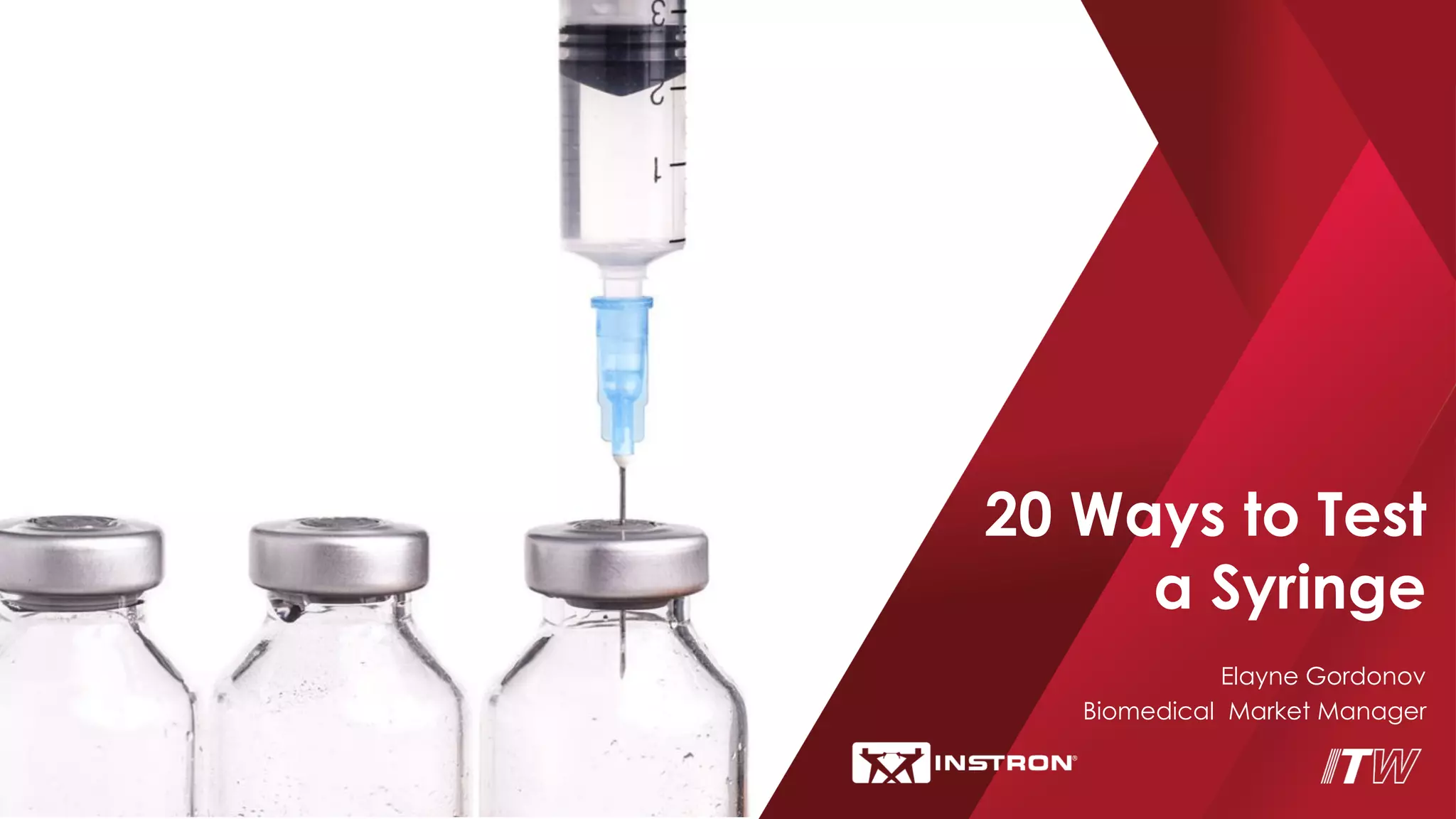
20 Ways to Test
a Syringe
22
Agenda
• Review of syringe components and injector types
• 20 Tests for a variety of different syringes and injectors
• Luer lock testing
• Plastic single-use syringes
• Glass pre-filled syringes
• Pen-injectors
• Auto-injectors
• Q&A
33
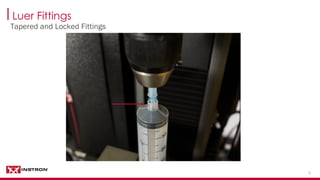
Luer Fittings
Tapered and Locked Fittings
44
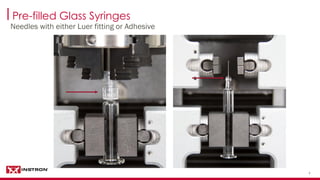
Pre-filled Glass Syringes
Needles with either Luer fitting or Adhesive
55
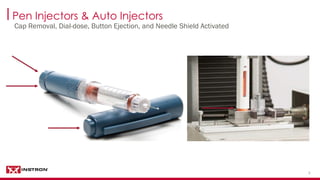
Pen Injectors & Auto Injectors
Cap Removal, Dial-dose, Button Ejection, and Needle Shield Activated
66
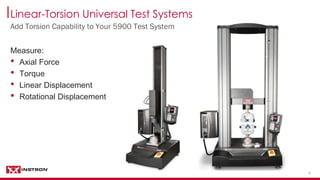
Linear-Torsion Universal Test Systems
Measure:
• Axial Force
• Torque
• Linear Displacement
• Rotational Displacement
Add Torsion Capability to Your 5900 Test System
77
Overview for Syringes and Syringe Components
20 Ways to Test a Syringe
88
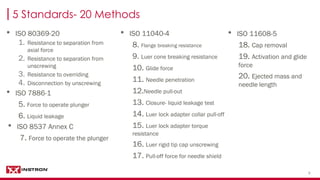
5 Standards- 20 Methods
• ISO 80369-20
1. Resistance to separation from
axial force
2. Resistance to separation from
unscrewing
3. Resistance to overriding
4. Disconnection by unscrewing
• ISO 7886-1
5. Force to operate plunger
6. Liquid leakage
• ISO 8537 Annex C
7. Force to operate the plunger
• ISO 11040-4
8. Flange breaking resistance
9. Luer cone breaking resistance
10. Glide force
11. Needle penetration
12.Needle pull-out
13. Closure- liquid leakage test
14. Luer lock adapter collar pull-off
15. Luer lock adapter torque
resistance
16. Luer rigid tip cap unscrewing
17. Pull-off force for needle shield
• ISO 11608-5
18. Cap removal
19. Activation and glide
force
20. Ejected mass and
needle length
99
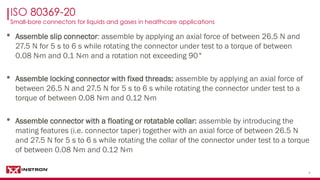
ISO 80369-20
Small-bore connectors for liquids and gases in healthcare applications
• Assemble slip connector: assemble by applying an axial force of between 26.5 N and
27.5 N for 5 s to 6 s while rotating the connector under test to a torque of between
0.08 N·m and 0.1 N·m and a rotation not exceeding 90°
• Assemble locking connector with fixed threads: assemble by applying an axial force of
between 26.5 N and 27.5 N for 5 s to 6 s while rotating the connector under test to a
torque of between 0.08 N·m and 0.12 N·m
• Assemble connector with a floating or rotatable collar: assemble by introducing the
mating features (i.e. connector taper) together with an axial force of between 26.5 N
and 27.5 N for 5 s to 6 s while rotating the collar of the connector under test to a torque
of between 0.08 N·m and 0.12 N·m
1010
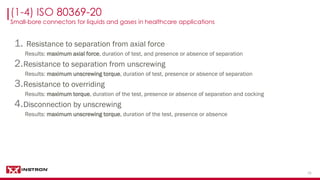
(1-4) ISO 80369-20
Small-bore connectors for liquids and gases in healthcare applications
1. Resistance to separation from axial force
Results: maximum axial force, duration of test, and presence or absence of separation
2.Resistance to separation from unscrewing
Results: maximum unscrewing torque, duration of test, presence or absence of separation
3.Resistance to overriding
Results: maximum torque, duration of the test, presence or absence of separation and cocking
4.Disconnection by unscrewing
Results: maximum unscrewing torque, duration of the test, presence or absence
1111
ISO 80369-20
Small-bore connectors for liquids and gases in healthcare applications
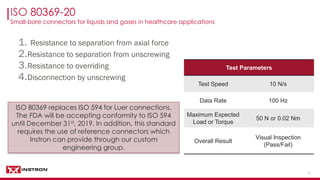
1. Resistance to separation from axial force
2.Resistance to separation from unscrewing
3.Resistance to overriding
4.Disconnection by unscrewing
Test Parameters
Test Speed 10 N/s
Data Rate 100 Hz
Maximum Expected
Load or Torque
50 N or 0.02 Nm
Overall Result
Visual Inspection
(Pass/Fail)
ISO 80369 replaces ISO 594 for Luer connections.
The FDA will be accepting conformity to ISO 594
until December 31st, 2019. In addition, this standard
requires the use of reference connectors which
Instron can provide through our custom
engineering group.
1212
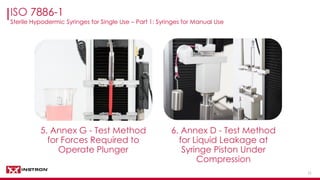
ISO 7886-1
Sterile Hypodermic Syringes for Single Use – Part 1: Syringes for Manual Use
5. Annex G - Test Method
for Forces Required to
Operate Plunger
6. Annex D - Test Method
for Liquid Leakage at
Syringe Piston Under
Compression
1313
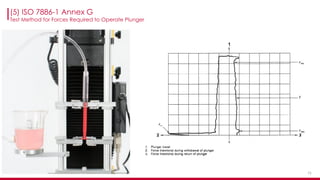
(5) ISO 7886-1 Annex G
Test Method for Forces Required to Operate Plunger
1414
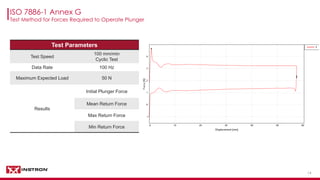
ISO 7886-1 Annex G
Test Method for Forces Required to Operate Plunger
Test Parameters
Test Speed
100 mm/min
Cyclic Test
Data Rate 100 Hz
Maximum Expected Load 50 N
Results
Initial Plunger Force
Mean Return Force
Max Return Force
Min Return Force
1515
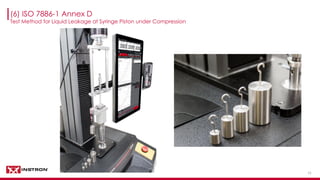
(6) ISO 7886-1 Annex D
Test Method for Liquid Leakage at Syringe Piston under Compression
1616
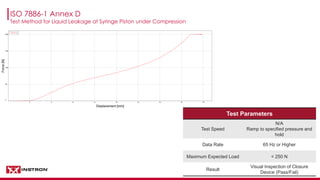
ISO 7886-1 Annex D
Test Method for Liquid Leakage at Syringe Piston under Compression
Test Parameters
Test Speed
N/A
Ramp to specified pressure and
hold
Data Rate 65 Hz or Higher
Maximum Expected Load < 250 N
Result
Visual Inspection of Closure
Device (Pass/Fail)
1717
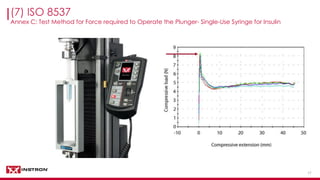
(7) ISO 8537
Annex C: Test Method for Force required to Operate the Plunger- Single-Use Syringe for Insulin
1818
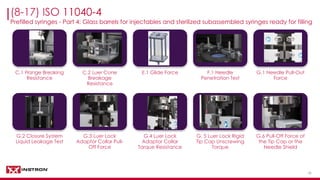
(8-17) ISO 11040-4
Prefilled syringes - Part 4: Glass barrels for injectables and sterilized subassembled syringes ready for filling
C.1 Flange Breaking
Resistance
C.2 Luer Cone
Breakage
Resistance
E.1 Glide Force F.1 Needle
Penetration Test
G.1 Needle Pull-Out
Force
G.2 Closure System
Liquid Leakage Test
G.3 Luer Lock
Adaptor Collar Pull-
Off Force
G.4 Luer Lock
Adaptor Collar
Torque Resistance
G. 5 Luer Lock Rigid
Tip Cap Unscrewing
Torque
G.6 Pull-Off Force of
the Tip Cap or the
Needle Shield
1919
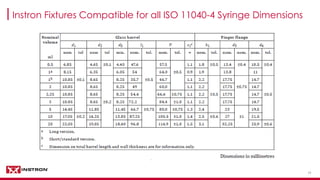
Instron Fixtures Compatible for all ISO 11040-4 Syringe Dimensions
2020
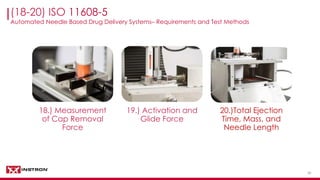
(18-20) ISO 11608-5
Automated Needle Based Drug Delivery Systems– Requirements and Test Methods
18.) Measurement
of Cap Removal
Force
19.) Activation and
Glide Force
20.)Total Ejection
Time, Mass, and
Needle Length
2121
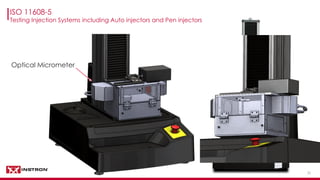
ISO 11608-5
Testing Injection Systems including Auto injectors and Pen injectors
Optical Micrometer
2222
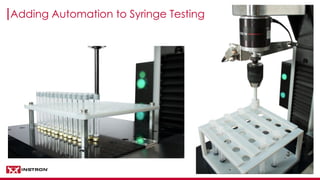
Adding Automation to Syringe Testing
2323
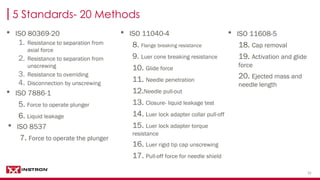
5 Standards- 20 Methods
• ISO 80369-20
1. Resistance to separation from
axial force
2. Resistance to separation from
unscrewing
3. Resistance to overriding
4. Disconnection by unscrewing
• ISO 7886-1
5. Force to operate plunger
6. Liquid leakage
• ISO 8537
7. Force to operate the plunger
• ISO 11040-4
8. Flange breaking resistance
9. Luer cone breaking resistance
10. Glide force
11. Needle penetration
12.Needle pull-out
13. Closure- liquid leakage test
14. Luer lock adapter collar pull-off
15. Luer lock adapter torque
resistance
16. Luer rigid tip cap unscrewing
17. Pull-off force for needle shield
• ISO 11608-5
18. Cap removal
19. Activation and glide
force
20. Ejected mass and
needle length
2424
Want to learn more?
www.instron.com/en/our-company/contact-us

20 Ways to Test a Syringe

  • 1.
    Elayne Gordonov Biomedical MarketManager 20 Ways to Test a Syringe
  • 2.
    22 Agenda • Review ofsyringe components and injector types • 20 Tests for a variety of different syringes and injectors • Luer lock testing • Plastic single-use syringes • Glass pre-filled syringes • Pen-injectors • Auto-injectors • Q&A
  • 3.
  • 4.
    44 Pre-filled Glass Syringes Needleswith either Luer fitting or Adhesive
  • 5.
    55 Pen Injectors &Auto Injectors Cap Removal, Dial-dose, Button Ejection, and Needle Shield Activated
  • 6.
    66 Linear-Torsion Universal TestSystems Measure: • Axial Force • Torque • Linear Displacement • Rotational Displacement Add Torsion Capability to Your 5900 Test System
  • 7.
    77 Overview for Syringesand Syringe Components 20 Ways to Test a Syringe
  • 8.
    88 5 Standards- 20Methods • ISO 80369-20 1. Resistance to separation from axial force 2. Resistance to separation from unscrewing 3. Resistance to overriding 4. Disconnection by unscrewing • ISO 7886-1 5. Force to operate plunger 6. Liquid leakage • ISO 8537 Annex C 7. Force to operate the plunger • ISO 11040-4 8. Flange breaking resistance 9. Luer cone breaking resistance 10. Glide force 11. Needle penetration 12.Needle pull-out 13. Closure- liquid leakage test 14. Luer lock adapter collar pull-off 15. Luer lock adapter torque resistance 16. Luer rigid tip cap unscrewing 17. Pull-off force for needle shield • ISO 11608-5 18. Cap removal 19. Activation and glide force 20. Ejected mass and needle length
  • 9.
    99 ISO 80369-20 Small-bore connectorsfor liquids and gases in healthcare applications • Assemble slip connector: assemble by applying an axial force of between 26.5 N and 27.5 N for 5 s to 6 s while rotating the connector under test to a torque of between 0.08 N·m and 0.1 N·m and a rotation not exceeding 90° • Assemble locking connector with fixed threads: assemble by applying an axial force of between 26.5 N and 27.5 N for 5 s to 6 s while rotating the connector under test to a torque of between 0.08 N·m and 0.12 N·m • Assemble connector with a floating or rotatable collar: assemble by introducing the mating features (i.e. connector taper) together with an axial force of between 26.5 N and 27.5 N for 5 s to 6 s while rotating the collar of the connector under test to a torque of between 0.08 N·m and 0.12 N·m
  • 10.
    1010 (1-4) ISO 80369-20 Small-boreconnectors for liquids and gases in healthcare applications 1. Resistance to separation from axial force Results: maximum axial force, duration of test, and presence or absence of separation 2.Resistance to separation from unscrewing Results: maximum unscrewing torque, duration of test, presence or absence of separation 3.Resistance to overriding Results: maximum torque, duration of the test, presence or absence of separation and cocking 4.Disconnection by unscrewing Results: maximum unscrewing torque, duration of the test, presence or absence
  • 11.
    1111 ISO 80369-20 Small-bore connectorsfor liquids and gases in healthcare applications 1. Resistance to separation from axial force 2.Resistance to separation from unscrewing 3.Resistance to overriding 4.Disconnection by unscrewing Test Parameters Test Speed 10 N/s Data Rate 100 Hz Maximum Expected Load or Torque 50 N or 0.02 Nm Overall Result Visual Inspection (Pass/Fail) ISO 80369 replaces ISO 594 for Luer connections. The FDA will be accepting conformity to ISO 594 until December 31st, 2019. In addition, this standard requires the use of reference connectors which Instron can provide through our custom engineering group.
  • 12.
    1212 ISO 7886-1 Sterile HypodermicSyringes for Single Use – Part 1: Syringes for Manual Use 5. Annex G - Test Method for Forces Required to Operate Plunger 6. Annex D - Test Method for Liquid Leakage at Syringe Piston Under Compression
  • 13.
    1313 (5) ISO 7886-1Annex G Test Method for Forces Required to Operate Plunger
  • 14.
    1414 ISO 7886-1 AnnexG Test Method for Forces Required to Operate Plunger Test Parameters Test Speed 100 mm/min Cyclic Test Data Rate 100 Hz Maximum Expected Load 50 N Results Initial Plunger Force Mean Return Force Max Return Force Min Return Force
  • 15.
    1515 (6) ISO 7886-1Annex D Test Method for Liquid Leakage at Syringe Piston under Compression
  • 16.
    1616 ISO 7886-1 AnnexD Test Method for Liquid Leakage at Syringe Piston under Compression Test Parameters Test Speed N/A Ramp to specified pressure and hold Data Rate 65 Hz or Higher Maximum Expected Load < 250 N Result Visual Inspection of Closure Device (Pass/Fail)
  • 17.
    1717 (7) ISO 8537 AnnexC: Test Method for Force required to Operate the Plunger- Single-Use Syringe for Insulin
  • 18.
    1818 (8-17) ISO 11040-4 Prefilledsyringes - Part 4: Glass barrels for injectables and sterilized subassembled syringes ready for filling C.1 Flange Breaking Resistance C.2 Luer Cone Breakage Resistance E.1 Glide Force F.1 Needle Penetration Test G.1 Needle Pull-Out Force G.2 Closure System Liquid Leakage Test G.3 Luer Lock Adaptor Collar Pull- Off Force G.4 Luer Lock Adaptor Collar Torque Resistance G. 5 Luer Lock Rigid Tip Cap Unscrewing Torque G.6 Pull-Off Force of the Tip Cap or the Needle Shield
  • 19.
    1919 Instron Fixtures Compatiblefor all ISO 11040-4 Syringe Dimensions
  • 20.
    2020 (18-20) ISO 11608-5 AutomatedNeedle Based Drug Delivery Systems– Requirements and Test Methods 18.) Measurement of Cap Removal Force 19.) Activation and Glide Force 20.)Total Ejection Time, Mass, and Needle Length
  • 21.
    2121 ISO 11608-5 Testing InjectionSystems including Auto injectors and Pen injectors Optical Micrometer
  • 22.
  • 23.
    2323 5 Standards- 20Methods • ISO 80369-20 1. Resistance to separation from axial force 2. Resistance to separation from unscrewing 3. Resistance to overriding 4. Disconnection by unscrewing • ISO 7886-1 5. Force to operate plunger 6. Liquid leakage • ISO 8537 7. Force to operate the plunger • ISO 11040-4 8. Flange breaking resistance 9. Luer cone breaking resistance 10. Glide force 11. Needle penetration 12.Needle pull-out 13. Closure- liquid leakage test 14. Luer lock adapter collar pull-off 15. Luer lock adapter torque resistance 16. Luer rigid tip cap unscrewing 17. Pull-off force for needle shield • ISO 11608-5 18. Cap removal 19. Activation and glide force 20. Ejected mass and needle length
  • 24.
    2424 Want to learnmore? www.instron.com/en/our-company/contact-us