



P. B. S. Bailey, PhD
Manchester Conference Centre, November 2015
Composites on the Move:
The Need for Dynamic Testing
2
“New and Exciting”?
• Frequent improvements in resins and fibers
• Various “revolutionary” new processing
techniques
• Many effective test methods
• Too many?
• Or too few…
• Established structural composites market
for 30 years
3
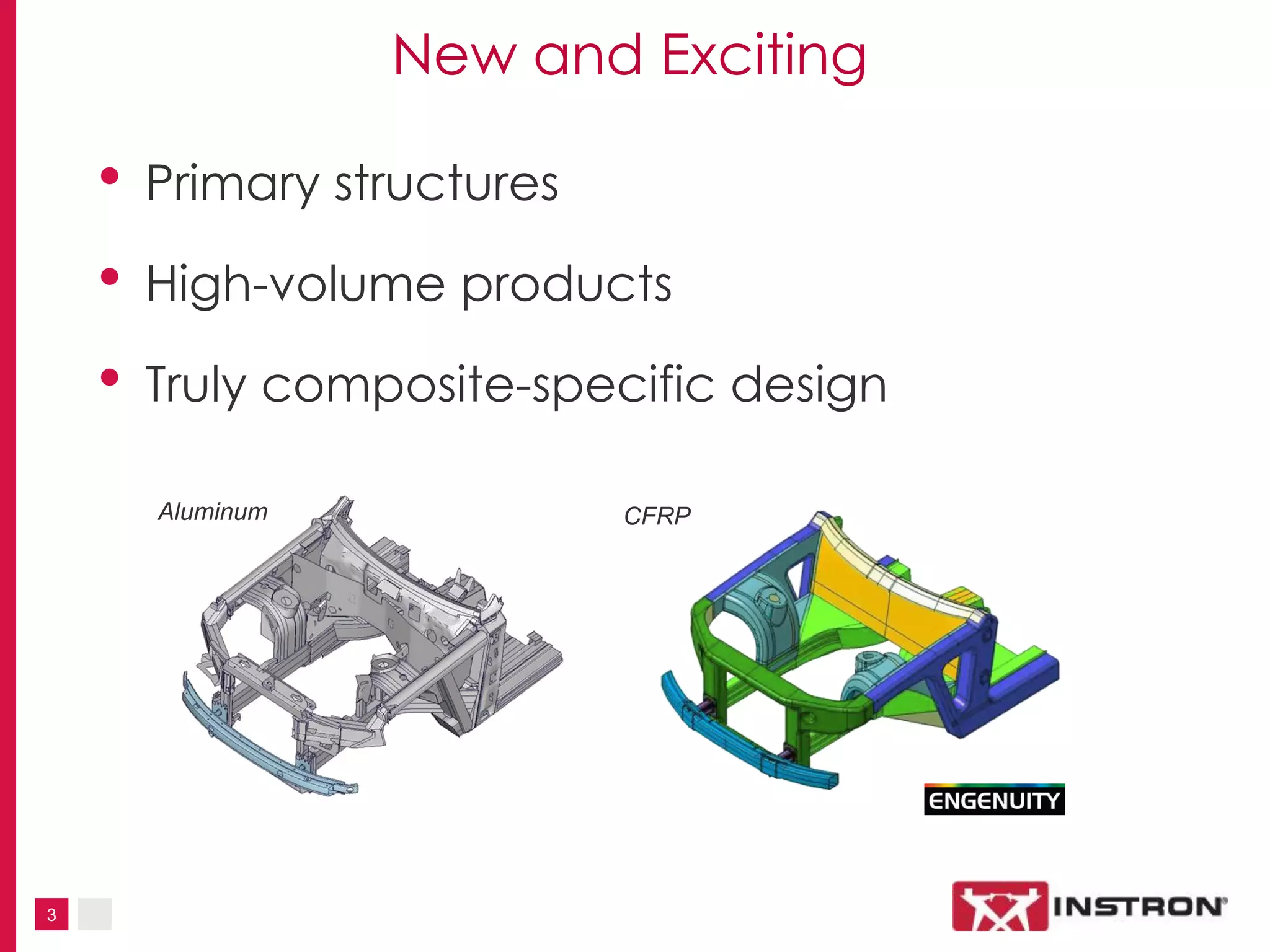
New and Exciting
• Primary structures
• High-volume products
• Truly composite-specific design
Aluminum CFRP
4
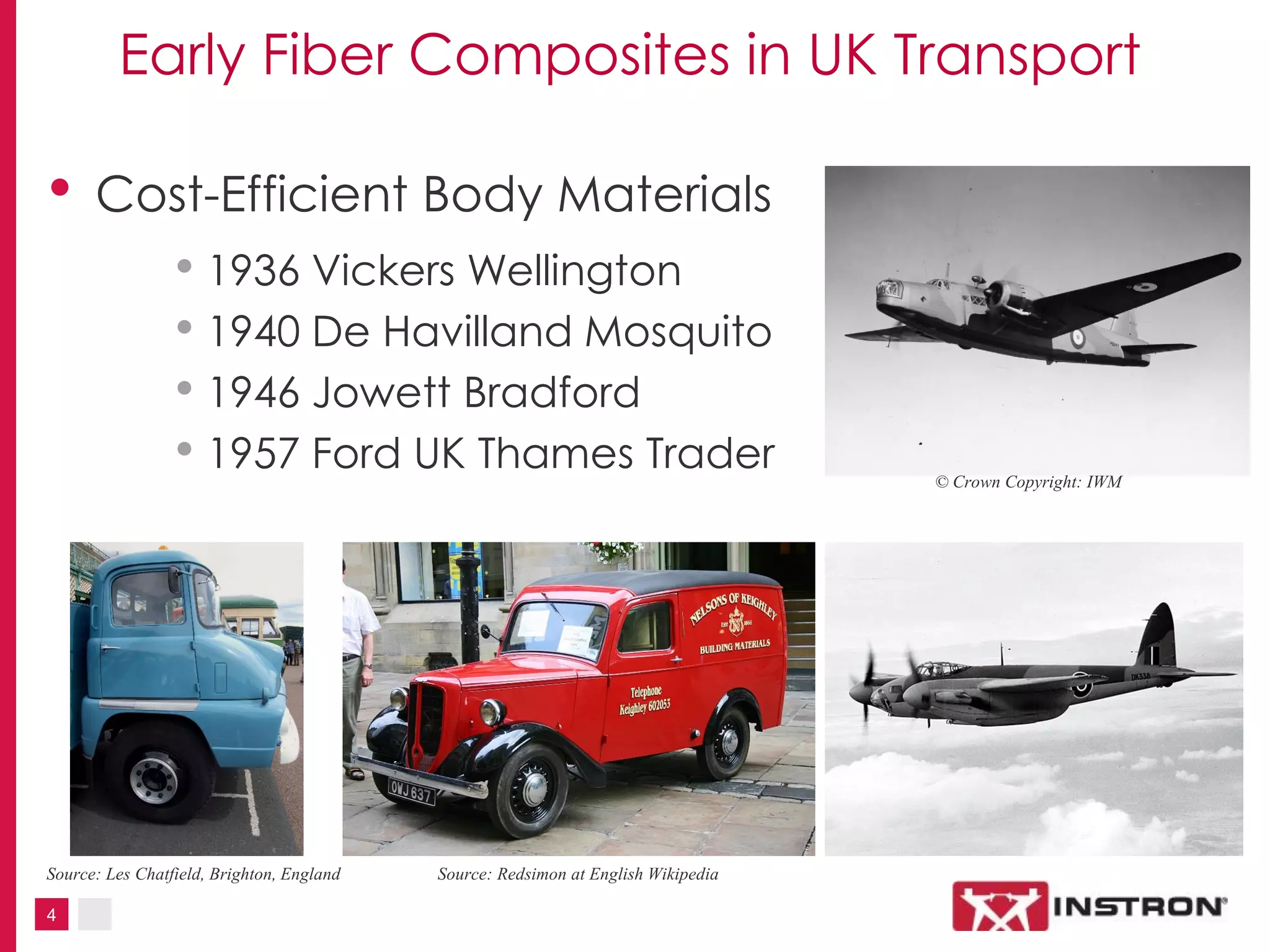
Early Fiber Composites in UK Transport
• Cost-Efficient Body Materials
• 1936 Vickers Wellington
• 1940 De Havilland Mosquito
• 1946 Jowett Bradford
• 1957 Ford UK Thames Trader © Crown Copyright: IWM
Source: Redsimon at English WikipediaSource: Les Chatfield, Brighton, England
5
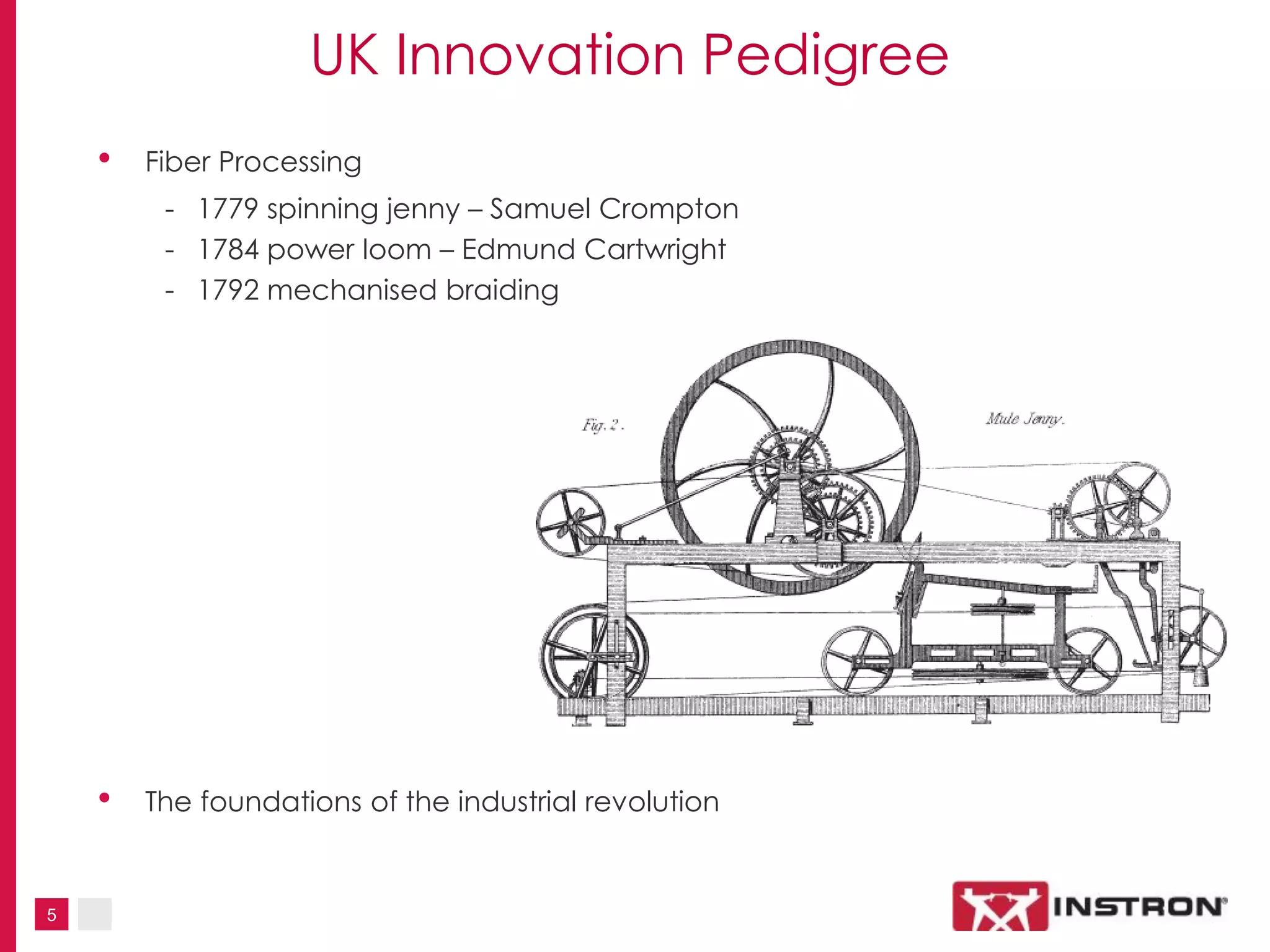
UK Innovation Pedigree
• Fiber Processing
- 1779 spinning jenny – Samuel Crompton
- 1784 power loom – Edmund Cartwright
- 1792 mechanised braiding
• The foundations of the industrial revolution
6
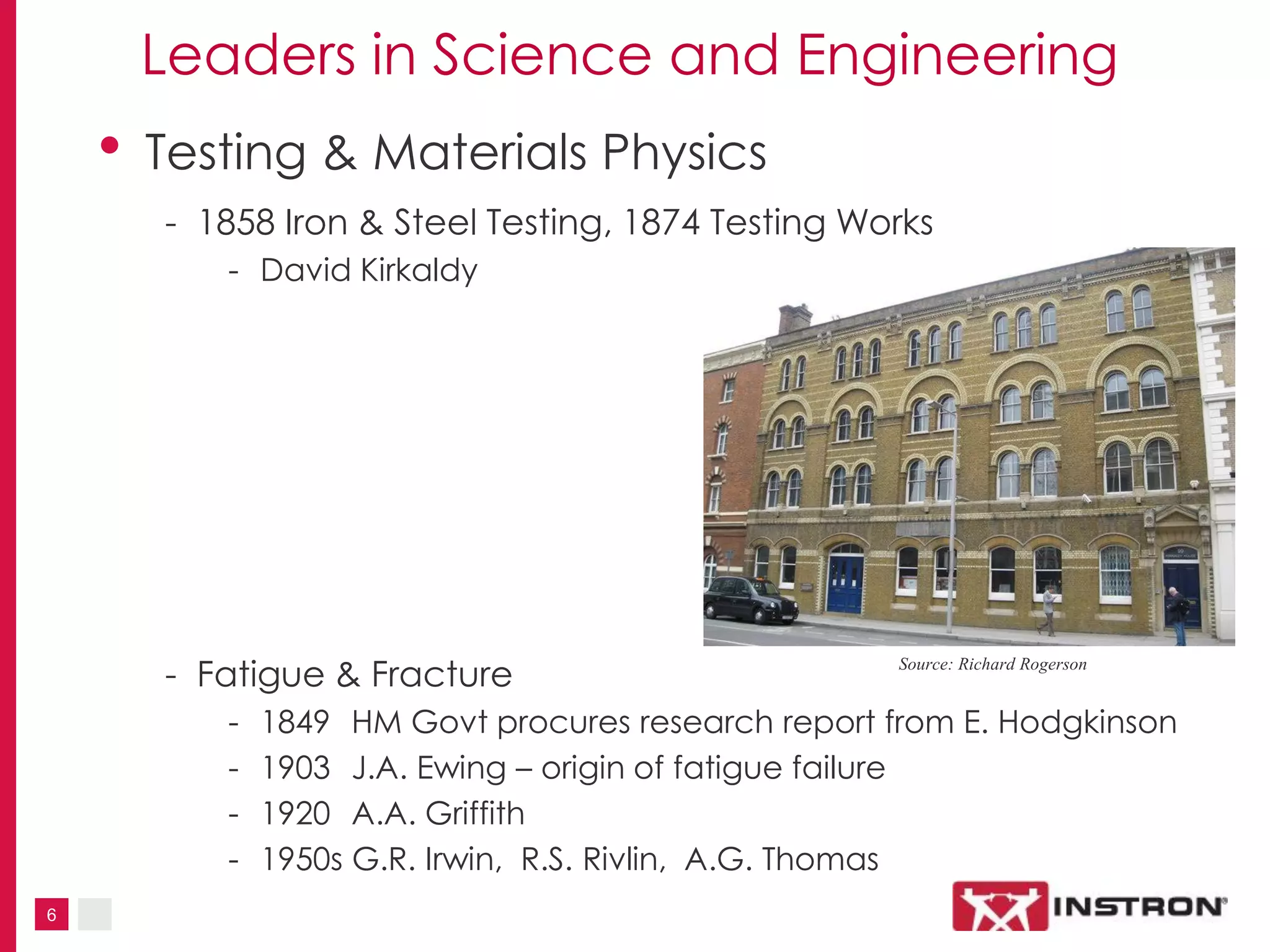
Leaders in Science and Engineering
• Testing & Materials Physics
- 1858 Iron & Steel Testing, 1874 Testing Works
- David Kirkaldy
- Fatigue & Fracture
- 1849 HM Govt procures research report from E. Hodgkinson
- 1903 J.A. Ewing – origin of fatigue failure
- 1920 A.A. Griffith
- 1950s G.R. Irwin, R.S. Rivlin, A.G. Thomas
Source: Richard Rogerson
7
Why the History Lesson?
• There is a huge weight of evidence behind
metals design
• Fibre technology has been around for a
while too!
• Structural composites have caught up a
lot in just a few decades
• But they are still some way behind…
8
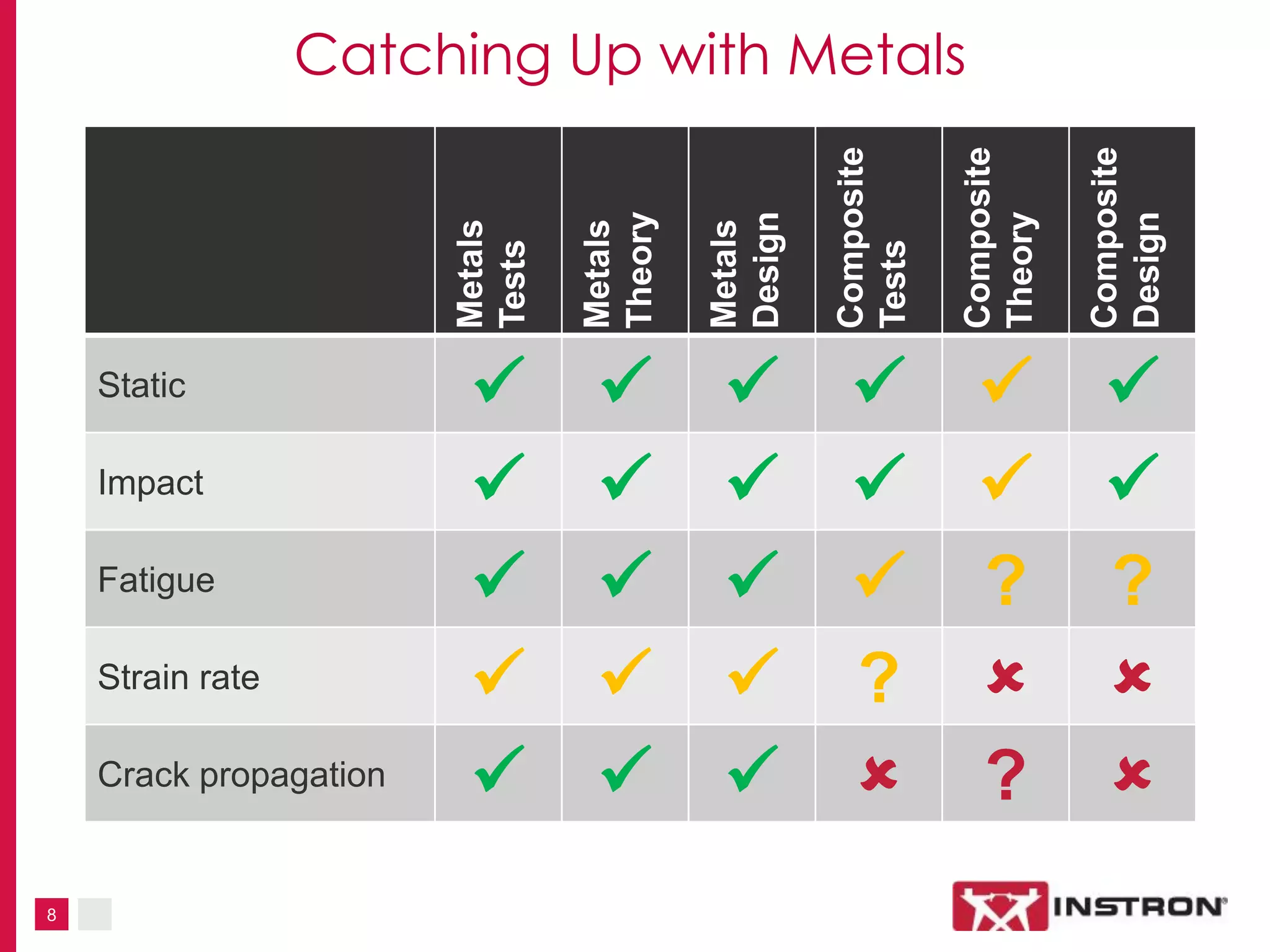
Catching Up with Metals
Metals
Tests
Metals
Theory
Metals
Design
Composite
Tests
Composite
Theory
Composite
Design
Static      
Impact      
Fatigue     ? ?
Strain rate    ?  
Crack propagation     ? 
9
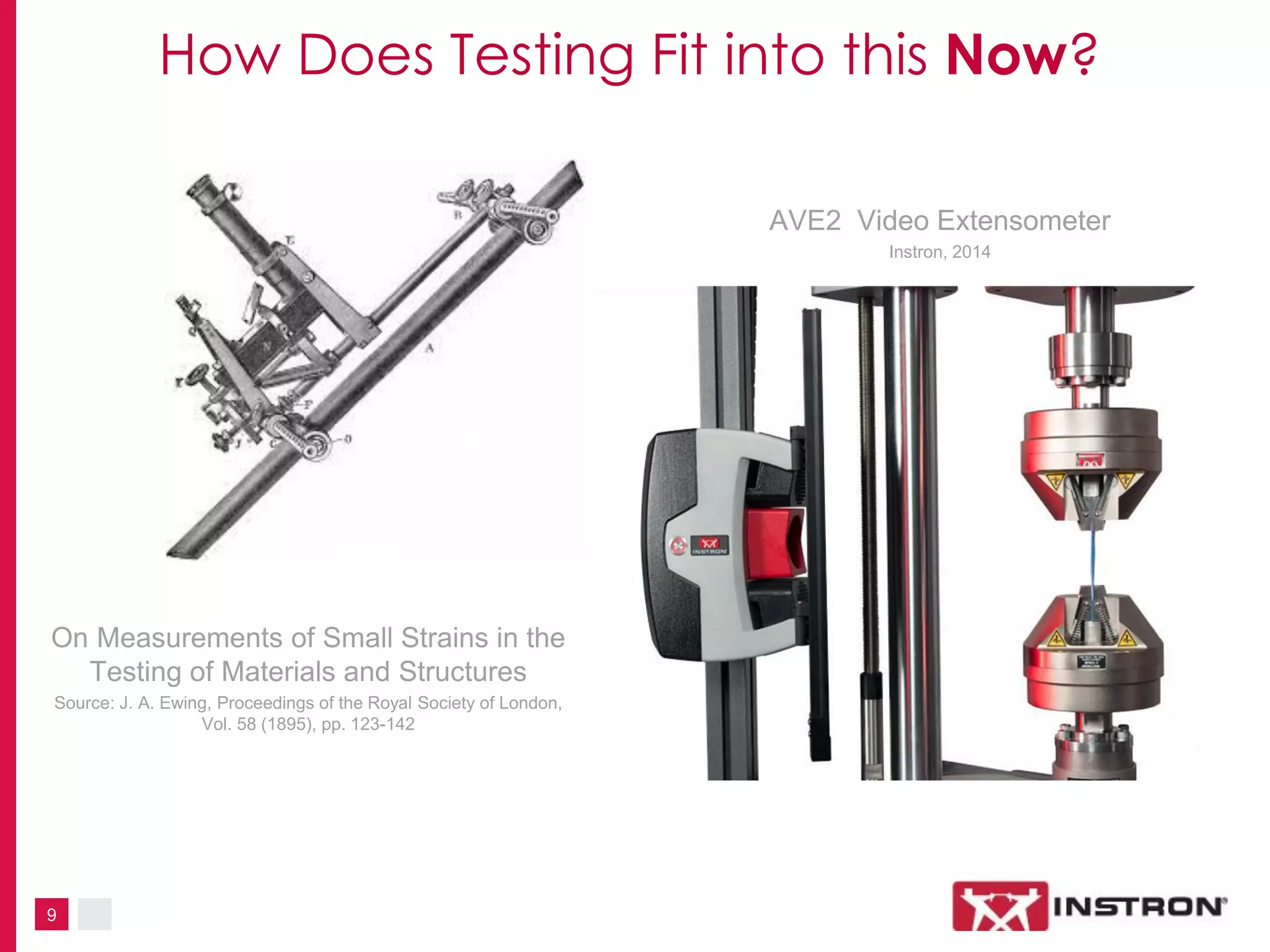
How Does Testing Fit into this Now?
On Measurements of Small Strains in the
Testing of Materials and Structures
Source: J. A. Ewing, Proceedings of the Royal Society of London,
Vol. 58 (1895), pp. 123-142
AVE2 Video Extensometer
Instron, 2014
10
What Do You Think About Testing?
• Costly?
• Difficult?
• Interesting?
• Useful for R&D?
• Central to your business success?
• Critical?
11
Yes …To All of Those!
• Testing composites is critical to the
continued success of the sector
• Testing and design methods need to fully
address the effects of dynamic behavior
12
Fatigue
• “Between 80% to 90% of ALL mechanical
service failures can be attributed to fatigue.”
(ASM – Metals Handbook 2008)
• >186 years of observation!
• Do we have enough data to make a
comparison for composites?
13
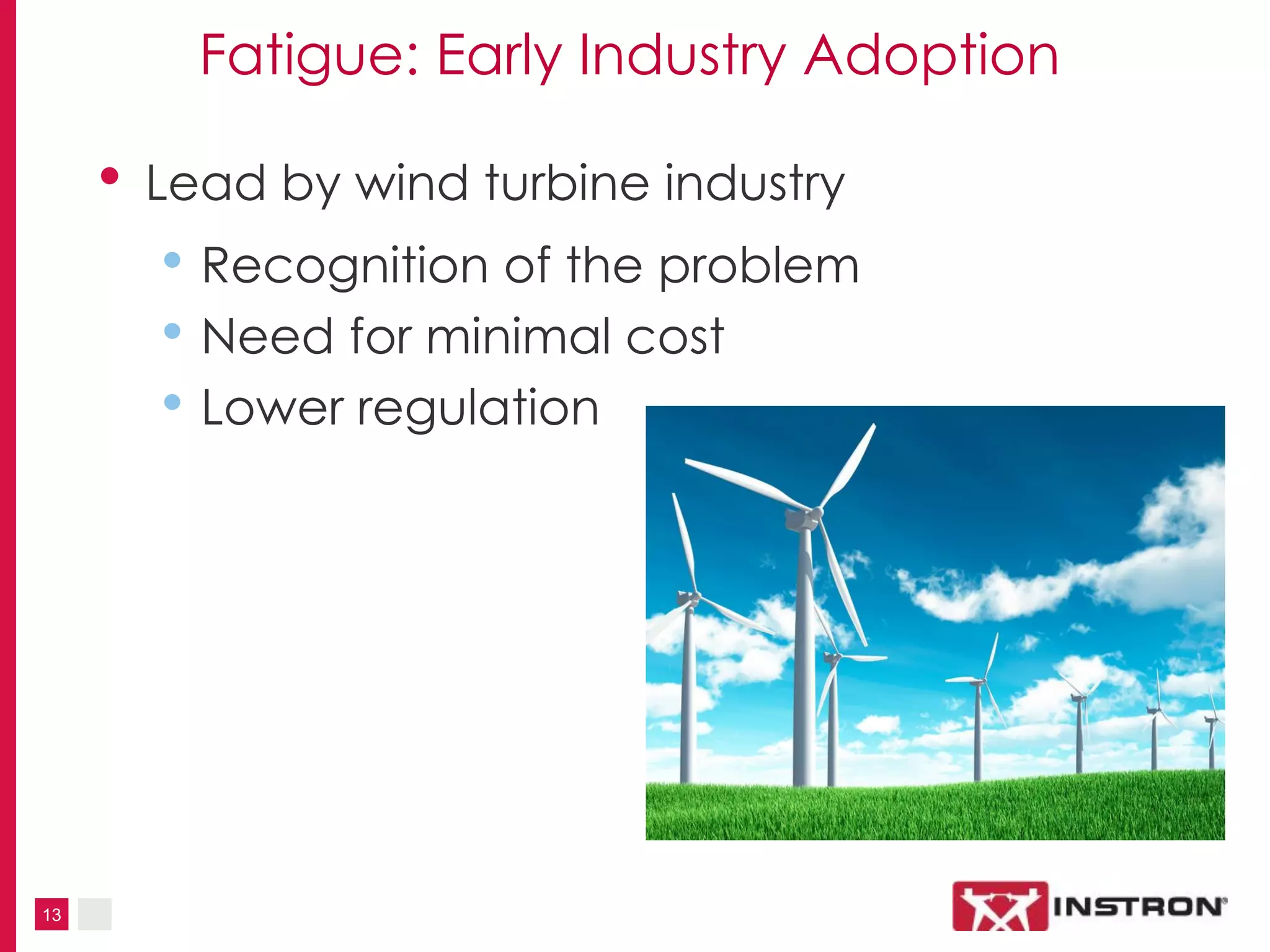
Fatigue: Early Industry Adoption
• Lead by wind turbine industry
• Recognition of the problem
• Need for minimal cost
• Lower regulation
14
Fatigue: Early Compromises
• Tension-tension tests only
• Sinusoidal loading
• Minimal temperature control
15
Is this Representative?
• Incomplete, but not incorrect…
• Where all science starts out!
• What is the next step?
• Compression or reversed loading would
be more aggressive and more realistic
• Constant / fixed strain rate would give
more comparable characterization
16
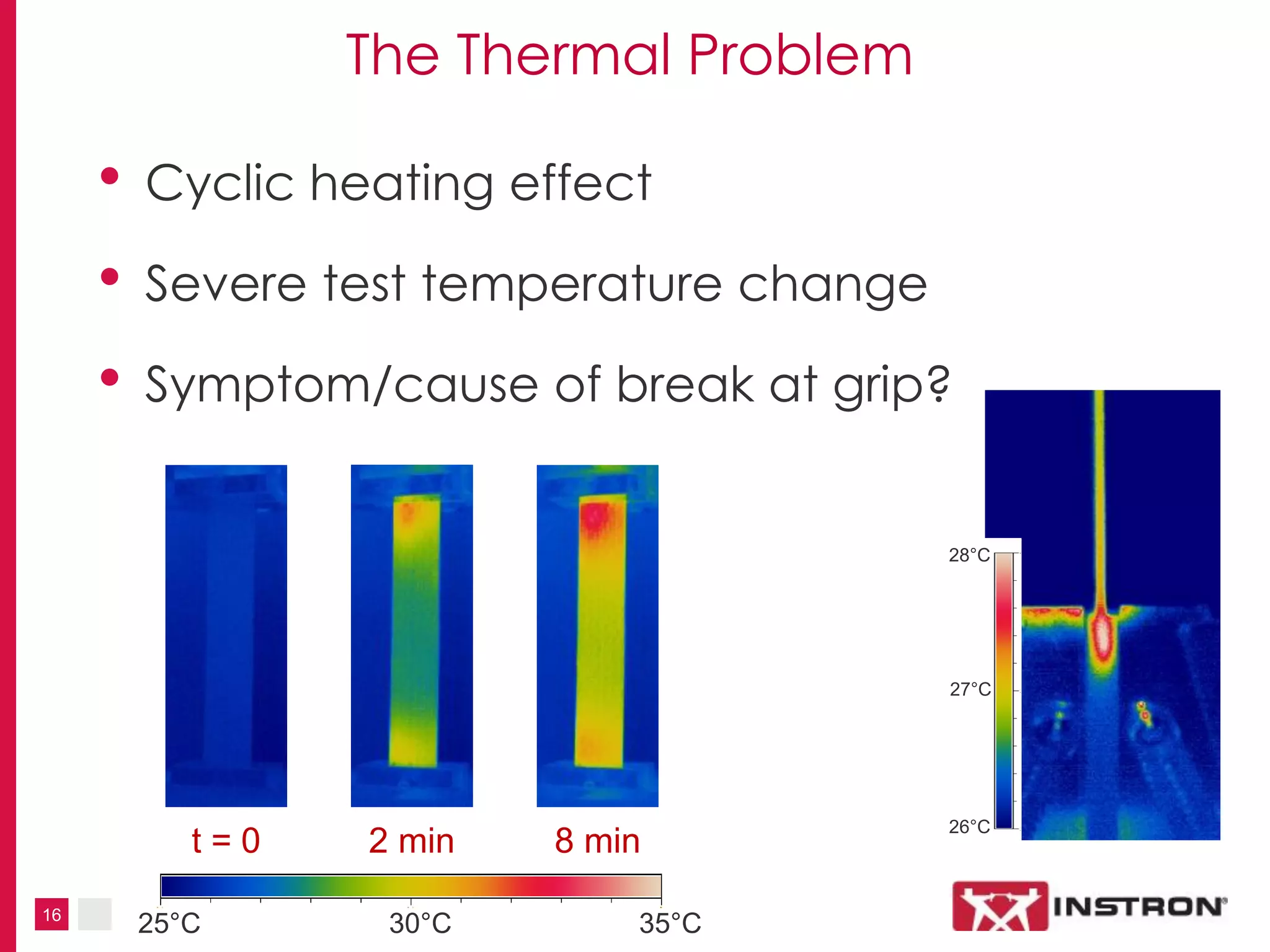
The Thermal Problem
• Cyclic heating effect
• Severe test temperature change
• Symptom/cause of break at grip?
t = 0 2 min 8 min
25°C 30°C 35°C
26°C
27°C
28°C
17
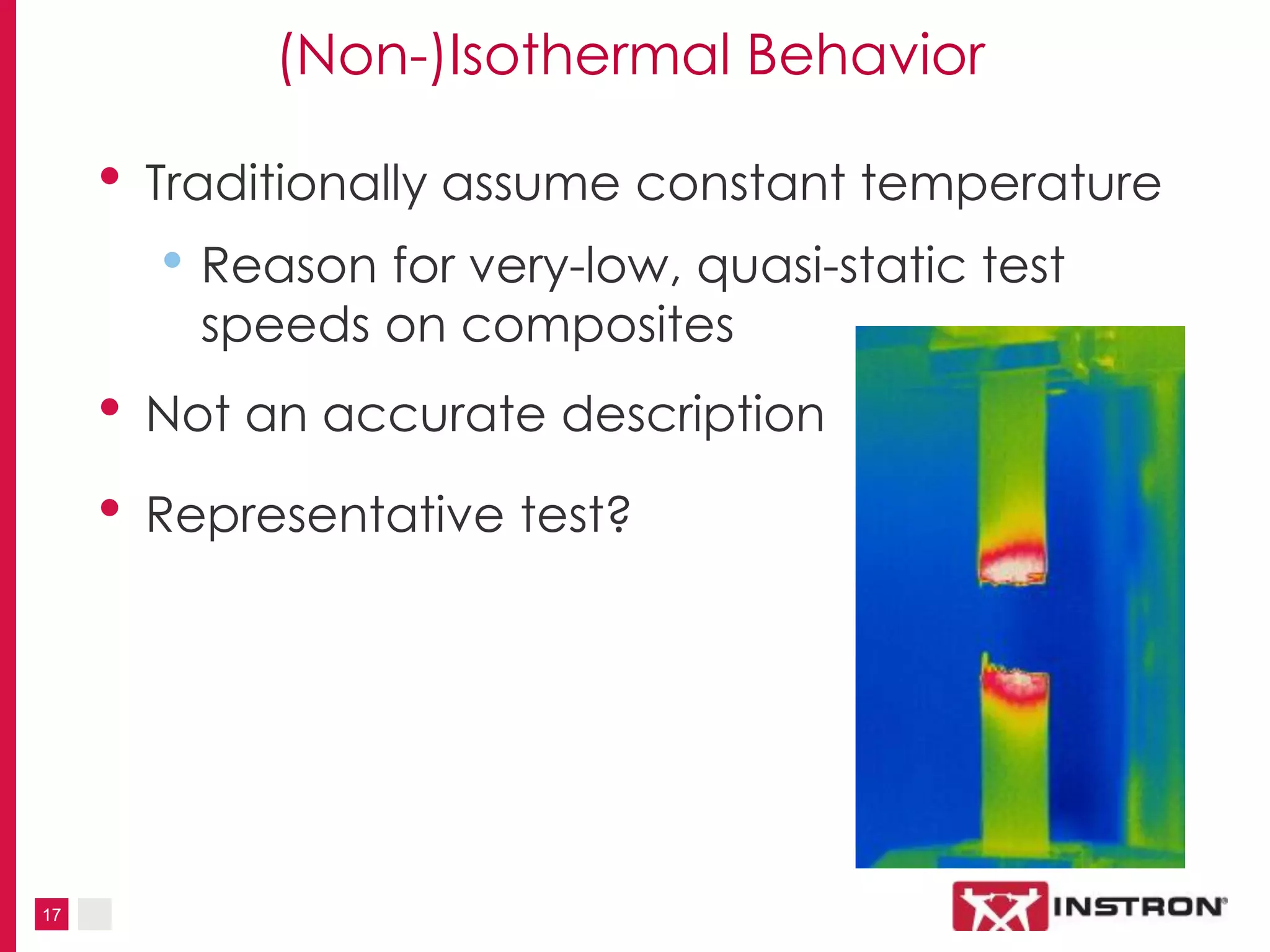
(Non-)Isothermal Behavior
• Traditionally assume constant temperature
• Reason for very-low, quasi-static test
speeds on composites
• Not an accurate description
• Representative test?
18
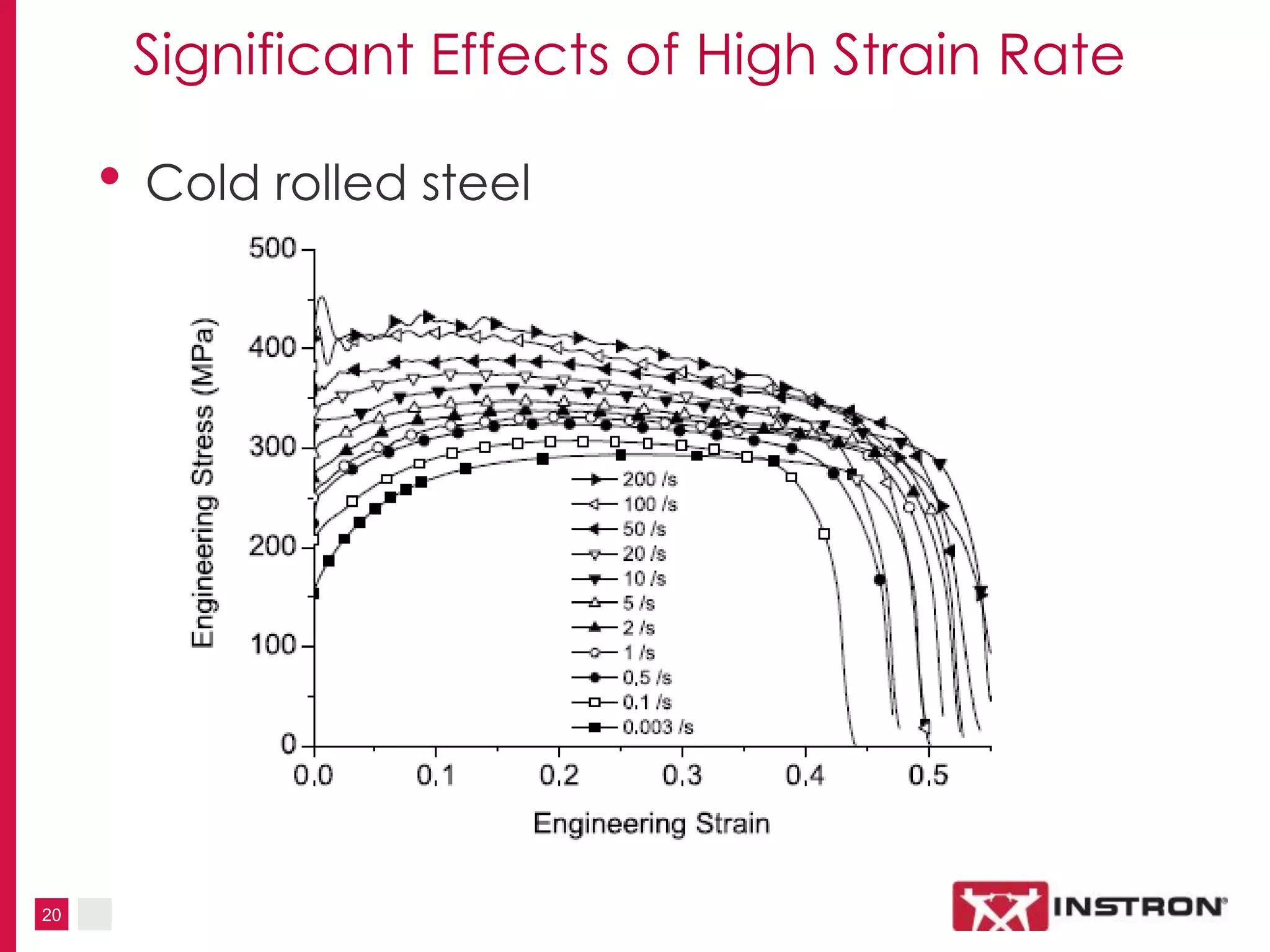
Strain Rate Testing
• Materials exhibit different mechanical
behavior at different strain rates
• Viscoelastic behavior in polymers
• Geometric & friction effects in textiles
• Crack propagation mechanisms
• Quasi-static data are insufficient to model
crash behavior
• Even for metals
19
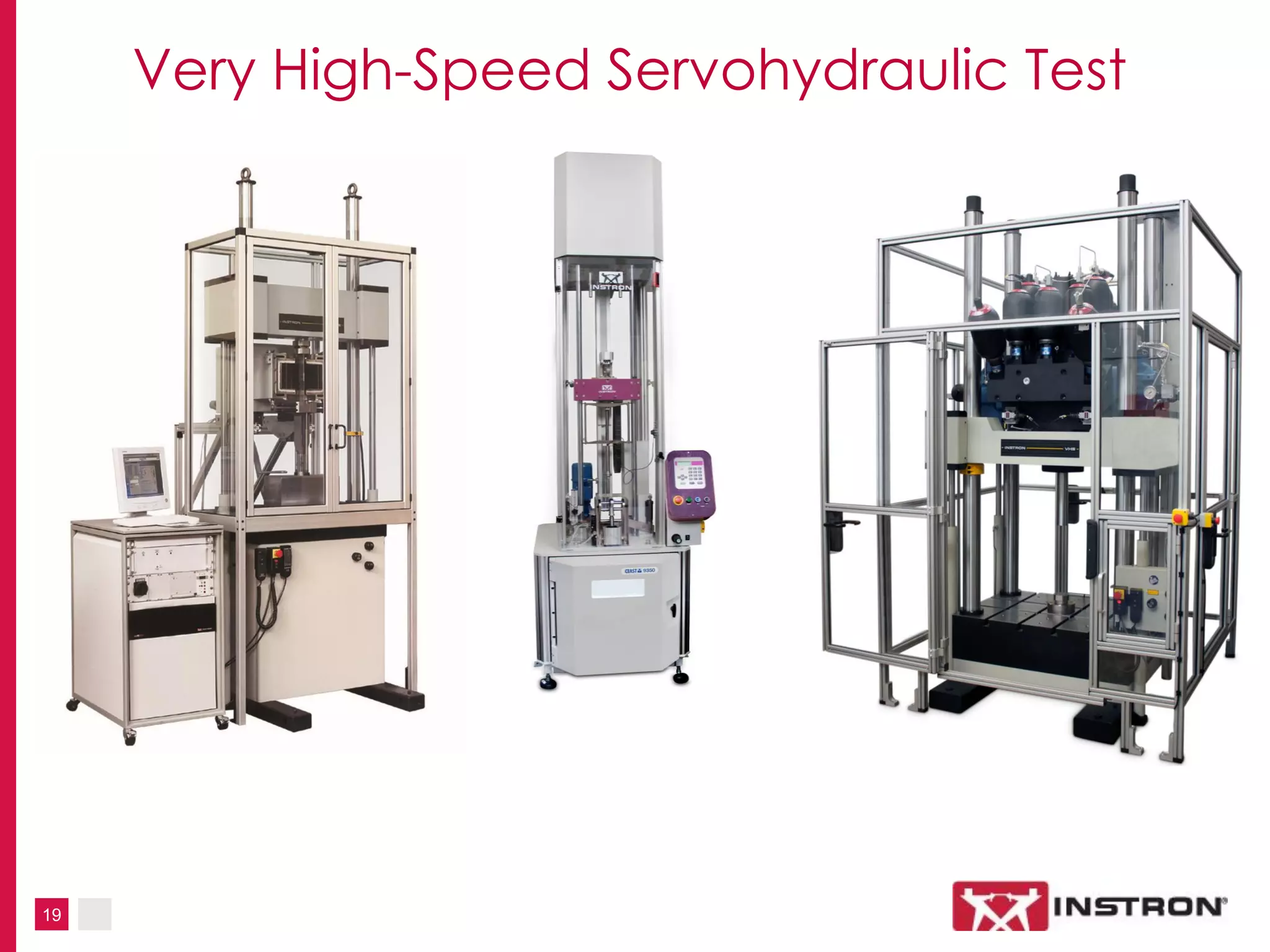
Very High-Speed Servohydraulic Test
20
Significant Effects of High Strain Rate
• Cold rolled steel
21
Renewed Interest
• Organic growth of research in:
• Composites performance
• Composites modelling
• 2010 onwards
• Automotive:
• Before 2014, interest…
• Now converted to urgent need
22
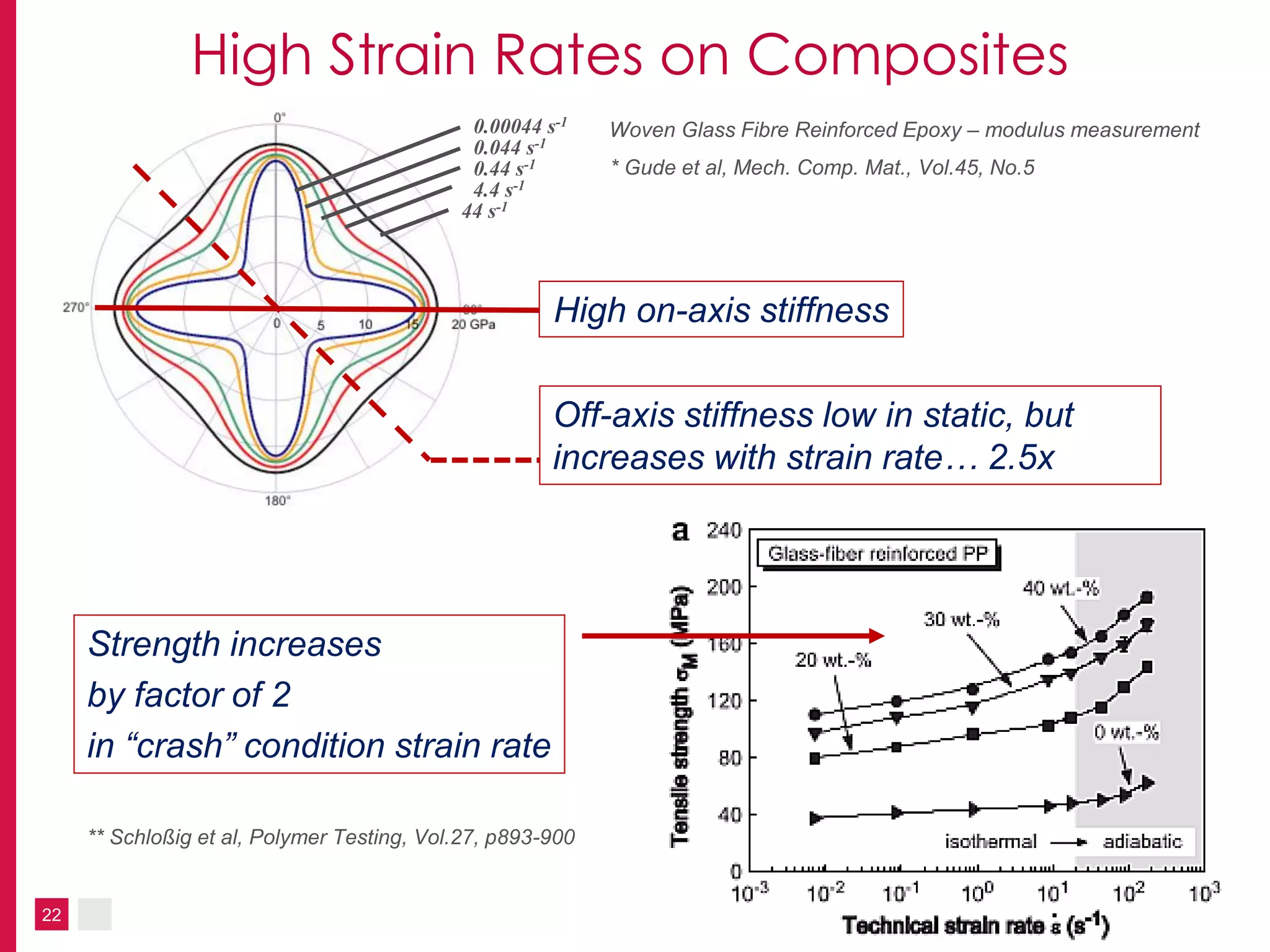
High Strain Rates on Composites
0.00044 s-1
0.044 s-1
4.4 s-1
0.44 s-1
44 s-1
* Gude et al, Mech. Comp. Mat., Vol.45, No.5
High on-axis stiffness
Off-axis stiffness low in static, but
increases with strain rate… 2.5x
Strength increases
by factor of 2
in “crash” condition strain rate
Woven Glass Fibre Reinforced Epoxy – modulus measurement
** Schloßig et al, Polymer Testing, Vol.27, p893-900
23
Measurement Challenges
• Strain rates over 100-s
• At >10 m/s this is a very fast test
• Looking at events on order of sound speed
• Resonance ≠ Signal Noise
• Careful interpretation needed
• Effective fixturing must be highly tailored
24
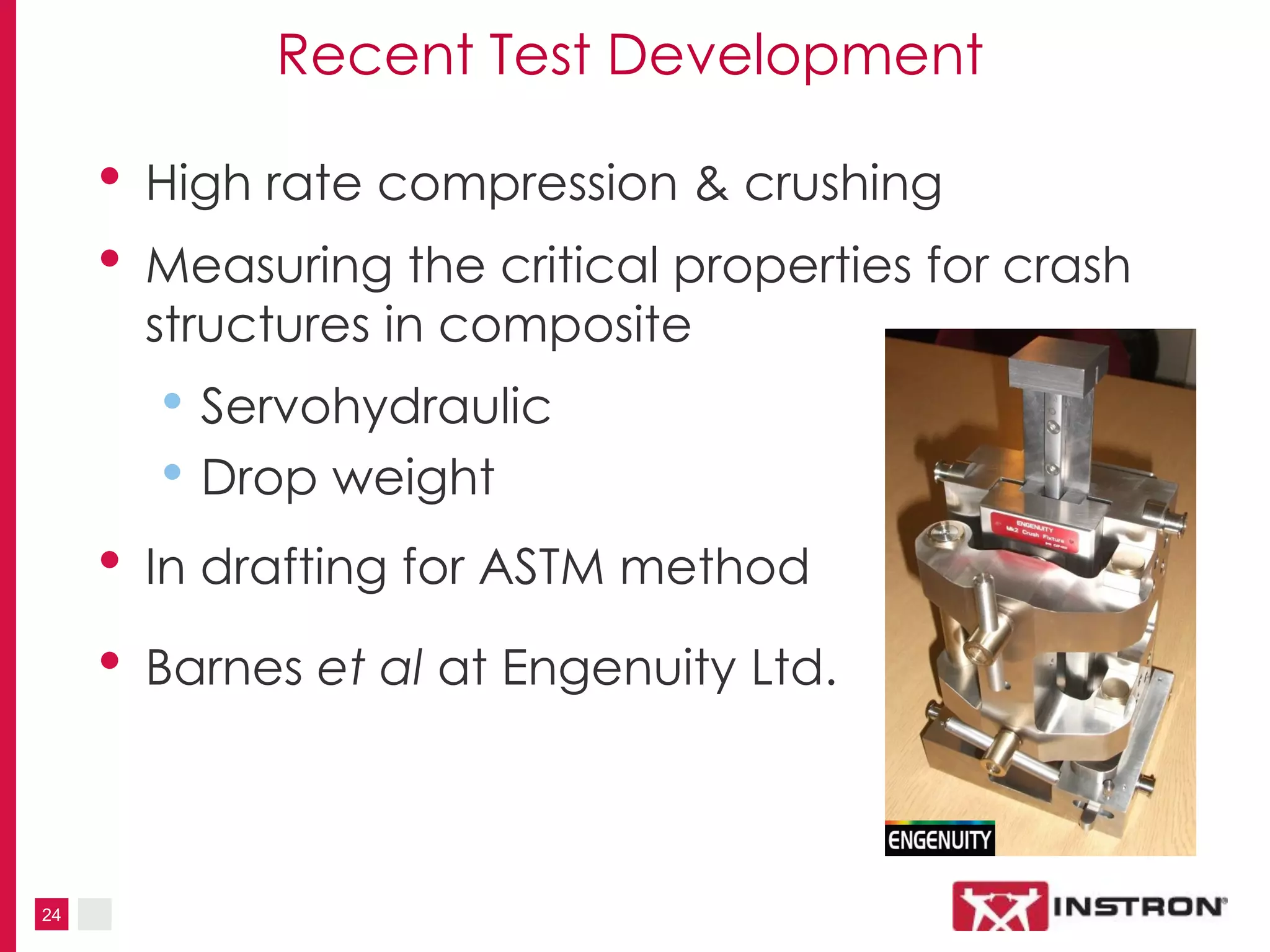
Recent Test Development
• High rate compression & crushing
• Measuring the critical properties for crash
structures in composite
• Servohydraulic
• Drop weight
• In drafting for ASTM method
• Barnes et al at Engenuity Ltd.
25
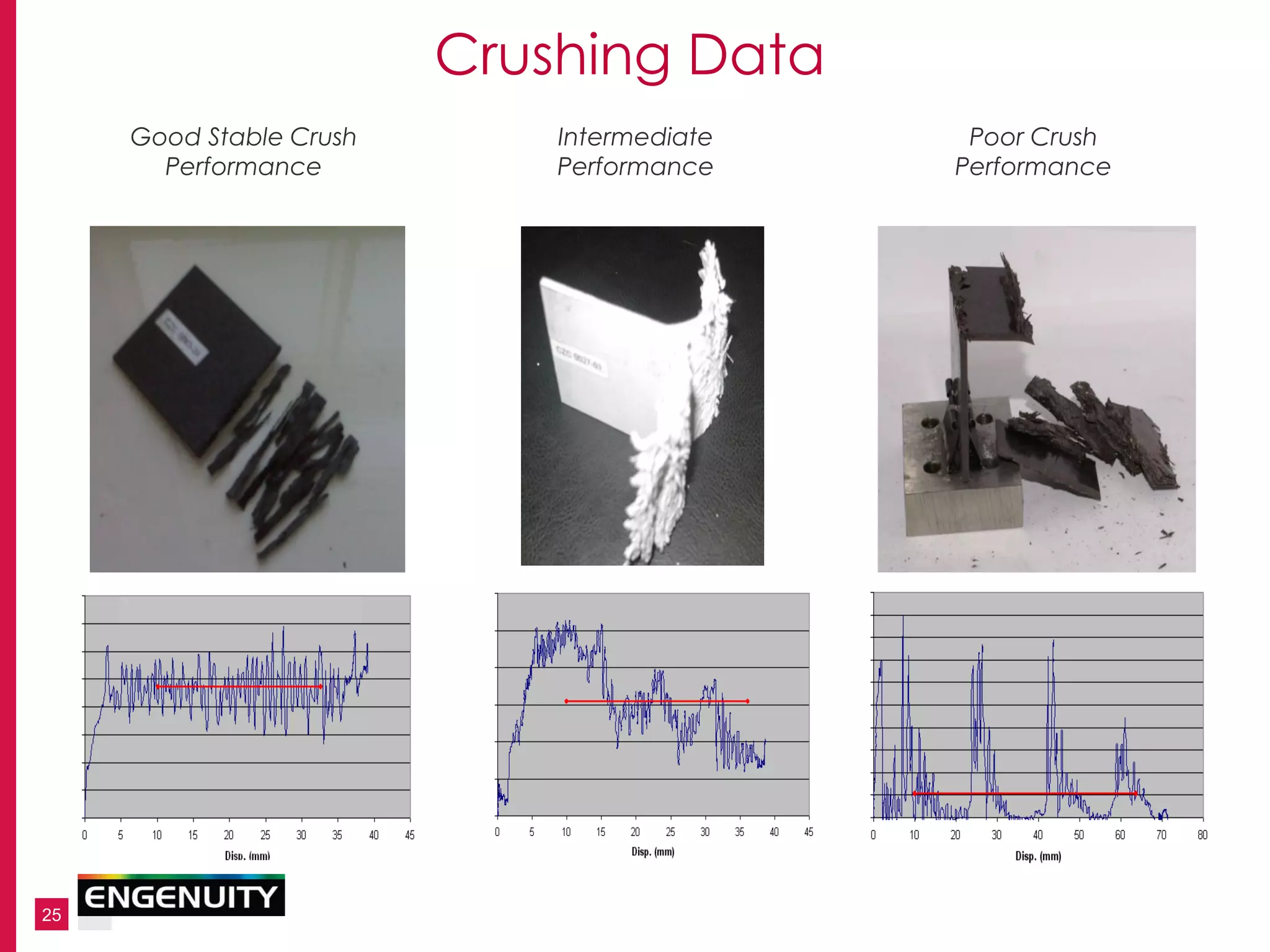
Crushing Data
Good Stable Crush
Performance
Intermediate
Performance
Poor Crush
Performance
26
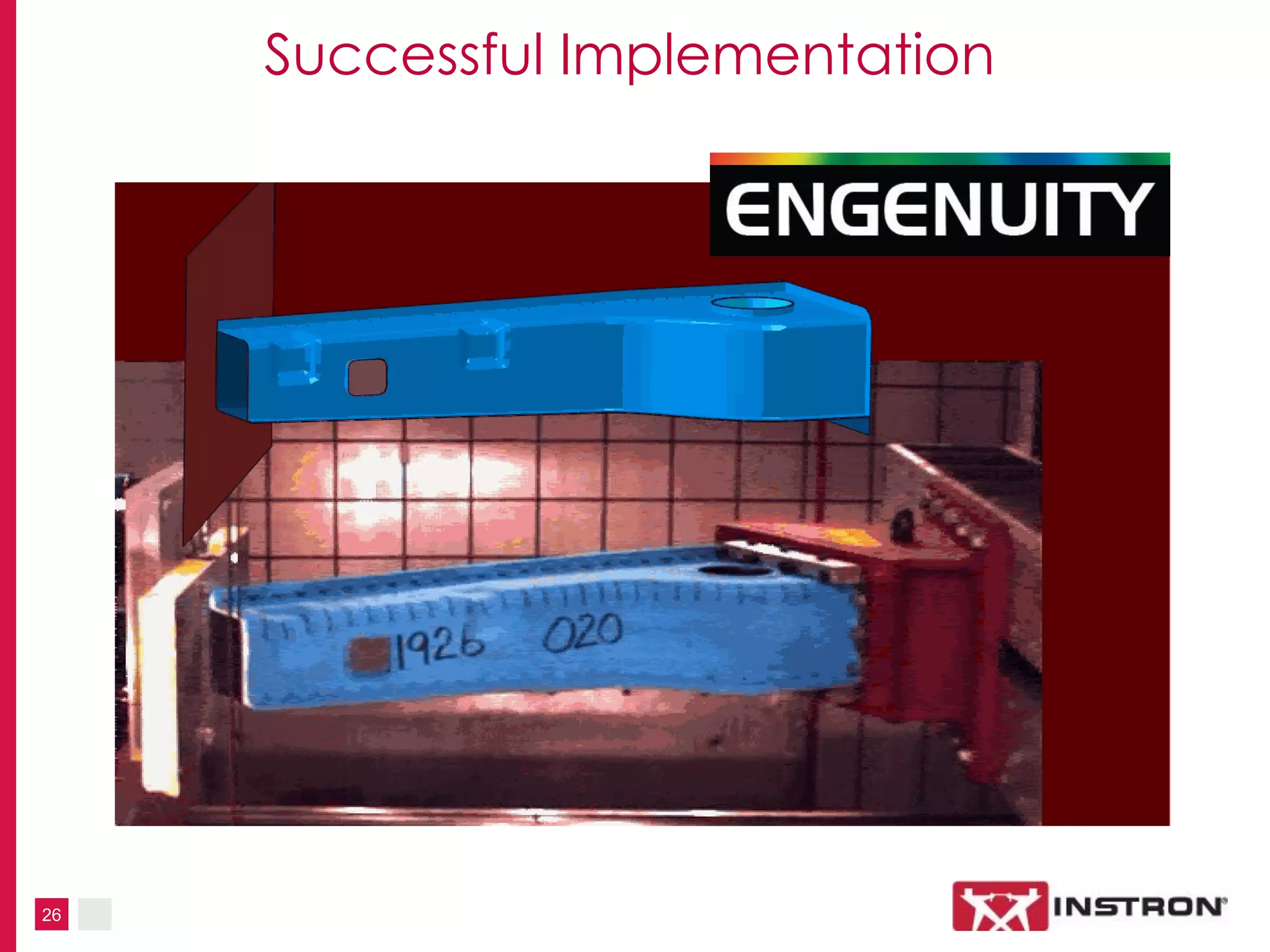
Successful Implementation
27
Is That All We Need?
• Good news or bad?
• This is all that design methods can handle
yet… or nearly
• But there is plenty of headroom in
measurement technology
28
Where are We Heading?
• What is the next level?
• More data-rich tests
• Crack propagation?
• Low-cycle fatigue?
…somewhere in Dallas, Texas, USA
29
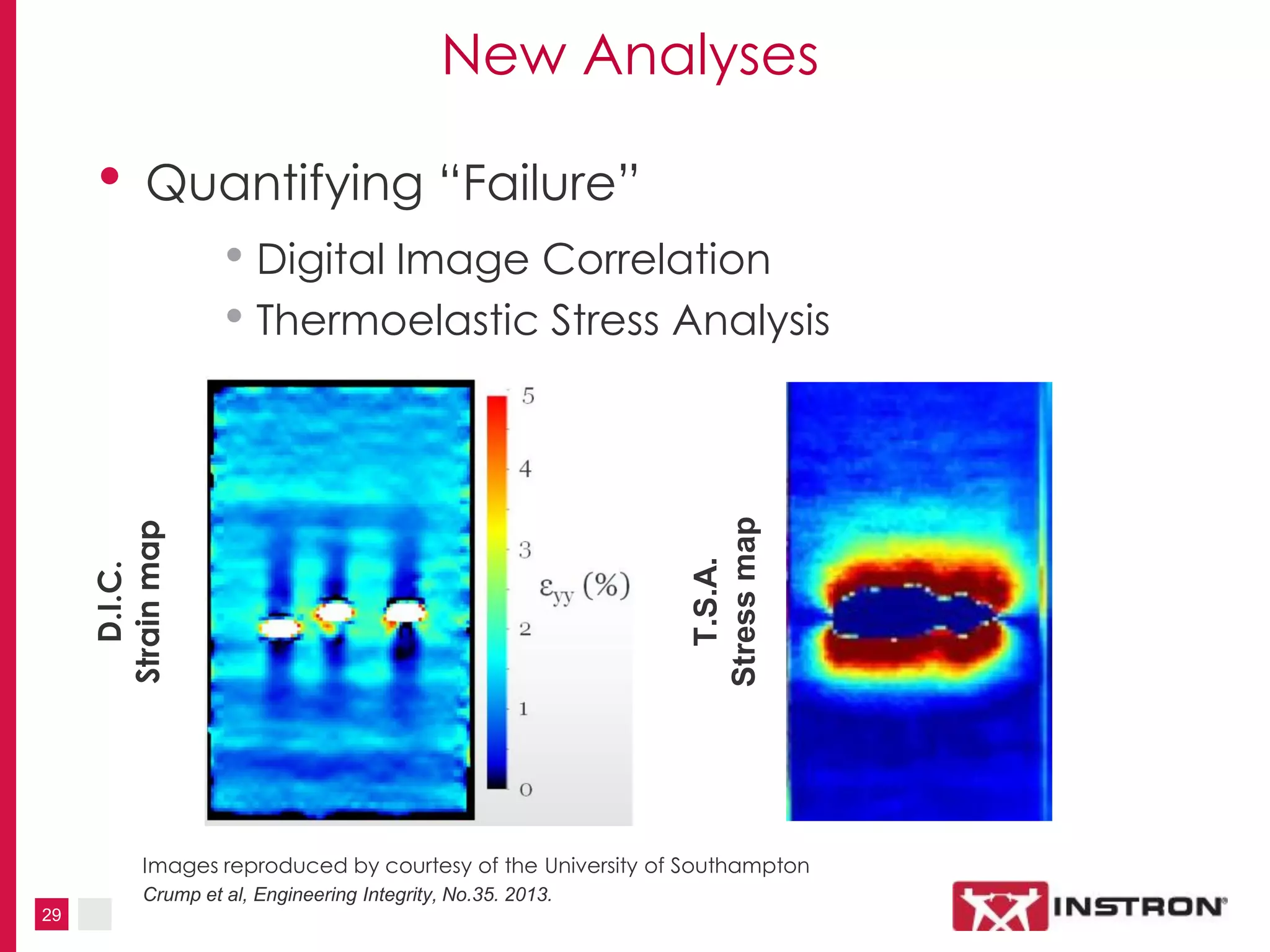
New Analyses
• Quantifying “Failure”
• Digital Image Correlation
• Thermoelastic Stress Analysis
Images reproduced by courtesy of the University of Southampton
Crump et al, Engineering Integrity, No.35. 2013.
T.S.A.
Stressmap
D.I.C.
Strainmap
30
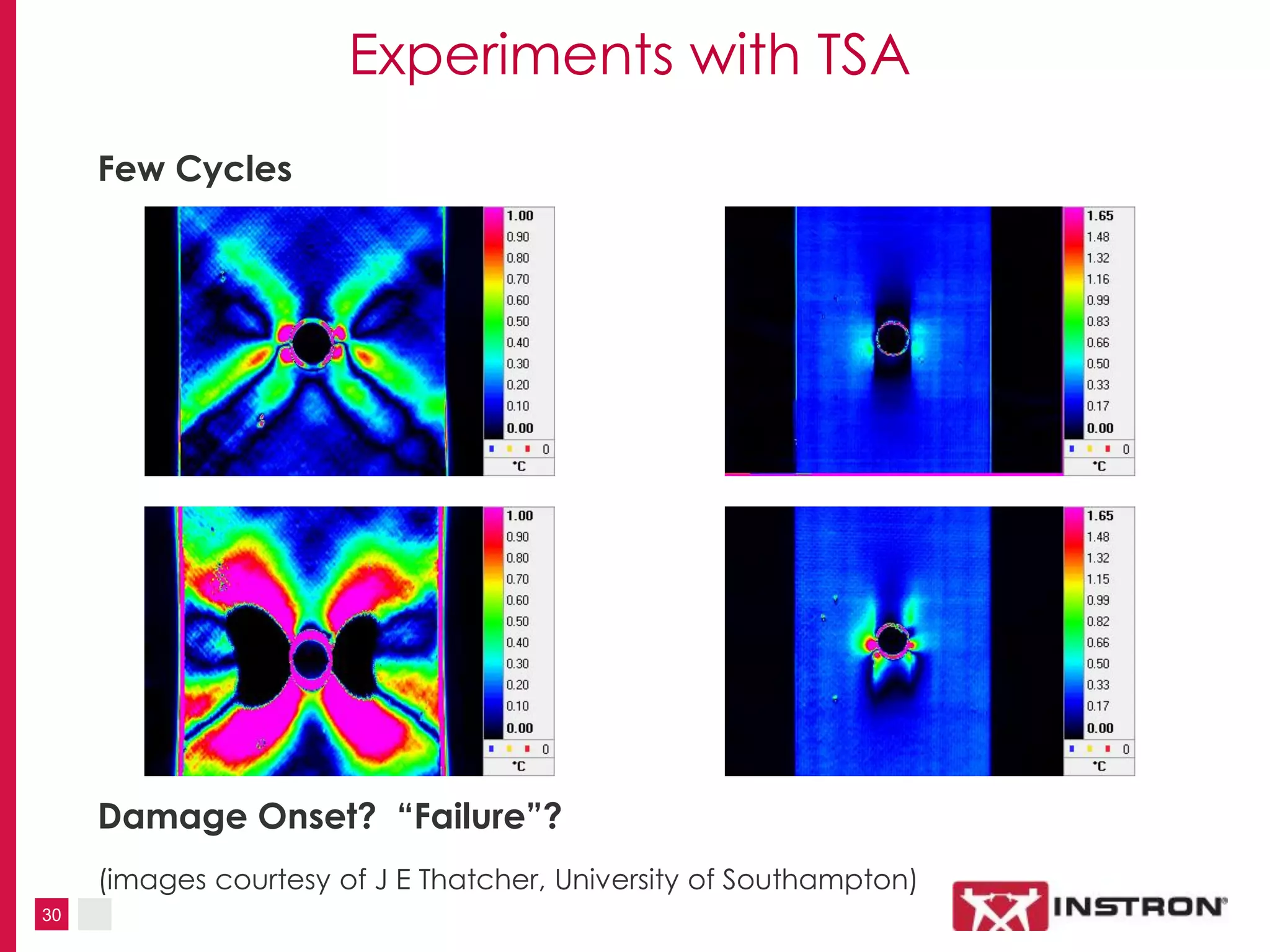
Experiments with TSA
Few Cycles
Damage Onset? “Failure”?
(images courtesy of J E Thatcher, University of Southampton)
31
It’s Not all Bad News
• Developing Effective Modelling
• AMSCI Datacomp project
• Engenuity Ltd.
• Industry Investment in Test Capability
• Automotive (Germany)
• Aerospace (e.g. Boeing, COMAC…)
• Materials (e.g. Hexcel, Borealis…)
• Developing Tests and Theory
32
We have the tools…
What do you want to test?
What do you need to
measure?
33
Questions?
Contact: Peter Bailey, PhD
Senior Applications Specialist
Instron
peter_bailey@instron.com
+44 7880 187 716

Composites on the Move: The Need for Dynamic Testing

  • 1.
    P. B. S.Bailey, PhD Manchester Conference Centre, November 2015 Composites on the Move: The Need for Dynamic Testing
  • 2.
    2 “New and Exciting”? •Frequent improvements in resins and fibers • Various “revolutionary” new processing techniques • Many effective test methods • Too many? • Or too few… • Established structural composites market for 30 years
  • 3.
    3 New and Exciting •Primary structures • High-volume products • Truly composite-specific design Aluminum CFRP
  • 4.
    4 Early Fiber Compositesin UK Transport • Cost-Efficient Body Materials • 1936 Vickers Wellington • 1940 De Havilland Mosquito • 1946 Jowett Bradford • 1957 Ford UK Thames Trader © Crown Copyright: IWM Source: Redsimon at English WikipediaSource: Les Chatfield, Brighton, England
  • 5.
    5 UK Innovation Pedigree •Fiber Processing - 1779 spinning jenny – Samuel Crompton - 1784 power loom – Edmund Cartwright - 1792 mechanised braiding • The foundations of the industrial revolution
  • 6.
    6 Leaders in Scienceand Engineering • Testing & Materials Physics - 1858 Iron & Steel Testing, 1874 Testing Works - David Kirkaldy - Fatigue & Fracture - 1849 HM Govt procures research report from E. Hodgkinson - 1903 J.A. Ewing – origin of fatigue failure - 1920 A.A. Griffith - 1950s G.R. Irwin, R.S. Rivlin, A.G. Thomas Source: Richard Rogerson
  • 7.
    7 Why the HistoryLesson? • There is a huge weight of evidence behind metals design • Fibre technology has been around for a while too! • Structural composites have caught up a lot in just a few decades • But they are still some way behind…
  • 8.
    8 Catching Up withMetals Metals Tests Metals Theory Metals Design Composite Tests Composite Theory Composite Design Static       Impact       Fatigue     ? ? Strain rate    ?   Crack propagation     ? 
  • 9.
    9 How Does TestingFit into this Now? On Measurements of Small Strains in the Testing of Materials and Structures Source: J. A. Ewing, Proceedings of the Royal Society of London, Vol. 58 (1895), pp. 123-142 AVE2 Video Extensometer Instron, 2014
  • 10.
    10 What Do YouThink About Testing? • Costly? • Difficult? • Interesting? • Useful for R&D? • Central to your business success? • Critical?
  • 11.
    11 Yes …To Allof Those! • Testing composites is critical to the continued success of the sector • Testing and design methods need to fully address the effects of dynamic behavior
  • 12.
    12 Fatigue • “Between 80%to 90% of ALL mechanical service failures can be attributed to fatigue.” (ASM – Metals Handbook 2008) • >186 years of observation! • Do we have enough data to make a comparison for composites?
  • 13.
    13 Fatigue: Early IndustryAdoption • Lead by wind turbine industry • Recognition of the problem • Need for minimal cost • Lower regulation
  • 14.
    14 Fatigue: Early Compromises •Tension-tension tests only • Sinusoidal loading • Minimal temperature control
  • 15.
    15 Is this Representative? •Incomplete, but not incorrect… • Where all science starts out! • What is the next step? • Compression or reversed loading would be more aggressive and more realistic • Constant / fixed strain rate would give more comparable characterization
  • 16.
    16 The Thermal Problem •Cyclic heating effect • Severe test temperature change • Symptom/cause of break at grip? t = 0 2 min 8 min 25°C 30°C 35°C 26°C 27°C 28°C
  • 17.
    17 (Non-)Isothermal Behavior • Traditionallyassume constant temperature • Reason for very-low, quasi-static test speeds on composites • Not an accurate description • Representative test?
  • 18.
    18 Strain Rate Testing •Materials exhibit different mechanical behavior at different strain rates • Viscoelastic behavior in polymers • Geometric & friction effects in textiles • Crack propagation mechanisms • Quasi-static data are insufficient to model crash behavior • Even for metals
  • 19.
  • 20.
    20 Significant Effects ofHigh Strain Rate • Cold rolled steel
  • 21.
    21 Renewed Interest • Organicgrowth of research in: • Composites performance • Composites modelling • 2010 onwards • Automotive: • Before 2014, interest… • Now converted to urgent need
  • 22.
    22 High Strain Rateson Composites 0.00044 s-1 0.044 s-1 4.4 s-1 0.44 s-1 44 s-1 * Gude et al, Mech. Comp. Mat., Vol.45, No.5 High on-axis stiffness Off-axis stiffness low in static, but increases with strain rate… 2.5x Strength increases by factor of 2 in “crash” condition strain rate Woven Glass Fibre Reinforced Epoxy – modulus measurement ** Schloßig et al, Polymer Testing, Vol.27, p893-900
  • 23.
    23 Measurement Challenges • Strainrates over 100-s • At >10 m/s this is a very fast test • Looking at events on order of sound speed • Resonance ≠ Signal Noise • Careful interpretation needed • Effective fixturing must be highly tailored
  • 24.
    24 Recent Test Development •High rate compression & crushing • Measuring the critical properties for crash structures in composite • Servohydraulic • Drop weight • In drafting for ASTM method • Barnes et al at Engenuity Ltd.
  • 25.
    25 Crushing Data Good StableCrush Performance Intermediate Performance Poor Crush Performance
  • 26.
  • 27.
    27 Is That AllWe Need? • Good news or bad? • This is all that design methods can handle yet… or nearly • But there is plenty of headroom in measurement technology
  • 28.
    28 Where are WeHeading? • What is the next level? • More data-rich tests • Crack propagation? • Low-cycle fatigue? …somewhere in Dallas, Texas, USA
  • 29.
    29 New Analyses • Quantifying“Failure” • Digital Image Correlation • Thermoelastic Stress Analysis Images reproduced by courtesy of the University of Southampton Crump et al, Engineering Integrity, No.35. 2013. T.S.A. Stressmap D.I.C. Strainmap
  • 30.
    30 Experiments with TSA FewCycles Damage Onset? “Failure”? (images courtesy of J E Thatcher, University of Southampton)
  • 31.
    31 It’s Not allBad News • Developing Effective Modelling • AMSCI Datacomp project • Engenuity Ltd. • Industry Investment in Test Capability • Automotive (Germany) • Aerospace (e.g. Boeing, COMAC…) • Materials (e.g. Hexcel, Borealis…) • Developing Tests and Theory
  • 32.
    32 We have thetools… What do you want to test? What do you need to measure?
  • 33.
    33 Questions? Contact: Peter Bailey,PhD Senior Applications Specialist Instron peter_bailey@instron.com +44 7880 187 716