Rolf Stahel
University Hospital
Zürich
Switzerland
New drugs in oncogenic-driven
malignacies
ESO Masterclass, Ermatingen, April 4, 2011
ALK (Anaplastic Lymphoma Kinase)
pathway
1. Inamura K et al. J Thorac Oncol 2008;3:13–17
2. Soda M et al. Proc Natl Acad Sci U S A 2008;105:19893–19897
Figure based on: Chiarle R et al. Nat Rev Cancer 2008;8(1):11–23;
Mossé YP et al. Clin Cancer Res 2009;15(18):5609–5614; and Data on file. Pfizer Inc.
*Subcellular localization of the ALK
fusion gene, while likely to occur in
the cytoplasm, is not confirmed.1,2
Translocation
Or
ALK ALK fusion protein*
Tumor cell
proliferation
Inversion
Cell survival
PI3K
BAD
AKT
STAT3/5
mTOR
S6K
RAS
MEK
ErK
PLC-Y
PIP2
IP3
HE
4.jpg
30
HE20
CD5
ALK
Anaplastic T cell lymphoma
 ALK-positive anaplastic large cell lymphoma
represents about 6% of peripheral T-cell lymphomas
 Molecularly chararcterized
by t(2;5) resulting in a fusion
protein of ALK (anaplastic
lymphoma kinase) and
NPM (nucleophosmin)
 Good prognosis treated
by CHOP chemotherapy
Dunleavy, Clin Cancer Res 2010
ALK aberrations in malignancies
Mossé, CCR 2009
ALK in neuroblastoma
 Identification of ALK as familial predisposition gene
Mosse, Nature 2008
 Somatic and germline muations of the ALK kinase
receptor in neuroblastoma
Janoueix-Lerosey, Nature 2008
 Activating mutations
in ALK provide a
therapeutic target
for neuroblastomas
George, Nature 2008
 Alk mutations in 6.9% of 709 tumors, similar rate in
favorable and unfavorable neuroblastoma: Two
hotspots R1174 and F1174
De Brouwer, CCR 2010
ALK in lung cancer
Pao & Girard, Lancet Oncol, 2011
Soda M et al. Nature 2007;448:561–567
Reprinted by permission from
Macmillan Publishers Ltd: Nature, © 2007
EML4–ALK is a potent
“oncogenic” driver
3T3
Nude
mice
Tumor/
injection 0/8 0/8 0/8 8/8 0/8 8/8 2/2
Vector EML4 ALK EML4–ALK NPM–ALK v-Ras
Inhibition of ALK leads to dramatic in vivo tumor regression
EML4 = echinoderm microtubule-associated protein-like 4;
NPM = nucleophosmin
EML4–ALK
(K589M)
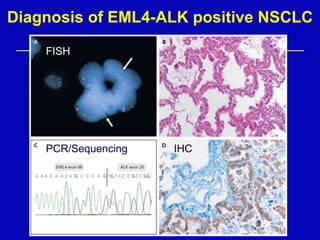
FISH
PCR/Sequencing IHC
Diagnosis of EML4-ALK positive NSCLC
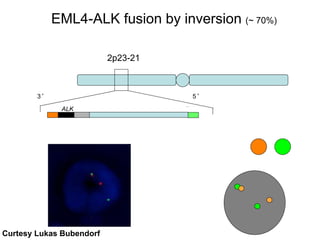
2p23-21
ALK EML4~ 12 Mb
EML4-ALK fusion by inversion (~ 70%)
3‘ 5‘
Curtesy Lukas Bubendorf
Clinical features of patients with
EML4-ALK NSCLC
 Predominantly found adenocarcinoma. TTF1 pos.,
acinar histology, mutually exclusive with EGFR and
KRAS mutations
Takeuchi, CCR 2008; Inamura,
Modern Path, 2009; Takahashi,
ASCO 2010; Zhang, Mol Cancer 2010
 More frequent in never or
former light smokers
Sasaki, EJC 2010
 Predominant in younger patients
– 36% (4/11) under 50 y/o (compared to 5% ALK-negative
adenocarcinomas)
Inamura, Modern Path, 2009
– Median age 52 yrs vs 66 and 64 for mEGFR or WT tumors
Shaw, JCO 2009
60
40
20
0
–20
–40
–60
–80
–100
Progressive disease
Stable disease
Confirmed partial response
Confirmed complete response
Maximumchangeintumorsize(%)
–30%
Responses to Crizotinib for patients
with ALK-positive NSCLC
*
Bang, ASCO 2010: Kwak, NEJM 2010
Response rate:
• 57% (95% CI: 46, 68%)
• 63% including 5 as yet unconfirmed
PFS:
• Median not yet reached
(median f/u for PFS of 6.4 months)
F1174L mutation associated with resistance
Sasaki, CR 2010
Targeting ALK through HSP90
inhibitors?
 Mutated proteins – such as the ALK fusion gene
product – depend on HSP90 for maturation and
conformational stability
 Inhibition of murine
ALK-driven adeno-
carcinoma by HSP90
inhibitor
Chen, CR 2010
 HSP90 inhibitor lowers
EML-ALK levels and
induces tumor regression
in NSCLC model
Normant, Oncogene, 2011
ALK
Inhibitor
HSP90
inhibitor
MAPK pathway activation in melanoma:
BRAF and kit
Arkenau, Br J Cancer 2011
BRAF and kit mutations in
melanoma
 60% of melanoma cell lines and cultures show
oncogenic mutations of BRAF
Davis, Nature 2002
 Distinct set of genetic alteration in different types of
melanoma
Curtin, NEJM 2003
CSD: chronic
sun-induced damage
PLX4032 treatment of melanoma
with RBAF V600E mutations
ICH at baseline and day 15
on therapy:
Flaherty, NEJM 2010
PLX4032 treatment of melanoma
with RBAFV600E mutations
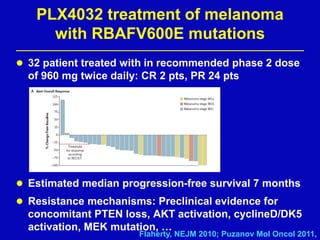
 32 patient treated with in recommended phase 2 dose
of 960 mg twice daily: CR 2 pts, PR 24 pts
 Estimated median progression-free survival 7 months
 Resistance mechanisms: Preclinical evidence for
concomitant PTEN loss, AKT activation, cyclineD/DK5
activation, MEK mutation, …
Flaherty, NEJM 2010; Puzanov Mol Oncol 2011,
Kit mutations in melanoma
 Associated with a proportion of mucosal, acral and
chronically sun-damaged melanoma
 Clinical studies with imatinib and nilotinib ongoing
 Patient with metastatic melanoma of the vulva treated
with imatinib
June 09 September 09
Dummer, USZ 2009
Hedgehog pathway
Low and de Sauvage, JCO 2010
Sonic hedgehog pathway driven tumors:
basal cell carcinoma and medulloblastoma
 Hedgehog pathway is inactive in adult tissue
 Gorlin syndrome: germ line mutation in PTCH1:
numerous basal cell carcinomas and other tumors,
especially medulloblastoma
 Basal cell carcinoma associated with mutations in the
hedgehop signaling pathway (PCHT1 > SMO) which
causes constitutive pathway signaling
 About 30% of medulloblastomas have activating
mutations in PTCH1
 GDC-0449 is a selective hedgehog signalling pathway
inhibitor
Inhibition of hedgehog pathway in
advanced basal-cell carcinoma
 33 patients with advanced or metastatic basal
cell carcinoma treated with GDC-0449, a small
molecule inhibitor of SMO
 RR 54%, SD 33%,
median response
duration 8.8+ mths
 No DLT
Von Hoff, NEJM 2009
Treatment of medulloblastoma with
hedghog pathway inhibitor GDC-0449
 Case report of 26 y/o man with metastatic
medulloblastoma with a PTCH1 mutation treated with
GDC-449. Rapid response with response duration of 3
months
 Resistance due to SMO mutation
Yauch, Science 2009
Baseline 2 months 3 months
Rudin, NEJM 2009
Phase I trial of GDC-449 in patients with
refractory solid tumors
 Responses in 58% of 33 patients with basal cell
carcinoma, duration 12.8+ months, 1/1 patient with
medulloblastoma and none of 34 patients with oder
solid tumors (including 3 SCLC and 3 mesothelioma)
 Downregulation of GLI1 as compared to baseline
LoRusso, CCR 2011
GLI1 expression
RET (REarranged during Transfection)
receptor tyrosine kinase activation in cancer
 Ligands: glial cell line-
derived neurotrophic
factor (GDNF) family
 Activation requires the
formation of a multimere
complex including the
ligand, a GDNF-family
receptor-α protein
binding binding the
ligand and ret
 Ret know-out mice: lack
of enteric neurons and
agenesis of the kidney
Phay, CCR 2010
Medullary thyroid cancer
 Araise from parafollicular or calcitonin-producing
c-cells of the thyroid
 15% of thyroid malignancies
 70-80% sporadic, 20-30% familial
 Associated with paraneoplastic syndroms related to
hormone production of c-cells (diarrhea)
 Activation of TET critical in MTC tumorigenesis
 RET mutation:
– 100% of hereditary MTC (autosomal dominat)
– >40% of sporadic thyroid cancer
Heredidary MTC-associated syndroms
 MEN-2A:
MTC with pheochromocytoma or parathyroid
hyperplasia or adenoma
 MEN-2A:
MTC with pheochromocytoma and associated clinical
abnormalities (mucosal neuromas, intestinal
ganglioneuromtosis, delayed puberty, marfanoid
habitus, skeletal abnormalities, corneal nerve
thickening
 FMCT:
Familial disease with no evidence for
pheochromocytom or parathyroid adenoma
Vandetanib for medullary thyroid
carcinoma
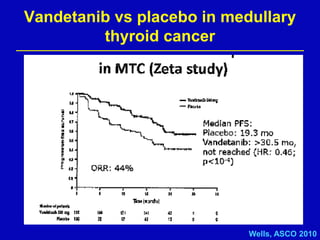
 Oral TKI targeting VEGFR, EGFR und RET
 30 patients, RR 20% (mean durstions 311+ days),
additional SDR at 24 weeks 53%
Wells, JCO 2009
Vandetanib vs placebo in medullary
thyroid cancer
Wells, ASCO 2010
Motesanib in locally advanced or
metastatic hereditary MTC
 Oral TKI targeting VEGFR, PDGF, Kit and RET
 Phase II study
 Response in 2%
of 91 patients,
stable disease
(>24 weeks) in 81%
 Decrease in calcitonin 83%
Schlumberger, JCO 2009
Targeted therapy for metastatic
differentiated thyroid cancer
 Most frequent - mutually exclusive - mutations: in
papillary thyroid cancer
– BRAF 45%, almost all V600E
– RAS 15%
– RET-translocations 20%
 Most frequent mutations in follicular thyroid cancer:
– RAS 45%
– PAX8-PPARϒ rearrangement 35%
– Mutation in PI3K/Akt pathway 10%
O’Neill, Oncologist, 2010
Sorafenib in thyroid cancer
 Sorafenib: TKI against VEGFR2, PDGF, BRAF,
 Medullary thyroid cancer:
16 pts, 1 objective response,
14 stable disease
 Differentiated thyroid cancer:
Ongoing randomized phase III study versus placebo
with cross over
Lam, JCO 2010
Pazopanib in radioiodine-refractory
metastatic differentiated thyroid cancer
 Oral TKI targeting VEGFRs, PDGFR and kit
 Responses in 49%
of 39 patients
 1-year PFS 47%
Bible, Lancet Oncol 2010
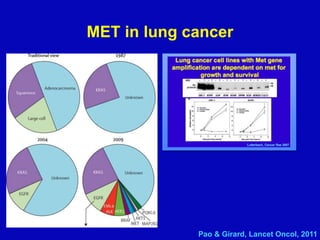
MET in lung cancer
Pao & Girard, Lancet Oncol, 2011
Why targeting MET and HGF in NSCLC:
Met amplification and EGFR resistance
 NSCLC cell lines with met
amplification depend on
MET for growth and survival
Lutterbach, CR 2007
 Increased MET copy number
(4%) associated with worse
prognosis in resected NSCLC.
Cappuzzo, JCO 2009
 MET amplification and resistance
to EGFR TKIs:
– Combination of gefitinib and
MET inhibitor
Engleman, Science 2007;
Spigel, ESMO 2010
Erloti
nib+
MetM
Ab
Cont
rol
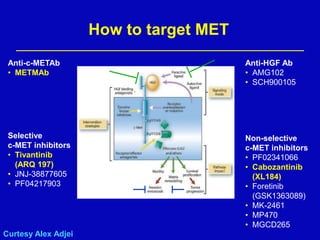
How to target MET
Anti-HGF Ab
• AMG102
• SCH900105
Non-selective
c-MET inhibitors
• PF02341066
• Cabozantinib
(XL184)
• Foretinib
(GSK1363089)
• MK-2461
• MP470
• MGCD265
Anti-c-METAb
• METMAb
Selective
c-MET inhibitors
• Tivantinib
(ARQ 197)
• JNJ-38877605
• PF04217903
Curtesy Alex Adjei
MetMab
MetMAb
Met
 
HGF HGF
Met
Growth, Migration, Survival No Activity
In Vivo
Erlotinib+
MetMAb
Control
EGFR WT NSCLC
XenograftNSCLC
Spigel, ESMO 2010
38
1+ 2+ 3+
 Intensity of Met staining on tumor cells scored on 0–3+ scale
 Tissue was obtained from 100% of patients.
 95% of patients had adequate tissue for evaluation of Met by IHC.
 54% patients had ‘Met High’ NSCLC.
Development of Met IHC as a Diagnostic
 Estimated that ~50% of patients would have ‘Met High’ tumors
 Met by IHC was assessed after randomization
‘Met High’ was defined prior to unblinding as:
≥50% tumor cells with a staining intensity of 2+ or 3+
Spigel, ESMO 2010
39
Anti-Met Monovalent Antibody:
PFS Subgroup Analyses in ITT
Spigel, ESMO 2010
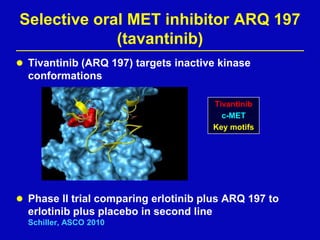
Selective oral MET inhibitor ARQ 197
(tavantinib)
 Tivantinib (ARQ 197) targets inactive kinase
conformations
 Phase II trial comparing erlotinib plus ARQ 197 to
erlotinib plus placebo in second line
Schiller, ASCO 2010
Tivantinib
c-MET
Key motifs
Phase II trial of erlotinib plus ARQ 197 vs erlotinib
plus placebo in second line:
Histologic and molecular subgroups
Schiller, ASCO 2010
Cabozantinib (XL184) multikinase
inhibitor
ATP competitive, reversible
RTK Cellular IC50 (nM) autophosphorylation
MET 8
VEGFR2 4
Kinase IC50 (nM)
MET 1.8
VEGFR2 0.035
RET 5.2
KIT 4.6
AXL 7.0
TIE2 14
FLT3 14
S/T Ks (47) >200
Cabozantinib (XL184): Promising activity
in previously treated NSCLC patients
Best Radiologic Time Point Response of Patients with >1 Post-baseline Tumor Assessment
Interim RDT data presented at 2010 EORTC-NCI-AACR Symposium

MCO 2011 - Slide 20 - R.A. Stahel - Spotlight session - New drugs in oncogenic-driven malignancies (thyroid, melanoma)

  • 1.
    Rolf Stahel University Hospital Zürich Switzerland Newdrugs in oncogenic-driven malignacies ESO Masterclass, Ermatingen, April 4, 2011
  • 2.
    ALK (Anaplastic LymphomaKinase) pathway 1. Inamura K et al. J Thorac Oncol 2008;3:13–17 2. Soda M et al. Proc Natl Acad Sci U S A 2008;105:19893–19897 Figure based on: Chiarle R et al. Nat Rev Cancer 2008;8(1):11–23; Mossé YP et al. Clin Cancer Res 2009;15(18):5609–5614; and Data on file. Pfizer Inc. *Subcellular localization of the ALK fusion gene, while likely to occur in the cytoplasm, is not confirmed.1,2 Translocation Or ALK ALK fusion protein* Tumor cell proliferation Inversion Cell survival PI3K BAD AKT STAT3/5 mTOR S6K RAS MEK ErK PLC-Y PIP2 IP3
  • 3.
  • 4.
  • 5.
    Anaplastic T celllymphoma  ALK-positive anaplastic large cell lymphoma represents about 6% of peripheral T-cell lymphomas  Molecularly chararcterized by t(2;5) resulting in a fusion protein of ALK (anaplastic lymphoma kinase) and NPM (nucleophosmin)  Good prognosis treated by CHOP chemotherapy Dunleavy, Clin Cancer Res 2010
  • 6.
    ALK aberrations inmalignancies Mossé, CCR 2009
  • 7.
    ALK in neuroblastoma Identification of ALK as familial predisposition gene Mosse, Nature 2008  Somatic and germline muations of the ALK kinase receptor in neuroblastoma Janoueix-Lerosey, Nature 2008  Activating mutations in ALK provide a therapeutic target for neuroblastomas George, Nature 2008  Alk mutations in 6.9% of 709 tumors, similar rate in favorable and unfavorable neuroblastoma: Two hotspots R1174 and F1174 De Brouwer, CCR 2010
  • 8.
    ALK in lungcancer Pao & Girard, Lancet Oncol, 2011
  • 9.
    Soda M etal. Nature 2007;448:561–567 Reprinted by permission from Macmillan Publishers Ltd: Nature, © 2007 EML4–ALK is a potent “oncogenic” driver 3T3 Nude mice Tumor/ injection 0/8 0/8 0/8 8/8 0/8 8/8 2/2 Vector EML4 ALK EML4–ALK NPM–ALK v-Ras Inhibition of ALK leads to dramatic in vivo tumor regression EML4 = echinoderm microtubule-associated protein-like 4; NPM = nucleophosmin EML4–ALK (K589M)
  • 10.
    FISH PCR/Sequencing IHC Diagnosis ofEML4-ALK positive NSCLC
  • 11.
    2p23-21 ALK EML4~ 12Mb EML4-ALK fusion by inversion (~ 70%) 3‘ 5‘ Curtesy Lukas Bubendorf
  • 12.
    Clinical features ofpatients with EML4-ALK NSCLC  Predominantly found adenocarcinoma. TTF1 pos., acinar histology, mutually exclusive with EGFR and KRAS mutations Takeuchi, CCR 2008; Inamura, Modern Path, 2009; Takahashi, ASCO 2010; Zhang, Mol Cancer 2010  More frequent in never or former light smokers Sasaki, EJC 2010  Predominant in younger patients – 36% (4/11) under 50 y/o (compared to 5% ALK-negative adenocarcinomas) Inamura, Modern Path, 2009 – Median age 52 yrs vs 66 and 64 for mEGFR or WT tumors Shaw, JCO 2009
  • 13.
    60 40 20 0 –20 –40 –60 –80 –100 Progressive disease Stable disease Confirmedpartial response Confirmed complete response Maximumchangeintumorsize(%) –30% Responses to Crizotinib for patients with ALK-positive NSCLC * Bang, ASCO 2010: Kwak, NEJM 2010 Response rate: • 57% (95% CI: 46, 68%) • 63% including 5 as yet unconfirmed PFS: • Median not yet reached (median f/u for PFS of 6.4 months) F1174L mutation associated with resistance Sasaki, CR 2010
  • 14.
    Targeting ALK throughHSP90 inhibitors?  Mutated proteins – such as the ALK fusion gene product – depend on HSP90 for maturation and conformational stability  Inhibition of murine ALK-driven adeno- carcinoma by HSP90 inhibitor Chen, CR 2010  HSP90 inhibitor lowers EML-ALK levels and induces tumor regression in NSCLC model Normant, Oncogene, 2011 ALK Inhibitor HSP90 inhibitor
  • 15.
    MAPK pathway activationin melanoma: BRAF and kit Arkenau, Br J Cancer 2011
  • 16.
    BRAF and kitmutations in melanoma  60% of melanoma cell lines and cultures show oncogenic mutations of BRAF Davis, Nature 2002  Distinct set of genetic alteration in different types of melanoma Curtin, NEJM 2003 CSD: chronic sun-induced damage
  • 17.
    PLX4032 treatment ofmelanoma with RBAF V600E mutations ICH at baseline and day 15 on therapy: Flaherty, NEJM 2010
  • 18.
    PLX4032 treatment ofmelanoma with RBAFV600E mutations  32 patient treated with in recommended phase 2 dose of 960 mg twice daily: CR 2 pts, PR 24 pts  Estimated median progression-free survival 7 months  Resistance mechanisms: Preclinical evidence for concomitant PTEN loss, AKT activation, cyclineD/DK5 activation, MEK mutation, … Flaherty, NEJM 2010; Puzanov Mol Oncol 2011,
  • 19.
    Kit mutations inmelanoma  Associated with a proportion of mucosal, acral and chronically sun-damaged melanoma  Clinical studies with imatinib and nilotinib ongoing  Patient with metastatic melanoma of the vulva treated with imatinib June 09 September 09 Dummer, USZ 2009
  • 20.
    Hedgehog pathway Low andde Sauvage, JCO 2010
  • 21.
    Sonic hedgehog pathwaydriven tumors: basal cell carcinoma and medulloblastoma  Hedgehog pathway is inactive in adult tissue  Gorlin syndrome: germ line mutation in PTCH1: numerous basal cell carcinomas and other tumors, especially medulloblastoma  Basal cell carcinoma associated with mutations in the hedgehop signaling pathway (PCHT1 > SMO) which causes constitutive pathway signaling  About 30% of medulloblastomas have activating mutations in PTCH1  GDC-0449 is a selective hedgehog signalling pathway inhibitor
  • 22.
    Inhibition of hedgehogpathway in advanced basal-cell carcinoma  33 patients with advanced or metastatic basal cell carcinoma treated with GDC-0449, a small molecule inhibitor of SMO  RR 54%, SD 33%, median response duration 8.8+ mths  No DLT Von Hoff, NEJM 2009
  • 23.
    Treatment of medulloblastomawith hedghog pathway inhibitor GDC-0449  Case report of 26 y/o man with metastatic medulloblastoma with a PTCH1 mutation treated with GDC-449. Rapid response with response duration of 3 months  Resistance due to SMO mutation Yauch, Science 2009 Baseline 2 months 3 months Rudin, NEJM 2009
  • 24.
    Phase I trialof GDC-449 in patients with refractory solid tumors  Responses in 58% of 33 patients with basal cell carcinoma, duration 12.8+ months, 1/1 patient with medulloblastoma and none of 34 patients with oder solid tumors (including 3 SCLC and 3 mesothelioma)  Downregulation of GLI1 as compared to baseline LoRusso, CCR 2011 GLI1 expression
  • 25.
    RET (REarranged duringTransfection) receptor tyrosine kinase activation in cancer  Ligands: glial cell line- derived neurotrophic factor (GDNF) family  Activation requires the formation of a multimere complex including the ligand, a GDNF-family receptor-α protein binding binding the ligand and ret  Ret know-out mice: lack of enteric neurons and agenesis of the kidney Phay, CCR 2010
  • 26.
    Medullary thyroid cancer Araise from parafollicular or calcitonin-producing c-cells of the thyroid  15% of thyroid malignancies  70-80% sporadic, 20-30% familial  Associated with paraneoplastic syndroms related to hormone production of c-cells (diarrhea)  Activation of TET critical in MTC tumorigenesis  RET mutation: – 100% of hereditary MTC (autosomal dominat) – >40% of sporadic thyroid cancer
  • 27.
    Heredidary MTC-associated syndroms MEN-2A: MTC with pheochromocytoma or parathyroid hyperplasia or adenoma  MEN-2A: MTC with pheochromocytoma and associated clinical abnormalities (mucosal neuromas, intestinal ganglioneuromtosis, delayed puberty, marfanoid habitus, skeletal abnormalities, corneal nerve thickening  FMCT: Familial disease with no evidence for pheochromocytom or parathyroid adenoma
  • 28.
    Vandetanib for medullarythyroid carcinoma  Oral TKI targeting VEGFR, EGFR und RET  30 patients, RR 20% (mean durstions 311+ days), additional SDR at 24 weeks 53% Wells, JCO 2009
  • 29.
    Vandetanib vs placeboin medullary thyroid cancer Wells, ASCO 2010
  • 30.
    Motesanib in locallyadvanced or metastatic hereditary MTC  Oral TKI targeting VEGFR, PDGF, Kit and RET  Phase II study  Response in 2% of 91 patients, stable disease (>24 weeks) in 81%  Decrease in calcitonin 83% Schlumberger, JCO 2009
  • 31.
    Targeted therapy formetastatic differentiated thyroid cancer  Most frequent - mutually exclusive - mutations: in papillary thyroid cancer – BRAF 45%, almost all V600E – RAS 15% – RET-translocations 20%  Most frequent mutations in follicular thyroid cancer: – RAS 45% – PAX8-PPARϒ rearrangement 35% – Mutation in PI3K/Akt pathway 10% O’Neill, Oncologist, 2010
  • 32.
    Sorafenib in thyroidcancer  Sorafenib: TKI against VEGFR2, PDGF, BRAF,  Medullary thyroid cancer: 16 pts, 1 objective response, 14 stable disease  Differentiated thyroid cancer: Ongoing randomized phase III study versus placebo with cross over Lam, JCO 2010
  • 33.
    Pazopanib in radioiodine-refractory metastaticdifferentiated thyroid cancer  Oral TKI targeting VEGFRs, PDGFR and kit  Responses in 49% of 39 patients  1-year PFS 47% Bible, Lancet Oncol 2010
  • 34.
    MET in lungcancer Pao & Girard, Lancet Oncol, 2011
  • 35.
    Why targeting METand HGF in NSCLC: Met amplification and EGFR resistance  NSCLC cell lines with met amplification depend on MET for growth and survival Lutterbach, CR 2007  Increased MET copy number (4%) associated with worse prognosis in resected NSCLC. Cappuzzo, JCO 2009  MET amplification and resistance to EGFR TKIs: – Combination of gefitinib and MET inhibitor Engleman, Science 2007; Spigel, ESMO 2010 Erloti nib+ MetM Ab Cont rol
  • 36.
    How to targetMET Anti-HGF Ab • AMG102 • SCH900105 Non-selective c-MET inhibitors • PF02341066 • Cabozantinib (XL184) • Foretinib (GSK1363089) • MK-2461 • MP470 • MGCD265 Anti-c-METAb • METMAb Selective c-MET inhibitors • Tivantinib (ARQ 197) • JNJ-38877605 • PF04217903 Curtesy Alex Adjei
  • 37.
    MetMab MetMAb Met   HGF HGF Met Growth,Migration, Survival No Activity In Vivo Erlotinib+ MetMAb Control EGFR WT NSCLC XenograftNSCLC Spigel, ESMO 2010
  • 38.
    38 1+ 2+ 3+ Intensity of Met staining on tumor cells scored on 0–3+ scale  Tissue was obtained from 100% of patients.  95% of patients had adequate tissue for evaluation of Met by IHC.  54% patients had ‘Met High’ NSCLC. Development of Met IHC as a Diagnostic  Estimated that ~50% of patients would have ‘Met High’ tumors  Met by IHC was assessed after randomization ‘Met High’ was defined prior to unblinding as: ≥50% tumor cells with a staining intensity of 2+ or 3+ Spigel, ESMO 2010
  • 39.
    39 Anti-Met Monovalent Antibody: PFSSubgroup Analyses in ITT Spigel, ESMO 2010
  • 40.
    Selective oral METinhibitor ARQ 197 (tavantinib)  Tivantinib (ARQ 197) targets inactive kinase conformations  Phase II trial comparing erlotinib plus ARQ 197 to erlotinib plus placebo in second line Schiller, ASCO 2010 Tivantinib c-MET Key motifs
  • 41.
    Phase II trialof erlotinib plus ARQ 197 vs erlotinib plus placebo in second line: Histologic and molecular subgroups Schiller, ASCO 2010
  • 42.
    Cabozantinib (XL184) multikinase inhibitor ATPcompetitive, reversible RTK Cellular IC50 (nM) autophosphorylation MET 8 VEGFR2 4 Kinase IC50 (nM) MET 1.8 VEGFR2 0.035 RET 5.2 KIT 4.6 AXL 7.0 TIE2 14 FLT3 14 S/T Ks (47) >200
  • 43.
    Cabozantinib (XL184): Promisingactivity in previously treated NSCLC patients Best Radiologic Time Point Response of Patients with >1 Post-baseline Tumor Assessment Interim RDT data presented at 2010 EORTC-NCI-AACR Symposium