WHO Medicines Safety Programme:
Pharmacovigilance and risk minimization programs
for biological products
Dr Shanthi Pal
Medicines Safety Programme Manager
Essential Medicines and Health Products, WHO
pals@who.int
pvsupport@who.int
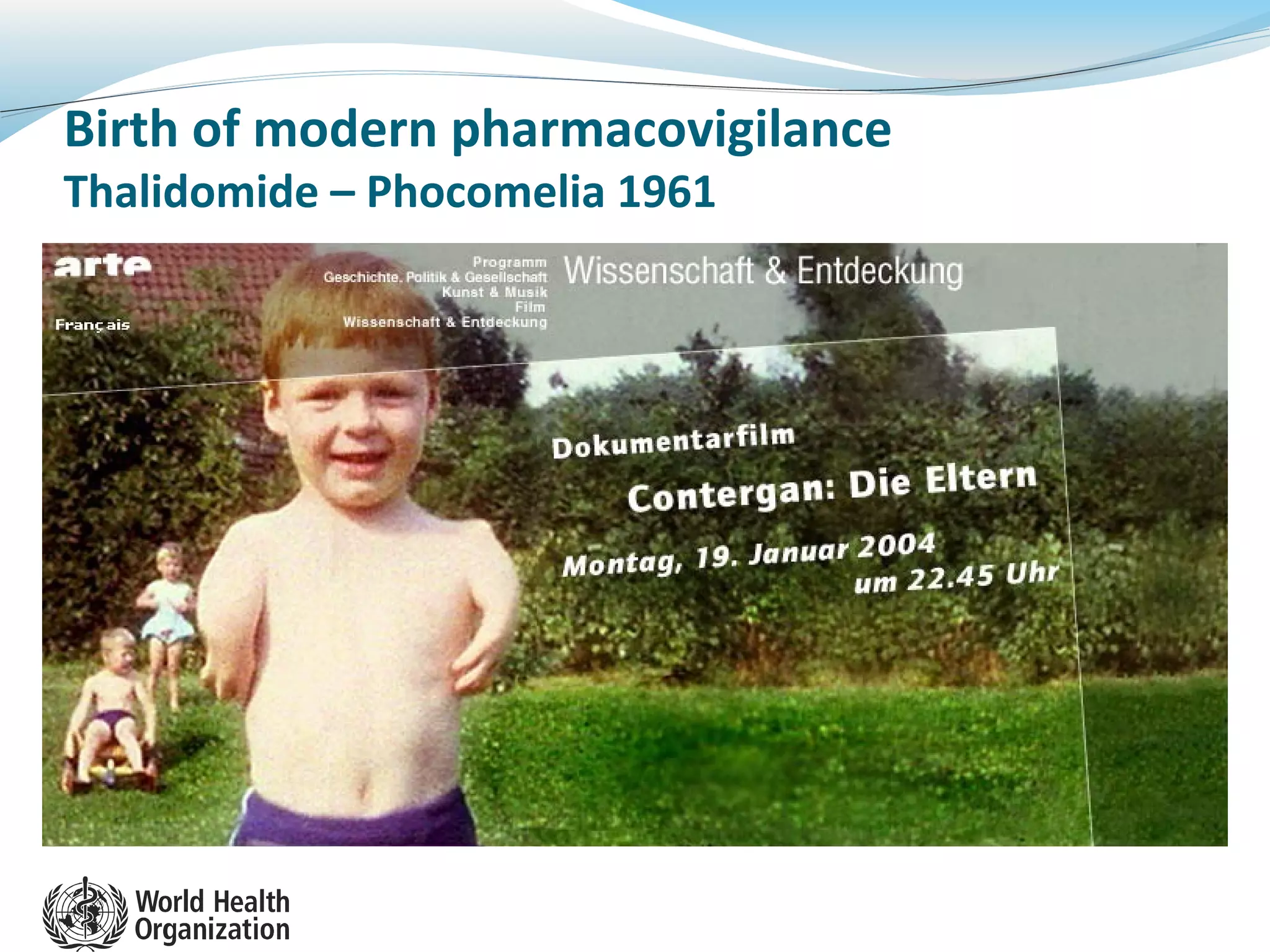
Birth of modern pharmacovigilance
Thalidomide – Phocomelia 1961
16th World Health Assembly 1963
Assembly Resolution 16.36 - Clinical and
Pharmacological Evaluation of Drugs
INVITES Member States to arrange for a systematic
collection of information on serious adverse drug
reactions observed during the development of a drug
and, in particular, after its release for general use.
WHO Programme for International
Drug Monitoring
WHO-HQ
Geneva
WHO-HQ
Geneva
UMC
WHO-CC
Uppsala
UMC
WHO-CC
Uppsala
National
Centres
UMC-A
WHO-CC
Accra
UMC-A
WHO-CC
Accra
WHO-CC
Rabat
WHO-CC
Rabat
WHO-CC
Oslo
ATC DDD
WHO-CC
Oslo
ATC DDD
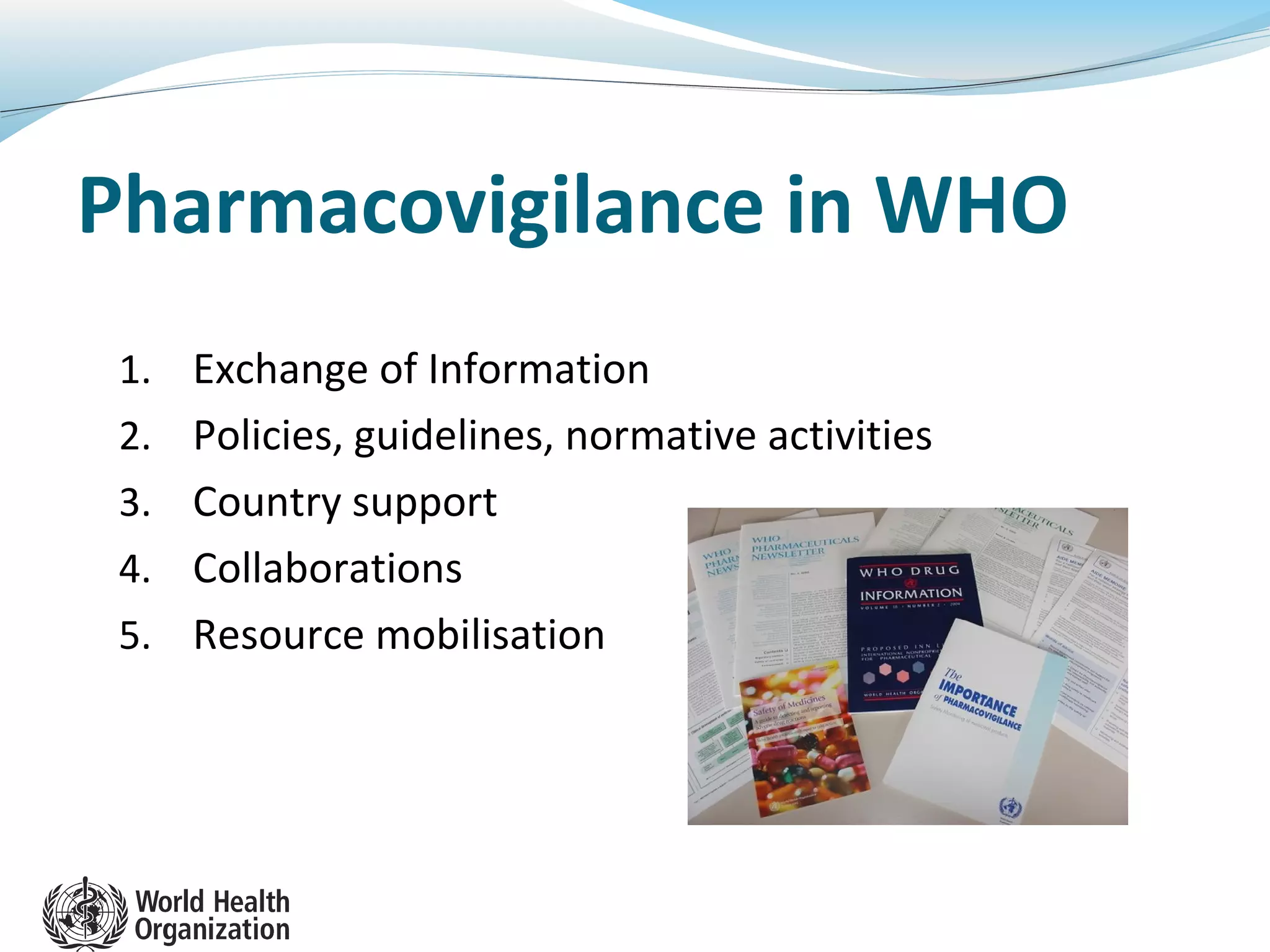
Pharmacovigilance in WHO
1. Exchange of Information
2. Policies, guidelines, normative activities
3. Country support
4. Collaborations
5. Resource mobilisation
Advisory Committee on Safety of Medicinal
Products (ACSoMP)
The Advisory Committee on Safety of Medicinal Products shall
provide advice on pharmacovigilance policy and issues
related to the safety and effectiveness of medicinal products
to the relevant Assistant Director-General in WHO and
through him / her
to the Collaborating Centres for the Medicines Safety
Programme, and
to the Member States of WHO
What defines it
The WHO PV strategy
Understanding what's available and
what's needed in countries
Challenges to Pharmacovigilance
Type of assistance needed
WHO International Drug Monitoring Programme
Situation 1990
WHO International Drug Monitoring Programme
Situation 2012
WHO strategy
Concept of generics
Patent expiry of medicines enables
Generics
Cost savings because no need to invest in further
human trials for safety and efficacy
Can use data from investigations with innovator
products
More patients receive treatment
Further investment in new medicines
Global Fund HIV/AIDS Coverage
After 9 Rounds of proposals
0 5,0002,500
Kilometers
´
Traditional chemical medicines
relatively small
Stable molecules
No need to repeat large-scale human trials
Safety monitoring is needed nevertheless
Used in 'other' environments & populations: LMIC
 Comorbidities, nutritional effects, genetic differences
Long-term effects
Pharmacovigilance in Global Fund grants
A 2010 analysis of Grant applications in the Global FundA 2010 analysis of Grant applications in the Global Fund
database (R4 to R9)database (R4 to R9)
Is PV mentioned?
Does it set out to establish min PV requirements?
 431 individual Global Fund Proposals
31% had “acceptable reference to PV''
Interviews: even if mentioned, PV not implemented in
practice
(Ref: Unpublished data, Pal, Xueref et al; 2010)
Joint WHO/Global Fund
pharmacovigilance strategy
Establish basic functions and minimum requirements of
national pharmacovigilance system
Minimum PV requirements
pharmacovigilance toolkit to support training and
development
www.PVToolkit.org
Strong wording in Round 10 requesting countries to include
PV
Biotherapeutics
Generally large, complex molecules
produced from living cells using biotechnology
can pose rare but serious risks of unwanted immune
responses
Require extensive testing and risk management
planning
Similar biotherapeutic products (SBPs)
Copies or 'generic' versions of biotherapeutic
products (SBP)
Are not exact copies of innovator products
Due to manufacturing process
Unlike other generics, can't rely on data for / from
innovator products
Need sufficient proof of similarity to innovator
product (both preclinical laboratory testing and
clinical trials
Risk management plans are also essential
Guidance from WHO
Developed in 2009
Published in 2010
Based on EMA guidelines of 2006
Pharmacovigilance of SBPs
Manufacturer required to submit
Safety specification and PV plan at the time of
submission for approval
Safety specification should describe important
identified or potential safety risks for RBP, the
substance class and / or any that are specifc for the SBP
 Risk minimization activities may be needed : education
material for patients / HCP etc
Post approval activities for SBPs
Due to potential of SBPs to provoke immune
reactions
manufacturers to undertake post marketing
surveillance to the same standards as RBP MAH
Pharmacovigilance plan should include
Safety monitoring as required of corresponding RBP
Safety monitoring for additional risks identified
SBP manufacturers required to have
PV systems in place at approval
Qualified PV personnel
means to report to NRAs where the reactions occur
Traceability of Adverse events
AEs may be product specific
Critical information to assign AEs with specific BPs
ADR report for any BP to include
INN
Proprietary or brand name
Manufacturer's name
Lot number
Country of origin
Number of reports/million inhabitants/year
Reporting last 5 years
Reports on Monoclonal antibodies (MABs) in
WHO database (out of 8 million Individual Case
Safety Reports, ICSRs)
Total
ICSR 356787
ICSRs with INN, trade
names, indications
285327
Reports by country (top 10)
Top 5 ADRs with MAB in WHO
database
MedDRA_PT_name Number_of_Reports
Fatigue 18208
Drug ineffective 15879
Headache 13543
Dyspnoea 13100
Pyrexia 13031
Country
MAB
reports
Ukraine
1
Latvia
9
Estonia
21
Russian Federation
23
Lithuania
55
Serbia
73
Slovenia
SBPs provide
An opportunity to engage in PPP for PV in LMIC
MAH of generic and innovator biotherapeutics are
obliged to invest in PV
Generics are often used in LMIC
Through PV of SBPs, possible to create PV systems in
LMIC
That will be used also for other medicines (not only SBP)
Governments and Pvt industry should work out a
model
Data on products (MAH & Regulator)
PV System and PV capacity in country
www.who.int/medicines/areas/quality_safety/safety_efficacy/en
But we do need to build structures and best
practices because…
Dying from a disease is sometimes unavoidable. But
dying from an adverse drug event is unacceptable
Dr Vladimir Lepakhin, ex Assistant Director General, World
Health Organization

20. Dr. Shanthi Pal - World Health Organization

  • 1.
    WHO Medicines SafetyProgramme: Pharmacovigilance and risk minimization programs for biological products Dr Shanthi Pal Medicines Safety Programme Manager Essential Medicines and Health Products, WHO pals@who.int pvsupport@who.int
  • 2.
    Birth of modernpharmacovigilance Thalidomide – Phocomelia 1961
  • 3.
    16th World HealthAssembly 1963 Assembly Resolution 16.36 - Clinical and Pharmacological Evaluation of Drugs INVITES Member States to arrange for a systematic collection of information on serious adverse drug reactions observed during the development of a drug and, in particular, after its release for general use.
  • 4.
    WHO Programme forInternational Drug Monitoring WHO-HQ Geneva WHO-HQ Geneva UMC WHO-CC Uppsala UMC WHO-CC Uppsala National Centres UMC-A WHO-CC Accra UMC-A WHO-CC Accra WHO-CC Rabat WHO-CC Rabat WHO-CC Oslo ATC DDD WHO-CC Oslo ATC DDD
  • 5.
    Pharmacovigilance in WHO 1.Exchange of Information 2. Policies, guidelines, normative activities 3. Country support 4. Collaborations 5. Resource mobilisation
  • 6.
    Advisory Committee onSafety of Medicinal Products (ACSoMP) The Advisory Committee on Safety of Medicinal Products shall provide advice on pharmacovigilance policy and issues related to the safety and effectiveness of medicinal products to the relevant Assistant Director-General in WHO and through him / her to the Collaborating Centres for the Medicines Safety Programme, and to the Member States of WHO
  • 7.
    What defines it TheWHO PV strategy
  • 8.
    Understanding what's availableand what's needed in countries
  • 9.
  • 10.
  • 11.
    WHO International DrugMonitoring Programme Situation 1990
  • 12.
    WHO International DrugMonitoring Programme Situation 2012
  • 13.
  • 14.
    Concept of generics Patentexpiry of medicines enables Generics Cost savings because no need to invest in further human trials for safety and efficacy Can use data from investigations with innovator products More patients receive treatment Further investment in new medicines
  • 15.
    Global Fund HIV/AIDSCoverage After 9 Rounds of proposals 0 5,0002,500 Kilometers ´
  • 16.
    Traditional chemical medicines relativelysmall Stable molecules No need to repeat large-scale human trials Safety monitoring is needed nevertheless Used in 'other' environments & populations: LMIC  Comorbidities, nutritional effects, genetic differences Long-term effects
  • 17.
    Pharmacovigilance in GlobalFund grants A 2010 analysis of Grant applications in the Global FundA 2010 analysis of Grant applications in the Global Fund database (R4 to R9)database (R4 to R9) Is PV mentioned? Does it set out to establish min PV requirements?  431 individual Global Fund Proposals 31% had “acceptable reference to PV'' Interviews: even if mentioned, PV not implemented in practice (Ref: Unpublished data, Pal, Xueref et al; 2010)
  • 18.
    Joint WHO/Global Fund pharmacovigilancestrategy Establish basic functions and minimum requirements of national pharmacovigilance system Minimum PV requirements pharmacovigilance toolkit to support training and development www.PVToolkit.org Strong wording in Round 10 requesting countries to include PV
  • 19.
    Biotherapeutics Generally large, complexmolecules produced from living cells using biotechnology can pose rare but serious risks of unwanted immune responses Require extensive testing and risk management planning
  • 20.
    Similar biotherapeutic products(SBPs) Copies or 'generic' versions of biotherapeutic products (SBP) Are not exact copies of innovator products Due to manufacturing process Unlike other generics, can't rely on data for / from innovator products Need sufficient proof of similarity to innovator product (both preclinical laboratory testing and clinical trials Risk management plans are also essential
  • 21.
    Guidance from WHO Developedin 2009 Published in 2010 Based on EMA guidelines of 2006
  • 22.
    Pharmacovigilance of SBPs Manufacturerrequired to submit Safety specification and PV plan at the time of submission for approval Safety specification should describe important identified or potential safety risks for RBP, the substance class and / or any that are specifc for the SBP  Risk minimization activities may be needed : education material for patients / HCP etc
  • 23.
    Post approval activitiesfor SBPs Due to potential of SBPs to provoke immune reactions manufacturers to undertake post marketing surveillance to the same standards as RBP MAH Pharmacovigilance plan should include Safety monitoring as required of corresponding RBP Safety monitoring for additional risks identified SBP manufacturers required to have PV systems in place at approval Qualified PV personnel means to report to NRAs where the reactions occur
  • 24.
    Traceability of Adverseevents AEs may be product specific Critical information to assign AEs with specific BPs ADR report for any BP to include INN Proprietary or brand name Manufacturer's name Lot number Country of origin
  • 25.
    Number of reports/millioninhabitants/year Reporting last 5 years
  • 26.
    Reports on Monoclonalantibodies (MABs) in WHO database (out of 8 million Individual Case Safety Reports, ICSRs) Total ICSR 356787 ICSRs with INN, trade names, indications 285327
  • 27.
  • 28.
    Top 5 ADRswith MAB in WHO database MedDRA_PT_name Number_of_Reports Fatigue 18208 Drug ineffective 15879 Headache 13543 Dyspnoea 13100 Pyrexia 13031
  • 29.
  • 30.
    SBPs provide An opportunityto engage in PPP for PV in LMIC MAH of generic and innovator biotherapeutics are obliged to invest in PV Generics are often used in LMIC Through PV of SBPs, possible to create PV systems in LMIC That will be used also for other medicines (not only SBP) Governments and Pvt industry should work out a model Data on products (MAH & Regulator) PV System and PV capacity in country
  • 31.
  • 32.
    But we doneed to build structures and best practices because… Dying from a disease is sometimes unavoidable. But dying from an adverse drug event is unacceptable Dr Vladimir Lepakhin, ex Assistant Director General, World Health Organization

Editor's Notes

  • #3 Article published 1961 in The Lancet. Resulted in the birth of pharmacovigilance. Before this catastrophy the general opinion about drug use was only positive. No negative effects were expected. Phocomelia means ’limbs like a seal’.
  • #6 National Information officers, WHO Pharmaceuticals Newsletter, ICDRA conference The Importance of pharmacovigilance, PV Toolkit, Public reporting of ADRs Training courses – in cooperation with others Collaboration with public health programmes to make PV a part of them e.g. Malaria, Chagas disease, Vaccines Make them interested in PV e.g Global Fund (sponsored the PV Toolkit), Gates foundation etc
  • #16 Update every 6-12 months