Phlebotomy
Objectives
• Theory and practice of phlebotomy
• How to interact professionally with patients
• Occupational health hazards and appropriate
precautions
• Related anatomy and physiology
• Phlebotomy equipment and supplies
• Phlebotomy procedures
• Complications of venipuncture and how to handle
them.
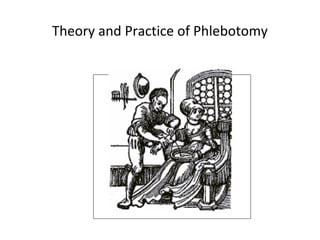
Theory and Practice of Phlebotomy
What is phlebotomy
• The term phlebotomy refers to the ancient
practice of bloodletting
• Now the term phlebotomy is used for the
withdrawal of blood from a vein, artery, or the
capillary bed for lab analysis or blood
transfusion.
Who is a phlebotomist
• Collects blood and other specimens
• Prepares specimens for testing
• Interacts with patients & health care
professionals
• plays a vital role in any health care system
Who is a phlebotomist
• Other medical professionals, including
doctors, nurses, technologists, and medical
assistants must also be trained to collect
blood specimens.
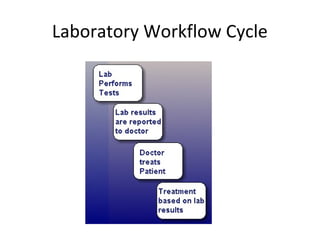
Laboratory or Blood Bank work flow
cycle
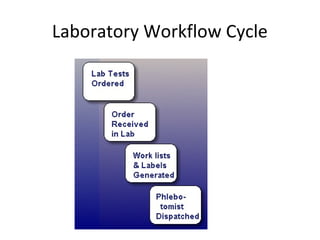
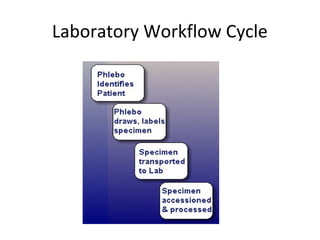
Laboratory Workflow Cycle
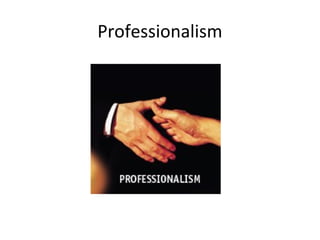
Professionalism
Professionalism
Confidentiality
• All employees are responsible for maintaining
confidentiality of medical information
Attitude
• Tone of voice and facial expression will
determine how patients respond to you.
• Always be polite, friendly, calm, and
considerate.
Appearance
• Your personal appearance will also affect the
impression you make. Professional dress.
• Comply with your facility’s dress code and
personal appearance policies.
Safety
micro-organisms
bloodborne pathogens
contaminated body fluids.
Blood-Borne Pathogens
• Infectious micro-organisms which live in the
bloodstream.
• You can be exposed to bloodborne pathogens
if you are injured with a contaminated needle.
• You can also be exposed if your mucous
membranes, including eyes, mouth, or the
inside of your nose come into contact with
contaminated body fluids.
• Advance countries :
Occupational Health and Safety Administration
of the federal government has mandated
bloodborne pathogen training for all workers
who are at risk of exposure.
Training
• Standard Precautions
• Personal Protective Equipment
• Hand Washing
• Hazardous waste disposal
• Needle sticks and prevention act
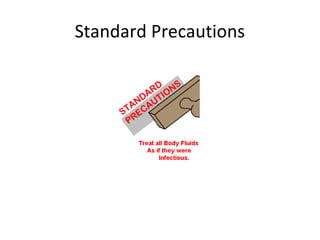
Standard Precautions
• Standard Precautions means treating all body
fluids and substances as if they were
infectious.
Standard Precautions
• Potentially infectious body fluids include:
Blood, Semen, Vaginal Secretion, fluids, and
Saliva
• Sweat and tears are not generally considered
infectious.
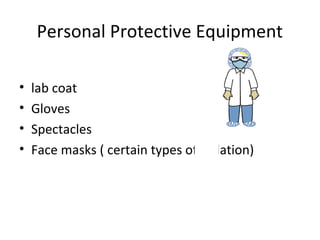
Personal Protective Equipment
• lab coat
• Gloves
• Spectacles
• Face masks ( certain types of isolation)
Hand Washing
• Hand washing is the single most important
infection control measure.
• Wash hands thoroughly before, after, and
between all patient contacts.
• using a paper towel to avoid contamination.
Hand washing
• Remove rings
• Stand by the sink but do not touch it
• Apply soap and rub hands together
• Both sides of the hand, between fingers,
under fingernails
• Rinse hands in a downward motion
• Dry hands with a clean paper towel
• Turn off water with another paper towel
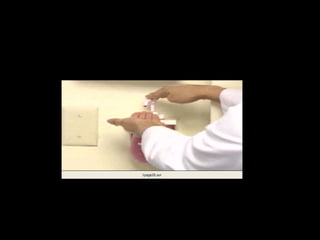
Hand Washing
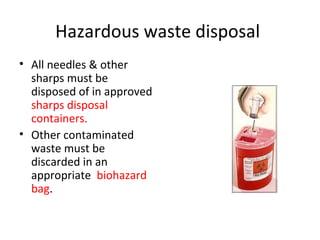
Hazardous waste disposal
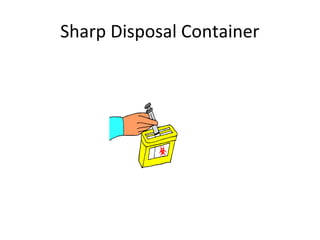
• All needles & other
sharps must be
disposed of in approved
sharps disposal
containers.
• Other contaminated
waste must be
discarded in an
appropriate biohazard
bag.
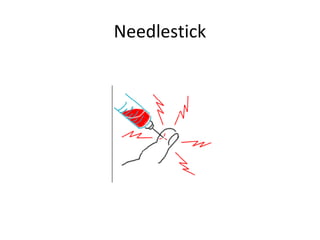
Needlestick
Needle sticks and prevention act
• Safety Devices should always be encouraged
Anatomy & Physiology
• Anatomy is the branch of science concerned
with the study of the structure of the body.
• Physiology is the branch of science concerned
with the study of the function of the body.
Anatomy & Physiology
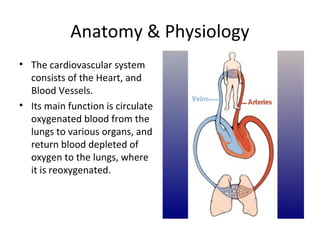
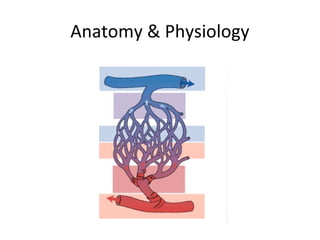
• The cardiovascular system
consists of the Heart, and
Blood Vessels.
• Its main function is circulate
oxygenated blood from the
lungs to various organs, and
return blood depleted of
oxygen to the lungs, where
it is reoxygenated.
Anatomy & Physiology
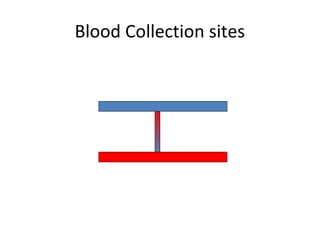
Blood Collection sites
Anatomy & Physiology
Blood Components
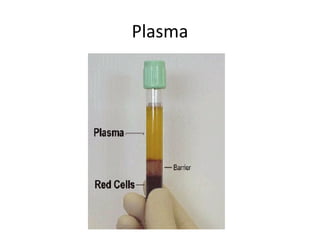
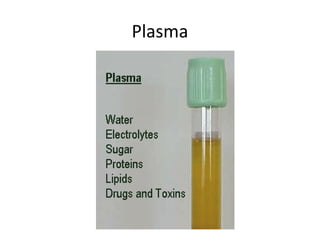
• Circulating whole blood is a mixture of:
• Plasma (which contains fluid, proteins, and
lipids), and
• Formed elements, consisting of red cells,
white cells, and platelets.
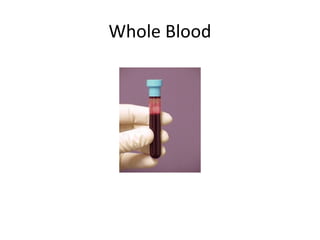
Whole Blood
Plasma
Plasma
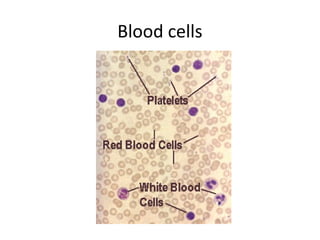
Blood cells
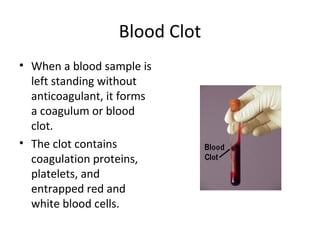
Blood Clot
• When a blood sample is
left standing without
anticoagulant, it forms
a coagulum or blood
clot.
• The clot contains
coagulation proteins,
platelets, and
entrapped red and
white blood cells.
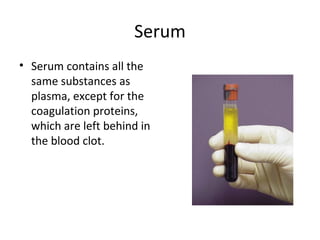
Serum
• Serum contains all the
same substances as
plasma, except for the
coagulation proteins,
which are left behind in
the blood clot.
Equipment
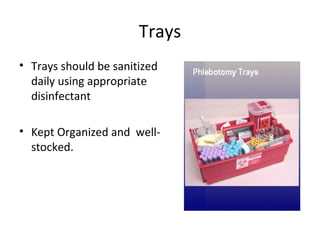
Trays
• Trays should be sanitized
daily using appropriate
disinfectant
• Kept Organized and well-
stocked.
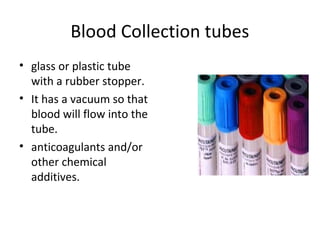
Blood Collection tubes
• glass or plastic tube
with a rubber stopper.
• It has a vacuum so that
blood will flow into the
tube.
• anticoagulants and/or
other chemical
additives.
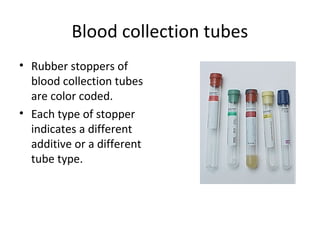
Blood collection tubes
• Rubber stoppers of
blood collection tubes
are color coded.
• Each type of stopper
indicates a different
additive or a different
tube type.
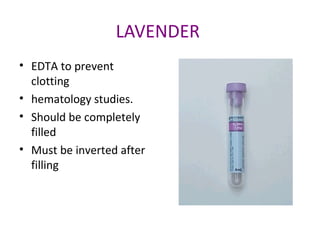
LAVENDER
• EDTA to prevent
clotting
• hematology studies.
• Should be completely
filled
• Must be inverted after
filling
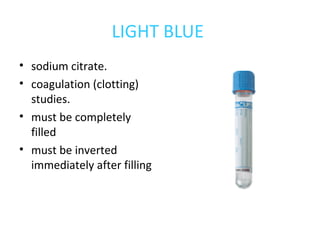
LIGHT BLUE
• sodium citrate.
• coagulation (clotting)
studies.
• must be completely
filled
• must be inverted
immediately after filling
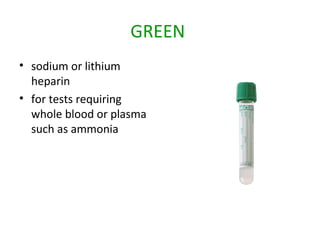
GREEN
• sodium or lithium
heparin
• for tests requiring
whole blood or plasma
such as ammonia
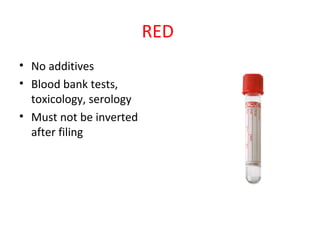
RED
• No additives
• Blood bank tests,
toxicology, serology
• Must not be inverted
after filing
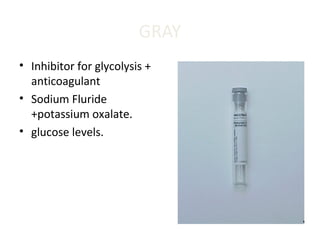
GRAY
• Inhibitor for glycolysis +
anticoagulant
• Sodium Fluride
+potassium oxalate.
• glucose levels.
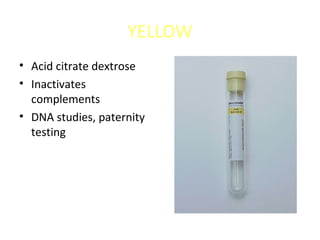
YELLOW
• Acid citrate dextrose
• Inactivates
complements
• DNA studies, paternity
testing
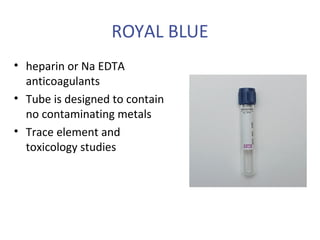
ROYAL BLUE
• heparin or Na EDTA
anticoagulants
• Tube is designed to contain
no contaminating metals
• Trace element and
toxicology studies
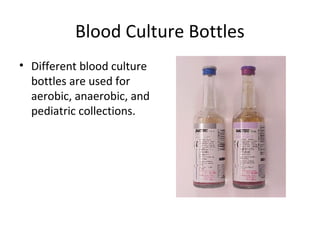
Blood Culture Bottles
• Different blood culture
bottles are used for
aerobic, anaerobic, and
pediatric collections.
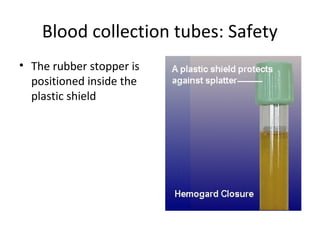
Blood collection tubes: Safety
• The rubber stopper is
positioned inside the
plastic shield
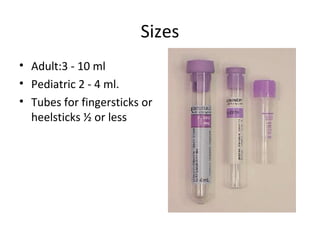
Sizes
• Adult:3 - 10 ml
• Pediatric 2 - 4 ml.
• Tubes for fingersticks or
heelsticks ½ or less
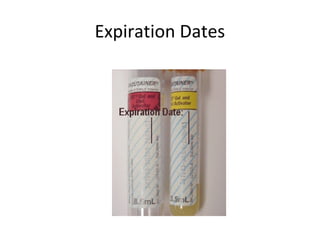
Expiration Dates
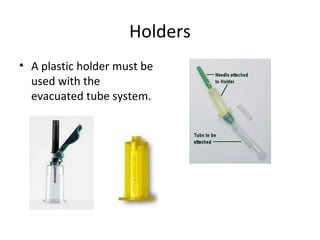
Holders
• A plastic holder must be
used with the
evacuated tube system.
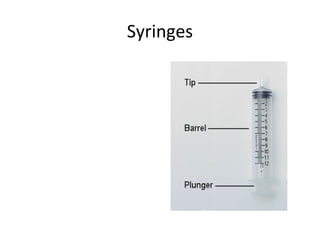
Syringes
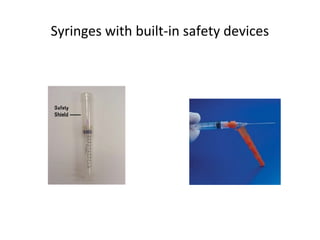
Syringes with built-in safety devices
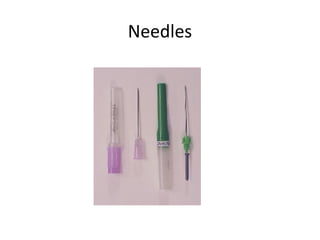
Needles
Needles
• Different sizes.
• size =gauge.
• The larger the needle, the smaller the gauge
number.
• 21 or 22 gauge needle is mostly used.
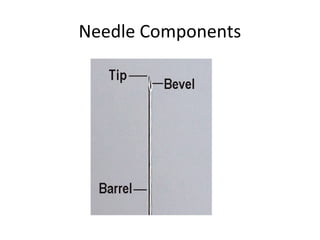
Needle Components
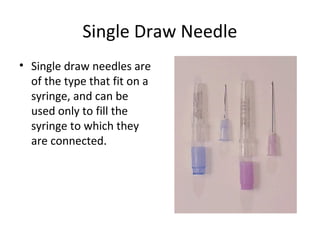
Single Draw Needle
• Single draw needles are
of the type that fit on a
syringe, and can be
used only to fill the
syringe to which they
are connected.
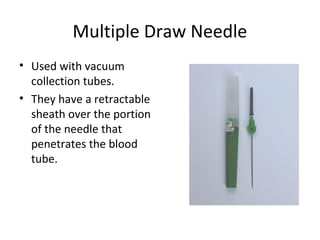
Multiple Draw Needle
• Used with vacuum
collection tubes.
• They have a retractable
sheath over the portion
of the needle that
penetrates the blood
tube.
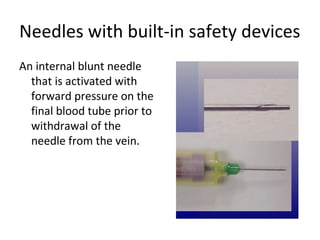
Needles with built-in safety devices
An internal blunt needle
that is activated with
forward pressure on the
final blood tube prior to
withdrawal of the
needle from the vein.
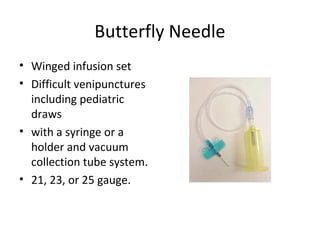
Butterfly Needle
• Winged infusion set
• Difficult venipunctures
including pediatric
draws
• with a syringe or a
holder and vacuum
collection tube system.
• 21, 23, or 25 gauge.
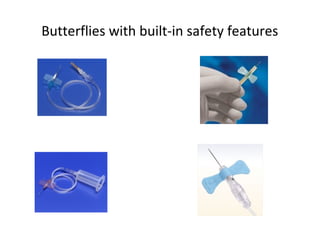
Butterflies with built-in safety features
• number-one cause of needlestick injuries, so
proper use of their safety devices is critical.
Butterflies with built-in safety features
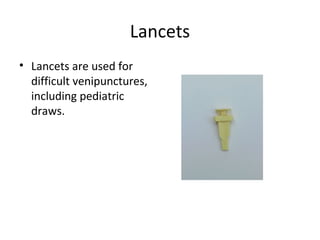
Lancets
• Lancets are used for
difficult venipunctures,
including pediatric
draws.
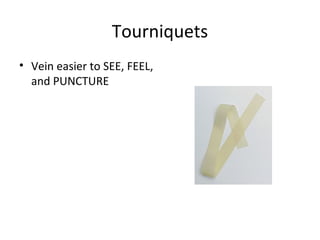
Tourniquets
• Vein easier to SEE, FEEL,
and PUNCTURE
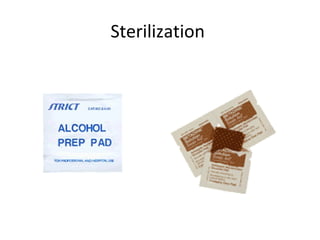
Sterilization
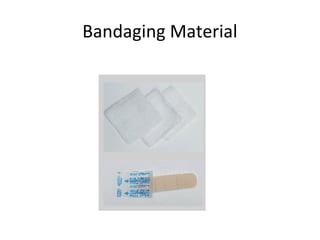
Bandaging Material
Gloves
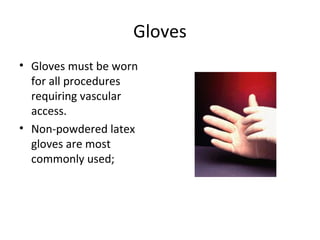
• Gloves must be worn
for all procedures
requiring vascular
access.
• Non-powdered latex
gloves are most
commonly used;
Sharp Disposal Container
Collecting Blood
Greeting
• Always greet patient in a professional, friendly
manner.
• A good initial impression will earn the patients
trust, and make it easier and more pleasant to
draw a good specimen.
• Knock on the patient’s door before entering.
• Identify yourself by name and department.
• Explain the reason for your presence.
• The more relaxed and trusting your patient,
the greater chance of a successful atraumatic
venipuncture.
Technical Tip
• Good verbal, listening, and nonverbal skills are
very important for patient reassurance
Technical Tip
Patient Identification
• Make sure the name, medical record number,
and date of birth on your order/requisition
match those on the patient’s armband.
• Verify the patient’s identity by politely asking
them to state their full name.
Patient Identification
• Properly identifying patients and specimens is
probably the single most critical part of your
job.
• The consequences of misidentifying a
specimen can be life threatening.
Patient Identification
• Never rely on the patient name on the door or
above the bed. Patients are frequently moved
from room to room.
• A hospitalized patient must always be
correctly identified by an ID band that is
attached to the patient.
Technical Tip
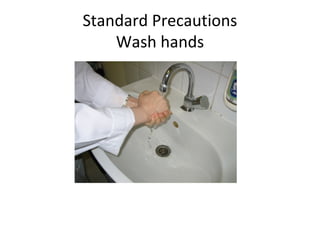
Standard Precautions
Wash hands
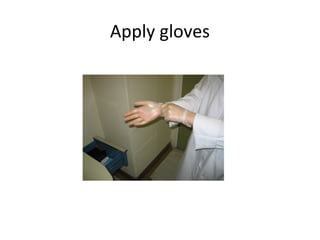
Apply gloves
• Patients are often reassured that proper
safety measures are being followed when
gloves are put on in their presence.
Technical Tip
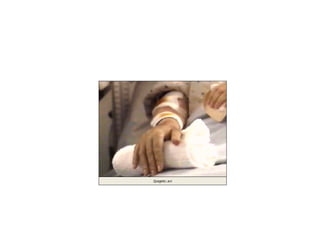
Position the Patient
• Comfortable position
• Turn the arm so that the wrist and palm face
upward, and the antecubital area is accessible
• When supporting the patient’s arm, do not
hyperextend the elbow. This may make vein
palpation difficult.
Technical Tip
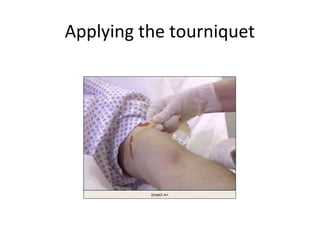
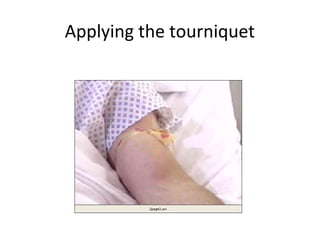
Applying the tourniquet
• Tie the tourniquet just above the elbow.
• The tourniquet should be applied a maximum
of 1 – 2 minutes.
Applying the tourniquet
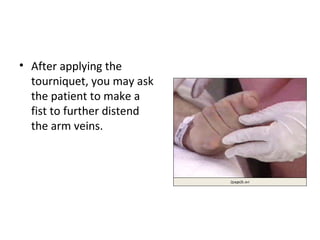
• After applying the
tourniquet, you may ask
the patient to make a
fist to further distend
the arm veins.
• Patients often think they are helping by
pumping their fists
• This is an acceptable practice when donating
blood, but not in sample collection as this can
lead to hemoconcentration
Technical Tip
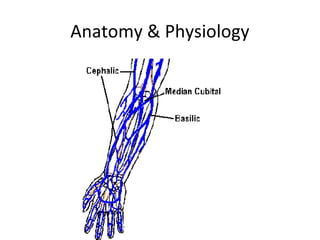
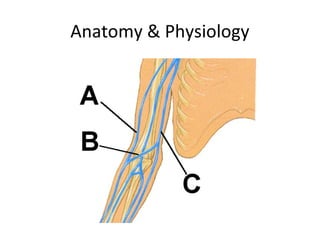
Choose a site
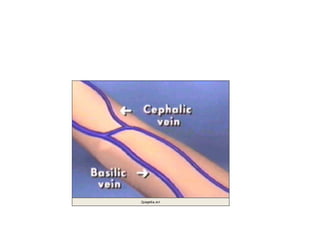
• The median cubital vein
• If not accessible: Cephalic vein, or the Basilic
vein.
• If not accessible: veins on the back of the
hand.
• Use a much smaller needle for these hand
veins.
• Using the nondominant hand routinely for
palpation may be helpful when additional
palpation is required immediately before
performing the puncture.
• Often, a patient has veins that are more
prominent in the dominant arm.
Technical Tip
Never
• Scarred, abraded, or inflamed skin
• Arms containing IV catheters
• Oedematous arms
• Occluded Veins
• Shunts
draw from these areas
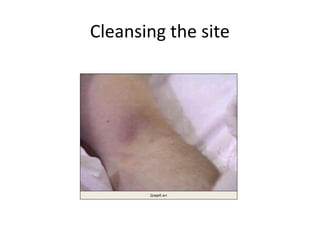
Cleansing the site
• Isopropyl alcohol swab
• Outward expanding spiral starting with the
actual venipuncture site.
• Allow the alcohol to dry:-
1-disinfect the site
2-prevent a burning sensation
Cleansing the site
• Patients are quick to complain about a painful
venipuncture. The stinging sensation caused
by undry alcohol is a frequent, yet easily
avoided, cause of complaints.
Technical Tip
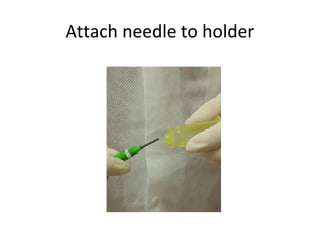
Attach needle to holder
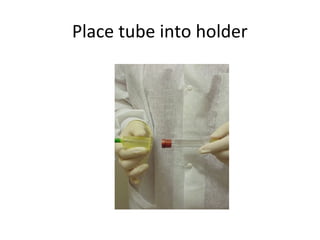
Place tube into holder
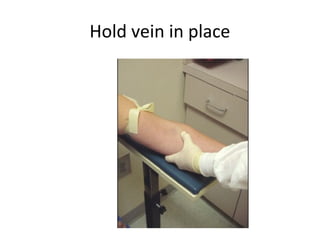
Hold vein in place
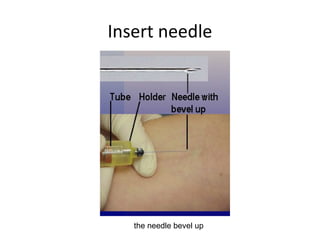
Insert needle
the needle bevel up
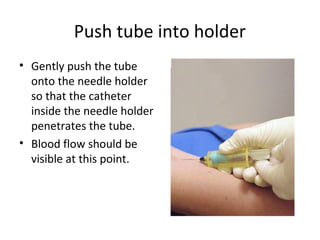
Push tube into holder
• Gently push the tube
onto the needle holder
so that the catheter
inside the needle holder
penetrates the tube.
• Blood flow should be
visible at this point.
• Allow tubes to fill until the vacuum is
exhausted to ensure the correct blood to
anticoagulant ratio.
Technical Tip
Blood won’t flow
If you do not see blood flow, the tip of the
needle:
1.May not yet be within the vein.
2.May have already passed through the vein.
3.May have missed the vein entirely.
4.May be pushed up against the inside wall of
the vein.
TROUBLESHOOTING
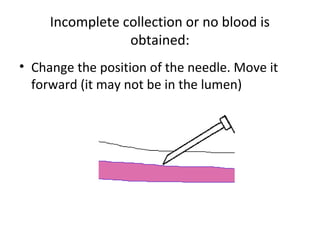
Incomplete collection or no blood is
obtained:
• Change the position of the needle. Move it
forward (it may not be in the lumen)
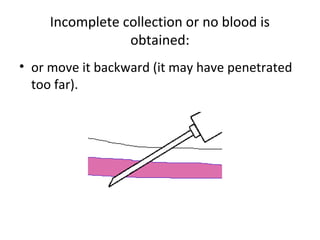
Incomplete collection or no blood is
obtained:
• or move it backward (it may have penetrated
too far).
Incomplete collection or no blood is
obtained:
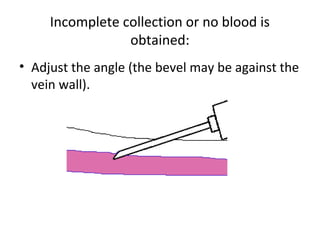
• Adjust the angle (the bevel may be against the
vein wall).
Incomplete collection or no blood is
obtained:
• Loosen the tourniquet. It may be obstructing
blood flow.
• Try another tube. There may be no vacuum in
the one being used.
• Re-anchor the vein. Veins sometimes roll
away from the point of the needle and
puncture site.
Other Problems
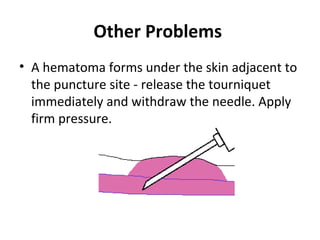
• A hematoma forms under the skin adjacent to
the puncture site - release the tourniquet
immediately and withdraw the needle. Apply
firm pressure.
Other Problems
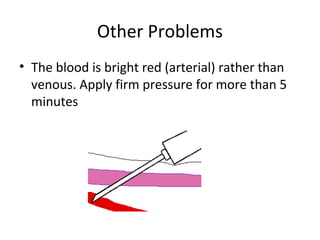
• The blood is bright red (arterial) rather than
venous. Apply firm pressure for more than 5
minutes
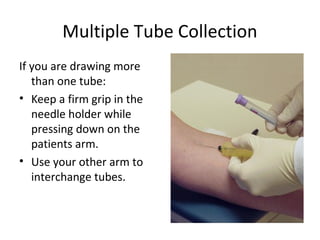
Multiple Tube Collection
If you are drawing more
than one tube:
• Keep a firm grip in the
needle holder while
pressing down on the
patients arm.
• Use your other arm to
interchange tubes.
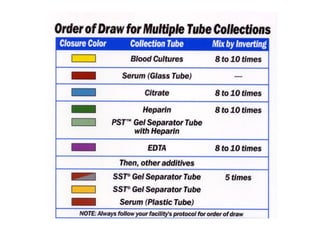
Order of draw
Removing the Needle
• Gently release the tourniquet before the last
tube of blood is filled
• Remove the last tube from the needle
• Withdraw the needle in a single quick
movement
Apply Pressure
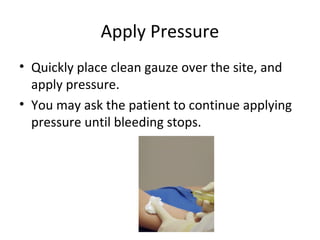
• Quickly place clean gauze over the site, and
apply pressure.
• You may ask the patient to continue applying
pressure until bleeding stops.
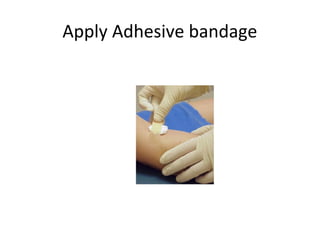
Apply Adhesive bandage
• The practice of quickly applying tape over the
gauze without checking the puncture site
frequently produces a hematoma
Technical Tip
Needle disposal
• Remove the needle from the holder if
appropriate, and properly discard it in an
approved sharps disposal container.
• Discard all waste and gloves in the
appropriate biohazardous waste container.
• Wash hands.
Specimen Labeling
• Label specimens at the bedside according to
your institution’s standard procedures, or
apply preprinted labels.
• Proper labeling is the single most critical task
you are asked to perform.
Proper labeling generally includes:
• Patient’s first and last name
• Hospital identification number
• Date & time
• Phlebotomist initials
• Your institution may provide bar coded
computer generated labels that contain this
information.
Summary Of Venipuncture Technique
1. requisition form.
2. Greet the patient.
3. Identify the patient.
4. Reassure the patient and explain the procedure.
5. Prepare the patient.
6. Select equipment and supplies.
7. Wash hands and apply gloves.
8. Apply the tourniquet.
9. Select the venipuncture site.
10.Release the tourniquet.
11.Cleanse the site.
12.Assemble equipment.
Summary Of Venipuncture Technique
13.Reapply the tourniquet.
14.Confirm the venipuncture site.
15.Examine the needle.
16.Anchor the vein.
17.Insert the needle.
18.Push the evacuated tube completely into adapter.
19.Gently invert the specimens, as they are collected.
20.Remove the last tube from the adapter.
21.Release the tourniquet.
22.Place sterile gauze over the needle.
23.Remove the needle, and apply pressure.
24.Activate needle safety device.
Summary Of Venipuncture Technique
25.Dispose of the needle.
26.Label the tubes.
27.Examine the patient’s arm.
28.Bandage the patient’s arm.
29.Dispose of used supplies.
30.Remove and dispose of gloves.
31.Wash hands.
32.Complete any required paperwork.
33.Thank the patient.
34.Deliver specimens to appropriate locations.
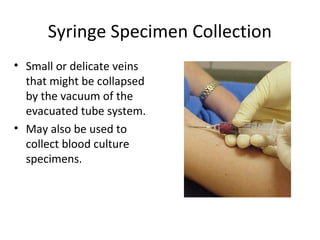
Syringe Specimen Collection
• Small or delicate veins
that might be collapsed
by the vacuum of the
evacuated tube system.
• May also be used to
collect blood culture
specimens.
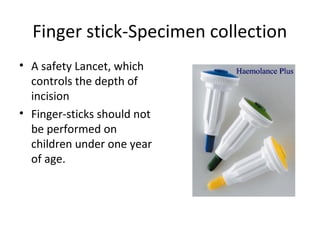
Finger stick-Specimen collection
• A safety Lancet, which
controls the depth of
incision
• Finger-sticks should not
be performed on
children under one year
of age.
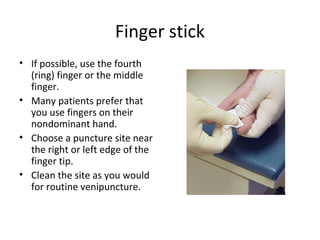
Finger stick
• If possible, use the fourth
(ring) finger or the middle
finger.
• Many patients prefer that
you use fingers on their
nondominant hand.
• Choose a puncture site near
the right or left edge of the
finger tip.
• Clean the site as you would
for routine venipuncture.
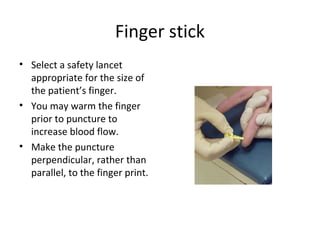
Finger stick
• Select a safety lancet
appropriate for the size of
the patient’s finger.
• You may warm the finger
prior to puncture to
increase blood flow.
• Make the puncture
perpendicular, rather than
parallel, to the finger print.
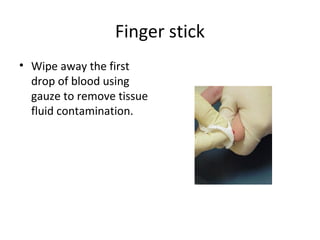
Finger stick
• Wipe away the first
drop of blood using
gauze to remove tissue
fluid contamination.
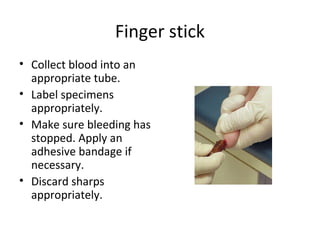
Finger stick
• Collect blood into an
appropriate tube.
• Label specimens
appropriately.
• Make sure bleeding has
stopped. Apply an
adhesive bandage if
necessary.
• Discard sharps
appropriately.
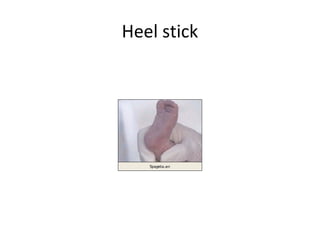
Heel stick
• Veins of small children
and infants are too
small for venipuncture;
• Butterfly needles may
be used to collect
venous blood in older
children.
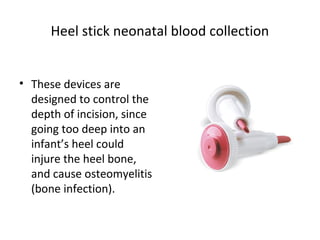
Heel stick neonatal blood collection
• These devices are
designed to control the
depth of incision, since
going too deep into an
infant’s heel could
injure the heel bone,
and cause osteomyelitis
(bone infection).
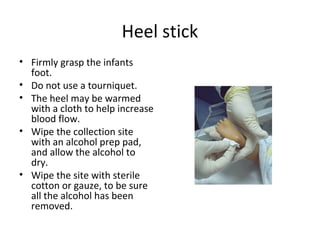
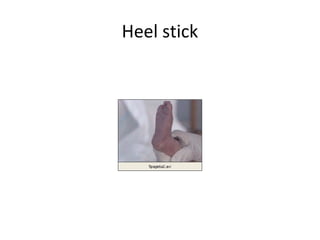
Heel stick
• Firmly grasp the infants
foot.
• Do not use a tourniquet.
• The heel may be warmed
with a cloth to help increase
blood flow.
• Wipe the collection site
with an alcohol prep pad,
and allow the alcohol to
dry.
• Wipe the site with sterile
cotton or gauze, to be sure
all the alcohol has been
removed.
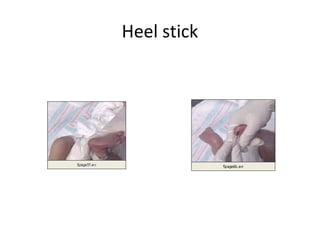
Heel stick
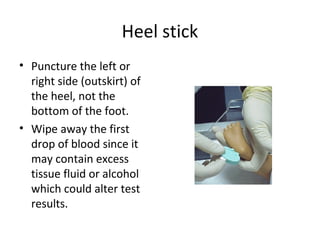
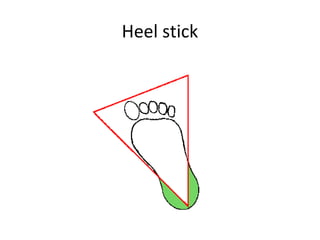
• Puncture the left or
right side (outskirt) of
the heel, not the
bottom of the foot.
• Wipe away the first
drop of blood since it
may contain excess
tissue fluid or alcohol
which could alter test
results.
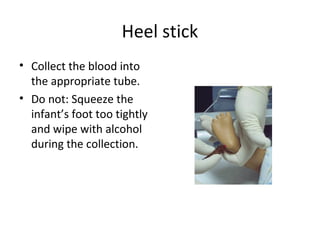
Heel stick
• Collect the blood into
the appropriate tube.
• Do not: Squeeze the
infant’s foot too tightly
and wipe with alcohol
during the collection.
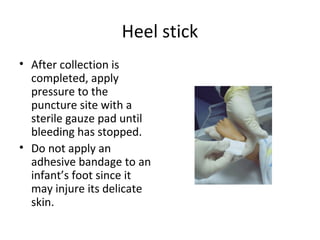
Heel stick
• After collection is
completed, apply
pressure to the
puncture site with a
sterile gauze pad until
bleeding has stopped.
• Do not apply an
adhesive bandage to an
infant’s foot since it
may injure its delicate
skin.
Heel stick
Heel stick
Heel stick
Heel stick
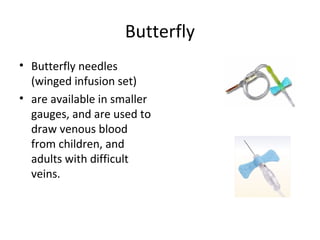
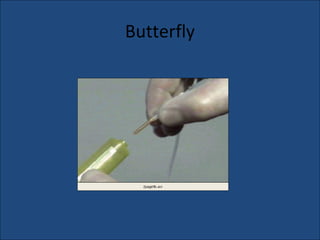
Butterfly
• Butterfly needles
(winged infusion set)
• are available in smaller
gauges, and are used to
draw venous blood
from children, and
adults with difficult
veins.
Butterfly
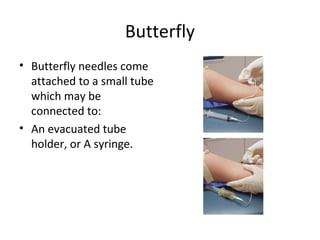
• Butterfly needles come
attached to a small tube
which may be
connected to:
• An evacuated tube
holder, or A syringe.
Butterfly
Special situations
Patients refusing blood work
• If someone hesitates to let you collect a blood
specimen, explain to them that their blood
test results are important to their care.
• Patients have a right to refuse blood tests
• If the patient still refuses, report and
document patient refusal
Fainting
• Rarely, patients will faint during venipuncture.
• It is therefore important that patients are
properly seated or lying in such a way during
venipuncture so that if they do faint, they
won’t hurt themselves.
• self-limited
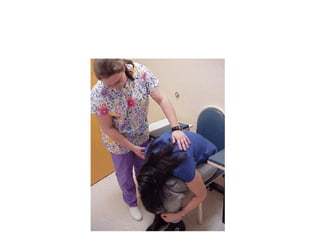
Fainting; what to do?
• Gently remove the tourniquet and needle from the
patients arm, apply gauze and pressure to the skin
puncture site.
• Call for help.
• If the patient is seated, place his head between his
knees.
• A cold compress on the back of the neck may help to
revive the patient more quickly.
Unsatisfactory Specimens
• They can cause misleading laboratory results
• Must be rejected by the laboratory.
• The patient must then undergo another
venipuncture to get a better specimen.
• It costs time & money to redraw the specimen.
• The credibility of the laboratory is reduced if too
many unsatisfactory specimens are drawn.
Causes of Unsatisfactory Specimens
Hemolysis
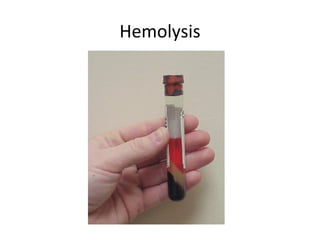
Hemolysis
• Hemolysis means the breakup of fragile red
blood cells within the specimen, and the
release of their hemoglobin and other
substances, into the plasma.
• A hemolyzed specimen can be recognized
after it is centrifuged by the red color of the
plasma.
Causes of Hemolysis
• Using a too small needle for a relatively bigger
vein
• Pulling a syringe plunger too rapidly
• Expelling blood vigorously into a tube,
• Shaking a tube of blood too hard.
Hemolysis
Hemolysis
Hemolysis
• Hemolysis can cause falsely increased
potassium, magnesium, iron, and ammonia
levels, and other aberrant lab results.
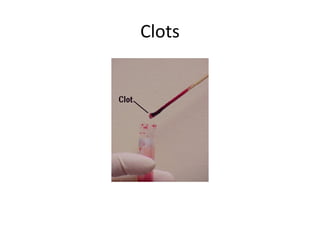
Clots
Clots
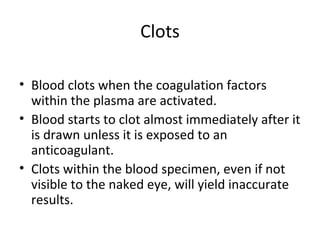
• Blood clots when the coagulation factors
within the plasma are activated.
• Blood starts to clot almost immediately after it
is drawn unless it is exposed to an
anticoagulant.
• Clots within the blood specimen, even if not
visible to the naked eye, will yield inaccurate
results.
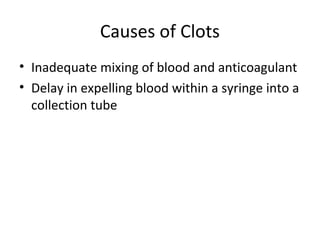
Causes of Clots
• Inadequate mixing of blood and anticoagulant
• Delay in expelling blood within a syringe into a
collection tube
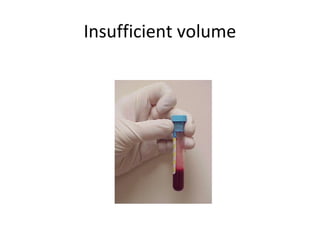
Insufficient volume
Insufficient volume
• short draws will result in an incorrect ratio of
blood to anticoagulant, and yield incorrect
test results.
• Short draws can be caused by:
• A vein collapsing during phlebotomy.
• The needle coming out of the vein before the
collection tube is full.
• Loss of collection tube vacuum before the
tube is full.
Labeling Errorrs
• Labeling errors are the most common cause of
incorrect laboratory results.
• If detected, the incorrectly labeled specimen
will be rejected.
• If undetected, it will produce incorrect results
which might adversely affect your patient’s
care.
Causes
• Failure to follow proper patient identification
procedure.
• Failure to label the specimen completely and
immediately after collection.
Ten Commandments
 
I. Thou shalt protect thyself from injury 
II. Thou shalt identify thy patients 
III. Thou shalt stretch the skin at the puncture site
IV. Thou shalt puncture the skin at about a 15 degree angle 
V. Thou shalt glorify the median vein 
VI. Thou shalt invert tubes containing anticoagulants immediately
after collection 
VII. Thou shalt attempt to collect specimens only from an acceptable
site 
VIII. Thou shalt label specimens at the bedside 
IX. Thou shalt know when to quit  
X.Thou shalt treat patient's like they are family
 

Phlebotomy

  • 2.
  • 3.
    Objectives • Theory andpractice of phlebotomy • How to interact professionally with patients • Occupational health hazards and appropriate precautions • Related anatomy and physiology • Phlebotomy equipment and supplies • Phlebotomy procedures • Complications of venipuncture and how to handle them.
  • 4.
    Theory and Practiceof Phlebotomy
  • 5.
    What is phlebotomy •The term phlebotomy refers to the ancient practice of bloodletting • Now the term phlebotomy is used for the withdrawal of blood from a vein, artery, or the capillary bed for lab analysis or blood transfusion.
  • 6.
    Who is aphlebotomist • Collects blood and other specimens • Prepares specimens for testing • Interacts with patients & health care professionals • plays a vital role in any health care system
  • 7.
    Who is aphlebotomist • Other medical professionals, including doctors, nurses, technologists, and medical assistants must also be trained to collect blood specimens.
  • 8.
    Laboratory or BloodBank work flow cycle
  • 9.
  • 10.
  • 11.
  • 12.
  • 13.
  • 14.
    Confidentiality • All employeesare responsible for maintaining confidentiality of medical information
  • 15.
    Attitude • Tone ofvoice and facial expression will determine how patients respond to you. • Always be polite, friendly, calm, and considerate.
  • 16.
    Appearance • Your personalappearance will also affect the impression you make. Professional dress. • Comply with your facility’s dress code and personal appearance policies.
  • 17.
  • 18.
    Blood-Borne Pathogens • Infectiousmicro-organisms which live in the bloodstream. • You can be exposed to bloodborne pathogens if you are injured with a contaminated needle. • You can also be exposed if your mucous membranes, including eyes, mouth, or the inside of your nose come into contact with contaminated body fluids.
  • 19.
    • Advance countries: Occupational Health and Safety Administration of the federal government has mandated bloodborne pathogen training for all workers who are at risk of exposure.
  • 20.
    Training • Standard Precautions •Personal Protective Equipment • Hand Washing • Hazardous waste disposal • Needle sticks and prevention act
  • 21.
  • 22.
    Standard Precautions • StandardPrecautions means treating all body fluids and substances as if they were infectious.
  • 23.
    Standard Precautions • Potentiallyinfectious body fluids include: Blood, Semen, Vaginal Secretion, fluids, and Saliva • Sweat and tears are not generally considered infectious.
  • 24.
  • 25.
    Personal Protective Equipment •lab coat • Gloves • Spectacles • Face masks ( certain types of isolation)
  • 26.
    Hand Washing • Handwashing is the single most important infection control measure. • Wash hands thoroughly before, after, and between all patient contacts. • using a paper towel to avoid contamination.
  • 27.
    Hand washing • Removerings • Stand by the sink but do not touch it • Apply soap and rub hands together • Both sides of the hand, between fingers, under fingernails • Rinse hands in a downward motion • Dry hands with a clean paper towel • Turn off water with another paper towel
  • 28.
  • 29.
    Hazardous waste disposal •All needles & other sharps must be disposed of in approved sharps disposal containers. • Other contaminated waste must be discarded in an appropriate biohazard bag.
  • 30.
  • 31.
    Needle sticks andprevention act • Safety Devices should always be encouraged
  • 32.
  • 33.
    Anatomy & Physiology •Anatomy is the branch of science concerned with the study of the structure of the body. • Physiology is the branch of science concerned with the study of the function of the body.
  • 34.
    Anatomy & Physiology •The cardiovascular system consists of the Heart, and Blood Vessels. • Its main function is circulate oxygenated blood from the lungs to various organs, and return blood depleted of oxygen to the lungs, where it is reoxygenated.
  • 35.
  • 36.
  • 37.
  • 38.
  • 39.
    Blood Components • Circulatingwhole blood is a mixture of: • Plasma (which contains fluid, proteins, and lipids), and • Formed elements, consisting of red cells, white cells, and platelets.
  • 40.
  • 41.
  • 42.
  • 43.
  • 44.
    Blood Clot • Whena blood sample is left standing without anticoagulant, it forms a coagulum or blood clot. • The clot contains coagulation proteins, platelets, and entrapped red and white blood cells.
  • 45.
    Serum • Serum containsall the same substances as plasma, except for the coagulation proteins, which are left behind in the blood clot.
  • 46.
  • 47.
    Trays • Trays shouldbe sanitized daily using appropriate disinfectant • Kept Organized and well- stocked.
  • 48.
    Blood Collection tubes •glass or plastic tube with a rubber stopper. • It has a vacuum so that blood will flow into the tube. • anticoagulants and/or other chemical additives.
  • 49.
    Blood collection tubes •Rubber stoppers of blood collection tubes are color coded. • Each type of stopper indicates a different additive or a different tube type.
  • 50.
    LAVENDER • EDTA toprevent clotting • hematology studies. • Should be completely filled • Must be inverted after filling
  • 51.
    LIGHT BLUE • sodiumcitrate. • coagulation (clotting) studies. • must be completely filled • must be inverted immediately after filling
  • 52.
    GREEN • sodium orlithium heparin • for tests requiring whole blood or plasma such as ammonia
  • 53.
    RED • No additives •Blood bank tests, toxicology, serology • Must not be inverted after filing
  • 54.
    GRAY • Inhibitor forglycolysis + anticoagulant • Sodium Fluride +potassium oxalate. • glucose levels.
  • 55.
    YELLOW • Acid citratedextrose • Inactivates complements • DNA studies, paternity testing
  • 56.
    ROYAL BLUE • heparinor Na EDTA anticoagulants • Tube is designed to contain no contaminating metals • Trace element and toxicology studies
  • 57.
    Blood Culture Bottles •Different blood culture bottles are used for aerobic, anaerobic, and pediatric collections.
  • 58.
    Blood collection tubes:Safety • The rubber stopper is positioned inside the plastic shield
  • 59.
    Sizes • Adult:3 -10 ml • Pediatric 2 - 4 ml. • Tubes for fingersticks or heelsticks ½ or less
  • 60.
  • 61.
    Holders • A plasticholder must be used with the evacuated tube system.
  • 62.
  • 63.
    Syringes with built-insafety devices
  • 64.
  • 65.
    Needles • Different sizes. •size =gauge. • The larger the needle, the smaller the gauge number. • 21 or 22 gauge needle is mostly used.
  • 66.
  • 67.
    Single Draw Needle •Single draw needles are of the type that fit on a syringe, and can be used only to fill the syringe to which they are connected.
  • 68.
    Multiple Draw Needle •Used with vacuum collection tubes. • They have a retractable sheath over the portion of the needle that penetrates the blood tube.
  • 69.
    Needles with built-insafety devices An internal blunt needle that is activated with forward pressure on the final blood tube prior to withdrawal of the needle from the vein.
  • 70.
    Butterfly Needle • Wingedinfusion set • Difficult venipunctures including pediatric draws • with a syringe or a holder and vacuum collection tube system. • 21, 23, or 25 gauge.
  • 71.
    Butterflies with built-insafety features • number-one cause of needlestick injuries, so proper use of their safety devices is critical.
  • 72.
  • 73.
    Lancets • Lancets areused for difficult venipunctures, including pediatric draws.
  • 74.
    Tourniquets • Vein easierto SEE, FEEL, and PUNCTURE
  • 75.
  • 76.
  • 77.
    Gloves • Gloves mustbe worn for all procedures requiring vascular access. • Non-powdered latex gloves are most commonly used;
  • 78.
  • 79.
  • 80.
    Greeting • Always greetpatient in a professional, friendly manner. • A good initial impression will earn the patients trust, and make it easier and more pleasant to draw a good specimen. • Knock on the patient’s door before entering. • Identify yourself by name and department. • Explain the reason for your presence.
  • 81.
    • The morerelaxed and trusting your patient, the greater chance of a successful atraumatic venipuncture. Technical Tip
  • 82.
    • Good verbal,listening, and nonverbal skills are very important for patient reassurance Technical Tip
  • 83.
    Patient Identification • Makesure the name, medical record number, and date of birth on your order/requisition match those on the patient’s armband. • Verify the patient’s identity by politely asking them to state their full name.
  • 84.
    Patient Identification • Properlyidentifying patients and specimens is probably the single most critical part of your job. • The consequences of misidentifying a specimen can be life threatening.
  • 85.
    Patient Identification • Neverrely on the patient name on the door or above the bed. Patients are frequently moved from room to room.
  • 86.
    • A hospitalizedpatient must always be correctly identified by an ID band that is attached to the patient. Technical Tip
  • 87.
  • 88.
  • 89.
    • Patients areoften reassured that proper safety measures are being followed when gloves are put on in their presence. Technical Tip
  • 90.
    Position the Patient •Comfortable position • Turn the arm so that the wrist and palm face upward, and the antecubital area is accessible
  • 91.
    • When supportingthe patient’s arm, do not hyperextend the elbow. This may make vein palpation difficult. Technical Tip
  • 92.
    Applying the tourniquet •Tie the tourniquet just above the elbow. • The tourniquet should be applied a maximum of 1 – 2 minutes.
  • 93.
  • 94.
  • 95.
    • After applyingthe tourniquet, you may ask the patient to make a fist to further distend the arm veins.
  • 96.
    • Patients oftenthink they are helping by pumping their fists • This is an acceptable practice when donating blood, but not in sample collection as this can lead to hemoconcentration Technical Tip
  • 97.
    Choose a site •The median cubital vein • If not accessible: Cephalic vein, or the Basilic vein. • If not accessible: veins on the back of the hand. • Use a much smaller needle for these hand veins.
  • 99.
    • Using thenondominant hand routinely for palpation may be helpful when additional palpation is required immediately before performing the puncture. • Often, a patient has veins that are more prominent in the dominant arm. Technical Tip
  • 101.
    Never • Scarred, abraded,or inflamed skin • Arms containing IV catheters • Oedematous arms • Occluded Veins • Shunts draw from these areas
  • 102.
    Cleansing the site •Isopropyl alcohol swab • Outward expanding spiral starting with the actual venipuncture site. • Allow the alcohol to dry:- 1-disinfect the site 2-prevent a burning sensation
  • 103.
  • 104.
    • Patients arequick to complain about a painful venipuncture. The stinging sensation caused by undry alcohol is a frequent, yet easily avoided, cause of complaints. Technical Tip
  • 105.
  • 106.
  • 107.
  • 108.
  • 109.
    Push tube intoholder • Gently push the tube onto the needle holder so that the catheter inside the needle holder penetrates the tube. • Blood flow should be visible at this point.
  • 111.
    • Allow tubesto fill until the vacuum is exhausted to ensure the correct blood to anticoagulant ratio. Technical Tip
  • 112.
    Blood won’t flow Ifyou do not see blood flow, the tip of the needle: 1.May not yet be within the vein. 2.May have already passed through the vein. 3.May have missed the vein entirely. 4.May be pushed up against the inside wall of the vein.
  • 113.
  • 114.
    Incomplete collection orno blood is obtained: • Change the position of the needle. Move it forward (it may not be in the lumen)
  • 115.
    Incomplete collection orno blood is obtained: • or move it backward (it may have penetrated too far).
  • 116.
    Incomplete collection orno blood is obtained: • Adjust the angle (the bevel may be against the vein wall).
  • 117.
    Incomplete collection orno blood is obtained: • Loosen the tourniquet. It may be obstructing blood flow. • Try another tube. There may be no vacuum in the one being used. • Re-anchor the vein. Veins sometimes roll away from the point of the needle and puncture site.
  • 118.
    Other Problems • Ahematoma forms under the skin adjacent to the puncture site - release the tourniquet immediately and withdraw the needle. Apply firm pressure.
  • 119.
    Other Problems • Theblood is bright red (arterial) rather than venous. Apply firm pressure for more than 5 minutes
  • 120.
    Multiple Tube Collection Ifyou are drawing more than one tube: • Keep a firm grip in the needle holder while pressing down on the patients arm. • Use your other arm to interchange tubes.
  • 121.
  • 123.
    Removing the Needle •Gently release the tourniquet before the last tube of blood is filled • Remove the last tube from the needle • Withdraw the needle in a single quick movement
  • 124.
    Apply Pressure • Quicklyplace clean gauze over the site, and apply pressure. • You may ask the patient to continue applying pressure until bleeding stops.
  • 125.
  • 126.
    • The practiceof quickly applying tape over the gauze without checking the puncture site frequently produces a hematoma Technical Tip
  • 127.
    Needle disposal • Removethe needle from the holder if appropriate, and properly discard it in an approved sharps disposal container. • Discard all waste and gloves in the appropriate biohazardous waste container. • Wash hands.
  • 129.
    Specimen Labeling • Labelspecimens at the bedside according to your institution’s standard procedures, or apply preprinted labels. • Proper labeling is the single most critical task you are asked to perform.
  • 130.
    Proper labeling generallyincludes: • Patient’s first and last name • Hospital identification number • Date & time • Phlebotomist initials • Your institution may provide bar coded computer generated labels that contain this information.
  • 131.
    Summary Of VenipunctureTechnique 1. requisition form. 2. Greet the patient. 3. Identify the patient. 4. Reassure the patient and explain the procedure. 5. Prepare the patient. 6. Select equipment and supplies. 7. Wash hands and apply gloves. 8. Apply the tourniquet. 9. Select the venipuncture site. 10.Release the tourniquet. 11.Cleanse the site. 12.Assemble equipment.
  • 132.
    Summary Of VenipunctureTechnique 13.Reapply the tourniquet. 14.Confirm the venipuncture site. 15.Examine the needle. 16.Anchor the vein. 17.Insert the needle. 18.Push the evacuated tube completely into adapter. 19.Gently invert the specimens, as they are collected. 20.Remove the last tube from the adapter. 21.Release the tourniquet. 22.Place sterile gauze over the needle. 23.Remove the needle, and apply pressure. 24.Activate needle safety device.
  • 133.
    Summary Of VenipunctureTechnique 25.Dispose of the needle. 26.Label the tubes. 27.Examine the patient’s arm. 28.Bandage the patient’s arm. 29.Dispose of used supplies. 30.Remove and dispose of gloves. 31.Wash hands. 32.Complete any required paperwork. 33.Thank the patient. 34.Deliver specimens to appropriate locations.
  • 134.
    Syringe Specimen Collection •Small or delicate veins that might be collapsed by the vacuum of the evacuated tube system. • May also be used to collect blood culture specimens.
  • 135.
    Finger stick-Specimen collection •A safety Lancet, which controls the depth of incision • Finger-sticks should not be performed on children under one year of age.
  • 136.
    Finger stick • Ifpossible, use the fourth (ring) finger or the middle finger. • Many patients prefer that you use fingers on their nondominant hand. • Choose a puncture site near the right or left edge of the finger tip. • Clean the site as you would for routine venipuncture.
  • 137.
    Finger stick • Selecta safety lancet appropriate for the size of the patient’s finger. • You may warm the finger prior to puncture to increase blood flow. • Make the puncture perpendicular, rather than parallel, to the finger print.
  • 138.
    Finger stick • Wipeaway the first drop of blood using gauze to remove tissue fluid contamination.
  • 139.
    Finger stick • Collectblood into an appropriate tube. • Label specimens appropriately. • Make sure bleeding has stopped. Apply an adhesive bandage if necessary. • Discard sharps appropriately.
  • 141.
    Heel stick • Veinsof small children and infants are too small for venipuncture; • Butterfly needles may be used to collect venous blood in older children.
  • 142.
    Heel stick neonatalblood collection • These devices are designed to control the depth of incision, since going too deep into an infant’s heel could injure the heel bone, and cause osteomyelitis (bone infection).
  • 143.
    Heel stick • Firmlygrasp the infants foot. • Do not use a tourniquet. • The heel may be warmed with a cloth to help increase blood flow. • Wipe the collection site with an alcohol prep pad, and allow the alcohol to dry. • Wipe the site with sterile cotton or gauze, to be sure all the alcohol has been removed.
  • 144.
    Heel stick • Puncturethe left or right side (outskirt) of the heel, not the bottom of the foot. • Wipe away the first drop of blood since it may contain excess tissue fluid or alcohol which could alter test results.
  • 145.
    Heel stick • Collectthe blood into the appropriate tube. • Do not: Squeeze the infant’s foot too tightly and wipe with alcohol during the collection.
  • 146.
    Heel stick • Aftercollection is completed, apply pressure to the puncture site with a sterile gauze pad until bleeding has stopped. • Do not apply an adhesive bandage to an infant’s foot since it may injure its delicate skin.
  • 147.
  • 148.
  • 149.
  • 150.
  • 151.
    Butterfly • Butterfly needles (wingedinfusion set) • are available in smaller gauges, and are used to draw venous blood from children, and adults with difficult veins.
  • 152.
    Butterfly • Butterfly needlescome attached to a small tube which may be connected to: • An evacuated tube holder, or A syringe.
  • 153.
  • 154.
  • 155.
    Patients refusing bloodwork • If someone hesitates to let you collect a blood specimen, explain to them that their blood test results are important to their care. • Patients have a right to refuse blood tests • If the patient still refuses, report and document patient refusal
  • 156.
    Fainting • Rarely, patientswill faint during venipuncture. • It is therefore important that patients are properly seated or lying in such a way during venipuncture so that if they do faint, they won’t hurt themselves. • self-limited
  • 157.
    Fainting; what todo? • Gently remove the tourniquet and needle from the patients arm, apply gauze and pressure to the skin puncture site. • Call for help. • If the patient is seated, place his head between his knees. • A cold compress on the back of the neck may help to revive the patient more quickly.
  • 159.
    Unsatisfactory Specimens • Theycan cause misleading laboratory results • Must be rejected by the laboratory. • The patient must then undergo another venipuncture to get a better specimen. • It costs time & money to redraw the specimen. • The credibility of the laboratory is reduced if too many unsatisfactory specimens are drawn.
  • 160.
  • 161.
  • 162.
    Hemolysis • Hemolysis meansthe breakup of fragile red blood cells within the specimen, and the release of their hemoglobin and other substances, into the plasma. • A hemolyzed specimen can be recognized after it is centrifuged by the red color of the plasma.
  • 163.
    Causes of Hemolysis •Using a too small needle for a relatively bigger vein • Pulling a syringe plunger too rapidly • Expelling blood vigorously into a tube, • Shaking a tube of blood too hard.
  • 164.
  • 165.
  • 166.
    Hemolysis • Hemolysis cancause falsely increased potassium, magnesium, iron, and ammonia levels, and other aberrant lab results.
  • 167.
  • 168.
    Clots • Blood clotswhen the coagulation factors within the plasma are activated. • Blood starts to clot almost immediately after it is drawn unless it is exposed to an anticoagulant. • Clots within the blood specimen, even if not visible to the naked eye, will yield inaccurate results.
  • 169.
    Causes of Clots •Inadequate mixing of blood and anticoagulant • Delay in expelling blood within a syringe into a collection tube
  • 170.
  • 171.
    Insufficient volume • shortdraws will result in an incorrect ratio of blood to anticoagulant, and yield incorrect test results. • Short draws can be caused by: • A vein collapsing during phlebotomy. • The needle coming out of the vein before the collection tube is full. • Loss of collection tube vacuum before the tube is full.
  • 172.
    Labeling Errorrs • Labelingerrors are the most common cause of incorrect laboratory results. • If detected, the incorrectly labeled specimen will be rejected. • If undetected, it will produce incorrect results which might adversely affect your patient’s care.
  • 173.
    Causes • Failure tofollow proper patient identification procedure. • Failure to label the specimen completely and immediately after collection.
  • 174.
    Ten Commandments   I. Thoushalt protect thyself from injury  II. Thou shalt identify thy patients  III. Thou shalt stretch the skin at the puncture site IV. Thou shalt puncture the skin at about a 15 degree angle  V. Thou shalt glorify the median vein  VI. Thou shalt invert tubes containing anticoagulants immediately after collection  VII. Thou shalt attempt to collect specimens only from an acceptable site  VIII. Thou shalt label specimens at the bedside  IX. Thou shalt know when to quit   X.Thou shalt treat patient's like they are family