


Analysing the EU PVG regulations Manoj SHARMA,Ph.D (Clin.Pharmacology, FRANCE) Pharmacovigilance Unit Clinical Research Department Panacea Biotec.
Overview of Presentation Principles of Pharmacovigilance Basis of Pharmacovigilance Regulations The EU rules Registration of medicinal products in EU The clinical trials EU Directive Challenges
Pharmacovigilance Greek  ‘pharmakon’  meaning a drug or medicine and from the Latin  ‘vigilans’  meaning watchful or careful.   Bernard B Gaud WHO definition: ‘ the science and activities related to the detection, assessment, understanding and prevention of adverse effects or any other drug related problem’
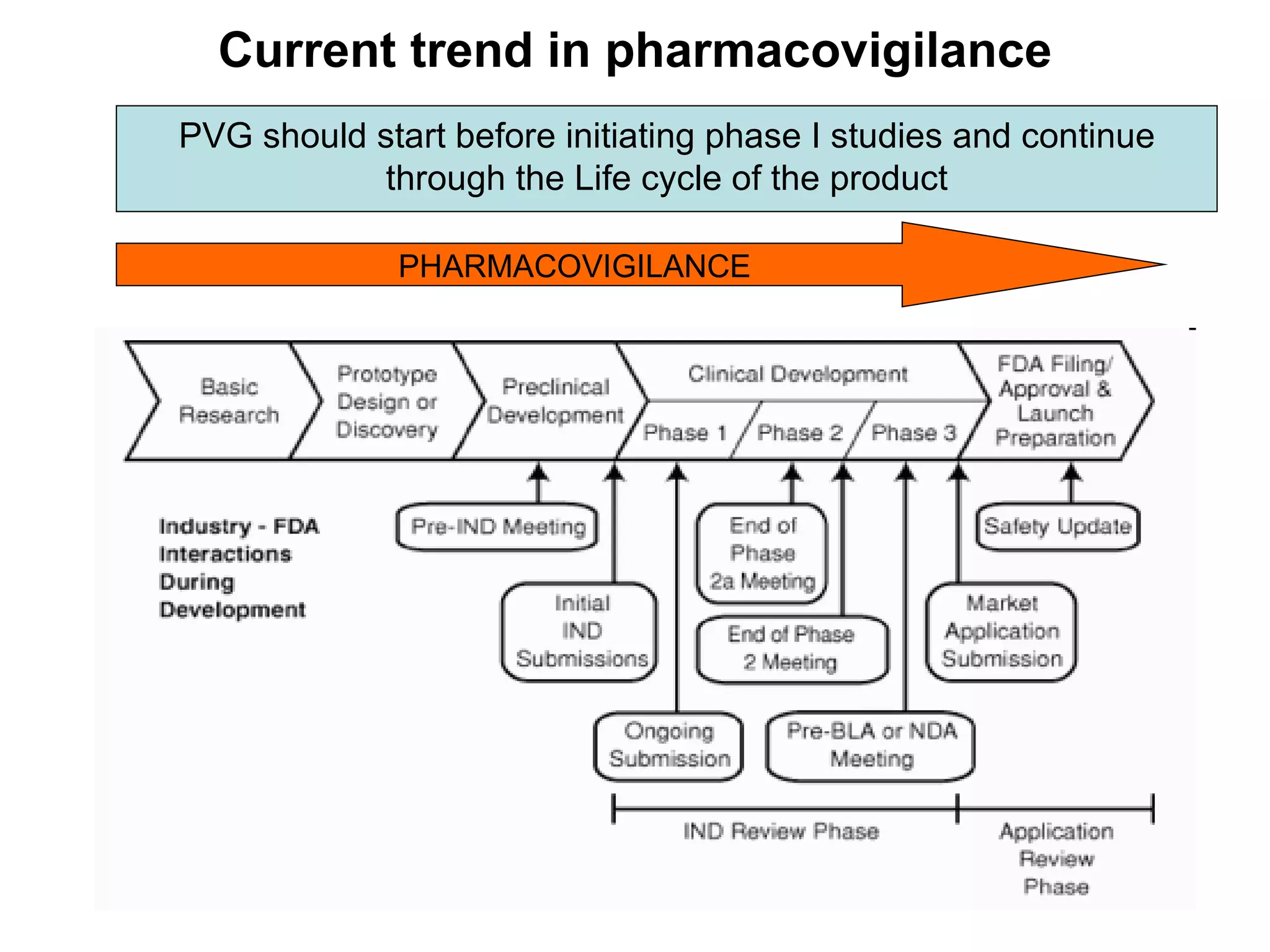
Current trend in pharmacovigilance PHARMACOVIGILANCE PVG should start before initiating phase I studies and continue through the Life cycle of the product
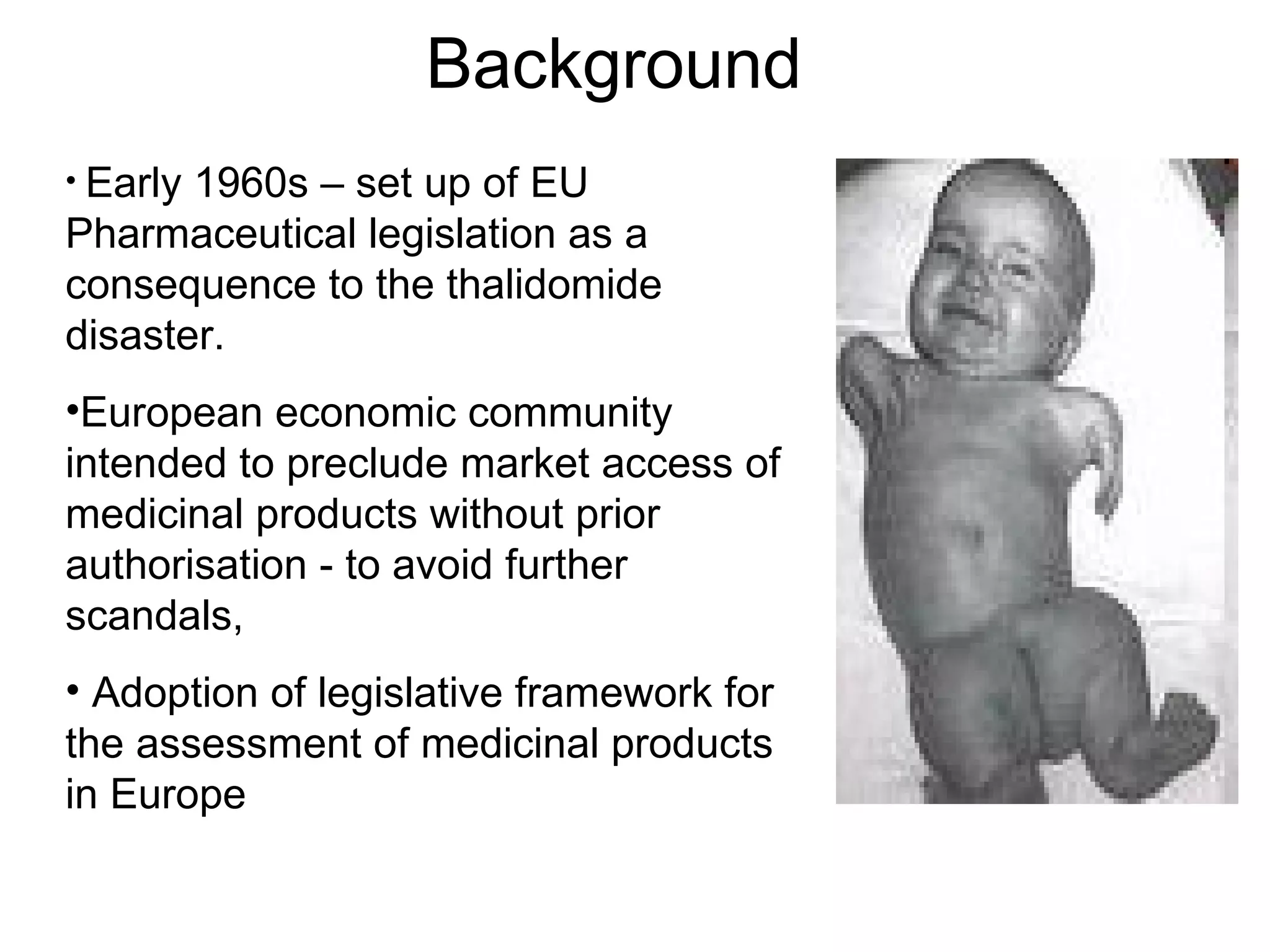
Background Early 1960s – set up of EU Pharmaceutical legislation as a consequence to the thalidomide disaster. European economic community intended to preclude market access of medicinal products without prior authorisation - to avoid further scandals,  Adoption of legislative framework for the assessment of medicinal products in Europe
Limitations of CTs:  controlled conditions rare side effects Experience gained during the post-autorisation phase may also provide valuable input into the evaluation of medicinal products at the stage of application for marketing autorisation, if there are chemical or pharmacological similarities with authorised products. Pharmacovigilance Why??
PVG Legislation in Europe:Milestones 26 January 1965 :  Harmonisation of national laws applicable to medicinal products started with adoption of Directive65/65/EEC 1975: Directives75/318/EE and 75/319/EE introduced a mutual recognition procedure for Member states to recognise each others national marketing authorities. CPMP set up- assessment whether candidate products complied with Directive 65/65/EEC. 1993: Council directive 93/39/EEC 1995: Establishment of EMEA Nov 2001: 2001/83/EC Parameters for regulation: Quality Safety  Efficacy
EU PVG regulations Served as a model for development of ICH E2A and E2C CIOMS working group I and II CIOMS/WHO Working Group on Vaccine Pharmacovigilance Management of Safety Information from Clinical Trials. CIOMS working group VI Current challenges in Pharmacovigilance: Pragmatic approaches CIOMS working group V Benefit-Risk balance for marketed drugs. Evaluating safety signals. CIOMS working group IV Guidelines for preparing core clincial safety information (CCSI) CIOMS working group III  The Rules Governing Medicinal Products in the European Union  –  Guidelines on Pharmacovigilance for Medicinal Products for Human Use  Vol 9A Good Clinical Practices  E6 Development safety update report E2F Pharmacovigilance planning for the early postmarketing period of a new drug (chemical entities, biotechnology-derived products, and vaccines)  E2E Post-approval safety data managament: Definitions ans standards for Expedited reporting  E2D Clinical Safety data management: Periodic Safety update report (PSUR) E2C Data elements for transmission of ICSRs E2BM Clinical safety data management: Definitions and standards for expedited reporting E2A
The national pharmacovigilance systems of the Member states together form the pharmacovigilance system in the EU Cooperates in a network structure under the co-ordination of the EMEA and in Liasion with the European Commission. EEA: Norway, Iceland and Liechtenstein Pharmacovigilance model
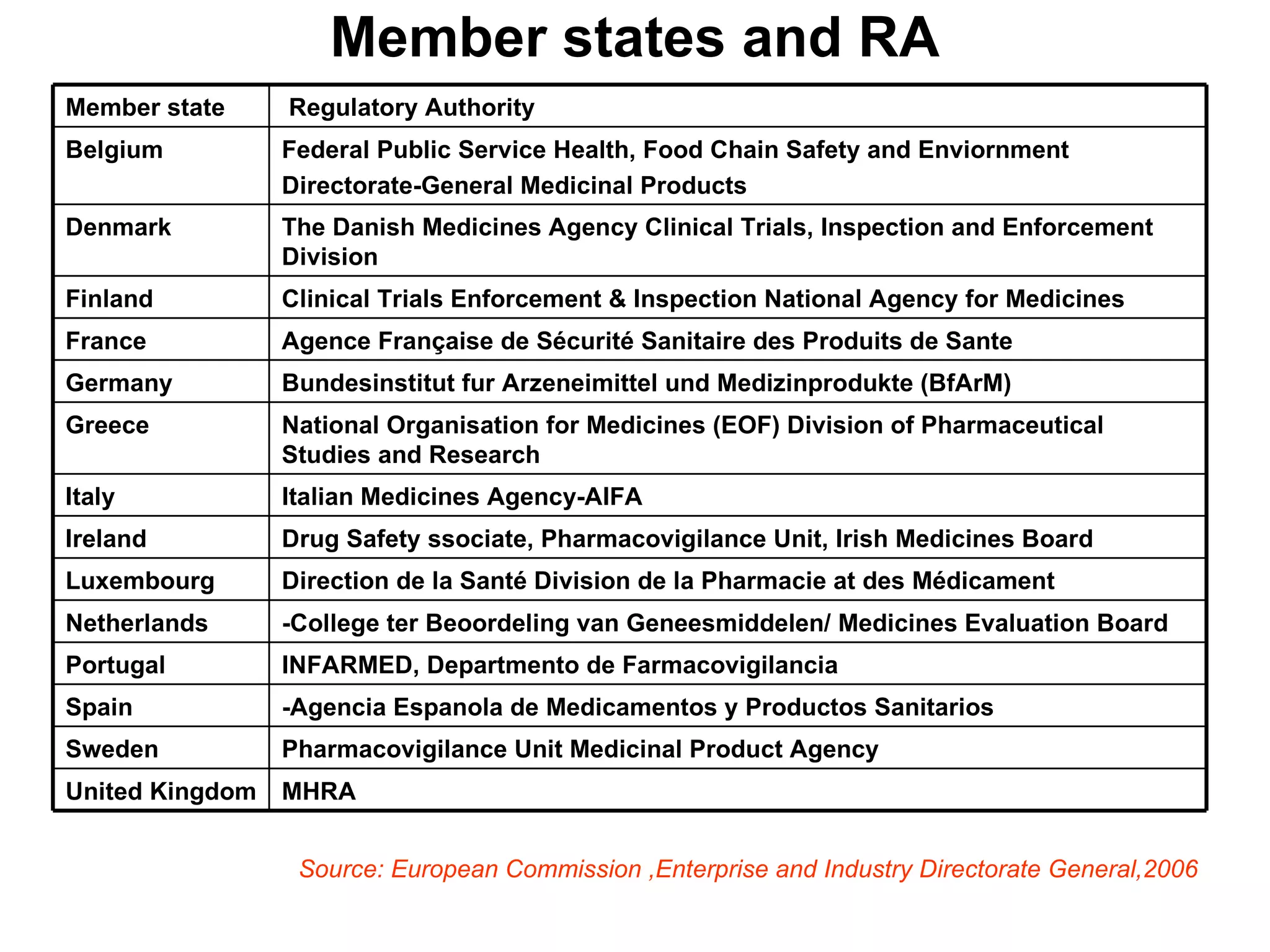
Member states and RA Source: European Commission ,Enterprise and Industry Directorate General,2006 Regulatory Authority Member state MHRA United Kingdom Pharmacovigilance Unit Medicinal Product Agency Sweden -Agencia Espanola de Medicamentos y Productos Sanitarios Spain INFARMED, Departmento de Farmacovigilancia Portugal -College ter Beoordeling van Geneesmiddelen/ Medicines Evaluation Board Netherlands Direction de la Santé Division de la Pharmacie at des Médicament Luxembourg Drug Safety ssociate, Pharmacovigilance Unit, Irish Medicines Board Ireland Italian Medicines Agency-AIFA Italy National Organisation for Medicines (EOF) Division of Pharmaceutical Studies and Research Greece Bundesinstitut fur Arzeneimittel und Medizinprodukte (BfArM) Germany Agence Française de Sécurité Sanitaire des Produits de Sante France Clinical Trials Enforcement & Inspection National Agency for Medicines Finland The Danish Medicines Agency Clinical Trials, Inspection and Enforcement Division  Denmark Federal Public Service Health, Food Chain Safety and Enviornment Directorate-General Medicinal Products Belgium
National basis  by the competent authority of a member state (where the product will be marketed in one member state only) Mutual recognition procedure  : where a marketing autorisation granted by the competent authority of an original (‘Reference’) Member state is accepted by the competent authorities of other member states. Centralised procedure:   EU basis by the European Commission in accordance with the provisions of  Regulation (EC) no. 726/2004. Marketing authorisation types : EU PVG requirements apply to all  authorised medicinal products in  EU and EEA states (Iceland, Liechtenstein and Norway)
Long term monitoring of drug safety in clincial practice to identify previously unrecognised safety signals. Assessment of the risks and benefits of authorised medicines to take action to improve drug safety. Provision of information to users to optimise safe and effective use of their medicines. Monitoring the impact of any action taken EU Regulatory Pharmacovigilance :  Objective
Legal Basis, Principles and Organisation of EU PVG System
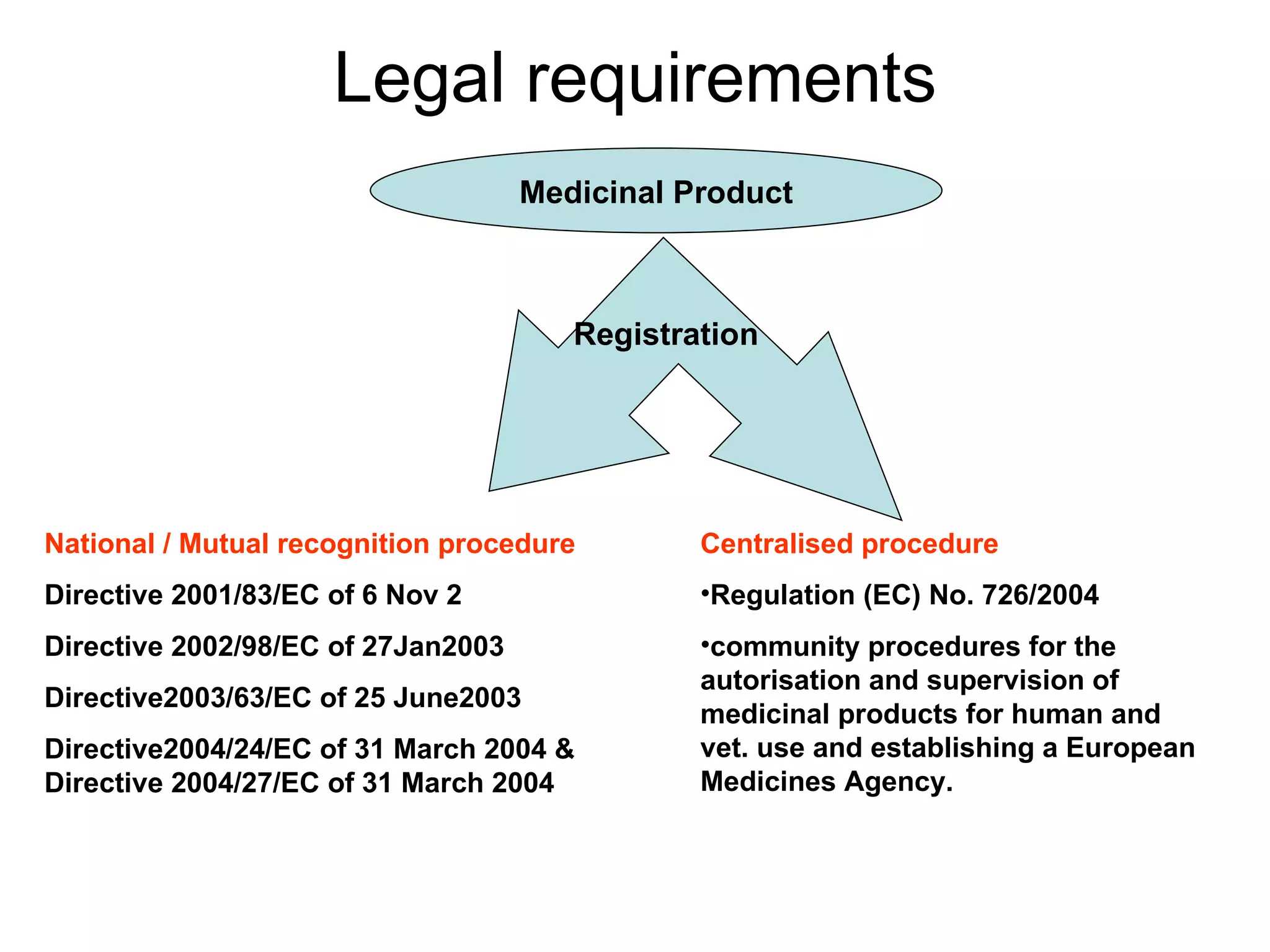
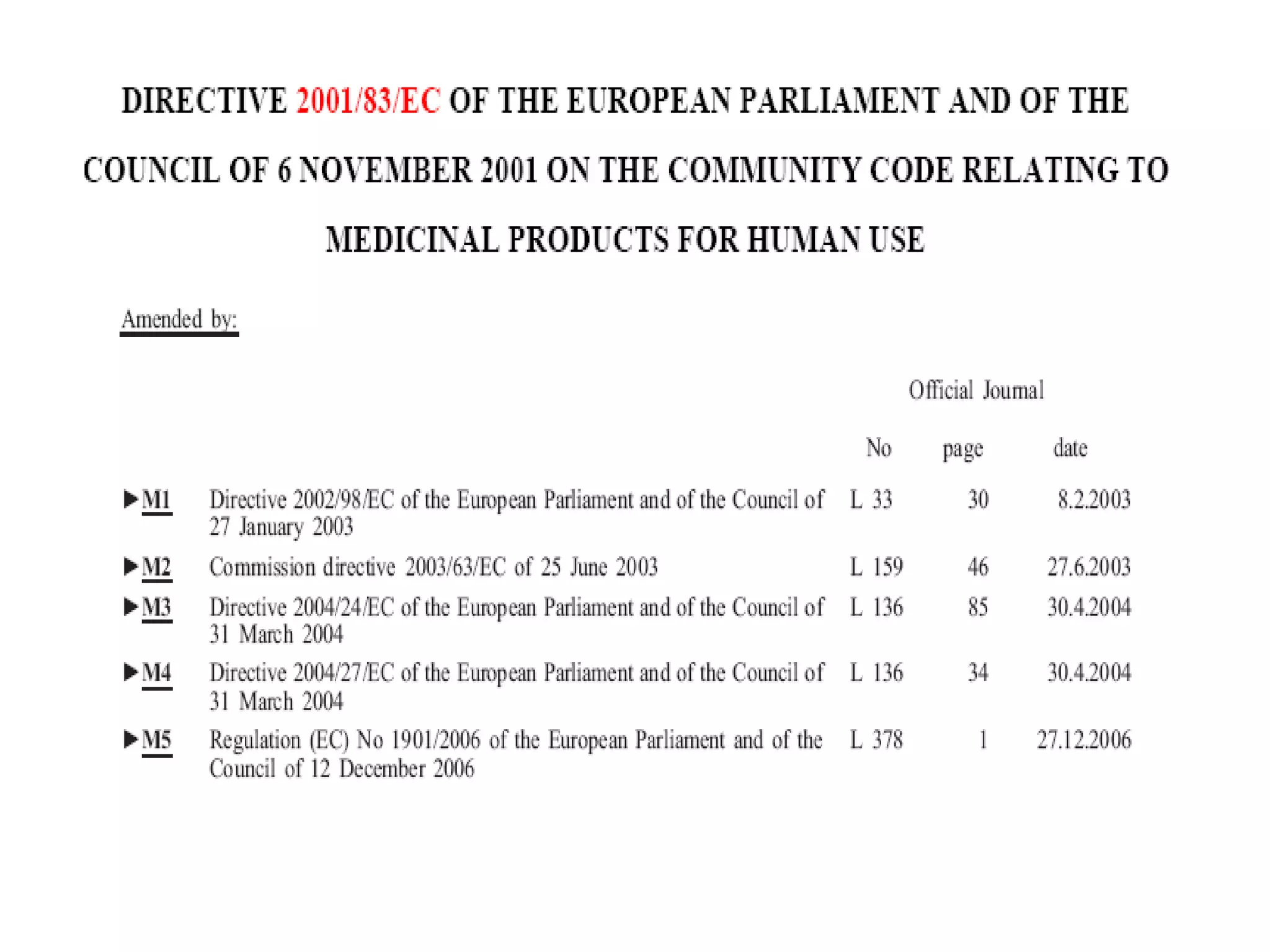
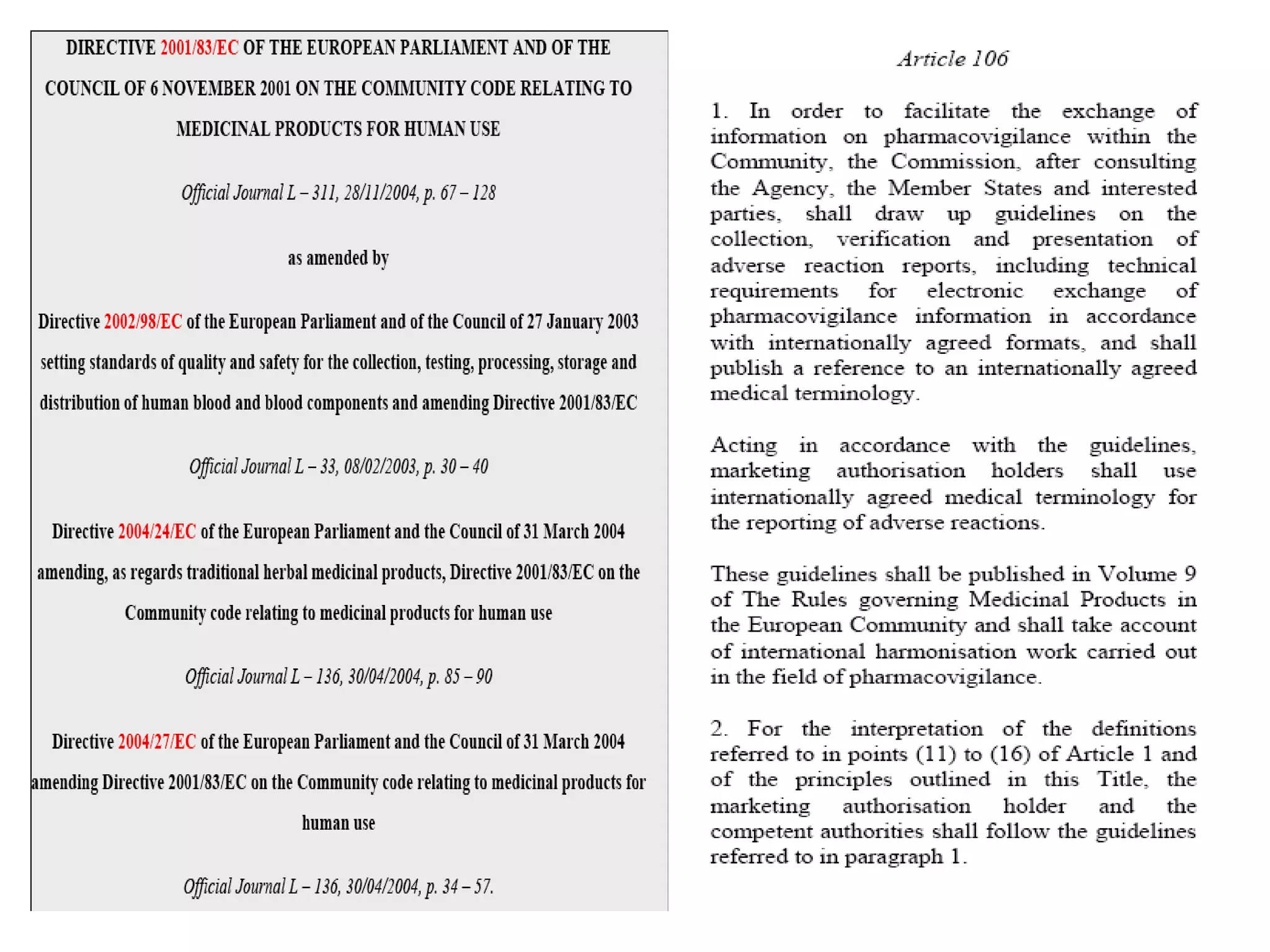
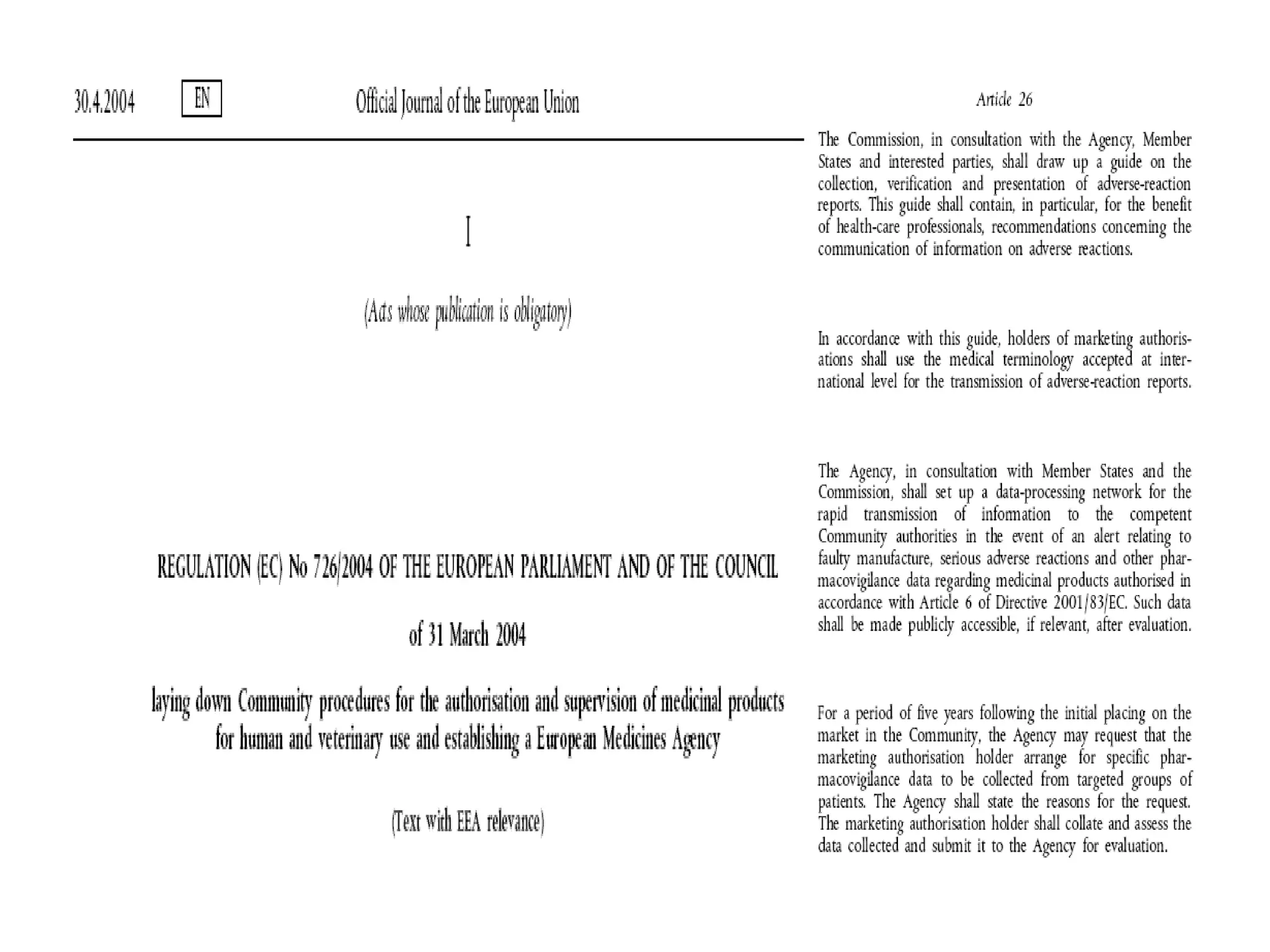
Legal requirements Medicinal Product Registration National / Mutual recognition procedure Directive 2001/83/EC of 6 Nov 2 Directive 2002/98/EC of 27Jan2003 Directive2003/63/EC of 25 June2003 Directive2004/24/EC of 31 March 2004 & Directive 2004/27/EC of 31 March 2004  Centralised procedure Regulation (EC) No. 726/2004 community procedures for the autorisation and supervision of medicinal products for human and vet. use and establishing a European Medicines Agency.
European PVG : National or Mutual recognition licensing procedures
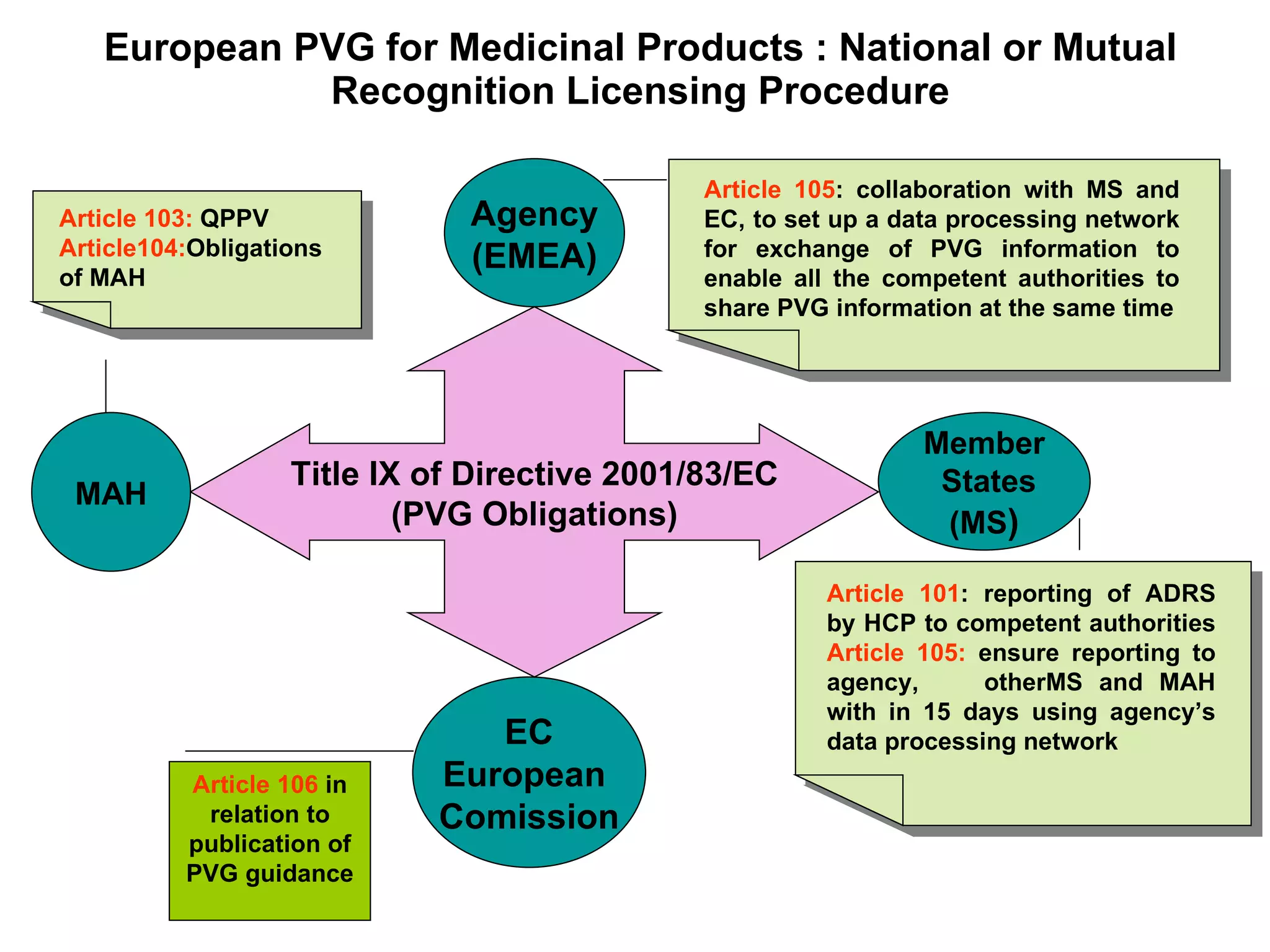
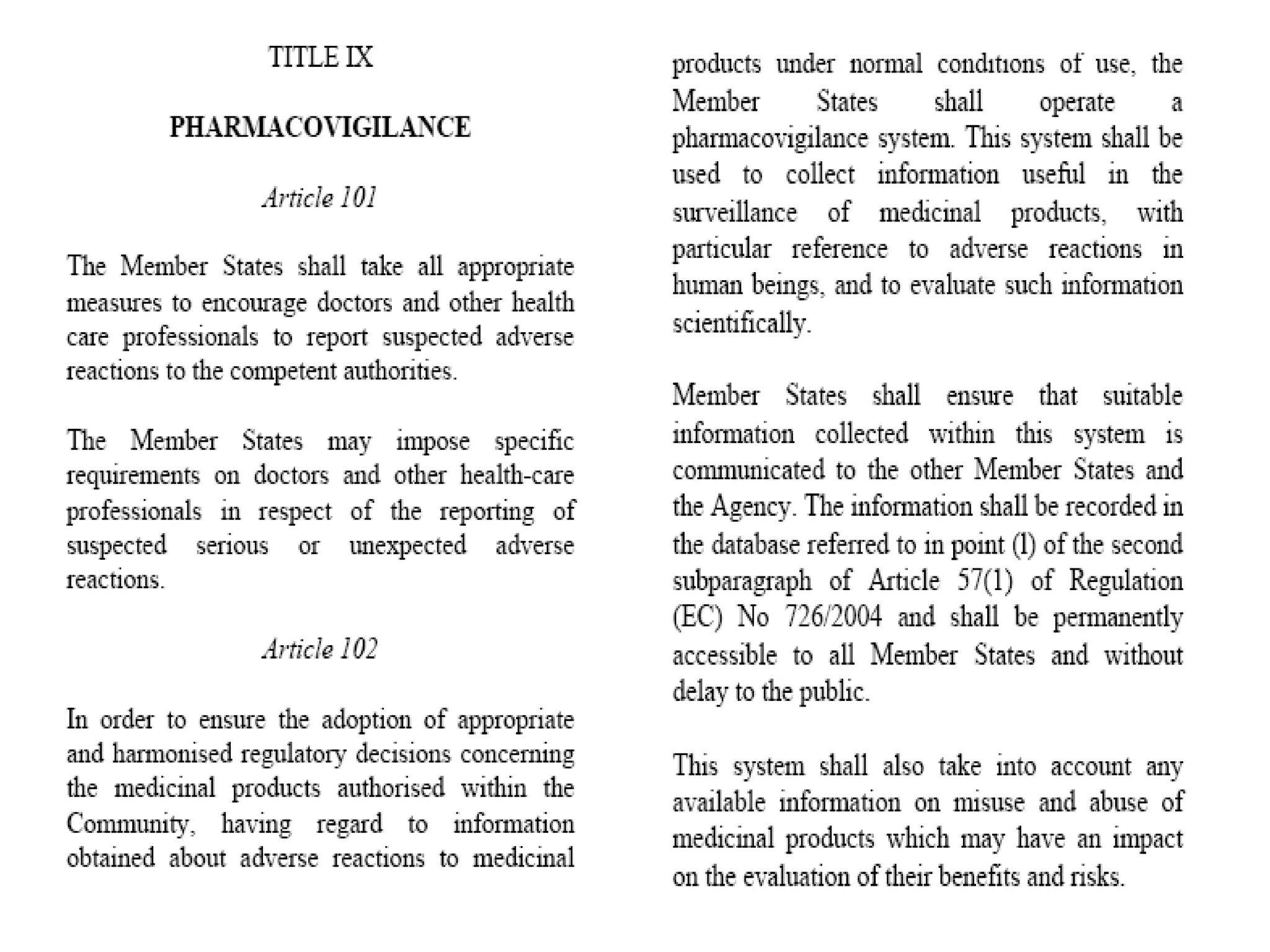
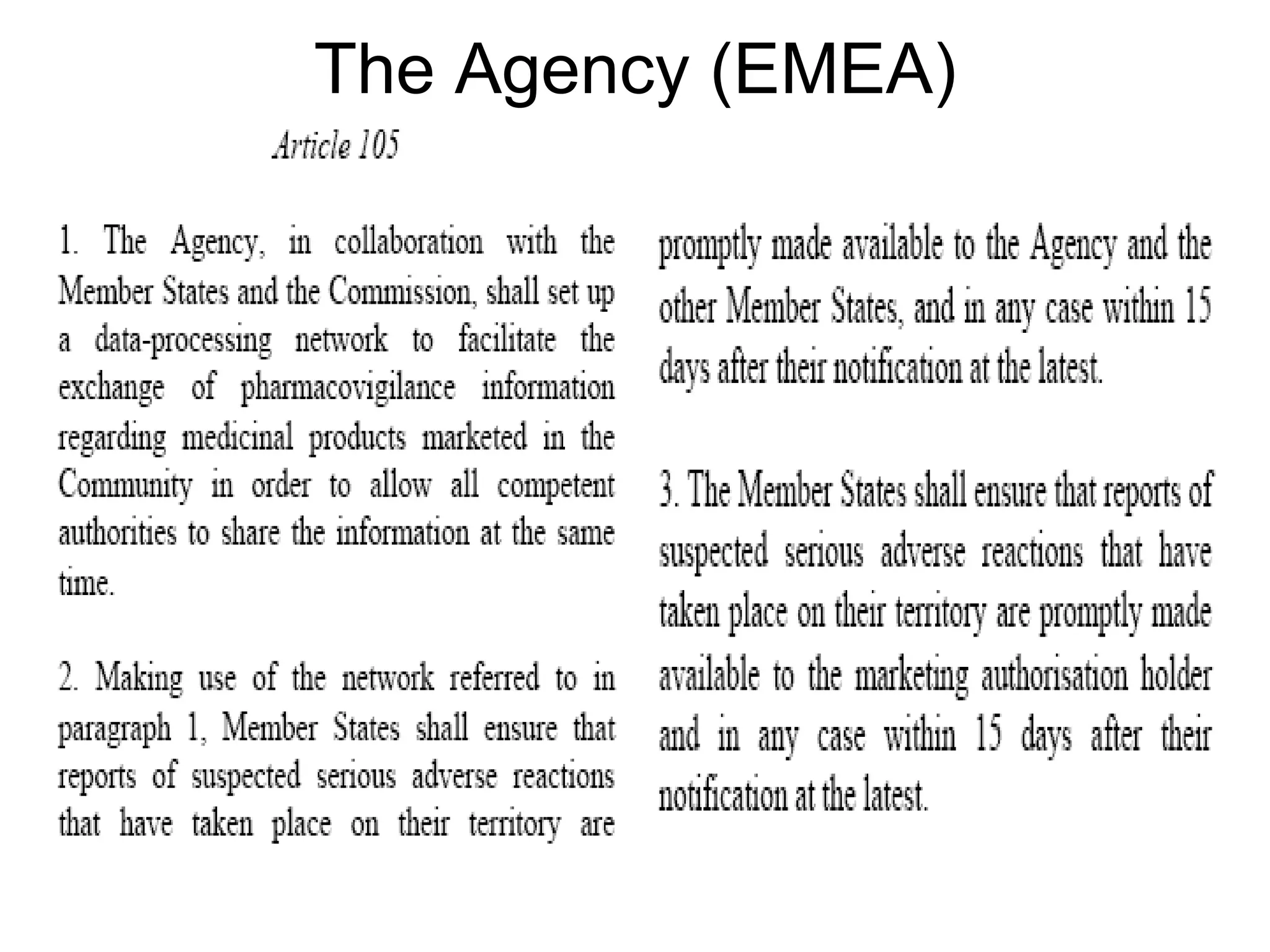
European PVG for Medicinal Products : National or Mutual Recognition Licensing Procedure Title IX of Directive 2001/83/EC (PVG Obligations) Agency (EMEA) MAH EC European  Comission Member States (MS ) Article 106  in relation to publication of PVG guidance Article 105 : collaboration with MS and EC, to set up a data processing network for exchange of PVG information to enable all the competent authorities to share PVG information at the same time Article 101 : reporting of ADRS by HCP to competent authorities  Article 105:  ensure reporting to agency,  otherMS and MAH with in 15 days using agency’s data processing network Article 103:  QPPV Article104: Obligations of MAH
 
 
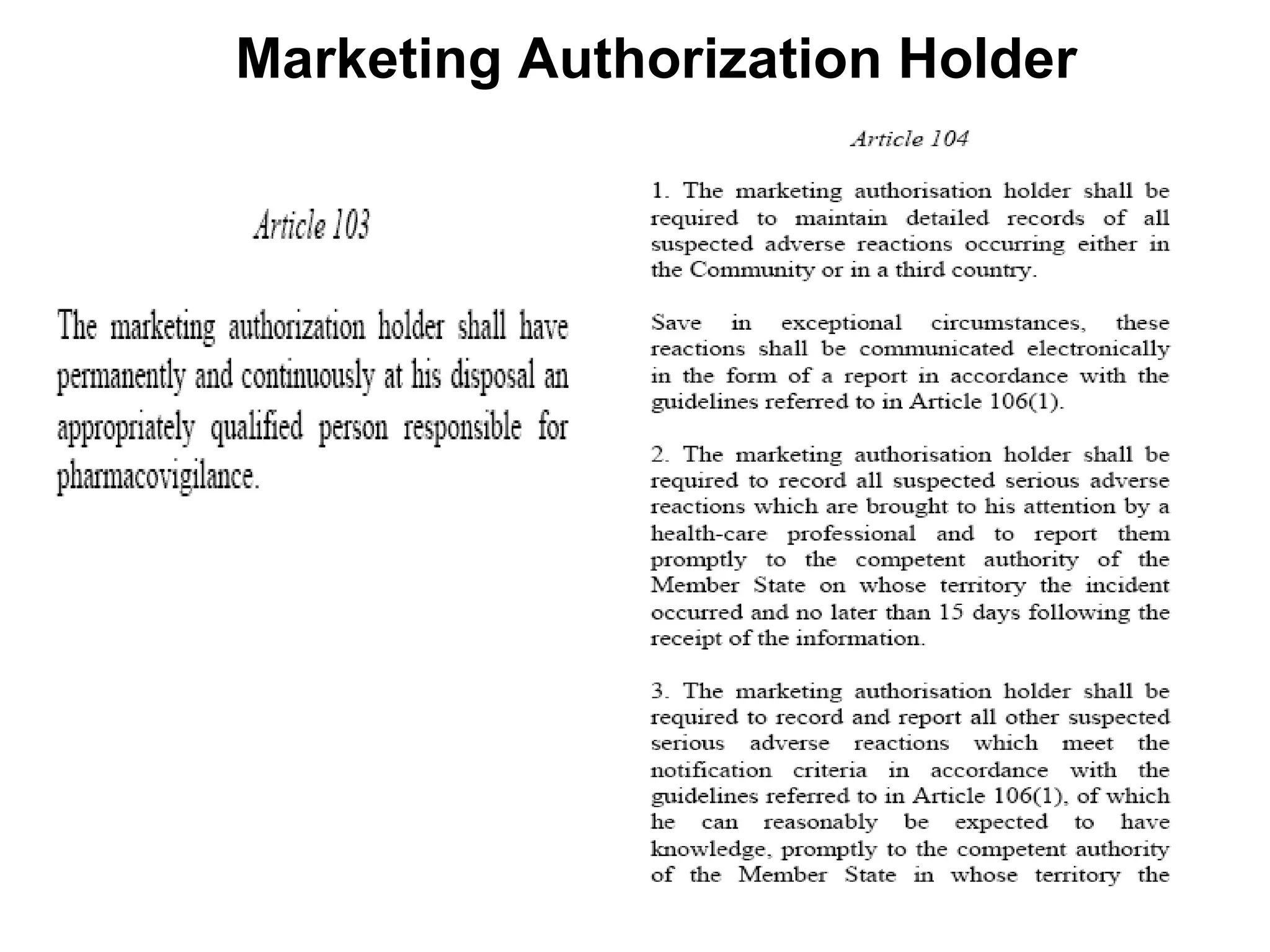
Marketing Authorization Holder
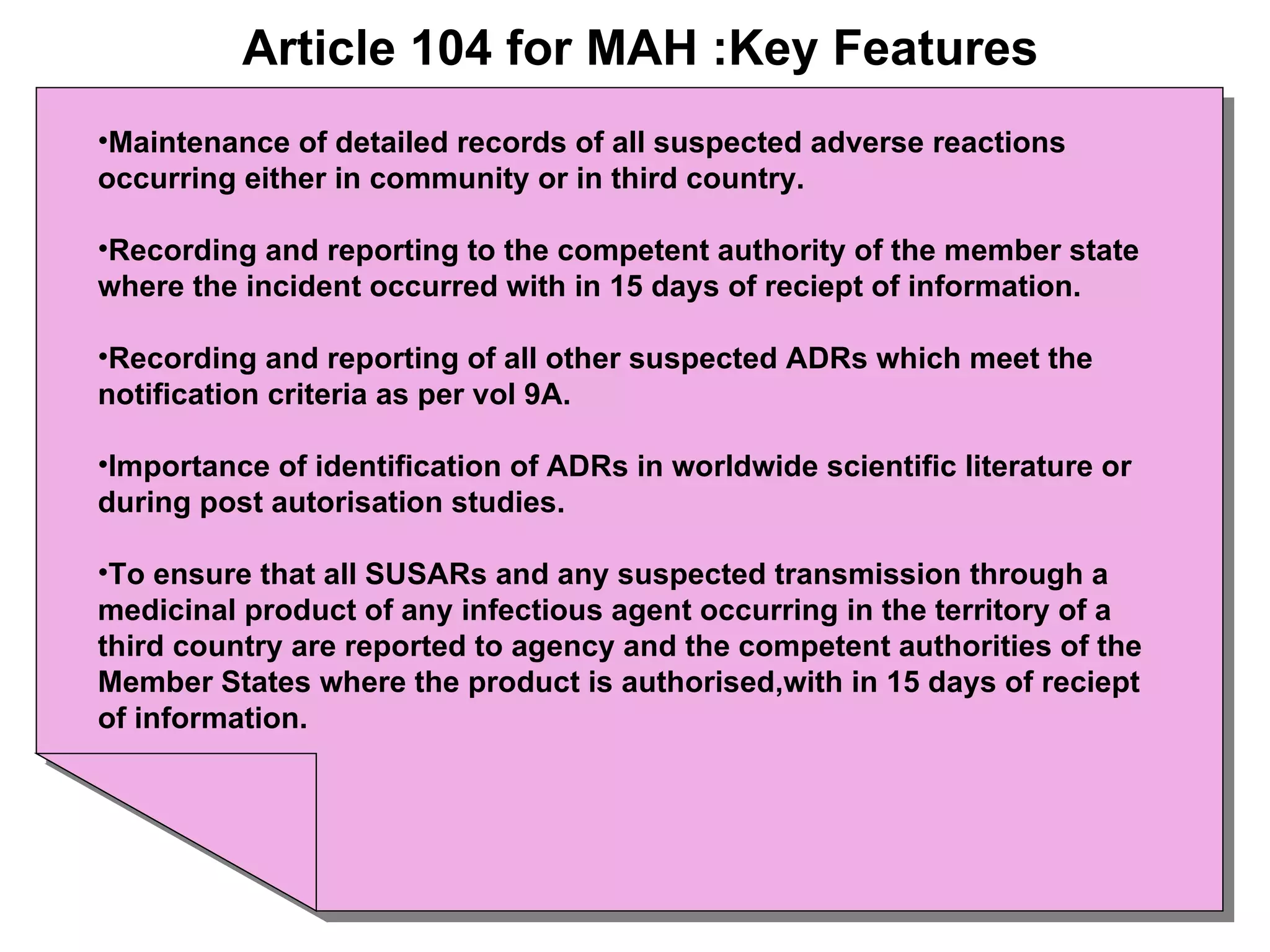
Article 104 for MAH :Key Features Maintenance of detailed records of all suspected adverse reactions occurring either in community or in third country. Recording and reporting to the competent authority of the member state where the incident occurred with in 15 days of reciept of information. Recording and reporting of all other suspected ADRs which meet the notification criteria as per vol 9A. Importance of identification of ADRs in worldwide scientific literature or during post autorisation studies. To ensure that all SUSARs and any suspected transmission through a medicinal product of any infectious agent occurring in the territory of a third country are reported to agency and the competent authorities of the Member States where the product is authorised,with in 15 days of reciept of information.
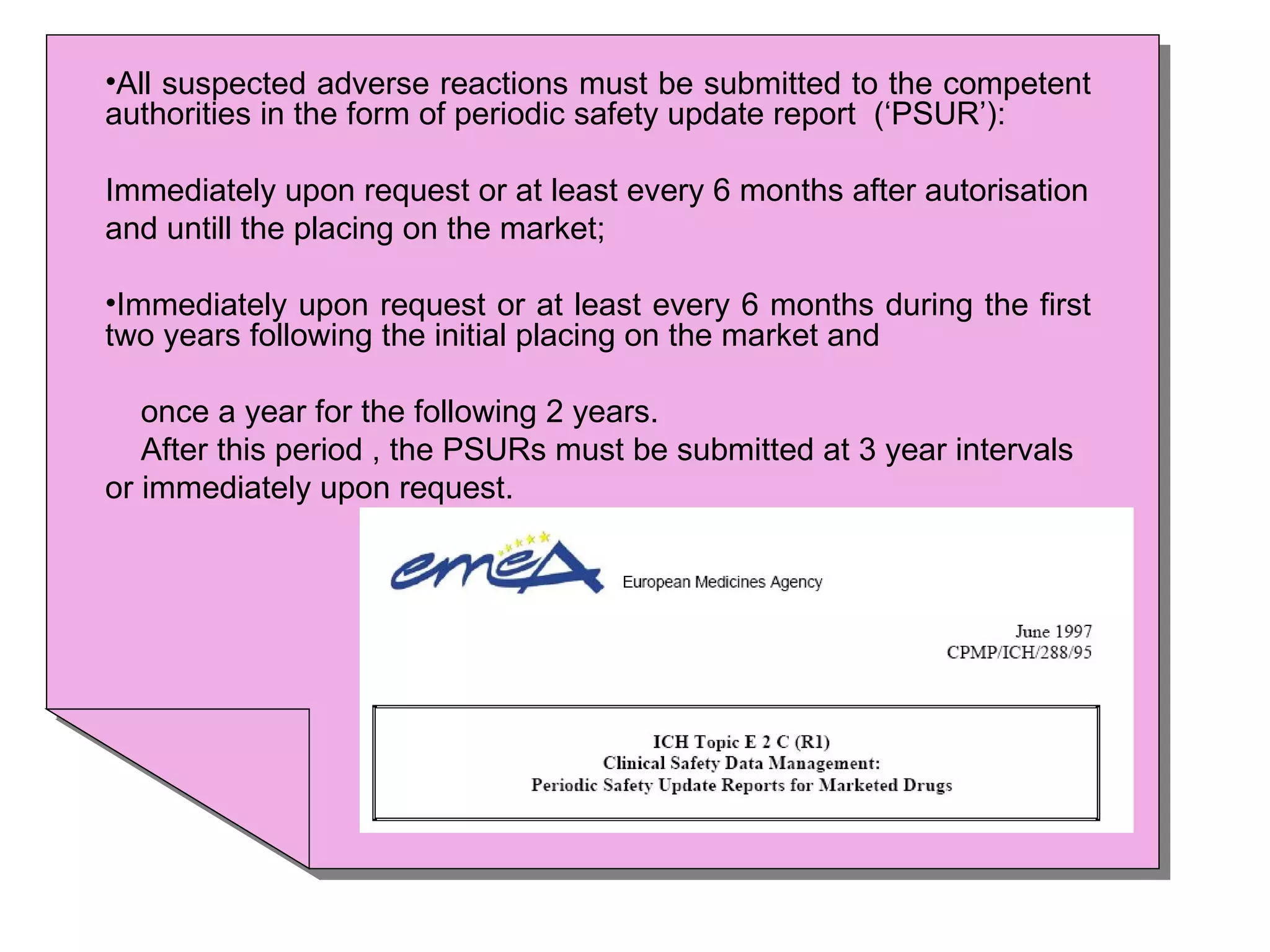
All suspected adverse reactions must be submitted to the competent authorities in the form of periodic safety update report  (‘PSUR’): Immediately upon request or at least every 6 months after autorisation and untill the placing on the market; Immediately upon request or at least every 6 months during the first two years following the initial placing on the market and  once a year for the following 2 years. After this period , the PSURs must be submitted at 3 year intervals or immediately upon request.
The Agency (EMEA)
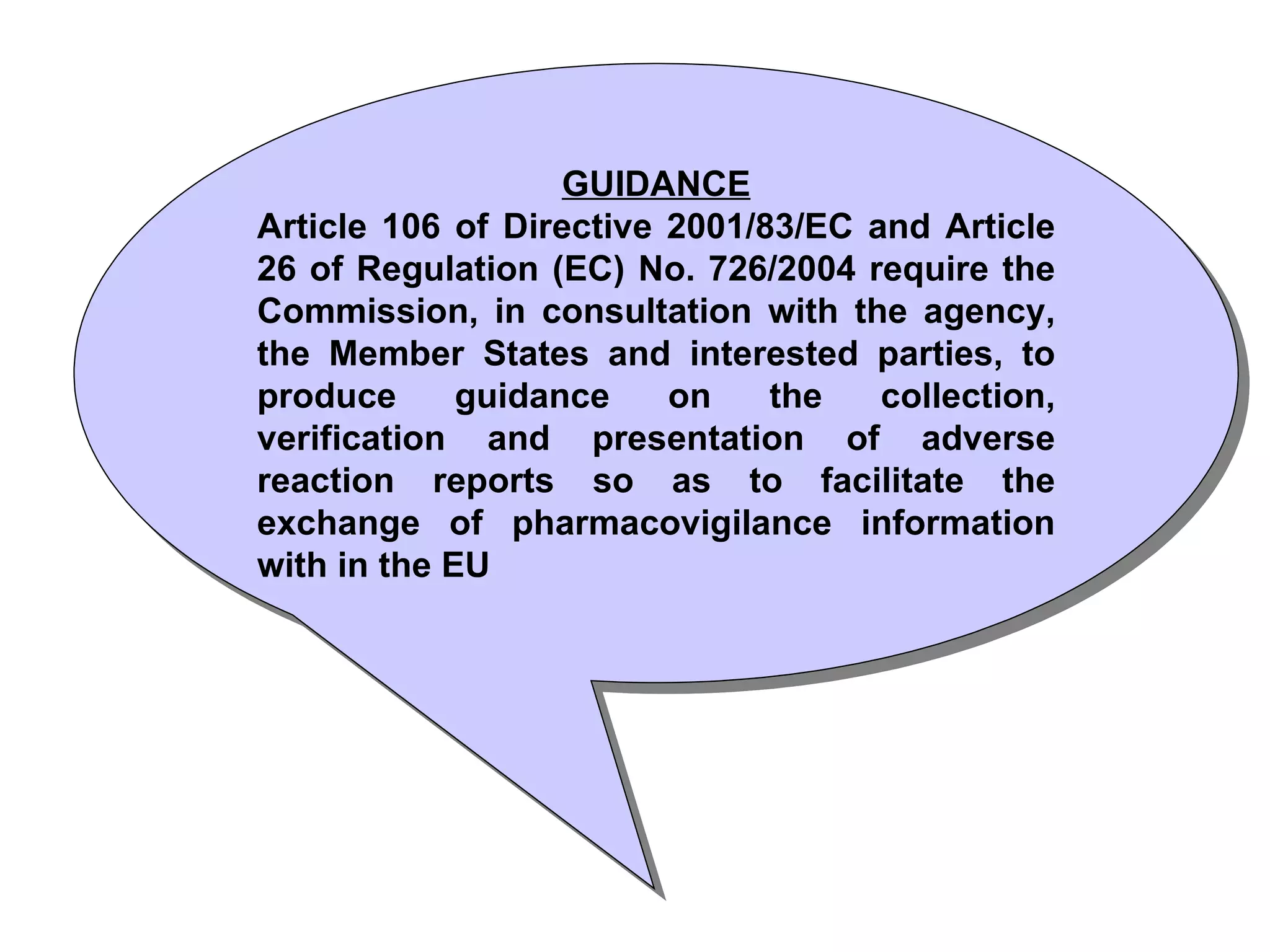
GUIDANCE Article 106 of Directive 2001/83/EC and Article 26 of Regulation (EC) No. 726/2004 require the Commission, in consultation with the agency, the Member States and interested parties, to produce guidance on the collection, verification and presentation of adverse reaction reports so as to facilitate the exchange of pharmacovigilance information with in the EU
 
 
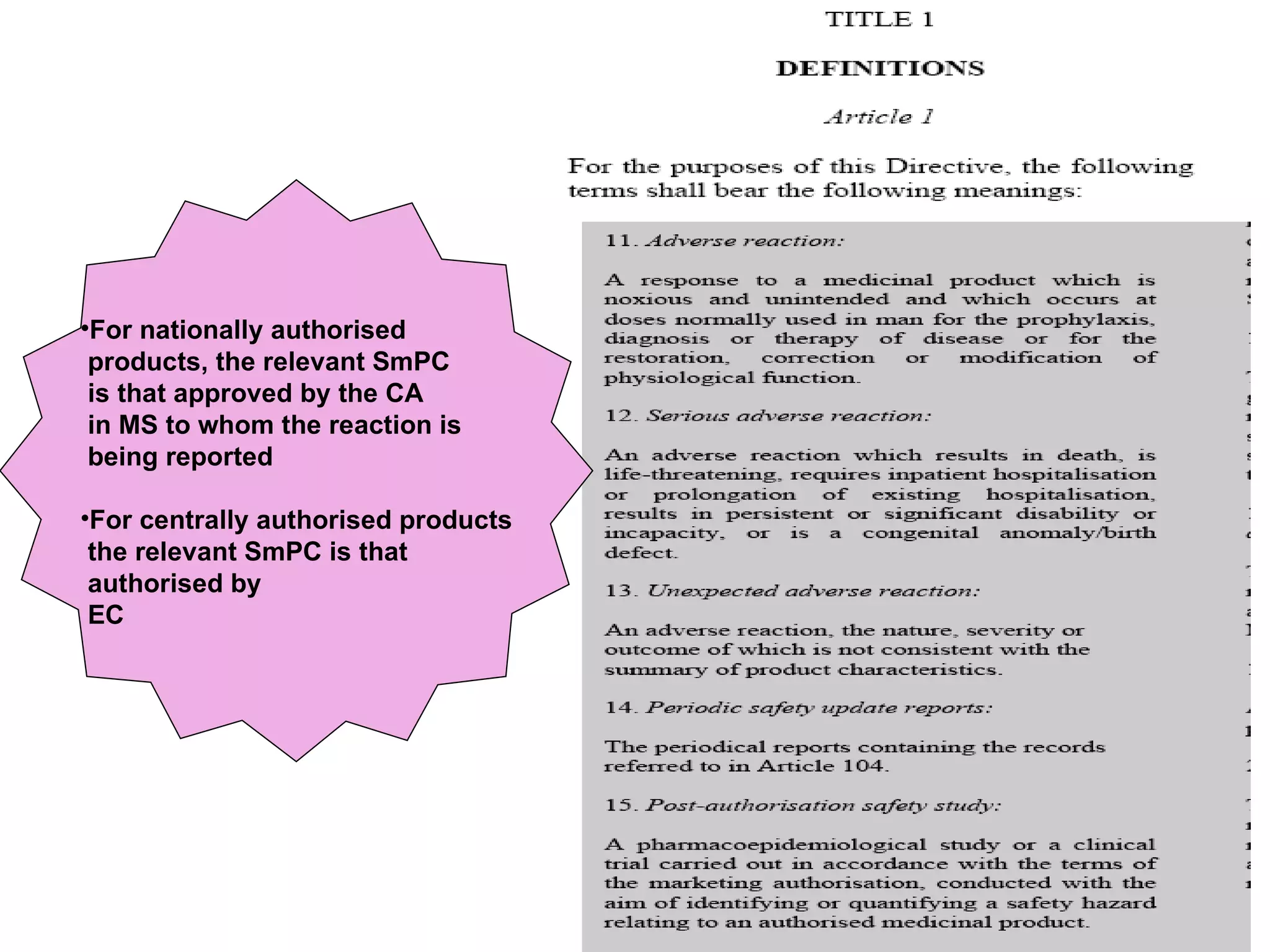
For nationally authorised  products, the relevant SmPC is that approved by the CA in MS to whom the reaction is  being reported For centrally authorised products the relevant SmPC is that  authorised by  EC
 
European PVG : Centrally Authorised Medicinal Products
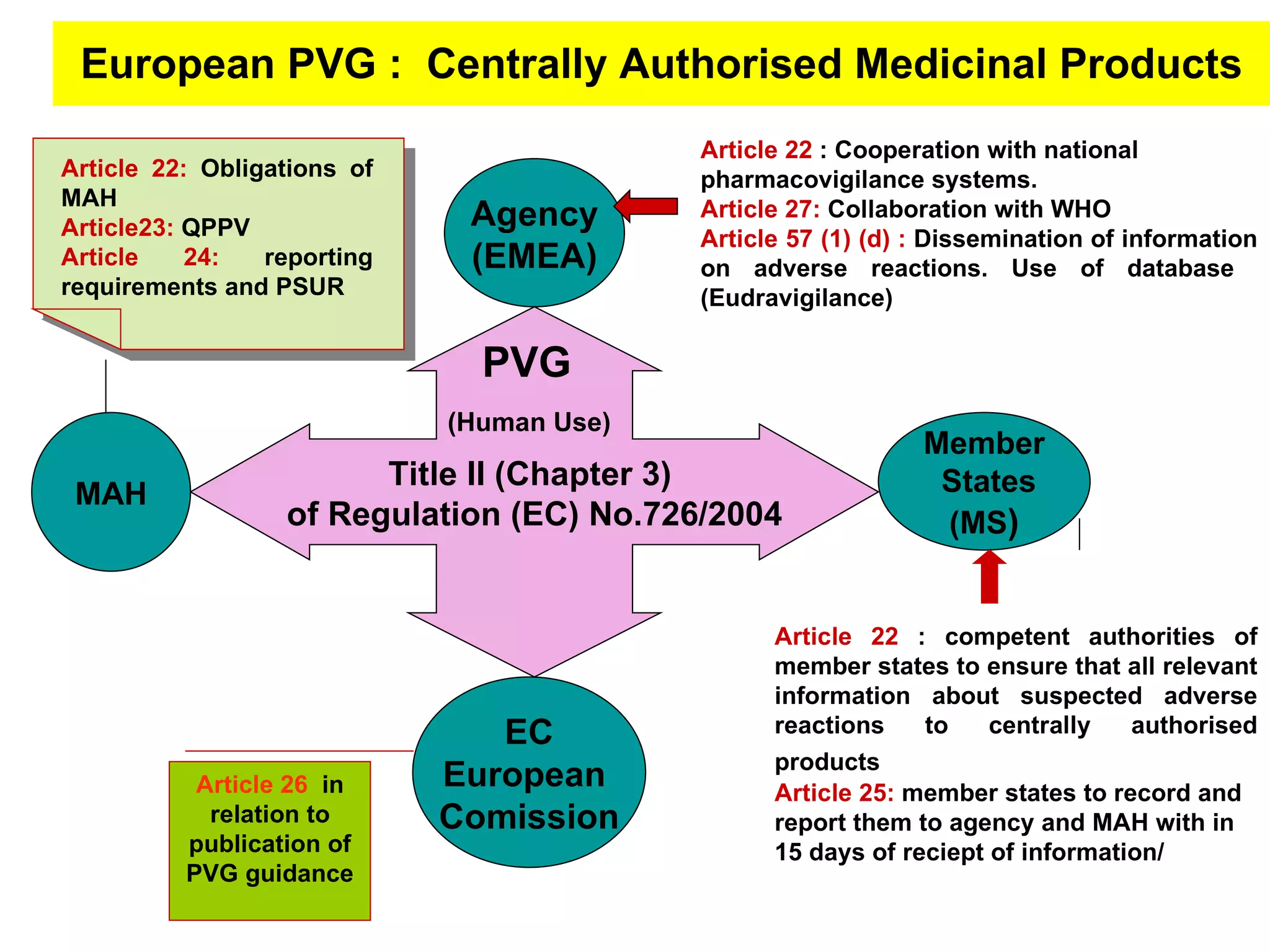
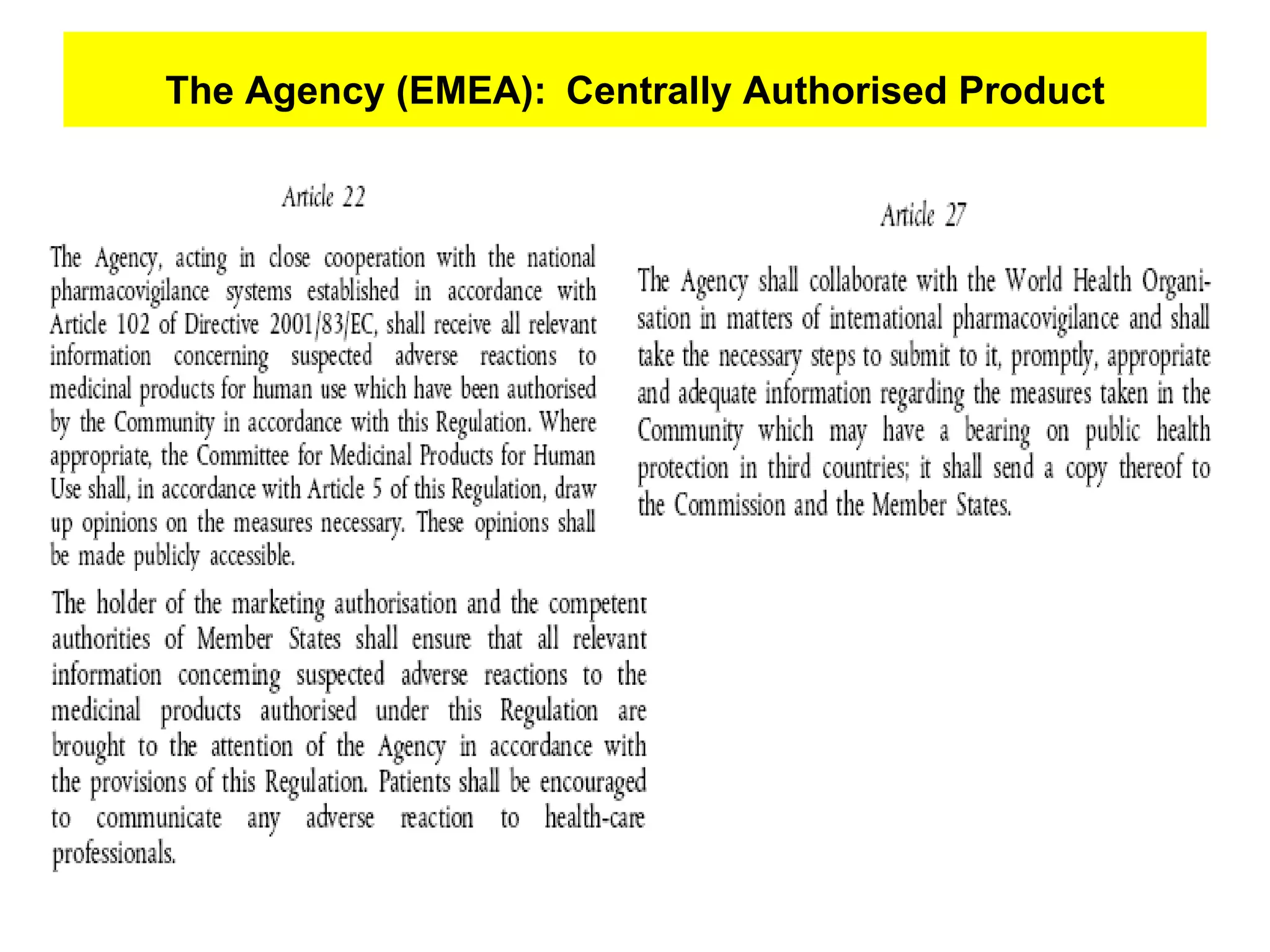
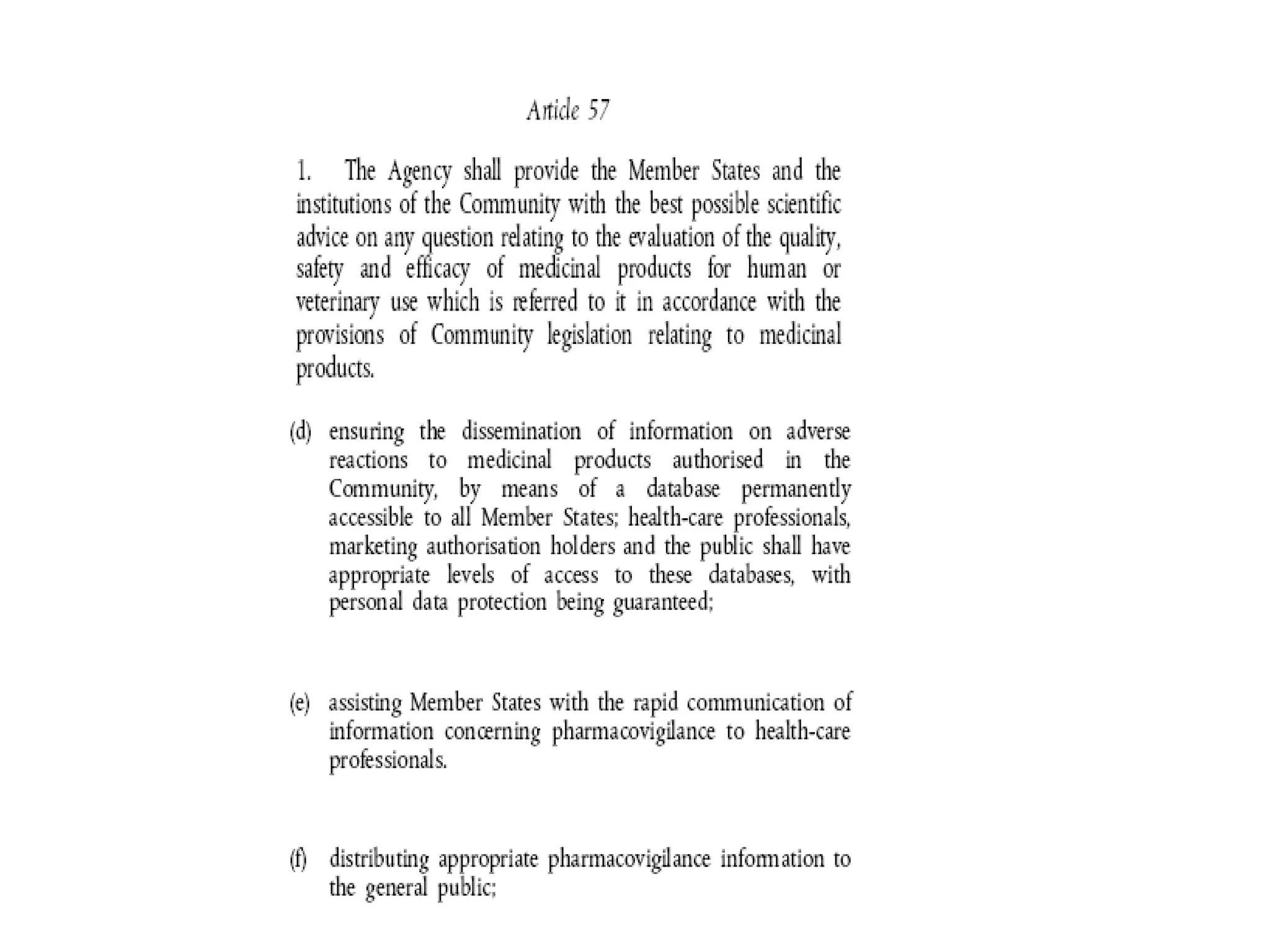
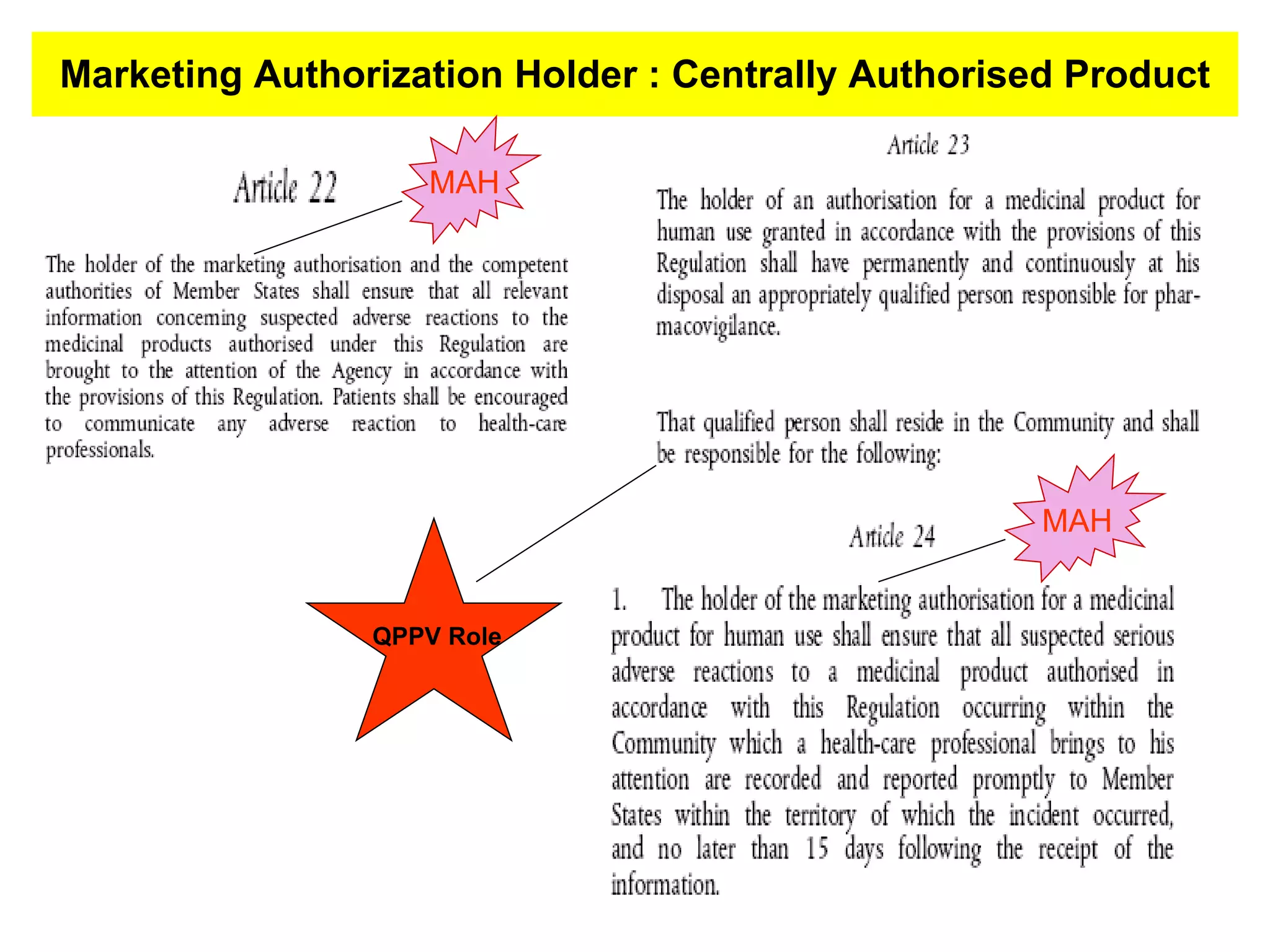
European PVG :  Centrally Authorised Medicinal Products Title II (Chapter 3)  of Regulation (EC) No.726/2004 Agency (EMEA) MAH EC European  Comission Member States (MS ) Article 26  in relation to publication of PVG guidance Article 22:  Obligations of MAH Article23:  QPPV Article 24:  reporting requirements and PSUR PVG (Human Use)   Article 22   : Cooperation with national pharmacovigilance systems. Article 27:  Collaboration with WHO Article 57 (1) (d) :  Dissemination of information on adverse reactions. Use of database  (Eudravigilance) Article 22   : competent authorities of member states to ensure that all relevant information about suspected adverse reactions to centrally authorised products   Article 25:  member states to record and report them to agency and MAH with in 15 days of reciept of information/
 
The Agency (EMEA):   Centrally Authorised Product
 
Marketing Authorization Holder : Centrally Authorised Product QPPV Role MAH MAH
Clinical Trial Directive
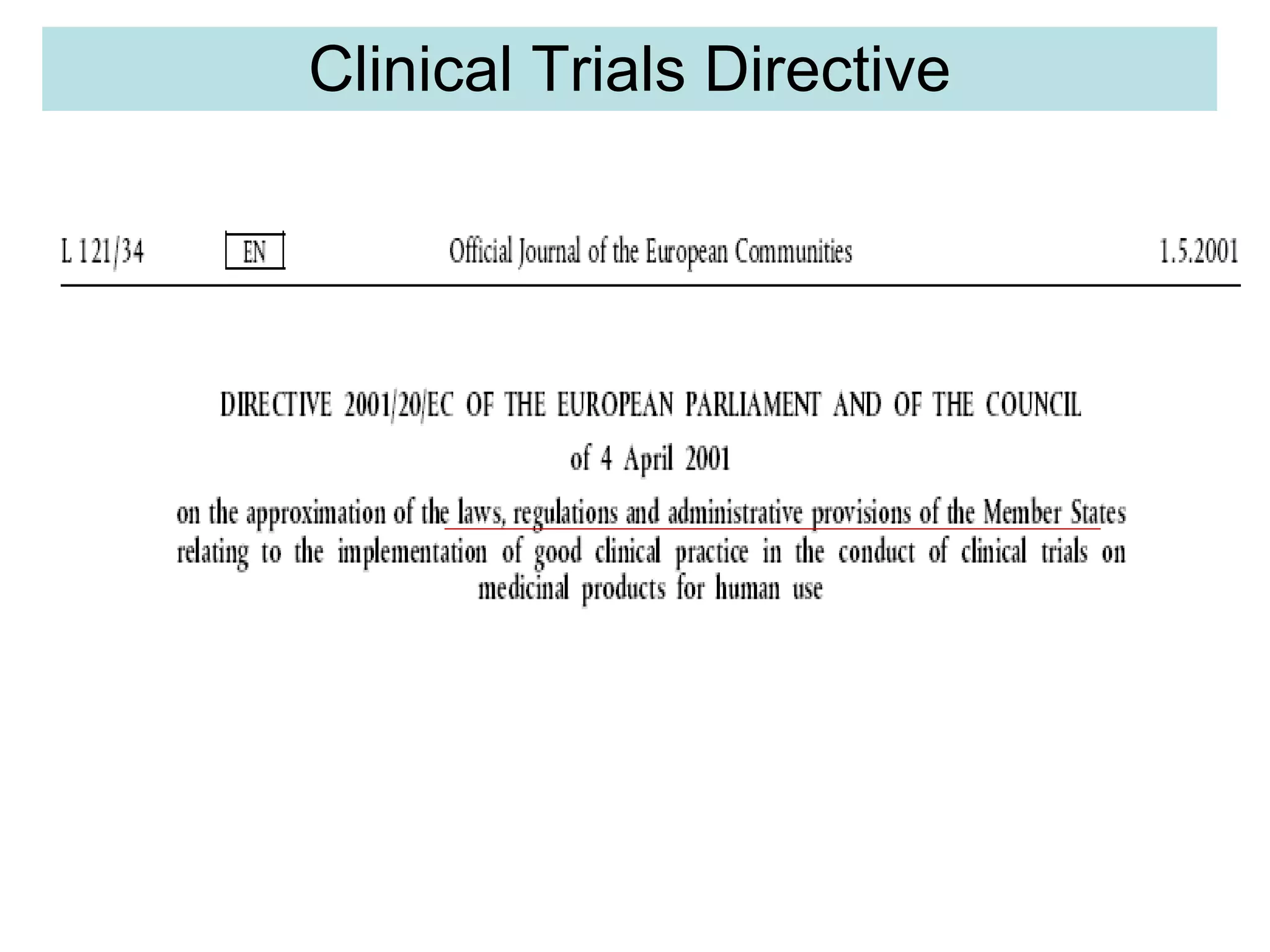
Clinical Trials Directive
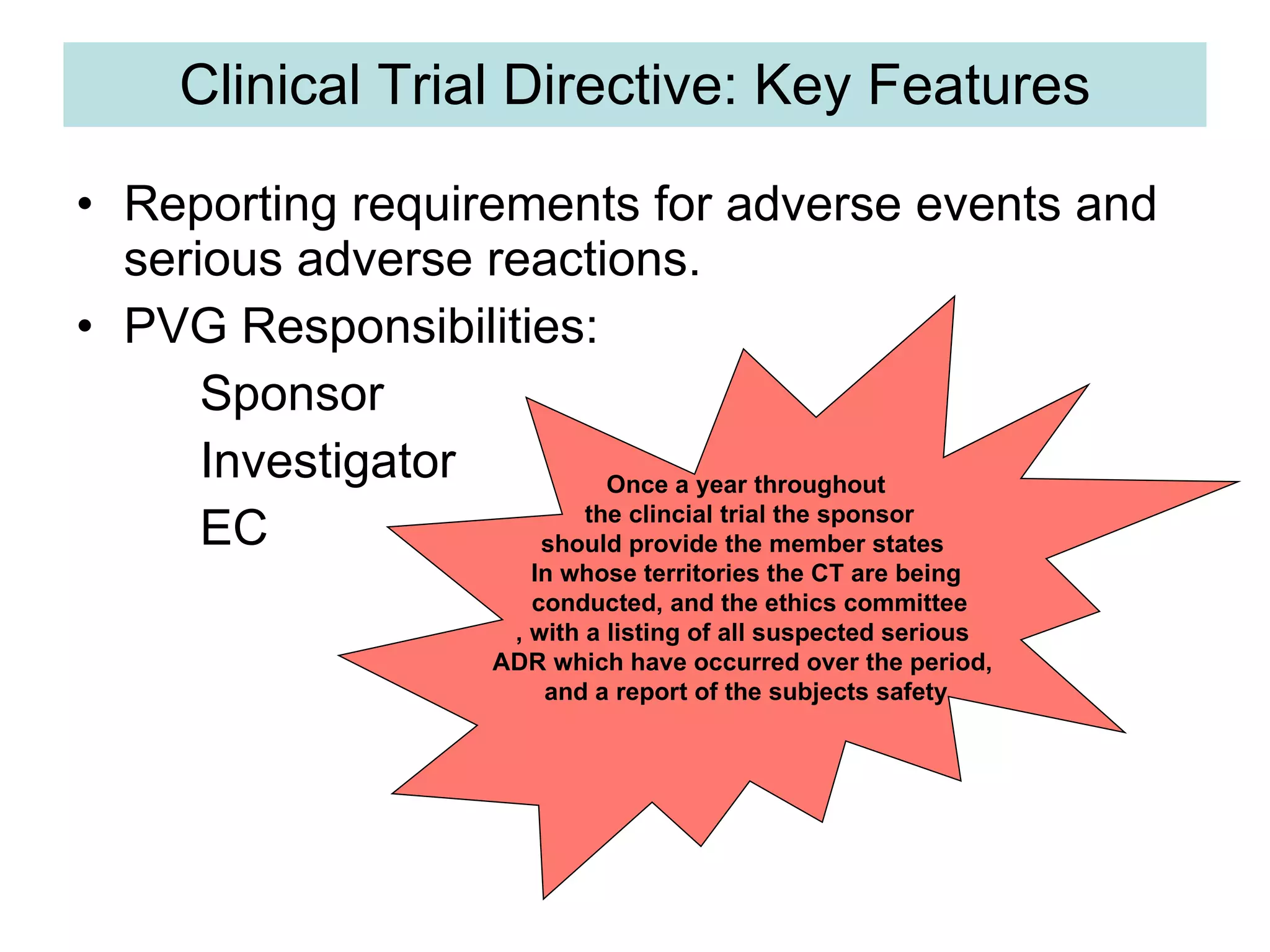
Clinical Trial Directive: Key Features Reporting requirements for adverse events and serious adverse reactions. PVG Responsibilities: Sponsor Investigator EC Once a year throughout the clincial trial the sponsor should provide the member states  In whose territories the CT are being conducted, and the ethics committee , with a listing of all suspected serious  ADR which have occurred over the period,  and a report of the subjects safety
European Pharmacovigilance-Member State Implementation
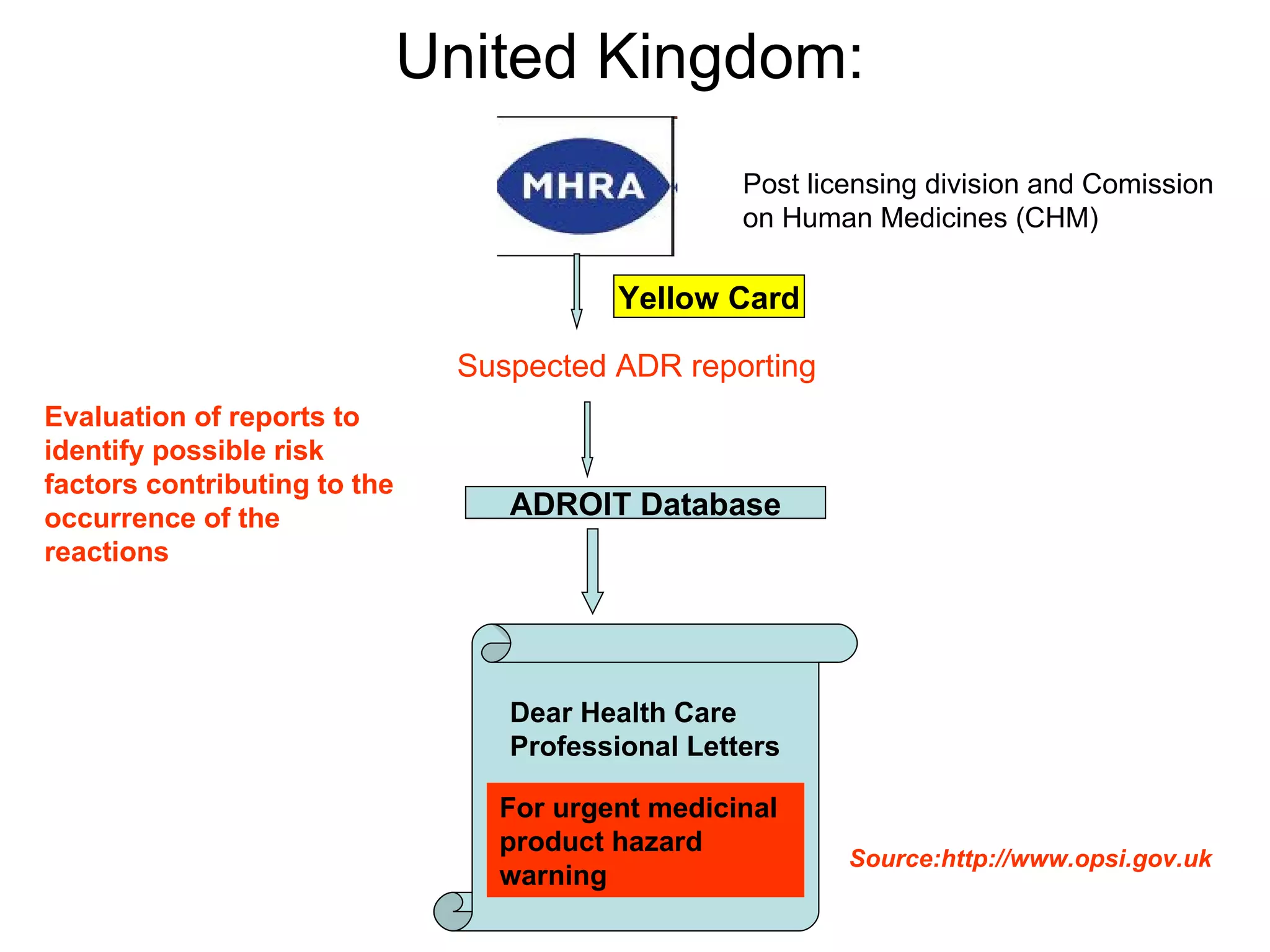
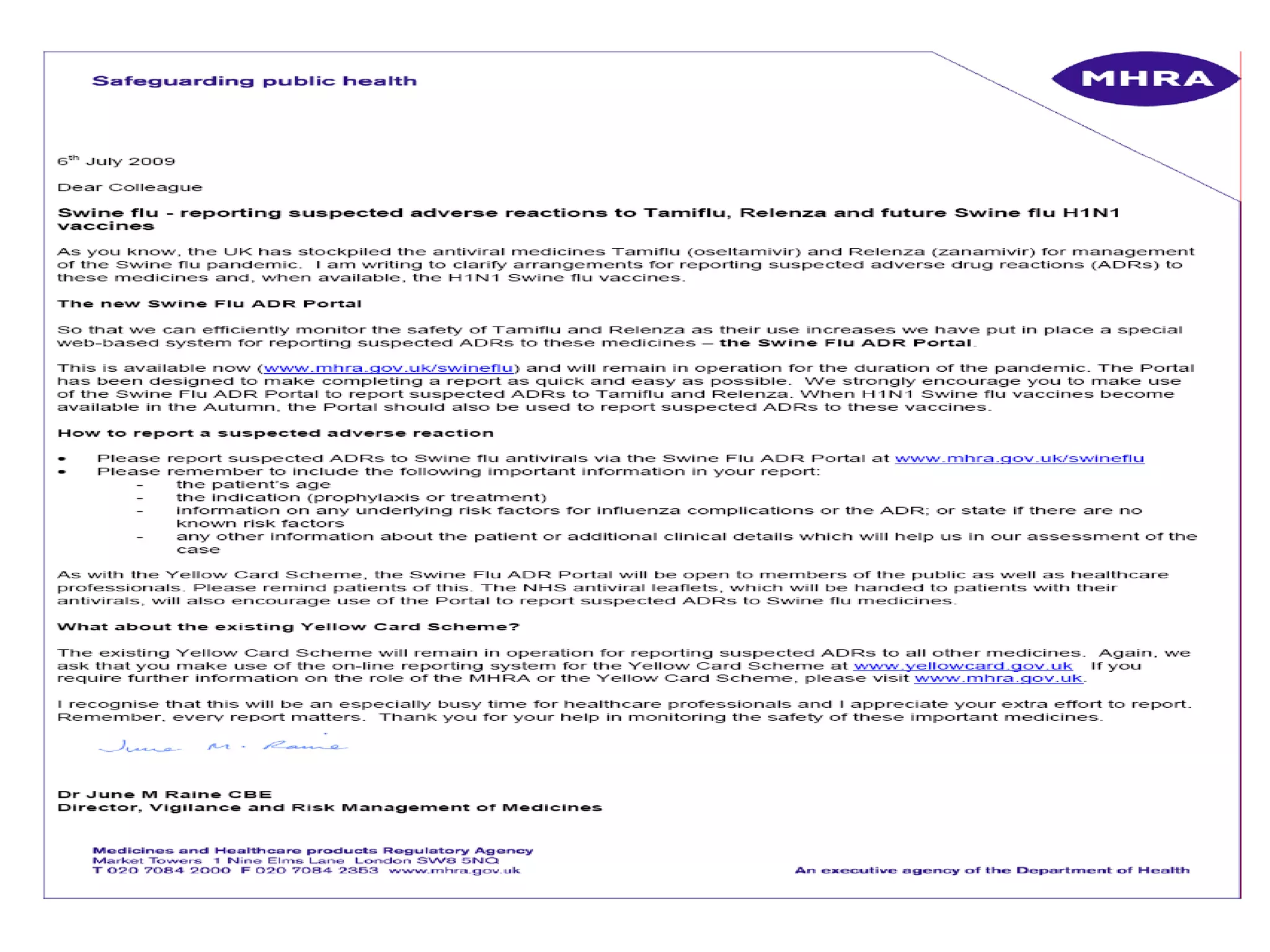
United Kingdom: Post licensing division and Comission on Human Medicines (CHM) Suspected ADR reporting Yellow Card ADROIT Database For urgent medicinal product hazard warning Dear Health Care Professional Letters Evaluation of reports to identify possible risk factors contributing to the occurrence of the reactions Source:http://www.opsi.gov.uk
 
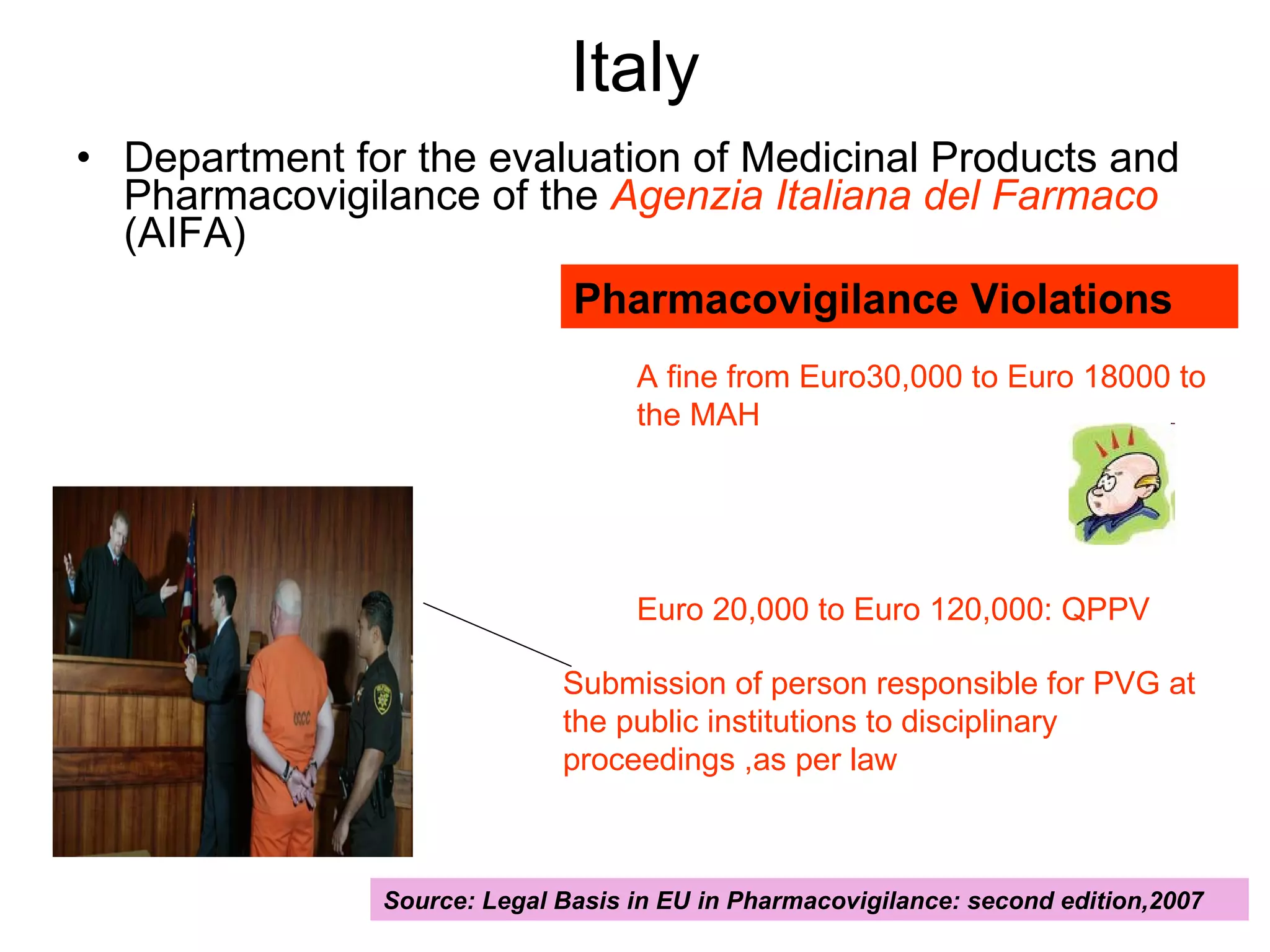
Italy Department for the evaluation of Medicinal Products and Pharmacovigilance of the  Agenzia Italiana del Farmaco  (AIFA) Pharmacovigilance Violations A fine from Euro30,000 to Euro 18000 to the MAH Euro 20,000 to Euro 120,000: QPPV Submission of person responsible for PVG at the public institutions to disciplinary  proceedings ,as per law Source: Legal Basis in EU in Pharmacovigilance: second edition,2007
France Agence française de sécurité sanitaire des produits de sainté Source:http://www.afssaps.fr/
Germany German Drug Act (Arzneimittelgestez, AMG) Each pharmaceutical is legally obliged to appoint a Phased Plan Procedure (PPP) officer, whose duty is to comply with the reporting requirements of the AMG and to co-ordinate and implement pharmacovigilance activities within the company  Source: Legal Basis in EU in Pharmacovigilance: second edition,2007
 
Higher expectations of EU citizens in establishing mechanisms for direct reporting of adverse experiences by consumers Good pharmacovigilance practice Difficulty in measuring the effects of action taken Full compliance with PVG obligations
Thank You! from

Analysing the EU PVG regulations

  • 1.
    Analysing the EUPVG regulations Manoj SHARMA,Ph.D (Clin.Pharmacology, FRANCE) Pharmacovigilance Unit Clinical Research Department Panacea Biotec.
  • 2.
    Overview of PresentationPrinciples of Pharmacovigilance Basis of Pharmacovigilance Regulations The EU rules Registration of medicinal products in EU The clinical trials EU Directive Challenges
  • 3.
    Pharmacovigilance Greek ‘pharmakon’ meaning a drug or medicine and from the Latin ‘vigilans’ meaning watchful or careful. Bernard B Gaud WHO definition: ‘ the science and activities related to the detection, assessment, understanding and prevention of adverse effects or any other drug related problem’
  • 4.
    Current trend inpharmacovigilance PHARMACOVIGILANCE PVG should start before initiating phase I studies and continue through the Life cycle of the product
  • 5.
    Background Early 1960s– set up of EU Pharmaceutical legislation as a consequence to the thalidomide disaster. European economic community intended to preclude market access of medicinal products without prior authorisation - to avoid further scandals, Adoption of legislative framework for the assessment of medicinal products in Europe
  • 6.
    Limitations of CTs: controlled conditions rare side effects Experience gained during the post-autorisation phase may also provide valuable input into the evaluation of medicinal products at the stage of application for marketing autorisation, if there are chemical or pharmacological similarities with authorised products. Pharmacovigilance Why??
  • 7.
    PVG Legislation inEurope:Milestones 26 January 1965 : Harmonisation of national laws applicable to medicinal products started with adoption of Directive65/65/EEC 1975: Directives75/318/EE and 75/319/EE introduced a mutual recognition procedure for Member states to recognise each others national marketing authorities. CPMP set up- assessment whether candidate products complied with Directive 65/65/EEC. 1993: Council directive 93/39/EEC 1995: Establishment of EMEA Nov 2001: 2001/83/EC Parameters for regulation: Quality Safety Efficacy
  • 8.
    EU PVG regulationsServed as a model for development of ICH E2A and E2C CIOMS working group I and II CIOMS/WHO Working Group on Vaccine Pharmacovigilance Management of Safety Information from Clinical Trials. CIOMS working group VI Current challenges in Pharmacovigilance: Pragmatic approaches CIOMS working group V Benefit-Risk balance for marketed drugs. Evaluating safety signals. CIOMS working group IV Guidelines for preparing core clincial safety information (CCSI) CIOMS working group III The Rules Governing Medicinal Products in the European Union – Guidelines on Pharmacovigilance for Medicinal Products for Human Use Vol 9A Good Clinical Practices E6 Development safety update report E2F Pharmacovigilance planning for the early postmarketing period of a new drug (chemical entities, biotechnology-derived products, and vaccines) E2E Post-approval safety data managament: Definitions ans standards for Expedited reporting E2D Clinical Safety data management: Periodic Safety update report (PSUR) E2C Data elements for transmission of ICSRs E2BM Clinical safety data management: Definitions and standards for expedited reporting E2A
  • 9.
    The national pharmacovigilancesystems of the Member states together form the pharmacovigilance system in the EU Cooperates in a network structure under the co-ordination of the EMEA and in Liasion with the European Commission. EEA: Norway, Iceland and Liechtenstein Pharmacovigilance model
  • 10.
    Member states andRA Source: European Commission ,Enterprise and Industry Directorate General,2006 Regulatory Authority Member state MHRA United Kingdom Pharmacovigilance Unit Medicinal Product Agency Sweden -Agencia Espanola de Medicamentos y Productos Sanitarios Spain INFARMED, Departmento de Farmacovigilancia Portugal -College ter Beoordeling van Geneesmiddelen/ Medicines Evaluation Board Netherlands Direction de la Santé Division de la Pharmacie at des Médicament Luxembourg Drug Safety ssociate, Pharmacovigilance Unit, Irish Medicines Board Ireland Italian Medicines Agency-AIFA Italy National Organisation for Medicines (EOF) Division of Pharmaceutical Studies and Research Greece Bundesinstitut fur Arzeneimittel und Medizinprodukte (BfArM) Germany Agence Française de Sécurité Sanitaire des Produits de Sante France Clinical Trials Enforcement & Inspection National Agency for Medicines Finland The Danish Medicines Agency Clinical Trials, Inspection and Enforcement Division Denmark Federal Public Service Health, Food Chain Safety and Enviornment Directorate-General Medicinal Products Belgium
  • 11.
    National basis by the competent authority of a member state (where the product will be marketed in one member state only) Mutual recognition procedure : where a marketing autorisation granted by the competent authority of an original (‘Reference’) Member state is accepted by the competent authorities of other member states. Centralised procedure: EU basis by the European Commission in accordance with the provisions of Regulation (EC) no. 726/2004. Marketing authorisation types : EU PVG requirements apply to all authorised medicinal products in EU and EEA states (Iceland, Liechtenstein and Norway)
  • 12.
    Long term monitoringof drug safety in clincial practice to identify previously unrecognised safety signals. Assessment of the risks and benefits of authorised medicines to take action to improve drug safety. Provision of information to users to optimise safe and effective use of their medicines. Monitoring the impact of any action taken EU Regulatory Pharmacovigilance : Objective
  • 13.
    Legal Basis, Principlesand Organisation of EU PVG System
  • 14.
    Legal requirements MedicinalProduct Registration National / Mutual recognition procedure Directive 2001/83/EC of 6 Nov 2 Directive 2002/98/EC of 27Jan2003 Directive2003/63/EC of 25 June2003 Directive2004/24/EC of 31 March 2004 & Directive 2004/27/EC of 31 March 2004 Centralised procedure Regulation (EC) No. 726/2004 community procedures for the autorisation and supervision of medicinal products for human and vet. use and establishing a European Medicines Agency.
  • 15.
    European PVG :National or Mutual recognition licensing procedures
  • 16.
    European PVG forMedicinal Products : National or Mutual Recognition Licensing Procedure Title IX of Directive 2001/83/EC (PVG Obligations) Agency (EMEA) MAH EC European Comission Member States (MS ) Article 106 in relation to publication of PVG guidance Article 105 : collaboration with MS and EC, to set up a data processing network for exchange of PVG information to enable all the competent authorities to share PVG information at the same time Article 101 : reporting of ADRS by HCP to competent authorities Article 105: ensure reporting to agency, otherMS and MAH with in 15 days using agency’s data processing network Article 103: QPPV Article104: Obligations of MAH
  • 17.
  • 18.
  • 19.
  • 20.
    Article 104 forMAH :Key Features Maintenance of detailed records of all suspected adverse reactions occurring either in community or in third country. Recording and reporting to the competent authority of the member state where the incident occurred with in 15 days of reciept of information. Recording and reporting of all other suspected ADRs which meet the notification criteria as per vol 9A. Importance of identification of ADRs in worldwide scientific literature or during post autorisation studies. To ensure that all SUSARs and any suspected transmission through a medicinal product of any infectious agent occurring in the territory of a third country are reported to agency and the competent authorities of the Member States where the product is authorised,with in 15 days of reciept of information.
  • 21.
    All suspected adversereactions must be submitted to the competent authorities in the form of periodic safety update report (‘PSUR’): Immediately upon request or at least every 6 months after autorisation and untill the placing on the market; Immediately upon request or at least every 6 months during the first two years following the initial placing on the market and once a year for the following 2 years. After this period , the PSURs must be submitted at 3 year intervals or immediately upon request.
  • 22.
  • 23.
    GUIDANCE Article 106of Directive 2001/83/EC and Article 26 of Regulation (EC) No. 726/2004 require the Commission, in consultation with the agency, the Member States and interested parties, to produce guidance on the collection, verification and presentation of adverse reaction reports so as to facilitate the exchange of pharmacovigilance information with in the EU
  • 24.
  • 25.
  • 26.
    For nationally authorised products, the relevant SmPC is that approved by the CA in MS to whom the reaction is being reported For centrally authorised products the relevant SmPC is that authorised by EC
  • 27.
  • 28.
    European PVG :Centrally Authorised Medicinal Products
  • 29.
    European PVG : Centrally Authorised Medicinal Products Title II (Chapter 3) of Regulation (EC) No.726/2004 Agency (EMEA) MAH EC European Comission Member States (MS ) Article 26 in relation to publication of PVG guidance Article 22: Obligations of MAH Article23: QPPV Article 24: reporting requirements and PSUR PVG (Human Use) Article 22 : Cooperation with national pharmacovigilance systems. Article 27: Collaboration with WHO Article 57 (1) (d) : Dissemination of information on adverse reactions. Use of database (Eudravigilance) Article 22 : competent authorities of member states to ensure that all relevant information about suspected adverse reactions to centrally authorised products Article 25: member states to record and report them to agency and MAH with in 15 days of reciept of information/
  • 30.
  • 31.
    The Agency (EMEA): Centrally Authorised Product
  • 32.
  • 33.
    Marketing Authorization Holder: Centrally Authorised Product QPPV Role MAH MAH
  • 34.
  • 35.
  • 36.
    Clinical Trial Directive:Key Features Reporting requirements for adverse events and serious adverse reactions. PVG Responsibilities: Sponsor Investigator EC Once a year throughout the clincial trial the sponsor should provide the member states In whose territories the CT are being conducted, and the ethics committee , with a listing of all suspected serious ADR which have occurred over the period, and a report of the subjects safety
  • 37.
  • 38.
    United Kingdom: Postlicensing division and Comission on Human Medicines (CHM) Suspected ADR reporting Yellow Card ADROIT Database For urgent medicinal product hazard warning Dear Health Care Professional Letters Evaluation of reports to identify possible risk factors contributing to the occurrence of the reactions Source:http://www.opsi.gov.uk
  • 39.
  • 40.
    Italy Department forthe evaluation of Medicinal Products and Pharmacovigilance of the Agenzia Italiana del Farmaco (AIFA) Pharmacovigilance Violations A fine from Euro30,000 to Euro 18000 to the MAH Euro 20,000 to Euro 120,000: QPPV Submission of person responsible for PVG at the public institutions to disciplinary proceedings ,as per law Source: Legal Basis in EU in Pharmacovigilance: second edition,2007
  • 41.
    France Agence françaisede sécurité sanitaire des produits de sainté Source:http://www.afssaps.fr/
  • 42.
    Germany German DrugAct (Arzneimittelgestez, AMG) Each pharmaceutical is legally obliged to appoint a Phased Plan Procedure (PPP) officer, whose duty is to comply with the reporting requirements of the AMG and to co-ordinate and implement pharmacovigilance activities within the company Source: Legal Basis in EU in Pharmacovigilance: second edition,2007
  • 43.
  • 44.
    Higher expectations ofEU citizens in establishing mechanisms for direct reporting of adverse experiences by consumers Good pharmacovigilance practice Difficulty in measuring the effects of action taken Full compliance with PVG obligations
  • 45.