METAPHOR AND METONYMY
Franklin De la Cruz M.
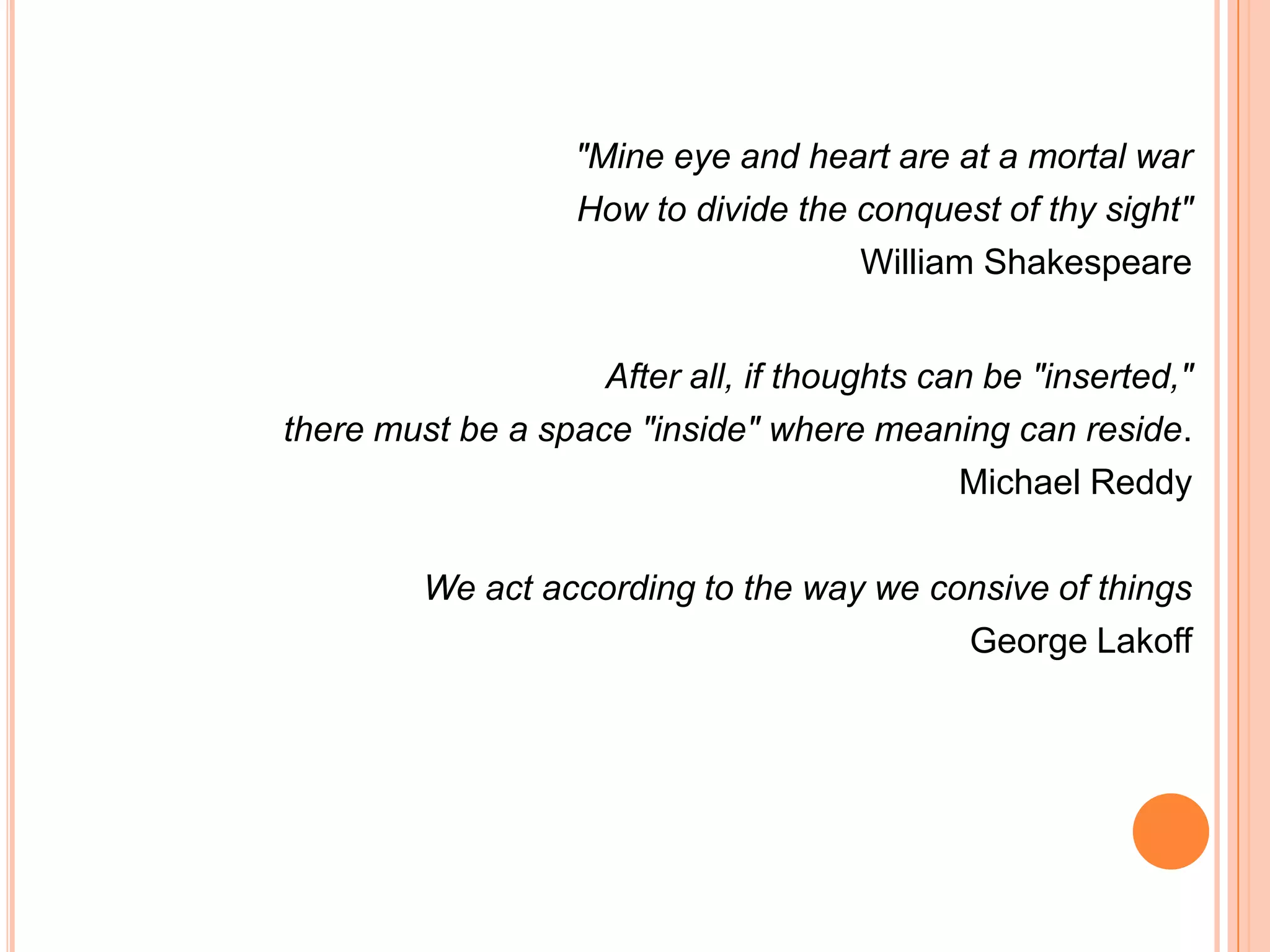
"Mine eye and heart are at a mortal war
                   How to divide the conquest of thy sight"
                                     William Shakespeare


                    After all, if thoughts can be "inserted,"
there must be a space "inside" where meaning can reside.
                                             Michael Reddy

         We act according to the way we consive of things
                                          George Lakoff
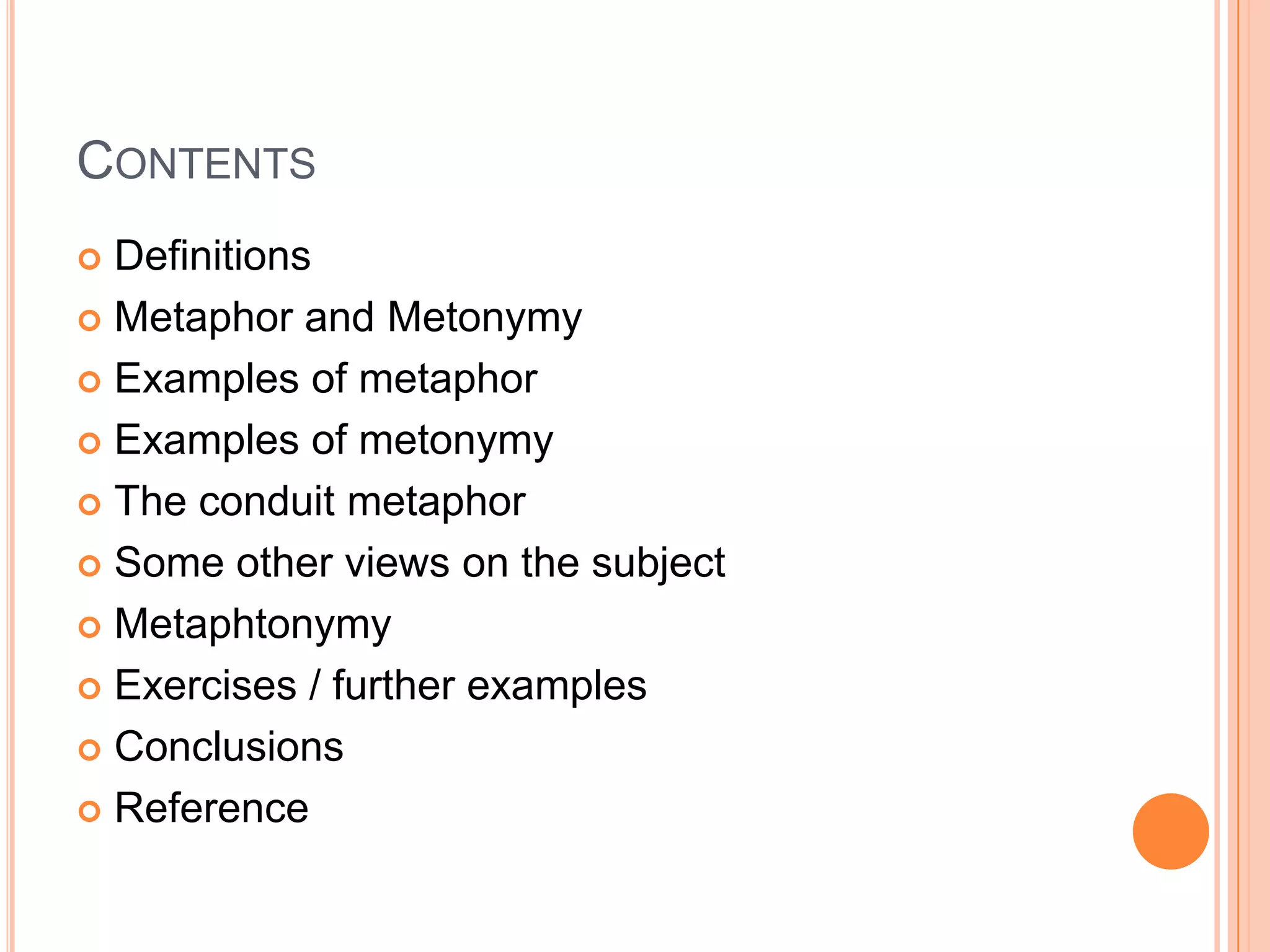
CONTENTS
 Definitions
 Metaphor and Metonymy

 Examples of metaphor

 Examples of metonymy

 The conduit metaphor

 Some other views on the subject

 Metaphtonymy

 Exercises / further examples

 Conclusions

 Reference
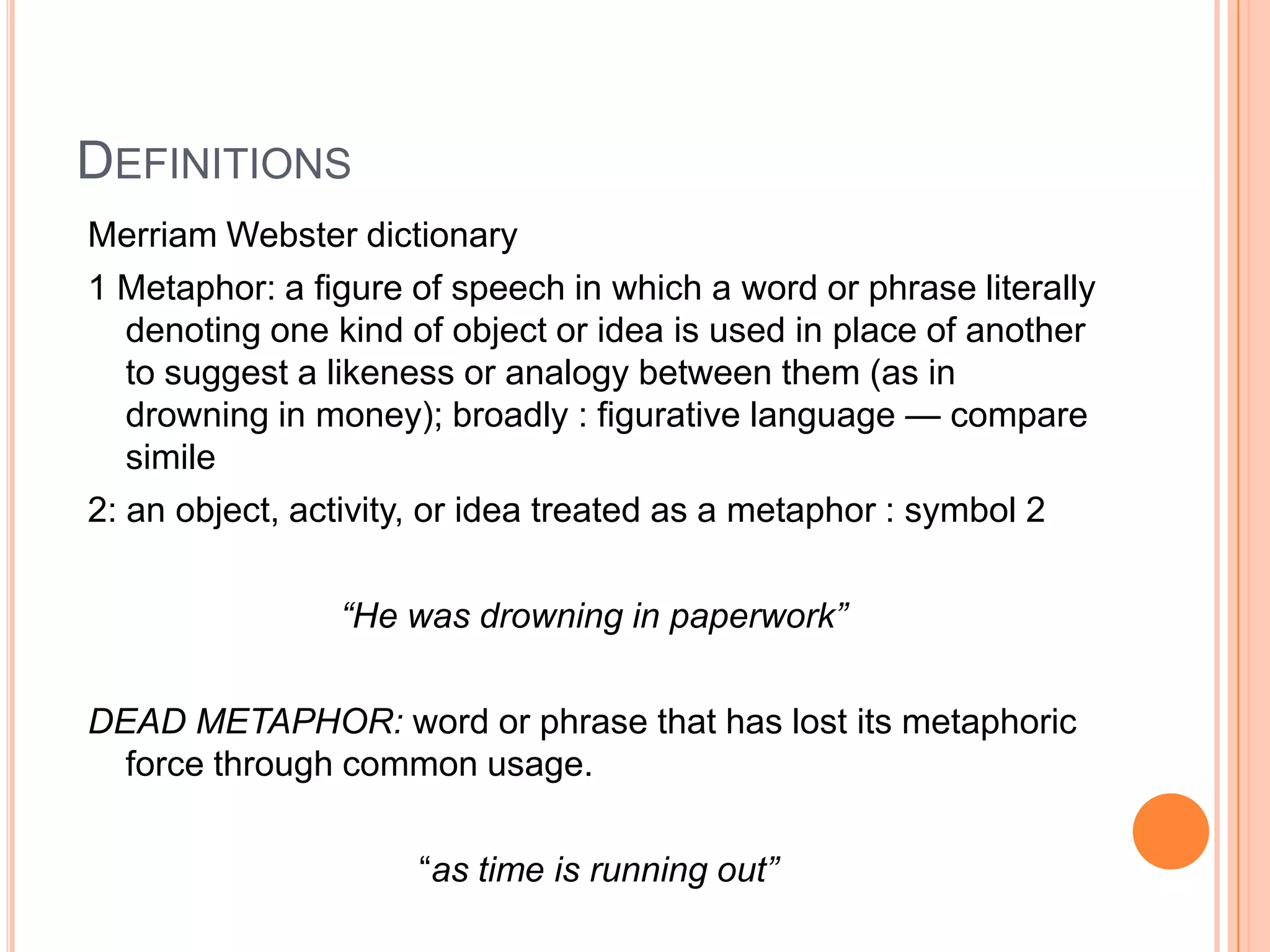
DEFINITIONS
Merriam Webster dictionary
1 Metaphor: a figure of speech in which a word or phrase literally
   denoting one kind of object or idea is used in place of another
   to suggest a likeness or analogy between them (as in
   drowning in money); broadly : figurative language — compare
   simile
2: an object, activity, or idea treated as a metaphor : symbol 2

                “He was drowning in paperwork”

DEAD METAPHOR: word or phrase that has lost its metaphoric
  force through common usage.

                     “as time is running out”
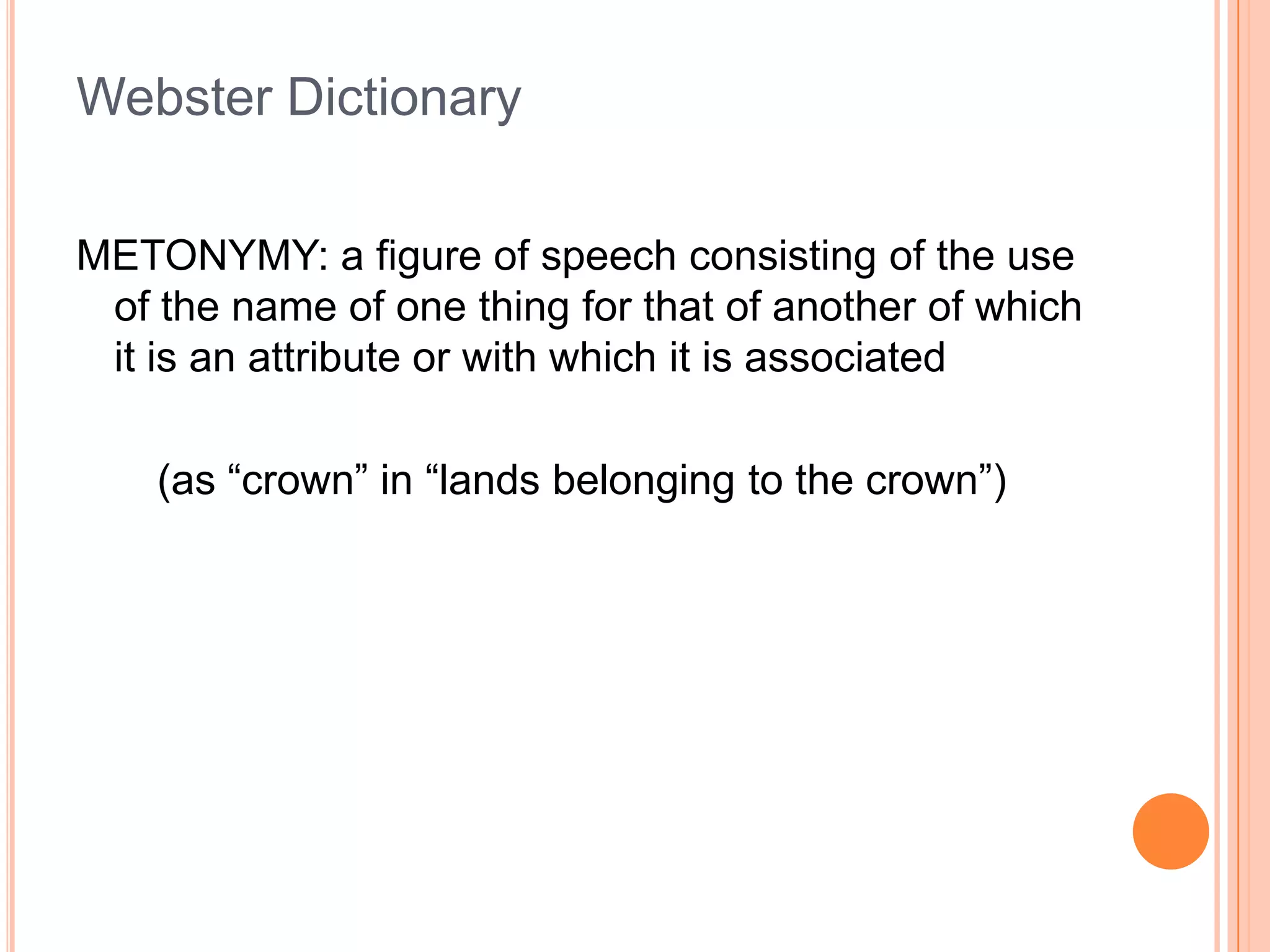
Webster Dictionary

METONYMY: a figure of speech consisting of the use
 of the name of one thing for that of another of which
 it is an attribute or with which it is associated

    (as “crown” in “lands belonging to the crown”)
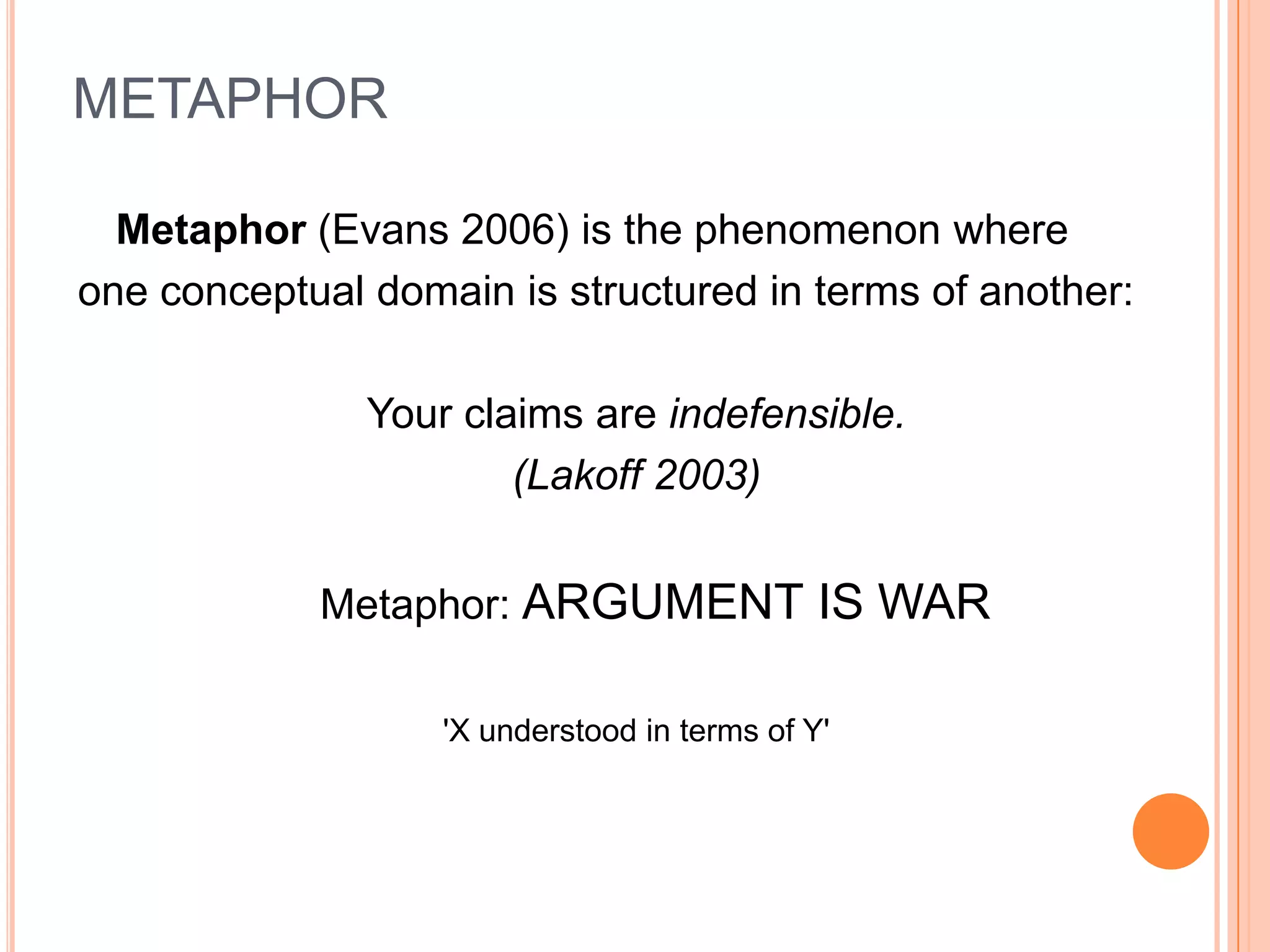
METAPHOR

  Metaphor (Evans 2006) is the phenomenon where
one conceptual domain is structured in terms of another:

               Your claims are indefensible.
                       (Lakoff 2003)


            Metaphor: ARGUMENT IS WAR

                   'X understood in terms of Y'
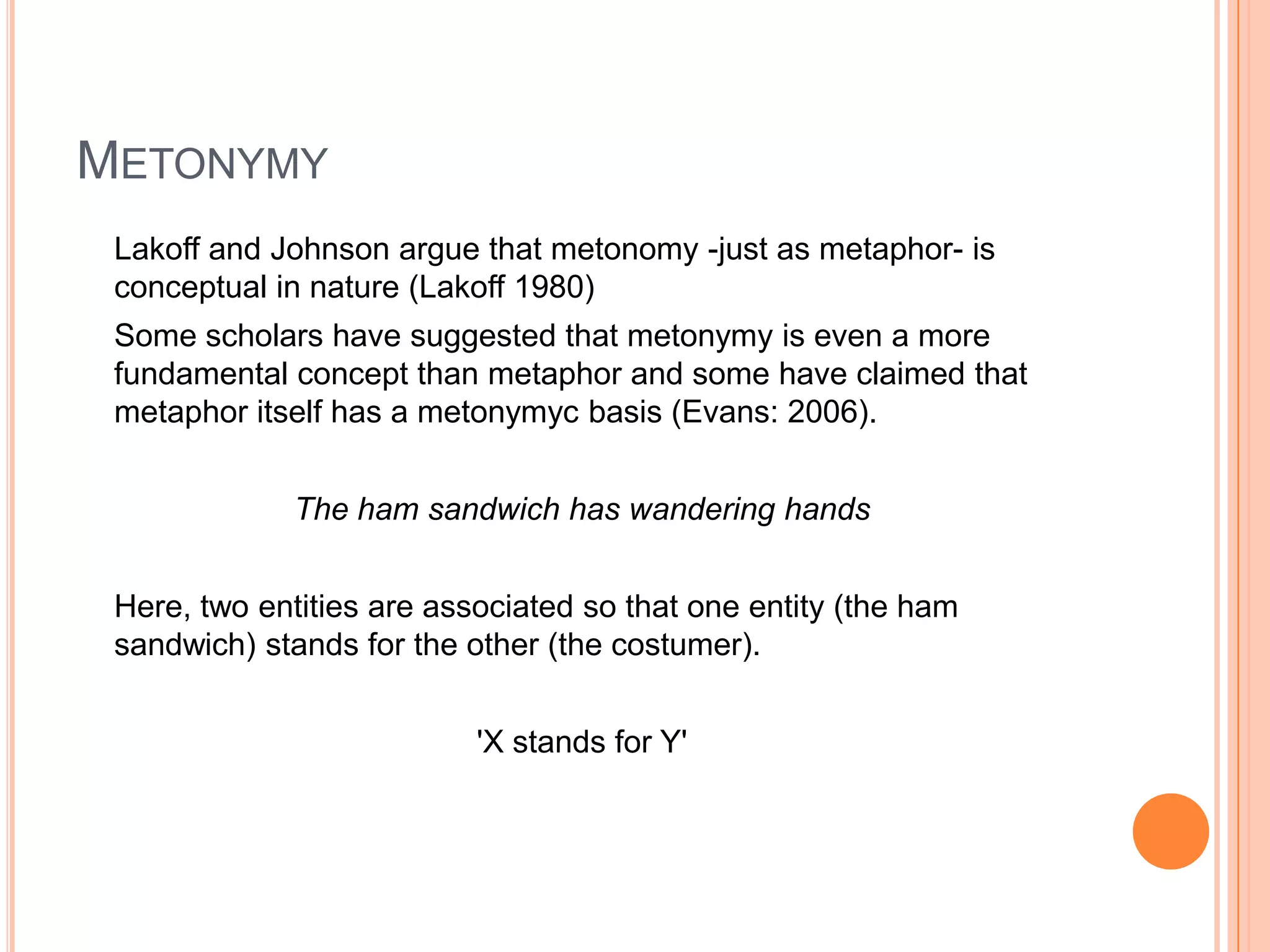
METONYMY
 Lakoff and Johnson argue that metonomy -just as metaphor- is
 conceptual in nature (Lakoff 1980)
 Some scholars have suggested that metonymy is even a more
 fundamental concept than metaphor and some have claimed that
 metaphor itself has a metonymyc basis (Evans: 2006).


             The ham sandwich has wandering hands


 Here, two entities are associated so that one entity (the ham
 sandwich) stands for the other (the costumer).


                           'X stands for Y'
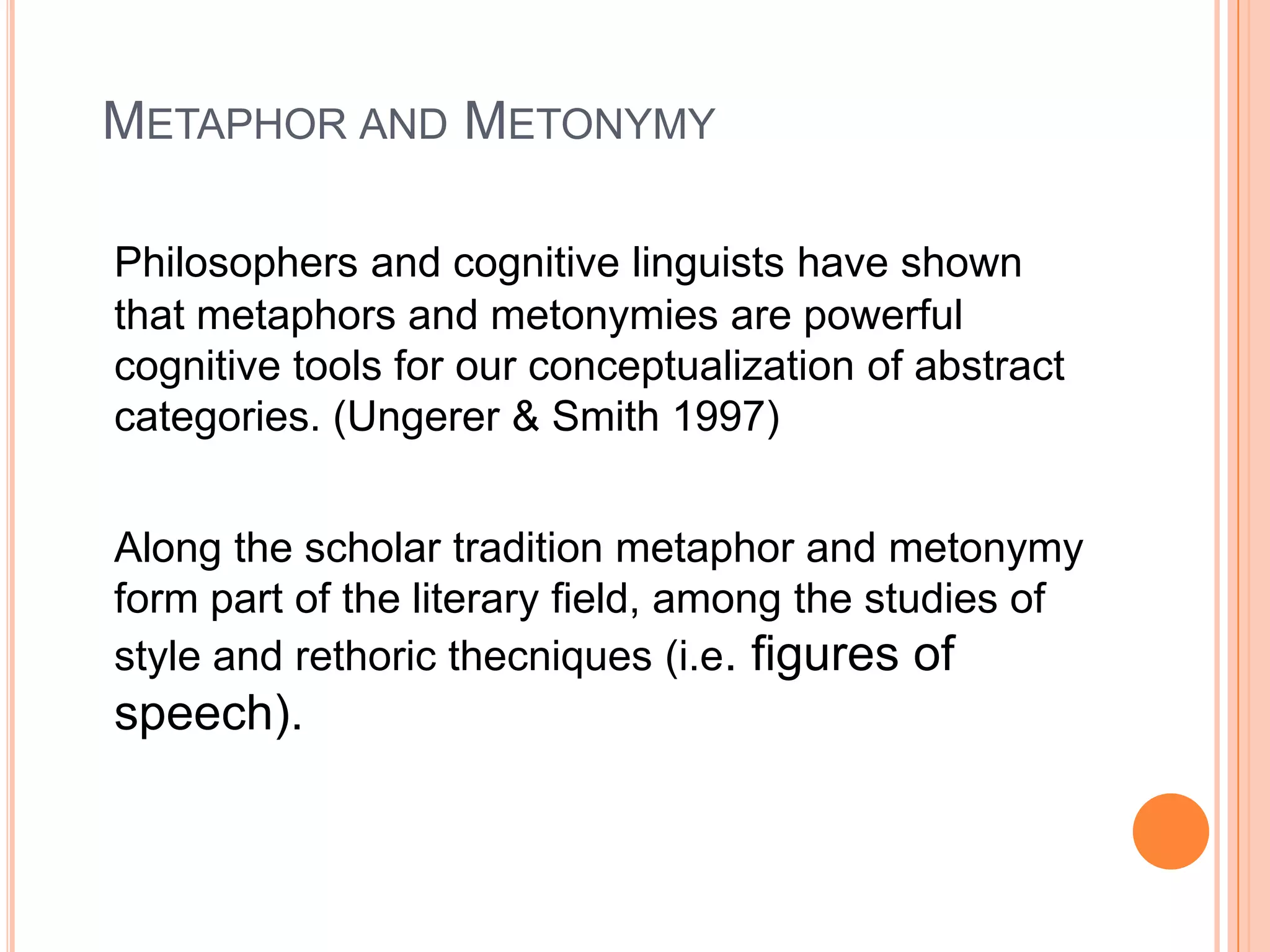
METAPHOR AND METONYMY

Philosophers and cognitive linguists have shown
that metaphors and metonymies are powerful
cognitive tools for our conceptualization of abstract
categories. (Ungerer & Smith 1997)


Along the scholar tradition metaphor and metonymy
form part of the literary field, among the studies of
style and rethoric thecniques (i.e. figures of
speech).
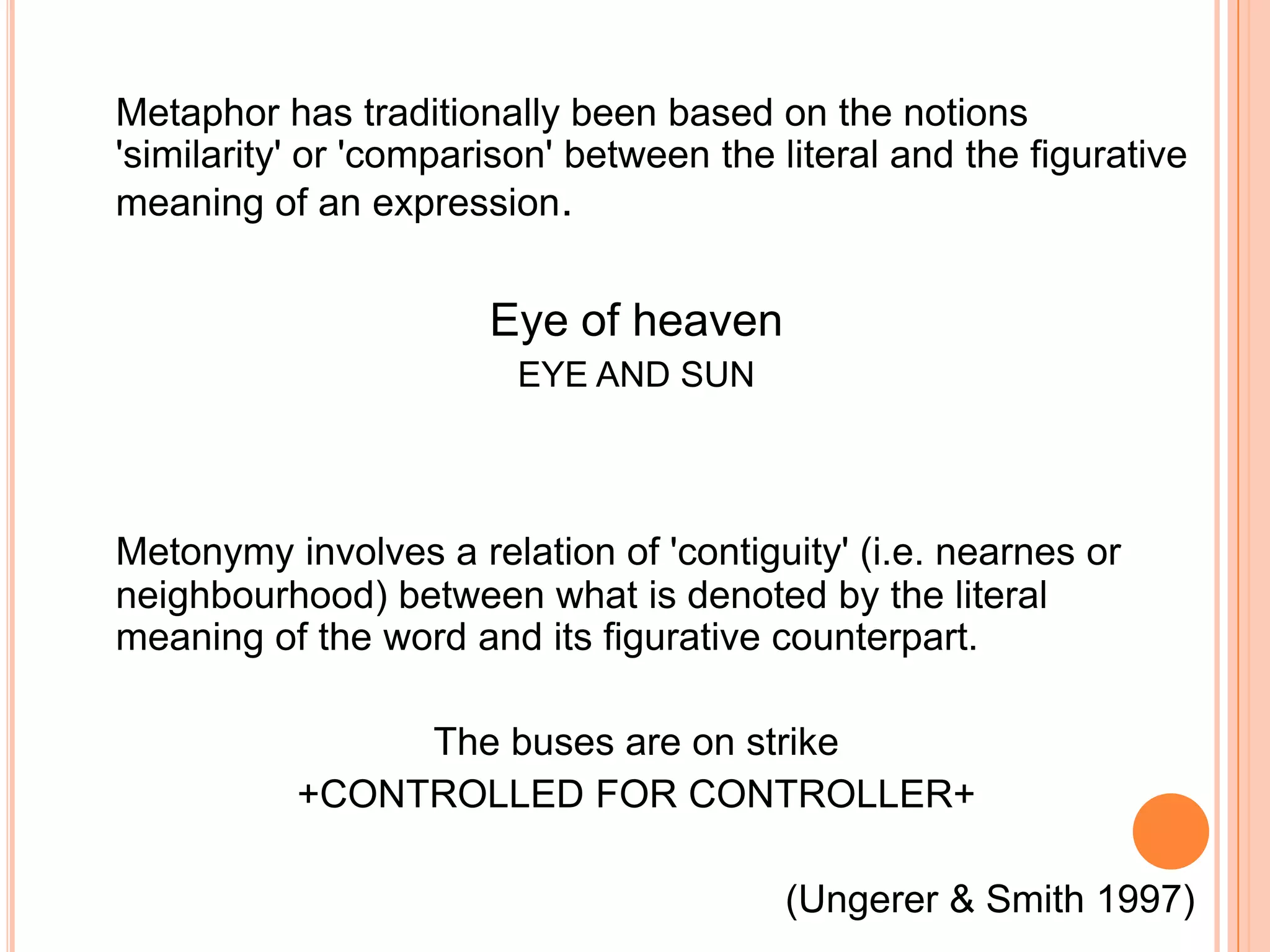
Metaphor has traditionally been based on the notions
'similarity' or 'comparison' between the literal and the figurative
meaning of an expression.


                       Eye of heaven
                         EYE AND SUN


Metonymy involves a relation of 'contiguity' (i.e. nearnes or
neighbourhood) between what is denoted by the literal
meaning of the word and its figurative counterpart.

                The buses are on strike
           +CONTROLLED FOR CONTROLLER+

                                         (Ungerer & Smith 1997)
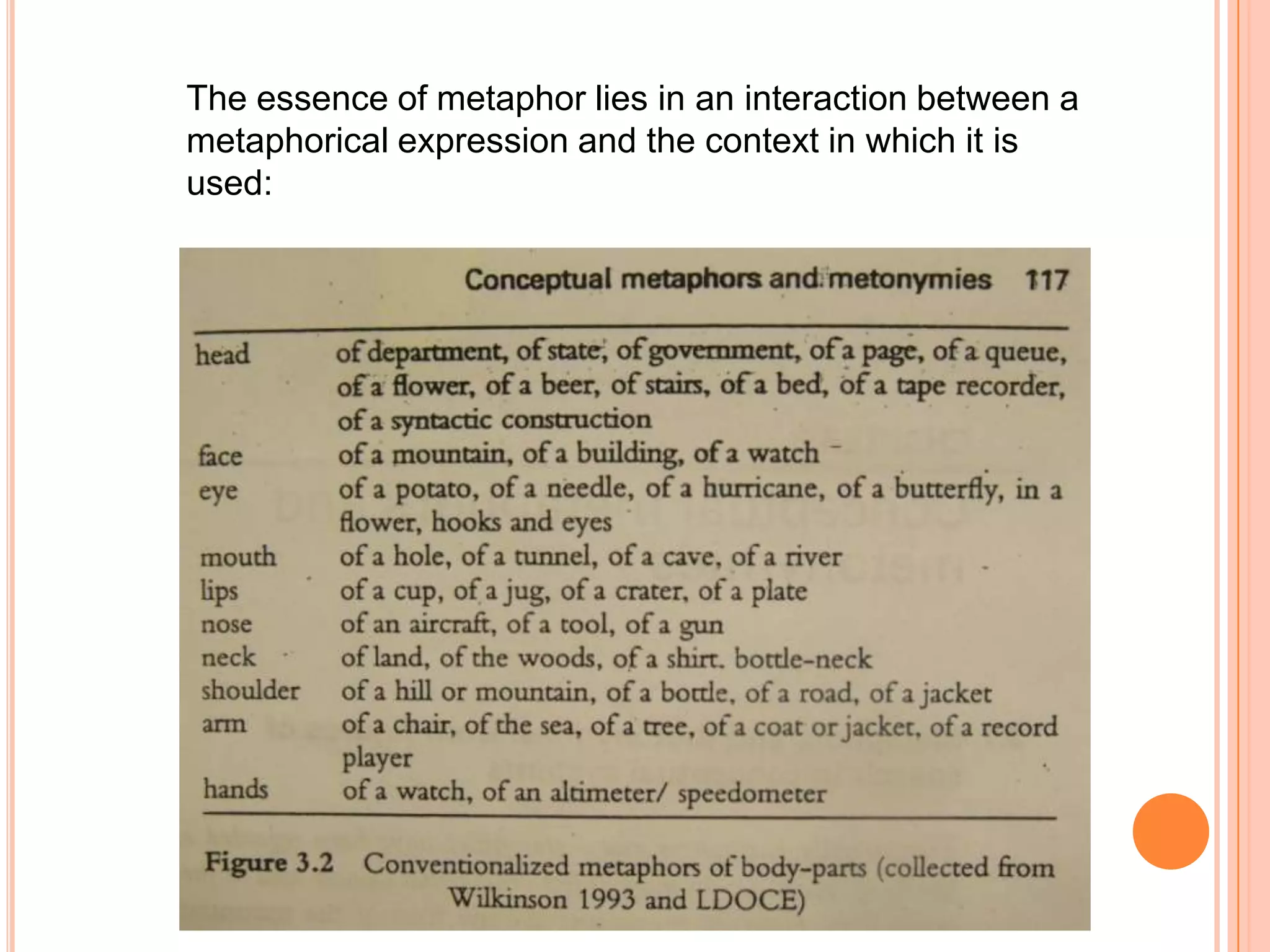
The essence of metaphor lies in an interaction between a
metaphorical expression and the context in which it is
used:
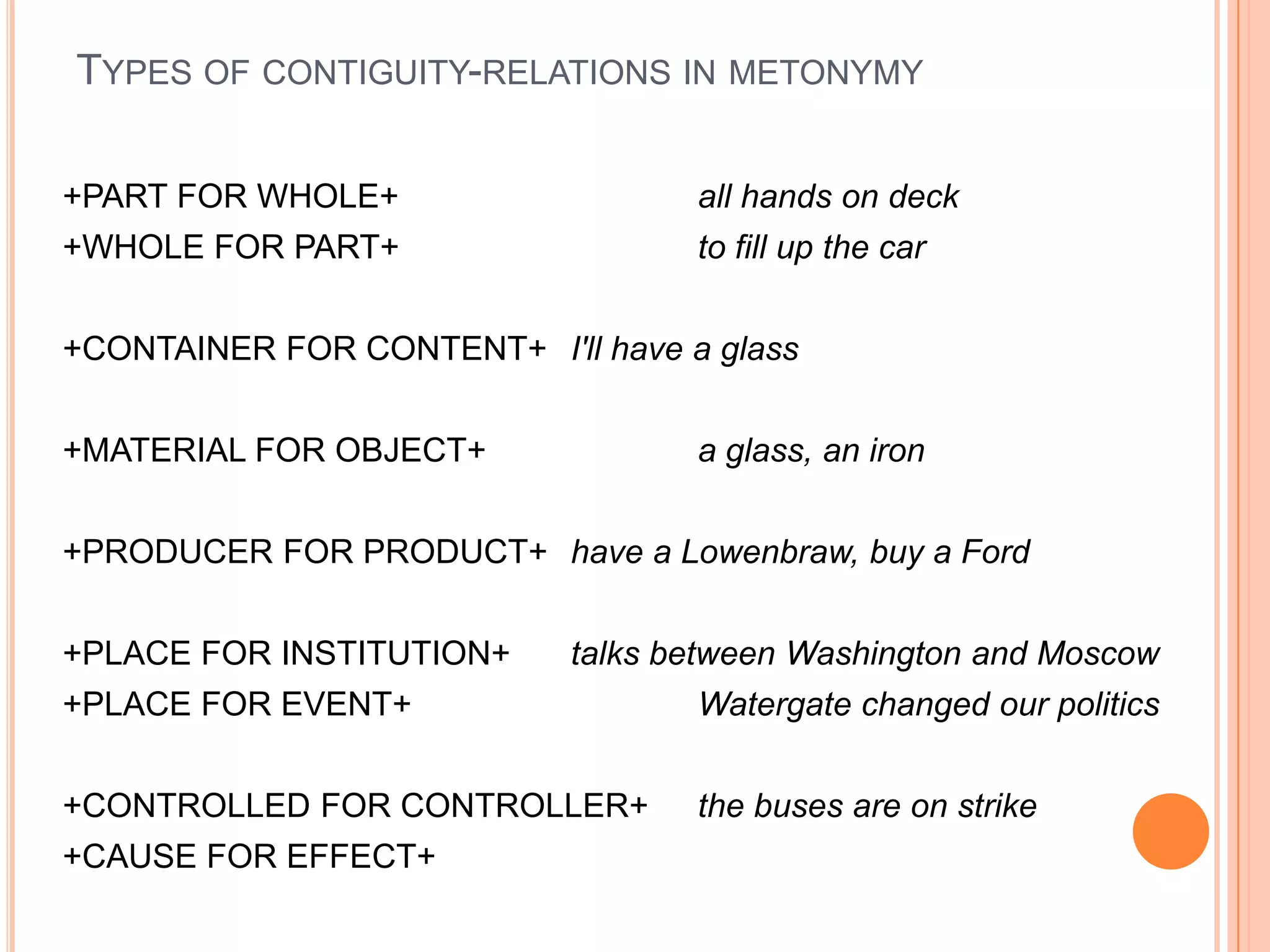
TYPES OF CONTIGUITY-RELATIONS IN METONYMY

+PART FOR WHOLE+                   all hands on deck
+WHOLE FOR PART+                   to fill up the car


+CONTAINER FOR CONTENT+ I'll have a glass


+MATERIAL FOR OBJECT+              a glass, an iron


+PRODUCER FOR PRODUCT+ have a Lowenbraw, buy a Ford


+PLACE FOR INSTITUTION+     talks between Washington and Moscow
+PLACE FOR EVENT+                  Watergate changed our politics


+CONTROLLED FOR CONTROLLER+        the buses are on strike
+CAUSE FOR EFFECT+
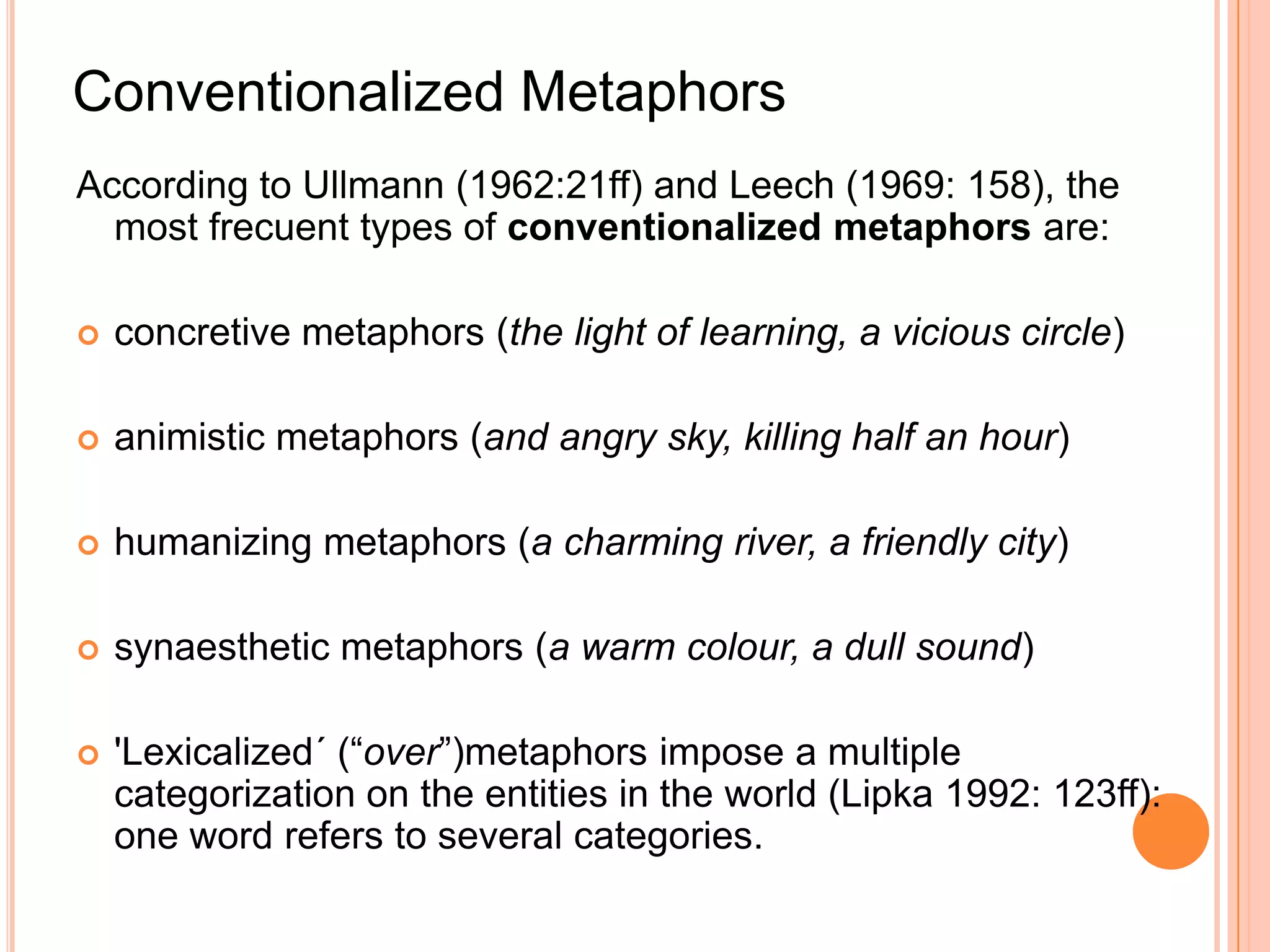
Conventionalized Metaphors
According to Ullmann (1962:21ff) and Leech (1969: 158), the
  most frecuent types of conventionalized metaphors are:

   concretive metaphors (the light of learning, a vicious circle)

   animistic metaphors (and angry sky, killing half an hour)

   humanizing metaphors (a charming river, a friendly city)

   synaesthetic metaphors (a warm colour, a dull sound)

   'Lexicalized´ (“over”)metaphors impose a multiple
    categorization on the entities in the world (Lipka 1992: 123ff):
    one word refers to several categories.
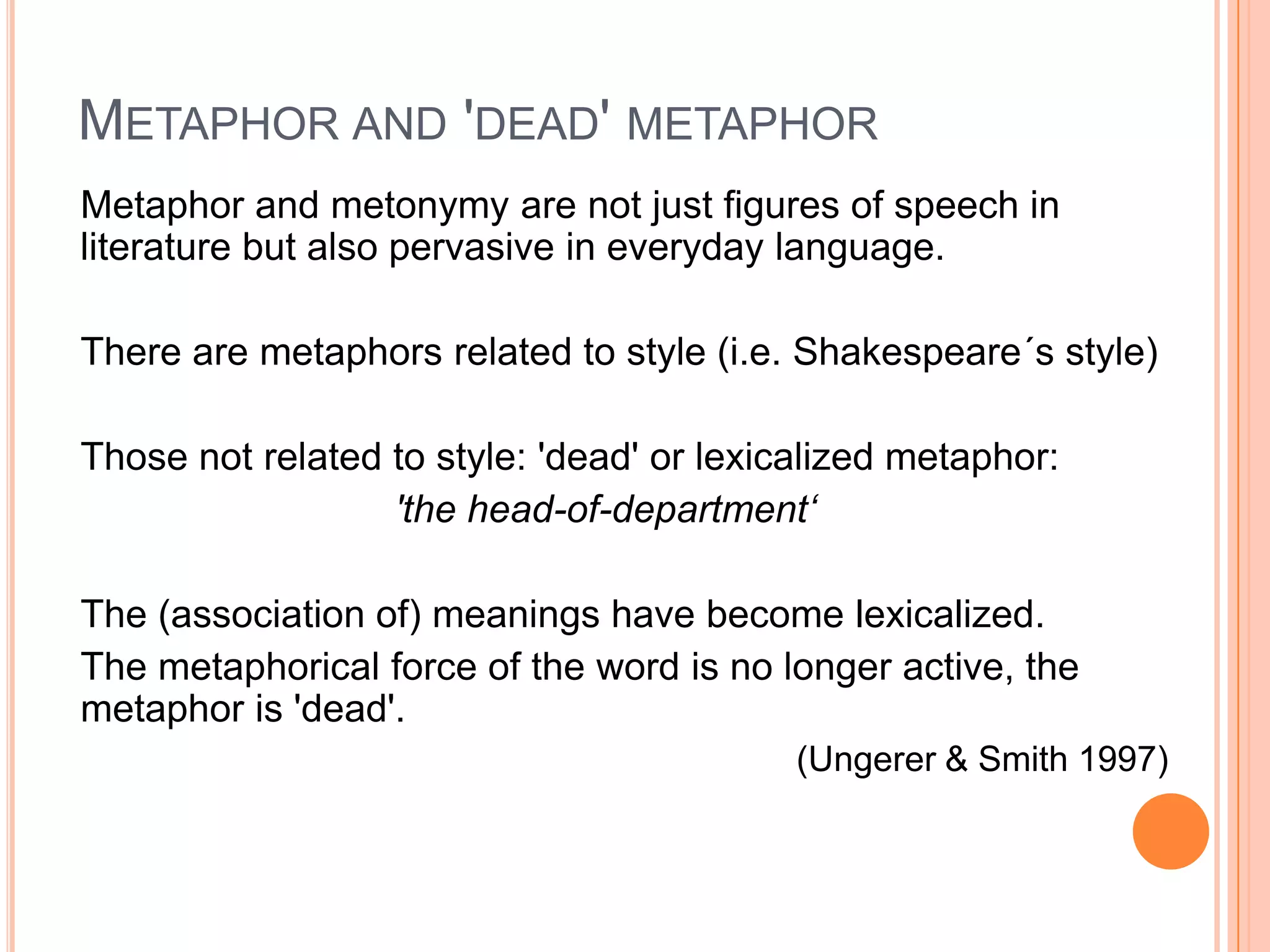
METAPHOR AND 'DEAD' METAPHOR
Metaphor and metonymy are not just figures of speech in
literature but also pervasive in everyday language.

There are metaphors related to style (i.e. Shakespeare´s style)

Those not related to style: 'dead' or lexicalized metaphor:
                  'the head-of-department„

The (association of) meanings have become lexicalized.
The metaphorical force of the word is no longer active, the
metaphor is 'dead'.
                                           (Ungerer & Smith 1997)
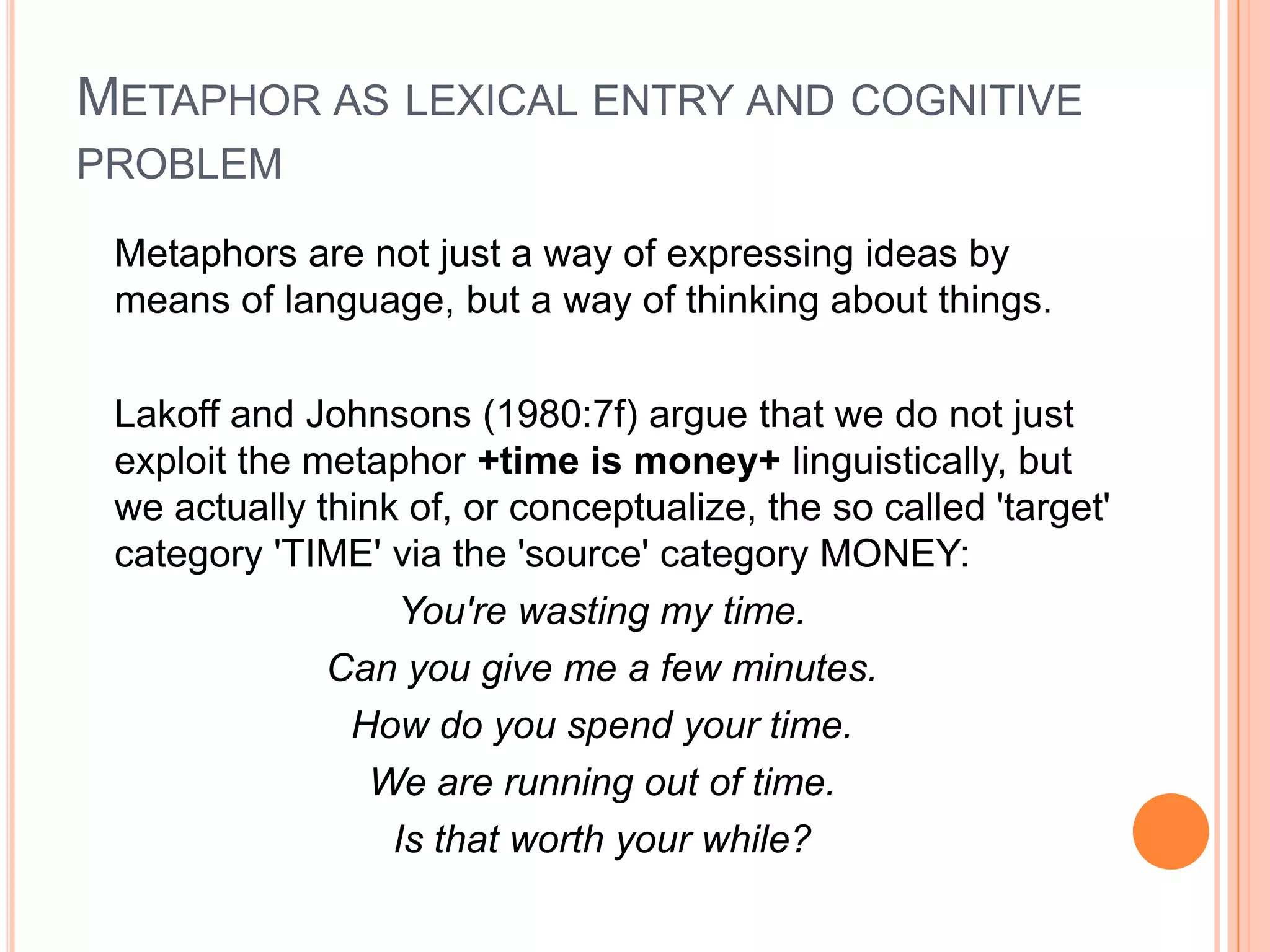
METAPHOR AS LEXICAL ENTRY AND COGNITIVE
PROBLEM

 Metaphors are not just a way of expressing ideas by
 means of language, but a way of thinking about things.

 Lakoff and Johnsons (1980:7f) argue that we do not just
 exploit the metaphor +time is money+ linguistically, but
 we actually think of, or conceptualize, the so called 'target'
 category 'TIME' via the 'source' category MONEY:
                  You're wasting my time.
              Can you give me a few minutes.
               How do you spend your time.
                 We are running out of time.
                  Is that worth your while?
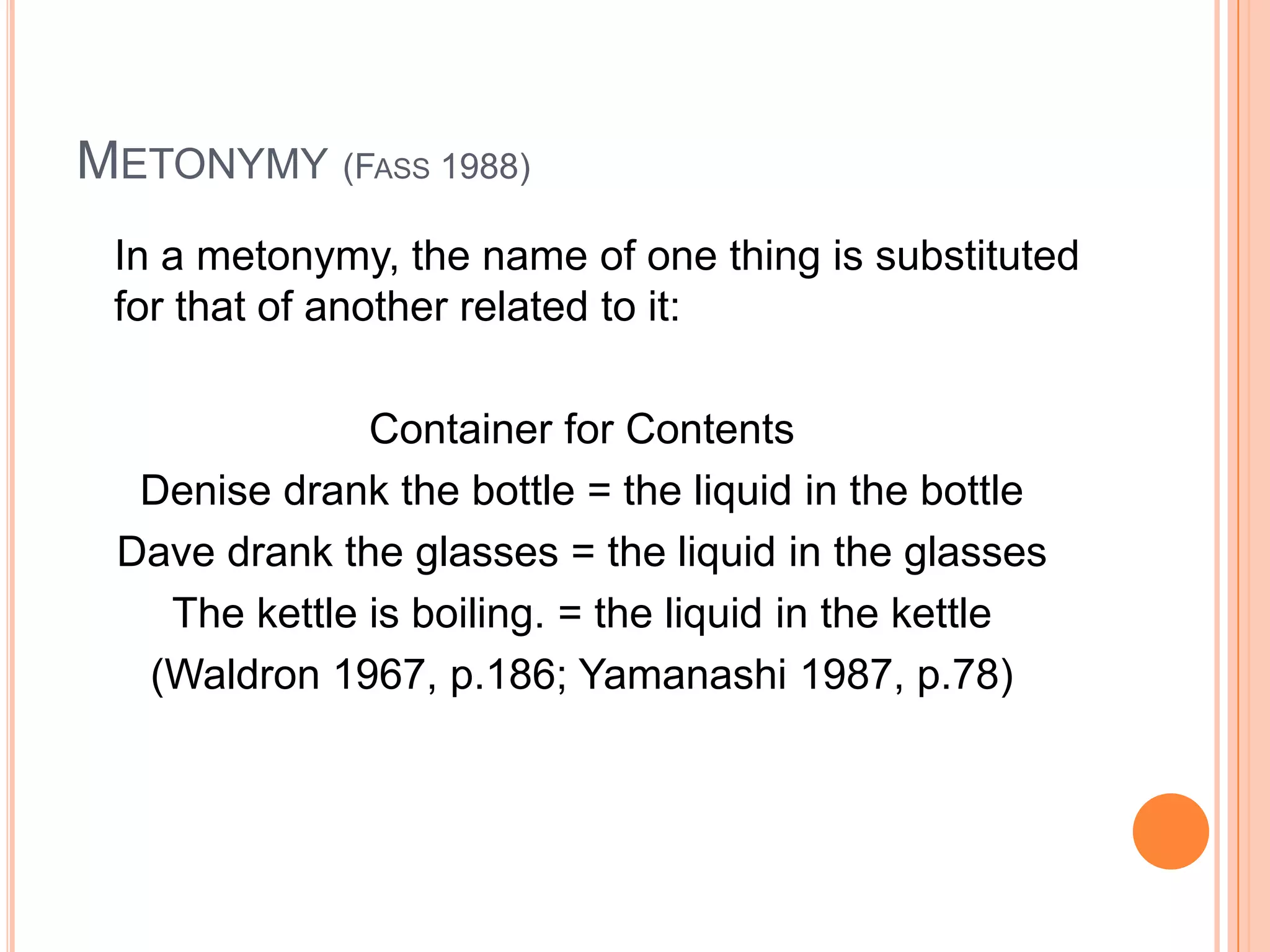
METONYMY (FASS 1988)
 In a metonymy, the name of one thing is substituted
 for that of another related to it:

              Container for Contents
  Denise drank the bottle = the liquid in the bottle
 Dave drank the glasses = the liquid in the glasses
   The kettle is boiling. = the liquid in the kettle
  (Waldron 1967, p.186; Yamanashi 1987, p.78)
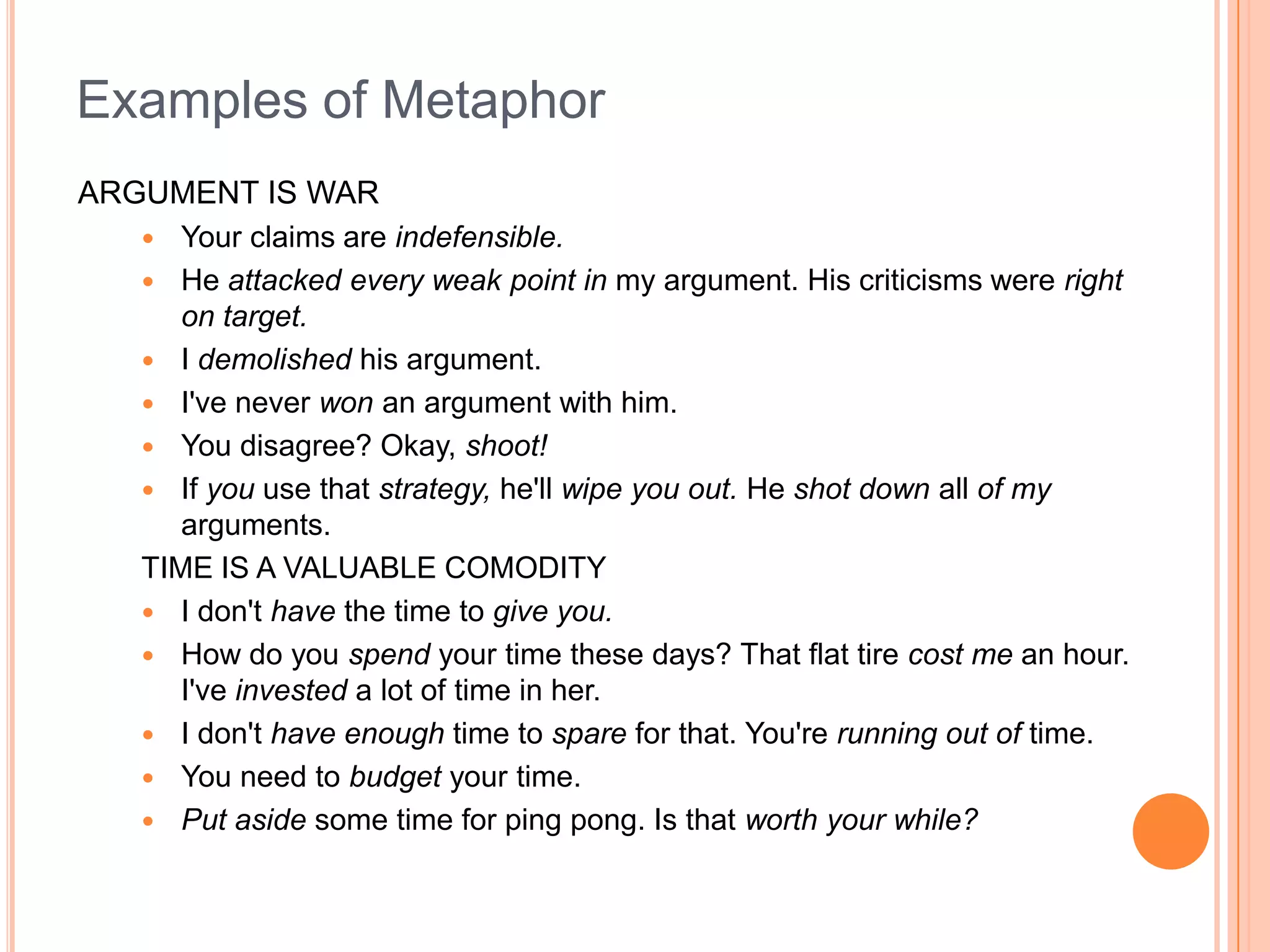
Examples of Metaphor
ARGUMENT IS WAR
     Your claims are indefensible.
    He attacked every weak point in my argument. His criticisms were right
      on target.
    I demolished his argument.
    I've never won an argument with him.
    You disagree? Okay, shoot!
    If you use that strategy, he'll wipe you out. He shot down all of my
      arguments.
   TIME IS A VALUABLE COMODITY
    I don't have the time to give you.
    How do you spend your time these days? That flat tire cost me an hour.
      I've invested a lot of time in her.
    I don't have enough time to spare for that. You're running out of time.
    You need to budget your time.
    Put aside some time for ping pong. Is that worth your while?
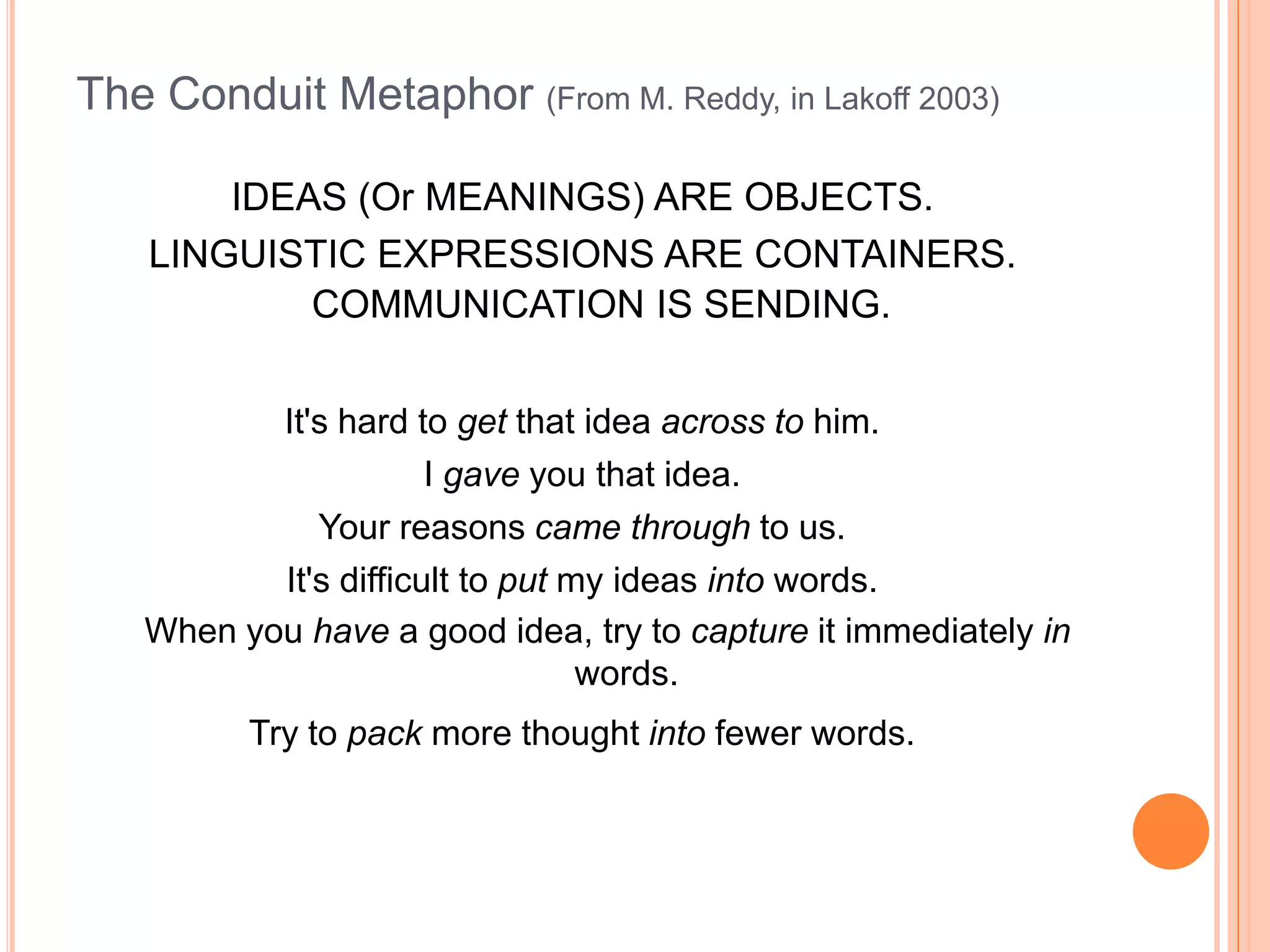
The Conduit Metaphor (From M. Reddy, in Lakoff 2003)

        IDEAS (Or MEANINGS) ARE OBJECTS.
    LINGUISTIC EXPRESSIONS ARE CONTAINERS.
            COMMUNICATION IS SENDING.

          It's hard to get that idea across to him.
                      I gave you that idea.
             Your reasons came through to us.
          It's difficult to put my ideas into words.
   When you have a good idea, try to capture it immediately in
                                 words.
         Try to pack more thought into fewer words.
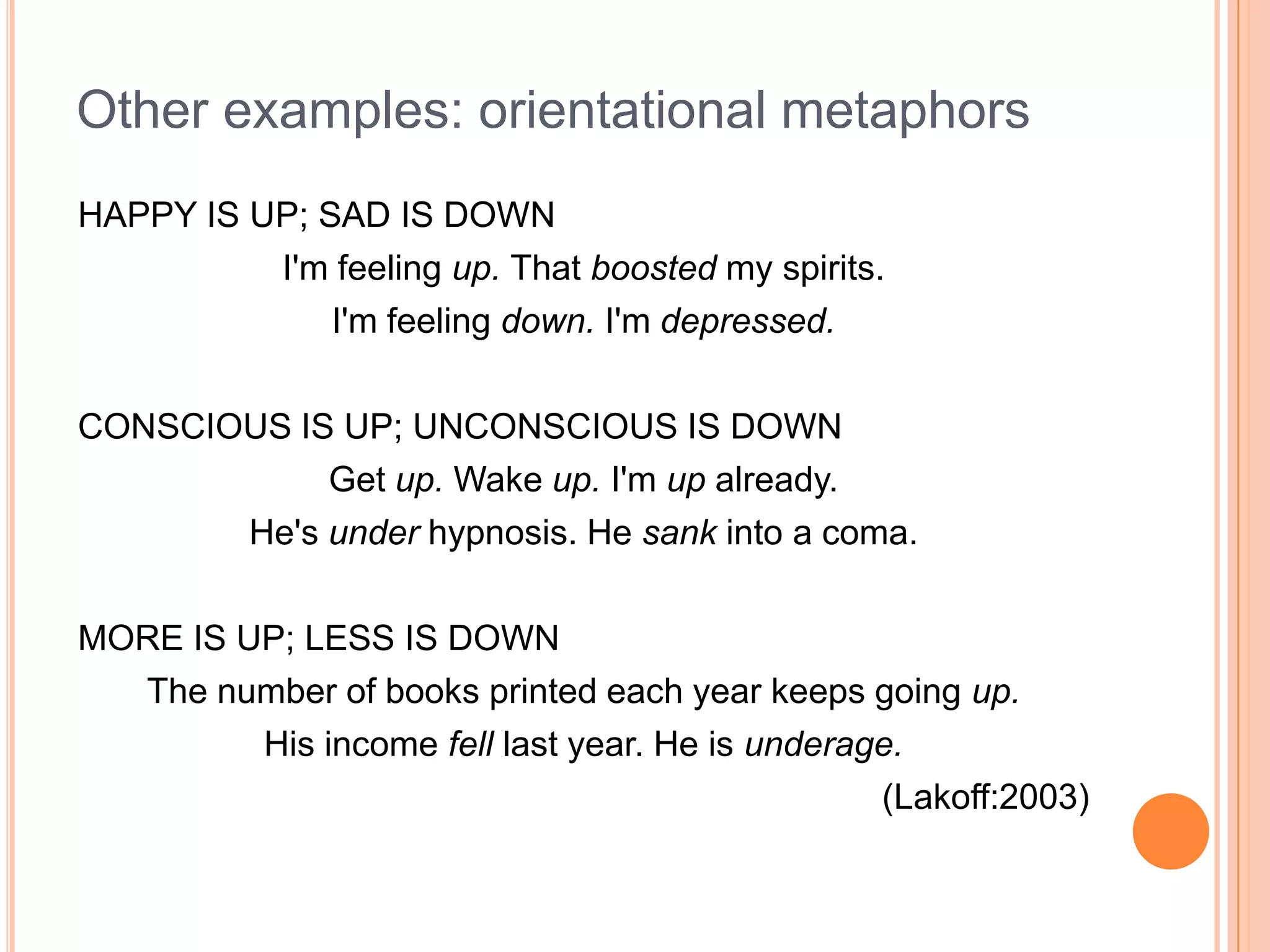
Other examples: orientational metaphors
HAPPY IS UP; SAD IS DOWN
          I'm feeling up. That boosted my spirits.
              I'm feeling down. I'm depressed.

CONSCIOUS IS UP; UNCONSCIOUS IS DOWN
            Get up. Wake up. I'm up already.
       He's under hypnosis. He sank into a coma.

MORE IS UP; LESS IS DOWN
  The number of books printed each year keeps going up.
         His income fell last year. He is underage.
                                                 (Lakoff:2003)
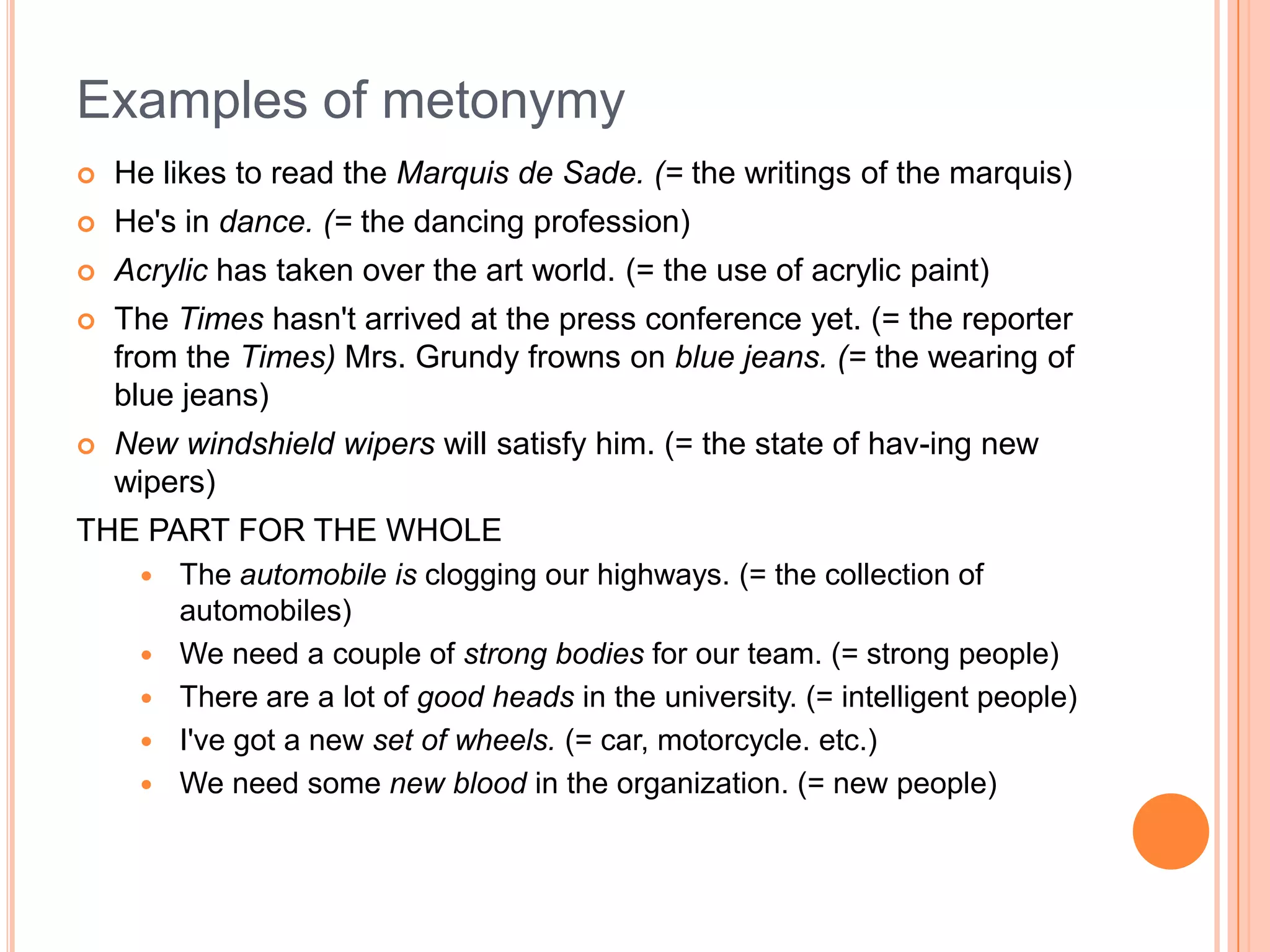
Examples of metonymy
   He likes to read the Marquis de Sade. (= the writings of the marquis)
   He's in dance. (= the dancing profession)
   Acrylic has taken over the art world. (= the use of acrylic paint)
   The Times hasn't arrived at the press conference yet. (= the reporter
    from the Times) Mrs. Grundy frowns on blue jeans. (= the wearing of
    blue jeans)
   New windshield wipers will satisfy him. (= the state of hav-ing new
    wipers)
THE PART FOR THE WHOLE
        The automobile is clogging our highways. (= the collection of
         automobiles)
        We need a couple of strong bodies for our team. (= strong people)
        There are a lot of good heads in the university. (= intelligent people)
        I've got a new set of wheels. (= car, motorcycle. etc.)
        We need some new blood in the organization. (= new people)
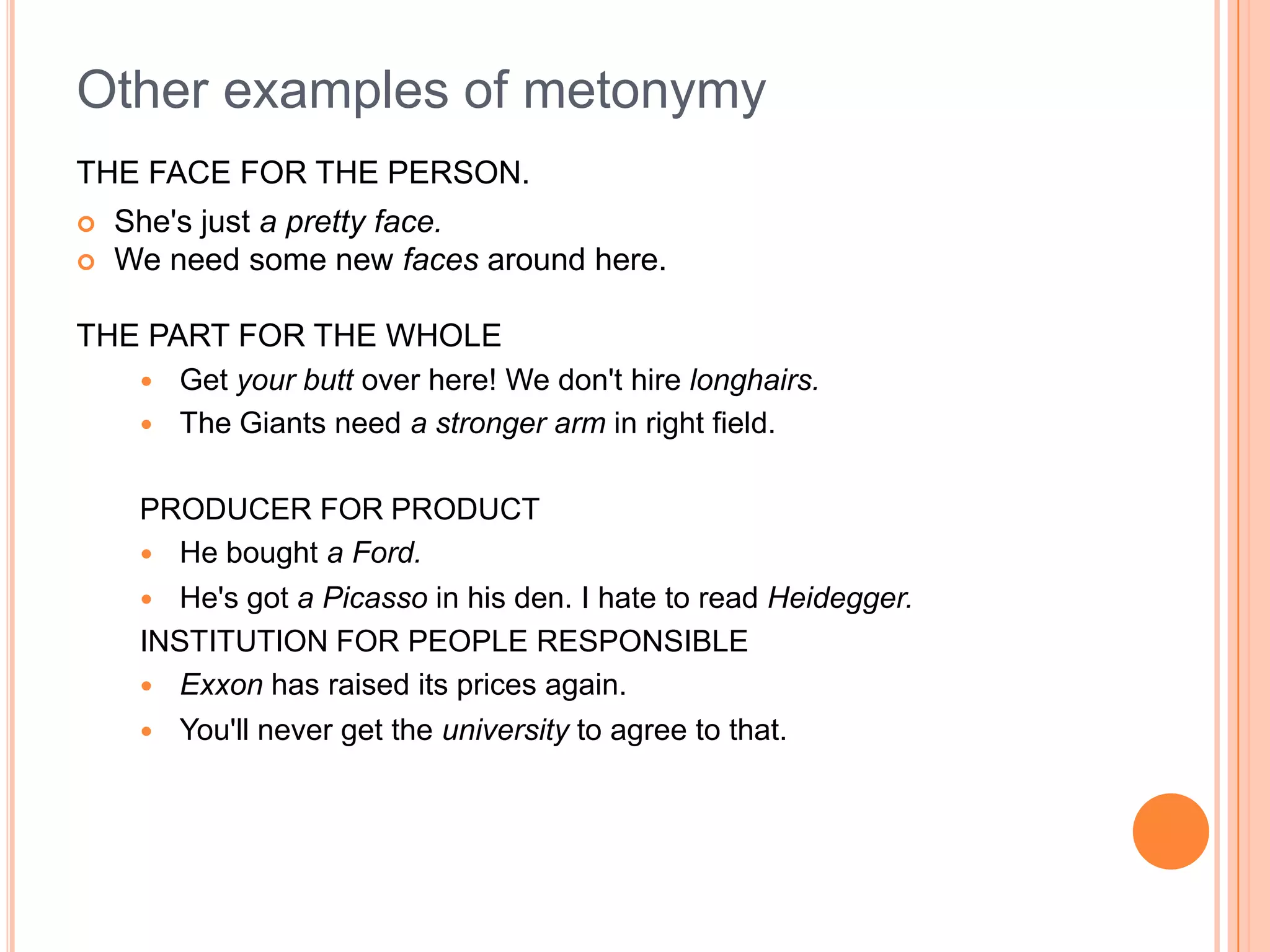
Other examples of metonymy
THE FACE FOR THE PERSON.
   She's just a pretty face.
   We need some new faces around here.

THE PART FOR THE WHOLE
        Get your butt over here! We don't hire longhairs.
        The Giants need a stronger arm in right field.

     PRODUCER FOR PRODUCT
      He bought a Ford.
      He's got a Picasso in his den. I hate to read Heidegger.
     INSTITUTION FOR PEOPLE RESPONSIBLE
      Exxon has raised its prices again.
        You'll never get the university to agree to that.
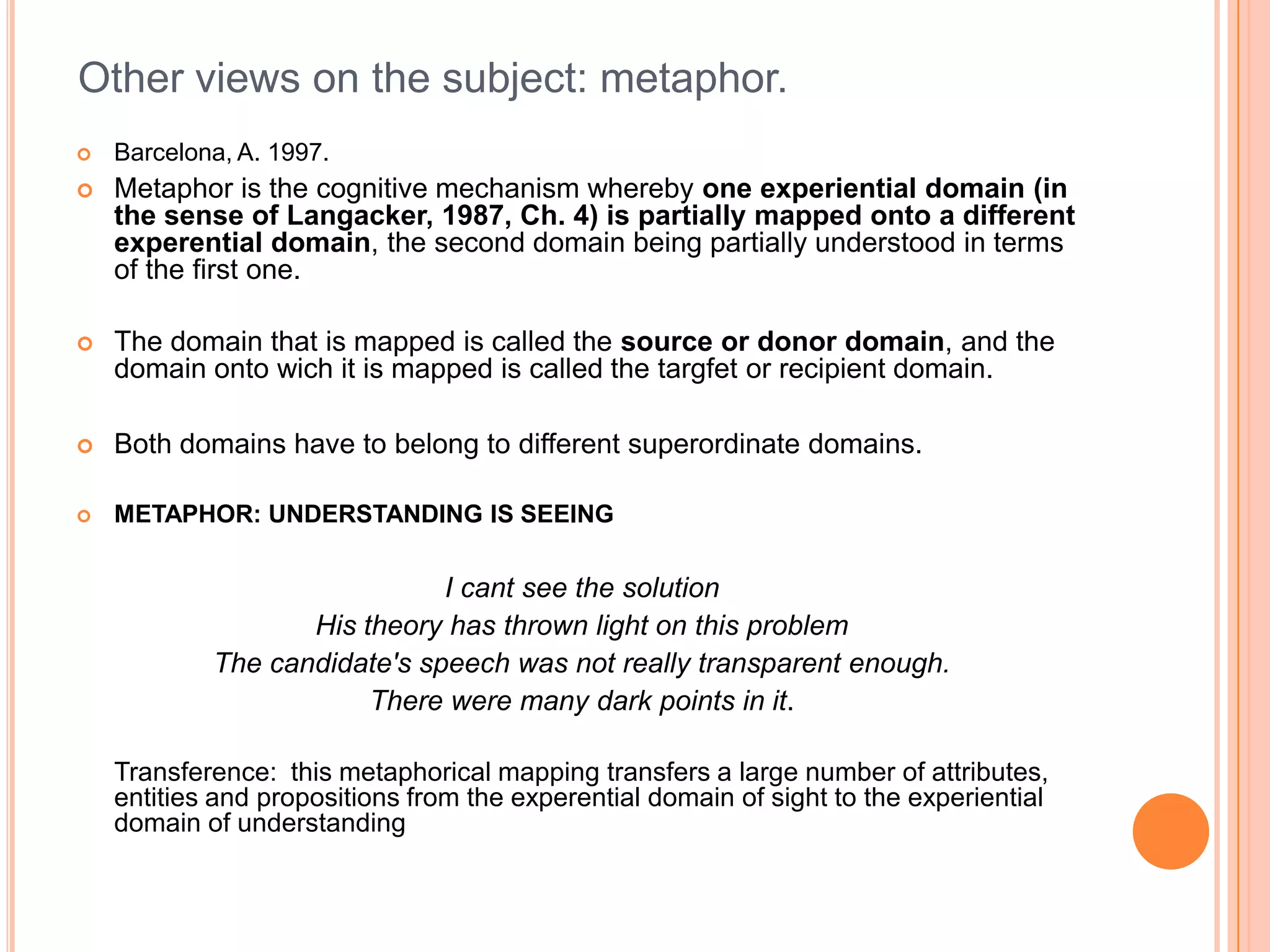
Other views on the subject: metaphor.
   Barcelona, A. 1997.
   Metaphor is the cognitive mechanism whereby one experiential domain (in
    the sense of Langacker, 1987, Ch. 4) is partially mapped onto a different
    experential domain, the second domain being partially understood in terms
    of the first one.

   The domain that is mapped is called the source or donor domain, and the
    domain onto wich it is mapped is called the targfet or recipient domain.

   Both domains have to belong to different superordinate domains.

   METAPHOR: UNDERSTANDING IS SEEING


                              I cant see the solution
                   His theory has thrown light on this problem
            The candidate's speech was not really transparent enough.
                        There were many dark points in it.

    Transference: this metaphorical mapping transfers a large number of attributes,
    entities and propositions from the experential domain of sight to the experiential
    domain of understanding
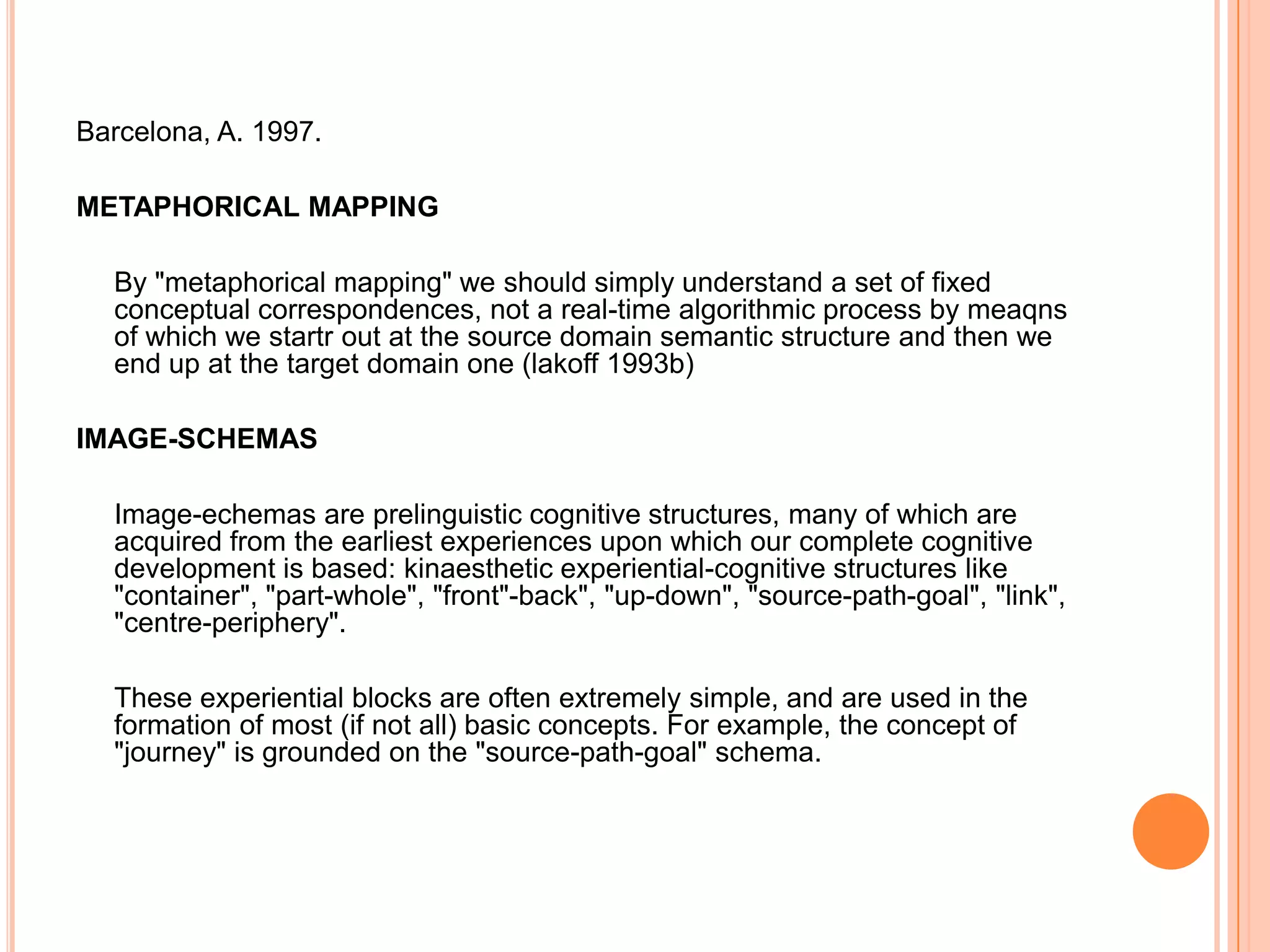
Barcelona, A. 1997.

METAPHORICAL MAPPING

  By "metaphorical mapping" we should simply understand a set of fixed
  conceptual correspondences, not a real-time algorithmic process by meaqns
  of which we startr out at the source domain semantic structure and then we
  end up at the target domain one (lakoff 1993b)

IMAGE-SCHEMAS

  Image-echemas are prelinguistic cognitive structures, many of which are
  acquired from the earliest experiences upon which our complete cognitive
  development is based: kinaesthetic experiential-cognitive structures like
  "container", "part-whole", "front"-back", "up-down", "source-path-goal", "link",
  "centre-periphery".

  These experiential blocks are often extremely simple, and are used in the
  formation of most (if not all) basic concepts. For example, the concept of
  "journey" is grounded on the "source-path-goal" schema.
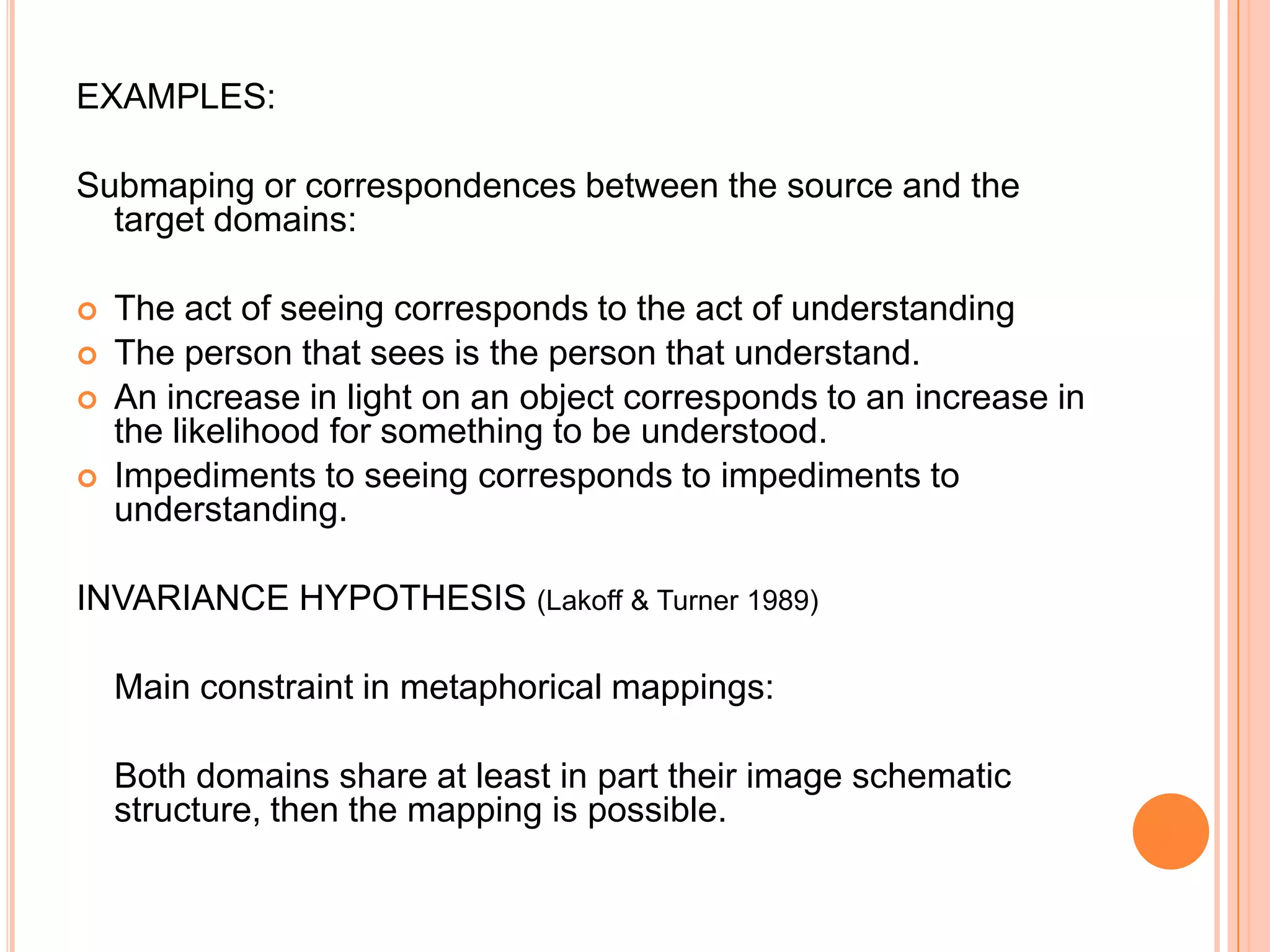
EXAMPLES:

Submaping or correspondences between the source and the
  target domains:

   The act of seeing corresponds to the act of understanding
   The person that sees is the person that understand.
   An increase in light on an object corresponds to an increase in
    the likelihood for something to be understood.
   Impediments to seeing corresponds to impediments to
    understanding.

INVARIANCE HYPOTHESIS (Lakoff & Turner 1989)

    Main constraint in metaphorical mappings:

    Both domains share at least in part their image schematic
    structure, then the mapping is possible.
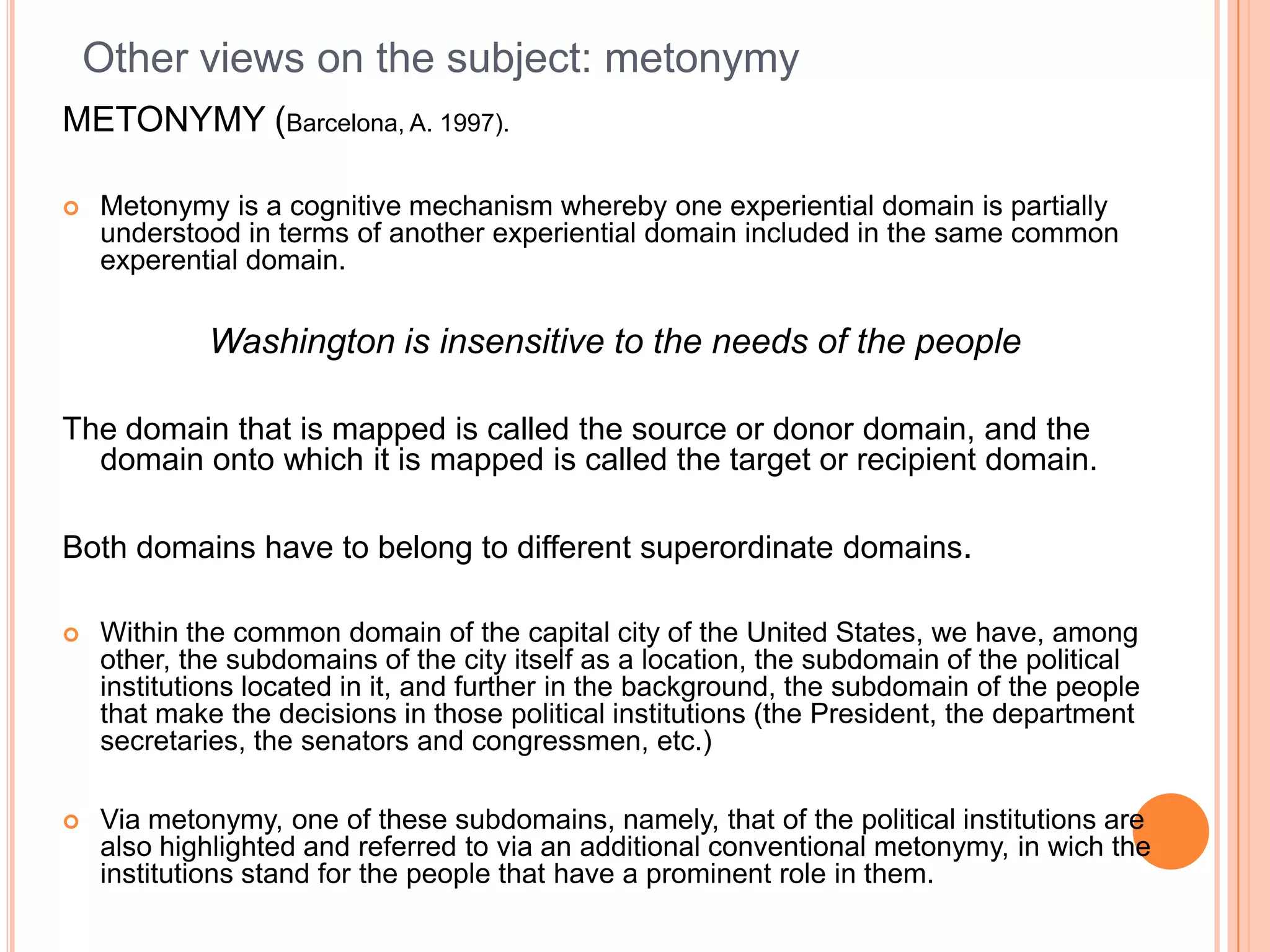
Other views on the subject: metonymy
METONYMY (Barcelona, A. 1997).

   Metonymy is a cognitive mechanism whereby one experiential domain is partially
    understood in terms of another experiential domain included in the same common
    experential domain.

            Washington is insensitive to the needs of the people

The domain that is mapped is called the source or donor domain, and the
  domain onto which it is mapped is called the target or recipient domain.

Both domains have to belong to different superordinate domains.

   Within the common domain of the capital city of the United States, we have, among
    other, the subdomains of the city itself as a location, the subdomain of the political
    institutions located in it, and further in the background, the subdomain of the people
    that make the decisions in those political institutions (the President, the department
    secretaries, the senators and congressmen, etc.)

   Via metonymy, one of these subdomains, namely, that of the political institutions are
    also highlighted and referred to via an additional conventional metonymy, in wich the
    institutions stand for the people that have a prominent role in them.
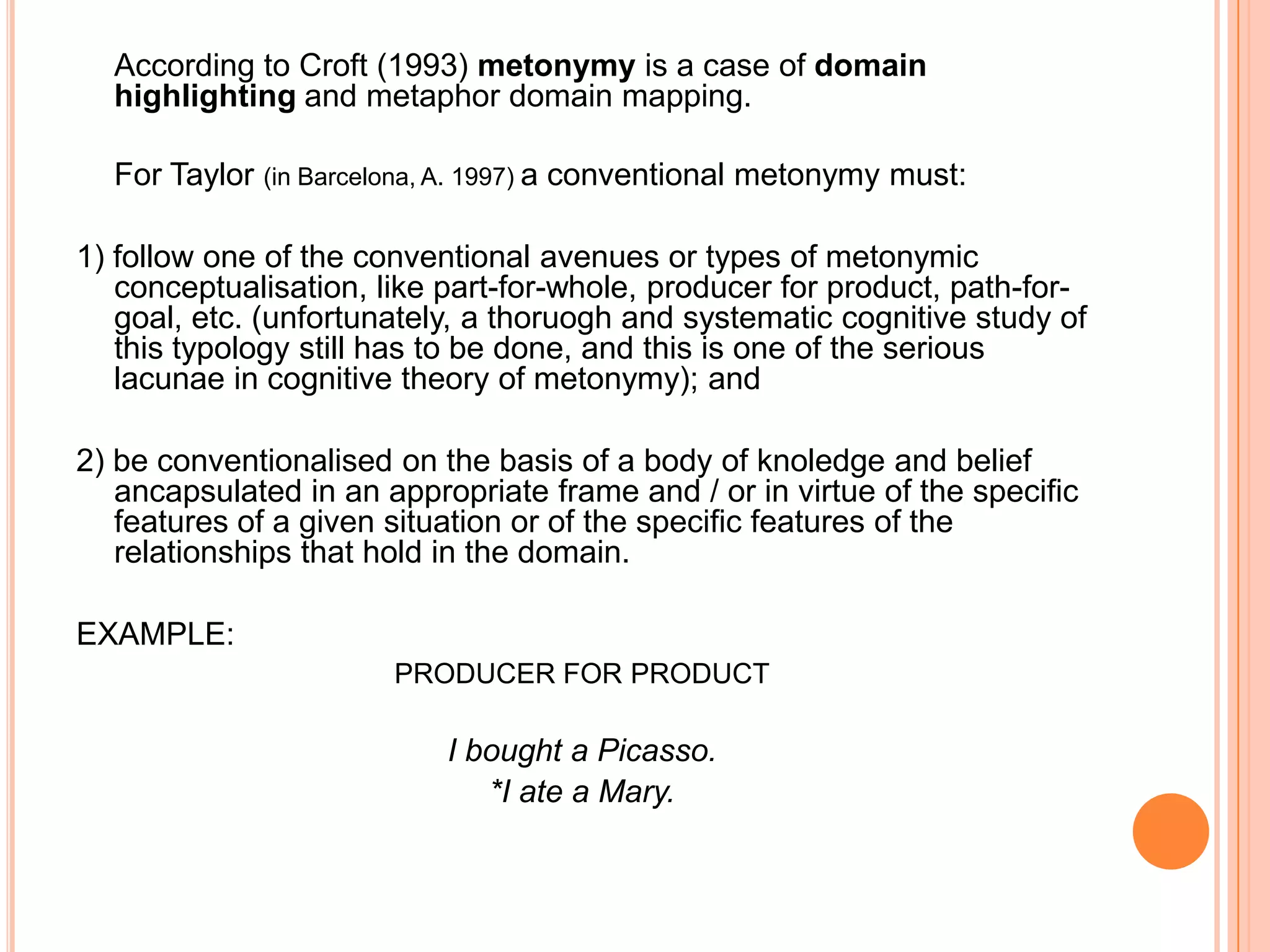
According to Croft (1993) metonymy is a case of domain
  highlighting and metaphor domain mapping.

  For Taylor (in Barcelona, A. 1997) a conventional metonymy must:

1) follow one of the conventional avenues or types of metonymic
   conceptualisation, like part-for-whole, producer for product, path-for-
   goal, etc. (unfortunately, a thoruogh and systematic cognitive study of
   this typology still has to be done, and this is one of the serious
   lacunae in cognitive theory of metonymy); and

2) be conventionalised on the basis of a body of knoledge and belief
   ancapsulated in an appropriate frame and / or in virtue of the specific
   features of a given situation or of the specific features of the
   relationships that hold in the domain.

EXAMPLE:
                       PRODUCER FOR PRODUCT

                           I bought a Picasso.
                              *I ate a Mary.
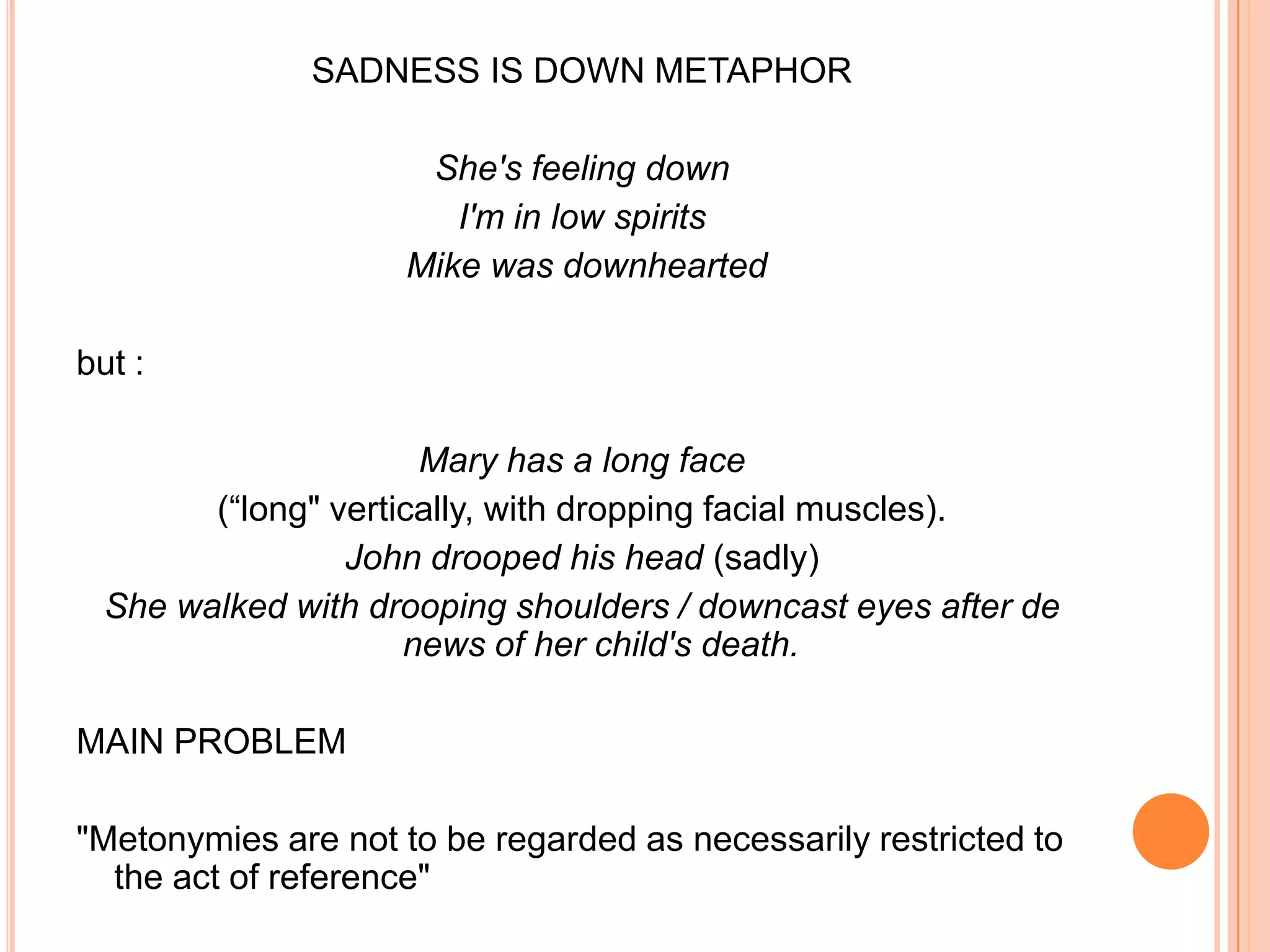
SADNESS IS DOWN METAPHOR

                      She's feeling down
                        I'm in low spirits
                     Mike was downhearted

but :

                      Mary has a long face
        (“long" vertically, with dropping facial muscles).
                 John drooped his head (sadly)
  She walked with drooping shoulders / downcast eyes after de
                     news of her child's death.

MAIN PROBLEM

"Metonymies are not to be regarded as necessarily restricted to
  the act of reference"
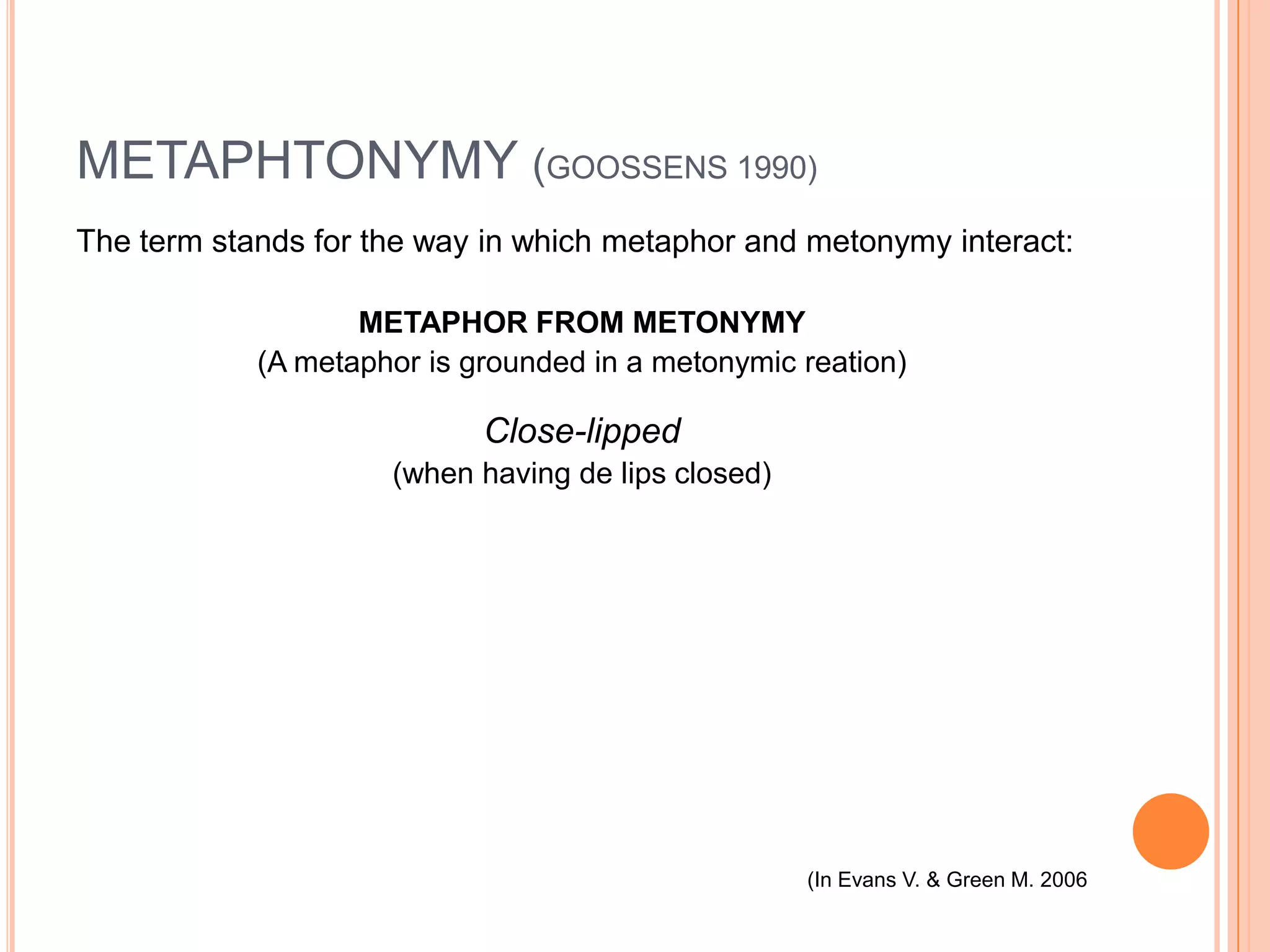
METAPHTONYMY (GOOSSENS 1990)
The term stands for the way in which metaphor and metonymy interact:

                   METAPHOR FROM METONYMY
            (A metaphor is grounded in a metonymic reation)

                            Close-lipped
                     (when having de lips closed)


                                                    (In Evans V. & Green M. 2006
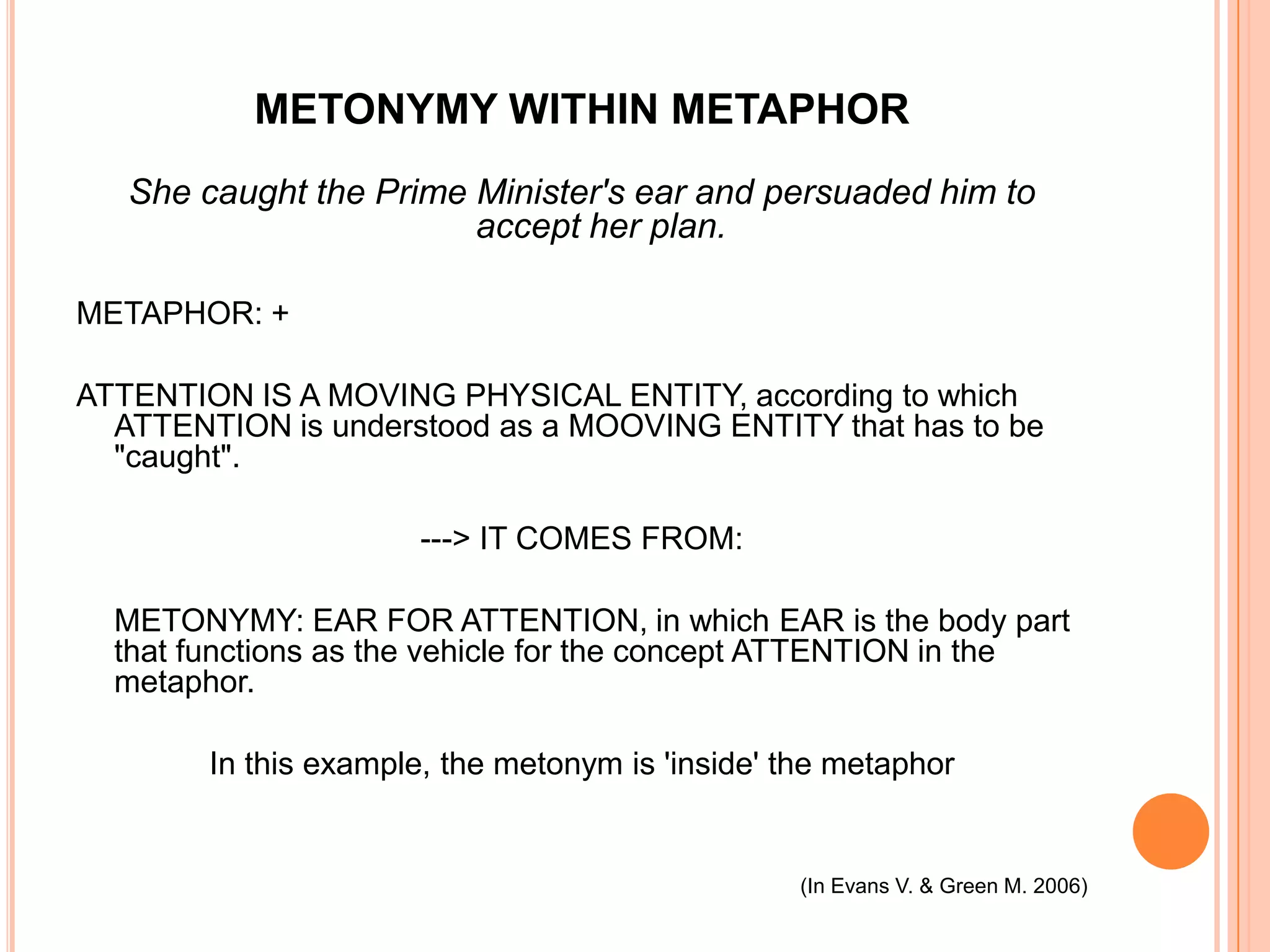
METONYMY WITHIN METAPHOR
   She caught the Prime Minister's ear and persuaded him to
                        accept her plan.

METAPHOR: +

ATTENTION IS A MOVING PHYSICAL ENTITY, according to which
  ATTENTION is understood as a MOOVING ENTITY that has to be
  "caught".

                       ---> IT COMES FROM:

  METONYMY: EAR FOR ATTENTION, in which EAR is the body part
  that functions as the vehicle for the concept ATTENTION in the
  metaphor.

        In this example, the metonym is 'inside' the metaphor


                                                  (In Evans V. & Green M. 2006)
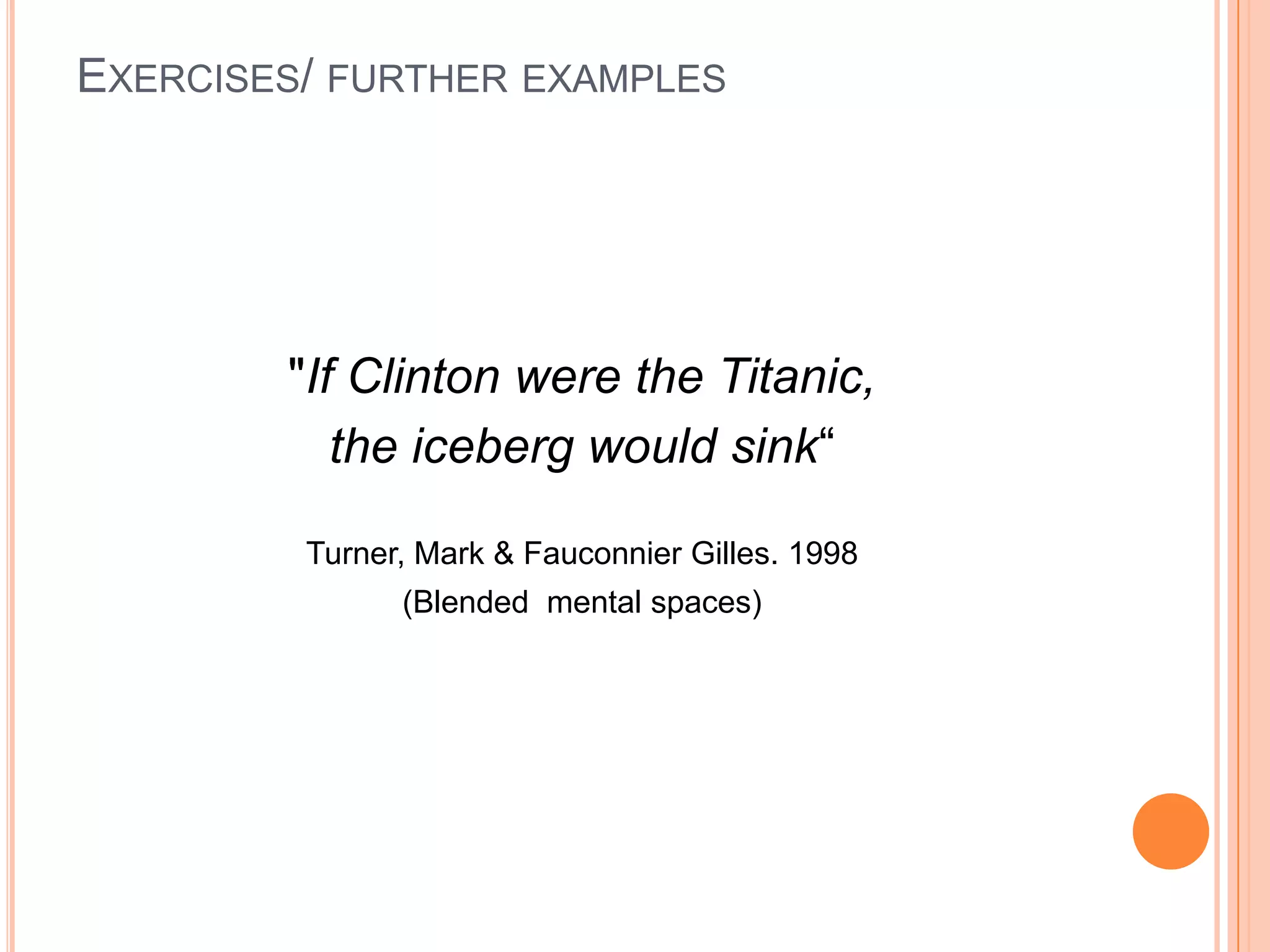
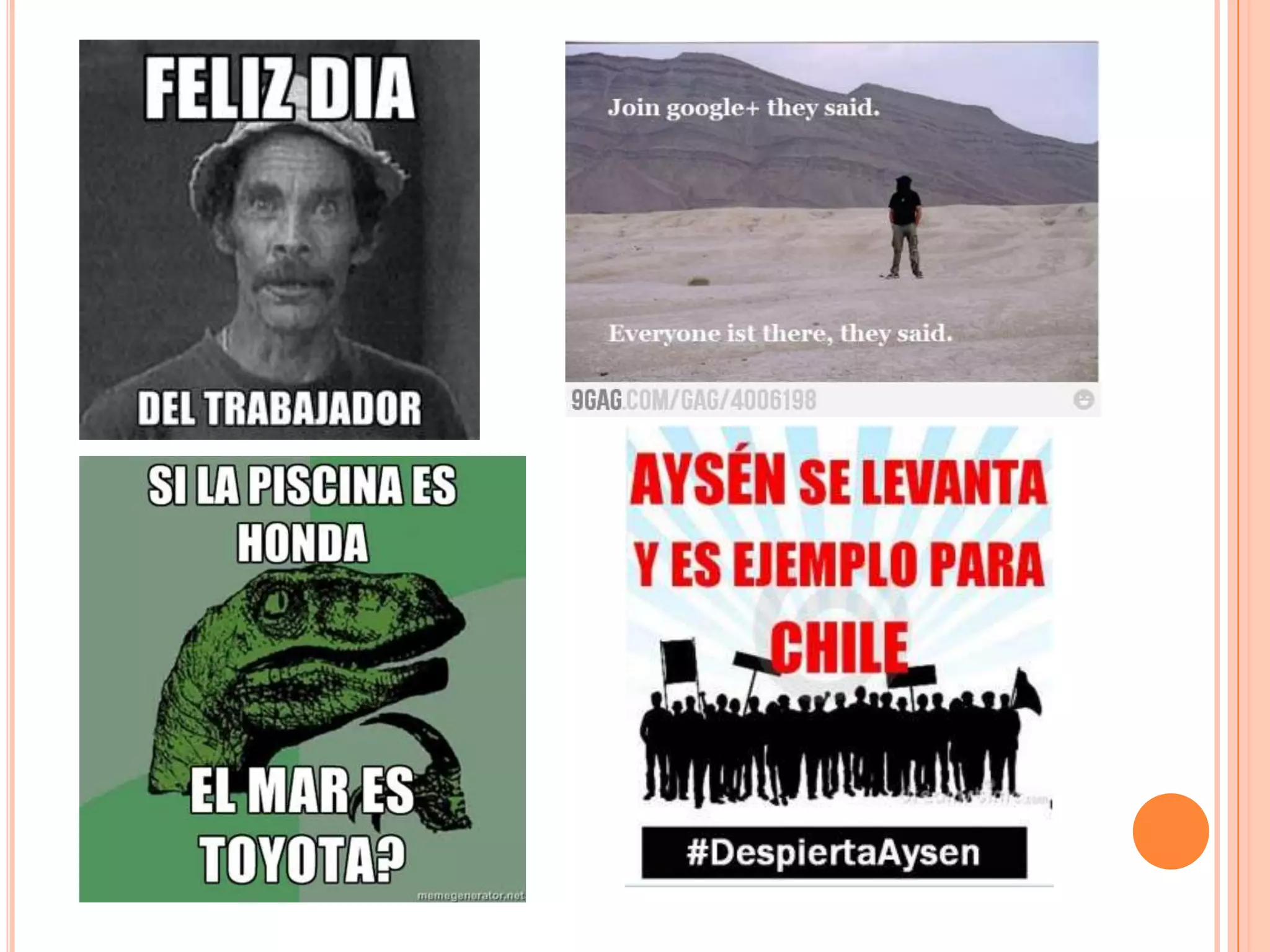
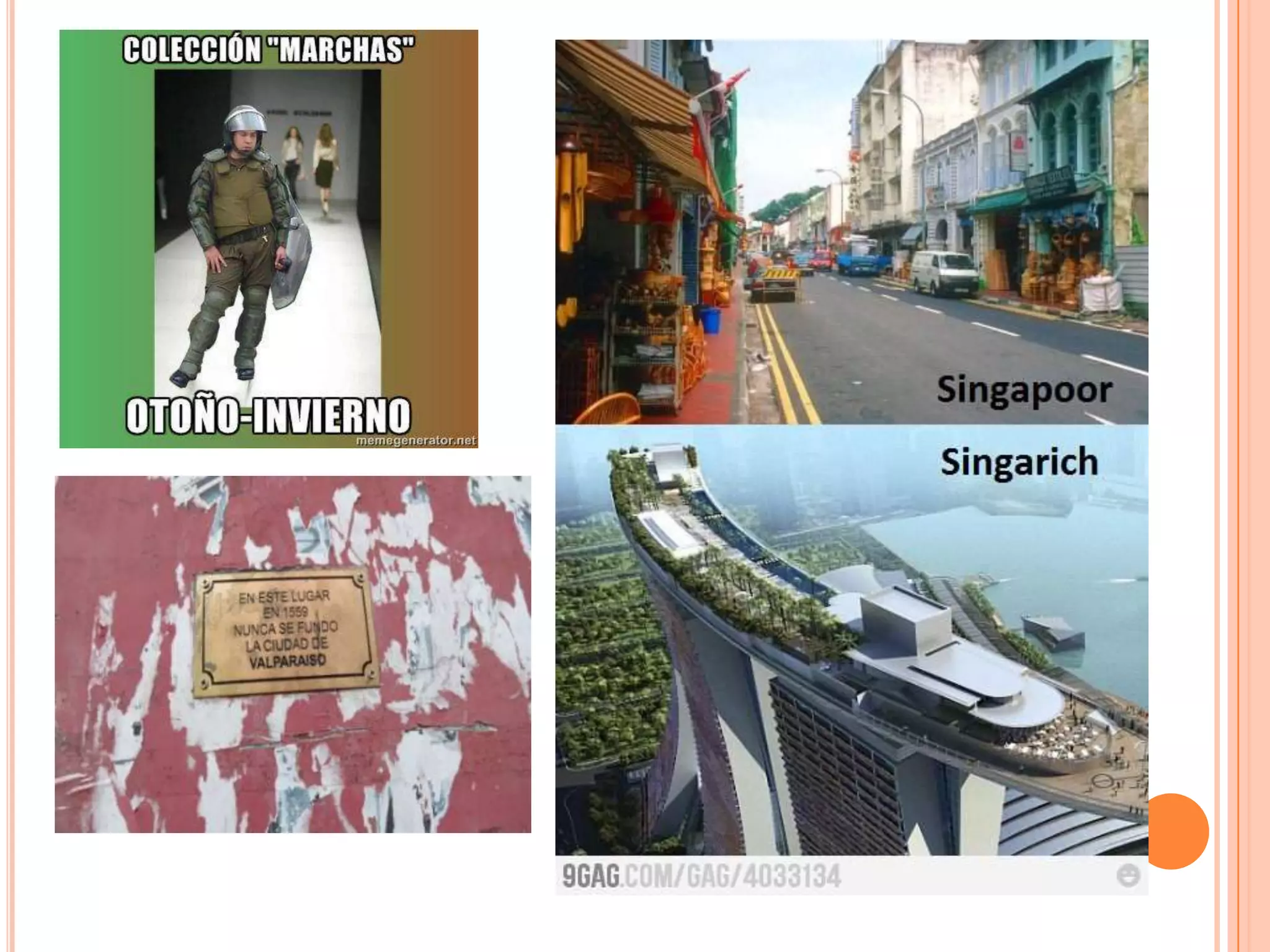
EXERCISES/ FURTHER EXAMPLES


        "If Clinton were the Titanic,
           the iceberg would sink“

         Turner, Mark & Fauconnier Gilles. 1998
               (Blended mental spaces)
Conclusions (from Lakoff: 2003)
   Most of our fundamental concepts are organized in terms of one or
    more spatialization metaphors.
   There is an internal systematicity to each spatialization metaphor.
   There is an overall external systematicity among the various
    spatialization metaphors, which defines coherence among them.
   Spatialization metaphors are rooted in physical and cultural
    experience; they are not randomly assigned. A metaphor can serve
    as a vehicle for understanding a concept only by virtue of its
    experiential basis.
   There are many possible physical and social bases for metaphor.
    Coherence within the overall system seems to be part of the reason
    why one is chosen and not another.
   So-called purely intellectual concepts, e.g., the concepts in a
    scientific theory, are often—perhaps always—based on metaphors
    that have a physical and/or cultural basis.
PERSONAL CONCLUSIONS

   Metaphors seem to be pervasive in our everyday lives and
    they are present in all linguistic levels(Lexeme,syntax).

   Metaphor is a cognitive mechanism at a superordinate level of
    concepts. They work between DOMAINS.

   Metonymies function AT A specific DOMAIN.

   There seems to be evidence to support the view that
    metaphors are not necesarilly unidirectional, but they can be
    by(multy)directional (“If Clinton were the Titanic, the iceberg
    would sink“)
REFERENCES
   Barcelona, A. 1997. Clarifying and Applying the Notions of Metaphor and
    metonymy within cognitive linguistics. Universidad de Murcia. Atlantis XIX(1)

   Evans V. & Green M. 2006. Cognitive Linguistics, an Introduction. Lawrence
    Erlbaum Associates, Publishers. London.

   FASS,Dan C. 1988. Metonymy and Metaphor: What´s the difference? Computing
    Research Laboratory, New Mexico State University, USA.

   Lakoff, George. 1998. Metaphor and Thought. Second Edition. Cambridge
    University Press. United Kingdom.

   Lakoff, G. Johnsen M. 2003 Metaphors we live by. London: The university of
    Chicago press.

   Reddy, M. 1978. The Conduit Metaphor- A Case of Frame Conflict in Our
    Language about Language.

   Turner, M. & Fauconnier G. 1998:Metaphor, Metonymy, and Binding. Antonio
    Barcelona. A volume in the series Topics in English Linguistics.

Metaphor and metonymy franklin delacruz

  • 1.
  • 2.
    "Mine eye andheart are at a mortal war How to divide the conquest of thy sight" William Shakespeare After all, if thoughts can be "inserted," there must be a space "inside" where meaning can reside. Michael Reddy We act according to the way we consive of things George Lakoff
  • 3.
    CONTENTS  Definitions  Metaphorand Metonymy  Examples of metaphor  Examples of metonymy  The conduit metaphor  Some other views on the subject  Metaphtonymy  Exercises / further examples  Conclusions  Reference
  • 4.
    DEFINITIONS Merriam Webster dictionary 1Metaphor: a figure of speech in which a word or phrase literally denoting one kind of object or idea is used in place of another to suggest a likeness or analogy between them (as in drowning in money); broadly : figurative language — compare simile 2: an object, activity, or idea treated as a metaphor : symbol 2 “He was drowning in paperwork” DEAD METAPHOR: word or phrase that has lost its metaphoric force through common usage. “as time is running out”
  • 5.
    Webster Dictionary METONYMY: afigure of speech consisting of the use of the name of one thing for that of another of which it is an attribute or with which it is associated (as “crown” in “lands belonging to the crown”)
  • 6.
    METAPHOR Metaphor(Evans 2006) is the phenomenon where one conceptual domain is structured in terms of another: Your claims are indefensible. (Lakoff 2003) Metaphor: ARGUMENT IS WAR 'X understood in terms of Y'
  • 7.
    METONYMY Lakoff andJohnson argue that metonomy -just as metaphor- is conceptual in nature (Lakoff 1980) Some scholars have suggested that metonymy is even a more fundamental concept than metaphor and some have claimed that metaphor itself has a metonymyc basis (Evans: 2006). The ham sandwich has wandering hands Here, two entities are associated so that one entity (the ham sandwich) stands for the other (the costumer). 'X stands for Y'
  • 8.
    METAPHOR AND METONYMY Philosophersand cognitive linguists have shown that metaphors and metonymies are powerful cognitive tools for our conceptualization of abstract categories. (Ungerer & Smith 1997) Along the scholar tradition metaphor and metonymy form part of the literary field, among the studies of style and rethoric thecniques (i.e. figures of speech).
  • 9.
    Metaphor has traditionallybeen based on the notions 'similarity' or 'comparison' between the literal and the figurative meaning of an expression. Eye of heaven EYE AND SUN Metonymy involves a relation of 'contiguity' (i.e. nearnes or neighbourhood) between what is denoted by the literal meaning of the word and its figurative counterpart. The buses are on strike +CONTROLLED FOR CONTROLLER+ (Ungerer & Smith 1997)
  • 10.
    The essence ofmetaphor lies in an interaction between a metaphorical expression and the context in which it is used:
  • 11.
    TYPES OF CONTIGUITY-RELATIONSIN METONYMY +PART FOR WHOLE+ all hands on deck +WHOLE FOR PART+ to fill up the car +CONTAINER FOR CONTENT+ I'll have a glass +MATERIAL FOR OBJECT+ a glass, an iron +PRODUCER FOR PRODUCT+ have a Lowenbraw, buy a Ford +PLACE FOR INSTITUTION+ talks between Washington and Moscow +PLACE FOR EVENT+ Watergate changed our politics +CONTROLLED FOR CONTROLLER+ the buses are on strike +CAUSE FOR EFFECT+
  • 12.
    Conventionalized Metaphors According toUllmann (1962:21ff) and Leech (1969: 158), the most frecuent types of conventionalized metaphors are:  concretive metaphors (the light of learning, a vicious circle)  animistic metaphors (and angry sky, killing half an hour)  humanizing metaphors (a charming river, a friendly city)  synaesthetic metaphors (a warm colour, a dull sound)  'Lexicalized´ (“over”)metaphors impose a multiple categorization on the entities in the world (Lipka 1992: 123ff): one word refers to several categories.
  • 13.
    METAPHOR AND 'DEAD'METAPHOR Metaphor and metonymy are not just figures of speech in literature but also pervasive in everyday language. There are metaphors related to style (i.e. Shakespeare´s style) Those not related to style: 'dead' or lexicalized metaphor: 'the head-of-department„ The (association of) meanings have become lexicalized. The metaphorical force of the word is no longer active, the metaphor is 'dead'. (Ungerer & Smith 1997)
  • 14.
    METAPHOR AS LEXICALENTRY AND COGNITIVE PROBLEM Metaphors are not just a way of expressing ideas by means of language, but a way of thinking about things. Lakoff and Johnsons (1980:7f) argue that we do not just exploit the metaphor +time is money+ linguistically, but we actually think of, or conceptualize, the so called 'target' category 'TIME' via the 'source' category MONEY: You're wasting my time. Can you give me a few minutes. How do you spend your time. We are running out of time. Is that worth your while?
  • 15.
    METONYMY (FASS 1988) In a metonymy, the name of one thing is substituted for that of another related to it: Container for Contents Denise drank the bottle = the liquid in the bottle Dave drank the glasses = the liquid in the glasses The kettle is boiling. = the liquid in the kettle (Waldron 1967, p.186; Yamanashi 1987, p.78)
  • 16.
    Examples of Metaphor ARGUMENTIS WAR  Your claims are indefensible.  He attacked every weak point in my argument. His criticisms were right on target.  I demolished his argument.  I've never won an argument with him.  You disagree? Okay, shoot!  If you use that strategy, he'll wipe you out. He shot down all of my arguments. TIME IS A VALUABLE COMODITY  I don't have the time to give you.  How do you spend your time these days? That flat tire cost me an hour. I've invested a lot of time in her.  I don't have enough time to spare for that. You're running out of time.  You need to budget your time.  Put aside some time for ping pong. Is that worth your while?
  • 17.
    The Conduit Metaphor(From M. Reddy, in Lakoff 2003) IDEAS (Or MEANINGS) ARE OBJECTS. LINGUISTIC EXPRESSIONS ARE CONTAINERS. COMMUNICATION IS SENDING. It's hard to get that idea across to him. I gave you that idea. Your reasons came through to us. It's difficult to put my ideas into words. When you have a good idea, try to capture it immediately in words. Try to pack more thought into fewer words.
  • 18.
    Other examples: orientationalmetaphors HAPPY IS UP; SAD IS DOWN I'm feeling up. That boosted my spirits. I'm feeling down. I'm depressed. CONSCIOUS IS UP; UNCONSCIOUS IS DOWN Get up. Wake up. I'm up already. He's under hypnosis. He sank into a coma. MORE IS UP; LESS IS DOWN The number of books printed each year keeps going up. His income fell last year. He is underage. (Lakoff:2003)
  • 19.
    Examples of metonymy  He likes to read the Marquis de Sade. (= the writings of the marquis)  He's in dance. (= the dancing profession)  Acrylic has taken over the art world. (= the use of acrylic paint)  The Times hasn't arrived at the press conference yet. (= the reporter from the Times) Mrs. Grundy frowns on blue jeans. (= the wearing of blue jeans)  New windshield wipers will satisfy him. (= the state of hav-ing new wipers) THE PART FOR THE WHOLE  The automobile is clogging our highways. (= the collection of automobiles)  We need a couple of strong bodies for our team. (= strong people)  There are a lot of good heads in the university. (= intelligent people)  I've got a new set of wheels. (= car, motorcycle. etc.)  We need some new blood in the organization. (= new people)
  • 20.
    Other examples ofmetonymy THE FACE FOR THE PERSON.  She's just a pretty face.  We need some new faces around here. THE PART FOR THE WHOLE  Get your butt over here! We don't hire longhairs.  The Giants need a stronger arm in right field. PRODUCER FOR PRODUCT  He bought a Ford.  He's got a Picasso in his den. I hate to read Heidegger. INSTITUTION FOR PEOPLE RESPONSIBLE  Exxon has raised its prices again.  You'll never get the university to agree to that.
  • 21.
    Other views onthe subject: metaphor.  Barcelona, A. 1997.  Metaphor is the cognitive mechanism whereby one experiential domain (in the sense of Langacker, 1987, Ch. 4) is partially mapped onto a different experential domain, the second domain being partially understood in terms of the first one.  The domain that is mapped is called the source or donor domain, and the domain onto wich it is mapped is called the targfet or recipient domain.  Both domains have to belong to different superordinate domains.  METAPHOR: UNDERSTANDING IS SEEING I cant see the solution His theory has thrown light on this problem The candidate's speech was not really transparent enough. There were many dark points in it. Transference: this metaphorical mapping transfers a large number of attributes, entities and propositions from the experential domain of sight to the experiential domain of understanding
  • 22.
    Barcelona, A. 1997. METAPHORICALMAPPING By "metaphorical mapping" we should simply understand a set of fixed conceptual correspondences, not a real-time algorithmic process by meaqns of which we startr out at the source domain semantic structure and then we end up at the target domain one (lakoff 1993b) IMAGE-SCHEMAS Image-echemas are prelinguistic cognitive structures, many of which are acquired from the earliest experiences upon which our complete cognitive development is based: kinaesthetic experiential-cognitive structures like "container", "part-whole", "front"-back", "up-down", "source-path-goal", "link", "centre-periphery". These experiential blocks are often extremely simple, and are used in the formation of most (if not all) basic concepts. For example, the concept of "journey" is grounded on the "source-path-goal" schema.
  • 23.
    EXAMPLES: Submaping or correspondencesbetween the source and the target domains:  The act of seeing corresponds to the act of understanding  The person that sees is the person that understand.  An increase in light on an object corresponds to an increase in the likelihood for something to be understood.  Impediments to seeing corresponds to impediments to understanding. INVARIANCE HYPOTHESIS (Lakoff & Turner 1989) Main constraint in metaphorical mappings: Both domains share at least in part their image schematic structure, then the mapping is possible.
  • 24.
    Other views onthe subject: metonymy METONYMY (Barcelona, A. 1997).  Metonymy is a cognitive mechanism whereby one experiential domain is partially understood in terms of another experiential domain included in the same common experential domain. Washington is insensitive to the needs of the people The domain that is mapped is called the source or donor domain, and the domain onto which it is mapped is called the target or recipient domain. Both domains have to belong to different superordinate domains.  Within the common domain of the capital city of the United States, we have, among other, the subdomains of the city itself as a location, the subdomain of the political institutions located in it, and further in the background, the subdomain of the people that make the decisions in those political institutions (the President, the department secretaries, the senators and congressmen, etc.)  Via metonymy, one of these subdomains, namely, that of the political institutions are also highlighted and referred to via an additional conventional metonymy, in wich the institutions stand for the people that have a prominent role in them.
  • 25.
    According to Croft(1993) metonymy is a case of domain highlighting and metaphor domain mapping. For Taylor (in Barcelona, A. 1997) a conventional metonymy must: 1) follow one of the conventional avenues or types of metonymic conceptualisation, like part-for-whole, producer for product, path-for- goal, etc. (unfortunately, a thoruogh and systematic cognitive study of this typology still has to be done, and this is one of the serious lacunae in cognitive theory of metonymy); and 2) be conventionalised on the basis of a body of knoledge and belief ancapsulated in an appropriate frame and / or in virtue of the specific features of a given situation or of the specific features of the relationships that hold in the domain. EXAMPLE: PRODUCER FOR PRODUCT I bought a Picasso. *I ate a Mary.
  • 26.
    SADNESS IS DOWNMETAPHOR She's feeling down I'm in low spirits Mike was downhearted but : Mary has a long face (“long" vertically, with dropping facial muscles). John drooped his head (sadly) She walked with drooping shoulders / downcast eyes after de news of her child's death. MAIN PROBLEM "Metonymies are not to be regarded as necessarily restricted to the act of reference"
  • 27.
    METAPHTONYMY (GOOSSENS 1990) Theterm stands for the way in which metaphor and metonymy interact: METAPHOR FROM METONYMY (A metaphor is grounded in a metonymic reation) Close-lipped (when having de lips closed) (In Evans V. & Green M. 2006
  • 28.
    METONYMY WITHIN METAPHOR She caught the Prime Minister's ear and persuaded him to accept her plan. METAPHOR: + ATTENTION IS A MOVING PHYSICAL ENTITY, according to which ATTENTION is understood as a MOOVING ENTITY that has to be "caught". ---> IT COMES FROM: METONYMY: EAR FOR ATTENTION, in which EAR is the body part that functions as the vehicle for the concept ATTENTION in the metaphor. In this example, the metonym is 'inside' the metaphor (In Evans V. & Green M. 2006)
  • 29.
    EXERCISES/ FURTHER EXAMPLES "If Clinton were the Titanic, the iceberg would sink“ Turner, Mark & Fauconnier Gilles. 1998 (Blended mental spaces)
  • 32.
    Conclusions (from Lakoff:2003)  Most of our fundamental concepts are organized in terms of one or more spatialization metaphors.  There is an internal systematicity to each spatialization metaphor.  There is an overall external systematicity among the various spatialization metaphors, which defines coherence among them.  Spatialization metaphors are rooted in physical and cultural experience; they are not randomly assigned. A metaphor can serve as a vehicle for understanding a concept only by virtue of its experiential basis.  There are many possible physical and social bases for metaphor. Coherence within the overall system seems to be part of the reason why one is chosen and not another.  So-called purely intellectual concepts, e.g., the concepts in a scientific theory, are often—perhaps always—based on metaphors that have a physical and/or cultural basis.
  • 33.
    PERSONAL CONCLUSIONS  Metaphors seem to be pervasive in our everyday lives and they are present in all linguistic levels(Lexeme,syntax).  Metaphor is a cognitive mechanism at a superordinate level of concepts. They work between DOMAINS.  Metonymies function AT A specific DOMAIN.  There seems to be evidence to support the view that metaphors are not necesarilly unidirectional, but they can be by(multy)directional (“If Clinton were the Titanic, the iceberg would sink“)
  • 34.
    REFERENCES  Barcelona, A. 1997. Clarifying and Applying the Notions of Metaphor and metonymy within cognitive linguistics. Universidad de Murcia. Atlantis XIX(1)  Evans V. & Green M. 2006. Cognitive Linguistics, an Introduction. Lawrence Erlbaum Associates, Publishers. London.  FASS,Dan C. 1988. Metonymy and Metaphor: What´s the difference? Computing Research Laboratory, New Mexico State University, USA.  Lakoff, George. 1998. Metaphor and Thought. Second Edition. Cambridge University Press. United Kingdom.  Lakoff, G. Johnsen M. 2003 Metaphors we live by. London: The university of Chicago press.  Reddy, M. 1978. The Conduit Metaphor- A Case of Frame Conflict in Our Language about Language.  Turner, M. & Fauconnier G. 1998:Metaphor, Metonymy, and Binding. Antonio Barcelona. A volume in the series Topics in English Linguistics.