Pretreatment / Electrocoat Trends
PPG Substrate Protection, November 16th,2011
Trends impacting Electrocoat
Mega Trends in Automotive
                  supported by Coatings

• Weight reduction         Paint consumption
                           Low density products
                           Treatment of Aluminum
• Environmental            Waste water, chemical
  foot print               consumption, energy
                           saving, lower toxicity of
                           used ingredients
• Reduced complexity       Shorter process, less
  and capital investment   process steps
Pretreatment
Drivers and Status for Alternatives
         to Tri-Cationic Phosphate
Pretreatment Market Outlook

•   Continued growth in thin film
    (zirconium) based pretreatments

•   Tri-cationic ZnPO4 pretreatment
    still significant technology
    through 2020.

•   Growth of alternate ZnPO4
    technologies to deal with high
    aluminum content

•   Performance to OEM requirements for
    Green Pretreatment is required

•   Pretreatment elimination system
    expected in market by 2015
Drivers for Technology Change
                     to Green Pretreatment
Drivers
• Shorter process – 7 stages versus 10 stages
• Substantial reduction of energy, waste water, chemicals
  and man power
   – Ni free, Phosphate free, 90% less sludge
   – Less heavy metal salts
   – Simplified waste and sludge management
• No limitation of Aluminum per vehicle
• Shorter process
Current Limitations
• Corrosion performance versus zinc phosphate controls
• Results depend on substrate and corrosion test used
Zircobond® Market Status/
                    Experience

• 12 commercial lines operating (first in 2007)

• Light vehicle and commercial vehicle (HDT) operations
  (including immersion, spray and 100% aluminum)

• Multiple electrocoat and topcoat systems

• PPG is leader in thin film pretreatment with over 2.0MM
  vehicles coated globally
Electrocoat

Drivers for new developments in coming years
Main Drivers for Electrocoat
                 Development

• Performance
  –   Compatibility with Green Pretreatments
  –   Compatibility with Compact Top Coat Systems
  –   Throw Power and optimized consumption
  –   Bake temperature
• Environmental
  – Avoid and minimize risk for EH&S
  – Energy and waste water reduction
• Economics
  – Work on alleviating escalating raw material costs
Electrocoat

Adaptation to green pretreatments
Role of Electro coat with
                   Green Pretreatment?

                          Electrocoat Countermeasures
• Throw Power                Electrocoat deposition
  & thickness deviation      characteristics and wet film
                             resistance
• Visibility of              Increased robustness
  pretreatment defects       via e-coat formulation

• Performance                Excellent cross linking
                             providing best adhesion
                             and corrosion
Dynamic Voltage measurements

                    Deposition on Phosphate pretreatment                                     Deposition on Green pretreatment
              350
                                                                                   350
              300
                                                                                   300
              250                                                                  250
Voltage (V)


                                                                     Voltage (V)
              200                                                                  200

              150                                                                  150

              100                                                                  100

               50                                                                   50

               0                                                                    0
                    0         50          100            150   200                       0          50          100            150   200
                                   Deposition time (s)                                                   Deposition time (s)


                •       Dynamic measurement of local potential differences in exterior surfaces
                        and inner surfaces were measured with a submarine device on
                        phosphatation or green pretreatment.
                •       The reached potential differences in the box sections are low in the
                        case of the green pretreatment, the electrocoat has to compensate this
                        difference.
Throw Box Set Up

             4 panels with
             2.0 cm spacing
             between each panel


     Goal: Maximize film build “G/A face“
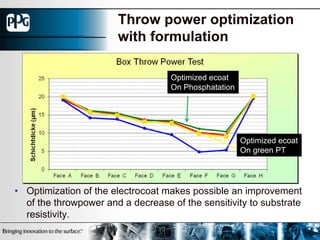
Throw power optimization
                       with formulation

                                   Optimized ecoat
                                   On Phosphatation


                                                      Optimized ecoat
                                                      On green PT


• Optimization of the electrocoat makes possible an improvement
  of the throwpower and a decrease of the sensitivity to substrate
  resistivity.
Deposition results of inner
                         sections
Body treated                                               Body treated with
with standard                                              Zircobond®
phosphatation                                              PPG Electrocoat
PPG
Electrocoat


   • With suitable electrocoat formulation, appropriate process
     optimization, same film build distribution outside and inside can be
     reached.
Electrocoat

Impact of compact process
Role of Electrocoat in
                         Compact Top Coat Processes?
Electrocoat


                               Electrocoat Countermeasures
• Appearance               Electrocoat smoothness and
                           maintained good edge coverage
• Less Sanding             Process Robustness
   (no primer surfacer
   sanding deck)
• Less cure                Excellent cure response
   (no primer surfacer cure)
Industrial experience
• European lines Running in Compact processes
  with PPG electrocoat:
          BMW         Oxford
          Daimler     Rastatt L1 & L2
          Daimler     Kesckemet
          PSA         Trnava
          Ford        Craiova
          PSA         Sochaux (SOP Q1 2012)
          RSA         Valladolid (SOP Q1 2012)

• Compact process top-coats are a reality, all car
  manufacturers are going in this direction.
Electrocoat adaptation


• PPG is running successfully the electrocoat at different
  customers where compact top-coats are used.

• Key parameters are the robustness of the couple product-
  process, on a given line:
   –   Good levelling of substrate roughness
   –   No dirt
   –   No mapping
   –   No external contamination (Oil, phosphate, …)

                 To avoid sanding operations
Impact of the structure of the
                      substrate
      40                                                    100
                         LW      SW/2     DOI
      35
                                                            95
      30


       25
                                                            90
      W
      S                                                           I
      &20                                                         O
                                                                  D
      W
      L
                                                            85
       15


      10
                                                            80
       5


       0                                                    75


The final appearance is also depending of the substrate smoothness
Electrocoat

Hyperthrow concept
HyperThrow Concept
                in Enviro-Prime® 7000
Electrocoat


                 Electrocoat Countermeasures
• Reduced        High Throw concept
  Consumption    to reduce outside film builds at
                 same inside film builds.
                 Reduced energy and water
                 Reduced weight Loss
• Improved       For difficult designed areas
  Throw          To eliminate interior anodes
                 To allow higher through put
Enviro-Prime® 7000
Electrocoat
                                    Optimize Usage: The Innovation

       Description

       PPG developed a Hyper Throw Electrocoat Coating via
        use of the following Design Principles :

          Increased Wet Film Resistivity which allows the paint to
          insulate with less film build (i.e. lower exterior film build)

          Increased Deposition Speed which increases time for coating
          of recessed areas (i.e. increase interior film build)

              High Throw Electrocoat is driven by deposition dynamics!!!
Enviro-Prime® 7000 Design Intent
                                      – Reduce Excessive Film Build
                                  ED7 vs Traditional ED ‐ Film Build Distribution
                                                     ED7        Std ED
  Required for
  Appearance
       A = Verticles, Hood


       V   B = Roof, Underbody

       e
       h
                  C = Floor Pan
       i
       c
       l
                 D = Recessed
       e

       A          E = Recessed
                                                                                  Excessive Film Builds
       r
       e
       a          F = Recessed


                    G = Rocker


Required for     0                        5                10                15         20         25
                                                           Film Build (Microns)
Corrosion Resistance
Enviro-Prime® 7000 Project
                              Status
Electrocoat


     • Commercial at 2 global car manufacturers

     • 20 production lines (NA, EU and Asia Pacific)
              − 15-20 additional lines planned in coming 6-12 months


     • Approved at 3 other global OEM’s

     • In use over both zinc phosphate and green pretreatments

     • Development nearing completion with non-heavy metal
       catalyst system
Enviro-Prime® 7000 Attributes

Advantages of Hyper-Throwpower Electrocoat
• Lower Overall Electrocoat Usage
   – High Throwpower Technology
   – Low Weight Loss & Low P/B Technology
• Factory Savings / Potential Benefits
   –   Lower Power Consumption
   –   Lower DI Water Consumption
   –   Potential Additional Areas for Savings
   –   Potential for Increased Throughput
   –   Potential for improved overall corrosion performance due to better inner
       recess coverage
• Environmental Benefits
   – Lower Vehicle Emissions
   – Lower Water Usage
Thanks for your attention !

In case of questions:
Philippe Bouden
Technical Manager Electrocoat Europe


bouden@ppg.com
+33 327 193 815

Philippe Bouden - Pretreatment / Electrocoat Trends

  • 1.
    Pretreatment / ElectrocoatTrends PPG Substrate Protection, November 16th,2011
  • 2.
  • 3.
    Mega Trends inAutomotive supported by Coatings • Weight reduction Paint consumption Low density products Treatment of Aluminum • Environmental Waste water, chemical foot print consumption, energy saving, lower toxicity of used ingredients • Reduced complexity Shorter process, less and capital investment process steps
  • 4.
    Pretreatment Drivers and Statusfor Alternatives to Tri-Cationic Phosphate
  • 5.
    Pretreatment Market Outlook • Continued growth in thin film (zirconium) based pretreatments • Tri-cationic ZnPO4 pretreatment still significant technology through 2020. • Growth of alternate ZnPO4 technologies to deal with high aluminum content • Performance to OEM requirements for Green Pretreatment is required • Pretreatment elimination system expected in market by 2015
  • 6.
    Drivers for TechnologyChange to Green Pretreatment Drivers • Shorter process – 7 stages versus 10 stages • Substantial reduction of energy, waste water, chemicals and man power – Ni free, Phosphate free, 90% less sludge – Less heavy metal salts – Simplified waste and sludge management • No limitation of Aluminum per vehicle • Shorter process Current Limitations • Corrosion performance versus zinc phosphate controls • Results depend on substrate and corrosion test used
  • 7.
    Zircobond® Market Status/ Experience • 12 commercial lines operating (first in 2007) • Light vehicle and commercial vehicle (HDT) operations (including immersion, spray and 100% aluminum) • Multiple electrocoat and topcoat systems • PPG is leader in thin film pretreatment with over 2.0MM vehicles coated globally
  • 8.
    Electrocoat Drivers for newdevelopments in coming years
  • 9.
    Main Drivers forElectrocoat Development • Performance – Compatibility with Green Pretreatments – Compatibility with Compact Top Coat Systems – Throw Power and optimized consumption – Bake temperature • Environmental – Avoid and minimize risk for EH&S – Energy and waste water reduction • Economics – Work on alleviating escalating raw material costs
  • 10.
  • 11.
    Role of Electrocoat with Green Pretreatment? Electrocoat Countermeasures • Throw Power Electrocoat deposition & thickness deviation characteristics and wet film resistance • Visibility of Increased robustness pretreatment defects via e-coat formulation • Performance Excellent cross linking providing best adhesion and corrosion
  • 12.
    Dynamic Voltage measurements Deposition on Phosphate pretreatment Deposition on Green pretreatment 350 350 300 300 250 250 Voltage (V) Voltage (V) 200 200 150 150 100 100 50 50 0 0 0 50 100 150 200 0 50 100 150 200 Deposition time (s) Deposition time (s) • Dynamic measurement of local potential differences in exterior surfaces and inner surfaces were measured with a submarine device on phosphatation or green pretreatment. • The reached potential differences in the box sections are low in the case of the green pretreatment, the electrocoat has to compensate this difference.
  • 13.
    Throw Box SetUp 4 panels with 2.0 cm spacing between each panel Goal: Maximize film build “G/A face“
  • 14.
    Throw power optimization with formulation Optimized ecoat On Phosphatation Optimized ecoat On green PT • Optimization of the electrocoat makes possible an improvement of the throwpower and a decrease of the sensitivity to substrate resistivity.
  • 15.
    Deposition results ofinner sections Body treated Body treated with with standard Zircobond® phosphatation PPG Electrocoat PPG Electrocoat • With suitable electrocoat formulation, appropriate process optimization, same film build distribution outside and inside can be reached.
  • 16.
  • 17.
    Role of Electrocoatin Compact Top Coat Processes? Electrocoat Electrocoat Countermeasures • Appearance Electrocoat smoothness and maintained good edge coverage • Less Sanding Process Robustness (no primer surfacer sanding deck) • Less cure Excellent cure response (no primer surfacer cure)
  • 18.
    Industrial experience • Europeanlines Running in Compact processes with PPG electrocoat: BMW Oxford Daimler Rastatt L1 & L2 Daimler Kesckemet PSA Trnava Ford Craiova PSA Sochaux (SOP Q1 2012) RSA Valladolid (SOP Q1 2012) • Compact process top-coats are a reality, all car manufacturers are going in this direction.
  • 19.
    Electrocoat adaptation • PPGis running successfully the electrocoat at different customers where compact top-coats are used. • Key parameters are the robustness of the couple product- process, on a given line: – Good levelling of substrate roughness – No dirt – No mapping – No external contamination (Oil, phosphate, …) To avoid sanding operations
  • 20.
    Impact of thestructure of the substrate 40 100 LW SW/2 DOI 35 95 30 25 90 W S I &20 O D W L 85 15 10 80 5 0 75 The final appearance is also depending of the substrate smoothness
  • 21.
  • 22.
    HyperThrow Concept in Enviro-Prime® 7000 Electrocoat Electrocoat Countermeasures • Reduced High Throw concept Consumption to reduce outside film builds at same inside film builds. Reduced energy and water Reduced weight Loss • Improved For difficult designed areas Throw To eliminate interior anodes To allow higher through put
  • 23.
    Enviro-Prime® 7000 Electrocoat Optimize Usage: The Innovation Description PPG developed a Hyper Throw Electrocoat Coating via use of the following Design Principles : Increased Wet Film Resistivity which allows the paint to insulate with less film build (i.e. lower exterior film build) Increased Deposition Speed which increases time for coating of recessed areas (i.e. increase interior film build) High Throw Electrocoat is driven by deposition dynamics!!!
  • 24.
    Enviro-Prime® 7000 DesignIntent – Reduce Excessive Film Build ED7 vs Traditional ED ‐ Film Build Distribution ED7 Std ED Required for Appearance A = Verticles, Hood V B = Roof, Underbody e h C = Floor Pan i c l D = Recessed e A E = Recessed Excessive Film Builds r e a F = Recessed G = Rocker Required for 0 5 10 15 20 25 Film Build (Microns) Corrosion Resistance
  • 25.
    Enviro-Prime® 7000 Project Status Electrocoat • Commercial at 2 global car manufacturers • 20 production lines (NA, EU and Asia Pacific) − 15-20 additional lines planned in coming 6-12 months • Approved at 3 other global OEM’s • In use over both zinc phosphate and green pretreatments • Development nearing completion with non-heavy metal catalyst system
  • 26.
    Enviro-Prime® 7000 Attributes Advantagesof Hyper-Throwpower Electrocoat • Lower Overall Electrocoat Usage – High Throwpower Technology – Low Weight Loss & Low P/B Technology • Factory Savings / Potential Benefits – Lower Power Consumption – Lower DI Water Consumption – Potential Additional Areas for Savings – Potential for Increased Throughput – Potential for improved overall corrosion performance due to better inner recess coverage • Environmental Benefits – Lower Vehicle Emissions – Lower Water Usage
  • 27.
    Thanks for yourattention ! In case of questions: Philippe Bouden Technical Manager Electrocoat Europe bouden@ppg.com +33 327 193 815