LITERATURE
From the Philippines and the World
Ms. Rebekah C. Mambiar
Fiction
Literature in the form of prose,
especially short stories and novels,
that describes imaginary events and
people.
ELEMENTS
OF FICTION
PLOT
Plot
• the main events of a play, novel, movie,
or similar work, devised and presented
by the writer as an interrelated
sequence.
Plot
• Types of plot:
• Dramatic/Progressive/Chronological
• Episodic plot
• Parallel plot
• Flashback
• In medias res
Plot
• Types of plot:
• Dramatic/Progressive/Chronological plot
• Episodic plot
• Parallel plot
• Flashback
• In medias res
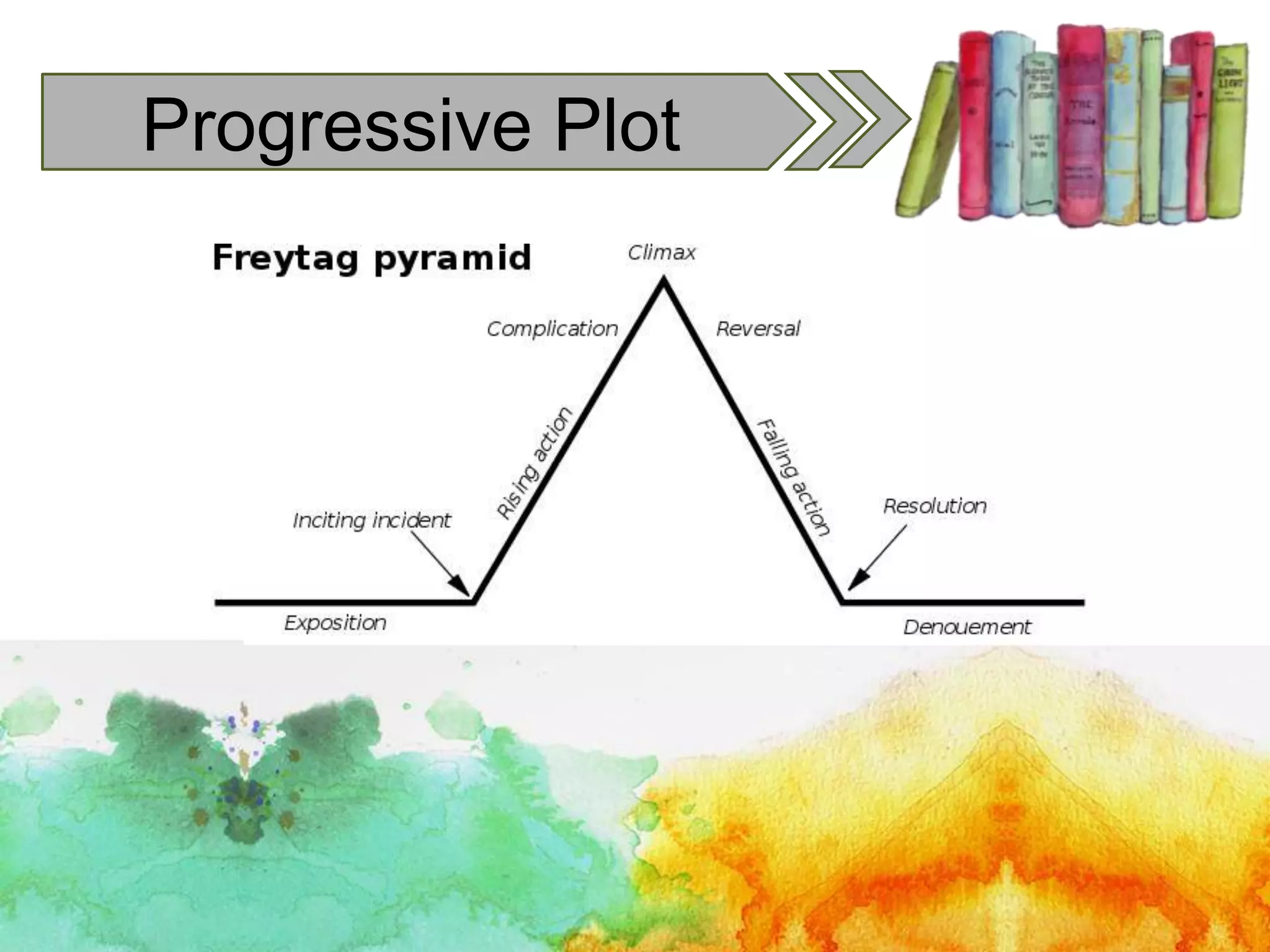
Progressive Plot
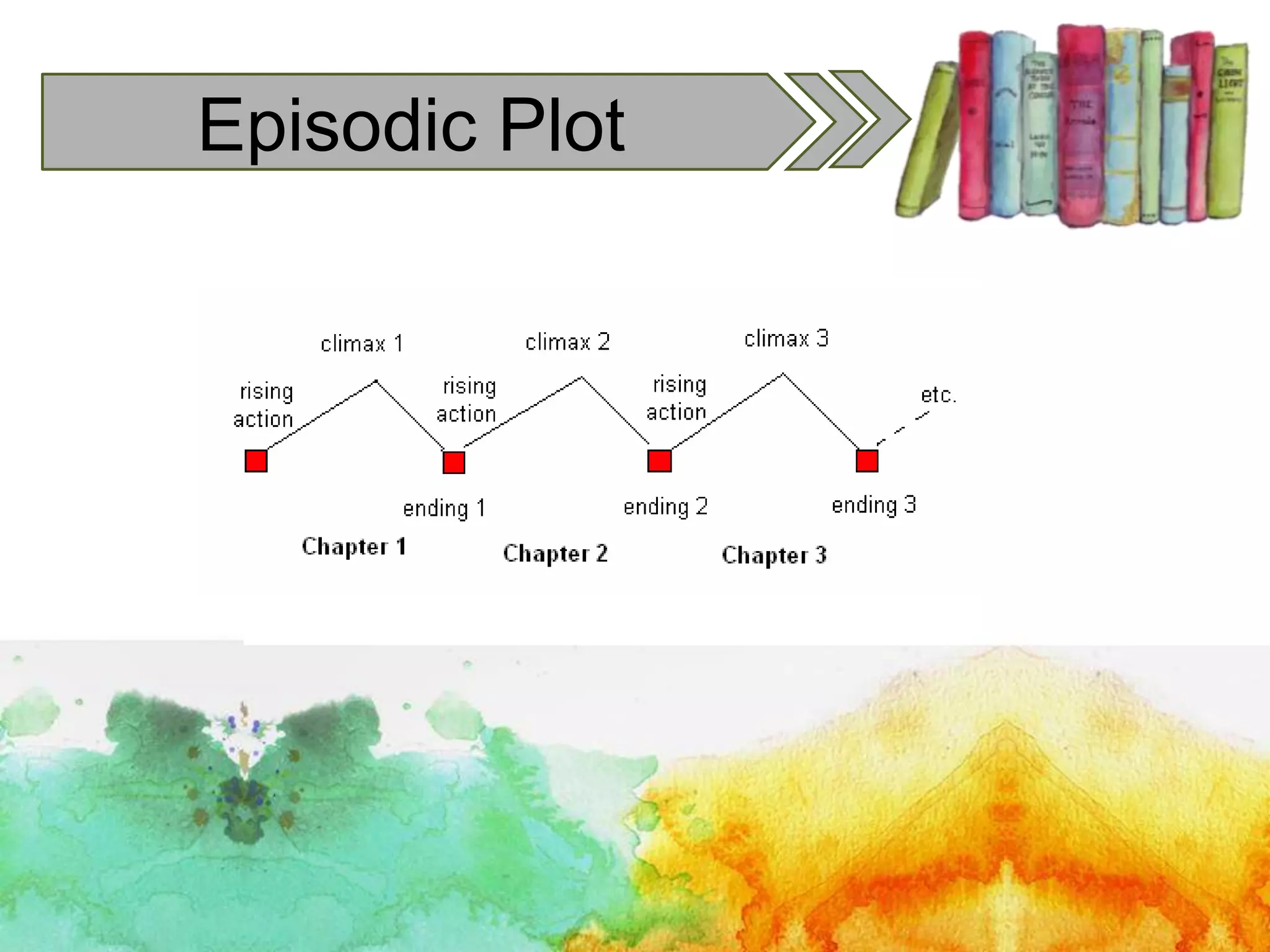
Episodic Plot
Parallel Plot
• The writer weaves two or more dramatic
plots that are usually linked by a
common character and a similar theme.
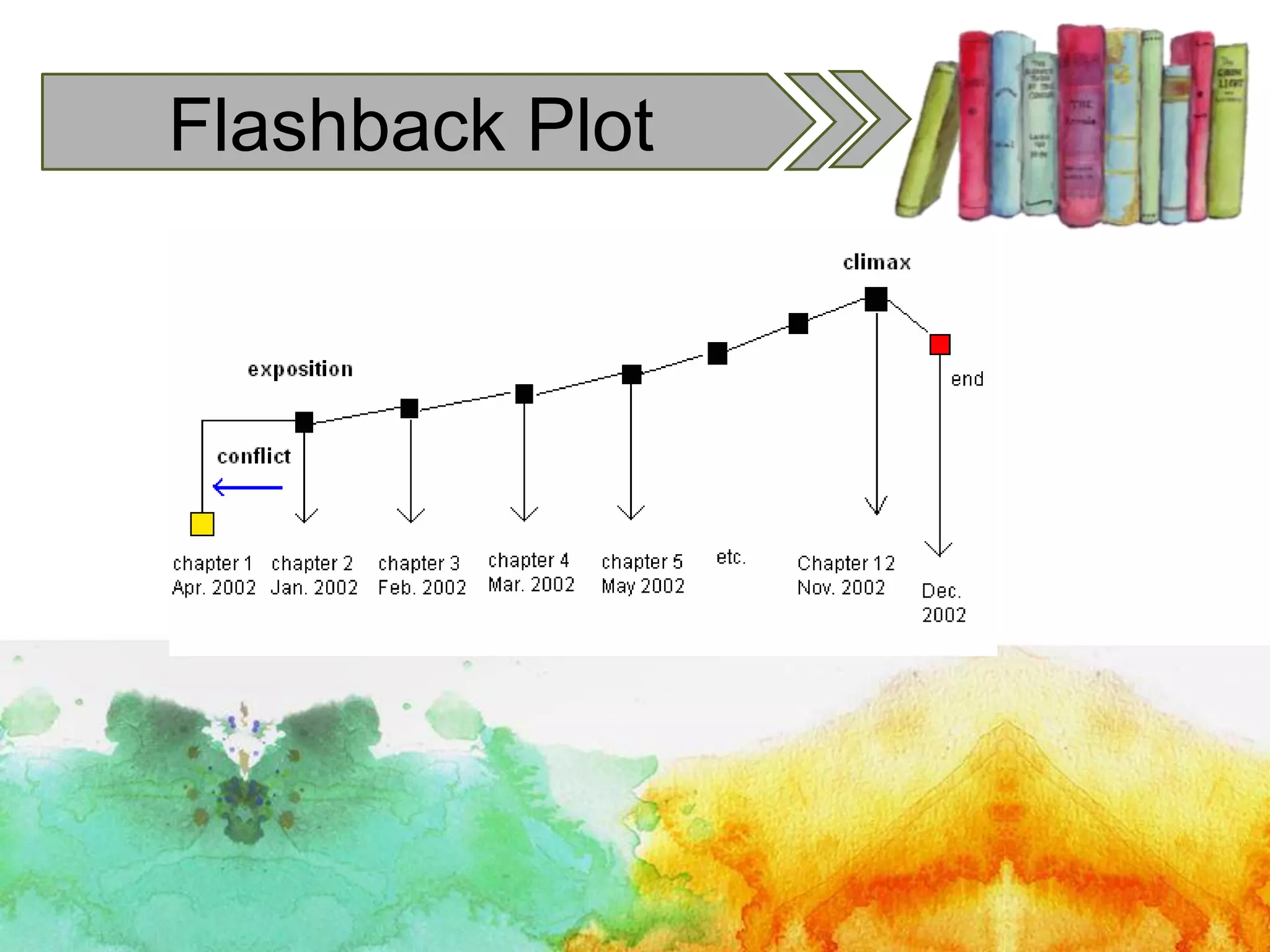
Flashback Plot
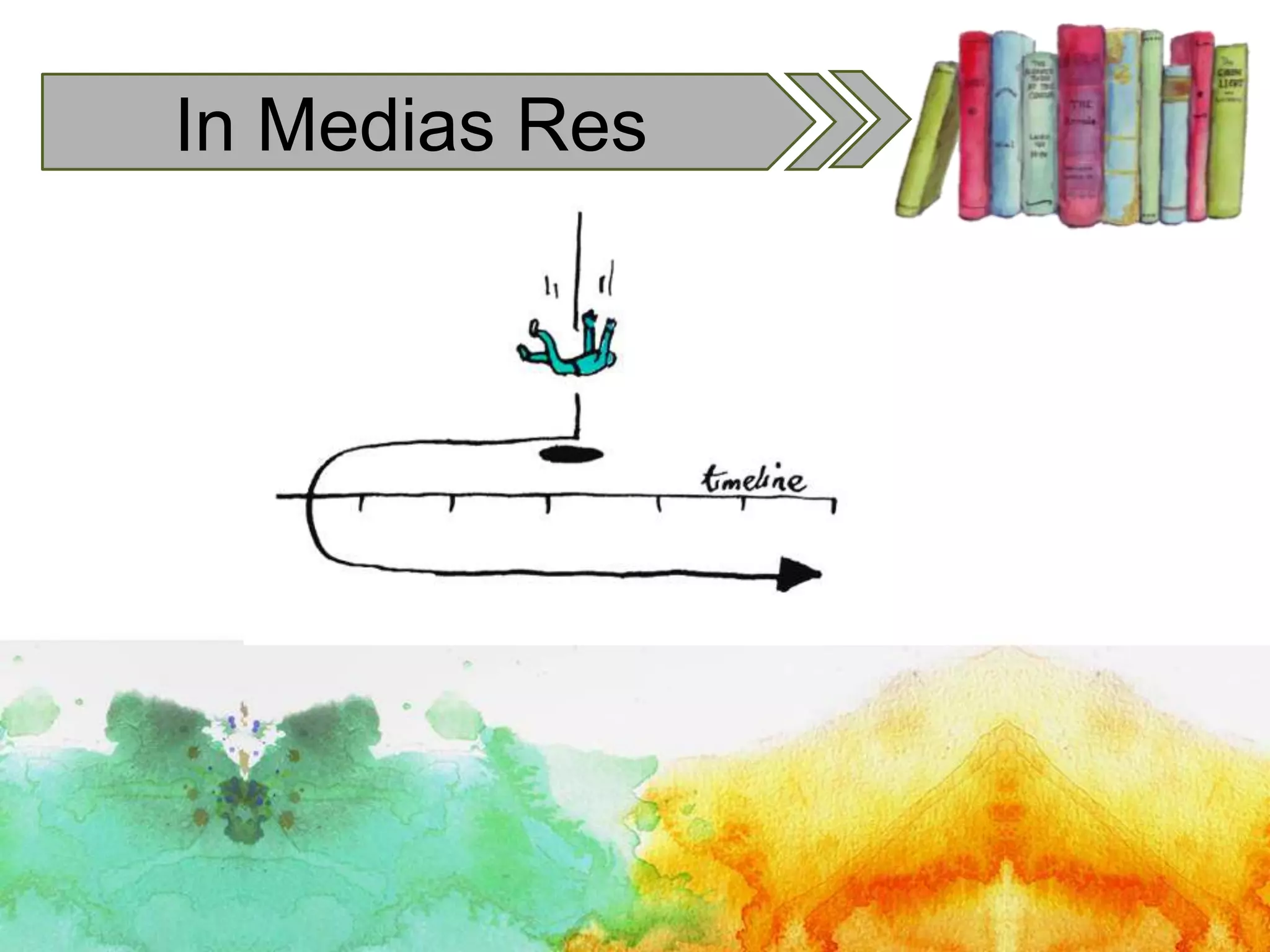
In Medias Res
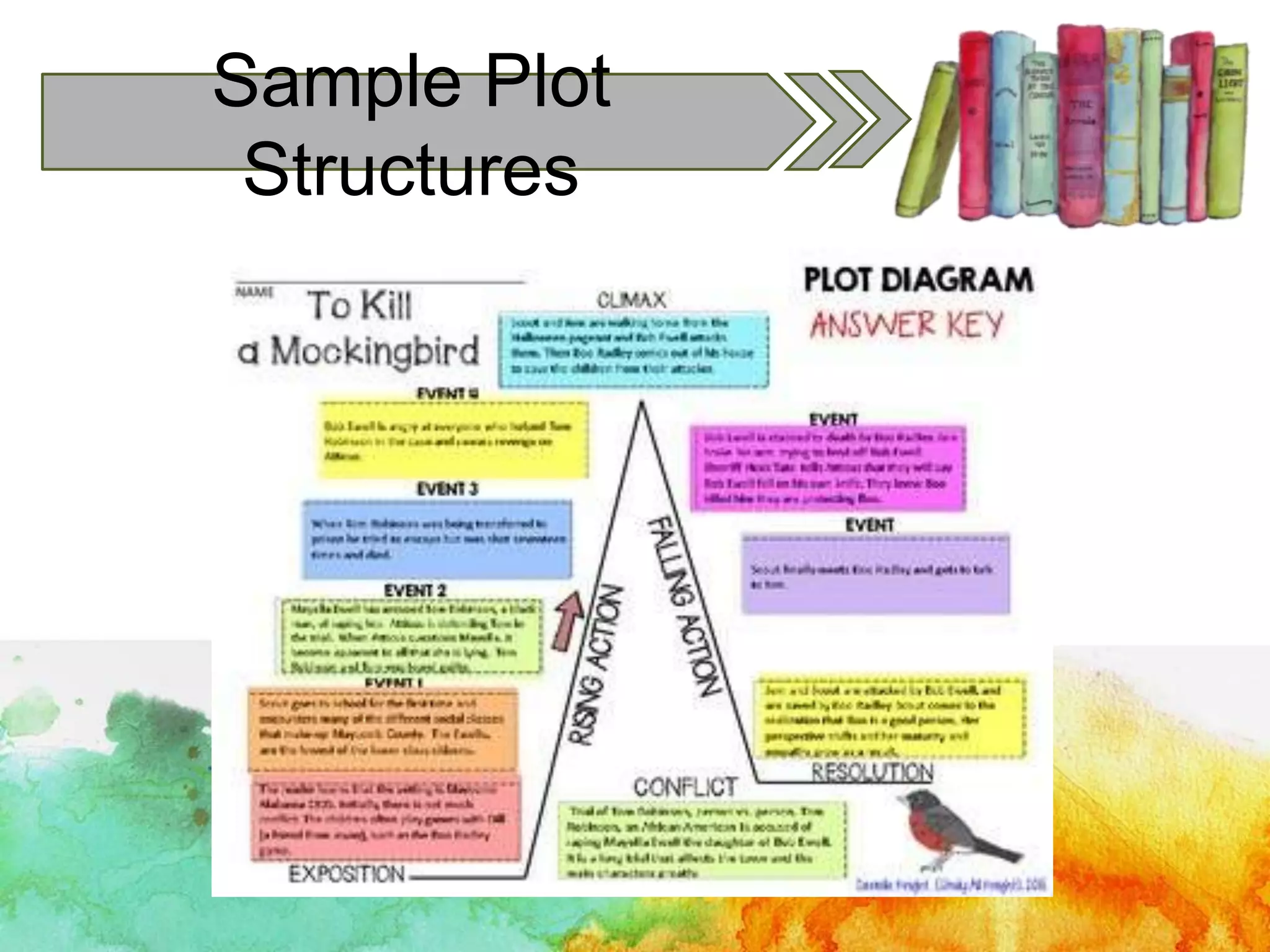
Sample Plot
Structures
ACTIVITY
• Choose a story/novel that follows each
plot structure. Identify plot elements
present in the selected work.
SETTING
SETTING
• The physical and social context in which
the action of a story occurs.
• The time, the place, and the social
environment that frames the characters.
CHARACTERS
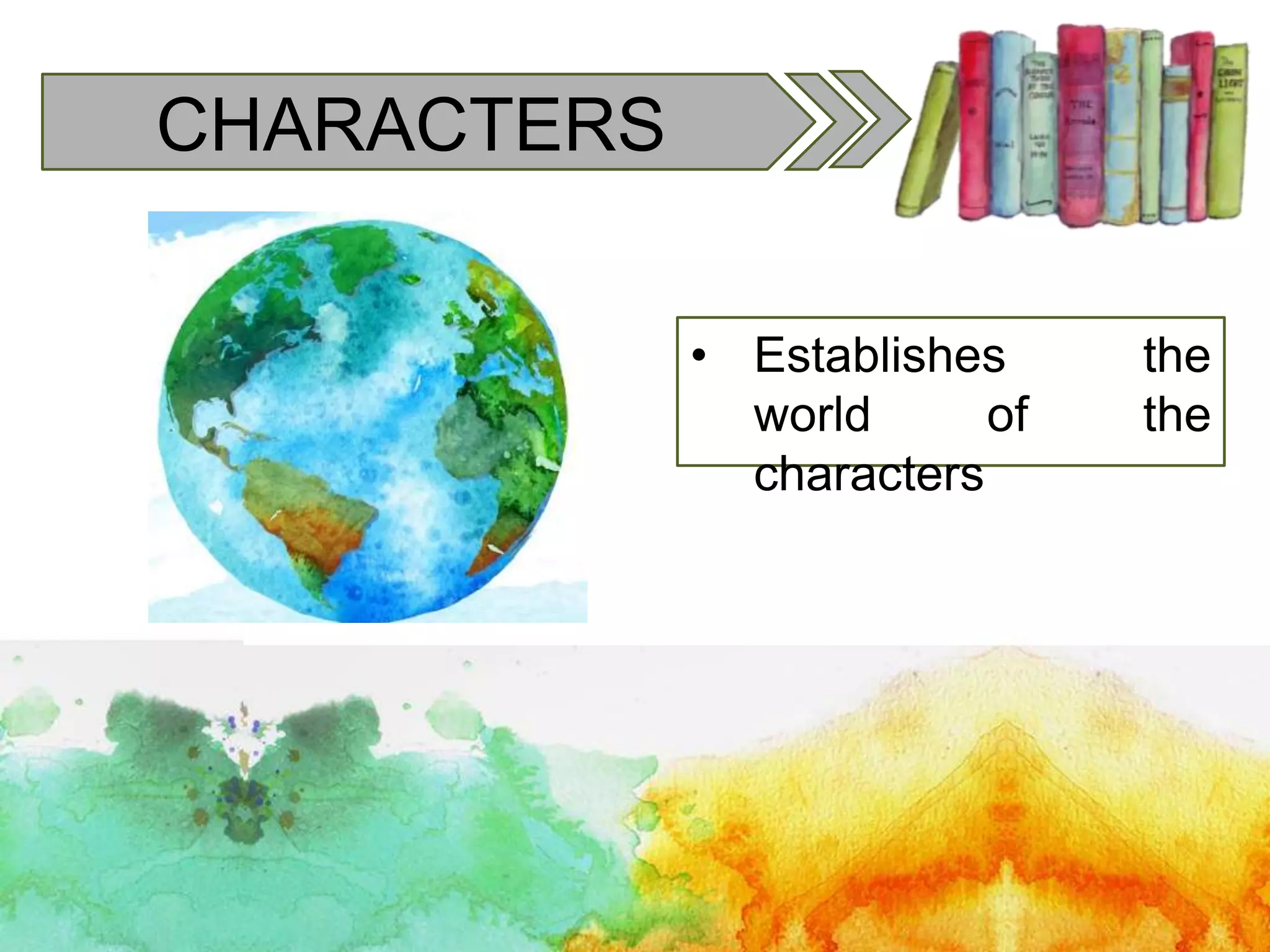
• Establishes the
world of the
characters
CHARACTE
RS
CHARACTERS
• Major or minor
• Static or dynamic
• Antagonist of protagonist
CHARACTERIZATIO
N
• Characterization is a means by which writers
present and reveal characters – by direct
• Description, by showing the character in
action, or by the presentation of other
characters who
• Help to define each other.
CHARACTERIZATIO
N
• Characterization is a means by which writers
present and reveal characters – by direct
• Description, by showing the character in
action, or by the presentation of other
characters who
• Help to define each other.
IRONY
• a contrast or discrepancy between one thing
and another
• Verbal, dramatic, or situational irony
POINT OF
VIEW
THIRD PERSON
NARRATOR
• Omniscient: The narrator is all-knowing and
takes the reader inside the characters’
thoughts, feelings, and motives, as well as
shows what the characters say and do.
THIRD PERSON
NARRATOR
• Limited omniscient: The narrator takes the
reader inside one (or at most very few
characters) but neither the reader nor the
character(s) has access to the inner lives of
any of the other characters in the story.
THIRD PERSON
NARRATOR
• Objective: The narrator does not see into the
mind of any character; rather he or she
reports the action and dialogue without
telling the reader directly what the characters
feel and think
FIRST PERSON
NARRATOR
• The narrator presents the point of view of
only one character’s consciousness, which
limits the narrative to what the first-person
narrator knows, experiences, infers, or can
find out by talking to other characters.
STYLE
• The way a writer chooses words (diction),
arranges them in sentences and longer units
of discourse (syntax) and exploits their
significance.
• Verbal identity of a writer
SYMBOL
• A person, object, image, word, or event that
evokes a range of additional meanings
beyond and usually more abstract than its
literal significance.
• Evoking complex ideas without having to
resort to painstaking explanations.
THEME
• Theme is the central idea or meaning of a
story.
• A generalized statement on truths about
humanity that is observed in the selection
TONE
• The author’s implicit attitude toward the
reader, subject, and/or the people, places,
and events.
• May be characterized as serious or ironic,
sad or happy, private of public, angry or
affectionate, bitter or nostalgic, or any other
attitudes and feelings that human beings
experience.
ACTIVITY (30pts)

2 elements of fiction

  • 1.
    LITERATURE From the Philippinesand the World Ms. Rebekah C. Mambiar
  • 2.
    Fiction Literature in theform of prose, especially short stories and novels, that describes imaginary events and people.
  • 3.
  • 4.
  • 5.
    Plot • the mainevents of a play, novel, movie, or similar work, devised and presented by the writer as an interrelated sequence.
  • 6.
    Plot • Types ofplot: • Dramatic/Progressive/Chronological • Episodic plot • Parallel plot • Flashback • In medias res
  • 7.
    Plot • Types ofplot: • Dramatic/Progressive/Chronological plot • Episodic plot • Parallel plot • Flashback • In medias res
  • 8.
  • 9.
  • 10.
    Parallel Plot • Thewriter weaves two or more dramatic plots that are usually linked by a common character and a similar theme.
  • 11.
  • 12.
  • 13.
  • 14.
    ACTIVITY • Choose astory/novel that follows each plot structure. Identify plot elements present in the selected work.
  • 15.
  • 16.
    SETTING • The physicaland social context in which the action of a story occurs. • The time, the place, and the social environment that frames the characters.
  • 17.
  • 18.
  • 19.
    CHARACTERS • Major orminor • Static or dynamic • Antagonist of protagonist
  • 20.
    CHARACTERIZATIO N • Characterization isa means by which writers present and reveal characters – by direct • Description, by showing the character in action, or by the presentation of other characters who • Help to define each other.
  • 21.
    CHARACTERIZATIO N • Characterization isa means by which writers present and reveal characters – by direct • Description, by showing the character in action, or by the presentation of other characters who • Help to define each other.
  • 22.
    IRONY • a contrastor discrepancy between one thing and another • Verbal, dramatic, or situational irony
  • 23.
  • 24.
    THIRD PERSON NARRATOR • Omniscient:The narrator is all-knowing and takes the reader inside the characters’ thoughts, feelings, and motives, as well as shows what the characters say and do.
  • 25.
    THIRD PERSON NARRATOR • Limitedomniscient: The narrator takes the reader inside one (or at most very few characters) but neither the reader nor the character(s) has access to the inner lives of any of the other characters in the story.
  • 26.
    THIRD PERSON NARRATOR • Objective:The narrator does not see into the mind of any character; rather he or she reports the action and dialogue without telling the reader directly what the characters feel and think
  • 27.
    FIRST PERSON NARRATOR • Thenarrator presents the point of view of only one character’s consciousness, which limits the narrative to what the first-person narrator knows, experiences, infers, or can find out by talking to other characters.
  • 28.
    STYLE • The waya writer chooses words (diction), arranges them in sentences and longer units of discourse (syntax) and exploits their significance. • Verbal identity of a writer
  • 29.
    SYMBOL • A person,object, image, word, or event that evokes a range of additional meanings beyond and usually more abstract than its literal significance. • Evoking complex ideas without having to resort to painstaking explanations.
  • 30.
    THEME • Theme isthe central idea or meaning of a story. • A generalized statement on truths about humanity that is observed in the selection
  • 31.
    TONE • The author’simplicit attitude toward the reader, subject, and/or the people, places, and events. • May be characterized as serious or ironic, sad or happy, private of public, angry or affectionate, bitter or nostalgic, or any other attitudes and feelings that human beings experience.
  • 32.

Editor's Notes

  • #9  This is a chronological structure which first establishes the setting and conflict, then follows the rising action through to a climax (the peak of the action and turning point), and concludes with a denouement (a wrapping up of loose ends). *Crisis: The turning point of the story
  • #10 An Episodic Plot: This is also a chronological structure, but it consists of a series of loosely related incidents, usually of chapter length, tied together by a common theme and/or characters. Episodic plots work best when the writer wishes to explore the personalities of the characters, the nature of their existence, and the flavor of an era.
  • #12 This structure conveys information about events that occurred earlier. It permits authors to begin the story in the midst of the action but later fill in the background for full understanding of the present events. Flashbacks can occur more than once and in different parts of a story.
  • #13 In medias res is Latin for "into the middle of things." It usually describes a narrative that begins, not at the beginning of a story, but somewhere in the middle — usually at some crucial point in the action.
  • #17 Setting is the physical and social context in which the action of a story occurs. The major elements of setting are the time, the place, and the social environment that frames the characters. These elements establish the world in which the characters act. Sometimes the setting is lightly sketched, presented only because the story has to take place somewhere and at some time. Often, however, the setting is more important, giving the reader the feel of the people who move through it. Setting can be used to evoke a mood or atmosphere that will prepare the reader for what is to come.
  • #18 Setting is the physical and social context in which the action of a story occurs. The major elements of setting are the time, the place, and the social environment that frames the characters. These elements establish the world in which the characters act. Sometimes the setting is lightly sketched, presented only because the story has to take place somewhere and at some time. Often, however, the setting is more important, giving the reader the feel of the people who move through it. Setting can be used to evoke a mood or atmosphere that will prepare the reader for what is to come.
  • #20 Characters in fiction can be conveniently classified as major and minor, static and dynamic. A major character is an important figure at the center of the story’s action or theme. The major character is sometimes called a protagonist whose conflict with an antagonist may spark the story’s conflict. Supporting the major character are one or more secondary or minor characters whose function is partly to illuminate the major characters. Minor characters are often static or unchanging: they remain the same from the beginning of a work to the end. Dynamic characters, on the other hand, exhibit some kind of change – of attitude, purpose, behavior, as the story progresses.
  • #21 Characters in fiction can be conveniently classified as major and minor, static and dynamic. A major character is an important figure at the center of the story’s action or theme. The major character is sometimes called a protagonist whose conflict with an antagonist may spark the story’s conflict. Supporting the major character are one or more secondary or minor characters whose function is partly to illuminate the major characters. Minor characters are often static or unchanging: they remain the same from the beginning of a work to the end. Dynamic characters, on the other hand, exhibit some kind of change – of attitude, purpose, behavior, as the story progresses.
  • #22 Characters in fiction can be conveniently classified as major and minor, static and dynamic. A major character is an important figure at the center of the story’s action or theme. The major character is sometimes called a protagonist whose conflict with an antagonist may spark the story’s conflict. Supporting the major character are one or more secondary or minor characters whose function is partly to illuminate the major characters. Minor characters are often static or unchanging: they remain the same from the beginning of a work to the end. Dynamic characters, on the other hand, exhibit some kind of change – of attitude, purpose, behavior, as the story progresses.
  • #23 Irony is not so much an element of fiction as a pervasive quality in it. It may appear in fiction in three ways: in a work’s language, in its incidents, or in its point of view. But in whatever form it emerges, irony always involves a contrast or discrepancy between one thing and another. The contrast may be between what is said and what is meant (verbal irony), what is expected to happen and what actually happens (situational irony) or between what a character believes or says and what the reader understands to be true (dramatic irony)
  • #25 Irony is not so much an element of fiction as a pervasive quality in it. It may appear in fiction in three ways: in a work’s language, in its incidents, or in its point of view. But in whatever form it emerges, irony always involves a contrast or discrepancy between one thing and another. The contrast may be between what is said and what is meant (verbal irony), what is expected to happen and what actually happens (situational irony) or between what a character believes or says and what the reader understands to be true (dramatic irony)
  • #26 Irony is not so much an element of fiction as a pervasive quality in it. It may appear in fiction in three ways: in a work’s language, in its incidents, or in its point of view. But in whatever form it emerges, irony always involves a contrast or discrepancy between one thing and another. The contrast may be between what is said and what is meant (verbal irony), what is expected to happen and what actually happens (situational irony) or between what a character believes or says and what the reader understands to be true (dramatic irony)
  • #27 Irony is not so much an element of fiction as a pervasive quality in it. It may appear in fiction in three ways: in a work’s language, in its incidents, or in its point of view. But in whatever form it emerges, irony always involves a contrast or discrepancy between one thing and another. The contrast may be between what is said and what is meant (verbal irony), what is expected to happen and what actually happens (situational irony) or between what a character believes or says and what the reader understands to be true (dramatic irony)
  • #28 Irony is not so much an element of fiction as a pervasive quality in it. It may appear in fiction in three ways: in a work’s language, in its incidents, or in its point of view. But in whatever form it emerges, irony always involves a contrast or discrepancy between one thing and another. The contrast may be between what is said and what is meant (verbal irony), what is expected to happen and what actually happens (situational irony) or between what a character believes or says and what the reader understands to be true (dramatic irony)
  • #29 Style is the way a writer chooses words (diction), arranges them in sentences and longer units of discourse (syntax) and exploits their significance. Style is the verbal identity of a writer, as unmistakable as his or her face or voice. Reflecting their individuality, writers’ styles convey their unique ways of seeing the world.
  • #30 A symbol is a person, object, image, word, ore vent that evokes a range of additional meanings beyond and usually more abstract than its literal significance. Symbols are devices for evoking complex ideas without having to resort to painstaking explanations. Conventional symbols have meanings that are widely recognized by a society or culture, i.e., the Christian cross, the Star of David, a swastika, a nation’s flag. A literary or contextual symbol can be a setting, a character, action, object, name, or anything else in a specific work that maintains its literal significance while suggesting other meanings. For example, the white whale in Melville’s Moby Dick takes on multiple symbolic meanings in the work, but these meanings do not automatically carry over into other stories about whales.
  • #32 A symbol is a person, object, image, word, ore vent that evokes a range of additional meanings beyond and usually more abstract than its literal significance. Symbols are devices for evoking complex ideas without having to resort to painstaking explanations. Conventional symbols have meanings that are widely recognized by a society or culture, i.e., the Christian cross, the Star of David, a swastika, a nation’s flag. A literary or contextual symbol can be a setting, a character, action, object, name, or anything else in a specific work that maintains its literal significance while suggesting other meanings. For example, the white whale in Melville’s Moby Dick takes on multiple symbolic meanings in the work, but these meanings do not automatically carry over into other stories about whales.