Downloaded by MARIFE VILLEGAS ABADIA (marifeabadia@sksu.edu.ph)
lOMoAR cPSD|16565076
A Semi-Detailed Lesson Plan in The Elements of Fiction
Tchg S.S. To Children (Fordham University)
Studocu is not sponsored or endorsed by any college or university
lOMoAR cPSD|16565076
Downloaded by MARIFE VILLEGAS ABADIA (marifeabadia@sksu.edu.ph)
HUM 003:
Creative
Writing
lOMoAR cPSD|16565076
Downloaded by MARIFE VILLEGAS ABADIA (marifeabadia@sksu.edu.ph)
Sitti Aiza Zen I. Almazan
XII – HUMSS
Olivarez College
A Semi-detailed Lesson Plan
Creative Writing
The Elements of
Fiction
I. Objectives
At the end of the discussion, the learners should be
able to:
A. define fiction as a genre of creative writing;
B. differentiate fiction from other genres of creative writing;
C. identify the various elements, techniques, and literary
devices in fiction; and
D. write text analysis and other short exercises exploring
key elements of fiction.
II. Subject Matter
A. Topic: The Elements of Fiction
B. Materials: Visual Aids (Slide Presentation, Video Presentation)
C. References:
• Ramos, J.M., Talisay, J.M., Mendinueto, C. C., (2017).
Fundamentals of Creative Writing. Brilliant
Creations Publishing, Inc.
lOMoAR cPSD|16565076
Downloaded by MARIFE VILLEGAS ABADIA (marifeabadia@sksu.edu.ph)
Activity #1: F
Friendship Co
• Bernales, R. A. (2017). Creative Writing: A Journey.
Mutya Publishing House, Inc.
• Montenegro, A., Mantaring, G. Q., Lusica, F. S.,
Cidro, M. O., Miranda, A. U., Mendoza, L. G.,
Nacino, H.C., Sentones, A.M., (2017). IE for EC:
Creative Writing. Phoenix Publishing House, Inc.
III. Procedure
A. Daily Routine
1. Prayer & “Thought of the Day”
2. Greetings
3. Attendance (Photo Op)
B. Simple Recall
C. Motivation
riendship Slam book
ntract:
• Thou shall answer the questions truthfully no
matter how silly the response is.
• Thou shall not laugh at hilarious answers.
• Thou shall not judge friends for their honesty.
• Thou shall not share the things disclosed in the
following pages with other people.
D. Lesson Proper
The Elements of Fiction
Fiction
• A work of imaginative prose that may be in the form
of a novel, a short story, or a novella.
lOMoAR cPSD|16565076
Downloaded by MARIFE VILLEGAS ABADIA (marifeabadia@sksu.edu.ph)
“The 20th century has seen the rise of fiction as
the dominant literary form widely used and
patronized by writers and readers alike.”
✓ What is your favorite fictional film/book?
Fiction
• is a literary classification for any story created from
imagination and, therefore, not necessarily based on
facts.
"Writing fiction constitutes a creative invention; if
taken as a whole, it may overwhelm even a seasoned
writer."
In aid of reading and writing, it is necessary to
divide fiction into several elements.
Characters
• the participants in the work of fiction
• a person or a persona (identity or entity that has a
contribution or effect to the development of the
story)
Characterization - is the means by which writers
present and reveal characters.
Two Types of Characters (Foster, 1972)
1. Flat/Static Characters
• are relatively uncomplicated and often
presented as two-dimensional.
• remain the same all throughout the story
Example: Miss Maudie - To Kill a Mockingbird
(1960) by Harper Lee
Miss Maudie maintained the same
characteristics and outlook throughout the
narrative. From the beginning up to end of the
novel, she only acted as the voice of reason for
kids, supporting and explaining Atticus’
motivations and actions. She did not openly
give a warning to Atticus for taking the case of
Tom Robinson. Even after losing her house to
lOMoAR cPSD|16565076
Downloaded by MARIFE VILLEGAS ABADIA (marifeabadia@sksu.edu.ph)
the fire, her positive and optimistic attitude
remained steady.
2. Round/Dynamic Characters
• are complex figures with different
characteristics which may sufficiently
surprise the readers as they undergo
changes during the course of the story
Example: Ebenezer Scrooge - In a Christmas
Carol (1843) by Charles Dickens
Ebeneger Scrooge was very stingy with his
money. He had his employees working very
hard for little pay. After his experiences with
the ghosts that visited him, he changed his
ways, paying his employees a more than fair
wage, providing days off from work and
actually giving gifts.
Other Types of Characters
1. Protagonist - is the main character around whose
life or experience the story revolves.
2. Antagonist - is the character who stands in
opposition to the protagonist.
“A writer must be able to project a character as if it
exists in real life.”
Point of View (POV)
• is the narrative perspective which describes the
position of the narrator; that is, the character of the
storyteller in relation to the story being told.
Types of POV
1. First Person
• the narrator is also a character within the
story
• "I " and "We"
lOMoAR cPSD|16565076
Downloaded by MARIFE VILLEGAS ABADIA (marifeabadia@sksu.edu.ph)
• is used as a way to convey directly the
deeply internal, but unspoken thoughts of
the narrator
• the narrator is usually the protagonist - inner
thoughts are expressed to the
audience/reader, not to the characters
Example: The Sun Also Rises (1926) - Ernest
Hemingway
"I could picture it. I have a rotten habit of
picturing the bedroom scenes of my friends. We
went out to the Cafe Napolitain to have an
aperitif and watch the evening crowd on the
Boulevard."
- Jake Barnes
2. Second Person
• The narrator refers to the protagonist by
using the second-person personal pronoun
"you"
• The narrator may also refer to
himself/herself, using "you" in a way that
suggests alienation from the events
described, or emotional/ironic distance
• The less common narrative technique in
fiction
Example: Sevastopol in December (1855) - Leo
Tolstoy
"You walk along between the beds and seek a
face less stern and suffering, which you decide
to approach, with the object of conversing.
'Where are you wounded?' you inquire,
timidly and with indecision, of an old, gaunt
soldier, who, seated in his hammock, is
lOMoAR cPSD|16565076
Downloaded by MARIFE VILLEGAS ABADIA (marifeabadia@sksu.edu.ph)
watching you with a good-natured glance and
seems to invite you to approach him."
3. Third Person
• "he", "she", "it", "they"
• the narrator is an unspecified entity or
uninvolved person who conveys the story
from the outside
• categorized according to the knowledge
available to the narrator
Third Person Omniscient
• The narrator has knowledge of all times,
people, places, and events, including all
characters' thoughts.
Example: The Scarlet Letter (1850) -
Nathaniel Hawthorne
"When he found the eyes of Hester
Prynne fastened on his own and saw that she
appeared to recognize him, he slowly and
calmly raised his finger, made a gesture with
it in the air, and laid it on his lips."
Third Person Limited
• The narrator knows everything about a
character - what is in his/her mind, but is
limited to him/her.
Example: For Whom the Bells Toll (1940) -
Ernest Hemingway
"This Anselmo had been a good guide
and he could travel wonderfully in the
mountains. Robert Jordan could walk well
enough himself and he knew from following
him since before daylight that the old man
could walk him to death. Robert Jordan
lOMoAR cPSD|16565076
Downloaded by MARIFE VILLEGAS ABADIA (marifeabadia@sksu.edu.ph)
trusted the man, Anselmo, so far, in
everything, except judgment. He had not yet
had an opportunity to test his judgment, and,
anyway, the judgment was his own
responsibility."
“A writer must always assume the role of the narrator.
The perspective of your fiction depends upon the angle
of narration you have chosen - from a particular
character (1St Person), from a direct observer (2nd
person), or from an all-seeing and sometimes all-
knowing narrator (3rd person).”
Plot
• is the narrative perspective which describes the
position of the narrator; that is, the character of the
storyteller in relation to the story being told.
Foster (1927):
"The king died, and then the queen died." - a story
"The king died, and then the queen died of grief." - a
plot
Two Kinds of Plot:
• Linear Plot - the plot-line follows a single and
chronological flow of event.
▪ Beginning
• Characters and Setting
• Central Problem
• Character – goal to create a problem
• Main Character – goal to solve the
problem
lOMoAR cPSD|16565076
Downloaded by MARIFE VILLEGAS ABADIA (marifeabadia@sksu.edu.ph)
▪ Middle
• Main Character - participates in a
series of events to reach the goal that
leads to a resolution of the problem
▪ End
• Main Character - may/may not reach
his/her goal
• Episodic/Nonlinear Plot
▪ the plot-line includes separate stories or
chapters that are linked together by the
same character, setting, or theme
▪ there is no overall beginning, middle, and
end to the story as they can be shuffled
around and placed in different orders
Example: The Prince and the Pauper by
Mark Twain
The Prince and the Pauper separately
tells the story of Tom, the pauper, and
Edward, the king. Although it seemingly
has two stories, they are still part of the
larger narrative as the two are linked by
the same setting and characters.
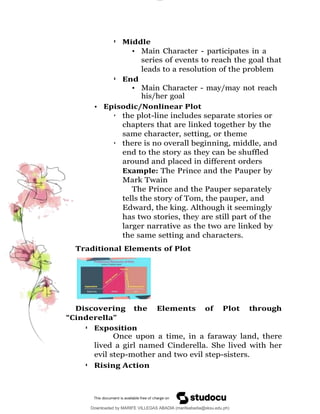
Traditional Elements of Plot
Discovering the Elements of Plot through
“Cinderella”
▪ Exposition
Once upon a time, in a faraway land, there
lived a girl named Cinderella. She lived with her
evil step-mother and two evil step-sisters.
▪ Rising Action
lOMoAR cPSD|16565076
Downloaded by MARIFE VILLEGAS ABADIA (marifeabadia@sksu.edu.ph)
Once upon a time, in a faraway land, there
lived a girl named Cinderella. She lived with her
evil step-mother and two evil step-sisters.
▪ Climax
The step-sisters forced their feet into the
slipper, but it didn't work. Feeling hopeless, the
servant decided to leave, until Cinderella
appeared at the last minute. Finally, the glass
slipper perfectly fitted Cinderella's foot.
▪ Falling Action
Cinderella went to the palace, and married
the charming prince.
▪ Denouement
Cinderella and Prince Charming lived
happily ever after.
Traditional Elements of Plot
▪ Exposition
o the beginning
o characters are introduced
o setting is established
o main problem is presented
▪ Rising Action
o problem/conflict
o writer adds tension and excitement
o the main character is in a crisis - conflict
with:
▪ oneself
▪ another character
▪ society
▪ nature
▪ fate
▪ external forces
▪ Climax
o the highest point in the story where the main
event happens
lOMoAR cPSD|16565076
Downloaded by MARIFE VILLEGAS ABADIA (marifeabadia@sksu.edu.ph)
o the point where the main character may
seem to fail until a turning point happens
"The fiction one is writing must ultimately
reach its peak of interest before it tumbles
down."
▪ Falling Action
o winding down
o shows the result of the actions or decisions
made by the main character
o eventually leads to the final part of the story,
the resolution of the crisis
▪ Denouement/Resolution
o the conclusion to a story
o the main character's conflicts are resolved
o all loose ends are tied up
o concludes with either a happy or sad ending
E. Generalization
"While it is true that all elements of fiction are equally
important, it is undeniable that plot makes up almost the
entire fiction."
F. Application
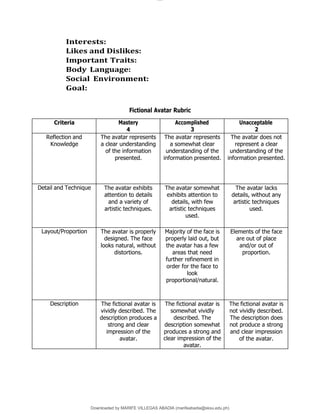
Activity #2: Fictional Avatar
Mechanics: Think of a character you want to have in
your story. It may be a protagonist or an antagonist.
Create your character using Avatar Maker and complete
his/her profile below.
Age:
Gender:
Name:
Education/Job:
lOMoAR cPSD|16565076
Downloaded by MARIFE VILLEGAS ABADIA (marifeabadia@sksu.edu.ph)
Interests:
Likes and Dislikes:
Important Traits:
Body Language:
Social Environment:
Goal:
Fictional Avatar Rubric
Criteria Mastery
4
Accomplished
3
Unacceptable
2
Reflection and
Knowledge
The avatar represents
a clear understanding
of the information
presented.
The avatar represents
a somewhat clear
understanding of the
information presented.
The avatar does not
represent a clear
understanding of the
information presented.
Detail and Technique The avatar exhibits
attention to details
and a variety of
artistic techniques.
The avatar somewhat
exhibits attention to
details, with few
artistic techniques
used.
The avatar lacks
details, without any
artistic techniques
used.
Layout/Proportion The avatar is properly
designed. The face
looks natural, without
distortions.
Majority of the face is
properly laid out, but
the avatar has a few
areas that need
further refinement in
order for the face to
look
proportional/natural.
Elements of the face
are out of place
and/or out of
proportion.
Description The fictional avatar is
vividly described. The
description produces a
strong and clear
impression of the
avatar.
The fictional avatar is
somewhat vividly
described. The
description somewhat
produces a strong and
clear impression of the
avatar.
The fictional avatar is
not vividly described.
The description does
not produce a strong
and clear impression
of the avatar.
lOMoAR cPSD|16565076
Downloaded by MARIFE VILLEGAS ABADIA (marifeabadia@sksu.edu.ph)
Originality/Creativity The fictional avatar is
new and interesting.
The attributes and
characteristics are
artistic and inventive.
The fictional avatar is
somewhat new and
interesting. The
attributes and
characteristics are
somewhat artistic and
inventive.
The fictional avatar is
not new and
interesting. The
attributes and
characteristics are not
artistic and inventive.
Drawing Rubrics General | PDF | Drawing | Psychology (scribd.com) TOTAL: /20
G. Assessment
Activity#3: Mapping “My Brother’s Peculiar Chicken”
Out
In the short story “My Brother’s Peculiar Chicken” by
Alejandro R. Roces, identify the elements of fiction and
the elements of the plot.
My Brother's Peculiar Chicken - UBD Library (wikidot.com)

a-semi-detailed-lesson-plan-in-the-elements-of-fiction.docx

  • 1.
    Downloaded by MARIFEVILLEGAS ABADIA (marifeabadia@sksu.edu.ph) lOMoAR cPSD|16565076 A Semi-Detailed Lesson Plan in The Elements of Fiction Tchg S.S. To Children (Fordham University) Studocu is not sponsored or endorsed by any college or university
  • 2.
    lOMoAR cPSD|16565076 Downloaded byMARIFE VILLEGAS ABADIA (marifeabadia@sksu.edu.ph) HUM 003: Creative Writing
  • 3.
    lOMoAR cPSD|16565076 Downloaded byMARIFE VILLEGAS ABADIA (marifeabadia@sksu.edu.ph) Sitti Aiza Zen I. Almazan XII – HUMSS Olivarez College A Semi-detailed Lesson Plan Creative Writing The Elements of Fiction I. Objectives At the end of the discussion, the learners should be able to: A. define fiction as a genre of creative writing; B. differentiate fiction from other genres of creative writing; C. identify the various elements, techniques, and literary devices in fiction; and D. write text analysis and other short exercises exploring key elements of fiction. II. Subject Matter A. Topic: The Elements of Fiction B. Materials: Visual Aids (Slide Presentation, Video Presentation) C. References: • Ramos, J.M., Talisay, J.M., Mendinueto, C. C., (2017). Fundamentals of Creative Writing. Brilliant Creations Publishing, Inc.
  • 4.
    lOMoAR cPSD|16565076 Downloaded byMARIFE VILLEGAS ABADIA (marifeabadia@sksu.edu.ph) Activity #1: F Friendship Co • Bernales, R. A. (2017). Creative Writing: A Journey. Mutya Publishing House, Inc. • Montenegro, A., Mantaring, G. Q., Lusica, F. S., Cidro, M. O., Miranda, A. U., Mendoza, L. G., Nacino, H.C., Sentones, A.M., (2017). IE for EC: Creative Writing. Phoenix Publishing House, Inc. III. Procedure A. Daily Routine 1. Prayer & “Thought of the Day” 2. Greetings 3. Attendance (Photo Op) B. Simple Recall C. Motivation riendship Slam book ntract: • Thou shall answer the questions truthfully no matter how silly the response is. • Thou shall not laugh at hilarious answers. • Thou shall not judge friends for their honesty. • Thou shall not share the things disclosed in the following pages with other people. D. Lesson Proper The Elements of Fiction Fiction • A work of imaginative prose that may be in the form of a novel, a short story, or a novella.
  • 5.
    lOMoAR cPSD|16565076 Downloaded byMARIFE VILLEGAS ABADIA (marifeabadia@sksu.edu.ph) “The 20th century has seen the rise of fiction as the dominant literary form widely used and patronized by writers and readers alike.” ✓ What is your favorite fictional film/book? Fiction • is a literary classification for any story created from imagination and, therefore, not necessarily based on facts. "Writing fiction constitutes a creative invention; if taken as a whole, it may overwhelm even a seasoned writer." In aid of reading and writing, it is necessary to divide fiction into several elements. Characters • the participants in the work of fiction • a person or a persona (identity or entity that has a contribution or effect to the development of the story) Characterization - is the means by which writers present and reveal characters. Two Types of Characters (Foster, 1972) 1. Flat/Static Characters • are relatively uncomplicated and often presented as two-dimensional. • remain the same all throughout the story Example: Miss Maudie - To Kill a Mockingbird (1960) by Harper Lee Miss Maudie maintained the same characteristics and outlook throughout the narrative. From the beginning up to end of the novel, she only acted as the voice of reason for kids, supporting and explaining Atticus’ motivations and actions. She did not openly give a warning to Atticus for taking the case of Tom Robinson. Even after losing her house to
  • 6.
    lOMoAR cPSD|16565076 Downloaded byMARIFE VILLEGAS ABADIA (marifeabadia@sksu.edu.ph) the fire, her positive and optimistic attitude remained steady. 2. Round/Dynamic Characters • are complex figures with different characteristics which may sufficiently surprise the readers as they undergo changes during the course of the story Example: Ebenezer Scrooge - In a Christmas Carol (1843) by Charles Dickens Ebeneger Scrooge was very stingy with his money. He had his employees working very hard for little pay. After his experiences with the ghosts that visited him, he changed his ways, paying his employees a more than fair wage, providing days off from work and actually giving gifts. Other Types of Characters 1. Protagonist - is the main character around whose life or experience the story revolves. 2. Antagonist - is the character who stands in opposition to the protagonist. “A writer must be able to project a character as if it exists in real life.” Point of View (POV) • is the narrative perspective which describes the position of the narrator; that is, the character of the storyteller in relation to the story being told. Types of POV 1. First Person • the narrator is also a character within the story • "I " and "We"
  • 7.
    lOMoAR cPSD|16565076 Downloaded byMARIFE VILLEGAS ABADIA (marifeabadia@sksu.edu.ph) • is used as a way to convey directly the deeply internal, but unspoken thoughts of the narrator • the narrator is usually the protagonist - inner thoughts are expressed to the audience/reader, not to the characters Example: The Sun Also Rises (1926) - Ernest Hemingway "I could picture it. I have a rotten habit of picturing the bedroom scenes of my friends. We went out to the Cafe Napolitain to have an aperitif and watch the evening crowd on the Boulevard." - Jake Barnes 2. Second Person • The narrator refers to the protagonist by using the second-person personal pronoun "you" • The narrator may also refer to himself/herself, using "you" in a way that suggests alienation from the events described, or emotional/ironic distance • The less common narrative technique in fiction Example: Sevastopol in December (1855) - Leo Tolstoy "You walk along between the beds and seek a face less stern and suffering, which you decide to approach, with the object of conversing. 'Where are you wounded?' you inquire, timidly and with indecision, of an old, gaunt soldier, who, seated in his hammock, is
  • 8.
    lOMoAR cPSD|16565076 Downloaded byMARIFE VILLEGAS ABADIA (marifeabadia@sksu.edu.ph) watching you with a good-natured glance and seems to invite you to approach him." 3. Third Person • "he", "she", "it", "they" • the narrator is an unspecified entity or uninvolved person who conveys the story from the outside • categorized according to the knowledge available to the narrator Third Person Omniscient • The narrator has knowledge of all times, people, places, and events, including all characters' thoughts. Example: The Scarlet Letter (1850) - Nathaniel Hawthorne "When he found the eyes of Hester Prynne fastened on his own and saw that she appeared to recognize him, he slowly and calmly raised his finger, made a gesture with it in the air, and laid it on his lips." Third Person Limited • The narrator knows everything about a character - what is in his/her mind, but is limited to him/her. Example: For Whom the Bells Toll (1940) - Ernest Hemingway "This Anselmo had been a good guide and he could travel wonderfully in the mountains. Robert Jordan could walk well enough himself and he knew from following him since before daylight that the old man could walk him to death. Robert Jordan
  • 9.
    lOMoAR cPSD|16565076 Downloaded byMARIFE VILLEGAS ABADIA (marifeabadia@sksu.edu.ph) trusted the man, Anselmo, so far, in everything, except judgment. He had not yet had an opportunity to test his judgment, and, anyway, the judgment was his own responsibility." “A writer must always assume the role of the narrator. The perspective of your fiction depends upon the angle of narration you have chosen - from a particular character (1St Person), from a direct observer (2nd person), or from an all-seeing and sometimes all- knowing narrator (3rd person).” Plot • is the narrative perspective which describes the position of the narrator; that is, the character of the storyteller in relation to the story being told. Foster (1927): "The king died, and then the queen died." - a story "The king died, and then the queen died of grief." - a plot Two Kinds of Plot: • Linear Plot - the plot-line follows a single and chronological flow of event. ▪ Beginning • Characters and Setting • Central Problem • Character – goal to create a problem • Main Character – goal to solve the problem
  • 10.
    lOMoAR cPSD|16565076 Downloaded byMARIFE VILLEGAS ABADIA (marifeabadia@sksu.edu.ph) ▪ Middle • Main Character - participates in a series of events to reach the goal that leads to a resolution of the problem ▪ End • Main Character - may/may not reach his/her goal • Episodic/Nonlinear Plot ▪ the plot-line includes separate stories or chapters that are linked together by the same character, setting, or theme ▪ there is no overall beginning, middle, and end to the story as they can be shuffled around and placed in different orders Example: The Prince and the Pauper by Mark Twain The Prince and the Pauper separately tells the story of Tom, the pauper, and Edward, the king. Although it seemingly has two stories, they are still part of the larger narrative as the two are linked by the same setting and characters. Traditional Elements of Plot Discovering the Elements of Plot through “Cinderella” ▪ Exposition Once upon a time, in a faraway land, there lived a girl named Cinderella. She lived with her evil step-mother and two evil step-sisters. ▪ Rising Action
  • 11.
    lOMoAR cPSD|16565076 Downloaded byMARIFE VILLEGAS ABADIA (marifeabadia@sksu.edu.ph) Once upon a time, in a faraway land, there lived a girl named Cinderella. She lived with her evil step-mother and two evil step-sisters. ▪ Climax The step-sisters forced their feet into the slipper, but it didn't work. Feeling hopeless, the servant decided to leave, until Cinderella appeared at the last minute. Finally, the glass slipper perfectly fitted Cinderella's foot. ▪ Falling Action Cinderella went to the palace, and married the charming prince. ▪ Denouement Cinderella and Prince Charming lived happily ever after. Traditional Elements of Plot ▪ Exposition o the beginning o characters are introduced o setting is established o main problem is presented ▪ Rising Action o problem/conflict o writer adds tension and excitement o the main character is in a crisis - conflict with: ▪ oneself ▪ another character ▪ society ▪ nature ▪ fate ▪ external forces ▪ Climax o the highest point in the story where the main event happens
  • 12.
    lOMoAR cPSD|16565076 Downloaded byMARIFE VILLEGAS ABADIA (marifeabadia@sksu.edu.ph) o the point where the main character may seem to fail until a turning point happens "The fiction one is writing must ultimately reach its peak of interest before it tumbles down." ▪ Falling Action o winding down o shows the result of the actions or decisions made by the main character o eventually leads to the final part of the story, the resolution of the crisis ▪ Denouement/Resolution o the conclusion to a story o the main character's conflicts are resolved o all loose ends are tied up o concludes with either a happy or sad ending E. Generalization "While it is true that all elements of fiction are equally important, it is undeniable that plot makes up almost the entire fiction." F. Application Activity #2: Fictional Avatar Mechanics: Think of a character you want to have in your story. It may be a protagonist or an antagonist. Create your character using Avatar Maker and complete his/her profile below. Age: Gender: Name: Education/Job:
  • 13.
    lOMoAR cPSD|16565076 Downloaded byMARIFE VILLEGAS ABADIA (marifeabadia@sksu.edu.ph) Interests: Likes and Dislikes: Important Traits: Body Language: Social Environment: Goal: Fictional Avatar Rubric Criteria Mastery 4 Accomplished 3 Unacceptable 2 Reflection and Knowledge The avatar represents a clear understanding of the information presented. The avatar represents a somewhat clear understanding of the information presented. The avatar does not represent a clear understanding of the information presented. Detail and Technique The avatar exhibits attention to details and a variety of artistic techniques. The avatar somewhat exhibits attention to details, with few artistic techniques used. The avatar lacks details, without any artistic techniques used. Layout/Proportion The avatar is properly designed. The face looks natural, without distortions. Majority of the face is properly laid out, but the avatar has a few areas that need further refinement in order for the face to look proportional/natural. Elements of the face are out of place and/or out of proportion. Description The fictional avatar is vividly described. The description produces a strong and clear impression of the avatar. The fictional avatar is somewhat vividly described. The description somewhat produces a strong and clear impression of the avatar. The fictional avatar is not vividly described. The description does not produce a strong and clear impression of the avatar.
  • 14.
    lOMoAR cPSD|16565076 Downloaded byMARIFE VILLEGAS ABADIA (marifeabadia@sksu.edu.ph) Originality/Creativity The fictional avatar is new and interesting. The attributes and characteristics are artistic and inventive. The fictional avatar is somewhat new and interesting. The attributes and characteristics are somewhat artistic and inventive. The fictional avatar is not new and interesting. The attributes and characteristics are not artistic and inventive. Drawing Rubrics General | PDF | Drawing | Psychology (scribd.com) TOTAL: /20 G. Assessment Activity#3: Mapping “My Brother’s Peculiar Chicken” Out In the short story “My Brother’s Peculiar Chicken” by Alejandro R. Roces, identify the elements of fiction and the elements of the plot. My Brother's Peculiar Chicken - UBD Library (wikidot.com)