CREATIVE
WRITING 11
CREATIVE
WRITING 11
MISS ROSALYN D. MANDAC
SUBJECT TEACHER
LITERARY
TECHNIQUE AND
DEVICES OF
FICTION
LITERARY
TECHNIQUE AND
DEVICES OF
FICTION
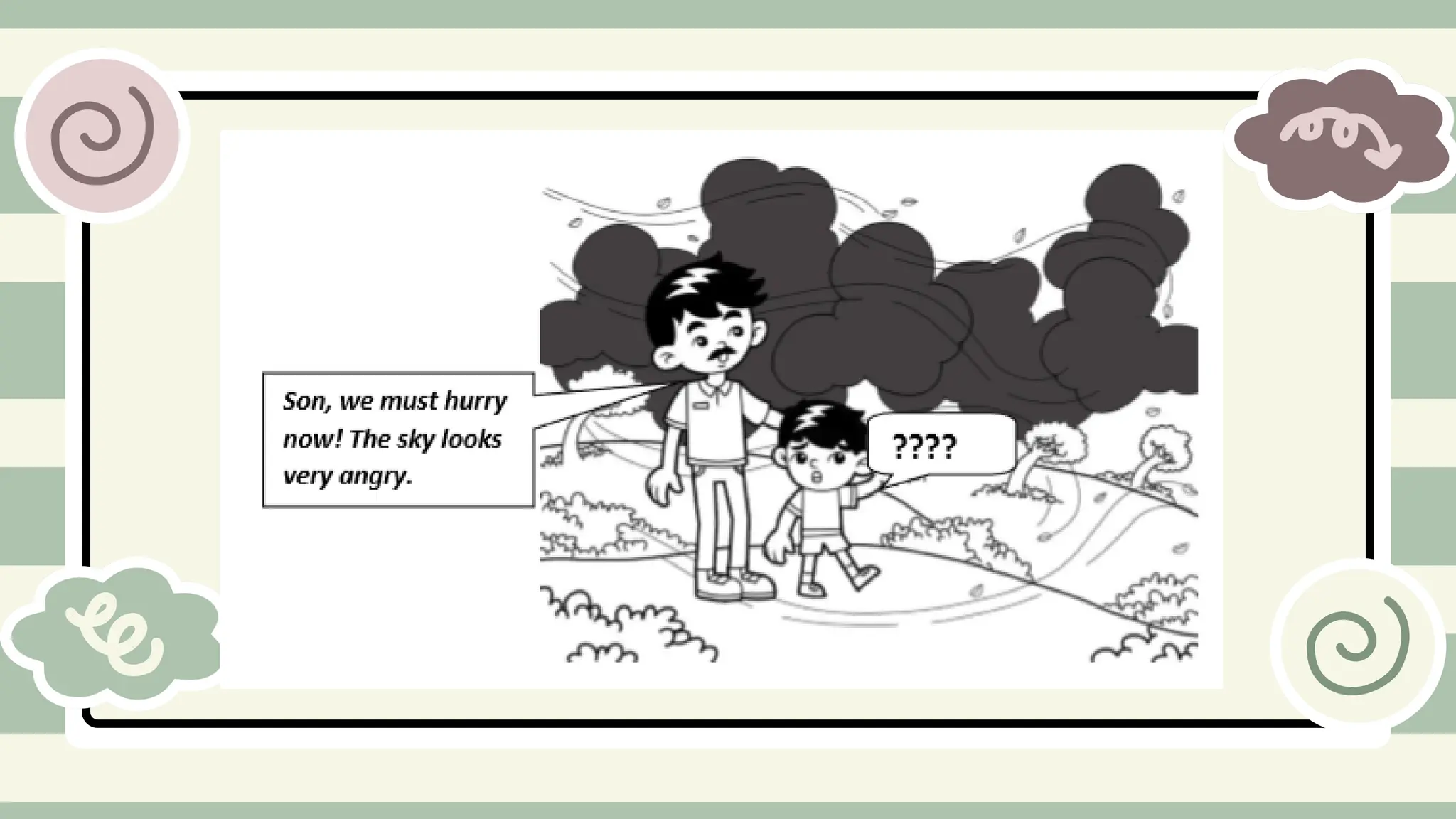
Analyze the comic strip.
LITERARY
TECHNIQUE AND
DEVICES OF
FICTION
LITERARY
TECHNIQUE AND
DEVICES OF
FICTION
What does the father mean when he said,
“It (sky) looks very angry?”
What does the father mean when he said,
“It (sky) looks very angry?”
How do you call this language?
Yes! It is a figurative language.
The use of figurative language is just
one of the techniques authors use to
make their work vivid and interesting.
Read the story in the next activity to
find out what happened why the sky
looked very angry.
CATCH-UP
FRIDAY
CATCH-UP
FRIDAY
READING
TIME!!!
READING
TIME!!!
Now, that we have already reviewed some
of the terms used in fiction, we will now
move on to the next activities where we will
learn more of these terms.
DIFFERENT
LITERARY DEVICES
AND TECHNIQUES
IN FICTION
DIFFERENT
LITERARY DEVICES
AND TECHNIQUES
IN FICTION
It is the giving of life to inanimate
objects.
PERSONIFICATION
PERSONIFICATION
"It looks very angry,"
"Earth and sea are struggling together
ocean yields to the fires
wave rushed toward the shore
It (earth) groaned and split open.
hurricane wind broke out of the ocean
PERSONIFICATION
PERSONIFICATION
You have noticed that the author uses
figurative language, specifically more of the
personification. The use of personification
is the author’s technique in writing, making
the events in the story vivid and exciting.
PERSONIFICATION
PERSONIFICATION
It uses exaggeration to make an
emphasis.
HYPERBOLE
HYPERBOLE
• The purple rim of the ocean seemed to
lift and rise against the clouds.
HYPERBOLE
HYPERBOLE
• The purple rim of the ocean seemed to
lift and rise against the clouds.
HYPERBOLE
HYPERBOLE
The author also used a hyperbole to
exaggerate an event in the story making it
even more interesting.
• Rain fell in such sheets that the whole
heavens seemed falling into the sea and
the sea seemed leaping up in the sky.
(Ceyx and Alcyone)
HYPERBOLE
HYPERBOLE
It is the comparison of two unlike
objects without using the word “like” or
“as”
METAPHOR
METAPHOR
• But soft, what light through yonder
window breaks? It is the east, and Juliet
is the sun! (William Shakespeare –
Romeo & Juliet)
METAPHOR
METAPHOR
• But soft, what light through yonder
window breaks? It is the east, and Juliet
is the sun! (William Shakespeare –
Romeo & Juliet)
METAPHOR
METAPHOR
In the example, Juliet is compared to a
sun; thus giving light.
It is the comparison of two unlike
objectives using the word “like” or “as”
SIMILE
SIMILE
• “Her father had inherited that temper;
and at times, like antelope fleeing before
fire on the slope, his people fled from
his red rages.” — Riders of the Purple
Sage, by Zane Grey
SIMILE
SIMILE
• “Her father had inherited that temper;
and at times, like antelope fleeing before
fire on the slope, his people fled from
his red rages.” — Riders of the Purple
Sage, by Zane Grey
SIMILE
SIMILE
In the example, His father’s temper is
compared to an antelope.
It uses a part to represent and whole or
vice versa.
SYNECDOCHE
SYNECDOCHE
• Her name was on his lips when the
ship sank and waters closed over him. –
(Ceyx and Alcyone)
SYNECDOCHE
SYNECDOCHE
• Her name was on his lips when the
ship sank and waters closed over him. –
(Ceyx and Alcyone)
SYNECDOCHE
SYNECDOCHE
This is a synecdoche because the lips is
just a part of the body.
OTHER LITERARY
TECHNIQUES
OTHER LITERARY
TECHNIQUES
Creative writers also use different structures
in sequencing the events in the plot.
It is a technique in narratives in which
the present story brings into a scene
from the past.
FLASHBACK
FLASHBACK
I was thinking of the hospital. We had
gone there that afternoon to visit my
father for Valentine’s day. We had to go
the day before the actual holiday
because Mama said we couldn’t get out
of school to go on Monday. (Don’t Wait
to Give Daddy a Hug)
FLASHBACK
FLASHBACK
Study the paragraph below.
FLASHBACK
FLASHBACK
The paragraph describes a scene is the
story where the little girl recalls her visit
to the hospital that afternoon. This is an
example of flashback.
It is a technique in narratives in which
the present story brings into a scene in
the future.
FORESHADOW
FORESHADOW
“Simba, let me tell you something my
father told me. Look at the stars. The
great kings of the past look down on us
from those stars. So whenever you feel
alone, just remember that those kings
will always be there to guide you. And
so will I.”
FORESHADOW
FORESHADOW
Study the paragraph below. This scene was taken from the
movie, The Lion King.
FORESHADOW
FORESHADOW
The underlined phrase are the words of
Mufasa, the father of Simba foretelling
Simba, that he, too will die and become
one of those stars who will be watching
Simba from above. Hence, this is an
example of foreshadow.
It is a literary term putting two different
elements side by side in order to
emphasize their differences, reveal
surprising similarities, or explore a
unique relationship between the two.
JUXTAPOSITION
JUXTAPOSITION
E.g. The fable, The Rabbit and the Turtle,
is a juxtaposition where the author puts
the two characters side by side to show
how fast the rabbit is and how slow that
turtle is to compare the two characters.
JUXTAPOSITION
JUXTAPOSITION
It uses vivid words to create a mental
picture of the events in the story. It
appeals to the senses such as sight,
taste, smell, touch, and sound.
IMAGERY
IMAGERY
It appeals to the sense of seeing.
VISUAL
VISUAL
E.g. They came upon a humble little hovel,
poorer than any they had seen before, with
a roof made only of straw and reeds.
(Baucis and Philemon)
It appeals to the sense of touching.
TACTILE
TACTILE
No breath of wind stirs the waters.
(Ceyx and Alcyone)
It appeals to the sense of smelling.
OLFACTORY
OLFACTORY
"I lay still and took another minute to smell:
I smelled the warm, sweet, all-pervasive
smell of silage, as well as the sour dirty
laundry spilling over the basket in the hall”.
(A Map of the World)
It appeals to the sense of tasting.
GUSTATORY
GUSTATORY
E.g. The warm, sweet chocolate drink
made her happy on that winter day.
It appeals to the sense of hearing.
AUDITORY
AUDITORY
E.g. They would steal to the crack and
utter words of burning love but always in
softest whispers. (Pyramus and Thisbe)
LET’S TRY!!!
LET’S TRY!!!
Read the excerpt from the flash
fiction, “The Deep” by Adam Smith.
Flash fiction contains at least 1000
words and can be read in one sitting.
THANK
YOU
THANK
YOU

Grade 11 Creative Writing Module 3 Lesson 2.pdf

  • 1.
    CREATIVE WRITING 11 CREATIVE WRITING 11 MISSROSALYN D. MANDAC SUBJECT TEACHER
  • 2.
  • 3.
  • 4.
  • 6.
    What does thefather mean when he said, “It (sky) looks very angry?”
  • 7.
    What does thefather mean when he said, “It (sky) looks very angry?” How do you call this language?
  • 8.
    Yes! It isa figurative language.
  • 9.
    Yes! It isa figurative language. The use of figurative language is just one of the techniques authors use to make their work vivid and interesting.
  • 10.
    Read the storyin the next activity to find out what happened why the sky looked very angry.
  • 11.
  • 12.
  • 13.
    Now, that wehave already reviewed some of the terms used in fiction, we will now move on to the next activities where we will learn more of these terms.
  • 14.
    DIFFERENT LITERARY DEVICES AND TECHNIQUES INFICTION DIFFERENT LITERARY DEVICES AND TECHNIQUES IN FICTION
  • 15.
    It is thegiving of life to inanimate objects. PERSONIFICATION PERSONIFICATION
  • 16.
    "It looks veryangry," "Earth and sea are struggling together ocean yields to the fires wave rushed toward the shore It (earth) groaned and split open. hurricane wind broke out of the ocean PERSONIFICATION PERSONIFICATION
  • 17.
    You have noticedthat the author uses figurative language, specifically more of the personification. The use of personification is the author’s technique in writing, making the events in the story vivid and exciting. PERSONIFICATION PERSONIFICATION
  • 18.
    It uses exaggerationto make an emphasis. HYPERBOLE HYPERBOLE
  • 19.
    • The purplerim of the ocean seemed to lift and rise against the clouds. HYPERBOLE HYPERBOLE
  • 20.
    • The purplerim of the ocean seemed to lift and rise against the clouds. HYPERBOLE HYPERBOLE The author also used a hyperbole to exaggerate an event in the story making it even more interesting.
  • 21.
    • Rain fellin such sheets that the whole heavens seemed falling into the sea and the sea seemed leaping up in the sky. (Ceyx and Alcyone) HYPERBOLE HYPERBOLE
  • 22.
    It is thecomparison of two unlike objects without using the word “like” or “as” METAPHOR METAPHOR
  • 23.
    • But soft,what light through yonder window breaks? It is the east, and Juliet is the sun! (William Shakespeare – Romeo & Juliet) METAPHOR METAPHOR
  • 24.
    • But soft,what light through yonder window breaks? It is the east, and Juliet is the sun! (William Shakespeare – Romeo & Juliet) METAPHOR METAPHOR In the example, Juliet is compared to a sun; thus giving light.
  • 25.
    It is thecomparison of two unlike objectives using the word “like” or “as” SIMILE SIMILE
  • 26.
    • “Her fatherhad inherited that temper; and at times, like antelope fleeing before fire on the slope, his people fled from his red rages.” — Riders of the Purple Sage, by Zane Grey SIMILE SIMILE
  • 27.
    • “Her fatherhad inherited that temper; and at times, like antelope fleeing before fire on the slope, his people fled from his red rages.” — Riders of the Purple Sage, by Zane Grey SIMILE SIMILE In the example, His father’s temper is compared to an antelope.
  • 28.
    It uses apart to represent and whole or vice versa. SYNECDOCHE SYNECDOCHE
  • 29.
    • Her namewas on his lips when the ship sank and waters closed over him. – (Ceyx and Alcyone) SYNECDOCHE SYNECDOCHE
  • 30.
    • Her namewas on his lips when the ship sank and waters closed over him. – (Ceyx and Alcyone) SYNECDOCHE SYNECDOCHE This is a synecdoche because the lips is just a part of the body.
  • 31.
  • 32.
    Creative writers alsouse different structures in sequencing the events in the plot.
  • 33.
    It is atechnique in narratives in which the present story brings into a scene from the past. FLASHBACK FLASHBACK
  • 34.
    I was thinkingof the hospital. We had gone there that afternoon to visit my father for Valentine’s day. We had to go the day before the actual holiday because Mama said we couldn’t get out of school to go on Monday. (Don’t Wait to Give Daddy a Hug) FLASHBACK FLASHBACK Study the paragraph below.
  • 35.
    FLASHBACK FLASHBACK The paragraph describesa scene is the story where the little girl recalls her visit to the hospital that afternoon. This is an example of flashback.
  • 36.
    It is atechnique in narratives in which the present story brings into a scene in the future. FORESHADOW FORESHADOW
  • 37.
    “Simba, let metell you something my father told me. Look at the stars. The great kings of the past look down on us from those stars. So whenever you feel alone, just remember that those kings will always be there to guide you. And so will I.” FORESHADOW FORESHADOW Study the paragraph below. This scene was taken from the movie, The Lion King.
  • 38.
    FORESHADOW FORESHADOW The underlined phraseare the words of Mufasa, the father of Simba foretelling Simba, that he, too will die and become one of those stars who will be watching Simba from above. Hence, this is an example of foreshadow.
  • 39.
    It is aliterary term putting two different elements side by side in order to emphasize their differences, reveal surprising similarities, or explore a unique relationship between the two. JUXTAPOSITION JUXTAPOSITION
  • 40.
    E.g. The fable,The Rabbit and the Turtle, is a juxtaposition where the author puts the two characters side by side to show how fast the rabbit is and how slow that turtle is to compare the two characters. JUXTAPOSITION JUXTAPOSITION
  • 41.
    It uses vividwords to create a mental picture of the events in the story. It appeals to the senses such as sight, taste, smell, touch, and sound. IMAGERY IMAGERY
  • 42.
    It appeals tothe sense of seeing. VISUAL VISUAL E.g. They came upon a humble little hovel, poorer than any they had seen before, with a roof made only of straw and reeds. (Baucis and Philemon)
  • 43.
    It appeals tothe sense of touching. TACTILE TACTILE No breath of wind stirs the waters. (Ceyx and Alcyone)
  • 44.
    It appeals tothe sense of smelling. OLFACTORY OLFACTORY "I lay still and took another minute to smell: I smelled the warm, sweet, all-pervasive smell of silage, as well as the sour dirty laundry spilling over the basket in the hall”. (A Map of the World)
  • 45.
    It appeals tothe sense of tasting. GUSTATORY GUSTATORY E.g. The warm, sweet chocolate drink made her happy on that winter day.
  • 46.
    It appeals tothe sense of hearing. AUDITORY AUDITORY E.g. They would steal to the crack and utter words of burning love but always in softest whispers. (Pyramus and Thisbe)
  • 47.
    LET’S TRY!!! LET’S TRY!!! Readthe excerpt from the flash fiction, “The Deep” by Adam Smith. Flash fiction contains at least 1000 words and can be read in one sitting.
  • 48.