The Bolsheviks in Power   February 1917 - the Tsar is overthrown by popular revolt. Replaced by liberal government. October 1917 - Bolshevik Revolution establishes communist state. July 1918 – New constitution establishes ‘Soviet Federal Socialist Republic’
Key Figures   Lenin Trotsky Zinoviev Kamenev Bukharin (Stalin has minor role initially)
Lenin’s Reforms   Eight hour working day Workers elected factory committee’s who were given far-reaching powers. ‘ Decree on Land’ abolished private ownership of land. Redistributed to the peasants without compensation for owners. Women given the vote and guaranteed equality. Universal free education. Major campaign to combat adult illiteracy. All ranks and titles were abolished. Civil marriages introduced.
Opposition to Communist Rule   ‘ White Russians’ included members of Socialist Revolutionary Party, liberals, nationalists, ex-army officers and fascists. Invasions by 14 different ‘Allied Countries to help the White Army. Invasion force totals 250,000 troops  Brutal War lasts until 1923. Trotsky masterminds Red Army victory.  Up to 1 million die in fighting and 3 million more from famine and disease that sweeps Russia.
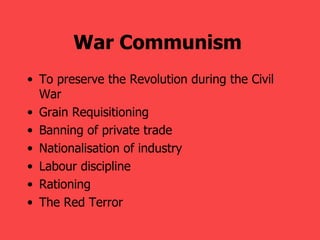
War Communism   To preserve the Revolution during the Civil War Grain Requisitioning Banning of private trade Nationalisation of industry Labour discipline Rationing The Red Terror
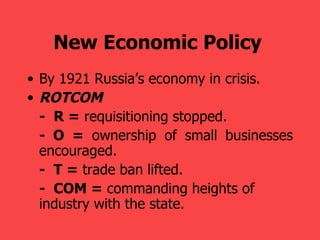
New Economic Policy   By 1921 Russia’s economy in crisis. ROTCOM -  R =  requisitioning stopped. - O =  ownership of small businesses encouraged. -  T =  trade ban lifted. -  COM =  commanding heights of industry with the state.
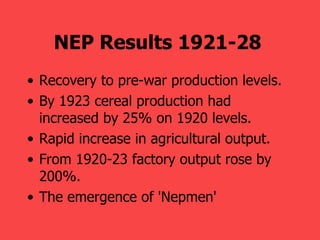
NEP Results 1921-28   Recovery to pre-war production levels. By 1923 cereal production had increased by 25% on 1920 levels. Rapid increase in agricultural output. From 1920-23 factory output rose by 200%. The emergence of 'Nepmen'
Power Struggle   Lenin died 1924. Power struggle between Stalin ‘s supporters and Trotsky’s Left Opposition. Political power struggle Trotsky’s ‘Permanent Revolution’ – Russia’s working class too small to build socialism. Encourage spread of Revolution Stalin’s ‘Socialism in One Country’ – Revolution outside Russia unlikely. Russians should get on with building socialism themselves.
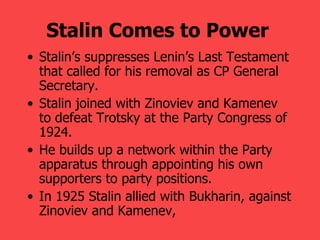
Stalin Comes to Power   Stalin’s suppresses Lenin’s Last Testament that called for his removal as CP General Secretary. Stalin joined with Zinoviev and Kamenev to defeat Trotsky at the Party Congress of 1924. He builds up a network within the Party apparatus through appointing his own supporters to party positions. In 1925 Stalin allied with Bukharin, against Zinoviev and Kamenev,
 
Stalin advocates the continuation of the NEP. Communist Party supports  ‘Socialism in One Country’ In 1928, Stalin turned against the NEP and begins Collectivisation. Bukharin is defeated and Stalin became the undisputed leader of the USSR in 1929.   Stalin Comes to Power
Presentation prepared by: Dominic Haugh St. Particks Comprehensive School Shannon Co. Clare Presentation can be used for educational purposes only – all rights remain with author

The bolsheviks in power

  • 1.
    The Bolsheviks inPower February 1917 - the Tsar is overthrown by popular revolt. Replaced by liberal government. October 1917 - Bolshevik Revolution establishes communist state. July 1918 – New constitution establishes ‘Soviet Federal Socialist Republic’
  • 2.
    Key Figures Lenin Trotsky Zinoviev Kamenev Bukharin (Stalin has minor role initially)
  • 3.
    Lenin’s Reforms Eight hour working day Workers elected factory committee’s who were given far-reaching powers. ‘ Decree on Land’ abolished private ownership of land. Redistributed to the peasants without compensation for owners. Women given the vote and guaranteed equality. Universal free education. Major campaign to combat adult illiteracy. All ranks and titles were abolished. Civil marriages introduced.
  • 4.
    Opposition to CommunistRule ‘ White Russians’ included members of Socialist Revolutionary Party, liberals, nationalists, ex-army officers and fascists. Invasions by 14 different ‘Allied Countries to help the White Army. Invasion force totals 250,000 troops Brutal War lasts until 1923. Trotsky masterminds Red Army victory. Up to 1 million die in fighting and 3 million more from famine and disease that sweeps Russia.
  • 5.
    War Communism To preserve the Revolution during the Civil War Grain Requisitioning Banning of private trade Nationalisation of industry Labour discipline Rationing The Red Terror
  • 6.
    New Economic Policy By 1921 Russia’s economy in crisis. ROTCOM - R = requisitioning stopped. - O = ownership of small businesses encouraged. - T = trade ban lifted. - COM = commanding heights of industry with the state.
  • 7.
    NEP Results 1921-28 Recovery to pre-war production levels. By 1923 cereal production had increased by 25% on 1920 levels. Rapid increase in agricultural output. From 1920-23 factory output rose by 200%. The emergence of 'Nepmen'
  • 8.
    Power Struggle Lenin died 1924. Power struggle between Stalin ‘s supporters and Trotsky’s Left Opposition. Political power struggle Trotsky’s ‘Permanent Revolution’ – Russia’s working class too small to build socialism. Encourage spread of Revolution Stalin’s ‘Socialism in One Country’ – Revolution outside Russia unlikely. Russians should get on with building socialism themselves.
  • 9.
    Stalin Comes toPower Stalin’s suppresses Lenin’s Last Testament that called for his removal as CP General Secretary. Stalin joined with Zinoviev and Kamenev to defeat Trotsky at the Party Congress of 1924. He builds up a network within the Party apparatus through appointing his own supporters to party positions. In 1925 Stalin allied with Bukharin, against Zinoviev and Kamenev,
  • 10.
  • 11.
    Stalin advocates thecontinuation of the NEP. Communist Party supports ‘Socialism in One Country’ In 1928, Stalin turned against the NEP and begins Collectivisation. Bukharin is defeated and Stalin became the undisputed leader of the USSR in 1929. Stalin Comes to Power
  • 12.
    Presentation prepared by:Dominic Haugh St. Particks Comprehensive School Shannon Co. Clare Presentation can be used for educational purposes only – all rights remain with author