World Regions in Global Context: Peoples, Places, and Environments (3 rd . ed) Sallie A. Marston, Paul L. Knox,  & Diana M. Liverman Chapter 1: A World of Regions Robert M. Arthur
Geography matters Global differences in  Cultures, Resources, Capital, Spatial Organization, & Territoriality Geographic Study Appreciate the variety of the world’s people and places Understand the relationships between the world’s communities Help with regional, national & global development The Power of Geography
Geographic Study Physical Geography Examines how natural forces shape the Earth Human Geography How human interaction modifies the environment and the spatial organization of human activity Regional Geography Combines both physical & human approaches Holistic examination of territories The Power of Geography
Regions Region Large size territories (such as counties, provinces, and countries, or large sections of countries such as the Midwest USA) that encompass many places, all or most of which share a set of attributes that differ from the attributes of places that make up a different region.
A World of Regions Regions are dynamic, changing A two-way process of people’s activities changing their environment and people being affected by their environment Created by people responding to the opportunities and constraints presented by their environments
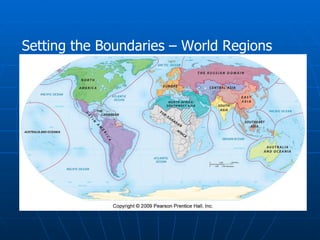
Setting the Boundaries – World Regions
Regionalization Classification Logical Division Grouping Homogeneity Formal Regions High degree of homogeneity Functional Regions Characterized by functional organization of human occupancy The Regional Approach
Regions Formal Functional Vernacular
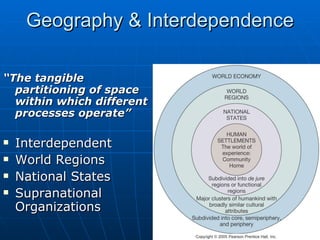
Geography & Interdependence “ The tangible partitioning of space within which different processes operate” Interdependent World Regions National States Supranational Organizations
Regionalization The geographer’s classification of individual places or areal units The geographers equivalent of scientific classification
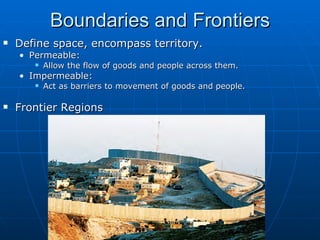
Boundaries and Frontiers Define space, encompass territory. Permeable: Allow the flow of goods and people across them. Impermeable: Act as barriers to movement of goods and people. Frontier Regions
Regionalism & Sectionalism Regionalism: When individuals begin to relate stronger to their region than their country, then separatist movements can occur. Sectionalism Irredentism
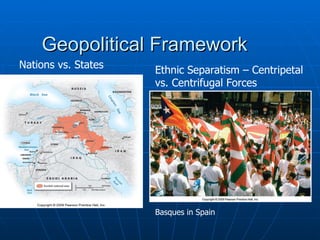
Geopolitical Framework Nations vs. States Ethnic Separatism – Centripetal vs. Centrifugal Forces Basques in Spain
Globalization   The increasing interconnectedness of the world’s regions. Resulting from: Technological Factors -  Advances in communications Advances in information handling Advances in transportation Economic factors – Multinational corporations Trade associations between countries Political factors – Supranational governments (EU, NAFTA, ASEAN, etc)
Issues of Scale Global to Local  Example of Call Centers (Back Office Jobs) Are we in Nebraska or in India?? Call Center in Mumbai, India
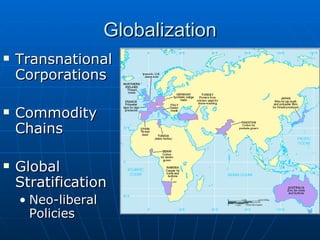
Globalization Transnational Corporations Commodity Chains Global Stratification Neo-liberal Policies
Globalization and Population Change Unevenly distributed, 3 major areas of high density, China, India & Europe. Near water, oceans, seas, lakes or rivers, temperate, low lying areas with fertile soils. 6 billion now, projected to rise to 10 billion by 2050.
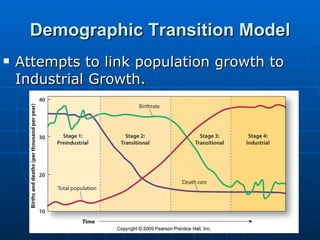
Demographic Transition Model Attempts to link population growth to Industrial Growth.
Population Growth and Change
Age–Sex Structure of Populations
Globalization and Cultural Change The global spread of common architectural forms, dress, ‘fast food’, entertainment, & the English language. These changes do have local character and are not universal. Many local fashions, foods, etc. are exported around the world, not just those of the developed world.
Diversity Amid Globalization Globalization Increasing Interconnectedness Human and Physical Environments Continual Reorganization of Global and Local Geographies Figure 1.0 Contemporary and Traditional Landscapes in Shanghai
Alternative Images of Globalization Southwestern India Washington, D.C.  demonstration Guilin, China
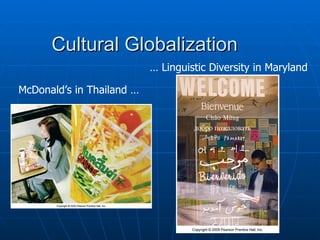
Cultural Globalization McDonald’s in Thailand … …  Linguistic Diversity in Maryland
Economic Globalization – Formal Figure 1.10
Economic Globalization – Informal Figure 1.6
Economic Development, Technology, and Social Well-Being Uneven global distribution of natural resources and of energy sources Favors a few countries while leaving others disadvantaged Political factors important too Japan has few resources unfavorable conditions (war, civil strife, corrupt governments, poor infrastructure) Technology facilitates the shift of energy and natural resource inputs to cheaper sources
Global Inequities Figure 1.11
Technology Systems 1790 – 1840: Water & steam, textiles, ironworking Canals & turnpikes 1840 – 1890: Coal powered steam, machine tools, steel Railroads & world-wide shipping 1890 – 1950: Internal combustion power, oil, plastics, electrical Aircraft, automobiles, radio & telecommunications 1950 – 1990: Nuclear power, electronics, petrochemicals Global air routes, highways 1990 - ?: Solar energy, robotics, microelectronics, biotechnology & IT
Economic Sectors Primary Activity: Natural resource extraction Secondary Activity: Manufacturing or processing of natural resources Tertiary Activity: Sale and exchange Quaternary Activity: Information processing and handling
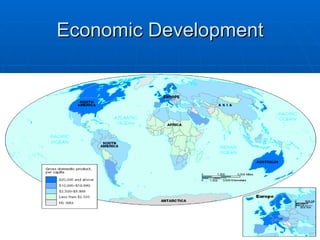
Economic Development Gross Domestic Product (GDP): All goods and services produced by a country in one year Gross National Product (GNP): All goods, services and income or loss generated abroad from investments, bank accounts, etc. Measures the overall wealth of a country, not how that wealth is distributed. Divide by the population to give GDP  per capita.
Economic Development Figure 1.47 Figure 1.49
Economic Development
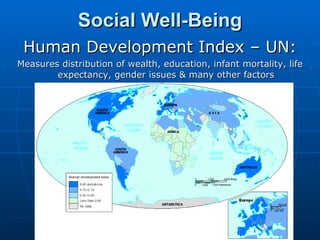
Social Well-Being Human Development Index – UN: Measures distribution of wealth, education, infant mortality, life expectancy, gender issues & many other factors
Social Development – Health and Education < Receiving a polio vaccine in Jakarta Women and Literacy
Development & Gender Equality Global inequality of female income & attainment In many countries women perform most of the work
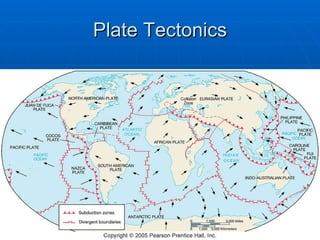
Earth System Science Dynamic Processes Plate Tectonics Continental Drift Continental Shield Alfred Wegener
Plate Tectonics
Seasons, Weather & Climate Earth’s Orbit Axial Tilt Equinox Summer Solstice Winter Solstice Weather At a specific time & place Rain Snow Windy Climate Average conditions over longer time frames Seasonality Monsoons
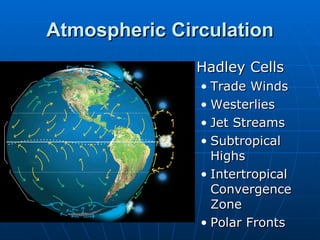
Atmospheric Circulation Hadley Cells Trade Winds Westerlies Jet Streams Subtropical Highs Intertropical Convergence Zone Polar Fronts
Precipitation Convectional Precipitation Equatorial Orographic Precipitation Rising air over mountains
Global Rainfall & Climatic Zones
World Ecosystems Ecosystems Biomes Biogeography Biodiversity
Climate Change Natural Processes Glaciers Volcanoes Tectonics Human Processes Greenhouse Gases Carbon Dioxide Water Vapor Aerosols
World-System Economic Ties Capitalism Communism Immanuel Wallerstein Interdependent Core Semi-Periphery Periphery Consolidation of the World Economy Spatial Justice
Organizing the Core Division of Labor Separation of productive processes Gender division of labor Standardization Time Space Measure Value Money Organizes labor Facilitates trade Supports Industry Supports credit
National Identities Nation  Nation-State Nationalism  Diaspora
Commodification of Nature Judeo-Christian View Earlier View, Organic: Nature as nurturing and chaotic Both considered female Enlightenment Rationalize the nurturing Tame the chaotic Commodify
Organizing the Periphery Exploration Settlement 1870s on –  Growth of colonies Leadership Cycles Hegemony Imperial Overstretch Imperialism Colonialism Britain Germany France The Netherlands U.S. Japan Carving of Africa
Imperialism & Colonialism
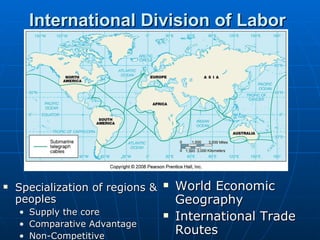
International Division of Labor Specialization of regions & peoples Supply the core Comparative Advantage Non-Competitive World Economic Geography International Trade Routes
Exploration & Exploitation
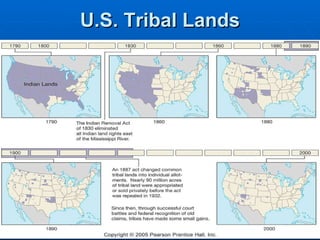
U.S. Tribal Lands
Discovery or Invasion Economic, Political, & Religious Motives Supposed Superiority of the West Transformation and Destruction of Local Systems
Development Theory Rostow’s Stages of Economic Growth Assumes that poverty and lack of development are the problems  Also assumes that poor countries need to emulate Western growth Developmentalism
Neoliberalism World Bank International Monetary Fund (IMF) Structural Adjustment Privatization Export Production Removal of Import Restrictions Encourage Foreign Investment Reduce Government Budgets Food Subsidies, Welfare Programs, Health Care, Education usually first to suffer
Key Factors of Globalization New International Division of Labor Decline of U.S. as an Industrial Producer Decentralization of Manufacturing Production Specializations Within the Core Internationalization of Finance Global Banking & Financial Markets World Cities
Key Factors of Globalization New Technology Systems Energy Technologies Manufacturing & Management Technologies Communications & Transportation Time-Space Convergence Homogenization of Consumer Markets World Products Materialism Advertising & Entertainment
Key Factors of Globalization Transnational Corporations Limited Liability Corporations Investments & Activities Span International Boundaries Exercise of Power Over Peripheral States Export of Jobs to Cheaper Labor Markets Footloose Companies Transnational Economic Integration
Urban Structure Seattle and Industry Contrasts between high  and low income – New Delhi
Cultural Diversity Cultural Collisions … and Hybridization Figure 1.33 Figure 1.35 Gujarat, India South Asia
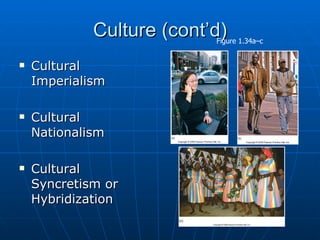
Culture (cont’d) Cultural Imperialism Cultural Nationalism Cultural Syncretism or Hybridization Figure 1.34a–c
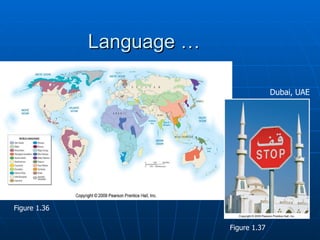
Language … Figure 1.36 Figure 1.37 Dubai, UAE
… and Religion Figure 1.38
World Regions in Global Context: Peoples, Places, and Environments (3 rd . ed) Sallie A. Marston, Paul L. Knox,  & Diana M. Liverman End of Chapter 1: A World of Regions

Chapter 1

  • 1.
    World Regions inGlobal Context: Peoples, Places, and Environments (3 rd . ed) Sallie A. Marston, Paul L. Knox, & Diana M. Liverman Chapter 1: A World of Regions Robert M. Arthur
  • 2.
    Geography matters Globaldifferences in Cultures, Resources, Capital, Spatial Organization, & Territoriality Geographic Study Appreciate the variety of the world’s people and places Understand the relationships between the world’s communities Help with regional, national & global development The Power of Geography
  • 3.
    Geographic Study PhysicalGeography Examines how natural forces shape the Earth Human Geography How human interaction modifies the environment and the spatial organization of human activity Regional Geography Combines both physical & human approaches Holistic examination of territories The Power of Geography
  • 4.
    Regions Region Largesize territories (such as counties, provinces, and countries, or large sections of countries such as the Midwest USA) that encompass many places, all or most of which share a set of attributes that differ from the attributes of places that make up a different region.
  • 5.
    A World ofRegions Regions are dynamic, changing A two-way process of people’s activities changing their environment and people being affected by their environment Created by people responding to the opportunities and constraints presented by their environments
  • 6.
    Setting the Boundaries– World Regions
  • 7.
    Regionalization Classification LogicalDivision Grouping Homogeneity Formal Regions High degree of homogeneity Functional Regions Characterized by functional organization of human occupancy The Regional Approach
  • 8.
  • 9.
    Geography & Interdependence“ The tangible partitioning of space within which different processes operate” Interdependent World Regions National States Supranational Organizations
  • 10.
    Regionalization The geographer’sclassification of individual places or areal units The geographers equivalent of scientific classification
  • 11.
    Boundaries and FrontiersDefine space, encompass territory. Permeable: Allow the flow of goods and people across them. Impermeable: Act as barriers to movement of goods and people. Frontier Regions
  • 12.
    Regionalism & SectionalismRegionalism: When individuals begin to relate stronger to their region than their country, then separatist movements can occur. Sectionalism Irredentism
  • 13.
    Geopolitical Framework Nationsvs. States Ethnic Separatism – Centripetal vs. Centrifugal Forces Basques in Spain
  • 14.
    Globalization The increasing interconnectedness of the world’s regions. Resulting from: Technological Factors - Advances in communications Advances in information handling Advances in transportation Economic factors – Multinational corporations Trade associations between countries Political factors – Supranational governments (EU, NAFTA, ASEAN, etc)
  • 15.
    Issues of ScaleGlobal to Local Example of Call Centers (Back Office Jobs) Are we in Nebraska or in India?? Call Center in Mumbai, India
  • 16.
    Globalization Transnational CorporationsCommodity Chains Global Stratification Neo-liberal Policies
  • 17.
    Globalization and PopulationChange Unevenly distributed, 3 major areas of high density, China, India & Europe. Near water, oceans, seas, lakes or rivers, temperate, low lying areas with fertile soils. 6 billion now, projected to rise to 10 billion by 2050.
  • 18.
    Demographic Transition ModelAttempts to link population growth to Industrial Growth.
  • 19.
  • 20.
  • 21.
    Globalization and CulturalChange The global spread of common architectural forms, dress, ‘fast food’, entertainment, & the English language. These changes do have local character and are not universal. Many local fashions, foods, etc. are exported around the world, not just those of the developed world.
  • 22.
    Diversity Amid GlobalizationGlobalization Increasing Interconnectedness Human and Physical Environments Continual Reorganization of Global and Local Geographies Figure 1.0 Contemporary and Traditional Landscapes in Shanghai
  • 23.
    Alternative Images ofGlobalization Southwestern India Washington, D.C. demonstration Guilin, China
  • 24.
    Cultural Globalization McDonald’sin Thailand … … Linguistic Diversity in Maryland
  • 25.
    Economic Globalization –Formal Figure 1.10
  • 26.
    Economic Globalization –Informal Figure 1.6
  • 27.
    Economic Development, Technology,and Social Well-Being Uneven global distribution of natural resources and of energy sources Favors a few countries while leaving others disadvantaged Political factors important too Japan has few resources unfavorable conditions (war, civil strife, corrupt governments, poor infrastructure) Technology facilitates the shift of energy and natural resource inputs to cheaper sources
  • 28.
  • 29.
    Technology Systems 1790– 1840: Water & steam, textiles, ironworking Canals & turnpikes 1840 – 1890: Coal powered steam, machine tools, steel Railroads & world-wide shipping 1890 – 1950: Internal combustion power, oil, plastics, electrical Aircraft, automobiles, radio & telecommunications 1950 – 1990: Nuclear power, electronics, petrochemicals Global air routes, highways 1990 - ?: Solar energy, robotics, microelectronics, biotechnology & IT
  • 30.
    Economic Sectors PrimaryActivity: Natural resource extraction Secondary Activity: Manufacturing or processing of natural resources Tertiary Activity: Sale and exchange Quaternary Activity: Information processing and handling
  • 31.
    Economic Development GrossDomestic Product (GDP): All goods and services produced by a country in one year Gross National Product (GNP): All goods, services and income or loss generated abroad from investments, bank accounts, etc. Measures the overall wealth of a country, not how that wealth is distributed. Divide by the population to give GDP per capita.
  • 32.
  • 33.
  • 34.
    Social Well-Being HumanDevelopment Index – UN: Measures distribution of wealth, education, infant mortality, life expectancy, gender issues & many other factors
  • 35.
    Social Development –Health and Education < Receiving a polio vaccine in Jakarta Women and Literacy
  • 36.
    Development & GenderEquality Global inequality of female income & attainment In many countries women perform most of the work
  • 37.
    Earth System ScienceDynamic Processes Plate Tectonics Continental Drift Continental Shield Alfred Wegener
  • 38.
  • 39.
    Seasons, Weather &Climate Earth’s Orbit Axial Tilt Equinox Summer Solstice Winter Solstice Weather At a specific time & place Rain Snow Windy Climate Average conditions over longer time frames Seasonality Monsoons
  • 40.
    Atmospheric Circulation HadleyCells Trade Winds Westerlies Jet Streams Subtropical Highs Intertropical Convergence Zone Polar Fronts
  • 41.
    Precipitation Convectional PrecipitationEquatorial Orographic Precipitation Rising air over mountains
  • 42.
    Global Rainfall &Climatic Zones
  • 43.
    World Ecosystems EcosystemsBiomes Biogeography Biodiversity
  • 44.
    Climate Change NaturalProcesses Glaciers Volcanoes Tectonics Human Processes Greenhouse Gases Carbon Dioxide Water Vapor Aerosols
  • 45.
    World-System Economic TiesCapitalism Communism Immanuel Wallerstein Interdependent Core Semi-Periphery Periphery Consolidation of the World Economy Spatial Justice
  • 46.
    Organizing the CoreDivision of Labor Separation of productive processes Gender division of labor Standardization Time Space Measure Value Money Organizes labor Facilitates trade Supports Industry Supports credit
  • 47.
    National Identities Nation Nation-State Nationalism Diaspora
  • 48.
    Commodification of NatureJudeo-Christian View Earlier View, Organic: Nature as nurturing and chaotic Both considered female Enlightenment Rationalize the nurturing Tame the chaotic Commodify
  • 49.
    Organizing the PeripheryExploration Settlement 1870s on – Growth of colonies Leadership Cycles Hegemony Imperial Overstretch Imperialism Colonialism Britain Germany France The Netherlands U.S. Japan Carving of Africa
  • 50.
  • 51.
  • 52.
    International Division ofLabor Specialization of regions & peoples Supply the core Comparative Advantage Non-Competitive World Economic Geography International Trade Routes
  • 53.
  • 54.
  • 55.
    Discovery or InvasionEconomic, Political, & Religious Motives Supposed Superiority of the West Transformation and Destruction of Local Systems
  • 56.
    Development Theory Rostow’sStages of Economic Growth Assumes that poverty and lack of development are the problems Also assumes that poor countries need to emulate Western growth Developmentalism
  • 57.
    Neoliberalism World BankInternational Monetary Fund (IMF) Structural Adjustment Privatization Export Production Removal of Import Restrictions Encourage Foreign Investment Reduce Government Budgets Food Subsidies, Welfare Programs, Health Care, Education usually first to suffer
  • 58.
    Key Factors ofGlobalization New International Division of Labor Decline of U.S. as an Industrial Producer Decentralization of Manufacturing Production Specializations Within the Core Internationalization of Finance Global Banking & Financial Markets World Cities
  • 59.
    Key Factors ofGlobalization New Technology Systems Energy Technologies Manufacturing & Management Technologies Communications & Transportation Time-Space Convergence Homogenization of Consumer Markets World Products Materialism Advertising & Entertainment
  • 60.
    Key Factors ofGlobalization Transnational Corporations Limited Liability Corporations Investments & Activities Span International Boundaries Exercise of Power Over Peripheral States Export of Jobs to Cheaper Labor Markets Footloose Companies Transnational Economic Integration
  • 61.
    Urban Structure Seattleand Industry Contrasts between high and low income – New Delhi
  • 62.
    Cultural Diversity CulturalCollisions … and Hybridization Figure 1.33 Figure 1.35 Gujarat, India South Asia
  • 63.
    Culture (cont’d) CulturalImperialism Cultural Nationalism Cultural Syncretism or Hybridization Figure 1.34a–c
  • 64.
    Language … Figure1.36 Figure 1.37 Dubai, UAE
  • 65.
    … and ReligionFigure 1.38
  • 66.
    World Regions inGlobal Context: Peoples, Places, and Environments (3 rd . ed) Sallie A. Marston, Paul L. Knox, & Diana M. Liverman End of Chapter 1: A World of Regions

Editor's Notes

  • #10 One of the best ways of organizing knowledge about the world.
  • #64 Korean woman in Downtown Washington, D.C. Amsterdam, the Netherlands Garifuna women in Honduras