International
Business 7e
by Charles W.L. Hill
McGraw-Hill/Irwin Copyright © 2009 by The McGraw-Hill Companies, Inc. All rights reserved.
Chapter 1
Globalization
1-3
What Is Globalization?
The world is moving away from self-contained national
economies toward an interdependent, integrated global
economic system
Globalization refers to the shift toward a more integrated
and interdependent world economy
Globalization has two facets:
1) the globalization of markets
2) the globalization of production
1-4
The Globalization Of Markets
The globalization of markets refers to the merging of
historically distinct and separate national markets into one
huge global marketplace
In many industries, it is no longer meaningful to talk
about the “German market” or the “American market”
Instead, there is only the global market
1-5
The Globalization Of Markets
Falling trade barriers make it easier to sell internationally
The tastes and preferences of consumers are converging
on some global norm
Firms help create the global market by offering the same
basic products worldwide
1-6
Classroom Performance System
The shift toward a more integrated and interdependent
world economy is referred to as
a) economic integration
b) economic interdependency
c) globalization
d) internationalization
1-7
The Globalization Of Production
The globalization of production refers to the sourcing of
goods and services from locations around the globe to take
advantage of national differences in the cost and quality of
factors of production like land, labor, and capital
Companies compete more effectively by lowering their
overall cost structure or improving the quality or
functionality of their product offering
1-8
Classroom Performance System
The merging of historically distinct and separate
national markets into one huge global marketplace is
known as
a) global market facilitation
b) cross-border trade
c) supranational market integration
d) the globalization of markets
1-9
Classroom Performance System
Firms that are involved in international business tend to
be
a) large
b) small
c) medium-sized
d) large, small, and medium-sized
1-10
The Emergence Of Global Institutions
Institutions are needed to:
help manage, regulate, and police the global marketplace
promote the establishment of multinational treaties to
govern the global business system
1-11
The Emergence Of Global Institutions
Institutions created over the past half century include:
the General Agreement on Tariffs and Trade (GATT)
the World Trade Organization (WTO)
the International Monetary Fund (IMF)
the World Bank
the United Nations (UN)
1-12
The Emergence Of Global Institutions
The World Trade Organization (like its predecessor
GATT) is primarily responsible for policing the world trading
system and making sure that nation-states adhere to the
rules laid down in trade treaties signed by WTO members
In 2007, the 150 nations that accounted for 97% of world
trade were WTO members
The WTO promotes lower barriers to trade and
investment
1-13
The Emergence Of Global Institutions
The International Monetary Fund and the World Bank
were created in 1944
The IMF was established to maintain order in the
international monetary system
The World Bank was established to promote economic
development
1-14
The Emergence Of Global Institutions
The United Nations was established in 1945 to:
maintain international peace and security
develop friendly relations among nations
cooperate in solving international problems and in
promoting respect for human rights
be a center for harmonizing the actions of nations
1-15
Classroom Performance System
Which is not a factor of production?
a) land
b) trade
c) capital
d) labor
1-16
Drivers Of Globalization
Two macro factors underlie the trend toward greater
globalization:
the decline in barriers to the free flow of goods, services,
and capital that has occurred since the end of World War II
technological change
1-17
Declining Trade And
Investment Barriers
International trade occurs when a firm exports goods or
services to consumers in another country
Foreign direct investment (FDI) occurs when a firm
invests resources in business activities outside its home
country
After World War II, advanced countries made a
commitment to lower barriers to trade and investment
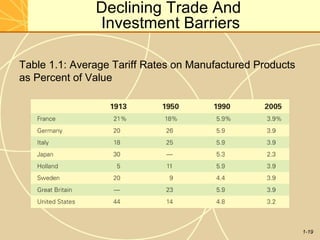
Since 1950, average tariffs have fallen significantly and
are now at about 4%
Countries have also been opening markets to FDI
1-18
Classroom Performance System
The sourcing of good and services from around the world
to take advantage of national differences in the cost and
quality of factors of production is called
a) economies of scale
b) the globalization of production
c) global integration
d) global sourcing
1-19
Declining Trade And
Investment Barriers
Table 1.1: Average Tariff Rates on Manufactured Products
as Percent of Value
1-20
Declining Trade And
Investment Barriers
Lower barriers to trade and investment mean:
that firms can view the world, rather than a single
country, as their market
that firms can base production in the optimal location for
that activity
1-21
Classroom Performance System
Which organization is responsible for policing the world
trading system?
a) the International Monetary Fund
b) the United Nations
c) the World Trade Organization
d) the World Bank
1-22
The Role Of Technological Change
Implications of technological change for the globalization of
production include:
lower transportation costs that enable firms to disperse
production to economical, geographically separate
locations
lower information processing and communication costs
that enable firms to create and manage globally dispersed
production systems
1-23
The Role Of Technological Change
Implications of technological change for the globalization of
markets include:
low cost global communications networks help create
electronic global marketplace
low-cost transportation help create global markets
global communication networks and global media are
creating a worldwide culture, and a global market for
consumer products
1-24
The Changing Demographics
Of The Global Economy
There has been a drastic change in the demographics of
the world economy in the last 30 years
Four trends are important:
the Changing World Output and World Trade Picture
the Changing Foreign Direct Investment Picture
the Changing Nature of the Multinational Enterprise
the Changing World Order
1-25
The Changing World Output
And World Trade Picture
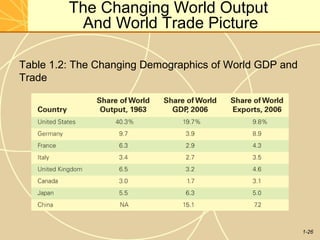
In 1960, the United States accounted for over 40% of
world economic activity
By 2006, the United States accounted for less than 20%
of world economic activity
A similar trend occurred in other developed countries
The share of world output accounted for by developing
nations is rising and is expected to account for more than
60% of world economic activity by 2020
1-26
The Changing World Output
And World Trade Picture
Table 1.2: The Changing Demographics of World GDP and
Trade
1-27
The Changing Foreign Direct
Investment Picture
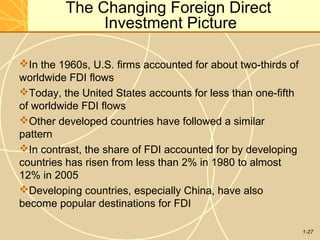
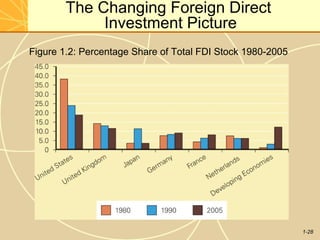
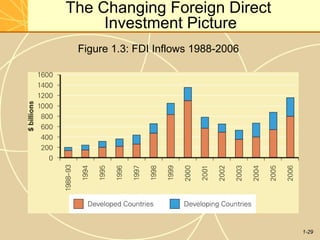
In the 1960s, U.S. firms accounted for about two-thirds of
worldwide FDI flows
Today, the United States accounts for less than one-fifth
of worldwide FDI flows
Other developed countries have followed a similar
pattern
In contrast, the share of FDI accounted for by developing
countries has risen from less than 2% in 1980 to almost
12% in 2005
Developing countries, especially China, have also
become popular destinations for FDI
1-28
The Changing Foreign Direct
Investment Picture
Figure 1.2: Percentage Share of Total FDI Stock 1980-2005
1-29
The Changing Foreign Direct
Investment Picture
Figure 1.3: FDI Inflows 1988-2006
1-30
The Changing Nature Of
The Multinational Enterprise
A multinational enterprise (MNE) is any business that has
productive activities in two or more countries
Since the 1960s, there has been a rise in non-U.S.
multinationals, and a growth of mini-multinationals
1-31
The Changing World Order
Many former Communist nations in Europe and Asia are
now committed to democratic politics and free market
economies and so, create new opportunities for
international businesses
China and Latin America are also moving toward greater
free market reforms
1-32
The Global Economy Of
The Twenty-first Century
The world is moving toward a more global economic
system, but globalization is not inevitable
Globalization also brings risks like the financial crisis that
swept through South East Asia in the late 1990s
1-33
Classroom Performance System
Which of the following trends is true?
a) the United States is accounting for a greater percentage
of world trade than ever before
b) the United States is accounting for a greater percentage
of foreign direct investment than ever before
c) the share of world trade accounted for by developing
countries is rising
d) the share of foreign direct investment by developing
countries is declining
1-34
The Globalization Debate
Is the shift toward a more integrated and interdependent
global economy a good thing?
Supporters believe that increased trade and cross-border
investment mean lower prices for goods and services,
greater economic growth, higher consumer income, and
more jobs
Critics worry that globalization will cause job losses,
environmental degradation, and the cultural imperialism of
global media and MNEs
1-35
Anti-Globalization Protests
More than 40,000 anti-globalization protesters took to the
street at the WTO meeting in Seattle in 1999
Protesters now regularly show up at most major
meetings of global institutions
1-36
Globalization, Jobs, And Income
Globalization critics argue that falling barriers to trade are
destroying manufacturing jobs in advanced countries
Supporters of globalization contend that the benefits of
this trend outweigh the costs—that countries will specialize
in what they do most efficiently and trade for other goods—
and all countries will benefit
1-37
Globalization, Labor Policies,
And The Environment
Globalization critics argue that firms avoid costly efforts
to adhere to labor and environmental regulations by moving
production to countries where such regulations do not exist,
or are not enforced
Globalization supporters claim that tougher
environmental and labor standards are associated with
economic progress, so as countries get richer from free
trade, they get tougher environmental and labor regulations
1-38
Globalization And
National Sovereignty
Critics of globalization worry that today’s interdependent
global economy is shifting economic power away from
national governments toward supranational organizations
like the WTO, the EU, and the UN
Supporters of globalization contend that the power of
these organizations is limited to what nation-states agree to
grant, and that the power of the organizations lies in their
ability to get countries to agree to follow certain actions
1-39
Globalization And The World’s Poor
Critics of globalization argue that the gap between rich
nations and poor nations is getting wider
Supporters of globalization claim that the best way for the
poor nations to improve their situation is to reduce barriers
to trade and investment and implement economic policies
based on free market economies, and to receive debt
forgiveness for debts incurred under totalitarian regimes
1-40
Managing In The Global Marketplace
An international business is any firm that engages in
international trade or investment
1-41
Managing In The Global Marketplace
Managing an international business differs from managing
a domestic business because:
countries are different
the range of problems confronted in an international
business is wider and the problems more complex than
those in a domestic business
firms have to find ways to work within the limits imposed
by government intervention in the international trade and
investment system
international transactions involve converting money into
different currencies

Globalization Debate

  • 1.
    International Business 7e by CharlesW.L. Hill McGraw-Hill/Irwin Copyright © 2009 by The McGraw-Hill Companies, Inc. All rights reserved.
  • 2.
  • 3.
    1-3 What Is Globalization? Theworld is moving away from self-contained national economies toward an interdependent, integrated global economic system Globalization refers to the shift toward a more integrated and interdependent world economy Globalization has two facets: 1) the globalization of markets 2) the globalization of production
  • 4.
    1-4 The Globalization OfMarkets The globalization of markets refers to the merging of historically distinct and separate national markets into one huge global marketplace In many industries, it is no longer meaningful to talk about the “German market” or the “American market” Instead, there is only the global market
  • 5.
    1-5 The Globalization OfMarkets Falling trade barriers make it easier to sell internationally The tastes and preferences of consumers are converging on some global norm Firms help create the global market by offering the same basic products worldwide
  • 6.
    1-6 Classroom Performance System Theshift toward a more integrated and interdependent world economy is referred to as a) economic integration b) economic interdependency c) globalization d) internationalization
  • 7.
    1-7 The Globalization OfProduction The globalization of production refers to the sourcing of goods and services from locations around the globe to take advantage of national differences in the cost and quality of factors of production like land, labor, and capital Companies compete more effectively by lowering their overall cost structure or improving the quality or functionality of their product offering
  • 8.
    1-8 Classroom Performance System Themerging of historically distinct and separate national markets into one huge global marketplace is known as a) global market facilitation b) cross-border trade c) supranational market integration d) the globalization of markets
  • 9.
    1-9 Classroom Performance System Firmsthat are involved in international business tend to be a) large b) small c) medium-sized d) large, small, and medium-sized
  • 10.
    1-10 The Emergence OfGlobal Institutions Institutions are needed to: help manage, regulate, and police the global marketplace promote the establishment of multinational treaties to govern the global business system
  • 11.
    1-11 The Emergence OfGlobal Institutions Institutions created over the past half century include: the General Agreement on Tariffs and Trade (GATT) the World Trade Organization (WTO) the International Monetary Fund (IMF) the World Bank the United Nations (UN)
  • 12.
    1-12 The Emergence OfGlobal Institutions The World Trade Organization (like its predecessor GATT) is primarily responsible for policing the world trading system and making sure that nation-states adhere to the rules laid down in trade treaties signed by WTO members In 2007, the 150 nations that accounted for 97% of world trade were WTO members The WTO promotes lower barriers to trade and investment
  • 13.
    1-13 The Emergence OfGlobal Institutions The International Monetary Fund and the World Bank were created in 1944 The IMF was established to maintain order in the international monetary system The World Bank was established to promote economic development
  • 14.
    1-14 The Emergence OfGlobal Institutions The United Nations was established in 1945 to: maintain international peace and security develop friendly relations among nations cooperate in solving international problems and in promoting respect for human rights be a center for harmonizing the actions of nations
  • 15.
    1-15 Classroom Performance System Whichis not a factor of production? a) land b) trade c) capital d) labor
  • 16.
    1-16 Drivers Of Globalization Twomacro factors underlie the trend toward greater globalization: the decline in barriers to the free flow of goods, services, and capital that has occurred since the end of World War II technological change
  • 17.
    1-17 Declining Trade And InvestmentBarriers International trade occurs when a firm exports goods or services to consumers in another country Foreign direct investment (FDI) occurs when a firm invests resources in business activities outside its home country After World War II, advanced countries made a commitment to lower barriers to trade and investment Since 1950, average tariffs have fallen significantly and are now at about 4% Countries have also been opening markets to FDI
  • 18.
    1-18 Classroom Performance System Thesourcing of good and services from around the world to take advantage of national differences in the cost and quality of factors of production is called a) economies of scale b) the globalization of production c) global integration d) global sourcing
  • 19.
    1-19 Declining Trade And InvestmentBarriers Table 1.1: Average Tariff Rates on Manufactured Products as Percent of Value
  • 20.
    1-20 Declining Trade And InvestmentBarriers Lower barriers to trade and investment mean: that firms can view the world, rather than a single country, as their market that firms can base production in the optimal location for that activity
  • 21.
    1-21 Classroom Performance System Whichorganization is responsible for policing the world trading system? a) the International Monetary Fund b) the United Nations c) the World Trade Organization d) the World Bank
  • 22.
    1-22 The Role OfTechnological Change Implications of technological change for the globalization of production include: lower transportation costs that enable firms to disperse production to economical, geographically separate locations lower information processing and communication costs that enable firms to create and manage globally dispersed production systems
  • 23.
    1-23 The Role OfTechnological Change Implications of technological change for the globalization of markets include: low cost global communications networks help create electronic global marketplace low-cost transportation help create global markets global communication networks and global media are creating a worldwide culture, and a global market for consumer products
  • 24.
    1-24 The Changing Demographics OfThe Global Economy There has been a drastic change in the demographics of the world economy in the last 30 years Four trends are important: the Changing World Output and World Trade Picture the Changing Foreign Direct Investment Picture the Changing Nature of the Multinational Enterprise the Changing World Order
  • 25.
    1-25 The Changing WorldOutput And World Trade Picture In 1960, the United States accounted for over 40% of world economic activity By 2006, the United States accounted for less than 20% of world economic activity A similar trend occurred in other developed countries The share of world output accounted for by developing nations is rising and is expected to account for more than 60% of world economic activity by 2020
  • 26.
    1-26 The Changing WorldOutput And World Trade Picture Table 1.2: The Changing Demographics of World GDP and Trade
  • 27.
    1-27 The Changing ForeignDirect Investment Picture In the 1960s, U.S. firms accounted for about two-thirds of worldwide FDI flows Today, the United States accounts for less than one-fifth of worldwide FDI flows Other developed countries have followed a similar pattern In contrast, the share of FDI accounted for by developing countries has risen from less than 2% in 1980 to almost 12% in 2005 Developing countries, especially China, have also become popular destinations for FDI
  • 28.
    1-28 The Changing ForeignDirect Investment Picture Figure 1.2: Percentage Share of Total FDI Stock 1980-2005
  • 29.
    1-29 The Changing ForeignDirect Investment Picture Figure 1.3: FDI Inflows 1988-2006
  • 30.
    1-30 The Changing NatureOf The Multinational Enterprise A multinational enterprise (MNE) is any business that has productive activities in two or more countries Since the 1960s, there has been a rise in non-U.S. multinationals, and a growth of mini-multinationals
  • 31.
    1-31 The Changing WorldOrder Many former Communist nations in Europe and Asia are now committed to democratic politics and free market economies and so, create new opportunities for international businesses China and Latin America are also moving toward greater free market reforms
  • 32.
    1-32 The Global EconomyOf The Twenty-first Century The world is moving toward a more global economic system, but globalization is not inevitable Globalization also brings risks like the financial crisis that swept through South East Asia in the late 1990s
  • 33.
    1-33 Classroom Performance System Whichof the following trends is true? a) the United States is accounting for a greater percentage of world trade than ever before b) the United States is accounting for a greater percentage of foreign direct investment than ever before c) the share of world trade accounted for by developing countries is rising d) the share of foreign direct investment by developing countries is declining
  • 34.
    1-34 The Globalization Debate Isthe shift toward a more integrated and interdependent global economy a good thing? Supporters believe that increased trade and cross-border investment mean lower prices for goods and services, greater economic growth, higher consumer income, and more jobs Critics worry that globalization will cause job losses, environmental degradation, and the cultural imperialism of global media and MNEs
  • 35.
    1-35 Anti-Globalization Protests More than40,000 anti-globalization protesters took to the street at the WTO meeting in Seattle in 1999 Protesters now regularly show up at most major meetings of global institutions
  • 36.
    1-36 Globalization, Jobs, AndIncome Globalization critics argue that falling barriers to trade are destroying manufacturing jobs in advanced countries Supporters of globalization contend that the benefits of this trend outweigh the costs—that countries will specialize in what they do most efficiently and trade for other goods— and all countries will benefit
  • 37.
    1-37 Globalization, Labor Policies, AndThe Environment Globalization critics argue that firms avoid costly efforts to adhere to labor and environmental regulations by moving production to countries where such regulations do not exist, or are not enforced Globalization supporters claim that tougher environmental and labor standards are associated with economic progress, so as countries get richer from free trade, they get tougher environmental and labor regulations
  • 38.
    1-38 Globalization And National Sovereignty Criticsof globalization worry that today’s interdependent global economy is shifting economic power away from national governments toward supranational organizations like the WTO, the EU, and the UN Supporters of globalization contend that the power of these organizations is limited to what nation-states agree to grant, and that the power of the organizations lies in their ability to get countries to agree to follow certain actions
  • 39.
    1-39 Globalization And TheWorld’s Poor Critics of globalization argue that the gap between rich nations and poor nations is getting wider Supporters of globalization claim that the best way for the poor nations to improve their situation is to reduce barriers to trade and investment and implement economic policies based on free market economies, and to receive debt forgiveness for debts incurred under totalitarian regimes
  • 40.
    1-40 Managing In TheGlobal Marketplace An international business is any firm that engages in international trade or investment
  • 41.
    1-41 Managing In TheGlobal Marketplace Managing an international business differs from managing a domestic business because: countries are different the range of problems confronted in an international business is wider and the problems more complex than those in a domestic business firms have to find ways to work within the limits imposed by government intervention in the international trade and investment system international transactions involve converting money into different currencies

Editor's Notes

  • #5 The globalization of markets refers to the merging of historically distinct and separate national markets into one huge global marketplace. It is important to recognize that significant differences still exist among national markets, requiring companies to customize market strategies, product features, and operating practices to meet the conditions in particular markets. The most global markets currently are not markets for consumer products—where national differences in tastes and preferences are still often important enough to act as a brake on globalization—but markets for industrial goods and materials that serve a universal need the world over. These include the markets for commodities such as aluminum, oil, and wheat; the markets for industrial products such as microprocessors, DRAMs (computer memory chips), and commercial jet aircraft; the markets for computer software; and the markets for financial assets from U.S. Treasury bills to Eurobonds and futures on the Nikkei index or the Mexican peso.
  • #6 In many markets the emergence of a global marketplace has begun to occur. There are three causes: falling barriers to cross-border trade have made it easier to sell internationally; tastes and preferences are converging on some global norm helping to create a global market; and firms are facilitating the trend by offering standardized products worldwide creating a global market.
  • #7 The correct answer is c.
  • #8 The globalization of production refers to the sourcing of goods and services from locations around the globe to take advantage of national differences in the cost and quality of factors of production (such as labor, energy, land, and capital). By doing this, companies hope to lower their overall cost structure and/or improve the quality or functionality of their product offering, thereby allowing them to compete more effectively. Early outsourcing efforts were primarily confined to manufacturing enterprises, but today, more companies are taking advantage of modern communications technology, like the Internet, to outsource service activities to low-cost producers in other nations. The Country Focus: Outsourcing American Healthcare illustrates how the Internet has allowed hospitals to outsource some radiology work to India, where images from MRI scans and the like are read at night while U.S. physicians sleep, and are the results are ready for them in the morning. There are still substantial impediments to the globalization of production including formal and informal barriers to trade, barriers to foreign direct investment, transportation costs, issues associated with economic risk, and issues associated with political risk.
  • #9 The correct answer is d.
  • #10 The correct answer is d.
  • #16 The correct answer is b.
  • #17 The two macro factors underlie the trend towards greater globalization: First, the decline in the barriers to free flow of goods, services, and capital Second, technological change in communications, information processing, and transportation technologies.
  • #18 International trade occurs when a firm exports goods or services to consumers in another country. Foreign direct investment (FDI) occurs when a firm invests resources in business activities outside its home country. After World War II, advanced industrial nations of the West committed themselves to removing barriers to the free flow of goods, services, and capital between nations.
  • #19 The correct answer is b.
  • #22 The correct answer is c.
  • #26 In the 1960s: the U.S. dominated the world economy and the world trade picture, U.S. multinationals dominated the international business scene, and about half the world-- the centrally planned economies of the communist world-- was off limits to Western international business.
  • #27 The Country Focus: India’s Software Sector feature explores the growth of India’ software sector over the last twenty-five years. Four factors account for the growth of the sector. First, the country has a large supply of engineers. Second, labor costs in India are low. Third, since many Indians are fluent in English, coordination between Western firms and Indian firms is easier. Fourth, because of time differences, Indians can work while Americans sleep.
  • #28 The share of world output generated by developing countries has been steadily increasing since the 1960s. The stock (total cumulative value of foreign investments) generated by rich industrial countries has been on a steady decline. There has been a sustained growth in cross-border flows of foreign direct investment. The flow of foreign direct investment (amounts invested across national borders each year) has been directed at developing nations especially China.
  • #29 This slide offers a definition for globalization; it highlights that globalization affects two primary areas.
  • #30 This slide offers a definition for globalization; it highlights that globalization affects two primary areas.
  • #31 A multinational enterprise is any business that has productive activities in two or more countries. Expect the growth of new multinational enterprises (any business that has productive activities in two or more countries) from the world's developing nations. The number of mini-multinationals (small and medium-sized companies) is on the rise.
  • #32 The Management Focus: China’s Hisense – An Emerging Multinational examines how one Chinese company, Hisense, has emerged as one of China’s premier makers of televisions, air conditioners, refrigerators, personal computers, and telecommunications. Hisense began as a state-owned company in 1969, but became a private corporation in 1994. Today, the company has sales of $3.3 billion, and has sets its sights on becoming a global enterprise with a world class consumer brand. Hisnese believes its core strength lies with its ability to rapidly innovate. Teaching Tip: To find out more about Hisense, visit the company’s web site at {http://www..hisense.com}
  • #34 The correct answer is c.
  • #36 The Country Focus: Protesting Globalization in France feature describes the anti-globalization protests going on in France. The protests, led by activist Jose Bove, started when the U.S. retaliated against EU bans on beef imports by imposing a 100% tariff on some EU products. Bove and his associates targeted McDonald’s, and also California winemaker Mondavi as symbols of their opposition to American investments. Still, despite the protests, foreign investment in France is at record highs, and ironically, so are French investments abroad.