General Purpose of
Classroom Assessment
1. Assessment OF Learning
2. Assessment FOR Learning
3. Assessment AS Learning
General Purpose of
Classroom Assessment
1. Assessment OF Learning
- refers to the use of assessment to determine
learner’s acquired knowledge and skills from
instruction and whether they achieve the curriculum
outcomes
General Purpose of
Classroom Assessment
2. Assessment FOR Learning
- refers to the use of assessment to identify the
needs of learners in order to modify instruction or
learning activities in the classroom
- it is meant to identify gaps in the learning
experiences or learners
General Purpose of
Classroom Assessment
3. Assessment AS Learning
- refers to the use of assessment to help learners
become self-regulated.
- it is meant to use assessment tasks, results,
feedback to help learners make adjustments to
achieve the curriculum outcomes
The Roles of Classroom
Assessment in the Teaching-
Learning Process
1. Formative
2. Diagnostic
3. Evaluative
4. Facilitative
5. Motivational
The Revised BLOOM’S TAXONOMY
- Anderson and Krathwohl proposed the revision of
Bloom’s Taxonomy
- the Bloom’s taxonomy has a two-dimensional
model of writing the objectives
- a. cognitive process dimension
- b. knowledge dimension
The Revised BLOOM’S TAXONOMY
6 Types of Cognitive process dimensions
a. Remember
b. Understand
c. Apply
d. Analyze
e. Evaluate
f. Create
The Revised BLOOM’S TAXONOMY
6 Types of Cognitive process dimensions
a. Remember
- Recognizing and recalling facts
illustrative verbs:
identify, list, name, underline, recall, retrieve,
locate
The Revised BLOOM’S TAXONOMY
6 Types of Cognitive process dimensions
b. Understand
- understanding what the information means
illustrative verbs:
describe, determine, interpret, translate,
paraphrase, explain
The Revised BLOOM’S TAXONOMY
6 Types of Cognitive process dimensions
c. Apply
- applying the facts, rules, concepts, and ideas, in
another context
illustrative verbs:
apply, employ, practice, relate, use, implement,
carry-out, solve
The Revised BLOOM’S TAXONOMY
6 Types of Cognitive process dimensions
d. Analyze
- breaking down information into facts
illustrative verbs:
analyze, calculate, examine, test, compare,
differentiate, organize, classify
The Revised BLOOM’S TAXONOMY
6 Types of Cognitive process dimensions
e. Evaluate
- judging the value of information or data
illustrative verbs:
assess, measure, estimate, evaluate, critique,
judge
The Revised BLOOM’S TAXONOMY
6 Types of Cognitive process dimensions
f. Create
- combining parts to make a whole
illustrative verbs:
compose, produce, formulate, devise, prepare,
design, construct, propose, re-organized
The Revised BLOOM’S TAXONOMY
4 Types of Knowledge dimensions
a. Metacognitive
b. Procedural
c. Conceptual
d. Factual
The Revised BLOOM’S TAXONOMY
4 Types of Knowledge dimensions
a. Metacognitive
- makes the discipline relevant to one’s life
- it makes one understand the value of learning on
one’s life
- it requires reflective knowledge and strategies on
how to solve problems or perform a cognitive task
through understanding of oneself and context
-
The Revised BLOOM’S TAXONOMY
4 Types of Knowledge dimensions
b. Procedural
- it tells the processes, steps, techniques,
methodologies, or specific skills needed in performing
a specific task that one needs to know and be able to
do in a discipline
The Revised BLOOM’S TAXONOMY
4 Types of Knowledge dimensions
c. Conceptual
- it tells the concepts, generalizations, principles,
theories, and models that one needs to know in a
discipline
The Revised BLOOM’S TAXONOMY
4 Types of Knowledge dimensions
d. Factual
- it tells the facts or bits of information one needs
to know in a discipline
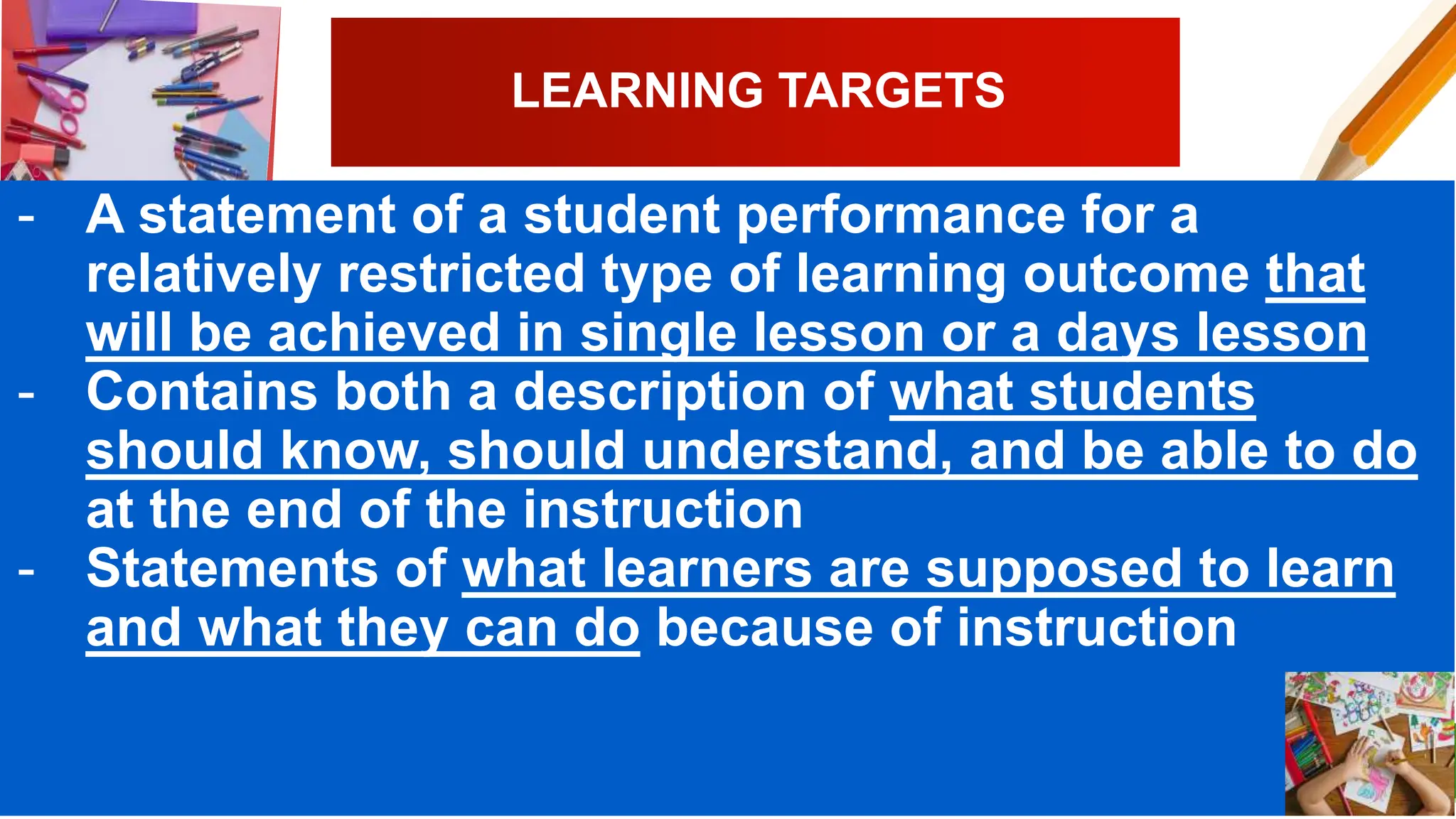
LEARNING TARGETS
- A statement of a student performance for a
relatively restricted type of learning outcome that
will be achieved in single lesson or a days lesson
- Contains both a description of what students
should know, should understand, and be able to do
at the end of the instruction
- Statements of what learners are supposed to learn
and what they can do because of instruction
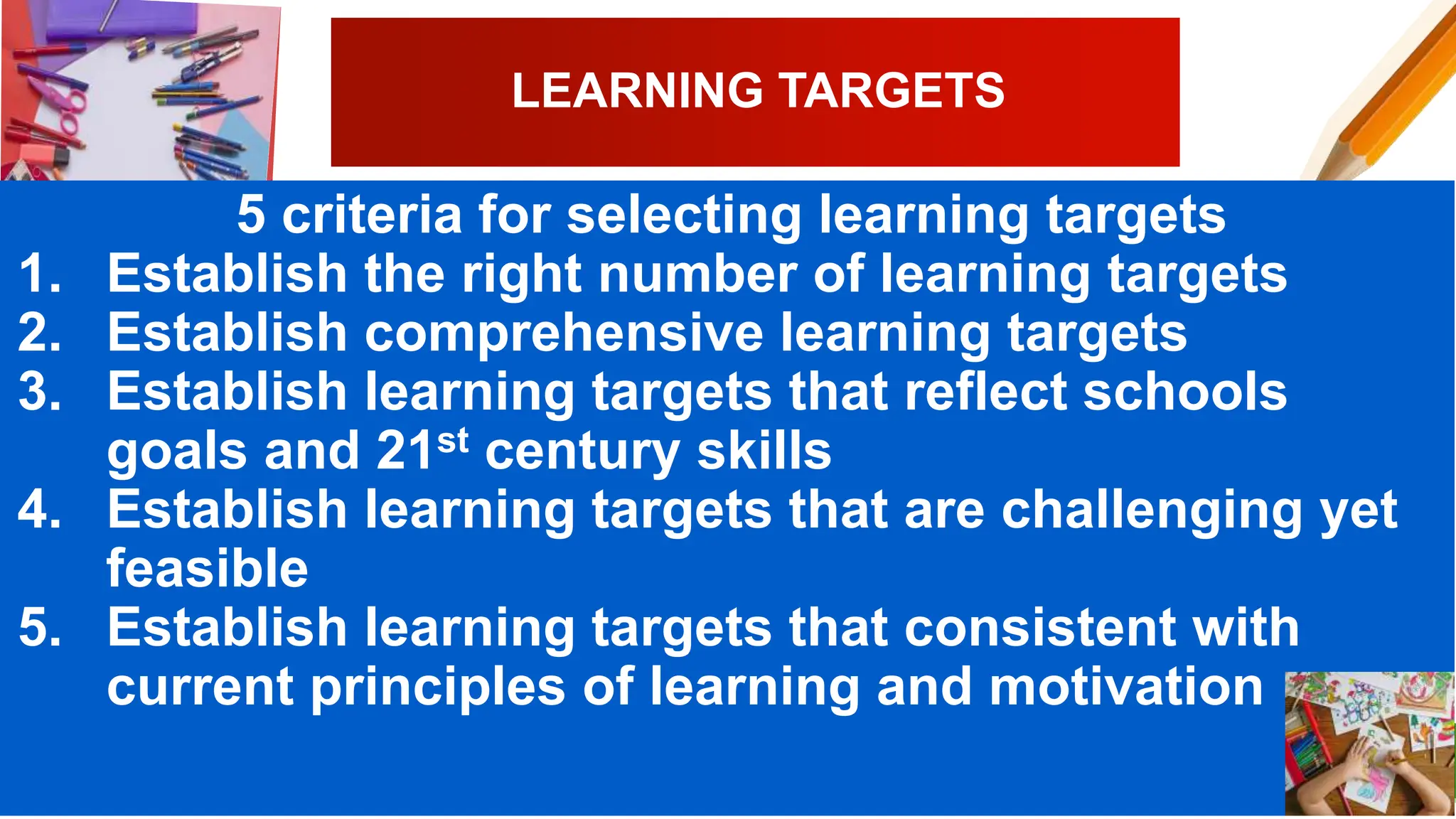
LEARNING TARGETS
5 criteria for selecting learning targets
1. Establish the right number of learning targets
2. Establish comprehensive learning targets
3. Establish learning targets that reflect schools
goals and 21st century skills
4. Establish learning targets that are challenging yet
feasible
5. Establish learning targets that consistent with
current principles of learning and motivation
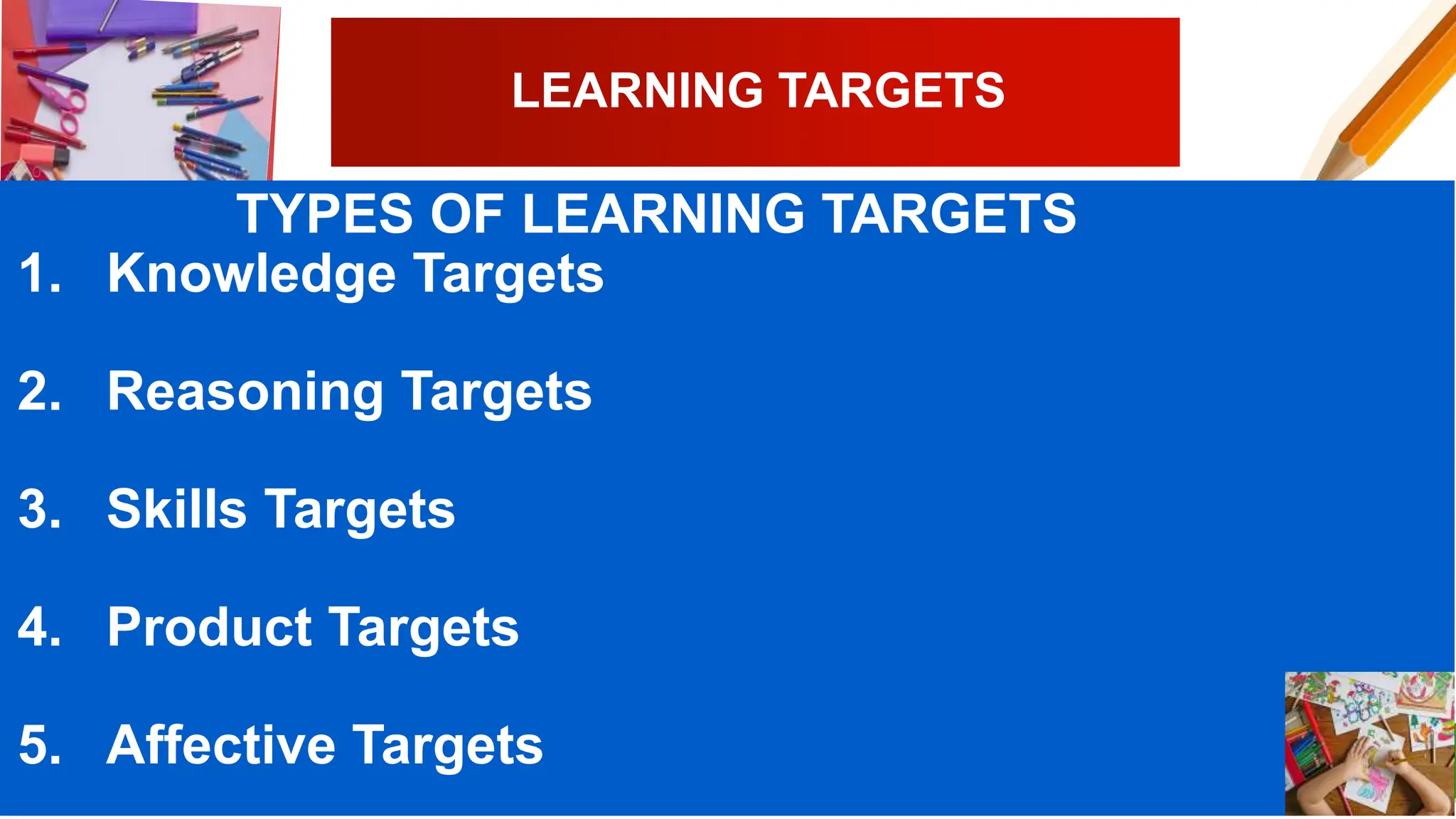
LEARNING TARGETS
TYPES OF LEARNING TARGETS
1. Knowledge Targets
2. Reasoning Targets
3. Skills Targets
4. Product Targets
5. Affective Targets
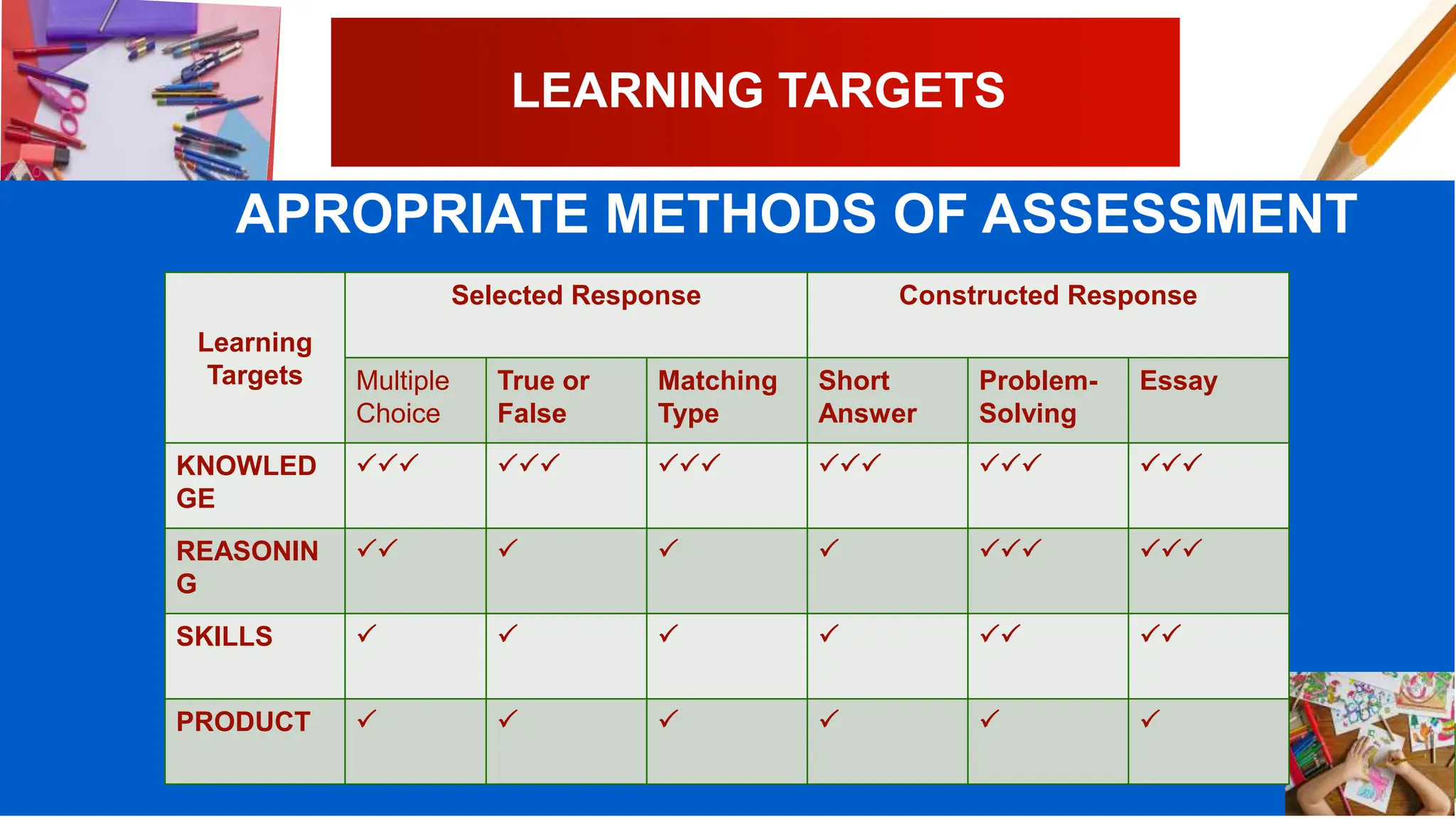
LEARNING TARGETS
APROPRIATE METHODS OF ASSESSMENT
Learning
Targets
Selected Response Constructed Response
Multiple
Choice
True or
False
Matching
Type
Short
Answer
Problem-
Solving
Essay
KNOWLED
GE
     
REASONIN
G
     
SKILLS      
PRODUCT      
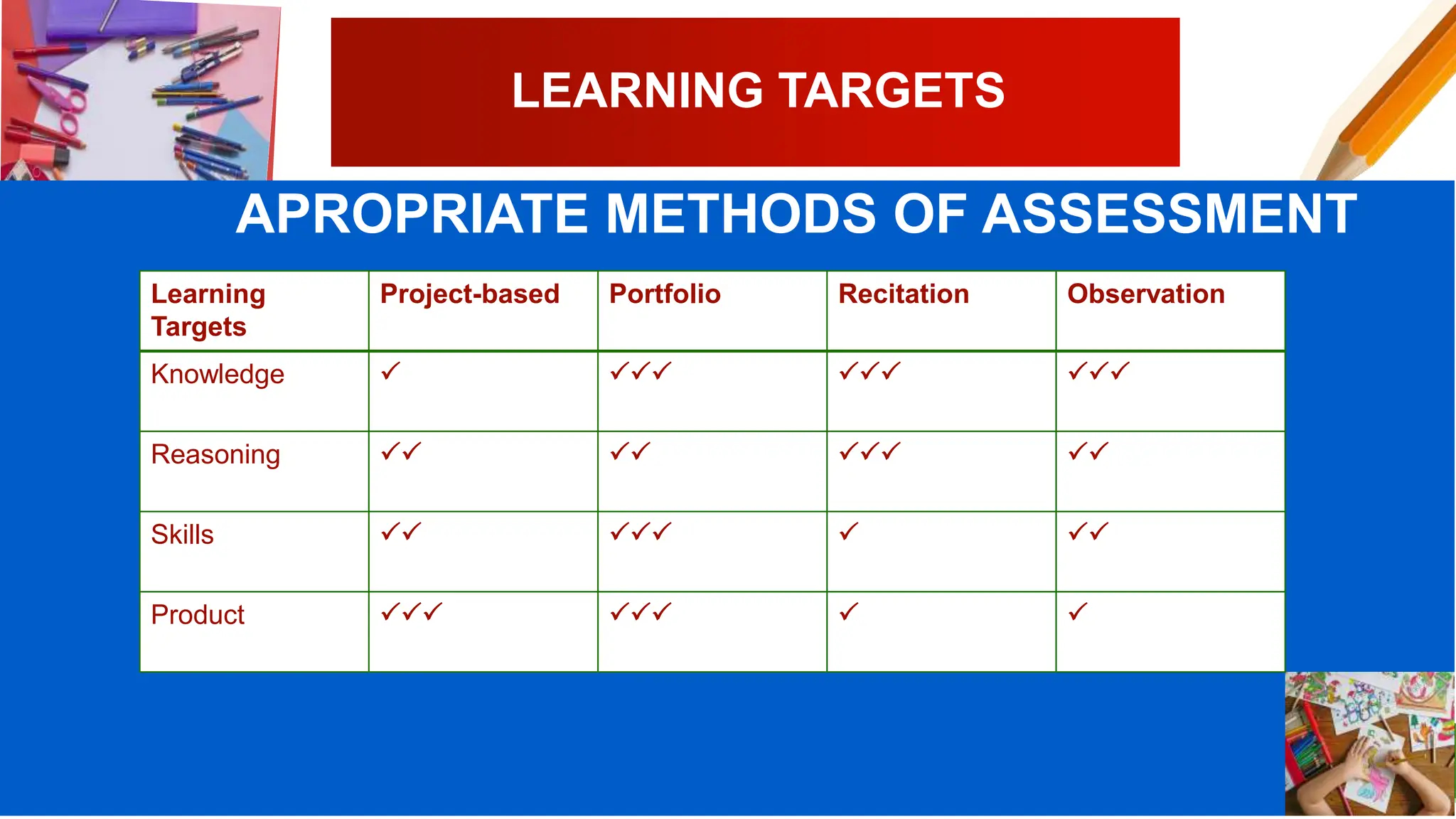
LEARNING TARGETS
APROPRIATE METHODS OF ASSESSMENT
Learning
Targets
Project-based Portfolio Recitation Observation
Knowledge    
Reasoning    
Skills    
Product    
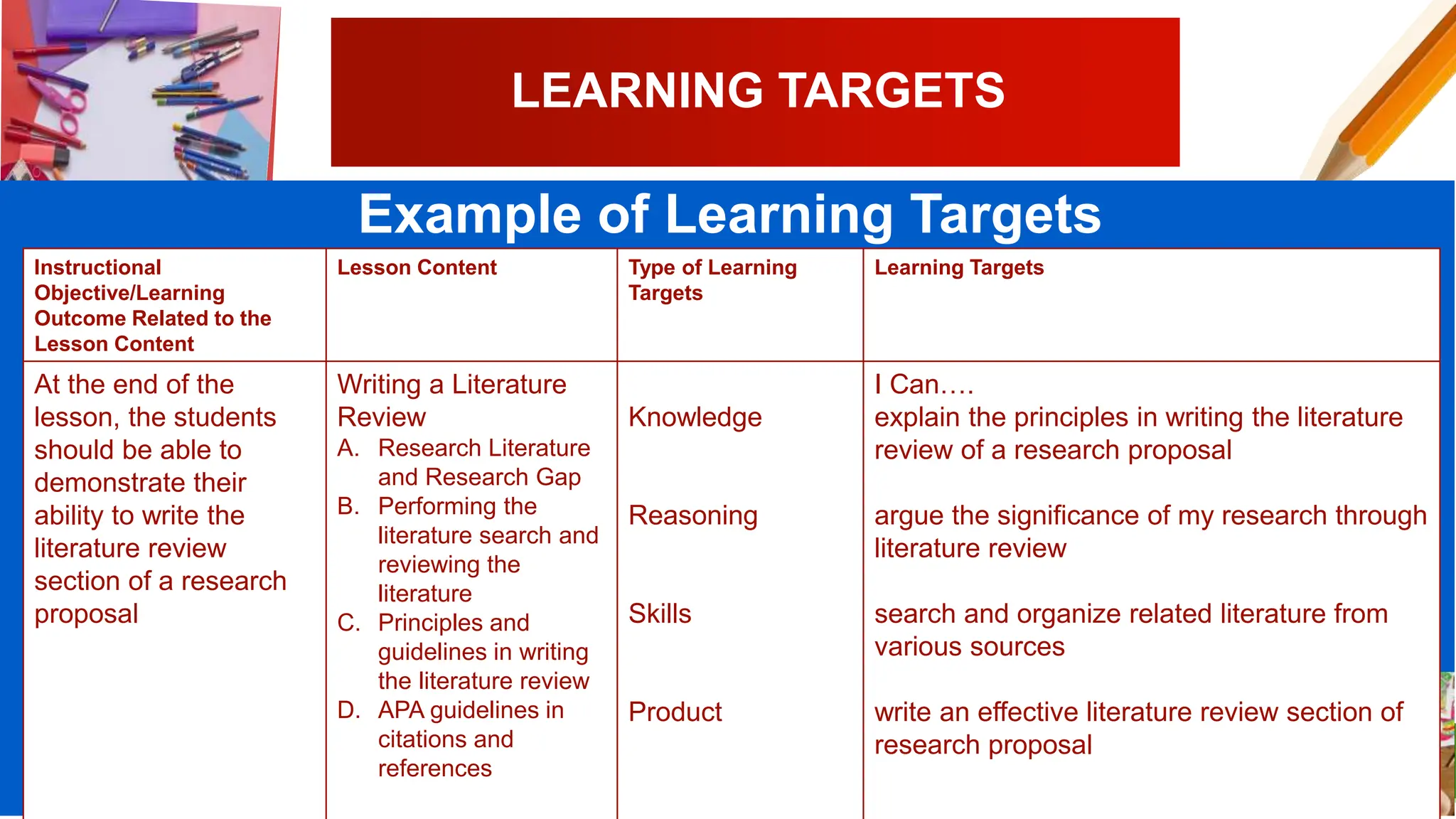
LEARNING TARGETS
Example of Learning Targets
Instructional
Objective/Learning
Outcome Related to the
Lesson Content
Lesson Content Type of Learning
Targets
Learning Targets
At the end of the
lesson, the students
should be able to
demonstrate their
ability to write the
literature review
section of a research
proposal
Writing a Literature
Review
A. Research Literature
and Research Gap
B. Performing the
literature search and
reviewing the
literature
C. Principles and
guidelines in writing
the literature review
D. APA guidelines in
citations and
references
Knowledge
Reasoning
Skills
Product
I Can….
explain the principles in writing the literature
review of a research proposal
argue the significance of my research through
literature review
search and organize related literature from
various sources
write an effective literature review section of
research proposal
2. Assessment purposes, learning targets, and appropriate methods.pptx

2. Assessment purposes, learning targets, and appropriate methods.pptx

  • 2.
    General Purpose of ClassroomAssessment 1. Assessment OF Learning 2. Assessment FOR Learning 3. Assessment AS Learning
  • 3.
    General Purpose of ClassroomAssessment 1. Assessment OF Learning - refers to the use of assessment to determine learner’s acquired knowledge and skills from instruction and whether they achieve the curriculum outcomes
  • 4.
    General Purpose of ClassroomAssessment 2. Assessment FOR Learning - refers to the use of assessment to identify the needs of learners in order to modify instruction or learning activities in the classroom - it is meant to identify gaps in the learning experiences or learners
  • 5.
    General Purpose of ClassroomAssessment 3. Assessment AS Learning - refers to the use of assessment to help learners become self-regulated. - it is meant to use assessment tasks, results, feedback to help learners make adjustments to achieve the curriculum outcomes
  • 6.
    The Roles ofClassroom Assessment in the Teaching- Learning Process 1. Formative 2. Diagnostic 3. Evaluative 4. Facilitative 5. Motivational
  • 7.
    The Revised BLOOM’STAXONOMY - Anderson and Krathwohl proposed the revision of Bloom’s Taxonomy - the Bloom’s taxonomy has a two-dimensional model of writing the objectives - a. cognitive process dimension - b. knowledge dimension
  • 8.
    The Revised BLOOM’STAXONOMY 6 Types of Cognitive process dimensions a. Remember b. Understand c. Apply d. Analyze e. Evaluate f. Create
  • 9.
    The Revised BLOOM’STAXONOMY 6 Types of Cognitive process dimensions a. Remember - Recognizing and recalling facts illustrative verbs: identify, list, name, underline, recall, retrieve, locate
  • 10.
    The Revised BLOOM’STAXONOMY 6 Types of Cognitive process dimensions b. Understand - understanding what the information means illustrative verbs: describe, determine, interpret, translate, paraphrase, explain
  • 11.
    The Revised BLOOM’STAXONOMY 6 Types of Cognitive process dimensions c. Apply - applying the facts, rules, concepts, and ideas, in another context illustrative verbs: apply, employ, practice, relate, use, implement, carry-out, solve
  • 12.
    The Revised BLOOM’STAXONOMY 6 Types of Cognitive process dimensions d. Analyze - breaking down information into facts illustrative verbs: analyze, calculate, examine, test, compare, differentiate, organize, classify
  • 13.
    The Revised BLOOM’STAXONOMY 6 Types of Cognitive process dimensions e. Evaluate - judging the value of information or data illustrative verbs: assess, measure, estimate, evaluate, critique, judge
  • 14.
    The Revised BLOOM’STAXONOMY 6 Types of Cognitive process dimensions f. Create - combining parts to make a whole illustrative verbs: compose, produce, formulate, devise, prepare, design, construct, propose, re-organized
  • 15.
    The Revised BLOOM’STAXONOMY 4 Types of Knowledge dimensions a. Metacognitive b. Procedural c. Conceptual d. Factual
  • 16.
    The Revised BLOOM’STAXONOMY 4 Types of Knowledge dimensions a. Metacognitive - makes the discipline relevant to one’s life - it makes one understand the value of learning on one’s life - it requires reflective knowledge and strategies on how to solve problems or perform a cognitive task through understanding of oneself and context -
  • 17.
    The Revised BLOOM’STAXONOMY 4 Types of Knowledge dimensions b. Procedural - it tells the processes, steps, techniques, methodologies, or specific skills needed in performing a specific task that one needs to know and be able to do in a discipline
  • 18.
    The Revised BLOOM’STAXONOMY 4 Types of Knowledge dimensions c. Conceptual - it tells the concepts, generalizations, principles, theories, and models that one needs to know in a discipline
  • 19.
    The Revised BLOOM’STAXONOMY 4 Types of Knowledge dimensions d. Factual - it tells the facts or bits of information one needs to know in a discipline
  • 20.
    LEARNING TARGETS - Astatement of a student performance for a relatively restricted type of learning outcome that will be achieved in single lesson or a days lesson - Contains both a description of what students should know, should understand, and be able to do at the end of the instruction - Statements of what learners are supposed to learn and what they can do because of instruction
  • 21.
    LEARNING TARGETS 5 criteriafor selecting learning targets 1. Establish the right number of learning targets 2. Establish comprehensive learning targets 3. Establish learning targets that reflect schools goals and 21st century skills 4. Establish learning targets that are challenging yet feasible 5. Establish learning targets that consistent with current principles of learning and motivation
  • 22.
    LEARNING TARGETS TYPES OFLEARNING TARGETS 1. Knowledge Targets 2. Reasoning Targets 3. Skills Targets 4. Product Targets 5. Affective Targets
  • 23.
    LEARNING TARGETS APROPRIATE METHODSOF ASSESSMENT Learning Targets Selected Response Constructed Response Multiple Choice True or False Matching Type Short Answer Problem- Solving Essay KNOWLED GE       REASONIN G       SKILLS       PRODUCT      
  • 24.
    LEARNING TARGETS APROPRIATE METHODSOF ASSESSMENT Learning Targets Project-based Portfolio Recitation Observation Knowledge     Reasoning     Skills     Product    
  • 25.
    LEARNING TARGETS Example ofLearning Targets Instructional Objective/Learning Outcome Related to the Lesson Content Lesson Content Type of Learning Targets Learning Targets At the end of the lesson, the students should be able to demonstrate their ability to write the literature review section of a research proposal Writing a Literature Review A. Research Literature and Research Gap B. Performing the literature search and reviewing the literature C. Principles and guidelines in writing the literature review D. APA guidelines in citations and references Knowledge Reasoning Skills Product I Can…. explain the principles in writing the literature review of a research proposal argue the significance of my research through literature review search and organize related literature from various sources write an effective literature review section of research proposal