‫العلمي‬ ‫البحث‬‫ات‬‫ر‬‫مها‬ ‫برنامج‬
‫التاسع‬
Guidelines for Writing a
Literature Review
Manal A.AlSheddi. BDS, MSc, DMSc (Harvard), AAOMP Fellow ABOMP Diplomat.
Associate Professor & Consultant
Oral & Maxillofacial Pathology
College of Dentistry
msheddi@ksu.edu.sa
‫التاسع‬ ‫العلمي‬ ‫البحث‬ ‫مهارات‬ ‫برنامج‬2016
Guidelines for
writing a
literature review
THE SKILLS OF SCIENTIFIC RESEARCH-9
OCTOBER, 2016
‫التاسع‬ ‫العلمي‬ ‫البحث‬ ‫مهارات‬ ‫برنامج‬2016
Lecture outline
Definitions
What is a literature review?
Use/Purpose?
Components
Literature Assessment
What should I do before writing the literature review?
Begin composing
Conclusions
‫التاسع‬ ‫العلمي‬ ‫البحث‬ ‫مهارات‬ ‫برنامج‬2016
Definitions
Literature
lit·er·a·ture:
The body of written work produced
by scholars or researchers in a given
field
Review
1. To look over, study, or examine
again.
2. To consider retrospectively; look
back on.
3. To examine with an eye to criticism
or correction
‫التاسع‬ ‫العلمي‬ ‫البحث‬ ‫مهارات‬ ‫برنامج‬2016
Where is it located?
A literature review is
conducted in the
beginning stages of your
research, and is usually
written up as a document
or chapter by the same
title. It requires a
commitment to searching
a range of information
sources
‫التاسع‬ ‫العلمي‬ ‫البحث‬ ‫مهارات‬ ‫برنامج‬2016
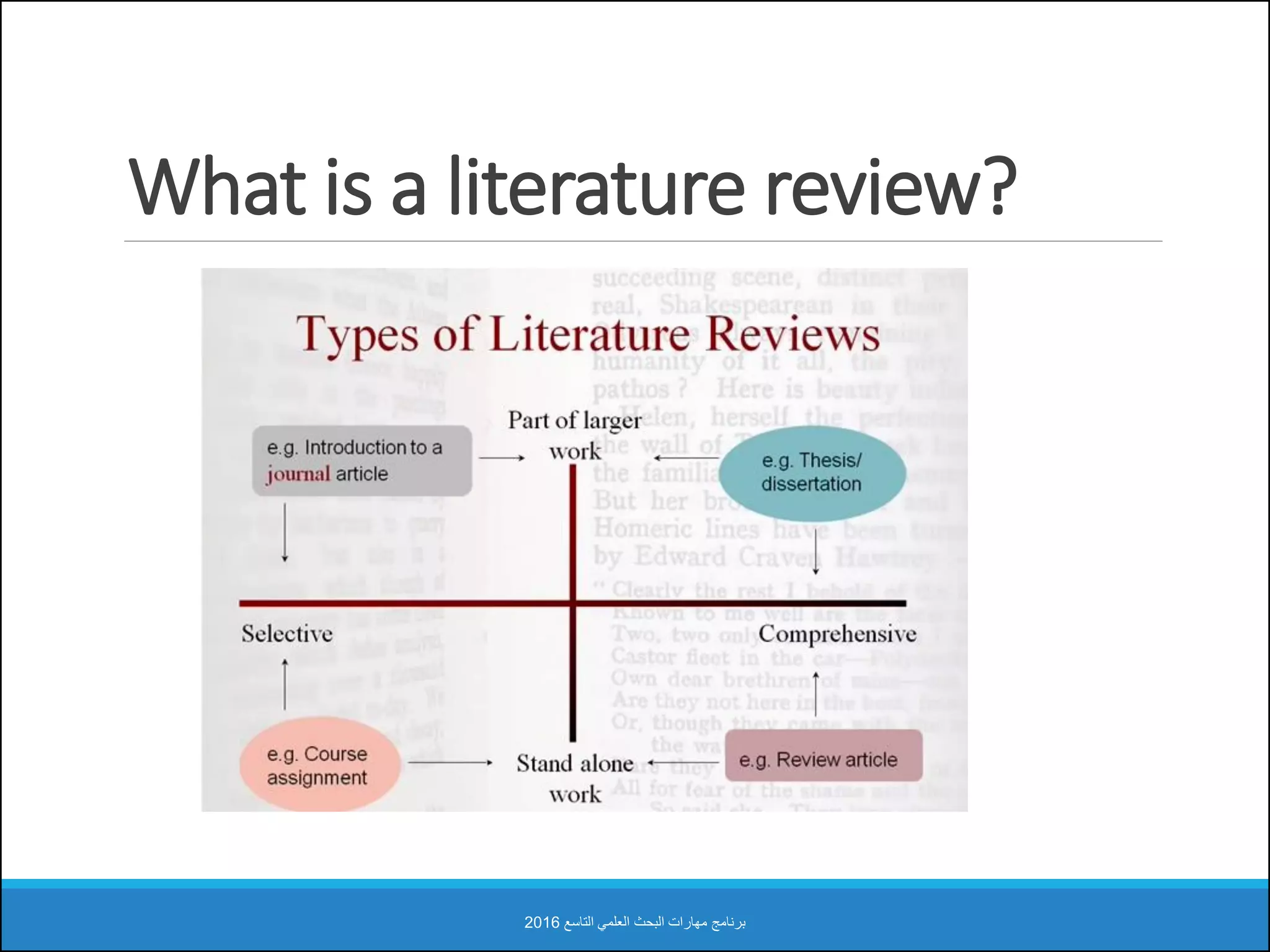
What is a literature review?
‫التاسع‬ ‫العلمي‬ ‫البحث‬ ‫مهارات‬ ‫برنامج‬2016
Use/Purpose?
‫التاسع‬ ‫العلمي‬ ‫البحث‬ ‫مهارات‬ ‫برنامج‬2016
Use/Purpose?
Place each work in the context of its
contribution to the understanding of
the subject under review
‫التاسع‬ ‫العلمي‬ ‫البحث‬ ‫مهارات‬ ‫برنامج‬2016
Use/Purpose?
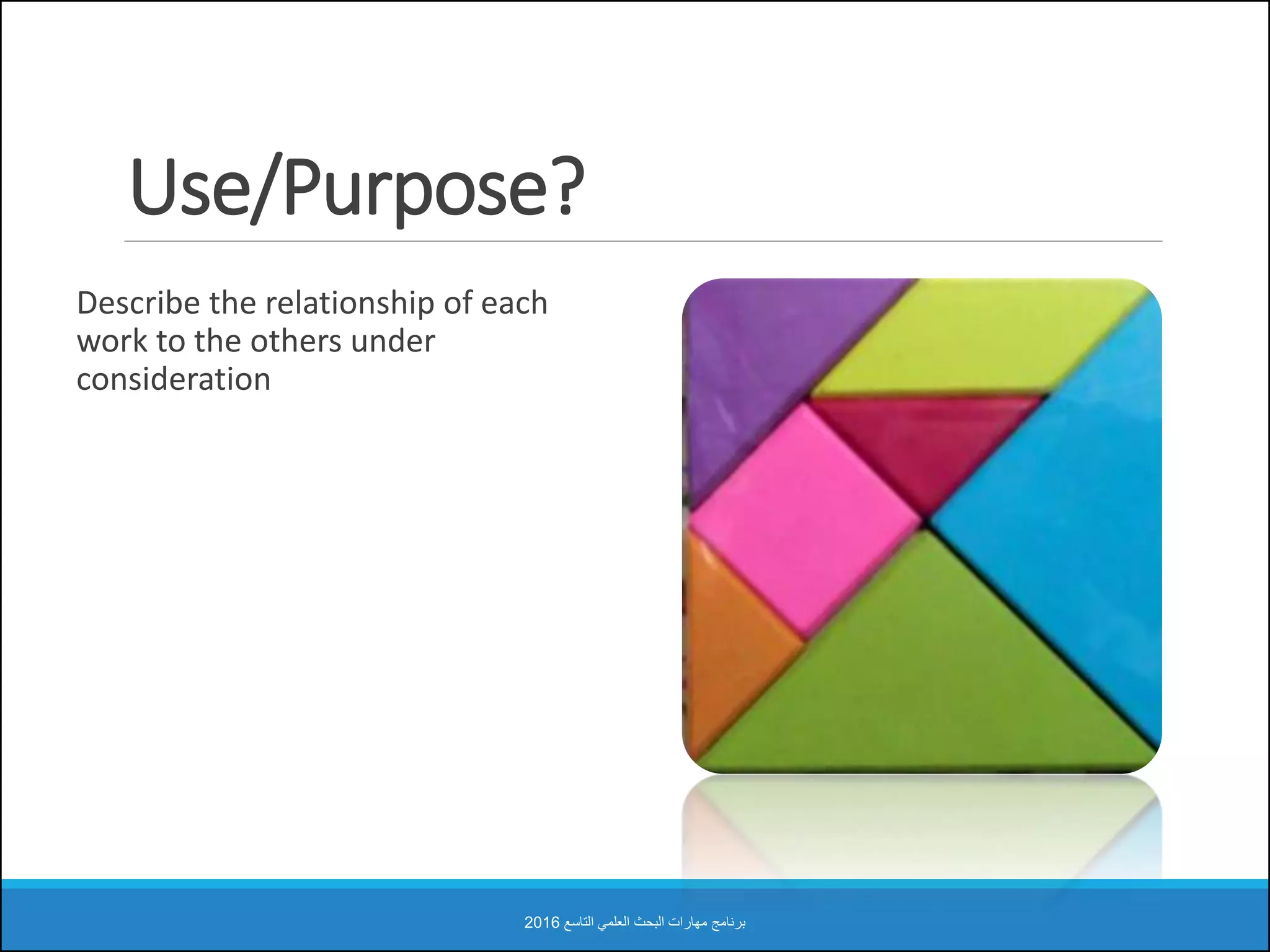
Describe the relationship of each
work to the others under
consideration
‫التاسع‬ ‫العلمي‬ ‫البحث‬ ‫مهارات‬ ‫برنامج‬2016
Use/Purpose?
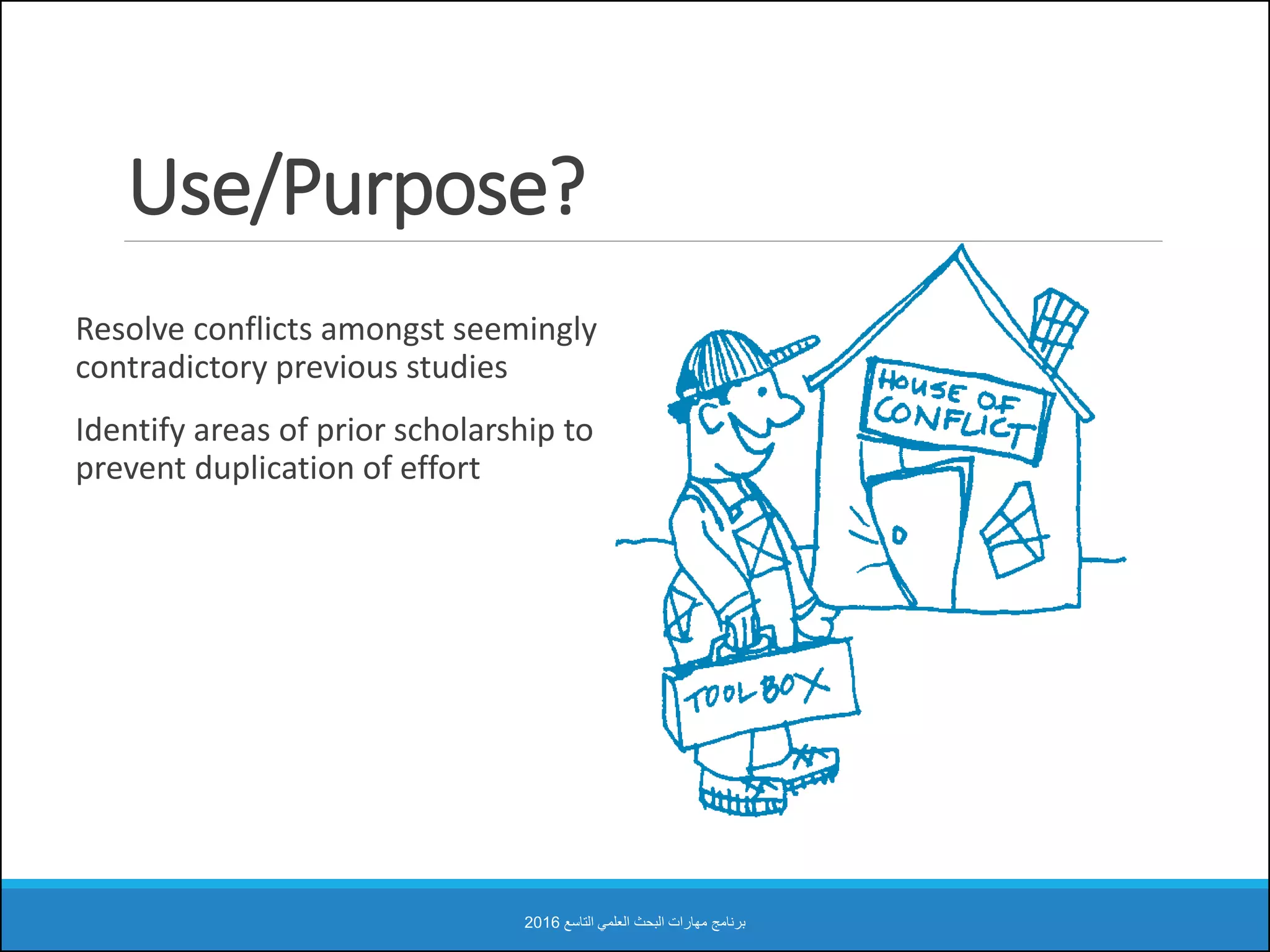
Resolve conflicts amongst seemingly
contradictory previous studies
Identify areas of prior scholarship to
prevent duplication of effort
‫التاسع‬ ‫العلمي‬ ‫البحث‬ ‫مهارات‬ ‫برنامج‬2016
Use/Purpose?
Point the way forward for further
research
‫التاسع‬ ‫العلمي‬ ‫البحث‬ ‫مهارات‬ ‫برنامج‬2016
Use/Purpose?
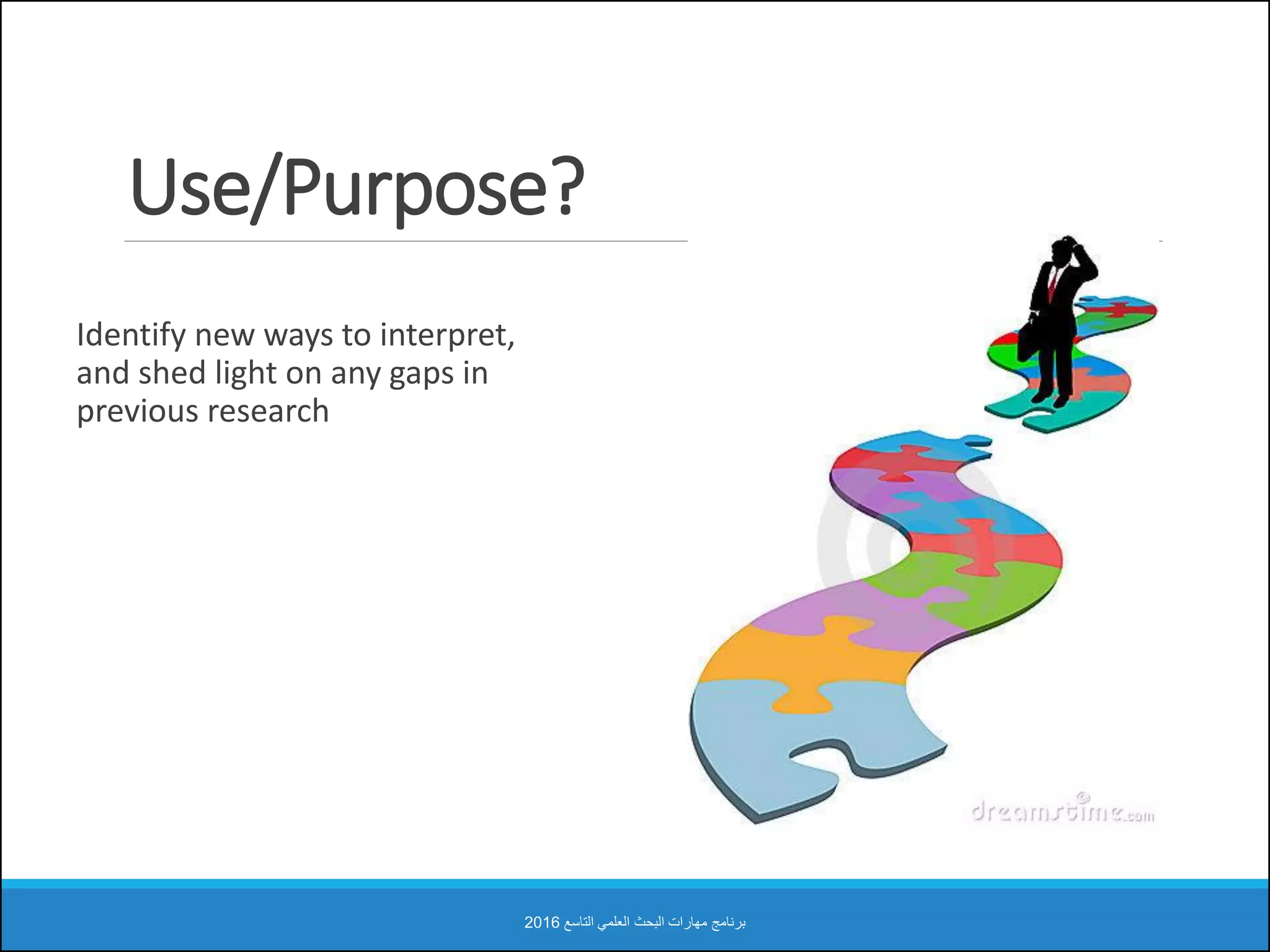
Identify new ways to interpret,
and shed light on any gaps in
previous research
‫التاسع‬ ‫العلمي‬ ‫البحث‬ ‫مهارات‬ ‫برنامج‬2016
Components
‫التاسع‬ ‫العلمي‬ ‫البحث‬ ‫مهارات‬ ‫برنامج‬2016
Components
Development of the literature review
requires four stages:
1-Problem formulation
‫التاسع‬ ‫العلمي‬ ‫البحث‬ ‫مهارات‬ ‫برنامج‬2016
Components
Development of the literature review
requires four stages:
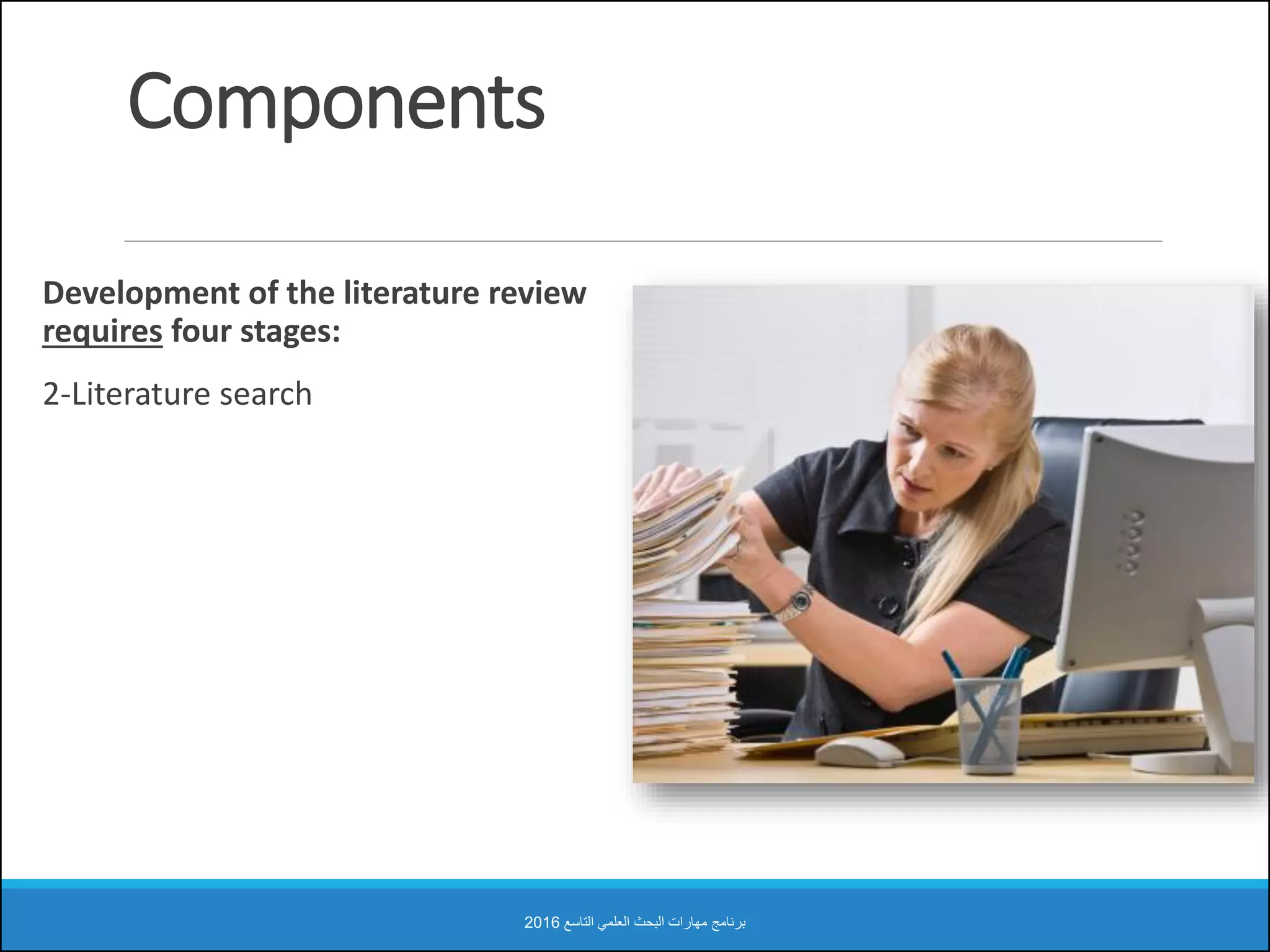
2-Literature search
‫التاسع‬ ‫العلمي‬ ‫البحث‬ ‫مهارات‬ ‫برنامج‬2016
Components
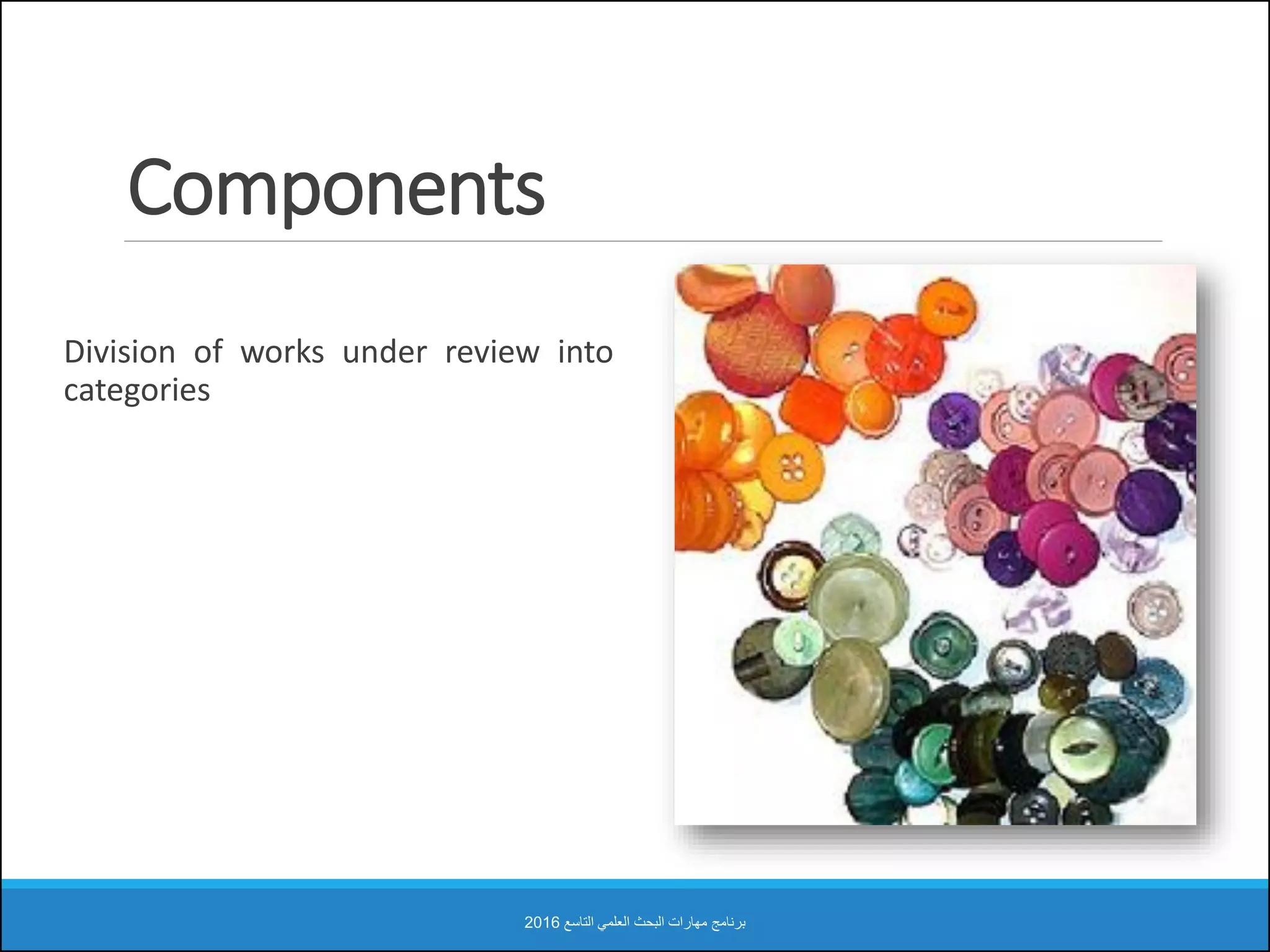
Division of works under review into
categories
‫التاسع‬ ‫العلمي‬ ‫البحث‬ ‫مهارات‬ ‫برنامج‬2016
Components
‫التاسع‬ ‫العلمي‬ ‫البحث‬ ‫مهارات‬ ‫برنامج‬2016
Before you start your search!
‫التاسع‬ ‫العلمي‬ ‫البحث‬ ‫مهارات‬ ‫برنامج‬2016
Before you start your search!
Citation and organization:
Which reference manager is
the right fit for you?
‫التاسع‬ ‫العلمي‬ ‫البحث‬ ‫مهارات‬ ‫برنامج‬2016
References managing
How to cite?
Reference mangers
‫التاسع‬ ‫العلمي‬ ‫البحث‬ ‫مهارات‬ ‫برنامج‬2016
Components
Development of the literature review
requires four stages:
3-Data evaluation
‫التاسع‬ ‫العلمي‬ ‫البحث‬ ‫مهارات‬ ‫برنامج‬2016
Components
Development of the literature
review requires four stages:
4-Analysis and interpretation
Explanation of how each work is
similar to and how it varies from the
others
Conclusions as to which pieces are
best considered in their argument
‫التاسع‬ ‫العلمي‬ ‫البحث‬ ‫مهارات‬ ‫برنامج‬2016
Literature Assessment
In assessing each piece, consideration should be given to:
Provenance ‫المصدر‬
Objectivity ‫الموضوعية‬
Persuasiveness ‫األقناع‬
Value ‫القيمة‬
‫التاسع‬ ‫العلمي‬ ‫البحث‬ ‫مهارات‬ ‫برنامج‬2016
Literature Assessment
In assessing each piece,
consideration should be
given to:
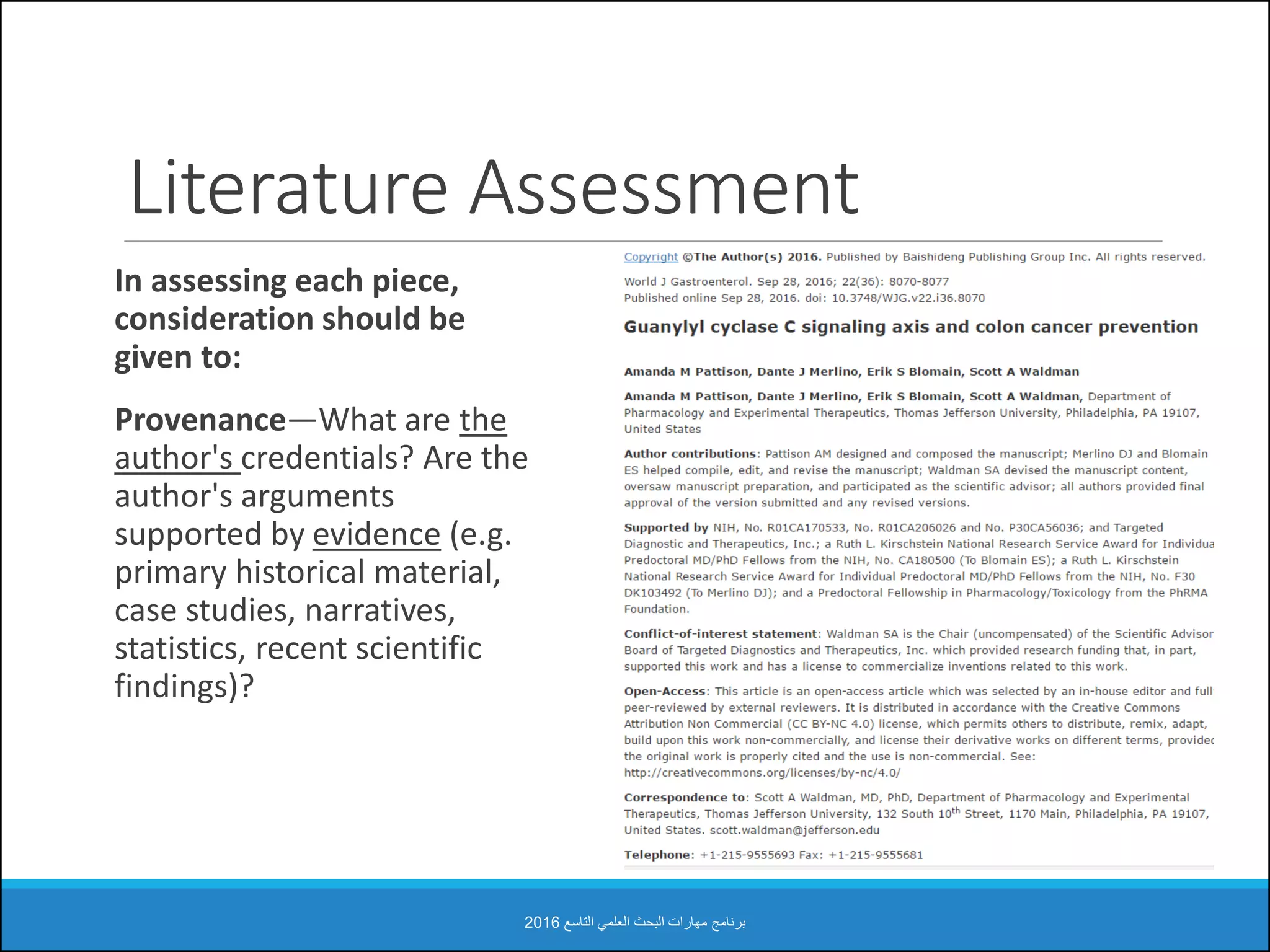
Provenance—What are the
author's credentials? Are the
author's arguments
supported by evidence (e.g.
primary historical material,
case studies, narratives,
statistics, recent scientific
findings)?
‫التاسع‬ ‫العلمي‬ ‫البحث‬ ‫مهارات‬ ‫برنامج‬2016
Literature Assessment
In assessing each piece, consideration should be given to:
Objectivity—Is the author's perspective even-handed or prejudicial?
‫التاسع‬ ‫العلمي‬ ‫البحث‬ ‫مهارات‬ ‫برنامج‬2016
Literature Assessment
In assessing each piece, consideration should be given to:
Persuasiveness—Which of the author's theses are most/least
convincing?
‫التاسع‬ ‫العلمي‬ ‫البحث‬ ‫مهارات‬ ‫برنامج‬2016
Literature Assessment
In assessing each piece, consideration should be given to:
Value—Are the author's arguments and conclusions convincing? Does the work
ultimately contribute in any significant way to an understanding of the subject?
‫التاسع‬ ‫العلمي‬ ‫البحث‬ ‫مهارات‬ ‫برنامج‬2016
Writing A Literature Review and
Using a Synthesis Matrix
One way that seems particularly
helpful in organizing literature
reviews is the synthesis matrix.
‫التاسع‬ ‫العلمي‬ ‫البحث‬ ‫مهارات‬ ‫برنامج‬2016
Writing A Literature Review and
Using a Synthesis Matrix
The synthesis matrix is a chart that allows a researcher to sort and
categorize the different arguments presented on an issue.
‫التاسع‬ ‫العلمي‬ ‫البحث‬ ‫مهارات‬ ‫برنامج‬2016
Writing A Literature Review and
Using a Synthesis Matrix
‫التاسع‬ ‫العلمي‬ ‫البحث‬ ‫مهارات‬ ‫برنامج‬2016
Let’s get to it! What should I do
before writing the literature review?
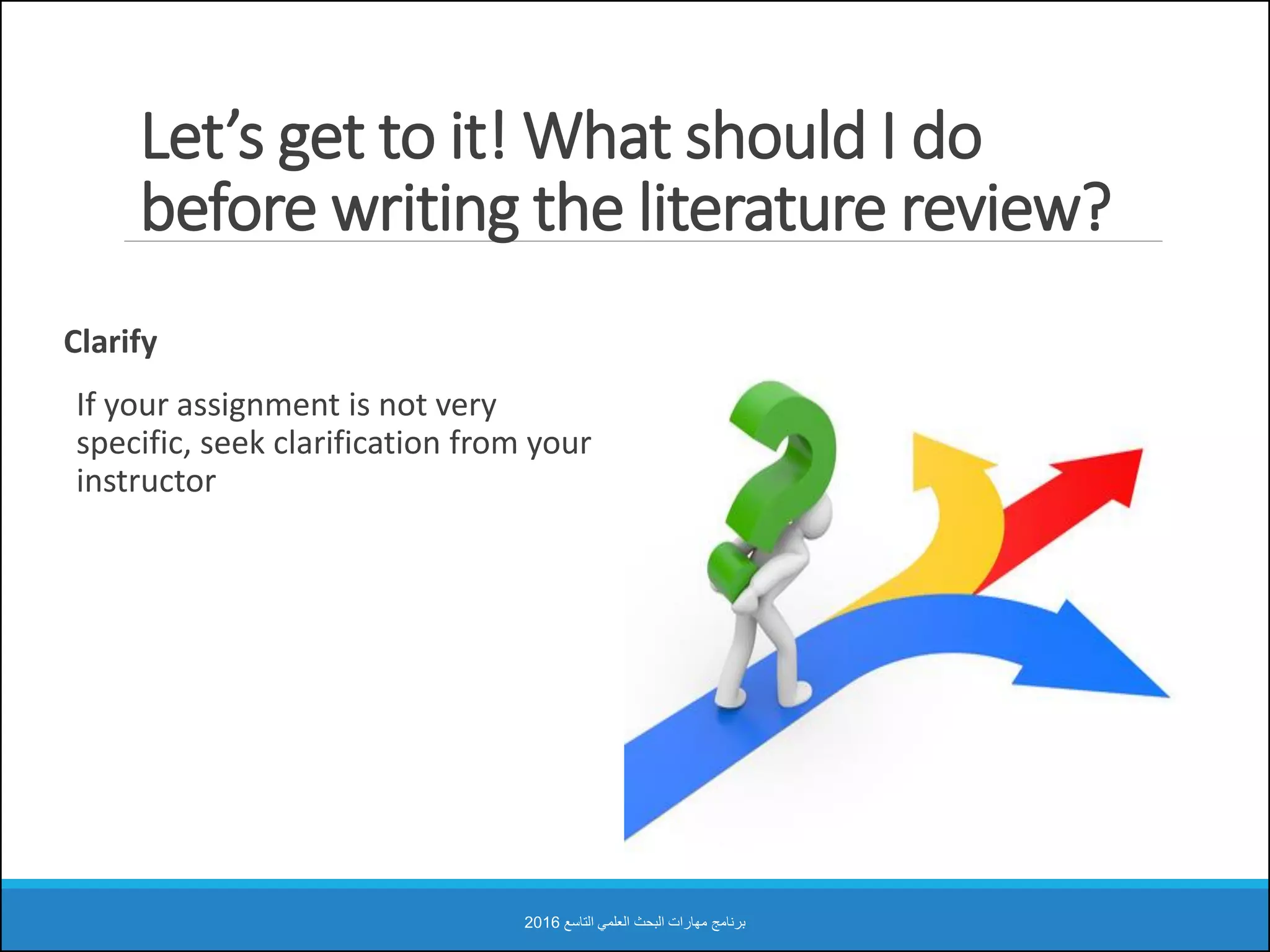
Clarify
If your assignment is not very
specific, seek clarification from your
instructor
‫التاسع‬ ‫العلمي‬ ‫البحث‬ ‫مهارات‬ ‫برنامج‬2016
Let’s get to it! What should I do
before writing the literature
review?
Clarify
Should you summarize, synthesize, or
critique your sources by discussing a
common theme or issue?
‫التاسع‬ ‫العلمي‬ ‫البحث‬ ‫مهارات‬ ‫برنامج‬2016
Let’s get to it! What should I do
before writing the literature
review?
Find models
‫التاسع‬ ‫العلمي‬ ‫البحث‬ ‫مهارات‬ ‫برنامج‬2016
Let’s get to it! What should I do
before writing the literature
review?
Consider whether your sources are current
‫التاسع‬ ‫العلمي‬ ‫البحث‬ ‫مهارات‬ ‫برنامج‬2016
Strategies for writing the
literature review
Find a focus
A literature review is usually organized around ideas, not the sources
themselves as an annotated bibliography would be organized. This
means that you will not just simply list your sources and go into detail
about each one of them, one at a time.
‫التاسع‬ ‫العلمي‬ ‫البحث‬ ‫مهارات‬ ‫برنامج‬2016
Strategies for writing the
literature review
Construct a working thesis statement
Use the focus you’ve found to construct a thesis statement.
‫التاسع‬ ‫العلمي‬ ‫البحث‬ ‫مهارات‬ ‫برنامج‬2016
Strategies for writing the
literature review
Consider organization
You’ve got a focus, and you’ve narrowed
it down to a thesis statement.
What are the most important topics,
subtopics, etc., that your review needs to
include?
And in what order should you present
them?
‫التاسع‬ ‫العلمي‬ ‫البحث‬ ‫مهارات‬ ‫برنامج‬2016
Begin composing
Once you’ve settled on a general pattern of organization, you’re ready to
write each section. There are a few guidelines you should follow during the
writing stage as well.
‫التاسع‬ ‫العلمي‬ ‫البحث‬ ‫مهارات‬ ‫برنامج‬2016
Begin composing
Use evidence
Your interpretation of the available sources must be supported with
evidence to show that what you are saying is valid
‫التاسع‬ ‫العلمي‬ ‫البحث‬ ‫مهارات‬ ‫برنامج‬2016
Begin composing
Be selective
Select only the most important points in each source to highlight in the
review.
‫التاسع‬ ‫العلمي‬ ‫البحث‬ ‫مهارات‬ ‫برنامج‬2016
Begin composing
Use quotes sparingly
‫التاسع‬ ‫العلمي‬ ‫البحث‬ ‫مهارات‬ ‫برنامج‬2016
Begin composing
Summarize and synthesize
Remember to summarize and synthesize your sources within each
paragraph as well as throughout the review.
‫التاسع‬ ‫العلمي‬ ‫البحث‬ ‫مهارات‬ ‫برنامج‬2016
Begin composing
Keep your own voice
While the literature review presents others’ ideas, your voice (the
writer’s) should remain front and center.
‫التاسع‬ ‫العلمي‬ ‫البحث‬ ‫مهارات‬ ‫برنامج‬2016
Begin composing
Use caution when paraphrasing
When paraphrasing a source that is not your own, be sure to represent
the author’s information or opinions accurately and in your own words.
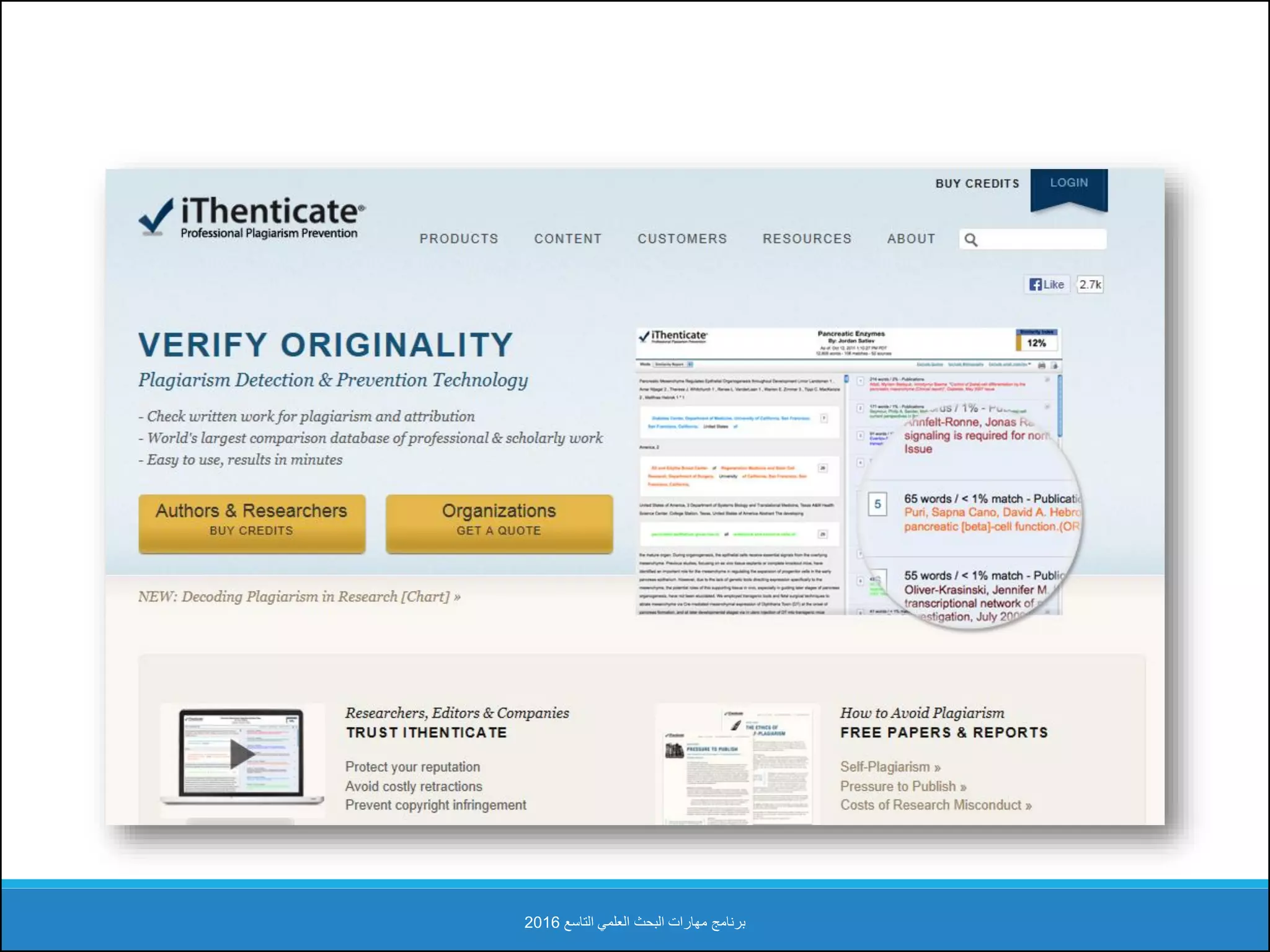
Plagiarism??
‫التاسع‬ ‫العلمي‬ ‫البحث‬ ‫مهارات‬ ‫برنامج‬2016
References managing
How to cite?
Reference mangers
‫التاسع‬ ‫العلمي‬ ‫البحث‬ ‫مهارات‬ ‫برنامج‬2016
Revise, revise, revise
Draft in hand? Now you’re ready to revise. Spending a lot of time
revising is a wise idea, because your main objective is to present the
material, not the argument. So check over your review again to make
sure it follows the assignment and/or your outline.
‫التاسع‬ ‫العلمي‬ ‫البحث‬ ‫مهارات‬ ‫برنامج‬2016
Revise, revise, revise
Then, just as you would for most other academic forms of writing,
rewrite or rework the language of your review so that you’ve
presented your information in the most concise manner possible.
‫التاسع‬ ‫العلمي‬ ‫البحث‬ ‫مهارات‬ ‫برنامج‬2016
Some tips to help
you be effectual !!
‫التاسع‬ ‫العلمي‬ ‫البحث‬ ‫مهارات‬ ‫برنامج‬2016
Some tips to help you be effectual
1. Write a sentence or two after reading an article that could fit into your
literature review. This is not a summary, but how the article relates to
your literature review theme
‫التاسع‬ ‫العلمي‬ ‫البحث‬ ‫مهارات‬ ‫برنامج‬2016
Some tips to help you be effectual
2. Aim to write something every day. Set a writing goal, whether it’s a
paragraphe or a page. Only do reading so that you can achieve your
writing goal.
‫التاسع‬ ‫العلمي‬ ‫البحث‬ ‫مهارات‬ ‫برنامج‬2016
Some tips to help you be effectual
3. Ask yourself why should you read this paper. Before you read anything,
think about how it should contribute to your literature review and look
for that information in the article.
‫التاسع‬ ‫العلمي‬ ‫البحث‬ ‫مهارات‬ ‫برنامج‬2016
Some tips to help you be effectual
4. Narrow down your search terms. Only search for things that return a
manageable number of search results.
‫التاسع‬ ‫العلمي‬ ‫البحث‬ ‫مهارات‬ ‫برنامج‬2016
Some tips to help you be effectual
5. Set regular, strict deadlines. Decide that you must complete a certain
quantity of writing by a certain date and stick to it.
‫التاسع‬ ‫العلمي‬ ‫البحث‬ ‫مهارات‬ ‫برنامج‬2016
Tips for effective literature searching
and keeping up with new publications
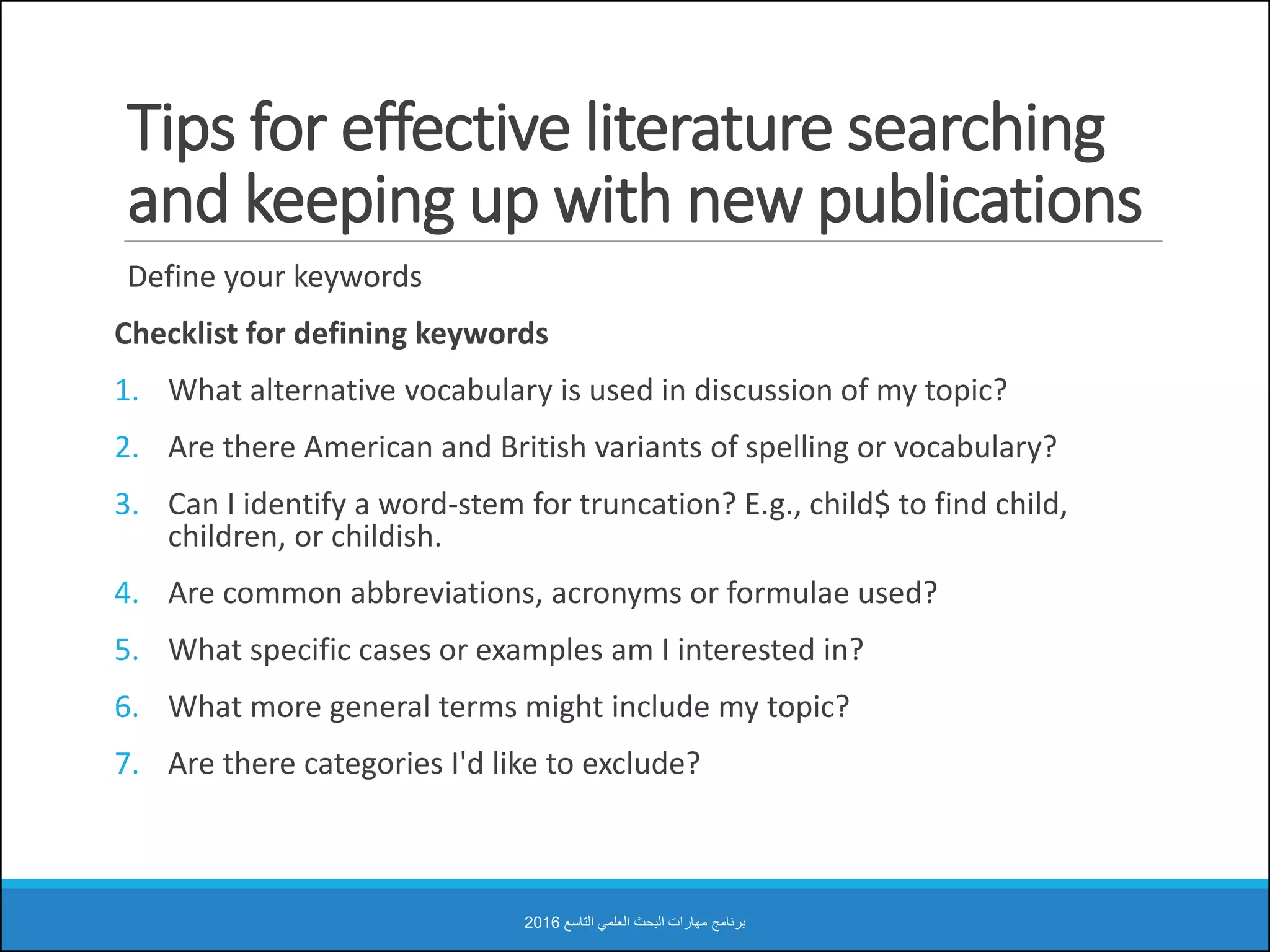
Define your keywords
Checklist for defining keywords
1. What alternative vocabulary is used in discussion of my topic?
2. Are there American and British variants of spelling or vocabulary?
3. Can I identify a word-stem for truncation? E.g., child$ to find child,
children, or childish.
4. Are common abbreviations, acronyms or formulae used?
5. What specific cases or examples am I interested in?
6. What more general terms might include my topic?
7. Are there categories I'd like to exclude?
‫التاسع‬ ‫العلمي‬ ‫البحث‬ ‫مهارات‬ ‫برنامج‬2016
Start your search
You might need to search
several academic databases to
make sure you’ve covered all
bases. Since each database has
unique sources for obtaining
data and unique processes for
deciding which journal articles
to index, limiting your search to
only one database may cause
you to overlook relevant
articles. For example, if you
restrict your search to Elsevier’s
Science Direct, you are very
likely to miss relevant
publications, since this database
mostly indexes journals
published by Elsevier.
‫التاسع‬ ‫العلمي‬ ‫البحث‬ ‫مهارات‬ ‫برنامج‬2016
Sources for searching
Follow the citations
Once you have identified some relevant journal articles, an easy way to
find more studies is by looking through the reference lists of these
articles (backward searching). The reference studies are likely to be quite
relevant for you as well. In addition, look at the papers that have cited
the articles since they were published (forward searching). This will help
you find the newer studies that have built upon the work
‫التاسع‬ ‫العلمي‬ ‫البحث‬ ‫مهارات‬ ‫برنامج‬2016
Keep a written record of your
searches
Note down the names of journals that you come across often during
your searches. Over time, you will get a good idea of which journals are
most prominent in your field and which journals you should consider
publishing in. In addition, keep a list of the keywords and keyword
combinations that return the best results. This will not only reduce the
time taken for future searches but also yield a list of terminologies that
are common in your field
‫التاسع‬ ‫العلمي‬ ‫البحث‬ ‫مهارات‬ ‫برنامج‬2016
Keeping up with literature
‫التاسع‬ ‫العلمي‬ ‫البحث‬ ‫مهارات‬ ‫برنامج‬2016
How to keep up with new publications
through alerts
How to keep up with new publications through alerts
Conclusion
The literature review is the trickiest
part of a dissertation
‫التاسع‬ ‫العلمي‬ ‫البحث‬ ‫مهارات‬ ‫برنامج‬2016
Conclusion
The dissertation literature review
consumes most the time and
energy of a researcher in proving
his findings to the board of
dissertation committee.
‫التاسع‬ ‫العلمي‬ ‫البحث‬ ‫مهارات‬ ‫برنامج‬2016
Conclusion
The best way to do this is gather the
best ones and keep it in line with
your topic in order to avoid
unnecessary questions gathered
from an excessive analysis
‫التاسع‬ ‫العلمي‬ ‫البحث‬ ‫مهارات‬ ‫برنامج‬2016
http://www.dissertation-ideas.com/dissertation-introduction/
http://writingcenter.unc.edu/handouts/literature-reviews/
https://www.coursera.org/course/sciwrite
‫التاسع‬ ‫العلمي‬ ‫البحث‬ ‫مهارات‬ ‫برنامج‬2016
https://www.docphin.com/
The Best Way to Keep Up with Medical
Research
Good application to help you get publication alerts
Many thanks !
QUESTIONS?
‫التاسع‬ ‫العلمي‬ ‫البحث‬ ‫مهارات‬ ‫برنامج‬2016

المادة العلمية محاضرة 2 كيفية كتابة المسح الأدبي

  • 1.
    ‫العلمي‬ ‫البحث‬‫ات‬‫ر‬‫مها‬ ‫برنامج‬ ‫التاسع‬ Guidelinesfor Writing a Literature Review Manal A.AlSheddi. BDS, MSc, DMSc (Harvard), AAOMP Fellow ABOMP Diplomat. Associate Professor & Consultant Oral & Maxillofacial Pathology College of Dentistry msheddi@ksu.edu.sa ‫التاسع‬ ‫العلمي‬ ‫البحث‬ ‫مهارات‬ ‫برنامج‬2016
  • 2.
    Guidelines for writing a literaturereview THE SKILLS OF SCIENTIFIC RESEARCH-9 OCTOBER, 2016 ‫التاسع‬ ‫العلمي‬ ‫البحث‬ ‫مهارات‬ ‫برنامج‬2016
  • 3.
    Lecture outline Definitions What isa literature review? Use/Purpose? Components Literature Assessment What should I do before writing the literature review? Begin composing Conclusions ‫التاسع‬ ‫العلمي‬ ‫البحث‬ ‫مهارات‬ ‫برنامج‬2016
  • 4.
    Definitions Literature lit·er·a·ture: The body ofwritten work produced by scholars or researchers in a given field Review 1. To look over, study, or examine again. 2. To consider retrospectively; look back on. 3. To examine with an eye to criticism or correction ‫التاسع‬ ‫العلمي‬ ‫البحث‬ ‫مهارات‬ ‫برنامج‬2016
  • 5.
    Where is itlocated? A literature review is conducted in the beginning stages of your research, and is usually written up as a document or chapter by the same title. It requires a commitment to searching a range of information sources ‫التاسع‬ ‫العلمي‬ ‫البحث‬ ‫مهارات‬ ‫برنامج‬2016
  • 6.
    ‫التاسع‬ ‫العلمي‬ ‫البحث‬‫مهارات‬ ‫برنامج‬2016
  • 7.
    What is aliterature review? ‫التاسع‬ ‫العلمي‬ ‫البحث‬ ‫مهارات‬ ‫برنامج‬2016
  • 8.
  • 9.
    Use/Purpose? Place each workin the context of its contribution to the understanding of the subject under review ‫التاسع‬ ‫العلمي‬ ‫البحث‬ ‫مهارات‬ ‫برنامج‬2016
  • 10.
    Use/Purpose? Describe the relationshipof each work to the others under consideration ‫التاسع‬ ‫العلمي‬ ‫البحث‬ ‫مهارات‬ ‫برنامج‬2016
  • 11.
    Use/Purpose? Resolve conflicts amongstseemingly contradictory previous studies Identify areas of prior scholarship to prevent duplication of effort ‫التاسع‬ ‫العلمي‬ ‫البحث‬ ‫مهارات‬ ‫برنامج‬2016
  • 12.
    Use/Purpose? Point the wayforward for further research ‫التاسع‬ ‫العلمي‬ ‫البحث‬ ‫مهارات‬ ‫برنامج‬2016
  • 13.
    Use/Purpose? Identify new waysto interpret, and shed light on any gaps in previous research ‫التاسع‬ ‫العلمي‬ ‫البحث‬ ‫مهارات‬ ‫برنامج‬2016
  • 14.
  • 15.
    Components Development of theliterature review requires four stages: 1-Problem formulation ‫التاسع‬ ‫العلمي‬ ‫البحث‬ ‫مهارات‬ ‫برنامج‬2016
  • 16.
    Components Development of theliterature review requires four stages: 2-Literature search ‫التاسع‬ ‫العلمي‬ ‫البحث‬ ‫مهارات‬ ‫برنامج‬2016
  • 17.
    Components Division of worksunder review into categories ‫التاسع‬ ‫العلمي‬ ‫البحث‬ ‫مهارات‬ ‫برنامج‬2016
  • 18.
  • 19.
    Before you startyour search! ‫التاسع‬ ‫العلمي‬ ‫البحث‬ ‫مهارات‬ ‫برنامج‬2016
  • 20.
    Before you startyour search! Citation and organization: Which reference manager is the right fit for you? ‫التاسع‬ ‫العلمي‬ ‫البحث‬ ‫مهارات‬ ‫برنامج‬2016
  • 21.
    References managing How tocite? Reference mangers ‫التاسع‬ ‫العلمي‬ ‫البحث‬ ‫مهارات‬ ‫برنامج‬2016
  • 22.
    Components Development of theliterature review requires four stages: 3-Data evaluation ‫التاسع‬ ‫العلمي‬ ‫البحث‬ ‫مهارات‬ ‫برنامج‬2016
  • 23.
    Components Development of theliterature review requires four stages: 4-Analysis and interpretation Explanation of how each work is similar to and how it varies from the others Conclusions as to which pieces are best considered in their argument ‫التاسع‬ ‫العلمي‬ ‫البحث‬ ‫مهارات‬ ‫برنامج‬2016
  • 24.
    Literature Assessment In assessingeach piece, consideration should be given to: Provenance ‫المصدر‬ Objectivity ‫الموضوعية‬ Persuasiveness ‫األقناع‬ Value ‫القيمة‬ ‫التاسع‬ ‫العلمي‬ ‫البحث‬ ‫مهارات‬ ‫برنامج‬2016
  • 25.
    Literature Assessment In assessingeach piece, consideration should be given to: Provenance—What are the author's credentials? Are the author's arguments supported by evidence (e.g. primary historical material, case studies, narratives, statistics, recent scientific findings)? ‫التاسع‬ ‫العلمي‬ ‫البحث‬ ‫مهارات‬ ‫برنامج‬2016
  • 26.
    Literature Assessment In assessingeach piece, consideration should be given to: Objectivity—Is the author's perspective even-handed or prejudicial? ‫التاسع‬ ‫العلمي‬ ‫البحث‬ ‫مهارات‬ ‫برنامج‬2016
  • 27.
    Literature Assessment In assessingeach piece, consideration should be given to: Persuasiveness—Which of the author's theses are most/least convincing? ‫التاسع‬ ‫العلمي‬ ‫البحث‬ ‫مهارات‬ ‫برنامج‬2016
  • 28.
    Literature Assessment In assessingeach piece, consideration should be given to: Value—Are the author's arguments and conclusions convincing? Does the work ultimately contribute in any significant way to an understanding of the subject? ‫التاسع‬ ‫العلمي‬ ‫البحث‬ ‫مهارات‬ ‫برنامج‬2016
  • 29.
    Writing A LiteratureReview and Using a Synthesis Matrix One way that seems particularly helpful in organizing literature reviews is the synthesis matrix. ‫التاسع‬ ‫العلمي‬ ‫البحث‬ ‫مهارات‬ ‫برنامج‬2016
  • 30.
    Writing A LiteratureReview and Using a Synthesis Matrix The synthesis matrix is a chart that allows a researcher to sort and categorize the different arguments presented on an issue. ‫التاسع‬ ‫العلمي‬ ‫البحث‬ ‫مهارات‬ ‫برنامج‬2016
  • 31.
    Writing A LiteratureReview and Using a Synthesis Matrix ‫التاسع‬ ‫العلمي‬ ‫البحث‬ ‫مهارات‬ ‫برنامج‬2016
  • 32.
    Let’s get toit! What should I do before writing the literature review? Clarify If your assignment is not very specific, seek clarification from your instructor ‫التاسع‬ ‫العلمي‬ ‫البحث‬ ‫مهارات‬ ‫برنامج‬2016
  • 33.
    Let’s get toit! What should I do before writing the literature review? Clarify Should you summarize, synthesize, or critique your sources by discussing a common theme or issue? ‫التاسع‬ ‫العلمي‬ ‫البحث‬ ‫مهارات‬ ‫برنامج‬2016
  • 34.
    Let’s get toit! What should I do before writing the literature review? Find models ‫التاسع‬ ‫العلمي‬ ‫البحث‬ ‫مهارات‬ ‫برنامج‬2016
  • 35.
    Let’s get toit! What should I do before writing the literature review? Consider whether your sources are current ‫التاسع‬ ‫العلمي‬ ‫البحث‬ ‫مهارات‬ ‫برنامج‬2016
  • 36.
    Strategies for writingthe literature review Find a focus A literature review is usually organized around ideas, not the sources themselves as an annotated bibliography would be organized. This means that you will not just simply list your sources and go into detail about each one of them, one at a time. ‫التاسع‬ ‫العلمي‬ ‫البحث‬ ‫مهارات‬ ‫برنامج‬2016
  • 37.
    Strategies for writingthe literature review Construct a working thesis statement Use the focus you’ve found to construct a thesis statement. ‫التاسع‬ ‫العلمي‬ ‫البحث‬ ‫مهارات‬ ‫برنامج‬2016
  • 38.
    Strategies for writingthe literature review Consider organization You’ve got a focus, and you’ve narrowed it down to a thesis statement. What are the most important topics, subtopics, etc., that your review needs to include? And in what order should you present them? ‫التاسع‬ ‫العلمي‬ ‫البحث‬ ‫مهارات‬ ‫برنامج‬2016
  • 39.
    Begin composing Once you’vesettled on a general pattern of organization, you’re ready to write each section. There are a few guidelines you should follow during the writing stage as well. ‫التاسع‬ ‫العلمي‬ ‫البحث‬ ‫مهارات‬ ‫برنامج‬2016
  • 40.
    Begin composing Use evidence Yourinterpretation of the available sources must be supported with evidence to show that what you are saying is valid ‫التاسع‬ ‫العلمي‬ ‫البحث‬ ‫مهارات‬ ‫برنامج‬2016
  • 41.
    Begin composing Be selective Selectonly the most important points in each source to highlight in the review. ‫التاسع‬ ‫العلمي‬ ‫البحث‬ ‫مهارات‬ ‫برنامج‬2016
  • 42.
    Begin composing Use quotessparingly ‫التاسع‬ ‫العلمي‬ ‫البحث‬ ‫مهارات‬ ‫برنامج‬2016
  • 43.
    Begin composing Summarize andsynthesize Remember to summarize and synthesize your sources within each paragraph as well as throughout the review. ‫التاسع‬ ‫العلمي‬ ‫البحث‬ ‫مهارات‬ ‫برنامج‬2016
  • 44.
    Begin composing Keep yourown voice While the literature review presents others’ ideas, your voice (the writer’s) should remain front and center. ‫التاسع‬ ‫العلمي‬ ‫البحث‬ ‫مهارات‬ ‫برنامج‬2016
  • 45.
    Begin composing Use cautionwhen paraphrasing When paraphrasing a source that is not your own, be sure to represent the author’s information or opinions accurately and in your own words. Plagiarism?? ‫التاسع‬ ‫العلمي‬ ‫البحث‬ ‫مهارات‬ ‫برنامج‬2016
  • 46.
    ‫التاسع‬ ‫العلمي‬ ‫البحث‬‫مهارات‬ ‫برنامج‬2016
  • 47.
    References managing How tocite? Reference mangers ‫التاسع‬ ‫العلمي‬ ‫البحث‬ ‫مهارات‬ ‫برنامج‬2016
  • 48.
    Revise, revise, revise Draftin hand? Now you’re ready to revise. Spending a lot of time revising is a wise idea, because your main objective is to present the material, not the argument. So check over your review again to make sure it follows the assignment and/or your outline. ‫التاسع‬ ‫العلمي‬ ‫البحث‬ ‫مهارات‬ ‫برنامج‬2016
  • 49.
    Revise, revise, revise Then,just as you would for most other academic forms of writing, rewrite or rework the language of your review so that you’ve presented your information in the most concise manner possible. ‫التاسع‬ ‫العلمي‬ ‫البحث‬ ‫مهارات‬ ‫برنامج‬2016
  • 50.
    ‫التاسع‬ ‫العلمي‬ ‫البحث‬‫مهارات‬ ‫برنامج‬2016
  • 51.
    Some tips tohelp you be effectual !! ‫التاسع‬ ‫العلمي‬ ‫البحث‬ ‫مهارات‬ ‫برنامج‬2016
  • 52.
    Some tips tohelp you be effectual 1. Write a sentence or two after reading an article that could fit into your literature review. This is not a summary, but how the article relates to your literature review theme ‫التاسع‬ ‫العلمي‬ ‫البحث‬ ‫مهارات‬ ‫برنامج‬2016
  • 53.
    Some tips tohelp you be effectual 2. Aim to write something every day. Set a writing goal, whether it’s a paragraphe or a page. Only do reading so that you can achieve your writing goal. ‫التاسع‬ ‫العلمي‬ ‫البحث‬ ‫مهارات‬ ‫برنامج‬2016
  • 54.
    Some tips tohelp you be effectual 3. Ask yourself why should you read this paper. Before you read anything, think about how it should contribute to your literature review and look for that information in the article. ‫التاسع‬ ‫العلمي‬ ‫البحث‬ ‫مهارات‬ ‫برنامج‬2016
  • 55.
    Some tips tohelp you be effectual 4. Narrow down your search terms. Only search for things that return a manageable number of search results. ‫التاسع‬ ‫العلمي‬ ‫البحث‬ ‫مهارات‬ ‫برنامج‬2016
  • 56.
    Some tips tohelp you be effectual 5. Set regular, strict deadlines. Decide that you must complete a certain quantity of writing by a certain date and stick to it. ‫التاسع‬ ‫العلمي‬ ‫البحث‬ ‫مهارات‬ ‫برنامج‬2016
  • 57.
    Tips for effectiveliterature searching and keeping up with new publications Define your keywords Checklist for defining keywords 1. What alternative vocabulary is used in discussion of my topic? 2. Are there American and British variants of spelling or vocabulary? 3. Can I identify a word-stem for truncation? E.g., child$ to find child, children, or childish. 4. Are common abbreviations, acronyms or formulae used? 5. What specific cases or examples am I interested in? 6. What more general terms might include my topic? 7. Are there categories I'd like to exclude? ‫التاسع‬ ‫العلمي‬ ‫البحث‬ ‫مهارات‬ ‫برنامج‬2016
  • 58.
    Start your search Youmight need to search several academic databases to make sure you’ve covered all bases. Since each database has unique sources for obtaining data and unique processes for deciding which journal articles to index, limiting your search to only one database may cause you to overlook relevant articles. For example, if you restrict your search to Elsevier’s Science Direct, you are very likely to miss relevant publications, since this database mostly indexes journals published by Elsevier. ‫التاسع‬ ‫العلمي‬ ‫البحث‬ ‫مهارات‬ ‫برنامج‬2016 Sources for searching
  • 59.
    Follow the citations Onceyou have identified some relevant journal articles, an easy way to find more studies is by looking through the reference lists of these articles (backward searching). The reference studies are likely to be quite relevant for you as well. In addition, look at the papers that have cited the articles since they were published (forward searching). This will help you find the newer studies that have built upon the work ‫التاسع‬ ‫العلمي‬ ‫البحث‬ ‫مهارات‬ ‫برنامج‬2016
  • 60.
    Keep a writtenrecord of your searches Note down the names of journals that you come across often during your searches. Over time, you will get a good idea of which journals are most prominent in your field and which journals you should consider publishing in. In addition, keep a list of the keywords and keyword combinations that return the best results. This will not only reduce the time taken for future searches but also yield a list of terminologies that are common in your field ‫التاسع‬ ‫العلمي‬ ‫البحث‬ ‫مهارات‬ ‫برنامج‬2016
  • 61.
    Keeping up withliterature ‫التاسع‬ ‫العلمي‬ ‫البحث‬ ‫مهارات‬ ‫برنامج‬2016 How to keep up with new publications through alerts How to keep up with new publications through alerts
  • 62.
    Conclusion The literature reviewis the trickiest part of a dissertation ‫التاسع‬ ‫العلمي‬ ‫البحث‬ ‫مهارات‬ ‫برنامج‬2016
  • 63.
    Conclusion The dissertation literaturereview consumes most the time and energy of a researcher in proving his findings to the board of dissertation committee. ‫التاسع‬ ‫العلمي‬ ‫البحث‬ ‫مهارات‬ ‫برنامج‬2016
  • 64.
    Conclusion The best wayto do this is gather the best ones and keep it in line with your topic in order to avoid unnecessary questions gathered from an excessive analysis ‫التاسع‬ ‫العلمي‬ ‫البحث‬ ‫مهارات‬ ‫برنامج‬2016
  • 65.
  • 66.
    ‫التاسع‬ ‫العلمي‬ ‫البحث‬‫مهارات‬ ‫برنامج‬2016
  • 67.
    ‫التاسع‬ ‫العلمي‬ ‫البحث‬‫مهارات‬ ‫برنامج‬2016 https://www.docphin.com/ The Best Way to Keep Up with Medical Research Good application to help you get publication alerts
  • 68.
    Many thanks ! QUESTIONS? ‫التاسع‬‫العلمي‬ ‫البحث‬ ‫مهارات‬ ‫برنامج‬2016