B.Sc. (Hons.) Agriculture
College of Agriculture
BZU Bahadur Sub Campus Layyah
Breeding Vegetable Crops
Muhammad
Anas Rasool
AGL-15-07
Presented
By
Introduction
Single Factor Deigns
Double Factor Design
Conclusion
OUTLINE
Introduction
What is a n Experiment…?
• A planned inquiry
• Discover new facts
• Deny or conform previous results
What is Experimental Design…?
• Research conducted with a scientific approach.
• Set of variables are kept constant.
• While the other set of variables are being measured as the subject of
experiment.
Layout of Different Designs
Factor…?
Any entity
Maximum level is to be exploited
Treatment…?
Levels of a factor
(Single Factor)
• Only a single factor varies
• Treatments are only different levels of the single variable factor
• All other factors are applied.
Examples
• Fertilizer trials (several rates of a single fertilizer element are tested)
• Insecticide trials (several insecticides are tested)
• Plant-population trials (several plant densities are tested)
CRD (Single Factor)
• Treatment are assigned completely at random.
• Each experimental unit has the same chance of receiving any one
treatment.
Step 1
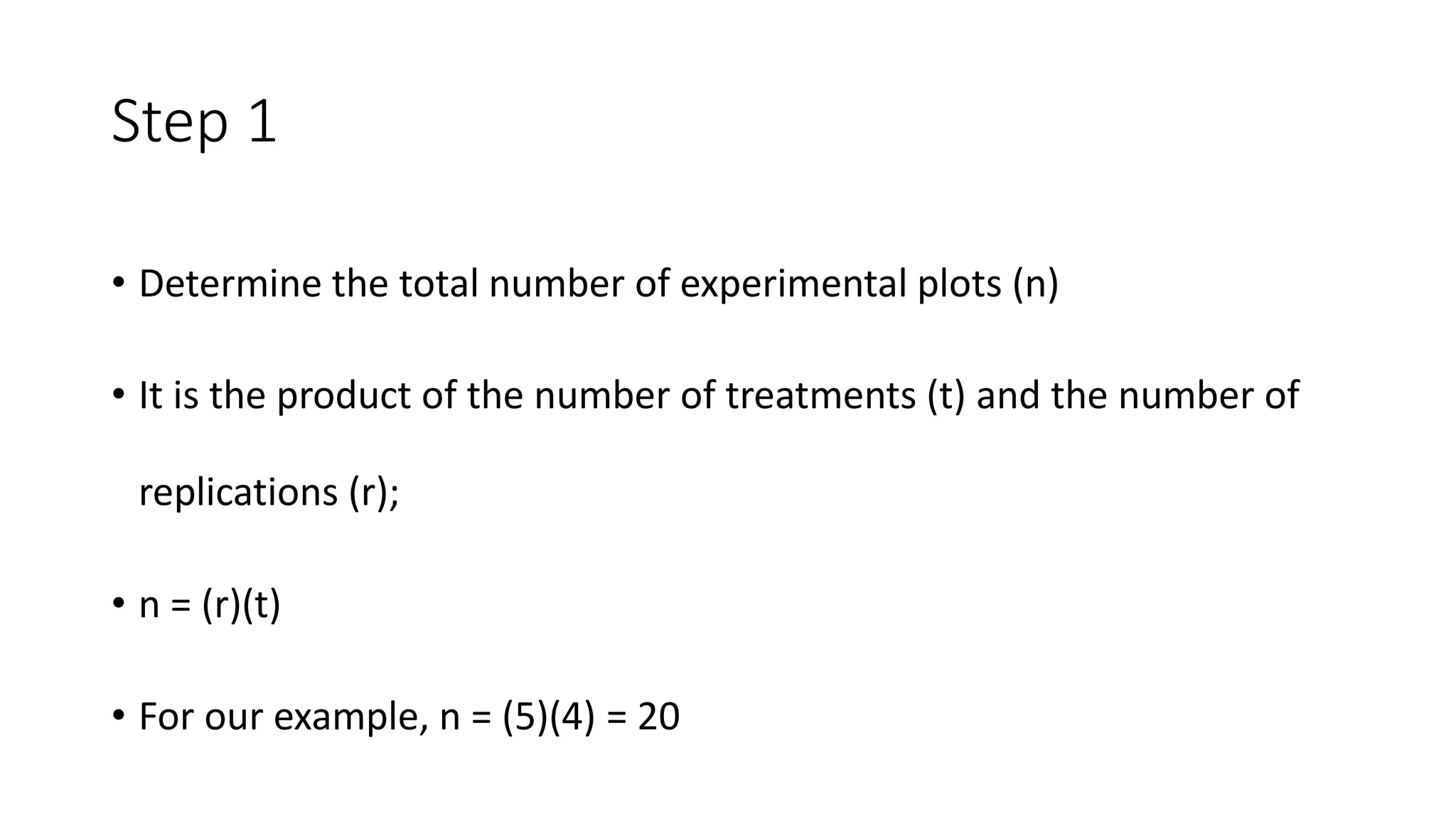
• Determine the total number of experimental plots (n)
• It is the product of the number of treatments (t) and the number of
replications (r);
• n = (r)(t)
• For our example, n = (5)(4) = 20
Step 2
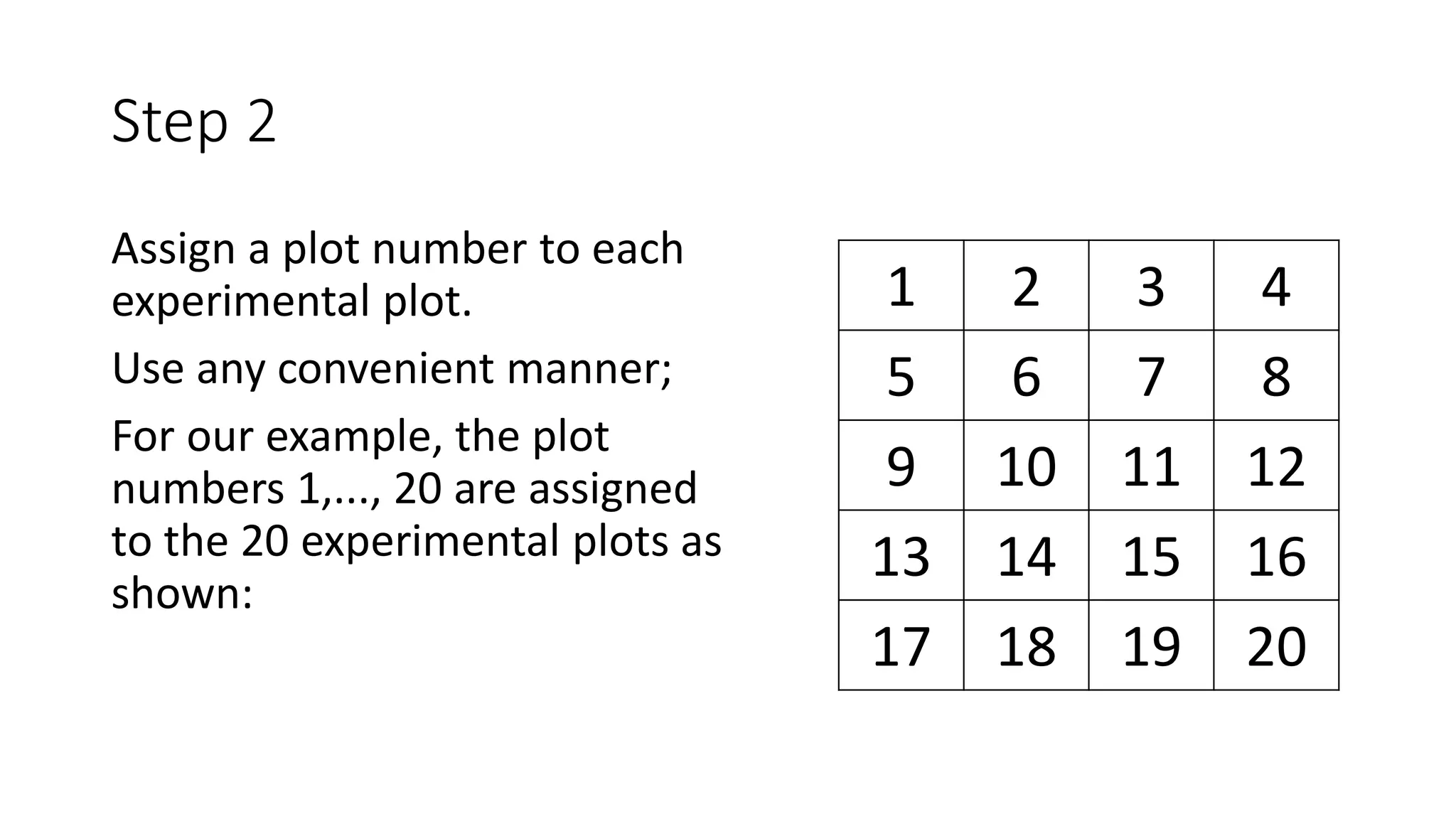
Assign a plot number to each
experimental plot.
Use any convenient manner;
For our example, the plot
numbers 1,..., 20 are assigned
to the 20 experimental plots as
shown:
1 2 3 4
5 6 7 8
9 10 11 12
13 14 15 16
17 18 19 20
Step 3
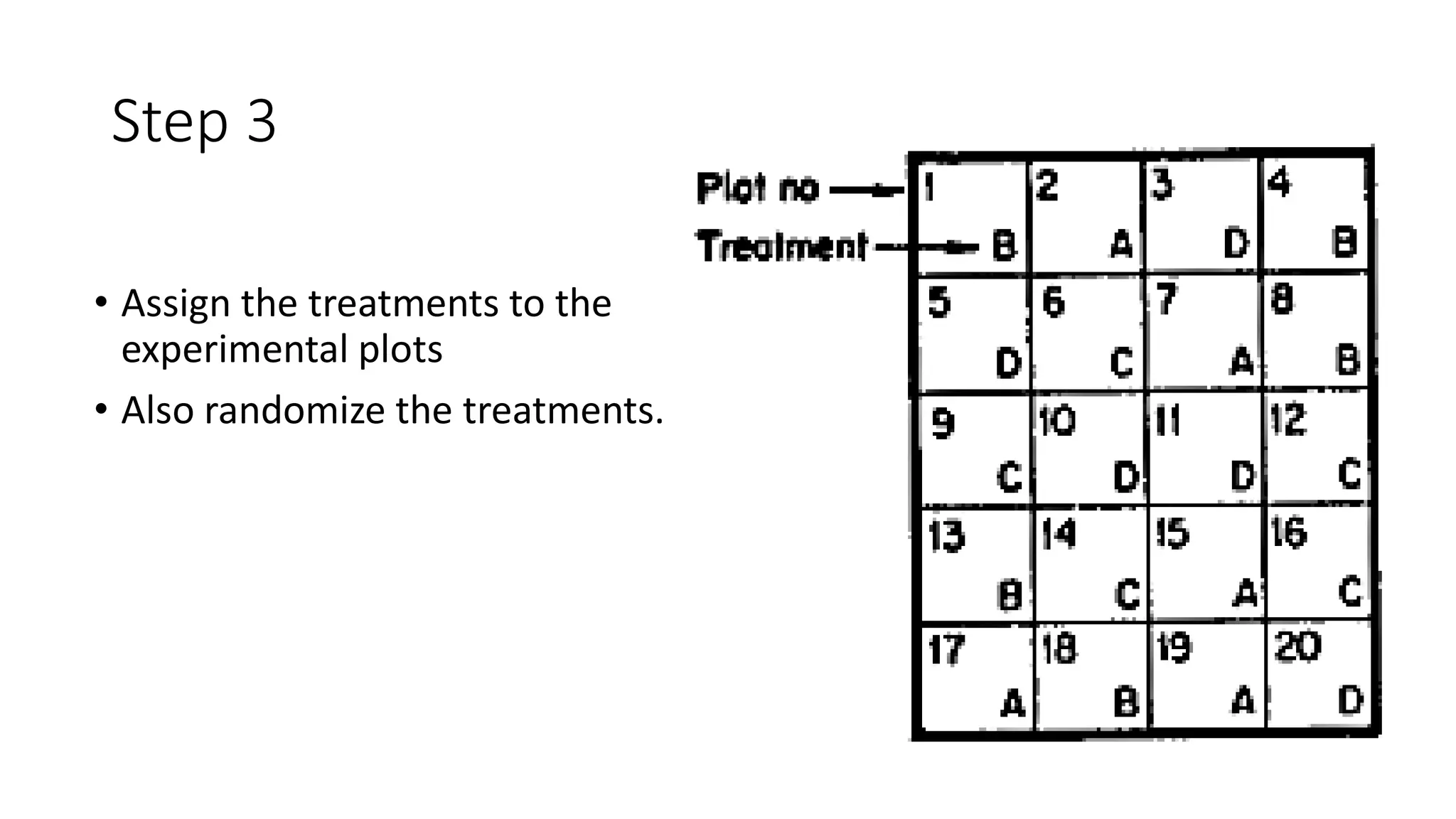
• Assign the treatments to the
experimental plots
• Also randomize the treatments.
RCBD (Single Factor)
• One of the most widely used experimental design, in agricultural
research.
• Especially suited for field experiments
• Experimental area has a predictable productivity gradient.
• The primary distinguishing feature of the RCB design is the presence
of blocks of equal size, each of which contains all the treatments.
RCBD (Single Factor)
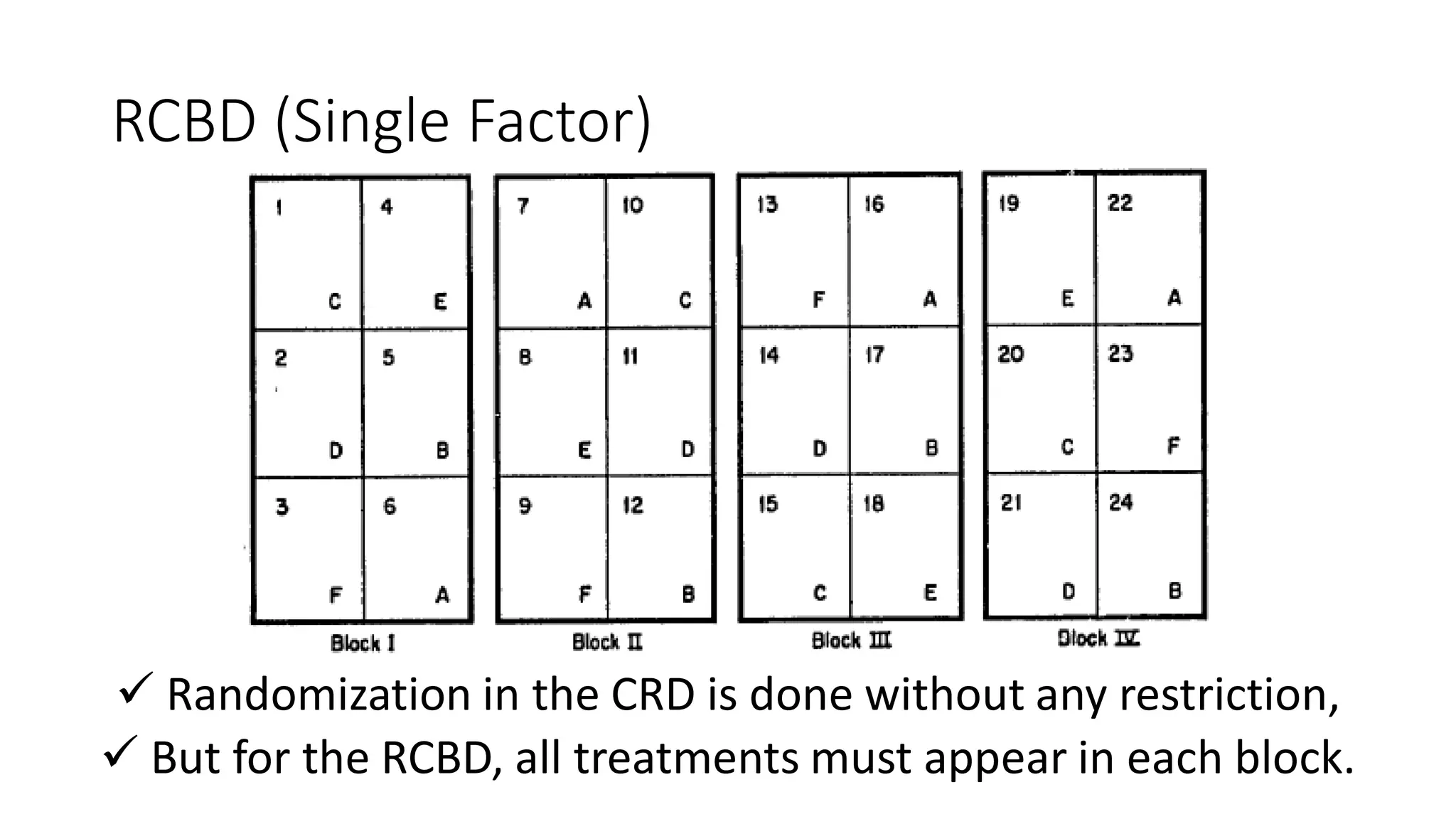
• The randomization process for a RCB design is applied separately and
independently to each of the blocks. We use a field experiment with
six treatments A, B, C, D, E, F and four replications to illustrate the
procedure.
RCBD (Single Factor)
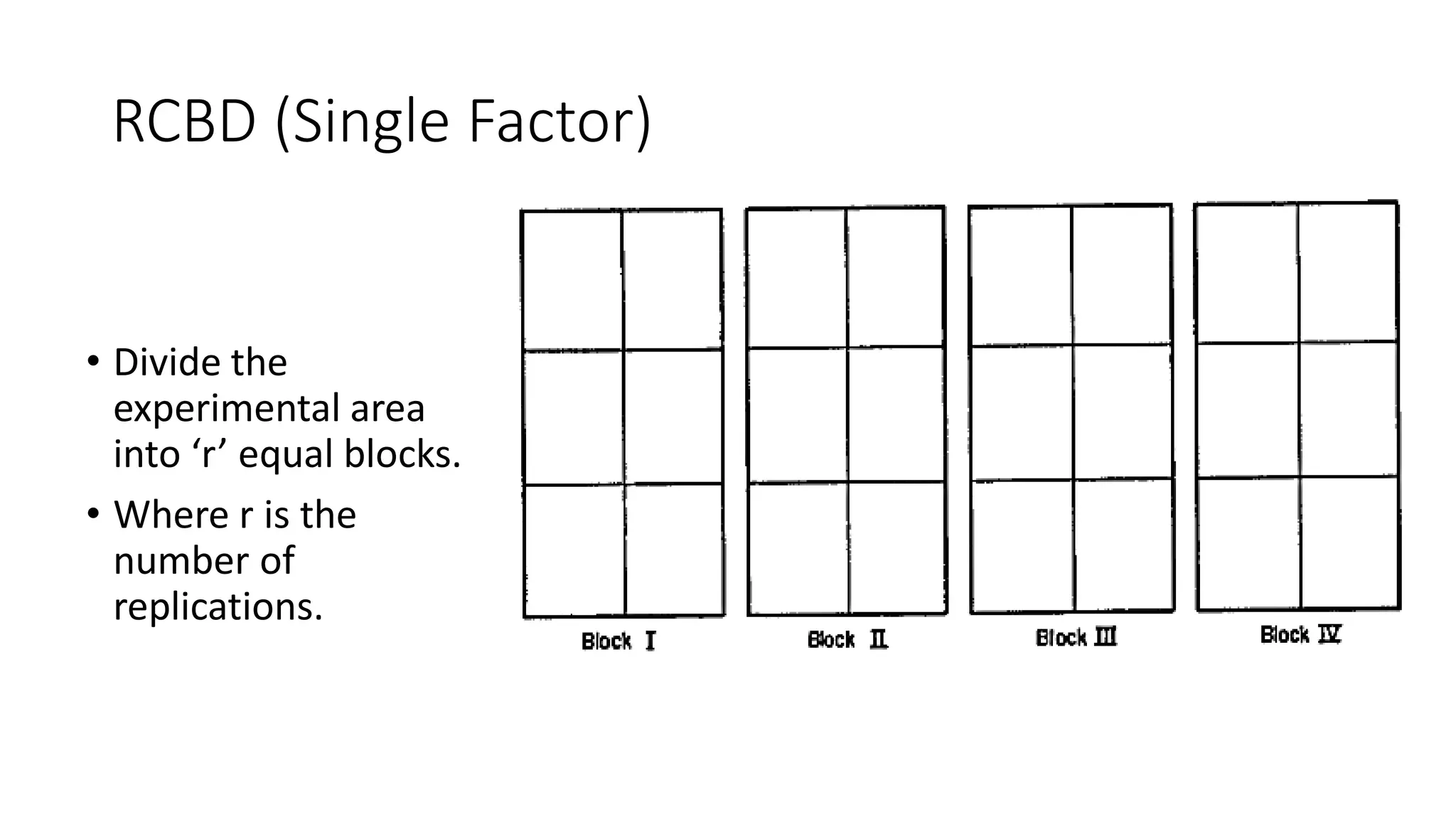
• Divide the
experimental area
into ‘r’ equal blocks.
• Where r is the
number of
replications.
RCBD (Single Factor)
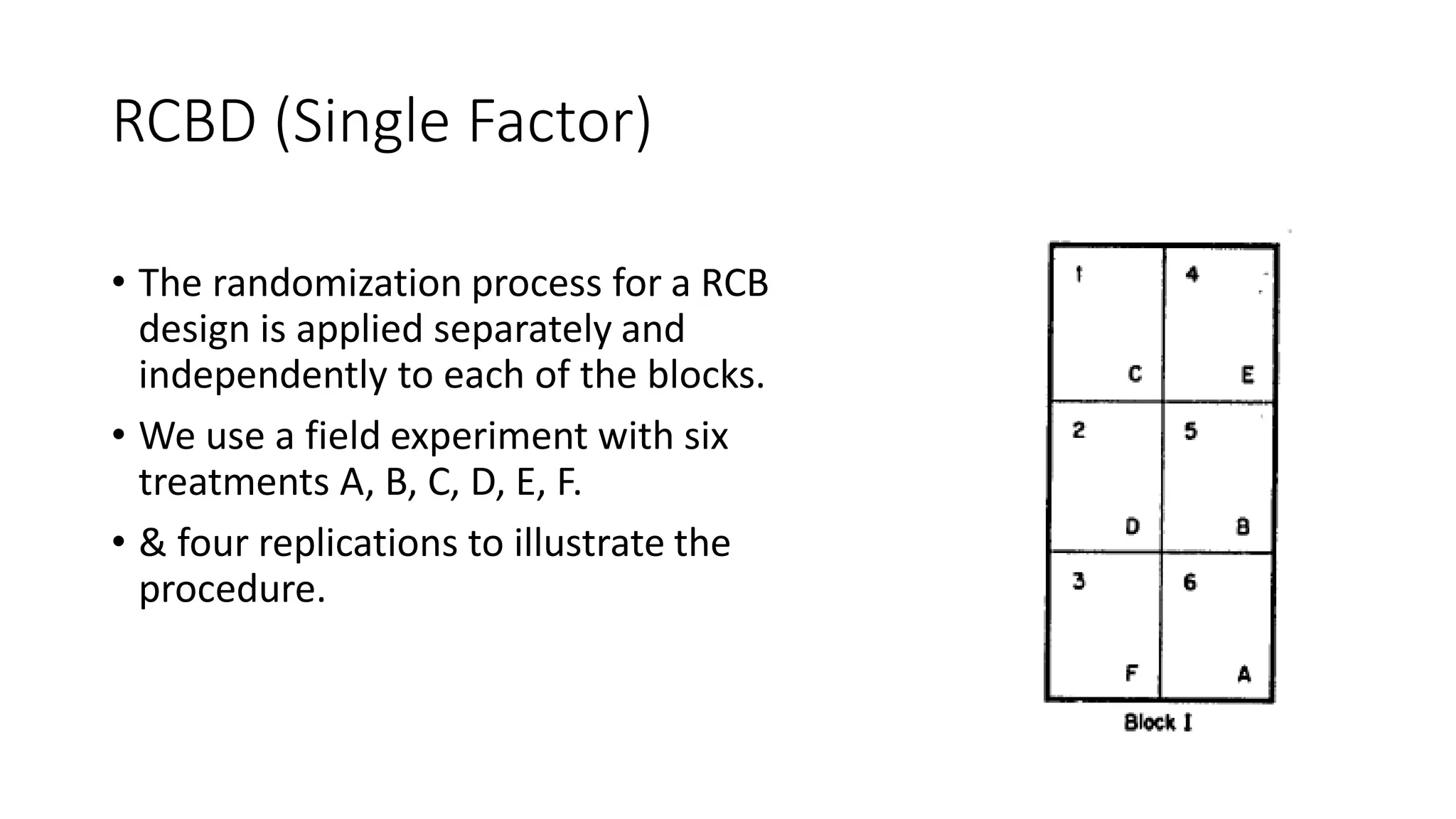
• The randomization process for a RCB
design is applied separately and
independently to each of the blocks.
• We use a field experiment with six
treatments A, B, C, D, E, F.
• & four replications to illustrate the
procedure.
RCBD (Single Factor)
✓ Randomization in the CRD is done without any restriction,
✓ But for the RCBD, all treatments must appear in each block.
(Two Factors)
•An experiment in which the treatments consist of all
possible combinations of the selected levels in two or
more factors is referred to as a factorial experiment.
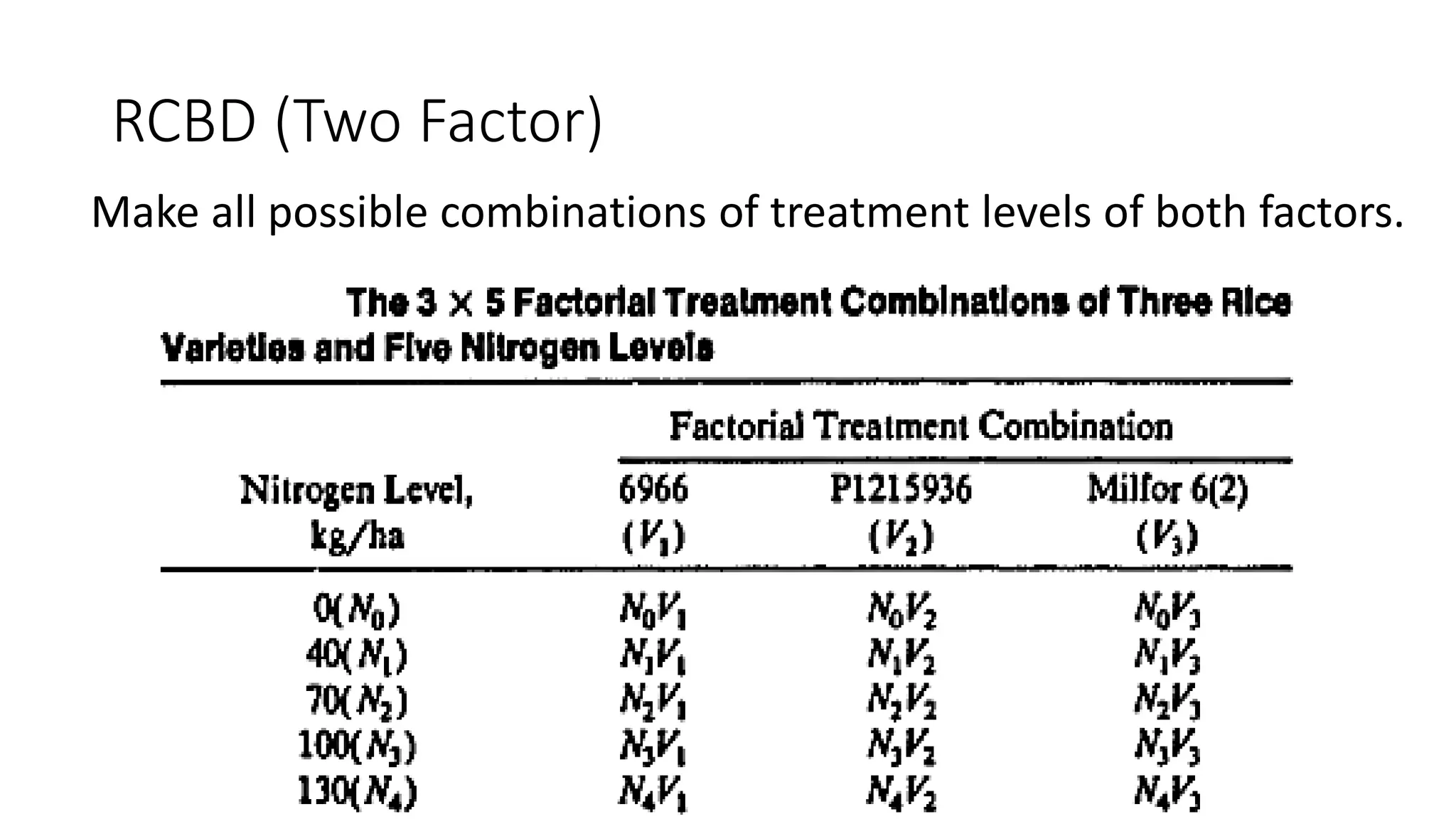
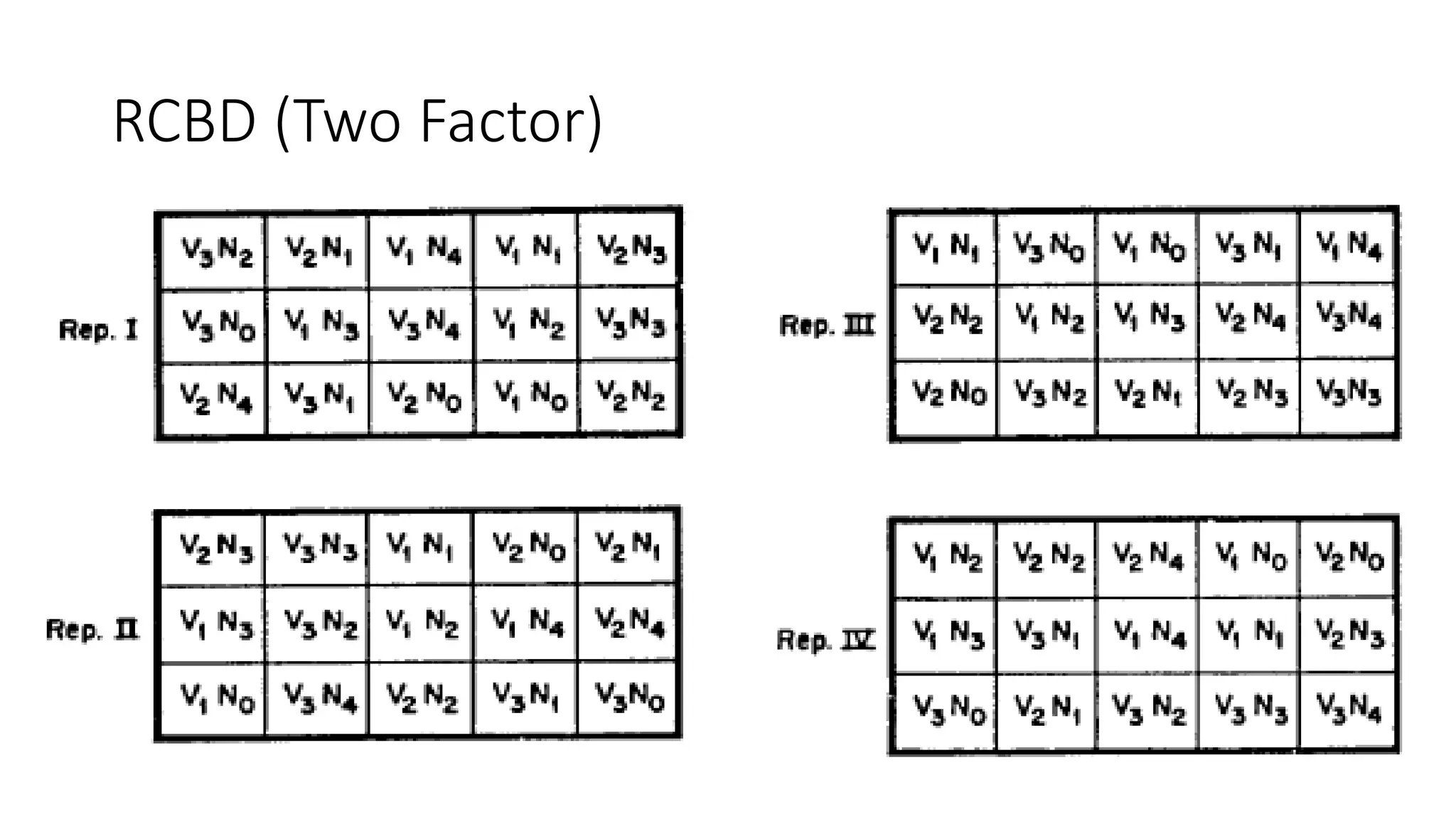
RCBD (Two Factor)
Make all possible combinations of treatment levels of both factors.
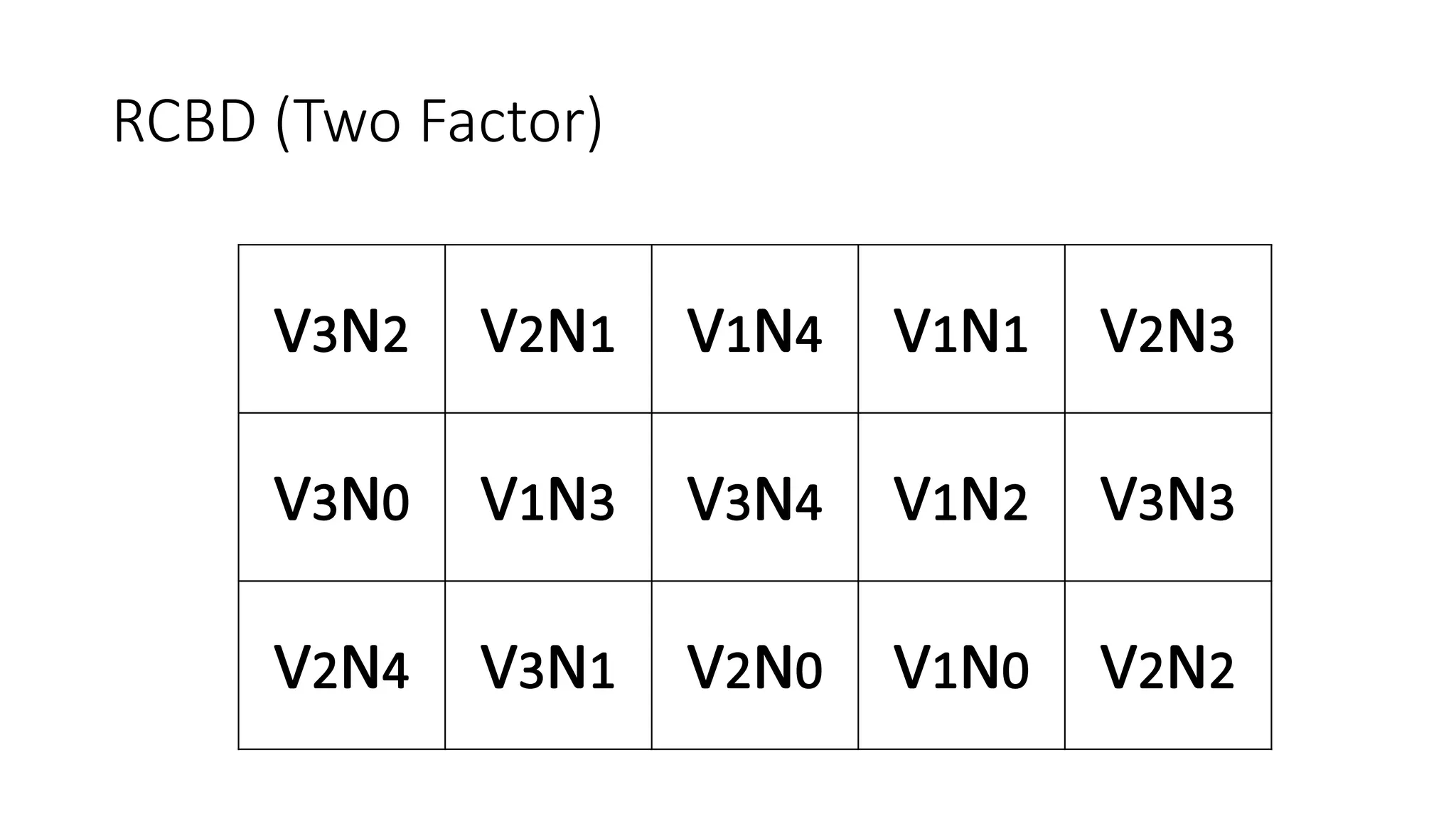
RCBD (Two Factor)
RCBD (Two Factor)
Layout of Agricultural field experiments

Layout of Agricultural field experiments

  • 1.
    B.Sc. (Hons.) Agriculture Collegeof Agriculture BZU Bahadur Sub Campus Layyah Breeding Vegetable Crops
  • 2.
  • 3.
    Introduction Single Factor Deigns DoubleFactor Design Conclusion OUTLINE
  • 4.
    Introduction What is an Experiment…? • A planned inquiry • Discover new facts • Deny or conform previous results What is Experimental Design…? • Research conducted with a scientific approach. • Set of variables are kept constant. • While the other set of variables are being measured as the subject of experiment.
  • 5.
    Layout of DifferentDesigns Factor…? Any entity Maximum level is to be exploited Treatment…? Levels of a factor
  • 6.
    (Single Factor) • Onlya single factor varies • Treatments are only different levels of the single variable factor • All other factors are applied.
  • 7.
    Examples • Fertilizer trials(several rates of a single fertilizer element are tested) • Insecticide trials (several insecticides are tested) • Plant-population trials (several plant densities are tested)
  • 8.
    CRD (Single Factor) •Treatment are assigned completely at random. • Each experimental unit has the same chance of receiving any one treatment.
  • 9.
    Step 1 • Determinethe total number of experimental plots (n) • It is the product of the number of treatments (t) and the number of replications (r); • n = (r)(t) • For our example, n = (5)(4) = 20
  • 10.
    Step 2 Assign aplot number to each experimental plot. Use any convenient manner; For our example, the plot numbers 1,..., 20 are assigned to the 20 experimental plots as shown: 1 2 3 4 5 6 7 8 9 10 11 12 13 14 15 16 17 18 19 20
  • 11.
    Step 3 • Assignthe treatments to the experimental plots • Also randomize the treatments.
  • 12.
    RCBD (Single Factor) •One of the most widely used experimental design, in agricultural research. • Especially suited for field experiments • Experimental area has a predictable productivity gradient. • The primary distinguishing feature of the RCB design is the presence of blocks of equal size, each of which contains all the treatments.
  • 13.
    RCBD (Single Factor) •The randomization process for a RCB design is applied separately and independently to each of the blocks. We use a field experiment with six treatments A, B, C, D, E, F and four replications to illustrate the procedure.
  • 14.
    RCBD (Single Factor) •Divide the experimental area into ‘r’ equal blocks. • Where r is the number of replications.
  • 15.
    RCBD (Single Factor) •The randomization process for a RCB design is applied separately and independently to each of the blocks. • We use a field experiment with six treatments A, B, C, D, E, F. • & four replications to illustrate the procedure.
  • 16.
    RCBD (Single Factor) ✓Randomization in the CRD is done without any restriction, ✓ But for the RCBD, all treatments must appear in each block.
  • 17.
    (Two Factors) •An experimentin which the treatments consist of all possible combinations of the selected levels in two or more factors is referred to as a factorial experiment.
  • 18.
    RCBD (Two Factor) Makeall possible combinations of treatment levels of both factors.
  • 19.
  • 20.