Prepared By: John Michael Reyes
Emerlyn Sigue
Monneca Marquez
Evalyn Garing
“Early and Medieval
Southeast Asia”
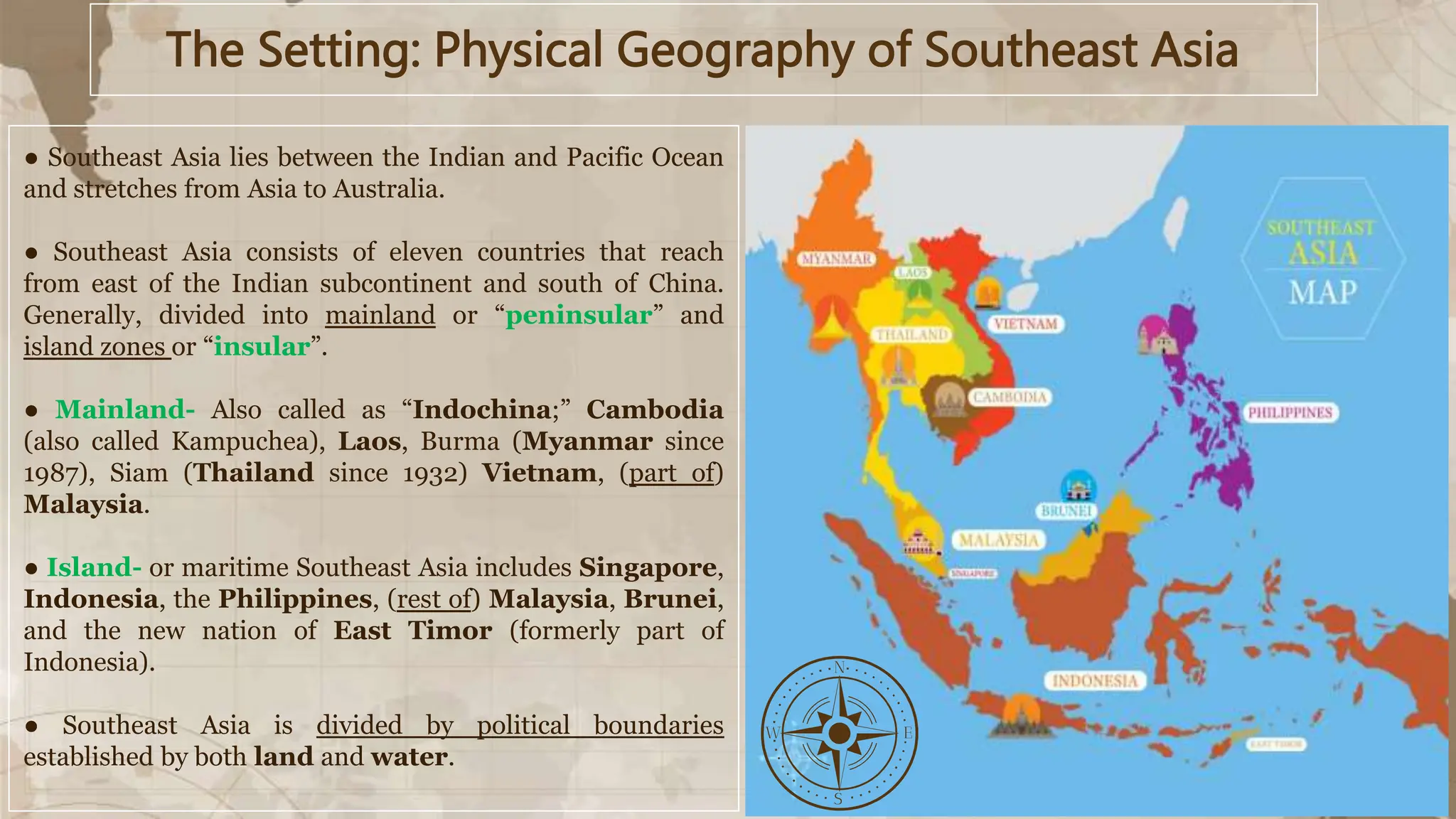
The Setting: Physical Geography of Southeast Asia
● Southeast Asia lies between the Indian and Pacific Ocean
and stretches from Asia to Australia.
● Southeast Asia consists of eleven countries that reach
from east of the Indian subcontinent and south of China.
Generally, divided into mainland or “peninsular” and
island zones or “insular”.
● Mainland- Also called as “Indochina;” Cambodia
(also called Kampuchea), Laos, Burma (Myanmar since
1987), Siam (Thailand since 1932) Vietnam, (part of)
Malaysia.
● Island- or maritime Southeast Asia includes Singapore,
Indonesia, the Philippines, (rest of) Malaysia, Brunei,
and the new nation of East Timor (formerly part of
Indonesia).
● Southeast Asia is divided by political boundaries
established by both land and water.
“Southeast Asia in Globe”
“Southeast Asia is a tropical region of
peninsulas, islands, and waterways with
diverse flora and fauna”
● Two peninsulas extend from the Asian mainland.
Indochina Peninsula and Malay Peninsula.
● The Malay Peninsula bridges mainland island
archipelagoes.
● The Malay Archipelago includes the Philippines and
Indonesian Islands.
● Archipelagoes
1. East Indies- Sumatra, Borneo, Java, and Celebes
2. Philippines- Luzon, and Mindanao
The Setting: Physical Geography of Southeast Asia
“Indochina Peninsula” “Malay Peninsula”
“Malay Archipelago”
“Southeast Asia is a tropical region of
peninsulas, islands, and waterways
with diverse flora and fauna”
Landforms
● Mainland Southeast Asia- Rugged mountains
across Myanmar, Thailand, Laos, and Vietnam; Low
plateaus and river floodplains
● Island Southeast Asia- More than 20, 000
islands; New Guinea, Borneo. There are high
mountains on the larger islands.
● The Islands of Southeast Asia are part of the
Pacific Ring of Fire, a region of volcanoes and
earthquakes surrounding the Pacific Ocean.
The Setting: Physical Geography of Southeast Asia
“Physical Map of Southeast Asia”
“Pacific Ring of Fire”
“Active Volcanoes found in Southeast Asia”
“Southeast Asia’s physical features
include peninsulas, islands, rivers,
and many seas, straits and gulfs.”
Bodies of Water
● Seas- Andaman Sea, West Philippine Sea,
Philippine Sea, Celebes Sea, and Java Sea.
● Gulfs- Gulf of Thailand and Gulf of Tonkin
● Oceans- Pacific Ocean and Indian Ocean
● Rivers- Mekong River and Irrawaddy River
● Straits- Malacca and Sunda Straits
● Many streams, riverine, and lakes which fishing
support millions of people.
The Setting: Physical Geography of Southeast Asia
“Irrawaddy River” “Andaman Sea”
“Gulf of Thailand”
“Java Sea”
“The tropical climate of Southeast Asia supports
a wide range of plants and animals.”
● Southeast Asia is so wet because of the effects of two separate summer
monsoons and winter monsoon.
Tropical Savanna Climate
● Much of the mainland, the temperature is warm to hot all year-round, but
cooler in the north and in the mountains.
● Seasonal monsoons bring heavy rain in the summer.
● Tropical wet climate in coastal Myanmar, Thailand, Vietnam also, in most
of Malaysia, Indonesia and the Philippines.
Humid Tropical Climate
● Islands and Malay Peninsula which experienced hot, muggy, and rainy all
year.
● Typhoons can bring heavy rains and powerful winds, but, supports tropical
rainforests.
● Lush tropical rain forests are home to a large number of different plants
and animals.
The Setting: Physical Geography of Southeast Asia
“The Asia Monsoon”
Origin of Peoples: Early Settlements
●Archaeological evidence dates human habitation of Southeast Asia
to around a million years ago.
● Migration in to the Southeast Asia’s Archipelago occurred 5,000
years ago.
Two Theories of Migration
1. Austronesian- Large group of various people in Taiwan, Island
of Southeast Asia, Micronesia, coastal New Guinea, Island of
Melanesia, Polynesia, and Madagascar
2. Austroasian- Group of people from the mainland of Southeast
Asia, believed to have earlier migrated from South Asia.
● Archeological evidence shows the development of bronze casting
and agriculture were being practiced by the end of 3rd millennium
B.C.E. in northeastern Thailand and northern Vietnam.
● By the same time or earlier, the use of sailing vessels and navigation
across sea are prominent and were indigenous.
“Two Theories of Migration”
Origin of Peoples: Early Settlements
● These technological changes are vital for two crucial
development in Southeast Asia.
● First, seaborne expansion of Proto-Austronesian
language and their descendants- speakers of Austronesian (or
Malayo-Polynesian) languages.
● The outward movement of people and culture was
evolutionary rather than revolutionary.
● In result, societal preference for small groups and to hive off
once a certain population size had been reached.
● It began in 4000 BCE when Taiwan was populated from the
Asian mainland.
● Subsequently it continued southward through the northern
Philippines (3rd millennium BCE), central Indonesia (2nd
millennium BCE), and western and eastern Indonesia (2nd
and 1st millennia BCE).
“Austronesian Expansion”
Origin of Peoples: Early Settlements
● The second development (which began as early as 1000 BCE)
centered on the production of bronze and the bronze-and-iron
objects, found at the site in northern Vietnam known as Dong Son.
“Dong Son Culture and Government”
● Dong son culture has socketed plowshares and axes, shaft-hole
sickles, spearheads, and such small items as fishhooks and personal
ornaments; and bronze drums from which it is known.
● This metal industry was not derived from similar industries in
China or India.
● Dong Son culture also suggests that the region as a whole variety
of societies and cultures of tied together by broad and long-extant
trading patterns.
● But, none of the societies possessed writing and none appears to
have constituted a territorial centralized state.
“Dong Son Material Culture”
Origin of Peoples: Early Settlements
“Dong Son Society”
● Dongson houses were set on stilts with thatched roofs.
● A handful of larger communities such as Co Loa contained
fortifications, and there is some evidence for social differentiation
(ranking).
● Scholars are split on whether "Dongson" was a state-level
society or a loose confederation of villages that shared cultural
materials and practices. “Dong Son Society”
Origin of Peoples: Early Settlements
“Ban Chiang Village, Thailand”
● Ban Chiang is an important Bronze Age village and cemetery site.
● Bronze bells, tools, and weapons gave way to Iron weapons,
bracelets.
● Wet rice cultivation replaces dry cultivation that increased yields.
● Water buffalo were domesticated and pulled plow.
● It is considered by scholars to be the most important prehistoric
settlement so far discovered in Southeast Asia, marking the
beginning and showing the development of the wet-rice culture
typical of the region.
-World Heritage Convention
“Ban Chiang Archaeological Site”
Outside Contacts
● 7th Century BCE- Likely some few of Indian merchants had
visited Southeast Asia. Because there is a reference in the Hindu
epic Ramayana.
● 5th Century BCE- Internal Chinese migrations and conquests.
● 3rd Century BCE- Ashoka sent Theravada Buddhist
missionaries. And Mon people exchanges with India.
● 334 BCE- Chinese absorb Yueh ( Vietnamese) state in Yangtze
River. Chinese attempt to Sinicize elites and elite culture.
● 2nd Century BCE- State of Nam Viet arose in Red River (208
BCE).
● Then, India and China begin to trade trough Southeast Asia.
“Nan Yue or Nam Viet”
After conquering India,
King Ashoka adopted
Buddhism and sent
missionaries to
Southeast Asia in the
third century BC.
Effects of Trade in Southeast Asia
“Maritime Silk Road”
● Monsoons shaped trade in the region because
ships relied on the monsoon to sail.
● Often had to wait in port until winds shifted to
resume voyage.
● Southeast Asian port cities became important
economic centers.
● Overland trade routes through central Asia
became more dangerous after the Han dynasty
fell in 220.
● Indian merchants took advantage of the
monsoon winds, and began to sailed across the
Indian Ocean and arrive in Southeast Asia.
● Political power often was whoever controlled
the trade routes and harbors.
“Trade Routes across Southeast Asia”
● South East Asia waterways (such as seas,
rivers, straits) were the predominant trade
routes between India and China.
● The Two most important routes were:
1. The Malacca Strait – between Malaya and
Sumatra.
2. The Sunda Strait- between Sumatra and
Java.
Effects of Trade in Southeast Asia
India and China: Traders Influence in the Region
● Geography and the cultures of India and China influenced the
early civilizations of Southeast Asia.
● Between approximately 150 BCE and 150 CE, most of
Southeast Asia was first influenced by the more mature cultures of
it’s neighbors to the north and west.
● Chinese expansion south of the Yangtze River eventually led to
the colonization of Vietnam (from 111 B.C.- 393 A.D.).
● It disturbed the Vietnam trade and incorporate as province of
the Han Empire.
● From India, there is no evidence of conquests, colonization, or
even extensive migration.
● Eventually, the states of the mainland became mainly Buddhist. “China under the Han emperor Wudi (c. 100
BCE)”
Influence of India and China
“India”
● The wide ranging “Indianization” began in the third century
B.C.E. with Ashoka’s Buddhist missions to Southeast Asia,
accompanied by Goa traders.
● Missionaries introduced Hinduism and Buddhism where
kingdoms adopted the religions.
● Ideas about government, science, writing and art.
● Many local rulers embraced many of these ideas adopting Indian
names and political ideas.
● Sanskrit- ancient language became widely used.
● Indian Muslim traders eventually brought Islam, forming Islamic
states.
“Võ Cạnh inscription-oldest
Sanskrit inscription”
“Buddha-Gupta stone
(4th–5th century CE)”
“A statue depicting Buddha”
Influence of India and China
“China”
● Influences spread to parts of the mainland through conquest
trade, and migration.
● It controlled northern Vietnam at different times , strongly
influencing that region.
● Vietnamese began using Chinese ways of farming and adopted
some of the teachings of Confucius.
● Chinese control was permanently ended in 1427, but Confucian
philosophy had a lasting influence when Vietnam became
independent.
● Still, Chinese and Indian influences were anything but superficial.
“Confucianism in Medieval China”
“Confucius”
The spread of Islamic culture was
facilitated by trade, misionnaries, and the
political structure of Islamic society. As a
result, we encounter multiple different
interpretations of Islam across many
different Islamic societies.
Eastward Spread of Islam
Pagan Kingdom (Myanmar)
● Early kingdoms and empires blended influences from India
and China to create their own unique societies and cultures.
● Circ. AD 840s, the Burman’s established the Pagan Kingdom
(present day Myanmar-Burma) in the fertile Irrawaddy River
valley- ideal for rice farming.
● Anawratha (ruled from 1044- 1077) united much of what is
now Myanmar under his rule.
● Another group of Tibetan- Burman speakers established by
Burmans in the Northern dry zone.
● Centered on the small settlement of Pagan on the Irrawaddy
River.
“Anawratha (1044- 1077)”
Pagan Kingdom (Myanmar)
● Situated on the left bank of the Irrawaddy
River and approximately 90 miles (145km)
southwest of Mandalay.
● Burma, Myanmar
Irrawaddy River
● Principal river of Myanmar
● Most important waterway of Myanmar
● Its valley form the historical, cultural, and
economic heartland of Myanmar.
“Kingdom of Pagan (849–1297)”
“Geography”
Pagan Kingdom (Myanmar)
● First built probably in 8849 CE, from the 11th century to the end of
the 13th century.
● A pilgrimage center and contains ancient Buddhist shrines that
have been restored and redecorated and are in current use.
● Overrun by the Mongols during their wised ranging conquests.
“Golden Shwezigon Pagoda”
“Society”
“Economy”
● Overseas trade was conducted with India, Ceylon, and other
regions of sout5heast Asia
● Irrigation and Rice Cultivation
● Conquests provided Pagan with access to trading ports and
Anawratha’s kingdom prospered.
Pagan Kingdom (Myanmar)
● People of the Burman ethnic group had been infiltrating from the North
into a region occupied by other people; these people already had been
converted to Indian religion, especially the Mahayana Buddhism of Bihar
and Bengal.
● Pagan became center of Buddhist learning. Theravada Buddhism became
the state religion of Pagan.
● Buddhism adopted from Ceylon (Sri Lanka) about 1056
“Culture”
“Government”
Thamudarit
● Traditional founder of Bagan
Anawrahta
● Credited with the founding of Bagan
● Constructed the Shwezigon Pagoda- huge, terraced pyramid
● He made a pilgrimage to Ceylon
Government: Pagan Kingdom (Myanmar)
Kyanzittha
● Was crowned and reigned from 1084-1113
● Well-known for building a large number of temples and religious monuments in Pagan, particularly the Ananda
Temple
Alaugsithu
● Recovered the inheritance
● He neglected the work of adeministrat5ion and there was apparently much disorder during his absence from the
capital.
Narathu (1116-1170)
● Murdered his father and served the throne
● His short reigned was a time opf disorder and bloodshed
Narathihapate
● Last true ruler who refused the Khans and executed them in their second visit in 1273.
Ananda
Temple
Contributions
Nat Hlaung
Gayung
Glass Palace
Chronicles
Plinth
Buddhist
Stupa
Hall Bell Dome
Decline
Pagan kingdom went into decline as
more lands and resources fell into the
hands of the powerful Songhe
(Monkhood) and the Mongols
Threatened from the North.
“Geography”
● Its geographic location between the Indian
Ocean and the South China sea permitted it to
filter trade between India and China.
● Malacca is located at the north of the Melaka
River and is about 150 km north of Singapore.
“MALACCA EMPIRE”
1. Moonsoon winds
that enabled Arab and
Indian traders from the
west to travel to China
in the east and vice
versa
2. Also the center of
Islam in the eastern
sphere where imams
and ustazes came to
discuss religion and
philosophy.
3. Most of Southeast asia
that time was Hindu and
Muslim missionaries were
sent by the Sultan to spread
Islamn to other communities
in the Malay archipelago
such as in Java, Borneo, and
the Philippines.
“Factors Contributed to the rise of
Malacca”
“Society”
● Indigenous population who lived in was then merely a fishing village
● Speakers of eighty languages were reportedly found in Malacca
“Economy”
● Malacca became the most important trade center in the region where such in demand
commodities as gold, spices, silk, and tea passed through.
● Grew into an international trading port
“Culture”
● Islam reached the region
● Ruler of Malacca, who had himself converted encouraged Muslim trades
● Golden age of Nusantara Islam
“MALACCA EMPIRE”
Government
Parameswara
● A Palembang Prince of Hindu descent from Srivijaya founded
Malacca around 140.
● Born in 1344 and died at the age of 70
● Married to Malik Ul Sahh
● He did not convert to Islam but his marriage to the Muslim
princess encouraged a number of his subjects to embrace Islam.
“MALACCA EMPIRE”
“Indianized Southeast
Asia”
BOROBUDOR
Geography
● Borobudur is located about 40 km to the northwest of
Yogyakarta and86 km the city of Surakarta in central of
Java.
● Lies in area between two volcanoes Mt. Sundoro-
Sumlang and Mt. Merbabu- Mecapi - as well as
rivers – Progo and Elo.
● A temple where Buddhist performed
pilgrimage and other rituals (14th and 15th
century).
● The temple may have been abandoned
when the population converted to Islam in
the 15th century or a famine caused by a
volcanic eruption may have forced local
inhabitants to leave their lands and the
monument.
Borobudur Temple
“Srivijaya Kingdom”
Introduction
● A Malay Kingdom on the island of
Sumatra which influenced much of the Malay
archipelago.
● It was a thalassocracy (sea-based
Empire).
“Society”
“Srivijaya Kingdom”
● First major Indonesian Kingdom and the
first major Indonesian commercial sea power
that last until 13th century.
● A name which translates to “shining
victory.”
● Was a Malay polity and a Hindu- Buddhist
trading Kingship
“Economy”
“Srivijaya Kingdom”
● The empire was based around trade.
● Merchants from Arabia, Persia, and India
brought goods to Srivijaya’s coastal cities in
exchange fro goods from China and local
products.
“Government”
“Srivijaya Kingdom”
Dapunta Hyang Cri Yacanaca
● Led 20, 000 troops from Minanga Tamwon- Palembang, Jambi, and Bengkulu.
King Dharmasetu
● Launched various raids against the coastal cities of Indochina
Samaratuga (792- 835)
● He did not indulge in military expansion but preferred to strengthen the
Srivijaya hold of Java
Declined in the 11th century because of
forced changes in trade routes brought
about by increase piracy in the Sunda
and Malacca Straits
Decline
“Majapahit Kingdom”
“Majapahit Kingdom”
● It was a smaller Javan Buddhist kingdom that controlled the shipping lane leading to and
from the Strait of Malacca.
● Greatest of the early Indonesian Kingdoms
● Founded in 1294 in East Java by Wijaya. An Indianized Kingdom
● The name Majapahit stems from the two words ‘Maja’ meaning a type of fruit and Pahit
which is the Indonesian word for ‘bitter’
“Society”
“Majapahit Kingdom”
● Developed a high degree of sophistication in both
commercial and artistic activities.
● Its capital was inhabited by a cosmopolitan
population among whom literature and art
flourishes.
● It had a thriving cash economy based on rice
cultivation and trade which supported a wide variety
of industries and profession.
“Economy”
“Majapahit Kingdom”
● Majapoahit was baaed on the combined development of agriculture and large scale maritime
trade.
● Local wealth came from extensive wet rice cultivation
● International wealth came from the spice trade
● Majapahit ships carried bulk goods, spices, and other exotic commodities throughout the
region, spiced the use of Malay(not Javanese) as a lingua Franca
● Use gold and silver coins
“Culture”
“Majapahit Kingdom”
● Hinduism fused with Buddhism were the primary religions
● Islam was tolerated
● Establish Java’s first Islamic sultanate art Demak in late 15th century.
● Negara Kertagoma by Prapancha (1335-1380)
● Written during this golden period of Majapahit
● Parts of the book described the diplomatic and economic ties between Majapahit and
numerous Southeast Asian countries
“Government”
“Majapahit Kingdom”
Hayum Wuruk
● Grew to prominence
● Became a significant power in the region, maintaining relation with other
Southeast Asian countries.
● His death resulted for the majapahit Kingdom to decline
Raden Wijaya
● Founder of the Majapahit empire
● Son in law of Kertaragara, the last ruler of the Singhasari Kingdom
Beginning after Wuruk’s death an agricultural crisis,
civil wars of succession, the appearance of strong
trading rivals such as Persia and Melaka and vesture
vassal rule is eager for independence all changed
the political-economic order from which Majapahit
had drawn much of its legitimacy.
Decline
“Geography”
● Cambodia has a land area of 181,035
square kilometers.
● A country located in the southern
portion of the Indochinese Peninsula in
Southeast Asia.
Funan Kingdom (Cambodia)
● The first important “Indianized” Southeast Asian state was
Funan.
● Chinese envoys Kang Tai and Chu Ying.
● The state was founded in the first century C.E. and flourished
into the sixth century.
● The state of Funan was established by an Indian Brahmin
named Kautilya.
● Myth Concerning the rise of Funan were Kautilya sails to Funan
and defeated and married the queen.
● The historical evidence shows that Funan, it reached it greatest
extent in the early 3rd century C.E. and Khmer dominated the
government and it’s society. “Chot Mat Tower”
“History”
Funan Kingdom (Cambodia)
Population concentrated mainly along the
Mekong River
•Towns, villages concentrated on coast, rivers
• Natural region for fishing and rice cultivation
• Extensive inland irrigation system
• Lowlands: Mon-Khmer peoples
• Highlands, Hills: Negritos
“Vyadhapura in the Funan empire”
“Funanese Demography”
Funan Kingdom (Cambodia)
State
• Quasi-feudal pattern with princes, aristocrats
• Large naval, merchant fleet; bureaucracy
• System of mercantilism, commercial
monopolies •Effectively a tribute empire
• Left local customs and identities intact
“Vyadhapura in the Funan empire”
“Structure of Society”
Funan Kingdom (Cambodia)
Devaraja: God-King
● The structure of Funan became a modeled states in Southeast Asia.
● Devaraja Cult were Indian notion of divine ruler, and reincarnation of Shiva (could also
be Vishnu).
● Buddhist adaptation and blended with local animism.
● A mixture of native beliefs and Indian ideas; believed the cobra to be sacred and ancestor
worship.
● Heavily influenced by Indian culture- Brahmins and Kshatriyas dominated.
● Religious doctrines were syncretism, Hinduism and Buddhism.
“Funanese Culture”
Funan Kingdom (Cambodia)
● Funan was rich because of trade and agriculture
and Maritime trade also extremely important role.
● At Funan’s main port- “Oc Eo” were found.
● Population concentrated mainly along the
Mekong River and towns are on coast and rivers.
● Extensive inland irrigation system.
“Economy and Geography”
Funan Kingdom (Cambodia)
Early Khmer tributary kingdom of Funan
• Revolted and Conquered Funan
• Collapse of Funan due to end of maritime trade
• Related to the collapse of Rome, China Chenla
Divided into northern, southern states
• "Chenla of the Land" or inland areas especially Laos."
• Chenla of the Sea" or coastal, Mekong River area
• Divided into smaller states
Decline
• Chenla threatened Srivijaya
• Srivijaya invaded, killed king
• Srivijaya set up its own prince as ruler
“SUCCESSOR: CHENLA”
“KHMER EMPIRE”
“ORIGIN OF PEOPLE'S AND THEIR
SETTLEMENTS”
● The Khmer people probably came originally
from southern China and are ethnically related
to other populations who migrated into
neighboring Burma at the same time.
● They followed a migration route down the
Mekong River into what is now Cambodia,
probably by or before 100 B.C.E. but before
they had any lasting contact with Chinese or
Indian civilizations.
“KHMER EMPIRE”
“KHMER PEOPLE”
● Khmer, also called Cambodian, or
Kampuchean, any member of an
ethno linguistic group that constitutes
most of the population of Cambodia.
“KHMER EMPIRE”
“GEOGRAPHY OF THE KHMER EMPIRE”
● In start of empire, main source of water was Mekong River
● Surrounded by the South China Sea and Bay of Bengal
● The area ruled under the Khmer Empire consists of modern day
Cambodia, Thailand, and Laos.
● Topography consisted of mostly plains and small mountains
around the Mid-west and North-west.
● Warm tropic weather
● Either dry aired or heavy rainfall
“KHMER EMPIRE”
“FOUNDING THE KHMER EMPIRE”
● Jayavarman II (reigned AD 802 to 850)
● Lived as prince at the court of Sailendra dynasty
in Java
● Influenced by refined art and culture of Javan
Sailendra
● Adoption of the concept of divine Deva-Raja
(God-King)
● Rulers deified as Shiva.
● Lingam pillars displayed throughout state
● Late in the 8th and early in the 9th century
● Srivijaya launched naval raid against Indochina
● Invasion against the modern day Cambodia
● Jayavarman was a Srivijayan puppet ruler
In 802 .
● Recognized as the Deva-raja
● Declared independence
“KHMER EMPIRE”
“NEW CAPITAL CITIES”
● Building Capital Cities
● No large cities to serve as capital
● Each new ruler added on to older capitals
● Many new rulers simply built new capitals
● Capitals were to impress people of rulers' power
● Began extensive building projects
● Wealth gained through trade and agriculture made
possible.
● Indravarman I Reigned A.D. 877- 889
● Expanded kingdom without wars
“KHMER EMPIRE”
“NEW CAPITAL CITIES”
● Established a new capital, Yasodharapura (First
city of Angkor)
Jayavarman V From A.D. 968 to c. 1001
● His rule was a largely peaceful period
● Marked by prosperity and cultural flowering •
Established a new capital near Yashodharapura,
Jayenanagari
● At court lived philosophers, scholars and artists.
● New temples were also established including first
of Angkor Wat
“KHMER EMPIRE”
“Jayavarman V From A.D. 968 to c. 1001 ”
● His rule was a largely peaceful period; Marked by prosperity and cultural flowering and established a new
capital near Yashodharapura, Jayenanagari
● At court lived philosophers, scholars and artists.
● New temples were also established including first of Angkor Wat.
“Jayavarman VII”
● The future king Jayavarman VII (reigned 1181-after 1206)
● Already a military leader as prince under previous kings.
● After Cham conquered Angkor, he built army, regained capital •In 1181 he ascended the throne
● Continued war against the Champa until conquered in 1203; and was a follower of Mahayana Buddhism.
“KHMER EMPIRE”
● New capital Angkor Thom (literally: "Great City")
was built
● Constructed the state temple the Bayon with its
towers
● Further important temples built under Jayavarman
V
● Built the reservoir of Srah Srang
● Laid down an extensive network of streets
● Built roads to connect every town of the empire
● Built 121 rest-houses were built for traders, officials,
travellers
● Built 102 hospitals..
“KHMER EMPIRE”
● Khmer culture is “Indianized”; influenced mostly
by India.
● Religion : Hinduism; worshiped Shiva and
Vishnu; followed caste system with Brahmins.
● Architecture : temples and monuments were
built in honor of Hindu gods such as Angkor Wat
● Art : stone carvings taught by Indian Brahmans
● Public Works : learned how to make irrigation
systems and waterways from Brahmans
“Khmer Culture”
“KHMER EMPIRE”
● The majority of the Khmer empire are people who follows the Khmer style of Buddhism, which
blends the elements of Hinduism, Buddhism and spirit worship.
● The Angkor rulers also adopted its idea of god-kings, in which the kings were an incarnation of
Shiva, a Hindu god who was known as the protector.
“Religion and Beliefs”
“Language”
● The official language in Khmer was very similar to Sanskrit. Many of its characters derived from
Sanskrit which was a sacred Indian language.
●The language was usually written on stone or carved into it. Some of the inscriptions were placed
in temples to honor and show respect to the gods they believed in.
● The alphabet consists of 74 letters.
“KHMER EMPIRE”
Mongols disrupt East Asia
● Conquer China, Vietnam, Burma and disrupt trade
● Attempt to Invade Borneo and Java
● Khmer paid tribute to Mongols
Rise of Thai
● Mongols conquer Nan Chao, Thai state in Sichuan China
and Thai peoples moved into Indo-China.
● They settled in central peninsula and rebelled against
Khmer.
● Eventually, established Thai state and overran most of
Khmer Empire
“Decline of Khmer”
“LAOS”
● A landlocked nation in Southeast Asia
occupying the northwest portion of the
Indochinese peninsula, Laos is surrounded
by China, Vietnam, Cambodia, Thai land,
and Burma. It is twice the size of
Pennsylvania. Laos is a mountainous
country, especially in the north, where
peaks rise above 9,000 ft (2,800 m). Dense
forests cover the northern and eastern
areas. The Mekong River, which forms the
boundary with Burma and Thailand, flows
through the country for 932 mi (1,500 km)
of its course.
“Geography”
● Buddhism first appeared in Laos during the
eighth century A.D.
● After the foundation of the unified Kingdom of
Lan Xang, King Fa Ngum (14th Century) declared
Buddhism as the state religion and urged the
people to abandon Animism or other beliefs such
as the Cult of Spirits.
THE DHAMMAPADA
● Is an important book in Buddhist literature. It
contains 423 verses spoken by the Buddha on
various occasions.
“Religion”
“LAOS”
● The Lao Kingdom of Lan Xang Hom Khao existed as
a unified kingdom from 1353 to 1707. For three and a
half centuries, Lan Xang was one of the largest
kingdoms in Southeast Asia.
RELIGION
● Theravada Buddhism
GOVERNMENT
● Absolute monarchy
ARTS AND LITERATURE
● Laos has a long tradition of oral literature, including
folk tales, children's stories, proverbs, parables and
poems.
“VIETNAM”
● The lowlands of southern Vietnam are
dominated by alluvial plains, the most
extensive of which is the Mekong delta,
covering an area of 15,400 square miles
(39,900 square km) in Vietnam. Smaller
deltaic plains also occur along the south-
central coast facing the South China Sea.
“Geography”
“VIETNAM”
● Unlike the Koreans who seemed content to be
dominated by Chinese culture, the Vietnamese did not
want to lose their own culture by being conquered by
China
“Culture”
“Chinese First Meet The Vietnamese”
● 1st encounter in 220s B.C.E. when Qin Dynasty of
China invaded Vietnam (and later in 111 B.C.E. the Han
continue fight and conquer Vietnam).
● After the invasion, trade increased b/t China and
Vietnam (Viets got silk for ivory, pearls, and aromatic
woods
“VIETNAM”
● Viet elites accepted Chinese rule b/c
they knew they could learn a lot from the Chinese
● Eventually Vietnamese elites were even allowed
into the Han bureaucracy
But Vietnamese Culture Different From Chinese
• Vietnamese strong tradition of village autonomy (self-rule)
• Vietnamese lived with nuclear family
• Vietnamese women had better status than Chinese
• Vietnamese language different and unrelated
• Vietnamese chewed betel nuts (Chinese thought gross)
Vietnamese blackened teeth (Chinese also thought gross
• Vietnamese art and literature different
• Vietnamese even more attached to Buddhism than Chinese
“Chinese Official And Directly Rule Vietnam”
“VIETNAM”
● Vietnamese took advantage when there was turmoil in China
(nomadic invasions and civil wars)
● Main Chinese cities far from Vietnam (and separated by
mountains)
● Vietnamese fought for centuries against Chinese rule before
finally getting independence
“Vietnamese Struggle for Independence”
“INDEPENDENCE
WON”
● For the next thousand years, Vietnam had to fight off the
Chinese and Mongols to remain independent
In 939 C.E.
● Vietnam finally gains independence (shortly after the Tang
Dynasty fell from power
“VIETNAM”
● Vietnamese built Chinese styled cities and copied Chinese bureaucracy
(including the exam system).
● Bureaucrats studied Confucianism and had high status in society
(similar to China), though they never gained as much power as in China.
● Vietnamese were forced to adopt the Chinese’s language, clothing, and
hairstyles. They adopted the Chinese bureaucratic system and a
Confucian-based civil service system.
● Vietnam embraced Mahayana Buddhism; its art and architecture
influenced culture. Despite these influences, Vietnam maintained many
traditional customs(worship of nature spirits, etc.) determined to preserve
its own culture and identity.
“Chinese Cultural Influence Still Seen After
Independence”
“VIETNAM”
●Once free from China, the Vietnamese drive south to
conquer more land
●Vietnamese Defeat Chams and Khmers to Gain Territory in
South
●They were successful largely thanks to political and military
tactics learned from China (people they fought had learned
from India)
“Vietnamese Expansion”
“Vietnam Expansion Divides People”
● Capital of Vietnam was up north in Hanoi
● Hanoi leaders found it difficult to rule far away areas down
south
● Over time, people in Khmers and developed
south intermarried with Chams and distinct culture (which
north Vietnamese thought inferior
“VIETNAM”
● VIETNAM The fall of China’s Tang dynasty (early 900s) provided
another chance at independence, which lead to success.
● In 939 the Vietnamese established the independent kingdom of Dai
Viet in present-day northern Vietnam.
● The Chinese failed to re-conquer. Although the rulers of Dai Viet sent
tribute to China, the kingdom remained independent Late 1200s.
● The Mongols invaded, but the Vietnamese defeated the Mongols and
remained independent.
“BURMA (MYANMAR)”
Burmans arrive 8th Century CE
● First way of migrations from Tibet and China
● Founded Pagan
● Unified all of Burma in early 11th century
● Expanded to borders of Khmer Empire
● Kings fell under control of Sangha brotherhood of monks
● Mongols Invade and capture entire kingdom ending Pagan Dynasty
Post-Mongols
● Burma divided into numerous states, constantly warring on one
another.
● Never able to recover as Thai Shan people migrated through region.
“BURMA (MYANMAR): PYU”
Burma (or Myanmar)
● Oldest ethnic group is Mon or Pyu. Burman people migrated from China-Tibet border c. 800 CE
● Into the valley of the Ayeyarwady Now form the governing majority.
● Paleolithic Life
● Artifacts suggests rice growing settlements c. 500 BCE Trade with Qin, Han Dynasties of China c. 200 BCE
The Pyu
● Arrived in Burma in the 1st century BC Established 18 city-state kingdoms
● Part of an overland trade route from China to India
● War was virtually unknown Disputes solved through duels by champions or building competitions.
● Wore silk cotton instead of actual silk so did not have to kill silk worms
● Crime was punished by whippings and jails were unknown, Pacticed
● Theravada Buddhism, Children educated as novices in temples from age of 7 until 20
“BURMA (MYANMAR)”
MYANMAR MON & PAGAN
● Mon kingdom of Dvaravati I
• Expanded in the lower Chao Phrava valley in present day Thalland
• Khmer forced Mon into modern Burma
• Oral tradition: Buddhism arrived via sea 3rd century BCE
Adopted Indian culture
• Devaraja Concept
• Sanskrit
• Theravada Buddhism and are thought to have founded kingdoms I
• Indians probably founded Thaton in the 6th or 7th century
“THAI AYUDHYA”
Thailand- “Geography”
● A country at the center of the Indochina peninsula
in Southeast Asia.
● It is bordered to the north by Burma and Laos, to
the east by Laos and Cambodia, to the south by the
Gulf of Thailand and Malaysia, and to the west by the
Andaman Sea and the southern extremity of Burma.
● Its maritime boundaries include Vietnam in the
Gulf of Thailand to the southeast, and Indonesia and
India on the Andaman Sea to the southwest.
“THAI AYUDHYA”
Thailand
● Thai had formed a state that grew in
power and began to impinge on and eventually take
over much of the earlier Khmer Empire, which was
decaying by about 1250, and in 1431 captured the
Khmer capital at Angkor.
● Thai had probably spilled southward across
the present border of southern China before 1200, but
the trickle became a flood after the Mongol conquest of
their Yunnan homeland in the late thirteenth century
“Malaya, Indonesia and
The Philippines”
Introduction
The people of Maritime South East Asia – present –day Malaysia,
Indonesia and the Philippines – are though to have migrated
Southwards from Southern China sometime between 2500 and 1500 B.
C. They continued to have contacts with the Chinese Civilizations (well
established in the second millennium B. C), but the influence of the
other long – established civilizations of India gradually become
predominant among them, and among the peoples of the South East
Asia Mainland.
MALAYA
01
Malaya
• Had been settled during the period around 2000 to 1500
B. C by Mongoloid tribes from South – Western China.
• The Malay came under Indian influence from about the
beginning of the Christian Era.
Geography
Mountainous and rain – forested lansdcape
contained no extensive river valleys or
productive agricultural plains, and settlement
was most concentrated on the coast, where
small ports were engaged in the trade of the
archipelago.
Culture
• Strongly influence by that of other peoples,
including the Siamese, Javanese and
Sumatran.
• Animistic beliefs in spirits of the soil and
jungle (influenced by Hindu India)
• The Malay Language is part of the
Austronesian language family. It’s widely
used in Singapore, Indonesia, Brunei and
Malaysia
Arrival of Islam
- Malaya converted in Islam by 15th century
- Sumatran Prince, Parameswara
* Who successfully sought a
tributary relationship with
powerful China.
* Converted to Islam
Social
- Feudal Social Organizer, living in villages as
farmers.
Population
- never supported a very large population.
- 473, 000 persons for the Malay Peninsula in the
1890s
Politics
- not politically unified
- constant domination by outsiders
- first controlled by the Indonesian
trading empire of Srivijaya.
INDONESIA
02
Geography
Indonesia has many high mountains, the highest
of which are over 4000 metres. Many of them are
active volcanoes. There are tropical rainforests
and jungles, as well as swampy mangrove areas.
Indonesia's most fertile land is on the island of
Java.
Java : Saliendra
• Java as Rival to Sumatra
- Java has few ports but large
amount of rich farm land.
- States in Java tended to be small
but heavily populated.
- Javanese states defied Srivijayan
control of the area.
- Agricultural states produced large
surpluses of crops.
Indonesia’s Dominant Island
• Rice Paddy culture
- Requires extensive work on
drainage, canals, terracing
- Dysnastic states mobilized
labor of large populations
Java : Saliendra
• Sailendra power centered on the Kedu Plain ( South
Java)
- an area where paddy field or sawah
cultivation flourished
- location secure from sea – borne Srivijayan
raids
- used of symbolic power associated with
Hinduism and Buddhism.
- an indianized court
Indonesia’s Dominant Island
• Rice Paddy culture
- Requires extensive
work on drainage, canals,
terracing
- Dysnastic states mobilized
labor of large ppopulations
• Maintained close alliance with
Srivijaya
- married their sons, daughter
into Srivijaya
- later when ousted from Java,
became rulers in Srivijaya.
Borobudur
( 19th century – 14th century)
 Largest Buddhist Temple on
the planet
 Borobudur is considered the
highest expression of early
Javanese artistic expression.
Its bas-reliefs depict the
pantheon of Buddhas and
bodhisattvas in the classical
style of Gupta India, but there
are distinctive Javanese
characteristics.
Majapahit in East
Java
- Developed sawah through clearing of new land and irrigation, creating more landed
nobility.
- From ports in east Java ( near Surabaya), international trade based on rice and
Malukan spices helped create strong merchant class.
- High point of Majapahit in mid 14th century under Hayam Wuruk ( 1350 – 69) and able
prime minister, Gajah Mada.
- Areas under “protection” of Majapahit ruler from Malay Peninsula to Bird shead
Peninsula in Papua, but Ayudhya, Cambodia, Champa (central amd Southern Vietnam)
and ( Northern) Vietnam are “always friends”.
- Majapahit : Nationalist symbol of Indonesia, along with Srivijaya.
Majapahit (c. 1294 – 1486)
Majapahit Culture
- Flourished 7th – 13th centuries, influence from Sumatra and the Malay Peninsula to
Kava, South Borneo and Luzon ( Laguna inscription in 900 CE in Philippines)
- Late 17th century trade to Malagasy from Borneo
- Ability to provide facilities and desired products attract large numbers amd variety of
traders
- Role of the Orang Laut as collectors of sea products and guardians of the sea lanes.
- Srivijaya known as “civilized” with skilled mathematicians able to calculate eclipses of
sun.
- Center of Buddhist studies with 1000 Mahayana Buddhist monks studying the Sutras in
late 7th century.
- Cultural origins of the Malays, symbol of Indonesia.
Srivijaya : A Maritime Polity
- Demanded submission and tribute from
the King of East Java
- Kartanegara
* who had made an alliance with
Champa, against the Mongols.
The Mongols
- Kubilai Khan launched a punitive
expedition in 1292 with 1,000 ships and
20,000 men.
- Javanese naval and land forces defeated
and expelled the Mongols
Philippine
s
03
- The Philippines is an archipelago
comprised of 7,107 islands in the South
China, Philippine, Sulu, and Celebes Seas,
along with the Luzon Strait. The topography
of the islands is mostly mountainous with
narrow to large coastal lowlands, depending
on the island.
Geography
- The Philippine Islands
starts with the coming of
the Spaniards, or with
Magellan's voyage in 1521,
in which he claimed the
islands for Spain before
being killed in battle with
some of the people he
encountered
- The Philippines are even
more fragmented, into some
7,000 islands, than is
Indonesia, with only some
3,000.
- The culture of India, China,
and Southeastern Asia
had reached in the
Philippines through the
early settlers.
- Philippines was part of
a great Hindu -
Malayan Empire ruled
from Java and Sumatra.
- Arrival of Islam.
- * Muslims came into
the Sulu archipelago
and Mindanao and
converted the people.
Philippines
- Spanish priests set about the conversion of
the inhabitants to Roman Catholicism.
- Filipinos had developed a way of life and a
distinct culture.
- Introduced new crops :
- * corn
- * cacao
- * improve sugar and coffee production.
Spanish in the Philippines
- Trade in sugar, abaca ( Manila Hemp) and
tabacco boomed, tripling in value from ( 1825
to 1850).
- British and American merchants were
prominent in the mian trade center at Manila.
- One of the famous personality
- Dr. Jose Rizal
- He studied medicine at the
University of Santo Tomas
and in
the Philippines and the
University
of Madrid
- Rizal wrote two important
novels
that portrayed the abuses of
Spanish rule.
- December 30, 1896
- Rizal proclaimed the
Philippines " The Pearl
of the
Oriental Seas "
Spanish in the Philippines
- The Philippines was the first
colonized country to achieve full
freedom.
- In 1935, the United States pledged
independence in ten years.
Indipendece: The Philippines
- After nearly 400 years of colonial
administration under Spain and later the
United States, the Philippines became a
republic in July 1946.
- In 1948, Quezon City (named after
Manuel Quezon, the first President of the
Philippines Commonwealth in 1935), took
the position of Manila as the country's
capital.
F. Melaka and The Entry of
The West
Melaka
01
 Strait of Malacca, waterway
connecting the Andaman Sea
(Indian Ocean) and the South
China Sea (Pacific Ocean). It
runs between the Indonesian
island of Sumatra to the west
and peninsular (West)
Malaysia and extreme
southern Thailand to the east
and has an area of about
25,000 square miles (65,000
square km)
Geography
 Parameswara (1344-1414), a
Palembang prince of Hindu
descent from Srivijaya, founded
Malacca around 1400
Establishment of Melaka ( Malacca)
 The Sultanate of Melaka
provided a unique trading
center at the crossroads of
the Bay of Bengal, the
South China Sea, and the
Java Sea regional
networks in the fifteenth
century.
Trade Emporiums
Friendship with Ming
 In the early 1400s, Parameswara
embarked on several voyages to China,
to visit Emperor Yongle (Chinese: 永樂)
(Wade-Giles: Yung-Lo), escorted by
Zheng He, Yin Qing (Wade-Giles:
Names are Cheng Ho and Ying Ching),
and other envoys. Malacca's diplomatic
relationships with Ming granted
protection to Malacca against attacks
from Siam and Majapahit.
Portuguese Invasions
 the Portuguese king sent Admiral Lopes de
Sequeira to find Malacca, to make a friendly
compact with its ruler and to stay on as
Portugal's representative east of India.
 In April 1511, Afonso de Albuquerque set sail
from Goa to Malacca with a force of some
1200 men and seventeen or eighteen ships.
 It soon became clear that Portuguese control
of Malacca did guarantee their control of the
Asian trade that centered around it.
The Entry
of the
West
02
 Portuguese arrive in India
- Unprepared to abide by common rules, traditions
- Aside from gold, silver, Portugal had little to trade
- Portuguese were mercantilists: I want it all
 Establish trade network in Indian Ocean.
- Destroyed, pillaged more than traded
- Learned could make more profit in trade
- Do not control whole area
* Tried to monopolize all luxuries trade, control all trade
* Controlled choke points: Goa, Macao, Malucca,
Mombasa,
Hormuz
* Each was a fortified port with factories, church,
warehouses
* Men intermarried with locals, raised mixed families who
came to join trade
 Tended to war on other states
Arrival of Europeans
Indian Ocean Trade Network
European, Asian Change Overtime
 Portugal had liabilities
-Too small of a nation, too little population: could not control whole region
- Asian resistance, poor discipline, shipping loses, corruption hurt
- In 1590, Portugal inherited by Spanish king; Portuguese interests ignored
- Spanish enemies: Dutch, English begin to raid Portuguese territories
 Dutch establish their own Indian Ocean trading empire
- Captured Malacca, came to control East Indies (Indonesia) Followed Portuguese
model of port, fort, factory
- Systematized monopoly, built, used better, more ships in trade Decided to
monopolize
the spice trade
- Established plantations, transplanted crops: spices, coffee
- Biggest change was to work with Asians, cooperate in system Decided to
monopolize
transshipping trade between ports.
- As middlemen would buy in one area, sell in another
European, Asian Change Overtime
Thank You
For
Listening!

1.-Medieval-Southeast-Asia-Reyes-Sigue-Marquez-Garing.pptx

  • 1.
    Prepared By: JohnMichael Reyes Emerlyn Sigue Monneca Marquez Evalyn Garing “Early and Medieval Southeast Asia”
  • 2.
    The Setting: PhysicalGeography of Southeast Asia ● Southeast Asia lies between the Indian and Pacific Ocean and stretches from Asia to Australia. ● Southeast Asia consists of eleven countries that reach from east of the Indian subcontinent and south of China. Generally, divided into mainland or “peninsular” and island zones or “insular”. ● Mainland- Also called as “Indochina;” Cambodia (also called Kampuchea), Laos, Burma (Myanmar since 1987), Siam (Thailand since 1932) Vietnam, (part of) Malaysia. ● Island- or maritime Southeast Asia includes Singapore, Indonesia, the Philippines, (rest of) Malaysia, Brunei, and the new nation of East Timor (formerly part of Indonesia). ● Southeast Asia is divided by political boundaries established by both land and water.
  • 3.
  • 4.
    “Southeast Asia isa tropical region of peninsulas, islands, and waterways with diverse flora and fauna” ● Two peninsulas extend from the Asian mainland. Indochina Peninsula and Malay Peninsula. ● The Malay Peninsula bridges mainland island archipelagoes. ● The Malay Archipelago includes the Philippines and Indonesian Islands. ● Archipelagoes 1. East Indies- Sumatra, Borneo, Java, and Celebes 2. Philippines- Luzon, and Mindanao The Setting: Physical Geography of Southeast Asia “Indochina Peninsula” “Malay Peninsula” “Malay Archipelago”
  • 5.
    “Southeast Asia isa tropical region of peninsulas, islands, and waterways with diverse flora and fauna” Landforms ● Mainland Southeast Asia- Rugged mountains across Myanmar, Thailand, Laos, and Vietnam; Low plateaus and river floodplains ● Island Southeast Asia- More than 20, 000 islands; New Guinea, Borneo. There are high mountains on the larger islands. ● The Islands of Southeast Asia are part of the Pacific Ring of Fire, a region of volcanoes and earthquakes surrounding the Pacific Ocean. The Setting: Physical Geography of Southeast Asia “Physical Map of Southeast Asia” “Pacific Ring of Fire”
  • 6.
    “Active Volcanoes foundin Southeast Asia”
  • 7.
    “Southeast Asia’s physicalfeatures include peninsulas, islands, rivers, and many seas, straits and gulfs.” Bodies of Water ● Seas- Andaman Sea, West Philippine Sea, Philippine Sea, Celebes Sea, and Java Sea. ● Gulfs- Gulf of Thailand and Gulf of Tonkin ● Oceans- Pacific Ocean and Indian Ocean ● Rivers- Mekong River and Irrawaddy River ● Straits- Malacca and Sunda Straits ● Many streams, riverine, and lakes which fishing support millions of people. The Setting: Physical Geography of Southeast Asia “Irrawaddy River” “Andaman Sea” “Gulf of Thailand” “Java Sea”
  • 8.
    “The tropical climateof Southeast Asia supports a wide range of plants and animals.” ● Southeast Asia is so wet because of the effects of two separate summer monsoons and winter monsoon. Tropical Savanna Climate ● Much of the mainland, the temperature is warm to hot all year-round, but cooler in the north and in the mountains. ● Seasonal monsoons bring heavy rain in the summer. ● Tropical wet climate in coastal Myanmar, Thailand, Vietnam also, in most of Malaysia, Indonesia and the Philippines. Humid Tropical Climate ● Islands and Malay Peninsula which experienced hot, muggy, and rainy all year. ● Typhoons can bring heavy rains and powerful winds, but, supports tropical rainforests. ● Lush tropical rain forests are home to a large number of different plants and animals. The Setting: Physical Geography of Southeast Asia “The Asia Monsoon”
  • 9.
    Origin of Peoples:Early Settlements ●Archaeological evidence dates human habitation of Southeast Asia to around a million years ago. ● Migration in to the Southeast Asia’s Archipelago occurred 5,000 years ago. Two Theories of Migration 1. Austronesian- Large group of various people in Taiwan, Island of Southeast Asia, Micronesia, coastal New Guinea, Island of Melanesia, Polynesia, and Madagascar 2. Austroasian- Group of people from the mainland of Southeast Asia, believed to have earlier migrated from South Asia. ● Archeological evidence shows the development of bronze casting and agriculture were being practiced by the end of 3rd millennium B.C.E. in northeastern Thailand and northern Vietnam. ● By the same time or earlier, the use of sailing vessels and navigation across sea are prominent and were indigenous. “Two Theories of Migration”
  • 10.
    Origin of Peoples:Early Settlements ● These technological changes are vital for two crucial development in Southeast Asia. ● First, seaborne expansion of Proto-Austronesian language and their descendants- speakers of Austronesian (or Malayo-Polynesian) languages. ● The outward movement of people and culture was evolutionary rather than revolutionary. ● In result, societal preference for small groups and to hive off once a certain population size had been reached. ● It began in 4000 BCE when Taiwan was populated from the Asian mainland. ● Subsequently it continued southward through the northern Philippines (3rd millennium BCE), central Indonesia (2nd millennium BCE), and western and eastern Indonesia (2nd and 1st millennia BCE). “Austronesian Expansion”
  • 11.
    Origin of Peoples:Early Settlements ● The second development (which began as early as 1000 BCE) centered on the production of bronze and the bronze-and-iron objects, found at the site in northern Vietnam known as Dong Son. “Dong Son Culture and Government” ● Dong son culture has socketed plowshares and axes, shaft-hole sickles, spearheads, and such small items as fishhooks and personal ornaments; and bronze drums from which it is known. ● This metal industry was not derived from similar industries in China or India. ● Dong Son culture also suggests that the region as a whole variety of societies and cultures of tied together by broad and long-extant trading patterns. ● But, none of the societies possessed writing and none appears to have constituted a territorial centralized state. “Dong Son Material Culture”
  • 12.
    Origin of Peoples:Early Settlements “Dong Son Society” ● Dongson houses were set on stilts with thatched roofs. ● A handful of larger communities such as Co Loa contained fortifications, and there is some evidence for social differentiation (ranking). ● Scholars are split on whether "Dongson" was a state-level society or a loose confederation of villages that shared cultural materials and practices. “Dong Son Society”
  • 13.
    Origin of Peoples:Early Settlements “Ban Chiang Village, Thailand” ● Ban Chiang is an important Bronze Age village and cemetery site. ● Bronze bells, tools, and weapons gave way to Iron weapons, bracelets. ● Wet rice cultivation replaces dry cultivation that increased yields. ● Water buffalo were domesticated and pulled plow. ● It is considered by scholars to be the most important prehistoric settlement so far discovered in Southeast Asia, marking the beginning and showing the development of the wet-rice culture typical of the region. -World Heritage Convention “Ban Chiang Archaeological Site”
  • 14.
    Outside Contacts ● 7thCentury BCE- Likely some few of Indian merchants had visited Southeast Asia. Because there is a reference in the Hindu epic Ramayana. ● 5th Century BCE- Internal Chinese migrations and conquests. ● 3rd Century BCE- Ashoka sent Theravada Buddhist missionaries. And Mon people exchanges with India. ● 334 BCE- Chinese absorb Yueh ( Vietnamese) state in Yangtze River. Chinese attempt to Sinicize elites and elite culture. ● 2nd Century BCE- State of Nam Viet arose in Red River (208 BCE). ● Then, India and China begin to trade trough Southeast Asia. “Nan Yue or Nam Viet” After conquering India, King Ashoka adopted Buddhism and sent missionaries to Southeast Asia in the third century BC.
  • 15.
    Effects of Tradein Southeast Asia “Maritime Silk Road” ● Monsoons shaped trade in the region because ships relied on the monsoon to sail. ● Often had to wait in port until winds shifted to resume voyage. ● Southeast Asian port cities became important economic centers. ● Overland trade routes through central Asia became more dangerous after the Han dynasty fell in 220. ● Indian merchants took advantage of the monsoon winds, and began to sailed across the Indian Ocean and arrive in Southeast Asia. ● Political power often was whoever controlled the trade routes and harbors. “Trade Routes across Southeast Asia”
  • 16.
    ● South EastAsia waterways (such as seas, rivers, straits) were the predominant trade routes between India and China. ● The Two most important routes were: 1. The Malacca Strait – between Malaya and Sumatra. 2. The Sunda Strait- between Sumatra and Java. Effects of Trade in Southeast Asia
  • 17.
    India and China:Traders Influence in the Region ● Geography and the cultures of India and China influenced the early civilizations of Southeast Asia. ● Between approximately 150 BCE and 150 CE, most of Southeast Asia was first influenced by the more mature cultures of it’s neighbors to the north and west. ● Chinese expansion south of the Yangtze River eventually led to the colonization of Vietnam (from 111 B.C.- 393 A.D.). ● It disturbed the Vietnam trade and incorporate as province of the Han Empire. ● From India, there is no evidence of conquests, colonization, or even extensive migration. ● Eventually, the states of the mainland became mainly Buddhist. “China under the Han emperor Wudi (c. 100 BCE)”
  • 18.
    Influence of Indiaand China “India” ● The wide ranging “Indianization” began in the third century B.C.E. with Ashoka’s Buddhist missions to Southeast Asia, accompanied by Goa traders. ● Missionaries introduced Hinduism and Buddhism where kingdoms adopted the religions. ● Ideas about government, science, writing and art. ● Many local rulers embraced many of these ideas adopting Indian names and political ideas. ● Sanskrit- ancient language became widely used. ● Indian Muslim traders eventually brought Islam, forming Islamic states. “Võ Cạnh inscription-oldest Sanskrit inscription” “Buddha-Gupta stone (4th–5th century CE)” “A statue depicting Buddha”
  • 19.
    Influence of Indiaand China “China” ● Influences spread to parts of the mainland through conquest trade, and migration. ● It controlled northern Vietnam at different times , strongly influencing that region. ● Vietnamese began using Chinese ways of farming and adopted some of the teachings of Confucius. ● Chinese control was permanently ended in 1427, but Confucian philosophy had a lasting influence when Vietnam became independent. ● Still, Chinese and Indian influences were anything but superficial. “Confucianism in Medieval China” “Confucius”
  • 20.
    The spread ofIslamic culture was facilitated by trade, misionnaries, and the political structure of Islamic society. As a result, we encounter multiple different interpretations of Islam across many different Islamic societies. Eastward Spread of Islam
  • 21.
    Pagan Kingdom (Myanmar) ●Early kingdoms and empires blended influences from India and China to create their own unique societies and cultures. ● Circ. AD 840s, the Burman’s established the Pagan Kingdom (present day Myanmar-Burma) in the fertile Irrawaddy River valley- ideal for rice farming. ● Anawratha (ruled from 1044- 1077) united much of what is now Myanmar under his rule. ● Another group of Tibetan- Burman speakers established by Burmans in the Northern dry zone. ● Centered on the small settlement of Pagan on the Irrawaddy River. “Anawratha (1044- 1077)”
  • 22.
    Pagan Kingdom (Myanmar) ●Situated on the left bank of the Irrawaddy River and approximately 90 miles (145km) southwest of Mandalay. ● Burma, Myanmar Irrawaddy River ● Principal river of Myanmar ● Most important waterway of Myanmar ● Its valley form the historical, cultural, and economic heartland of Myanmar. “Kingdom of Pagan (849–1297)” “Geography”
  • 23.
    Pagan Kingdom (Myanmar) ●First built probably in 8849 CE, from the 11th century to the end of the 13th century. ● A pilgrimage center and contains ancient Buddhist shrines that have been restored and redecorated and are in current use. ● Overrun by the Mongols during their wised ranging conquests. “Golden Shwezigon Pagoda” “Society” “Economy” ● Overseas trade was conducted with India, Ceylon, and other regions of sout5heast Asia ● Irrigation and Rice Cultivation ● Conquests provided Pagan with access to trading ports and Anawratha’s kingdom prospered.
  • 24.
    Pagan Kingdom (Myanmar) ●People of the Burman ethnic group had been infiltrating from the North into a region occupied by other people; these people already had been converted to Indian religion, especially the Mahayana Buddhism of Bihar and Bengal. ● Pagan became center of Buddhist learning. Theravada Buddhism became the state religion of Pagan. ● Buddhism adopted from Ceylon (Sri Lanka) about 1056 “Culture” “Government” Thamudarit ● Traditional founder of Bagan Anawrahta ● Credited with the founding of Bagan ● Constructed the Shwezigon Pagoda- huge, terraced pyramid ● He made a pilgrimage to Ceylon
  • 25.
    Government: Pagan Kingdom(Myanmar) Kyanzittha ● Was crowned and reigned from 1084-1113 ● Well-known for building a large number of temples and religious monuments in Pagan, particularly the Ananda Temple Alaugsithu ● Recovered the inheritance ● He neglected the work of adeministrat5ion and there was apparently much disorder during his absence from the capital. Narathu (1116-1170) ● Murdered his father and served the throne ● His short reigned was a time opf disorder and bloodshed Narathihapate ● Last true ruler who refused the Khans and executed them in their second visit in 1273.
  • 26.
  • 27.
    Decline Pagan kingdom wentinto decline as more lands and resources fell into the hands of the powerful Songhe (Monkhood) and the Mongols Threatened from the North.
  • 28.
    “Geography” ● Its geographiclocation between the Indian Ocean and the South China sea permitted it to filter trade between India and China. ● Malacca is located at the north of the Melaka River and is about 150 km north of Singapore. “MALACCA EMPIRE”
  • 29.
    1. Moonsoon winds thatenabled Arab and Indian traders from the west to travel to China in the east and vice versa 2. Also the center of Islam in the eastern sphere where imams and ustazes came to discuss religion and philosophy. 3. Most of Southeast asia that time was Hindu and Muslim missionaries were sent by the Sultan to spread Islamn to other communities in the Malay archipelago such as in Java, Borneo, and the Philippines. “Factors Contributed to the rise of Malacca”
  • 30.
    “Society” ● Indigenous populationwho lived in was then merely a fishing village ● Speakers of eighty languages were reportedly found in Malacca “Economy” ● Malacca became the most important trade center in the region where such in demand commodities as gold, spices, silk, and tea passed through. ● Grew into an international trading port “Culture” ● Islam reached the region ● Ruler of Malacca, who had himself converted encouraged Muslim trades ● Golden age of Nusantara Islam “MALACCA EMPIRE”
  • 31.
    Government Parameswara ● A PalembangPrince of Hindu descent from Srivijaya founded Malacca around 140. ● Born in 1344 and died at the age of 70 ● Married to Malik Ul Sahh ● He did not convert to Islam but his marriage to the Muslim princess encouraged a number of his subjects to embrace Islam. “MALACCA EMPIRE”
  • 32.
  • 33.
    Geography ● Borobudur islocated about 40 km to the northwest of Yogyakarta and86 km the city of Surakarta in central of Java. ● Lies in area between two volcanoes Mt. Sundoro- Sumlang and Mt. Merbabu- Mecapi - as well as rivers – Progo and Elo.
  • 34.
    ● A templewhere Buddhist performed pilgrimage and other rituals (14th and 15th century). ● The temple may have been abandoned when the population converted to Islam in the 15th century or a famine caused by a volcanic eruption may have forced local inhabitants to leave their lands and the monument. Borobudur Temple
  • 35.
    “Srivijaya Kingdom” Introduction ● AMalay Kingdom on the island of Sumatra which influenced much of the Malay archipelago. ● It was a thalassocracy (sea-based Empire).
  • 36.
    “Society” “Srivijaya Kingdom” ● Firstmajor Indonesian Kingdom and the first major Indonesian commercial sea power that last until 13th century. ● A name which translates to “shining victory.” ● Was a Malay polity and a Hindu- Buddhist trading Kingship
  • 37.
    “Economy” “Srivijaya Kingdom” ● Theempire was based around trade. ● Merchants from Arabia, Persia, and India brought goods to Srivijaya’s coastal cities in exchange fro goods from China and local products.
  • 38.
    “Government” “Srivijaya Kingdom” Dapunta HyangCri Yacanaca ● Led 20, 000 troops from Minanga Tamwon- Palembang, Jambi, and Bengkulu. King Dharmasetu ● Launched various raids against the coastal cities of Indochina Samaratuga (792- 835) ● He did not indulge in military expansion but preferred to strengthen the Srivijaya hold of Java
  • 39.
    Declined in the11th century because of forced changes in trade routes brought about by increase piracy in the Sunda and Malacca Straits Decline
  • 40.
  • 41.
    “Majapahit Kingdom” ● Itwas a smaller Javan Buddhist kingdom that controlled the shipping lane leading to and from the Strait of Malacca. ● Greatest of the early Indonesian Kingdoms ● Founded in 1294 in East Java by Wijaya. An Indianized Kingdom ● The name Majapahit stems from the two words ‘Maja’ meaning a type of fruit and Pahit which is the Indonesian word for ‘bitter’
  • 42.
    “Society” “Majapahit Kingdom” ● Developeda high degree of sophistication in both commercial and artistic activities. ● Its capital was inhabited by a cosmopolitan population among whom literature and art flourishes. ● It had a thriving cash economy based on rice cultivation and trade which supported a wide variety of industries and profession.
  • 43.
    “Economy” “Majapahit Kingdom” ● Majapoahitwas baaed on the combined development of agriculture and large scale maritime trade. ● Local wealth came from extensive wet rice cultivation ● International wealth came from the spice trade ● Majapahit ships carried bulk goods, spices, and other exotic commodities throughout the region, spiced the use of Malay(not Javanese) as a lingua Franca ● Use gold and silver coins
  • 44.
    “Culture” “Majapahit Kingdom” ● Hinduismfused with Buddhism were the primary religions ● Islam was tolerated ● Establish Java’s first Islamic sultanate art Demak in late 15th century. ● Negara Kertagoma by Prapancha (1335-1380) ● Written during this golden period of Majapahit ● Parts of the book described the diplomatic and economic ties between Majapahit and numerous Southeast Asian countries
  • 45.
    “Government” “Majapahit Kingdom” Hayum Wuruk ●Grew to prominence ● Became a significant power in the region, maintaining relation with other Southeast Asian countries. ● His death resulted for the majapahit Kingdom to decline Raden Wijaya ● Founder of the Majapahit empire ● Son in law of Kertaragara, the last ruler of the Singhasari Kingdom
  • 46.
    Beginning after Wuruk’sdeath an agricultural crisis, civil wars of succession, the appearance of strong trading rivals such as Persia and Melaka and vesture vassal rule is eager for independence all changed the political-economic order from which Majapahit had drawn much of its legitimacy. Decline
  • 47.
    “Geography” ● Cambodia hasa land area of 181,035 square kilometers. ● A country located in the southern portion of the Indochinese Peninsula in Southeast Asia. Funan Kingdom (Cambodia)
  • 48.
    Funan Kingdom (Cambodia) ●The first important “Indianized” Southeast Asian state was Funan. ● Chinese envoys Kang Tai and Chu Ying. ● The state was founded in the first century C.E. and flourished into the sixth century. ● The state of Funan was established by an Indian Brahmin named Kautilya. ● Myth Concerning the rise of Funan were Kautilya sails to Funan and defeated and married the queen. ● The historical evidence shows that Funan, it reached it greatest extent in the early 3rd century C.E. and Khmer dominated the government and it’s society. “Chot Mat Tower” “History”
  • 49.
    Funan Kingdom (Cambodia) Populationconcentrated mainly along the Mekong River •Towns, villages concentrated on coast, rivers • Natural region for fishing and rice cultivation • Extensive inland irrigation system • Lowlands: Mon-Khmer peoples • Highlands, Hills: Negritos “Vyadhapura in the Funan empire” “Funanese Demography”
  • 50.
    Funan Kingdom (Cambodia) State •Quasi-feudal pattern with princes, aristocrats • Large naval, merchant fleet; bureaucracy • System of mercantilism, commercial monopolies •Effectively a tribute empire • Left local customs and identities intact “Vyadhapura in the Funan empire” “Structure of Society”
  • 51.
    Funan Kingdom (Cambodia) Devaraja:God-King ● The structure of Funan became a modeled states in Southeast Asia. ● Devaraja Cult were Indian notion of divine ruler, and reincarnation of Shiva (could also be Vishnu). ● Buddhist adaptation and blended with local animism. ● A mixture of native beliefs and Indian ideas; believed the cobra to be sacred and ancestor worship. ● Heavily influenced by Indian culture- Brahmins and Kshatriyas dominated. ● Religious doctrines were syncretism, Hinduism and Buddhism. “Funanese Culture”
  • 52.
    Funan Kingdom (Cambodia) ●Funan was rich because of trade and agriculture and Maritime trade also extremely important role. ● At Funan’s main port- “Oc Eo” were found. ● Population concentrated mainly along the Mekong River and towns are on coast and rivers. ● Extensive inland irrigation system. “Economy and Geography”
  • 53.
    Funan Kingdom (Cambodia) EarlyKhmer tributary kingdom of Funan • Revolted and Conquered Funan • Collapse of Funan due to end of maritime trade • Related to the collapse of Rome, China Chenla Divided into northern, southern states • "Chenla of the Land" or inland areas especially Laos." • Chenla of the Sea" or coastal, Mekong River area • Divided into smaller states Decline • Chenla threatened Srivijaya • Srivijaya invaded, killed king • Srivijaya set up its own prince as ruler “SUCCESSOR: CHENLA”
  • 55.
    “KHMER EMPIRE” “ORIGIN OFPEOPLE'S AND THEIR SETTLEMENTS” ● The Khmer people probably came originally from southern China and are ethnically related to other populations who migrated into neighboring Burma at the same time. ● They followed a migration route down the Mekong River into what is now Cambodia, probably by or before 100 B.C.E. but before they had any lasting contact with Chinese or Indian civilizations.
  • 56.
    “KHMER EMPIRE” “KHMER PEOPLE” ●Khmer, also called Cambodian, or Kampuchean, any member of an ethno linguistic group that constitutes most of the population of Cambodia.
  • 57.
    “KHMER EMPIRE” “GEOGRAPHY OFTHE KHMER EMPIRE” ● In start of empire, main source of water was Mekong River ● Surrounded by the South China Sea and Bay of Bengal ● The area ruled under the Khmer Empire consists of modern day Cambodia, Thailand, and Laos. ● Topography consisted of mostly plains and small mountains around the Mid-west and North-west. ● Warm tropic weather ● Either dry aired or heavy rainfall
  • 58.
    “KHMER EMPIRE” “FOUNDING THEKHMER EMPIRE” ● Jayavarman II (reigned AD 802 to 850) ● Lived as prince at the court of Sailendra dynasty in Java ● Influenced by refined art and culture of Javan Sailendra ● Adoption of the concept of divine Deva-Raja (God-King) ● Rulers deified as Shiva. ● Lingam pillars displayed throughout state ● Late in the 8th and early in the 9th century ● Srivijaya launched naval raid against Indochina ● Invasion against the modern day Cambodia ● Jayavarman was a Srivijayan puppet ruler In 802 . ● Recognized as the Deva-raja ● Declared independence
  • 59.
    “KHMER EMPIRE” “NEW CAPITALCITIES” ● Building Capital Cities ● No large cities to serve as capital ● Each new ruler added on to older capitals ● Many new rulers simply built new capitals ● Capitals were to impress people of rulers' power ● Began extensive building projects ● Wealth gained through trade and agriculture made possible. ● Indravarman I Reigned A.D. 877- 889 ● Expanded kingdom without wars
  • 60.
    “KHMER EMPIRE” “NEW CAPITALCITIES” ● Established a new capital, Yasodharapura (First city of Angkor) Jayavarman V From A.D. 968 to c. 1001 ● His rule was a largely peaceful period ● Marked by prosperity and cultural flowering • Established a new capital near Yashodharapura, Jayenanagari ● At court lived philosophers, scholars and artists. ● New temples were also established including first of Angkor Wat
  • 61.
    “KHMER EMPIRE” “Jayavarman VFrom A.D. 968 to c. 1001 ” ● His rule was a largely peaceful period; Marked by prosperity and cultural flowering and established a new capital near Yashodharapura, Jayenanagari ● At court lived philosophers, scholars and artists. ● New temples were also established including first of Angkor Wat. “Jayavarman VII” ● The future king Jayavarman VII (reigned 1181-after 1206) ● Already a military leader as prince under previous kings. ● After Cham conquered Angkor, he built army, regained capital •In 1181 he ascended the throne ● Continued war against the Champa until conquered in 1203; and was a follower of Mahayana Buddhism.
  • 62.
    “KHMER EMPIRE” ● Newcapital Angkor Thom (literally: "Great City") was built ● Constructed the state temple the Bayon with its towers ● Further important temples built under Jayavarman V ● Built the reservoir of Srah Srang ● Laid down an extensive network of streets ● Built roads to connect every town of the empire ● Built 121 rest-houses were built for traders, officials, travellers ● Built 102 hospitals..
  • 63.
    “KHMER EMPIRE” ● Khmerculture is “Indianized”; influenced mostly by India. ● Religion : Hinduism; worshiped Shiva and Vishnu; followed caste system with Brahmins. ● Architecture : temples and monuments were built in honor of Hindu gods such as Angkor Wat ● Art : stone carvings taught by Indian Brahmans ● Public Works : learned how to make irrigation systems and waterways from Brahmans “Khmer Culture”
  • 64.
    “KHMER EMPIRE” ● Themajority of the Khmer empire are people who follows the Khmer style of Buddhism, which blends the elements of Hinduism, Buddhism and spirit worship. ● The Angkor rulers also adopted its idea of god-kings, in which the kings were an incarnation of Shiva, a Hindu god who was known as the protector. “Religion and Beliefs” “Language” ● The official language in Khmer was very similar to Sanskrit. Many of its characters derived from Sanskrit which was a sacred Indian language. ●The language was usually written on stone or carved into it. Some of the inscriptions were placed in temples to honor and show respect to the gods they believed in. ● The alphabet consists of 74 letters.
  • 65.
    “KHMER EMPIRE” Mongols disruptEast Asia ● Conquer China, Vietnam, Burma and disrupt trade ● Attempt to Invade Borneo and Java ● Khmer paid tribute to Mongols Rise of Thai ● Mongols conquer Nan Chao, Thai state in Sichuan China and Thai peoples moved into Indo-China. ● They settled in central peninsula and rebelled against Khmer. ● Eventually, established Thai state and overran most of Khmer Empire “Decline of Khmer”
  • 66.
    “LAOS” ● A landlockednation in Southeast Asia occupying the northwest portion of the Indochinese peninsula, Laos is surrounded by China, Vietnam, Cambodia, Thai land, and Burma. It is twice the size of Pennsylvania. Laos is a mountainous country, especially in the north, where peaks rise above 9,000 ft (2,800 m). Dense forests cover the northern and eastern areas. The Mekong River, which forms the boundary with Burma and Thailand, flows through the country for 932 mi (1,500 km) of its course. “Geography” ● Buddhism first appeared in Laos during the eighth century A.D. ● After the foundation of the unified Kingdom of Lan Xang, King Fa Ngum (14th Century) declared Buddhism as the state religion and urged the people to abandon Animism or other beliefs such as the Cult of Spirits. THE DHAMMAPADA ● Is an important book in Buddhist literature. It contains 423 verses spoken by the Buddha on various occasions. “Religion”
  • 67.
    “LAOS” ● The LaoKingdom of Lan Xang Hom Khao existed as a unified kingdom from 1353 to 1707. For three and a half centuries, Lan Xang was one of the largest kingdoms in Southeast Asia. RELIGION ● Theravada Buddhism GOVERNMENT ● Absolute monarchy ARTS AND LITERATURE ● Laos has a long tradition of oral literature, including folk tales, children's stories, proverbs, parables and poems.
  • 68.
    “VIETNAM” ● The lowlandsof southern Vietnam are dominated by alluvial plains, the most extensive of which is the Mekong delta, covering an area of 15,400 square miles (39,900 square km) in Vietnam. Smaller deltaic plains also occur along the south- central coast facing the South China Sea. “Geography”
  • 69.
    “VIETNAM” ● Unlike theKoreans who seemed content to be dominated by Chinese culture, the Vietnamese did not want to lose their own culture by being conquered by China “Culture” “Chinese First Meet The Vietnamese” ● 1st encounter in 220s B.C.E. when Qin Dynasty of China invaded Vietnam (and later in 111 B.C.E. the Han continue fight and conquer Vietnam). ● After the invasion, trade increased b/t China and Vietnam (Viets got silk for ivory, pearls, and aromatic woods
  • 70.
    “VIETNAM” ● Viet elitesaccepted Chinese rule b/c they knew they could learn a lot from the Chinese ● Eventually Vietnamese elites were even allowed into the Han bureaucracy But Vietnamese Culture Different From Chinese • Vietnamese strong tradition of village autonomy (self-rule) • Vietnamese lived with nuclear family • Vietnamese women had better status than Chinese • Vietnamese language different and unrelated • Vietnamese chewed betel nuts (Chinese thought gross) Vietnamese blackened teeth (Chinese also thought gross • Vietnamese art and literature different • Vietnamese even more attached to Buddhism than Chinese “Chinese Official And Directly Rule Vietnam”
  • 71.
    “VIETNAM” ● Vietnamese tookadvantage when there was turmoil in China (nomadic invasions and civil wars) ● Main Chinese cities far from Vietnam (and separated by mountains) ● Vietnamese fought for centuries against Chinese rule before finally getting independence “Vietnamese Struggle for Independence” “INDEPENDENCE WON” ● For the next thousand years, Vietnam had to fight off the Chinese and Mongols to remain independent In 939 C.E. ● Vietnam finally gains independence (shortly after the Tang Dynasty fell from power
  • 72.
    “VIETNAM” ● Vietnamese builtChinese styled cities and copied Chinese bureaucracy (including the exam system). ● Bureaucrats studied Confucianism and had high status in society (similar to China), though they never gained as much power as in China. ● Vietnamese were forced to adopt the Chinese’s language, clothing, and hairstyles. They adopted the Chinese bureaucratic system and a Confucian-based civil service system. ● Vietnam embraced Mahayana Buddhism; its art and architecture influenced culture. Despite these influences, Vietnam maintained many traditional customs(worship of nature spirits, etc.) determined to preserve its own culture and identity. “Chinese Cultural Influence Still Seen After Independence”
  • 73.
    “VIETNAM” ●Once free fromChina, the Vietnamese drive south to conquer more land ●Vietnamese Defeat Chams and Khmers to Gain Territory in South ●They were successful largely thanks to political and military tactics learned from China (people they fought had learned from India) “Vietnamese Expansion” “Vietnam Expansion Divides People” ● Capital of Vietnam was up north in Hanoi ● Hanoi leaders found it difficult to rule far away areas down south ● Over time, people in Khmers and developed south intermarried with Chams and distinct culture (which north Vietnamese thought inferior
  • 74.
    “VIETNAM” ● VIETNAM Thefall of China’s Tang dynasty (early 900s) provided another chance at independence, which lead to success. ● In 939 the Vietnamese established the independent kingdom of Dai Viet in present-day northern Vietnam. ● The Chinese failed to re-conquer. Although the rulers of Dai Viet sent tribute to China, the kingdom remained independent Late 1200s. ● The Mongols invaded, but the Vietnamese defeated the Mongols and remained independent.
  • 75.
    “BURMA (MYANMAR)” Burmans arrive8th Century CE ● First way of migrations from Tibet and China ● Founded Pagan ● Unified all of Burma in early 11th century ● Expanded to borders of Khmer Empire ● Kings fell under control of Sangha brotherhood of monks ● Mongols Invade and capture entire kingdom ending Pagan Dynasty Post-Mongols ● Burma divided into numerous states, constantly warring on one another. ● Never able to recover as Thai Shan people migrated through region.
  • 76.
    “BURMA (MYANMAR): PYU” Burma(or Myanmar) ● Oldest ethnic group is Mon or Pyu. Burman people migrated from China-Tibet border c. 800 CE ● Into the valley of the Ayeyarwady Now form the governing majority. ● Paleolithic Life ● Artifacts suggests rice growing settlements c. 500 BCE Trade with Qin, Han Dynasties of China c. 200 BCE The Pyu ● Arrived in Burma in the 1st century BC Established 18 city-state kingdoms ● Part of an overland trade route from China to India ● War was virtually unknown Disputes solved through duels by champions or building competitions. ● Wore silk cotton instead of actual silk so did not have to kill silk worms ● Crime was punished by whippings and jails were unknown, Pacticed ● Theravada Buddhism, Children educated as novices in temples from age of 7 until 20
  • 77.
    “BURMA (MYANMAR)” MYANMAR MON& PAGAN ● Mon kingdom of Dvaravati I • Expanded in the lower Chao Phrava valley in present day Thalland • Khmer forced Mon into modern Burma • Oral tradition: Buddhism arrived via sea 3rd century BCE Adopted Indian culture • Devaraja Concept • Sanskrit • Theravada Buddhism and are thought to have founded kingdoms I • Indians probably founded Thaton in the 6th or 7th century
  • 78.
    “THAI AYUDHYA” Thailand- “Geography” ●A country at the center of the Indochina peninsula in Southeast Asia. ● It is bordered to the north by Burma and Laos, to the east by Laos and Cambodia, to the south by the Gulf of Thailand and Malaysia, and to the west by the Andaman Sea and the southern extremity of Burma. ● Its maritime boundaries include Vietnam in the Gulf of Thailand to the southeast, and Indonesia and India on the Andaman Sea to the southwest.
  • 79.
    “THAI AYUDHYA” Thailand ● Thaihad formed a state that grew in power and began to impinge on and eventually take over much of the earlier Khmer Empire, which was decaying by about 1250, and in 1431 captured the Khmer capital at Angkor. ● Thai had probably spilled southward across the present border of southern China before 1200, but the trickle became a flood after the Mongol conquest of their Yunnan homeland in the late thirteenth century
  • 80.
  • 81.
    Introduction The people ofMaritime South East Asia – present –day Malaysia, Indonesia and the Philippines – are though to have migrated Southwards from Southern China sometime between 2500 and 1500 B. C. They continued to have contacts with the Chinese Civilizations (well established in the second millennium B. C), but the influence of the other long – established civilizations of India gradually become predominant among them, and among the peoples of the South East Asia Mainland.
  • 82.
  • 83.
    Malaya • Had beensettled during the period around 2000 to 1500 B. C by Mongoloid tribes from South – Western China. • The Malay came under Indian influence from about the beginning of the Christian Era.
  • 84.
    Geography Mountainous and rain– forested lansdcape contained no extensive river valleys or productive agricultural plains, and settlement was most concentrated on the coast, where small ports were engaged in the trade of the archipelago.
  • 85.
    Culture • Strongly influenceby that of other peoples, including the Siamese, Javanese and Sumatran. • Animistic beliefs in spirits of the soil and jungle (influenced by Hindu India) • The Malay Language is part of the Austronesian language family. It’s widely used in Singapore, Indonesia, Brunei and Malaysia Arrival of Islam - Malaya converted in Islam by 15th century - Sumatran Prince, Parameswara * Who successfully sought a tributary relationship with powerful China. * Converted to Islam
  • 86.
    Social - Feudal SocialOrganizer, living in villages as farmers. Population - never supported a very large population. - 473, 000 persons for the Malay Peninsula in the 1890s Politics - not politically unified - constant domination by outsiders - first controlled by the Indonesian trading empire of Srivijaya.
  • 87.
  • 88.
    Geography Indonesia has manyhigh mountains, the highest of which are over 4000 metres. Many of them are active volcanoes. There are tropical rainforests and jungles, as well as swampy mangrove areas. Indonesia's most fertile land is on the island of Java.
  • 89.
    Java : Saliendra •Java as Rival to Sumatra - Java has few ports but large amount of rich farm land. - States in Java tended to be small but heavily populated. - Javanese states defied Srivijayan control of the area. - Agricultural states produced large surpluses of crops. Indonesia’s Dominant Island • Rice Paddy culture - Requires extensive work on drainage, canals, terracing - Dysnastic states mobilized labor of large populations
  • 90.
    Java : Saliendra •Sailendra power centered on the Kedu Plain ( South Java) - an area where paddy field or sawah cultivation flourished - location secure from sea – borne Srivijayan raids - used of symbolic power associated with Hinduism and Buddhism. - an indianized court Indonesia’s Dominant Island • Rice Paddy culture - Requires extensive work on drainage, canals, terracing - Dysnastic states mobilized labor of large ppopulations • Maintained close alliance with Srivijaya - married their sons, daughter into Srivijaya - later when ousted from Java, became rulers in Srivijaya.
  • 91.
    Borobudur ( 19th century– 14th century)  Largest Buddhist Temple on the planet  Borobudur is considered the highest expression of early Javanese artistic expression. Its bas-reliefs depict the pantheon of Buddhas and bodhisattvas in the classical style of Gupta India, but there are distinctive Javanese characteristics.
  • 92.
  • 93.
    - Developed sawahthrough clearing of new land and irrigation, creating more landed nobility. - From ports in east Java ( near Surabaya), international trade based on rice and Malukan spices helped create strong merchant class. - High point of Majapahit in mid 14th century under Hayam Wuruk ( 1350 – 69) and able prime minister, Gajah Mada. - Areas under “protection” of Majapahit ruler from Malay Peninsula to Bird shead Peninsula in Papua, but Ayudhya, Cambodia, Champa (central amd Southern Vietnam) and ( Northern) Vietnam are “always friends”. - Majapahit : Nationalist symbol of Indonesia, along with Srivijaya. Majapahit (c. 1294 – 1486)
  • 94.
  • 95.
    - Flourished 7th– 13th centuries, influence from Sumatra and the Malay Peninsula to Kava, South Borneo and Luzon ( Laguna inscription in 900 CE in Philippines) - Late 17th century trade to Malagasy from Borneo - Ability to provide facilities and desired products attract large numbers amd variety of traders - Role of the Orang Laut as collectors of sea products and guardians of the sea lanes. - Srivijaya known as “civilized” with skilled mathematicians able to calculate eclipses of sun. - Center of Buddhist studies with 1000 Mahayana Buddhist monks studying the Sutras in late 7th century. - Cultural origins of the Malays, symbol of Indonesia. Srivijaya : A Maritime Polity
  • 96.
    - Demanded submissionand tribute from the King of East Java - Kartanegara * who had made an alliance with Champa, against the Mongols. The Mongols - Kubilai Khan launched a punitive expedition in 1292 with 1,000 ships and 20,000 men. - Javanese naval and land forces defeated and expelled the Mongols
  • 97.
  • 98.
    - The Philippinesis an archipelago comprised of 7,107 islands in the South China, Philippine, Sulu, and Celebes Seas, along with the Luzon Strait. The topography of the islands is mostly mountainous with narrow to large coastal lowlands, depending on the island. Geography
  • 99.
    - The PhilippineIslands starts with the coming of the Spaniards, or with Magellan's voyage in 1521, in which he claimed the islands for Spain before being killed in battle with some of the people he encountered - The Philippines are even more fragmented, into some 7,000 islands, than is Indonesia, with only some 3,000. - The culture of India, China, and Southeastern Asia had reached in the Philippines through the early settlers. - Philippines was part of a great Hindu - Malayan Empire ruled from Java and Sumatra. - Arrival of Islam. - * Muslims came into the Sulu archipelago and Mindanao and converted the people. Philippines
  • 100.
    - Spanish priestsset about the conversion of the inhabitants to Roman Catholicism. - Filipinos had developed a way of life and a distinct culture. - Introduced new crops : - * corn - * cacao - * improve sugar and coffee production. Spanish in the Philippines - Trade in sugar, abaca ( Manila Hemp) and tabacco boomed, tripling in value from ( 1825 to 1850). - British and American merchants were prominent in the mian trade center at Manila.
  • 101.
    - One ofthe famous personality - Dr. Jose Rizal - He studied medicine at the University of Santo Tomas and in the Philippines and the University of Madrid - Rizal wrote two important novels that portrayed the abuses of Spanish rule. - December 30, 1896 - Rizal proclaimed the Philippines " The Pearl of the Oriental Seas " Spanish in the Philippines
  • 102.
    - The Philippineswas the first colonized country to achieve full freedom. - In 1935, the United States pledged independence in ten years. Indipendece: The Philippines - After nearly 400 years of colonial administration under Spain and later the United States, the Philippines became a republic in July 1946. - In 1948, Quezon City (named after Manuel Quezon, the first President of the Philippines Commonwealth in 1935), took the position of Manila as the country's capital.
  • 103.
    F. Melaka andThe Entry of The West
  • 104.
  • 105.
     Strait ofMalacca, waterway connecting the Andaman Sea (Indian Ocean) and the South China Sea (Pacific Ocean). It runs between the Indonesian island of Sumatra to the west and peninsular (West) Malaysia and extreme southern Thailand to the east and has an area of about 25,000 square miles (65,000 square km) Geography
  • 106.
     Parameswara (1344-1414),a Palembang prince of Hindu descent from Srivijaya, founded Malacca around 1400 Establishment of Melaka ( Malacca)
  • 107.
     The Sultanateof Melaka provided a unique trading center at the crossroads of the Bay of Bengal, the South China Sea, and the Java Sea regional networks in the fifteenth century. Trade Emporiums
  • 108.
    Friendship with Ming In the early 1400s, Parameswara embarked on several voyages to China, to visit Emperor Yongle (Chinese: 永樂) (Wade-Giles: Yung-Lo), escorted by Zheng He, Yin Qing (Wade-Giles: Names are Cheng Ho and Ying Ching), and other envoys. Malacca's diplomatic relationships with Ming granted protection to Malacca against attacks from Siam and Majapahit. Portuguese Invasions  the Portuguese king sent Admiral Lopes de Sequeira to find Malacca, to make a friendly compact with its ruler and to stay on as Portugal's representative east of India.  In April 1511, Afonso de Albuquerque set sail from Goa to Malacca with a force of some 1200 men and seventeen or eighteen ships.  It soon became clear that Portuguese control of Malacca did guarantee their control of the Asian trade that centered around it.
  • 109.
  • 110.
     Portuguese arrivein India - Unprepared to abide by common rules, traditions - Aside from gold, silver, Portugal had little to trade - Portuguese were mercantilists: I want it all  Establish trade network in Indian Ocean. - Destroyed, pillaged more than traded - Learned could make more profit in trade - Do not control whole area * Tried to monopolize all luxuries trade, control all trade * Controlled choke points: Goa, Macao, Malucca, Mombasa, Hormuz * Each was a fortified port with factories, church, warehouses * Men intermarried with locals, raised mixed families who came to join trade  Tended to war on other states Arrival of Europeans
  • 111.
  • 112.
    European, Asian ChangeOvertime  Portugal had liabilities -Too small of a nation, too little population: could not control whole region - Asian resistance, poor discipline, shipping loses, corruption hurt - In 1590, Portugal inherited by Spanish king; Portuguese interests ignored - Spanish enemies: Dutch, English begin to raid Portuguese territories  Dutch establish their own Indian Ocean trading empire - Captured Malacca, came to control East Indies (Indonesia) Followed Portuguese model of port, fort, factory - Systematized monopoly, built, used better, more ships in trade Decided to monopolize the spice trade - Established plantations, transplanted crops: spices, coffee - Biggest change was to work with Asians, cooperate in system Decided to monopolize transshipping trade between ports. - As middlemen would buy in one area, sell in another
  • 113.
  • 114.
  • 115.