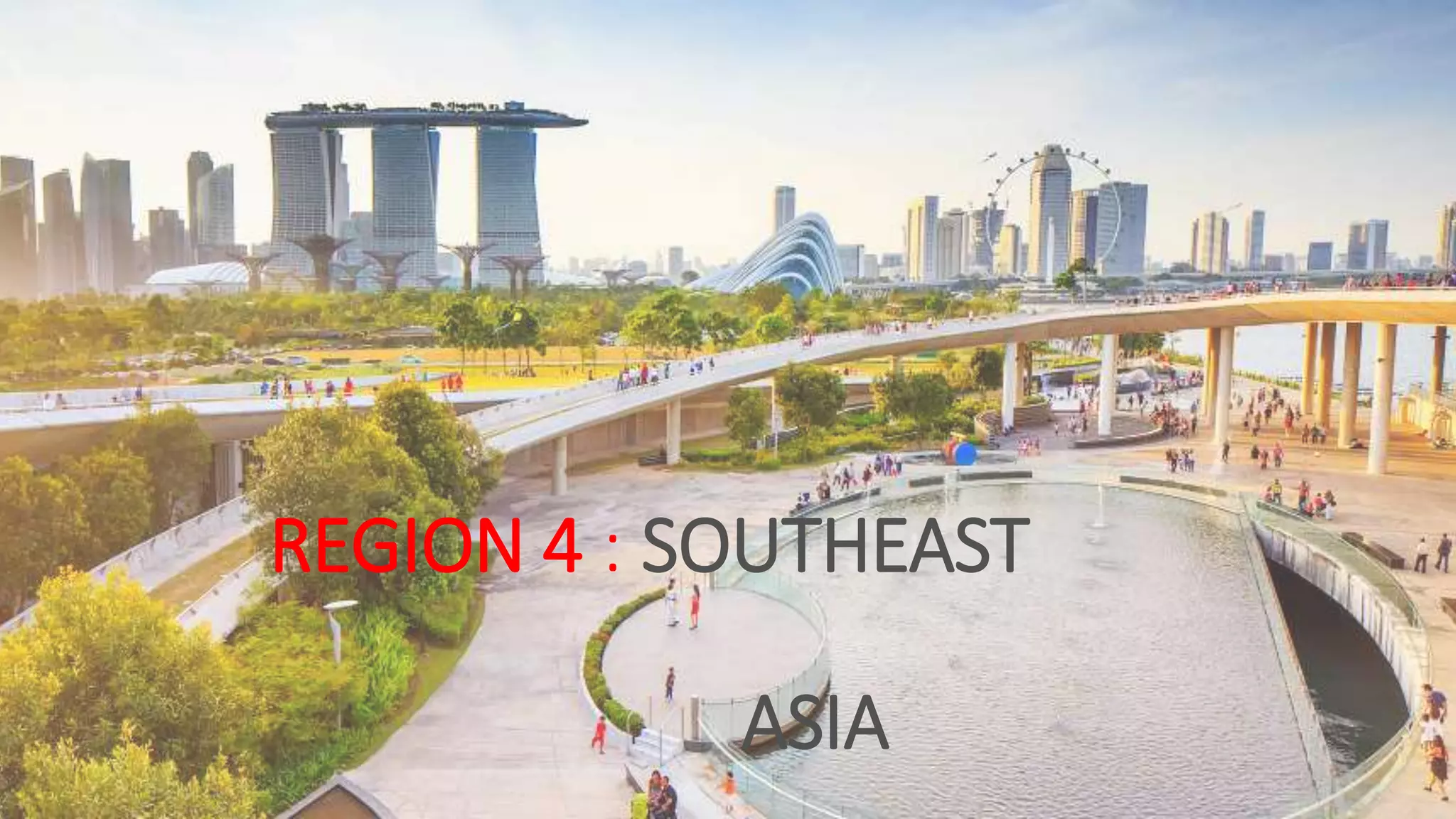
REGION 4 : SOUTHEAST
ASIA
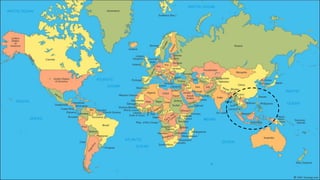
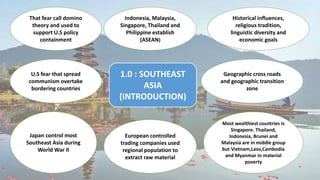
1.0 : SOUTHEAST
ASIA
(INTRODUCTION)
Historical influences,
religious tradition,
linguistic diversity and
economic goals
Geographic cross roads
and geographic transition
zone
Most wealthiest countries is
Singapore. Thailand,
Indonesia, Brunei and
Malaysia are in middle group
but Vietnam,Laos,Cambodia
and Myanmar in material
poverty
European controlled
trading companies used
regional population to
extract raw material
Japan control most
Southeast Asia during
World War II
U.S fear that spread
communism overtake
bordering countries
That fear call domino
theory and used to
support U.S policy
containment
Indonesia, Malaysia,
Singapore, Thailand and
Philippine establish
(ASEAN)
2.0 CLIMATE IN SOUTHEAST ASIA
2.1 EQUATORIAL CLIMATE (RAINY TROPICAL)
2.2 OCEANIC CLIMATE (MONSOON TROPICAL)
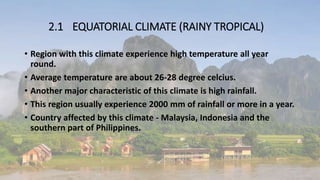
2.1 EQUATORIAL CLIMATE (RAINY TROPICAL)
• Region with this climate experience high temperature all year
round.
• Average temperature are about 26-28 degree celcius.
• Another major characteristic of this climate is high rainfall.
• This region usually experience 2000 mm of rainfall or more in a year.
• Country affected by this climate - Malaysia, Indonesia and the
southern part of Philippines.
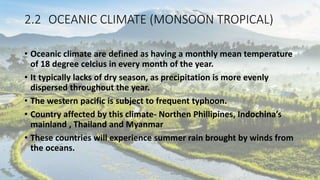
2.2 OCEANIC CLIMATE (MONSOON TROPICAL)
• Oceanic climate are defined as having a monthly mean temperature
of 18 degree celcius in every month of the year.
• It typically lacks of dry season, as precipitation is more evenly
dispersed throughout the year.
• The western pacific is subject to frequent typhoon.
• Country affected by this climate- Northen Phillipines, Indochina’s
mainland , Thailand and Myanmar
• These countries will experience summer rain brought by winds from
the oceans.
3.0 ENVIRONMENTAL PROBLEMS
3.1 Natural Hazards
3.2 Tsunami
3.3 Pollution, Erosion and Mining excavations
3.1 NATURAL HAZARDS
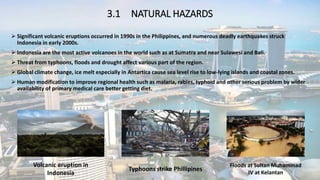
 Significant volcanic eruptions occurred in 1990s in the Philippines, and numerous deadly earthquakes struck
Indonesia in early 2000s.
 Indonesia are the most active volcanoes in the world such as at Sumatra and near Sulawesi and Bali.
 Threat from typhoons, floods and drought affect various part of the region.
 Global climate change, ice melt especially in Antartica cause sea level rise to low-lying islands and coastal zones.
 Human modification to improve regional health such as malaria, rabies, typhoid and other serious problem by wider
availability of primary medical care better getting diet.
Volcanic eruption in
Indonesia
Typhoons strike Phillipines
Floods at Sultan Muhammad
IV at Kelantan
3.2 TSUNAMI
• The peninsular and island nature of the countries of Southeast Asia situated where Indian and
Pacific Ocean meet and creates expansive coastal.
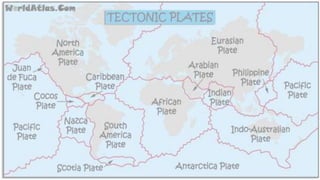
• Southeast Asia exposed to tsunami because of the plate convergence under the ocean pair with
the expansive regional coasts. (JAPANESE FOR “HARBOR WAVE”)
• Tsunami are wave usually generated by water displacement from megathrust seafloor
earthquake.
• More tsunami generated in the pacific ocean than in other earth’s ocean.
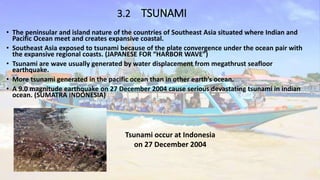
• A 9.0 magnitude earthquake on 27 December 2004 cause serious devastating tsunami in indian
ocean. (SUMATRA INDONESIA)
Tsunami occur at Indonesia
on 27 December 2004
3.3 POLLUTION, EROSION AND MINING EXCAVATIONS
 People use natural environment in areas of high population density and modern industrialization give impacts of
natural hazards.
 Cutting forests for export lumber, have resulted in extensive deforestation.
 Contributes to soil erosion, watershed flooding, damaging fishing area and also coral reef areas as silt carried out to
coastal waters.
 1960s and 1970s there was a warfare in Vietnam by defoliated forests and produce chemical residue and barren
hillsides.
 Pollution of air, water and soil are the serious problem
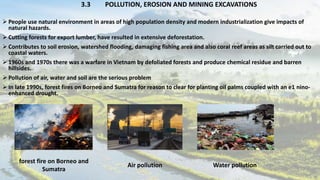
 In late 1990s, forest fires on Borneo and Sumatra for reason to clear for planting oil palms coupled with an e1 nino-
enhanced drought.
forest fire on Borneo and
Sumatra
Air pollution Water pollution
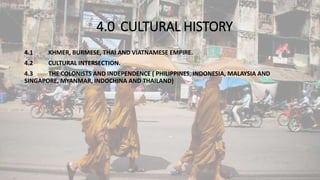
4.0 CULTURAL HISTORY
4.1 KHMER, BURMESE, THAI AND VIATNAMESE EMPIRE.
4.2 CULTURAL INTERSECTION.
4.3 THE COLONISTS AND INDEPENDENCE ( PHILIPPINES, INDONESIA, MALAYSIA AND
SINGAPORE, MYANMAR, INDOCHINA AND THAILAND)
4.1 KHMER, BURMESE, THAI, AND VIETNAMESE EMPIRES
• Mon and Khmer people occupied present day Cambodia from the north between 800s and 1200s.
• Viatnamese, Laos and Burmese arrived in territories.
• Indian traders brought Hindu and Buddhist religions across the ocean from the west.
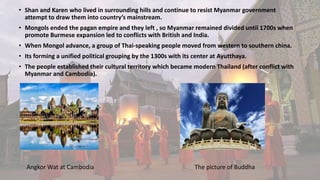
• The imprint of Indian traditions and architecture reflected in temples such as Angkor Wat, Cambodia.
• The red river valley in the north became the centre of a Viatnamese kingdom and the area conquered
and reconquered by various Chinese dynasties.
• And then, Vieatnamese repeatedly fought to regain control and managed to retain their distinct
identity.
• Viatnamese extended their landed southward across older coastal kingdoms to take over some of
Khmer territories at Mekong River in ad 1400s.
• Myanmar became Buddhist as Sri Lankan monks disseminated Buddhism.
• The central pagan kingdom situated around present day Mandalay in a fertile.
• Mountain-rimmed plain in northern Myanmar fought powerful tribes.
• Shan and Karen who lived in surrounding hills and continue to resist Myanmar government
attempt to draw them into country’s mainstream.
• Mongols ended the pagan empire and they left , so Myanmar remained divided until 1700s when
promote Burmese expansion led to conflicts with British and India.
• When Mongol advance, a group of Thai-speaking people moved from western to southern china.
• Its forming a unified political grouping by the 1300s with its center at Ayutthaya.
• The people established their cultural territory which became modern Thailand (after conflict with
Myanmar and Cambodia).
Angkor Wat at Cambodia The picture of Buddha
4.2 CULTURAL INTERSECTION
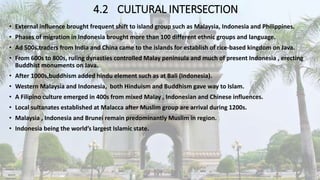
• External influence brought frequent shift to island group such as Malaysia, Indonesia and Philippines.
• Phases of migration in Indonesia brought more than 100 different ethnic groups and language.
• Ad 500s,traders from India and China came to the islands for establish of rice-based kingdom on Java.
• From 600s to 800s, ruling dynasties controlled Malay peninsula and much of present Indonesia , erecting
Buddhist monuments on Java.
• After 1000s,buddhism added hindu element such as at Bali (Indonesia).
• Western Malaysia and Indonesia, both Hinduism and Buddhism gave way to Islam.
• A Filipino culture emerged in 400s from mixed Malay , Indonesian and Chinese influences.
• Local sultanates established at Malacca after Muslim group are arrival during 1200s.
• Malaysia , Indonesia and Brunei remain predominantly Muslim in region.
• Indonesia being the world’s largest Islamic state.
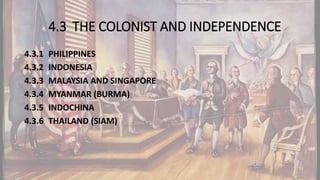
4.3 THE COLONIST AND INDEPENDENCE
4.3.1 PHILIPPINES
4.3.2 INDONESIA
4.3.3 MALAYSIA AND SINGAPORE
4.3.4 MYANMAR (BURMA)
4.3.5 INDOCHINA
4.3.6 THAILAND (SIAM)
4.3.1 PHILIPPINES
• The Portuguese were the first colonial force to establish trading centers in Philippines.
• Spanish built their capital at Manila on Luzon in 1500s.
• Spanish control attracted Roman Catholic priests and their monastic order.
• Rapid conversion many different groups of Filipinos became large Christian country in
Southeast Asia.
• The end of 1800s, Spain retained its Philippine colonies when United States placed
them under its jurisdiction after winning war with Spain over Cuba (Spanish American
War).
• 1946, the Philippines republic was established.
• Until 1990, U.S retained its military bases at Philippines and reactivated some after the
attacks on September 11, 2001.
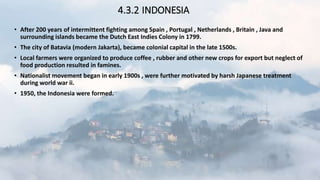
4.3.2 INDONESIA
• After 200 years of intermittent fighting among Spain , Portugal , Netherlands , Britain , Java and
surrounding islands became the Dutch East Indies Colony in 1799.
• The city of Batavia (modern Jakarta), became colonial capital in the late 1500s.
• Local farmers were organized to produce coffee , rubber and other new crops for export but neglect of
food production resulted in famines.
• Nationalist movement began in early 1900s , were further motivated by harsh Japanese treatment
during world war ii.
• 1950, the Indonesia were formed.
4.3.3 MALAYSIA AND SINGAPORE
• In 1511 the Portugese take over Malacca on the Malay Peninsula to control the spice trade.
• In 1600s he Dutch took over the Malay Peninsula and establish regional spice trade monopoly that lased
for over 100 years.
• In 1700s he British founded a port and rival trading centre on Penang Island.
• In 1804 the British and Dutch agreed to take control of Malaya and the East Indies , respectively.
• In 1819,he British built a new port in Singapore, and controlled Malay states by diplomacy.
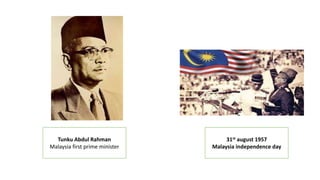
• In world war ii the Japanese took Malaya but British re-established their rule afterward , fighting against
Communist guerrillas until Malaya was granted independence on 31st august 1957
• Singapore , Sabah, and Sarawak joined the federation of Malaya on their 1963 independence.
• Brunei decided to stay out of the federation and Singapore withdrew in 1965 after having problems
maintaining its largely Chinese identity among the Malay majority in the rest of Malaysia.
Tunku Abdul Rahman
Malaysia first prime minister
31st august 1957
Malaysia independence day
4.3.4 Myanmar(Burma)
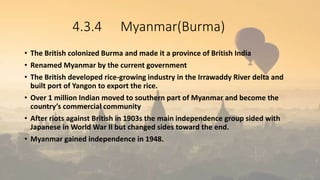
• The British colonized Burma and made it a province of British India
• Renamed Myanmar by the current government
• The British developed rice-growing industry in the Irrawaddy River delta and
built port of Yangon to export the rice.
• Over 1 million Indian moved to southern part of Myanmar and become the
country’s commercial community
• After riots against British in 1903s the main independence group sided with
Japanese in World War II but changed sides toward the end.
• Myanmar gained independence in 1948.
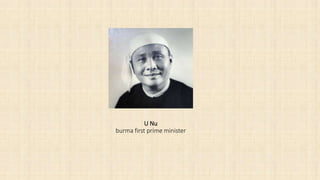
U Nu
burma first prime minister
4.3.5 Indochina
• During 1800s and early 1900s the French occupied Indochina
• They built road and railroads to encourage manufacturing.
• During World War II , Nazi Germany occupied France and persuaded the
French colonial government to allow the Japanese forces to pass through
Indochina.
• In 1954 after the war ,the French tried to re-establish control of the area ,
but Communist group forces them to leave the Northern Parts of Vietnam.
• In 1975 ,North Vietnam was victorious and reunified the country
• Laos strife along is border during the Vietnam war , slowing the economic
development.
• Cambodia gained independence in 1953 but suffered 30 years of civil war
by the Vietnamese.
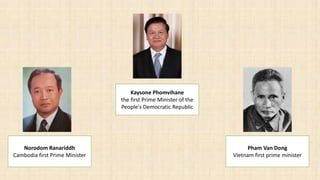
Norodom Ranariddh
Cambodia first Prime Minister
Pham Van Dong
Vietnam first prime minister
Kaysone Phomvihane
the first Prime Minister of the
People's Democratic Republic
4.3.6 Thailand (Siam)
• Thailand was know as Siam from 1856 to 1939 and 1945 to 1948
• The term Thai only get to use in early 1900s.
• With strong monarchy and relationship with European powers, Thailand maintain
their independence during the colonial era.
• In 1800s Thailand rulers established commercial treaties with Britain and
encourage modernization.
• In 1890 Thailand had a short war with France as France wanted to make Thai a
part of Indochina as the result Thailand yielded land to France which is now in
Cambodia and some of Peninsula Malaya to Britain.
• In world war II Thailand first sided to Japanese and they regained territories in
Cambodia and Malaya.
• The fighting in Vietnam in 1960’s and 1970’s Thailand stemmed advance at its
boarder, attracting considerable aid from united states to help it resist.
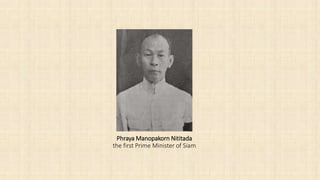
Phraya Manopakorn Nititada
the first Prime Minister of Siam
5.0 Organizations
involving Southeast
Asia countries
5.1 Association of Southeast Asian Nations
(ASEAN)
• Preceded by an organization formed in 31july 1961 called the Association of Southeast Asia (ASA)
consisting Philippines , federation of Malaya and Thailand.
• Asean itself was created on 8 August 1967 consisting five countries Indonesia , Malaysia, Singapore,
Philippines and Thailand.
• Brunei become the 6th member of ASEAN in 1984, 28 July 1995 Vietnam join ASEAN.
• Laos and Myanmar joined two years later in 1997 and Cambodia was the last country to join ASEAN
in 1999.
• Headquarter location located at Jakarta, Indonesia.
• Main objective
- accelerate the economic growth, social progress and cultural development in the region.
-to promote regional peace and stability through abiding respect for justice and the rule of law in
the relationship among countries.
5.2 Asia-Pacific Economic
Cooperation(APEC)
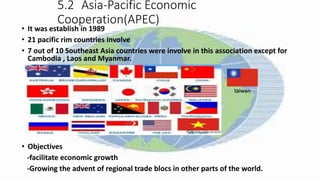
• It was establish in 1989
• 21 pacific rim countries involve
• 7 out of 10 Southeast Asia countries were involve in this association except for
Cambodia , Laos and Myanmar.
• Objectives
-facilitate economic growth
-Growing the advent of regional trade blocs in other parts of the world.
taiwan
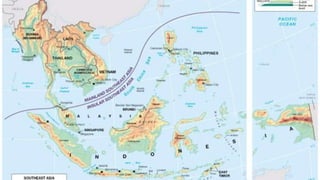
6.0Subregions in southeast asia
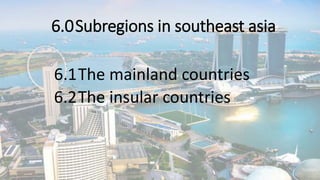
6.1The mainland countries
6.2The insular countries
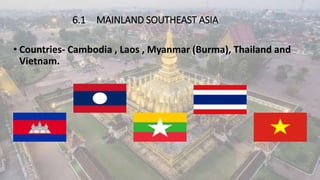
6.1 MAINLAND SOUTHEAST ASIA
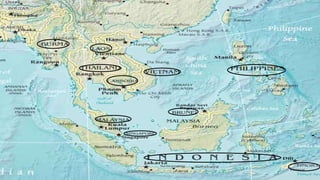
• Countries- Cambodia , Laos , Myanmar (Burma), Thailand and
Vietnam.
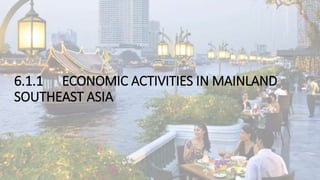
6.1.1 ECONOMIC ACTIVITIES IN MAINLAND
SOUTHEAST ASIA
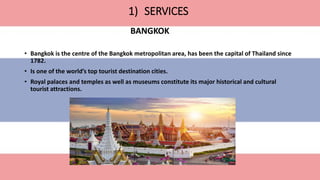
1) SERVICES
BANGKOK
• Bangkok is the centre of the Bangkok metropolitan area, has been the capital of Thailand since
1782.
• Is one of the world’s top tourist destination cities.
• Royal palaces and temples as well as museums constitute its major historical and cultural
tourist attractions.
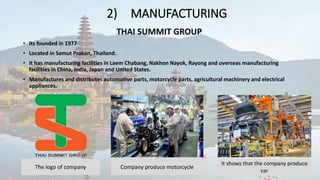
2) MANUFACTURING
THAI SUMMIT GROUP
• Its founded in 1977
• Located in Samut Prakan, Thailand.
• It has manufacturing facilities in Laem Chabang, Nakhon Nayok, Rayong and overseas manufacturing
facilities in China, India, Japan and United States.
• Manufactures and distributes automotive parts, motorcycle parts, agricultural machinery and electrical
appliances.
The logo of company Company produce motorcycle
It shows that the company produce
car
3) FOOD AND BEVERAGE
HAI HA CONFECTIONERY
• Stock company manufactures and sells confectionery products in Vietnam.
• Founded in 1960 and based in Hanoi, Vietnam.
• Export their products to Japan, Taiwan and Russia.
• Main products such as chewy candies, jellies, lollipops, cakes, cookies, cream wafers and biscuits.
Logo of the company
Biscuit that produce in
the company
Candies that produce in
the company
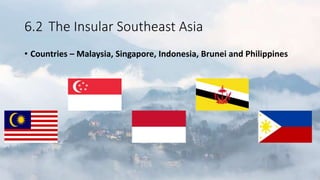
6.2 The Insular Southeast Asia
• Countries – Malaysia, Singapore, Indonesia, Brunei and Philippines
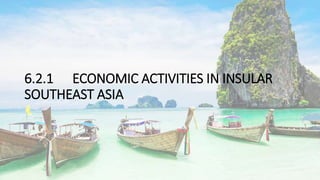
6.2.1 ECONOMIC ACTIVITIES IN INSULAR
SOUTHEAST ASIA
1) AGRICULTURE
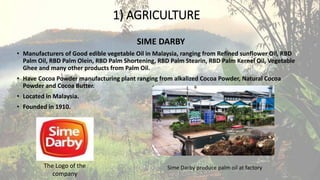
SIME DARBY
• Manufacturers of Good edible vegetable Oil in Malaysia, ranging from Refined sunflower Oil, RBD
Palm Oil, RBD Palm Olein, RBD Palm Shortening, RBD Palm Stearin, RBD Palm Kernel Oil, Vegetable
Ghee and many other products from Palm Oil.
• Have Cocoa Powder manufacturing plant ranging from alkalized Cocoa Powder, Natural Cocoa
Powder and Cocoa Butter.
• Located in Malaysia.
• Founded in 1910.
The Logo of the
company
Sime Darby produce palm oil at factory
2)SERVICES
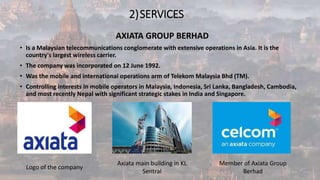
AXIATA GROUP BERHAD
• Is a Malaysian telecommunications conglomerate with extensive operations in Asia. It is the
country's largest wireless carrier.
• The company was incorporated on 12 June 1992.
• Was the mobile and international operations arm of Telekom Malaysia Bhd (TM).
• Controlling interests in mobile operators in Malaysia, Indonesia, Sri Lanka, Bangladesh, Cambodia,
and most recently Nepal with significant strategic stakes in India and Singapore.
Logo of the company
Axiata main building in KL
Sentral
Member of Axiata Group
Berhad
3) MANUFACTURING
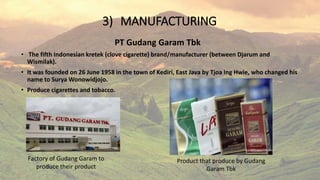
PT Gudang Garam Tbk
• The fifth Indonesian kretek (clove cigarette) brand/manufacturer (between Djarum and
Wismilak).
• It was founded on 26 June 1958 in the town of Kediri, East Java by Tjoa Ing Hwie, who changed his
name to Surya Wonowidjojo.
• Produce cigarettes and tobacco.
Factory of Gudang Garam to
produce their product
Product that produce by Gudang
Garam Tbk
7.0 Current Issue In Southeast Asia ( Pulau
Batu Puteh’s case)
PULAU BATU PUTEH
7.1 BACKGROUND
• The issue of Pulau Batu Puteh pits Malaysia’s original title to the island against Singapore’s
much claim from 1980.
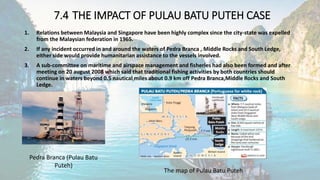
• The island is about 7.7 nauticle miles from Malaysian mainland but 25.5 miles over the sea from
Singapore.
• 14 February 1980, Singapore protested of Malaysian map that showed Batu Puteh are
belonging to Malaysia.
• Singapore led to an exchange of correspondence and subsequently to a series of
intergovernmental talks in 1993-1994.
• Must be agreed that the matter should be resolved by reference to the International Court of
Justice (ICJ).
• Batu Puteh has always been part of Malaysian state of Johor.
7.2 HISTORY OF DISPUTE
• On 14 February 1980, Singapore first laid claim to Batu Puteh (BP) through a Diplomatic Note protesting
Malaysia’s showing PBP as a Malaysian island in Malaysia’s 1979 map.
• In September 1994, Malaysia and Singapore agreed to end the impasse in resolving the Batu Puteh issue by
referring it to the International Court of Justice (ICJ).
• In February 2003, Malaysia and Singapore signed a Special Agreement in which they mutually agreed to refer
the dispute to the ICJ for a decision.
• Provided in the Special Agreement, Malaysia and Singapore submitted their respective Memorials and Counter-
Memorials on 25 March 2004 and 25 January 2005.
• In November 2005 The respective reply of the parties was submitted to the ICJ.
• On 6-23 November 2007, The Oral Hearings of the case before the ICJ in The Hague and was heard by 16 Judges
presided by the Acting President, Judge Awn Shawkat Al-Khasawneh.
• In early 2008, The Court is expected to deliver its judgment.
7.3 SUMMARY OF PULAU BATU CASE
• Friday 23 may 2008, the International Court of Justice (ICJ) rendered its judgement in the case
concerning the sovereignty over Pedra Branca/Pulau Batu Puteh, Middle Rocks and South Ledge
(Malaysia/Singapore)
• The court accordingly found that sovereignty over Pulau Batu Puteh belonged to Singapore.
7.4 THE IMPACT OF PULAU BATU PUTEH CASE
1. Relations between Malaysia and Singapore have been highly complex since the city-state was expelled
from the Malaysian federation in 1965.
2. If any incident occurred in and around the waters of Pedra Branca , Middle Rocks and South Ledge,
either side would provide humanitarian assistance to the vessels involved.
3. A sub-committee on maritime and airspace management and fisheries had also been formed and after
meeting on 20 august 2008 which said that traditional fishing activities by both countries should
continue in waters beyond 0.5 nautical miles about 0.9 km off Pedra Branca,Middle Rocks and South
Ledge.
Pedra Branca (Pulau Batu
Puteh)
The map of Pulau Batu Puteh
Latest issue of Pulau Batu Puteh
(Pedra Blanca)
• Malaysia has filed an application requesting interpretation of the judgement delivered by the
International Court of Justice (ICJ) on 23 May 2008 over Pulau Batu Puteh and South Ledge.
• Under the court’s rules, states can ask for a judgement to be revised if new facts come to light
within 10 years of the first ruling.
• Attorney-General Tan Sri Mohamed Apandi Ali will lead a team of experts to take on the revision
of the International Court of Justice (ICJ)’s judgment over Pulau Batu Puteh.
• Malaysia lodged its case in February 2017, calling for the court to overturn its 2008 ruling granting
its neighbour sovereignty over the disputed rocky outcrop.
• Malaysia asked the court to revise that judgement based on the discovery of three documents in
the British national archives between August 2016 and late January 2017.
• They included internal correspondence from the Singapore colonial authorities in 1958, a British
naval incident report from 1958 and a map from the 1960s
• In a separate filing, Malaysia has also asked for an interpretation of the 2008 ruling, saying
despite having formed a joint committee with Singapore the two countries have failed to delimit
their maritime borders in the area.
THANK YOU SO MUCH

Region 4 SOUTHEAST ASIA

  • 1.
    REGION 4 :SOUTHEAST ASIA
  • 4.
    1.0 : SOUTHEAST ASIA (INTRODUCTION) Historicalinfluences, religious tradition, linguistic diversity and economic goals Geographic cross roads and geographic transition zone Most wealthiest countries is Singapore. Thailand, Indonesia, Brunei and Malaysia are in middle group but Vietnam,Laos,Cambodia and Myanmar in material poverty European controlled trading companies used regional population to extract raw material Japan control most Southeast Asia during World War II U.S fear that spread communism overtake bordering countries That fear call domino theory and used to support U.S policy containment Indonesia, Malaysia, Singapore, Thailand and Philippine establish (ASEAN)
  • 5.
    2.0 CLIMATE INSOUTHEAST ASIA 2.1 EQUATORIAL CLIMATE (RAINY TROPICAL) 2.2 OCEANIC CLIMATE (MONSOON TROPICAL)
  • 6.
    2.1 EQUATORIAL CLIMATE(RAINY TROPICAL) • Region with this climate experience high temperature all year round. • Average temperature are about 26-28 degree celcius. • Another major characteristic of this climate is high rainfall. • This region usually experience 2000 mm of rainfall or more in a year. • Country affected by this climate - Malaysia, Indonesia and the southern part of Philippines.
  • 7.
    2.2 OCEANIC CLIMATE(MONSOON TROPICAL) • Oceanic climate are defined as having a monthly mean temperature of 18 degree celcius in every month of the year. • It typically lacks of dry season, as precipitation is more evenly dispersed throughout the year. • The western pacific is subject to frequent typhoon. • Country affected by this climate- Northen Phillipines, Indochina’s mainland , Thailand and Myanmar • These countries will experience summer rain brought by winds from the oceans.
  • 8.
    3.0 ENVIRONMENTAL PROBLEMS 3.1Natural Hazards 3.2 Tsunami 3.3 Pollution, Erosion and Mining excavations
  • 9.
    3.1 NATURAL HAZARDS Significant volcanic eruptions occurred in 1990s in the Philippines, and numerous deadly earthquakes struck Indonesia in early 2000s.  Indonesia are the most active volcanoes in the world such as at Sumatra and near Sulawesi and Bali.  Threat from typhoons, floods and drought affect various part of the region.  Global climate change, ice melt especially in Antartica cause sea level rise to low-lying islands and coastal zones.  Human modification to improve regional health such as malaria, rabies, typhoid and other serious problem by wider availability of primary medical care better getting diet. Volcanic eruption in Indonesia Typhoons strike Phillipines Floods at Sultan Muhammad IV at Kelantan
  • 10.
    3.2 TSUNAMI • Thepeninsular and island nature of the countries of Southeast Asia situated where Indian and Pacific Ocean meet and creates expansive coastal. • Southeast Asia exposed to tsunami because of the plate convergence under the ocean pair with the expansive regional coasts. (JAPANESE FOR “HARBOR WAVE”) • Tsunami are wave usually generated by water displacement from megathrust seafloor earthquake. • More tsunami generated in the pacific ocean than in other earth’s ocean. • A 9.0 magnitude earthquake on 27 December 2004 cause serious devastating tsunami in indian ocean. (SUMATRA INDONESIA) Tsunami occur at Indonesia on 27 December 2004
  • 12.
    3.3 POLLUTION, EROSIONAND MINING EXCAVATIONS  People use natural environment in areas of high population density and modern industrialization give impacts of natural hazards.  Cutting forests for export lumber, have resulted in extensive deforestation.  Contributes to soil erosion, watershed flooding, damaging fishing area and also coral reef areas as silt carried out to coastal waters.  1960s and 1970s there was a warfare in Vietnam by defoliated forests and produce chemical residue and barren hillsides.  Pollution of air, water and soil are the serious problem  In late 1990s, forest fires on Borneo and Sumatra for reason to clear for planting oil palms coupled with an e1 nino- enhanced drought. forest fire on Borneo and Sumatra Air pollution Water pollution
  • 13.
    4.0 CULTURAL HISTORY 4.1KHMER, BURMESE, THAI AND VIATNAMESE EMPIRE. 4.2 CULTURAL INTERSECTION. 4.3 THE COLONISTS AND INDEPENDENCE ( PHILIPPINES, INDONESIA, MALAYSIA AND SINGAPORE, MYANMAR, INDOCHINA AND THAILAND)
  • 14.
    4.1 KHMER, BURMESE,THAI, AND VIETNAMESE EMPIRES • Mon and Khmer people occupied present day Cambodia from the north between 800s and 1200s. • Viatnamese, Laos and Burmese arrived in territories. • Indian traders brought Hindu and Buddhist religions across the ocean from the west. • The imprint of Indian traditions and architecture reflected in temples such as Angkor Wat, Cambodia. • The red river valley in the north became the centre of a Viatnamese kingdom and the area conquered and reconquered by various Chinese dynasties. • And then, Vieatnamese repeatedly fought to regain control and managed to retain their distinct identity. • Viatnamese extended their landed southward across older coastal kingdoms to take over some of Khmer territories at Mekong River in ad 1400s. • Myanmar became Buddhist as Sri Lankan monks disseminated Buddhism. • The central pagan kingdom situated around present day Mandalay in a fertile. • Mountain-rimmed plain in northern Myanmar fought powerful tribes.
  • 15.
    • Shan andKaren who lived in surrounding hills and continue to resist Myanmar government attempt to draw them into country’s mainstream. • Mongols ended the pagan empire and they left , so Myanmar remained divided until 1700s when promote Burmese expansion led to conflicts with British and India. • When Mongol advance, a group of Thai-speaking people moved from western to southern china. • Its forming a unified political grouping by the 1300s with its center at Ayutthaya. • The people established their cultural territory which became modern Thailand (after conflict with Myanmar and Cambodia). Angkor Wat at Cambodia The picture of Buddha
  • 16.
    4.2 CULTURAL INTERSECTION •External influence brought frequent shift to island group such as Malaysia, Indonesia and Philippines. • Phases of migration in Indonesia brought more than 100 different ethnic groups and language. • Ad 500s,traders from India and China came to the islands for establish of rice-based kingdom on Java. • From 600s to 800s, ruling dynasties controlled Malay peninsula and much of present Indonesia , erecting Buddhist monuments on Java. • After 1000s,buddhism added hindu element such as at Bali (Indonesia). • Western Malaysia and Indonesia, both Hinduism and Buddhism gave way to Islam. • A Filipino culture emerged in 400s from mixed Malay , Indonesian and Chinese influences. • Local sultanates established at Malacca after Muslim group are arrival during 1200s. • Malaysia , Indonesia and Brunei remain predominantly Muslim in region. • Indonesia being the world’s largest Islamic state.
  • 17.
    4.3 THE COLONISTAND INDEPENDENCE 4.3.1 PHILIPPINES 4.3.2 INDONESIA 4.3.3 MALAYSIA AND SINGAPORE 4.3.4 MYANMAR (BURMA) 4.3.5 INDOCHINA 4.3.6 THAILAND (SIAM)
  • 18.
    4.3.1 PHILIPPINES • ThePortuguese were the first colonial force to establish trading centers in Philippines. • Spanish built their capital at Manila on Luzon in 1500s. • Spanish control attracted Roman Catholic priests and their monastic order. • Rapid conversion many different groups of Filipinos became large Christian country in Southeast Asia. • The end of 1800s, Spain retained its Philippine colonies when United States placed them under its jurisdiction after winning war with Spain over Cuba (Spanish American War). • 1946, the Philippines republic was established. • Until 1990, U.S retained its military bases at Philippines and reactivated some after the attacks on September 11, 2001.
  • 20.
    4.3.2 INDONESIA • After200 years of intermittent fighting among Spain , Portugal , Netherlands , Britain , Java and surrounding islands became the Dutch East Indies Colony in 1799. • The city of Batavia (modern Jakarta), became colonial capital in the late 1500s. • Local farmers were organized to produce coffee , rubber and other new crops for export but neglect of food production resulted in famines. • Nationalist movement began in early 1900s , were further motivated by harsh Japanese treatment during world war ii. • 1950, the Indonesia were formed.
  • 21.
    4.3.3 MALAYSIA ANDSINGAPORE • In 1511 the Portugese take over Malacca on the Malay Peninsula to control the spice trade. • In 1600s he Dutch took over the Malay Peninsula and establish regional spice trade monopoly that lased for over 100 years. • In 1700s he British founded a port and rival trading centre on Penang Island. • In 1804 the British and Dutch agreed to take control of Malaya and the East Indies , respectively. • In 1819,he British built a new port in Singapore, and controlled Malay states by diplomacy. • In world war ii the Japanese took Malaya but British re-established their rule afterward , fighting against Communist guerrillas until Malaya was granted independence on 31st august 1957 • Singapore , Sabah, and Sarawak joined the federation of Malaya on their 1963 independence. • Brunei decided to stay out of the federation and Singapore withdrew in 1965 after having problems maintaining its largely Chinese identity among the Malay majority in the rest of Malaysia.
  • 22.
    Tunku Abdul Rahman Malaysiafirst prime minister 31st august 1957 Malaysia independence day
  • 23.
    4.3.4 Myanmar(Burma) • TheBritish colonized Burma and made it a province of British India • Renamed Myanmar by the current government • The British developed rice-growing industry in the Irrawaddy River delta and built port of Yangon to export the rice. • Over 1 million Indian moved to southern part of Myanmar and become the country’s commercial community • After riots against British in 1903s the main independence group sided with Japanese in World War II but changed sides toward the end. • Myanmar gained independence in 1948.
  • 24.
    U Nu burma firstprime minister
  • 25.
    4.3.5 Indochina • During1800s and early 1900s the French occupied Indochina • They built road and railroads to encourage manufacturing. • During World War II , Nazi Germany occupied France and persuaded the French colonial government to allow the Japanese forces to pass through Indochina. • In 1954 after the war ,the French tried to re-establish control of the area , but Communist group forces them to leave the Northern Parts of Vietnam. • In 1975 ,North Vietnam was victorious and reunified the country • Laos strife along is border during the Vietnam war , slowing the economic development. • Cambodia gained independence in 1953 but suffered 30 years of civil war by the Vietnamese.
  • 26.
    Norodom Ranariddh Cambodia firstPrime Minister Pham Van Dong Vietnam first prime minister Kaysone Phomvihane the first Prime Minister of the People's Democratic Republic
  • 27.
    4.3.6 Thailand (Siam) •Thailand was know as Siam from 1856 to 1939 and 1945 to 1948 • The term Thai only get to use in early 1900s. • With strong monarchy and relationship with European powers, Thailand maintain their independence during the colonial era. • In 1800s Thailand rulers established commercial treaties with Britain and encourage modernization. • In 1890 Thailand had a short war with France as France wanted to make Thai a part of Indochina as the result Thailand yielded land to France which is now in Cambodia and some of Peninsula Malaya to Britain. • In world war II Thailand first sided to Japanese and they regained territories in Cambodia and Malaya. • The fighting in Vietnam in 1960’s and 1970’s Thailand stemmed advance at its boarder, attracting considerable aid from united states to help it resist.
  • 28.
    Phraya Manopakorn Nititada thefirst Prime Minister of Siam
  • 29.
  • 30.
    5.1 Association ofSoutheast Asian Nations (ASEAN) • Preceded by an organization formed in 31july 1961 called the Association of Southeast Asia (ASA) consisting Philippines , federation of Malaya and Thailand. • Asean itself was created on 8 August 1967 consisting five countries Indonesia , Malaysia, Singapore, Philippines and Thailand. • Brunei become the 6th member of ASEAN in 1984, 28 July 1995 Vietnam join ASEAN. • Laos and Myanmar joined two years later in 1997 and Cambodia was the last country to join ASEAN in 1999. • Headquarter location located at Jakarta, Indonesia. • Main objective - accelerate the economic growth, social progress and cultural development in the region. -to promote regional peace and stability through abiding respect for justice and the rule of law in the relationship among countries.
  • 31.
    5.2 Asia-Pacific Economic Cooperation(APEC) •It was establish in 1989 • 21 pacific rim countries involve • 7 out of 10 Southeast Asia countries were involve in this association except for Cambodia , Laos and Myanmar. • Objectives -facilitate economic growth -Growing the advent of regional trade blocs in other parts of the world. taiwan
  • 32.
    6.0Subregions in southeastasia 6.1The mainland countries 6.2The insular countries
  • 34.
    6.1 MAINLAND SOUTHEASTASIA • Countries- Cambodia , Laos , Myanmar (Burma), Thailand and Vietnam.
  • 35.
    6.1.1 ECONOMIC ACTIVITIESIN MAINLAND SOUTHEAST ASIA
  • 36.
    1) SERVICES BANGKOK • Bangkokis the centre of the Bangkok metropolitan area, has been the capital of Thailand since 1782. • Is one of the world’s top tourist destination cities. • Royal palaces and temples as well as museums constitute its major historical and cultural tourist attractions.
  • 37.
    2) MANUFACTURING THAI SUMMITGROUP • Its founded in 1977 • Located in Samut Prakan, Thailand. • It has manufacturing facilities in Laem Chabang, Nakhon Nayok, Rayong and overseas manufacturing facilities in China, India, Japan and United States. • Manufactures and distributes automotive parts, motorcycle parts, agricultural machinery and electrical appliances. The logo of company Company produce motorcycle It shows that the company produce car
  • 38.
    3) FOOD ANDBEVERAGE HAI HA CONFECTIONERY • Stock company manufactures and sells confectionery products in Vietnam. • Founded in 1960 and based in Hanoi, Vietnam. • Export their products to Japan, Taiwan and Russia. • Main products such as chewy candies, jellies, lollipops, cakes, cookies, cream wafers and biscuits. Logo of the company Biscuit that produce in the company Candies that produce in the company
  • 39.
    6.2 The InsularSoutheast Asia • Countries – Malaysia, Singapore, Indonesia, Brunei and Philippines
  • 40.
    6.2.1 ECONOMIC ACTIVITIESIN INSULAR SOUTHEAST ASIA
  • 41.
    1) AGRICULTURE SIME DARBY •Manufacturers of Good edible vegetable Oil in Malaysia, ranging from Refined sunflower Oil, RBD Palm Oil, RBD Palm Olein, RBD Palm Shortening, RBD Palm Stearin, RBD Palm Kernel Oil, Vegetable Ghee and many other products from Palm Oil. • Have Cocoa Powder manufacturing plant ranging from alkalized Cocoa Powder, Natural Cocoa Powder and Cocoa Butter. • Located in Malaysia. • Founded in 1910. The Logo of the company Sime Darby produce palm oil at factory
  • 42.
    2)SERVICES AXIATA GROUP BERHAD •Is a Malaysian telecommunications conglomerate with extensive operations in Asia. It is the country's largest wireless carrier. • The company was incorporated on 12 June 1992. • Was the mobile and international operations arm of Telekom Malaysia Bhd (TM). • Controlling interests in mobile operators in Malaysia, Indonesia, Sri Lanka, Bangladesh, Cambodia, and most recently Nepal with significant strategic stakes in India and Singapore. Logo of the company Axiata main building in KL Sentral Member of Axiata Group Berhad
  • 43.
    3) MANUFACTURING PT GudangGaram Tbk • The fifth Indonesian kretek (clove cigarette) brand/manufacturer (between Djarum and Wismilak). • It was founded on 26 June 1958 in the town of Kediri, East Java by Tjoa Ing Hwie, who changed his name to Surya Wonowidjojo. • Produce cigarettes and tobacco. Factory of Gudang Garam to produce their product Product that produce by Gudang Garam Tbk
  • 44.
    7.0 Current IssueIn Southeast Asia ( Pulau Batu Puteh’s case)
  • 45.
    PULAU BATU PUTEH 7.1BACKGROUND • The issue of Pulau Batu Puteh pits Malaysia’s original title to the island against Singapore’s much claim from 1980. • The island is about 7.7 nauticle miles from Malaysian mainland but 25.5 miles over the sea from Singapore. • 14 February 1980, Singapore protested of Malaysian map that showed Batu Puteh are belonging to Malaysia. • Singapore led to an exchange of correspondence and subsequently to a series of intergovernmental talks in 1993-1994. • Must be agreed that the matter should be resolved by reference to the International Court of Justice (ICJ). • Batu Puteh has always been part of Malaysian state of Johor.
  • 46.
    7.2 HISTORY OFDISPUTE • On 14 February 1980, Singapore first laid claim to Batu Puteh (BP) through a Diplomatic Note protesting Malaysia’s showing PBP as a Malaysian island in Malaysia’s 1979 map. • In September 1994, Malaysia and Singapore agreed to end the impasse in resolving the Batu Puteh issue by referring it to the International Court of Justice (ICJ). • In February 2003, Malaysia and Singapore signed a Special Agreement in which they mutually agreed to refer the dispute to the ICJ for a decision. • Provided in the Special Agreement, Malaysia and Singapore submitted their respective Memorials and Counter- Memorials on 25 March 2004 and 25 January 2005. • In November 2005 The respective reply of the parties was submitted to the ICJ. • On 6-23 November 2007, The Oral Hearings of the case before the ICJ in The Hague and was heard by 16 Judges presided by the Acting President, Judge Awn Shawkat Al-Khasawneh. • In early 2008, The Court is expected to deliver its judgment.
  • 47.
    7.3 SUMMARY OFPULAU BATU CASE • Friday 23 may 2008, the International Court of Justice (ICJ) rendered its judgement in the case concerning the sovereignty over Pedra Branca/Pulau Batu Puteh, Middle Rocks and South Ledge (Malaysia/Singapore) • The court accordingly found that sovereignty over Pulau Batu Puteh belonged to Singapore.
  • 48.
    7.4 THE IMPACTOF PULAU BATU PUTEH CASE 1. Relations between Malaysia and Singapore have been highly complex since the city-state was expelled from the Malaysian federation in 1965. 2. If any incident occurred in and around the waters of Pedra Branca , Middle Rocks and South Ledge, either side would provide humanitarian assistance to the vessels involved. 3. A sub-committee on maritime and airspace management and fisheries had also been formed and after meeting on 20 august 2008 which said that traditional fishing activities by both countries should continue in waters beyond 0.5 nautical miles about 0.9 km off Pedra Branca,Middle Rocks and South Ledge. Pedra Branca (Pulau Batu Puteh) The map of Pulau Batu Puteh
  • 49.
    Latest issue ofPulau Batu Puteh (Pedra Blanca) • Malaysia has filed an application requesting interpretation of the judgement delivered by the International Court of Justice (ICJ) on 23 May 2008 over Pulau Batu Puteh and South Ledge. • Under the court’s rules, states can ask for a judgement to be revised if new facts come to light within 10 years of the first ruling. • Attorney-General Tan Sri Mohamed Apandi Ali will lead a team of experts to take on the revision of the International Court of Justice (ICJ)’s judgment over Pulau Batu Puteh. • Malaysia lodged its case in February 2017, calling for the court to overturn its 2008 ruling granting its neighbour sovereignty over the disputed rocky outcrop. • Malaysia asked the court to revise that judgement based on the discovery of three documents in the British national archives between August 2016 and late January 2017. • They included internal correspondence from the Singapore colonial authorities in 1958, a British naval incident report from 1958 and a map from the 1960s • In a separate filing, Malaysia has also asked for an interpretation of the 2008 ruling, saying despite having formed a joint committee with Singapore the two countries have failed to delimit their maritime borders in the area.
  • 50.

Editor's Notes

  • #11 TSUNAMI IS A JAPANESE WORD THAT CALL HARBOR PLACE Tsunamis are shallow-water waves, and therefore, like tides, they move in the open ocean at very high speeds. ... This leads to an increase in wave height and particle velocity, which can exceed 7 m/s (~ 25 km/hr)
  • #13 A residue is what remains of a chemical or heavy metal (for example, lead, arsenic, cadmium) inside a plant at a point in time. In late 1990s,forest fire on borneo n Sarawak for planting oil palms n cause haze n air pollution Lumber is the wood Barren is too poor to produce much vegetation. Pollution bcz of increase indusrtrial activities , more vehicle are used , use fertilizers or pesticide. El Niño means The Little Boy, or Christ Child in Spanish. El Niño was originally recognized by fishermen off the coast of South America in the 1600s, with the appearance of unusually warm water in the Pacific Ocean. Migros is large swiss supermarket chain
  • #17 Indonesia such as Sumatra(malays,Minangkabau),Sulawesi(bajauan,toraja)