● Overview
● Scopes Of Higher Education in Computer Science & IT Engineering
● Awards in Computer Science & IT Engineering
● New And Latest Programmes in Computer Science & IT Engineering
● Future of the Computer Science & IT Engineering
● Current Trends in the Computer Science & IT Engineering
● Latest Research Developments in Computer Science & IT Engineering
● Opportunities And Benefits of Computer Science & IT Engineering
● Demand Of Computer Science & IT Engineering In The Future
● Huge Demand Countries in Computer Science & IT Engineering for Graduate
Holders
● Top 10 Institutions of the World in the Computer Science & IT Engineering
● Top 10 Institutions of the Europe in the Computer Science & IT Engineering
INDEX
Computation has become a vital part of nearly everything in our world.
Biology, communications, education, environmental studies, health care, law,
art, finance, manufacturing, transportation, entertainment, agriculture, energy,
sports, government, and many other aspects of our world heavily rely on the
advances brought about by computer scientists. Our degree programs are
designed to train a new generation of computer scientists--people like you,
people who want to change the world with their dedication, knowledge, and
expertise, be it within the realm of computer science or in one of the many
areas that are critically affected by it.
Overview
Computer Science is one of the most sought after courses by Indian students, thanks to the software and IT boom of the
past two decades. Apart from putting India on the global map, computer science has pretty much changed the whole
landscape of how people live. Right from social media to the genomics revolution, computer science has played a central
role in many of the greatest technological innovations and developments of the 21st century. Since this field is hugely
popular among Indian students, admissions to prestigious universities such as IITs, NITs and IIITs are very competitive.
On the other hand, computer science is all set to grow in an unparalleled manner in the coming few years, thereby
creating a lot of opportunities for students. Read on to discover more about this field in-depth.
Most students take up computer science as their undergraduate major because of the huge number of job opportunities
in India’s software and IT industry. But, there is so much more to computer science than just software and IT. A degree in
computer science engineering exposes students to both theoretical as well as practical aspects of computer science. By
the time undergraduate studies are over, you would have barely scratched the surface of this vast and burgeoning field.
Over the past two decades, computer science has evolved rapidly and has produced remarkable acceleration and
innovation not just in the world of internet and artificial intelligence but also in diverse fields such as banking,
electronics, biology, chemistry, medicine and healthcare, to name a few. In short, computer science has invaded every
other field and good programming and coding skills has become a basic requisite.
Since computer science is based on the fundamentals of mathematics, computer science students develop critical
reasoning and complex problem solving abilities that will help them in all walks of life. Some of the sub disciplines of
computer science are theoretical computer science, theory of computation, information and coding theory, algorithms
and data structures, programming language theory, formal methods, applied computer science etc. and students can
specialize in any one (or more) of these areas during their undergraduate or graduate studies. Presently, job
opportunities are great for computer science students all over the world. Even during difficult times such as recession, a
highly skilled and bright computer science professional will always be in demand.
What is Computer Science all about?Discover the Scope of Computer Science?
Awards in Computer Science & IT Engineering.
IEEE Medal of Honor - The Award: The IEEE Internet Award is a technical award given by The Institute of Electrical
and Electronics Engineers, a worldwide (160 countries and 400,000 members) non-profit that promotes advancement of
technology. Nokia is a sponsor of the awards.
Turing Award - The Award: The Association for Computer Machinery has a host of awards; the A.M. Turing Award is
the most prestigious and sought after. It has been dubbed as the “Nobel Prize” of Computing. Recipients are selected for
major contributions of lasting importance to computing and invited to give the annual A.M. Turing Award Lecture.
Millennium Technology Prize - The Award: If the Turing Award can be likened to the Nobel, The Millennium
Technology Prize is another contender. It is said to be the largest technology prize in the world (probably in terms of
prize money). It is awarded every two years by the Technology Academy Finland, for innovations that enrich our everyday
life.
The Kyoto Prize For Advanced Technology - The Award: Set up by the Inamori Foundation of Japan, The Kyoto
Prize is an international award to honor those who have contributed significantly to the scientific, cultural, and spiritual
betterment of mankind. The prize is rapidly gaining in stature.
New And Latest Programmes in Computer Science & IT Engineering.
❏ Design Computing Studio.
❏ Computer Systems Principles and Programming.
❏ Human-Computer Interaction.
❏ Artificial Intelligence.
❏ Service-Oriented Architectures.
❏ Web Information Systems.
❏ Advanced Database Systems.
❏ The Software Process.
❏ Visualization, Computer Graphics & Data Analysis.
❏ Social & Mobile Computing.
❏ Information Security.
❏ Advanced Embedded Systems.
❏ Information Retrieval and Web Search.
❏ Business Information Systems Analysis and Design.
Future of the Computer Science
1. Semantic Web (Powerful algorithms for relationship graph,More personalized search results ,Information
retrieval and Entity recognition).
2. Intelligent Augmentation.
3. Artificial Intelligence to make humanoid robots or system.
4. Geo-spatial Search.
5. Quantum Computing.
6. Low cost Internet for everyone with minimum delay and high bandwidth.
7. Powerfully Concurrent, parallel and distributed systems with no failure.
8. Health Informatics (Mapping everyone's biological information).
9. Making computer Graphics as fast as possible.
10. More efficient algorithms and data structures depending on needs and many more.
11. Tracking the flow of ideas in scientific literature
12. Tracking evolution of communities in social networks
13. Extracting information from unstructured data sources
14. Processing massive data sets and streams
15. Extracting signals from noise
16. Dealing with high dimensional data and dimension reduction
Current Trends of Computer Technology
● 5G
● Virtual Reality and Augmented Reality
● Nonvolatile Memory
● Cyber Physical Systems (CPS)
● Data Science
● Capability-based Security
● Advanced Machine Learning
● Network Function Virtualization (NFV)
● Containers
Latest Research Developments in Computer Science & IT Engineering.
•Digital security
•Deep data has replaced Big Data
•Fog computing has replaced cloud computing
•Internet of Things (IoT)
•Artificial Intelligence
•The IT field has advanced in many aspects.:
• Cloud Computing - Openstack, Azure, AWS etc. as everything (industries and
businesses are "moving to the cloud")
• Web services & Scalability - REST architectures, frameworks for delivering the
content quickly and cheaply- Django, Pyramid etc.
• Virtualization - Use of VMs to perform tasks or jobs without using physical
infrastructure
• Mobile Access – 4G (LTE) enabled technologies
• Python, Javascript, HTML5 and CSS3 - has led to a great user experience
• Big Data, Hadoop, MongoDB, NoSQL
• Mobile application development - Android, iOS
Opportunities And Benefits of Computer Science & IT Engineering
● Computer Science Graduates Earn Higher Salaries
● Computer Science Majors Have More Job Prospects
● Computer Science Grads Join a Fast Growing Industry
● Computer Science Degree Holders Work in a Wide Range of Industries
● Computer Science Grads can Help Make the World a Better Place
● Computer Science Graduates are on the Cutting-Edge of IT
● Advanced Diploma in Multilingual Computer Programming (ADMCP)
● 3D Animation and Visual Effects
● CCNA
● Certification Program for Telecom Software Testing
● Advance Diploma in Hardware and Networking (ADHN)
● Certification Program for Network Planning and Optimization
● Database Administration
● IHT Certified Network Professional
● Certified Professional for the Web Development
● HCE+ (Hardware Course)
● Red Hat Certified Engineer (RHCE)
● TCNP Certification
● Information Security and Ethical Hacking
● IIJT Certified Networking Expert (IC- Next) (PC NEXT)
● Integrated Master of Computer Application (IMCA)
● Master of Science Information Technology MSc (IT)
● Web & Software Engineering
● SAP Courses
● MBA Telecommunication Systems Management
● Microsoft Certified System Engineer (MCSE)
● Robotics Course
Higher Studies after B.C.S
There are many post graduate courses the candidate can pursue after completing B.C.S. The
candidates can opt for M.Sc. Computer Science, Master of Computer Application (M.C.A) or Master
of Computer Management (M.C.M). The candidates who are interested in management can opt for
Master of Business Administration. There are many other options for higher studies after B.C.S.
Some of them are listed below.
Opportunities for Higher Education in Computer Science - INDIA
Let us see which opportunities are there for high quality higher education in computer science.
The first question to get clarity is: “Is a premier Master’s program valuable for a better job?”
In the first decade of IT growth (1990-2000), the IT sector in India concentrated on low-end solutions. The emphasis, when it came to employment,
was on people with basic exposure to IT and average programming skills.
However, all big organizations have realized that they can enhance their business substantially only if they take to high-end IT, namely, research
and cutting edge solutions along with low-end development work. In addition to this, several non-Indian organizations whose emphasis is on
research and development (IBM, Microsoft, etc.), have opened R&D labs in India for high-end work.
High-end fields like artificial intelligence, networking, embedded systems, knowledge-based systems, and bio-informatics require very qualified
professionals. In this context, there is a tremendous opportunity for specialists (not just programmers). If you have the right academic credentials
and are interested in establishing a technically focused career in IT, you should consider doing a high quality/high-end Master’s programs. The two
years that you spend doing such a program will add tremendous value to your resume.
High-end Master’s programs are: M.S., M.Tech, or M.E. They can be done after you have studied the relevant subject(s) at the graduate or post-
graduate level for 3 to 5 years (i.e., after doing B.E., M.C.A., or M.Sc.).
These Master’s programs take 1.5 to 3 years to do. After completing any of these programs you can pursue a Ph.D. This will take another 4 to 6
years. A PhD is a must for a faculty position in any good university, whether in India or abroad.
The Master’s courses help you get a job in R&D divisions or as a project lead in the best of organizations. Estimates indicate that the demand from
industry for such positions in the next 5 years will touch several tens of thousands.
When you study for M.S., M.Tech., or M.E, you will be exposed to the finest researchers and professors. Moreover, these courses will also cover
many important concepts not covered in your graduate or post-graduate programs. For example, a “computer architecture” course at the M.S. level
covers the subject at a much greater depth than at the B.E level.
Job Opportunities after B.C.S
The aspirants can find many job
opportunities after completing B.C.S.
The different employment areas
where the aspirants can find the job
are listed below.
Banks
Computer Manufacturing Firms
Desktop Publishing
Consultancies
Government Agencies
Financial Institutions
Insurance Providers
Security and Surveillance Companies
Technical Support
Schools and Colleges
Software Development Companies
System Maintenance
Traffic Light Management
The job types of the candidates after completing Bachelor of
Computer Science are listed below.
Software Developer
Programmer Analyst
Teacher
Information Technology (IT) Manager
Theorist
Researcher
Project Manager (IT)
Technical Support Developer / Programmer
Demand Of Computer Science & IT Engineering In The Future
In Future……………….
● Creating the future of networking
● Driving advances in all fields of science and engineering
● Reckless driving
● Personalized education
● Predictive, preventive,personalized medicine
● Quantum computing
● Empowerment for the developing world
● Personalized health monitoring quality of life
● Harnessing parallelism: many-core and DISC
● Neurobotics
● Synthetic biology
● The algorithmic lens: Cyber-enabled Discovery and Innovation
Huge Demand Countries in Computer Science & IT Engineering for Graduate Holders
● Washington,D.C
● New York
● San Jose
● San Francisco
● Boston
● Seattle
● Chicago
● Atlanta
● Los Angeles
● Dallas
Top Computer Science Schools in 2016 in the World
Rank Name of Institution Location
1. Massachusetts Institute of Technology(MIT) United States
2. Stanford University United States
3. University of Oxford. United Kingdom
4. Harvard University United States
5. Carnegie Mellon University United States
6. University of Cambridge United Kingdom
7. University of California, Berkeley(UCB) United States
8. ETH Zurich (Swiss Federal institute of Technology) Switzerland
9. National University of Singapore (NUS) Singapore
10. Princeton University United States
Based on the QS World University Rankings 2016
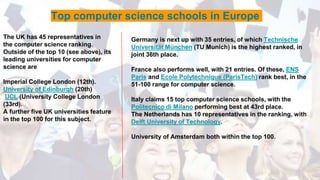
Top computer science schools in Europe
The UK has 45 representatives in
the computer science ranking.
Outside of the top 10 (see above), its
leading universities for computer
science are
Imperial College London (12th).
University of Edinburgh (20th)
UCL (University College London
(33rd).
A further five UK universities feature
in the top 100 for this subject.
Germany is next up with 35 entries, of which Technische
Universität München (TU Munich) is the highest ranked, in
joint 36th place.
France also performs well, with 21 entries. Of these, ENS
Paris and Ecole Polytechnique (ParisTech) rank best, in the
51-100 range for computer science.
Italy claims 15 top computer science schools, with the
Politecnico di Milano performing best at 43rd place.
The Netherlands has 10 representatives in the ranking, with
Delft University of Technology.
University of Amsterdam both within the top 100.
Eight of the world’s top universities
for computer science can be found
in Spain, including
Universitat Politecnica de
Catalunya in the top 100.
Also with eight entries is Ireland,
including Trinity College Dublin
(TCD) in the top 150.
Switzerland has seven entries, with
ETH Zurich in the top 10
Ecole Polytechnique Fédérale de
Lausanne (EPFL) in 18th place.
Russia also claims seven entries,
including Lomonosov Moscow
State University in the top 100.
Austria, Belgium, Greece and Sweden boast six
representatives each in the computer science ranking.
Of these, Belgium’s KU Leuven,
Sweden’s KTH, Royal Institute of Technology.
Austria’s Technische Universität Wien (Vienna University of
Technology) are all ranked in the top 100.
Elsewhere in Europe, the Czech Republic, Denmark and
Poland each have five entries ranked among the world’s top
universities for computer science. Of these, Denmark’s entries
perform best, with Aarhus University and the University of
Copenhagen both ranked in the top 150.
Finland has four entries, while Norway, Portugal and Romania
each have three universities featured. Finally, Hungary has
two schools featured among the top universities for computer
science, while Estonia, Luxembourg, Serbia, Slovakia and
Slovenia are all new to the ranking this year, with one entry
each.

Computer science & IT Engineering.

  • 2.
    ● Overview ● ScopesOf Higher Education in Computer Science & IT Engineering ● Awards in Computer Science & IT Engineering ● New And Latest Programmes in Computer Science & IT Engineering ● Future of the Computer Science & IT Engineering ● Current Trends in the Computer Science & IT Engineering ● Latest Research Developments in Computer Science & IT Engineering ● Opportunities And Benefits of Computer Science & IT Engineering ● Demand Of Computer Science & IT Engineering In The Future ● Huge Demand Countries in Computer Science & IT Engineering for Graduate Holders ● Top 10 Institutions of the World in the Computer Science & IT Engineering ● Top 10 Institutions of the Europe in the Computer Science & IT Engineering INDEX
  • 3.
    Computation has becomea vital part of nearly everything in our world. Biology, communications, education, environmental studies, health care, law, art, finance, manufacturing, transportation, entertainment, agriculture, energy, sports, government, and many other aspects of our world heavily rely on the advances brought about by computer scientists. Our degree programs are designed to train a new generation of computer scientists--people like you, people who want to change the world with their dedication, knowledge, and expertise, be it within the realm of computer science or in one of the many areas that are critically affected by it. Overview
  • 4.
    Computer Science isone of the most sought after courses by Indian students, thanks to the software and IT boom of the past two decades. Apart from putting India on the global map, computer science has pretty much changed the whole landscape of how people live. Right from social media to the genomics revolution, computer science has played a central role in many of the greatest technological innovations and developments of the 21st century. Since this field is hugely popular among Indian students, admissions to prestigious universities such as IITs, NITs and IIITs are very competitive. On the other hand, computer science is all set to grow in an unparalleled manner in the coming few years, thereby creating a lot of opportunities for students. Read on to discover more about this field in-depth. Most students take up computer science as their undergraduate major because of the huge number of job opportunities in India’s software and IT industry. But, there is so much more to computer science than just software and IT. A degree in computer science engineering exposes students to both theoretical as well as practical aspects of computer science. By the time undergraduate studies are over, you would have barely scratched the surface of this vast and burgeoning field. Over the past two decades, computer science has evolved rapidly and has produced remarkable acceleration and innovation not just in the world of internet and artificial intelligence but also in diverse fields such as banking, electronics, biology, chemistry, medicine and healthcare, to name a few. In short, computer science has invaded every other field and good programming and coding skills has become a basic requisite. Since computer science is based on the fundamentals of mathematics, computer science students develop critical reasoning and complex problem solving abilities that will help them in all walks of life. Some of the sub disciplines of computer science are theoretical computer science, theory of computation, information and coding theory, algorithms and data structures, programming language theory, formal methods, applied computer science etc. and students can specialize in any one (or more) of these areas during their undergraduate or graduate studies. Presently, job opportunities are great for computer science students all over the world. Even during difficult times such as recession, a highly skilled and bright computer science professional will always be in demand. What is Computer Science all about?Discover the Scope of Computer Science?
  • 5.
    Awards in ComputerScience & IT Engineering. IEEE Medal of Honor - The Award: The IEEE Internet Award is a technical award given by The Institute of Electrical and Electronics Engineers, a worldwide (160 countries and 400,000 members) non-profit that promotes advancement of technology. Nokia is a sponsor of the awards. Turing Award - The Award: The Association for Computer Machinery has a host of awards; the A.M. Turing Award is the most prestigious and sought after. It has been dubbed as the “Nobel Prize” of Computing. Recipients are selected for major contributions of lasting importance to computing and invited to give the annual A.M. Turing Award Lecture. Millennium Technology Prize - The Award: If the Turing Award can be likened to the Nobel, The Millennium Technology Prize is another contender. It is said to be the largest technology prize in the world (probably in terms of prize money). It is awarded every two years by the Technology Academy Finland, for innovations that enrich our everyday life. The Kyoto Prize For Advanced Technology - The Award: Set up by the Inamori Foundation of Japan, The Kyoto Prize is an international award to honor those who have contributed significantly to the scientific, cultural, and spiritual betterment of mankind. The prize is rapidly gaining in stature.
  • 6.
    New And LatestProgrammes in Computer Science & IT Engineering. ❏ Design Computing Studio. ❏ Computer Systems Principles and Programming. ❏ Human-Computer Interaction. ❏ Artificial Intelligence. ❏ Service-Oriented Architectures. ❏ Web Information Systems. ❏ Advanced Database Systems. ❏ The Software Process. ❏ Visualization, Computer Graphics & Data Analysis. ❏ Social & Mobile Computing. ❏ Information Security. ❏ Advanced Embedded Systems. ❏ Information Retrieval and Web Search. ❏ Business Information Systems Analysis and Design.
  • 7.
    Future of theComputer Science 1. Semantic Web (Powerful algorithms for relationship graph,More personalized search results ,Information retrieval and Entity recognition). 2. Intelligent Augmentation. 3. Artificial Intelligence to make humanoid robots or system. 4. Geo-spatial Search. 5. Quantum Computing. 6. Low cost Internet for everyone with minimum delay and high bandwidth. 7. Powerfully Concurrent, parallel and distributed systems with no failure. 8. Health Informatics (Mapping everyone's biological information). 9. Making computer Graphics as fast as possible. 10. More efficient algorithms and data structures depending on needs and many more. 11. Tracking the flow of ideas in scientific literature 12. Tracking evolution of communities in social networks 13. Extracting information from unstructured data sources 14. Processing massive data sets and streams 15. Extracting signals from noise 16. Dealing with high dimensional data and dimension reduction
  • 8.
    Current Trends ofComputer Technology ● 5G ● Virtual Reality and Augmented Reality ● Nonvolatile Memory ● Cyber Physical Systems (CPS) ● Data Science ● Capability-based Security ● Advanced Machine Learning ● Network Function Virtualization (NFV) ● Containers
  • 9.
    Latest Research Developmentsin Computer Science & IT Engineering. •Digital security •Deep data has replaced Big Data •Fog computing has replaced cloud computing •Internet of Things (IoT) •Artificial Intelligence •The IT field has advanced in many aspects.: • Cloud Computing - Openstack, Azure, AWS etc. as everything (industries and businesses are "moving to the cloud") • Web services & Scalability - REST architectures, frameworks for delivering the content quickly and cheaply- Django, Pyramid etc. • Virtualization - Use of VMs to perform tasks or jobs without using physical infrastructure • Mobile Access – 4G (LTE) enabled technologies • Python, Javascript, HTML5 and CSS3 - has led to a great user experience • Big Data, Hadoop, MongoDB, NoSQL • Mobile application development - Android, iOS
  • 10.
    Opportunities And Benefitsof Computer Science & IT Engineering ● Computer Science Graduates Earn Higher Salaries ● Computer Science Majors Have More Job Prospects ● Computer Science Grads Join a Fast Growing Industry ● Computer Science Degree Holders Work in a Wide Range of Industries ● Computer Science Grads can Help Make the World a Better Place ● Computer Science Graduates are on the Cutting-Edge of IT
  • 11.
    ● Advanced Diplomain Multilingual Computer Programming (ADMCP) ● 3D Animation and Visual Effects ● CCNA ● Certification Program for Telecom Software Testing ● Advance Diploma in Hardware and Networking (ADHN) ● Certification Program for Network Planning and Optimization ● Database Administration ● IHT Certified Network Professional ● Certified Professional for the Web Development ● HCE+ (Hardware Course) ● Red Hat Certified Engineer (RHCE) ● TCNP Certification ● Information Security and Ethical Hacking ● IIJT Certified Networking Expert (IC- Next) (PC NEXT) ● Integrated Master of Computer Application (IMCA) ● Master of Science Information Technology MSc (IT) ● Web & Software Engineering ● SAP Courses ● MBA Telecommunication Systems Management ● Microsoft Certified System Engineer (MCSE) ● Robotics Course Higher Studies after B.C.S There are many post graduate courses the candidate can pursue after completing B.C.S. The candidates can opt for M.Sc. Computer Science, Master of Computer Application (M.C.A) or Master of Computer Management (M.C.M). The candidates who are interested in management can opt for Master of Business Administration. There are many other options for higher studies after B.C.S. Some of them are listed below.
  • 12.
    Opportunities for HigherEducation in Computer Science - INDIA Let us see which opportunities are there for high quality higher education in computer science. The first question to get clarity is: “Is a premier Master’s program valuable for a better job?” In the first decade of IT growth (1990-2000), the IT sector in India concentrated on low-end solutions. The emphasis, when it came to employment, was on people with basic exposure to IT and average programming skills. However, all big organizations have realized that they can enhance their business substantially only if they take to high-end IT, namely, research and cutting edge solutions along with low-end development work. In addition to this, several non-Indian organizations whose emphasis is on research and development (IBM, Microsoft, etc.), have opened R&D labs in India for high-end work. High-end fields like artificial intelligence, networking, embedded systems, knowledge-based systems, and bio-informatics require very qualified professionals. In this context, there is a tremendous opportunity for specialists (not just programmers). If you have the right academic credentials and are interested in establishing a technically focused career in IT, you should consider doing a high quality/high-end Master’s programs. The two years that you spend doing such a program will add tremendous value to your resume. High-end Master’s programs are: M.S., M.Tech, or M.E. They can be done after you have studied the relevant subject(s) at the graduate or post- graduate level for 3 to 5 years (i.e., after doing B.E., M.C.A., or M.Sc.). These Master’s programs take 1.5 to 3 years to do. After completing any of these programs you can pursue a Ph.D. This will take another 4 to 6 years. A PhD is a must for a faculty position in any good university, whether in India or abroad. The Master’s courses help you get a job in R&D divisions or as a project lead in the best of organizations. Estimates indicate that the demand from industry for such positions in the next 5 years will touch several tens of thousands. When you study for M.S., M.Tech., or M.E, you will be exposed to the finest researchers and professors. Moreover, these courses will also cover many important concepts not covered in your graduate or post-graduate programs. For example, a “computer architecture” course at the M.S. level covers the subject at a much greater depth than at the B.E level.
  • 13.
    Job Opportunities afterB.C.S The aspirants can find many job opportunities after completing B.C.S. The different employment areas where the aspirants can find the job are listed below. Banks Computer Manufacturing Firms Desktop Publishing Consultancies Government Agencies Financial Institutions Insurance Providers Security and Surveillance Companies Technical Support Schools and Colleges Software Development Companies System Maintenance Traffic Light Management The job types of the candidates after completing Bachelor of Computer Science are listed below. Software Developer Programmer Analyst Teacher Information Technology (IT) Manager Theorist Researcher Project Manager (IT) Technical Support Developer / Programmer
  • 14.
    Demand Of ComputerScience & IT Engineering In The Future In Future………………. ● Creating the future of networking ● Driving advances in all fields of science and engineering ● Reckless driving ● Personalized education ● Predictive, preventive,personalized medicine ● Quantum computing ● Empowerment for the developing world ● Personalized health monitoring quality of life ● Harnessing parallelism: many-core and DISC ● Neurobotics ● Synthetic biology ● The algorithmic lens: Cyber-enabled Discovery and Innovation
  • 15.
    Huge Demand Countriesin Computer Science & IT Engineering for Graduate Holders ● Washington,D.C ● New York ● San Jose ● San Francisco ● Boston ● Seattle ● Chicago ● Atlanta ● Los Angeles ● Dallas
  • 16.
    Top Computer ScienceSchools in 2016 in the World Rank Name of Institution Location 1. Massachusetts Institute of Technology(MIT) United States 2. Stanford University United States 3. University of Oxford. United Kingdom 4. Harvard University United States 5. Carnegie Mellon University United States 6. University of Cambridge United Kingdom 7. University of California, Berkeley(UCB) United States 8. ETH Zurich (Swiss Federal institute of Technology) Switzerland 9. National University of Singapore (NUS) Singapore 10. Princeton University United States Based on the QS World University Rankings 2016
  • 17.
    Top computer scienceschools in Europe The UK has 45 representatives in the computer science ranking. Outside of the top 10 (see above), its leading universities for computer science are Imperial College London (12th). University of Edinburgh (20th) UCL (University College London (33rd). A further five UK universities feature in the top 100 for this subject. Germany is next up with 35 entries, of which Technische Universität München (TU Munich) is the highest ranked, in joint 36th place. France also performs well, with 21 entries. Of these, ENS Paris and Ecole Polytechnique (ParisTech) rank best, in the 51-100 range for computer science. Italy claims 15 top computer science schools, with the Politecnico di Milano performing best at 43rd place. The Netherlands has 10 representatives in the ranking, with Delft University of Technology. University of Amsterdam both within the top 100.
  • 18.
    Eight of theworld’s top universities for computer science can be found in Spain, including Universitat Politecnica de Catalunya in the top 100. Also with eight entries is Ireland, including Trinity College Dublin (TCD) in the top 150. Switzerland has seven entries, with ETH Zurich in the top 10 Ecole Polytechnique Fédérale de Lausanne (EPFL) in 18th place. Russia also claims seven entries, including Lomonosov Moscow State University in the top 100. Austria, Belgium, Greece and Sweden boast six representatives each in the computer science ranking. Of these, Belgium’s KU Leuven, Sweden’s KTH, Royal Institute of Technology. Austria’s Technische Universität Wien (Vienna University of Technology) are all ranked in the top 100. Elsewhere in Europe, the Czech Republic, Denmark and Poland each have five entries ranked among the world’s top universities for computer science. Of these, Denmark’s entries perform best, with Aarhus University and the University of Copenhagen both ranked in the top 150. Finland has four entries, while Norway, Portugal and Romania each have three universities featured. Finally, Hungary has two schools featured among the top universities for computer science, while Estonia, Luxembourg, Serbia, Slovakia and Slovenia are all new to the ranking this year, with one entry each.