Educational Technologies:
Learning Analytics
and Artificial Intelligence
Xavier Ochoa
Assistant Professor of Learning Analytics
Learning Analytics Research Network (LEARN)
School of Culture, Education and Human Development
New York University (NYU)
http://www.slideshare.net/xaoch
The role of Educational
Technologies
Profession
Isaac Asimov (1957)
Augmenting human capabilities
in educational contexts
Freeman, A., Adams Becker, S., Cummins, M., Davis, A., and Hall Giesinger, C. (2017). NMC/CoSN Horizon Report: 2017 K–12 Edition.
Austin, Texas: The New Media Consortium.
Bryan Alexander, Kevin Ashford-Rowe, Noreen Barajas-Murphy, Gregory Dobbin, Jessica Knott, Mark McCormack, Jeffery Pomerantz, Ryan
Seilhamer, and Nicole Weber, EDUCAUSE Horizon Report: 2019 Higher Education Edition (Louisville, CO: EDUCAUSE, 2019).
Freeman, A., Adams Becker, S., Cummins, M., Davis, A., and Hall Giesinger, C. (2017). NMC/CoSN Horizon Report: 2017 K–12 Edition.
Austin, Texas: The New Media Consortium.
Bryan Alexander, Kevin Ashford-Rowe, Noreen Barajas-Murphy, Gregory Dobbin, Jessica Knott, Mark McCormack, Jeffery Pomerantz, Ryan
Seilhamer, and Nicole Weber, EDUCAUSE Horizon Report: 2019 Higher Education Edition (Louisville, CO: EDUCAUSE, 2019).
Learning Analytics
Learning analytics is the measurement,
collection, analysis and reporting of data
about learners and their contexts, for
purposes of understanding and
optimizing learning and the environments in
which it occurs.
Society for Learning Analytics Research (SoLAR)
Sensemaking
“Sensemaking is a
motivated, continuous
effort to understand
connections . . . in order
to anticipate their
trajectories and act
effectively”
Klein, Gary, Brian Moon, and Robert R. Hoffman. "Making sense of
sensemaking 1: Alternative perspectives." IEEE intelligent systems 21.4
(2006): 70-73.
Learning Analytics
=
Augmenting Sensemaking
Maier, Karin, Philipp Leitner, and Martin Ebner. "Learning Analytics Cockpit for MOOC Platforms." Emerging Trends in Learning Analytics. Brill Sense, 2019.
271-285.
Maier, Karin, Philipp Leitner, and Martin Ebner. "Learning Analytics Cockpit for MOOC Platforms." Emerging Trends in Learning Analytics. Brill Sense, 2019.
271-285.
Maier, Karin, Philipp Leitner, and Martin Ebner. "Learning Analytics Cockpit for MOOC Platforms." Emerging Trends in Learning Analytics. Brill Sense, 2019.
271-285.
Siemens, George, and Phil Long. "Penetrating the fog: Analytics in learning
and education." Educause Review 46.5 (2011): 30-32.
An (simple) example:
Computer Science Program Redesign
Mendez, G., Ochoa, X., Chiluiza, K., & De Wever, B. (2014). Curricular design analysis: a data-driven perspective. Journal
of Learning Analytics, 1(3), 84-119.
Computer Science Program Redesign
Which are the hardest/more difficult courses?
What lead our students to success/failure?
How courses are related?
Are there courses that could be eliminated?
Is the work-load adequate for our students?
Good Old Academic Data
Student Course Section Semester Grade
9093233 HCD001 1 2005-1S 85
9093233 LMS003 2 2005-1S 97
9088442 HCD001 2 2005-2S 100
… … … … …
Difficulty Estimation
How difficult a course is?
Course Difficulty Estimation
grade > GPA
grade < GPA
0
grade = GPA
Three scenarios:
Differences between
GPA and grade
> 0< 0
But…
Why do these distributions look like this?
They are skewed!
Real examples
Difficult Courses (Top 10)
Perceived Estimated
Algorithms Analysis
Operating Systems
Physics A
Differential Equations
Linear Algebra
Programming Fundamentals
Object-Oriented Programming
Differential Calculus
Data Structures
Statistics
Operating Systems
Statistics
Differential Equations
Linear Algebra
Programming Languages
Electrical Networks I
Artificial Intelligence
Programming Fundamentals
Data Structures
Hardware Architecture and Organization
Difficult Courses (Top 10)
Perceived Estimated
Algorithms Analysis
Operating Systems
Physics A
Differential Equations
Linear Algebra
Programming Fundamentals
Object-Oriented Programming
Differential Calculus
Data Structures
Statistics
Operating Systems
Statistics
Differential Equations
Linear Algebra
Programming Languages
Electrical Networks I
Artificial Intelligence
Programming Fundamentals
Data Structures
Hardware Architecture and Organization
Perception != Estimation
That lead to a deeper conversation
among Faculty
Curriculum Coherence
How courses group together
CORE - CS CURRICULUM
Basic Physics
Integral Calculus
Multivariate Calculus
Electrical Networks
Digital Systems I
Hardware Architectures
Operative Systems
General Chemistry
Programming
Fundamentals
Object-oriented
Programming
Data Structures
Programming
Languages
Database Systems I
Software Engineering I
Software Engineering II
Oral and Written
Communication Techniques
Computing and Society
Discrete Mathematics
Algorithms Analysis
Human-computer
Interaction
Differential Calculus
Linear Algebra
Differential Equations
Ecology and
Environmental Education
Statistics
Economic Engineering I
Artificial Intelligence
PROFESSIONAL TRAINING HUMANITIES BASIC SCIENCE
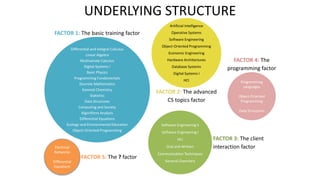
Principal Factor Analysis
UNDERLYING STRUCTURE
Electrical
Networks
Differential
Equations
Software Engineering II
Software Engineering I
HCI
Oral and Written
Communication Techniques
General Chemistry
Programming
Languages
Object-Oriented
Programming
Data Structures
Artificial Intelligence
Operative Systems
Software Engineering
Object-Oriented Programming
Economic Engineering
Hardware Architectures
Database Systems
Digital Systems I
HCI
Differential and Integral Calculus
Linear Algebra
Multivariate Calculus
Digital Systems I
Basic Physics
Programming Fundamentals
Discrete Mathematics
General Chemistry
Statistics
Data Structures
Computing and Society
Algorithms Analysis
Differential Equations
Ecology and Environmental Education
Object-Oriented Programming
FACTOR 1: The basic training factor
FACTOR 2: The advanced
CS topics factor
FACTOR 3: The client
interaction factor
FACTOR 4: The
programming factor
FACTOR 5: The ? factor
Grouping is off
Fundamental Programming is not in the Programming factor?
What to do with Electrical Networks and Differential
Equations?
Drop-out Paths
What courses lead the students to
drop-out
DROPOUT PATHS
Sequence Support
<Physics A, Dropout> 0.608196721
<Differential Calculus , Dropout> 0.570491803
<Programming Fundamentals , Dropout> 0.532786885
<Integral Calculus , Dropout> 0.496721311
<Physics A, Differential Calculus , Dropout> 0.43442623
<Linear Algebra , Dropout> 0.432786885
<Differential Calculus, Integral Calculus , Dropout> 0.385245902
<Physics C , Dropout> 0.347540984
<Physics A, Integral Calculus , Dropout> 0.327868852
<General Chemistry , Dropout> 0.319672131
<Differential Equations , Dropout> 0.31147541
Sequence Mining
(Sequential PAttern
Discovery using
Equivalence classes -
SPADE)
Most drop-outs fail basic courses
Should students start with CS topics?
Too much pressure in engineering courses?
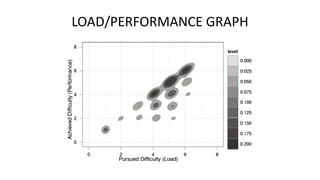
Load/Performance Graph
What students think they can
manage vs. what they can actually
manage
LOAD/PERFORMANCE GRAPH
Unrealistic Suggested Load
How to the present the Curriculum in a better way?
How we can recommend students the right load?
Which are the hardest/more difficult courses?
What lead our students to success/failure?
How courses are related?
Are there courses that could be eliminated?
Is the work-load adequate for our
students?
What makes a course difficult then?
Why Programming Fundamentals does not correlate?
Why Computers and Society correlates with a lot of courses?
Fundamental Programming is not in the Programming
factor?
Should students start with CS topics?
Too much pressure in engineering courses?
How to the present the Curriculum in a better way?
How we can recommend students the right load?
What to do with Electrical Networks and Differential
Equations?
Good Old Academic Data
Student Course Section Semester Grade
9093233 HCD001 1 2005-1S 85
9093233 LMS003 2 2005-1S 97
9088442 HCD001 2 2005-2S 100
… … … … …
Another example:
Augmenting Academic Advising
Gutiérrez, F., Seipp, K., Ochoa, X., Chiluiza, K., De Laet, T., & Verbert, K. (2018). LADA: A learning analytics dashboard for
academic advising. Computers in Human Behavior
How to better recommend
academic load to different
students
In 15 minutes or less!
Basic
Advising
Dashboard
Add a student-dependent
load-recommender system
Based on CS-program
data analysis
Prediction + Uncertainty
Results from Evaluation
Amount of explored scenarios increased in
experts, especially for hard-cases.
Detrimental effect on laymen (non-
advisors)
What about Artificial
Intelligence?
Artificial Intelligence
The theory and development of computer
systems able to perform tasks normally requiring
human intelligence, such as visual perception,
speech recognition, decision-making, and
translation between languages.
Not so much….
Providing feedback on student writing
Feedback is valuable… but costly
ACA Writer: Automatic Feedback on Written Essays
Gibson, A., Aitken, A., Sándor, Á., Buckingham Shum, S., Tsingos-Lucas, C., & Knight, S. (2017). Reflective
writing analytics for actionable feedback.
ETS Writing Mentor: Automatic Feedback on Written Essays
Madnani, N., Burstein, J., Elliot, N., Klebanov, B. B., Napolitano, D., Andreyev, S., & Schwartz, M. (2018, August). Writing
mentor: Self-regulated writing feedback for struggling writers. In Proceedings of the 27th International Conference on
Computational Linguistics: System Demonstrations (pp. 113-117).
Oral presentation feedback
Again… feedback is very valuable… but costly
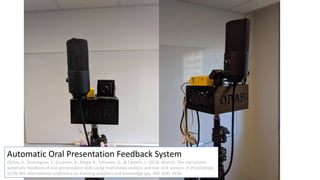
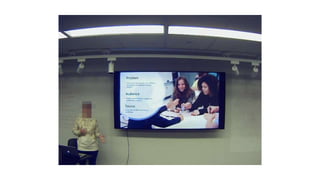
Automatic Oral Presentation Feedback System
Ochoa, X., Domínguez, F., Guamán, B., Maya, R., Falcones, G., & Castells, J. (2018, March). The rap system:
automatic feedback of oral presentation skills using multimodal analysis and low-cost sensors. In Proceedings
of the 8th international conference on learning analytics and knowledge (pp. 360-364). ACM.
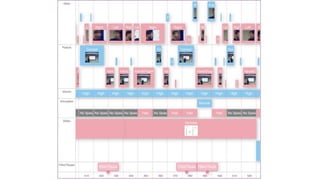
(Multimodal) Formative Feedback Report
Experiment
•Used by 1140 students
•2 times during the semester
•Real classroom presentations
•Students used the system on their own
Effect of the System
• Looking at the public: +++
• Presentation posture: +
• Filled pauses: = +++ (For students with low scores)
• Slides: = ++
Can we mix LA with AI?
Medical Collaboration Feedback
Martinez-Maldonado, R., Power, T., Hayes, C., Abdiprano, A., Vo, T., Axisa, C., & Buckingham Shum, S. (2017, March). Analytics meet
patient manikins: challenges in an authentic small-group healthcare simulation classroom. In Proceedings of the seventh
international learning analytics & knowledge conference (pp. 90-94). ACM.
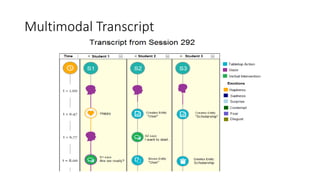
Multimodal Transcript
Ochoa, X. et al. Multimodal Transcript of Face-to-Face Group-Work Activity Around Interactive Tabletops
CrossMMLA Workshop, Learning Analytics and Knowledge conference 2018, In Print
Multimodal Transcript
Conclusions
and a word of caution
LA & AI will
not replace the
Teacher
They will enable the Augmented Teacher
LA & AI will not limit the
options of students
They will empower Augmented Students
Responsible LA & AI
Want to know more…
https://steinhardt.nyu.edu/learn/connectwithus
Xavier Ochoa
xavier.ochoa@nyu.edu
http://wp.nyu.edu/xavier_ochoa
Twitter: @xaoch

Educational Technologies

  • 1.
    Educational Technologies: Learning Analytics andArtificial Intelligence Xavier Ochoa Assistant Professor of Learning Analytics Learning Analytics Research Network (LEARN) School of Culture, Education and Human Development New York University (NYU)
  • 2.
  • 3.
    The role ofEducational Technologies
  • 5.
  • 7.
  • 8.
    Freeman, A., AdamsBecker, S., Cummins, M., Davis, A., and Hall Giesinger, C. (2017). NMC/CoSN Horizon Report: 2017 K–12 Edition. Austin, Texas: The New Media Consortium. Bryan Alexander, Kevin Ashford-Rowe, Noreen Barajas-Murphy, Gregory Dobbin, Jessica Knott, Mark McCormack, Jeffery Pomerantz, Ryan Seilhamer, and Nicole Weber, EDUCAUSE Horizon Report: 2019 Higher Education Edition (Louisville, CO: EDUCAUSE, 2019).
  • 9.
    Freeman, A., AdamsBecker, S., Cummins, M., Davis, A., and Hall Giesinger, C. (2017). NMC/CoSN Horizon Report: 2017 K–12 Edition. Austin, Texas: The New Media Consortium. Bryan Alexander, Kevin Ashford-Rowe, Noreen Barajas-Murphy, Gregory Dobbin, Jessica Knott, Mark McCormack, Jeffery Pomerantz, Ryan Seilhamer, and Nicole Weber, EDUCAUSE Horizon Report: 2019 Higher Education Edition (Louisville, CO: EDUCAUSE, 2019).
  • 10.
    Learning Analytics Learning analyticsis the measurement, collection, analysis and reporting of data about learners and their contexts, for purposes of understanding and optimizing learning and the environments in which it occurs. Society for Learning Analytics Research (SoLAR)
  • 12.
    Sensemaking “Sensemaking is a motivated,continuous effort to understand connections . . . in order to anticipate their trajectories and act effectively” Klein, Gary, Brian Moon, and Robert R. Hoffman. "Making sense of sensemaking 1: Alternative perspectives." IEEE intelligent systems 21.4 (2006): 70-73.
  • 13.
  • 14.
    Maier, Karin, PhilippLeitner, and Martin Ebner. "Learning Analytics Cockpit for MOOC Platforms." Emerging Trends in Learning Analytics. Brill Sense, 2019. 271-285.
  • 15.
    Maier, Karin, PhilippLeitner, and Martin Ebner. "Learning Analytics Cockpit for MOOC Platforms." Emerging Trends in Learning Analytics. Brill Sense, 2019. 271-285.
  • 16.
    Maier, Karin, PhilippLeitner, and Martin Ebner. "Learning Analytics Cockpit for MOOC Platforms." Emerging Trends in Learning Analytics. Brill Sense, 2019. 271-285.
  • 17.
    Siemens, George, andPhil Long. "Penetrating the fog: Analytics in learning and education." Educause Review 46.5 (2011): 30-32.
  • 18.
    An (simple) example: ComputerScience Program Redesign Mendez, G., Ochoa, X., Chiluiza, K., & De Wever, B. (2014). Curricular design analysis: a data-driven perspective. Journal of Learning Analytics, 1(3), 84-119.
  • 19.
  • 20.
    Which are thehardest/more difficult courses? What lead our students to success/failure? How courses are related? Are there courses that could be eliminated? Is the work-load adequate for our students?
  • 21.
    Good Old AcademicData Student Course Section Semester Grade 9093233 HCD001 1 2005-1S 85 9093233 LMS003 2 2005-1S 97 9088442 HCD001 2 2005-2S 100 … … … … …
  • 22.
  • 23.
    Course Difficulty Estimation grade> GPA grade < GPA 0 grade = GPA Three scenarios: Differences between GPA and grade > 0< 0
  • 24.
    But… Why do thesedistributions look like this? They are skewed!
  • 25.
  • 26.
    Difficult Courses (Top10) Perceived Estimated Algorithms Analysis Operating Systems Physics A Differential Equations Linear Algebra Programming Fundamentals Object-Oriented Programming Differential Calculus Data Structures Statistics Operating Systems Statistics Differential Equations Linear Algebra Programming Languages Electrical Networks I Artificial Intelligence Programming Fundamentals Data Structures Hardware Architecture and Organization
  • 27.
    Difficult Courses (Top10) Perceived Estimated Algorithms Analysis Operating Systems Physics A Differential Equations Linear Algebra Programming Fundamentals Object-Oriented Programming Differential Calculus Data Structures Statistics Operating Systems Statistics Differential Equations Linear Algebra Programming Languages Electrical Networks I Artificial Intelligence Programming Fundamentals Data Structures Hardware Architecture and Organization
  • 28.
    Perception != Estimation Thatlead to a deeper conversation among Faculty
  • 29.
  • 30.
    CORE - CSCURRICULUM Basic Physics Integral Calculus Multivariate Calculus Electrical Networks Digital Systems I Hardware Architectures Operative Systems General Chemistry Programming Fundamentals Object-oriented Programming Data Structures Programming Languages Database Systems I Software Engineering I Software Engineering II Oral and Written Communication Techniques Computing and Society Discrete Mathematics Algorithms Analysis Human-computer Interaction Differential Calculus Linear Algebra Differential Equations Ecology and Environmental Education Statistics Economic Engineering I Artificial Intelligence PROFESSIONAL TRAINING HUMANITIES BASIC SCIENCE
  • 31.
  • 32.
    UNDERLYING STRUCTURE Electrical Networks Differential Equations Software EngineeringII Software Engineering I HCI Oral and Written Communication Techniques General Chemistry Programming Languages Object-Oriented Programming Data Structures Artificial Intelligence Operative Systems Software Engineering Object-Oriented Programming Economic Engineering Hardware Architectures Database Systems Digital Systems I HCI Differential and Integral Calculus Linear Algebra Multivariate Calculus Digital Systems I Basic Physics Programming Fundamentals Discrete Mathematics General Chemistry Statistics Data Structures Computing and Society Algorithms Analysis Differential Equations Ecology and Environmental Education Object-Oriented Programming FACTOR 1: The basic training factor FACTOR 2: The advanced CS topics factor FACTOR 3: The client interaction factor FACTOR 4: The programming factor FACTOR 5: The ? factor
  • 33.
    Grouping is off FundamentalProgramming is not in the Programming factor? What to do with Electrical Networks and Differential Equations?
  • 34.
    Drop-out Paths What courseslead the students to drop-out
  • 35.
    DROPOUT PATHS Sequence Support <PhysicsA, Dropout> 0.608196721 <Differential Calculus , Dropout> 0.570491803 <Programming Fundamentals , Dropout> 0.532786885 <Integral Calculus , Dropout> 0.496721311 <Physics A, Differential Calculus , Dropout> 0.43442623 <Linear Algebra , Dropout> 0.432786885 <Differential Calculus, Integral Calculus , Dropout> 0.385245902 <Physics C , Dropout> 0.347540984 <Physics A, Integral Calculus , Dropout> 0.327868852 <General Chemistry , Dropout> 0.319672131 <Differential Equations , Dropout> 0.31147541 Sequence Mining (Sequential PAttern Discovery using Equivalence classes - SPADE)
  • 36.
    Most drop-outs failbasic courses Should students start with CS topics? Too much pressure in engineering courses?
  • 37.
    Load/Performance Graph What studentsthink they can manage vs. what they can actually manage
  • 39.
  • 40.
  • 41.
  • 42.
    Unrealistic Suggested Load Howto the present the Curriculum in a better way? How we can recommend students the right load?
  • 43.
    Which are thehardest/more difficult courses? What lead our students to success/failure? How courses are related? Are there courses that could be eliminated? Is the work-load adequate for our students?
  • 44.
    What makes acourse difficult then? Why Programming Fundamentals does not correlate? Why Computers and Society correlates with a lot of courses? Fundamental Programming is not in the Programming factor? Should students start with CS topics? Too much pressure in engineering courses? How to the present the Curriculum in a better way? How we can recommend students the right load? What to do with Electrical Networks and Differential Equations?
  • 45.
    Good Old AcademicData Student Course Section Semester Grade 9093233 HCD001 1 2005-1S 85 9093233 LMS003 2 2005-1S 97 9088442 HCD001 2 2005-2S 100 … … … … …
  • 46.
    Another example: Augmenting AcademicAdvising Gutiérrez, F., Seipp, K., Ochoa, X., Chiluiza, K., De Laet, T., & Verbert, K. (2018). LADA: A learning analytics dashboard for academic advising. Computers in Human Behavior
  • 47.
    How to betterrecommend academic load to different students In 15 minutes or less!
  • 48.
  • 49.
    Add a student-dependent load-recommendersystem Based on CS-program data analysis
  • 51.
  • 52.
  • 53.
    Results from Evaluation Amountof explored scenarios increased in experts, especially for hard-cases. Detrimental effect on laymen (non- advisors)
  • 54.
  • 55.
    Artificial Intelligence The theoryand development of computer systems able to perform tasks normally requiring human intelligence, such as visual perception, speech recognition, decision-making, and translation between languages.
  • 56.
  • 57.
    Providing feedback onstudent writing
  • 58.
  • 59.
    ACA Writer: AutomaticFeedback on Written Essays Gibson, A., Aitken, A., Sándor, Á., Buckingham Shum, S., Tsingos-Lucas, C., & Knight, S. (2017). Reflective writing analytics for actionable feedback.
  • 60.
    ETS Writing Mentor:Automatic Feedback on Written Essays Madnani, N., Burstein, J., Elliot, N., Klebanov, B. B., Napolitano, D., Andreyev, S., & Schwartz, M. (2018, August). Writing mentor: Self-regulated writing feedback for struggling writers. In Proceedings of the 27th International Conference on Computational Linguistics: System Demonstrations (pp. 113-117).
  • 61.
  • 62.
    Again… feedback isvery valuable… but costly
  • 63.
    Automatic Oral PresentationFeedback System Ochoa, X., Domínguez, F., Guamán, B., Maya, R., Falcones, G., & Castells, J. (2018, March). The rap system: automatic feedback of oral presentation skills using multimodal analysis and low-cost sensors. In Proceedings of the 8th international conference on learning analytics and knowledge (pp. 360-364). ACM.
  • 65.
  • 69.
    Experiment •Used by 1140students •2 times during the semester •Real classroom presentations •Students used the system on their own
  • 70.
    Effect of theSystem • Looking at the public: +++ • Presentation posture: + • Filled pauses: = +++ (For students with low scores) • Slides: = ++
  • 71.
    Can we mixLA with AI?
  • 72.
    Medical Collaboration Feedback Martinez-Maldonado,R., Power, T., Hayes, C., Abdiprano, A., Vo, T., Axisa, C., & Buckingham Shum, S. (2017, March). Analytics meet patient manikins: challenges in an authentic small-group healthcare simulation classroom. In Proceedings of the seventh international learning analytics & knowledge conference (pp. 90-94). ACM.
  • 74.
    Multimodal Transcript Ochoa, X.et al. Multimodal Transcript of Face-to-Face Group-Work Activity Around Interactive Tabletops CrossMMLA Workshop, Learning Analytics and Knowledge conference 2018, In Print
  • 75.
  • 77.
  • 78.
    LA & AIwill not replace the Teacher They will enable the Augmented Teacher
  • 79.
    LA & AIwill not limit the options of students They will empower Augmented Students
  • 80.
  • 82.
    Want to knowmore… https://steinhardt.nyu.edu/learn/connectwithus Xavier Ochoa xavier.ochoa@nyu.edu http://wp.nyu.edu/xavier_ochoa Twitter: @xaoch