MAPÚA UNIVERSITY
SCHOOL OF MECHANICAL AND MANUFACTURING ENGINEERING
ME139L-2/E01
MECHANICAL ENGINEERING LABORATORY 1
WRITTEN REPORT ON
RELATIVE DENSITY AND VISCOSITY
EXPERIMENT NO. 1
SUBMITTED BY:
BATUYONG, JUSTINE P.
2019100680
SUBMITTED TO:
ENGR. PAULO RAFAEL V. MERIS
MARCH 19, 2022
ii
ABSTRACT
Viscosity and density are two important examples of a liquid’s quantifiable property. The
apparent weight of something is influenced by its mass (symbol m), the volume it occupies
(symbol V), and gravity. Materials are distinct and can be defined by density 𝜌, but this property
is different for every state of matter of the same material. Relative density (or Specific Gravity,
symbol SG) is the scale of something (identified as 𝜌 in the equation) from a reference. The
coefficient of absolute viscosity (dynamic viscosity, symbol 𝜇) is the ratio of shear stress and
shear rate (deformation rate), fluids resist motion and cause a reaction force in the opposite
direction. The weight of the pycnometer and the test specimen (WPO) is the quantified output
of the relative density experiment. Data from the viscometer test was used to compute the
specific weight of the steel ball, correction factor, dynamic viscosity, the corrected velocity of
the steel ball, observed velocity of the steel ball, kinematic viscosity, specific weight of
glycerin, the ratio of steel ball diameter and viscometer ID. The specific gravity of the two
samples measured using the pycnometer method was determined from the study of the principle
of density. The falling sphere viscometer method provided fine data, which was used to
calculate the dynamic and kinematic viscosity of glycerin.
OBJECTIVES:
1. To determine the relative density of Glucose (C6H12O6) and Ethylene Glycol
(C2H6O2).
2. To determine the dynamic and kinematic viscosity of glycerin.
3. Create a V vs. DSB/DT graph.
iii
TABLE OF CONTENTS
TITLE PAGE i
ABSTRACT ii
OBJECTIVES ii
TABLE OF CONTENTS iii
THEORIES AND PRINCIPLES 1
DISCUSSION 2
SAMPLE PROBLEMS 3
LIST OF APPARATUS / SET-UP 4
FINAL DATA SHEET 7
CONCLUSION 8
RECOMMENDATION 8
REFERENCES 8
1
THEORIES AND PRINCIPLES
Studying liquids is a course not satisfied by the classical mechanics of rigid and deformable
bodies and requires modern theories to grasp its behaviors. Viscosity and density are two
important examples of a liquid’s quantifiable property; however, the earliest form of a theory
related to density was 250 B.C.—the widely known story of Archimedes and the Crown of
Syracuse (Grigg, 2013, para. 2). The apparent weight of something is influenced by its mass
(symbol m), the volume it occupies (symbol V), and gravity, e.g., one pound of iron is equal to
one pound of cotton, but the former is smaller in size.
𝜌 =
𝑚
𝑉
Materials are distinct and can be defined by density 𝜌, but this property is different for
every state of matter of the same material. For example, liquid water is denser than any of its
vapor states. Density is also different between states of liquid water. Relative density (or
Specific Gravity, symbol SG) is the scale of something (identified as 𝜌 in the equation) as from.
Liquid in terms of density, and liquid water (identified as 𝜌𝐻2 𝑂 in the equation) is widely chosen
as the reference because it is convenient in most aspects (Aaron, 2021).
𝑆𝐺 =
𝜌
𝜌𝐻2 𝑂
As density has a strict relationship with temperature, specific gravity follows. In the
experiment with density, both the water and the sample must have the same temperature. The
other property studied in this experiment is viscosity. The coefficient of absolute viscosity
(dynamic viscosity, symbol 𝜇) is the ratio of shear stress and shear rate (deformation rate),
fluids resist motion and cause a reaction force in the opposite direction. In another perspective,
solids in motion that interact with static fluids experience an opposing force establishing
equilibrium and restraining the position or velocity of the solid. For spheres traveling through
Newtonian fluids, the drag force increases with velocity as defined by Stoke’s law:
𝐹𝐷 = 6𝜇𝜋𝑟𝑉
⃗
Where FD is the drag force, r is the radius of the sphere, and 𝑉
⃗ is its relative velocity to the
fluid.
Eq. 1
Eq. 2
Eq. 3
2
DISCUSSION
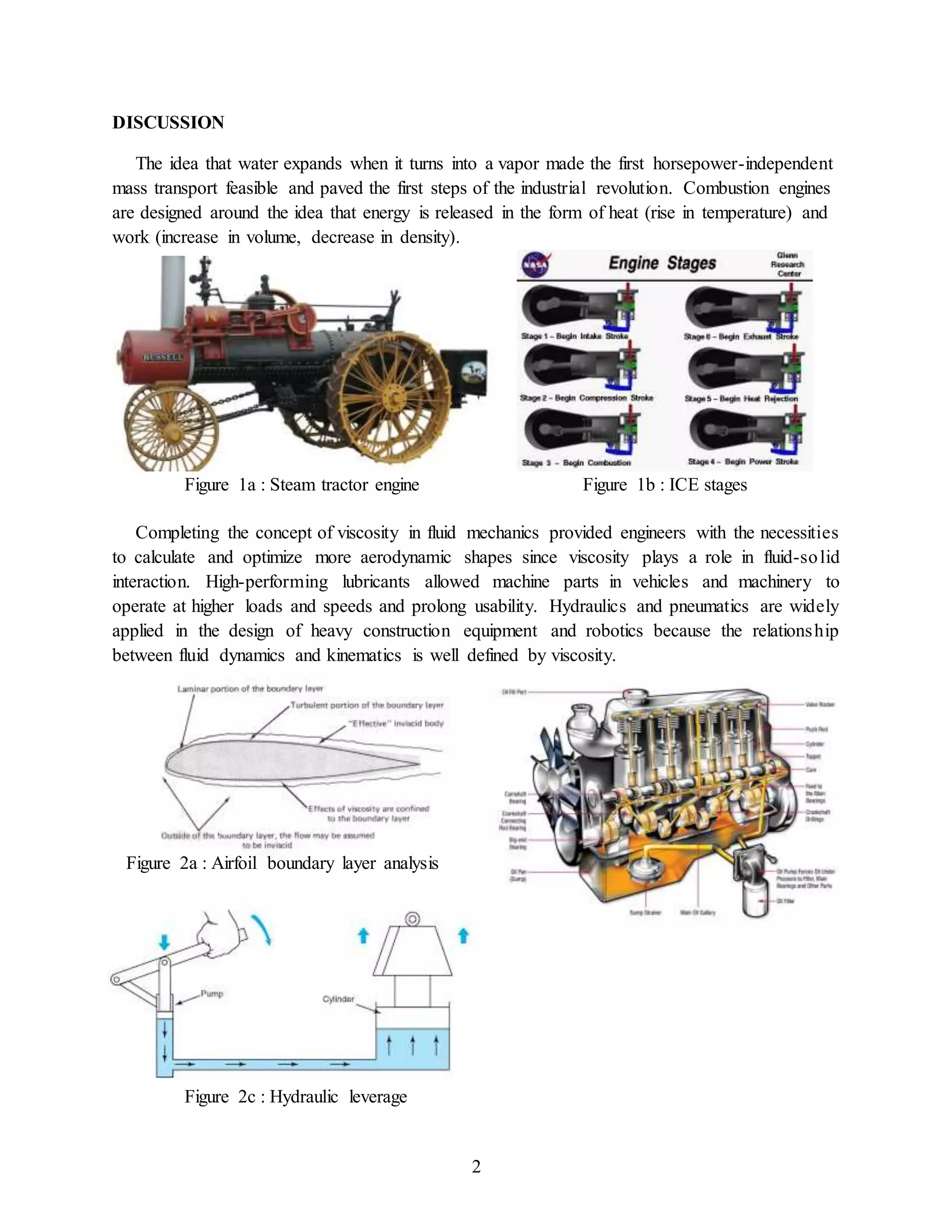
The idea that water expands when it turns into a vapor made the first horsepower-independent
mass transport feasible and paved the first steps of the industrial revolution. Combustion engines
are designed around the idea that energy is released in the form of heat (rise in temperature) and
work (increase in volume, decrease in density).
Completing the concept of viscosity in fluid mechanics provided engineers with the necessities
to calculate and optimize more aerodynamic shapes since viscosity plays a role in fluid-solid
interaction. High-performing lubricants allowed machine parts in vehicles and machinery to
operate at higher loads and speeds and prolong usability. Hydraulics and pneumatics are widely
applied in the design of heavy construction equipment and robotics because the relationship
between fluid dynamics and kinematics is well defined by viscosity.
Figure 1a : Steam tractor engine Figure 1b : ICE stages
Figure 2a : Airfoil boundary layer analysis
Figure 2c : Hydraulic leverage
3
SAMPLE PROBLEMS
1. What is relative density / specific gravity, and how is it related to density?
-It is the ratio of the two densities of substances, the specific gravity of a substance is
commonly in reference to the density of water (about 1000 kg/m3)
2. What happens to density if you halve the amount of a substance?
-its density remains the same if the volume occupied by that substance changes
accordingly (the substance itself, either half, does not expand or contract).
3. What is Bulk density?
-granular materials contain air (or space) between particles because each particle
cannot deform to occupy these spaces and is restricted by contact with other particles.
As such, the bulk density is used to define these materials; it is the density of the
materials whose volume includes the empty spaces.
4. What are the differences between kinematic and dynamic viscosity?
-dynamic viscosity (absolute viscosity) is independent of density, whereas kinematic
density is defined by the dynamic viscosity and density. Dynamic viscosity is defined
by force applied to a substance, and the motion of the substance defines kinematic
viscosity.
5. What are non-Newtonian fluids? Explain. Give examples
-one of the characteristics of non-Newtonian fluids is having varying viscosity with
the deformation rate, a non-linear relationship between shear stress and shear rate. For
example, magma is a quasi-Newtonian fluid (Sonder et al., 2006), meaning it
possesses non-Newtonian behavior along with other viscosity characteristics. Honey is
another non-Newtonian fluid, its viscosity changes (decreases) with time as it
experiences shear stress—thixotropic behavior (Rusty, 2010).
4
LIST OF APPARATUS / SET-UP
1. Pycnometer
-it is an assembly consisting of the glass body
and the capillary stopper. It maintains the
volume of its contents at a specified value
(photo shows a pycnometer volume of 50 ml).
2. Hydrometer
-it is a submersible device that displaces volume in a
graduated cylinder filled with the reference liquid
(water). It directly measures the specific gravity which
is indicated in its scale.
5
3. Graduated Cylinder
-a glass tube used to measure the volume of liquids.
In this experiment, it is used to contain water in a
column.
4. Digital balance
-a laboratory equipment used to measure the
weight of a specimen.
5. Falling sphere viscometer
-a glass tube that contains the test specimen in a tall column and a
metal ball denser than the test specimen. The glass tube has two
markings one meter apart between the ends.
5
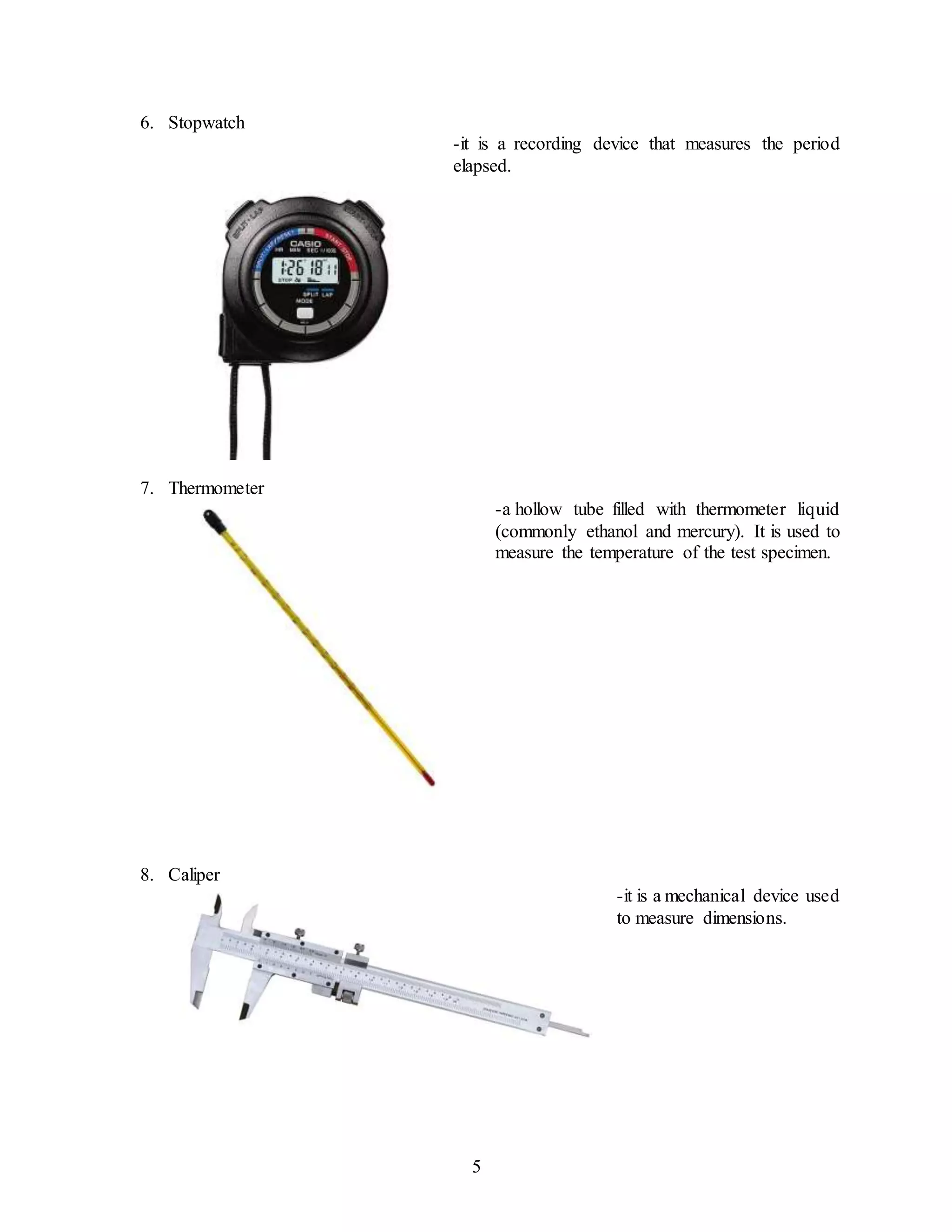
6. Stopwatch
-it is a recording device that measures the period
elapsed.
7. Thermometer
-a hollow tube filled with thermometer liquid
(commonly ethanol and mercury). It is used to
measure the temperature of the test specimen.
8. Caliper
-it is a mechanical device used
to measure dimensions.
6
9. Steel balls
-it is a spherical solid to be dropped into the viscometer
with the test specimen.
10. Meter stick
-it is a measuring tool to precisely
quantify the length of the markings in
the viscometer.
7
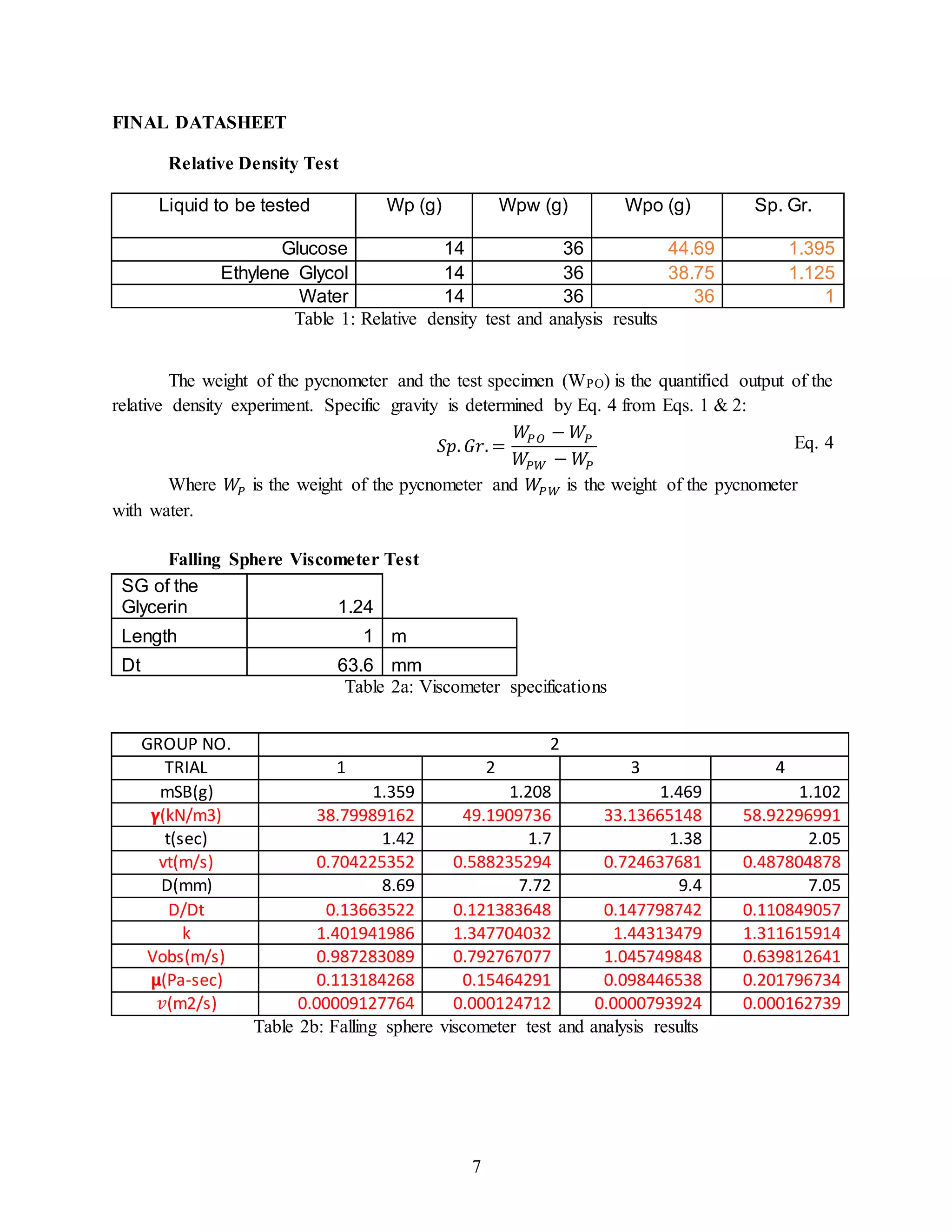
FINAL DATASHEET
Relative Density Test
Liquid to be tested Wp (g) Wpw (g) Wpo (g) Sp. Gr.
Glucose 14 36 44.69 1.395
Ethylene Glycol 14 36 38.75 1.125
Water 14 36 36 1
Table 1: Relative density test and analysis results
The weight of the pycnometer and the test specimen (WPO) is the quantified output of the
relative density experiment. Specific gravity is determined by Eq. 4 from Eqs. 1 & 2:
𝑆𝑝. 𝐺𝑟. =
𝑊
𝑃𝑂 − 𝑊𝑃
𝑊
𝑃𝑊 − 𝑊
𝑃
Where 𝑊
𝑃 is the weight of the pycnometer and 𝑊𝑃𝑊 is the weight of the pycnometer
with water.
Falling Sphere Viscometer Test
SG of the
Glycerin 1.24
Length 1 m
Dt 63.6 mm
Table 2a: Viscometer specifications
GROUP NO. 2
TRIAL 1 2 3 4
mSB(g) 1.359 1.208 1.469 1.102
𝝲(kN/m3) 38.79989162 49.1909736 33.13665148 58.92296991
t(sec) 1.42 1.7 1.38 2.05
vt(m/s) 0.704225352 0.588235294 0.724637681 0.487804878
D(mm) 8.69 7.72 9.4 7.05
D/Dt 0.13663522 0.121383648 0.147798742 0.110849057
k 1.401941986 1.347704032 1.44313479 1.311615914
Vobs(m/s) 0.987283089 0.792767077 1.045749848 0.639812641
𝝻(Pa-sec) 0.113184268 0.15464291 0.098446538 0.201796734
𝑣(m2/s) 0.00009127764 0.000124712 0.0000793924 0.000162739
Table 2b: Falling sphere viscometer test and analysis results
Eq. 4
8
Data from the test is in standard format, whereas computed values are in red. The
quantities’ notations are consistent with the formulas below.
This set of equations is recomputed to consider unit conversion to follow the notations in
the table.
Figure 1: V vs. DSB/DT line plot of viscometer test
0.00
0.02
0.04
0.06
0.08
0.10
0.12
0.14
0.16
0.98728 0.79277 1.04575 0.63981
VOBS vs. DSB/DT
9
CONCLUSION
- The specific gravity of the two samples measured using the pycnometer method was
determined from the study of the principle of density, computed as the ratio of two
densities. The falling sphere viscometer method provided fine data, which was used to
calculate the dynamic and kinematic viscosity of glycerin, V vs. DSB/DT line plot is
included in the analysis to visualize the precision and consistency of the data.
RECOMMENDATION
- Measuring the time elapsed for the steel ball to travel the one-meter distance relies on
the physical reaction of the operator, an array of sensors should be included in the set-
up of the viscometer.
REFERENCES
• Laboratory Solutions from METTLER TOLEDO [METTLERTOLEDOLaboratory].
(2019, September 6). Measure density with a pycnometer. Youtube.
https://www.youtube.com/watch?v=5w3IKnovlng
• Uy, F. A. [UCPM7Yyo4BJAlHm9IxsNJEPA]. (2020, April 29). DR. UY’s mapua
fluid mechanics lab experiments - FALLING SPHERE VISCOMETER. Youtube.
https://www.youtube.com/watch?v=LIY76gjZj9E
• Grigg, C. (n.d.). Eureka! Density! Mrsd.Org. Retrieved March 21, 2022, from
https://www.mrsd.org/cms/lib/NH01912397/Centricity/Domain/245/3
-eureka%20density.pdf
• Aaron, K. (2021, February 18). Why water used in specific gravity
test? https://qr.ae/pGLf7B
• Sonder, I., Zimanowski, B., & Büttner, R. (2006). Non-Newtonian viscosity of
basaltic magma. Geophysical Research Letters, 33(2).
https://doi.org/10.1029/2005gl024240
• Burlew, Rusty. (2010, September 15). Honey bee suite. Honey Bee Suite.
https://www.honeybeesuite.com/author/rustyburlew/
E1.docx

E1.docx

  • 1.
    MAPÚA UNIVERSITY SCHOOL OFMECHANICAL AND MANUFACTURING ENGINEERING ME139L-2/E01 MECHANICAL ENGINEERING LABORATORY 1 WRITTEN REPORT ON RELATIVE DENSITY AND VISCOSITY EXPERIMENT NO. 1 SUBMITTED BY: BATUYONG, JUSTINE P. 2019100680 SUBMITTED TO: ENGR. PAULO RAFAEL V. MERIS MARCH 19, 2022
  • 2.
    ii ABSTRACT Viscosity and densityare two important examples of a liquid’s quantifiable property. The apparent weight of something is influenced by its mass (symbol m), the volume it occupies (symbol V), and gravity. Materials are distinct and can be defined by density 𝜌, but this property is different for every state of matter of the same material. Relative density (or Specific Gravity, symbol SG) is the scale of something (identified as 𝜌 in the equation) from a reference. The coefficient of absolute viscosity (dynamic viscosity, symbol 𝜇) is the ratio of shear stress and shear rate (deformation rate), fluids resist motion and cause a reaction force in the opposite direction. The weight of the pycnometer and the test specimen (WPO) is the quantified output of the relative density experiment. Data from the viscometer test was used to compute the specific weight of the steel ball, correction factor, dynamic viscosity, the corrected velocity of the steel ball, observed velocity of the steel ball, kinematic viscosity, specific weight of glycerin, the ratio of steel ball diameter and viscometer ID. The specific gravity of the two samples measured using the pycnometer method was determined from the study of the principle of density. The falling sphere viscometer method provided fine data, which was used to calculate the dynamic and kinematic viscosity of glycerin. OBJECTIVES: 1. To determine the relative density of Glucose (C6H12O6) and Ethylene Glycol (C2H6O2). 2. To determine the dynamic and kinematic viscosity of glycerin. 3. Create a V vs. DSB/DT graph.
  • 3.
    iii TABLE OF CONTENTS TITLEPAGE i ABSTRACT ii OBJECTIVES ii TABLE OF CONTENTS iii THEORIES AND PRINCIPLES 1 DISCUSSION 2 SAMPLE PROBLEMS 3 LIST OF APPARATUS / SET-UP 4 FINAL DATA SHEET 7 CONCLUSION 8 RECOMMENDATION 8 REFERENCES 8
  • 4.
    1 THEORIES AND PRINCIPLES Studyingliquids is a course not satisfied by the classical mechanics of rigid and deformable bodies and requires modern theories to grasp its behaviors. Viscosity and density are two important examples of a liquid’s quantifiable property; however, the earliest form of a theory related to density was 250 B.C.—the widely known story of Archimedes and the Crown of Syracuse (Grigg, 2013, para. 2). The apparent weight of something is influenced by its mass (symbol m), the volume it occupies (symbol V), and gravity, e.g., one pound of iron is equal to one pound of cotton, but the former is smaller in size. 𝜌 = 𝑚 𝑉 Materials are distinct and can be defined by density 𝜌, but this property is different for every state of matter of the same material. For example, liquid water is denser than any of its vapor states. Density is also different between states of liquid water. Relative density (or Specific Gravity, symbol SG) is the scale of something (identified as 𝜌 in the equation) as from. Liquid in terms of density, and liquid water (identified as 𝜌𝐻2 𝑂 in the equation) is widely chosen as the reference because it is convenient in most aspects (Aaron, 2021). 𝑆𝐺 = 𝜌 𝜌𝐻2 𝑂 As density has a strict relationship with temperature, specific gravity follows. In the experiment with density, both the water and the sample must have the same temperature. The other property studied in this experiment is viscosity. The coefficient of absolute viscosity (dynamic viscosity, symbol 𝜇) is the ratio of shear stress and shear rate (deformation rate), fluids resist motion and cause a reaction force in the opposite direction. In another perspective, solids in motion that interact with static fluids experience an opposing force establishing equilibrium and restraining the position or velocity of the solid. For spheres traveling through Newtonian fluids, the drag force increases with velocity as defined by Stoke’s law: 𝐹𝐷 = 6𝜇𝜋𝑟𝑉 ⃗ Where FD is the drag force, r is the radius of the sphere, and 𝑉 ⃗ is its relative velocity to the fluid. Eq. 1 Eq. 2 Eq. 3
  • 5.
    2 DISCUSSION The idea thatwater expands when it turns into a vapor made the first horsepower-independent mass transport feasible and paved the first steps of the industrial revolution. Combustion engines are designed around the idea that energy is released in the form of heat (rise in temperature) and work (increase in volume, decrease in density). Completing the concept of viscosity in fluid mechanics provided engineers with the necessities to calculate and optimize more aerodynamic shapes since viscosity plays a role in fluid-solid interaction. High-performing lubricants allowed machine parts in vehicles and machinery to operate at higher loads and speeds and prolong usability. Hydraulics and pneumatics are widely applied in the design of heavy construction equipment and robotics because the relationship between fluid dynamics and kinematics is well defined by viscosity. Figure 1a : Steam tractor engine Figure 1b : ICE stages Figure 2a : Airfoil boundary layer analysis Figure 2c : Hydraulic leverage
  • 6.
    3 SAMPLE PROBLEMS 1. Whatis relative density / specific gravity, and how is it related to density? -It is the ratio of the two densities of substances, the specific gravity of a substance is commonly in reference to the density of water (about 1000 kg/m3) 2. What happens to density if you halve the amount of a substance? -its density remains the same if the volume occupied by that substance changes accordingly (the substance itself, either half, does not expand or contract). 3. What is Bulk density? -granular materials contain air (or space) between particles because each particle cannot deform to occupy these spaces and is restricted by contact with other particles. As such, the bulk density is used to define these materials; it is the density of the materials whose volume includes the empty spaces. 4. What are the differences between kinematic and dynamic viscosity? -dynamic viscosity (absolute viscosity) is independent of density, whereas kinematic density is defined by the dynamic viscosity and density. Dynamic viscosity is defined by force applied to a substance, and the motion of the substance defines kinematic viscosity. 5. What are non-Newtonian fluids? Explain. Give examples -one of the characteristics of non-Newtonian fluids is having varying viscosity with the deformation rate, a non-linear relationship between shear stress and shear rate. For example, magma is a quasi-Newtonian fluid (Sonder et al., 2006), meaning it possesses non-Newtonian behavior along with other viscosity characteristics. Honey is another non-Newtonian fluid, its viscosity changes (decreases) with time as it experiences shear stress—thixotropic behavior (Rusty, 2010).
  • 7.
    4 LIST OF APPARATUS/ SET-UP 1. Pycnometer -it is an assembly consisting of the glass body and the capillary stopper. It maintains the volume of its contents at a specified value (photo shows a pycnometer volume of 50 ml). 2. Hydrometer -it is a submersible device that displaces volume in a graduated cylinder filled with the reference liquid (water). It directly measures the specific gravity which is indicated in its scale.
  • 8.
    5 3. Graduated Cylinder -aglass tube used to measure the volume of liquids. In this experiment, it is used to contain water in a column. 4. Digital balance -a laboratory equipment used to measure the weight of a specimen. 5. Falling sphere viscometer -a glass tube that contains the test specimen in a tall column and a metal ball denser than the test specimen. The glass tube has two markings one meter apart between the ends.
  • 9.
    5 6. Stopwatch -it isa recording device that measures the period elapsed. 7. Thermometer -a hollow tube filled with thermometer liquid (commonly ethanol and mercury). It is used to measure the temperature of the test specimen. 8. Caliper -it is a mechanical device used to measure dimensions.
  • 10.
    6 9. Steel balls -itis a spherical solid to be dropped into the viscometer with the test specimen. 10. Meter stick -it is a measuring tool to precisely quantify the length of the markings in the viscometer.
  • 11.
    7 FINAL DATASHEET Relative DensityTest Liquid to be tested Wp (g) Wpw (g) Wpo (g) Sp. Gr. Glucose 14 36 44.69 1.395 Ethylene Glycol 14 36 38.75 1.125 Water 14 36 36 1 Table 1: Relative density test and analysis results The weight of the pycnometer and the test specimen (WPO) is the quantified output of the relative density experiment. Specific gravity is determined by Eq. 4 from Eqs. 1 & 2: 𝑆𝑝. 𝐺𝑟. = 𝑊 𝑃𝑂 − 𝑊𝑃 𝑊 𝑃𝑊 − 𝑊 𝑃 Where 𝑊 𝑃 is the weight of the pycnometer and 𝑊𝑃𝑊 is the weight of the pycnometer with water. Falling Sphere Viscometer Test SG of the Glycerin 1.24 Length 1 m Dt 63.6 mm Table 2a: Viscometer specifications GROUP NO. 2 TRIAL 1 2 3 4 mSB(g) 1.359 1.208 1.469 1.102 𝝲(kN/m3) 38.79989162 49.1909736 33.13665148 58.92296991 t(sec) 1.42 1.7 1.38 2.05 vt(m/s) 0.704225352 0.588235294 0.724637681 0.487804878 D(mm) 8.69 7.72 9.4 7.05 D/Dt 0.13663522 0.121383648 0.147798742 0.110849057 k 1.401941986 1.347704032 1.44313479 1.311615914 Vobs(m/s) 0.987283089 0.792767077 1.045749848 0.639812641 𝝻(Pa-sec) 0.113184268 0.15464291 0.098446538 0.201796734 𝑣(m2/s) 0.00009127764 0.000124712 0.0000793924 0.000162739 Table 2b: Falling sphere viscometer test and analysis results Eq. 4
  • 12.
    8 Data from thetest is in standard format, whereas computed values are in red. The quantities’ notations are consistent with the formulas below. This set of equations is recomputed to consider unit conversion to follow the notations in the table. Figure 1: V vs. DSB/DT line plot of viscometer test 0.00 0.02 0.04 0.06 0.08 0.10 0.12 0.14 0.16 0.98728 0.79277 1.04575 0.63981 VOBS vs. DSB/DT
  • 13.
    9 CONCLUSION - The specificgravity of the two samples measured using the pycnometer method was determined from the study of the principle of density, computed as the ratio of two densities. The falling sphere viscometer method provided fine data, which was used to calculate the dynamic and kinematic viscosity of glycerin, V vs. DSB/DT line plot is included in the analysis to visualize the precision and consistency of the data. RECOMMENDATION - Measuring the time elapsed for the steel ball to travel the one-meter distance relies on the physical reaction of the operator, an array of sensors should be included in the set- up of the viscometer. REFERENCES • Laboratory Solutions from METTLER TOLEDO [METTLERTOLEDOLaboratory]. (2019, September 6). Measure density with a pycnometer. Youtube. https://www.youtube.com/watch?v=5w3IKnovlng • Uy, F. A. [UCPM7Yyo4BJAlHm9IxsNJEPA]. (2020, April 29). DR. UY’s mapua fluid mechanics lab experiments - FALLING SPHERE VISCOMETER. Youtube. https://www.youtube.com/watch?v=LIY76gjZj9E • Grigg, C. (n.d.). Eureka! Density! Mrsd.Org. Retrieved March 21, 2022, from https://www.mrsd.org/cms/lib/NH01912397/Centricity/Domain/245/3 -eureka%20density.pdf • Aaron, K. (2021, February 18). Why water used in specific gravity test? https://qr.ae/pGLf7B • Sonder, I., Zimanowski, B., & Büttner, R. (2006). Non-Newtonian viscosity of basaltic magma. Geophysical Research Letters, 33(2). https://doi.org/10.1029/2005gl024240 • Burlew, Rusty. (2010, September 15). Honey bee suite. Honey Bee Suite. https://www.honeybeesuite.com/author/rustyburlew/